
THE CELL 
BY DR. SAKINA RUHI 
MBBS, MD(BIOCHEMISTRY) 
SENIOR LECTURER,DEPARTMENT OF 
BIOCHEMISTRY,IMS, SHAHALAM
2 
OUTLINE 
• Difference between prokaryotic & Eukaryotic cell . 
• Difference between Animal & Plant cell 
• Different cell organelles & Its function 
• Cell Membrane 
• Molecular movements & Cell-transport mechanism
3 
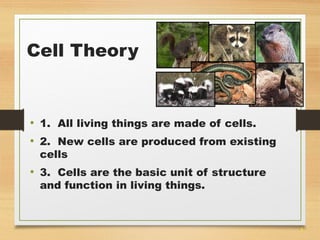
Cell Theory 
• 1. All living things are made of cells. 
• 2. New cells are produced from existing 
cells 
• 3. Cells are the basic unit of structure 
and function in living things.
4 
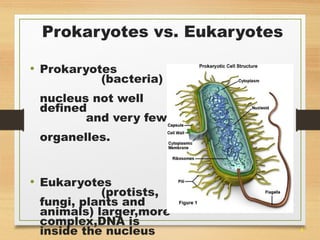
Prokaryotes vs. Eukaryotes 
• Prokaryotes 
(bacteria) 
nucleus not well 
defined 
and very few 
organelles. 
• Eukaryotes 
(protists, 
fungi, plants and 
animals) larger,more 
complex,DNA is 
inside the nucleus
5 
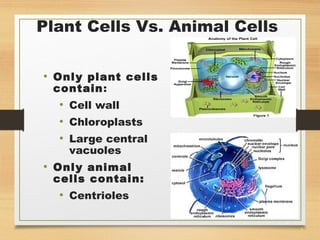
Plant Cells Vs. Animal Cells 
• Only plant cells 
contain: 
• Cell wall 
• Chloroplasts 
• Large central 
vacuoles 
• Only animal 
cells contain: 
• Centrioles
6
7 
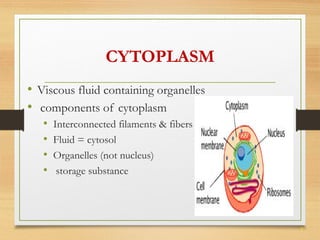
CYTOPLASM 
• Viscous fluid containing organelles 
• components of cytoplasm 
• Interconnected filaments & fibers 
• Fluid = cytosol 
• Organelles (not nucleus) 
• storage substance
8 
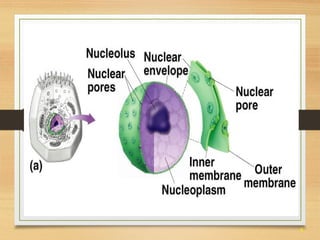
Nucleus
9 
Nucleus 
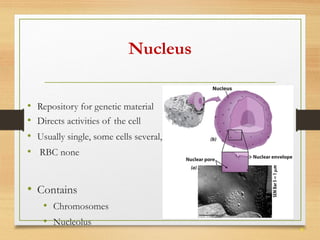
• Repository for genetic material 
• Directs activities of the cell 
• Usually single, some cells several, 
• RBC none 
• Contains 
• Chromosomes 
• Nucleolus
10 
Nuclear Envelope 
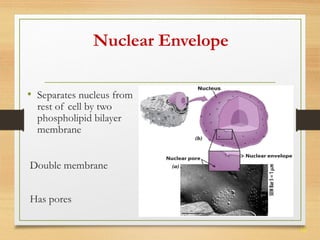
• Separates nucleus from 
rest of cell by two 
phospholipid bilayer 
membrane 
Double membrane 
Has pores
11 
Nucleolus 
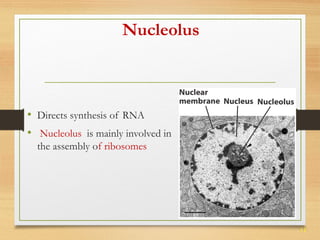
• Directs synthesis of RNA 
• Nucleolus is mainly involved in 
the assembly of ribosomes
12 
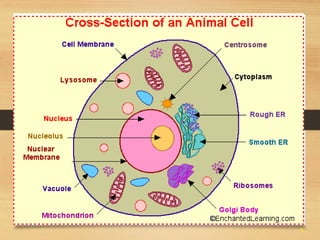
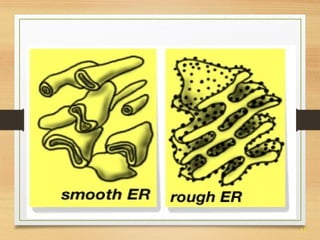
Endoplasmic reticulum 
• Largest internal membrane 
• Composed of Lipid bilayer 
• Serves as system of channels from the nucleus 
• Functions in storage and secretion 
• Two types 
• Rough endoplasmic reticulum 
• Smooth endoplasmic reticulum
13
14 
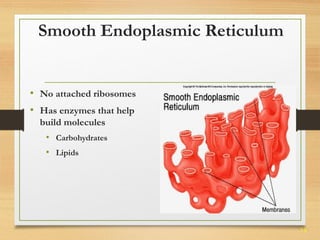
Smooth Endoplasmic Reticulum 
• No attached ribosomes 
• Has enzymes that help 
build molecules 
• Carbohydrates 
• Lipids
15 
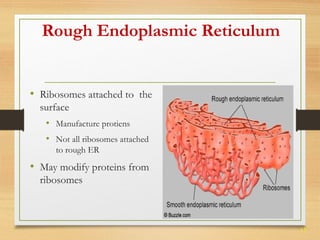
Rough Endoplasmic Reticulum 
• Ribosomes attached to the 
surface 
• Manufacture protiens 
• Not all ribosomes attached 
to rough ER 
• May modify proteins from 
ribosomes
16 
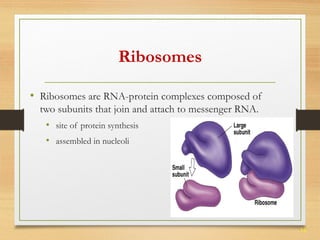
Ribosomes 
• Ribosomes are RNA-protein complexes composed of 
two subunits that join and attach to messenger RNA. 
• site of protein synthesis 
• assembled in nucleoli
17 
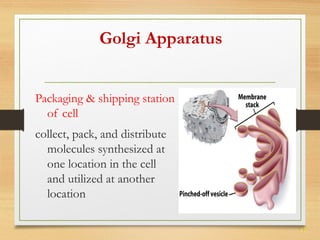
Golgi Apparatus 
Packaging & shipping station 
of cell 
collect, pack, and distribute 
molecules synthesized at 
one location in the cell 
and utilized at another 
location
18 
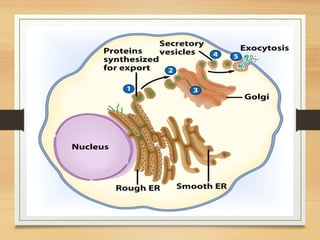
HOW Golgi Apparatus Functions 
1. Molecules come in vesicles 
2. Vesicles fuse with Golgi 
membrane 
3. Molecules may be modified 
by Golgi 
4. Molecules pinched-off in 
separate vesicle 
5. Vesicle leaves Golgi apparatus 
6. Vesicles may combine with plasma 
membrane to secrete contents
19
20 
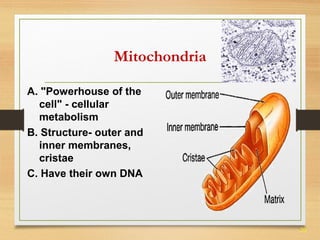
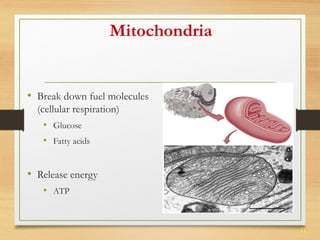
Mitochondria 
A. "Powerhouse of the 
cell" - cellular 
metabolism 
B. Structure- outer and 
inner membranes, 
cristae 
C. Have their own DNA
21 
Mitochondria 
• Break down fuel molecules 
(cellular respiration) 
• Glucose 
• Fatty acids 
• Release energy 
• ATP
22 
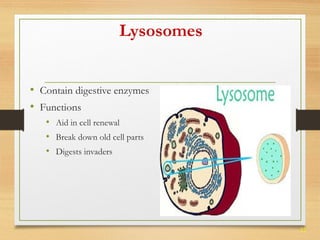
Lysosomes 
• Contain digestive enzymes 
• Functions 
• Aid in cell renewal 
• Break down old cell parts 
• Digests invaders
23 
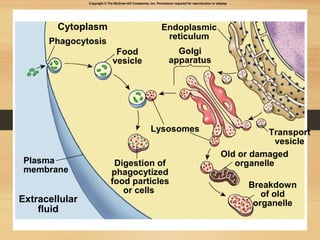
Cytoplasm 
Phagocytosis 
Food 
vesicle 
Endoplasmic 
reticulum 
Golgi 
apparatus 
Lysosomes 
Plasma 
membrane 
Digestion of 
phagocytized 
food particles 
or cells 
Transport 
vesicle 
Old or damaged 
organelle 
Breakdown 
of old 
Extracellular organelle 
fluid 
Copyright © The McGraw-Hill Companies, Inc. Permission required for reproduction or display.
24 
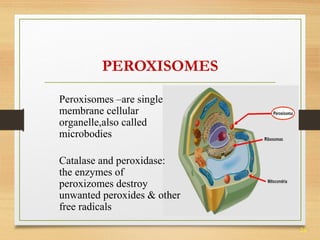
PEROXISOMES 
Peroxisomes –are single 
membrane cellular 
organelle,also called 
microbodies 
Catalase and peroxidase: 
the enzymes of 
peroxizomes destroy 
unwanted peroxides & other 
free radicals
25 
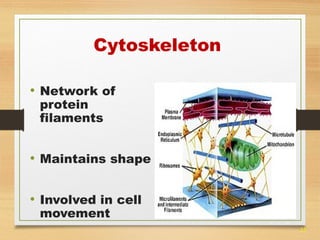
Cytoskeleton 
• Network of 
protein 
filaments 
• Maintains shape 
• Involved in cell 
movement
26 
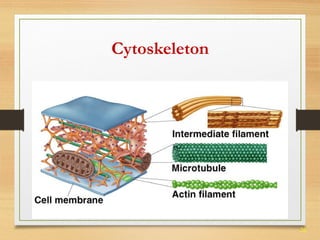
Cytoskeleton
27 
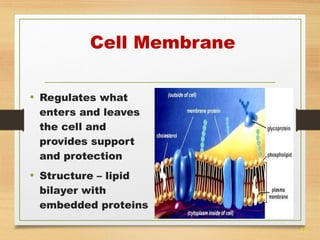
Cell Membrane 
• Regulates what 
enters and leaves 
the cell and 
provides support 
and protection 
• Structure – lipid 
bilayer with 
embedded proteins
28
29 
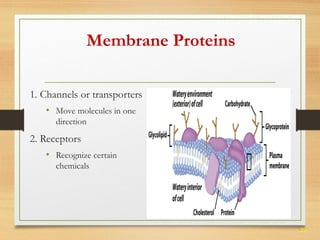
Membrane Proteins 
1. Channels or transporters 
• Move molecules in one 
direction 
2. Receptors 
• Recognize certain 
chemicals
30 
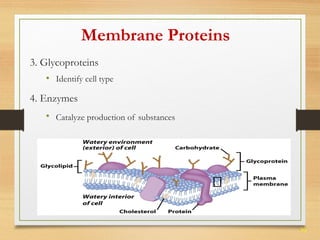
Membrane Proteins 
3. Glycoproteins 
• Identify cell type 
4. Enzymes 
• Catalyze production of substances
31 
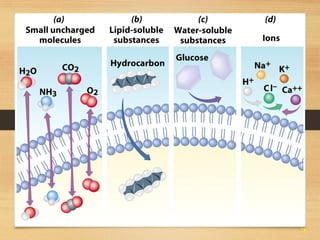
TRANSPORT MECHANISM 
classified into 
 Passive Transport (i)simple diffusion 
(ii)facilitated diffusion 
(iii) ion exchange 
 Active Transport 
 Pumps –can drive molecules against the gradient using 
energy
32 
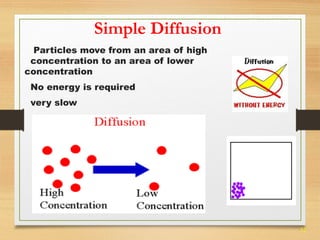
Simple Diffusion 
Particles move from an area of high 
concentration to an area of lower 
concentration 
No energy is required 
very slow
33 
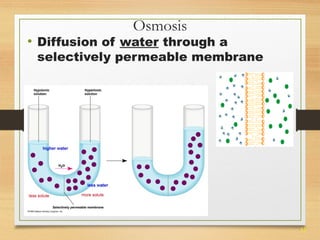
Osmosis 
• Diffusion of water through a 
selectively permeable membrane
34 
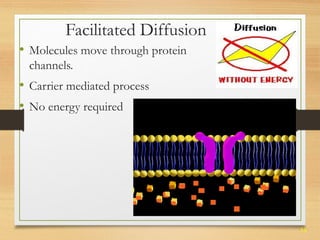
Facilitated Diffusion 
• Molecules move through protein 
channels. 
• Carrier mediated process 
• No energy required
35 
ION CHANNELS 
• Membrane have special devices called ion channels 
• For quick transport of Na +,K+ ,Cl + and Ca ++ 
• They remain close and open on response to stimulus 
• They are also called as gated channels 
• Important for nerve impulse propogation,synaptic 
transmission
36 
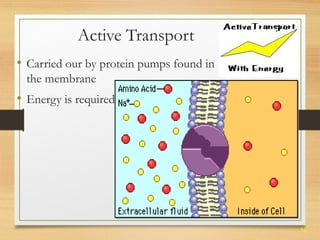
Active Transport 
• Carried our by protein pumps found in 
the membrane 
• Energy is required
37 
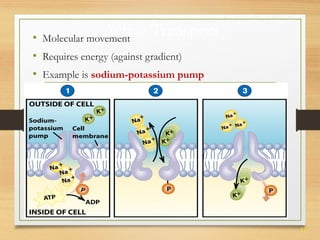
• Molecular movAemcenttive Transport 
• Requires energy (against gradient) 
• Example is sodium-potassium pump
Endocytosis 
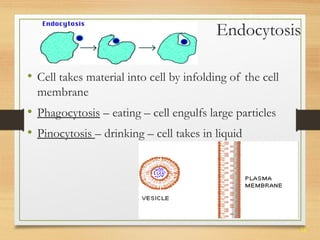
38 
• Cell takes material into cell by infolding of the cell 
membrane 
• Phagocytosis – eating – cell engulfs large particles 
• Pinocytosis – drinking – cell takes in liquid
39 
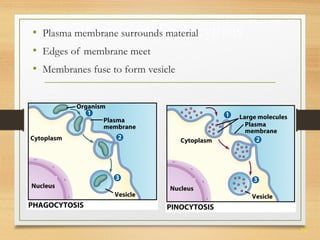
• Plasma mPemrobrcanee ssusr rooufn dEs mnatderoialcytosis 
• Edges of membrane meet 
• Membranes fuse to form vesicle
40 
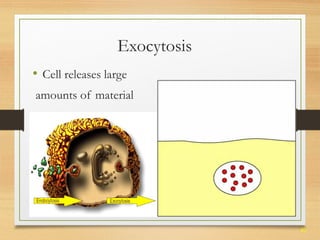
Exocytosis 
• Cell releases large 
amounts of material
41 
Transport system 
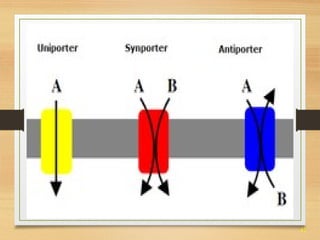
• Classified as Uniport , Symport and Antiport 
• UNIPORT-Carries single solute across the membrane e.g – 
glucose transporter in most cells ,calcium pump 
• CO TRANSPORT –If transfer of one molecule depend on 
simultaneous transfer of another molecule. 
• (i)SYMPORT (ii) ANTIPORT
42
43 
• SYMPORT-Transporter carries two solutes in same 
direction . 
• eg-sodium dependent glucose transport 
• ANTIPORT –Carries two solutes or ions in opposite 
direction 
• eg sodium pump,sodium bicarbonate exchange in RBC
44 
THANK YOU

Cell structure

  • 1.
    THE CELL BYDR. SAKINA RUHI MBBS, MD(BIOCHEMISTRY) SENIOR LECTURER,DEPARTMENT OF BIOCHEMISTRY,IMS, SHAHALAM
  • 2.
    2 OUTLINE •Difference between prokaryotic & Eukaryotic cell . • Difference between Animal & Plant cell • Different cell organelles & Its function • Cell Membrane • Molecular movements & Cell-transport mechanism
  • 3.
    3 Cell Theory • 1. All living things are made of cells. • 2. New cells are produced from existing cells • 3. Cells are the basic unit of structure and function in living things.
  • 4.
    4 Prokaryotes vs.Eukaryotes • Prokaryotes (bacteria) nucleus not well defined and very few organelles. • Eukaryotes (protists, fungi, plants and animals) larger,more complex,DNA is inside the nucleus
  • 5.
    5 Plant CellsVs. Animal Cells • Only plant cells contain: • Cell wall • Chloroplasts • Large central vacuoles • Only animal cells contain: • Centrioles
  • 6.
  • 7.
    7 CYTOPLASM •Viscous fluid containing organelles • components of cytoplasm • Interconnected filaments & fibers • Fluid = cytosol • Organelles (not nucleus) • storage substance
  • 8.
  • 9.
    9 Nucleus •Repository for genetic material • Directs activities of the cell • Usually single, some cells several, • RBC none • Contains • Chromosomes • Nucleolus
  • 10.
    10 Nuclear Envelope • Separates nucleus from rest of cell by two phospholipid bilayer membrane Double membrane Has pores
  • 11.
    11 Nucleolus •Directs synthesis of RNA • Nucleolus is mainly involved in the assembly of ribosomes
  • 12.
    12 Endoplasmic reticulum • Largest internal membrane • Composed of Lipid bilayer • Serves as system of channels from the nucleus • Functions in storage and secretion • Two types • Rough endoplasmic reticulum • Smooth endoplasmic reticulum
  • 13.
  • 14.
    14 Smooth EndoplasmicReticulum • No attached ribosomes • Has enzymes that help build molecules • Carbohydrates • Lipids
  • 15.
    15 Rough EndoplasmicReticulum • Ribosomes attached to the surface • Manufacture protiens • Not all ribosomes attached to rough ER • May modify proteins from ribosomes
  • 16.
    16 Ribosomes •Ribosomes are RNA-protein complexes composed of two subunits that join and attach to messenger RNA. • site of protein synthesis • assembled in nucleoli
  • 17.
    17 Golgi Apparatus Packaging & shipping station of cell collect, pack, and distribute molecules synthesized at one location in the cell and utilized at another location
  • 18.
    18 HOW GolgiApparatus Functions 1. Molecules come in vesicles 2. Vesicles fuse with Golgi membrane 3. Molecules may be modified by Golgi 4. Molecules pinched-off in separate vesicle 5. Vesicle leaves Golgi apparatus 6. Vesicles may combine with plasma membrane to secrete contents
  • 19.
  • 20.
    20 Mitochondria A."Powerhouse of the cell" - cellular metabolism B. Structure- outer and inner membranes, cristae C. Have their own DNA
  • 21.
    21 Mitochondria •Break down fuel molecules (cellular respiration) • Glucose • Fatty acids • Release energy • ATP
  • 22.
    22 Lysosomes •Contain digestive enzymes • Functions • Aid in cell renewal • Break down old cell parts • Digests invaders
  • 23.
    23 Cytoplasm Phagocytosis Food vesicle Endoplasmic reticulum Golgi apparatus Lysosomes Plasma membrane Digestion of phagocytized food particles or cells Transport vesicle Old or damaged organelle Breakdown of old Extracellular organelle fluid Copyright © The McGraw-Hill Companies, Inc. Permission required for reproduction or display.
  • 24.
    24 PEROXISOMES Peroxisomes–are single membrane cellular organelle,also called microbodies Catalase and peroxidase: the enzymes of peroxizomes destroy unwanted peroxides & other free radicals
  • 25.
    25 Cytoskeleton •Network of protein filaments • Maintains shape • Involved in cell movement
  • 26.
  • 27.
    27 Cell Membrane • Regulates what enters and leaves the cell and provides support and protection • Structure – lipid bilayer with embedded proteins
  • 28.
  • 29.
    29 Membrane Proteins 1. Channels or transporters • Move molecules in one direction 2. Receptors • Recognize certain chemicals
  • 30.
    30 Membrane Proteins 3. Glycoproteins • Identify cell type 4. Enzymes • Catalyze production of substances
  • 31.
    31 TRANSPORT MECHANISM classified into  Passive Transport (i)simple diffusion (ii)facilitated diffusion (iii) ion exchange  Active Transport  Pumps –can drive molecules against the gradient using energy
  • 32.
    32 Simple Diffusion Particles move from an area of high concentration to an area of lower concentration No energy is required very slow
  • 33.
    33 Osmosis •Diffusion of water through a selectively permeable membrane
  • 34.
    34 Facilitated Diffusion • Molecules move through protein channels. • Carrier mediated process • No energy required
  • 35.
    35 ION CHANNELS • Membrane have special devices called ion channels • For quick transport of Na +,K+ ,Cl + and Ca ++ • They remain close and open on response to stimulus • They are also called as gated channels • Important for nerve impulse propogation,synaptic transmission
  • 36.
    36 Active Transport • Carried our by protein pumps found in the membrane • Energy is required
  • 37.
    37 • MolecularmovAemcenttive Transport • Requires energy (against gradient) • Example is sodium-potassium pump
  • 38.
    Endocytosis 38 •Cell takes material into cell by infolding of the cell membrane • Phagocytosis – eating – cell engulfs large particles • Pinocytosis – drinking – cell takes in liquid
  • 39.
    39 • PlasmamPemrobrcanee ssusr rooufn dEs mnatderoialcytosis • Edges of membrane meet • Membranes fuse to form vesicle
  • 40.
    40 Exocytosis •Cell releases large amounts of material
  • 41.
    41 Transport system • Classified as Uniport , Symport and Antiport • UNIPORT-Carries single solute across the membrane e.g – glucose transporter in most cells ,calcium pump • CO TRANSPORT –If transfer of one molecule depend on simultaneous transfer of another molecule. • (i)SYMPORT (ii) ANTIPORT
  • 42.
  • 43.
    43 • SYMPORT-Transportercarries two solutes in same direction . • eg-sodium dependent glucose transport • ANTIPORT –Carries two solutes or ions in opposite direction • eg sodium pump,sodium bicarbonate exchange in RBC
  • 44.