Differentiation in
Action
Dr. Rubenstein
EDPS 393
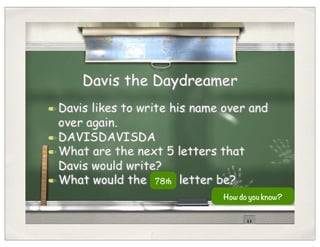
78th
How do you know?
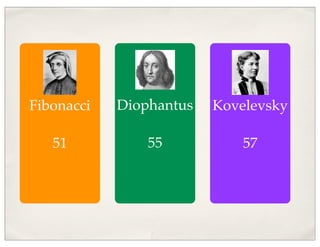
Fibonacci
51
Diophantus
55
Kovelevsky
57
What are the principles
of differentiation?
What are the ways in
which we can implement
differentiation?
Closer Look at 3...
• Single Question Method
• Hint/Challenge Cards
• Tiered Lessons
Single Question
Method
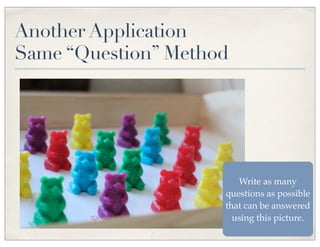
Another Application
Same “Question” Method
Write as many
questions as possible
that can be answered
using this picture.
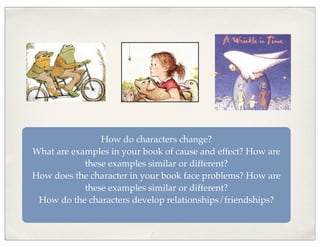
How do characters change?
What are examples in your book of cause and effect? How are
these examples similar or different?
How does the character in your book face problems? How are
these examples similar or different?
How do the characters develop relationships/friendships?
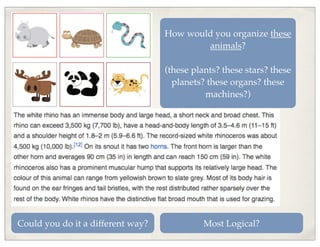
How would you organize these
animals?
(these plants? these stars? these
planets? these organs? these
machines?)
Could you do it a different way? Most Logical?
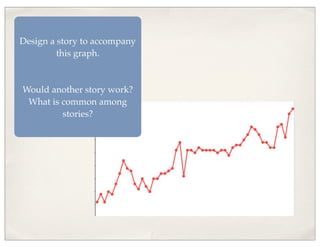
Design a story to accompany
this graph.
Would another story work?
What is common among
stories?
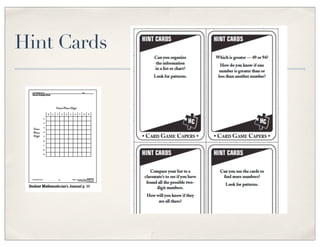
Hint Cards
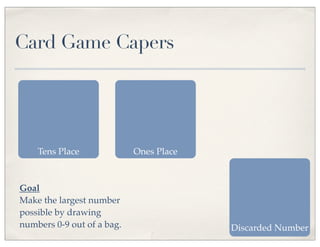
Card Game Capers
Tens Place Ones Place
Discarded Number
Goal
Make the largest number
possible by drawing
numbers 0-9 out of a bag.
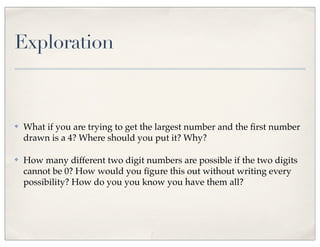
Exploration
✤ What if you are trying to get the largest number and the first number
drawn is a 4? Where should you put it? Why?
✤ How many different two digit numbers are possible if the two digits
cannot be 0? How would you figure this out without writing every
possibility? How do you you know you have them all?
Hint Cards
Challenge Cards
Tiered Lessons
Dan Meyer
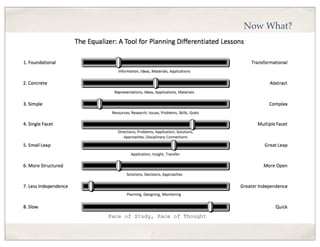
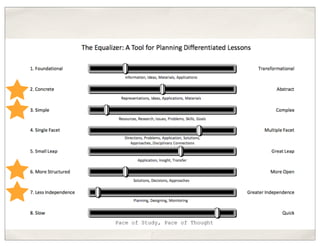
Now What?
Pace of Study, Pace of Thought
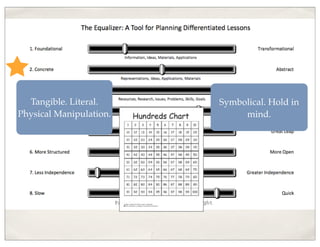
Now What?
Pace of Study, Pace of Thought
Tangible. Literal.
Physical Manipulation.
Symbolical. Hold in
mind.
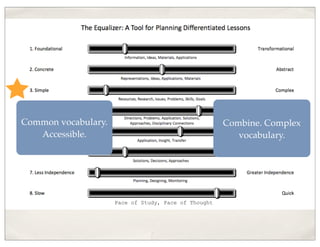
Now What?
Pace of Study, Pace of Thought
Common vocabulary.
Accessible.
Combine. Complex
vocabulary.
Simple/Complex
Pace of Study, Pace of Thought
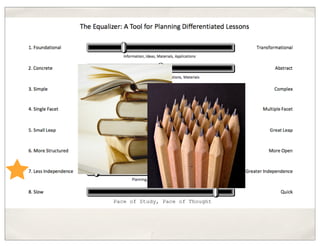
Now What?
Pace of Study, Pace of Thought
Quick Strategy: Be less helpful.
✤ Think about all the scaffolding you provide.
✤ Take that scaffolding away.
✤ Provide it if they need it.
Practice Standard
Create scaled picture graphs, scaled bar
graphs, and frequency tables to
represent a data set-including data
collected through observations, surveys,
and experiments.
Solve one and two step “how many more
and how many less” problems regarding
the data and make predictions based on
the data.

Differentiation Spring 2015