PROJECT
DATE PRESENTER
08.14.2014 LISA RUBENSTEIN
GIFTED AND TALENTED
EXPLORING DEFINITIONS AND RECOMMENDATIONS
Who is your favorite gifted
person?
What are the defining
characteristics of being
gifted?
Is the school
responsible for
recognizing them all?
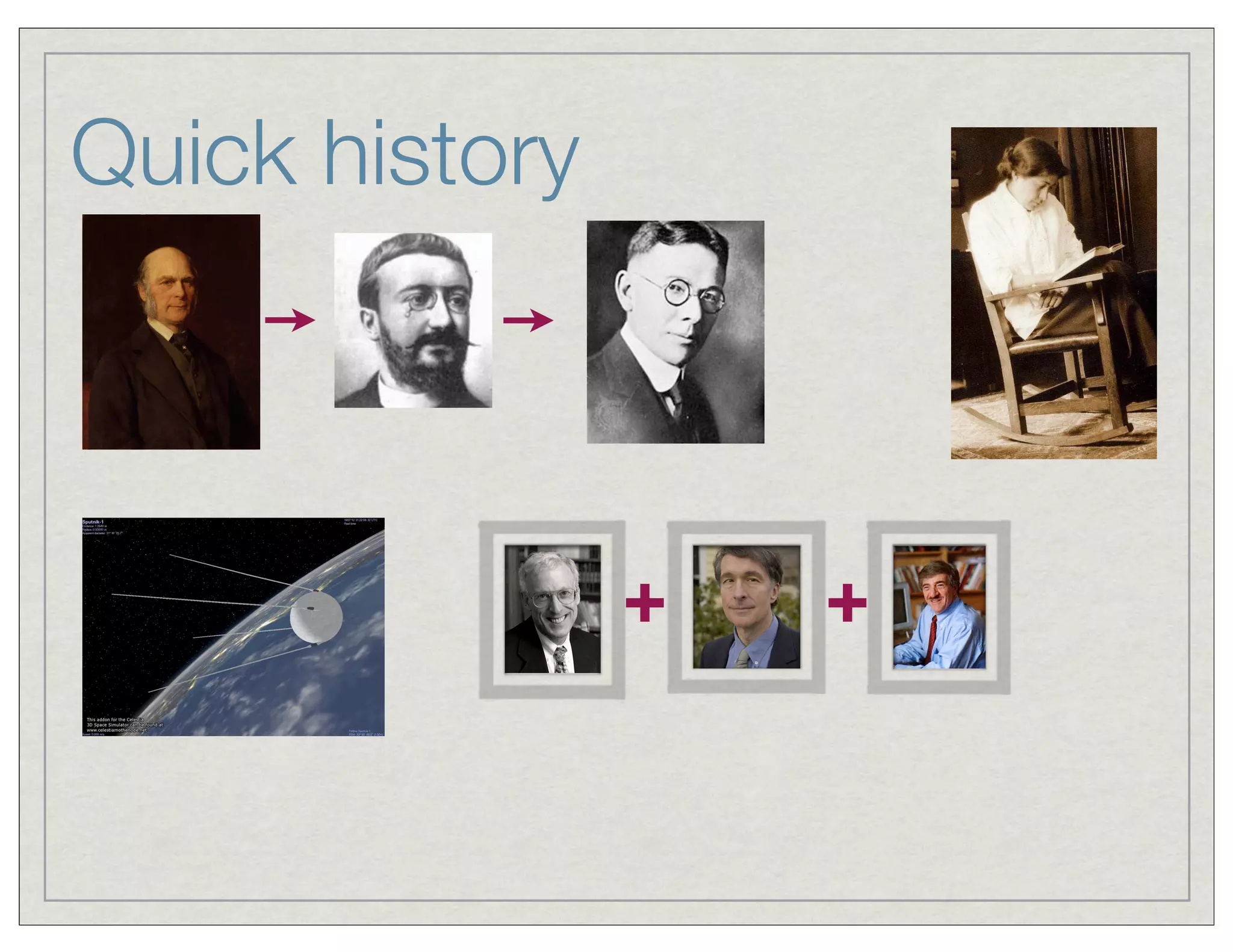
Quick history
+ +
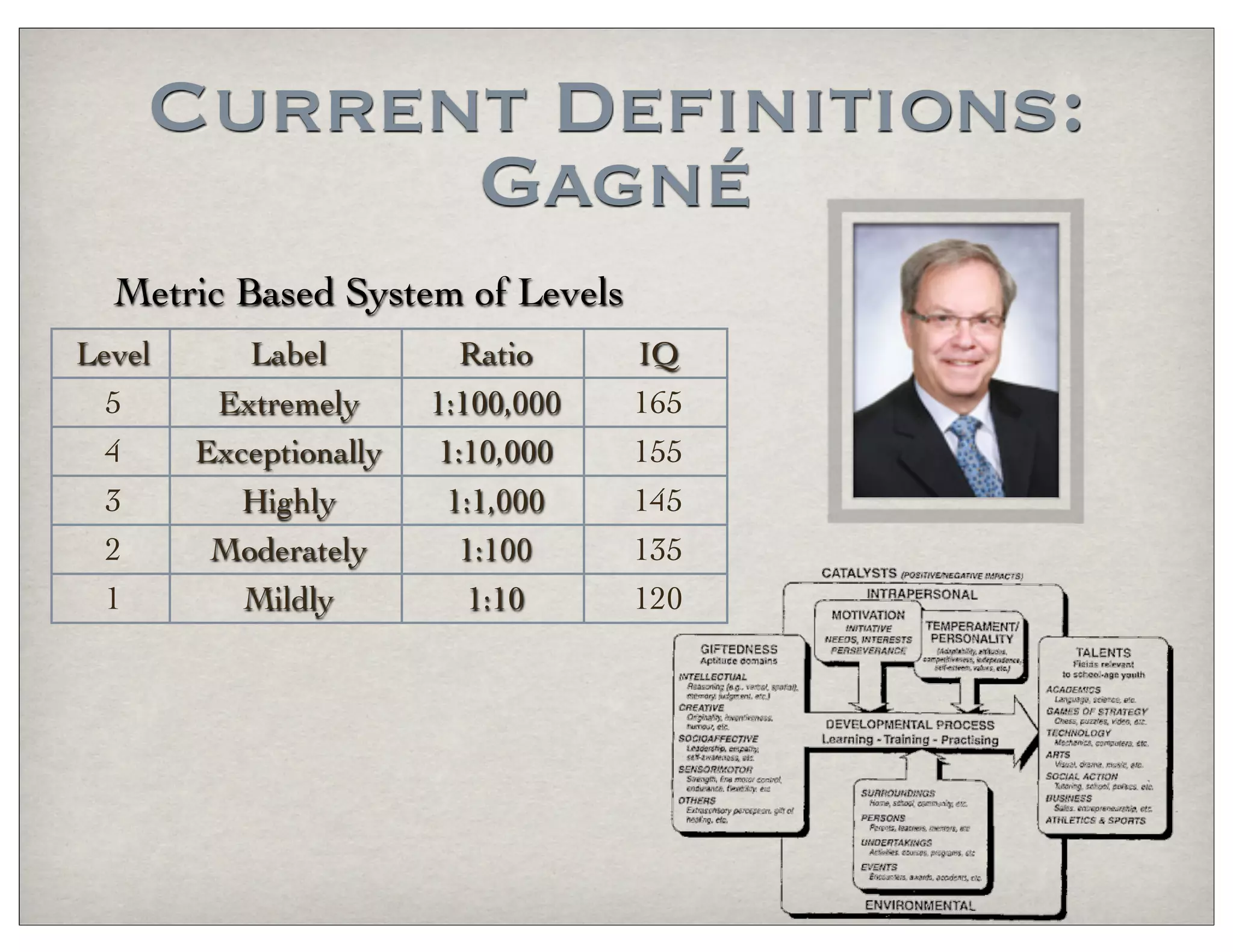
Current Definitions:
Gagné
Metric Based System of Levels
Level Label Ratio IQ
5 Extremely 1:100,000 165
4 Exceptionally 1:10,000 155
3 Highly 1:1,000 145
2 Moderately 1:100 135
1 Mildly 1:10 120
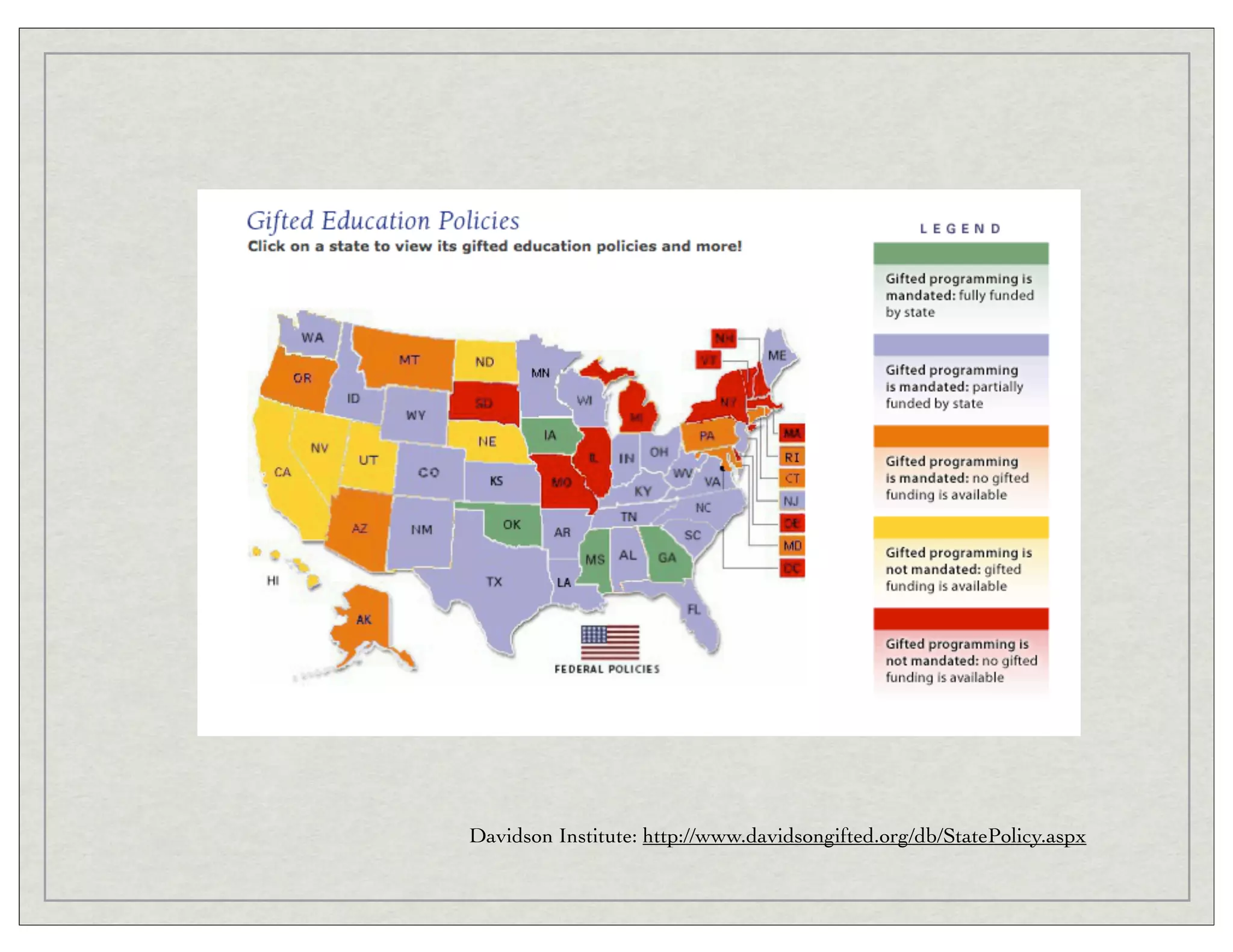
Davidson Institute: http://www.davidsongifted.org/db/StatePolicy.aspx
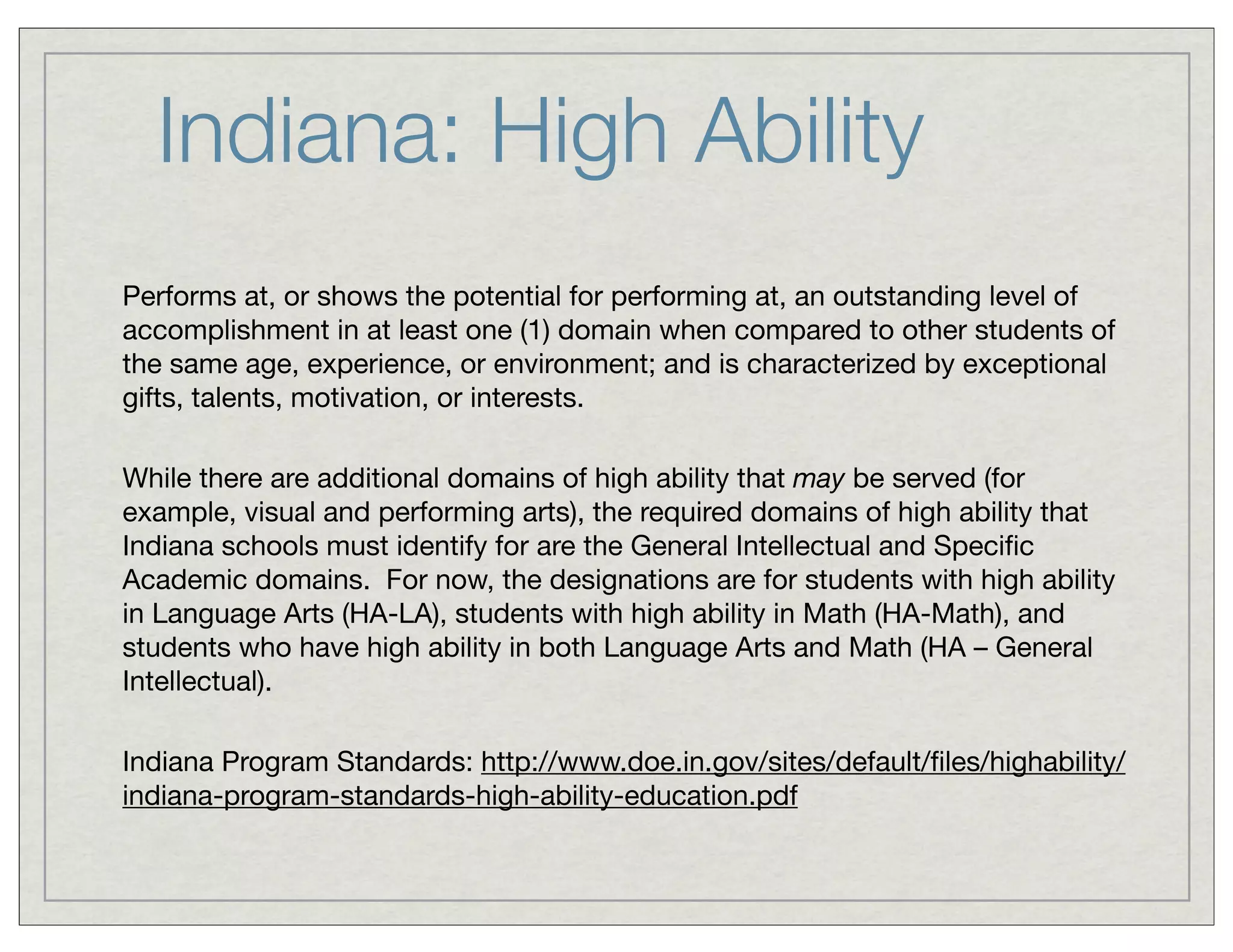
Indiana: High Ability
Performs at, or shows the potential for performing at, an outstanding level of
accomplishment in at least one (1) domain when compared to other students of
the same age, experience, or environment; and is characterized by exceptional
gifts, talents, motivation, or interests.
While there are additional domains of high ability that may be served (for
example, visual and performing arts), the required domains of high ability that
Indiana schools must identify for are the General Intellectual and Specific
Academic domains.  For now, the designations are for students with high ability
in Language Arts (HA-LA), students with high ability in Math (HA-Math), and
students who have high ability in both Language Arts and Math (HA – General
Intellectual).
Indiana Program Standards: http://www.doe.in.gov/sites/default/files/highability/
indiana-program-standards-high-ability-education.pdf
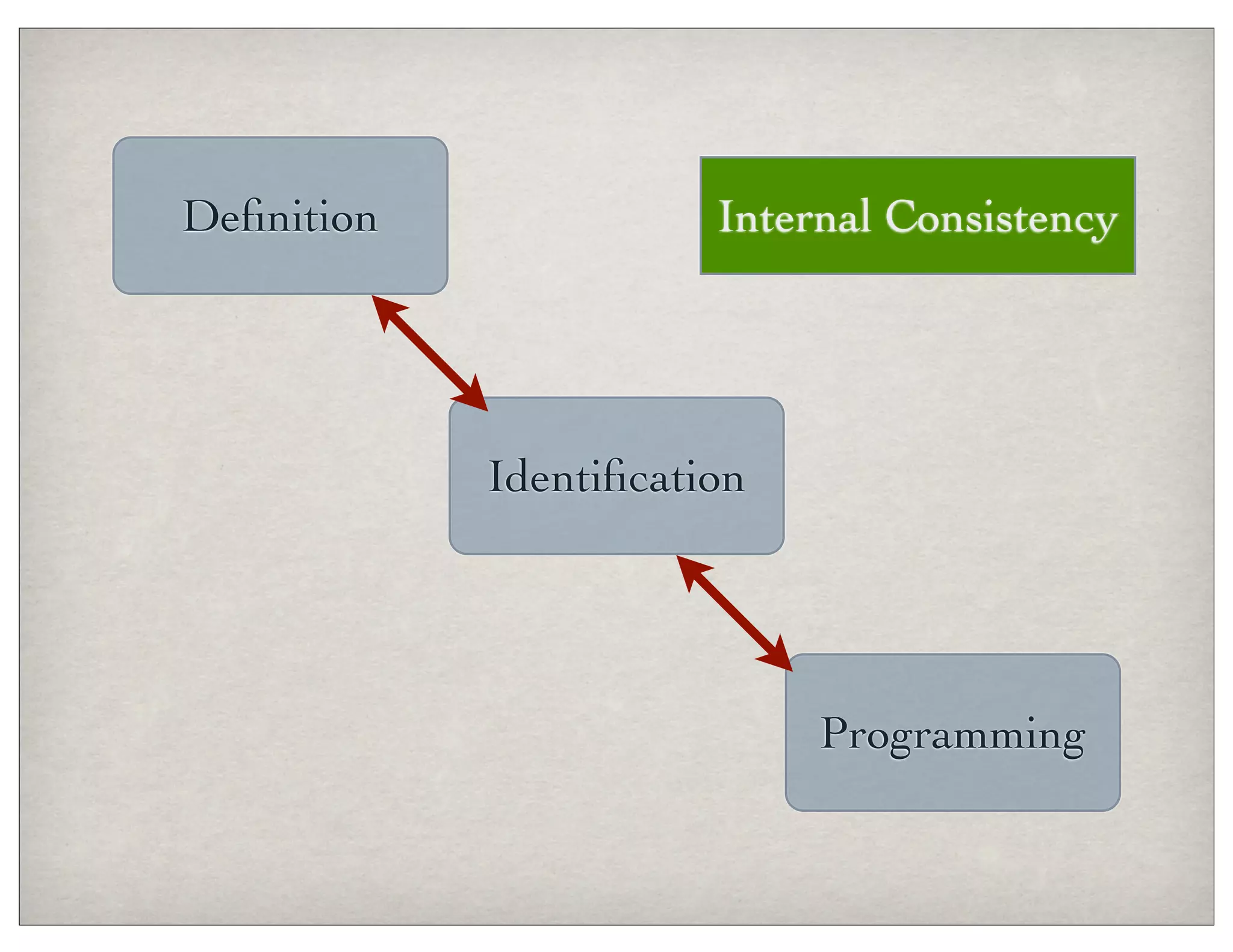
Definition
Identification
Programming
Internal Consistency
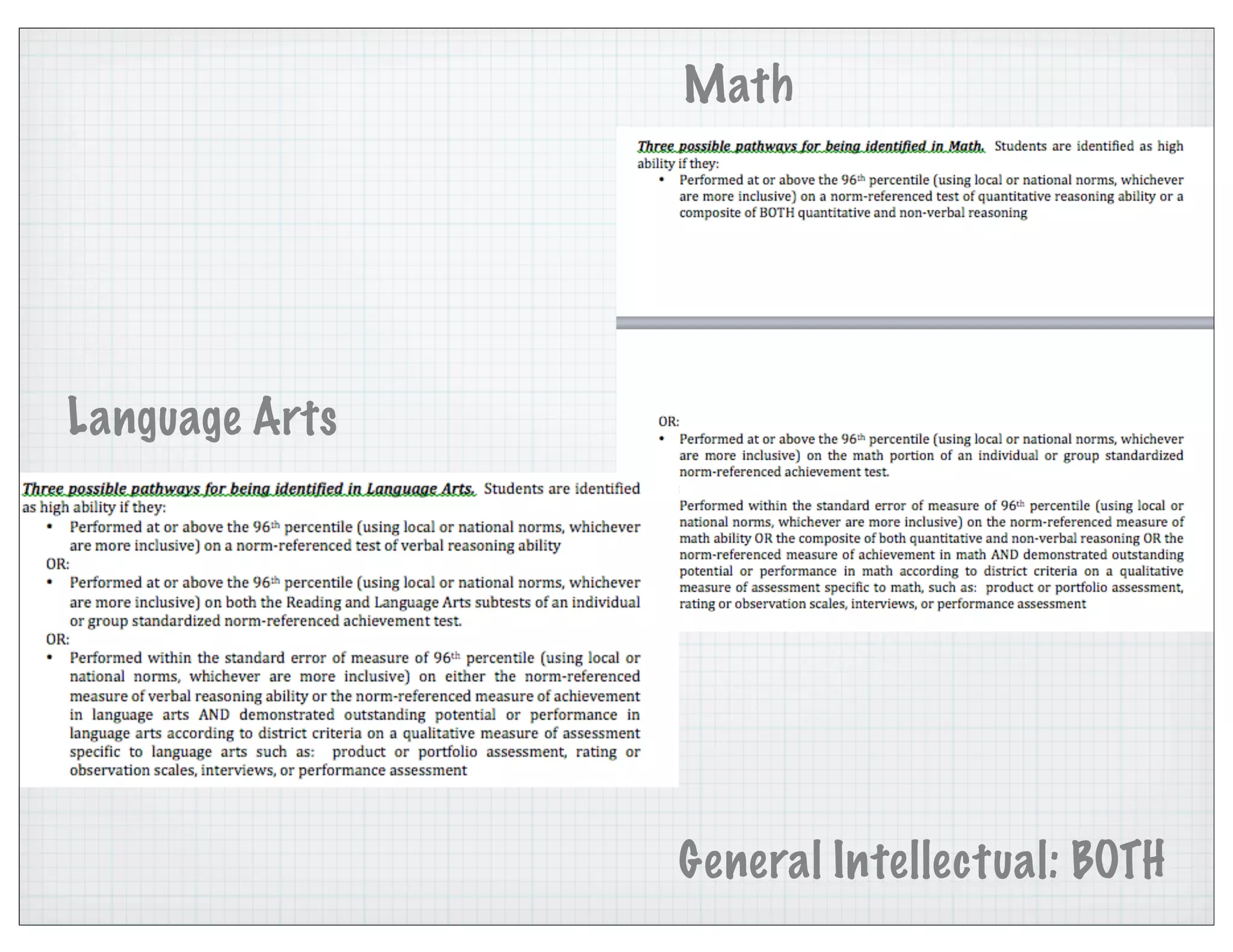
Language Arts
Math
General Intellectual: BOTH
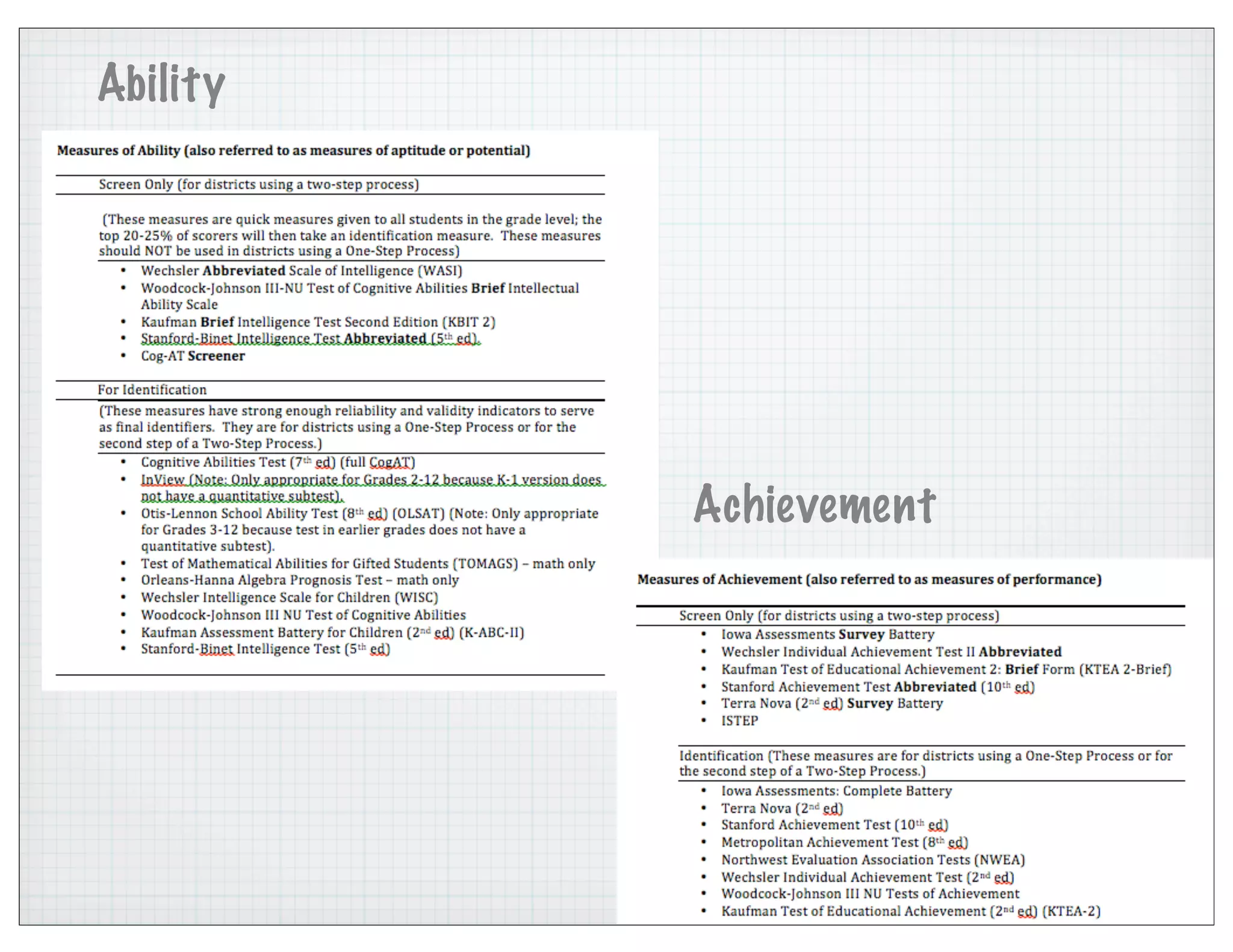
Ability
Achievement
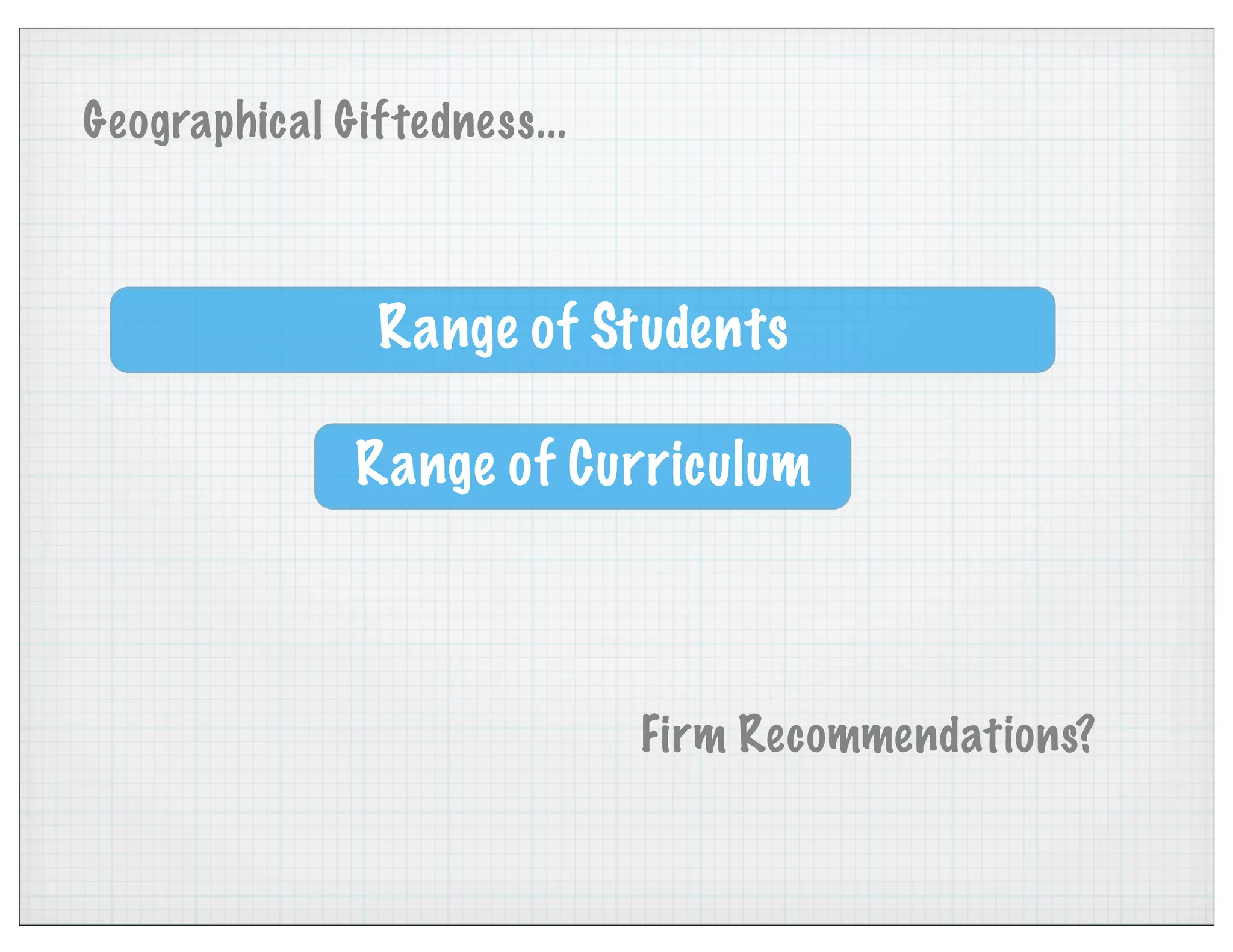
Geographical Giftedness...
Range of Students
Range of Curriculum
Firm Recommendations?
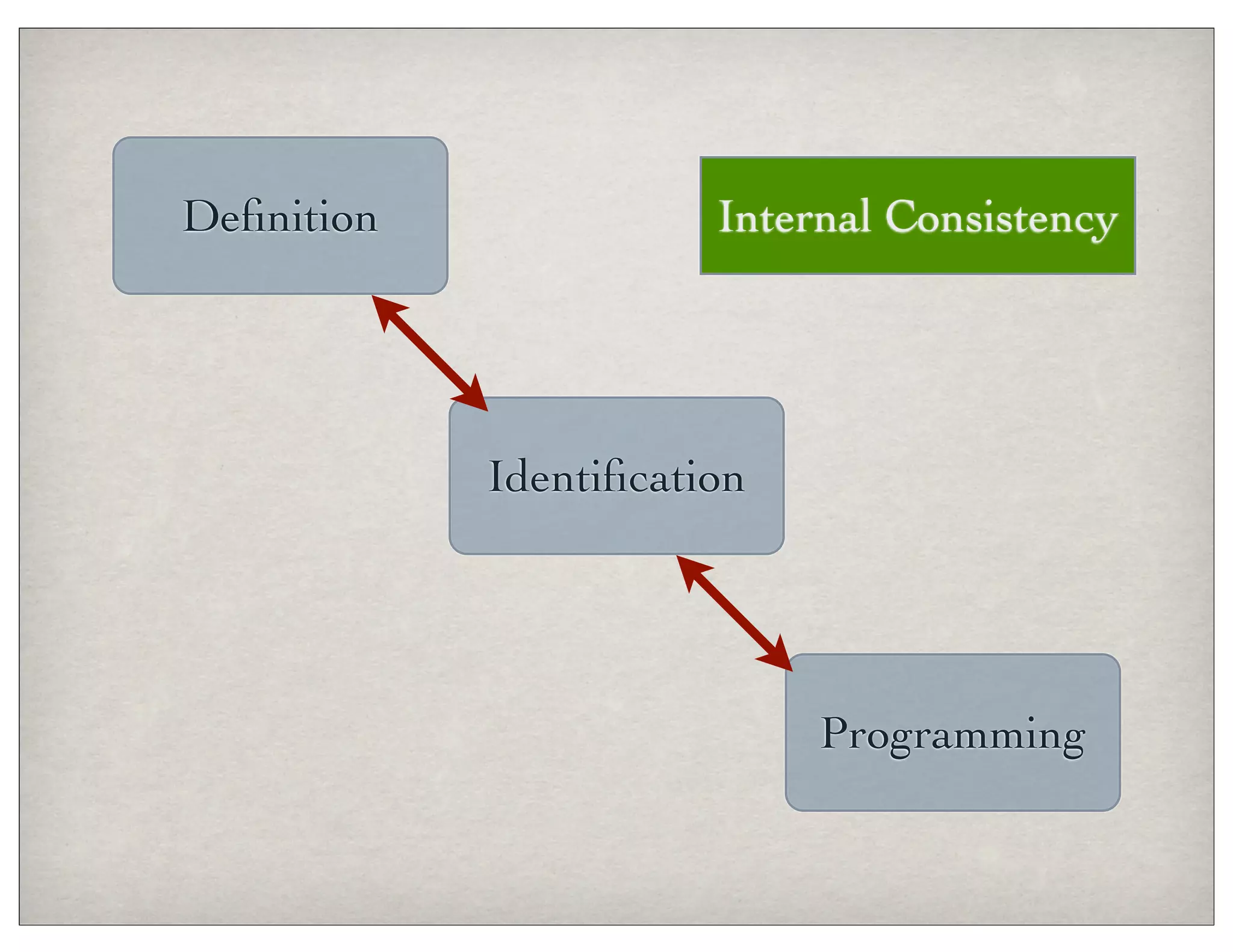
Definition
Identification
Programming
Internal Consistency
Within Class and
Non-Graded Cluster
Grouping by Skill Level
Enrichment Clusters
Within and Across Grade
Pull-Out Groups by Targeted
Abilities and Interest Areas
Within Grade Level and
Across Grade Level
Advanced Classes
Advanced Placement
Self-Designed Courses or
Independent Study
International Baccalaureate
Honors Classes
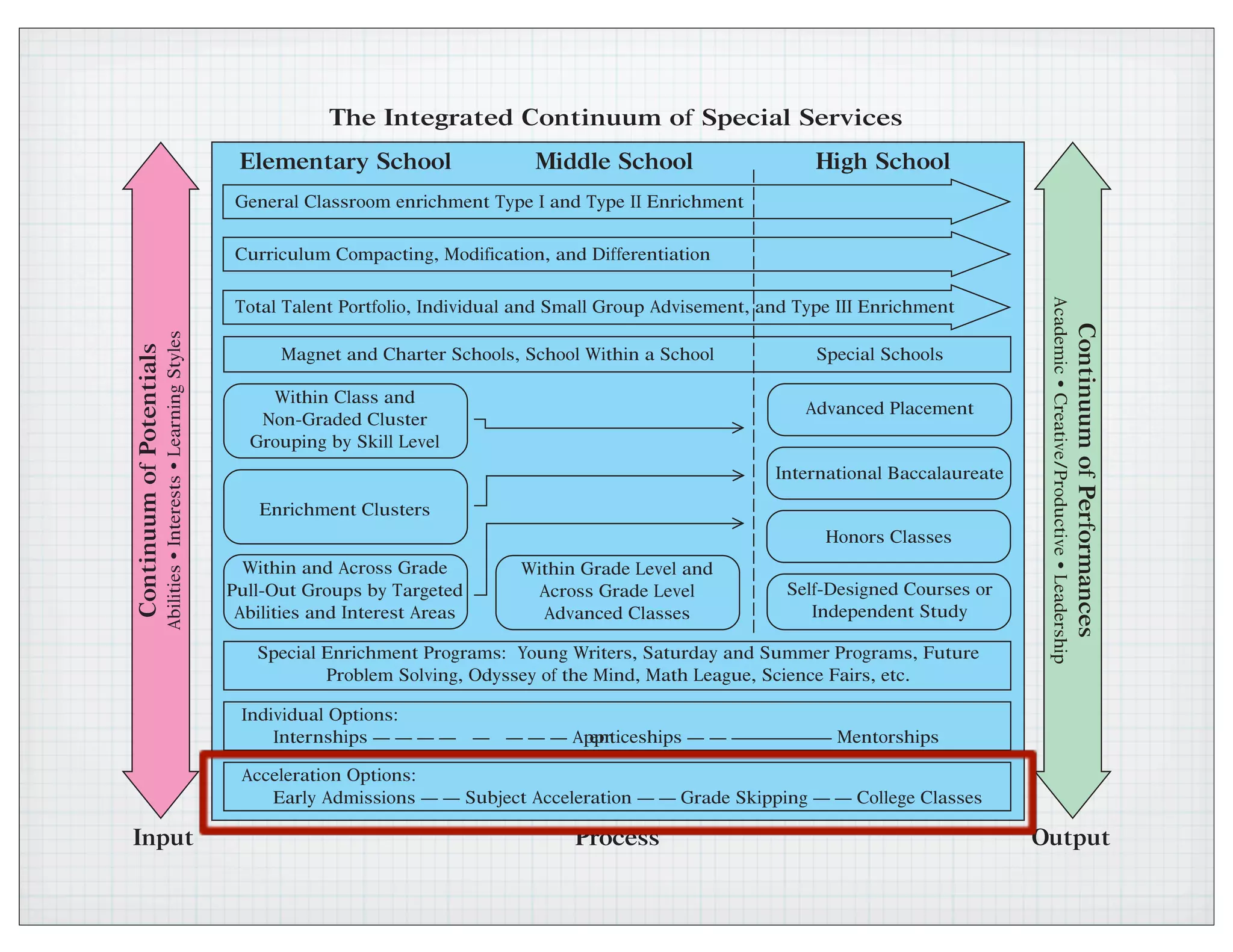
The Integrated Continuum of Special Services
Elementary School Middle School High School
General Classroom enrichment Type I and Type II Enrichment
Curriculum Compacting, Modification, and Differentiation
Total Talent Portfolio, Individual and Small Group Advisement, and Type III Enrichment
Magnet and Charter Schools, School Within a School Special Schools
Special Enrichment Programs: Young Writers, Saturday and Summer Programs, Future
Problem Solving, Odyssey of the Mind, Math League, Science Fairs, etc.
Individual Options:
Internships — — — — — — — — Apprenticeships — — —————— Mentorships
Acceleration Options:
Early Admissions — — Subject Acceleration — — Grade Skipping — — College Classes
ContinuumofPotentials
Abilities•Interests•LearningStyles
ContinuumofPerformances
Academic•Creative/Productive•Leadership
Input Process Output
Programming
Enrichment
Acceleration
Enrichment
Grouping Options
Differentiation
Curriculum Design
Outside of School Development
Hoagies
Prufrock Press
James A. Kulik
No other arrangement for gifted children works
as well as acceleration…
Karen B. Rodgers
Research on grade skipping comprises one of
the strongest and most consistent bodies of
research in the field of gifted education.
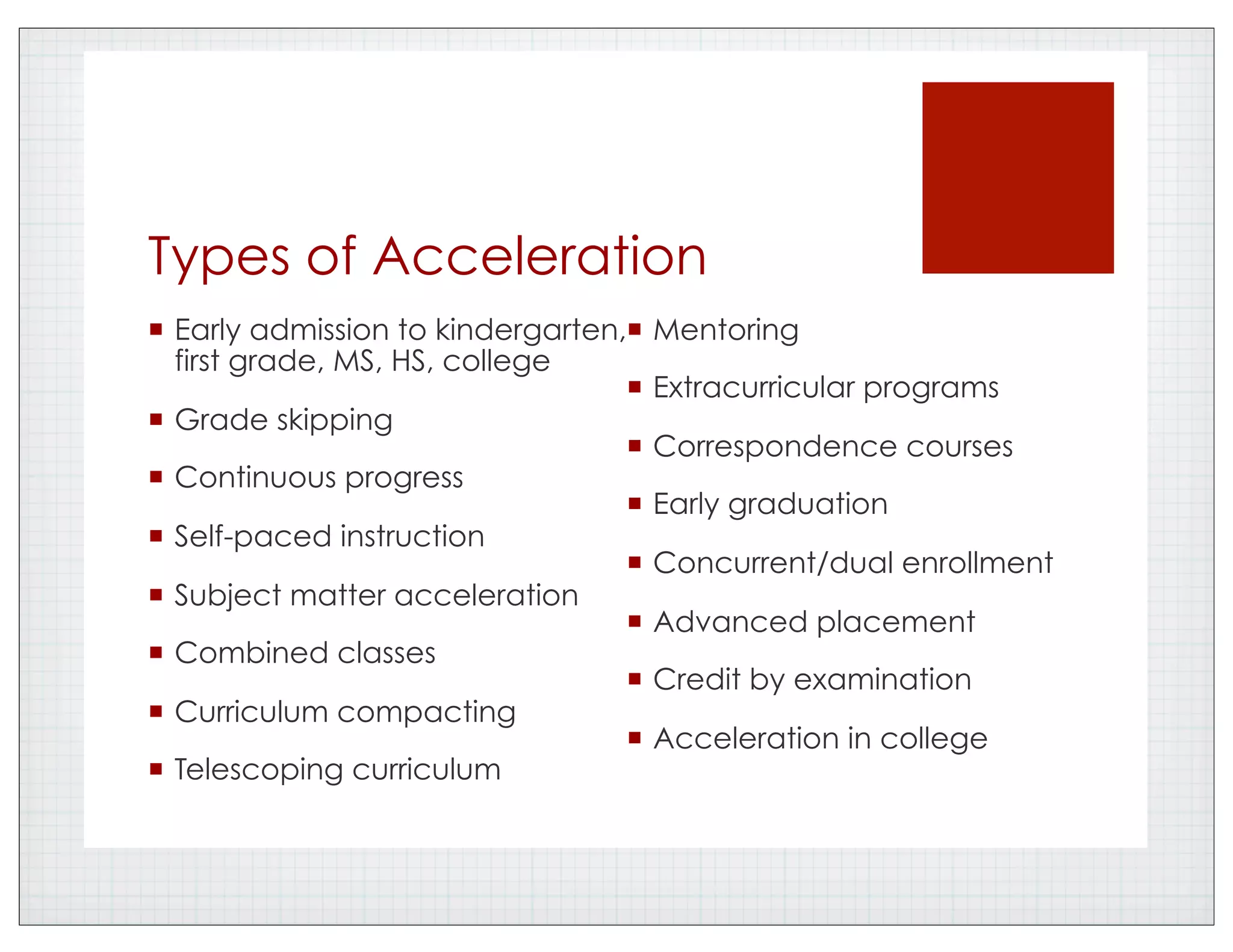
Types of Acceleration
!  Early admission to kindergarten,
first grade, MS, HS, college
!  Grade skipping
!  Continuous progress
!  Self-paced instruction
!  Subject matter acceleration
!  Combined classes
!  Curriculum compacting
!  Telescoping curriculum
!  Mentoring
!  Extracurricular programs
!  Correspondence courses
!  Early graduation
!  Concurrent/dual enrollment
!  Advanced placement
!  Credit by examination
!  Acceleration in college
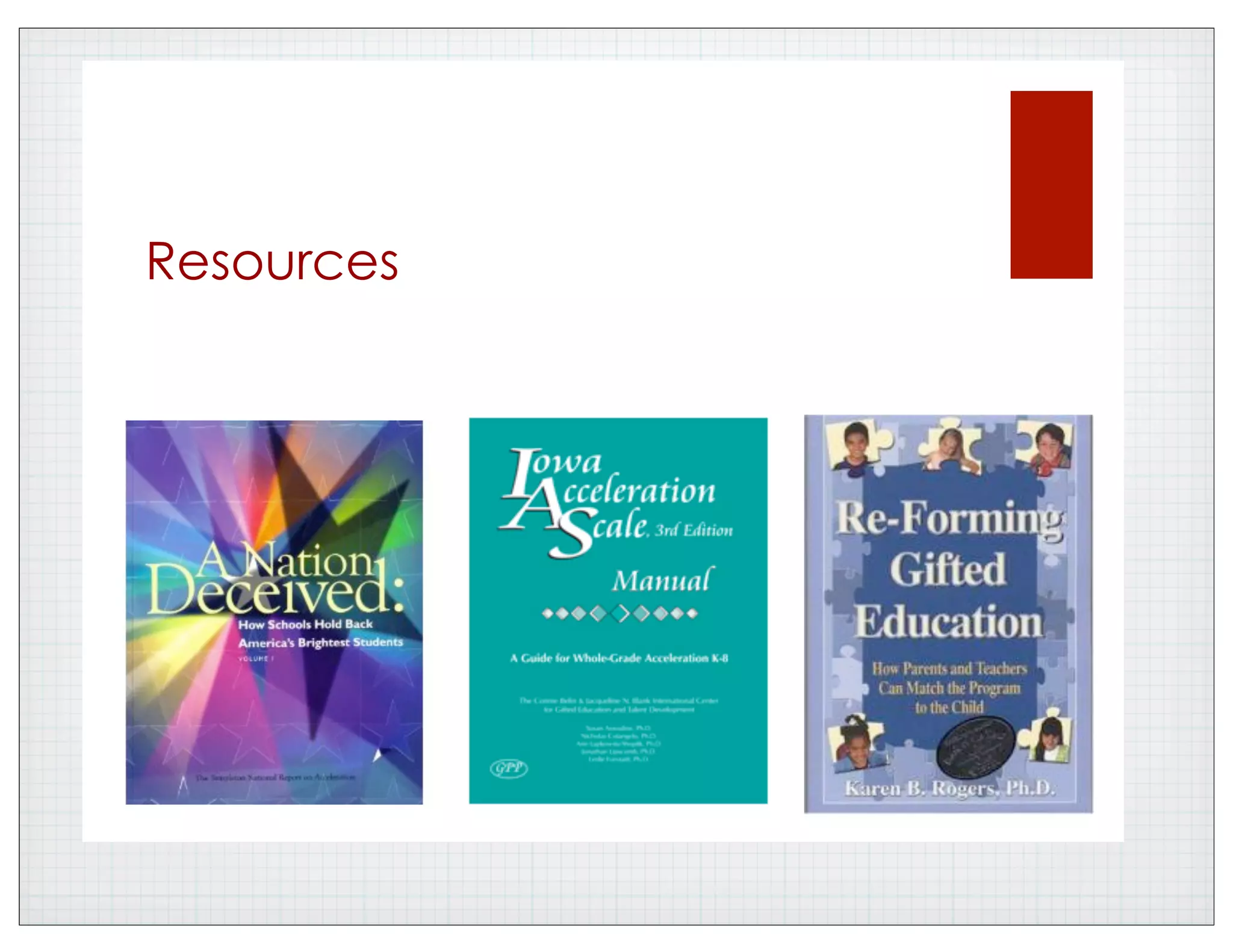
Resources
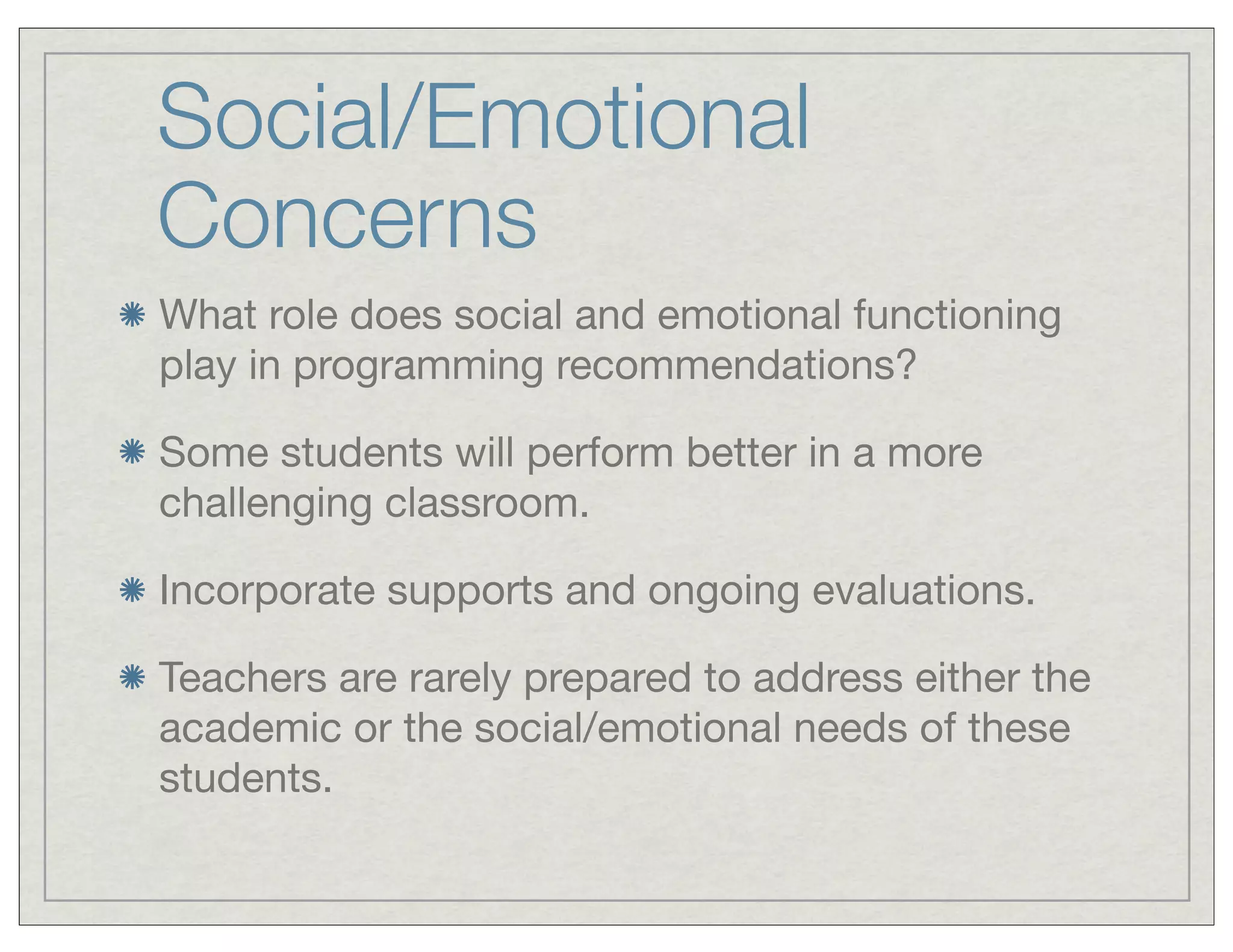
Social/Emotional
Concerns
What role does social and emotional functioning
play in programming recommendations?
Some students will perform better in a more
challenging classroom.
Incorporate supports and ongoing evaluations.
Teachers are rarely prepared to address either the
academic or the social/emotional needs of these
students.
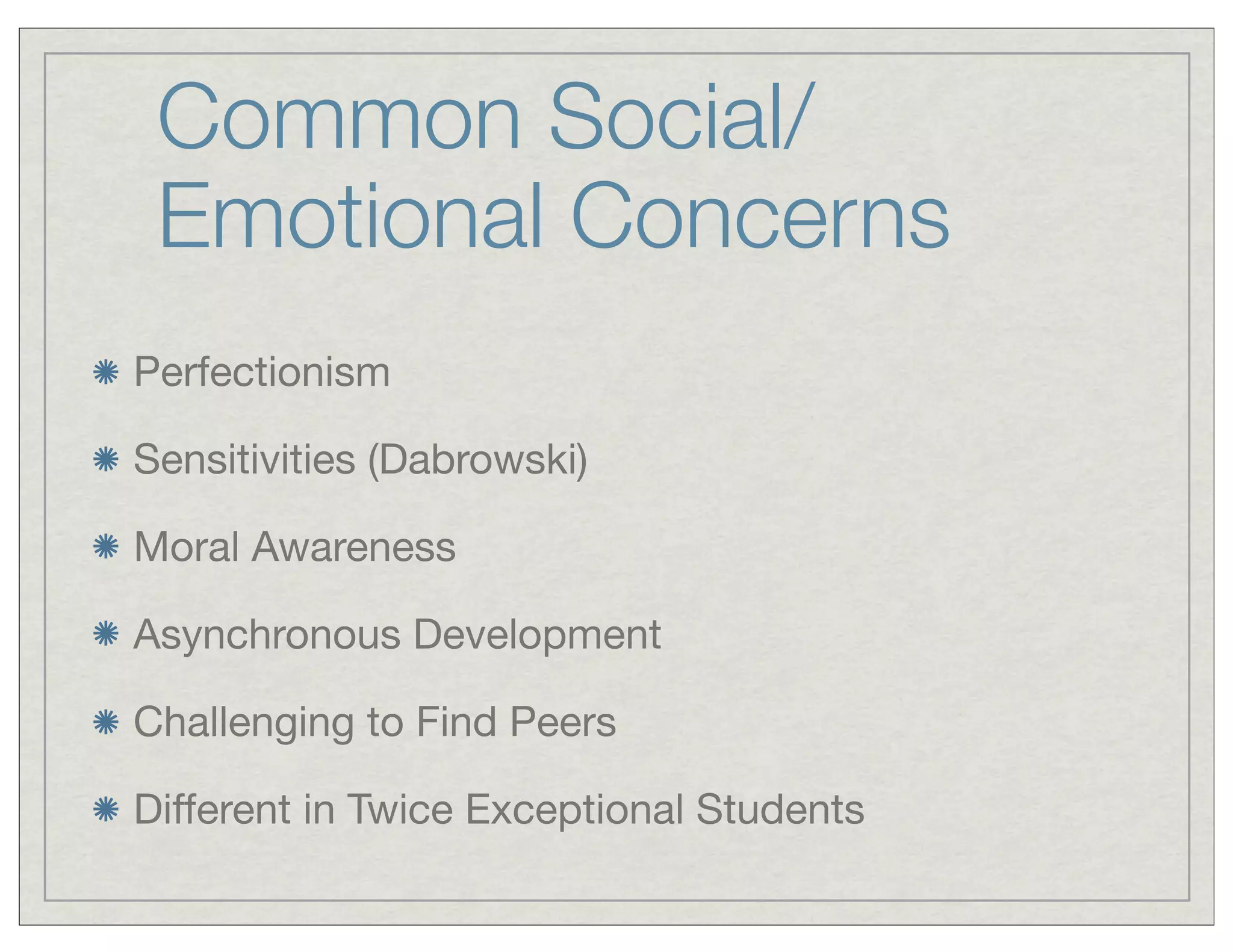
Common Social/
Emotional Concerns
Perfectionism
Sensitivities (Dabrowski)
Moral Awareness
Asynchronous Development
Challenging to Find Peers
Different in Twice Exceptional Students
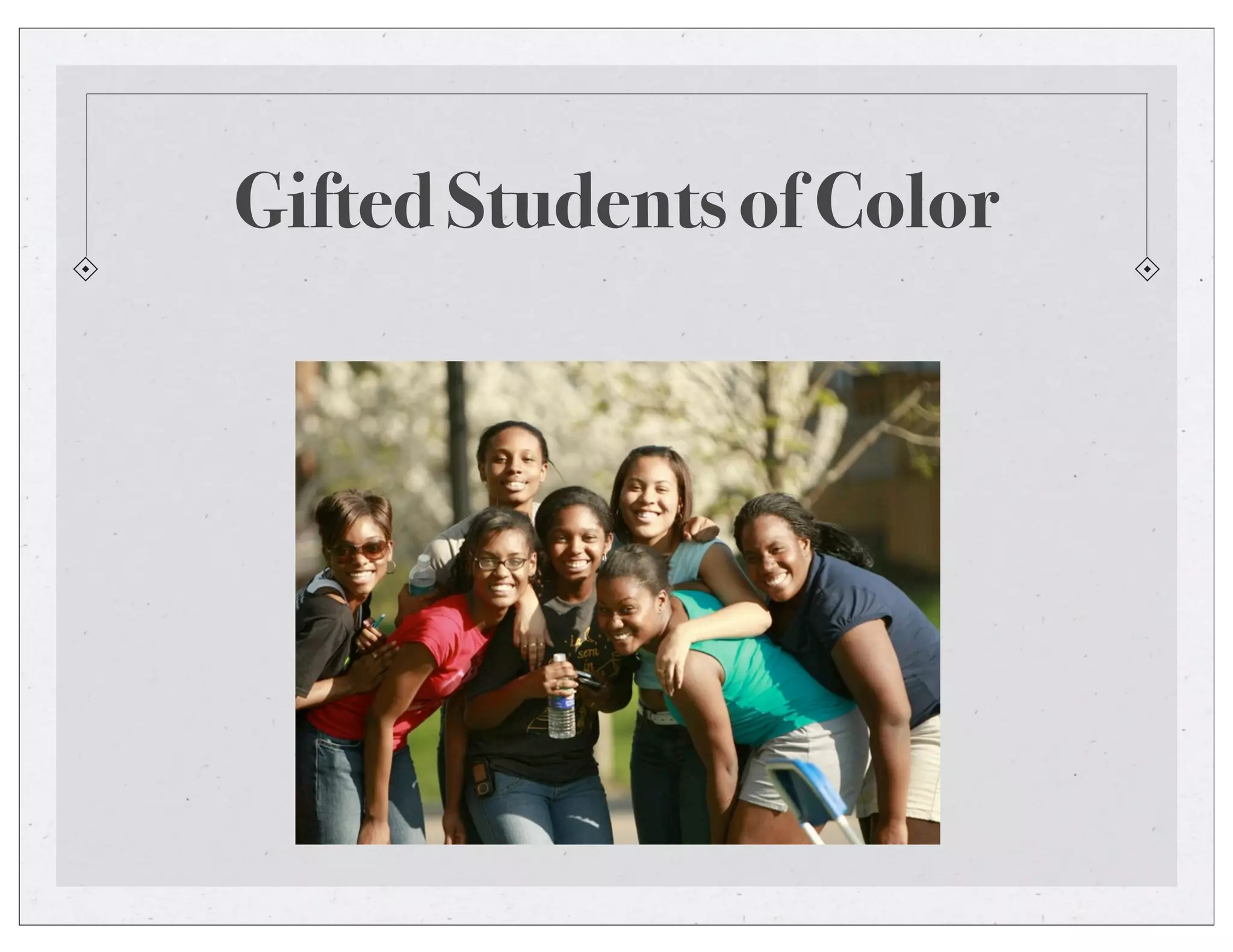
Gifted Students of Color
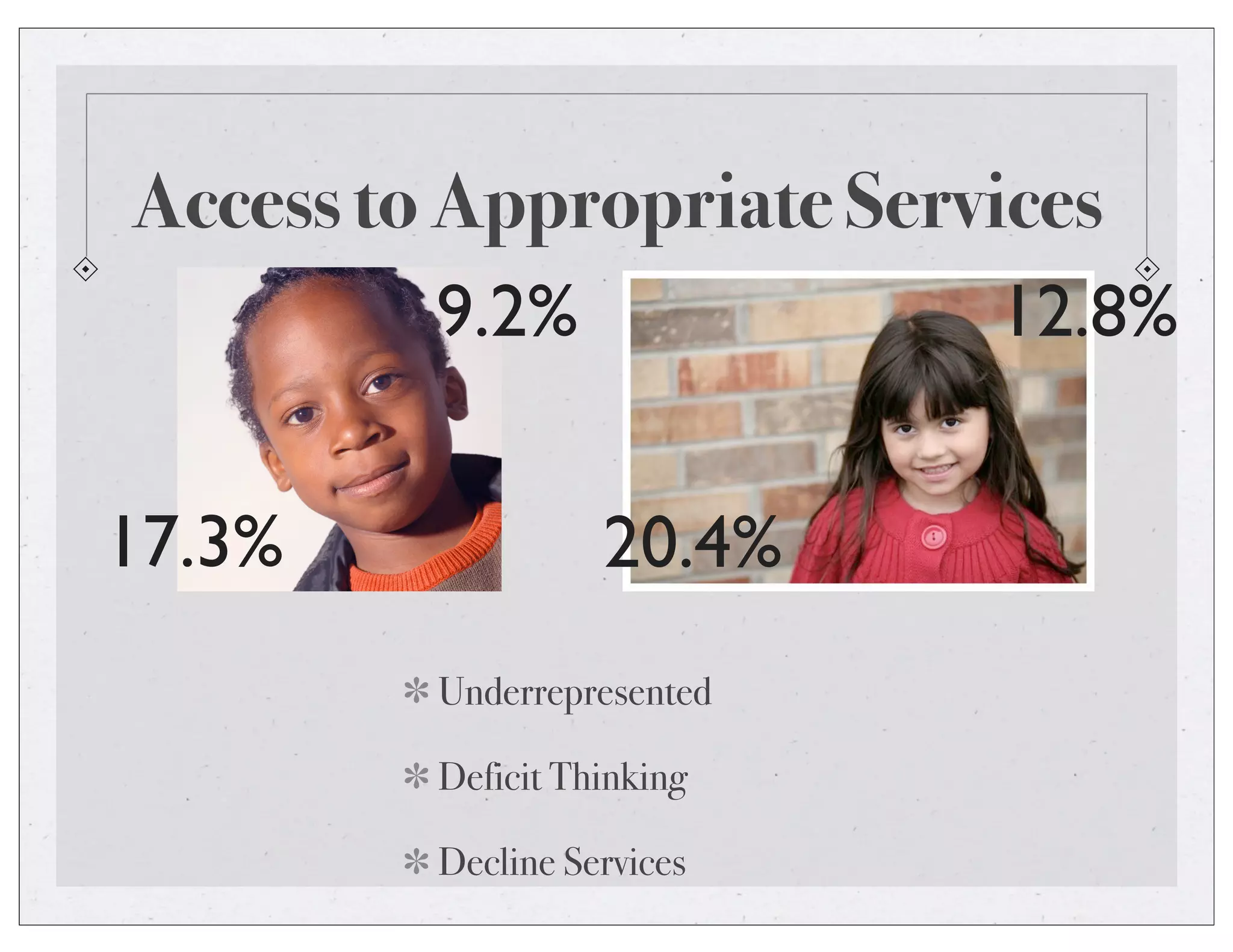
Access to Appropriate Services
Underrepresented
Deficit Thinking
Decline Services
17.3%
9.2%
20.4%
12.8%
Just say no...?
Happy and successful where they were, including friendships
Lack of multicultural curriculum
Less academic pressure
Lack of racial diversity
Fear of isolation
Desire to maintain relationships with students outside of the the
gt program
Achievement/High Aspiration
Identity
Optimal identity for positive adjustment depends on the
individual
Scholar Identity Program (Whiting and Ford)
Meyerhoff Program
Half of Black and Latino students do not
graduate from high school.
(U.S. Department of Education, 2008)
Resilience and Persistence
Importance of counternarratives and role models
Need high expectations
Multicultural curriculum
Stereotype Threat: Around ages 8-9 students are aware of
stereotypes.
When asked why some students do not
perform, peer pressure was the most
common response.
(Ford, Grantham, & Whiting, 2008)
80%
Vanderbilt Achievement Gap
Project
http://www.youtube.com/watch?v=YrNP1zqMr3A&feature=relmfu
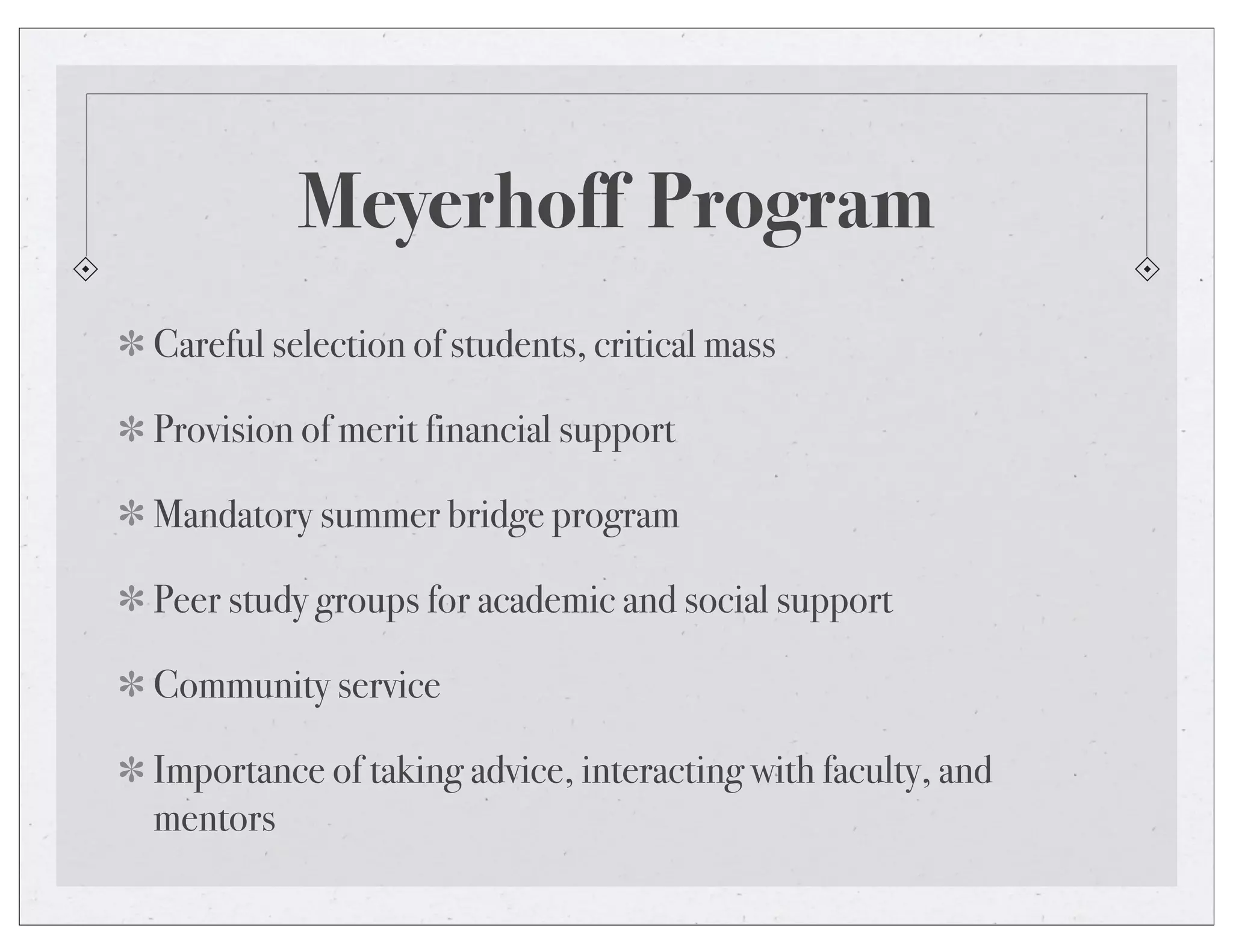
Meyerhoff Program
Careful selection of students, critical mass
Provision of merit financial support
Mandatory summer bridge program
Peer study groups for academic and social support
Community service
Importance of taking advice, interacting with faculty, and
mentors
Email: lmrubenstein@bsu.edu

Gt presentation 8 14_14

  • 1.
    PROJECT DATE PRESENTER 08.14.2014 LISARUBENSTEIN GIFTED AND TALENTED EXPLORING DEFINITIONS AND RECOMMENDATIONS
  • 2.
    Who is yourfavorite gifted person?
  • 3.
    What are thedefining characteristics of being gifted?
  • 4.
    Is the school responsiblefor recognizing them all?
  • 5.
  • 6.
    Current Definitions: Gagné Metric BasedSystem of Levels Level Label Ratio IQ 5 Extremely 1:100,000 165 4 Exceptionally 1:10,000 155 3 Highly 1:1,000 145 2 Moderately 1:100 135 1 Mildly 1:10 120
  • 9.
  • 10.
    Indiana: High Ability Performsat, or shows the potential for performing at, an outstanding level of accomplishment in at least one (1) domain when compared to other students of the same age, experience, or environment; and is characterized by exceptional gifts, talents, motivation, or interests. While there are additional domains of high ability that may be served (for example, visual and performing arts), the required domains of high ability that Indiana schools must identify for are the General Intellectual and Specific Academic domains.  For now, the designations are for students with high ability in Language Arts (HA-LA), students with high ability in Math (HA-Math), and students who have high ability in both Language Arts and Math (HA – General Intellectual). Indiana Program Standards: http://www.doe.in.gov/sites/default/files/highability/ indiana-program-standards-high-ability-education.pdf
  • 11.
  • 12.
  • 13.
  • 14.
    Geographical Giftedness... Range ofStudents Range of Curriculum Firm Recommendations?
  • 15.
  • 16.
    Within Class and Non-GradedCluster Grouping by Skill Level Enrichment Clusters Within and Across Grade Pull-Out Groups by Targeted Abilities and Interest Areas Within Grade Level and Across Grade Level Advanced Classes Advanced Placement Self-Designed Courses or Independent Study International Baccalaureate Honors Classes The Integrated Continuum of Special Services Elementary School Middle School High School General Classroom enrichment Type I and Type II Enrichment Curriculum Compacting, Modification, and Differentiation Total Talent Portfolio, Individual and Small Group Advisement, and Type III Enrichment Magnet and Charter Schools, School Within a School Special Schools Special Enrichment Programs: Young Writers, Saturday and Summer Programs, Future Problem Solving, Odyssey of the Mind, Math League, Science Fairs, etc. Individual Options: Internships — — — — — — — — Apprenticeships — — —————— Mentorships Acceleration Options: Early Admissions — — Subject Acceleration — — Grade Skipping — — College Classes ContinuumofPotentials Abilities•Interests•LearningStyles ContinuumofPerformances Academic•Creative/Productive•Leadership Input Process Output
  • 17.
  • 18.
  • 19.
    James A. Kulik Noother arrangement for gifted children works as well as acceleration…
  • 20.
    Karen B. Rodgers Researchon grade skipping comprises one of the strongest and most consistent bodies of research in the field of gifted education.
  • 21.
    Types of Acceleration ! Early admission to kindergarten, first grade, MS, HS, college !  Grade skipping !  Continuous progress !  Self-paced instruction !  Subject matter acceleration !  Combined classes !  Curriculum compacting !  Telescoping curriculum !  Mentoring !  Extracurricular programs !  Correspondence courses !  Early graduation !  Concurrent/dual enrollment !  Advanced placement !  Credit by examination !  Acceleration in college
  • 22.
  • 23.
    Social/Emotional Concerns What role doessocial and emotional functioning play in programming recommendations? Some students will perform better in a more challenging classroom. Incorporate supports and ongoing evaluations. Teachers are rarely prepared to address either the academic or the social/emotional needs of these students.
  • 24.
    Common Social/ Emotional Concerns Perfectionism Sensitivities(Dabrowski) Moral Awareness Asynchronous Development Challenging to Find Peers Different in Twice Exceptional Students
  • 25.
  • 26.
    Access to AppropriateServices Underrepresented Deficit Thinking Decline Services 17.3% 9.2% 20.4% 12.8%
  • 27.
    Just say no...? Happyand successful where they were, including friendships Lack of multicultural curriculum Less academic pressure Lack of racial diversity Fear of isolation Desire to maintain relationships with students outside of the the gt program
  • 28.
    Achievement/High Aspiration Identity Optimal identityfor positive adjustment depends on the individual Scholar Identity Program (Whiting and Ford) Meyerhoff Program Half of Black and Latino students do not graduate from high school. (U.S. Department of Education, 2008)
  • 29.
    Resilience and Persistence Importanceof counternarratives and role models Need high expectations Multicultural curriculum Stereotype Threat: Around ages 8-9 students are aware of stereotypes. When asked why some students do not perform, peer pressure was the most common response. (Ford, Grantham, & Whiting, 2008) 80%
  • 30.
  • 31.
    Meyerhoff Program Careful selectionof students, critical mass Provision of merit financial support Mandatory summer bridge program Peer study groups for academic and social support Community service Importance of taking advice, interacting with faculty, and mentors
  • 33.