Metaphorical
Thinking
A Microscope for Seeing Content Creatively
Lisa Rubenstein
Ball State University
Indiana Association for the Gifted
December 16, 2014
Analogies are comparisons of the similar features of
two things. They are mental telescopes [or microscopes]
through which you can spy ideas.
-Michael Michalko
James Geary
Why use metaphors?
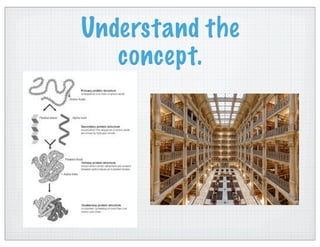
Understand the concept (abstract?)
Solve a problem with new perspective
Think about topic from a different
angle...inspiration.
Understanding the
Concept
We are threatened by the strange.
Helps to connect with something
familiar
Helps to make sense of unfamiliar
Promotes cognitive dissonance and
constructivist learning ideals
Understand the
concept.
Solve a problem from a
new perspective.
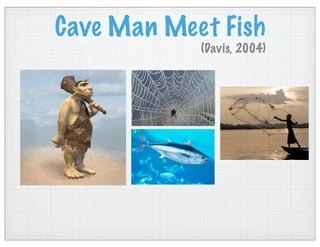
Cave Man Meet Fish
(Davis, 2004)
Inspiration...
Option 1: Force it.
Goal: Improve a flashlight.
Metaphor: Attend medical school.
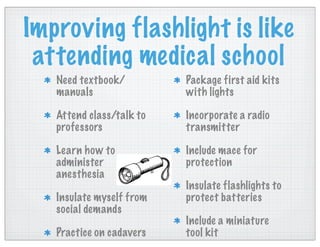
Improving flashlight is like
attending medical school
Need textbook/
manuals
Attend class/talk to
professors
Learn how to
administer
anesthesia
Insulate myself from
social demands
Practice on cadavers
Package first aid kits
with lights
Incorporate a radio
transmitter
Include mace for
protection
Insulate flashlights to
protect batteries
Include a miniature
tool kit
Option 2: Give options.
Pick a problem.
Can’t sell copiers
Want to increase library usage
Can’t get the car to start
Can’t motivate students
Need to design a swimming pool
Time to
Experiment
Now pick an analogy
counterpart...
Television evangelists
Denny’s
Your favorite sports team (hint:
Steelers)
Tape measure
Pearl Harbor
Brainstorm the
characteristics of
your analogy.
Apply those
characteristics to
your problem.
What are some
potential solutions?
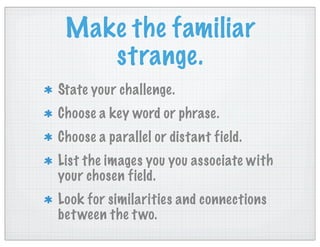
Make the familiar
strange.
State your challenge.
Choose a key word or phrase.
Choose a parallel or distant field.
List the images you you associate with
your chosen field.
Look for similarities and connections
between the two.
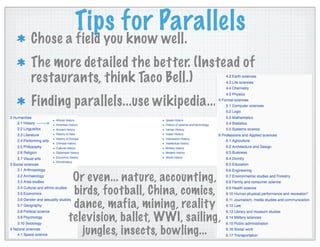
Tips for Parallels
Chose a field you know well.
The more detailed the better. (Instead of
restaurants, think Taco Bell.)
Finding parallels...use wikipedia....
Or even... nature, accounting,
birds, football, China, comics,
dance, mafia, mining, reality
television, ballet, WWI, sailing,
jungles, insects, bowling...
Imagine this in the
classroom...
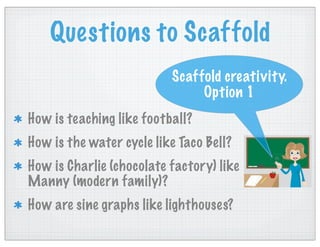
Questions to Scaffold
How is teaching like football?
How is the water cycle like Taco Bell?
How is Charlie (chocolate factory) like
Manny (modern family)?
How are sine graphs like lighthouses?
Scaffold creativity.
Option 1
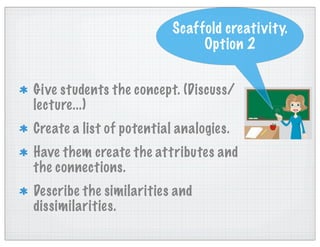
Give students the concept. (Discuss/
lecture...)
Create a list of potential analogies.
Have them create the attributes and
the connections.
Describe the similarities and
dissimilarities.
Scaffold creativity.
Option 2
Design your own analogy.
Scaffold creativity.
Option 3
Other Analogies
Fantasy Analogy: Fantastic,
farfetched, craziest situation possible.
Symbolic Analogy: Oxymorons
Personal Analogy: Empathy, become the
challenge/concept.
A teaching analogy...
How is teaching like a movie?
What makes a good movie good?
What makes a bad movie bad?
WHY ARE SPOILERS SO
FRUSTRATING?
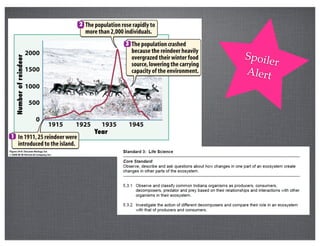
Spoiler
Alert
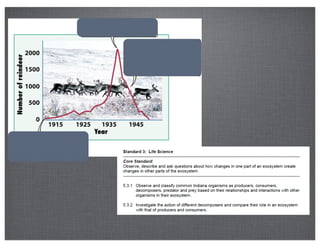
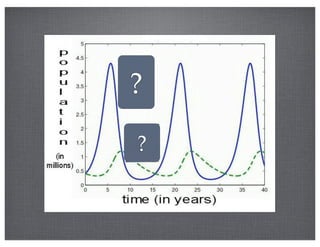
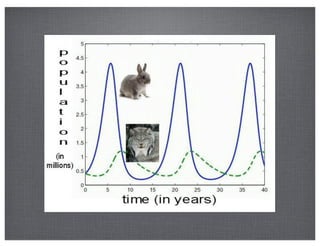
?
?
HOW WAS ____ DISCOVERED?
CAN WE REPLICATE IN THE
CLASSROOM?
Concluding Thoughts
Analogies can be used to help students
connect unfamiliar content to the
familiar.
Analogies can be used for inspiration
and problem solving...even within the
teaching profession.
Questions?
lmrubenstein@bsu.edu

IAG_2014 Metaphorical Thinking

  • 1.
    Metaphorical Thinking A Microscope forSeeing Content Creatively Lisa Rubenstein Ball State University Indiana Association for the Gifted December 16, 2014
  • 2.
    Analogies are comparisonsof the similar features of two things. They are mental telescopes [or microscopes] through which you can spy ideas. -Michael Michalko
  • 3.
  • 4.
    Why use metaphors? Understandthe concept (abstract?) Solve a problem with new perspective Think about topic from a different angle...inspiration.
  • 5.
    Understanding the Concept We arethreatened by the strange. Helps to connect with something familiar Helps to make sense of unfamiliar Promotes cognitive dissonance and constructivist learning ideals
  • 6.
  • 7.
    Solve a problemfrom a new perspective.
  • 8.
    Cave Man MeetFish (Davis, 2004)
  • 9.
  • 10.
    Option 1: Forceit. Goal: Improve a flashlight. Metaphor: Attend medical school.
  • 11.
    Improving flashlight islike attending medical school Need textbook/ manuals Attend class/talk to professors Learn how to administer anesthesia Insulate myself from social demands Practice on cadavers Package first aid kits with lights Incorporate a radio transmitter Include mace for protection Insulate flashlights to protect batteries Include a miniature tool kit
  • 12.
    Option 2: Giveoptions. Pick a problem. Can’t sell copiers Want to increase library usage Can’t get the car to start Can’t motivate students Need to design a swimming pool Time to Experiment
  • 13.
    Now pick ananalogy counterpart... Television evangelists Denny’s Your favorite sports team (hint: Steelers) Tape measure Pearl Harbor
  • 14.
  • 15.
  • 16.
  • 17.
    Make the familiar strange. Stateyour challenge. Choose a key word or phrase. Choose a parallel or distant field. List the images you you associate with your chosen field. Look for similarities and connections between the two.
  • 18.
    Tips for Parallels Chosea field you know well. The more detailed the better. (Instead of restaurants, think Taco Bell.) Finding parallels...use wikipedia.... Or even... nature, accounting, birds, football, China, comics, dance, mafia, mining, reality television, ballet, WWI, sailing, jungles, insects, bowling...
  • 19.
    Imagine this inthe classroom...
  • 20.
    Questions to Scaffold Howis teaching like football? How is the water cycle like Taco Bell? How is Charlie (chocolate factory) like Manny (modern family)? How are sine graphs like lighthouses? Scaffold creativity. Option 1
  • 21.
    Give students theconcept. (Discuss/ lecture...) Create a list of potential analogies. Have them create the attributes and the connections. Describe the similarities and dissimilarities. Scaffold creativity. Option 2
  • 22.
    Design your ownanalogy. Scaffold creativity. Option 3
  • 23.
    Other Analogies Fantasy Analogy:Fantastic, farfetched, craziest situation possible. Symbolic Analogy: Oxymorons Personal Analogy: Empathy, become the challenge/concept.
  • 24.
    A teaching analogy... Howis teaching like a movie? What makes a good movie good? What makes a bad movie bad?
  • 26.
    WHY ARE SPOILERSSO FRUSTRATING?
  • 27.
  • 29.
  • 31.
    HOW WAS ____DISCOVERED? CAN WE REPLICATE IN THE CLASSROOM?
  • 32.
    Concluding Thoughts Analogies canbe used to help students connect unfamiliar content to the familiar. Analogies can be used for inspiration and problem solving...even within the teaching profession.
  • 33.