STRESS & THE HIGH
ACHIEVING CHILD
Lisa DaVia Rubenstein, Ph.D.
Saint Simon the Apostle
January 9, 2017
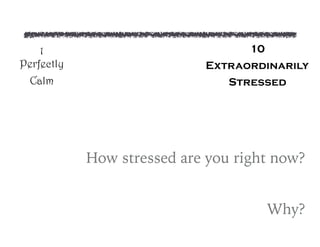
How stressed are you right now?
Why?
1

Perfectly
Calm
10
Extraordinarily
Stressed
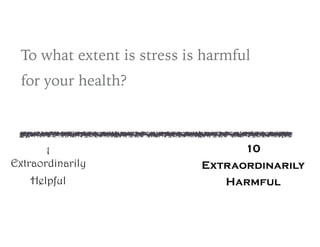
To what extent is stress is harmful
for your health?
1

Extraordinarily
Helpful
10
Extraordinarily
Harmful
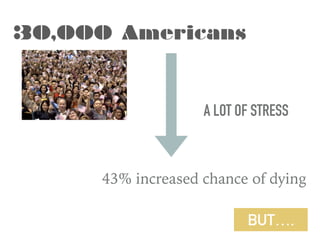
30,000 Americans
A LOT OF STRESS
43% increased chance of dying
BUT….
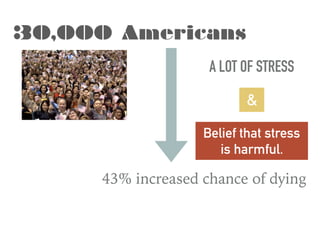
30,000 Americans
A LOT OF STRESS
43% increased chance of dying
Belief that stress
is harmful.
&
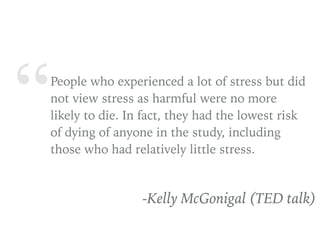
“People who experienced a lot of stress but did
not view stress as harmful were no more
likely to die. In fact, they had the lowest risk
of dying of anyone in the study, including
those who had relatively little stress.
-Kelly McGonigal (TED talk)
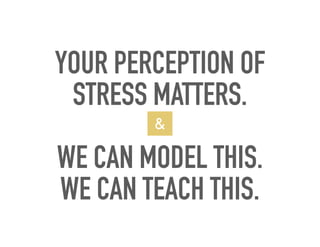
YOUR PERCEPTION OF
STRESS MATTERS.
WE CAN MODEL THIS.
WE CAN TEACH THIS.
&
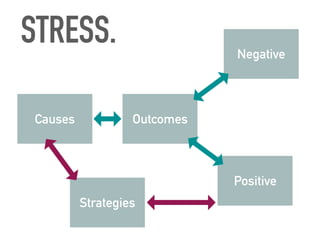
Causes Outcomes
Negative
Positive
STRESS.
Strategies
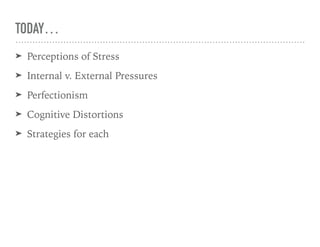
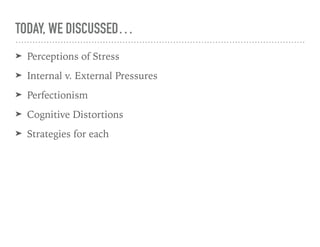
TODAY…
➤ Perceptions of Stress
➤ Internal v. External Pressures
➤ Perfectionism
➤ Cognitive Distortions
➤ Strategies for each
WHAT WOULD HAPPEN IF
YOU DIDN’T FEEL
STRESS?
WHAT WOULD HAPPEN IF
YOU DIDN’T FEEL
STRESS?
1. Stress is very useful. It is built it to help us respond to our
environment, to help us rise to the challenges.
2. Yet, stress can be harmful.
3. Sometimes, however, stress becomes a way to make ourselves feel
important. (More later…)
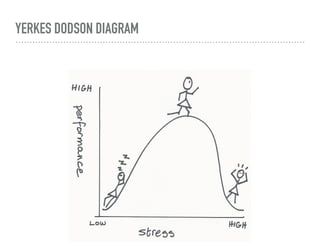
YERKES DODSON DIAGRAM
The goal is not to eliminate stress, but
rather to create ways to leverage it to work
for us.
How does mindset theory mirror this
concept?
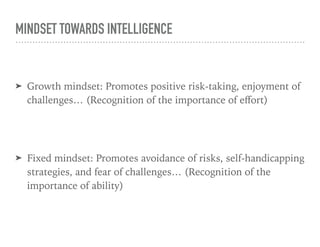
MINDSET TOWARDS INTELLIGENCE
➤ Growth mindset: Promotes positive risk-taking, enjoyment of
challenges… (Recognition of the importance of effort)
➤ Fixed mindset: Promotes avoidance of risks, self-handicapping
strategies, and fear of challenges… (Recognition of the
importance of ability)
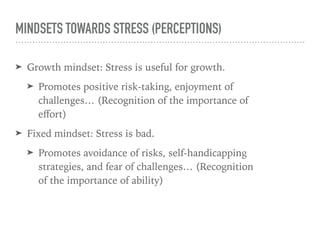
MINDSETS TOWARDS STRESS (PERCEPTIONS)
➤ Growth mindset: Stress is useful for growth.
➤ Promotes positive risk-taking, enjoyment of
challenges… (Recognition of the importance of
effort)
➤ Fixed mindset: Stress is bad.
➤ Promotes avoidance of risks, self-handicapping
strategies, and fear of challenges… (Recognition
of the importance of ability)
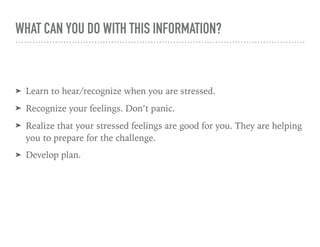
WHAT CAN YOU DO WITH THIS INFORMATION?
➤ Learn to hear/recognize when you are stressed.
➤ Recognize your feelings. Don’t panic.
➤ Realize that your stressed feelings are good for you. They are helping
you to prepare for the challenge.
➤ Develop plan.
Building Resilience
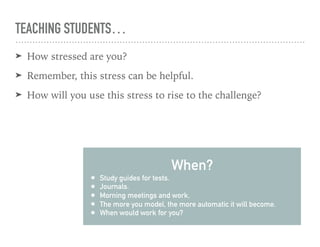
TEACHING STUDENTS…
➤ How stressed are you?
➤ Remember, this stress can be helpful.
➤ How will you use this stress to rise to the challenge?
When?
Study guides for tests.
Journals.
Morning meetings and work.
The more you model, the more automatic it will become.
When would work for you?
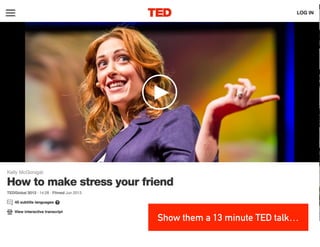
Show them a 13 minute TED talk…
HOW TO USE STRESS TO RISE TO THE CHALLENGE?
Optimists? Pessimists?VS.
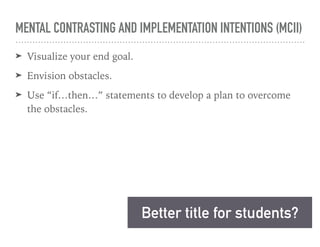
MENTAL CONTRASTING AND IMPLEMENTATION INTENTIONS (MCII)
➤ Visualize your end goal.
➤ Envision obstacles.
➤ Use “if…then…” statements to develop a plan to overcome
the obstacles.
Better title for students?
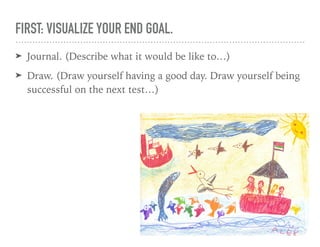
FIRST: VISUALIZE YOUR END GOAL.
➤ Journal. (Describe what it would be like to…)
➤ Draw. (Draw yourself having a good day. Draw yourself being
successful on the next test…)
LET’S TRY IT…
➤ Visualize end goal: Get an A on my test.
➤ Obstacles:
➤ If/Then Statements:
➤ Visualize end goal: Get in shape.
➤ Obstacles:
➤ If/Then Statements:
OR
LET’S TRY IT…
➤ Visualize end goal: Get an A on my test.
➤ Obstacles: Friends, lack of focus, too much information.
➤ If/Then Statements:
➤ If my friends are texting, I will respond that I need to
study and then I will hide my phone from myself.
➤ If I can’t focus, I will move locations, I will remove my
distractions, I will set a timer.
➤ If there is too much information, I will break it down
and study a little everyday. I will pretend to teach one
section every night to my stuffed animals…
STRESS V. ANXIETY?
➤ Stress is the body’s reaction to a circumstance or situation
that requires physical, mental, or emotional adjustment or
response. It could be caused by negative or positive changes.
➤ Anxiety disorders are the most common mental illness in
America, affecting 18% of US population, and almost 30% of
Americans across the lifespan.
➤ Anxiety is a feeling of fear, unease, worry when situations are
perceived as uncontrollable, unavoidable. Most common
symptoms of anxiety are insistent worrying, phobias, social
anxiety, and OCD. Others include: chest pain, dizziness,
shortness of breath, and panic attacks.
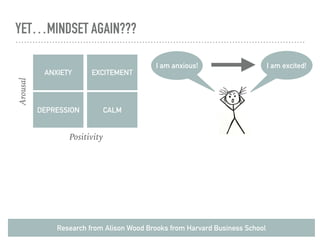
YET…MINDSET AGAIN???
Research from Alison Wood Brooks from Harvard Business School
I am anxious!
ANXIETY EXCITEMENT
DEPRESSION CALM
Positivity
Arousal
I am excited!
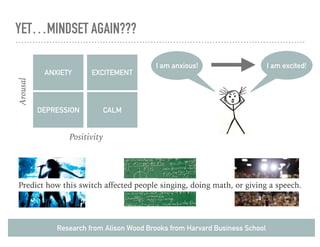
YET…MINDSET AGAIN???
Research from Alison Wood Brooks from Harvard Business School
I am anxious!
ANXIETY EXCITEMENT
DEPRESSION CALM
Positivity
Arousal
I am excited!
Predict how this switch affected people singing, doing math, or giving a speech.
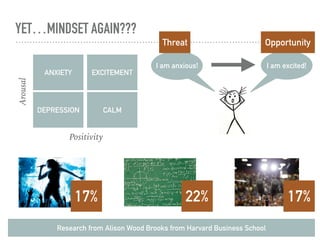
YET…MINDSET AGAIN???
Research from Alison Wood Brooks from Harvard Business School
I am anxious!
ANXIETY EXCITEMENT
DEPRESSION CALM
Positivity
Arousal
I am excited!
17% 22% 17%
Threat Opportunity
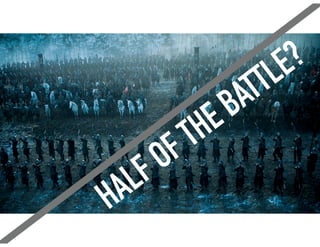
HALFOFTHEBATTLE?
PERCEPTIONS OF STRESS ARE IMPORTANT.
WHAT OTHER FACTORS MAY INFLUENCE
THE STRESS LEVEL OF HIGH ACHIEVING
STUDENTS?
INTERNAL V. EXTERNAL
PRESSURES
What are the internal and external pressures that may be too much
for students’ available resources?
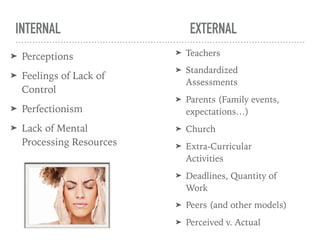
INTERNAL
➤ Perceptions
➤ Feelings of Lack of
Control
➤ Perfectionism
➤ Lack of Mental
Processing Resources
EXTERNAL
➤ Teachers
➤ Standardized
Assessments
➤ Parents (Family events,
expectations…)
➤ Church
➤ Extra-Curricular
Activities
➤ Deadlines, Quantity of
Work
➤ Peers (and other models)
➤ Perceived v. Actual
PERFECTIONISM
Think of a student who you would classify
as a perfectionist.
How do you know? What characteristics
does this student display?
TYPES OF PERFECTIONISM
➤ Healthy (Silverman; Schuler; many others…)
➤ Unhealthy
➤ Self-oriented (Hewitt & Flett)
➤ Others-oriented
➤ Socially-prescribed
➤ Personal standards (Frost et al.)
➤ Concern over mistakes
Think back to your student.
How would you classify
this student?
How does the environment promote
perfectionism?
How does perfectionism contribute to
stress?
2 OPTIONS AS A TEACHER…
Consider the
messages you
are sending.
Teach students
to manage
perfectionism.
MESSAGES TEACHERS SEND…
➤ What kind of feedback do you give?
➤ What papers do you hang in the classroom?
➤ How many opportunities do students have to resubmit work?
➤ What happens when you make a mistake?
➤ How often does the best student fail?
➤ How much autonomy do students have?
TEACHING STUDENTS TO MANAGE THEIR OWN PERFECTIONISM
➤ General Self-Talk
➤ More specific: Cognitive Distortions
➤ Cognitive Behavior Therapy (CBT)
➤ Remember: Counselors can help anyone! This is not defeat.
This is strength.
Self-Talk Coaches
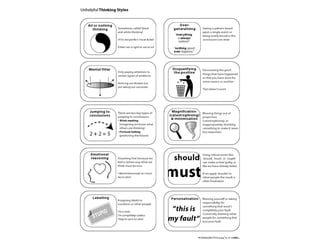
“Cognitive distortions are specific
examples of negative self-talk.
#1: ALL OR NONE
THINKING
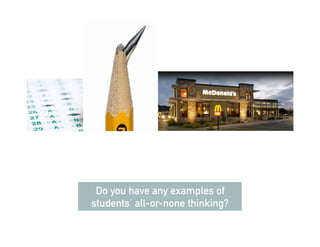
Do you have any examples of
students’ all-or-none thinking?
HEALTHY ALTERNATIVES
➤ Recognize the distortion.
➤ Compartmentalize 1. What is the middle ground?
➤ Compartmentalize 2. What are things to be good at? What are
things that it is okay not to be perfect in?
➤ Create a plan.
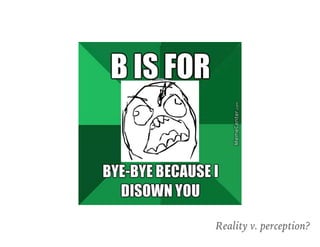
#2: MIND READER
Reality v. perception?
HEALTHY ALTERNATIVES
➤ Recognize the distortion.
➤ Reflect/journal on the following:
➤ Who says you have to be perfect?
➤ What will your parents think if you are not perfect?
➤ What will your teachers think if you are not perfect?
➤ Ask the person. Discuss.
➤ Feedback filter (selective listening/actively ignoring):
➤ What is helpful? What can I use to get better?
➤ Everything else: Let go.
Why might “Just do your
best.” be a dangerous
phrase for a perfectionist?
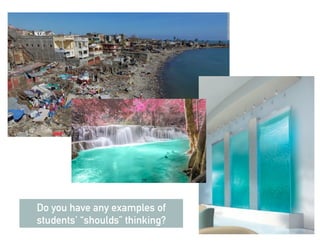
#3: SHOULDS
Do you have any examples of
students’ “shoulds” thinking?
“If one fails to meet the unrealistic
expectation, one has failed; but if one
does meet it, one feels no glow of
achievement for one has only done
what was expected.
(Weisinger & Lobsenz, 1981, p.281)
HEALTHY ALTERNATIVES
➤ Recognize the distortion.
➤ Consider: How much can you do? Think back to all-or-none
thinking. Some is better than nothing.
➤ Goal: Promote realistic thinking.
➤ Create a realistic plan. (Perhaps, still a little aspirational, but
not so much so that they feel like a failure.)
➤ Celebrate effort.
GENERAL
GENERAL OVERARCHING STEPS
➤ Learn to hear/recognize when you are stressed.
➤ Recognize your feelings. Don’t panic.
➤ Consider the causes. What internal voices do you hear? What
cognitive distortions are present?
➤ Talk it back with a healthier internal voice.
➤ Consider what actions you can control.
➤ Consider how you can perceive the situation.
➤ Try to maintain the healthier perspective. Set goals.
➤ Be proactive in addressing stress. (see calming techniques…)
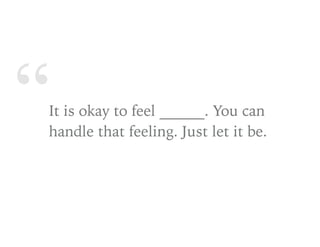
“It is okay to feel ______. You can
handle that feeling. Just let it be.
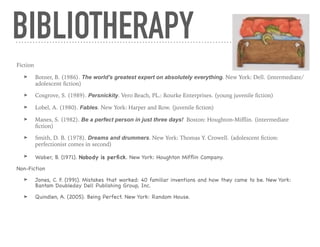
Fiction
➤ Botner, B. (1986). The world's greatest expert on absolutely everything. New York: Dell. (intermediate/
adolescent fiction)
➤ Cosgrove, S. (1989). Persnickity. Vero Beach, PL.: Rourke Enterprises. (young juvenile fiction)
➤ Lobel, A. (1980). Fables. New York: Harper and Row. (juvenile fiction)
➤ Manes, S. (1982). Be a perfect person in just three days! Boston: Houghton-Mifflin. (intermediate
fiction)
➤ Smith, D. B. (1978). Dreams and drummers. New York: Thomas Y. Crowell. (adolescent fiction:
perfectionist comes in second)
➤ Waber, B. (1971). Nobody is perfick. New York: Houghton Mifflin Company.
Non-Fiction

➤ Jones, C. F. (1991). Mistakes that worked: 40 familiar inventions and how they came to be. New York:
Bantam Doubleday Dell Publishing Group, Inc.

➤ Quindlen, A. (2005). Being Perfect. New York: Random House.

BIBLIOTHERAPY
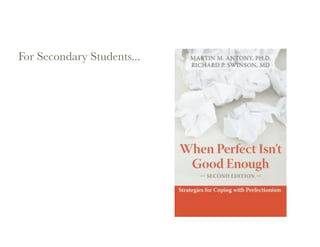
For Secondary Students...
CALMING TECHNIQUES
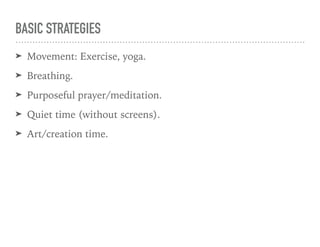
BASIC STRATEGIES
➤ Movement: Exercise, yoga.
➤ Breathing.
➤ Purposeful prayer/meditation.
➤ Quiet time (without screens).
➤ Art/creation time.
OVERVIEW &
CONCLUSIONS
TODAY, WE DISCUSSED…
➤ Perceptions of Stress
➤ Internal v. External Pressures
➤ Perfectionism
➤ Cognitive Distortions
➤ Strategies for each
AT THE END OF THE DAY…
DO YOU WANT TO BE
STRESS FREE?
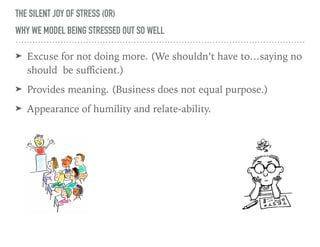
THE SILENT JOY OF STRESS (OR)
WHY WE MODEL BEING STRESSED OUT SO WELL
➤ Excuse for not doing more. (We shouldn’t have to…saying no
should be sufficient.)
➤ Provides meaning. (Business does not equal purpose.)
➤ Appearance of humility and relate-ability.
YOU ARE MODELING
HOW TO DEAL WITH
STRESS.
Your modeling is as important as your direct teaching of strategies for helping students.
THANK YOU.
lmrubenstein@bsu.edu

Stress and the High Achieving Student

  • 1.
    STRESS & THEHIGH ACHIEVING CHILD Lisa DaVia Rubenstein, Ph.D. Saint Simon the Apostle January 9, 2017
  • 2.
    How stressed areyou right now? Why? 1
 Perfectly Calm 10 Extraordinarily Stressed
  • 3.
    To what extentis stress is harmful for your health? 1
 Extraordinarily Helpful 10 Extraordinarily Harmful
  • 4.
    30,000 Americans A LOTOF STRESS 43% increased chance of dying BUT….
  • 5.
    30,000 Americans A LOTOF STRESS 43% increased chance of dying Belief that stress is harmful. &
  • 6.
    “People who experienceda lot of stress but did not view stress as harmful were no more likely to die. In fact, they had the lowest risk of dying of anyone in the study, including those who had relatively little stress. -Kelly McGonigal (TED talk)
  • 7.
    YOUR PERCEPTION OF STRESSMATTERS. WE CAN MODEL THIS. WE CAN TEACH THIS. &
  • 8.
  • 9.
    TODAY… ➤ Perceptions ofStress ➤ Internal v. External Pressures ➤ Perfectionism ➤ Cognitive Distortions ➤ Strategies for each
  • 10.
    WHAT WOULD HAPPENIF YOU DIDN’T FEEL STRESS?
  • 11.
    WHAT WOULD HAPPENIF YOU DIDN’T FEEL STRESS? 1. Stress is very useful. It is built it to help us respond to our environment, to help us rise to the challenges. 2. Yet, stress can be harmful. 3. Sometimes, however, stress becomes a way to make ourselves feel important. (More later…)
  • 12.
  • 13.
    The goal isnot to eliminate stress, but rather to create ways to leverage it to work for us.
  • 14.
    How does mindsettheory mirror this concept?
  • 15.
    MINDSET TOWARDS INTELLIGENCE ➤Growth mindset: Promotes positive risk-taking, enjoyment of challenges… (Recognition of the importance of effort) ➤ Fixed mindset: Promotes avoidance of risks, self-handicapping strategies, and fear of challenges… (Recognition of the importance of ability)
  • 16.
    MINDSETS TOWARDS STRESS(PERCEPTIONS) ➤ Growth mindset: Stress is useful for growth. ➤ Promotes positive risk-taking, enjoyment of challenges… (Recognition of the importance of effort) ➤ Fixed mindset: Stress is bad. ➤ Promotes avoidance of risks, self-handicapping strategies, and fear of challenges… (Recognition of the importance of ability)
  • 17.
    WHAT CAN YOUDO WITH THIS INFORMATION? ➤ Learn to hear/recognize when you are stressed. ➤ Recognize your feelings. Don’t panic. ➤ Realize that your stressed feelings are good for you. They are helping you to prepare for the challenge. ➤ Develop plan.
  • 18.
  • 19.
    TEACHING STUDENTS… ➤ Howstressed are you? ➤ Remember, this stress can be helpful. ➤ How will you use this stress to rise to the challenge? When? Study guides for tests. Journals. Morning meetings and work. The more you model, the more automatic it will become. When would work for you?
  • 20.
    Show them a13 minute TED talk…
  • 21.
    HOW TO USESTRESS TO RISE TO THE CHALLENGE? Optimists? Pessimists?VS.
  • 22.
    MENTAL CONTRASTING ANDIMPLEMENTATION INTENTIONS (MCII) ➤ Visualize your end goal. ➤ Envision obstacles. ➤ Use “if…then…” statements to develop a plan to overcome the obstacles. Better title for students?
  • 23.
    FIRST: VISUALIZE YOUREND GOAL. ➤ Journal. (Describe what it would be like to…) ➤ Draw. (Draw yourself having a good day. Draw yourself being successful on the next test…)
  • 24.
    LET’S TRY IT… ➤Visualize end goal: Get an A on my test. ➤ Obstacles: ➤ If/Then Statements: ➤ Visualize end goal: Get in shape. ➤ Obstacles: ➤ If/Then Statements: OR
  • 25.
    LET’S TRY IT… ➤Visualize end goal: Get an A on my test. ➤ Obstacles: Friends, lack of focus, too much information. ➤ If/Then Statements: ➤ If my friends are texting, I will respond that I need to study and then I will hide my phone from myself. ➤ If I can’t focus, I will move locations, I will remove my distractions, I will set a timer. ➤ If there is too much information, I will break it down and study a little everyday. I will pretend to teach one section every night to my stuffed animals…
  • 26.
    STRESS V. ANXIETY? ➤Stress is the body’s reaction to a circumstance or situation that requires physical, mental, or emotional adjustment or response. It could be caused by negative or positive changes. ➤ Anxiety disorders are the most common mental illness in America, affecting 18% of US population, and almost 30% of Americans across the lifespan. ➤ Anxiety is a feeling of fear, unease, worry when situations are perceived as uncontrollable, unavoidable. Most common symptoms of anxiety are insistent worrying, phobias, social anxiety, and OCD. Others include: chest pain, dizziness, shortness of breath, and panic attacks.
  • 27.
    YET…MINDSET AGAIN??? Research fromAlison Wood Brooks from Harvard Business School I am anxious! ANXIETY EXCITEMENT DEPRESSION CALM Positivity Arousal I am excited!
  • 28.
    YET…MINDSET AGAIN??? Research fromAlison Wood Brooks from Harvard Business School I am anxious! ANXIETY EXCITEMENT DEPRESSION CALM Positivity Arousal I am excited! Predict how this switch affected people singing, doing math, or giving a speech.
  • 29.
    YET…MINDSET AGAIN??? Research fromAlison Wood Brooks from Harvard Business School I am anxious! ANXIETY EXCITEMENT DEPRESSION CALM Positivity Arousal I am excited! 17% 22% 17% Threat Opportunity
  • 30.
  • 31.
    PERCEPTIONS OF STRESSARE IMPORTANT. WHAT OTHER FACTORS MAY INFLUENCE THE STRESS LEVEL OF HIGH ACHIEVING STUDENTS?
  • 32.
  • 33.
    What are theinternal and external pressures that may be too much for students’ available resources?
  • 34.
    INTERNAL ➤ Perceptions ➤ Feelingsof Lack of Control ➤ Perfectionism ➤ Lack of Mental Processing Resources EXTERNAL ➤ Teachers ➤ Standardized Assessments ➤ Parents (Family events, expectations…) ➤ Church ➤ Extra-Curricular Activities ➤ Deadlines, Quantity of Work ➤ Peers (and other models) ➤ Perceived v. Actual
  • 35.
  • 36.
    Think of astudent who you would classify as a perfectionist. How do you know? What characteristics does this student display?
  • 37.
    TYPES OF PERFECTIONISM ➤Healthy (Silverman; Schuler; many others…) ➤ Unhealthy ➤ Self-oriented (Hewitt & Flett) ➤ Others-oriented ➤ Socially-prescribed ➤ Personal standards (Frost et al.) ➤ Concern over mistakes Think back to your student. How would you classify this student?
  • 38.
    How does theenvironment promote perfectionism? How does perfectionism contribute to stress?
  • 39.
    2 OPTIONS ASA TEACHER… Consider the messages you are sending. Teach students to manage perfectionism.
  • 40.
    MESSAGES TEACHERS SEND… ➤What kind of feedback do you give? ➤ What papers do you hang in the classroom? ➤ How many opportunities do students have to resubmit work? ➤ What happens when you make a mistake? ➤ How often does the best student fail? ➤ How much autonomy do students have?
  • 41.
    TEACHING STUDENTS TOMANAGE THEIR OWN PERFECTIONISM ➤ General Self-Talk ➤ More specific: Cognitive Distortions ➤ Cognitive Behavior Therapy (CBT) ➤ Remember: Counselors can help anyone! This is not defeat. This is strength.
  • 42.
  • 43.
    “Cognitive distortions arespecific examples of negative self-talk.
  • 45.
    #1: ALL ORNONE THINKING
  • 47.
    Do you haveany examples of students’ all-or-none thinking?
  • 48.
    HEALTHY ALTERNATIVES ➤ Recognizethe distortion. ➤ Compartmentalize 1. What is the middle ground? ➤ Compartmentalize 2. What are things to be good at? What are things that it is okay not to be perfect in? ➤ Create a plan.
  • 49.
  • 50.
  • 51.
    HEALTHY ALTERNATIVES ➤ Recognizethe distortion. ➤ Reflect/journal on the following: ➤ Who says you have to be perfect? ➤ What will your parents think if you are not perfect? ➤ What will your teachers think if you are not perfect? ➤ Ask the person. Discuss. ➤ Feedback filter (selective listening/actively ignoring): ➤ What is helpful? What can I use to get better? ➤ Everything else: Let go. Why might “Just do your best.” be a dangerous phrase for a perfectionist?
  • 52.
  • 53.
    Do you haveany examples of students’ “shoulds” thinking?
  • 54.
    “If one failsto meet the unrealistic expectation, one has failed; but if one does meet it, one feels no glow of achievement for one has only done what was expected. (Weisinger & Lobsenz, 1981, p.281)
  • 55.
    HEALTHY ALTERNATIVES ➤ Recognizethe distortion. ➤ Consider: How much can you do? Think back to all-or-none thinking. Some is better than nothing. ➤ Goal: Promote realistic thinking. ➤ Create a realistic plan. (Perhaps, still a little aspirational, but not so much so that they feel like a failure.) ➤ Celebrate effort.
  • 56.
  • 57.
    GENERAL OVERARCHING STEPS ➤Learn to hear/recognize when you are stressed. ➤ Recognize your feelings. Don’t panic. ➤ Consider the causes. What internal voices do you hear? What cognitive distortions are present? ➤ Talk it back with a healthier internal voice. ➤ Consider what actions you can control. ➤ Consider how you can perceive the situation. ➤ Try to maintain the healthier perspective. Set goals. ➤ Be proactive in addressing stress. (see calming techniques…)
  • 58.
    “It is okayto feel ______. You can handle that feeling. Just let it be.
  • 59.
    Fiction ➤ Botner, B.(1986). The world's greatest expert on absolutely everything. New York: Dell. (intermediate/ adolescent fiction) ➤ Cosgrove, S. (1989). Persnickity. Vero Beach, PL.: Rourke Enterprises. (young juvenile fiction) ➤ Lobel, A. (1980). Fables. New York: Harper and Row. (juvenile fiction) ➤ Manes, S. (1982). Be a perfect person in just three days! Boston: Houghton-Mifflin. (intermediate fiction) ➤ Smith, D. B. (1978). Dreams and drummers. New York: Thomas Y. Crowell. (adolescent fiction: perfectionist comes in second) ➤ Waber, B. (1971). Nobody is perfick. New York: Houghton Mifflin Company. Non-Fiction ➤ Jones, C. F. (1991). Mistakes that worked: 40 familiar inventions and how they came to be. New York: Bantam Doubleday Dell Publishing Group, Inc. ➤ Quindlen, A. (2005). Being Perfect. New York: Random House. BIBLIOTHERAPY
  • 60.
  • 61.
  • 62.
    BASIC STRATEGIES ➤ Movement:Exercise, yoga. ➤ Breathing. ➤ Purposeful prayer/meditation. ➤ Quiet time (without screens). ➤ Art/creation time.
  • 63.
  • 64.
    TODAY, WE DISCUSSED… ➤Perceptions of Stress ➤ Internal v. External Pressures ➤ Perfectionism ➤ Cognitive Distortions ➤ Strategies for each
  • 65.
    AT THE ENDOF THE DAY… DO YOU WANT TO BE STRESS FREE?
  • 66.
    THE SILENT JOYOF STRESS (OR) WHY WE MODEL BEING STRESSED OUT SO WELL ➤ Excuse for not doing more. (We shouldn’t have to…saying no should be sufficient.) ➤ Provides meaning. (Business does not equal purpose.) ➤ Appearance of humility and relate-ability.
  • 67.
    YOU ARE MODELING HOWTO DEAL WITH STRESS. Your modeling is as important as your direct teaching of strategies for helping students.
  • 68.