Differentiated Instruction Presented by: Tina Holtz Family and Consumer Sciences Educator DeKalb High School
What is Differentiated Instruction? A flexible approach to teaching in which the teacher plans and carries out varied approaches to content, process, and product in anticipation of and in response to student differences in readiness, interests, and learning needs. In short… Moving away from “single sized” education Forming the curriculum to meet the needs of individual children instead of forcing all children to fit the same mold.
Differentiated Instruction IS NOT… The rebirth of individualized instruction (a different method for all 30 of your students) Complete chaos, willy-nilly rules, lack of discipline, feel-good praise for undeserving work Tracking or another way to group homogeneously  Cutting the assignment in half for some, and adding problems to the assignment for others.
Why differentiate?  Isn’t it just for special needs students? No!   Differentiating curriculum benefits all students!  “… EVERY student has special needs at some time (or many times) in a school day, a school year, and a school life.”  (Wormeli, 2007)
Where did differentiation come from? One room school houses were early examples of differentiation!  Multiple grade levels, vastly different needs and one teacher! D.I. is based on brain research about memory processing, DI is influenced by… Gardner’s Multiple Intelligence Theory. Gregoric’s Thinking Styles Kolb’s Learning Styles Model Bloom’s Taxonomy
How do I differentiate as the teacher? Differentiate (multiple paths to reach the same objectives) your classroom by examining the following elements of curriculum: (1) Content - input,  what  the students learn (2) Process -  how  students go about making sense of ideas and information (3) Product - Output, how students  demonstrate  what they have learned
Fresh Idea! Add a blank page to the back of your final assessments where a student can demonstrate what they know about the topic.  This prevents the student from feeling that their hard work did not not pay off because “What they studied and know what not on the test,” or they didn’t understand the format of the assessment.  The information the student provides should not be information that was given on the test.
Things to keep in mind while planning and teaching… There is a time for choice and a time for teacher directed activities When students are given choices in all situations, “There strengths become stronger, and their weaknesses become weaker.” (Chapman, 2005)  Students should be engaged in activity during all lessons Lessons should emphasize critical and creative thinking Be clear on key concepts and “big ideas” to help students form a framework for their new information
What about when the people say, “We are not preparing them for the real world!” Differentiated instruction (done right)… Guides students to think on their own Helps students accept significant responsibility for learning Develop a sense of pride in what they do Makes learners an active participant in their evaluations Prepares students for a better quality of life
What is assessment in DI terms? Used to gauge individual learning An ongoing process that occurs before, during and after instruction Identifies a learners needs and strengths Assessment is  not  the “gotcha” unit test to see if they studied. When planning assessment in your classroom keep the following acronym in mind…
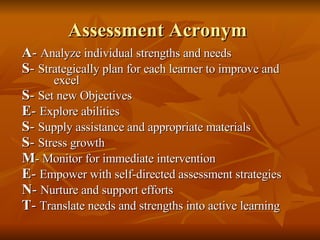
Assessment Acronym  A -  Analyze individual strengths and needs S -  Strategically plan for each learner to improve and  excel S -  Set new Objectives E -  Explore abilities S -  Supply assistance and appropriate materials S -  Stress growth M - Monitor for immediate intervention E -  Empower with self-directed assessment strategies N -  Nurture and support efforts T -  Translate needs and strengths into active learning
Now to the question you all have in your head… How can this help us meet AYP and maintain our autonomy as a district?!
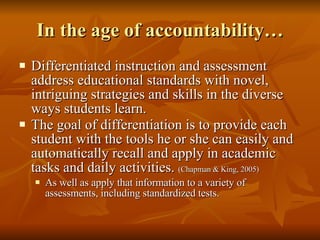
In the age of accountability… Differentiated instruction and assessment address educational standards with novel, intriguing strategies and skills in the diverse ways students learn. The goal of differentiation is to provide each student with the tools he or she can easily and automatically recall and apply in academic tasks and daily activities.  (Chapman & King, 2005) As well as apply that information to a variety of assessments, including standardized tests.
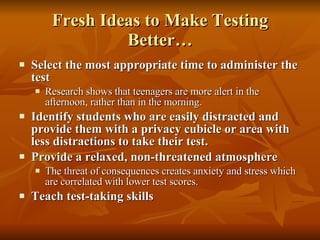
Fresh Ideas to Make Testing Better… Select the most appropriate time to administer the test Research shows that teenagers are more alert in the afternoon, rather than in the morning. Identify students who are easily distracted and provide them with a privacy cubicle or area with less distractions to take their test. Provide a relaxed, non-threatened atmosphere The threat of consequences creates anxiety and stress which are correlated with lower test scores. Teach test-taking skills
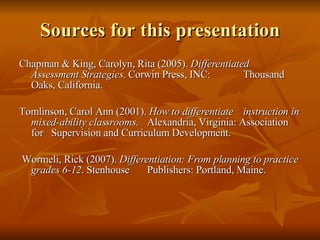
Sources for this presentation Chapman & King, Carolyn, Rita (2005).  Differentiated  Assessment Strategies . Corwin Press, INC:  Thousand Oaks, California.  Tomlinson, Carol Ann (2001).  How to differentiate  instruction in mixed-ability classrooms .  Alexandria, Virginia: Association for  Supervision and Curriculum Development.    Wormeli, Rick (2007).  Differentiation: From planning to practice grades 6-12 . Stenhouse  Publishers: Portland, Maine.
Resources for further development A fantastic article!  “Finding manageable ways to meet individual needs”  http://www.ascd.org/ed_topics/cu2000win_willis.html Some fun upper level strategies to try out… http://www.newhorizons.org/lifelong/adolescence/weber.htm Differentiation explained in plain english! http://www.teach-nology.com/tutorials/teaching/differentiate/print.htm Awesome website sources for just about any subjcet and level! http:// school.discovery.com/schrockguide /

Di Powerpoint

  • 1.
    Differentiated Instruction Presentedby: Tina Holtz Family and Consumer Sciences Educator DeKalb High School
  • 2.
    What is DifferentiatedInstruction? A flexible approach to teaching in which the teacher plans and carries out varied approaches to content, process, and product in anticipation of and in response to student differences in readiness, interests, and learning needs. In short… Moving away from “single sized” education Forming the curriculum to meet the needs of individual children instead of forcing all children to fit the same mold.
  • 3.
    Differentiated Instruction ISNOT… The rebirth of individualized instruction (a different method for all 30 of your students) Complete chaos, willy-nilly rules, lack of discipline, feel-good praise for undeserving work Tracking or another way to group homogeneously Cutting the assignment in half for some, and adding problems to the assignment for others.
  • 4.
    Why differentiate? Isn’t it just for special needs students? No! Differentiating curriculum benefits all students! “… EVERY student has special needs at some time (or many times) in a school day, a school year, and a school life.” (Wormeli, 2007)
  • 5.
    Where did differentiationcome from? One room school houses were early examples of differentiation! Multiple grade levels, vastly different needs and one teacher! D.I. is based on brain research about memory processing, DI is influenced by… Gardner’s Multiple Intelligence Theory. Gregoric’s Thinking Styles Kolb’s Learning Styles Model Bloom’s Taxonomy
  • 6.
    How do Idifferentiate as the teacher? Differentiate (multiple paths to reach the same objectives) your classroom by examining the following elements of curriculum: (1) Content - input, what the students learn (2) Process - how students go about making sense of ideas and information (3) Product - Output, how students demonstrate what they have learned
  • 7.
    Fresh Idea! Adda blank page to the back of your final assessments where a student can demonstrate what they know about the topic. This prevents the student from feeling that their hard work did not not pay off because “What they studied and know what not on the test,” or they didn’t understand the format of the assessment. The information the student provides should not be information that was given on the test.
  • 8.
    Things to keepin mind while planning and teaching… There is a time for choice and a time for teacher directed activities When students are given choices in all situations, “There strengths become stronger, and their weaknesses become weaker.” (Chapman, 2005) Students should be engaged in activity during all lessons Lessons should emphasize critical and creative thinking Be clear on key concepts and “big ideas” to help students form a framework for their new information
  • 9.
    What about whenthe people say, “We are not preparing them for the real world!” Differentiated instruction (done right)… Guides students to think on their own Helps students accept significant responsibility for learning Develop a sense of pride in what they do Makes learners an active participant in their evaluations Prepares students for a better quality of life
  • 10.
    What is assessmentin DI terms? Used to gauge individual learning An ongoing process that occurs before, during and after instruction Identifies a learners needs and strengths Assessment is not the “gotcha” unit test to see if they studied. When planning assessment in your classroom keep the following acronym in mind…
  • 11.
    Assessment Acronym A - Analyze individual strengths and needs S - Strategically plan for each learner to improve and excel S - Set new Objectives E - Explore abilities S - Supply assistance and appropriate materials S - Stress growth M - Monitor for immediate intervention E - Empower with self-directed assessment strategies N - Nurture and support efforts T - Translate needs and strengths into active learning
  • 12.
    Now to thequestion you all have in your head… How can this help us meet AYP and maintain our autonomy as a district?!
  • 13.
    In the ageof accountability… Differentiated instruction and assessment address educational standards with novel, intriguing strategies and skills in the diverse ways students learn. The goal of differentiation is to provide each student with the tools he or she can easily and automatically recall and apply in academic tasks and daily activities. (Chapman & King, 2005) As well as apply that information to a variety of assessments, including standardized tests.
  • 14.
    Fresh Ideas toMake Testing Better… Select the most appropriate time to administer the test Research shows that teenagers are more alert in the afternoon, rather than in the morning. Identify students who are easily distracted and provide them with a privacy cubicle or area with less distractions to take their test. Provide a relaxed, non-threatened atmosphere The threat of consequences creates anxiety and stress which are correlated with lower test scores. Teach test-taking skills
  • 15.
    Sources for thispresentation Chapman & King, Carolyn, Rita (2005). Differentiated Assessment Strategies . Corwin Press, INC: Thousand Oaks, California. Tomlinson, Carol Ann (2001). How to differentiate instruction in mixed-ability classrooms . Alexandria, Virginia: Association for Supervision and Curriculum Development.   Wormeli, Rick (2007). Differentiation: From planning to practice grades 6-12 . Stenhouse Publishers: Portland, Maine.
  • 16.
    Resources for furtherdevelopment A fantastic article! “Finding manageable ways to meet individual needs” http://www.ascd.org/ed_topics/cu2000win_willis.html Some fun upper level strategies to try out… http://www.newhorizons.org/lifelong/adolescence/weber.htm Differentiation explained in plain english! http://www.teach-nology.com/tutorials/teaching/differentiate/print.htm Awesome website sources for just about any subjcet and level! http:// school.discovery.com/schrockguide /