Arc welding
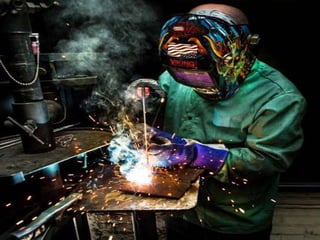
• Arc welding is one of the most common kinds of welding.
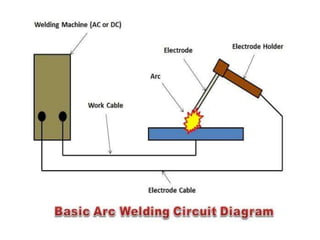
• The concentrated heat of an electric arc joins metal by
fusing the parent metal to a joint using a consumable
electrode.
• Direct or alternating current could be used, and which one
depends on the welding material and the electrode.
• There are different types of Arc Welding
•
Gas metal arc welding (GMAW)
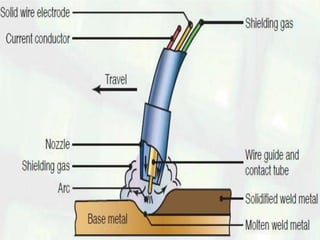
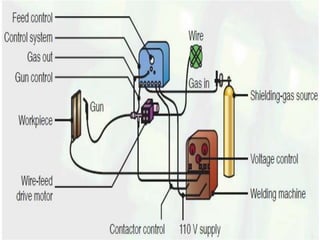
• Gas metal arc welding, also known as MIG welding, shields the
welding arc with a gas such as argon or helium or even a
mixture.
• Deoxidizers in the electrodes can prevent oxidation which
makes it possible to weld mulitple layers.
• It’s a simple, versatile, and economical welding process.
• The temperatures are also relatively low and it is used for thin
sheet and sections.
• It can easily be automated.
•
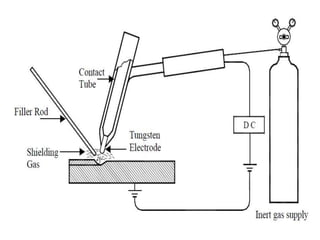
Gas tungsten arc welding (GTAW)
• Gas tungsten arc welding is also known as TIG welding.
• It uses tungsten electrodes as one pole of the arc in order to
create the required heat.
• The gas is argon, helium, or a mixture of those two. Filler
wires provide the molten material if it is necessary.
• This process is good for thin materials and the filler wires
are similar in composition to whatever is being welded.
•
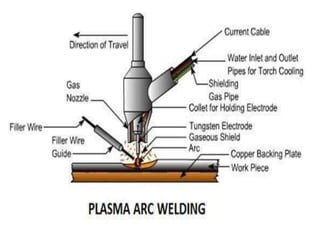
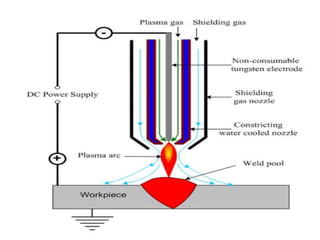
Plasma arc welding (PAW)
• Plasma arc welding has ionized gases and
electrodes that generate hot plasma jets that are
aimed at the welding area.
• These jets are extremely hot.
• The concentration of higher energy is good for
narrower and deeper welds as well as an increase
in welding speeds.
•
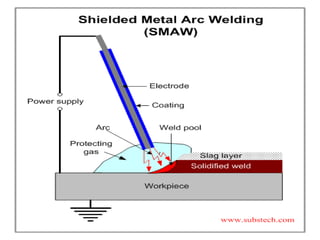
Shielded metal arc welding (SMAW)
• Shielded metal arc welding is one of the simplest, oldest, and
most versatile welding methods.
• The arc comes from a coated electrode tip being touched to the
workpiece and then withdrawn to maintain the arc.
• The heat that is generated melts the tip, coating, and base metal
and the weld is formed out of that alloy when it solidifies.
• Slag that is formed and protects the weld from oxides, inclusions,
and nitrides has to be removed after every pass.
• This is commonly used in pipeline work, shipbuilding, and
construction.
•
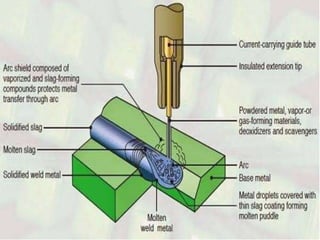
Flux-cored arc welding (FCAW)
• Flux-cored arc welding uses tubular electrodes that are filled
with flux.
• It’s much less brittle than the coatings on SMAW electrodes
and preserves most of the alloying benefits.
• The emissive fluxes shield the welding arc from the air, or
shielding gases might be used if nonemissive fluxes are
required.
• It’s popular when welding heavy sections an inch or more
thick thanks to the higher weld-metal deposition rate.
•
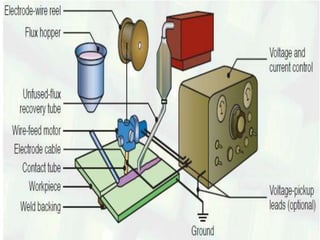
Submerged arc welding (SAW)
• Submerged arc welding has a granular flux that is fed into the weld
zone that forms a thick layer, completely covering the molten zone
and preventing sparks and spatter.
• It allows for deeper heat penetration since it acts like a thermal
insulator.
• The process is limited to horizontal welds and used for high speed
sheet or plate steel welding.
• It can be semiautomatic or automatic.
• The flux can be recovered and treated then used again.
• This method provides 4-10 times as much productivity as shielded
metal arc welding.
Arc welding
Arc welding
Arc welding

Arc welding

  • 2.
    Arc welding • Arcwelding is one of the most common kinds of welding. • The concentrated heat of an electric arc joins metal by fusing the parent metal to a joint using a consumable electrode. • Direct or alternating current could be used, and which one depends on the welding material and the electrode. • There are different types of Arc Welding •
  • 5.
    Gas metal arcwelding (GMAW) • Gas metal arc welding, also known as MIG welding, shields the welding arc with a gas such as argon or helium or even a mixture. • Deoxidizers in the electrodes can prevent oxidation which makes it possible to weld mulitple layers. • It’s a simple, versatile, and economical welding process. • The temperatures are also relatively low and it is used for thin sheet and sections. • It can easily be automated. •
  • 7.
    Gas tungsten arcwelding (GTAW) • Gas tungsten arc welding is also known as TIG welding. • It uses tungsten electrodes as one pole of the arc in order to create the required heat. • The gas is argon, helium, or a mixture of those two. Filler wires provide the molten material if it is necessary. • This process is good for thin materials and the filler wires are similar in composition to whatever is being welded. •
  • 10.
    Plasma arc welding(PAW) • Plasma arc welding has ionized gases and electrodes that generate hot plasma jets that are aimed at the welding area. • These jets are extremely hot. • The concentration of higher energy is good for narrower and deeper welds as well as an increase in welding speeds. •
  • 13.
    Shielded metal arcwelding (SMAW) • Shielded metal arc welding is one of the simplest, oldest, and most versatile welding methods. • The arc comes from a coated electrode tip being touched to the workpiece and then withdrawn to maintain the arc. • The heat that is generated melts the tip, coating, and base metal and the weld is formed out of that alloy when it solidifies. • Slag that is formed and protects the weld from oxides, inclusions, and nitrides has to be removed after every pass. • This is commonly used in pipeline work, shipbuilding, and construction. •
  • 15.
    Flux-cored arc welding(FCAW) • Flux-cored arc welding uses tubular electrodes that are filled with flux. • It’s much less brittle than the coatings on SMAW electrodes and preserves most of the alloying benefits. • The emissive fluxes shield the welding arc from the air, or shielding gases might be used if nonemissive fluxes are required. • It’s popular when welding heavy sections an inch or more thick thanks to the higher weld-metal deposition rate. •
  • 17.
    Submerged arc welding(SAW) • Submerged arc welding has a granular flux that is fed into the weld zone that forms a thick layer, completely covering the molten zone and preventing sparks and spatter. • It allows for deeper heat penetration since it acts like a thermal insulator. • The process is limited to horizontal welds and used for high speed sheet or plate steel welding. • It can be semiautomatic or automatic. • The flux can be recovered and treated then used again. • This method provides 4-10 times as much productivity as shielded metal arc welding.