Different Methods of Water
Storage
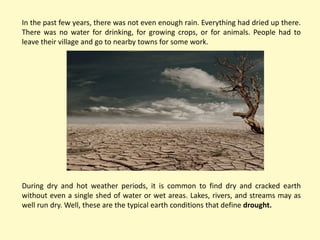
In the past few years, there was not even enough rain. Everything had dried up there.
There was no water for drinking, for growing crops, or for animals. People had to
leave their village and go to nearby towns for some work.
During dry and hot weather periods, it is common to find dry and cracked earth
without even a single shed of water or wet areas. Lakes, rivers, and streams may as
well run dry. Well, these are the typical earth conditions that define drought.
When plants do not grow, agriculture suffers and famers are not able to grow enough
food to sell and make money. This leads to people getting poorer. There is lack of food
in the region, causing a famine.
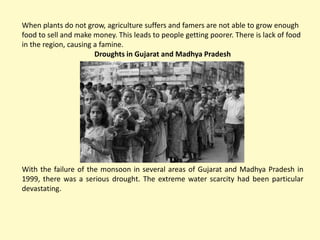
Droughts in Gujarat and Madhya Pradesh
With the failure of the monsoon in several areas of Gujarat and Madhya Pradesh in
1999, there was a serious drought. The extreme water scarcity had been particular
devastating.
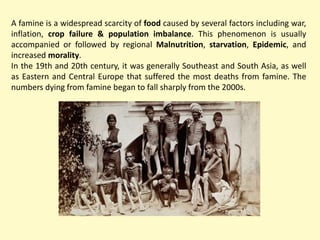
A famine is a widespread scarcity of food caused by several factors including war,
inflation, crop failure & population imbalance. This phenomenon is usually
accompanied or followed by regional Malnutrition, starvation, Epidemic, and
increased morality.
In the 19th and 20th century, it was generally Southeast and South Asia, as well
as Eastern and Central Europe that suffered the most deaths from famine. The
numbers dying from famine began to fall sharply from the 2000s.
Causes of Drought
Rainfall or Precipitation Deficiency:
Droughts take place whenever there is prolonged periods of rainfall deficiency for a season
or more and usually when there is a lack of anticipated rainfall or precipitation. ... Farmers,
for instance, plant in expectation of rain and so when it doesn't rain as expected, drought
conditions are experienced.
Human Causes
Human activities play a relatively significant role in the management of the water cycle.
Human acts such as deforestation, construction, and agriculture negatively impact the
water cycle. Trees and vegetation cover are essential for the water cycle as it helps to limit
evaporation, stores water, and attracts rainfall.
Drying out of Surface Water Flow
Lakes, rivers, and streams are the primary suppliers of downstream surface waters in
various geographical regions around the globe. In extremely hot seasons or because of
certain human activities, these surface water flows may dry out downstream contributing
to drought – meaning the demands for water supply become higher than the available
water.
Global Warming
Human actions have contributed to more and more emissions of greenhouse gasses into
the atmosphere thus resulting in the continued rise of the earth’s average temperatures.
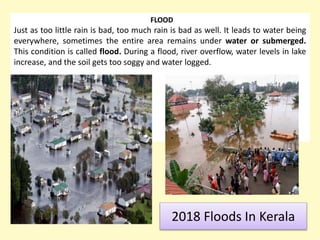
FFLOOD
Just as too little rain is bad, too much rain is bad as well. It leads to water being
everywhere, sometimes the entire area remains under water or submerged.
This condition is called flood. During a flood, river overflow, water levels in lake
increase, and the soil gets too soggy and water logged.
2018 Floods In Kerala
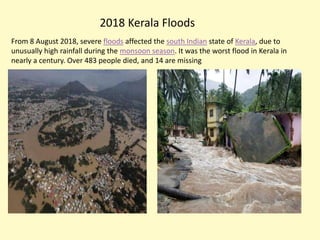
2018 Kerala Floods
From 8 August 2018, severe floods affected the south Indian state of Kerala, due to
unusually high rainfall during the monsoon season. It was the worst flood in Kerala in
nearly a century. Over 483 people died, and 14 are missing
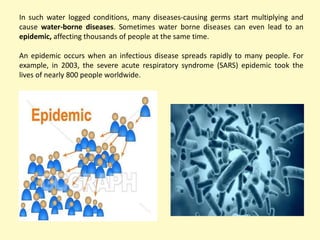
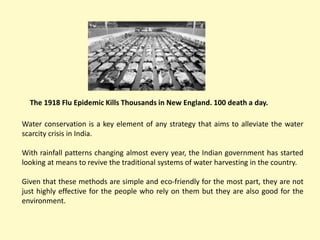
In such water logged conditions, many diseases-causing germs start multiplying and
cause water-borne diseases. Sometimes water borne diseases can even lead to an
epidemic, affecting thousands of people at the same time.
An epidemic occurs when an infectious disease spreads rapidly to many people. For
example, in 2003, the severe acute respiratory syndrome (SARS) epidemic took the
lives of nearly 800 people worldwide.
The 1918 Flu Epidemic Kills Thousands in New England. 100 death a day.
Water conservation is a key element of any strategy that aims to alleviate the water
scarcity crisis in India.
With rainfall patterns changing almost every year, the Indian government has started
looking at means to revive the traditional systems of water harvesting in the country.
Given that these methods are simple and eco-friendly for the most part, they are not
just highly effective for the people who rely on them but they are also good for the
environment.
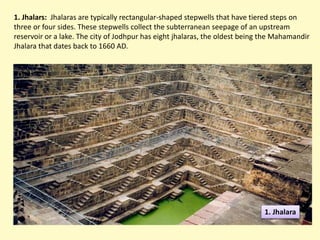
1. Jhalara
1. Jhalars: Jhalaras are typically rectangular-shaped stepwells that have tiered steps on
three or four sides. These stepwells collect the subterranean seepage of an upstream
reservoir or a lake. The city of Jodhpur has eight jhalaras, the oldest being the Mahamandir
Jhalara that dates back to 1660 AD.
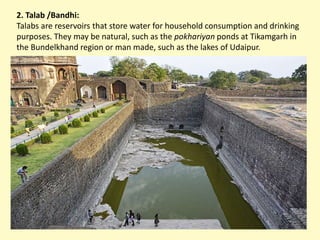
2. Talab /Bandhi:
Talabs are reservoirs that store water for household consumption and drinking
purposes. They may be natural, such as the pokhariyan ponds at Tikamgarh in
the Bundelkhand region or man made, such as the lakes of Udaipur.
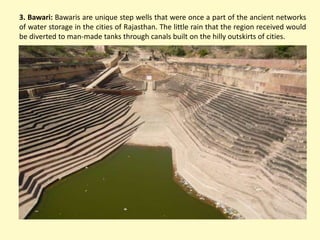
3. Bawari: Bawaris are unique step wells that were once a part of the ancient networks
of water storage in the cities of Rajasthan. The little rain that the region received would
be diverted to man-made tanks through canals built on the hilly outskirts of cities.
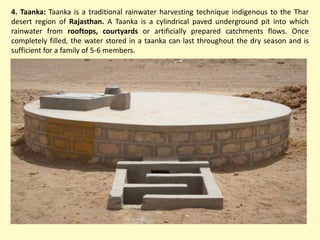
4. Taanka: Taanka is a traditional rainwater harvesting technique indigenous to the Thar
desert region of Rajasthan. A Taanka is a cylindrical paved underground pit into which
rainwater from rooftops, courtyards or artificially prepared catchments flows. Once
completely filled, the water stored in a taanka can last throughout the dry season and is
sufficient for a family of 5-6 members.
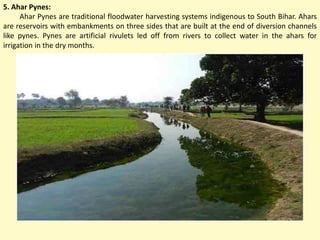
5. Ahar Pynes:
Ahar Pynes are traditional floodwater harvesting systems indigenous to South Bihar. Ahars
are reservoirs with embankments on three sides that are built at the end of diversion channels
like pynes. Pynes are artificial rivulets led off from rivers to collect water in the ahars for
irrigation in the dry months.
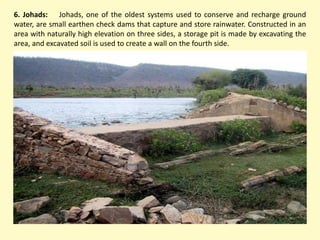
6. Johads: Johads, one of the oldest systems used to conserve and recharge ground
water, are small earthen check dams that capture and store rainwater. Constructed in an
area with naturally high elevation on three sides, a storage pit is made by excavating the
area, and excavated soil is used to create a wall on the fourth side.
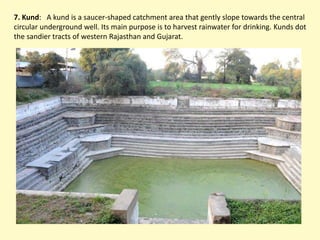
7. Kund: A kund is a saucer-shaped catchment area that gently slope towards the central
circular underground well. Its main purpose is to harvest rainwater for drinking. Kunds dot
the sandier tracts of western Rajasthan and Gujarat.
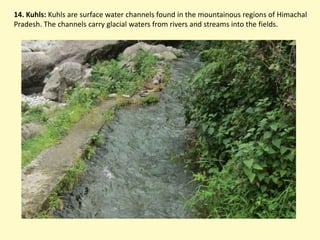
14. Kuhls: Kuhls are surface water channels found in the mountainous regions of Himachal
Pradesh. The channels carry glacial waters from rivers and streams into the fields.
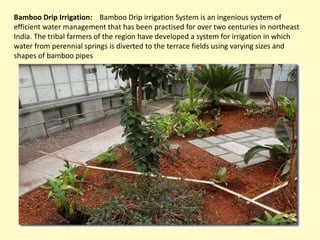
Bamboo Drip Irrigation: Bamboo Drip irrigation System is an ingenious system of
efficient water management that has been practised for over two centuries in northeast
India. The tribal farmers of the region have developed a system for irrigation in which
water from perennial springs is diverted to the terrace fields using varying sizes and
shapes of bamboo pipes
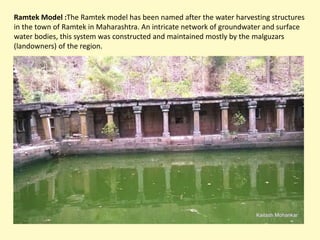
Ramtek Model :The Ramtek model has been named after the water harvesting structures
in the town of Ramtek in Maharashtra. An intricate network of groundwater and surface
water bodies, this system was constructed and maintained mostly by the malguzars
(landowners) of the region.
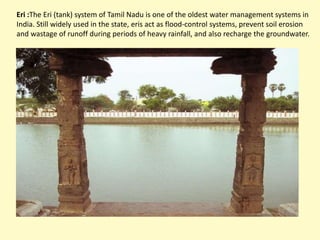
Eri :The Eri (tank) system of Tamil Nadu is one of the oldest water management systems in
India. Still widely used in the state, eris act as flood-control systems, prevent soil erosion
and wastage of runoff during periods of heavy rainfall, and also recharge the groundwater.
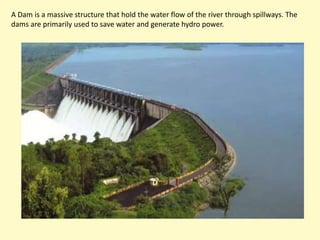
A Dam is a massive structure that hold the water flow of the river through spillways. The
dams are primarily used to save water and generate hydro power.
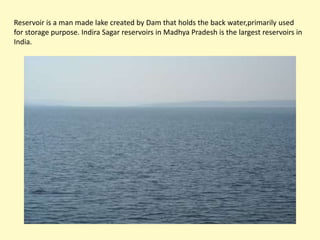
Reservoir is a man made lake created by Dam that holds the back water,primarily used
for storage purpose. Indira Sagar reservoirs in Madhya Pradesh is the largest reservoirs in
India.
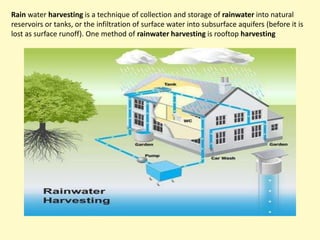
Rain water harvesting is a technique of collection and storage of rainwater into natural
reservoirs or tanks, or the infiltration of surface water into subsurface aquifers (before it is
lost as surface runoff). One method of rainwater harvesting is rooftop harvesting
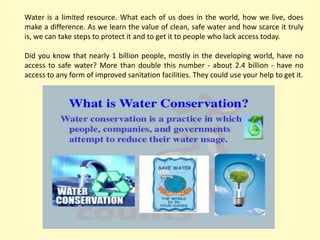
Water is a limited resource. What each of us does in the world, how we live, does
make a difference. As we learn the value of clean, safe water and how scarce it truly
is, we can take steps to protect it and to get it to people who lack access today.
Did you know that nearly 1 billion people, mostly in the developing world, have no
access to safe water? More than double this number - about 2.4 billion - have no
access to any form of improved sanitation facilities. They could use your help to get it.
How to save water: 10 tips for saving water around the home
The majority of household water use comes from toilets, washing machines, showers,
baths, faucets and leaks, but what you can do to save water is fairly simple. These 10
water-saving tips will put you on the path to conserving water in your house hold.
Turn off the tap while brushing your teeth.
Turn off the tap while washing your hands.
Fix your leaks.
Re-use your pasta cooking liquid.
Don’t run the dishwasher or washing machine until it’s full.
Flush with less.
Water outdoor plants in the early morning.
Use less electricity.
Skip the shower from time to time

Different Methods of water storage

  • 1.
    Different Methods ofWater Storage
  • 2.
    In the pastfew years, there was not even enough rain. Everything had dried up there. There was no water for drinking, for growing crops, or for animals. People had to leave their village and go to nearby towns for some work. During dry and hot weather periods, it is common to find dry and cracked earth without even a single shed of water or wet areas. Lakes, rivers, and streams may as well run dry. Well, these are the typical earth conditions that define drought.
  • 3.
    When plants donot grow, agriculture suffers and famers are not able to grow enough food to sell and make money. This leads to people getting poorer. There is lack of food in the region, causing a famine. Droughts in Gujarat and Madhya Pradesh With the failure of the monsoon in several areas of Gujarat and Madhya Pradesh in 1999, there was a serious drought. The extreme water scarcity had been particular devastating.
  • 4.
    A famine isa widespread scarcity of food caused by several factors including war, inflation, crop failure & population imbalance. This phenomenon is usually accompanied or followed by regional Malnutrition, starvation, Epidemic, and increased morality. In the 19th and 20th century, it was generally Southeast and South Asia, as well as Eastern and Central Europe that suffered the most deaths from famine. The numbers dying from famine began to fall sharply from the 2000s.
  • 5.
    Causes of Drought Rainfallor Precipitation Deficiency: Droughts take place whenever there is prolonged periods of rainfall deficiency for a season or more and usually when there is a lack of anticipated rainfall or precipitation. ... Farmers, for instance, plant in expectation of rain and so when it doesn't rain as expected, drought conditions are experienced. Human Causes Human activities play a relatively significant role in the management of the water cycle. Human acts such as deforestation, construction, and agriculture negatively impact the water cycle. Trees and vegetation cover are essential for the water cycle as it helps to limit evaporation, stores water, and attracts rainfall. Drying out of Surface Water Flow Lakes, rivers, and streams are the primary suppliers of downstream surface waters in various geographical regions around the globe. In extremely hot seasons or because of certain human activities, these surface water flows may dry out downstream contributing to drought – meaning the demands for water supply become higher than the available water. Global Warming Human actions have contributed to more and more emissions of greenhouse gasses into the atmosphere thus resulting in the continued rise of the earth’s average temperatures.
  • 6.
    FFLOOD Just as toolittle rain is bad, too much rain is bad as well. It leads to water being everywhere, sometimes the entire area remains under water or submerged. This condition is called flood. During a flood, river overflow, water levels in lake increase, and the soil gets too soggy and water logged. 2018 Floods In Kerala
  • 7.
    2018 Kerala Floods From8 August 2018, severe floods affected the south Indian state of Kerala, due to unusually high rainfall during the monsoon season. It was the worst flood in Kerala in nearly a century. Over 483 people died, and 14 are missing
  • 8.
    In such waterlogged conditions, many diseases-causing germs start multiplying and cause water-borne diseases. Sometimes water borne diseases can even lead to an epidemic, affecting thousands of people at the same time. An epidemic occurs when an infectious disease spreads rapidly to many people. For example, in 2003, the severe acute respiratory syndrome (SARS) epidemic took the lives of nearly 800 people worldwide.
  • 9.
    The 1918 FluEpidemic Kills Thousands in New England. 100 death a day. Water conservation is a key element of any strategy that aims to alleviate the water scarcity crisis in India. With rainfall patterns changing almost every year, the Indian government has started looking at means to revive the traditional systems of water harvesting in the country. Given that these methods are simple and eco-friendly for the most part, they are not just highly effective for the people who rely on them but they are also good for the environment.
  • 10.
    1. Jhalara 1. Jhalars:Jhalaras are typically rectangular-shaped stepwells that have tiered steps on three or four sides. These stepwells collect the subterranean seepage of an upstream reservoir or a lake. The city of Jodhpur has eight jhalaras, the oldest being the Mahamandir Jhalara that dates back to 1660 AD.
  • 11.
    2. Talab /Bandhi: Talabsare reservoirs that store water for household consumption and drinking purposes. They may be natural, such as the pokhariyan ponds at Tikamgarh in the Bundelkhand region or man made, such as the lakes of Udaipur.
  • 12.
    3. Bawari: Bawarisare unique step wells that were once a part of the ancient networks of water storage in the cities of Rajasthan. The little rain that the region received would be diverted to man-made tanks through canals built on the hilly outskirts of cities.
  • 13.
    4. Taanka: Taankais a traditional rainwater harvesting technique indigenous to the Thar desert region of Rajasthan. A Taanka is a cylindrical paved underground pit into which rainwater from rooftops, courtyards or artificially prepared catchments flows. Once completely filled, the water stored in a taanka can last throughout the dry season and is sufficient for a family of 5-6 members.
  • 14.
    5. Ahar Pynes: AharPynes are traditional floodwater harvesting systems indigenous to South Bihar. Ahars are reservoirs with embankments on three sides that are built at the end of diversion channels like pynes. Pynes are artificial rivulets led off from rivers to collect water in the ahars for irrigation in the dry months.
  • 15.
    6. Johads: Johads,one of the oldest systems used to conserve and recharge ground water, are small earthen check dams that capture and store rainwater. Constructed in an area with naturally high elevation on three sides, a storage pit is made by excavating the area, and excavated soil is used to create a wall on the fourth side.
  • 16.
    7. Kund: Akund is a saucer-shaped catchment area that gently slope towards the central circular underground well. Its main purpose is to harvest rainwater for drinking. Kunds dot the sandier tracts of western Rajasthan and Gujarat.
  • 17.
    14. Kuhls: Kuhlsare surface water channels found in the mountainous regions of Himachal Pradesh. The channels carry glacial waters from rivers and streams into the fields.
  • 18.
    Bamboo Drip Irrigation:Bamboo Drip irrigation System is an ingenious system of efficient water management that has been practised for over two centuries in northeast India. The tribal farmers of the region have developed a system for irrigation in which water from perennial springs is diverted to the terrace fields using varying sizes and shapes of bamboo pipes
  • 19.
    Ramtek Model :TheRamtek model has been named after the water harvesting structures in the town of Ramtek in Maharashtra. An intricate network of groundwater and surface water bodies, this system was constructed and maintained mostly by the malguzars (landowners) of the region.
  • 20.
    Eri :The Eri(tank) system of Tamil Nadu is one of the oldest water management systems in India. Still widely used in the state, eris act as flood-control systems, prevent soil erosion and wastage of runoff during periods of heavy rainfall, and also recharge the groundwater.
  • 21.
    A Dam isa massive structure that hold the water flow of the river through spillways. The dams are primarily used to save water and generate hydro power.
  • 22.
    Reservoir is aman made lake created by Dam that holds the back water,primarily used for storage purpose. Indira Sagar reservoirs in Madhya Pradesh is the largest reservoirs in India.
  • 23.
    Rain water harvestingis a technique of collection and storage of rainwater into natural reservoirs or tanks, or the infiltration of surface water into subsurface aquifers (before it is lost as surface runoff). One method of rainwater harvesting is rooftop harvesting
  • 24.
    Water is alimited resource. What each of us does in the world, how we live, does make a difference. As we learn the value of clean, safe water and how scarce it truly is, we can take steps to protect it and to get it to people who lack access today. Did you know that nearly 1 billion people, mostly in the developing world, have no access to safe water? More than double this number - about 2.4 billion - have no access to any form of improved sanitation facilities. They could use your help to get it.
  • 25.
    How to savewater: 10 tips for saving water around the home The majority of household water use comes from toilets, washing machines, showers, baths, faucets and leaks, but what you can do to save water is fairly simple. These 10 water-saving tips will put you on the path to conserving water in your house hold. Turn off the tap while brushing your teeth. Turn off the tap while washing your hands. Fix your leaks. Re-use your pasta cooking liquid. Don’t run the dishwasher or washing machine until it’s full. Flush with less. Water outdoor plants in the early morning. Use less electricity. Skip the shower from time to time