Chapter 4 - Carbon and its Compounds- Activity 4.1
Procedure:
Make a list of ten things you have used or consumed since the morning.
Compile this list with the lists made by your classmates and then sort the items into the
following table.
If there are items that are made up of more than one material, put them into both the
relevant columns.
Things made of metal Things made of glass/clay Others
S. No. Things made of metals Things made of glass/clay Others
(i)
(ii)
(iii)
(iv)
(v)
(vi)
Utensils
Bucket
Mug
Cooking pans
fridge
key chain
iron box
fan
bowl
Test tube
Cooking pans
mirror
Water
cloth
book
bag
Furniture
Soaps and
detergents
Newspaper
food items
Chapter 4 - Carbon and its Compounds- Activity 4.1
Conclusion: Most of the utilities that we use in our daily life are made up of
compounds of carbon. These carbon compounds are called Organic compounds.
Aim : Calculate the difference in the formulae and molecular masses for (a) CH₂OH and
C₂H₂OH (b) C₂H₂OH and C₂H/OH, and (c) C₂H₂OH and C.H.OH.
Chapter 4 - Carbon and its Compounds- Activity 4.2
Compounds Difference in formulae Differences in molecular
masses
CH3OH & C2H5OH -CH2 14u
C2H5OH & C3H7OH -CH2 14u
C3H7OH& C4H9OH. -CH2 14u
2. Yes, all these compounds have -OH group.
3. CH3OH , C2H5OH , C3H7OH, C4H9OH.
All these compounds have -OH group so they are a family and we can call this
family a homologous series because they show a difference in -CH2.
Chapter 4 - Carbon and its Compounds- Activity 4.2
1.Chloro Group – CH3
Cl, C2
H5
Cl , C3
H7
Cl , C4
H9
Cl
2. Aldehyde Group- CH3
CHO, CH3
CHO, CH3
CHO, CH3
CHO
3. Ketone Group – CH3
COCH3
, CH3
CH2
COCH3
, CH3
CH2
CO CH2
CH3
,
CH3
CH2
CH2
CO CH2
CH2
CH3
4. Carboxylic Acid - CH3
COOH, C2
H5
COOH, C3
H7
COOH,
C4
H9
COOH
Conclusion - Now from the above discussion, it is clear that the common difference in the molecular
formula is -CH2
and molecular mass is 14u.
Chapter 4 - Carbon and its Compounds- Activity 4.3
Caution: This activity needs the teacher’s assistance.
· Take some carbon compounds (naphthalene, camphor, alcohol) one by one on a spatula and burn them.
·Observe the nature of the flame and note whether smoke is produced.
· Place a metal plate above the flame. Is there a deposition on the plate in case of any of the compounds?
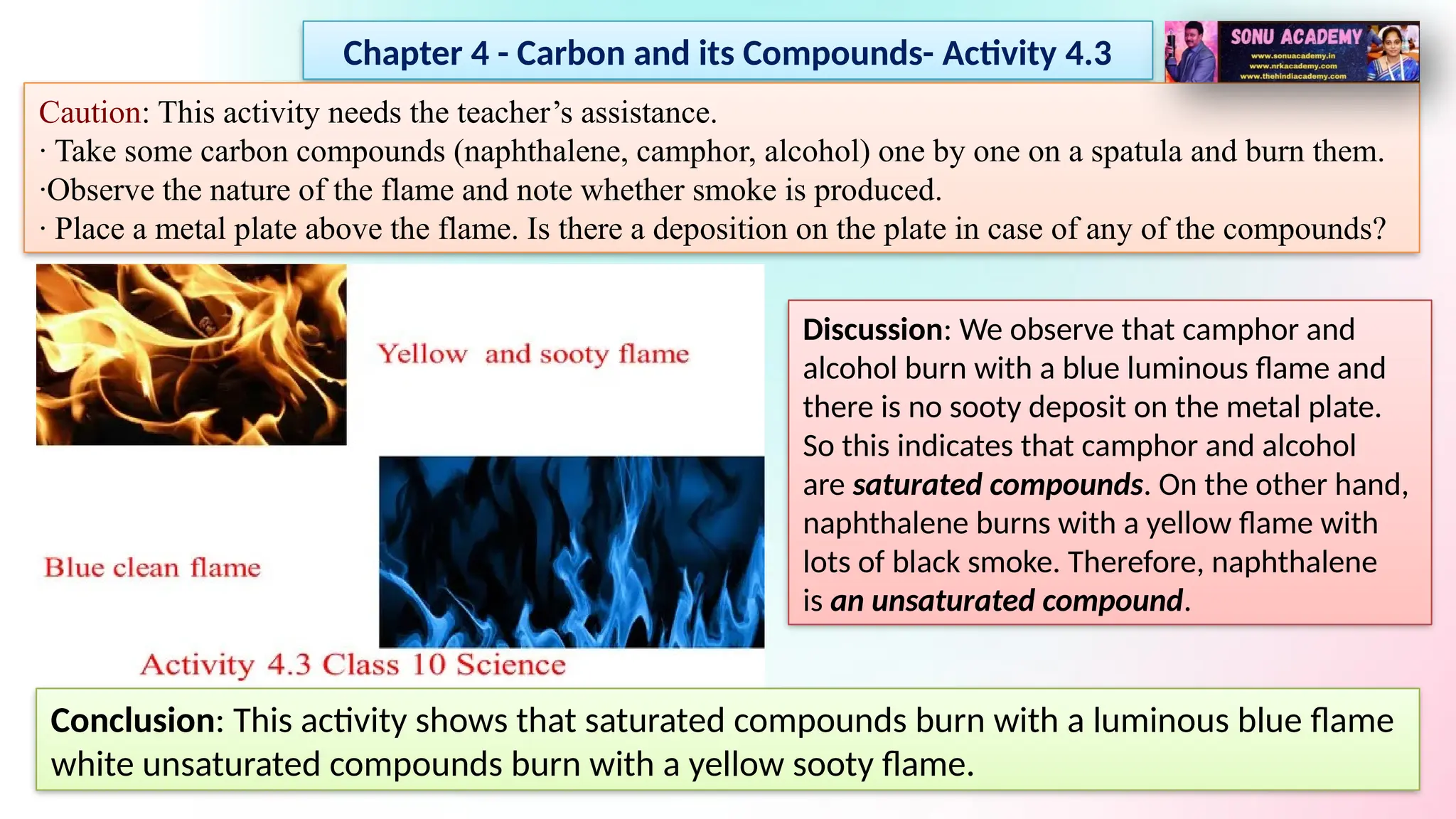
Discussion: We observe that camphor and
alcohol burn with a blue luminous flame and
there is no sooty deposit on the metal plate.
So this indicates that camphor and alcohol
are saturated compounds. On the other hand,
naphthalene burns with a yellow flame with
lots of black smoke. Therefore, naphthalene
is an unsaturated compound.
Conclusion: This activity shows that saturated compounds burn with a luminous blue flame
white unsaturated compounds burn with a yellow sooty flame.
Chapter 4 - Carbon and its Compounds- Activity 4.4
AIM: Light a Bunsen burner and adjust a hole at the base to get different types of flames/presence of
smoke.
· When do you get a yellow, sooty flame?
· When do you get a blue flame?
Discussion: We get a sooty flame when the hole of the Bunsen burner is closed, enough
supply of air is not available, and hence the gas burns completely to produce a yellow sooty
flame, on the other hand, when the hole is open, complete combustion of gas occurs and a
blue flame is produced.
Conclusion: From activity 4.4, it is clear that the amount of oxygen available at the time
of burning is responsible for colour of the flame.
Chapter 4 - Carbon and its Compounds- Activity 4.5
Procedure: Take about 3ml of ethanol in a test tube and warm it gently in a water bath.
 Add a 5% solution of alkaline potassium permanganate drop by drop to this solution.
 Does the colour of potassium permanganate persist when it is added initially?
 Why does the colour of potassium permanganate not disappear when excess is added?
Discussion: In addition to a 5% solution of alkaline KMnO4 to
warm alcohol drop by drop, the colour of KMnO4 disappears
initially because it oxidises ethanol to ethanoic acid.
Alkaline KMnO4
CH3CH2OH -----------------→CH3COOH
When potassium permanganate is added in excess, its colour
does not disappear because the reaction with alcohol stops.
Conclusion: With alkaline KMnO4, Ethyl alcohol gets oxidised to ethanoic acid which
turns blue litmus red.
Chapter 4 - Carbon and its Compounds- Activity 4.6
Teacher’s demonstration:
· Drop a small piece of sodium, about the size of a couple of grains of rice, into ethanol
(absolute alcohol).
· What do you observe?
· How will you test the gas evolved?
Discussion and Conclusion: On the addition of a piece of sodium to absolute alcohol (100%
alcohol), a brisk effervescence due to the evolution of Hydrogen gas takes place. As Hydrogen
is a combustible gas, therefore, when a burning splinter is brought near it, it burns with a ‘pop’
sound.
2C2H5OH + 2Na → 2C2H5ONa + H2
Chapter 4 - Carbon and its Compounds- Activity 4.7
Procedure: Compare the PHPH of dilute acetic acid and dilute hydrochloric acid using both
litmus and universal indicators.
· Are both acids indicated by the litmus test?
·Does the universal indicator show them as equally strong acids?
Observation
Litmus paper is a PHPH indicator that changes colour when comes in contact with acidic
or alkaline solutions. It is available in red or blue colour.
Chapter 4 - Carbon and its Compounds- Activity 4.7
Acids change blue litmus paper into red while base (alkali) change red litmus into blue.
Acids Red litmus paper Blue litmus paper
Hydrochloric acid No change in colour Change into red
Acetic acid No change in colour Change into red
When blue litmus paper is dipped into a dilute acetic acid solution. It becomes slightly red.
When blue litmus paper is dipped into dilute hydrochloric acid, it becomes red
So this indicates both acetic acid and hydrochloric acid are acidic in nature.
Chapter 4 - Carbon and its Compounds- Activity 4.7
Acids Universal indicator PH value
Hydrochloric acid light pink colour Approx 2
Acetic acid yellowish pink colour Approx 4
Now we add a universal indicator in both acetic acid and hydrochloric solutions and observe the result.
Universal indicator is also a PHPH indicator but it has a wide range of PH and provides more clear results.
When a universal indicator is added to dilute acetic acid, it shows PHPH in the range of 3 to 6 which
indicates that acetic acid is a mild acid.
When a universal indicator is added to dilute acetic acid, it shows the PHPH below 3 (approx 2)which
indicates that HCl is a strong acid.
i. Both litmus and universal indicators show that dilute acetic acid and hydrochloric acids are acidic
solutions.
ii. Universal indicator shows that HCl is stronger than acetic acid.
Conclusion: This activity shows that HCl is completely ionized while acetic acid is only partly ionized,
therefore, we can say that hydrochloric acid is a stronger acid than acetic acid.
Chapter 4 - Carbon and its Compounds- Activity 4.8
Procedure: Take 1 ml ethanol (absolute alcohol) and 1 ml glacial acetic acid along with a few drops
of concentrated sulphuric acid in a test tube.
· Warm in a water bath for at least five minutes as shown in the figure.
· Pour into a beaker containing 20-25 ml of water and smell the resulting mixture.
Discussion and Conclusion: On addition of
absolute ethyl alcohol and glacial acid in presence
of a few drops of conc. H2SO4 forms a sweet-
smelling ester, i.e. ethyl acetate, conc.
H2SO4 removes the water formed during the
reaction and thus shifts the equilibrium in the
forward direction.
Chapter 4 - Carbon and its Compounds- Activity 4.9
Procedure : Set up the apparatus as shown in chapter 2, activity 2.5
Take a spatula full of sodium carbonate in a test tube and add 2 ml of dilute ethanoic acid.
What do you observe?
· Pass the gas produced through freshly prepared lime water what do you observe?
Can the gas produced by the reaction between ethanoic acid and sodium carbonate be identified by
this test?
Discussion and Conclusion: On the addition of sodium carbonate to a dilute solution of ethanoic acid, a
brisk effervescence due to the evolution of carbon dioxide (CO2) gas is produced.
2CH3COOH + Na2CO3 → 2CH3COONa +H2O +CO2
When carbon dioxide gas is passed through freshly prepared lime water, it changes lime water milky due
to the formation of insoluble calcium carbonate.
Same observations are noted in the replacement of sodium bicarbonate instead of sodium carbonate.
CH3COOH + NaHCO3 → CH3COONa +H2O +CO2
Chapter 4 - Carbon and its Compounds- Activity 4.10
Procedure:
Take about 10 ml of water each in two test tubes.
Add a drop of oil (cooking oil) to both the test tubes and label them as A and B.
To test tube B, add a few drops of soap solution.
 Now shake both the test tubes vigorously for the same period of time.
 Can you see the oil and water layers separately in both the test tubes immediately after you
 stop shaking them?
 Leave the test tubes undisturbed for some time and observe. Does the oil layer separate out? In which
test tube does this happen first?
Discussion and Conclusions: In test-tube B containing cooking oil, water, and soap solution was
allowed to stand after vigorous shaking for the same period of time only one layer was observed. This
shows that oil dissolves in soap and thus helps in cleaning.
On the other hand, when test tube A containing water and cooking oil was allowed to stand after vigorous
shaking, two separate layers-one of water and the other of oil were seen.
This activity shows that oil does not dissolve in water and hence water alone does not clean clothes. This
activity also shows the cleansing action of soap.
Chapter 4 - Carbon and its Compounds- Activity 4.11
Procedure :
Take about 10 ml of distilled water (or rainwater) and 10 ml of hard water (from a tubewell or hand
pump) in separate test tubes.
 Add a couple of drops of soap solution to both.
 Shake the test tubes vigorously for an equal period of time and observe the amount of foam formed.
 In which test tube do you get more foam?
 In which test tube do you observe a white curdy precipitate?
Note for teacher: If hard water is not available in your locality, prepare some hard water by dissolving
hydrogen carbonates, sulphates/chlorides of calcium or magnesium in water.
Discussion: The test tube containing distilled water produces foam readily. On the other hand, a test tube
that contains hard water produces a curdy white precipitate due to the formation of insoluble calcium or
magnesium salts.
Conclusion: Distilled water or soft water readily produces foam with soaps while hard water produces a
curdy white precipitate.
Chapter 4 - Carbon and its Compounds- Activity 4.12
Take two test tubes with about 10 ml of hard water in each.
Add five drops of soap solution to one and five drops of detergent solution to the other.
Shake both test tubes for the same period.
Do both test tubes have the same amount of foam?
In which test tube is a curdy solid formed?
Discussion: The amount of foam is different in both the test tubes. The test tube containing soap
solution has little foam, on the other hand, the test tube containing detergent produced a large amount
of foam with little or no white precipitate.
Conclusion: The use of detergent can be for washing both in soft and hard water on the other hand
soap can be used only in soft water. Now we can say that detergents are better than that soaps.
Detergents – Detergents are ammonium or sulphonate salts of long chains of carboxylic acids. Sometimes
they are called soapless soaps because they act as soap in cleansing but they don’t have sodium or
potassium salts.
Soaps – Soaps are sodium or potassium salt of a long chain of fatty acids such as stearic acid, oleic acid,
lauric acid, etc.
Activities
Explanation & Conclusion
Chapter 4
Class X

Carbon and its Compounds- Activities Explanation & Conclusion

  • 2.
    Chapter 4 -Carbon and its Compounds- Activity 4.1 Procedure: Make a list of ten things you have used or consumed since the morning. Compile this list with the lists made by your classmates and then sort the items into the following table. If there are items that are made up of more than one material, put them into both the relevant columns. Things made of metal Things made of glass/clay Others
  • 3.
    S. No. Thingsmade of metals Things made of glass/clay Others (i) (ii) (iii) (iv) (v) (vi) Utensils Bucket Mug Cooking pans fridge key chain iron box fan bowl Test tube Cooking pans mirror Water cloth book bag Furniture Soaps and detergents Newspaper food items Chapter 4 - Carbon and its Compounds- Activity 4.1 Conclusion: Most of the utilities that we use in our daily life are made up of compounds of carbon. These carbon compounds are called Organic compounds.
  • 4.
    Aim : Calculatethe difference in the formulae and molecular masses for (a) CH₂OH and C₂H₂OH (b) C₂H₂OH and C₂H/OH, and (c) C₂H₂OH and C.H.OH. Chapter 4 - Carbon and its Compounds- Activity 4.2 Compounds Difference in formulae Differences in molecular masses CH3OH & C2H5OH -CH2 14u C2H5OH & C3H7OH -CH2 14u C3H7OH& C4H9OH. -CH2 14u 2. Yes, all these compounds have -OH group. 3. CH3OH , C2H5OH , C3H7OH, C4H9OH. All these compounds have -OH group so they are a family and we can call this family a homologous series because they show a difference in -CH2.
  • 5.
    Chapter 4 -Carbon and its Compounds- Activity 4.2 1.Chloro Group – CH3 Cl, C2 H5 Cl , C3 H7 Cl , C4 H9 Cl 2. Aldehyde Group- CH3 CHO, CH3 CHO, CH3 CHO, CH3 CHO 3. Ketone Group – CH3 COCH3 , CH3 CH2 COCH3 , CH3 CH2 CO CH2 CH3 , CH3 CH2 CH2 CO CH2 CH2 CH3 4. Carboxylic Acid - CH3 COOH, C2 H5 COOH, C3 H7 COOH, C4 H9 COOH Conclusion - Now from the above discussion, it is clear that the common difference in the molecular formula is -CH2 and molecular mass is 14u.
  • 6.
    Chapter 4 -Carbon and its Compounds- Activity 4.3 Caution: This activity needs the teacher’s assistance. · Take some carbon compounds (naphthalene, camphor, alcohol) one by one on a spatula and burn them. ·Observe the nature of the flame and note whether smoke is produced. · Place a metal plate above the flame. Is there a deposition on the plate in case of any of the compounds? Discussion: We observe that camphor and alcohol burn with a blue luminous flame and there is no sooty deposit on the metal plate. So this indicates that camphor and alcohol are saturated compounds. On the other hand, naphthalene burns with a yellow flame with lots of black smoke. Therefore, naphthalene is an unsaturated compound. Conclusion: This activity shows that saturated compounds burn with a luminous blue flame white unsaturated compounds burn with a yellow sooty flame.
  • 7.
    Chapter 4 -Carbon and its Compounds- Activity 4.4 AIM: Light a Bunsen burner and adjust a hole at the base to get different types of flames/presence of smoke. · When do you get a yellow, sooty flame? · When do you get a blue flame? Discussion: We get a sooty flame when the hole of the Bunsen burner is closed, enough supply of air is not available, and hence the gas burns completely to produce a yellow sooty flame, on the other hand, when the hole is open, complete combustion of gas occurs and a blue flame is produced. Conclusion: From activity 4.4, it is clear that the amount of oxygen available at the time of burning is responsible for colour of the flame.
  • 8.
    Chapter 4 -Carbon and its Compounds- Activity 4.5 Procedure: Take about 3ml of ethanol in a test tube and warm it gently in a water bath.  Add a 5% solution of alkaline potassium permanganate drop by drop to this solution.  Does the colour of potassium permanganate persist when it is added initially?  Why does the colour of potassium permanganate not disappear when excess is added? Discussion: In addition to a 5% solution of alkaline KMnO4 to warm alcohol drop by drop, the colour of KMnO4 disappears initially because it oxidises ethanol to ethanoic acid. Alkaline KMnO4 CH3CH2OH -----------------→CH3COOH When potassium permanganate is added in excess, its colour does not disappear because the reaction with alcohol stops. Conclusion: With alkaline KMnO4, Ethyl alcohol gets oxidised to ethanoic acid which turns blue litmus red.
  • 9.
    Chapter 4 -Carbon and its Compounds- Activity 4.6 Teacher’s demonstration: · Drop a small piece of sodium, about the size of a couple of grains of rice, into ethanol (absolute alcohol). · What do you observe? · How will you test the gas evolved? Discussion and Conclusion: On the addition of a piece of sodium to absolute alcohol (100% alcohol), a brisk effervescence due to the evolution of Hydrogen gas takes place. As Hydrogen is a combustible gas, therefore, when a burning splinter is brought near it, it burns with a ‘pop’ sound. 2C2H5OH + 2Na → 2C2H5ONa + H2
  • 10.
    Chapter 4 -Carbon and its Compounds- Activity 4.7 Procedure: Compare the PHPH of dilute acetic acid and dilute hydrochloric acid using both litmus and universal indicators. · Are both acids indicated by the litmus test? ·Does the universal indicator show them as equally strong acids? Observation Litmus paper is a PHPH indicator that changes colour when comes in contact with acidic or alkaline solutions. It is available in red or blue colour.
  • 11.
    Chapter 4 -Carbon and its Compounds- Activity 4.7 Acids change blue litmus paper into red while base (alkali) change red litmus into blue. Acids Red litmus paper Blue litmus paper Hydrochloric acid No change in colour Change into red Acetic acid No change in colour Change into red When blue litmus paper is dipped into a dilute acetic acid solution. It becomes slightly red. When blue litmus paper is dipped into dilute hydrochloric acid, it becomes red So this indicates both acetic acid and hydrochloric acid are acidic in nature.
  • 12.
    Chapter 4 -Carbon and its Compounds- Activity 4.7 Acids Universal indicator PH value Hydrochloric acid light pink colour Approx 2 Acetic acid yellowish pink colour Approx 4 Now we add a universal indicator in both acetic acid and hydrochloric solutions and observe the result. Universal indicator is also a PHPH indicator but it has a wide range of PH and provides more clear results. When a universal indicator is added to dilute acetic acid, it shows PHPH in the range of 3 to 6 which indicates that acetic acid is a mild acid. When a universal indicator is added to dilute acetic acid, it shows the PHPH below 3 (approx 2)which indicates that HCl is a strong acid. i. Both litmus and universal indicators show that dilute acetic acid and hydrochloric acids are acidic solutions. ii. Universal indicator shows that HCl is stronger than acetic acid. Conclusion: This activity shows that HCl is completely ionized while acetic acid is only partly ionized, therefore, we can say that hydrochloric acid is a stronger acid than acetic acid.
  • 13.
    Chapter 4 -Carbon and its Compounds- Activity 4.8 Procedure: Take 1 ml ethanol (absolute alcohol) and 1 ml glacial acetic acid along with a few drops of concentrated sulphuric acid in a test tube. · Warm in a water bath for at least five minutes as shown in the figure. · Pour into a beaker containing 20-25 ml of water and smell the resulting mixture. Discussion and Conclusion: On addition of absolute ethyl alcohol and glacial acid in presence of a few drops of conc. H2SO4 forms a sweet- smelling ester, i.e. ethyl acetate, conc. H2SO4 removes the water formed during the reaction and thus shifts the equilibrium in the forward direction.
  • 14.
    Chapter 4 -Carbon and its Compounds- Activity 4.9 Procedure : Set up the apparatus as shown in chapter 2, activity 2.5 Take a spatula full of sodium carbonate in a test tube and add 2 ml of dilute ethanoic acid. What do you observe? · Pass the gas produced through freshly prepared lime water what do you observe? Can the gas produced by the reaction between ethanoic acid and sodium carbonate be identified by this test? Discussion and Conclusion: On the addition of sodium carbonate to a dilute solution of ethanoic acid, a brisk effervescence due to the evolution of carbon dioxide (CO2) gas is produced. 2CH3COOH + Na2CO3 → 2CH3COONa +H2O +CO2 When carbon dioxide gas is passed through freshly prepared lime water, it changes lime water milky due to the formation of insoluble calcium carbonate. Same observations are noted in the replacement of sodium bicarbonate instead of sodium carbonate. CH3COOH + NaHCO3 → CH3COONa +H2O +CO2
  • 15.
    Chapter 4 -Carbon and its Compounds- Activity 4.10 Procedure: Take about 10 ml of water each in two test tubes. Add a drop of oil (cooking oil) to both the test tubes and label them as A and B. To test tube B, add a few drops of soap solution.  Now shake both the test tubes vigorously for the same period of time.  Can you see the oil and water layers separately in both the test tubes immediately after you  stop shaking them?  Leave the test tubes undisturbed for some time and observe. Does the oil layer separate out? In which test tube does this happen first? Discussion and Conclusions: In test-tube B containing cooking oil, water, and soap solution was allowed to stand after vigorous shaking for the same period of time only one layer was observed. This shows that oil dissolves in soap and thus helps in cleaning. On the other hand, when test tube A containing water and cooking oil was allowed to stand after vigorous shaking, two separate layers-one of water and the other of oil were seen. This activity shows that oil does not dissolve in water and hence water alone does not clean clothes. This activity also shows the cleansing action of soap.
  • 16.
    Chapter 4 -Carbon and its Compounds- Activity 4.11 Procedure : Take about 10 ml of distilled water (or rainwater) and 10 ml of hard water (from a tubewell or hand pump) in separate test tubes.  Add a couple of drops of soap solution to both.  Shake the test tubes vigorously for an equal period of time and observe the amount of foam formed.  In which test tube do you get more foam?  In which test tube do you observe a white curdy precipitate? Note for teacher: If hard water is not available in your locality, prepare some hard water by dissolving hydrogen carbonates, sulphates/chlorides of calcium or magnesium in water. Discussion: The test tube containing distilled water produces foam readily. On the other hand, a test tube that contains hard water produces a curdy white precipitate due to the formation of insoluble calcium or magnesium salts. Conclusion: Distilled water or soft water readily produces foam with soaps while hard water produces a curdy white precipitate.
  • 17.
    Chapter 4 -Carbon and its Compounds- Activity 4.12 Take two test tubes with about 10 ml of hard water in each. Add five drops of soap solution to one and five drops of detergent solution to the other. Shake both test tubes for the same period. Do both test tubes have the same amount of foam? In which test tube is a curdy solid formed? Discussion: The amount of foam is different in both the test tubes. The test tube containing soap solution has little foam, on the other hand, the test tube containing detergent produced a large amount of foam with little or no white precipitate. Conclusion: The use of detergent can be for washing both in soft and hard water on the other hand soap can be used only in soft water. Now we can say that detergents are better than that soaps. Detergents – Detergents are ammonium or sulphonate salts of long chains of carboxylic acids. Sometimes they are called soapless soaps because they act as soap in cleansing but they don’t have sodium or potassium salts. Soaps – Soaps are sodium or potassium salt of a long chain of fatty acids such as stearic acid, oleic acid, lauric acid, etc.
  • 18.