National Seminar on Rainwater Harvesting and Water Management 11-12 Nov. 2006, Nagpur


                                      STATE OF THE ART LECTURE

    1. Rain Water Harvesting, Conservation and Management Strategies
                     for Urban and Rural Sectors
                                           * Dr. R. K. Sivanappan

1. Introduction                                               Nabateans and other people of the Middle east.
       Water is essential for all life and used in many       While the early water harvesting techniques used
different ways, It is also a part of the larger               natural materials, 20th century technology has made
ecosystem in which the reproduction of the bio                it possible to use artificial means for increasing runoff
diversity depends. Fresh water scarcity is not limited        from precipitation.
to the arid climate regions only, but in areas with                  Evenari and his colleagues of Israel have
good supply the access of safe water is becoming              described water harvesting system in the Negve
critical problem. Lack of water is caused by low              desert. The system involved clearing hill sides to
water storage capacity, low infiltration, larger inter        smooth the soil and increase runoff and then building
annual and annual fluctuations of precipitation (due          contour ditches to collect the water and carry it to
to monsoonic rains) and high evaporation demand.              low lying fields where the water was used to irrigate
       The term water harvesting was probably used            crops. By the time of the Roman Empire, these runoff
first by Geddes of the University of Sydney. He               farms had evolved into relatively sophisticated
defined as the collection and storage of any form of          systems.
water either runoff or creek flow for irrigation use.                The next significant development was the
Meyer’s of USDA, USA has defined it as the                    construction of roaded catchments as described by
practice of collecting water from an area treated to          the public works Department of Western Australia
increase runoff from rainfall. Recently Currier ,USA          in 1956. They are so called because the soil is graded
has defined it as the process of collecting natural           into ditches. These ditches convey the collected
precipitation from prepared watershed for beneficial          water to a storage reservoir. Lauritzan, USA has
use. Now a days water harvesting has become a                 done pioneering work in evaluating plastic and
general term for collecting and storing runoff water          artificial rubber membranes for the construction of
or creek flow ,resulting from rain in soil profile and        catchments and reservoirs during 1950’s. In
reservoirs both over surface /under surface.                  1959,Mayer of water conservation laboratory, USA
Previously this was used for arid and semi arid areas,        began to investigate materials that caused soil to
but recently their use has been extended to sub humid         become hydrophobic or water repellent. Then
and humid regions too. In India water harvesting              gradually expanded to include sprayable asphalt
means utilizing the erratic monsoon rain for raising          compounds, plastic and metal films bounded to the
good crops in dry tracks and conserve the excess              soil compaction and dispersion and asphalt fiber glass
runoff water for drinking and for recharging                  membranes. Early 1960, research programmes in
purposes.                                                     water harvesting were also initiated in Israel by Hillal
                                                              and at the University of Arizana by Gluff. Hillal’s
2. History of Rain Water Harvesting                           work related primarily to soil smoothing and runoff
      Water harvesting like many techniques in use            farming. Cluff has done a considerable amount of
today is not new. It is practiced as early as 4500            work on the use of soil sealing with sodium salt and
B.C. by the people of Ur and also latest by the               on ground covered with plastic membranes.

                           * International Consultant in Water Resources & Irrigation,
                           No:14, Bharathi park, 4th Cross Road, Coimbatore 641 043

                                                          1
Water harvesting was practiced more than                These rainwater are used for all labs, which require
1000 years back in South India, by way of                       pure and good quality of water. In the same way
construction of irrigation tank, ooranis, temple tanks,         the rainwater falling on the terrace in all the building
farm ponds etc, but the research in India on this               constructed subsequently are collected and stored
subject is of recent one. Work is taken up at                   in the underground masonry tanks Even the surface
ICRISAT, Hyderabad, Central arid Zone Research                  water flowing in the Nalla’s in the campus are also
Institute, Jodhpur, Central Research Institute for              diverted by providing obstructions, to the open wells
dryland Agriculture (CRIDA), Hyderabad, State                   to recharge ground water.
Agricultural Universities and other dry land research                  Hence Rainwater harvesting is as old as
centers throughout India.                                       civilization and practiced continuously in different
        In Pakistan, in the mountainous and dry                 ways for different purposes in the world The only
province of Balukhistan, bunds are constructed                  thing is that it has not been done systematically in all
across the slopes to force the runoff to infiltrate. In         places. Need has come to harvest the rainwater
China, with its vast population is actively promoting           including roof water to solve the water problems
rain and stream water harvesting. One very old but              everywhere not only in the arid but also in the humid
still common flood diversion technique is called                region.
‘Warping’ (harvesting water as well as sediment).
        When water harvesting technique are used                3. Need for Rain Water Harvesting
for runoff farming, the storage reservoir will be soil                 Water is a becoming a scarce commodity and
itself, but when the water is to be used for livestock,         it is considered as a liquid gold in this part of the
supplementary irrigation or human consumption, a                country (especially in Coimbatore, Erode, Salem
storage facility of some kind will have to be                   Districts of Tamil Nadu). The demand of water is
produced. In countries where land is abundant, water            also increasing day by day not only for Agriculture,
harvesting involves; harvesting or reaping the entire           but also for household and Industrial purposes. It is
rainwater, store it and utilize it for various purposes.        estimated that water need for drinking and other
In India, it is not possible to use the land area only to       municipal uses will be increased from 3.3 MHm to
harvest water and hence water harvesting means                  7.00 MHm in 2020/25. Similarly the demand of water
use the rain water at the place where it falls to the           for industries will be increased by 4 fold i.e. from
maximum and the excess water is collected and                   3.0 MHm ti 12.00 MHm during this period At the
again reused in the same area. Therefore the                    same time more area should be brought under
meaning of water harvesting is different in different           irrigation to feed the escalating population of the
area/ countries. The methods explained above are                country, which also needs more water. But we are
used for both agriculture and to increase the ground            not going to get one litre more water than we get at
water availability.                                             present though the demand is alarming.
        The water harvesting for household and for                     The perennial rivers are becoming dry and
recharging purposes are also in existence for long              ground water table is depleting in most of the areas.
years in the world. During rainy days, the people in            In Coimbatore, the depletion is about 30-50m in the
the villages used to collect the roof water in the              last 30-40 years. Country is facing floods and drought
vessels and use the same for household purposes                 in the same year in many states. This is because, no
including drinking. In South East Asian countries               concrete action was taken to conserve, harvest and
people used to collect the roof water ( thatched roof           manage the rain water efficiently.
by providing gutters) by placing 4 big earthern drums                  The rainfall is abundant in the world and also
in 4 corners of their houses. They use this water for           in India. But it is not evenly distributed in all places.
all household purposes and if it is exhausted only              India being the monsoonic country, the rain falls only
they will go for well water. The main building of the           for 3 to 4 months in a year with high intensity, which
Agricultural College at Coimbatore was constructed              results more runoff and soil erosion. Total rain occurs
100 years ago and they have collected all the roof              only in about 100 hours out of 8760 hours in a year.
water by pipes and stored in a big under ground                 It also erratic and fails once in 3 or 4 years. This is
masonry storage tanks by the sides of the building.             very common in many parts of the country.

                                                            2
The availability of water in the world, in India         hard rock in Tamil Nadu. Further the porosity of the
and in Tamil Nadu is given below with rainfall.                rock is only about 3%. The natural recharge of
                                                               rainwater in this region is only about 8 -12%, which
 Places       Rainfall Population     Availability of          is very minimal. Therefore there is an urgent need
              in mm                   Water/Person/Yr          to take up the artificial recharge of the rain for which
                                      M 3 /P/Year              water harvesting and water conservation structures
 World        840       6 Billion     700                      are to be build up in large scale. The rainfall in coastal
                                                               area is more than 1200 mm (Chennai) still; drinking
 India        1150      1.0 Billion    2200                    water is a problem in almost every year. This is
 Tamil Nadu 925         62.5 Million 750                       because the entire rainwater is collected in masonry
                                                               drains (from houses, streets/roads etc) are taken to
         If the availability of water is 1700 M3/p/y,          the sea instead of taking into the ground water
there will be occasional water stress, and if it is less       aquifers or in surface reservoirs by pumping if need
than 1000 M3/p/y, it is under water scarcity condition.        be. The ground water available can be used during
Though India is not under water stress conditions              summer and make the aquifer empty so that the
but Tamil Nadu state is already under water scarcity           rainwater can be put into the aquifers during rainy
condition, but there is no need for panic since it is          period by suitable water harvesting measures.
possible to manage this condition as in the case of                   All the above details indicate the need for
Israel where the availability is only about 450 M3/p/          water harvesting measures in urban and rural area
y, by means of water harvesting, water conservation            for the use of Agriculture, drinking and other
and water management.                                          purposes.
         Water scarcity / stress is not limited to the
arid regions; only but also occurring in high rainfall         4. Methods of Water Harvesting in Rural and
areas also. Chirapunji gets more than 11,000mm of              Urban Areas
average annual rainfall but face drinking water                      There are different / various system of water
problem before monsoon commences whereas in                    harvesting depending upon the source of water
Ralegoan Siddhi, in Maharastra there is no water               supply and places as classified below.
scarcity problem though the annual average rainfall            a) In situ Rainwater harvesting
is only about 450mm. Hence to mitigate water                         • Bunding and terracing.
problem / drought etc, there is an urgent need to                    • Vegetative / stone contour barriers.
follow our ancestral way of water harvesting and
                                                                     • Contour trenching.
the latest technologies adopted in Soil and water
conservation measures on watershed basis including                   • Contour stone walls.
roof water harvesting etc which are described in                     • Contour farming.
detail below.                                                        • Micro catchments.
         The Theme paper on Water vision 2050 of                     • Tie ridging methods
India, prepared by Indian Water Resources                            • Farm ponds.
Society(IWRS) has indicated that a storage of 60               b) Direct surface runoff harvesting
MHm is necessary to meet tbne demand of water                        • Roof water collection
for irrigation, drinking and other purposes. But the                 • Dug out ponds / storage tanks
present live storage of all reservoirs put together is
                                                                     • Tankas
equivalent of about 17.5 MHm which is less than
10% of the annual flow in the rivers in the country.                 • Kundis
The projects under contruction (7.5 MHm) and those                   • Ooranis
contemplated (13 MHm) are added, it comes only                       • Temple tanks
37.50 MHm and hence we have to go a long way in                      • Diversion bunds
water harvesting to build up storage structures in                   • Water spreading
order to store about 60 MHm.                                   c) Stream flow / runoff harvesting
         More than 75% of the areas comes under                      • Nalla bunding

                                                           3
• Gully control structures                              municipalities / corporation without any difficulty to
     • Check dams – Temporary                                some extent.
                         Permanent                                To sum up the following types of Water
     • Silt detension tanks                                  Harvesting System for different uses can be
     • Percolation ponds                                     implemented in different parts of the country.
d) Sub surface flow harvesting
     • Sub surface dams                                       No. Region       Types of Water           Use
     • Diaphragm dams
e) Micro catchment’s / watershed                              1    Arid      Artificial catchments    Drinking
     • Inter terrace / inter plot water harvesting                 plains    to capture rainfall
                                                                             (tankas or kundis in
     • Conservation bench terrace
                                                                             Rajasthan)
f) Runoff inducement by surface treatment
     • Roaded catchments                                                     Tanks or talabs in       Drinking
     • Use of cover materials – Aluminum foils,                              Rajasthan to capture     and
       Plastic sheet, bentonite, Rubber, etc                                 surface runoff           irrigation
     • Using chemicals for water proofing, water
       repellent etc. to get more run off water.                             Embankments /          Irrigation
                                                                             obstructions across    water & also
      A comprehensive watershed development on                               drainage / Nalla to    for recharging
watershed basisincluding water harvesting structures                         capture surface runoff
are given in the figure 1.
                                                              2    Semi      Tanks / Ponds/Eri to     Irrigation
                                                                   Arid      capture surface runoff   water and
5. Plan of Action for Rainwater Harvesting                         places    and also chains of       drinking water
      As stated early, rainwater harvesting is as old                        tanks called cascade.    through
as civilization and is practiced in many countries                                                    recharge of
including India from time immemorable. But                                                            ground water
government and people remember this only when
water is not available even for drinking purposes.            3.   Flood     Mud embankment           Irrigation
There is no use of spending huge sum of money                      plains    which may be             water and
                                                                             breached during the      drinking water
when we notice the water scarcity for drinking,
                                                                             floods.                   through
industry and agriculture. These activities / structure                                                recharging
should be taken / constructed before the rainy season                                                 ground water
so that the rain water which goes as runoff outside
the sub watershed / city limits can be collected and          4    Hill and Diverted stream flows Irrigation
used directly or by recharging into the ground.                    Mountain Jammu, M.P.,          water
Government is undertaking the wasteland /                          region   Maharastra
watershed development programs, but not done in a
comprehensive / integrated manner / holistic                 6. Case Study In Water Harvesting
saturating the watershed in all water harvesting                   There are numerous case studies available in
measures. Hence there is a need to take up                   water harvesting both in Rural and Urban sectors.
watershed development programmes – mainly water              In Rural areas it is Soil and Water conservation
harvesting measures in a scientific and systematic           measures taken on watershed basis to conserve and
manner.                                                      augment ground water. In the urban sector, it is
      The government of Tamil Nadu has laid                  mostly roof water harvesting for direct use and
condition that in any building construction, water           recharging the ground water and also collecting of
harvesting work should be included and executed,             surface runoff from pavements / roads and
but in practice, it is not perfect. The authorities          recharging it into the ground through recharge pits
concerned should monitor the programme so that               or using abandoned / existing wells. The following
the drinking water problem can be solved in all              are the places where rain water / roof water

                                                         4
harvesting has been implemented in a successful               the rain water harvesting to their Industry premises.
manner.                                                              If the above measures are implemented in
1.    Rural areas                                             Rural and Urban areas, the drought in rural areas
a. Ralegoan Siddhi in Maharastra state                        and drinking water problem in Urban and Rural
b. Lakshman Nagar and Varisai Nadu inTheni                    population can be solved to some extent. The people,
   Dt., Tamil Nadu.                                           NGO, and Government should joint together and
c. Alankulam Taluk in Tirunelveli Dt., Tamil Nadu.            implement the rain water harvesting in a big way in
d. Aravari watershed in Alwar Dt., of Rajasthan.              all places in the years to come to solve water scarcity
e. Maheshwaram watershed in Andhra Pradesh.                   problem in the country.
f. Kapilnalla watershed in Karnataka
                                                              7. Conclusions
2.      Urban Sectors                                                  It is very important to make water everybody’s
Mostly the roof water harvesting measures are taken           business. It means a role for everybody with respect
up.                                                           to water. Every household and community has to
a.      India                                                 become involved in the provision of water and in
i. Tamil Nadu Agricultural University, Coimbatore,            the protection of water resources. Make water the
    all main buildings.                                       subject of a people’s movement. It means the
ii. PRICOL, Periyanaickenpalayam (Industry                    empowerment of our Urban and Rural community,
    Building), Coimbatore                                     i.e., to manage their own affairs with the state playing
iii. TWAD Board / office and PWD office at                    a critical supportive role.
     Chennai.                                                          Further involving people will give the people
iv. Numerous Apartment buildings in Chennai.                  greater ownership over the water project including
v. Sundaram and Clayton Ltd, Padi, Chennai –                  watershed development, Soil and Water
    (Industry buildings)                                      conservation and water harvesting will go a long
vi. TVS training schoool at Vanagaran, Chennai                way towards reducing misuse of government funds.
vii. Rastrapathi Bhavan, Delhi.                               It will also develop the ownership (own water supply
viii. Center of science and environment building at           systems), they will also take good care of them. In
     Delhi.                                                   this way it is possible to solve water problems facing
ix. Institute of economic growth, New Delhi.                  the county in the 21st century.

b.     Foreign Countries                                      References
i. Thailand – Many houses including thatched                  • Ake Nilsson, Ground water dams for small-scale water
     houses in villages.                                      supply, IT publication, 1988.
ii. Japan – office complex.                                   • Center for science and environment. A water-harvesting
                                                              manual, Delhi 2001.
iii. Germany – office buildings.                              • Center for Science and Environment – Making water
iv. Singapore – office buildings.                             everybody’s business, New Delhi, 2001.
                                                              • Chitale M.A., A blue revolution, Bhavans Book
       Rules and regulations have been framed for             University, Pune 2000.
Rain Water Harvesting in all corporation,                     • CII, Rainwter harvesting – A guide, New Delhi 2000.
municipalities and panchayat unions in Tamil Nadu.            • Rajiv Gandhi, National Drinking water missions
The Gujarat government has issued a general                   Handbook on Rainwater harvesting, Government of India,
                                                              New Delhi, 1998.
resolution for the effort that no new construction            • Sivanappan, R.K., Soil and Water Conservation and
would be allowed if it does not have provision for            Water harvesting, Tamil Nadu Afforestation project,
roof top rainwater harvesting. This would be valid            Chennai, 1999.
in all 143 municipalities and 6 urban development             • Sivanappan, R.K. Water harvesting, ICCI, Coimbatore
authorities in the state. It is heartening to note that       2001.
Confederation of Indian Industries (CII) and                  • Stockholm water Symposium – ‘Water harvesting’
                                                              Stockholm, Aug 1998.
Federation of Indian Chambers of Commerce and
                                                              • Verma HN & Tiwan KN current status and Prospects of
Industries (FICCI) have taken action to implement             Rain Water Harvesting, NIH, Roorkee, 1995.

                                                          5
National Seminar on Rainwater Harvesting and Water Management 11-12 Nov. 2006, Nagpur


                           2. Water Issues and Related Concerns
                   * Prof. (Mrs.) Vijaya Agarwal ** Prof. (Dr.) J. H. Agarwal


        ABSTRACT
                 By 2025, world population will be 8 billion – water will become scarcer. Global
        farming accounts for 70% of water use, while only 17% of farmland is irrigated and
        it provides only 40% (estimated) of world’s food. Water application losses in irrigation
        are quite high – almost 40 % of the total irrigation water is lost. Per capita irrigated
        agricultural land is declining – main reason shortage of water. Water table is falling
        steadily in intensive farming regions. People and ecosystems are under threat from
        persistent chemicals like pesticides, fertilizers and heavy metals in waters. There are
        no serious efforts to gain water by practices like rainwater harvesting, watersheds
        and mini-ponds, reuse and recycling of waste water. It is said there is enough freshwater
        in world – however, it is not always available in the right place or right form. The
        problem is mainly of access, distribution, and optimum utilization.
                 The paper discusses related concerns and outlines what need to be done.
        Key words : Fresh water, harvesting and conservation of water, water reuse, water
        management in agro-ecosystems, electronics and IT based devices.


1.0    WHAT NEED TO BE DONE? – Some                       •     Water conservation and higher efficiencies for
suggestions                                                     water-conveyance, water-application and
                                                                water-use. Scientific management of water by
1.1      Ground Water Recharge, Reuse, and                      making use of electronics and IT based aids
Efficient Systems                                               like soil-moisture measurements.
•    Watersheds, Check dams, Roof water                   •     Participation of women in conservation of
     harvesting (should be made compulsory and                  water.
     mandatory), India uses around 15% of rain            •     Competent, knowledgeable and experienced
     water while Israel almost 100% (see                        personnel to be involved in management of
     Appendix).                                                 water related activities and balanced
•    Efficient irrigation systems: Sprinkler, drip,             distribution of water.
     trickle (macro and micro irrigation). Drip
     irrigation cuts water use by between 30% and         1.2      Water needs of plants
     70% , increases crop yield by between 20%                     Agriculture accounts for 70% of fresh water
     and 90%, compared with traditional irrigation.       use. It requires as much as 2000 litres of water to
•    Sequential water use : Reuse, recovery and           grow 1 kg of rice. Water (with elements H + O) is
     recycling of waste waters.                           a vital component for crop growth. Plants need
•    Switching to less water-dependent crops.             water for:

   * Selection Grade Assistant Professor (Electrical Engineering), Department of Agricultural Structures and
  Environmental Engineering, College of Agricultural Engineering, Jawaharlal Nehru Agricultural University,
  Krishi Nagar, Adhartal P.O., Jabalpur 482 004, Email : vijaya_agarwal@gmail.com Phone : 0761 – 2681820
    ** Retired Director Instrumentation & Project Coordinator UNDP-GOI-MAEP, JNAU, G-83 Krishi Nagar,
          Adhartal P.O., Jabalpur 482 004 Email : jhagarwal@sancharnet.in Phone : 0761 – 2680400

                                                      6
•     Temperature regulation,                                     web site: www.irrometer.com).
•     Photosynthesis,                                        •    Tensiometric principle, indicates the amount of
•     Transport of nutrients from soil to plant, and              moisture available to plants.
•     Transport of assimilates from plant parts to the       •    Direct display of moisture.
      produce location.                                      •    Automatic control of irrigation systems.

1.3      Excess water harmful                                4. Watermark Soil Moisture Sensor – 200SS
         Excess water to crop is harmful. It causes/            (Irrometer Company, USA,
results in :                                                    web site : www.irrometer.com ).
• Spoilage of soil-health, salinity built up.                • Solid state, electrical resistance type.
• Loss of nutrients due to excessive leaching.               • Available with meter, electronic control unit.
• Contamination of surface and ground water.                 • Low cost.
• No proportionate increase in yield, and wastage
    of water and energy.                                     5.   Sentek Soil Moisture Probes – EnviroSCAN,
                                                                  EnviroSMART, EasyAG and Diviner 2000
2.0      SOIL-MOISTURE MEASUREMENT                                (Sentek, Australia,
SYSTEMS                                                           web site : www.sentek.com.au ).
         A variety of electronics and microprocessor-        •    Electrical capacitance principle, continuous
based devices for soil-moisture measurement are                   measurement of soil moisture over multiple
available for scientific water management in agro-                depths in root-zone.
ecosystems. Some of the devices are based on                 •    Easy installation, data download options for
electrical impedance, infrared thermometry and                    retrieving data in the field or remotely.
time-domain reflectometry. Salient features of five          •    Provides information on crop water use and
such devices are given below:                                     water management in root-zone, facilitates
1. Gro-Point GP-ERS Moisture Sensor and                           decisions on how much and when to irrigate.
     Irrigation Management System (ESI
     Environment Sensors Inc., Canada,                                These devices should be used for scientific
     web site : www.esica.com ).                             management of water in agro-ecosystems to make
• Soil moisture range: 5 – 50 % (volumetric) +/-             efficient use of water and to minimize problems like
     1%.                                                     water logging, salinity built up, non-point
• Rechargeable battery or mains operated.                    contamination (see Appendix , Fig. 2 (a), (b), (c)
• Available with hand-held display or with data              and (d) for photographs of some soil-moisture
     logger.                                                 devices).
• Intelligent Irrigation System, with a set of
     sensors, computer,                                      3.0      IT ENABLED SUPPORT SYSTEMS
    software and irrigation controller.                      FOR OPTIMUM UTILIZATION
                                                                      Use of Crop Simulation Models, Weather
2. Moisture-Point, Multi-Probe Sensor MP-917                 data and Knowledge Base(s):
   (ESI Environment Sensors Inc., Canada,                    • To select appropriate crop and crop variety
   web site: www.esica.com ).                                    suitable to agro-climatic pattern, and switch to
• Soil moisture range : 0 – 50 % (volumetric) +/-                less water-dependent crops.
   1.5%.                                                     • To decide about the date of sowing, duration of
• A single probe gives moisture profile.                         crop.
• Rechargeable battery or mains operated.                    • To decide about the irrigation inputs to crop by
• LCD display or datalogger or RS-232 with                       monitoring soil-moisture and crop-water stress,
   PC.                                                           to decide when and how much to irrigate, and
                                                                 to optimize utilization of water by using
3.     Irrometer-Tensiometer Probe (Irrometer                    efficient systems like sprinkler, drip and trickle
      Company, USA,                                              irrigation.

                                                         7
•     To apply fertilizer to crops through irrigation              Population Reports, Series M, No. 14.
      water by computer-controlled fertigation                     Population Information Program, Johns Hopkins
      techniques.                                                  School of Public Health, Baltimore, December
•     To adopt controlled environment farming                      1997.
      wherever easily feasible: This provides                  •   United States Department of Agriculture. ARS
      monitoring and control of lighting, humidity,                National Program # 201 on Water Quality and
      temperature, CO2 level, irrigation, nutrients                Management : Component I – Agricultural
      supply, chemical treatments, etc.                            watershed management, Component II –
•     To adopt a GIS coupled soil-water-balance                    Irrigation and drainage management,
      computation system to calculate the available                Component III – Water quality protection and
      residual soil-moisture for its better utilization.           management, 1998 – ongoing. <
                                                                   www.nps.ars.usda.gov >
4.0     CONCLUDING REMARKS                                     •   Li, F., S. Cook, G. T. Geballe and W. R.
        Water is a very valuable resource. There are               Burch. Rainwater Harvesting Agriculture: An
no serious efforts to gain water by practices like                 integrated system for water management on
rainwater harvesting, watersheds and mini-ponds.                   rainfed land in China’s semiarid areas, AMBIO
Rainwater harvesting should be made mandatory.                     – Journal of Human Environment, Vol. 29, Issue
Sequential water use (reuse, recovery and recycling                8, December 2000, pp. 477-483.
of waste waters) should be planned wherever                    •   Gleick, P. H. The World’s Water 2000 - 2001:
possible so that the load on fresh water can be                    The Biennial Report on Freshwater Resources.
reduced. Water’s presence in agro-ecosystems                       Island Press, Washington, DC, 2000.
should be treated on a holistic approach, and by               •   Rijsberman, F. and D. Molden. Balancing water
employing scientific management tools it should be                 uses: water for food and water for nature
judiciously used. For agriculture, an integrated                   (Thematic background paper), International
water management practice consisting of three main                 Conference on Freshwater, Bonn, Germany, 3-
components – rain water harvesting, water-saving                   7 December 2001.
micro-irrigation, and highly efficient crop                    •   Smajstrla, A.G., B.J. Boman, D.Z. Haman, F.T.
production – should be adopted. Conservation of                    Izuno, D.J. Pitts and F.S. Zazueta. Basic
water should be taken as a way of life and widely                  irrigation scheduling in Florida < http://
adopted.                                                           edis.ifas.ufl.edu/AE111 > Bulletin # 249,
                                                                   Agricultural and Biological Engineering
SELECTED READING                                                   Department, Cooperative Extension Service,
• Goodchild, M.F., B.O. Parks and L.T. Steyaert                    Institute of Food and Agricultural Sciences,
   (Eds.). Environmental Modelling with GIS.                       University of Florida, Gainesville, 2002.
   Oxford University Press, New York, 1993.                    •   Fahimi, F.R., L. Creel and R.M. De Souza.
• Berkhoff, J. A Strategy for Managing Water in                    Finding The Balance: Population and Water
   the Middle East and North Africa. World Bank,                   Scarcity in the Middle East and North Africa.
   Washington, DC, 1994.                                           Population Reference Bureau, Washington, DC,
• Bian, F., Z. Sha and W. Hong. An integrated                      2002.
   GIS and knowledge-based decision support                    •   Simonne, E. and G. Hochmuth. Irrigation
   system in assisting farm-level agronomic                        scheduling as a means of applying the right
   decision-making. J. Geogr. Syst., 1995, 3, pp.                  water amount and monitoring soil moisture for
   49-67.                                                          vegetable crops grown in Florida in the BMP
• Soil-Moisture Systems. ESI – Canada <                            era. Document # HS909, Horticultural Sciences
   www.esica.com > , Irrometer – USA                               Department, Cooperative Extension Service,
  < www.irrometer.com > , Sentek – Australia <                     Institute of Food and Agricultural Sciences,
   www.sentek.com.au > .                                           University of Florida, Gainesville, 2003 < http:/
• Hinrichsen, D., B. Robey and U. D.                               /edis.ifas.ufl.edu/HS166 >
   Upadhyay. Solutions for a Water-Short World.                •   Rijsberman, F. Sanitation and Water, In: Global

                                                           8
crises, global solutions (Ed. - B. Lomborg),        2.       Soil-Moisture Probes :
    Cambridge University Press, Cambridge, 2004,
    670 p.
•   IWMI. Beyond more crop per drop (Note
    prepared by F. Rijsberman and D. Molden for
    the 4 th World Water Forum, Mexico, 16-22
    March 2006), International Water Management
    Institute, Sri Lanka, Press release, 17 March
    2006.

APPENDIX

1. Rainfall Facts : Percentage of Rainfall               (a) Soil-Moisture Probe for moisture measurements in the
consumed to support direct and indirect human            root zone of a crop (Sensors are mounted on a screwable
                                                         insert )
uses of water (Source: IWMI, Sri Lanka)
    System / Uses                 % of Rainfall
    Food – irrigation                   2
    Food – rainfed                      4
    Domestic & industry                 1
    In-stream ecology                   8
    Flood runoff                       27
    Permanent grazing                  18
    Grasslands                         11
    Forests & woodlands                17
    Arid lands                          5
    All others                          7
    Total                             100
                                                              (b)   Tensiometer type soil-moisture probe.


                                                             (d) Soil-Moisture Probe working on impedance
                                                                                principle.

                                                        [Note : Photographs of the probes from websites / product
     (c) Sentek Soil-Moisture Probe working on          literature. Disclaimer: No preference to any particular firm
               capacitance principle.                   by the authors].

                                                    9
National Seminar on Rainwater Harvesting and Water Management 11-12 Nov. 2006, Nagpur


                              3. Rainwater Harvesting Techniques
                                      * Dr. K. A. Patil ** G. K. Patil


         ABSTRACT
                  Water is our most precious natural resource and something that most of us take for
         granted. We are now increasingly becoming aware of the importance of water to our survival
         and its limited supply. The human beings require water for various purposes. The most part
         of the earth surface i.e. about 71 % is covered by water. Out of total volume of water
         available on the surface of the earth 97 % is saline water, 2 % water is in the form of ice
         and glaciers and only 1 % is fresh and potable water. India is well endowed nations in the
         world in terms of average annual rainfall. It is unbelievable but it is true that Cherapunji
         which gets 11000 mm annual rainfall still suffers from serious drinking water shortage.
         Though India’s average annual rainfall is 1170 mm; in the deserts of western India it is as
         low as about 100 mm. Hence, it is necessary to opt for rainwater harvesting measures for
         fulfillment of water requirement.


INTRODUCTION                                                    harvesting can play important role for solving the
        India is one of the developing countries. Due           water problems.
to faster industrialization and urbanization and
increase in population water demand is increasing               WHY RAINWATER HARVESTING?
day by day. Rainfall in India is highly irregular. Most                Rainwater harvesting means the activity of
of it is concentrated during a few months of the year           direct collection of rain water which can be
and maximum amount flows away resulting in poor                 recharged in to the ground water to prevent fall of
recharge of ground water. There is significant spatial          ground water level or storing in surface or
imbalance in water resource available and water                 underground water tank. It is most suited in today’s
demand. Therefore, it is becoming necessary to                  context due to following reasons.
bring water from distant places increasing the cost             1. It is the most scientific and cost effective way
of conveyance. It is also a common observation that                 of recharging the ground water and reviving the
underground water table is depleting due to                         water table.
uncontrolled extraction of water. The state of                  2. It offers advantage in water quality for both
Maharashtra covers an area of 307,713 square km                     irrigation and domestic use.
and supports a population of 82 million. Over half              3. It provides naturally soft water and contains
of this population is in rural area which faces                     almost no dissolved minerals or salts, arsenic
problems related to water. Conventional sources like                and other heavy metals.
open well, bore well and piped water supplies have              4. It can be done at individual as well as in a
failed due to depleting water tables, poor water                    community level. This way we can be self
quality and high cost involved in operation and                     sufficient in terms of domestic water
maintenance. Every year a great amount of water                     requirements and not just dependent on the
is being lost that falls on terraces, all of which finds            actions initiated by government or any other
its way to the storm water drains. Rain water                       local body.


        * Lecturers in Civil Engineering Dept; Govt. College of Engineering, Aurangabad (M.S.) 431 005

                                                           10
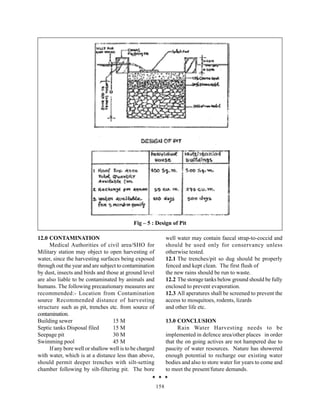
Collecting rainwater as it falls from the sky          2. Utilization of Rainwater for Recharging Pit
seems immensely sensible in areas struggling to                     Where there is no well or bore well in the
cope with potable water needs. Rainwater is one of           house, total rainwater falling on the open plot can
the purest sources of water available as it contains         be recharged by making recharge pit. Water flowing
very low impurities. Rain water harvesting systems           out of the plot can be directed to this pit. This pit
can be adopted where conventional water supply               may get filled 10 to 15 times in one monsoon and
systems have failed to meet people’s needs.                  can recharge water up to 200 m3. This method is
                                                             effective in the area where permeability of soil is
COMPONENTS               OF        RAINWATER                 more. The capacity of the pit may be taken up to 10
HARVESTING STRUCTURE                                         m3. The percolation of water through this pit of the
All rainwater harvesting structures will have three          order of 200 m3 per annum is possible. The cost of
basic components:                                            this structure may come about Rs 7000.
1. Catchment area i.e. the surface area utilized for
    capturing the rainwater.                                 3. Utilization of Rainwater for Well Recharging
2. Collection device, like tanks or cisterns or                      Rainwater flowing in the farm is diverted to
    percolation pits used for collecting or holding          a water collecting tank of size 6 m x 6 m x 1.5 m
    the water.                                               near well and a small filter pit of size 1.5 m x 1.5 m
3. Conveyance system i.e. the system of pipes or             x 0.6m is made at the bottom of large pit. Otherwise
    percolation pits through which water is                  suitable pit may be excavated depending upon the
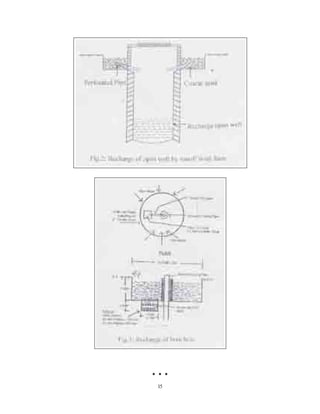
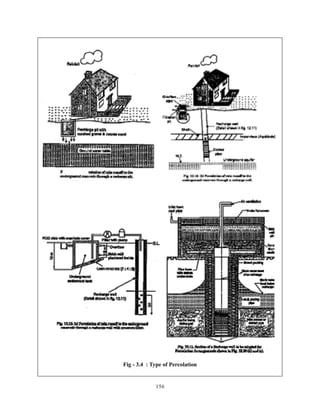
    transported from the catchment area to the               availability of space near well. Fig.2 shows details
    collection device.                                       regarding recharge of open well by runoff from farm.
                                                             Filter pit is filled with sand, pebbles larger than 20
METHODS OF RAINWATER HARVESTING                              mm and pebbles/boulders larger than 75mm pebbles
      There are different ways by which rain water           is filled in three equal layers and connected to the
harvesting is carried out. Some of the important             well by 150 mm diameter PVC pipe and this pipe
methods are discussed one by one as discussed in             projects 0.5 to 1.0 m inside the well. The capacity
coming paragraphs.                                           of the water tank may be taken about 50 m3. The
                                                             percolation of water 400 to 1000 m3 per year is
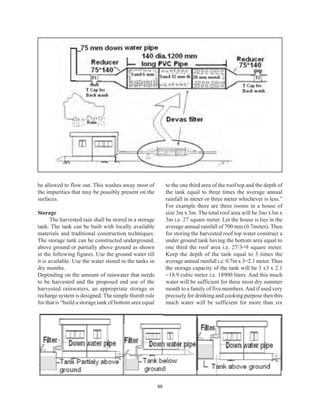
1. Utilizing Rainwater for Dewas Roof Water                  possible through this structure.
Filter
        Dewas is the name of the city located in             4. Utilizing of Rainwater for Bore well
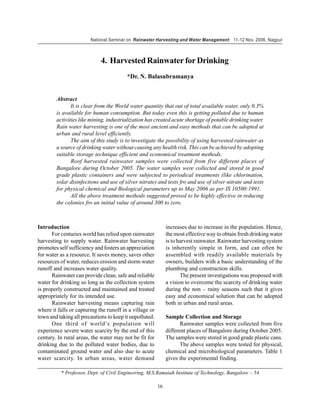
Madhya Pradesh. This roof water filter is first              Recharging
practiced at Dewas and hence the name Dewas roof                    Arrangement of bore well recharging is as
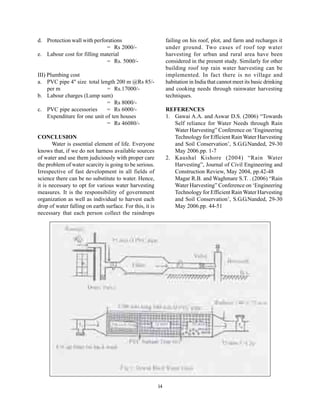
water filter. Fig.1 shows details of Dewar roof water        shown in fig. 3. A six metre diameter collecting pit
filter. It can be made easily using sand pebbles of          of 1.5 m depth is excavated around the bore well
different sizes. In this two caps are provided as T1         casing pipe. Another small pit of 1.5 m x 1.5 m x
and T2. Keep the cap T1 and T2 always closed. The            0.6 m depth is made at the bottom of large pit and
T2 is used for periodical back washing of filter and         filled with filter media. A 75 mm diameter PVC pipe
cap T1 is used for backwash drainage. Small pebbles          is connected to the bore well casing pipe after first
of size 6 mm are on entry side of rainwater. Use of          layer of 75 mm pebbles. An inverted elbow is
medicine for water purification is made through cap          connected to the pipe.
T2. Do not recharge rainwater for first two days in
rainy season. Keep the roof always clean, especially         5. Utilizing Roof Water to Recharge Trench
in rainy season so that quality of rain water falling              The roof water collected can be recharged
on roof is not deteriorated. The cost of this roof           through recharge trench. Water can be recharged
filter excluding connecting pipe is about Rs 800.            throughout the year either by using used water or
For average condition in Maharashtra, from 100               rainwater. This recharge trench may get filled many
square metres roof area about 50 m3 of water can             times as per availability of used or rain water. This
be percolated through this filter.                           method is effective in the area where permeability

                                                        11
of soil is more. The capacity of the trench may be             second sand filter surrounding the slotted section of
taken up to 20 m3. The percolation of water through            the well at the top prevents the remaining suspended
this pit of the order of 100 to 200 m3 per annum is            material entering the well. Beyond this is a coir
possible. The cost of this structure may come about            wrapping as a final protective filter before water
Rs 5000.                                                       enters the well. The rate gradually decreases due to
                                                               setting of slit at the top. Every year, after the rainy
6. Utilizing Surface Rainwater to Recharge Tube                season about one meter of the sand at the filter bed
well                                                           has to be replaced. Every year the well is developed
      Depleted aquifers are directly fed with surface          with a compressor once immediately after the
rainwater by using a recharge tube well so that                storage structures become empty because the water
recharge is fast and evaporation and transit losses            level is shallow immediately after the monsoon and
are zero.                                                      development is effective.
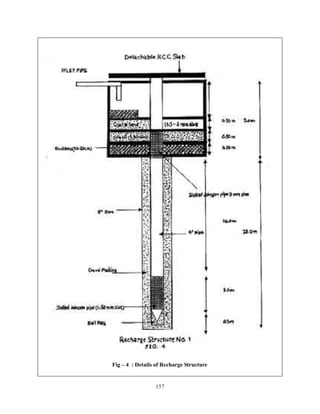
      A typical recharge tube well is designed as                     During pumping when the water is clear, it
follows :                                                      may be allowed on the filtered bed so that it takes
1. A borehole of 50 cm diameter is drilled to the              down the slit accumulated in the filter bed into the
    desired depth.                                             well which is being developed. Through this method
2. A 20 cm diameter casing i.e. outer pipe of the              the entire filter bed also gets cleared of the silt during
    bore well is designed by providing slotted                 the time of infiltration.
    perforated sections against aquifers.
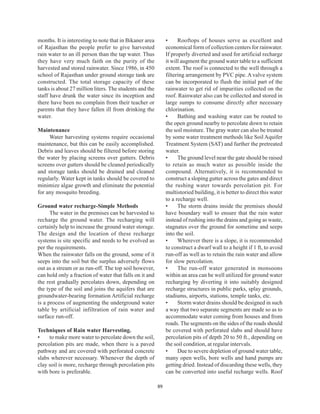
3. The depth of the recharge tube well should be               7. Utilizing Roof Water to Collect into the Storage
    about 30 metre below the water table in the area.          Tanks
4. The annular space between the borehole and                          Rainwater from the roof surface is drained
    the pipe is filled with good gravel and developed          through gutters into storage tanks. To prevent
    with a compressor till it gives clear water. To            contamination and dust to flow into the storage tanks
    stop the suspended solids from entering the                there is a provision of a hand movable gutter
    recharge tube well, a filter mechanism is                  connection which can be manually moved to divert
    provided at the top.                                       the water out. The rooftop is used as the collection
5. A pit of dimensions 6 m x 6 m x 6 m is dug with             device. Guttering generally made of PVC is used to
    the tube well at the center.                               transport the rainwater from the roof top to the
6. This pit is filled with small rounded boulders,             storage tanks. Storage tanks may be either above or
    stone chips and sand in layers with boulders at            below the ground and should be properly covered.
    the bottom and sand at the top.                            In apartments more than one storage tanks can be
7. The top one metre of the casing assembly in                 used and they can be interconnected through
    this pit is filled with sand. The top of the casing        connecting pipes. The storage tanks should have
    pipe is provided with a cap which is about 600             provision of an adequate enclosure to minimize
    mm below the sand bed to prevent suspended                 contamination from human, animal or other
    material from entering the well.                           environmental contaminants. The end of the gutter,
8. In order to release the air present in the casing           which connects the storage tank, should be attached
    assembly during the percolation process of                 with a filter to prevent any contaminants to get into
    floodwater, the air vent is provided through a             the storage tank. It is also advisable to drain the
    75 mm diameter pipe connected to the                       first flow to get rid of the dust and contaminants
    recharging tube well within the top 600 mm                 from the roof top.
    through a reducer tee of dimensions 200 mm x
    75 mm. The air releasing pipe is then extended             CASE STUDY OF RAIN WATER
    to one of the banks where the vent is                      HARVESTING FOR BUILDING IN URBAN
    constructed.                                               AND VILLAGE AREA
                                                                    Rain water harvesting system for annexure
      When flood water filters through the sand,               building of Govt. College of Engineering,
most of the suspended materials are filtered out. The          Aurangabad is being considered for study purpose.

                                                          12
The Government Engineering College is located in               III) Plumbing cost
Marathwada region of Maharashtra State. The                    a. PVC pipe 6" size total length 200 m @ Rs
average annual rainfall of Aurangabad town is                       100/- per m             = Rs.20000/-
around 700 mm/year. The population of the city is              b. PVC pipe 4" size total length 120 m @Rs 85/-
more than 10 lakh. Presently the water is supplied                  per m                   = Rs 10200/-
to the town by Municipal Corporation, Aurangabad.              c. Labour charges (Lump sum)
Considering the capacity of water treatment plant,                                          = Rs 20000/-
the water is supplied to town on alternate day.                d. PVC pipe accessories      = Rs 10000/-
       The institute needs water about 350 m3 per
day. In last few years it is observed that the ground          IV) Tube Well 100 m deep and 2 H.P. pump
water level of the town is being depleted. It is                                              = Rs.30000/-
essential to conserve the rainwater not only in the                Total Expenditure          = Rs142680 /-
city itself but also in areas surrounding to                       The total cost of rain water harvesting system
Aurangabad. No one can neglect the importance of                   project is Rs.142680/-
rainwater harvesting. According it is proposed to
collect roof water from at least ten hoses from each           Rain water harvesting system for village
village. It is also proposed to collect rainwater from         community
roof of Annex building of this institute. If this roof                This system is designed for the village
top rain water harvesting scheme is implemented                community situated in locality where there is
all civil engineering students from this institute will        scarcity of water. The annual rainfall is 650 mm per
have a role model. These students will see the system          year. The water is supplied by panchayat/local
and in future they will be motivated to implement              authority alternate day. Incase of summer season
roof water harvesting system elsewhere. The                    the water is supplied by tankers. So it is proposed
tentative estimate is as given below.                          to conserve the rain water by allowing it to percolate
                                                               so as to meet underground water. It is proposed to
Estimate for rain water harvesting system for                  conserve rain water collected on top of every house
annex building                                                 and common rain water harvesting system is
Area of building : 2159.78 m2                                  designed for group of 10 houses having approximate
Perimeter of building : 335.45 m                               area of 70 m2 each
Average annual rainfall at Aurangabad : 700 mm
Coefficient of runoff : 0.8                                    Estimate for rain water harvesting system for
Quantity of water to be harvested per year :                   village community
                                 1209.47 m3                    Area of group of houses : 700 m2
Requirement of soak pit : 6 m x 6 m x 1.5 m (Two               Perimeter: 340 m
numbers)                                                       Average annual rainfall: 650 mm
                                                               Coefficient of runoff: 0.8
I ) Cost of excavation :        2 x 54 m3 x Rs.60/-            Quantity of water to be harvested per year: 364 m3
                                = Rs. 6480/-                   Requirement of soak pit: 3 m x 3 m x 2 m

II) Cost of material for filling of soak pit                   I) Cost of excavation :     18 m3 x Rs.60/-
a. 75 mm to 100 mm size aggregate                                                             = Rs. 1080/-
                                = Rs. 12000/-
b. 15 mm to 25 mm size aggregate                               II) Cost of material for filling of soak pit
                                = Rs. 12000/-                  a. 75 mm to 100 mm size aggregate
c. Sand                         = Rs. 8000/-                                                   = Rs. 2500/-
d. Protection wall with perforation                            b. 15 mm to 25 mm size aggregate
                                = Rs 8000/-                                                    = Rs. 2500/-
e. Labour cost for filling material ( Lump sum)                c. Sand                         = Rs. 2000/-
                                = Rs. 6000/-

                                                          13
d. Protection wall with perforations                           failing on his roof, plot, and farm and recharges it
                             = Rs 2000/-                       under ground. Two cases of roof top water
e. Labour cost for filling material                            harvesting for urban and rural area have been
                             = Rs. 5000/-                      considered in the present study. Similarly for other
                                                               building roof top rain water harvesting can be
III) Plumbing cost                                             implemented. In fact there is no village and
a. PVC pipe 4" size total length 200 m @Rs 85/-                habitation in India that cannot meet its basic drinking
     per m                     = Rs.17000/-                    and cooking needs through rainwater harvesting
b. Labour charges (Lump sum)                                   techniques.
                               = Rs 8000/-
c. PVC pipe accessories        = Rs 6000/-                     REFERENCES
     Expenditure for one unit of ten houses                    1. Gawai A.A. and Aswar D.S. (2006) “Towards
                               = Rs 46080/-                       Self reliance for Water Needs through Rain
                                                                  Water Harvesting” Conference on ‘Engineering
CONCLUSION                                                        Technology for Efficient Rain Water Harvesting
       Water is essential element of life. Everyone               and Soil Conservation’, S.G.G.Nanded, 29-30
knows that, if we do not harness available sources                May 2006.pp. 1-7
of water and use them judiciously with proper care             2. Kaushal Kishore (2004) “Rain Water
the problem of water scarcity is going to be serious.             Harvesting”, Journal of Civil Engineering and
Irrespective of fast development in all fields of                 Construction Review, May 2004, pp.42-48
science there can be no substitute to water. Hence,               Magar R.B. and Waghmare S.T. . (2006) “Rain
it is necessary to opt for various water harvesting               Water Harvesting” Conference on ‘Engineering
measures. It is the responsibility of government                  Technology for Efficient Rain Water Harvesting
organization as well as individual to harvest each                and Soil Conservation’, S.G.G.Nanded, 29-30
drop of water falling on earth surface. For this, it is           May 2006.pp. 44-51
necessary that each person collect the raindrops


                                                          14
15
National Seminar on Rainwater Harvesting and Water Management 11-12 Nov. 2006, Nagpur


                             4. Harvested Rainwater for Drinking
                                         *Dr. N. Balasubramanya


        Abstract
               It is clear from the World water quantity that out of total available water, only 0.3%
        is available for human consumption. But today even this is getting polluted due to human
        activities like mining, industrialization has created acute shortage of potable drinking water.
        Rain water harvesting is one of the most ancient and easy methods that can be adopted at
        urban and rural level efficiently.
               The aim of this study is to investigate the possibility of using harvested rainwater as
        a source of drinking water without causing any health risk. This can be achieved by adopting
        suitable storage technique efficient and economical treatment methods.
               Roof harvested rainwater samples were collected from five different places of
        Bangalore during October 2005. The water samples were collected and stored in good
        grade plastic containers and were subjected to periodical treatments (like chlorination,
        solar disinfections and use of silver nitrate) and tests fro and use of silver nitrate and tests
        for physical chemical and Biological parameters up to May 2006 as per IS 10500:1991.
               All the above treatment methods suggested proved to be highly effective in reducing
        the colonies fro an initial value of around 300 to zero.


Introduction                                                  increases due to increase in the population. Hence,
      For centuries world has relied upon rainwater           the most effective way to obtain fresh drinking water
harvesting to supply water. Rainwater harvesting              is to harvest rainwater. Rainwater harvesting system
promotes self sufficiency and fosters an appreciation         is inherently simple in form, and can often be
for water as a resource. It saves money, saves other          assembled with readily available materials by
resources of water, reduces erosion and storm water           owners, builders with a basic understanding of the
runoff and increases water quality.                           plumbing and construction skills.
      Rainwater can provide clean, safe and reliable                 The present investigations was proposed with
water for drinking so long as the collection system           a vision to overcome the scarcity of drinking water
is properly constructed and maintained and treated            during the non – rainy seasons such that it gives
appropriately for its intended use.                           easy and economical solution that can be adopted
      Rainwater harvesting means capturing rain               both in urban and rural areas.
where it falls or capturing the runoff in a village or
town and taking all precautions to keep it unpolluted.        Sample Collection and Storage
      One third of world’s population will                           Rainwater samples were collected from five
experience severe water scarcity by the end of this           different places of Bangalore during October 2005.
century. In rural areas, the water may not be fit for         The samples were stored in good grade plastic cans.
drinking due to the polluted water bodies, due to                    The above samples were tested for physical,
contaminated ground water and also due to acute               chemical and microbiological parameters. Table 1
water scarcity. In urban areas, water demand                  gives the experimental finding.

          * Professor, Dept. of Civil Engineering, M.S.Ramaiah Institute of Technology, Bangalore – 54

                                                         16
Table 1 : Experimental Results of Physical, Chemical & Biological Parameters

      Sample              Date of Expt Turbidity pH            Do        Hardness       Chloride   Alkalinity Acidity
                                       NTU                     mg/l of   mg/l           mg/l       mg/l of    mg/l of
                                                                                                   CaCO3      CaCO3
 1. Banashankari          14/08/05       4.6        7          7.8       56             13.96      86          06
 2. MSRIT                 17/01/06       6.3        8.4        7.7       22             16         30          08
 3. Shivajinagar          21/11/05       8.3        8.11       8         58             13.2       40          06
 4. Vijayanagar           18/01/06       11.9       7          7.7       58             21.3       46          12
 5. Vidyaranyapura        12/12/05       7.3        8          8.1       46             12         18          14

        A detailed study of Table 1 reveals that both          sis hours. Such an exposure increases the
the physical& chemical parameters are very much                temperature of water and also gives an extended
within the limits for drinking water standards                 dose of solar radiation killing the microbes.
specified by WHO (1984) and IS 10500:1991.
However, the colony counts were quite significant              Chlorination
in all the five samples.                                             Chlorination is one of the most reliable
        Therefore, it was decided to emphasize more            methods of disinfecting drinking water. In this
on the microbiological contaminations and suitable             method the calculated amount of chlorine is added
treatment methods to make the rainwater fit for                to one litre of water sample for a specified tune and
drinking.                                                      thereafter tested for the coliform counts.

Treatment methods and Results                                  Silver Nitrate
       All the five rain water samples were subjected                 Silver nitrate is very small doses of 0.05 to
to the following treatments.                                   0.1 mg/l helps in disinfecting the drinking water.
•      Solar disinfection                                      Silver nitrate in smaller doses does not impart any
•      Chlorination                                            taste, odour or produces any harmful effect on
•      Using Silver nitrate                                    human body.
•      Combination of the above method.
                                                               Combination of the above methods
Solar Disinfection                                                    In order to investigate the effectiveness of the
       Solar disinfection is a process where in                treatment methods following combinations were
microbes are destroyed through temperature and                 tried.
ultra violet radiation provided by the fun.                    a)     Chlorine + Solar disinfection
       Water is filled either in a clean transparent or        b)     Silver nitrate + Solar disinfection.
painted (Black) bottle oxygenated by shaking,
followed by topping up. It is placed in the horizontal         Tables 2,3 & 4 presents the details of coliform
portion on tope exposed to direct sunlight for about           counts of the above specified treatments.
                              Table 2: Coliform Count (At room temperature)
     Sample                  Date of Collection   Date of experiment Coliform Count/100ml (Average of 3 tests)
                                                                        Chlorination        Silver Nitrate
   1. Banashankari           20/10/05             17/05/06                          0                      0
   2. MSRIT                  25/10/05             17/05/06                          0                      0
   3. Shivajinagar           25/10/05             17/05/06                          0                      0
   4. Vijayanagar            25/10/05             17/05/06                          0                      0
   5. Vidyaranyapura         28/10/05             17/05/06                          0                      0

                                                          17
Table 3 : Coliform Count (Solar disinfection using transparent bottle)

  Sample                  Date of          Date of Expt                       Coliform count / 100ml
                          Collection                           Transparent Bottle        Chlorination    Silver nitrate
                                                                                    (Average of 3 tests)
  1. Banashankari         20/10/05         17/03/06                   40                       0                  0
  2. MSRIT                25/10/05         24/03/06                   38                       0                  0
  3. Shivajinagar         25/10/05         02/04/06                   40                       0                  0
  4. Vijayanagar          25/10/05         15/04/06                   35                       0                  0
  5. Vidyaranyapura       25/10/05         21/04/06                   28                       0                  0


               Table 4 : Coliform Count (Solar Disinfection using black painted bottle)

  Sample                      Date of          Date of Expt.          Coliform Count / 100 ml (Average of 3 tests)
                              Collection                                Black Bottle               Chlorination
  1. Banashankari             20/10/05         17/03/06                      2                          0
  2. MSRIT                    25/10/05         24/03/06                      2                          0
  3. Shivajinagar             25/10/05         02/04/06                      3                          0
  4. Vijayanagar              25/10/05         15/04/06                      2                          0
  5. Vidyaranyapura           28/10/05         21/04/06                      0                          0


       Careful study of Table 2 depicts that                   Conclusions
chlorination and Silver nitrate in very small dosages             Rainwater collection is easy and economical
are very effective even at room conditions, justifying            both in rural and urban areas.
their selection.                                                  Rainwater harvested during Oct 2005, tested till
       Detailed study of Table 3 indicates that solar             May 2006 without much changes in physical
disinfection using a transparent bottle is not very               properties like colour, odour & turbidity, inspite
effective in reducing the coliform counts. However,               of the fact that they were from various sources
addition of chlorine and silver nitrate have proved               and stored in normal food grade plastic
to be highly effective, further strengthening their               containers.
selection as disinfectants.                                       All the treatment methods suggested are highly
       Finally from Table 4, it can be seen that solar            effective in reducing the microbiological
disinfection using a black painted bottle has yielded             contamination and also viable both at rural and
in a more effective disinfection, the coliform counts             urban levels.
have very significant, reduced. The reason being                  Rainwater harvesting and its treatment is
that a black bottle or body absorbs more heat, which              affordable by individuals and will be highly
enables in destroying the bacteria. In the present                useful in drought prone areas.
investigations is was observed that the water
temperature in the bottles recorded a temperature              Future
around 500 C.                                                         It is suggested that similar investigations are
       It is also very interesting of disinfection to          made on a number of samples collected from
note that the chlorination method has established              different places, stored under different conditions.
its supremacy.

                                                          18
Acknowledgement                                                    Proe. 23rd WEDC Conf. Sep 1-5 1997, Durban
      The author wishes to thank the management                    S.Africa.
of M.S.Ramaiah Institute of Technology, Bangalore            6.    Sharma S.K. and Jain S.K, Proceedings of the
560054 for all the encouragements & inspiration                    International Conference on Management of
provided for the study. Also many thanks are due to                Drinking water resources – central leather
Mr.Sunil Hegde, Mr.Anantha Padmanabha &                            Research Institute. Anna University & Tamil
Mr.Vinay Final Year B.E. Students for their help                   Nadu Water supply & Drainage, Board,
during the course of the experimental investigations.              Chennai, 1997, pp129-138.
                                                             7.    Wegelin M & Sommer B, Solar water
References :                                                       disinfections (SODIS) – Destines for world
1. Bell, F.A.Jr, D.L.Jerry, J.K.Smoth, and                         wide use. Water lines, Vol 16, No.3, IT
   S.C.Lynch, Studies on home water treatment                      Publications, London 1998.
   systems. Jr.Am water works Assoc. 75:104-107-             8.    Winter bottom, Daniel “Rainwater Harvesting,
   1984.                                                           An ancient technology – cisterns in
2. Davies C.M., and Evison L M “Sunlight & the                     reconsidered, Landscape Architecture”, April
   survival of entropic bacteria in natural water                  .2000 pp 42-46.
   Journal of applied Bacteriology 7, 265-274-               9.    White G.C, Hand Book of chlorination &
   1991.                                                           Alternative Disinfectants, Johns Wiley & Sons,
3. Drinking water standards, www.epa.gov/safe                      Inc, New York 1999.
   water/md.html.                                            10.   Wolfe R.L., 1990, “Ultraviolet Disinfection of
4. I.S. 10500:1991 “Drinking Water Standards”.                     Possible water” Env.Sci and Technology 24(6),
5. Jalbottt R “Rural water supply and Sanitation                   768-773, 1990.
   program in India – Goals, roles & innovation.


                                                        19
National Seminar on Rainwater Harvesting and Water Management 11-12 Nov. 2006, Nagpur


             5. Rain Water Harvesting and Ground Water Recharge
                                   *Madhaorao Bajirao Deshmukh


1.1 Water is an essential natural resource for                  By adopting water harvesting, an additional 160
sustaining life and environment. The available water         BCM shall be available for use.
resources are under pressure due to increasing
demands and the time is not far when water, which            3.2 Ground water level in some areas are falling at
we have always thought to be available in abundance          the rate of one meter per year and rising in some
and free gift of nature, will become a scarce                other areas at the same rate.
commodity. Conservation and preservation of water                  You can capture and recharge 650000 liters of
resources is urgently required to be done. Water             rainwater from a 100-sq. meters size rooftop and
management has always been practiced in our                  meet drinking and domestic water requirement of
communities since ancient times, but today this has          family of four for 160 days.
to be done on priority basis.                                      The number of wells and borewells for
                                                             irrigation in the country has increased five fold to
1.2 India’s population has recently crossed the one          175 lacks during past fifty years.
billion mark, with an ever-increasing population, our        There are 25 to 30 lack wells and borewells for
country faces a serious threat to the management of          drinking, domestic and industrial uses.
her water resources as the gap between demand and            More than 80% of rural and 50% of urban, industrial
supply widens.                                               and irrigation water requirement in the country are
                                                             met from ground water.
2.1 In our villages and cities, down the ages, people
have developed a wide array of techniques to harvest         3.3 Causes Of Fall In Ground Water Levels
rainwater, which are simple, efficient and cost              •     Over exploitation or excessive pumpage either
effective. There is a tendency to ignore these               locally or over large areas to meet increasing water
traditional water-harvesting systems. We should              demands.
draw upon the wisdom of our ancient life sustaining          •     Non-availability of other sources of water.
systems and through better management, conserve              Therefore, sole dependence is on ground water.
our precious water resources.                                •     Unreliability of municipal water supplies both
                                                             in terms of quantity and timings, driving people to
2.2 Harvesting of rainwater is of utmost important           there own sources.
and the ministry of water resources is embarking on          •     Disuse of ancient means of water conservation
such programme. A judicious mix of ancient                   like village ponds, baolis, percolation tanks and
knowledge, modern technology, public and private             therefore, higher pressure on ground water
investment and above all, people’s participation will        development.
go a long way in reviving and strengthening water
harvesting practices through out the country.                3.4 Effects Of Over Exploitation Of Ground
                                                             Water Resources
3.1 Ground Water Resources: - Annually                       •   Drastic fall in water levels in some area
replenishable resources are assessed as 432 billion          •   Drying up wells/ borewells
cubic meters (BCM)                                           •   Enhanced use of energy

         *B.Sc., B.E. (Hon), AMICE (USA), Ex- Superintending Engineer, 54, Tatya Tope Nagar, Nagpur

                                                        20
•    Deterioration in ground water quality                   •    Benefiting in the water quality
•    Ingress of sea water in coastal areas.                  •    Arresting sea water ingress
                                                             •    Assuring sustainability of the ground water
4.0 Method And Techniques Of Rain Water                      abstraction sources and consequently the village and
Harvesting                                                   town water supply system
•     Roof – top rain water harvesting and its               •    Mitigating the effect of droughts and achieving
recharge to underground through existing wells and           drought proofing
borewells or by constructing new wells, borewells,           •    Reviving the dying traditional water harvesting
shafts etc.                                                  structures and their rehabilitation as recharge
•     Capturing and recharging city storm water run          structures.
off through wells, shafts, storm water drains.               •    Effective use of lack of defunct wells and
•     Harnessing run off in the catchment by                 tubwells as recharge structure
constructing structures such as gabions, check dams,         •    Up gradation of social and environmental status
bhandaras, percolation trenches, sub-surface dykes           etc.
etc.
•     Recharging treated and industrial affluent             7.0 Proposed Policy Measures For Rain Water
underground by using it for direct irrigation or             Harvesting
through ponds, basins or wells etc.                          •    Provides at least one roof-top rain water
                                                             harvesting structure for every 200sq. meters plot in
5.0 Objective Of Rain Water Harvesting                       urban areas.
•    Restore supplies from the aquifers depleted due         •    Revive/ rehabilitation all village ponds
to over exploitation                                         •    Subject to technical feasibility, provides at least
•    Improve supplies from aquifers lacking                  one check dam / KT weir / Sub- surface dyke in
adequate recharge.                                           each streamlet with catchments of 1 to 3 sq. km.
•    Store excess water for use at subsequent times.         •    Provide all drinking water wells with a recharge
•    Improve physical and chemical quality of                structure
ground water                                                 •    Ban construction of irrigation wells / tubewells
•    Reduced storm water run off and soil erosion            within a distance of 200 m or less (depending on
•    Prevent salinity ingress in coastal areas.              scientific criteria) of the drinking water supply well.
•    Increase hydrostatic pressure to prevent/ stop
land subsidence.                                             8.0 Success Stories Of MAHARASHTRA
•    Recycle urban and industrial wastewater etc.            •     In Yaval taluka, Jalgaon District, Six
•    Rehabilitate the existing traditional water             percolation tanks, two recharge shafts and one
harvesting structure like village ponds, percolation         injection well were constructed- A total of about 546
tanks, baolis, tanks, etc                                    ha area benefited
•    With minor scientific modifications and                 •     In Amravati District, three percolation tanks
redesigning, convert the traditional water harvesting        and ten cement plugs benefiting an area of 280 ha
structure into ground water recharge facilities.             and 100 ha respectively have been constructed- rise
•    Use the existing defunct wells and borewells            in water level up to 10 meters recorded.
after cleaning and also the operational wells as             •     Experiments of catchments treatment carried
recharge structures.                                         out at Adgaon and Palaswadi in Aurangabad,
                                                             Ralegaon Siddhi in Ahmednagar and Naigaon in
6.0 Benefits Of Rain Water Harvesting                        Pune by Shri Anna Hazare - effort have led to revival
•   Rise in ground water levels in water                     of streamlets and enhanced availability of ground
•   Increased availability of water from wells               water in the water shed.
•   Prevent decline in water levels
•   Reduction in the use of energy for pumping               9.0 Proposed Strategy
water and consequently the costs.                            •   Organize Mass Awareness Programmes
•   Reduction in flood hazard and soil erosion               involving district administration and NGOs to

                                                        21
educate in different sections of users and to make            industrial houses to be invited to participate in the
the programme demand oriented.                                work and adopt towns and villages and provide
•     Roof-Top rain water harvesting and its recharge         financial support.
underground through more than two lack existing               •    Government organizations to act as facilitators
but defunct drinking water and irrigation wells, or           and provide technical and financial support for
by constructing new wells, borewells, Shafts,                 creating the demonstration facilities etc.
spreading basins etc.
•     Make roof-top rain water harvesting and                 10.0 Future Action Plans
recharge mandatory in all urban dwellings.                    •    Prepare national and state level water
•     Capturing city storm water run- off and                 harvesting perspective plans.
recharging it through wells, shafts, spreading basins,        •    Develop plans and implement roof-top rain
storms and water drains etc.                                  water harvesting measures using 1,00,000 wells
•     Harnessing run off in catchments by                     (existing, defunct and or operative wells to be used
constructing structures such as gabions, check dams,          in the first instance)
bhandaras, percolation trenches, bus-surface dykes            •    Provide rural drinking water wells with
etc.                                                          recharge facilities- cover 1,00,000 wells
•     Impounding surface run from village                     •    Harvest and recharge city storm water in 100
catchments and water shed(s) in village ponds and             towns
percolation tanks.                                            •    Revive and rehabilitate 1, 000 dying village
•     Rehabilitation all ancient rain water harvesting        ponds.
structures.                                                   •    Design and construct 200 percolation tanks,
•     Invoke legal provision, if and when required,           5000 check dams/ bhandaras and 1,000 sub surface
to regulate indiscriminate boring of wells and to             dykes.
make the installation of recharge facilities mandatory        •    Recycle secondary treated urban waste water
•     Constitute water user Association (WUA) or              through aquifers at five centers.
village Beneficiary Groups (VBG) NGOs to                      •    Identify potential aquifers in drought prone
organize the constitution of these bodies. The WUA/           areas and declare these apart as “Ground Water
VBG and NGOs to be associated with the project                Sanctuaries”
right from the concept to completion stages.
•     For expanding further scope of work, the                Ref: - CENTRAL GROUND WATER BOARD-
                                                              MINISTRY OF WATER RESOURCES.


                                                         22
National Seminar on Rainwater Harvesting and Water Management 11-12 Nov. 2006, Nagpur


    6. Rain Water Harvesting Tanks for Supplementing Minor Irrigation
                        Tanks during Drought
                                        * Mohd. Mahboob Hussain


Introduction :                                                 development etc. Rainwater harvesting is usually
        India’s total land area is 3287263 Sqkm. The           classified into two types (i) harvesting for
cultivated land is 55.7% i.e., 183.09 million hectors.         agriculture (irrigation) needs and (ii) harvesting for
Average annual rainfall is 117 Cm; average monsoon             domestic and other needs. For irrigation needs the
rainfall is 55 Cm. The occupation of about 70% of              rainwater can be harvested during rainy season by
people in India is agriculture. The population of              constructing any of the following structures.
India is fed on the food production of the country.            1.     Major storage reservoir
Main source of water in this country is rainfall               2.     Medium storage reservoir
during monsoon season. The rainfall mainly                     3.     Minor storage tanks
confined in the months from June to September. But             4.     Watershed development Structures, like
it is not regular and erratic with respect to both time        Check dams, percolation tanks, Sunken gully pits
and place. Now a days drought and floods are the               etc.,
sever hazards in different parts of our country. The                  Looking in to the rainfall trends in past forty
requirement of agricultural produce is expected to             years it is felt that rain water above 75% P.L. should
rise steeply by 2025.Hence India must concentrate              be stored for beneficial use during droughts / low
on increasing area under irrigation and improving              rainfall year. In this paper it is proposed to construct
the productivity of both land and water to meet the            Rain Water Harvesting Tanks for the beneficial use
needs of the population. The demand of water                   of water for supplementing minor irrigation tanks
increasing due to several factors such as increase in          during drought years. Rain Water Harvesting is
population growth, which has led to a situation in             being promoted extensively in India, particularly
which water has become a scarce resource. Hence                in the Southern States.
it is very essential to harvest rainwater during rainy
season. Rainwater harvesting is the intentional                Need for Rain Water Harvesting Tanks :
collection of rain water from a surface and its                      Since rivers occasionally swells, hence some
subsequent storage in order to supply water during             countries have built oversized capacity reservoirs
the time of demand. Rain water harvesting is                   to store surplus water which will other wise be
essential in view of the fact that rainfall, which is a        wasted in to sea. For example, Egypt had built
source of fresh water, occurs in very short spells             Oswan Dam to store water about five times the yield
and runs off as a waste unless arrangements are                available in Nile River. During droughts they are
made for its storing.                                          successfully irrigating lands so that the country is
        Main source of irrigation development are              not vulnerable by famine. In most of the areas of
dams and canals. Other option are water harvesting             semi-arid region yearly rainfall is below the normal
structure such as for ground water development,                for continuous two to three years followed by a
surface minor irrigation systems, watershed                    normal rainfall year. The year wise monsoon rainfall


        * Deputy Executive Engineer, Medium Irrigation, I & C.A.D.Department, Govt. of A.P., Hyderabad

                                                          23
for some of the rain-gauge stations of Ranga Reddy              natural resource. Hence all water over and above
District in Andhra Pradesh are shown in annexure-               75% dependable yield is wasted in to sea. Since
I and graph enclosed showing rainfall variation for             rainfall is a natural phenomenon, we do not know
last 40 years indicates that lot of water above 75%             when and in which year rainfall will be above 75%
P.L .is wasted. More over from rainfall graphs it               P.L., hence it is the need of the hour to harvest Rain
can be seen that there are number of years when                 water above 75% P.L. also and to utilize during the
there is rainfall more than 75 % P.L followed by a              drought / low rainfall year. It is proposed to construct
low rainfall year. From graph of Monsoon rainfall               Rain Water Harvesting Tanks without any canal
versus year for Medchal R.G.S, the following                    system with a sluice to letdown water in the down
conclusions are drawn.                                          stream for existing minor irrigation tanks.
                                                                       For one R.G.S (i.e., TANDUR) the year wise
(i)      In the year 1967 there is excess rainfall over         total yield available for one of the subgroup having
         75% P.L. followed by a normal rainfall year            20 Sq.Miles for 40 years have been calculated. The
         1968 and a low rainfall year in 1969.                  yield available @ 75 % PL also has been calculated
(ii)     In the year 1971 the rainfall is much higher           using strange’s table which works out to 255.64
         than 75% P.L. followed by low rainfall year            Mcft. The surplus yield available after deducting
         of 1972.                                               the yield @ 75 % PL from the total yield is also
(iii)    In the year 1974 the rainfall is much higher           calculated year wise. Statement showing the above
         than 75% P.L. followed by low rainfall year            values year wise are presented in annexure- II
         of 1975.                                               enclosed. From the statement it is observed that for
(iv)     In the year 1976 the rainfall is much higher           30 years there is surplus yield available. The
         than 75% P.L. followed by low rainfall year            maximum surplus yield is 801.20 MCft. The
         of 1977.                                               average of surplus yield for 30 years is 267.495
(v)      In the year 1978 the rainfall is much higher           Mcft, but where as the 75% dependable yield is
         than 75% P.L. followed by low rainfall year            255.64 Mcft. The average of surplus yield is slightly
         of 1979.                                               higher than the yield available at 75% dependability.
(vi)     In the year 1983 there is flood followed by a          Since every year the surplus yield may not be
         normal rainfall year of 1984 and a low rainfall        available so much, hence it is proposed to utilize at
         year of 1985.                                          least 50% of the yield available at 75%
(vii)    In the year 1990 the rainfall is much higher           dependability duly constructing Rain Water
         than 75% P.L. followed by low rainfall year            Harvesting Tanks. In the statement minus values
         of 1991.                                               indicates that the yield available is below the 75%
(viii)   In the year 1996 the rainfall is much higher           PL yield for ten years out of 40 years. Hence there
         than 75% P.L. followed by low rainfall year            is scope for storing this surplus yield in the proposed
         of 1997.                                               Rain Water Harvesting Tanks.
(ix)     In the year 2000 the rainfall is much higher                  More over sometimes heavy rainfall occurs
         than 75% P.L. followed by low rainfall year            in one single month followed by a dry spell of 20 to
         of 2001.                                               30 days. In such case also this excess water due to
                                                                heavy rainfall can be stored in Rain Water
       From the above it can be stated that the water           Harvesting Tanks and released for existing minor
above 75% P.L. can be stored in the proposed Rain               irrigation tanks during dry spell so that crops can
Water Harvesting Tanks and used in the low rainfall             be grown successfully.
years. Presently any irrigation project is design to                   The World Banks has published a report
utilize water out of the available 75% dependable               “India’s Water Economy: Bracing for a turbulent
yield. Water has to be harvested, preserved and                 future”. In this report it is highlighted that India’s
utilized for beneficial used, as it is becoming a scarce        storage capacity of 200m3 per person is too little, as

                                                           24
compared to over 5000 m3 per person in U.S.A.                  through natural stream with minimum conveyance
and Australia, and 1000 m3 per person in Mexico                losses. The Rain Water Harvesting Tanks should
and China. It is also highlighted that the need for            essentially have a sluice and a surplus weir to
storages in India will be even more in the post                dispose off flood water. The sluice can be used to
climate change scenario. In India the poverty in               let down water to the down stream existing minor
irrigated districts is one third of that in unirrigated        irrigation tanks. The design procedure of minor
districts. Hence the proposed Rain Water Harvesting            irrigation tank can be adopted for design of Rain
Tanks will increase storage capacity per person in             Water Harvesting Tanks. The capacity of each Rain
India.                                                         Water Harvesting Tank can be fixed based on the
                                                               number of tanks to be taken up as Rain Water
Methodology for Proposing Rain Water                           Harvesting Tanks duly utilizing at least 50 % of the
Harvesting Tanks :                                             utilization of that of minor irrigation tank designed
       In a sub-group of a given sub-basin of a river          for 75 % dependable water. Eg: - In a given sub-
basin there may be few minor irrigation tanks, check           group if the 75% dependable water is 100 M.cft.
dams and percolation tanks which together may                  and the existing utilization is 80 M.cft. under
utilize 75 % dependable yield. Whenever there is               existing minor irrigation tanks. Rain Water
high rainfall above 75% P.L. in the catchment, the             Harvesting Tanks should be design to hold 40 M.cft.
water go waste down stream and ultimately joins                of water, which is 50% of present utilization. To
sea. We may not be able to know how much surplus               store 40 M.cft. of water, now propose 4 tanks of
water (above 75% P.L.) a sub-group catchment                   each 10 M.cft. live capacity in the upper reaches of
yields. Hence it is proposed to utilize at least 50 %          streams so that this water can be utilized during
of the water utilization of that of existing tanks             droughts / low rainfall year.
designed to utilize 75 % dependable water, so that
if there is failure of monsoon next year we can make           Plan of operation for Rain Water Harvesting
use of this water for irrigation and avoid drought.            Tanks :
The following sketch shows probable locations of                      Once these Rain Water Harvesting Tanks are
Rain Water Harvesting Tanks in a given sub-group.              constructed, the sluices should be kept open so that
The Rain Water Harvesting Tanks should be located              when it rains the water will flow down to the existing
in the initial reaches of streams, so that the stored          minor irrigation tanks to fill them up to their full
water can be utilized for filling the minor irrigation         tank level in the monsoon. When the minor irrigation
tanks when there is scanty rainfall and hence crops            tanks are filled up the sluices of Rain Water
can be grown successfully.                                     Harvesting Tanks should be closed so that water
                                                               can be stored in these Rain Water Harvesting Tanks.
                                                               Then depending up on the number of fillings
                                                               required ( as per design ) again water can be released
                                                               to lower existing minor irrigation tanks for their full
                                                               utilization as per hydrological clearance given . Now
                                                               close the sluices of Rain Water Harvesting Tanks
                                                               and store water up to full tank level. If there are
                                                               heavy rains again the surplus water will
                                                               automatically flow down through surplus weir. Next
                                                               year when monsoon are late, some quantity of water
                                                               from these Rain Water Harvesting Tank can be
Design of Rain Water Harvesting Tanks :                        released through sluices to the existing minor
     Select the site of Rain Water Harvesting Tanks            irrigation tanks so that farmers can take up land
such that it can feed the minor irrigation tank                preparation and sowing can be done in time. Even

                                                          25
if the monsoon fails the remaining water also can be        (9)  There will be soil conservation in the upper
released to down stream tanks so that the crops can              reaches of the catchment because of
be grown successfully. In a year when total rainfall             construction of Rain Water Harvesting Tanks.
is less than normal, these Rain Water Harvesting            (10) There is a need to workout surplus yields for
Tanks can be kept empty.                                         every year for each Rain Gage Stations and
                                                                 prepare model for storing water in Rain Water
Conclusions :                                                    Harvesting Tanks to utilize surplus water
(1) The concept of Rain Water Harvesting Tank                    optimally.
     is to store water during excess rainfall year          (11) As water is becoming scarce natural resource,
     (above 75% P.L.) and to utilize during drought              the cost of construction of Rain Water
     /scanty rain fall year.                                     Harvesting tanks should not come into way.
(2) Since Rain Water Harvesting Tanks are                   (12) There is a need to formulate a coherent policy
     designed to store surplus water over and                    or strategy towards strengthening extension
     above 75% P.L yield, there will not be any                  and technical support for Rain Water
     effect on existing minor irrigation system.                 Harvesting Tanks for crop production.
(3) Success rate of existing minor irrigation tanks
     can be ensured by regulation of water from             References :
     Rain Water Harvesting Tanks, thus utilizing            (1) “Innovative participatory technologies for
     water optimally.                                            water shed development in drought prone
(4) Generally minor irrigation tanks are designed                areas of India” by Sri. T. Hanmanth Rao,
     for 150% irrigation intensity. Because of                   Consultant of united nation.
     proposed Rain Water Harvesting Tanks in                (2) “Hand book for planning water shed
     upstream by storing surplus water, the                      management works”, Government of India,
     intensity of irrigation can be increased to                 Ministry of water resources, CWC,
     200% by supplying water for Rabi crops by                   December, 2000.
     virtue of which food production can be                 (3) Paper on “Irrigation development in India”
     enhanced.                                                   by Sri. Uddhao Wankede published in
(5) These Rain Water Harvesting Tank can serve                   proceedings of National Seminar on “
     as percolation tank in upper reaches of                     Irrigation development India” held from 9-
     catchments to improve ground water table,                   10 October 2004 hosted by the Institution of
     as there will be some dead storage below sill               Engineers (India), Nagpur local Center.
     level of sluice of that tank.                          (4) Irrigation manual by Illys.
(6) Because of construction of Rain Water                   (5) “Rain water harvesting – a case study in a
     Harvesting Tanks the loss due to flood                      collage campus in Mysore”, by Sri. M. R.
     damages can be minimized.                                   YADUPATHI PUTTY & Sri. P.RAJE URS,
(7) Wastage of heavy surplus water in to sea can                 Dept. of civil engineering, National Institute
     be minimized.                                               of Engineering, Mysore published in
(8) Rain Water Harvesting Tanks also will be very                Hydrology Journal of Indian Association of
     much useful for flora and fauna for                         Hydrologist volume 28, November 3-4,
     maintaining ecology of that area.                           September – December 2005.


                                                       26
ANNEXURE - I
Monsoon Rainfall ( in mm ) of different Rain guage stations of R.R. District in A.P
        S.No      Year       Medchal          Tandur        Himayat Sagar
        1         1960           N/A             N/A            551.2
        2         1961           N/A            909.1           571.2
        3         1962           N/A           1063.6             856
        4         1963          759.9           942.8           751.8
        5         1964          710.3           751.5           710.8
        6         1965          671.9           663.6             796
        7         1966          468.2           493.1           689.4
        8         1967          804.2           670.2           865.4
        9         1968          663.4           652.3           440.9
        10        1969          600.9           684.4           452.4
        11        1970          754.9           992.9             842
        12        1971          797.7           459.3           497.6
        13        1972          547.8             454           221.7
        14        1973          957.6            1097           633.5
        15        1974          784.4             850           614.4
        16        1975          566.7          1116.5          1689.6
        17        1976          720.1           725.1           906.8
        18        1977          584.1           480.8           568.5
        19        1978          783.3          1216.6          1009.7
        20        1979          440.3           585.2           564.6
        21        1980          845.2           650.5           577.6
        22        1981         1102.8           711.9           660.1
        23        1982          862.8           665.9           564.6
        24        1983         1858.5          1036.6           793.2
        25        1984          673.7           651.6           595.6
        26        1985          563.1           822.6           550.9
        27        1986          445.9             645             586
        28        1987          604.8           853.8           795.5
        29        1988          933.4           961.1           741.4
        30        1989          845.3           864.4           711.5
        31        1990          760.4            1173           721.6
        32        1991          624.8           767.4           393.4
        33        1992          645.8           795.8           611.9
        34        1993          767.5           697.2           479.8
        35        1994          787.2           479.8           598.7
        36        1995          899.9           790.8            1077
        37        1996          775.8           758.6           803.7
        38        1997          533.6           648.3           514.4
        39        1998          988.6          1342.1           983.5
        40        1999          701.3           670.7           540.8
        41        2000          791.3           861.9           N/A
        42        2001          589.6           N/A             N/A          N/A –
        43        2002          629.4           N/A             N/A          Not Available.

                                         27
Annexure- II
                        Statement showing the surplus yield beyond 75% dependability

No.   Year   Monsoon     Yield per    Total Yeild     Yeild        Surplus   % of Surplus
             Rainfall    Sq.miles     from            Available    Yeild     Yeild beyond
             in mm       in MCft      subgroup        @ 75% PL               75 % PL
                                      C.A ( 20 Sqm)
1     1961    909.1        27.25           545        255.64       289.36     113.19
2     1962   1063.6       38.566        771.32        255.64       515.68     201.72
3     1963    942.8        29.53         590.6        255.64       334.96     131.03
4     1964    751.5       17.742        354.84        255.64         99.2       38.8
5     1965    663.6       13.317        266.34        255.64         10.7       4.19
6     1966    493.1        6.479        129.58        255.64      -126.06     -49.31
7     1967    670.2       13.628        272.56        255.64        16.92       6.62
8     1968    652.3       12.783        255.66        255.64         0.02       0.01
9     1969    684.4       14.297        285.94        255.64         30.3      11.85
10    1970    992.9       33.148        662.96        255.64       407.32     159.33
11    1971    459.3        5.417        108.34        255.64       -147.3     -57.62
12    1972      454        5.255         105.1        255.64      -150.54     -58.89
13    1973     1097       41.248        824.96        255.64       569.32      222.7
14    1974      850       23.447        468.94        255.64        213.3      83.44
15    1975   1116.5       42.841        856.82        255.64       601.18     235.17
16    1976    725.1       16.322        326.44        255.64         70.8       27.7
17    1977    480.8        6.079        121.58        255.64      -134.06     -52.44
18    1978   1216.6       51.618       1032.36        255.64       776.72     303.83
19    1979    585.2        9.872        197.44        255.64        -58.2     -22.77
20    1980    650.5       12.698        253.96        255.64        -1.68      -0.66
21    1981    711.9       15.647        312.94        255.64         57.3      22.41
22    1982    665.9       13.426        268.52        255.64        12.88       5.04
23    1983   1036.6       36.404        728.08        255.64       472.44     184.81
24    1984    651.6        12.75           255        255.64        -0.64      -0.25
25    1985    822.6       21.767        435.34        255.64        179.7      70.29
26    1986      645       12.437        248.74        255.64         -6.9       -2.7
27    1987    853.8       23.691        473.82        255.64       218.18      85.35
28    1988    961.1       30.863        617.26        255.64       361.62     141.46
29    1989    864.4        24.37         487.4        255.64       231.76      90.66
30    1990     1173       47.745         954.9        255.64       699.26     273.53
31    1991    767.4       18.627        372.54        255.64        116.9      45.73
32    1992    795.8       20.213        404.26        255.64       148.62      58.14
33    1993    697.2       27.448        548.96        255.64       293.32     114.74
34    1994    479.8        6.048        120.96        255.64      -134.68     -52.68
35    1995    790.8       19.926        398.52        255.64       142.88      55.89
36    1996    758.6       18.139        362.78        255.64       107.14      41.91
37    1997    648.3       12.593        251.86        255.64        -3.78      -1.48
38    1998   1342.1       52.838       1056.76        255.64       801.12     313.38
39    1999    670.7       13.652        273.04        255.64         17.4       6.81
40    2000    861.9        24.21         484.2        255.64       228.56      89.41

                                         28
29
30
National Seminar on Rainwater Harvesting and Water Management 11-12 Nov. 2006, Nagpur


            7. Rain Water Harvesting and Recharging Ground Water
                          *R. K. Parghane *S. P. Kulkarni **A.W. Dhawale


INTRODUCTION :                                                WATER AVAILABILITY :
          Water is the most important resource of the                  India receives precipitation (including
entire society as a whole, since no life is possible          snowfall & rain) of around 4,000 billion cubic
without water. As water, being a limited resource,            metres (BCM), only 1,869 BCM is accessible water,
its efficient use is basic to the survival of the ever        of which India uses barely a third. Nearly 1,179
increasing population of the world. In India, the             BCM of water drains in to the sea. Region, whose
ground water is mainly used for drinking and                  yearly renewable freshwater availability is below
agricultural purposes. About 85% of drinking water            1,700 m3/ person is called as the water stress region.
is available through dug well, bore well, filter point        And the region whose yearly availability falls below
and tube well etc. The per-capital availability of            1,000 m3 / person is termed as water scarcity region.
water at national level has reduced from about 5,177          But national figure of annual average per capita
m3 in the year 1951 to present level of 1,869 m3.             water availability is 2,464m3. It shows that the
In view of this, water management is very critical            country is not in the water stress range so far.
for the growth and development of any economy,                However in some regions per capita availability is
more so in a large country like India which is                as low as 411m3. (Kanyakumari, Pennar, Kutchh,
endowed with many large rivers, lakes and wells               Kathiawar, Krishna basin, etc. )
that need to be conserved, better managed, recharged                   The run-off which is about 215 MHM needs
and channellised for meeting the ever growing                 to be arrested by making proper planning on micro
requirement of agriculture, industrial and urban              level as well macro level. Microlevel means water
growth. Moreover exploitation of ground water has             conservation schemes of the state governments
been taken up by millions of individual farmers               which is to be implemented in every village. But on
mostly in regions where surface water is either               macro level, a large chunk of water must be arrested
scarce or absent to meet their dire water needs.              by programme like national river – linking.
Although this has lead to local depletion or decline          Availability and utilization of water in India is
of ground water levels causing serious concern about          shown in table No.1 & Fig. No.1.
rainwater harvesting & the need to recharge ground
water. The quantum of ground water so far harnessed                               Table No. 1
is one third of the replenishable ground water of              No. Item                                   Quantity
431 km3 a year. In the comprehensive strategy                                                            (Cu.Kms.)
needed for the conservation and development of                 1. Annual precipitation volume
water resources, several factors are to be kept in                (including snowfall)                      4,000
view. These include the availability of water, its             2. Average annual potential flow
quality, location, distribution and variation in its              in rivers                                 1,869
occurrence, climatic conditions, nature of the soil,           3. Per Capita Water availability
competing demands & Socio-economic conditions.                    (1997)                                    1,967
In dealing with each of these, every effort must be            4. Estimated utilizable water resources      1,122
made to make the best use of water for the survival               i) Surface water resources                  690
of human life, animal and plant life.                             ii) Ground water resources                  432

        *Lect.in Civil Engg., Govt. Polytechnic, Nanded **Lect.in Civil Engg., Govt. Polytechnic, Washim

                                                         31
The average annual precipitation is
                                        400 million Hectare Metre (MHM)


                    Evaporates                      Percolates                        Run - off
                     70 MHM                         115 MHM                          215 MHM


                    Moist soils                         Enters into the ground water table
                    65 MHM                                           50 MHM

                                       Fig. 1 : Details of precipitation water


RAINWATER HARVESTING AND ITS                                 have been depicted in the Fig.No.2, Fig.No.3, Fig.
TECHNIQUES :                                                 No.4.
         Rain is the ultimate source of fresh water
with the ground area around houses and buildings
being cemented, rain water which run–off from
terraces and roofs was draining into low-lying areas
and percolating into the soil and causing floods else
where.
         Rainwater Harvesting is a system by which,
rainwater that collects on the roofs and the area
around buildings is directed into open wells, bore
wells, tube wells through a filter tank or in to a
percolation chamber, built specifically to serve the
purpose. The rain water can be stored in tanks and
can be recharged in to the ground to improve ground
water storage.                                                     Fig. No. 2 Roof Top Rainwater Harvesting
         The storage of rainwater on surface is a
traditional technique and the structures used were
underground tanks, ponds, check dams, percolation
wells, weirs etc. Recharge to ground water is a new
concept of rainwater harvesting.
There are following three techniques of rainwater
harvesting.
a) Storing rain water for direct use.
b) Recharging ground water aquifers, from roof
     top run off.
c) Recharging ground water aquifers with runoff
     from ground area.
                                                                      Fig. No. 3 Recharging of Bore well
        The techniques of rainwater harvesting

                                                        32
Fig. No. 4 Recharging of Open well


WHY RAINWATER HARVESTING ?                                             Following table shows how much roof
          To meet our water demand, we entirely              water can be harvested by considering 80%
depend upon rivers, lakes & ground water. However            efficiency and according to roof top surface areas.
the rain is the ultimate source that feeds all these         Roof top Area (Sq.m)
sources. The rainfall is highly seasonal and occurs                     Considering hypothetical case following
over a short rainy season with a very large dry              calculations shows as to how much rain water can
period. As a result, there is a progressive decrease         be harvested.
in the ground water level. Hence, it should be                     Consider a building with a flat terrier area =
admitted that rain water harvesting is essential                   125 Sq.m.
because.                                                           Average annual gainful in the area is say 1000
i) Surface water is inadequate to meet our demand                  mm (40 inch)
     and we have to mostly depend on ground water.                 Suppose, there is no loss of water from the
ii) Due to rapid urbanization population growth                    terrace floor, then in one year, there will be
     and industrialization, improved sanitation,                   rainwater on the terrace floor to a height of
     living standard, infiltration of rain water into              1000mm.
     the sub-soil has decreased drastically and                    Height of rainfall = 1000 mm, Volume of
     recharging of ground water has diminished.                    rainfall = 125 x 1000= 1,25,000 litres
iii) Over exploitation of ground water results in to-              Assuming that only 80% water harvested.
i) Ground water depletion.                                         Volume of water harvested = 1,00,000 litres.
ii) Drying up of wells / bore wells.                               A family of four needs 87,600 litres of water
iii) Enhance use of energy.                                        per year. (@ 60 litres / person)
iv) Ingress of sea water in coastal area.
          It is now alarming to seriously consider           ARTIFICIAL              GROUND              WATER
about conserving water by harvesting and managing            RECHARGE :
this natural resource by artificially recharging the                 Optimum development and sound
system.                                                      management practices are vital to the sustained use
                                                             of ground water. Ground water recharge may be
HOW MUCH RAIN WATER CAN BE                                   increased by conservation measures and artificial
HARVESTED FROM ROOF TOP ?                                    recharge procedures. Artificial recharge to ground
         The estimation of water available from top          water is a process by which the ground water
of roof (flat terrace) is worked out by multiplying          reservoir is augmented at a rate exceeding that
the roof area with normal rainfall data for monsoon          obtaining under natural conditions of replenishment.
period. Total quantity of rain water available from          In general any man-made system or facility that adds
roof top to be used for harvesting is about 70% to           water to an aquifer is an artificial recharge system.
90%, due to losses like evaporation, absorption,                     Artificial recharge of ground water is,
leakages etc.                                                therefore, preferred and encouraged in the present

                                                        33
Roof                                                Rain Fall (mm.)
   top
   Area      100            200      300       400        500       600      800                               1000
   (Sq.m)                          Harvested Water from Roof Top (Cum) @ 80%
   20        1.6            3.2        4.8             6.4             8.0           9.6          12.8          16.0
   30        2.4            4.8        7.2             9.6             12.0          14.4         19.2          24.0
   40        3.2            6.4        9.6             12.8            16.0          19.2         25.6          32.0
   50        4.0            8.0        12.0            16.0            20.0          24.0         32.0          40.0
   60        4.8            9.6        14.4            19.2            24.0          28.8         38.4          48.0
   70        5.6            11.2       16.8            22.4            28.0          33.6         44.8          56.0
   80        6.4            12.8       19.2            25.60           32.0          38.4         51.2          64.0
   90        7.2            14.4       21.6            28.80           36.0          43.2         57.6          72.0
   100       8.0            16         24.0            32.0            40.0          48.0         64.0          80.0
   150       12.0           24         36.0            48.0            60.0          72.0         96.0         120.0
   200       16.0           32         48.0            64.0            80.0          96.0         128.0        160.0
   250       20.0           40         60.0            80.0            100.0         120.0        160.0        200.0
   300       24.0           48         72.0            96.0            120.0         144.00       192.0        240.0
   400       32.0           64         96.0            128.0           160.0         192.0        256.0        288.0
   500       40.0           80         120.0           160.0           200.0         240.0        320.0        400.0
   1000      80             160        240             320             400           480          640.0       800.0
   2000      160            320        480             640             800           960          1280.0      1600.0

days, so as to augment the natural available                               During wet season, the W.T. rose by, 6-4.8
underground yield for management of water supply                   = 1.2 m., Since 2m lowering of W.T. equals 2M.m3
systems. Artificial recharging techniques is under                 of water, 1.2 m rise will equal to 1.2 M. m3 of
intensive research and is being increasingly used in               recharge.
France, Israel, U.K. Germany etc.
Ex.- Estimation of                                                 DIVERSION OF RUN OFF IN TO EXISTING
i) The specific yield of the aquifer and                           SURFACE BODIES
ii) The volume of Recharge during the wet season.                            Construction activity in and around the city/
Soln -                                                             town is resulting in the drying up of water bodies
Consider, the area of aquifer is 4 km2.                            and also reclamation of these tanks for conversion
Water pummeled out in lowering W.T. i.e.                           in to plots for houses has impacted urban hydrology
Volume of water drained by 6.8-4.8 = 2m is 2 M.m3                  as under.
Total Volume of aquifer drained in lowering W.T.                   1. Over consumption of water increases water
by 2 m                                                                  demand.
        =        Area x 2m                                         2. More dependence on ground water use.
        =        4x106x2m3        =       8M.m3                    3. Increase in run off, decline in well yields and
                                                                        fall in water levels.
Specific yield of aquifer S.Y.                                     4. Reduction in open soil surface area.
Specific yield, S.Y.= Volume of water drained         x 100
                                                                        Reduction in infiltration and deterioration of
                    Total volume of aquifer drained                     water quality.
                        =
                             2Mm3       x 100 = 25%
                             8Mm3

                                                              34
RECHARGING OF UNDERGROUND                                      the permeability of the spread area and on the depth
STORAGE :                                                      of water stored, and is generally less, say of the order
         In order to store the surplus surface water           of 1.5m/day, though rates as high as 22m/day have
the artificial surface reservoirs are constructed by           been possible.
building dams, in the summer, artificial underground
reservoirs are now-a-days developed by artificial              2.        Recharge-well Methods :
recharge for storing water underground.                                  This method consists in injecting the water
The development of such a reservoirs may be                    in to bore holes called recharge wells. Depending
advantageous as compared to the development of a               upon the favorable condition of surface, the water
dam reservoir, because of the following reasons.               is fed in to recharge wells by gravity or for increasing
i)    Much pure water can be obtained from an                  the recharge rate, it may be pumped under pressure.
      underground reservoir source.                            The recharge wells used are just like ordinary
ii)   No space is required for building such a                 production wells. In fact the ordinary wells are
      reservoir.                                               many a times could directly used for recharge during
iii) The cost of building such a reservoir by                  the off season, when the water is not required in
      recharging the aquifers may be considerably              use. With this method high recharge rates can be
      less than the cost of the surface reservoirs.            obtained. This method is widely used in Israel.
      Moreover in an underground reservoir, the                Moreover, this method may help in injecting water
      aquifer in which the water is stored shall itself        in to the aquifers and also where it is most needed.
      act as a distribution system for carrying the            To avoid clogging of the well screens, the water
      water from one place to another, and as such,            used for recharging well should be free from
      the necessity of constructing pipe lines or              suspended impurities.
      canals (as is required in a surface reservoir)
      is completely eliminated.                                3.       Induced Infiltration Method :
iv) The water lost in evaporation from an                               This method is sometimes used for recharge
      underground reservoir is much less than the              is that of the induced infiltration which is
      water lost from a surface reservoir.                     accomplished by increasing the water table gradient
v)    The raising of the water table by artificial             from a source of recharge. In this method, Renney
      recharge may help in building pressure                   type wells are constructed near the river banks. The
      barriers to prevent sea water intrusion in the           percolating water is collected in the well through
      coastal areas.                                           radial collectors and is then discharged in to a lower
                                                               level aquifer ‘B’ for storage as Shown in fig. No.5.
METHODS OF RECHARGING :                                        This types of well construction is very common in
        The below mentioned methods are being                  France and is sometimes referred to as French
generally adopted for ground water recharging.                 system of tapping underground water.
1.      Spreading Method.                                               In addition to the above mentioned
2.      Recharge-well Method.                                  methods, the recharge to ground water is
3.      Induced Infiltration Method.                           accomplished by using some of the structures are
                                                               a)     Pits : The pits have been constructed about 3
1.       Spreading Methods :                                          metres deep & 1 to 2 metres wide filled with
         This method consists in spreading the water                  boulders, gravel and coarse sand such types
over the surfaces of permeable open land and pits,                    of ponds are constructed for recharging
from where it directly infiltrates to rather shallow                  shallow aquifer.
aquifers. In this method, the water is temporarily
stored in shallow ditches or is spread over an open            b)    Trenches : Trenches are constructed
area by constructing low earth dykes (called                         subjected to the availability of permeable
percolation bunds). The stored water, slowly and                     stream at shallow depth. These trenches are
steadily, percolates downward so as to join the                      back filled with filter materials. The trenches
nearby aquifers. The recharging rate depends upon                    may be 0.5 to 1 metre wide, 1 to 1.5 meter

                                                          35
increasing the available usable water by developing
                                                              artificial rain technology. It is also of vital
                                                              importance to conserve water by practicing
                                                              economy and avoiding its wastage.
                                                                      However ground water exploitation is
                                                              inevitable especially urban areas. To curtail its
                                                              reduction, a strategy to implement the groundwater
                                                              recharge, in a major way needs to be launched with
                                                              concerted efforts by various Non-Governmental and
                                                              Governmental agencies and the public at large, to
                                                              increase the water table and make the groundwater
                                                              resource, a reliable and sustainable source for
                                                              supplementing water supply needs. It is about
                                                              building our relationship with water and the
                                                              environment. Harvest rain. Learn the prestigious
                                                              value of each rain drop.

                                                              REFERENCES :
                                                              1.  Dr. S.V.Dahasahasra, Dr. Y.B.Katpatal &
                                                                  Dr.M.M.Mahajan, “National River –
     Fig. No.5 Induced infiltration method of                     Linking” Journal of CE & CR, May – 2004,
                    recharge                                      PP.26 – 34.
                                                              2.  Eye Opener, “Rainwater Harvesting &
                                                                  Recharging Ground Water” enROUTE, JUL-
       deep and 10 to 20 meters long depending on                 DEC. 2005, Vol IX, PP. 16-17.
       the availability of water.                             3.  Kaushal Kishore, “Rainwater Harvesting”,
                                                                  CE & CR Journal, May 2004,       PP.42-48.
c)     Dug wells : Existing dug wells may be                  4.  Dr. Pranab Kumar Ghosh, “Rain Water
       utilized as recharge structure and water should            Harvesting – A Ray of Hope” Orissa Review,
       be allowed to pass through filter media before             August 2004, pp. 38-40.
       storage.                                               5.  Dr. Gauhar Mahmood & Sharshikant
                                                                  Chaudhary “A Comprehensive Water
CONCLUSION -                                                      Management Plan – A Case Study of
        The proper conservation, maintenance and                  Lakewood city, Harayana” Journal of Indian
careful use of water resources, along with                        Water Works Association, July – Sept. 2004,
developing additional storages may considerably                   pp. 219-228.
reduce the chance of water famines for further                    Santosh Kumar Garg, “Hydrology and Water
generations to come. In addition to these measures,               Resources Engineering” Khanna Publication.
it is necessary to find out means and ways for


                                                         36
National Seminar on Rainwater Harvesting and Water Management 11-12 Nov. 2006, Nagpur


                   8. Artificial Recharge of Aquifers in Urban Setup
                                         *Mrs. Grace Selvarani

Introduction                                                     The basic purpose of artificial recharge of
      To meet the growing water supply demand, we            ground water is to restore supplies from aquifers
are depending maximum on surface water, which is             depleted due to excessive ground water
stored in the form of lakes and reservoirs.                  development.
Availability and storage of water in reservoirs and
lakes depends ultimately on yearly rainfall. If              1. Basic Requirements for Artificial Recharge
rainfall is inadequate or if there is draughts for           Projects
successive years, surface water bodies get consumed               The basic requirements for recharging the
and in such a case, we have no alternative than using        ground water reservoir are:
the ground water. Therefore we must guard against            a) Source Water Availability
the depletion or spoiling of our most valuable                    Before undertaking any artificial recharge
ground water storage. Natural conservation and               project, it is a basic prerequisite to ascertain the
efficient use of this natural storage and at the same        availability of source water for the purpose of
time making arrangements for additional recharge             recharging the ground water reservoir. Availability
of ground water aquifer by one way or other, to              of non-committed surplus monsoon runoff in space
replenish the used ground water becomes our                  and time can be assessed by analysing the monsoon
responsibility. We should make maximum use of                rainfall pattern, its frequency, number of rainy days
the easily available normally wasted, local                  and maximum rainfall in a day and its variation in
renewable source of water that is rainwater. The             space and time.
effective way to store rainwater is by allowing it to
percolate into ground by enriching ground water              b)   Identification of Area
storage.                                                          The artificial recharge projects are site specific
      The artificial recharge to ground water aims at        and even the replication of the techniques from
augmentation of ground water reservoir by                    similar areas are to be based on the local hydro-
modifying the natural movement of surface water              geological and hydrological environments. The first
utilizing suitable civil construction techniques.            step in planning the project is to demarcate the area
Artificial recharge techniques normally address to           of recharge. The artificial recharge of ground water
following issues –                                           is normally taken in following areas:
(i) To enhance the sustainable yield in areas where          1. Areas where ground water levels are declining
over-development has depleted the aquifer                    on regular basis.
(ii) Conservation and storage of excess surface              2. Areas where substantial amount of aquifer has
water for future requirements, since these                   already been de-saturated.
requirements often changes within a season or a              3. Areas where availability of ground water is
period.                                                      inadequate in lean months.
(iii) To improve the quality of existing ground water        4. Areas where salinity ingress is taking place.
through dilution.
(iv) To remove bacteriological and other impurities          2.   Scientific Inputs
from sewage and waste water so that water is                      In order to plan the artificial recharge schemes
suitable for re-use.                                         following studies are needed.

        * Lecturer in Applied Mechanical Dept., M.H. Saboo & Siddik Polytechnic, Byculla, Mumbai - 8

                                                        37
Hydro meteorological Studies
     Hydro meteorological Studies are undertaken
to decipher the rainfall pattern, evaporation losses
and climatological features. These can bring out
the extent of evaporation losses in post monsoon
period which would be helpful in designing the
storages of particular capacity with a view to have
minimum evaporation losses. The data on rainfall
intensity, number of rain-days, etc. help in deciding
the capacity and design of the artificial recharge
structures.
     Hydrological Studies
     For determining the source water availability
for artificial recharge, hydrological investigations               Figure (1) Elements of RWH system
are required to be carried out in the Watershed/Sub-
basin/basin where the artificial recharge schemes
are envisaged. Hydrological studies are undertaken
to work out surplus monsoon run off which can be
harnessed as source water for artificial recharge.
     Soil Infiltration Studies
     In case of artificial recharge through water
spreading methods, soil and land use conditions
which control the rate of infiltration and downward
percolation of the water applied on the surface of
the soil assume special importance. These two
phenomena are closely related since infiltration
cannot continue unimpeded unless percolation                 Figure (2) Components of Rooftop RWH system
removes infiltrated water from the surface soil.
     Hydro geological Studies.                                    ‘In situ’ precipitation will be available almost at
     A detailed hydro geological study providing             every location but may or may not be adequate to
information on regional hydro geological rock units,         cause artificial recharge but the runoff going
their ground water potential and general pattern of          unutilised outside the watershed/ basin can be
ground water flow and chemical quality of water in           stored/ transmitted through simple recharge
different aquifers are necessary so as to know               structures at appropriate locations. Various kinds
precisely the promising hydro geological units for           of recharge structures are possible which can ensure
recharge and correctly decide on the location and            that rain water percolates into the ground instead of
type of structures to be constructed in field.               draining away from the surface. While some
                                                             structures promote the percolation of water through
      Geophysical Studies                                    soil strata at shallow depth (e.g. recharge trenches,
      The main purpose of applying geophysical               permeable pavements) others conduct water to
methods for the selection of appropriate site for            greater depths from where it joins the ground water.
artificial recharge studies is mostly to help and            (e.g. recharge wells). At many places, existing
assess the unknown sub-surface hydro geological              features like wells, pits, and tanks can be modified
conditions economically, adequately and                      and be used as recharge structures, eliminating the
unambiguously. Mostly it is employed to narrow               need to construct any structures afresh.
down the target zone, pinpoint the probable site for              A few commonly used artificial recharging
artificial recharge structure and its proper design.         methods are explained here. Innumerable
Concept :                                                    innovations and combinations of these methods are
                                                             possible.

                                                        38
a.     Direct surface techniques                              This is the most common method for artificial
       Flooding                                               recharge. In this method, water is impounded in
       Basins or percolation tanks                            series of basins or percolation tank. The size of basin
       Stream augmentation                                    may depend upon the topography of area, a flatter
       Ditch and furrow system                                area will have large basin. The most effective depth
.                                                             of water in basin is 1.25 m because lesser or greater
b.     Direct sub surface techniques                          depths resulted in reduced rate of infiltration. This
       Dug well/Bore well recharge                            method is applicable in alluvial area as well as hard
       Recharge pits /Recharge well                           rock formation. The efficiency and feasibility of this
       Percolation pit (Soak away)                            method is more in hard rock formation where the
       Recharge trenches                                      rocks are highly fractured and weathered.
       Modified injection well
       Aquifer storage and recovery                           3.      Stream Augmentation
                                                                       Seepage from natural streams or rivers is
c.     Indirect Techniques                                    one of the most important sources of recharge of
       Induced recharge from surface water source             the ground water reservoir. When total water supply
.                                                             available in a stream / river exceeds the rate of
d. Recharging Techniques to arrest sea water                  infiltration, the excess is lost as run off. This run
intrusion                                                     off can be arrested through check bunds or widening
                                                              the steam beds thus larger area is available to spread
I      DIRECT METHODS                                         the river water increasing the infiltration. The site
                                                              selected for check dam should have sufficient
A. SURFACE SPREADING METHODS                                  thickness of permeable bed or weathered formation
1. Flooding                                                   to facilitate recharge of stored water within short
      This method is suitable for relatively flat             span of time. The water stored in these structures is
topography. The water is spread as a thin sheet. It           mostly confined to stream course and height is
requires a system of distribution channel for the             normally less than 2 m. To harness maximum run
supply of water for flooding. Higher rate of vertical         off, a series of such check dam may be constructed.
infiltration is obtained on areas with undisturbed
vegetation and sandy soil covering.                           4.      Ditch & Furrow system
                                                                     In areas with irregular topography ditches or
2. Basin & Percolation Tanks                                  furrow provide maximum water contact area for
                                                              recharge. This technique consists of a system of
                                                              shallow flat bottomed and closely spaced ditches /
                                                              furrow which are used to carry water from source
                                                              like stream /canals and provide more percolation
                                                              opportunity. This technique required less soil
                                                              preparation and is less sensitive to silting. Generally
                                                              three pattern of Ditch & furrow system is adopted
                                                              (i) lateral (ii) dendritic & (iii) contour. In area of
                                                              low-transmissibility the density of ditch & furrow
                                                              will be high.

                                                              B.     SUB-SURFACE METHODS

    Figure (3) Generalized cross-section of artificial        (1) Artificial recharging of aquifers through
       recharge of groundwater using a surface                bore well/dug well
                 spreading technique.                               Figure (4) shows typical systems of
                                                              recharging wells directly from rooftop runoff.

                                                         39
Rainwater collected on the rooftop of the building            Settlement tank :
being diverted by drainpipes to a settlement or                     Settlement tanks are used to remove silt and
filtration tank, from which it flows into a recharge          other floating impurities from rainwater. A
well (bore well or dug well). If a bore well is used          settlement tank is like an ordinary storage container
for recharging, then the casing of the bore well              having provisions for inflow (bring water from the
should be preferably be slotted or perforated pipe,           catchment), out flow (carrying water to the recharge
so that more surface area will be available for the           well) and over flow. A settlement tank can have an
water to percolate                                            unpaved bottom surface to allow standing water to
                                                              percolate into the soil.
                                                                    Apart from removing silt from the water, the
                                                              de-silting tank acts like a buffer is the system. In
                                                              case of excess rainfall, the rate of recharge,
                                                              especially of bore wells may not match the rate of
                                                              rainfall. In such situations, the de-silting chamber
                                                              holds the excess amount of water till it is soaked up
                                                              the recharge structure.

                                                              Design Parameters :
                                                                   Providing the following elements in the system
                                                              can ensure the quality of water entering the
                                                              recharging wells.
                                                              1. Filter mesh at entrance point of roof top drains.
                                                              2. Settlement Chamber.
                                                              3. Filter bed.
Figure (4) Artificial recharging of aquifers through
                 bore well/dug well                           Design parameters for settlement tank:
                                                              For designing the optimum capacity of the tank
                                                              following aspects have to be considered.
      Developing a bore well would increase its               1. Size of the catchments
recharging capacity. Developing is a process where            2. Intensity of rainfall.
water or air is forced in to the well under pressure          3. Rate of recharge.
to loosen the soil strata surrounding the bore to make              Since the de-silting tank also acts as a buffer
it more permeable.                                            tank, it is designed such that, it can retain certain
      If a dug well is used for recharging the well           amount of rainfall, since the rate of recharge may
lining should have openings, (weep holes) at regular          not be comparable with the rate of runoff. The
intervals to allow seepage of water through the sides.        capacity of the tank should be enough to retain the
Dug well should be covered to prevent mosquito                runoff occurring from conditions of peak rainfall
breeding and entry of leaves and debris. The bottom           intensity. In Mumbai, peak hourly rainfall is 90 mm.
of recharge-dug wells should be de-silted annually            (Based on 25 year frequency). The rate of recharge
to maintain intake capacity. It is preferred that the         in comparison to runoff is critical factor. However,
dug well or bore well used for recharging shall be            since accurate recharge rates are not available
shallower than the water table. This ensures that             without detailed hydro geological studies, the rates
the water recharged through the well has a sufficient         have been assumed. The capacity of recharge tank
thickness of soil medium through which it has to              is designed to retain runoff from at least 15 minutes
pass before it joins the ground water. Any old well,          rainfall of peak intensity say 25 mm/hr.
which has become dysfunctional, can be used for
recharging, since the depth of such well is above             Suppose the following data is available,
water level.                                                  Area of rooftop catchment (A) = 100 m2
                                                              Peak rainfall is 15 min (r) = 25 mm=0.025 m.

                                                         40
Runoff coefficient, (C ) = 0.85
Then capacity of the de-silting tank =A x r x C =100
x 0.025 X 0.85 = 2.215 m3 (2125 lit).


(2) Recharge pits : (Recharge well)


                                                                     Figure (7) Percolation pit in section

                                                                    A soak away is a bored hole of up to 30 cm
                                                             diameter in the ground to a depth of 3 to 10 m. The
                                                             soak away can be drilled with a manual auger unless
      Figure (5) Recharge pit Plan and section               hard rock is found at a shallow depth. The borehole
      A recharge pit is a pit 1.5 m to 3 m wide and 2        can be left unlined if a stable soil formation like
m to 3 m deep. The excavated pit is lined with a             clay is present. In such a case, the soak away can be
brick/stone wall with (weep holes) at regular                filled up with a filter media like brickbats or pebbles.
intervals. The top area of the pit can be covered            In unstable formations like sand, the soak away
with a perforated cover to allow entry of rain water         should be lined with PVC or M.S. pipe to prevent
runoff.                                                      collapse of the vertical sides. The pipe may be
                                                             slotted or perforated to promote percolation through
(3)   Percolation pit (soak away) :                          sides.

                                                             (4)   Recharge trenches :


      Figure (6) Percolation pit (photograph)
                                                                    Figure (8) Recharge trench in section


                                                        41
Recharging through recharge trenches,                    (5) Modified injection well
recharge pits and soak away is simpler compared to                     Injection techniques use wells to accomplish
recharge through wells. Fewer precautions have to               artificial recharge. Injection wells usually place
be taken to maintain the quality of the rainfall runoff.        water directly into a deep, confined aquifer where
For these types of structures, there is no restriction          surface spreading would usually not work. Injection
on the type of catchments from which water is to be             wells also require maintenance to remove particles,
harvested, (i.e.) both paved and unpaved catchments             microbial growth, and chemical precipitates (solid
can be tapped.                                                  substances).Hence, modified injection wells are
       A recharge trench is simply a continuous                 preferred.
trench excavated in the ground and refilled with
porous media like pebbles, boulders or brickbats. A
recharge trench can be 0.5 m to 1m wide and1m to
1.5m deep. The length of the recharge trench is
decided as per the amount of runoff expected. The
recharge trench should be periodically cleaned off
the accumulated debris to maintain the intake
capacity.
       In terms of recharge rates, recharge trenches
are relatively less effective since the soil strata at
depth of about 1.5 m is less permeable. To enhance
the recharge rate, percolation pits can be provided
at the bottom of the trench.

Design of a recharge trench :
      The methodology of design of a recharge
trench is similar to that for designing a settlement
tank. The difference is that water holding capacity
of recharge trench is less than the gross volume
because it is filled with porous materials. A factor
of loose density (voids ratio) of the media has to be
applied to the equation. Using the same method as
used for design of settlement tank:
 Area of rooftop catchment (A) =100 m2
Peak rainfall is 15 min. (r) = 25 mm (0.025 m)
Runoff coefficient (C) = 0.85
Voids ratio D = 0.5 (assumed)
Required capacity of recharge tank
= (A x r x C)/D                                                          Figure (9) Modified injection well
= (100 x 0.025 x 0.85) / 0.5
= 4.25 m3 (4250 liters)                                                In this method water is not pumped into the
      The voids ratio of the filter material varies             aquifer but allowed to percolate through a filter bed,
with the kind of material used, but for the commonly            which comprises sand and gravel. A modified
used materials like brickbats, pebbles and gravel, a            injection well is generally a borehole, 500 mm
void ratio of 0.5 may be assumed.                               diameter, which is drilled to the desired depth
      In designing the recharge trench, the length              depending upon the geological conditions,
of the trench is an important factor. Once the                  preferably 2 to 3 m below the water table in the
required capacity is calculated as illustrated above,           area. Inside this hole a slotted casing pipe of 200
length can be calculated by considering a fixed depth           mm diameter is inserted. The annular space between
and width.

                                                           42
the borehole and the pipe is filled with gravel and             its path through the aquifer material before it is
developed with a compressor till it gives clear water.          discharged from the pumping well.
To stop the suspended solids from entering the
recharge tube well, a filter mechanism is provided              D. RECHARGING TECHNIQUES TO
at top.                                                         ARREST SEA WATER INTRUSION
                                                                     The situation of over-extraction of ground
(6)   Aquifer Storage and Recovery                              water in coastal aquifers cause problem of seawater
                                                                intrusion. The method that is used to control sea
                                                                water intrusion is to use recharge well barriers
                                                                through a line of injection tube wells driven parallel
                                                                to the coast. This mechanism establishes a pressure
                                                                ridge which pushes the saline front seawards.

                                                                SPECIAL PRECAUTIONS
                                                                      Whether the harvested water is used for direct
                                                                usage or for recharging ground water, it is of utmost
                                                                importance to ensure that the rainwater collected is
                                                                free of any pollutants that might be added to
                                                                rainwater from the atmosphere or the catchment.
Figure (10) Generalized cross-section of aquifer                While polluted water directly used for consumption
Storage and Recovery                                            would have an immediate impact on health, polluted
                                                                water recharged into the ground would cause long
     Aquifer storage and recovery is a special type             term problems of aquifer pollution. Damage done
of artificial recharge of groundwater that uses dual-           to aquifers by recharging polluted water is
purpose wells for both injecting water into the                 irreversible.
aquifer and recovering (withdrawing) it later.                        Most of the precautions to ensure rainwater
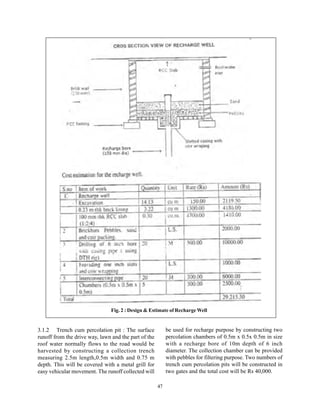
Although the intent of artificial recharge generally            quality have been summarized below.
is to increase groundwater storage for later use,               (1) At the catchment level
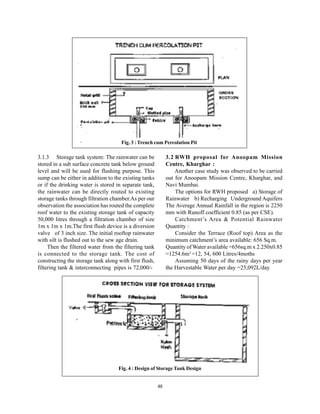
incidental activities such as excess irrigation, storm          8 Keeping the catchment clean
water disposal, canal leakage, and leaking water                8 Using gratings to trap debris at the catchment
pipes may also result in artificial recharge. Artificial        itself
recharge and aquifer storage and recovery are                   8 Paving the catchment with ceramic tiles stone
valuable water management tools that effectively                tile or other such non erosive materials
help to offset increased demands for water.
                                                                (2) At the conduit level.
II INDIRECT METHODS                                             8 Provision for first flush to drain off from initial
C. INDUCED RECHARGE                                             spell of rain
     It is an indirect method of artificial recharge
involving pumping from aquifer hydraulically                    (3) Before recharging.
connected with surface water such as perennial                  8 Allowing for sedimentation of water
streams, unlined canal or lakes. The heavy pumping              8 Filtering the water
lowers the ground water level and cone of
depression is created. Lowering of water levels                       In establishments like industries it is very
induces the surface water to replenish the ground               necessary to ensure that the catchments surfaces are
water. This method is effective where stream bed is             free of chemical wastes, fuels, lubricants etc.While
connected to aquifer by sandy formation.                        physical and biological impurities in water can be
     The greatest advantage of this method is that              easily removed by de-sedimentation and filtration,
under favourable hydro geological situations the                it is very difficult to remove chemical impurities.
quality of surface water generally improves due to

                                                           43
SCALE OF WATER HARVESTING:                                         To control the total amount of runoff received
     Most methods described here are applicable at            by a large-scale system, the catchment can be
a singular building or establishment level. However,          subdivided into smaller parts. A locality-level water
the same principles can be applied for implementing           harvesting system illustrated in figure shows how
water harvesting at a larger scale, say, a residential        the runoff from individual houses can be dealt with
colony or an institutional cluster. To an extent, the         at the building-level itself, while remaining runoff
nature of structures and design parameters remain             from the storm water drain (which drains water from
the same; the physical scale and number of                    roads and open areas) can be harvested by
structures may increase corresponding to the size             constructing recharge structures in common areas
of catchment.


                    Figure (11) Tapping storm water drains in a community level system


             References:
             1. ‘A Water Harvesting Manual’ Published by Centre for Science and
             Environment
             2. ‘Guide on Artificial Recharge to Ground Water’ Published by Central Ground
             Water Board, Ministry of Water Resources
             3. web site www.rainwaterharvesting.org
             4. www.waterencyclopedia.com
             5. http://www.aboutrainwaterharvesting.com/rwh_methods.htm


                                                         44
National Seminar on Rainwater Harvesting and Water Management 11-12 Nov. 2006, Nagpur


               9. The Scope of Rainwater Harvesting in Urban Areas
                            *Sandip. H. Deshmukh               **Prof. R. B. Magar

           Abstract :
               A project is being undertaken for the feasibilty study of RainWater Harvesting for
           the buildings in the premises of Fr.Agnel Technical Education Complex, Vashi. The
           research is being carried out as a part of one of the objectives of Agnel Seva
           Ashram, ‘Save Electricity & WaterAbhiyan’ (SEWA ). In a city like Mumbai, where
           the ground surface is heavily concretised, the main way to harvest rainwater is to
           tap the water falling on the terraces of buildings. Thus, in residential or commercial
           buildings, the pipes on terraces should be connected not to the BMC drains but to
           a recharge well or recharge pit. This process is termed ‘recharging’ the groundwater.
           The same bore well or tube well then can be used for pumping out the groundwater.
           Key words : Aquifer, Recharging, Catchments Area, Average annual rainfall.


1.    INTRODUCTION                                             an area of more than 1,000 square metres to install
      The rapid development in science and                     a rainwater harvesting system that will tap the
technology in the world has brought the countries              terrace water and make it flow to a bore well.
closer to each other and the world has become a                      The BMC will henceforth supply such buildings
global village. ‘Vasudeiva Kutumbakam’ (The world              only 90 liters/person/day for drinking, cooking, where
the one family) is the need of the day. The integrated         as they are expected to derive another 45 liters/
world is the new concept which Acharya Vinobaji                person/day from rain water for flushing of toilets
Bhave had given in his slogan of ‘Jay Jagat’ long              and other not potable uses.While many builders have
back in the same context.                                      only recently and grudgingly started implementing
      However as we see our country progressing in             BMC’ s directive, it will come as a surprise to many
the global market there is increase in the suicides            that the costs of doing it are not that high.
of Indian farmers every year. Today, it is the
responsibility of engineers in all the disciplines to          2.   THE PRINCIPLE OF RAINWATER
come together to provide them with possible                         HARVESTING
alternatives to cope up with the problems of                        Rainwater falling on the ground is absorbed
environmental imbalances and scarcity of proper                by the earth and it constitutes the groundwater. This
knowledge to adjust with the weather uncertainties.            water is stored amidst the loose soil and hard rocks
      On the other side, there are urban cities which          beneath the earth’s surface just as sponge stores
are over-flooded with the population and finding the           water. Just as the water can be sucked out of a
difficulties like inadequate supply of municipal water.        sponge, so can groundwater be sucked out from
Even though Bombay Municipal Corporation is in                 beneath the earth through bore wells. All this can
denial of a water crisis, since October 2002 it has            happen only if the rainwater is allowed to touch the
made it mandatory for all new constructions covering           loose earth. Extreme urbanisation in a city like

                                          *Asst.Professor **Sr.Lecturer
                Fr. Agnel Technical Education Complex, Sector 9A, Vashi, Navi Mumbai 400703.
                            E-mail: sandiphk@rediffmail.com, rbm59@rediffmail.com

                                                          45
Mumbai has meant that at least three-fourths of the            This will consolidate our methodology & validate the
city’s surface area has been developed, that is,               procedure. The simple formula to find the water
covered in hard concrete by way of buildings and               harvesting potential is given below in Fig.1.
roads.
       The BMC’s extensive drainage system in the
form of big nullahs and small arterial gutters is              3.1 RWH for Indian Woman Scientists
designed to ensure that rainwater does not                     Association
accumulate on the roads and buildings. It is another                The site of the construction is located at
matter that nullahs and gutters get choked with                Plot.No.20, Sector 10A of Vashi, Navi Mumbai. In
garbage and silt and many areas of Mumbai still                this site both the methods of rainwater harvesting
experience flooding. But even this flooded water               i.e. storage and recharge is proposed. The site falls
cannot seep in through the hard concrete. Which is             in a deccan trap terrain with top layer covered with
primarily why one needs to devise techniques that              clay.
can make the rainwater seep into the earth. It is also
necessary to ensure that only reasonably pure                  3.1.1 Recharging underground aquifers
rainwater goes into the ground, or else there is a                   The roof water from the top through the rain
grave risk of contamination of groundwater. The                water pipes can be collected by series of chambers
different techniques to make rainwater seep into the           with interconnected pipes and diverted to the
ground, which otherwise would not happen                       recharge well. The evaluation of rainwater
naturally, is known as ‘rainwater harvesting’.                 harvesting potential is done by the method shown
       In a city like Mumbai, where the ground                 the Fig.1.
surface is heavily concretised, the main way to                      The collection chambers are designed to be of
harvest rainwater is to tap the rainwater falling on           0.5 m x 0.5m x 0.5m in size and the interconnecting
the terraces of buildings. The idea is to prevent this         pipes are of 6 inches in diameter.
water from running off in BMC’s drains and divert                    The recharge well is of 2m x 1.5m x2m in size,
it to bore wells or storage tanks. Thus, in residential        and the recharge bore of 20m depth. This recharge
or commercial buildings, the pipes on terraces                 well can be filled with filtering materials consisting
should be connected not to the BMC drains but to a             of layer of pebbles and sand each of 0.3m in
bore well. This process is also termed as ‘recharging’         thickness. In the recharge well a recharge bore well
the groundwater. The same bore well is then used               of 6 inch diameter of 50m depth should be drilled
for pumping out the groundwater for use.                       using air compressor.
                                                                     A slotted casing pipe of 1m length should be
3. THE PROJECTS DONE ON RWH IN                                 provided inside the recharged well. This slotted pipe
   MUMBAI                                                      will be wrapped with coir rope to prevent the entry
   Let us have a short survey on the projects on               of fine silt into the recharge bore well. The cost for
RWH done in the past in Mumbai & near by area.                 recharge well including collection chambers and
                                                               interconnecting pipes is Rs.30, 000.


                            Fig.1 : Evaluating Roof Top Rainwater Harvesting Potential


                                                          46
Fig. 2 : Design & Estimate of Recharge Well


3.1.2 Trench cum percolation pit : The surface             be used for recharge purpose by constructing two
runoff from the drive way, lawn and the part of the        percolation chambers of 0.5m x 0.5x 0.5m in size
roof water normally flows to the road would be             with a recharge bore of 10m depth of 6 inch
harvested by constructing a collection trench              diameter. The collection chamber can be provided
measuring 2.5m length,0.5m width and 0.75 m                with pebbles for filtering purpose. Two numbers of
depth. This will be covered with a metal grill for         trench cum percolation pits will be constructed in
easy vehicular movement. The runoff collected will         two gates and the total cost will be Rs 40,000.

                                                      47
Fig. 3 : Trench cum Percolation Pit

3.1.3 Storage tank system: The rainwater can be              3.2 RWH proposal for Anoopam Mission
stored in a sub surface concrete tank below ground           Centre, Kharghar :
level and will be used for flushing purpose. This                Another case study was observed to be carried
sump can be either in addition to the existing tanks         out for Anoopam Mission Centre, Kharghar, and
or if the drinking water is stored in separate tank,         Navi Mumbai.
the rainwater can be directly routed to existing                 The options for RWH proposed a) Storage of
storage tanks through filtration chamber.As per our          Rainwater b) Recharging Underground Aquifers
observation the association has routed the complete          The Average Annual Rainfall in the region is 2250
roof water to the existing storage tank of capacity          mm with Runoff coefficient 0.85 (as per CSE).
50,000 litres through a filtration chamber of size               Catchment’s Area & Potential Rainwater
1m x 1m x 1m.The first flush device is a diversion           Quantity :
valve of 3 inch size. The initial rooftop rainwater              Consider the Terrace (Roof top) Area as the
with silt is flushed out to the sew age drain.               minimum catchment’s area available: 656 Sq.m.
     Then the filtered water from the filtering tank         Quantity of Water available =656sq.m x 2.250x0.85
is connected to the storage tank. The cost of                =1254.6m3 =12, 54, 600 Litres/4moths
constructing the storage tank along with first flush,            Assuming 50 days of the rainy days per year
filtering tank & interconnecting pipes is 72,000/-           the Harvestable Water per day =25,092L/day


                                    Fig. 4 : Design of Storage Tank Design


                                                        48
Water Requirements /day (Min):                             buildings, Ekta Woods of Ekta Shelters Builder at
   50 Residents @ 135 L/ h /day =6,750L                       Borivli (East), having three wings of eight floors
    60 Day staff or Personnel @ 45L/h/day =2,700L             each and four flats on each floor, the rainwater
    1000 Visitors @15L/h/day =15,000L                         harvesting system was in the final stage of
    Total Flushing Requirements = 11,100L /day                construction. A casual enquiry with the site-
Garden Requirements = 680 Sqm @ 4L/sq.m                       supervisor revealed that its total cost was about Rs
= 2,720 L /day                                                300,000. When you average it out across the
Total Water Requirements =27,170 L /day                       collective 96 flats in the three wings it worked out
                                                              to just Rs 3,100 per flat which is just 0.17 per cent
     The harvested rainwater can be used for                  of the average cost of a flat of Rs. 18,00,000.
flushing and gardening purposes. The rain water
from the terrace is to be routed to an underground            4. THE PROJECT ON RWH AT
Rainwater Storage Tank though a silt trap & 2                 Fr. A. T. E. COMPLEX :
filtering tanks each of 1mx 1mx1m size with a                      A project is being undertaken for the feasibility
facility for bypass or overflow into Cidco Storm              study of Rainwater Harvesting for the buildings in
Water Drain or Nallah. The terrace and filter media           the premises of Fr. Agnel Technical Education
needs to be cleaned before letting water into tank            Complex, Vashi. The research is being carried out
and mesh filter should be provides at the rainwater           as a part of the one of the objectives of Agnel Seva
pipe inlet. No fertilizers or pesticides should be            Ashram (ASA) as to ‘Save Electricity & Water
allowed to enter the system. Thus with the above              Abhiyan’(SEWA).
data a suitable size of the tank can be arrived.
                                                              4.1 Factors Influencing RWH potential:
3.3 RWH in Urban Housing Societies                                There are various factors which are influencing
3.3.1 Potential and estimate of installing                    RWH potential. Rainwater harvesting is catching
rainwater harvesting in a 12-year old building in             rainwater, when and where it falls for the use. It
Kandivli :                                                    can be done in two ways, either by diverting it into
     In the Coronet Co-op. Housing Society,                   tanks, ponds etc or as ground water by injecting into
Lokhandwala Township, Kandivli there are two                  the soil aquifers.
wings of seven floors each and four flats on each
floor. That means the total flats are 56 with the area             The choice of the system depends on
of terrace equal to 360 sq. m.                                • Geography of area, topographical features of
     Assuming the average yearly rainfall in                  the site etc.
Bombay of 2 metre high per sq. m.                             • Ecological and climate conditions
     The harvestable rainwater volume: 360 sq.m x             • Rainfall available at the site
2m x 0.85 = 612 (cu. m.) = 612,000 litres                     • The rainfall Pattern
     One-time estimated cost of installing a                  • Site characteristics like type of catchments,
rainwater harvesting system is evaluated as shown             runoff coefficient of site
below:
     For 50-250ft deep bore well : Rs 45,000 to Rs            4.2 Benefits Projects on RWH:
60,000                                                        1. It is an attempt to make a standby arrangement
     Settlement tank and filtration tank: Rs 15,000           or emergency supply services for the water needs
to 30,000 adjacent to bore well                               of the complex.
     Piping work: Rs 15,000 to Rs 20,000                      2. Rain water harvesting replenishes the ground
==============================================                water table and enables the dug wells and bore wells
      Total cost : Rs 75,000 to Rs 1, 10,000                  to yield in a sustained manner.
   (Average cost per flat = Rs 1350/- to 1965/-)              3. If ground water is brackish, harvesting will
 ==============================================               reduce the salinity of water. Flooding of low lying
3.2.2 RWH for Ekta Woods : In the month of                    areas and roads can be avoided to a large extent,
February 2006 it was observed that a new group of             since rain water that is not harvested both within

                                                         49
the house as well as out side is responsible for               Plan B : To dig a trench of 3m deep and 1m wide
flooding.                                                      along the inside portion of the compound wall and
4. Rain water harvesting can be used for irrigation            fill it with HDPE (High Density Poly Ethylene)
purpose.                                                       Film and clay along the length of the wall of the
5. It promotes conjunctive use of river, rain                  campus as shown in the fig 6. This will not allow
ground, and sea and sewage water.                              the saline sea water to drip into the soil of
6. It prevents unsustainable exploitation of the               Fr.A.T.E.C.campus. Then using the bore wells of
aquifer.                                                       15m to 18m deep we will pump out the existing
7. It ensures efficiency, economy and equity in the            saline water from the soil creating the voids which
water use through co-operative management of                   can be recharged with the rainwater. Using the
water sheds and command area.                                  recharge well technique we will fill the underground
                                                               aquifers with the rainwater collected from the roof
4.3 The various plans of RWH :                                 tops as shown in Fig 7. Then we can take two
•     Plan A : The first option is to utilize the three        additional bore wells to retrieve this stored water
existing water tanks of fire fighting system of                during non monsoon season. The care should be
capacity 1,52,400 liters (50800*3) to fill the                 taken that we pump less quantity of water than what
rainwater collected from the roof top. We can route            we will recharge. We are also trying to construct
the rainwater pipes of the BalBhavan & Boy’s hostel            open well instead of bore well if it is feasible.
Building to these tanks through proper
interconnected pipes, Devas filters and filtration
chambers.
      These two buildings have got rain water
harvesting potential per year of 16,25,630 liters. The
yearly flushing requirement for the two building per
year is 71,35,750 liters (considering 85litres
consumption per day per capita excluding drinking
water requirement).
      There is one more tank of capacity 1,020,50
liters which can be used for drinking purpose. There
is a provision to divert the BMC water supply to
this tank with a flow control valve to fill the other
three tanks if these tanks remain empty.
       One of the water pumps would be pumping
the water from these three interconnected tanks
supplying water to the buildings of Boy’s hostel &
BalBhavan for flushing.


    Fig. 5 : Routing rainwater to the storage tanks                    Fig.6 Compound Wall of HDPE Film

                                                          50
•     Plan C : The third plan is most assured way of        •     Plan D : In this plan we are planning to mount
getting the rain water collected from the roof tops.        loft tanks wherever necessary in staff quarters. The
This includes collecting the water from the rooftops        rainwater pipes can be routed to these tanks fitted
into underground tanks or open wells designed               in the houses. These tanks can be interconnected in
according to rooftop area and the average annual            such a way that, once the tank on the upper floor is
rain fall.                                                  full, water starts filling the tank on the adjacent
      This plan has limitations of high initial             lower floor. These tanks can be used only to store
investment cost of constructing tanks of Rs.1000/-          water for flushing purpose.
per m 3 and regular maintenance of the filters.
However this is the most ensured way of getting             5.   PILOT STUDY FOR DIFERENT PLANS
the rainwater during the no monsoon season. With
proper filtration system incorporated we can even           5.1 PLAN A:
use rainwater stored in these tanks for drinking            Total Catchments area of = 530 + 320 = 850 m2
purpose.                                                    Boy’s Hostel and BalBhavan

                                                            Average annual rainfall    = 2.25 m
                                                            in Navi-Mumbai
                                                            Total quantity of Harvestable Water = 850 X 2.25
                                                            = 1912.5m3

                                                            Considering 15% losses     = 1912.5 X 0.85
                                                                                       = 1625.625 m3
                                                            (For four months)
                                                            Total quantity of water available = 16, 25,625 L
                                                            (By considering 50 Rainy days)
                                                            Quantity of harvestable water = 32,512.5 L /
                                                            Day.
                                                            Assuming the requirement of 85L /capita/day
                                                            The total requirement of water for = 230X85x365
          Fig.7 Recharging bore well with
                                                            = 19,550L/day = 19.55 m3 /Day =136.85m3/Week
                 Wall of HDPE Film
                                                            both the buildings.


          Fig. 8 : Rainwater Harvesting
          for Bal Bhavan Building


                                                       51
As mentioned earlier, we have decided to            Then the total volume of 450m3 rain water can be
route the rainwater pipes of the BalBhavan & Boy’s           harvested by the method of under ground storage
hostel buildings to the existing three tanks of fire         water tank.
fighting system of capacity 50,800L each through                     This will be sufficient for 450/37.5=12 days
proper interconnected pipes, filters and filtration          of non monsoon season saving the equivalent cost
chambers. The total size of water that can be stored         of Rs.4,950/- per Year.
will be 1,52,400L i.e.152.4 m3.This will be quite
sufficient for weekly storage of rainwater 136.85m3
during rainy season. Also after the monsoon this
water will be sufficient for 152.4/19.55 = 8 days
during summer season.


            Fig. 9 Rainwater Harvesting                        Fig.10 Rainwater Harvesting of Fr. Agnel Degree
             for Boys Hostel Building                                       &Diploma Buildings

5.2 PLAN C:
Total catchments area         = 2500 sq. m.                  5.3 PLAN B :
Average annual rainfall        = 2.25 m                            We are trying to implement this plan by first
 in Navi-Mumbai                                              doing hydro geological investigation and estimating
Total quantity of Harvestable = 2500 x 2.25                  the rough estimate of construction of gravel pack
                              = 5,625 m3                     ring well cum bore well. This is necessary to be
Water                                                        carried out in order to identify points or locations
Considering 15% losses = 5625 x 0.85                         for ground water development. As per the quotation
                         = 4,781.25 m3
Total quantity of water available = 47, 81,250 L
(For four months)
        (By considering 50 Rainy days)

Quantity of Harvestable water     = 95,625 L / Day

available per day
Assuming the requirement of 15L /capita/day
The total requirement of water = 2500 x 15 =
37,500L/day = 37.5m3 /Day
         If we design and construct two tanks of size
15m length X 5m Width X 3m depth having the
total Area = 225m3                                              Fig.11 A open tank constructed with HDPE film


                                                        52
from one of the consultants the assessment cost will        the trench. The rate of excavation depends on the
be Rs 7,500/-                                               strata below the ground.
      After this assessment we will be able to
conclude whether we can take open well or not. Also         5.4 OBSERVATION TABLES
the estimate for one gravel pack ring well cum bore              After carrying out the pilot study we have made
well given including all taxes is 1,53,210/-. For           a observation Table 1, comparing the water
protection against the saline water to enter inside         harvesting potential of each building with the annual
the soil of the complex, HDPE film of gauge 500             water requirement .This also facilitate cost benefit
micron can be used as imperious film in the trench          analysis of the project. Also Table 2 shows the rough
that we are going to excavate .The cost of the film         estimate of the particulars of Plan A which very soon
is around Rs.50 per m2. We have to calculate the            we have decided to implement.
film area required and the quantity of excavation of


   NO.   PARTICULAR ITEM               UNIT      RATE / UNIT            TOTAL QNTY.          TOTAL COST
   I     PVC PIPES
   1     DIA.100mm                     m               155              28.22                     4374.1
   2     DIA.120mm                     m               165              56.6                       9339
   3     DIA.140mm                     m               175              29.92                      5236
   4     DIA.150mm                     m               180              15.9                       2862
   5     DIA.160mm                     m               185              18.5                       34225
   II    DEVAS FILTER                  -               600              7                          4200
   III   ELBOWS 45° ANGLE              -               100              7                           700
   IV
   1     EXACUVATION                   m3              150              17.89                     2683.5
   2     P.C.C.                        m3              15000            1.19                       1785
   3     BRICK WORK                    m3              1400             7.45                       10430
                                                                        TOTAL RATE :            55,469.10/-

                                                       53
Fig.12 Fr. Agnel Technical Education Complex, Vashi


6.   FURTHER STUDIES IN PROGRESS
    We have decided to first implement Plan A which involves designing the interconnecting pipes with
DEVAS filters. The rain pipes will be connected to main pipeline through these filters that are costing
approximately Rs. 600/- each. The following figure shows the DEVAS filters which can be manufactured
easily from PVC pipes and sands of various sizes. The crucial factor is soil assessment and determination in
what way we can recharge and retrieve the rainwater. This will be the area of our further research.


                        Fig.13 : Manufacturing of Devas Filters for Water Purification


                                                     54
7.   CONCLUSION and FUTURE SCOPE                           and flats, complexes since it makes us more self
     As per our Vedic scriptures the Great Saint           sufficient and less dependent on government for our
Parashara says                                             requirements of fresh water. Let us make a sincere
|| Annam Hi Dhanya Sanjatam, Dhanyanm Krishya              attempt to harvest rainwater falling on both rooftop
Vina Na Ch ||                                              as well as the open area all around our homes to
Tasmad Sarvam Parityajya, Krushim Yatnen                   prevent any further deterioration of ground water
Karayet ||1||                                              source.
|| Vrustimula Krushi Sarva, Vrushti Mulam Ch
Jeevanam ||                                                8. REFERENCES
Tasmadadau Prayatnen,Vrushti dhnyanam                      • Anil Agarwal, Available from: http://
Samacharet ||2||                                           www.rainwaterharvesting.org Accessed: 2006-07-
“Which means we get food from grains.Without               23
doing farming we can not get grains. Therefore             • Sunita Narain & Rahul Ranade (2003). A Water
leaving every thing aside we should do harvesting.         Harvesting Manual, Centre For Science And
As the root of agriculture is in the rains, life is        Environment, New Delhi
dependent on rains. Therefore we should very               • M. Jacob, (2005), ‘Technical Report for rainwater
meticulously study the rains”                              harvesting’, Navi Mumbai
                                                           • Gopal Chandorkar (2005). Parjanya Mapan va
     Thus in the direction of his guidance we march        Purva Anuman, Proceedings of Traditional Wisdom
forward to get more and more knowledge about rain          in Water Management, pp. 96-101, A National
harvesting and water management. We should feel            Conference at Nasik, October 2005, The Indian
proud of harvesting rainwater in our own houses            Council for Water & Culture, Aurangabad

                            “WATER SCARCITY DIVIDE PEOPLE…..
                        ….. RAINWATER HARVESTING UNITES THEM”.


                                                      55
National Seminar on Rainwater Harvesting and Water Management 11-12 Nov. 2006, Nagpur


                          10. Measures for Water Conservation and
                              Improvement in Water Quality
                                             *R. S. Goel **V. B. Patel

         ABSTRACT
                  Safe water supply and environmental sanitation are vital for protecting the
         environment, improving health and alleviating poverty. According to the World Bank
         estimates, water pollution accounts for about 60% of the major annual environmental
         costs in India. Availability of water in India is under tremendous stress due to growing
         population, rapid urbanization, increase in per-capita consumption, industrial growth
         and other demands for maintaining ecology. It is to be stressed that non-development
         of water storage projects is not a viable or available option; due to the large temporal
         variations in river flows in Indian monsoonic climate. Integrated water management
         is most vital for poverty reduction, environmental sustenance and sustainable
         economic development in India because water has the potential for both disease
         causation and prevention. This article highlights the challenges in supplying the
         qualitative water for the bulging requirements of water for various uses in our highly
         populated country and suggests measures to overcome the serious crisis. The article
         would help the policy planners, municipal agencies and professional societies to
         properly focus and channelise their energy for integrated water resources development
         and management.

         Keywords- water quality, water management, wastewater, reuse, recycle,


INTRODUCTION                                                   become a serious problem. Safe water supply and
      It is estimated that 80% of all diseases and over        environmental sanitation are vital for protecting the
1/3 rd of deaths are caused by consumption of                  environment, improving health and alleviating
contaminated water and on an average as much as                poverty. Unless facilities for the treatment of
1/10th of each person’s productive time is sacrificed          domestic sewage and industrial effluents are manifold
to water related diseases. India supports 1/6th of the         increased, the increasing pollution load due to
world’s population on 1/50th of world’s land with              urbanization will further deteriorate the quality of
meager 1/25th of the world’s water resources. Due              water bodies. Preserving the quality and the
to the indiscriminate discharge of untreated sewage            availability of the freshwater resources is the most
and industrial effluents into natural water bodies, the        pressing of the many environmental challenges on
quality of surface water as well as ground water is            the national horizon. It is imperative that conservation,
deteriorating in India. Deteriorating water quality has        recycle, reuse of precious water and proper

  *Former Vice-President, Indian Water Resources Society, Former Convenor of Programmes, Water Management
   Forum, Convenor, Coordination Committee, Water Related National Professional Societies, Chief Engineer,
   Narmada Tapi Basin Organisation, Central Water commission, Sector 10 A, Gandhinagar (Gujrat) – 382043
                                         E-mail - goelrscwc@yahoo.com
**Vice-President, Indian Water Resources Society, Former Chairman, Central Water Commission, Former Chairman,
Board of Governors, Water Management Forum, Co-chairman, Coordination Committee, Water Related National
Professional Societies, 128, Manekbaug Society, Ambawadi,Ahmedabad–38 00 52 E-mail - vbpatel@multimantech.com

                                                          56
treatment of waste are given serious attention for            terms, but also the cost that other communities have
sustainability of built environment for our highly            to incur in terms of opportunity lost by not using the
populated country.                                            water. The measure for water conservation should
                                                              include metering of supplies as a matter of policy
CONCENTRATED WATER NEEDS DUE TO                               and increase in tariff rate on a sliding scale. Use of
RAPID URBANIZATION                                            treated effluents, in place of filtered water for
      During last 50 years the share of urban                 horticulture and large gardens, and fitting of waste-
population in the country has increased from 14% to           not taps on public stand-posts to avoid wastage of
33%. During the last fifty years the population of            water should be encouraged.
India has grown two and half times, but Urban India
has grown by nearly five times. India’s population            WASTEWATER GENERATION
has already crossed 1 billion mark and it has been                  Between years 2000 and 2050 freshwater
assessed that the urban population may reach 50%              withdrawals by urban areas will rise from an
of the total population by the middle of this century,        estimated minimum of about 15 BCM to a projected
as against about 33% at present. Already there is             maximum of about 60 BCM. About 80 percent will
acute shortage of drinking water supply in cities like        be returned as polluted wastewater to nearby surface
Bangalore, Delhi, Mumbai, Hyderabad and Chennai               water bodies. This will result in massive pollution of
and water is being transmitted long distance to cater         fresh surface water resources. A large part of the
to the needs. Between years 2000 and 2050                     sewage in most of the municipalities is still flowing
freshwater withdrawals by urban areas will rise               into the aquatic environment without any treatment,
from an estimated minimum of about 15 BCM to a                thereby increasing the oxygen demand in shrinking
projected maximum of about 60 BCM. Options like               water bodies and increasing the bacterial load of
watershed management, rainwater harvesting,                   water, the main cause of water borne diseases.
groundwater exploitations, which create spatially             Discharge of untreated domestic waste water is
distributed resources, are unable to meet these               predominant source of pollution of aquatic resources
concentrated demands. Supply of safe drinking water           in India. Urban centers contribute more than 25%
to such a large urban population besides meeting the          of the sewage generation in the country. The smaller
commercial, industrial, cattle and recreational               towns and rural areas do not contribute significant
purposes is proving a Herculean task and calls for            amounts of sewage due to low per capita water
creating concentrated sources of water to meet the            supply. Waste water generated in these areas
concentrated demands.                                         normally percolates in the soil or evaporates. Owing
                                                              to the indiscriminate discharge of untreated sewage
WATER CONSERVATION                                            and industrial effluents into natural water bodies, the
     Water Conservation has three broad                       quality of surface water as well as ground water is
connotations; maximum storage of rainwater,                   deteriorating. A result of this is that the principal
economical and optimal use including prevention of            drinking water supply sources of cities and towns
wastage/ leakage and multiple use – Reuse and                 are becoming polluted of which is increasing
Recycling. In urban water supply almost 30 to 40%             considerably the cost of water treatment.
of the water is wasted through the distribution                     Even in the mega cities namely Mumbai,
system. In Industrial sector also, there is a scope of        Calcutta, Delhi and Chennai; wherein about two third
economy in use of water. Public awareness should              of the total wastewater of 23 metro cities is
be generated through a massive campaign of                    generated, the waste management is highly
communication through all available media and by              unsatisfactory despite the huge infrastructure and
the utility management itself setting an example for          paraphernalia due to many socio-political and
conservation. All urban dwellers should be made               managerial problems. Of the wastewater generated
aware of the source from which water is being                 in Class I cities, 12 metropolitan cities accounted for
brought to the city and from which additional water           about 65 percent. Mumbai and Delhi generated more
will have to be brought in the future. They should            wastewater than that generated in all the Class II
be aware of the costs involved, not only in financial         cities together. About 80% of about 20% collected

                                                         57
wastewater in these cities was receiving primary or             especially during lean season for various diverse uses
primary and secondary treatment. Further, out of the            has greatly diminished the dry flows in streams. To
wastewater generated in Class II cities, only 5%                reverse this situation, moderation of floods and
was being collected and only 2% was receiving some              increasing the dry season flows is imperative. The
kind of treatment. Almost all the wastewater was                increasing discharge of domestic and industrial
being disposed in the rivers and agricultural lands,            wastes has also led to the contamination of ground
affecting surface and ground water; creating highly             water, making it unfit for human consumption at
alarming situation.                                             many places. In some regions, over-exploitation of
      The major water polluting industries are leather,         ground water has led to salinity ingress and severe
sugar, distilleries, paper and pulp, chemicals, iron and        depletion of ground water accentuated by low
steel, and metal plating. A large part of industrial            recharge capabilities. For small scale sector, a
water pollution is caused by small-scale units. The             scheme titled Common Effluent Treatment Plant
integration of proper water supply, recycling and               (CETP) has not been uniformity successful as
reuse of water, roof water harvesting and adequate              different units within the same complex release
sanitation facilities in all cities and bigger towns is         different types of effluents which cannot be treated
absolutely vital for revival and maintaining the                through a single technology. More important, pooling
integrity and purity of rivers eco-system. In the 8th           of resources for this common cause has not found
five-year plan 24 highly polluted stretches in rivers           favour with small scale & cottage industry.
of 16 states were identified and Ganga Action Plan
Phase I & II were launched which were later on                  Waste Water Generation from Different types
integrated into National River Conservation Plan.                    of Industries and Possible Reuse
Focus of the River Action Plans has been on sewage
with very little success with regard to the other two            Industry          Average Volume of        Possible
forms of water pollution viz., industrial pollution and                            Wasteland per Unit       Percent
agricultural run off.                                                              of Product               Reuse
                                                                 Thermal Power     155 kl./hr/MW            98
SURFACE WATER POLLUTION                                          Plant
      About 75% of domestic water supplies from                  Pulp & Paper      250 kl./tonne            50
urban areas come back as return flow, deteriorated               Iron and steel    150 kl./1000 lit/tonne   40
in quality due to organic, chemical and bacterial
                                                                 Pharmaceutical    4.5 kl./tonne            40
pollution. Even though, drains and rivers have been
functioning as waste disposal channels from time                 Distillery        15 lit/lit of alcohol    25
immemorial; but the pollution load in earlier times              Textile           250 lit/kg cloth         15
was within the self-purification capacity of these               Tannery           34 lit/kg of raw hides   12
streams. Due to the bulk of discharge of effluents
with very heavy doses of impurities of the modern                    The main challenge lies in devising instruments,
day world which are mostly untreated, the pollution             which make it attractive for corporate sector to
load is now manifold and beyond the self-purification           conserve and recycle water by adopting less water
capacity of the rivers. Analysis of water quality data          intensive processes and encourage material recovery.
for 1997 reveals that Gujarat tops in chemical                  The direct regulation of the “Command and control
pollution, followed by Maharashtra, Andhra Pradesh,             Type” has not worked due to weaknesses in
Tamilnadu , Uttar Pradesh and Punjab. The worst                 enforcement coupled with low level of penalty.
affected states in terms of presence of coliform                Under regulation of this kind, perceived benefit from
bacteria in water, are Uttar Pradesh, Gujrat,                   conservation must be more than the cost of
Tamilnadu and Assam. In terms of BOD values                     compliance.
Kerala is at the bottom and Maharashtra at the top
(most polluted).                                                GROUND WATER POLLUTION
      Many of the modern water pollutants are non-                   Regulation and conservation of ground water
biodegradable. Greater abstraction of water,                    present technical and administrative difficulties

                                                           58
because precise delineation of aquifers is difficult            so that it is fit for use like fresh water, and
and monitoring and control of extraction by large               regeneration refers to replenishment of a water
numbers of individually owned wells is not feasible.            source in a natural manner. Recycling and re-use
Accordingly, depending upon the characteristics of              has been demonstrated to be cost-effective in a large
the pollutants and application of water, the pollutants         number of cases, with periods of return of
may migrate to the saturated zone along with recharge           investments ranging from a few months to less than
water, thereby affecting ground water quality. The              five years. Thus it makes sense to practice
reasons for ground water pollution mainly related to            recycling/re-use for economic reasons, besides doing
the faulty agricultural practices, industrial pollution,        so to meet moral or legal liability associated with
municipal pollution, mine pollution and natural                 disposal of wastewater.
pollutants present in the ground water itself. Central
Ground Water Board (CGWB) is monitoring the                     EFFECTIVE RECYCLE AND REUSE OF
quality of ground water at 16,000 hydrograph stations           WATER
in the country.                                                      In urban water supply, 30 to 40 % of the
                                                                municipal water is wasted through the distribution
ECOLOGICAL IMBALANCES DUE TO                                    system. In Industrial sector too, there is a scope of
DETERGENTS                                                      economy in use of water. As per estimates by
      The health risk posed by phosphate rich                   Bureau of Industrial Costs and Prices, 10 to 30%
detergents is not yet recognized in India despite a             saving in water consumption in industries is possible
worldwide awareness and ban in several countries                by recycling, modifications in processing, evaporation
in Europe and America. Detergents contain many                  control etc. Apart from ensuring leakage control,
ingredients which could be a threat to the environment          water conservation strategy in industries should
and human health. A common ingredient, sodium                   include introduction of appropriate technology to
tri-polyphosphate (STTP) softens the water thus                 ensure efficient use of cooling and process water
helping to remove dirt from clothes and to keep the             and necessary pollution control mechanisms and
dirt off during the washing cycle. Phosphorus, part             maximum recycling and reuse. Treatment of
of STPP is an essential nutrient for the growth of              wastewater in stabilization ponds is an effective and
aquatic plants and as such adds to the cultural                 low-cost method of pathogen removal, and is,
eutrophication, a process in which the excess                   therefore, suitable for schemes for wastewater reuse,
nutrients result in algae bloom, kill fish and increase         particularly for irrigation of crops. Similarly,
pathogenic organism, causing loss in aesthetic and              duckweed ponds are quite effective in treating
recreational values of water. Strict regulations be             municipal wastewater and at the same time the
made requiring that not more than 5% phosphorus                 harvested duckweed is a good fish and chicken feed.
in detergents.                                                  As such, there is a need to develop appropriate and
                                                                cost effective technologies, for treatment and reuse
WASTE WATER TREATMENT                                           of municipal wastewater, suitable to Urban Local
      Care is necessary that treated wastewater                 Bodies for their adoption. Possible health risks to
does not contain toxic matter beyond a threshold.               agricultural workers should, however, be assessed
Otherwise, it may enter the food chain, both aquatic            thoroughly and monitored regularly. Treated
and terrestrial. Besides, wastewater can damage                 wastewater should conform to pollution control
fertility of soil and quality of ground water if its            standards for adopting reuse practice.
constituents are not kept within the prescribed limit                There are various options for recycling and
For the most economic disposal of wastewater from               reuse of grey water (bathroom and kitchen wash)
various sources, recycling, re-use, renovation and              and black water (sewage). However, the grey water
regeneration (summed up by the term “4-R                        and black water from large residential complexes
Concept”) must be practiced with utmost keenness.               like Cooperative Housing Societies, multistoried
Recycling refers to repeating the same use; re-use              buildings and industrial effluents from large industries
is done by using effluent for other purposes;                   can be recycled and reused for various purposes
renovation refers to treatment to the (tertiary) level          other than drinking. The grey water may be put into

                                                           59
various types of treatment such as grease trap,                the scope of the polluter pays principle we can
anaerobic filter etc and the filtered water may be let         consider of such subsidies such as originating from
into wet land, polishing ponds etc. and can be reused          funds created on the basis of pollution related charges
for gardening and horticulture etc. The black water            (e.g. acidification funds).
may also be put into various types of treatment such
as screen, grit removal primary, secondary and                 RENTING OF WATER
tertiary treatment etc. and the treated waste water                 Above economic instruments provide incentives
can be let into wet land for irrigation or for ground          to economic actors inducing them to behave in an
water recharge. The municipal wastewater and                   environmentally responsible manner. Their merits
industrial effluent may be treated up-to tertiary level        include: effectiveness, efficiency, flexibility and
and used for various purposes other than drinking              incentives for eco-innovation. Under the scope of
by various industries and cities. For example, in              the polluter pays principle we can consider of such
Chennai the Chennai Metro Board is providing 30mld             subsidies as originating from funds created on the
treated municipal wastewater to Ennore Thermal                 basis of pollution related charges (e.g. acidification
Power Plant for recycle and reuse for cooling &                funds). Another important thing about pricing of
other purposes. Likewise in Mumbai, many of the                water may be costing it according to its end use.
industrial houses are using the recycled industrial            Farmers and low income industries may not be
effluent for purposes such as air-conditioning, cooling        charged at the rate of charges fixed for high yielding
etc. In Pondicherry Ashram, the wastewater from                industries.
housing complexes and community’s toilets are
recycled and reused for horticulture purposes and              MARKETING BOTTLED WATER
irrigation. State Governments may create Urban                      Considerably more satisfaction and benefit can
Development Fund for Urban Infrastructure                      be obtained from the present water supply system,
development and the same can also be used for                  if managed efficiently. Costly systems are
setting up of pilot projects for waste reuse, recycling        constructed, but for want of proper operation and
and resource recovery.                                         maintenance, the benefits are not received by the
                                                               people who have to incur considerable private costs
INCENTIVES AND LEGAL ASPECTS                                   and have to resort to alternate means or
      Suitable fiscal concessions and subsidies may            supplementary sources. Fast catching up practice
be considered by the Central and State Governments             of selling mineral water bottles at rates even more
to the industries, commercial establishments and any           than milk and more than 1000 times than the tap
other agencies which adopt/practice waste reuse,               water in India is paradoxical. While half of our
recycling and resource recovery. Similarly, in case            population is unable to afford even the absolute
the Urban Local Bodies on their own would like to              minimum needs to quench their thirst. Only water
take the initiative and set up waste reuse, recycling          supply utilities should be allowed to bottle and market
and resource recovery schemes in their respective              the bottled water to generate much-needed funds
areas, similar fiscal concessions and subsidies may            for modernization and proper maintenance of existing
also be made available to them. It may be made                 infrastructure.
mandatory in phases that large industries and
commercial establishments must meet a sizeable                 PROTECTION OF NATURAL WATER
percentage of their non-potable water requirements             RESOURCES
from the reclaimed water. Similarly, for irrigating                 Responsibility should be fixed on various civic
crops, horticulture, watering public lawns/gardens,            and industrial authorities to treat the wastewater
flushing of sewers, fire-fighting etc. reclaimed water         before disposing it in conveyance drains or natural
should only be used. Economic instruments may                  streams. Water quality should be monitored regularly
provide incentives to economic actors inducting them           at every out-fall drain. State wise river basin
to behave in an environmentally responsible manner.            conservation plan should be formulated for different
Their merits include: effectiveness, efficiency,               basins. The pathogenic, toxic and biological and
flexibility and incentives for eco-innovation. Under           physico-chemical effects of various types of water

                                                          60
pollution in different scenario and regions should be               Large storage projects are essentially required for
scientifically analysed, collated, understood and                   diverting surplus water from flood prone areas to
suitable action plans should be framed.                             deficit areas. Indira Gandhi Nahar Project has been
                                                                    a boon for large tracts of Rajasthan in alleviating
QUESTIONABLE USE OF WATER AS A                                      droughts.
CARRIER OF WASTES
      The traditional way of removing wastes from                   SOCIO-ECONOMIC & ECOLOGICAL
industries, and homes has been to dilute them in water              ASPECTS OF FLOODS
and then carry this wastewater over long distances                        Over 40 million hectares of the area of the
to extract most of the waste in the sludge, leaving                 country experiences periodic floods. The average
polluted water as effluent. Such traditional and highly             area affected by floods annually in India is about 7.5
unscientific method of using water carriers of wastes               m. ha of which crop area affected is about 3.5 m.ha.
need to be closely examined. There are many better                  Floods have claimed on an average 1,529 human
alternatives to treat the waste at its origin, without              lives and 94,000 cattle ever year. Apart from loss of
using so much water. Use of low flushing and dry                    life and domestic property, the devastating effects
toilets as well as use of ‘grey water’ drained from                 of floods, sense of insecurity and fear in the minds
showers, kitchens and laundries to flush the toilets,               of people living in the flood plains is enormous. The
should be targeted for adoption in at least in all new              after effects of floods like the agony of survivors,
construction of commercial institutions and planned                 spread of epidemics, non availability of essential
colonies in all class I and II cities.                              commodities and medicines and loss of their dwellings
                                                                    make floods most feared natural disaster being faced
MINIMUM FLOW REQUIREMENT                                            by human kind. Large-scale damages to forests,
      Quality of river waters is deteriorating with                 crops & precious plants and deaths of aquatic and
large number of municipal and industrial effluents                  wildlife, migratory and native birds in various National
being discharged untreated into rivers. Return flows                Parks, Delta region, low altitude hilly areas and
from irrigated areas pollute river water with residual              alluvial flood plains of Assam, Arunachal, Uttrakhand,
fertilizers, pesticides and herbicides. Necessity for               U.P., Bihar, Orissa, West Bengal, have always been
maintaining minimum flow therefore, arise out of the                the matter of serious concern. River Valley Projects
need to maintain water quality, river regime,                       such as Bhakra, Ramganga, Hirakud, Pong etc. have
maintenance of river eco-system or other public                     proved highly successful in moderating the
necessities.                                                        magnitudes as well as frequencies of floods.

SOCIO-ECONOMIC & ECOLOGICAL                                         ACCELERATED WATER STORAGE
ASPECTS OF DROUGHTS                                                 DEVELOPMENT
      It is estimated that around 263 million people                     Water demands forecasts show that Rajasthan,
live in drought prone area of about 108 m. ha., which               Maharashtra, Gujarat, Haryana, Karnataka and
works out to 1/3rd of the total Indian geographical                 Tamilnadu could face heavy water supply shortfalls.
area. Thus, more than 26% of total population of                    The water shortages would be far more serious in
the country face the consequences of recurring                      the water short basins like the Cauvery, Pennar,
droughts, on a wide spectrum of social concerns.                    Sabarmati, Mahi, and Krishna etc. To meet the
During the drought years there is a marked tendency                 bulging water requirements, it would be necessary
of intensive exploitation of ground water, resulting in             to ensure substantial augmentation of water supplies;
abnormal lowering of ground water table thus                        requiring sufficient raising of water storage
accentuating the distress. Grave adverse impacts                    capacities, thus necessitating completion of new large
are borne by flora, fauna and domestic cattle and                   water storage projects.
the very life itself fights against nature for its survival.             Supreme Court Majority Judgement for
Droughts accentuate problems in cities in the form                  Narmada Projects has also highlighted that against
of mushrooming of slums and pressure on the existing                the utilisable storage 690 cu. km. of surface water
civil amenities thereby adversely affecting urban life.             resources out of 1869 cu. km.; so far storage capacity

                                                               61
of all dams in India is only 174 cu. km., which is                societies can act as multi-disciplinary fora for national
incidently less than the capacity of Kariba Dam in                and regional debates, analysis and framing of action
Zambia/Zimbabwe with capacity of 180.6 cu. km.                    plans on water related matters by utilizing their
and only 12 cu. km. more than the Aswan High Dam                  infrastructure, professional expertise, library,
of Egypt. The impact on environment should be seen                publication and documentation services. These
in relation to the project as a whole. Water of poor              societies can serve as rich sources in generating
quality leads to ill health, whereas water in insufficient        technically sound options with well-defined limitations
quantity claims large chunks of time spent in                     & assumptions in Indian peculiar situations for taking
augmenting the supply; otherwise, the significant time            informed decisions. The services of professional
could be spent on more remunerative tasks. We must                Societies like Indian Water Resources Society, The
realize the basic fact that the medium and small                  Institution of Engineers (India), Indian National
water projects as well as water harvesting schemes                Science Academy, Indian Water Works Association,
cannot substitute the need of large water storages                Indian Association of Hydrologists, Indian Society
but can at best complement the larger projects. This,             of Hydraulics, Water Management Forum,
too, depends upon the hydrological, geological,                   Association of Hydrologists of India & Indian
topographical and regional limitations. The                       Buildings Congress having vast network, good spread
controversy of the large versus small dams is                     and pool of expertise may be channelised in debating,
irrelevant. Sustainable management of water                       dissemination and creating balanced scientific public
resources with due respect to ecological, economic                awareness.
and ethical sustainability blended with technical
feasibility requires a holistic and integrated approach           WORKING GROUP ON WATER RELATED
involving engineering, socio-economic and                         ECOLOGICAL MATTERS
environmental aspects. Expansion of storage                             Considering the seriousness and deteriorating
capacity by completing on-going projects and                      state of affairs concerning quality and quantity of
construction of new projects is imperative to enhance             available water particularly for urban use, alarming
water availability.                                               water pollution levels and challenges in managing
                                                                  water related ecological concerns, a Working Group
ROLE          OF       COMMUNITIES              AND               on Water Related Ecological Matters for X Five Year
PROFESSIONAL SOCIETIES                                            Plan was formed vide Planning Commission’s O.M.
      It is essential that environmental aspects and              No. M-12018/1/2000-E&F dated 8th January, 2001
the process of planning and operation of water                    under the Chairmanship of Secretary (Water
resources projects be fairly understood by the experts            Resources). The Group consisted of the
of different disciplines. Participation of people is a            representatives of the Planning Commission,
must in the management of water. People have to                   Confederation of Indian Industries and the Ministries
be made an integral part of the water management                  of Environment and Forests, Agriculture &
system. The community is to be made not only water                Cooperation, Urban Development & Poverty
conscious, but also to be integrated to participate in            Alleviation, Industrial Development, Rural
the planning and management of such projects and                  Development, Department of Ocean Development
pollution prevention programmes. It is unfortunate                as well as Chairman, Central Water Commission;
that a smear campaign has been launched during                    Chairman, Central Ground Water Board; Chairman,
last two decades against hydropower and water                     Central Pollution Control Board and Member (River
resources projects by exaggerating the likely or                  Management), CWC. The first author of this article
assumed adverse environmental impacts and by                      was inducted as Member Secretary for the Group.
suppressing their need and tremendous benefits.                   Working Group in its Report has suggested that the
      Knowledge about the changes required in                     following measures may yield significant benefits
cropping patterns and agronomic practices also must               from the overcoming crisis in the field of water related
be communicated to farmers to sensitise them about                ecological arena :
the constraints of water supply and motivate them                       Strict measures to ensure proper treatment of
to use it carefully and efficiently. Professional                 waste water

                                                             62
Strict enforcing of responsibility on users for            as 1/10 th of each person’s productive time is
waste treatment before discharging into water bodies             sacrificed to water related diseases. Deteriorating
      Local bodies should be responsibile for                    water quality has become a serious problem. We
maintaining CETPs                                                would have to maintain a balance between the thrust
      Economic Instruments as incentives and                     areas of development (infrastructure and consumer
subsidies to induce users accountability to curb                 goods), which are said to improve the quality of life,
increasing water demands and to encourage                        and the social aspects like bare necessities of life in
recycling and reuse of water                                     the areas of water, food, fiber, power, education,
      Suitable cess collected on marketing of water              health, housing and nutrition. Preserving the quality
bottles be exclusively reserved for modernization of             and the availability of the freshwater resources is
public water supply systems.                                     the most pressing of the many environmental
      Water sensitive urban planning                             challenges on the national horizon. Social tensions,
      Wide spread use of water saving fixtures                   political instability and street fights are already on
      Strategy based on agro-climatic regional                   the horizon; due to stoppage and slowing down the
planning                                                         construction of almost all major dams; ignoring the
      Integrated planning and management of river                bulging demands of water and power for municipal
basins                                                           uses in metro cities, by few environmental activists
      Declaration of water resources projects as                 and novelists; without professional analysis. It is to
green projects in respect of environmental clearance             be stressed that non-development of water storage
      Equitable distribution of water                            projects is not a viable or available option; due to the
      Use of appropriate technology in water supply              large temporal variations in river flows in Indian
and sanitation sectors                                           monsoonic climate. Conservation, recycle, reuse of
      Scientific public awareness and curbing                    precious water and proper treatment of waste water
environmental pseudoism.                                         must be given serious attention for sustainability of
      Encouraging professional societies for                     built environment for our highly populated country.
feedback, documentation and proper dissemination                 In such peculiar conditions, the initiative for
      Research and development activities in the area            interlinking of rivers in India so as to meet the bulging
of water quality management                                      demands of water for various uses even for water
      Impose restriction in water abstraction and                starved states is highly commendable and timely.
ensuring discharge of only treated sewage/ trade
effluent on land, rivers and other water bodies with             Note - The views in the article may not belong to
a view to mitigating crisis of water quality;                    the Authors’ Organisations.
      To maintain minimum discharge for sustenance
of aquatic life forms in riverine system;                        REFERENCES
      Encourage rain-water harvesting, roof top                  •     Central Water Commission, 2000 ‘River Valley
harvesting for indigenous consumption                            Projects and Environment-Concerns and Management’,
      To utilize self assimilation capacities to minimize        Publication No. 61/2000, New Delhi.
cost of effluent treatment;                                      •     Goel R.S.(Editor), 1993, ‘Environmental Impacts of
      Encourage ground water recharging with strict              Water Resources Development’, M/S Tata McGraw Hill
monitoring of the water quality                                  Publishing Company, New Delhi.
      To create public awareness on water                        •     Goel R.S.(Editor), 2000, ‘Environment Impacts
conservation and economical water usage.                         Assessment of Water Resources Projects’, M/s Oxford
                                                                 & IBH Publishing Co. Pvt. Ltd., ISBN-81-204-1422-5, New
                                                                 Delhi.
CONCLUSION
                                                                 •     Goel R.S. (Editor), 2000, ‘Environmental
     India supports 1/6th of the world’s population
                                                                 Management in Hydropower and River Valley Projects’,
on 1/50th of world’s land with meager 1/25th of the
                                                                 ISBN-81-204-1423-3, M/S Oxford & IBH Publishing Ltd.,
world’s water resources. Further, 80% of all diseases            New Delhi.
and over 1/3rd of deaths are caused by consumption               •     Goel R. S. and Srivastava R.N.(Editors), 2000,
of contaminated water and on an average as much

                                                            63
‘Hydropower and River Valley Development’, M/s Oxford              •    Indian Water Resources Society, 1999, ‘Theme Paper
& IBH Publishing Co. Ltd., New Delhi.                              on Water Vision 2050’, New Delhi.
•     Goel R.S., 2002, ‘Management of Water Supply and             •    Indian Water Resources Society, 2002, ‘Theme Paper
Wastewater for Sustenance of Indian Urban                          on Integrated Water Resources Development and
Infrastructure’, VIII Annual Convention and Seminar on             Management’, New Delhi.
Urban Infrastructure Development, Vigyan Bhavan, New               •    Ministry of Water Resources, 1999, ‘Report of the
Delhi, 14-16, June 2002.                                           National Commission for Integrated Water Resources
•     Goel R.S., 2002, ‘Integrated Water Management for            Development’, New Delhi.
Sustenance of Indian Urban Environment’, International             •    Ministry of Water Resources, 2001, ‘Report of the
Conference on Water & Wastewater: Perspectives of                  Working Group on Water Related Ecological Matters for
Developing Countries, 11-13th Dec, 2002, New Delhi.                Xth Five Year Plan’, New Delhi.
•     Goel R.S. and Shete D.T., 2005, ‘Water Quality               •    Prasad Kamta and Goel R.S.(Editors), 2000,
Management in Urban Centres- an Overview in Indian                 ‘Environmental Management in Hydro Electric Projects’,
Context’, XI Annual Convention and Seminar on Water                ISBN-81-7022-870-0, M/s Concept Publishing Company,
Management in Urban Centres, Vigyan Bhavan, New                    New Delhi.
Delhi, 21-23, July 2005.                                           •    Supreme Court Judgement, 2000, ‘Narmada Bahao
•     Goel R.S., 2000, ‘The Unquiet Narmada - The                  Andolan Vs. Union of India’, AIR, SCC, 2000.
Antagonism Against River Valley Projects Is Unjustified’,          •    Water Management Forum, 2002, ‘Theme Paper on
The Economic Times, New Delhi, 31st December 2000.                 Inter-Basin Transfers of Water – Challenges and
•     Goel R.S., 2001, ‘River Valley Projects, Dams are            Opportunities’, New Delhi.
Beneficial’, The Times of India, , 11th May 2001, New Delhi


                                                              64
National Seminar on Rainwater Harvesting and Water Management 11-12 Nov. 2006, Nagpur


                   11. Rainwater Harvesting and Water Management
                                               Dr. S. G. Kirloskar


           Abstract
                The water crisis has taken considerable space in our lives. The problem of
           water shortage has become a national and universal theme of discussion. The
           water crisis has become alarming to such an extent that unless every citizen starts
           acting towards saving and preserving the rainwater, the survival of present and
           future generations would be in jeopardy. Thanks to the environmentally aware
           masses for sowing the seeds of rainwater harvesting in the society.
                In this paper, some of the methods of rainwater harvesting, particularly
           feasible in urban areas, actually implemented elsewhere are discussed.


Introduction                                                     to the problem. The ecological balance has been
      India is facing a huge water crisis today. There           collapsed owing to irregular rains, environmental
is an enormous unmet demand for water. Even as                   deterioration, and uncontrolled pollution.
clean water sources are being viciously attacked by                    The exclusive reliance on river and groundwater
pollution and over exploitation, hardly any river or             is already leading to a number of problems.
groundwater aquifer near a city escapes the perils
of pollution today. While agricultural lands go thirsty,         Heavy extraction of water from rivers : The
many thousands of villages find it difficult to get clean        rivers are so heavily exploited that there is no water
drinking water. The dispute over tap waters heard                left during the summer season. Agencies involved in
in the history in olden days and in the villages in              water resource development are not bothered to
present times has been transferred to urban areas                implement the legislation for the minimum river flows.
too. The issue of water-crisis is more acute than the
petrol for which largely the human beings are                    Construction of large dams and neglect of small
responsible.                                                     water harvesting structure :
      There has been growing reliance on the use of                    Because of this, the numbers of displaced
surface and groundwater, while the earlier reliance              populations will steadily increase, while forests will
on rain water and flood water has been declined,                 submerge and availability of land for resettlement
even though rain water and flood water are available             will go down continuously.
in much greater abundance than river water or
groundwater. It is reported that the money pumped                Dependence on the state : There are financial
in for rural drinking water supply and methods used              and human problems with state sponsored water
were unsustainable. Corruption, lack of people’s                 supply. The state subsidises water. People squander
interests in maintaining government schemes, land                it. The state soon runs out of money for new projects
degradation leading to heavy runoff, heavy                       to meet the burgeoning demand and for maintaining
groundwater exploitation leading to lowering of                  projects already built. The state becomes responsible
groundwater tables, neglect of traditional water                 for water supply. Demand will grow in future
harvesting system and growing pollution are all added            because of population growth, increased urbanization,

    Professor of Environmental Engineering and Principal of Rizvi College of Engg., Bandra (W), Mumbai 50

                                                            65
industrialization. Increased water pollution has further         lid to avoid contamination.
reduced the availability of clean water which means
greater stress on remaining sources of ground and
surface water.
       To get the reliever, people started boring the
tube wells only to lower the depth of water table
from 50 feet to 100-200 feet. The water crisis has
become alarming to such an extent that everyone
has to be educated to start saving and preserving
the rainwater. The concept of storing the rainwater
and elevating the level of water table, popularly
known as ‘water harvesting’ has already taken its
roots.
       In the villages, the rainwater harvesting is being
practiced by building small bunds, by digging small
trenches around the wells. However in urban areas                                      Fig. 1.1
specific methods have to be applied for rainwater
harvesting. Some of the methods are listed                             Bleaching powder is applied to prevent
(1) water from roof or terrace can be allowed to                 contamination and maintain the quality of stored
permeate near the bore or well or in the house                   water. Airtight covers on storage tank protect the
premises if bore or well is not available                        water from sunlight and contamination. Initial
(2) water from roof or terrace can be taken                      investment cost of the structure is little high.
(i) to well or bore through pipe or                              Operating cost consists of cleaning expenses once
(ii) to an underground tank of sufficient capacity can           in a year and periodic expenses of bleaching powder
be built to receive the water through pipe.                      which would cost around only Rs. 1000/- per year.
                                                                 Considering the life span of the structure of 20 years
The methods of water harvesting are described                    and the relief it brings, this method is the most
below.                                                           reliable.
(1) Permeating the water from the roofs into
premises of the house                                            (2) A soak-pit can also be created at the outlet
      Construction of underground structures of                  point of the house premises
20,000 l capacity to harvest water from rooftops for                  As shown in fig. 1.2, a soak-pit of 8’ depth and
domestic consumption , manual withdrawal of water,               5’ length can be prepared containing brickbats,
to use runoff water as recharge in shallow wells.                stones, boulders etc. The water starts filling up the
The capacity depends upon the no. of people in the               trench of the soak-pit. It is estimated that a small
houses with average consumption of 7 l per capita                soak-pit gives 25000 liters of water in the monsoon
per day.                                                         season.
      Many houses will not have bore wells or wells.
One can utilize the open space available at any corner
of the plot for the permeation of water. A trench of
9-10’ depth and 6-8’ length can be prepared
depending up on the availability of the space.
As shown in fig. 1.1, the boulders of 2-3’ dia. are
placed up to 300 mm at the bottom of the trench.
The sand layer of 1.5-1.75 m is placed over the
boulders. The water from the roof and terrace should
be diverted into the trench. The bricks have to be
laid on the boundary of the trench to avoid falling of                                                    Fig. 1.2
earth in the trench. Trench is covered with a grilled

                                                            66
Fig. 1.3

(3) Diverting water from roof and terrace to bore                    A trench of 2’x 8’ (depth) is prepared at a corner
or well through a pipe                                         with pitching of stones on one side and a lining of
      The roof would be cleaned initially. Water               PVC sheet. The trench is filled up with the earth for
collected from the roof is taken to the bore through           rest of the year. In monsoon, the trench is filled up
pipe of 4.5" dia. As shown in Fig. 1.3, following              with water before it starts spreading around. Water
material is required.                                          is raised with this technique.
(i) pipe of 6" dia., and 4’ length (ii) two reducers
(iii) 4 mesh screen (iv) T pipe, 2 in number and T             (5) Open air rainwater harvesting
cap (v) 4.5" dia. and 4.5’ length                                    In this a number of materials are used to capture
                                                               rainfall directly from the skies.
      The assembly of pipe filter can be fabricated.           (i) Polythene sheets (3m x 3m size) spread across
One end of this pipe is connected to the outlet end            in open air devoid of trees to collect direct rainfall.
of the pipe from the roof. The other end of the pipe           Water thus collected is cleaner than the roof runoff.
filter through a casing is directed towards the bore.          The polythene sheet is mounted on 4 poles and a
The first rain water is allowed to drain. The system           hole is made centrally for collection of water. This
can be started operating from the second monsoon.              technique is an ad-hoc one, which is installed prior
The graded sand beds incorporated in the pipe act              to rain. Lot of water goes waste in heavy rains.
as filter. Thus there is three- stage filtration.              Collection rate is 85-100 l/hr on an average rainfall
                                                               day. This method is expensive and weak for wind
(4) The earthen bunds are placed at certain                    resistance.
places in the farms and thus water is temporarily              (ii) Galvanised sheet : A galvanized sheet of 2 m X
stored                                                         1 m is spread in the open air. The sheet is tied from
      Water is seeped through the soil. The earthen            the two corners in the shape of a boat. The sheet is
bund is constructed about 2-3 feet above the ground            mounted on 4 or 6 poles in the open air. This method
with pitching done from inner side, as shown in Fig.           is costly and faces rusting problem. The water
1.4. The bund is constructed necessarily on the sloping        collected is limited sufficient for about 2 days for a
ground.                                                        family of 7-8 members on average rainy day.
                                                               (iii) Akshaydhara System:
                                                               (a) First stage involves segregating the small
                                                               volume of sanitary toilet waste and subjecting it to
                                                               anaerobic bio-digestion and then discharging the liquid
                                                               effluent into the city sewer system. This step involves
                                                               only minor modification of the already existing civil
                                                               work as the drains toilet and non-toilet wastewaters
                                                               are already separated in buildings as part of the
                                                               normal building construction practice.
                                                               (b) The second stage involves construction of
                                                               percolation wells in the housing societies for soil-
                      Fig. 1.4                                 aquifer treatment of the segregated non-sanitary


                                                          67
wastewater and storm runoff water, to rejuvenate               sewer system will help reduce expenditure on
the shallow ground water system. This would result             collection / disposal of wet biodegradable waste as
in reduction of wastewater to be discharged into the           recyclable waste is more hygienic and
city sewer system.                                             environmentally sustainable. The biogas generated
(c) The third stage consists of providing separate             can be used for street lighting. This system is useful
plumbing and pumping / recycling system for non-               in urban environment because of reduction of the
potable water. This would gradually ease the load of           cost of centralized sewage collection, reduction in
high quality public drinking water supply system.              high quality water supply thus ensuring resource
(d) In the fourth stage, the existing wastewater               sustainability and involvement of the residents in
treatment system can be augmented through                      maintaining hygienic conditions in city. Fig. 1.5 shows
construction of infiltration basins and soil-aquifer           “Akshaydhara” concept for total water management.
treatment of the organic rich liquid waste collected
at the centralized sewage collection point.                    Facilitating urban water harvesting
(e) In the last stage, the domestic sewerage system            Following pints need to be undertaken:
can be linked to city garbage collection system,               •    All water bodies in urban areas should be
wherein segregated recyclable waste is collected by            controlled by one single water authority.
the dry waste collection network and the wet                   •    All building plans must provide for rainwater
biodegradable kitchen waste is disposed off in the             harvesting structures before applications are
community bioreactor, the output of which being                accepted.
liquid can be let out either into the city sewer system        •    There should be a ban on permitting rainwater
or utilized locally for horticulture. With the                 to be mixed with sewer or septic tanks.
commissioning of bioreactors for kitchen waste, the            •    A central rainwater harvesting fund can be set


                                                                                            Fig. 1.5


                                                          68
up by the union water resources ministry offering           Conclusion
funds on loan-cum-grant basis for the promotion of               The scarcity of water has gained global
rainwater harvesting.                                       attention. The developing countries due to lack of
•     Rainwater harvesting should be viewed by the          expertise, funds, national policies, public awareness
society as a means of provision of water and                can not do much about this complicated problem.
prevention of flooding of low-lying urban areas.            The efforts are being taken by the NGOs and other
•     One of the most effective means of encouraging        organizations from the micro level. The municipal
household and community participation is through            offices, town planners of the urban sectors are
financial instruments such as water tariffs and             changing their outlook positively towards meeting
property tax assessments.                                   water scarcity of the future generations. That is a
•     Water conservation may be included in the             useful step!
curriculum of the school
•     The Central Govt. should take up and declare          References
the rain water harvesting as the national program.          (1) NGOs from Sangli (Maharashtra) , Ref. No. 0233-
•     Annual national and state awards should be            2322412
announced on recognition of outstanding work in             (2) “Making water everybody’s business, Practice and
water conservation.                                         Policy of water harvesting” Edited by Anil Agarwal, Sunita
                                                            Narain and Indira Khurana CSE publication.


                                                       69
National Seminar on Rainwater Harvesting and Water Management 11-12 Nov. 2006, Nagpur


                12. Water Harvesting : Limitations in Implementation

                                           *Y. Arunakar Reddy


        Abstract
              Since water harvesting depends on natural rainfall, it is no more reliable than the
        weather. Without adequate storage facilities the system will fail in draught years. In locations
        with less average annual rainfall, water harvesting will probably never be economically
        feasible. Lack of rainfall data in many areas makes it very difficult to properly design a
        water harvesting system.
              Poorly designed and managed water harvesting systems can cause soil erosion, soil
        instability, and local flooding. All catchments require a certain amount of maintenance to
        keep them performing properly which may include occasional patches, weed control, cleaning
        trash from screens, seal coats, or complete reshaping.
              A water harvesting system must withstand weathering and some foot traffic. Some
        may require fences. Contamination of the water must be constantly considered. Discolored
        or contaminated water will require treatment before it can be used for human consumption.
              To day no one water harvesting method or material has proven suitable for all areas,
        soils, and climatic conditions. Another problem is the variability in the quality of some
        materials, even though they may meet existing manufacturing specifications. This has been
        particularly true for artificial rubber sheeting, since some batches have proven very effective
        and durable, whereas others, with the same specification, have failed in a short time.
               Design of water harvesting system has received less attention than methods or
        treatments for increasing runoff from the soil surface. Most design procedures are limited
        in application because of constraints mentioned in the above paragraphs.
              This paper reviews all the above constraints in implementation of water harvesting
        system with examples.


Introduction                                                 Ancient History
     The origin of the term “water harvesting” is                  Although the term “water harvesting” is
not known, but it was probably first used by Geddes          relatively new, the practice is ancient. Shanan,
of the University of Sidney. He defined water                Evenari, and Tadmor excavated runoff farms that
harvesting as “the collection and storage of any farm        were used over 3,000 yrs ago for several centuries
waters, either runoff or creek flow, for irrigation          in what is now the Negev Desert of Israel. This area
use.” Several modifications of the definition have           was intensively cultivated by an irrigation system
broadened the term to mean “the process of                   which collected the meager rainfall by clearing large
collecting natural precipitation from prepared               hillside areas of rocks, smoothing the soil, and
watersheds for beneficial use”.                              concentrating the runoff by a system of contour


     *Associate Professor in Civil Engineering, Swami Ramananda Tirtha Institute of Science & Technology,
                    Nalgonda, Andhra Pradesh. E-mail:arunakar_reddy2001@yahoo.com

                                                        70
ditches. The runoff water was used to irrigate a much         served as the basis for installing numerous butyl
smaller lower-lying area. By the time of the Roman            rubber catchments and storage bags, including over
occupation these runoff farms had evolved into                300 installations in Hawaii and other pacific islands.
relatively sophisticated systems covering about                     In 1958 and 1959 two ancient farm systems in
300,000 ha (740,000 acres) of the Negev Highlands.            Israel were restored to study the hydrology of the
After the Arab conquest, the ancient desert                   desert catchments and the water harvesting
agriculture in this area slowly disintegrated.                techniques of the ancient farmers.
      There is evidence that less complicated systems               In the 1960’s Myers and Cluff in the United
were used about 700 to 900 yrs ago by the Indians             States and Hillel in Israel initiated research programs
of the southwestern United States, particularly in            to devise methods of waterproofing the soil surface
the four corners of Arizona, Utah, Colorado, and              and using soil as the supporting structure. Myer’s
New Mexico.                                                   group developed methods using sprayable asphalt
                                                              compounds, plastic and metal films bonded to the
Recent Development                                            soil, soil compaction and dispersion, and field-
      Collection and storage of runoff from roofs of          fabricated asphalt fiberglass membranes. Cluff
houses is a more recent practice that is still used in        concentrated on using sodium salts to seal the soil
some regions of the world. Some of the first                  and on gravel-covered plastic membranes. Hillel
catchments build specifically to collect water were           investigated several soil treatments, like crude oil
roof – like structures built in Australia in the early        and water repellants, but worked primarily on soil
1930’s using galvanized sheet iron on a wooden                smoothing and crusting.
frame. Sheet metal was also used for other
catchments built in Australia at about the same time,         Present Status and Potential
but the metal sections were placed directly on the                 Research on ways to increase runoff by soil
soil surface and anchored with spikes.                        treatments is presently confined to a few U.S.
      The development of the most widely used type            researchers. Although both Israeli and Australian
of catchment was reported by the Public Works                 researchers are investigating the use of fuel oils and
Department of Western Australia in 1956. These                asphalt on a small scale, their major emphasis is
catchments were called “roaded catchments”                    runoff farming and roaded catchments, respectively.
because the soil was graded into a series of parallel              As yet water harvesting is not accepted as a
roadways or gently sloping ridges that drained into           competitive method of providing water supplies,
the ditches separating them. These ditches carried            although over 3,000 water harvesting systems have
the collected water to a storage reservoir by way of          been installed around the world. Most catchments
a collection ditch which ran perpendicular to the             are the roaded catchments type and are used in
roadways. Several thousand acres of these                     Western Australia where private farms have supplied
catchments have been installed in the relatively              the capital for installation. In the U.S. catchments
uniform topography of Western Australia where soils           have been built almost exclusively on public lands
often contain significant clay layers which are               by government agencies or research organizations.
exposed and compacted and provide a rather low                Despite the rather slow acceptance of water
infiltrating surface. Most of these catchments have           harvesting to provide water supplies, its potential
been used to provide farm water supplies, although            for providing economical water is still tremendous.
some are used for municipal water supplies.                        When water harvesting techniques are used,
      In the United States water harvesting began             available water supplies can be based on
during the 1940’s and early 1950’s when several               precipitation rather than stream flow or ground
small sheet steel and concrete catchments were built          water. This is true for both arid and humid areas.
to provide drinking water for livestock and wildlife.         Hawaii and Jamaica are two areas using water
Of considerably more impact was the pioneering                harvesting techniques developed by researchers in
work of Lauritzen in the 1950’s in which plastic and          arid parts of the world. For example, a 0.6-ha
artificial rubber membranes were evaluated for                catchment in Manchester, Jamaica, provides more
constructing catchments and reservoirs. This work             than 245,000 1/day of water during a year of average

                                                         71
rainfall.                                                       outcrops, highways, airports, and parking lots.
      Water harvesting will never be used in some               Chiarella and beck described a highway catchment
areas because other water sources are more                      system in Arizona, used for livestock drinking water
economical, or because the annual precipitation is              that has been used for over 16 yrs with no observed
very low. However, water harvesting can often mean              detrimental effect to livestock. According to Evans,
the difference between life and death, thus making              Woolhiser, and Rauzi, the interstate highway system
its economic aspects of minor importance.                       in Wyoming would provide 2 ha/km of catchment.
                                                                Assuming a 90% catchment efficiency, the water
Methods of Harvesting                                           supply from a 250-mm rainfall zone would be almost
     A wide variety of methods and materials have               4,700,000 1/km.
been used to increase precipitation runoff into                       For land where rock outcrops or highways are
storage facilities. Some materials, like concrete and           not available, sometimes a water supply can be
sheet metal, can be used in almost any situation.               developed by simple land alteration treatments
However, the most economical system for a                       which increase the runoff from the soil surface. Land
particular site can be determined by evaluating                 clearing is probably the least expensive treatment,
several factors, like soil type and depth, accessibility        but the increase in runoff is often negligible, unless
to equipment, climatic variables, vegetation, labour            storms are of high intensity of long duration.
and material costs, and availability of treatment               Because small precipitation events do not usually
products. Whatever treatment or method is used,                 produce sufficient runoff, rather large catchment and
some maintenance will be required to insure                     storage facilities must be constructed to insure an
optimum performance.                                            adequate water supply to carry over between the
     For discussion, the methods used to increase               large runoff events.
runoff can be divided into four general categories:                   Another simple treatment is constructing
vegetation management, land alteration, chemical                contour ditches to collect runoff from hillsides
treatments, and soil covers.                                    before it reaches natural channels or infiltrates into
                                                                the soil. This was practiced by ancient people who
Vegetation Management : A summary of studies                    once lived in what is now Mesa Verde National
conducted throughout the world indicates that runoff            Monument in southwestern Colorado.
can be increased by vegetation management from                        The “roaded catchments” discussed previously
areas with precipitation in excess of 280 mm                    are a more elaborate method of land alteration. It
annually. However, the conversion efficiency for                has been estimated that over 2,500 of this type of
producing extra water increases as rainfall increases,          catchment have been built in Western Australia.
at least up to 860 mm/yr; therefore, conversions at                   Soil erosion is a potential problem with all of
lower rainfall values may not be economical.                    the land elaborate methods. Hollick suggests that
Potential water yield increases depend upon the                 maximum nonerosive slopes should be used to
percent of total precipitation occurring as snowfall,           increase runoff. However, he indicated that no
the type, depth, and slope of the watershed soil, and           universal method exists for predicting the maximum
the varieties of vegetation with their associated               nonerosive slope, thus each site must be field
evapotranspiration rates, which can be managed                  evaluated.
considering all other constraints. Besides increasing
water yield, vegetation management on watersheds                Chemical and Physical Soil Treatments : Treating
can improve wildlife habitat, forage production, and            soil surfaces with materials to prevent water from
recreation activity.                                            soaking into the soil is an intriguing approach to
                                                                building efficient and low-cost catchments. Runoff
Land Alteration : Often the simplest and least                  from bare soil can often be increased by dispersing
expensive method of water harvesting is to construct            its aggregated particles with sodium salts to reduce
walls or ditches to collect runoff from existing                permeability. Hillel et al. in Israel, and Myers in
natural or manmade catchments like large rock                   Arizona, were able to increase runoff by treating
outcrops, highways catchments like large rock                   cleared and smoothed sandy-loam and clay-loam

                                                           72
soils with sodium carbonate. Both found that                    on the soil and the oil used. Rawitz and Hillel found
treatment effectiveness was lost in about 1 yr and              that retreatment each 2 years improved runoff yield
erosion was excessive. The same treatment has been              above initial treatment values.
very successful for sealing earthen stock tanks on                    Soil Covers. – Soil covers are treatments that
some soils where erosion is no problem.                         can generally be applied to a wide range of soil types,
      High-rate applications of sodium chloride have            since they only use the soil as a supporting structure
proven considerably more successful on a                        and do not depend on its properties to provide water
Whitehouse loam soil in the Tucson area. Here the               repellency.
soil was cleared and smoothed and 11,000 kg/ha of                     Asphalt pavements for water harvesting were
granulated salt was mixed into the upper 5 cm of                constructed by spraying asphalt compounds on
soil. The soil was later compacted after a couple of            nonswelling soils. Another, more durable type of
small rains. Over 50% runoff has been obtained                  asphalt catchment was made by placing a layer of
during the 3 yrs of records, with no deterioration or           fiberglass or polypropylene matting on the surface
salt movement noted.                                            and spraying it with asphalt. A seal coat of asphalt
      A silicone water repellant treatment on loamy             and a protective cover of special paint produced a
sand in Arizona produced 90% runoff during the                  very durable and efficient catchment. The matting
first year, but runoff gradually decreased to 60%               serves as a reinforcing fabric, and the asphalt as a
after 4 yrs.                                                    water-proofing agent. The paint extends the period
      Care must be used in designing silicone - and             between maintenance retreatments by protecting the
salt – treated catchments since increased runoff can            asphalt from sunlight, and reduces runoff water
cause excessive erosion. Silicone treatments provide            discoloration. This type of catchment can be
no apparent stability, and stabilizing effects of salt          installed over almost any soil and requires only
treatments have been limited to certain sandy loam              minimum surface preparation.
soils.                                                                Thin plastic films have been used as ground
      A paraffin wax treatment on a sandy loam soil             covers, but they were easily destroyed by wind and
has produced 90% runoff on test plots for over 2                deteriorated rapidly under exposure to solar
years with no visual signs of deterioration. The                radiation. Cluff developed a unique method of
molten paraffin penetrates the soil up to 25 mm and             utilizing plastic’s relatively low cost and high water-
tends to stabilize the soil particles as it solidifies.         proofing characteristics. He developed equipment
However, a 0.2-ha field catchment treated with                  to install plastic film and cover it with a layer of
paraffin was no longer water repellant or stable after          small gravel. The gravel protects the plastic against
freezing and thawing with a light snow cover.                   both wind and weathering damage; however, the
Although laboratory tests in a freeze-thaw chamber              gravel also reduces the runoff efficiency by retaining
confirmed the loss of effectiveness for this soil, two          part of the water which is then lost to evaporation.
other operational catchments on sandy soils in                  These catchments are useful where gravel is
Arizona have survived a winter of freezing and                  available and a large portion of the annual rainfall
thawing with no apparent damage. The lower end                  occurs as storms larger than 2.5 mm. A more recent
of one catchment did erode somewhat when the fine               catchment treatment developed by Cluff is
soil was disturbed during construction. Laboratory              constructed by spraying soil with a tack of asphalt,
tests indicated that hot summer temperatures may                followed immediately by a 4-mail layer of
regenerate the wax treatments after freeze-thaw                 polyethylene plastic. After the plastic is coated with
damage on some soils. These tests also indicated                an additional asphalt layer, rock chips are added as
that wax treatments were not effective on certain               a top cover. This catchment can be applied to a wide
soils under any climatic conditions; therefore, more            range of soil types and yields about 95% of the
effectively treated with wax.                                   rainfall runoff. A similar catchment using standard
      Several researchers have reported using fuel              roofing paper and procedures, but applied to the soil
oil to reduce infiltration. All of the studies indicated        surface, has remained in good condition after 6 yrs
that initially the oil did reduce infiltration, but             and yields about 80% runoff.
completely deteriorated within to 3 yrs, depending                    Artificial rubber sheeting has probably been

                                                           73
most widely used as a ground cover treatment.                release to the crop may be necessary if precipitation
Several rubber catchments have been used for over            uniformity and/or variability do not meet the crop
20 yrs in the United States, and over 300 additional         requirements.
rubber catchments or storage units have been                       Storage requirements should be balanced
installed in Hawaii and other Pacific islands during         against the quantity of precipitation for the area and
the past 15 yrs. When correctly installed and                the reliability of receiving this precipitation. Storage
maintained, good rubber sheeting is an efficient             requirements can be readily estimated by
catchment material that provides high quality water.         considering the purpose for which the water will be
Problems encountered with its use have been                  used and the use period. The precipitation quantity
attributed to improper installation, lack of                 and dependability generally are often more’ difficult
maintenance, poor quality material, or animal and            to determine due to inadequate precipitation records.
damage. Artificial rubber catchments have the                      Seepage Control. Dedrick reviewed the three
advantage of being rather easily transportable and           means of storing harvested water – excavated pits
simply installed once the site has been prepared.            or ponds, tanks, and bags – and various methods of
      Corrugated sheet metal, one of the first               controlling seepage losses. Excavated pits or small
catchment materials used for collecting                      ponds are easily constructed in relatively flat areas,
precipitation, has been used continually through the         but usually a water barrier must be used to minimize
years, although high costs have restricted its use.          seepage losses. The type of material used may
Some early sheet metal catchments were built above           depend on the pit site. Dedrick presented a list of
ground on a roof-like framework. Many catchments             characteristics that should be considered when
failed when the framework deteriorated or collapsed          selecting a barrier for seepage control: (a) degree of
under heavy snow loads. Sheet metal catchments               seepage control expected; (b) resistance to
built on the ground have proven very durable and             deterioration by soil microorganisms, atmospheric
essentially maintenance free. Their runoff efficiency        elements, wind, and sub grade movement: (c)
is perhaps the highest of any catchment material,            resistance to mechanical puncture and vermin attack;
and they have often produced runoff from dew. If             (d) toxicity; (e) installation ease; (f) transportability
protected from corrosion, sheet metal can be used            to use site; (g) maintenance requirements; and (h)
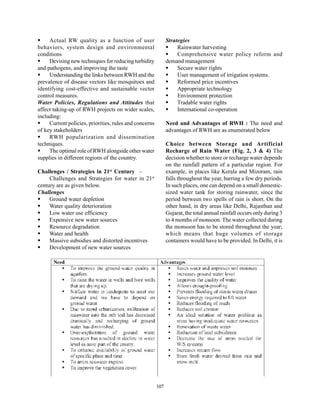

on almost any soil type and can provide an                   economics.
economical source of high quality water under                      Lining materials that have been used, with
present economic conditions.                                 varying degrees of success, can be categorized as
      Use of concrete as a catchment material has            (a) earth linings and chemical treatments –
been limited, mainly because of its high cost.               compacted earth, bentonite, chemical additives, and
Concrete catchments require more maintenance and             chemical sealants; (b) membrane and film –
have lower runoff efficiency (60 to 80%) then                prefabricated asphaltic plank, hot applied asphaltic
several other catchment materials. However, when             membrane, reinforced asphaltic membrane, plastic
properly constructed and maintained, concrete                film, and synthetic rubber; (c) hard surface linings
catchments are very durable and will provide years           – Portland cement concrete, shotcrete, soil-cement,
of service.                                                  brick, and stones. The underlined materials have
                                                             been the most successfully used in the field and are
Storage of Harvested Water                                   discussed further.
     Where water supplies are limited and water use                Sodium bentonite, fine-textured colloidal clay,
rates exceed the supply rate, a means of storing             has been used to reduce seepage in coarse-textured
harvested water becomes an essential part of the             soils. A good sealing bentonite must have a sufficient
water harvesting systems. The storage generally              amount of exchangeable sodium to disperse the soil
means confinement in either excavated pits or ponds,         particles. Application rates generally range from 5
or tanks. One exception to this type of storage is           to 15 kg/m. Laboratory analysis, like that of
direct storage in the soil profile associated with           Dirmeyer is recommended as a guide in classifying
runoff farming. Even with runoff farming,                    the bentonite to be used and in determining
conventionally storing water for later controlled            application rate.

                                                        74
Sodium salts have been the most successful              thicknesses and can be either fabric-supported or
chemical additives used to control seepage. Sodium            nonsupport. For most excavated pits, 0.08 cm, nylon-
carbonate has been most effective considering                 supported liners are adequate. Reservoir side slopes
treatment costs and ability to reduce seepage. The            should be not steeper than 1:2. Information regarding
Soil Conservation Service recommends sodium                   field installations, recommendations for use, and
carbonate application rates of 0.5 to 1.0 kg/m while          physical property requirements are discussed in
Reginato et al. presented an equation for calculating         several publications.
the amount of use. Retreatment may be required                      Vertical-walled tanks have advantages
every 2 to 3 yrs.                                             unattainable with excavated pits including: the ratio
      Reinforced asphaltic membrane liners consist            of water volume stored to water surface area is
of a substrate matting of fiberglass or polypropylene         maximum when the walls are vertical; evaporative
generally made watertight by using asphalt – either           control devices, like floating covers, can be used
emulsion or cutback. Linings are fabricated in the            more effectively and efficiently; and maintenance
field and shaped like the excavated pit. They can be          requirements are generally low and repair is easy.
used as an exposed liner if properly protected from           One main disadvantage of vertical-walled tanks is
mechanical damage. Pit side slopes should not be              initial cost; however, on an amortized basis the
steeper than 1:2 (vertical: horizontal). Plant growth         yearly cost may be lower than some low-initial-cost
under the liners should be eliminated by using soil           storage systems. Materials successfully used in
sterilants.                                                   constructing tank walls include Portland cement
      Plastic films of polyvinyl chloride (PVC),              concrete; plastered concrete and metal. The bottom
Polyethylene (PE), and chlorinated polyethylene               of the tanks has been made watertight by using
(CPE) have been successful only when buried.                  puddle clay, bentonite, sodium salts, concrete, metal,
Thickness of buried plastic film should be 0.02 to            and flexible membranes.
0.03cm depending on the sub grade soil. Side slope                  Storage bags constructed of butyl-coated nylon
should not exceed 1:3. The earthen pit should be              have been placed in excavated pits or basins. These
over-excavated to accommodate the cover material.             storage systems are completely closed and both
The sub grade should be cleared of all sharp objects,         seepage and evaporation losses are controlled. Their
and if too coarse, a fine-textured cushion should be          main disadvantages are susceptibility to mechanical
laid in the pit before installing the film.                   damage, vandalism, and vermin attack.
Recommended cover thickness varies from 15 to                       Evaporation Control. — Cooley has discussed
30 cm with the layer next to the film not coarser             evaporation suppression method. Many methods
than silty sand. Plastic-lined, rock-filled, excavated        have been investigated and can be categorized by
pits can be used and are a variation of the standard,         energy-reducing treatments (energy involved in the
buried, plastic-lined pond. The main difference is            evaporative process) like (a) changing the water
that the pond is completely filled with rock rather           color, (b) using wind barriers, (c) shading the water
than just covered with to protect the plastic. Freedom        surface, and (d) floating reflective covers. Of the
from vandalism and reduction of evaporation losses            four energy-reducing categories, floating covers
(as much as 90%) are advantages of rock-filled pits           have been most widely researched and certain
over open storage systems.                                    materials seem most promising for use in water
      Butyl rubber and ethylene propylene diene               harvesting storage facilities. These include covers
monomer (EPDM) are synthetic rubber membranes                 of continuous paraffin wax, polystyrene rafts, and
used as water barriers for harvesting water. All              formed rubber.
synthetic rubber membranes can be used as exposed                   The paraffin wax, like that used for canning,
linings, but they must be adequately protected                melts at 128 to 130 F and forms a continuous cover
against mechanical damage and damage due to                   during summer months. The wax can either be
vandalism and burrowing animals. Synthetic rubber             placed on the surface as blocks which will later be
membranes are resistant to weathering processes that          melted by the sun to form a wax layer or melted
cause failure in other membrane and film materials.           with a heater and sprayed or poured on the water.
Rubber membranes are fabricated in numerous                   Polystyrene rafts are constructed of 1.2 X 1.02 cm

                                                         75
sheets of expanded polystyrene, 25mm thick, coated                  Vegetation management methods have been
with emulsified asphalt and covered with a layer of           applied to larger areas than the other water
chips. They are then coupled together using a clamp           harvesting techniques. Annual precipitation in
made of PVC pipe. An outer frame of 32 – mm                   excess of 280 mm is generally required to assure
diameter PVC pipes is used as a bumper for the rafts.         successful vegetation management results, and
Continuous covers of low-density, closed-cell                 potential for increasing runoff yield increases as
synthetic rubber sheeting, available as 1.2-m wide            annual precipitation increases. Land alteration
roll stock, have been fabricated for use on water             methods are especially attractive where impervious
storage tanks. Covers have been fabricated from 5-            areas already exist (highways, airports, rock
and 6-mm thick material.                                      outcrops, etc.), and only collection and storage
      All three covers – continuous paraffin wax,             facilities are required. Land alteration techniques
polystyrene rafts, and foamed rubber – reduce                 are also economically feasible in areas where labor
evaporation by 85% to 95%. The cost of water saved            costs are low and soil conditions are suitable.
in high evaporation areas compares favorably with             Chemical and physical soil treatments, like salts,
alternate water sources. Wind damage to floating              silicones, and waxes, have been applied successfully
covers can be a disadvantage. Joining the                     to certain soils, but more research is required to
polystyrene rafts together helps to minimize the wind         delineate the conditions under which each can be
problem, as does maintaining an adequate freeboard            used. Soil covers are not generally restricted by soil
with the foamed rubber. The wax covers have                   and climatic conditions; however, initial cost of the
withstood winds up to 22 m/sec on a small tank with           system will generally be higher than for the other
only 25 mm freeboard.                                         methods discussed. Regardless of the material or
                                                              method used, erosion protection, routine
Summary                                                       maintenance, and protection of the catchment and
      Water harvesting is an ancient art used by              storage should be considered.
farmers in the Negev Desert of Israel over 3,000 yrs                Water collected from the catchments can be
ago where they cleared hillsides to increase rainfall-        stored in the soil itself (as in runoff farming) or in
runoff and directed the water to cultivated fields in         excavated pits or ponds, bags, or tanks. Sophisticated
the valleys. This practice was then essentially               computer models and practical experience have been
abandoned until the early 1930’s, except for                  used to provide design standards for constructing
collecting rainfall from rooftops in some areas.              and optimum sizing of catchment areas and storage
Although revival of water harvesting techniques               facilities.
began in the early 1930’s, most activity in both                    Water harvesting systems may provide the only
construction and research did not begin until the late        source of water in some areas and can provide a
1950’s. even this research effort and the development         low energy input, economical water source in many
of new materials have not yet produced widespread             others. The water obtained from water harvesting
use of water harvesting methods to provide water              system can be used to increase the productivity of
supplies, although there is still a potential for             rangelands of proper management practices are
economically collecting water in many areas of the            followed. Although it is very useful in many areas,
world.                                                        water harvesting depends on natural precipitation
      The particular water harvesting method used             and is, therefore, limited to areas where precipitation
to collect precipitation depends on several factors,          is sufficient and variability is not excessive.
including soil type and depth, vegetative cover,
surface roughness and slope, climatic factors, land,          References
labour, and material costs, water use rate and                •    American Society of Agricultural Engineers,
distribution, water quality desired, and availability         “Installation of Flexible Membrane Linings,
of materials. All of the commonly used methods fall           “Agricultural Engineers Yearbook, ASAE
into one of four categories — vegetation                      Recommendation: ASAE R340, American Society
management, land alteration, chemical or physical             of Agricultural Engineers, St. Joseph, Mich., 1974.
soil treatments, or soil covers.                              •    Baker, James W., “Polypropylene Fiber Mat

                                                         76
and Asphalt Used for Oxidation Pond Linear, “Water          •    Cluff, C. B., “Low-Cost Evaporation Control
and Wastes Engineering, Vol.7 No. 11, 1970, F-17-           to Save Precious Stock Water, “Arizona Farmer –
21.                                                         Ranchman, Vol. 51, No. 7, July 1972.
•    Burdass, W.J., “Water Harvesting for Livestock         •    Cluff, C. B., “Plastic Reinforced Asphalt
in Western Australia,           “Proceedings of the         Membranes for Precipitation Harvesting and
Water Harvesting Symposium, U.S. Department of              Seepage Control, “Proceedings of the 11th National
Agriculture, Agricultural Research Service, Western         Agricultural Plastics Conference, San Antonio, Tex.,
Region, ARS W-22, Feb., 1975.                               1973.
•    Burgy, R.H., and Papazifiriou, Z.G. “Effects of        •    Cluff, C.B., and Dutt, G. R., “Using Salt to
Vegetation Management on Slope Stability,                   Increase Irrigation Water,               “Progressive
“presented at the January 25, 1971, Water Resources         Agricultural in Arizona, Vol. 18, No. 3, 1966.
Center Advisory Council Meeting, held at Los                •    Dedrick, A. R., “ Rain trap Performance on the
Angeles, Calif.                                             Fishlake National Forest,            “ Journal Range
•    “Catchment Areas for Livestock Water,” Soil            Management, Vol. 26, No. 1, 1973.
Conservation Service, Wyoming Engineering                   •    Frasier, G. W., ed., “Concluding Remarks,
Standard, 701-WY, REev. Jan., 1968.                         “Proceedings of the Water Harvesting Symposium,
•    Chiarella, J.V., and Beck, W.H., “Water                U.S Department of Agricultural, Agricultural
Harvesting Catchments on Indian Lands in the                Research Service, Western Region, ARS W-22, Feb.,
Southwest,” Proceedings of the Water Harvesting             1975.
Symposium, U.S. Department of Agriculture,                  •    Frasier, Gary W., Myers, Lloyd E., and Griggs,
Agricultural Research Service, Western Region,              John R., “Installation of Asphalt – Fiberglass Linings
ARS W-22, Feb., 1975.                                       for Reservoirs and Catchments, “WCL Report 8,
•    Cluff, C. B., “Water Harvesting Plan for               U.S. Department of Agricultural, U.S. Water
Livestock of Home,” Progressive Agriculture in              Conservation Laboratory, 1970.
Arizona, Vol. 19, No. 3, 1967.


                                                       77
National Seminar on Rainwater Harvesting and Water Management 11-12 Nov. 2006, Nagpur


          13. Roof Top Rainwater Harvesting for Artificial Recharge to
             Ground Water : An Urgent Need of Present Century
                         * P. K. Singh **Bhaskar Singh **B. K. Tewary


        Abstract :
             The water has been harvested in India since antiquity. Evidence of this tradition
        can be found in ancient texts, inscriptions, local traditions and archaeological remains.
        The Puranas, Mahabharata, Ramayana and various Vedic. Buddhist and Jain texts
        contain several references to canals. tanks, embankments and wells.
             Overexploitation of groundwater resources is increasingly being recognized as a
        major problem. Despite being one of the wettest countries of the world, India’s growing
        water shortage has reached alarming proportions. Over the last few centuries, a
        range of techniques to harvest every possible form of water has been developed.
        Technically speaking, water harvesting means capturing the rain where it falls, or
        capturing the run-off in one’s own village or town. So, the need of roof top rain water
        harvesting has become an urgent demand of the present century.
             The amount of water harvested depends on the frequency and intensity of rainfall,
        catchments characteristics, water demands and how much runoff occurs & how quickly
        or how easy it is for the water to infiltrate through the subsoil and percolate down to
        recharge the aquifers. Moreover, in urban areas, adequate space for surface storage
        is not available and water levels are deep enough to accommodate additional rain
        water to recharge the aquifers, so the roof top rain water harvesting is ideal solution
        to solve the water supply problems.
             The present paper focuses in brief about the components of the roof top rain
        water harvesting structure, types of recharge structures and the benefits of the system.


1.0 Introduction :                                           water from the deepest portions of the earth.
      Rapid industrial development, urbanization and               Thus, the knowledge on the several traditional
increase in agricultural production have led to              water harvesting processes, storage facilities,
freshwater abstraction in many parts of the country          practices and their significance to the present day
as well as of the world. As the recharging of the            situations has become necessary in the present
groundwater is not adequate, there is a rapid                century. It is estimated1 that 8 billion people (globally)
decrease in groundwater level in several parts of            are to be fed by the end of the first quarter of the
the world. In view of increasing demand of water             21st century. This effort requires utilization of all
for various purposes like agricultural, domestic and         water resources intelligently. For this, there is a need
industrial etc., as well as unpredictable monsoon            to collect, conserve and use critical water resources
rainfall, a greater emphasis is being laid now-a-days        judiciously.
for re-use of waste water. It has become an urgent                 In this context, roof top rainwater harvesting
need of this century. Advancement in pumping                 can become popular technique to improve the
technology is extensively used in extracting ground          recharge regionally and globally. Moreover, in Urban

        * Scientists **Research Intern, Geo-environment Division, Environmental Management Group
          Central Mining Research Institute, Barwa Road, Dhanbad, Dhanbad- 826001 (Jharkhand)

                                                        78
Areas, adequate space for surface storage is not                c)   Abandoned Dugwells
available and water levels are deep enough to                   d)   Hand Pumps
accommodate additional rain water to recharge the               e)   Recharge Wells
aquifers, so roof top rain water harvesting is ideal            f)   Recharge Shafts
solution to solve the water supply problems.                    g)   Lateral Shafts With Borewells

2.0 Urgency of the Process:                                     a) Storage Tanks :
      A comparison of water levels from 1960 to 2001                 for harvesting the roof top rain water, the
shows that water levels in major part of country are            storage tanks may be used.
steadily declining because of over-exploitation.                     these tanks may be constructed on the surface
During 1960, in Delhi, the ground water level was               as well as under ground by utilizing local material.
by and large within 4 to 5 meters and even in some                   the size of tank depends upon availability of
parts water logged conditions existed. During 1960-             runoff & water demand.
2001, water levels have declined by 2- 6 m. in most                  after proper chlorination, the stored water may
part of the alluvial areas. Decline of 8-20 m. has              be used for drinking purpose.
been recorded in south-west district and in south
district the decline has been 8-30 m. Areas                     b)    Recharge Pits
registering significant decline fall mainly in south and              recharge pits are constructed for recharging
south-west districts and have been identified as                the shallow aquifers.
priority areas for taking up artificial recharge to                   these are constructed 1 to 2 m. wide and 2 to 3
ground water by roof top rain water harvesting.                 m. deep which are back filled with boulders, gravels
      Thus, though the concept of roof top rainwater            & coarse sand.
harvesting is an age old one, but systematic collection               the size of filter material is generally taken as
and recharging to ground water is of recent times.              below:
As surface water sources fail to meet the rising                      coarse sand : 1.5 - 2 mm
demands of water supply in urban areas, ground                        gravels       : 5 - 10 mm
water reserves are being tapped and over-exploited                    boulders        : 5 - 20 cm
resulting into decline in ground water levels and                     the filter material should be filled in graded
deterioration of ground water quality. This precarious          form. boulders at the bottom, gravels in between
situation needs to be rectified by immediately                  & coarse sand at the top so that the silt content that
recharging the depleted aquifers.                               will come with runoff will           be deposited on
                                                                the top of the coarse sand layer and can easily be
3.0 Typical Roof Top Rainwater Harvesting                       removed.
Structure:                                                            if clay layer encountered at shallow depth, it
     A typical roof top rainwater harvesting system             should be punctured with auger hole and that auger
comprises of:                                                   hole should be refilled with fine gravel of 3 to 6 mm
a) roof catchments                                              size.
b) gutters
c) down pipes                                                   c)   Trenches
d) rain water/storm water drains                                      these are constructed when the permeable
e) filter chamber                                               strata is available at shallow depths.
f) ground water recharge structures like pit,                         trench may be 0.5 to 1 m. wide, 1 to 1.5 m.
trench, tube well or combination of above structures.           deep and 10 to 20 m. long depending upon
                                                                availability of water.
4.0 Methods of Groundwater Recharge:                                  these are back filled with filter materials. in
     For Rainwater Harvesting System following                  case of clay layer encountered at shallow
structures are required:                                        depth,
a) Recharge Pits                                                      the number of auger holes may be constructed
b) Recharge Trenches                                            & back filled with fine gravels.

                                                           79
d) Abandoned Dug wells                                          30 m. long depending upon availability of water with
      existing abandoned dug wells may be utilised              one or more bore wells may be constructed. the
as recharge structure after cleaning and desilting              lateral trench is back filled with boulders, gravels &
the same.                                                       coarse sand.
      for removing the silt contents, the runoff water
should pass either through a desilting      chamber             5.0 Benefits of Rooftop Rainwater Harvesting
or filter chamber.                                              Structure
                                                                a) An ideal solution of water problem in areas
e)    Abandoned Hand pumps                                      having inadequate water resources.
      the existing abandoned hand pumps may be                  b) The ground water level will rise.
used for recharging the shallow / deep aquifers,                c) Mitigates the effects of drought.
if the availability of water is limited.                        d) Reduces the runoff which chokes the storm
      water should pass through filter media before             water drains.
diverting it into hand pumps.                                   e) Reduces flooding of roads.
                                                                f) Quality of water improves.
f)   recharge wells                                             g) Soil erosion will be reduced.
      recharge wells of 100 to 300 mm. diameter                 .
are generally constructed for recharging the                    6.0 Design Criteria of Recharge Structures
deeper aquifers and roof top rain water is diverted                  Recharge structures should be designed based
to recharge well for recharge to ground water. The              on availability of space, availability of runoff, depth
runoff water may be passed through filter media to              to water table & lithology of the area.
avoid choking of recharge wells.
                                                                Assessment Of Runoff
g) Vertical Recharge shafts                                          The runoff should be assessed accurately for
     For recharging the shallow aquifers which are              designing the recharge structure and may be
located below clayey surface at a depth of about 10             assessed by following formula.
to 15 m, recharge shafts of 0.5 to 3 m. diameter and                 Runoff = Catchment area * Runoff
10 to 15 m. deep are constructed depending upon                 Coefficient * Rainfall
availability of runoff. these are back filled with
boulders, gravels & coarse sand. For lesser diameter            Runoff Coefficients
shafts, the reverse / direct rotary rigs are used and                 Runoff coefficient plays an important role in
larger diameter shafts may be dug manually. In upper            assessing the runoff availability and it depends upon
portion of 1 or 2 m depth, the brick masonry work is            catchment characteristics. General values are
carried out for the stability of the structure.                 tabulated below which may be utilised for assessing
                                                                the runoff availability.
h) Shaft with Recharge well
      If the aquifer is available at greater depth say            Type of catchment          Runoff coefficient
20 or 30 m, in that case a shallow shaft of 2 to 5 m
diameter and 5 to 6 m deep may be constructed                     Roof top                        0.75 - 0.95
depending upon availability of runoff. inside the shaft,          Paved area                      0.50 - 0.85
a recharge well of 100 to 300 mm diameter is                      Bare ground                     0.10 - 0.20
constructed for recharging the available water to
deeper aquifer. at the bottom of the shaft a filter               Green area                      0.05 - 0.10
media is provided to avoid choking of the recharge
well.                                                           Design Considerations
                                                                     Three most important components, which
i) Lateral trench with bore wells                               need to be evaluated for designing the rainwater
     For recharging the upper as well as deeper                 harvesting structure, are:
aquifers, lateral trench of 1.5 to 3 m. wide & 10 to            1. Hydrogeology of the area including nature and

                                                           80
extent of aquifer, soil cover, topography, depth to          or green belts and general built up pattern of the
water levels and chemical quality of ground water            area.
2. Area contributing for runoff i.e. how much area           3. Hydrometeorological characters viz. rainfall
and land use pattern, whether industrial, residential        duration, general pattern and intensity of rainfall.


                     Schematic sketch of Rain Water Harvesting in Rural Areas


                                                        81
Roof Top Rain Water Harvesting Structure


8.0 Conclusions :                                              References :
       Thus, water has been harvested in India since           a) Nagrajan R. : Water ; Conservation, Use and
antiquity. Evidence of this tradition can be found in          Management for Semi-arid Region: Capital
ancient texts, inscriptions, local traditions and              Publishing Company;2006.
archaeological remains. The Puranas, Mahabharata,              b) Athavale, R.N. Water harvesting and
Ramayana and various Vedic. Buddhist and Jain                  sustainable supply in India, Centre for
texts contain several references to canals. tanks,             Environmental Education and Rawat Publications;
embankments and wells.                                         2003
       Overexploitation of groundwater resources is            c) Natarajan, P.M., & Kallolikar S. Rain Water
increasingly being recognized as a major problem.              Harvesting New Approaches For Sustainable
Despite being one of the wettest countries of the              Water Resources Development, Sarma Sanitorium
world, India’s growing water shortage has reached              Press; 2004
alarming proportions. Over the last few centuries, a           d) http://www.rainwaterharvesting.org/urban/
range of techniques to harvest every possible form             Howtoharvest.htm
of water has been developed. Technically speaking,             e) h t t p : / / a k a s h - g a n g a - r w h . c o m / RW H /
water harvesting means capturing the rain where it             WaterHarvesting.html
falls, or capturing the run-off in one’s own village or        f) http://www.gdrc.org/uem/water/rainwater/
town. Thus, the role of Institution of Engineers               introduction.html
(India), Nagpur Local Centre is worthy in this                 Todd, D.K. (1980). Groundwater Hydrology.
direction.                                                     Second edition., John Wiley & Sons, New York.

                                                          82
National Seminar on Rainwater Harvesting and Water Management 11-12 Nov. 2006, Nagpur


          14. Roof Top Rain Water Harvest- A Long Lasting Solution to
                   Drive away the Need of Water Tankers
                                *Mrs. Charu Bhavsar                **Pradeep Bhalge

        Abstract
                Water has been harvested in India since antiquity. Roof top water harvesting
        techniques are not new for Indians. Numerous documentary and filed evidences about
        the water harvesting techniques used by the ancestors exist in India. For general,
        Maharashtra receives a good amount of annual rainfall. But the Government has to
        supply drinking water by the water tankers to numerous villages and wadies. Many of
        the wadies or tandas are situated in remote places. In such cases drinking water cannot
        be supplied to the thirsty people by tankers or by any other means. The water supplied
        by the Tankers may not be either pure or sufficient. There is a need to think; ‘Is it
        necessary to supply the drinking water by Tankers?’ The answer is ‘not in all the
        cases’. Roof top rainwater is the best solution to solve all the problems discussed above.
        This paper will illustrate the drinking water needs, computation of the quantity of the
        annual rain water from the roof top, methods and type of storages in practice, care to
        be taken to maintain the purity of the rain water harvested, and the merits and demerits.


Introduction                                                      ponds and tanks in southern India. In Tamil Nadu,
       India receives good amount of rainfall. But                the ancient people stored rainwater in public placed
the rainfall is highly erratic in nature. It is not evenly        separately one for drinking purposes and another
distributed over the entire area and over the period.             for bathing and other domestic purposes. They also
India have distinct rainy season. In most part of the             formed percolation tanks or ponds, for the purpose
country the annual rainy days varies from 10 to 45.               of recharging irrigation or domestic wells. They
As soon as the rains are over, water scarcity starts.             periodically clean the waterways so as to get clean
The ancestors realize that, harvesting the water in               water throughout the year. These are instances in
rainy season will be use full in rest period of the               the history that people constructed crude rubble
year. They have developed varies techniques to                    bunds across river courses either for diversion of
harvest the water because they knew that without                  water or for augmenting the ground water.
harvesting the water life is difficult to survive. There                 Unfortunately under the British governance
are evidences that, during Harappan period, there                 system the wisdom of the raindrop was lost. The
was very good system of water management as                       technological interventions, which got water into
could be seen in the latest excavation at Dholavira               our taps, relied on large-scale water impoundments
in Kachch. The people use to manage water                         in the upper reaches of rivers and pushed the wisdom
resources considering it as part of the nature, which             of the raindrop into the background. Today the need
is essential for their survival. This could be seen               of the hour is to go back to the wisdom of ancestors,
from the rainwater harvesting structures in the low               rediscover their concepts and adapt them into our
rainfall areas of Rajasthan, harvesting springs in                lives.
hilly areas and mountainous region and percolation

                               *Indian Council for water and culture; Aurangabad.
                        **A.E.II, Water Resources Department, Government of Maharashtra.

                                                             83
Traditional rainwater harvesting                               Kunds of Thar Desert :
       Traditional rainwater harvesting, which is still               In the sandier tracts, the villagers of the Thar
prevalent in rural areas, was done in surface storage          Desert had evolved an ingenious system of rainwater
bodies like lakes, ponds, irrigation tanks, temple             harvesting known as kund or kundis. Kund, the local
tanks etc. In urban areas, due to shrinking of open            name given to a covered underground tank, was
spaces, rainwater will have to necessarily be                  developed primarily for tackling drinking water
harvested as ground water, Hence harvesting in such            problems. Usually constructed with local materials
places will depend very much on the nature of the              or cement, kund were more prevalent in the western
soil viz., clayey, sandy etc. The below listed are the         arid regions of Rajasthan, and in areas where the
various kinds of traditional rainwater harvesting              limited groundwater available is moderate to highly
methods.                                                       saline. Under such conditions, kund provides
                                                               convenient, clean and Sweetwater for drinking. The
                                                               kund consists of a saucer-shaped catchments area
                                                               with a gentle slope towards the centre where a tank
                                                               is situated. A wire mesh to prevent the entry of
                                                               floating debris, birds and reptiles, usually guard the
                                                               openings or inlets for water to go into the tank. The
                                                               top is usually covered with a lid from where water
                                                               can be drawn out with a bucket. Kund are by and
                                                               large circular in shape, with little variation between
                                                               the depth and diameter which ranges from 3-4.5 m.
                                                               Lime plaster or cement is typically used for the
                                                               construction of the tank, since stone as a building
            KUND OF RAJASTHAN                                  material is not always available and is relatively
                                                               more expensive. Either of these materials can be
                                                               used to plaster the horizontal and vertical soil
                                                               surfaces, although cement ensures a longer life span.
                                                               The success of a kund depends on the selection of
                                                               the site, particularly its catchments characteristics.
                                                               An adequately large catchments area has to be
                                                               selected or artificially prepared to produce adequate
                                                               runoff to meet the storage requirements of the kund.

                                                               Bamboo Method :
                                                                      In Meghalaya, an ingenious system of tapping
                                                               of stream and spring water by using bamboo pipes
                                                               to irrigate plantations is widely prevalent. About
                                                               18-20 liters of water entering the bamboo pipe
                                                               system per minute gets transported over several
                                                               hundred meters. The tribal farmers of Khasi and
                                                               Jaintia hills use the 200-year-old system. The
                                                               bamboo drip irrigation system is normally used to
                                                               irrigate the betel leaf or black pepper crops. Bamboo
                                                               pipes are used to divert perennial springs on the
                                                               hilltops to the lower reaches by gravity. The channel
                                                               sections, made of bamboo, divert and convey water
                                                               to the plot site where it is distributed without leakage
                                                               into branches, again made and laid out with different
       BAMBU DRIP IN MEGHALAYA                                 forms of bamboo pipes. Manipulating the intake

                                                          84
pipe positions also controls the flow of water into         But taking the mouthwash under a running tap will
the lateral pipes. Reduced channel sections and             require more than 15 to 20 liters of water. A bucket
diversion units are used at the last stage of water         of 15 to 20 liters was sufficient to take bath before
application. The last channel section enables the           the advent of tap water, but now a day’s taking bath
water to be dropped at the rate of 20-80 drops per          under the water tap consumes 50 to 100 liters of
minute near the roots of the plant.                         water. In this way, habits of wasteful use of water
                                                            are increased in these days. With the advent of the
Roof top rainwater harvesting and rainwater                 electric pumps the rate of withdrawal of water from
harvesting techniques is not new                            the well is increased tremendously, resulting in to
       The concept of roof top rainwater harvesting         depletion of ground water level. Every year the
and rainwater harvesting techniques is not new.             rains replenish the ground water. But due to
Many of us feel that this tool is devised by the            exploitation of more water than the replenish one;
modern society as a tool to drought proofing. This          peoples do not get water even for drinking in
is not so. Our ancestors had been doing it according        summer days. The wells and bore wells runs dry as
to the means available then. At large, no of places         soon as the rainy season is over. In such situations
in India, this art and science has been practiced.          tankers are supplying water. The local leaders put
The most beautiful rainwater-harvesting scheme              lot of pressure on the government officials to supply
could be witnessed at Deogiri fort. Water from the          water tankers. It is observed that nobody worries
adjacent hillock was transported through an inverted        about the purity of the water supplied by the tankers.
siphon of twin pipes and the mot around the hilltop         Drinking the impure water leads to water born
fort was filled. A moat around the hill top fort is         disease. It is said that 80% of the human disease
another wonder. Transportation of water though              are due to impure water. The whole family has to
inverted siphon was a unique feature. The temples           suffer when any member of their family becomes
were used as roof top rainwater harvesting devices.         ill. Especially incase of a family whose livelihoods
The noteworthy example is of Minakshi temple in             is depend upon the labor work, if an adult get ill,
Madurai. If seen carefully it is seen that beautiful        survival of his family comes in danger. All the
arrangement of collection of roof top rainwater             problems as said above can be minimized if every
scheme is made here. The harvested water is stored          family gets sufficient amount of pure water for
in a tank. With the advent of tap water, rainwater          drinking. A time is now came to think that is it
harvesting has lost its importance. As our State is         necessary to use heavy cost water supply schemes
in a situation where efficient management of water          everywhere? Is it necessary to supply water by
resources has become a necessity, rainwater                 tankers? This can be achieved by adopting roof top
harvesting has come to limelight again. We have to          rain water system. By adoption of the Roof top
resort to long-term measures in harvesting the              rainwater harvesting techniques, there will not be
rainwater due to the growing demand. It is hence            any need to supply water by tankers. Let us see that
emphasized that rainwater harvesting should                 how where and when this technique is useful.
become an integral part of every home, society,
village, city and country.                                  Human water needs : Let us understand our daily
                                                            per head water requirement.
Back to the tradition                                        Daily water need        Maximum        Minimum
      In the previous days peoples were bringing                                     in liters      in liters
water from the community well. The water was                 Latrine and             25             05
drawing from the well with the help of rope and              washing mouth
bucket. Thus there was a limitation of drawing the           Bath                    25             10
water and indirectly there was restriction on the            Washing cloths          25             10
water use. The methods of domestic utilization were          Food preparation        10             05
developed to support the minimum use of water.               and drinking
For example water for mouthwash was taken in a               Other purpose           10             05
pot. The capacity of such pot was around one liter.          Total                   95             35

                                                       85
The minimum water need is 35 liters per day                   Thus it is seen that the cost of the under
per person. Thus 175 liters water per day will be             ground storage tank i.e. 20000/-will be recovered
sufficient for a family of five persons. Suppose the          within five years.
roof top area of the house is 30 sqm; and the average                Construction of Kund and such type of under
annual rainfall is 700 mm. Then the roof top                  ground storage tanks are practiced in Rajasthan and
rainwater potential is 21000 liters. If a under ground        Gujarat. With these techniques they have solved the
tank of size 3m x 3m x 2.5m is constructed. The               water problems. They built a water storage tank
storage capacity of the tank will be 22500 liters.            under the main Hall of the house. The storage
This much water will be sufficient to them for 128            capacity is ranging from 20000 to 40000 liters. In
days. That is more than 4 months of the dry summer            summer days when the wells become dry they use
days. The construction cost of the tank will be               the stored water. The rainwater harvesting system
around Rs.20000/-. With nominal maintenance the               is found in the house of general publics as well as
tank will serve for more than 40 to 50 years. Thus            in the minister’s house also. It will be interested to
this is a long lasting solution. The annual cost of           note that an under ground tank was in use in the
the tank will be around Rs.2000/-                             house at Porabandar, where Mahatma Gandhi was
                                                              born.
      Comparison of tankers expenditure with the construction cost of water storage tank


                                          Harvesting Water at Home


                                                         86
The rainwater that is harvested is pure with              drained. 3 to 4 down water pipes seem sufficient
virtually no impurities and is suitable for all purposes.        for 30 to 40 square meter roof areas.
After filtration the harvested rainwater can be put
to all uses including drinking and cooking purposes.             Filtration
The area on which the rainwater falls is the                     Before the water enters the down water pipes
catchments area. The annual rainwater harvesting                 Filtration arrangements is must. This can be archived
potential of rooftop can be calculated by multiplying            with following simple methods.
the area and the amount of rainfall that is received             •     Put a piece of sponge placed at the inlet of the
annually.                                                        down water pipe.
       In rural areas, the roof top harvested rainwater          •     A PVC bucket with gravel, sand & charcoal is
can be stored or used for recharge of ground water.              a good filter before rainwater is stored
This approach requires connecting the outlets pipe               •     A PVC drum with sponge at the inlet & outlet
from rooftop to divert the water in to a storage tank            is also a filter
or divert it to either existing well/tube wells/bore             •     A small two chamber inspection/ filter tank can
wells or specially designed wells/ structures.                   also be devised
Following table shows the availability of rainwater              •     A Devas type filter is found to be useful. It is
through Roof Top Rain Water Harvesting.                          easy to construct, maintain, and have low cost.

Size of down water pipe                                                The rainwater dissolves the impurities that are
      The collection system directs the rainwater                present on the surface as it flows over the roof area
falling over the rooftop, into the filtration system. 75         into the collection system. Therefore it is advisable
to 90 mm diameter PVC pipes resistant to UV rays                 to keep the catchments area free of any chemical or
appear to be the best bet as down water pipes. Of                other harmful impurities. At times, it is also advised
course, this depends upon the roof area to be                    that the run-off of the first few minutes of the rain

                Water yield available in liters from the annual rainfall, roof top area
                                               Annual Rainfall in mm ..................


  (m²)                                      Harvested Roof Top Water in liters


                                                            87
be allowed to flow out. This washes away most of              to the one third area of the roof top and the depth of
the impurities that may be possibly present on the            the tank equal to three times the average annual
surfaces.                                                     rainfall in meter or three meter whichever is less.”
                                                              For example there are three rooms in a house of
Storage                                                       size 3m x 3m. The total roof area will be 3no x3m x
       The harvested rain shall be stored in a storage        3m i.e. 27 square meter. Let the house is lies in the
tank. The tank can be built with locally available            average annual rainfall of 700 mm (0.7meter). Then
materials and traditional construction techniques.            for storing the harvested roof top water construct a
The storage tank can be constructed underground,              under ground tank having the bottom area equal to
above ground or partially above ground as shown               one third the roof area i.e. 27/3=9 square meter.
in the following figures. Use the ground water till           Keep the depth of the tank equal to 3 times the
it is available. Use the water stored in the tanks in         average annual rainfall i.e. 0.7m x 3=2.1 meter. Thus
dry months.                                                   the storage capacity of the tank will be 3 x3 x 2.1
Depending on the amount of rainwater that needs               =18.9 cubic meter i.e. 18900 liters. And this much
to be harvested and the proposed end use of the               water will be sufficient for three most dry summer
harvested rainwaters, an appropriate storage or               month to a family of five members. And if used very
recharge system is designed. The simple thumb rule            precisely for drinking and cooking purpose then this
for that is “build a storage tank of bottom area equal        much water will be sufficient for more than six


                                                         88
months. It is interesting to note that in Bikaner area        •     Rooftops of houses serve as excellent and
of Rajasthan the people prefer to give harvested              economical form of collection centers for rainwater.
rain water to an ill person than the tap water. Thus          If properly diverted and used for artificial recharge
they have very much faith on the purity of the                it will augment the ground water table to a sufficient
harvested and stored rainwater. Since 1986, in 450            extent. The roof is connected to the well through a
school of Rajasthan under ground storage tank are             filtering arrangement by PVC pipe. A valve system
constructed. The total storage capacity of these              can be incorporated to flush the initial part of the
tanks is about 27 million liters. The students and the        rainwater to get rid of impurities collected on the
staff have drunk the water since its inception and            roof. Rainwater also can be collected and stored in
there have been no complain from their teacher or             large sumps to consume directly after necessary
parents that they have fallen ill from drinking the           chlorination.
water.                                                        •     Bathing and washing water can be routed to
                                                              the open ground nearby to percolate down to retain
Maintenance                                                   the soil moisture. The gray water can also be treated
     Water harvesting systems require occasional              by some water treatment methods like Soil Aquifer
maintenance, but this can be easily accomplished.             Treatment System (SAT) and further the pretreated
Debris and leaves should be filtered before storing           water.
the water by placing screens over gutters. Debris             •     The ground level near the gate should be raised
screens over gutters should be cleaned periodically           to retain as much water as possible inside the
and storage tanks should be drained and cleaned               compound. Alternatively, it is recommended to
regularly. Water kept in tanks should be covered to           construct a sloping gutter across the gates and direct
minimize algae growth and eliminate the potential             the rushing water towards percolation pit. For
for any mosquito breeding.                                    multistoried building, it is better to direct this water
                                                              to a recharge well.
Ground water recharge-Simple Methods                          •     The storm drains inside the premises should
      The water in the premises can be harvested to           have boundary wall to ensure that the rain water
recharge the ground water. The recharging will                instead of rushing into the drains and going as waste,
certainly help to increase the ground water storage.          stagnates over the ground for sometime and seeps
The design and the location of these recharge                 into the soil.
systems is site specific and needs to be evolved as           •     Wherever there is a slope, it is recommended
per the requirements.                                         to construct a dwarf wall to a height if 1 ft, to avoid
When the rainwater falls on the ground, some of it            run-off as well as to retain the rain water and allow
seeps into the soil but the surplus adversely flows           for slow percolation.
out as a stream or as run-off. The top soil however,          •     The run-off water generated in monsoons
can hold only a fraction of water that falls on it and        within an area can be well utilized for ground water
the rest gradually percolates down, depending on              recharging by diverting it into suitably designed
the type of the soil and joins the aquifers that are          recharge structures in public parks, splay grounds,
groundwater-bearing formation Artificial recharge             stadiums, airports, stations, temple tanks, etc.
is a process of augmenting the underground water              •     Storm water drains should be designed in such
table by artificial infiltration of rain water and            a way that two separate segments are made so as to
surface run-off.                                              accommodate water coming from houses and from
                                                              roads. The segments on the sides of the roads should
Techniques of Rain water Harvesting.                          be covered with perforated slabs and should have
•    to make more water to percolate down the soil,           percolation pits of depth 20 to 50 ft., depending on
percolation pits are made, when there is a paved              the soil condition, at regular intervals.
pathway and are covered with perforated concrete              •     Due to severe depletion of ground water table,
slabs wherever necessary. Whenever the depth of               many open wells, bore wells and hand pumps are
clay soil is more, recharge through percolation pits          getting dried. Instead of discarding these wells, they
with bore is preferable.                                      can be converted into useful recharge wells. Roof

                                                         89
water and run-off water can be diverted into these            the water sources get polluted due to entry of
wells after filling the wells with pebbles and river          floodwater in to them, and other reasons. In such
sand. There should be an effective arrangement for            conditions harvested rainwater will be the only
desalting before diverting the water into these wells.        source of pure water.
•     It is advisable to have numerous percolation            •    Combination of roof top rainwater harvesting
pits in agriculture lands for gradual percolation and         and rain water harvesting is a long lasting
recharging of aquifer. Construction of small bunds            sustainable solution for the drinking water crises,
on slope areas slows down the run-off water and               and to keep the tankers away.
helps easy percolation. Run-off water can be
diverted into a large well through a Baby well and            Demerits
filtering tank to avoid silt depositing in the well.               Roof top rain water harvesting system can not
•     In open grounds, the topsoil is removed and             supply water if there is no rain fall over the
filled with river sand. As the river sand is loosely          catchments or the water is not stored in the storage
packed, it allows water to percolate down quickly.            tank, in the preceding rainy season.

Merits                                                        References
•     It is a low cost long lasting solution supplying        Books
pure water.                                                   1. Pani Sarvansathi, Pradeep Bhalge
•     If it is made compulsory to adopt the roof top          2. Aaj bhee khare hai talab, Anupam Misra
rain water harvesting then there will be no need to           3. Bharatiya Jal Sanskriti Sawarup Ani Vyapti,
supply water by tankers. This will save huge amount           Dr. R.S.Morawanchikar
of money. This on other wise can be spent on the              4. Param vaibhavacha tappa ala, Prof.
development works. This will also save the diesel             R.M.Pandav
indirectly foreign currency.
•     The rainwater harvesting system is very useful          Papers and Articles
in the remote places and in arid zone.                        1. Glimpses of Water History of India, Dr. D.M.
•     It is also useful in high rainfall and well as          More
low rainfall zones.                                           2. Few Glimpses of Indian water Culture, Dr. R.
•     This can be a best solution in the areas having         S. Morawancikar
saline ground water or water containing fluorides.            3. Sankalan Pauspanyache, Pradeep Bhalge
•     It is also useful in case of flood situations as


                                                         90
National Seminar on Rainwater Harvesting and Water Management 11-12 Nov. 2006, Nagpur


   15. Additional Ground Water Storage Potential for Artificial Recharge
      in Phreatic Aquifers of Yavatmal District, Maharashtra, India
                              *Pandith Madhnure **Sunil Kumar Jain

     ABSTRACT
     Yavatmal district is mainly underlained by varied geological formations consisting of
     Penganga Group, Gondwana Group, Deccan Traps and Quaternary sediments. Post monsoon
     depth to water level and lithological logs of exploratory wells in shallow aquifers down to
     20 m depth have been studied and analysed in detailed. The average tahsil wise depth to
     water level varies from 6 to 9 m m bgl and the available porous space for artificial recharge
     in unsaturated zone in phreatic aquifers varies from 0.4 to 6 m. The potential of ground
     water storage by recharging the phreatic unsaturated zone is estimated to be 951.6 MCM.
     The drinking needs of 1,44,200 people during the 4 months of summer season can be met or
     additional 1,29,500 hectors of land can be brought under assured irrigation from this
     augmented ground water resources. The undue withdrawal of ground water from the deeper
     aquifers containing excessive fluoride causing fluorosis can be checked in the area.
     KEY WORDS: Shallow aquifer, Storage potential, Depth to water level Yavatmal, Artificial
     recharges potential.

1. INTRODUCTION                                               79009’ E Longitude (Maharashtra State Gazetteer,
         Ground water is basically a renewable                1974) and covers an area of 13584 km2, which is
resource, but the volume of water actually stored             4.41% of the Maharashtra state (Socio Economic
may vary greatly from place to place depending on             Review, 2003-04). It is one of the economically
physiography, climate, hydrogeology and rate of               backward district of Vidarbha regions of the state.
ground water withdrawal used for various purposes.            As per the 2001 census the district has got a
The ground water development has to be optimised              population of 24,58,271 with a density of 181/ km2
considering the demand and supply factors. Under              (Census of India, 2001). Location of the area is given
utilization of available resources is not desirable as        in Fig 1.
it deprives the economic development of the human
beings. On the other hand overexploitation of                 3. HYDRO-GEOLOGICAL SETUP
ground water leads to depletions of water resources
and scarcity in future. Available ground water                3.1 Physiography and Climate
resources and potential for its augmentation needs                    Physiographically the area is mostly
to be assessed scientifically and understood                  undulatory dissected plateau with isolated hills
holistically for planning the water resources                 excluding the eastern part of the district, which is
management. This study has been done for Yavatmal             plain. The district is well drained by the rivers
district on scientific lines as follows.                      Penganga, Wardha and their tributaries namely Pus,
                                                              Bembla, Aran, Arunavati, Waghadi, Khuni,
2. LOCATION                                                   Vaidharbha and Nirguda.
       The Yavatmal district lies between 19026’                      The climate of the district is characterized
N to 20042’ N Latitude and between 77018’ E to                by hot summer and general dryness except during

 * Scientist “B”, **Scientist “D” 2Central Ground Water Board, Central Region, Civil lines, Nagpur –440001
         For correspondence (email: Pandith_m@rediffmail.com or sunilkumar_jain@ rediffmail.com)

                                                         91
the SW monsoon. The normal annual rainfall varies             dug wells for the year 2005 (CGWB, 2006). The
from about 850 to 1150 mm and it increases from               depth to water level in the phreatic aquifers varies
NW to SE direction in the district. The temperature           between to 1.80 mbgl to 16.80 mbgl during the pre
varies from minimum of 15.1 0C in winter and                  monsoon season and between 0.30 m bgl to 15.15
maximum of 41.80C in summer.                                  mbgl during the post monsoon season in the district.
                                                              The tahsil wise average depth to water level in the
3.2 Geology                                                   area during post monsoon season of the year 2005
         Archaean rocks from the basement and are             varies from 6 m bgl to 9 mbgl with an average of
covered by Penganga and Vindhyan group of rocks.              6.96 m bgl. Deep water levels are observed in Wani,
The Gondwana group of rocks overlays these rocks.             Kelapur and Ghatanji tahsils. Hydrogeological map
Deccan trap is spread all over the area. Finally the          of the district along with depth to water level
action of atmosphere eroded the Deccan traps in               (November, 2005) is given in Fig 1.
parts, exposing the other older formations at surface.
The thickness of these formations therefore varies            4. GROUND WATER RESOURCES
from place to place and thus hydrogeology of the                        The CGWB and GSDA estimated the
area is influenced accordingly (Deshmukh, 1994).              ground water resources of the district based on
         The contact between Penganga Group of                Ground Water Estimation (GEC) Methodology
rocks and Deccan traps is marked by unconformity.             1997. The net annual available ground water
The contact between Gondwana and Deccan trap is               resources are 1278.34 MCM and the ground water
mostly undulatory. The eastern part of the district           draft is 314.35 MCM. Overall the stage of ground
is traversed by numerous faults; therefore rocks of           water development is 24.6 % in the district (GSDA
different groups are met at different altitude in the         & CGWB, 2005). The tahsil wise ground water
area owing to differential subsidence or upheaval             resources of the district are given in Table 2.
events. The lithological geometry of the phreatic                       Ground water development scenario varies
aquifers is generated exclusively based on the                in the district, while eastern part consisting of Wani,
exploratory drilling at 51 wells is given in Table 1          Maregaon, Kelapur, Ghatanji and Jhari Jamni tahsils
and plotted in Fig 2.                                         are the least developed tashils from ground water
                                                              resources point of view having less than 15% of
3.3 Hydrogeology                                              the development. The Ralegaon, Yavatmal,
        The Deccan traps are the predominant water            Babulgaon, Kalamb and Arni are the next developed
bearing formations with variations in hydro                   tahsils with the stage of development between 15
geological properties over horizontal and vertical            to 25%. There is better ground water development
space. It is followed by Gondwana formations                  in Darwah, Ner, Digras, Pusad and Umarkhed tashils
having sandstone and shales sequence. The                     where the stage of ground water development is 25
Penganga and Quaternary alluvium aquifers are                 to 40%. Maximum development of ground water is
spread in limited areas but have significant role             45% and is observed in Mahagaon tahsil. As per
wherever they are found. Archaean aquifers are                the GEC norms all the tahsils and 64 watersheds
limited and have less significance in the area.               falls in safe category.

3.3.1 Phreatic Aquifers: Phreatic aquifers are most           5. SCOPE OF GROUND WATER
productive and occur at shallow depth, which are              AUGMENTATION THROUGH ARTIFICIAL
developed by dug wells up to 20 m depth. Ground               RECHARGE
water occurs in the weathered zone, fractures in                       The ground water development scenario of
Archaean rocks, Penganga formations, Vindhyan                 the district is favorable for further ground water
formation and Gondwana formations and weathered               development in years to come. However, as the
zone, fractures and vesicular part in the basaltic            development of ground water resources proceeds
formations.                                                   with increasing ground water withdrawal, the
        A comprehensive depiction of depth to                 depletion of water table will accelerate resulting into
water level is made by using the data of the 317              drying or deepening of existing wells. There are

                                                         92
many pockets in the district where water levels have          tahsil) to 6 m (Kelapur tahsil) with an average of
deepened and also certain areas lack adequate                 3.16 m. It is found that only some percentage of
natural replenishment. Therefore, artificial recharge         total thickness of the unsaturated zone is porous and
measures would be required simultaneously so as               the remaining is non porous for ground water
to augment the ground water resources of the area.            storage. The percentage varies from 7% (Digras &
There is a need for assessing the scope and extent            Arni tahsil) to 67% (Kelapur tahsil) with an average
of artificial recharge potential available at present         of 48%. The area having maximum thickness of
in the area so as to make a comprehensive                     porous strata in unsaturated zone is most potential
management plans for the district. The artificial             for ground water recharge through artificial
recharge potential has been assessed accordingly              measures.
on the scientific pattern and methodology in this                       The artificial recharge is targeted to raise
study.                                                        the depth to water level up to 3 m bgl so as to avoid
                                                              the danger of water logging. The column 7 of Table
6. IDENTIFICATION OF POTENTIAL AREAS                          3 is worked out by subtracting column 5 from
FOR ARTIFICIAL RECHARGE (PHREATIC                             column 4 of Table 3 or the actual top impervious
AQUIFER)                                                      layer or 3 m whichever is more.
         The base map of Yavatmal district on 1:
250,000 scale is prepared by demarcating district,            7.       STORAGE            POTENTIAL               OF
tahsils boundary and major drainage. The                      UNSATURATED PHREATIC AQUIFERS
lithological logs of the phreatic aquifers down to                      The volume of water for recharging the
the depth of 20 meters below ground level (m bgl)             unsaturated (dry) zone of phreatic aquifers is
are compiled and plotted on the base map (Fig. 2),            estimated by multiplying the tahsilwise area with
as the area is developed by dug wells up to 20 m              the available unsaturated thickness and the average
depth. Data of 51 exploratory wells drilled by                specific yield of the particular strata. Thus, the total
CGWB is specifically analyzed in detail for the               storage potential of phreatic unsaturated aquifer
phreatic part although their depth ranges from 17             varies from 9.04 MCM in Digras & Arni tahsils to
m bgl to 470 m bgl. This is superimposed on the               142.56 MCM in Wani tahsil. The total potential of
base map so as to account for storage potential of            ground water resources augmented through artificial
different strata more precisely. The aquifer geometry         recharge is estimated in the district is 951.61 MCM.
is also reflected from this data source. The depth to         The tahsilwise details of estimated sub surface
water level data of post monsoon season for the year          storage potential of phreatic aquifers through
2005 is used to assess the unsaturated space                  artificial recharge to ground water are given Table
availability in phreatic zone. These are                      4.
superimposed and transferred on the base map to
generate a comprehensive map (Fig. 2).                        8. GROUND WATER AVAILABILITY VIS A
         Based on the above-mentioned information,            VIS AUGMENTATION POTENTIAL
the tahsilwise potential for artificial recharge to                   The ground water resources of the district
ground water is worked out. The summarized results            are 1278.34 MCM and possibility of further ground
of lithology, depths to water levels are given in             water augmentation is 951.61 MCM or the actual
Table 3.                                                      non-commuted surplus runoff. Thus, the overall
                                                              ground water resources can be made available is
         The disposition of impervious layers below           2230 MCM (Table 4) depending up on the available
the ground water surface has decisive role to                 surplus water. However, there are variations in the
facilitate or to retard the recharge from rainfall or         tahsilwise scenario of ground water availability and
storage tanks. A perusal of the Table 3 indicates that        augmentation potential.
the depth of impervious formation varies from 0.
75 m bgl (Darwah tahsil) to 5.6 m bgl (Digras &               RECOMMENDATIONS
Arni tahsil).The unsaturated thickness of porous                      The additional storage potential of the
zone availability varies from 0.4 m (Digras and Arni          phreatic aquifers may be harnessed appropriately

                                                         93
considering the drinking water scarcity and irrigation        suggestions and encouragement while preparing the
needs of the area. It will generate many fold benefits        paper. Sincere thanks are due to S/Sh. Bhushan
to ameliorate the suffering of underprivileged regions        Lamsoge, Binoy Ranjan, D.N.Mandal, B.N.Warke,
and economic upliftment of the local populations.             S.K.Bhatnagar, scientists, CGWB, CR who have
The recommendations follow.                                   collected the valuable data from the district.
1.       Efforts may be made to utilise the maximum
volume of water from the available potential of               REFERENCES
951.6 MCM or the actual non-commuted surplus                  1.        Census of India (2001): District census,
runoff, which will cater the drinking needs of rural          Yavatmal (Un published).
people even during the 4 summer months.                       2.        CGWB (2006): Report on Groundwater
2.       The existing rural ground water supply               management studies in parts of Yavatmal district,
schemes will be strengthened by ground water                  Maharashtra. Un published Central Ground Water
augmentation measures.                                        Board, Ministry of Water Resources, Government
3.       Alternately, the additional irrigation               of India report for A.A.P.; 2005-06.
potential can be generated from 951.61 MCM to                 3.        Deshmukh A.B. (1994): Ground water
the extent of 1,29,500 hectors considering the crop           resources and development potential of Yavatmal
requirement of 0.65 m prevailing in the area. Both            district, Maharashtra. Central Ground Water Board,
these requirement may also be managed by suitable             Ministry of Water Resources, Government of India,
appropriation of the augmented resources.                     report no 629/DIS. p. 62.
4.       Stress on ground water withdrawals from              4.        GSDA and CGWB (2005): Dynamic
deeper aquifers will be reduced which shall be used           ground water resources of Maharashtra as on March
in exigency and emergency for the future water                2004. Groundwater Surveys and Development
needs.                                                        Agency, Govt of Maharashtra and Central Ground
5.       Parts of the district is affected by high            Water Board, Ministry of Water Resources,
fluoride concentration in ground water resources              Government of India, p.332.
and therefore the utilization of water from phreatic          5.        GSI (2001): District resource map of
aquifers will minimize the fluorosis in the endemic           Yavatmal district, Maharashtra. Geological Survey
areas as deeper aquifers are discharging fluoride rich        of India.
ground waters.                                                6.        Maharashtra State Gazetteers (1974):
6.       Appropriate recharge schemes best suited             Gazetteers of India, Maharashtra state, Yeotmal
in the area may be identified on the basis of local           district, Second Edition (Revised), p. 872.
and site-specific surveys and terrain conditions.             7.        Socio Economic Review and District
                                                              Statistical Abstract (2003-04): Yavatmal District,
ACKNOWLEDGEMENTS                                              Maharashtra.
        The authors thank Shri Dinesh Prakash,                Subramanian P.R. (1998): Ground water exploration
Regional Director CGWB; CR, Nagpur for                        in Maharashtra State and Union Territory of Dadra
providing necessary guidelines and valuable                   and Nagar Haveli. Central Ground Water Board,
suggestions in carrying out the studies. Auther               Ministry of Water Resources, Government of India.
expresses their sincere thanks to Shri P.K.Parchure,          p. 294.
Sc “D” for his constructive comments valuable


                                                         94
Fig. 1


Fig. 2

  95
Table 1: Lithology of shallow aquifers based on the results of exploratory drilling in Yavatmal district


                                                                                                                       96
                                                                                                           contd....
Table 1: Lithology of shallow aquifers based on the results of exploratory drilling in Yavatmal district


97
     TS=Tope Soil, C=Clay, VB=Vesicular Basalt, WVB= Weathered Vesicular Basalt, FVB= Fractured Vesicular Basalt,
     WFVB= Weathered Fractured Vesicular Basalt, MB= Massive Basalt, WMB= Weathered Massive Basalt,
     FMB=Fractured Massive Basalt, WFMB= Weathered Fractured Massive Basalt, SS=Sandstone, SHS= Shale &
     Sandstone
Table 2: Ground water resources of the district as on March 2005 (After GEC-97)


                                                                                  98
Table 3: Summarized results of the lithology, depth to water level of the phreatic aquifers in the area


99
Table 4: Estimated sub surface storage potential of phreatic aquifer through
Artificial Recharge to ground water in Yavatmal district, Maharashtra (Post monsoon season 2005).


                                                                                                    100
National Seminar on Rainwater Harvesting and Water Management 11-12 Nov. 2006, Nagpur


   16. Appropriate Technique of Rainwater Management to Enhance Soil
        Moisture and Higher Productivity of Rainfed Bt Cotton
         *Jagvir Singh *D. Blaise *M.R.K. Rao *B. M. Khadi *N.R. Tandulkar


         ABSTRACT
               In Central part of India, 70 % of arable land is rainfed without assured irrigation and
         cotton occupy major area of 60 lakh ha under rainfed in 2005. Rainfed cotton production
         per unit ha is very low as compared to irrigated cotton. Higher production can be achieved
         if soil moisture conservation technique is to be adopted during growing season of Bt cotton.
         Sowing of Bt and non Bt cotton hybrids was done on flat system. Two different land
         configuration systems viz. ridges and furrow and flat bed system were compared in rainfed
         Bt hybrids at different fertilizer levels in Vertisols. Significant higher yield of seed cotton
         was received by adopting ridges and furrow method over flat bed system. An additional
         yield of 550 to 600 Kg/ha was obtained by utilizing run-off rain water in cotton field.
         Biomass accumulation and number of bolls in Bt hybrids by moisture conservation technique
         was higher compared to flat bed system in medium deep soil. The technique of soil moisture
         conservation through ridges and furrow was found superior over flat bed system in terms of
         increasing in moisture content by 4-5% and NUE during peak boll development stage when
         rainfall is scanty. Foliar application of Zn and B (@ 0.5%) improved fibre quality of Bt
         hybrids marginally. Higher dose of fertilizer was found non significant. Higher yield was
         observed in medium spacing (90x45cm) as compared to recommended spacing (90x60cm)
         adopted in medium deep soils.


INTRODUCTION                                                     period as increase productivity of rainfed agro eco-
       Bt cotton is available in India only in the form          regions (Venkateswarlu, 1981). Inspite of water
of hirsutum hybrids and now occupying an area of                 harvesting on watershed, an appropriate technique
33% to the total area of cotton while in Maharashtra             to conserve soil moisture through management of
it is about 80% area in Bt cotton. Production in the             run-off water during scanty rainfall and active
rainfed land is a very difficult task due to uncertainty         growth period of cotton has been successfully
and uneven distribution of rainfall. Hybrid cotton is            developed for conventional hybrids at CICR,
a long duration crop requires more water and                     Nagpur. The efforts have been made for
nutrients as compared to soybean or sorghum. It also             maximization of transgenic Bt cotton production
has capacity to tolerant excess water conditions for             through run-off water management during scanty
4-5 days or dry conditions for 20 to 25 days. Higher             rainfall under rainfed conditions.
production of cotton can be achieved at assured
rainfall of 650 to 700 mm with proper distribution               MATERIAL AND METHODS
of rainfall during growing season. Rain water                          Field trials on Bt cotton was laid out at Central
harvesting through tanks, ponds and reservoirs,                  Institute for Cotton Research, farm, Nagpur during
though an age old practice but use of harvested rain             2001-06, to achieve higher production through run-
water for supplementary irrigation in the stress                 off water management by making a ridges and

                             *Central Institute for Cotton Research, Nagpur – 440 010

                                                           101
furrows when rainfall recedes during September                off water and enhance soil moisture. Thus run-off
month. Two field trials on Mahyco Bt cotton viz.              water was saved by above mentioned technique. It
MECH 184, 162 & 12 with different fertilizers levels          enhanced the soil moisture and nutrient utilization
75, 100 & 125% RDF and different spacing                      in cotton. Rainfall of 80 mm received in the middle
(90x60cm, 90x45cm in medium deep soil and                     of October had beneficial effects in conservation of
90x60cm & 60x60cm in shallow soil) were                       soil moisture through ridges and furrows system.
evaluated for two years during 2001-03. Second field
experiment on bunny Bts viz. NCS 913 and NCS                  Soil conditions effect on yield and yield
138 with non Bt bunny was conducted in medium                 attributing characters :
deep soil with different fertilizers levels coupled                   Biomass accumulation at maturity stage (110
with flat bed and ridges & furrows systems. Sowing            DAS) in Bt cotton was significantly lower than
of cotton was done in the last week of June on flat           conventional hybrids. Higher Harvest index (%) was
bed system. Fertilizer dose of NPK 90:45:45(F1),              observed in Bt cotton because Bt cotton had higher
100:60:80(F2) and 150: 80:100 (F3) to all hybrids             bolls as compared to leaves. Higher seed cotton yield
were given as per recommended practices. Only one             and number of bolls in Bt was recorded in medium
spray of sucking pests was given to all hybrids and           deep soil as compared to shallow soil. No yield
2 sprays of insecticides for controlling bollworms            difference was observed in shallow soil by applying
were given in non Bt only. Cotton was picked thrice           higher dose of fertilizer (125% RDF) while in
in Bt and twice in non-Bt. Rainfall distribution and          medium deep soil, higher dose of fertilizer gave
temperature data during the crop season from 25               higher yield as compared to RDF but no significant
June to 31 December is presented in table 1.                  increase in yield was recorded due to higher dose of
                                                              fertilizer. Hence, the recommended dose of fertilizer
RESULTS AND DISSCUTION                                        to hybrid cotton Bt or conventional hybrid was
Effect of rainfall distribution on growth of                  sufficient for getting optimum seed cotton yield.
cotton :                                                      Fibre quality of Bt cotton was also improved when
      Rainfall data for the year 2002 and 2005 was            Bt was grown in medium deep soils.
interpreted in the paper where soil moisture content
of surface soil was measured at 80, 95 and 110 days           Spacing effect on yield and conservation of soil
after sowing (DAS). Total rainfall during the crop            moisture :
season was 1018, 651 and 1012 mm in 2003, 2004                      In shallow soils medium spacing (90x45 cm
and 2005, respectively. In 2002, there was a good             or 60x60 cm) for hybrid cotton was found superior
distribution (32 rainy days) of rainfall of 661 mm            over higher spacing viz. 90x60 cm or 90x75 cm.
during active growth period upto first fortnight of           sowing of cotton rows across the slope was also a
September and there after very few amount of                  good to protect soil erosion and run-off rainwater.
rainfall was received. Ridges and furrows ware made           At maturity stage there was higher soil moisture by
on third September, 2002 which has saved run-off              3-4% in lower spacing as compared to higher
rain-water of first week of September. After second           spacing in shallow soils resulted in higher nutrient
week of September there was a scanty rainfall of 30           utilization by cotton and higher seed cotton yield.
mm. In 2005, precipitation during the active growth           In spacing trial with Bt hybrids viz. NCS 138 and
period of cotton i.e. from 25 June to 15 August was           NCS 913, data indicated that higher seed cotton yield
673 mm and for the period from 16 August to 30                of 25q/ha in Bt cotton was obtained at medium
September, it was 370 mm. Rainfall distribution was           spacing (90cm x 45cm) as compared to 21q/ha in
uneven at initial growth period of cotton. Ridges             lower spacing (90cm x 30cm) and 22.5q/ha in
and furrows were made across the slope on 22                  recommended spacing (90cm x 60cm), it might be
August, 2005 when rainfall recedes. In the first              due to protection of soil erosion and run-off rain
fortnight of September, there was heavy rainfall of           water. Additional yield in medium spacing system
280 mm resulting in large proportion of run-off               may also be attributed by more plant population per
water. If ridges and furrows made before the rainfall         unit area.
of September it could have been better to save run-

                                                        102
Effect of soil moisture conservation technique:                   CONCLUSION
      Significant higher yield of seed cotton was                       Therefore, to make this technique a viable and
obtained at ridges & furrows system over flat bed                 successful one in rainfed Agro-ecoregions, ridges
system. Both the Bt hybrids gave an additional yield              and furrows are to be made across the slope and
of about 600 kg by utilizing run-off water through                when rainfall recedes and demand of water is more
land configuration as ridges & furrows system over                for development of bolls in cotton. The maximum
flat bed system. Higher seed cotton was recorded in               conservation of run-off of scanty rainwater and its
both the Bt hybrids as compared to non-Bt Bunny.                  prudent utilization practice is worth for
No significant difference in yield was observed due               maximization of cotton production under rainfed
to higher dose of fertilizers. However, the increase              condition.
in yield by 20-25% at ridges and furrows system
was noticed at higher dose of fertilizer.                         REFERENCE :
                                                                  Venkateshwarlu J. (1981). Maximization of crop
                                                                  production in dry lands. J. Soil Cons. 9: 124-40.


                      Table 1 : Rainfall (mm) distribution pattern during crop season

  Period                   Rainfall           No. of rainy days                          Max Temp. (Mean)
                                                   Year-2002
  25 Jun to 15 Sept        661                         32                                        330 C
                                        (Jun-3, Jul-3, Aug-19, Sept-7)          (June- 36, Jul -34, Aug- 30, Sept- 32)
  16 Sept to 30 Sept       7                          2                                           320 C
  1 Oct to 15 Oct          13                         1                                           340C
                                                   Year-2005
  25 Jun to 15 Sept        437                        33                                         340C
                                                                                   (Jun-38, Jul-30, Aug-31,Sept-31)
  16 Sept to 30 Sept       315                        16                                          320C
  1 Oct to 15 Oct          -                           -                                          320C


              Table-2 : Effect of fertilizer levels at different run-off water management
                                       on Seed cotton yield (q/ha)

 Hybrids                       Seed cotton yield                 F1:90:45:45                F2-100:60:80
                           Flat Bed       Ridge &          Flat Bed        Ridge &        Flat Bed        Ridge &
                                          furrows                          furrows                        furrows
 Bt NCS 138                17.28          22.06            15.95           21.62          16.6            23.31
 Bt NCS 913                15.99          21.72            15.91           20.55          16.06           20.88
 Non Bt (Bunny)            9.34           12.06            9.03            12.08          9.65            12


                                                           103
Table -3 Surface soil moisture content of different DAS in 2002
   Growth                                                                            Shallow soil                                                                       Medium soil
   period                                                    Flat bed                                      Ridg.& Furr.                                       Flat bed                         Ridg.& Furr.
   At 100% RDF treatment
   80 DAS                                                    20                                            24.5                                               22                               27
   95 DAS                                                    16                                            20                                                 20                               24.5
   110 DAS                                                   10.5                                          12.5                                               11                               13.5
    At 125% RDF
   80 DAS                                                    20                                            24                                                 22                               26
   95 DAS                                                    15                                            18.5                                               19.5                             24
   110 DAS                                                   9.5                                           12                                                 10.5                             11.5
Ridg.& furr.-Ridges & Furrows


                                                                    NCS 138                                  NCS 913                                     Bunny non-Bt

                                                  30
                                                                                     26.52

                                                                                                                24 .69                         24.3                  24.42
                                                  25                                         24.94
                                                                                                                                                      22.88
                                                        2 1. 8 6                                                                                                             2 1. 9 6
                                                                                                                         2 1. 5 2
                       Seed cotton yield (q/ha)


                                                                   20.8
                                                  20

                                                                                                                                    14 . 9 6
                                                  15                                            14 . 0 8                                                  13 . 9 5                  13 . 7 1
                                                                          12 . 4 3


                                                  10


                                                  5


                                                  0
                                                              90x30                      90x45                       90x60                      100:60:80             150:80:100
                                                                                                            Spacing x Fertilizer


                                                       Fig 2: Effect of Spacing and Fertilizers on Bt cotton yield


                                                                                                                104
National Seminar on Rainwater Harvesting and Water Management 11-12 Nov. 2006, Nagpur


          17. Rain Water Harvesting – An ultimate need in 21st Century
                                               Er. L. K.Bisoyi


Introduction :                                                      The collection system; and
      Rainwater harvesting (RWH) refers to                          The utilization system.
collection of rain falling on earth surfaces for
beneficial uses before it drains away as run-off. The          Factors : The following factors are to be taken into
concept of RWH has a long history. Evidences                   consideration for RWH practices
indicate domestic RWH having been used in the                        Location and topography of the area – Whether
Middle East for about 3000 years and in other parts            plane or hilly area, rain fed, desert, steep slope,
of Asia for at least 2000 years. Collection and                drought prone, flood prone, rural and urban area.
storages of rainwater in earthen tanks for domestic                  Rain fall pattern – Whether rain fall is
and agricultural uses is very common in India since            distributed uniformly through out the year or
historical times. The traditional knowledge and                intermittent.
practice of RWH has largely been abandoned in                        Intensity of rain fall- It varies from 100mm in
many parts of India after the implementation of dam            western Rajsthan to 11,000 mm in Cherapunji
and irrigation projects However, since the early 90s,          (Meghalaya).
there has been a renewed interest in RWH projects                    Soil Characteristics- Whether the soil is
in India and elsewhere. Rainwater harvesting can               permeable or impermeable to facilitate recharge of
be done at individual household level and at                   aquifers.
community level in both urban as well as rural areas.                Catchments area – Whether barren land, Forest
At household level, harvesting can be done through             area, Agricultural land, Ice caps and desert area.
roof catchments, and at community level through
ground catchments. Depending on the quantity,                  Water Resources at a Glance (India) : Out of
location and the intended use, harvested rainwater,            100% water what we have.
it can be utilized immediately or after storage. Other               97% as sea water, such a huge water source is
than as a water supply, RWH can be practiced with              of no use to us unless we treat it with highly
the objectives of flood control and soil erosion               expensive methods like Reverse osmosis or
control. The total water resources, comprising                 evaporation etc… However water which we get by
surface water (1953 bcm) and ground water (423                 such techniques is not affordable by every
bcm) are not uniformly distributed, in the sense,              individual.
roughly 67 percent of the resources are reported to                  2% water is in the form of ice and glaciers and
be available in the Indo-Gangetic alluvial basins              is also not of any immediate use to us.
covering 33 percent of the geographical area of the                  1% water is in the form of rivers, lakes, ground
country as against 33 percent of the potential in the          water etc. Which is the only source, readily available
hard rock regions occupying 67 per cent of the                 to whole world to satisfy their needs.
geographical area.                                                   This is represented in Fig-1. Now lets narrow
                                                               down our focus to our country. Out of 1% available
Components of RWH System :                                     potable water source globally, only 4% is available
   A RWH system has three components                           in India. As compared to the world population, 17%
   The catchments;                                             population live in India. Because of this situation there

  *FIE (India), ME (PH) (Committee Member, Env. Engg. divisionI.E (India), Orisssa state centre Bhubaneswar)
                         Address : Plot no-759, Jayadev Vihar, Bhubaneswar (Orissa)

                                                         105
is a tremendous crisis on our Water demand and supply arrangements.
  Water resources
 Available water in BCM       Losses in BCM                     Unutilized water that can be harnessed in BCM
 From all natural –           Evaporation    – 700              Remaining available water ………………1100
 Sources        — 4000        Flow on ground – 700              Out of which
                              Flow to sea    – 1500             Ground water recharge                – 430
                                                                Present utilizable surface water     – 370
                                                                Unutilized water that can be harness – 300
Per - capita availability of land/water in India :
   Year                                            1950           2000        2050 (prob.)         —
   Availability of land – ha/capita                0.28           0.1         0.07                 —
   Year                                            1947           1998        2005                 2025 (prob.)
   Availability water in Cum/yr. capita            6              2.2         1.6                  0.5
Projected water consumption :In BCM
                      Irrigation          Domestic             Manufacturing             Power           Total
  1997-98                 560                 30                     30                    9             629
  2020 BAU                640                 56                     57                   28             781
  2020 BCS                602                 51                     57                   27             737
  (Source – Water resources division, planning commission Govt. of India)

Harvesting potential(India) :
                      Potential of Water Harvesting to meet India’s Drinking Water Needs
  Assumptions
  Population:                                                    1050 million
  Average annual rainfall:                                       1,100mm
  Land area for which land-use records are available:            304 million hectares
  Average household water requirement nationwide:                100 litres/day/person
  Annual water             Water collection efficiency           Land requirement                % of India’s land
  requirements              (% of rainfall collected)
  38,325 billion litres               100%                       3.50 million hectares           1.15%
  38,325 billion litres               50%                        7.00 million hectares           2.30%

Issues : A number of issues may affect the widespread adoption of RWH systems in India. Such as:
Economics and Technology – Research and design needs to improve the cost-effectiveness of RWH, like:
     Economically optimizing the size of system components
     Minimizing the quantity or quality of materials needed to create any given volume of water storage.
     Developing new designs for tanks, guttering and catchments
     Developing measuring instruments to assist RWH system management
     Establishing the environmental and economic benefits of reducing extraction of domestic water from
distant point sources.
Water Quality and Health : the impact of RWH on health such as :
     The likely causes of low RW quality (physical, chemical, biological) and assessing its impact on health

                                                         106
Actual RW quality as a function of user                  Strategies
behaviors, system design and environmental                         Rainwater harvesting
conditions                                                         Comprehensive water policy reform and
     Devising new techniques for reducing turbidity           demand management
and pathogens, and improving the taste                             Secure water rights
     Understanding the links between RWH and the                   User management of irrigation systems.
prevalence of disease vectors like mosquitoes and                  Reformed price incentives
identifying cost-effective and sustainable vector                  Appropriate technology
control measures.                                                  Environment protection
Water Policies, Regulations and Attitudes that                     Tradable water rights
affect taking-up of RWH projects on wider scales,                  International co-operation
including:
     Current policies, priorities, rules and concerns         Need and Advantages of RWH : The need and
of key stakeholders                                           advantages of RWH are as enumerated below
     RWH popularization and dissemination
techniques.                                                   Choice between Storage and Artificial
     The optimal role of RWH alongside other water            Recharge of Rain Water (Fig. 2, 3 & 4) The
supplies in different regions of the country.                 decision whether to store or recharge water depends
                                                              on the rainfall pattern of a particular region. For
Challenges / Strategies in 21st Century –                     example, in places like Kerala and Mizoram, rain
     Challenges and Strategies for water in 21st              falls throughout the year, barring a few dry periods.
century are as given below.                                   In such places, one can depend on a small domestic-
Challenges                                                    sized water tank for storing rainwater, since the
     Ground water depletion                                   period between two spells of rain is short. On the
     Water quality deterioration                              other hand, in dry areas like Delhi, Rajasthan and
     Low water use efficiency                                 Gujarat, the total annual rainfall occurs only during 3
     Expensive new water sources                              to 4 months of monsoon. The water collected during
     Resource degradation                                     the monsoon has to be stored throughout the year;
     Water and health                                         which means that huge volumes of storage
     Massive subsidies and distorted incentives               containers would have to be provided. In Delhi, it is
     Development of new water sources


                                                        107
more feasible to use rainwater to recharge ground                that is collected on the rooftop of the building
water aquifers than for storage.                                       Hand pumps – The existing hand pump may
                                                                 be used for recharging the shallow / deep aquifers,
Rainwater Harvesting Practices(Fig.5-10) :                       if the availability of water is limited.
       There are two main practices of rainwater                       Recharge wells – recharges wells are generally
harvesting:                                                      constructed for recharging the deeper aquifer and
       Storage rainwater on surface for future use. It           water is passed through filter media to avoid choking
is a traditional practice and structures used are under          of recharge wells.
ground tanks, ponds, check dams, weirs etc.                            Recharge shafts – for recharging the shallow
       Recharges of ground water: is a new concepts              aquifers, which are, located below clayey surface.
of rain water harvesting and the structures generally                  Lateral shafts with bore wells- for recharging
used are:                                                        the upper as well as lengths. Deeper aquifers lateral
       Pits – recharge pits are constructed for                  shafts of 1.5 to 2-mt width and 10 to 30mt.
recharging the shallow aquifers.                                       Spreading techniques- when permeable strata
       Trenches – These are constructed when the                 start from top then this technique is used. Water is
permeable strata is available at shallow depths.                 spread in streams/nalas by making check dams,
       Dug wells – drainpipes to a filtration tank, from         cement plugs, gabion structures or a percolation
which it flows in to the dug well, divert rainwater              pond may be constructed.


                                                           108
Is there Water Shortage ?
     Every village in India can meet its own water needs: Land area needed per village in different states of
India to capture enough rainwater to meet drinking and cooking water needs


Note : Calculation based on the assumption that average village population in different meteorological
sub-divisions is the same as that of the state.
Source : India Meterological Department for normal rainfall data and based on Census of India data for
1981, 1991 & 2001

International Initiatives :
     In U.S. RWH practice in individual and small groups of Texas University through 3 cascade ponds to
support aquatic life for biology laboratory fed by harvested rain water.
     In Mexico due to artificial recharge of aquifer 50% reduction cost of pumping of ground water achieved.
     In South Africa in 25 million hector one non-native weed consumed almost 7% more of country’s run

                                                    109
off and it was replaced by indigenous plants to save            and industries. The recycled water must be used for
water remarkably.                                               all usages including agricultural needs, except for
     With active participation of NGO’s, World Bank             drinking. This will reduce the per capital requirement
and Denmark Govt. a special type of grass planted               of water to nearly 25% of the present consumption
in Denmark in slopes which reduced 70% rainwater                and enable larger number of population to get
run off and even strong roots of these grass                    adequate potable water and for sanitation.
penetrated hard rock and improved infiltration.                 Community managed in situ water harvesting
                                                                interventions on watershed basis can better the
Major initiatives(India) :                                      quality of life of people be ensuring access to safe
      Recommending schemes which will ensure                    drinking water and increased productivity of natural
availability of minimum 25 kiloliters of water per year         resources. Unless some crucial measures are not
for each citizen in the country.                                taken in time then by 2025 India will be highly water
      Water harvesting must be made mandatory for               stressed.. In view of this Rain water-harvesting
the buildings. Necessary legal provisions may be                system is the only alternative, which can provide
made in this regard.                                            good quality of water. Harvested rainwater if
      Appropriate legal provisions for making                   recharged in to the ground then problem of depletion
recycling of water mandatory in all buildings                   of under ground water can be sorted out very easily.
particularly larger hotels and industries where large           It has become very necessary to form certain
amount of water is consumed are to be taken out.                regulations and laws for the effective utilization of
      Since sustainability of the drinking water                available water source as well rain water harvesting
source is of paramount importance for smooth                    systems implementations so that our coming future
functioning of rural water supply, 25 per cent out of           will be secured at least on Water front. Financial
20 per cent of the allocation under Accelerated Rural           incentives also can be devised to over come the
Water Supply Programme (ARWSP) has been                         constraints.
earmarked exclusively for water harvesting schemes
to make implementation of such schemes mandatory.               Selected Reading
      Similarly, 25 percent out of the allocation under         • Agarawal, A etall – State Indias environment – Centre
Prime Minister’s Gramodaya Yojana has also been                 for science and Environment New Delhi. 2001 edition
                                                                • Agarawal, A etall – Making water every body business
earmarked for funding schemes under submission                  – Practice and policy or water harvesting        - do -
on sustainability.                                              • Bisoyi L.K. – Rain water harvesting and Artificial
      MP’s are to be requested to utilize Local Area            recharge – An innovative approach for crisis management
Development Fund in their respective constituencies             and sustainable development – An experiences of New
to take up water harvesting scheme.                             Delhi- 21st National convention of Env. Engineers, 11-12
                                                                Nov. 2005, Bhubaneswar, Orissa.
      Besides feasibility studies alone with                    • Concepts and practices for rain water harvesting –
consultancy services for preparation of pilot projects          CPCB-MOEF-10/2001, New Delhi.
on rainwater harvestings in select states have already          • Kalam A.P.J- Integrated water mission - do –
been taken.                                                     • Kulkarni M.K. – Rain water harvesting – Definite tool
      Further, preparation of user friendly atlas type          to win over water scarcity – Integrated water and waste
                                                                water management for sustainable urban development –
of document on traditional water harvesting                     Modern trends I.E(India), Pune Local Centre – 10-11
structures in various parts of the country has been             March-06.
initiated for popularizing the concept of water                 • Nimbal F. – Rain water harvesting – Yojana – 6/05
harvesting amongst all concerned including the                  New Delhi
community.                                                      • Rain water harvesting – Need of the Millennium-
                                                                I.E.(India), Tamil Nadu State Center. Jointly with HUDCO
                                                                and Anna University- 12/2000.
Conclusion : Rain harvesting is emerging as a viable            • Sahoo. N. – Water harvesting in water sheds. – Vigyan
long term strategy to tackle the increase pressure on           Diganta – 12/05, Bhubaneswar.
fresh water resources of our country. In addition to            • Yadupatty M.R. etall- Rain water harvesting – A case
water harvesting, water recycling is essential for              study of in a College campus at Myosore – Hydrology
                                                                journal, quarterly – IAH – ISSN-0971-569X-vol-28- no-
large consumers such as hotels, public Institutions             3-4 Sept.2005.

                                                          110
National Seminar on Rainwater Harvesting and Water Management 11-12 Nov. 2006, Nagpur


  18. Traditional Rainwater Harvesting Systems – Our Field Experiences
                                            DHAN Foundation


        SYNOPSIS
                 Traditional rainwater harvesting systems comprise mainly tanks, ponds and Ooranis
        (drinking water ponds). Considering the erratic rainfall obtaining in our country, they have
        been constructed by our ancestors over the past centuries, to capture the monsoon rains
        and store them for later use when required. During the past few decades they are getting
        degraded and even extinct due to various reasons, which has resulted in alarming water
        scarcity, over exploitation of ground water and environmental hazards. DHAN Foundation’s
        study, approach and efforts made to renovate these small scale water bodies with community
        participation are described. The achievements and experiences of these efforts are explained,
        with particular reference to the role of these renovated water bodies in augmenting storage
        capacity, stabilizing tankfed & rainfed agriculture, increasing crop production and most
        importantly improving the groundwater potential through recharge. In conclusion,
        formulation of a massive programme of tank renovation & its implementation with some
        priority criteria, and only through the user groups is recommended.


INTRODUCTION                                                   turns into flood inundating vast tracts of land and
      Rainwater harvesting is undertaken mainly to             damages life and property. When the rainfall is
capture the run off from the seasonal rains and store          scanty, part of it gets lost by interception by tree
it for use in times of need. The storage is made on            canopy, evaporation and run off leaving very little
the ground surface or underground, depending upon              of it for storage and future use. Although water is
the topography of the land, the types of surface and           renewable, it is a finite commodity. Therefore
sub surface soils and the underground geological               rainwater harvesting and storage becomes
formations. Storage cisterns, check dams, farm                 imperative in either case, for effective use by people,
ponds, percolation ponds, Ooranis (drinking water              livestock and nature.
ponds), irrigation tanks and reservoirs comprise the                 While in the urban areas rainwater harvesting
surface storage systems, Rain water stored in the              is practiced for drinking, domestic, gardening, and
soil profile upto its field capacity, sub surface dams         ground water recharge purposes, in rural areas it is
constructed in deep sandy beds across rivers and               undertaken more extensively for irrigation, dryland
streams, sumps, dug wells, filter point wells, tube            agriculture, horticulture, ground water recharge,
wells and aquifers constitute the underground                  domestic, livestock, inland fisheries, duck rearing
storage systems. The source of supply for all these            and for multifarious other similar purposes. Each
storages is the rainfall which is highly variable.             form of storage has its specific merits and uses,
      The rainwater which is not harvested and                 although from the efficiency point of view,
stored, mostly runs off the land surface and gets              underground storage is the best as evaporation and
wasted without proper use. Where the rains are                 other losses are eliminated.
intense and continuous over some days, the run off


                      18, Pillaiyar Koil Street, S.S.Colony, Madurai – 625010, Tamilnadu

                                                         111
Table 1 : Merits, demerits & uses of different forms of rainwater harvesting and storage


DHAN FOUNDATION’S APPROACH TO                                  resources as a means to increase productivity of tank
RAINWATER HARVESTING IN RURAL                                  fed and rainfed agriculture. These rainwater
AREAS                                                          harvesting structures of one form or the other, benefit
     DHAN Foundation is a grassroots development               predominantly the large number of livestock, small
organisation working mainly in rural areas with a              and marginal farmers and the rural folk who have
focus on water resources development and their local           no access to large and medium reservoirs. The
management. More specifically, it has been                     organisation comprises highly motivated, well
concentrating on the restoration of small scale water          qualified and/or experienced professionals, who live
resources like minor irrigation tanks and watershed            in and work from the villages, with a deep concern
development, and the revival of local initiatives like         for poverty alleviation through developmental
the maintenance and management of the water                    activities, and build people to become self reliant.

                                                         112
STUDY                                                            successive governments failed or did not care
      In order to gain a good understanding of the               enough to study and revive the old methods of water
traditional rainwater harvesting systems like tanks              harvesting, which would have once again made the
and ponds DHAN Foundation first took up detailed                 rural communities self reliant with regard to
study of the location, design and construction                   irrigation and drinking water. Inspite of the large
features, the water management practices and the                 number of large and small dams constructed across
maintenance of the systems. It found that those rain             many rivers in the country, irrigation facilities are
water harvesting structures were ideally located,                still woefully inadequate and people continue to
ingenious but simple in design, constructed with                 depend upon erratic rainfall conditions. In a country
locally available materials and maintained by the                where many regions are arid, semi arid or prone to
local communities. However due to various reasons,               monsoon floods, this dependence has proved costly.
the foremost among them being the decline of                     Where the rainfall is unseasonal, in excess or
community management, these rainwater harvesting                 inadequate, the price paid is heavy in terms of
structures have been steadily getting dilapidated and            destroyed crops, mounting debts and uprooted
in some cases even extinct. The government taking                human lives. The most cost effective way by which
control of the water bodies during the colonial rule             the water resources can hence forth be developed,
has triggered the decline of community management                at least in Tamilnadu and the adjacent peninsular
of them. Massive groundwater programmes like the                 states, is by rehabilitating the thousands of
construction of dug wells and tube wells,                        traditional irrigation tanks which are centuries old
aggressively promoted by government organisations                and which are still functioning well where the local
and banking institutions with inducements in the                 community is cohesive and enlightened, instead of
form of liberal loans and subsidies, technological               investing in new structures and systems. Further
innovations like electrical pumpsets, provision of               there are no more hydrologically appropriate sites
subsidised and in many cases free supply of                      available for forming new tank systems. After the
electricity to agriculturists for lifting water from the         detailed study and analysis of the reasons for the
wells - all these had contributed to the neglect of              decline of the small scale water resources, DHAN
the tanks.                                                       Foundation has ventured to restore these tanks to
      This neglect has set in motion, other intrusions           their original design standard and performance
like encroachments, weed infestation and                         efficiency; and more importantly, to undertake the
sedimentation of feeder channels and tank beds,                  programme by organising the concerned people,
erosion of earthen embankments of tanks, loss of                 enlisting their active participation, building their
sluice shutters, leaky sluices and damaged surplus               capacity and making them contribute a part of the
weirs, all of which have further compounded the                  cost of restoration and thus become stakeholders and
degradation process of the water bodies. Instead of              then facilitating them to implement the rehabilitation
repairing or restoring the water resources through               works. These processes would ensure proper timely
community action, the people began looking upto                  maintenance and management of the water resources
the government to undertake the works. The                       and make them sustainable over the years, so that
government’s attention was focussed more on                      the future generations would continue to enjoy the
construction of massive dams and large scale                     benefits derived. History confirms that a community
irrigation facilities across the country, terming them           is the best protector of its own resources.
as the new temples of modern India. It perhaps felt
that these small scale water bodies are too small to             ACHIEVEMENTS
provide any spectacular benefit and too scattered to                  During the past thirteen years DHAN
have an effective impact on the people, to initiate              Foundation has undertaken rehabilitation works of
any activity for their restoration. For a country which          more than 750 minor irrigation tanks and Ooranis
at the time of independence was in a hurry to catch              with people’s participation, in the five districts of
up with the rest of the world and where millions of              Madurai, Ramanathapuram, Theni, Tiruvallur and
people had to be literally hauled up above the poverty           Kancheepuram in Tamil Nadu; in two districts of
line, this was considered to be the way out. But                 Chittoor and Nalgonda in Andhra Pradesh and in

                                                           113
Tumkur district of Karnataka. Besides, it has also            and federations to provide credibility to them. DHAN
undertaken sixty tankbased watershed development              organised several exposure visits to the people to
works with people’s participation and contribution            other areas where the tank rehabilitation works were
in Madurai, Ramanathapuram, Virudhunagar,                     undertaken, for them to see and share the experience
Tuticorin and Chittoor districts. Twenty five                 of their counterparts in those areas. Several training
community wells were also constructed in Madurai,             programmes were conducted to the members of the
Ramanathapuram and Tiruvallur districts. The funds            Associations, Executive Councils and Federations,
to carry out these works came mainly from the                 on leadership, organising people, construction
District Rural Development Agencies (DRDA),                   technology, improved water management and crop
Drought Prone Area Programme (DPAP), National                 production techniques, accounting procedures and
Bank for Agriculture and Rural Development                    the like, to build their capacity, motivation and
(NABARD) and Sir Ratan Tata Trust (SRTT) while                confidence. All these efforts paid dividends to
the International funding agencies like the Ford              DHAN workers who could build a good rapport with
Foundation and NOVIB, met the overhead charges                the villagers and instill confidence in them. During
of DHAN Foundation. While the funding agencies                the initial years, with DHAN workers living in the
came forward with 100 percent of the cost of works            villages and the nearest small towns, it took about
as grant, DHAN Foundation availed only 75 percent             six to nine months to form one association. Presentily
of the works cost, and successfully mobilised the             with the experience gained over the years it takes
remaining 25 percent from the beneficiaries, right            only a month or two to do this. The process adopted
from the initiation of this programme in early 1992.          to form WUAs has also been refined and improved
We are happy to find that since 1997, the government          so that the farmers’ federations themselves organize
also has changed their financing policy from 100              new WUAs and undertake the activities that DHAN
percent grant to 75 percent and insists on 25 percent         has been carrying out, in order to upscale the
people’s contribution and full participation in many          programme in a big way in the future. It is this effort
of their development programmes.                              that makes people committed to their roles and
      DHAN Foundation organised about 950 water               responsibilities which we believe would result in
users (WUAs) and watershed development                        sustained community management of the water
associations with 60,000 members in order to enable           resources.
them to carry out the development works mentioned
above and to manage them thereafter. It also                  EXPERIENCES
organised tank farmers’ federations at the Panchayat                DHAN Foundation itself gained considerable
Union and district levels to guide and assist the             experience in these thirteen years of its involvement
WUAs in their work, ensure the quality of work,               in small scale water resources development. In its
mobilise funds towards people’s contribution and              pilot (first) phase of three years, the focus of work
liaise with funding agencies for speedy disbursement          was on rehabilitation of tank irrigation systems,
of funds. While the members of the general bodies             wherein the emphasis was on restoring the tank
of the various associations were the actual water             structures like tank storage capacity, bunds, sluice
users, in the selection of office bearers of the              outlets, and surplus weirs to their original design
Executive Councils of these associations DHAN                 standard. This effort has resulted in greater
Foundation focussed their attention and assisted the          acquisition and increased storage of rain water over
members to make the right choice with great care. It          longer periods. Additional storage capacity ranged
was these people’s organisation which did the                 from 100 to 200 percent. In the second phase of three
planning, implementation, quality control and                 years, the emphasis was on regeneration of farmers’
systematic accounting of the works, DHAN                      management in addition to rehabilitation. This effort
Foundation providing only the required technical              resulted in communities’ participation with active
and managerial support to them. DHAN also held                involvement, reduced wastage and equitable
several discussions at the tank and village levels to         distribution of water among the users. This was made
motivate the people and organise them, assisted them          possible by the users regulating the water use
in drafting byelaws and registering the associations          through their local management. During the third

                                                        114
phase, tankfed agriculture was the focus beside                   This has been a boon to the small and marginal land
rehabilitation and farmers’ management. This effort               holders who could not have their own individual
resulted in provision of appropriate inputs at the right          wells to practice conjunctive use.
time, improved water management and increased                           All these water conservation measures are
crop production ranging from 30 to 100%. And in                   introduced either on the initiative or with the consent
the fourth phase sustainability of the rehabilitated              of the users of the water resource and in accordance
tank systems in given importance by organising                    with their priorities. When the people get involved
Micro Finance Groups & facilitating them to                       intensely in every activity of tank rehabilitation
periodically maintain and manage those traditional                planning, decision making and implementation, they
small scale water resources. This has resulted in                 take good care to prevent wastage, preserve the
greater cohesion among the user groups and their                  stored water, and distribute it equitably among
concern to maintain and manage the tank systems                   themselves. They maintain the structures themselves
with their own initiative and ensure the sustainability           with their own funds mobilised for the purpose. In
and thus become self reliant.                                     times of disaster like a tank bund getting breached
       Similarly, from taking up isolated tanks for               due to unprecedented rains, the people themselves
renovation, the planning and implementation was                   undertake breach closing and bund strengthening
made taking a cascade of tanks as a unit, so as to                work collectively, when every able bodied villager
capture and store the entire run off flowing down                 joins in the team work. This attitudinal change
the micro watershed. The feeder channel cleaning                  occurs mainly through each member of the WUA
and restructuring (removal of wild growth of                      finding strength and confidence in unity. This is the
vegetation and desilting) and removal of                          most important and gratifying experience that has
encroachments formed an important component of                    happened.
tank rehabilitation. This work was found to be the
most cost effective component for augmenting tank                 TANKS AS RECHARGE STRUCTURES
storage, next to provision of plug and rod shutters                     Although the primary use of tanks is irrigation,
to sluice outlets for preventing leakage and                      they contribute as much as 40 percent of their storage
conserving the harvested rain water. The philosophy               to augment groundwater resources through recharge.
has been “a drop saved is equal to a drop added to                According to a study report by the National
storage”. Another component of work added to tank                 Geophysical Research Institute (ICAR), Hyderabad,
renovation was the provision of silt traps on the front           measurements carried out in about 20 river basins
side of sluice opening to prevent the choking up the              well distributed over the various climatic and
vent way (pipe or barrel). Tree planting on the                   geomorphic zones in India, 5 to 10 percent of the
foreshore of tank bed in the belt of land bound by                seasonal rainfall is contributed as annual recharge
the FTL contour of the tank upto the government                   in the peninsular hard rock regions, whereas in
boundary has been introduced, to provide additional               alluvial areas, about 15 to 20 percent of the rainfall
income to the people through usufructs and to                     contributes to groundwater. The Central Ground
minimise silt accretion into the tank waterspread.                Water Board in its manual on “Groundwater
Incidentally tree planting also serves to identify the            resources of India (1995)” accounted nearly 30 to
encroachments if any and to remove them promptly.                 40 percent of applied irrigation water as seepage
Yet another innovation made is provision of dead                  return from irrigated fields and field channels.
storage within the tank bed to hold water in a selected           Irrigated fields also contribute to augmentation of
pocket to facilitate aquaculture, to serve the drinking           groundwater resources. The average infiltration rate
water needs of livestock and/ or to provide life                  from paddy fields is reported to be generally higher
irrigation to withering crops in times of water                   than that from tanks. The paddy field infiltration
scarcity. The community wells sunk in the tank                    ratio (that is, the ratio between the water infiltrated
complex get much of their recharge from the tank                  underground to water applied) varied between 55
itself and from the water applied for the crops raised            and 88 percent. Paddy fields can be used as ground
in the tank command and provide supplemental or                   water recharge basins by harvesting the rainfall
life irrigation to the crops after the tank gets emptied.         effectively. Water spreading as a recharge method

                                                            115
is practiced on an increasing scale all over the world          OTHER BENEFITS
in areas where the aquifer is shallow. Our experience                 In quite a few tanks renovated in the rural areas
of the effectiveness of rehabilitated irrigation tanks          of Madurai district, inland fish culture has been
& Ooranis as groundwater recharge structures in                 introduced in tank water which fetches the water
Theni and Ramanathapuram districts is that there is             users a sizable income ranging from ten to fifty
a perceptible rise in the water table ranging from 4            thousand rupees a year per tank, depending upon
to 6 metres (m). Before restoration of the tanks, the           the period of tank storage and the efforts taken by
water table in the wells was between 30 to 45 m                 the local people to raise fish. Usufructs from trees
below ground level. After the desilting of the feeder           planted on the tank bunds and in tank beds have
channel & tank bed, the tanks filled up in the next             generated additional income upto Rs 75000/- over
rains and within a few weeks the water table in 169             a six year period to the water user group.
dug wells situated close to Silamalai tank in Theni                   In some tanks and Ooranis desilted under the
district rose by 5 to 6 m. In the wells situated in the         tank rehabilitation programme, the excavated tank
zone of influence of Kurinjiappagoundan tank in                 silt was applied to their agricultural lands, thereby
Theni district, the water table in twenty out of fifty          improving the texture and fertility status of the soils.
wells rose by five metres from 40 to 35 m below
ground level, while in the remaining thirty wells the           CONCLUSIONS
rise ranged from 2 to 4 metres. In the next year, the                 The Institute of Remote Sensing (IRS) Anna
water table rose still further, with many dried wells           University has prepared micro watershed maps
getting rejuvenated and providing adequate water                Panchayat Union wise, delineating therein the
supply for irrigated crops. The area under well                 revenue village boundaries; and identifying
irrigation in this region has expanded by 50 to 100             favourable areas for ground water recharge using
percent and ground water became a dependable                    remote sensing and GIS. We therefore suggest that
source of supply. A new well 22 m deep excavated                the tanks situated in such favourable tracts may be
downstream of a renovated tank has 9 m depth of                 taken up for rehabilitation on a priority basis, so
storage & provides drinking water for the entire                that the people of those regions will get the benefits
village of Silamalai. In most of the wells under the            of tankfed agriculture and groundwater recharge as
renovated tanks, people no more resort to deepening             well and also augment the storage of the existing
of the wells, which they were doing earlier, as they            wells in the concerned tank commands.
have adequate supply.                                                 We also strongly recommend that a ten year
      Similarly in Ramanathapuram district after the            plan for the period from 2006 to 2016 be prepared
reclamation of Ooranis, the water stored in them is             to rehabilitate all the existing tanks and ooranis;
available for drinking purposes almost round the                initiate tankbased watershed programme in all the
year as against hardly 3 to 4 months’ availability              districts of Tamilnadu to include farm ponds,
earlier, as the storage capacity is increased three to          drainage line treatment and tree planting on a
four times by deepening the Ooranis. Besides, the               massive scale. We believe that this effort will
quality of water in the surrounding wells has also              strengthen people’s participation and provide lasting
improved as confirmed by tests carried out in water             benefits to the rural communities through tankfed
testing laboratory as well as by the local villagers.           agriculture and groundwater recharge.
Above all, the womenfolk are saved from the                           All existing encroachments in the water bodies
drudgery of fetching water from distant places and              may be summarily evicted and future encroachments
the time spent for the purpose. Since the Oorani                be strictly prohibited in order to preserve these gifts
reclamation works also have been carried out with               of our forefathers and can be passed on to our future
people’s contribution of 25 to 30 percent and their             generations to go along Nature’s path. Here it will
participation, the beneficiaries take good care to              be appropriate to conclude this paper with a
preserve them from pollution and use the Oorani                 quotation from Gandhiji. “The greatness of a nation
water without wastage.                                          and its moral progress can be judged by the way
                                                                people treat the environment”.


                                                          116
National Seminar on Rainwater Harvesting and Water Management 11-12 Nov. 2006, Nagpur


          19. Importance of Rain Water Harvesting in Current Senario
                                   *S. R. Asati **Abhijit Deshpande

        Abstract
                In the last few decades, rapid growth in urbanization and industrialization trends,
        and dependence on ground water for domestic and agricultural purposes by rural community
        altogether have resulted in to exploitation of ground water without much focus on its recharge.
        Thus there is urgent need to search suitable methods to replenish the cause. In this context
        rainwater harvesting has been the crucial factor for sustaining the fast depleting surface
        and sub surface water resources. Rainwater harvesting is the traditional technique has
        been in use in hilly areas such as Forts and desert areas such as Rajasthan to conserve the
        water in the dry periods. Ground water is the main source and being exploited since the
        days of Mahabharata. The current paper focuses on the per capita water availability, critical
        ground water deficit problems in India and the various water harvesting techniques suitable
        for the Indian conditions. Each and every belt now faces the problem of depletion of ground
        water. This is the time to collect the people so as to solve the problem collectively, traditionally,
        economically, qualitatively so as to fulfill the minimum demand for the long time. Government
        policies and economic incentives have also determined how and how much of India’s water
        can be used.


Introduction                                                    is stored in inland water bodies both natural (lakes
     The unequal distribution of water resources                and ponds) and man-made (tanks and reservoirs).
over the time and geographic area and its constant              India receives a total precipitation of 4000 cu.km of
exploitation, especially the ground water resources             fresh water in the form of rain and snowfall out of
has arisen the severe ground water problems mainly              which only1869 cu.km is available as annual surface
due to its large dependence on ground water by the              runoff and only an estimated 1122 cu.km can be
rapid growth in urban, rural and industrial                     exploited due to topographic constraints and
establishments. This has resulted in decrease in                distribution effects.
ground water levels without much focus on its                         Groundwater represents one of the most
recharge and has thus necessitated the development              important water sources in India and accounts for
of water harvesting systems. Government policies                over 400 cu.km of the annual utilizable resource in
and economic incentives have also determined how                the country. Due to the highly variable nature of the
and how much of India’s water can be used. The                  climate, groundwater has become a popular
following discusses some of the major                           alternative for irrigation and domestic water use
characteristics of water in India: where it comes               across India. Reliance on groundwater resources is
from, where it goes and how it is currently being               particularly strong where dry season surface water
managed.                                                        levels are low or where wet season flows are too
      A portion of the total precipitation of the total         disruptive to be easily tapped. In addition to being
water is absorbed by the soil and is stored in                  accessible, groundwater quality is generally
underground aquifers. A much smaller percentage                 excellent in most areas and presents a relatively safe


                                    *Lecturer-Selection Grade **Lecturer
                               Deptt. of Civil Engg., MIET, Gondia- 441 614 (M.S)

                                                          117
source of drinking water for Indians in rural and urban         per year (World Bank, 1999). According to the World
centers.                                                        Bank, demand for industrial, energy production and
     The presence and availability of groundwater               other uses will rise from 67 billion m3 to 228 billion
varies greatly with changes in topography,                      Demand from the domestic sector has remained low
subsurface geology and the prevailing climate in the            and accounts for only 5% of the annual freshwater
region. In some areas, groundwater exists in deep               withdrawals in India (World Resources Institute,
aquifers while in others the water is stored near the           2000). Domestic water use will increase as the
surface. The location of the aquifer also affects its           population continues to grow and access to water is
recharge rate and its susceptibility to pollution and           improved. Recent data from the World Bank
overuse.                                                        indicates that demand over the next twenty years
                                                                will double from 25 billion m3 to 52 billion m3. Only
Water Harvesting Systems                                        85% of the urban and 79% of the rural population
      Water harvesting structures have been designed            has access to safe drinking water and fewer still have
to help capture and store rainwater during the                  access to adequate sanitation facilities (World
monsoon season and serve as a source of drinking                Resources Institute, 2000). The central government
and irrigation water during the rest of the year. In            made a commitment to improve access to water in
India, tanks, ponds and reservoirs cover a total of 5           rural and urban areas in the National Water Policy
million hectares, the majority of which lies in the             adopted in 1987. The original goal of providing
southern portion of the country (MOWR, 2001).                   water to 100% of all citizens of India by 1991 had
Although they do not make a significant contribution            to be revised and now stands at 90% access to urban
to the total freshwater water resource in India, water          and 85% access to rural areas, respectively. Drinking
harvesting systems do have a strong impact in terms             water and sanitation nevertheless remain high
of drinking water and irrigation provision on a local           priorities on the government agenda.
scale.
      Many of the water harvesting structures used              Groundwater Depletion : facts and figures
in India are based on ancient models, mainly due to                  Following findings focuses on the critical
the potential of these systems to supply freshwater             scenario of ground water depletion :
adequate to all areas and sectors and therefore highly               As per the findings in 1955 the availability of
adapted to the prevailing climatic and hydrologic               fresh water in India was 5277 cum while in 2001 it
conditions of the area. However, since colonial                 has depleted to 1820 cum.
times, these systems have been increasingly
abandoned and neglected in favor of large dam and                   Out of 650 BCM around 231 BCM water is
canal irrigation projects. So far, these ‘modern’               pumped from ground water.
structures have been successful in providing water
to portions of rural and urban India, yet high                       Around 575 liters of ground water per capita
economic, social and environmental costs have                   per day is in demand, of which only 46 liters is used
reduced their overall benefit. As a result,                     for domestic and industrial purposes while the rest
development and civil society organizations have                is consumed for irrigation.
been advocating the return to local water harvesting
systems for domestic and irrigation purposes. As                     The ground water is depleting at the rate of 2
awareness and public opinion continue to grow,                  to 3 mts.per year.
water-harvesting systems will become increasingly
more important source of water in India.                             Finally Meherana in Gujarat and Coimbatore
      In the past several decades, industrial                   in Tamil Nadu have lost their entire ground water
production has increased in India owing to an                   resources.
increasingly open economy and greater emphasis
on industrial development and international trade.                   The state wise ground water deficit (cu.km/
Water consumption for this sector has consequently              year) in India is depicted in following Table
risen and will continue growing at a rate of 4.2%

                                                          118
dropped 25-30 m. in a decade. The major utilization
    State                Deficit (cu.km/ year)
                                                              is for agriculture in Tamil Nadu, which has caused
    Rajasthan                     32.6                        the water table to drop close to 30 meters in a decade.
    Maharashtra                  22.0                         •     While it is estimated that Delhi will run out of
    Gujarat                      16.0                         groundwater by 2015 at current rates. In Ludhiana
                                                              district of Punjab, the water table is dropping nearly
    Haryana                      14.2
                                                              1 m annually; water tables are dropping by under
    Karnataka                    12.7                         one to several meters per year in much of northern
    Punjab                        4.0                         India’s Punjab, Haryana and Uttar Pradesh.
    Other                         2.8                         •     The position of most of the villages in India is
    Total                        104.3                        more pathetic where the major dependence of water
                                                              supply for the domestic and irrigation purposes is
                                                              the dependence on ground water
Forth-coming Problems
                                                              •     India’s irrigation water came from less than 30
•     In the Indus basin as a whole, groundwater
                                                              % groundwater in 1951 but over 40 % in 1980.
pumping is estimated to exceed recharge by 50%.
                                                              •     India’s potential surface water resource = 700-
•     India is one of the leading countries in total
                                                              800 cu.km / year.
irrigated area and the third-largest grain producer,
                                                              •     India’s potential utilizable ground-water
the number of shallow tube wells used to draw
                                                              resource = 350 cu.km / year.
groundwater was 3000 in 1960, and 6 million in
                                                              •     India’s rainfall = 110 cm / year. Ave. surface
1990.
                                                              flow = 1800 cu.km / year. Inflow from neighboring
•     Water Constraints on Irrigation : The eventual
                                                              countries accounts for 200-cu.km / year of this 1800.
lack of water for irrigation could cut India’s grain
                                                              Storage capacity (mid-1970s) = 160 cu.km. India’s
production by 25%. 25% of India’s grain harvest
                                                              water utilization = 250 cu.km / year (1974). 100
could be in jeopardy.
                                                              cu.km of this was from storage; 150 from rivers and
•     Pumped underground water is double the rate
                                                              streams. Irrigation accounted for 240-cu.km / year
of aquifer recharge from rainfall.
                                                              of this utilization. (95 cu.km were used in 1951)
                                                              Estimated surface water utilization in 2000 = 500
Following are the critical ground water deficit
                                                              cu.km / year, including 420 cu.km / year for
problems observed in various states of India
                                                              irrigation.
      The ground water availability and the projected
                                                              •     Of 1.33 million km2 of land being cropped,
deficit in India are shown in Fig.-1. It can be seen
                                                              240,000 km2 are irrigated, but only 50% of this has
from the figure that since 1951 the per capita water
                                                              an assured supply of water. 90,000 dug wells, 30,000
availability has rapidly decreased almost three times
                                                              shallow tube wells, and 9500 deep wells have been
in fifty years in the year 2001, while the future
                                                              installed in the past 15 years. The limited water
projected availability is expected to be 1140 cu.m
                                                              supply encourages inadequate leaching of land and
which is almost twice less than observed in 2001.
                                                              a resultant increase in soil salinity. Indian per-capita
However, this would much depend on increase/
                                                              water supplies fell by roughly half during 1955-90.
decrease in pumping and our earnestness to
                                                              •     Sugarcane growers in the state of Maharashtra
implement the water harvesting methods.
                                                              take 50% of available irrigation water supplies, even
      Presented below are the ground water deficit
                                                              though they occupy only 10% of cropped land.
problems observed in the various states of India: -
                                                              •     Water shortages plagued 17,000 villages in the
•     India’s use of ground water in 1973-74 was
                                                              northern Indian state of Uttar- Pradesh in the 1960s.
120-130 cu.km / year (80% for irrigation).
                                                              By 1985 that figure had risen to 70,000. Similarly,
•     65% of Haryana in India sits over salty
                                                              in Madhya-Pradesh, more than 36,400 villages
groundwater.
                                                              lacked sufficient water in 1980; in 1985 the number
•     In southern India, groundwater levels are
                                                              totaled more than 64,500. In the western state of
falling 2.5-3 m/ years and between 1946-86; the
                                                              Gujarat, the number of villages short of water tripled
water table in parts of Karnataka dropped 40 m while
                                                              between 1979 and 1986, from 3,840 to 12,250 and
in the state of Tamil Nadu, ground-water levels have
                                                        119
over-pumping by irrigators caused saltwater to invade         Following are the structures generally used for
the aquifer.                                                  the rainwater harvesting
                                                              1. Recharge Pits: Recharge pits are constructed
Why Rain Water Harvesting                                     for recharging the shallow aquifers. These are
     Unavailability and inadequacy of surface water           constructed 1 – 2 m. wide and 2 - -3 m. deep which
and to meet our demands, we have to depend on                 are backfilled with boulders, gravels and coarse
ground water.                                                 sand.
     Due to rapid urbanization and concrete                   2. Recharge Trench: These are constructed when
covering over the land the infiltration of rainwater          the permeable strata are available at shallow depths.
into the sub-soil has decreased drastically and               Trench may be 0.5 to 1 m. wide, 1 to 1.5 m. deep
recharging of ground water has diminished.                    and 10 to 20 m long depending upon the availability
     Over-exploitation of ground water resource has           of water. These are backfilled with filter materials.
resulted in decline in water levels.                          3. Open wells: Existing open wells may be
     To avoid the situation of temporary floods or            utilized as recharge structures and water should pass
stagnation of water in urban areas even for a short           through filter media before putting it into open well.
duration of rainfall.                                         4. Hand Pumps: The existing hand pumps may
     To enhance availability of ground water at a             be used for recharging the shallow / deep aquifers,
specific place and time.                                      if the availability of water is limited. Water should
     To arrest saline water intrusion.                        pass through filter before diverting it into hand
     Improvement of the water quality, conservation           pumps.
and augmentation of the ground water aquifers.                5. Recharge Wells: Recharge wells of 100 to 300
     Sustaining the moisture content in the subsoil           mm. Diameter are generally constructed for
so as to minimize the cracks during dry periods.              recharging the deeper aquifers and water is passed
     To improve the vegetation cover.                         through filter media to avoid choking of recharge
     To raise the water levels in dug wells and bore          wells.
wells that are drying up.                                     6. Recharge Shafts: For recharging the shallow
     Different methods of Roof Top Rain water                 aquifers, which are located below clayey surface,
Harvesting.                                                   recharge shafts of 0.5 to 3 m. diameter and 10 to 15
                                                              m. deep are constructed and back filled with
There are two main techniques of rainwater                    boulders, gravels and coarse sand.
harvesting                                                    7. Lateral shafts with bore wells: For recharging
a) Storage of rainwater on surface for future use.            the upper as well as deeper aquifers lateral shafts of
b) Recharge to ground water.                                  1.5 to 2 m. wide and 10 to 30 m. long depending

                  Rain Water Harvesting Techniques

                    Different methods of Roof Top Rain water Harvesting


                         Bore wells
                                                                                          Hand
                               Deserted             Open Wells                            Pumps
                Recharge       wells
                shafts
                                               Recharge            Recharge        Recharge
                                               pits                trenches        wells


                                                        120
upon availability of water with one or two bore wells              •    The structures required for rainwater harvesting
are constructed. The lateral shaft is back filled with             are simple and economical. Also suit in any
boulders, gravels and coarse sand.                                 environment.
8. Deserted wells: Recharge water is guided                        •    Rainwater harvesting provides a water supply
through a canvas pipe of 100 mm diameter to the                    buffer for use in times of emergency or breakdown
bottom of well or below the water level to avoid                   of the public water supply system.
scouring.
                                                                   References
Ideal Conditions for Rain Water Harvesting and                     • Artificial Recharge in India, A Publication of National
Artificial Recharge to Ground Water                                Geophysical Research Institute, Hyderabad.
•    Most suitable for the urban areas where                       • Asati S.R., “A case study on Rooftop rainwater
adequate space for surface storage is not available.               Harvesting,” Proceedings in National Conference and
•    Water level is deep enough (greater than 8m.)                 sustainable Development, L.A.D. and Smt.R.P.College for
an adequate surface storage is available.                          women, Nagpur dated 16-17 Dec.2005.
•    Permeable strata is available at shallow /                    • Asati S.R., and Sharma N.S.”Roof top Rainwater
                                                                   Harvesting: A case study,”proceedings in 38th Annual
moderate depth.
                                                                   Convention of I.W.W.A. hold at Jaipur (Rajasthan), 06-
•    Where adequate quantity of surface water is
                                                                   08 Jan2006.
available for recharge to ground water.
                                                                   • Ashtankar T, Kelkar P and Nanoti M, ., “Rainwater
•    Where there is possibility of intrusion of saline             Harvesting in Urban Areas- A Review ,” proceedings in
water especially in coastal areas.                                 38th Annual Convention of I.W.W.A. hold at Jaipur
•    Where the evaporation rate is very high from                  (Rajasthan), 06-08 Jan2006.
surface water bodies.                                              • C.G.W.B., Manual on Artificial Recharge of Ground
•    Where the ground water quality is bad.                        water, March 1994, Technical Series M.No-3.
                                                                   • Dainik Bhaskar-News Paper, 28th June 2004.
Conclusion and suggestions                                         • Development of Monomolecular Film to Act as
     The current paper discusses the ground water                  Evaporation Retardant and Prevent Water from
availability, deficit and its future prediction for India.         Evaporating from large Water Bodies Economically”,
Also, importance and various harvesting techniques                 Project No. ID/17/95 sponsored by Ministry of Water
have been discussed. Thus in the current scenario                  Resources, Govt. of India.
of severe water crises implementation of rain water                • Husiman L. & Olsthoorn T.N., “Artificial Groundwater
harvesting technique can be helpful in solving                     Recharge”, Pitman Advanced Publishing Program.
following problems :                                               • IWWA proceeding of 33rd Annual Convention Theme,
•    An ideal solution to water problems in areas                  “Water for New Millennium”.
                                                                   • Mahajan G., “Ground Water Recharge”, Ashish
having inadequate water resources.
                                                                   Publishing House, New Delhi.
                                                                   • Pingle S.S. “Water Harvesting- The Need of the Hour,”
The ground water level will rise.
                                                                   Proceedings in National Conference and sustainable
•    Mitigates the effects of drought and achieves                 Development, L.A.D. and Smt.R.P.College for women,
drought proofing.                                                  Nagpur dated 16-17 Dec.2005.
•    Rainwater harvesting can reduce storm                         • National Drinking Water Mission, “Water Harvesting
drainage load and flooding in city streets.                        System Reference manual”.
•    Flooding of roads is reduced.                                 • Rainwater Harvesting, A Publication of national
•    Rainwater is bacteriologically pure, free from                Institute of Hydrology, Roorkee
organic matter and soft in nature, so can be utilized              • Todd D. K., “Ground Water Hydrology”, John Wiley
for drinking purposes.                                             & sons
•    Soil erosion will be reduced.                                 • Trivedi S.H and Bhavnani H. V., “Artificial Ground
•    Saving of energy per well for lifting of ground               Water Recharge through Roof top Rainwater Harvesting:
water – a one-meter rise in water level saves about                A case study,” proceedings in 38th Annual Convention of
0.4 kwh of electricity.                                            I.W.W.A. hold at Jaipur (Rajasthan), 06-08 Jan2006.


                                                             121
122
National Seminar on Rainwater Harvesting and Water Management 11-12 Nov. 2006, Nagpur


      20. Rain Water Harvesting : A Viable Solution To Conserve Water
              *Rishab Mahajan **Prof. Shakti Kumar ***Dr. R. K. KhitoIiya


       Abstract :
            The problem of water shortage in arid and semi-arid regions is one due to low rainfall
       and uneven distribution through out the season, which makes rain fed agriculture a risky
       enterprise. Rain water harvesting for dry-land agriculture is a traditional water management
       technology to ease future water scarcity in many arid and semi-arid regions of world. The
       paper discusses the use of water harvesting as an effective tool for water management. The
       various forms of water harvesting have been elucidated. The common goal of all forms is to
       secure water supply for annual crops, pastures, trees and animals in dry areas without tapping
       groundwater or river-water sources. As the appropriate choice of technique depends on the
       amount of rainfall and its distribution, land topography, soil type and soil depth and local
       socio-economic factors, these systems tend to be very site specific. The water harvesting methods
       applied strongly depend on local conditions and include such widely differing practices as
       bunding, pitting, micro catchments water harvesting, flood water and ground water harvesting.


Introduction                                                   1. Basic Concept
      Rain water harvesting is defined as the                  1.1 General concept
collection of runoff and its use for the irrigation of               Water harvesting is applied in arid and semi-
crops, pastures and trees, and for livestock                   arid regions where rainfall is either not sufficient to
consumption. As long as mankind has inhabited                  sustain good crop and pasture growth or where, due
semi-arid areas and cultivated agricultural crops, it          to the erratic nature of precipitation, the risk of crop
has practiced some kind of water harvesting. Based             failure is very high. Water harvesting can
on “natural water harvesting” the use, of the                  significantly increase plant production in drought
waters of ephemeral streams was already the basis              prone areas by concentrating the rainfall/runoff in
of livelihood in the arid and semi-arid areas many             parts of the total area. The intermittent character of
thousands of years ago, allowing the establishment             rainfall and runoff and the ephemerality of
of cities in the desert .The European expansion,               floodwater flow requires some kind of storage. There
especially the technological development since                 might be some kind of interim storage in tanks,
1850, lead to a steady increase in area under                  cisterns or reservoirs or soil itself serves as a
“classical” irrigation techniques with preference to           reservoir for a certain period of time.
large schemes. The classical sources of irrigation                   Water harvesting is based on the utilization of
water are often at the break of overuse and therefore          surface runoff; therefore it requires runoff producing
untapped sources of (irrigation) water have to be              and runoff receiving areas. In most cases, with the
sought for increasing agricultural productivity and            exception of floodwater harvesting from far away
providing sustained economic base. Water                       catchments, water harvesting utilizes the rainfall
harvesting for dry-land agriculture is a traditional           from the same location or region. It do not include
water management technology to ease future water               its conveyance over long distances or its use after
scarcity in many arid and semi-arid regions of world.          enriching the groundwater reservoir. Water

  *Pre-final Year **Professor ***Professor & Head, Post Graduate Environmental Engineering Department
                Deptt. of Civil Engineering, Punjab Engineering College, Chandigarh – 160 012

                                                         123
harvesting projects are generally local and small scale          2.1 Roof top water harvesting
projects.                                                             Rain “harvested” from the roofs of buildings
                                                                 including greenhouses is, in many locations, a very
1.2 Necessities                                                  valuable resource being used mainly for drinking
The main goals of water harvesting are:                          and domestic purposes. Fig. 2 shows a typical roof
1. Restoring the productivity of land which suffers              top harvesting system.
from inadequate rainfall.
2. Increasing yields of rain fed farming                              The various types of roof top rain water
3. Minimizing the risk in drought prone areas                    harvesting are as follows :
4. Combating desertification by tree cultivation                 2.1.1 Component System
5. Supplying drinking water for animals.                              This system enables custom building from
                                                                 separate components giving great flexibility
2    Techniques of Rain Water Harvesting                         enabling the system to be adapted for many
     The various rain water harvesting techniques                situations regardless of location of storage tank
can be broadly classified into following six                     realative to building.
categories.
1. Rooftop water harvesting                                      2.1.2 Module System
2. Water harvesting for animal consumption                             This type of system differs in that they do not
3. Inter-row water harvesting                                    replenish the storage tank with main water. Instead
4. Microcatchment water harvesting                               there is an integral main water cistern which the
5. Medium-sized catchment water harvesting                       pump draws from when there is insufficient water
6. Large catchment water harvesting.                             in storage tank.

                                                                 2.1.3 Hybrid System
                                                                      Hybrid system comprises a module unit with
                                                                 an additional submersible pump located in
                                                                 underground storage tank.

                                                                 2.2 Water harvesting for animal consumption
                                                                       Ancient dwellers harvested rain water for
                                                                 human and animal consumption by redirecting the
                                                                 water running down hill slopes into cisterns.
                                                                 Presently, this tradition is still practiced in many
Fig. 1 : Annual precipitation ranges for different forms         regions, but where the means are available, surfaces
      of water harvesting in summer rainfall areas               used for rainwater collection are usually either
                                                                 physically compacted, chemically treated or covered
                                                                 to increase runoff volume:
                                                                 (i) Clay soils are well suited for compaction. The
                                                                 surfaces are shaped, smoothened and then
                                                                 compacted e.g. by tractor and rubber-tired rollers.
                                                                 (ii) Sodium salts, wax, latexes, asphalt, bitumen,
                                                                 fiberglass and silicones can be used as sealants on
                                                                 soils which do not swell with moisture (Frasier
                                                                 1994). Plots treated with sun-melted granulated
                                                                 paraffin-wax yielded about 90 percent of the rainfall
                                                                 as runoff, compared to 30 percent from untreated
                                                                 plots.
                                                                 (iii) Concrete, plastic sheeting, butyl rubber and
        Fig. 2 : Roof top rain water harvesting                  metal foil can also be used to cover the soil for

                                                           124
rainwater harvesting. Gravel may protect the                    “Matuta” (East Africa). The ridges of about 0.40 m
underlying membrane against radiation and wind                  height are built 2 to 20 m apart, depending on slope,
damage.                                                         soil surface treatment, general CCR and type of crop
      The runoff water is collected in lined or unlined         to be grown. The catchment area should be weeded
pits down the slope of the catchment area (Fig. 2),             and compacted; the crops are either grown in the
                                                                furrow, along the upper side of the bund or on top
                                                                of the bund. On sloping land, this system is
                                                                recommended only for areas with a known regular
                                                                rainfall pattern; very high rainfall intensities may
                                                                cause breakages of the bunds. Crops cultivated in
                                                                row water harvesting systems are maize, beans,
                                                                millet, rice or (in the USA) grapes and olives (Pacey
                                                                and Cullis 1986, Finkel and Finkel 1986, Tobby
                                                                1994). The preparation of the land for inter-row
                                                                water harvesting can be fully mechanized.

         Fig 3. Rainwater harvesting system                     2.4 Microcatchment systems
                for animal consumption                                Microcatchment water harvesting (MC-WH)
                                                                is a method of collecting surface runoff from a small
2.3 Inter-row water harvesting                                  catchment area and storing it in the root zone of an
       Inter-row water harvesting is applied either on          adjacent infiltration basin. This infiltration basin
flat land or on gentle slopes of up to 5 % having soil          may be planted with a single tree, bush or with
at least 1 m deep. The annual rainfall should not be            annual crop.
less than 200 mm/year. On flat terrain (0-1 %                         Fig 4. Illustrates a microcatchment system. The
inclination) bunds are constructed, compacted and,              water collected from different parts of the catchment
under higher-input conditions, treated with                     area in stored as shown in the figure.
chemicals to increase runoff. The aridity of the
location determines the catchment to cropping ratio
(CCR), which varies from 1:1 to 5:1 (Fig. 3).
       On sloping land (1 - 20% inclination) these
systems are called “contour ridges” (USA) or


                                                                     Fig 5 : Negarin type Microcathment system

                                                                     The system shown in the Fig was given by Ben-
                                                                Ashler [1] and has the following parameters.
                                                                1. Catchment Area = 3 - 250 sq. m
                                                                2. Cropping Area= 1 - 10 sq. m
                                                                3. Catchment: Cropping Ratio = 3: 1 -25:1
   Fig. 4. Various forms of flat-land inter-row water
                                                                4. Precipitation =150- 600 mm/a
    harvesting increasing CCR/aridity of location.
                                                                5. Slope = 1 - 20%

                                                          125
2.5 Medium-sized catchment water harvesting                   2.5.2             Floodwater diversion
      Water harvesting from medium-sized                           Floodwater diversion means forcing the wadi
catchments (1,000 m2 - 200 ha) is also known as               water to leave its natural course and conveying it to
“water harvesting from long slopes”, as “macro-               nearby areas suitable for arable cropping.
catchment water harvesting” or as “harvesting from            Floodwater diversion techniques were already
external catchment systems”.                                  applied several thousand years ago.
      The various characteristics of this type of
system are
1. A CCR of 10:1 to 100:1; the catchment being
located outside the arable areas.
2. The predominance of turbulent runoff and
channel flow of the catchment water in comparison
with sheet or rill flow of micro catchments.
3. The partial area contribution phenomenon
which is not relevant for micro catchments.
4. The catchment area may have an inclination
of 5 to 50 %; the cropping area is either terraced or
located in flat terrain.
      Fig. 6 shows a hillside conduit type system
which is adopted in areas having a precipitation of
100-600 m.                                                              Fig. 7 : Flood Diversion Technique


                                                              3. PARAMETERS FOR IDENTIFICATION
                                                              OF SUITABLE RAIN AREAS.
                                                                    The selection of suitable areas and techniques
                                                              for rain water harvesting is of utmost importance to
                                                              derive the maximum benefits from the scheme.

           Fig 6. Hill Type Conduit System                         The most important parameters to be
                                                              considered in identifying areas suitable for rain and
                                                              floodwater harvesting are as follows:
2.5 Large catchment water harvesting
      Large catchment water harvesting comprises              3.1 Rainfall
systems with catchments being many square                           The knowledge of rainfall characteristics
kilometers in size, from which runoff water flows             (intensity and distribution) for a given area is one
through a major wadi (bed of an ephemeral stream),            of the pre-requisites for designing a water harvesting
necessitating more complex structures of dams and             system. The availability of rainfall data series in
distribution networks.                                        space and time and rainfall distribution are important
      Two types are mainly distinguished:                     for rainfall-runoff process and also for determination
1. Floodwater harvesting within the stream bed.               of available soil moisture. A threshold rainfall events
2. Floodwater diversion.                                      (e.g. of 5 mm/event) is used in many rainfall runoff
                                                              models as a start value for runoff to occur. The
2.5.1 Floodwater harvesting within the stream                 intensity of rainfall is a good indicator of which
bed                                                           rainfall is likely to produce runoff. Useful rainfall
     Floodwater harvesting within the stream bed”             factors for the design of a rain- or floodwater
means blocking the water flow to inundate the valley          harvesting system include:
bottom of the entire flood plain, to force the water          (1) Number of days in which the rain exceeds the
to infiltrate and use the wetted area for crop                threshold rainfall of the catchment, on a weekly or
production or pasture improvement.                            monthly basis.

                                                        126
(2) Probability and occurrence (in years) for the             rainfall within a particular project area. The rain
mean monthly rainfall.                                        falling on a particular catchment area can be
(3) Probability and reoccurrence for the minimum              effective (as direct runoff) or ineffective (as
and maximum monthly rainfall.                                 evaporation, deep percolation). The quantity of
(4) Frequency distribution of storms of different             rainfall which produces runoff is a good indicator
specific intensities.                                         of the suitability of the area for water harvesting.

3.2 Land use or vegetation cover                              3.5 Socio-economic            &     infrastructure
      Vegetation is an infiltration rates which               conditions
consequently decrease the volume of runoff.                        The socio-economic conditions of a region
Vegetation density can be characterized by the size           being considered for any water harvesting scheme
of the area covered under vegetation. There is a high         are very important for planning, designing and
degree of congruence between density of vegetation            implementation. The chances for success are much
and suitability of the soil to be used for cropping.          greater if resource users and community groups are
                                                              involved from early planning stage onwards. The
3.3 Topography and terrain profile                            farming systems of the community, the financial
      The land form along with slope gradient and             capabilities of the average farmer, the cultural
relief intensity is other parameters to determine the         behaviour together with religious belief of the
type of water harvesting. The terrain analysis can            people, attitude of farmers towards the introduction
be used for determination of the length of slope, a           of new farming methods, the farmers knowledge
parameter regarded of very high importance for the            about irrigated agriculture, land tenure and property
suitability of an area for macro-catchments water             rights and the role of women and minorities in the
harvesting. With a given inclination, the runoff              communities are crucial issues.
volume increases with the length of slope. The slope
length can be used to determine the suitability for           3.6 Environmental and ecological impacts
macro or micro- or mixed water harvesting systems                   Dry area ecosystems are generally fragile and
decision making.                                              have a limited capacity to adjust to change [3]. If
                                                              the use of natural resources (land and water), is
3.4 Soil type & soil depth                                    suddenly changed by water harvesting, the
      The suitability of a certain area either as             environmental consequences are often far greater
catchments or as cropping area in water harvesting            than foreseen. Consideration should be given to the
depend strongly on its soils characteristics viz.             possible effect on natural wetlands as on other water
(1) Surface structure; which influence the rainfall-          users, both in terms of water quality and quantity.
runoff process                                                New water harvesting systems may intercept runoff
(2) The infiltration and percolation rate; which              at the upstream part of the catchment, thus depriving
determine water movement into the soil and within             potential down stream users of their share of the
the soil matrix, and                                          resources. Water harvesting technology should be
(3) The soil depth incl. soil texture; which                  seen as one component of a regional water
determines the quantity of water which can be stored          management improvement project. Components of
in the soil.                                                  such integrated plans should be the improvement of
                                                              agronomic practices, including the use of good plant
e)   Hydrology and water resources                            material, plant protection measures and soil fertility
     The hydrological processes relevant to water             management.
harvesting practices are those involved in the
production, flow and storage other important                  4.   Conclusions
parameter that affects the surface runoff. Various                 Substantial amounts of rainfall in semi-arid
studies have shown that an increase in the vegetation         areas are lost (e.g. by evaporation from soil
density results in a corresponding increase in                surfaces), which could be utilized for agricultural
interception losses, retention and of runoff from             production. This could be achieved through water

                                                        127
harvesting. Rainwater Harvesting have the potential              applicable in particular environmental and geo-
to increase the productivity of arable and grazing               physical conditions depends on kind of crop to be
land by increasing the yields and by reducing the                grown and prevalent socio-economic and cultural
risk of crop failure. They also facilitate re- or                factors.
afforestation, fruit tree planting or agroforestry. With
regard to tree establishment, rainwater and                      References
floodwater harvesting can contribute to the fight                1. Ben-Asher, J. (1988). A Review of Water
against desertification. Most of these techniques are            Harvesting in Israel. World Bank Working Paper 2.
relatively cheap and can therefore be a viable                   WorldBank Sub-Saharan Water Harvesting Study,
alternative where irrigation water from other sources            p. 47-69.
is not readily available or too costly. Unlike pumping           2. Boers, T. M. and Ben-Asher, J. (1982). A
water, water harvesting saves energy and                         review of rainwater harvesting. Agric. Water
maintenance costs. Using harvested rainwater helps               Management.
in decreasing the use of other valuable water sources            3. Oweis, T., A. Hachum, and J. Kijne. 1999.
like groundwater. Remote sensing and Geographical                Water harvesting and supplementary irrigation for
Information Systems can help in the determination                improved water use efficiency in dry areas.
of areas suitable for water harvesting. The decision             4. Prinz, D., S. Wolfer.1999. Traditional
making process concerning the best method                        techniques of Water Management.


                                                           128
National Seminar on Rainwater Harvesting and Water Management 11-12 Nov. 2006, Nagpur


   21. Technology to Effectively Utilize Rain and River Water through
 Advanced Ground Water Recharging Technique without Interlinking
                              of Rivers
                                           *Chetan Hari Sharma


        Abstract
              The technology to effectively utilize rain and river water through advanced ground
        water recharging technique is a system which club together nearly every engineering aspect
        related to it and utilizes them in the best possible way to serve the humanity.
              It channelizes the floodwater and the water, which would otherwise mix with the sea,
        as a ground water reserve, so that it can be made available, to the whole country during
        non-monsoon months. As the pure water free from all impurities is stored under-ground
        therefore a very huge percentage of water, which would have been evaporated if it had been
        stored on the surface, can be saved.
              In addition to all these capabilities the technology proves to be the gods blessing by
        generating electricity, through pollution free hydroelectric power plant in between the journey
        of this harnessed water from the surface location to under-ground aquifers, extracting all
        the additional energy which the water initially possess due to its potential head.


1.   INTRODUCTION                                               necessary so as to obtain from this servant, as many
     Water is an excellent resource of nature, and it           benefits as possible, with minimum expenditure.
can be made to serve various functions. Properly                Hence, the proposed proposal in this paper had been
planned use of water may nourish our farms and                  invented by me considering all the aspects of the
forests, may run our turbines for generation of hydro-          behavior of water resource and present engineering
electric power, may help in preparing modern                    capabilities which ensures that the proposal is the
medicines for cure of various ailments and diseases,            best one, and any other possible alternative will not
may help in beautifying our surroundings and                    be better then the proposed one.
environments, etc. Besides, fulfilling the basic                      The purpose of the plan to effectively utilize
necessities of life, properly harnessed and developed           rain and river water through advanced ground water
water can enable us to lead an effluent and a                   recharging technique is to :
luxurious life. It is in fact, an amazing fluid and can         [a] Reduce the extent of annual flooding at the
lead to an overall prosperity of a nation and that of           flood prone areas, mainly of the Ganga and
the entire community as a whole. But, if not properly           Brahmaputra Basin.
harnessed or planned, the same useful servant may               [b] Solve the ground water related problems, such
become wild or an enemy in the form of severe                   as ground water depletion, pollution and quality
storms, floods, hurricanes, etc bringing disasters,             deterioration, through rechargement of large amount
devastations and catastrophes.                                  of pure water, which would otherwise get wasted.
     Proper planning is, therefore, absolutely                  [c] Boost agricultural productivity, as ground


                  Krishna Mandir, Cement Road, Sadar, Gandhi Chowk, Nagpur - 440 001 India
                                  Email: chetan hari Sharma@indiatimes.com

                                                          129
water irrigation’s contribution to agricultural                the sea due to the floods, thus, the remaining available
productivity is some 45% higher then that made by              water is only 1100 BCM out of this ground water
the surface irrigation in India.                               recharge accounts for 430 BCM per year and the
[d] Prevent seawater intrusion in the costal area              present utilized surface water is 370 BCM the
aquifers, which is mostly caused because of ground             balance unutilized water which can be harnessed is
water over exploitation.                                       300 BCM.
[e] Provide water for drought prone areas, and the                   A large part of the precipitation on the country
regions where ground water level is depleting due              is received in the Himalayan Catchments of the
to over exploitation.                                          Ganga- Brahmaputra- Meghna (GBM) basis. The
[f] Generate additional hydroelectric power,                   distribution of precipitation over the India is
approximately 50% more then the present country’s              predominately governed by the monsoon as a result
hydroelectric power capacity.                                  of which the north eastern water of the country
[g] Harness maximum possible amount of 1500                    receives substantially large precipitation in
BCM of floodwater, 700 BCM of water which                      comparison with the north western, western and
presently gets evaporated and 300 BCM of balance               southern parts for example, the eastern part of GBM
water, which presently remains unutilized.                     basin Cherrapunji receives an annual precipitation
                                                               of about 11,000mm while Ajmer just outside the
2. PRESENT HYDROLOGICAL SCENARIO                               western boundary of the GBM basin may receive
      The rapid growth in the demand of fresh water            only 200 mm of annual rainfall.
driven by growth in the global population and of
the economies has lead to this natural resources               3. INDIA’S GROUND WATER SOCIO-
becoming scarce in many parts of the world. As a               ECOLOGY
result, the ratio between the number of the people                   The groundwater socio-ecology of India has
and the available water resource is worsening day              been at the heart of their agrarian boom; and this
by day. By 2020, the global population is projected            socio-ecology is under siege. Much concern about
to touch 7.9 billion, which is 50 percent longer than          the problems of groundwater depletion, pollution
that in 1990. Because of this rapid growing                    and quality deterioration is fueled by worries about
population the world may see more then six fold                their environmental consequences. These are indeed
increase in the number of people living in the                 serious; however, equally serious are their
condition of water stress from 470 million today to            consequences for the sustenance of agrarian
3 billion in 2025.                                             economies and millions of rural livelihoods that are
      In the global picture, India is identified as a          precariously dependent upon groundwater irrigation.
country where water scarcity is expected to grow               India, Pakistan, Bangladesh and China account for
considerably in the coming decades further drought             the bulk of the world’s groundwater use in
conditions resulting from climatic variability cause           agriculture. Indeed, while much public investment
considerable human suffering in many parts of the              has been devoted to the creation of surface irrigation,
country in the form of scarcity of water for both              the reality of India is that the bulk of its agrarian
satisfaction of domestic needs and for crop                    growth in recent decades has been energized by a
protection.                                                    rapid rise in groundwater irrigation through small
      Unlike the precipitation patterns in the                 pumps and wells financed mostly through private
temperate regions of the world, precipitation in India         farmer investments. A new analysis of Indian
is characterized by acute variation in both space and          agriculture suggests that based on an Indian data set
time. In our country 80 percent of the annual run off          offering the tentative macro-level test, groundwater
is limited to brief monsoon period generally less than         irrigation may contribute more to Indian agricultural
100 days. In total, country receives about 4000 BCM            growth than even surface irrigation development.
of water as precipitation annually out of which 700            The model results support the hypothesis that
BCM are lost in evaporation and another 700 BCM                groundwater irrigation contributes nearly 50 % more
are lost during the flow on the ground. Also, the              to rural wealth creation than surface irrigation; for
large part of the water namely 1500 BCM flows into             a 1,000 ha increase in the area under groundwater

                                                         130
irrigation increases a district’s average agricultural           development has tended to be more ‘democratic’; it
productivity by Rs 23/ha, whereas adding 1,000 ha                has responded more to people’s needs and demand
to surface water irrigated area increases it only by             rather than to hydrological opportunity; it is linked
Rs 16/ha. Table below provides an alternative mode               more to population density than to the occurrence
of comparing Agricultural Productivity and Ground                of the resource. Finally, groundwater has proven
Water Irrigation in India. In the ‘average’ district             more amenable to poverty targeting than have large
with 102,730 ha under groundwater and 79,230 ha                  surface irrigation systems; governments can design
under surface irrigation, Rs 2,363/ha of the average             pump subsidies or build public tube wells, but not
productivity, of Rs 10,460 is contributed by                     large canal systems, exclusively for the poorer
groundwater irrigation, while only Rs 1,258 is                   segments. That’s why groundwater economy of India
explained by surface irrigation.                                 is the backbone of its increasingly productive
                                                                 agriculture and rural livelihood systems.
                 Table -1 :                                           Throughout India, however, regions that have
 Comparison of Agricultural Productivity and                     sustainable groundwater balances are shrinking day
     Ground Water Irrigation in India                            by day. Three problems dominate groundwater use:
                                                                 depletion due to overdraft; water logging and
                                                                 salinization due mostly to inadequate drainage and
                                                                 insufficient conjunctive use; and pollution due to
                                                                 agricultural, industrial and other human activity.
                                                                 Groundwater depletion has major environmental
                                                                 consequences; but it has important economic
                                                                 consequences too. Declining water tables raise the
                                                                 energy and capital costs of accessing groundwater
     All in all, the analysis of Indian data explores            to prohibitive levels; in such regions, like North
that in the recent decades, of the agricultural                  Gujarat, entire agrarian economies face serious
productivity of a ‘representative’ (or typical) hectare,         threat of extinction from the decline of groundwater
the portion contributed by groundwater irrigation is             socio-ecologies. Water quality and health problems
very nearly twice that contributed by surface                    - such as very high fluoride and arsenic contents -
irrigation. It also shows that groundwater                       have similarly immiserizing social impacts in India.


                                                           131
Unlike India countries like the US and Australia, the           to effectively utilized rain and river water through
presence of a small number of large users and low               advanced ground water recharging technique, which
population density creates uniquely favorable                   emanates to bring a permanent solution to the
conditions for some institutional approaches to                 negative impacts or drought and floods. Such a
work; but these break down in India, with its high              desire must be considered without question, worthy
population density and multitude of tiny users. For             of applause because satisfaction of domestic water
instance, a stringent groundwater law that is                   needs should be considered as a human right and be
enforced in Australia would come unstuck in India               given the top priority.
because of prohibitive enforcement costs. Europe
has a high population density; but it is much more              4. ABOUT MY TECHNOLOGY
comfortable than India in its overall water balance.                  My proposal envisages the withdrawal of
Moreover, ground water is a little Importance in                flowing water through the river with the help of river
south East Asia, which has abundant surface water.              intake structure. It is necessary to construct such
      Therefore, it is obligatory that like surface             river intakes because when water is withdrawn
water, the groundwater resource too needs to be                 through a conduit, from a river independently, and
planned and managed for maximum basin-level                     as such the entrance of the conduit is not an integral
efficiency.                                                     part of the dam or any other related structure than
                                                                an intake structure is used for safe withdrawal of
4. FLOOD AND DROUGHT SITUATION                                  water from the river over a predetermined range of
      The vast variation both in space and time in              pool levels and thus to protect the conduit from being
the availability of water in different region of the            damaged, trash, debris, waves, etc. The most suitable
country has created what is normally referred to as             intake structures for this technology are: -
food drought flood syndrome with some area                      [a] Wet intake tower
suffering from flood damages and other facing acute             [b] Dry intake tower
water shortage, flood and drought affects vast area                   However, the dry intake towers are useful and
of country transcending state boundaries. As per                beneficial in the sense that water can be withdrawn
record after independence 70 droughts occurred in               from any selected level of the river by opening the
country. Land over 80% of our country goes under                port at that level. Since, the rain is uniformly
drought if there is a short fall of 5% rain in monsoon.         distributed over the entire basin therefore the run
Jodhpur, Banner, Charu district of Rajasthan is                 off goes on increasing while making its way towards
drought hited for 31 out of 38 years. Floods normally           sea. Hence, these river intakes can be installed at
affects, 8 major rivers valleys spread over 40 million          such spacing that the withdrawal of water through
hectare of area in the entire country affecting nearly          these intake maintains the desired level of flow
260 million people, similarly the drought affect 86             throughout the river.
million people who are spread in 14 states covering                   The water coming out from the conduit is send
a total 116 districts. This flood comes from the 1500           to the water purification plant to improve the quality
BCM of water every year flowing during the                      of the water, in such plants water is passed through
monsoon season. If we have to prevent the damage                number of treatments so that the water coming out
due to the flood and reduce the severity of drought,            of the plant when consumed for domestic purposes
we have to harness this 1500 BCM of water and                   it would not result in any health hazard. The quality
distribute it to the drought-affected areas. If we              of water can be defined and estimated by studying its
succeed in doing this, we will save Rs. 150 billion             1. PHYSICAL CHARACTERISTICS : Turbidity,
per annum which is spend on drought relief and                  colour, taste, odour and specific conductivity of
Rs.300 billion per annum which is spend on flood                water.
relief by our country. The question that arises is how          2. CHEMICAL CHARACTERISTICS : Total
to harness the floodwater? And how to regulate the              solids and suspended solids PH value of water,
out flow of floodwater so that it does not go into sea          hardness of water, sodium content of water.
and it is converted as useful water for the mankind.            3. BACTERIAL AND MICROSCOPIC
The answer is, through the project for technology               CHARACTERISTICS : Aerobic bacteria, faultative

                                                          132
bacteria, plankton (algae), protozoa, etc.                         The reservoir is further connected to the
      It is necessary to purify water because through         waterways, which acts as a passage through which
this technology I had planned to preserve this water          the water is carried from the storage reservoir to the
in the ground water aquifer’s, so that whenever and           powerhouse where electricity is generated, utilizing
wherever required this water can be extracted with            the power of water. The water has two_forms of
the help of pumps for domestic and other uses. Also,          energy while flowing through the penstock, kinetic
in the process of natural ground water recharging,            and potential. The kinetic depends upon the mass
the water while percolating below the ground surface          of water flowing and its velocity, while the forms of
passes through the voids of the rocks, and join water         energy while flowing through the penstock, kinetic
table, which makes it automatically purified along            and potential. The kinetic depends upon the mass
its passage. But, in this artificial recharging               of water flowing and its velocity, while the potential
technique water is directly passed to the underground         energy exists as a result of difference in the water
location. Hence it most be purified first.                    level between the two points, which is known as
      Depending upon the capacity of water                    “head” the hydraulic turbine convent kinetic and
purification plants water may be supplied to a single         potential energies possessed by the water into
plant from the number of river intake structure via,          mechanical power. The hydraulic turbine is thus a
conduit pipe or water may be supplied to the plant            prime mover which when coupled to a generator
from a single river intake structure. The water               produces electric power.
released from the purification plant is impounded             Since, in this technology our aim is to prevent floods
by a reservoir having a dam constructed over it. The          and deliver maximum possible mass of water
construction of such reservoir may hand out in many           underground to enhance the ground water level,
ways.                                                         therefore there is no limitation, in the amount of
[a] Store a portion of the flood flows in such a              water to be used. Hence, we are provided with the
way as to play down the flood peaks at the areas to           ample mass of water with us, which can produce
be protected downstream.                                      very high kinetic energy. Also since we have to
[b] To prevent difficulties to carry out the                  transmit water under ground therefore high heads
operation, during high flows.                                 can be attained resulting in tremendous amount of
[c] Fulfill the demand of hydroelectric power plant.          power generation.
[d] Direct water supply to the city, etc.


                      FIG : MODIFIED HYDRO ELECTRIC POWER PLANT

                                                        133
As such, it is a matter of concern that 59 years         to huge distribution network and the large area of
after independence, more than fifty percent of all             land which would be utilized in constructing such
rural house hold in India do not have electricity and          canals is saved. Therefore through my technology
use kerosene for lighting. Even for those rural areas,         of artificial ground water storage the following
which are electrified, there is a tremendous shortage          benefits can be obtained.
of power supply. Thus it is not uncommon for those             [a] The present ground water decline rate is as high
areas to have 10-15 hours of black outs every day.             as 1.5 meters per year in some parts, has not only
There is a short fall of about 20,000 MW of                    destroyed many wells but also resulted increased
electricity in the country and we require about                cost from water pumping, this problem can be
1,40,000 MW of additional capacity by 2010. This               rectified only through my technique.
project will give a major contribution to overcome             [b] Since, in India some 60% of total agricultural
such energy crisis; it will be helpful to meet out             water comes from the ground water, which accounts
energy demands, by a 40-45% contribution in                    of over half of total irrigated area, increase in the
national power grids through, hydroelectric                    water table can give new boost to agricultural
generation by 35,000-40,000 MW.                                growth.
      The water coming out from the draft tube of              [c] This type of ground water management
the hydroelectric power plant is discharged to the             requires no or sometimes very minor modification
artificial underground reservoirs. Such reservoirs are         in the aquifer to distribute the water to the drought
created because of varying amount of valid spaces              affected regions such as Rajasthan and Gujarat
in the bedrocks where ground water accumulates.                which are under havoc and misery.
The rocks below the earth’s surface is the bedrock             [d] The water lost in evaporation from an
consisting of many types of rocks, such as sand                underground reservoir of this technology is much
stones, granite, and limestone. Bed rocks can also             less than the water lost from a surface reservoir.
become broken and fractured, creating spaces that              [e] My technology will prove to be more amenable
can be fill with water. And some bedrock, such as              to poverty targeting than have large surface irrigation
limestone, is dissolved by water, which results in             system, since government can design pump subsidies
large cavities that fill with water.                           or build public tube wells but not large canal system
      In many places, considering vertical cross-              exclusively for the poorer segments.
section of the earth the rock is laid down in layers           [f] The ground water development as tented to be
especially in areas of sedimentary rocks. Some layers          more democratic; it can respond more to people’s
have rocks that are more porous than others, and               needs and demand rather than hydrological
here water moves more freely in the horizontal                 opportunity; it is linked more to population density
manner through the earth deep, in the bedrock there            than to occurrence of the resource.
are rock layers made of dense material such as                 [g] More than 65% of India’s total ground water
granite or materials that water has a hard time                is affected by excessive fluoride content, resulting
penetration, such as clay. These layers may be                 in fluorine related diseases, excess fluoride in
underneath the porous rock layers and thus, act as a           drinking water also causes bone related problems
confining layer to retard the vertical movement of             and ground water of West Bengal has high arsenic
water. Since, it is more difficult for the water to go         content, this has become a major water quality and
any deeper it tends to pool in the porous layers and           health issue effecting huge areas of population,
flow in more horizontal direction across the aquifer           through this technology such problems can be solved
towards regions having there aquifer with low water            by keeping the concentration of fluoride, arsenic and
level. In this way the aquifer in which the water is           other chemicals get diluted and much purer water
stored shall itself be act as the distribution system          can be made available.
for carrying water from one place to another with              [h] The sea water intrusion on India’s coasts,
or without any minor modification in its flow pattern          specially Gujarat’s Savrashtra region, Tamil Nadu’s
and so such necessity of constructing pipelines or             Minjur aquifer, coastal areas of Indus basin is
canals (as required in the project of interlinking of          threatening the ecology of important wet lands,
rivers) is completely eliminated, therefore cost due           including Mangrove forests of over 1,30,000 ha,

                                                         134
ground water over-exploitation is the main cause of             explore the ways through which the available
these sea-water intrusion. The raising of water table           resources can be utilized in the best possible manner
by this artificial recharging method may help in                to fulfill our needs. In total India has as many as 12
building pressure barriers to prevent seawater                  major rivers whose total catchment area is 252.8
intrusion in the coastal areas.                                 million hectare (mha) of the major rivers; the Ganga-
[i] No space is required to build such reservoir.               Brahmaputra-Meghna system is the biggest with the
                                                                catchments area of about 110 mha which is more
      In another form of such type of project, the              than 43 percent of the catchment area of all the major
reservoir can be constructed directly across the river.         rivers in the country. The other major rivers with
The water from the reservoir is extracted and send              catchment area more then 10 mha are Indus (32.1
to water purification plant and this water after the            mha), Godavari (31.3mha), Krishna (25.9mha), and
purification is send to another reservoir which is              Mahanadi (14.2mha). The catchment area of
further connected to the same system of                         medium rivers is about 25 mha and Subernarekha
hydroelectric power plant and ground water aquifer              with 1.9mha catchment area is the largest river
as discussed above.                                             among the medium rivers in the country. About 40
      In such types of construction there is no need            percent of utilizable surface water resources are
to build river intake structure and are suitable for            presently in Ganga-Brahmaputra-Meghna system.
implementation in the region where there is high                The distribution of water resources potential in the
probability of sudden rise in the run off due to very           country shows that as against the national per capita
heavy precipitation. As, in the previous method we              annual availability of water as 2,208 cubic meters,
where sending the water at the water purification               the average availability in Brahmaputra and Barak
plant with the help of conduit and then transmitting            is as high as 16,589 cubic metres while it is low as
this purified plant would do not be able to manage              360 cubic meters in Sabarmati Basin. Brahmaputra
their operation due to devastating floods, as they              and Barak basin with 7.3 percent of geographical
could not work above their capacity. This could                 area 4.2 % of population of the country has 31% of
result in little higher flood peaks, all these problems         the annual water resources per capita annual
can be avoided by building a reservoir fitted with              availability for rest of the country excluding
dam over it, directly over the river. The water from            Brahmaputra and Barak basin works out to about
the reservoir is extracted according to the capacity            1,583 cubic meters. Any situation of availability of
of water purification plant and the requirement of              less than 1,000 cubic meters per capita is considered
hydel power plant and then after purification is send           by international agencies as scarcity condition
to a closed large tank from where it can be supplied            Cauvery, Pennar, Sabarmati, East flowing rivers and
to the power plant and so on.                                   West flowing rivers are some of the basins which
                                                                fall into this category.
5. MOST SUITABLE LOCATIONS                                            The technology to effectively utilize rain and
      India is blessed with the wonderful gift by the           river water through advanced ground water
nature in the form of Himalayan Mountain in the                 recharging technique can be implemented at the
north, which plays a very significant role in                   locations where, per capita annual availability of
providing the supplies of water the human societies             water is much greater than national per capita annual
needs. The Himalayas is the source of many large                availability of water. At present, most of these
rivers like Yangtse, Irrawadi, Yarlung, Tsangpo,                locations are selected for the project of interlinking
Brahmaputra, Ganga, Indus, Amu Darya, etc. Indeed               of Indian rivers. In this project 36 main dams had
the Himalayas can be called the water tower of Asia             been planned to be constructed and hydropower of
the amount of water that India receives because of              34000 MW is estimated to be generated. At all the
such geographical conditions is capable to satisfy              30 locations where surplus river water is planned to
its presents and future water needs comfortably if              be supplied to the rivers with low flow rate, my
harassed effectively. Indeed, it is true that nature            project can be implemented and instead of supplying
had given us the solution of each and every problem,            such water to other rivers, the complete water can
now it is the duty, of we engineers and scientists to           be stored in the ground water aquifer.

                                                          135
6.  VARIOUS     PROPOSALS                      FOR            WATER RECHARGING TECHNIQUE OVER
INTERLINKING OF RIVERS                                        INTERLINKING PROJECT :
                                                              [a] The project of interlinking of rivers sounds
6.1 PENINSULAR RIVERS DEVELOPMENT                             good but involves a massive expenditure of about
      It is planned by national water development             Rs. 5,60,000 crores, for a developing country like
agency to direct about 19 KM3 of surplus flow of              India if such a large amount is saved then it can be
Mahanadi River to the Godavari system and to                  used for development in other areas, where as my
further transfer 38 KM 3 from Godavari and its                project’s cost would be negligible in front of it since
tributaries to the Krishna river downwards South.             cost of construction of large canals are eliminated.
Another part of this proposal is to divert a part of          [b] For the construction of canals nearly 4.5 lakh
the surplus water of West flowing rivers of Kerala            people will be displayed from there homes,
to the East and generate hydropower. The third                farmlands and offices and a large cost will be
segment envisages construction, storage to interlink          involved in there rehabilitation for the interlinking
small rivers flowing along the West coast north of            project, while such cost is not involve in my project.
Mumbai and South of Tapi. The fourth part                     [c] Though, through this project water would be
envisages interlinking of the Ken and the Chambal.            supplied to the rivers having low run off, but it would
The proposal of peninsular river development                  be of no use, because with the addition of sewage
provides additional surface water in irrigation               water and the water from the industrial waste the
benefits of 13 mha and generation of 4000 MW of               new water system will not remain fit for drinking
power. The addition, about the 3mha area could be             and other domestic purposes for much time, but in
irrigated with ground water.                                  my technology water can be extracted from any
                                                              where, any time with the help of tube wells and can
6.2 HIMALAYAN RIVER DEVELOPMENT                               be consumed for domestic purposes, since it is
       Out of the total water resource of the GBM             completely purified.
basin of about l000 maft, less than 10% there of is           [d] Whenever it will become necessary to use the
being consumptively used at present. It is estimated          water through flow channel of the linked rivers, for
that by providing large storage floods can be                 the domestic needs it must be purified first, the
moderated providing substantial benefits of flood             purification cost of this water would be
control in the downstream regions. About 600KM3               comparatively higher then what would be required
of storage is required to fully harness the water             in my project, since after flowing over a large
resources of the GBM basin, but through interlinking          distances, a huge percentage of impurities will mix
process only 215KM3 of storage could be provided              with this water.
in India, Nepal and Bhutan on the GBM system.                 [e] The major drought affected areas of India are
       It is proposed to divert the water from                Rajasthan and Gujarat, where there is extreme need
Brahmaputra, Ganga, and Subernarekha to River                 to supply water as soon as possible, the interlinking
Mahanadi by five river links and then to the southern         project must have been planned to transmit most of
rivers. The second segment consists of interlinking           the surplus flow to those regions, to prove itself
tributaries of Ganga, as another part of the proposal         beneficial to mankind, but no major steps are to be
is to Interlink Sharda, Yamuna, and Sabarmati River           taken considering this aspects, while through my
by canals.                                                    project sufficient water can be supplied to the ground
       If the regional view is taken, India can get           water aquifer of each and every regions where
additional irrigation of 22 mha after fully meeting           ground water level is depleting.
the needs of water in the other three countries.              [f] India manages to loose more quantity of water
Besides, this hydropower generation of about                  then, what it needs to satisfy its annual domestic
30000MW is possible.                                          needs through evaporation. The interlinking involves
                                                              construction of 30 links extending up to 10,880 KM
7. BENEFITS OF TECHNOLOGY TO                                  occupying about 3.42 million KM 2 of the
EFFECTIVELY UTILISE RAIN AND RIVER                            geographical area, through this project such a large
WATER THROUGH ADVANCED GROUND                                 amount of additional water surface area would be

                                                        136
exposed to atmosphere making evaporation of water              us with uncountable benefits. It is capable of solving
a predominating problem. Indeed, it is a very                  all the water related problems not only through India
wasteful way of supplying domestic water needs.                but also from the whole world and in addition to
While, evaporation looses are completely absent in             this it would produce a large capacity of pollution
my project.                                                    free hydro electricity. I had tried to explain its every
[g] Since, whole of the water even after interlink             aspects briefly in this paper.
will ultimately merge into the sea; all the efforts                  As such, for a country like India, where one
utilized for digging such large holes to form canals           part is soaked in water, while other parts fears the
and the large money employed in this project of                problems of drought. This type of mega project is
interlinking will get ruined. Where as, through my             required in order to have uniform distribution of
project every single drop of water, which is                   water. Our country with world’s second largest
harnessed and send underground can be utilized                 population and ever growing demand of food and
efficiently.                                                   water, my project is required. On the other hand the
[h] The period of implementation for the gigantic              ambitious plan of inter basin transfer; as per the
project of interlinking of rivers as given by Supreme          experience of other countries argumentation of water
Court order, is mere 12 years. But experts say that            is a very wasteful and costly option. This project
interlinking of rivers is highly complex process with          will have a large social, environmental ramification.
huge backward and forward and inter-sectoral                   Heavy pumping machinery required continuous
linkages that may be accomplished incrementally                energy supply. It is very difficulty to give constant
over to next 50-100 years. Where as, since my                  power supply in the period of energy crisis. So it
project is free from all such complexities, it can be          will be impossible to cover stage pumping. Also,
implemented at much less time.                                 remarkable change in eco-system will affect human
[i] Interlinking project would not be cost effective           and animal life. At last, a major part of this precious
option for domestic water security in Drought-Prone            and scarce water resource will get wasted, unutilized
areas as it tries to supply domestic water through             due to evaporation and mixing into the sea.
collection at far away points and distribution through               The project of interlinking of rivers is like a
long canals or existing river bed, with the help of            few lines drawn on the map of country and I am
heavy pumping machineries. However, it is quite                confident that it will remain the same even after
clear that both financial cost and the amount of water         implementation, with very less benefits then what
lost, my technology would be much effective.                   can be achieved through my technology of artificial
[j] Ground water gets distributed equally in the               ground water recharging. I request the government,
regions where water level gets depleted therefore              engineers, scientists and citizens of India to please
harnessing of water through my technique will not              take each and every point, which I had, mention in
give birth to conflicts isolated to water which could          my paper, with little seriousness. As the project of
result due to interlinking of rivers.                          interlinking of rivers may not effect most of us
[k] The submergence of forests due to interlinking             directly, and a few, of us will be displaced. However,
project may lead to serious implications in terms of           everyone living in the country will be affected by
bio-diversity loss; there are no such problems with            the long-term consequences of the project.
my project.                                                          I hope that my project of technology effectively
                                                               utilized rain and river water through advance ground
8.   CONCLUSION                                                water recharging technique would be appreciated
     The technology to effectively utilize rain and            by each and every community in India ad well as
river water through advanced ground water                      abroad with open mind and open heart as it is an
recharging technique is a project that would provide           essential requirement for the prosperity of the nation.


                                                         137
National Seminar on Rainwater Harvesting and Water Management 11-12 Nov. 2006, Nagpur


          22. Rainwater Harvesting and Northeast India : A Simple and
                            Cheapest Method
                           *Shukla Acharjee **Mangesh G. Waghmare


        ABSTRACT
              The present drought like situation in the lower Assam Brahmaputra Valley compelled
        the people residing here to change their mindset that Northeast India won’t experience
        drought. More than five lakhs farmers were affected by the unusual drought this year. Until
        recent past the valley was considered to be the most vulnerably affected by flood twice a
        year. However, due to global climatic change and other such factors now this region is also
        experiencing drought like situation. Therefore, it is high time that people should wake up
        and culture their mind to face any such situation in near future and use the resources
        judiciously and learn the concept of sustainable development to preserve the natural resource
        available to them for future generation. Here the authors have designed a simple model and
        the cheapest method of rainwater harvesting keeping in mind the amount of precipitation,
        topography, soil, depth, vegetation, cost of construction, storage and distribution system
        for the poor people of northeast India. As rainfall is the main source of surface water and
        its conservation is essential, therefore rainwater harvesting is one of the most promising
        techniques for collection of excess runoff. In this northeastern part, bamboo is considered
        the green gold. From storage to groundwater recharge in the present model bamboo has
        been used which is easily available here. This technique of rainwater harvesting would be
        very cheap for the farmers in particular and the masses in general living in the hilly regions
        as well as in the plains of northeast India.
        KEYWORDS : Rainwater harvesting, sustainable development, ground water recharge,
        bamboo.

        Corresponding Author: suklageo@yahoo.com


INTRODUCTION                                                  only fraction of water. Huge quantity of rainwater
     Water is a key for sustainable watershed                 finds its way ultimately to sea through streams
development and of all the natural resources; water           without much contribution to aquifer system.
plays a very vital role in lives of human beings.                   Hence, the only alternative is to harvest &
Presence and absence of water clearly determines              conserve this precious gift of the nature by
the culture and growth of community and a healthy             scientifically designed Rain Water Harvesting
economy. Rain is the only natural source of fresh             structure. Ground water is the water stored in sub–
water in India. Over all the percentage of recharging         surface level in soil or rock formation of earth. It is
of ground aquifers is 5-20% of total rain. It also            observed that the dense forest cover is reducing for
depends on terrain, topsoil condition, sub- surface           last few decades. And hence, capacity of the soil to
formation & rainfall pattern etc. Topsoil can hold            hold water is also reduced. In addition to this, heavy

            *Department of Applied Geology, Dibrugarh University, Dibrugarh-786006, Assam, India
                  **B.E (Civil), X83/14, Godrej Colony, Vikroli (E), Mumbai-400079, India

                                                        138
extraction of ground water is leading to an imbalance          valley is 213 cm while the in the northeastern foothill
in ground water reserves, as the withdrawal of water           belt is 414 cm. The basin as a whole has the average
is more than recharging of water. This is leading to           annual rainfall of 230 cm with a variability of 15-
depletion of ground water resources resulting in               20 percent. The Himalayan sector receives 500 cm
increasing depth of ground water table from surface.           of rainfall per year, the lower ranges receiving more
Though, according to recent studies by Assam State             than the higher area (Goswami, 1985). The principal
Public Health Engineering Department (PHED) after              rocks of Meghalaya plateau are granite and gneisses.
the current dry spell says that it have not affected           At the foot of hills are found beds of conglomerates.
much the ground water table but in future chances              In between these two ranges lies the narrow
are there of major depletion of ground water table.            Brahmaputra valley, which is alluvial in origin and
However, time to time the scientists are giving                consists of sand, sandstones, pebbles, clay and
warnings to the people that ground water table is              sometimes a mixture of sand and clay with
going down every passing year in the northeastern              decomposed vegetable matter. The fragile rocks of
cities because of high extraction of ground water.             Arunachal Pradesh are prone to severe erosion.
Several urban settlements of the different states of
northeastern region are already facing a severe
scarcity of potable water. In this backdrop, rainwater
harvesting appears to be the only solution that could
provide some reprieve during the scorching summer.
The principle itself is very simple-collecting
rainwater during wet season and using it in times of
need. Another part of the collected water could be
used to recharge the aquifers and restore the water
level.

THE STUDY AREA
      The North Eastern Region of India comprising
the states of Assam, Arunachal Pradesh, Meghalaya,
Manipur, Mizoram, Tripura, and Nagaland, is a huge
sprawling landmass made up of extensive countless
hills and mountainous terrain that rises in the north
to snow-capped heights of the Himalaya, and is the
playground of the mighty river Brahmaputra
regarded as one of the largest rivers of the world
and its tributaries (Fig:1). The climate of the region
may be called Humid Mesothermal Brahmaputra
type or ‘Cwb’ type according to Mr. W. Koppen. It
is humid sub-tropical, and high rainfall and high
humidity are the main features thereof. The number
of rainy days may sometimes equal three weeks in a
month (Table:1). The climate influences soil types.
The soils of the region are alluvium derived and are
classified into old alluvial and forest soil. Soil
profiles representing major soil orders are Entisol,
Inceptisol, and Alfisol. The region also encounters
the presence of poorly drenched soils. In addition,
the mineralogy of soils, which includes sand, silt
and clay mineralogy, is also equally important. The
average annual rainfall in the lower Brahmaputra               Fig: 1. North eastern Region :The study area

                                                         139
Table 1 : Annual Rainfall and Rainy days

                  State                                           Rainfall & rainy days in a year
                  Assam                                           2262.95 mm with 144 rainy days
                  Arunachal Pradesh                               3000 mm with 200 rainy days
                  Manipur, Mizoram & Nagaland                     1927 mm
                  Meghalaya                                       2050 mm with 200 rainy days


WHY RAIN WATER HARVESTING ?
PROBLEMS WITH GROUND WATER
1) The current precious reserves of ground water
are vanishing rapidly due to heavy extraction of
ground water, which is more than recharge. Hence,
ground water is reducing in quantity.
2) The other important factors for degrading the
quality of ground water are heavy industrialization
and contamination of surface & subsurface water
with highly toxic pollutants. Already 21 districts of
Assam have reported arsenic contamination of
ground water, while five of the districts have
reported fluoride contamination.
3) Unfortunately, we do not have system for                             Fig. 2 : Bamboo the Green Gold of
protecting water from contamination to stop or                                    North East India
reduce the contamination, even to treat these ground
water reserves.                                                   SUBSYSTEM                COMPONENTS                 OF
      Considering all the above conditions and                    RAINWATER HARVESTING
problems of ground water, there must be some                           A rainwater harvesting system consists of the
solution for it. It is our duty to find out some definite         following subsystems: catchment area (roof),
strategy on for solving the same; since we only have              conveyance system (guttering, downspouts, first
created the problem. Rainwater harvesting is the                  flush and piping), filtration, storage and distribution.
best, economic and feasible solution for water crisis
in comparison with other technologies, which are                  Catchment Subsystem : For domestic rainwater
very costly.                                                      harvesting, the most common surface for collection
                                                                  of water is the roof of the dwelling. Many other
BAMBOO-THE GREEN GOLD AND                                         surfaces can be used. Most dwellings, however, have
RAINWATER HARVESTING                                              a roof. Rainwater harvesting can be done with any
     Bamboo, a fast growing, versatile woody grass                roofing material if it is for non-drinking use only.
is found across the country. It is an economic                    For potable use of rainwater, the best roof materials
resource having immense potential for improving                   are metal, clay, cementitious and thatch (from a
the quality of life of rural and urban communities                variety of organic materials), provide a surface
with environment regeneration qualities like carbon               adequate for high quality water collection. In
sequestering. Bamboo provides raw material for                    Northeast India, locally available grass thatched roof
large industries like paper and pulp as well as for               is very popular.
cottage and handicrafts industry (Fig. 2). Some                   Conveyance Subsystem : Guttering is used to
bamboo species can grow one metre in a day.                       transport rainwater from the roof to the storage

                                                            140
vessel. Guttering comes in a wide variety of shapes             First Flush System : Debris, dirt, dust and droppings
and forms, ranging from the factory made PVC type               will collect on the roof of a building or other collection
to home made guttering using bamboo (Fig:6) or                  area. When the first rains arrive, this unwanted
folded metal sheet. Guttering is usually fixed to the           matter will be washed into the tank. This will cause
building or bamboo hut just below the roof and it               contamination of the water and the quality will be
catches the water as it falls from the roof. Some               reduced. Many DRWH (Domestic Rain Water
common gutter shapes and fixing methods are shown               Harvesting) systems therefore incorporate a system
in fig.3.
                                                                for diverting this ‘first flush’ water so that it does
      Guttering could be installed on one grass roof
                                                                not enter the tank. There are a number of simple
that had been constructed with a plastic membrane
beneath it – this helps to prevent UV degradation of            systems that are commonly used and also a number
the plastic. The grass could be loosely thatched and            of other, slightly more complex, arrangements. The
found locally. The plastic sheet guttering that was             simpler ideas are based on a manually operated
installed is shown in Fig: 3. It should be designed to          arrangement whereby the inlet pipe is moved away
capture all the water falling on the thatch and passing         from the tank inlet and then replaced again once the
through to the plastic sheet. It should be fixed using          initial first flush has been diverted. This method has
two long poles, one suspended below the eaves and               obvious drawbacks in that there has to be a person
one on top of the thatch. It can also be designed to            present who will remember to move the pipe. Here
be demountable from the upper surface, such that it             we have designed the storage tank with a sand filter
can be ‘put away’ under the eaves when there is no              fitted on the lid of the tank itself so that when the
rain. Again, this helps prevent degradation due to              water is diverted to the tank pipe it would filter the
sunlight.                                                       water first then goes inside the tank (Fig: 5).

                                                                Filtration System : Again, there are wide varieties
                                                                of systems available for treating water before, during
                                                                and after storage. The level of sophistication also
                                                                varies, from extremely high-tech to very
                                                                rudimentary. The sand-charcoal-stone filter is often
                                                                used for filtering rainwater entering a tank. This type
                                                                of filter is only suitable, however, where the inflow
                                                                is low to moderate, and will soon overflow if the
                                                                inflow exceeds the rate at which the water can
                                                                percolate through the sand. Settling tanks and
                                                                partitions can be used to remove silt and other
                                                                suspended solids from the water. Many systems
                                                                found in the field rely simply on a piece of cloth or
                                                                fine mosquito mesh to act as the filter (and to prevent
                                                                mosquitoes entering the tank).

                                                                Storage Subsystem : In larger prospective of storage
                                                                system we can say; Natural storage system i.e.
                                                                recharging ground water aquifers & another is man
                                                                made that is storage tanks. They can be made of
                                                                various locally available materials, in various sizes
                                                                & shape. In addition, their cost varies according to
Fig. 3 : Bamboo hut & Plastic sheet guttering and the           that.
            designs of Gutters & Fixings                        DATA BASE AND METHODOLOGY FOR

                                                          141
NORTH EAST                                                     To prevent algae infestation, the tanks must be kept
      Average annual rainfall was calculated from              closed without exposure to sunlight. Therefore,
the rainfall data collected from Indian                        direct collection of rainwater is not safe for potable
Meteorological Department. For other related data,             use. The cost of a tank having a capacity of 1500
standard literature and methods have been followed.            litres is Rs.1000. If a larger tank is required, one
Methodology for rainwater harvesting are: for                  could make a plinth of cement and stones having
potable water - simply to collect water from the roof          the desired diameter, and by using chemically treated
to a storage tank or to collect water from roof to             bamboo poles, a palisade of bamboo is erected along
recharge bore well, open well, hand pump etc. For              the periphery of the plinth, like a fencing (Fig:4). A
groundwater recharge abandoned well, abandoned                 tank having a diameter and a height of 1.2m can
or running bore well, hand pump, recharge pit,                 store 23,000 litres of water, which ensures a daily
recharge trench or recharge well could be used. To             supply of 60 – 80 litres of clean drinking water
prevent surface runoff percolation ponds, check                throughout the year. The cost of such a tank comes
dams, sub-surface dyke, recharge pit, recharge trench          to about Rs.10,000. For ground water - recharge pits
could be constructed. The low-cost water tank to               are with size varying from 1.5 – 3.0 meter wide and
store rain water could be made of bamboo and plastic           2.0 – 3.0 meter deep could be constructed. It should
film. Villagers in North East use a large bamboo               be lined with brick / stone with openings (weep -
basket shaped like a silo, for storing grain. If this          holes) at regular intervals. Top area of pit must be
silo is internally lined with a good grade polythene           covered with grill.
film, it can be used as a water tank. The bamboo                     The recharge point allows percolation and
should be made non-biodegradable by soaking it in
a solution containing 450g of sodium dichromate,
300g of copper sulphate and 150g of boric acid
dissolved in 10litres of water. Such treated bamboo
has an outside life of between 10 and 20 years.
      The distance between adjacent bamboo poles


                                                                                                           SLOW SAND FILTER FOR
                                                                                                           FILTERATION OF RAINWATER


 Fig. 4 : Low Cost Bamboo Tank to Store Rain Water
                                                                                                                                               OVER FLOW
                                                                                                                                               OUTLET


                                                                                      1200


should be about 50 – 60 cm. The plinth can have a                                 DRAINOUT
                                                                                  VALVE
                                                                                                                                      OUTLET


diameter of up to 5 or 6m, but the height of the                                                    5000


bamboo palisade should not exceed 120cm because                                               BAMBOO WATER TANK OF
                                                                                              CAPACITY 23000 lit

the pressure exerted by the water column on the side
walls is determined by the column height. Using the
bamboo poles as a skeleton, the entire structure could
be woven like wickerwork, using chemically treated
bamboo strips. One can use it to collect run-off water
from the roof, or one can even allow the rain to fall          Fig. 5 : Simple design for rainwater harvesting, design
directly into the tank. Once the tank is full its top                       for low cost percolation pit for
must be covered by another film of plastic, which                       ground water recharge and the design of
keeps the water clean and prevents evaporation. Both                 bamboo tank with a capacity of 23,000 lt. for
sunlight and nutrients are needed for algae to grow.                 plain and hilly areas of North-Eastern India.


                                                         142
electrical investigations). Therefore, the recharge
                                                                points should be selected only after identifying
                                                                permeable zone. If there is no permeable zone, the
                                                                groundwater cannot move from one place to other
                                                                and the water would come up through the recharge
                                                                point and reach the surface. On the other hand, the
                                                                ingress of water through the permeable zone should
                                                                be checked, as the water reduces the shear and
                                                                compressive strengths of the material of the
                                                                foundation. It should be always kept in mind that
Fig. 6 : Bamboo pipes to transfer water from the stored         Rainwater harvesting is a social responsibility
       rainwater tank for ground water recharge                 involving the whole community.

recharges the groundwater. Recharge points could                Tank size – ideal tank size vs. affordability
be of various dimensions, depending upon                              Tank sizing techniques usually only consider
physiographic and hydro geological conditions.                  the optimum size for a tank based on the rainfall
Important considerations for successful rainwater               available, the size of the catchment area (Table:2),
harvesting are:                                                 and the demand on the system. Little consideration
(i) location of recharge points,                                is usually given to the affordability of the tank. It is
(ii) hydrological properties responsible for                    assumed that the person will be looking at capturing
recharging the aquifers, and                                    all the water from the roof or enough to meet all
(iii) Social responsibilities of the people.                    their demand.
      The location of the recharge point especially                   In many cases, the person may not be able to
in the crystalline terrain should have a weathered              afford a tank suitable for catching the optimum
material with sufficient porosity to hold substantial           amount of water. In such cases, the tank size is
quantities of water and also fractures for storage of           determined by the tank cost and so, in this case, we
water. Porosity, which generates the hydrological               need to maximize capacity for a given (low) cost.
properties, must be identified using groundwater                Below, in Table: 3 we have classified domestic tank
exploration techniques (well inventory, landscape               sizes into three distinct groups – small, medium and
indicators, topographical features, geological set-up,          large scale.
structural controls, drainage conditions and geo-                     Affordability is a strong function of tank size

                    Table - 2 : Showing availability of rainwater in Thousand litres


                                                          143
Table 3 : Tank scale classification                              water (i.e. cost per litre), we might construct a curve
                                                                 such as shown in Fig: 7. Each socio-economic group
  Scale of      Description                                      would have its own curve.
  domestic                                                             The cost line on Fig: 7 is horizontal, which
  tanks                                                          reasonably represents the situation where water is
  Small-scale   Any tank or jar up to seven days storage         fetched, each successive litre requiring the same
                or up to 1000 litres                             input of labour. Such a line does not fairly represent
  Medium        A tank up to several weeks storage or            harvested roof water, where the effective cost
                between 1000 and 20,000 litres storage           general rises with daily consumption despite the
                                                                 economies of scale in tank construction. A typical
  Large         Any tank with several months of
                                                                 cost vs volume characteristic for Rain Water
                storage or above 20,000 litres storage
                                                                 Harvesting supply is shown in Fig 7.
                capacity
                                                                       Sometimes we find examples of water purchase
and tank design. The smaller the tank the cheaper it             and use them to infer the value of water. Richer
will be and the cheaper the construction materials               house holds, or those experiencing illness, may pay
and labour costs, the cheaper the tank will be. For              for water to be brought to the house. More usually,
increased affordability we are therefore looking at              we have to infer costs indirectly through conversion
small-scale, locally produced RWH systems that use               of fetching distance/height into time and then time
local materials like bamboo. Local manufacture and               into money. Such costs, like the value of water
use of local skills are design issues. Affordability is          discussed above, will be lower for poorer households
a function of a number of socio-economic factors                 than for richer ones.
and is decided at the household level. Moreover,
we know economies of scale show the cost per litre               Some careful steps to be taken before
dropping as tank size increases. In addition, factory            implementation of rain water harvesting projects
made tanks are generally more expensive than                     • Convenient first flush device must be integrated.
locally manufactured tanks.                                      • a good fitting, light-proof cover will prevent debris,
                                                                 animals or humans from entering the tank and
Value of water                                                   prevent light from causing algae growth
     As with many other goods, water has a                       • water quality can enhanced by putting water into
declining value with quantity. The first litre per day           the tank and taking it out of the tank at the correct
is worth more than the tenth. By examining the                   location – low-level tank entry and floating off-takes
limited data available that relates household                    are devices designed to aid this approach
consumption per day to the effective unit cost of                • good sanitary conditions around a tank will prevent


                         Fig. 7 : Showing value vs quantity and cost vs volume


                                                           144
disease being spread                                             groundwater reserves because it is the only present
• water extraction should be such that the water is              state-of-art to replenishes the ground water table
not contaminated while being drawn                               which would enable our dug wells and bore wells
     Poorly managed water harvesting systems may                 to yield in a sustained manner. A sustainable human
cause soil erosion and soil instability. Therefore,              community should use its resources without
water-harvesting catchments require maintenance to               endangering the survival of future generations.
keep them in good condition.
                                                                 ACKNOWLEDGEMENT
CONCLUSIONS                                                           The authors gratefully acknowledges thanks to
      The forest covers are decreasing. Hence, water             Prof. J.N.Sarma, Dept. of Applied Geology,
and soil hold by roots, plants are degraded. And, it             Dibrugarh University, Dibrugarh, Assam for his
is affecting hydrological cycle badly. This is                   valuable suggestion. Thanks to our friend Negul
resulting in tremendous increase in depth of ground              Devan K.R. (B.E) for timely help.
water level. It is high time to implement rainwater-
harvesting projects in northeastern part of India.               REFERENCES
These technologies are simple to install and operate.            C-3 Report by IIT Delhi, July 2000, Water quality in domestic
Local people can be easily trained to implement such             roof water harvesting systems (DRWH) & Bamboo reinforced
technologies, and construction materials are also                concrete construction
                                                                 Gould, J.E. 1992. Rainwater Catchment Systems for Household
readily available. It is convenient in the sense that it
                                                                 Water Supply, Environmental Sanitation Reviews, No. 32,
provides water at the point of consumption, and                  ENSIC, Asian Institute of Technology, Bangkok.
family members have full control of their own                    Gould, J.E. and H.J. McPherson 1987. Bacteriological Quality
systems, which greatly reduces operation and                     of Rainwater in Roof and Groundwater Catchment Systems in
maintenance problems. Although regional or other                 Botswana, Water International, 12:135-138.
local factors can modify the local climatic                      Nissen-Petersen, E. 1982. Rain Catchment and Water Supply
conditions, rainwater can be a continuous source of              in Rural Africa: A Manual. Hodder and Stoughton, Ltd., London.
water supply for both the rural and poor.                        Pacey, A. and A. Cullis 1989. Rainwater Harvesting: The
                                                                 Collection of Rainfall and Runoff in Rural Areas, WBC Print
      The feasibility of rainwater harvesting in a
                                                                 Ltd., London.
particular locality is highly dependent upon the                 Rao, N.S, “Important considerations for the success of rainwater
amount and intensity of rainfall. Other variables,               harvesting” Hydrogeology Laboratory, Department of Geology,
such as catchment area and type of catchment                     Andhra University,
surface, usually can be adjusted according to                    Rees, D.G, Nyakaana, S & Thomas, T.H, 2000, Development
household needs. As rainfall is usually unevenly                 Technology Unit ,School of Engineering, University of Warwick,
distributed throughout the year, rainwater collection            Domestic Rainwater Harvesting Research Programme “VERY-
                                                                 LOW-COST ROOFWATER HARVESTING IN EAST
methods can serve as only supplementary sources
                                                                 AFRICA” (Based on a Feasibility Study performed in the Great
of household water. Rainwater harvesting appears                 Lakes Region during May – July 2000) by Working Paper No.
to be one of the most promising alternatives for                 55, pp. 8,9, 22,23,30,31.
supplying freshwater in the face of increasing water             Schiller, E.J. and B. G. Latham 1987. A Comparison of
scarcity and escalating demand in the urban as well              Commonly Used Hydrologic Design Methods for Rainwater
as in the rural areas. The pressures on rural water              Collectors, Water Resources Development, 3.
supplies, greater environmental impacts associated               Singh, V.P, Sharma, N & Ojha, C.S.P 2004, Ed. The
with new projects, and increased opposition from                 Brahmaputra Basin Water Resources, Vol. 47, Kluwer Academic
                                                                 Publishers, London.
NGOs to the development of new surface water
                                                                 Singh, R.V. 2003, Ed. Watershed Planning and Management,
sources, as well as deteriorating water quality in               Yash Publishing House, Bikaner-334003, India.
surface reservoirs already constructed, constrain the            UNEP (United Nations Environment Programme) 1982. Rain
ability of communities to meet the demand for                    and Storm water Harvesting in Rural Areas, Tycooly
freshwater from traditional sources, and present an              International Publishing Ltd., Dublin.
opportunity for augmentation of water supplies using             Wall, B.H. and R.L. McCown 1989. Designing Roof Catchment
this technology. May be with every rural and urban               Water Supply Systems Using Water Budgeting Methods, Water
household participation in their unique small scale              Resources Development, 5:11-18.
rainwater harvesting projects replenishes the

                                                           145
National Seminar on Rainwater Harvesting and Water Management            11-12 Nov. 2006, Nagpur


                                    23. Rain Water Harvesting
                                            *Shri S. K. Sinha

       ABSTRACT
                A precious source of water availability has become scarce, hence the need for
       conservation. The development of water resources in the country is at cross roads. This
       sustainability of water resources has been endangered by vagaries of rainfall and unplanned
       development. An optimum development can be achieved by the conjuctive use of surface and
       ground waters.
                Rain water Harvesting is the concept, which includes a holistic approach to develop,
       augments, protect and conserve water resources. This concept is to be envisaged and practice
       in order to ensure the sustainability of ongoing groundwater development for multiple uses
       and to provide scope for further development of growing demand/population. To maintain
       the ground water resources indefinitely, a hydrologic equilibrium must exist between all water
       entering and leaving the water basin of the earth. Rain water Harvesting i.e Artificial Recharge
       of the ground water resources is the most commonly adopted and cost effective method of
       replenishing the ground water reserves.
                The Rain Water Harvesting are based on the different technique. The methods
       suggested for Rain Water Harvesting is water spreading, recharge through pils, trenches,
       wells, shafts and directly run off water into the existing wells. The choice/selection of any
       particular method is governed by local hydrogeological, soil condition etc and ultimate use.
                Rain water Harvesting needs to be implemented to avoid the paucity of water resources
       for present/future demands. Since the nature has showered enough potential to recharge our
       existing water bodies and also to conserve/preserve the waters for future needs/requirements.


1.0. INTRODUCTION                                           population. To maintain the ground water resources
      A precious source of water availability has           indefinitely, a hydrologic equilibrium must exist
become scarce, hence the need for conservation. The         between all water entering and leaving the water
development of water resources in the country is at         basin of the earth. Rain Water Harvesting i.e
cross roads. This sustainability of water resources         Artificial Recharge of the ground water resources is
has been endangered by vagaries of rainfall and             the most commonly adopted and cost effective
unplanned development. An optimum development               method of replenishing the ground water reserves.
can be achieved by the conjuctive use of surface                  Army cantonments to a large scale depend on
and ground waters.                                          supply of water from civil bodies. And since the
      Rain water Harvesting is the concept, which           entire country is in high water stress situation, the
includes a holistic approach to develop, augment,           total available water resources for various use sectors
protect and conserve water resources. This concept          have decreased drastically. This has resulted in
is to be envisaged and practice in order to ensure          meager an erratic water supply to cantt thereby
the sustainability of ongoing groundwater                   encouraging exploitation of ground and surface
development for multiple uses and to provide scope          water available within the cantt by the MES. With a
for further development of growing demand/                  view to conserve the already depleting reservoirs,

                *SE, ME, MIE, PG (PMIR), DIRECTOR (LIAISON), HQ EAC IAF, C/O 99 APO

                                                      146
judicious management of water in each cantt shall            4.4 Reduces flood hazard and soil erosion.
be undertaken. In this paper the various                     4.5 Treated urban effluent can be recharge and
technological aspect of Rain Water Harvesting has            quality beneficiated by re-circulation through the
been described with basic theory and with real               aquifers.
ground conditions.
                                                             5.0 SUGGESTED                  METHODS            /
2.0 AIM                                                      TECHNIQUES
     The aim of the Rain Water Harvesting by virtue               Methods for local unit / area / body can be
of suitable techniques/methods to conserve the               implemented in diverse hydro geological and varied
already depleting reservoirs. Therefore, the local           climatic set-ups. Number of methods are available
units/area/body are impressed upon to under take             to achieve the sustainability of water through rain
these feasible technique/methods through simple but          water Harvesting. The best method among the
lucid description, provide small budgetary estimates         available methods depends on hydrology, available
with time frame in which this can be achieved.               of source of water, available of land and
Therefore, our aim is to improve the existing ground         physiography of the areas. The methods/techniques
surface water through efficient rainwater harvesting         are broadly categorized are as under :
management.                                                  5.1 RECHARGE ON SURFACE
                                                                  This includes the following :-
3.0 MANAGEMENT                                               5.1.1 Loading.
      It is the technical methods, which manage the          5.1.2 Basins or percolation tanks.
existing surface, and ground water potential of the          5.1.3 Stream augmentation.
catchments or water shed areas. So as to develop,            5.1.4 Ditch and furrow.
augment and conserve them. Judicious harvesting              5.1.5 Over irrigation.
management is most inevitable to the followings:-            5.1.6 Revival of village pond concept.
3.1 Arrest ground water decline, improve ground              5.1.7 Recharge of secondary treated urban liquid
water levels and availability.                               effluents in identified aquifers.
3.2 Beneficiate water quality in acquirers.
3.3 Arrest seawater ingress.                                 5.2 DIRECT RECHARGE IN SUB
3.4 Conserve surface water run off during                    SURFACE AQUIFERS
monsoons.                                                          This includes the following :- Injection wells
3.5 Enhance availability of ground water at the              are recharge well. In this the recharging in watershed
specific place and time.                                     is carried out by directing discharge of rainwater
3.6 Reduce power consumption.                                through a settling sump to the underground waterbed.
3.7 Consume unused wastewater.                               These wells can be used both as percolation wells
3.8 Conserve energy.                                         and recharge wells. The advantages of direct
3.9 Save environment from degradation.                       injection of rooftop run off water in the wells are :-
                                                             5.2.1 Harvesting from roof rain water.
4.0 ADVANTAGE OF RAIN WATER                                  5.2.2 Relatively high rate of recharge.
HARVESTING                                                   5.2.3 Utilisation of ground water during non rainy
4.1 Enhanced sustainability of water supply                  days.
projects and structures;
4.2 Improved well yields and reduced pumping lifts           5.3 OPEN WELL RECHARGE
and cost;                                                          Direct recharge of the aquifer through open
4.3 Improved water quality through dilution                  wells will be an easier and in expensive process in
especially fluoride, nitrate and salinity. This is           the shallow aquifer region. The rooftop run off water
achieved with filtration and percolation.                    can be directed in to the open wells through pipes
4.4 Conservation of water lost to run off and                and settling pit to avoid possible turbidity.
evaporation.
                                                             5.4 RECHARGE PITS AND SHAFTS

                                                       147
TRENCHES                                                       EXISTING WELLS
5.4.1 Recharge pits. Pits are dug depending upon                    Ground water recharge of existing bore wells
available rooftop water from the buildings and are             is one of the method of modifying the hydrological
located inside the premise and away from foundation            cycle and thereby providing ground water in excess
or concrete structures so as to have its sitting over          of that available by natural processes. It is
pervious soil for better and faster absorption. The            accomplished by augmenting the natural infiltration
pits are preferably located near the precinct and              of precipitation or surface water in to underground
thereafter filled with permeable material like                 formations by some method of construction, by
pebbles, gravel and sand for better percolation and            providing or spreading of water or by artificially
improved water quality through dilution during                 changing the natural conditions.
percolation.
                                                               6.0 INDICATION OF DEPLETING WATER
5.4.2 Recharge shaft. Where the contour and                    YIELD
topology of a large area permit flow in unidirectional              It has been observed from the post
and having step slopes, the shafts are dug. The                performances of the bore wells/shallow wells/open
average depth of 10 to 15 meters with width of 1               wells that the over exploitation has gradually
meter and length of 2 meters at places depending               diminished their yields. This was ascertain / evident
upon amount of water available from catchments.                from the observation and are as under.
These are terminated above the aquifer level. The              6.1 Poor quality of water, occasionally muddy.
shafts are usually cased with PVC casing to prevent            6.2 Frequent lowering of submersible pump in
contamination and collapse. These are back filled              order to keep the later submerged.
with pervious soils, which facilities faster and               6.3 Water output varying and found in spurts.
efficient percolation and mitigates bio and chemical           6.4 More draw out than natural recharge by rains
pollutions after filtration through the soil.                  etc. Bore wells being run continuously for hours
                                                               without permitting recharge.
5.5 BORE HOLE FLOODING                                         6.5 Sealing of natural recharge areas in and around
                                                               bore wells with impervious
5.6 NATURAL OPENINGS AND CAVITY                                side well, streets, parking lots and buildings. This
FILLINGS                                                       diverts ground water flow
     Normally the topology of cantt is such that               direction and prevent recharge.
these openings are limited.                                    6.6 In real ground situation, sub surface water is
                                                               diverted due to troughs and
5.7 COMBINATION OF SURFACE AND                                 mounds, other Geological, Topological conditions.
SUB SURFACE                                                         The above factors have caused overdraft from
5.7.1 Following are the techniques usually                     the bore wells and must be recharged
adopted Basin/percolation tanks with pits/shaft or             immediately as the yield from these bore wells have
wells are constructed to collect subsurface and                been helping us to reduce dependence
surface water.                                                 on outside agency for the deficient supply of water
5.7.2 Water treatment : In this technique the                  especially during peak summer when
affluent/sewage/sullage is collected in a pit,                 the catchments go dry and reduce available water.
filtered and then supplied to required place                        The wells which are near surface water bodies
through gravity well or deep trenches in slope.                (such as ponds, Golf course, Dairy form and play
                                                               grounds) continuing to give good yields and
5.8 In this method induce recharge from surface                harvesting is naturally carried out.
water source is utilised for improving ground water
potential. Another practice is to have aquifer                 7.0 COMPUTATION               AND        TOTAL
modification.                                                  POTENTIAL OF RECHARGE
                                                                   The potential through bore well harvesting will
5.9 GROUND WATER RECHARGE OF                                   depend upon how big catchments is diverted for

                                                         148
percolation near bore wells, through trench/pit/shaft.          METHOD
The exact quantity is difficult to assess.                            The water is led from the roof to the storage
                                                                tank through a series of gutters and pipes.
7.1 RECHARGE                                                    Conventional gutters are normally used, but for
      Exact computation of sub surface inflow and               economy they can be made with “V” shaped lengths
infiltration (Water entering the soil at the surface is         of tin sheet hang under the roof edge from wire or
called infiltration) need comprehensive geological              lengths of rigid PVC pipe at along the length and
investigation. The recharge of bore wells can be                clamped to the edge of the roof. Rigid PVC pipes
carried out through water shed approach while dried             are considered as they are cheaper easier to maintain
up dug well can be used directly for storing water of           and will reduce contamination.
surround catchment.
      The rainwater harvesting to increase the water            8.0 DESIGN OF TRENCHES AND PITS
table should be graded so as to prevent the                     8.1 TRENCHES
accumulation or retention of surface water within a             Average rainfall = 780 mm
radius of 15 meters from the bore well.                         Available for harvesting = 390 mm (50% of
      An expensive proposition is not viable for                average)
Military stations where water quality can be
improved with silt filtering pit alone. Hence it is             To be harvested in the water = 39 mm 10% available
being considered only at those locations to augment             economically harvesting
for potable water. The shallow wells were rainwater
from surrounding catchments can be directed inside              Economic width & Depth of trench = 1.5 M depth
through silt filtering unit above as the water is soft          & 0.5 M Width
and does not get surface impurities.
      To have economical and viable harvesting of               For 1000 M2 roof top available water
rainwater in the water source, an area of approx                = 1000 X 0.039 M3 = 39 M3
5,000 to 10,000 Sq m around bore well should be
made ground water collection. The area should                   Assuming 90 days rainfall per
commence 15 meters away from bore well.                         = 39M3 per rain fall rainfall average water

Total water collection/recharge per bore well                   90 = 433 litter per day of rain
     Average rainfall (Say)       =       780 mm                      PVC rigid pipe for 40mm can carry water to
     Available for harvesting =           390 mm                the required place.
(@ 50%) after evaporation To harvest 10% of above
= 39 mm (0.039 M)                                               8.2 SIZE OF PIT
Total water recharge for = 10,000 x 0.039 M                          Average Rains yield = 3.05 M3 per shower
10,000 Sq M              = 3,90,000 Liters                           Taking 100% extra for proper storage and
     This water is available in one year (90 days of            percolation without contamination by surface water.
rains) per bore well assuming unpaved area around
bore well.                                                      Size of pit    =       6 Cu M
                                                                Taking 2 M Dia Pit Depth
7.2 ROOFS HARVESTING                                            of pit (L)             =      6X4
     The collection and storage of rain from rooftop                                          pX 4
run off has been practiced by man since ancient
times. This may be particularly useful for domestic                                      =        6
use in the residential, messes and offices. The                                                   p
collection of rain water from paved or GI corrugated
roofs and court yards of houses is done either in                                        =    1.91M
storage tank or in ground water reservoir.                                                    Say 1.9 M depth
                                                                     Such pit can be easily & economically dug

                                                          149
without encountering hard rock with mechanical                        Method 5.1 for Recharge on surface are most
excavator if required.                                           suitable for water harvest.
Size of Pit = 6 Cum (Dia – 2.0M, Depth – 1.9M)
15% of sand      =     0.15 X 6 Cum                              10.0 PREFERABLE LOCATIONS TO DO IT
20% of 20 mm =         0.20 X 6 Cum aggregate                    10.1    Cantt/Military Stations/Areas can be
50% of 40 mm =         0.50 X 6 Cum aggregate                    subdivided into smaller catchments /
                                                                 water shed and maintained under local units. These
9.0 EXPLOITATION AND HARNESSING                                  watersheds can be.
TOTAL        POTENTIAL          OF      WATER                    10.1.1 Ranges.
HARVESTING                                                       10.1.2 Training areas
    Considering a defence land / area available for              10.1.3 Play fields
water shed is 9000 acres.                                        10.1.4 Open spaces and parks
                                                                      These above areas are normally situated at
Area / land             =       9000 acres                       different locations in Defence establishment.
1 acres                 =       4047 SQM                         Therefore method for smaller catchments area is
Total SQM land          =       36423000 SQM                     more suitable and viable. The methods for smaller
Average rainfalls (Say) =       780 mm (0.780M)                  catchments area are as under.
Available for recharge after evaporation from soil
& water surface (evaporation & percolation losses)               10.2 METHODS FOR SMALLER AREA
                        =       390 mm (0.390 M)                 HARVESTING
Total potential         = 0.39 X 36423000 M3                     Assuming the followings
                        = 14.20 Millions KL                      Range Area                 = 500 Acres
                                                                 Training area (10 Pockets) = 1000 Acres (Total)
      This indicates that the total potential of water           Play fields (5 Pockets)    = 50 Acres (Total)
harvest in one rainy season if exploited is sufficient           Open Spaces (40 Pockets) =   200 Acres (Total)
to meet the requirement to the maximum/ full extent.
      This potential can be tapped from rooftop (most            10.2.1 Check Dams :
efficient use), road top (difficult to tap due to faulty               Ranges can be utilised for creating check dams
slopes, berms and economics) and from water shed                 at low laying area and storing water. The check dam
(catchment) through soils other than paved and roof              may be ailed with cheaper option to prevent fall of
top.                                                             human being and animals.

9.1 METHODS                                                      The range area = 500 Acres
      Artificial charge of water source can be                                    = 2023500 (1 Acre = 4047 SQM)
managed and developed by planned extractions of                                      SQM
ground and surface water during periods of low                   With 390 MM of rainfall available for harvesting.
precipitation while subsequent replenishment can be              Total water available from rains
made during periods of surplus surface supply. Such                               = 2023500 x 0.39 Cu M
a coordinated operation of surface and ground water                               = 789165 Cu M
supplies is possible if there is sufficient ground water              To harness 10% of this water check dams of
storage to meet the requirements for regulation of               sizes 30m x 1mx1m may be constructed in natural
local water supplies and if the aquifers possesses               slope directions 3 CHECK DAMS will be
sufficient transmissibility to permit the movement               economically viable to cover the area.
of recharged water to the area of extraction. The
recharged storage constructed under watershed                    10.2.2 STAGGERED CONTOUR TRENCHES
approach should be devoid of losses due to                       (SCT) / PERCOLATION TRENCHES (PT)
evaporation and quality deterioration due to                          The training areas can be utilised for creating
pollution (which will make it useless for any                    staggered contour trenches (SCT) and percolation
application).                                                    trenches (PT). In general, the training areas are

                                                           150
scattered in defence established                                from all sides can be collected and allowed to drain
     The training area is 1000 acres (Say) in                   away from sports fields to a location where storage
Military/Cantt Station/Areas. Considering there are             can be made. Trenches dug should be covered with
10 Nos of pockets for training in various units.                manhole cover arrangements.
                                                                Average play field in Cantt Area
Total water potential in 100 acres                              = 10 Acres for each pocket.
= 100 (Acres) x 4047 SqM                                        Total water potential from rain
= 100 x 4047 x 0.39 M3                                          = 10 x 4047 x 0.39 M3
= 157833 M3                                                     = 15783M3
                                                                     To harvest 10% of it, trenches may be dug all
     The staggered contour trenches (SCT) of                    round of size 0.5m x 0.5 m with manhole cover. The
dimension 3.0M x 1.0M x 1.0M (For average 20000                 trench size is sufficient to carry per day rains water.
M3 of water potential area) can be created. These               Which is received in 90 to 100 days of rainfalls.
are to be created at the end of slope and properly                   The above proposal is however very expensive
protected to prevent accidental of human/others.                but will fetch a great deal of water.
                                                                Total trench length
                                                                = 1000 RM for on average 10 acres field.
The No of SCT
= Nos of Pockets x Water Potential in M3                        Total excavation Per site = 1000 x 0.5 x 0.5
                    20000                                                                =       250 CuM
                                                                For 5 play field site    =       250 x 5 CuM
=    10 x 157833          =        78.92                                                 =       1250 CuM
          20000                                                 Manhole cover of 1 m x 0.6 m each = 1000 No x 5
                        =       79 Nos                                                       = 50000 Nos for sites
       Therefore, in each pocket 7 or 8 Nos of SCT
may be created.                                                 OPEN SPACES AND PARKS : At these places
                                                                creation of ponds, tanks and shaft storage at deep
     Percolation Trenches (PT) may be dug away                  low lying can be considered.
from the training tools and located at fenced places.           Total open spaces at 40 pockets in station =200 Acres
Percolation trench may be located at the down                   Average Area                            = 05 acres
stream. The trench may be size 1m x 1m and all                  Water potential                          = 7891 CUM
along the low stream at least 50 M and filled with                   Trenches of size 0.5 x 0.5 m can be dug to carry
impervious materials locally available and not                  rainwater to the storage spaces created in the form
specified provided for their purpose. Total trench              of tank/ponds. These structures may be properly
length on four sides 50m (10) location = 500 RM                 fenced and treated with bleaching powder
of 1m x 1m.                                                     periodically approx 50 RM of trench 0.5 x 0.5 M to
                                                                carry water to 40 different storage can be considered.
10.2.3 PLAYFIELDS, OPEN SPEACES AND                                  Cu M of trench       =         50 x 40 x 0.5 x 0.5
PARKS                                                                                     =         500 CUM
     The play fields, open space and parks areas can
be effectively utilised for rain water harvesting.                   Pond size can be 10 m dia at 40 locations with
                                                                average 1 m depth properly fenced on all sides.
Play fields : Considering 5 pockets with total 50
acres of play field in Defence Establishment have a             Note : The capacity of ponds created is of much smaller
total water potential of 86808 CUM. A lot of care               size than the water potential available for harvesting.
has to be taken to create water-harvesting structures           This is kept to keep economic viability of these structures
since play fields are common places for play                    in the available space without hampering training/play
                                                                activities. The depth has been kept as 1 M maximum so
activities, leisure walk and other activities. The play
                                                                that if required the same can be achieved through troops
fields have natural slope duly leveled. This water              labour.

                                                          151
11.0 DRAWINGS                                                  Fig – 1, Composite Plan.
     The drawings showing composite plan for                   Fig - 2 ,Plan of Recharging.
recharging structure, design details of Ferro cement           Fig – 3.1,       Typical Drawing Details.
storage tank capacity 12000 Ltr, plan for recharging           Fig – 3.2,       Typical Roof Top Harvesting
structure, design and details of recharging structure,         Fig – 3.3,       Design of Storage Tank and ilters.
typical drawing details of roof water harvesting               Fig - 3.4,       Type of Percolation
structure, roof top rain water harvesting structure            Fig – 4 and      Details of Recharge Structure
and design of pits for rain water harvesting are               Fig – 5          Design of Pit
attached as                                                         For understanding and execution of works.


           COMPOSITE PLAN FOR RECHARGE STRUCTURE NO.1


                                                                                 Fig – 1 : Composite Plan


                                                         152
Plan for Recharge Structure No.1


Inlet Pipe
                                                 3.0 m
6” dia pipe


                             3.0 m


              Plan for Recharge Structure No.2


Inlet Pipe
                                                 3.0 m
6” dia pipe


                             3.0 m

                Fig - 2 : Plan of Recharging


                            153
TYPICAL DRAWING DETAILS
ROOF WATER HARVESTING STRUCTURE


    Fig – 3.1 : Typical Drawing Details


                      154
TYPICAL ROOF TOP RAINWATER                    DESIGN DETAILS OF FERRO CEMENT
    HARVESTING SYSTEM                         STORAGE TANK 12,000 Liters capacity


                                                 FILTERS USED FOR FILTERING
                                                         RAIN WATER


Fig – 3.2 Typical Roof Top Harvesting         Fig – 3.3 Design of Storage Tank and ilters


                                        155
Fig - 3.4 : Type of Percolation


             156
Fig – 4 : Details of Recharge Structure


                 157
Fig – 5 : Design of Pit

12.0 CONTAMINATION                                             well water may contain faecal strap-to-coccid and
     Medical Authorities of civil area/SHO for                 should be used only for conservancy unless
Military station may object to open harvesting of              otherwise tested.
water, since the harvesting surfaces being exposed             12.1 The trenches/pit so dug should be properly
through out the year and are subject to contamination          fenced and kept clean. The first flush of
by dust, insects and birds and those at ground level           the new rains should be run to waste.
are also liable to be contaminated by animals and              12.2 The storage tanks below ground should be fully
humans. The following precautionary measures are               enclosed to prevent evaporation.
recommended:- Location from Contamination                      12.3 All aperatures shall be screened to prevent the
source Recommended distance of harvesting                      access to mosquitoes, rodents, lizards
structure such as pit, trenches etc. from source of            and other life etc.
contamination.
Building sewer                    15 M                         13.0 CONCLUSION
Septic tanks Disposal filed       15 M                               Rain Water Harvesting needs to be
Seepage pit                       30 M                         implemented in defence area/other places in order
Swimming pool                     45 M                         that the on going actives are not hampered due to
     If any bore well or shallow well is to be charged         paucity of water resources. Nature has showered
with water, which is at a distance less than above,            enough potential to recharge our existing water
should permit deeper trenches with silt-setting                bodies and also to store water for years to come and
chamber following by silt-filtering pit. The bore              to meet the present/future demands.

                                                         158
National Seminar on Rainwater Harvesting and Water Management 11-12 Nov. 2006, Nagpur


                       24. Review of Rain Water Harvesting in India
                                   *R. M. Dhoble          **Dr. A. G. Bhole


INTRODUCTION                                                   70 % of population is rural and agriculture related.
      We have greatly hampered the natural ground              The rainfall pattern in India is highly irregular in
water recharge by drawnif excessive water and                  space and time. Most of it is concentrated during
covering / paving up all the available open land.              just a few months of year and that too, in a few
Rainwater harvesting is merely “putting back                   regions. Rainfall occurs about 70 % in about four
rainwater into the soil or in underground or above             months. So, even in a year of normal rainfall, some
ground tank so that we can draw it whenever we                 parts of a country face several droughts. RWH
need it”. Less than 1% of world‘s water is available           system benefits in many ways in rural and urban
in the form of river, pond and lake for human use.             areas such as it develop improvements in infiltration
Out of total rainfall in India, run off is about 85 %,         and reduction in runoff, improvement in
percolation is about 7%, evaporation is about 5%               groundwater quality, reduces strain on specially
and human use is about is about 3%. Urbanization               village Panchayat / Municipal/Municipal
and increase in population in the recent decades               corporation water supply, improvement in
have contaminated water bodies, thus making them               groundwater level and Yields etc.
unfit for drinking and use. This is coupled with
man’s growing needs and excessive tapping of                   Advantages and Disadvantages :
groundwater through numerous bore wells and tube               Advantages:
wells, which has depleted water table to great extent.         1) It gives high agriculture returns.
Rain Water harvesting (RWH) will to some extend                2) It is a potential solution to problems of rural
help to meet the increased demand. It has been                 poverty and unemployments, resulting in an overall
estimated that the amount of rainwater that falls on           improvement in the nation’s economy.
the terrace of the houses can take care of the water           3) Local people can be easily trained to
requirement of an average family of four members               implement such technology and construction
for one year.                                                  methods. RWH is a convenient in the sense that it
       RWH is a technology used for collecting and             provides water at the point of consumption, which
storing rainwater from rooftops, the land surface or           greatly reduces the operation and maintenance
rock catchments using simple techniques such as                problem.
underground check dams.                                        4) It is sustainable due to decentralization and
       RWH has gained tremendous interest among                community participation.
academicians, institutions and layman in the past
few years. Roof top harvesting has a clearer                   Disadvantages :
definition as water collected from rooftop chiefly                   This system mainly depends upon the limited
for domestic consumption. Rain Water Harvesting                supply and uncertainty of rainfall. Adoption of this
is a low cost solution to solve water crises.                  technology requires a bottom up approach rather
                                                               than top to bottom. This makes this system less
Need of RWH :                                                  attractive to some government agencies. If old roof
    In India there are 600000 villages and almost              is used as the catchment area, if it is under tree

                   *Sr. Lecturer,Civil Engg.Dept., G.H.Raisoni College of Engineering, Nagpur.
                                 **Retired Prof.Civil Engg.Dept., V.N.I.T. Nagpur

                                                         159
branches, if the building relies on wood heat, or if            and on the mouth of inlet of drained pipe, mesh of
the air is too polluted, then there may be possibility          850 micron screen or coarse mesh 10mm x10mm
of contamination of rain water.                                 should be provided to prevent the entry of derbies
                                                                as shown in Fig No 2. The inlet of drained pipe
COMPONENTS OF RWH SYSTEM                                        should be provided on the sloping side of the roof.
      It consists of various stages, transporting
rainwater through pipes or drains, filtration and
storage in tanks for reuse or recharge. The common
components of RWH system consists of three stages
A) CATCHMENTS : The catchments of RWH
system, the surfaces which directly receive the
rainfall and provide water for system. It can be paved
area like a terrace or courtyard of building or an
unpaved area like a lawn or open ground. R.C.C.,
galvanized iron or corrugated sheets can also be used
for R.W.H. Following Fig. shows elements of rain
water system.
                                                                   Source: A water Harvesting manual for urban area
      As the rooftop is the main catchment area, the
                                                                       Course mesh on roof top (Fig 2.0)
amount and quality of rainwater collected depends
upon the area of catchment, intensity of rainfall and           Gutter : Channels are provided all around the edge
type of roofing materials. Galvanized corrugated                of sloping roof to collect and transport rainwater to
iron, asbestos cement sheets and slate and tiles can            the storage tank. It semicircular or rectangular and
collect reasonably pure water from the rooftops.                could be made using
Although thatched roof tiled with bamboo gutter,                •     Locally available materials such as plain
laid in proper slopes can produced almost the same              galvanized iron sheet (20 to 22 gauge), folded to
amount of runoff less expensively (Gould, 1992).                the required shapes.
Because of possible health hazards, bamboo roofs                •     Semicircular gutter of PVC material can be
are least suitable and roofs with metallic paints or            readily prepared by cutting those pipes into two
other coating are not recommended as they may                   equal semi- circular channels.
impart taste or colour to the collected water. To avoid         •     Bamboo or betel trunks cut vertically in half.
entry of dust, leaves and bird dropping, the roof               The size of gutter should be accurate to flow water
catchment should be cleaned regularly.                          during highest intensity of rainfall and it is advisable
                                                                to make them 10 to 15 % over size. Gutter need to
                                                                be supported so they do not sag or fall off when
                                                                loaded with water. The way, in which the gutters
                                                                are fixed depending upon the construction of houses
                                                                having wider eaves, some method of attachment to
                                                                the rafter is necessary.

                                                                Conduit : Theses are the pipelines or drains that
                                                                carry rainwater from the catchments or rooftop area
                                                                to the harvesting system called as down conduct
                                                                can be of any materials that are commonly available.
  Source – A water-harvesting manual for Urban area              The following Table No 1.0 gives ideas about the
                        Fig. 1                                  diameter of pipe required for draining out rainfall
                                                                based on rainfall intensity and roof area. The down-
Course mesh – It should be provided at the roof to              pipe should be atleast 100 mm diameter with 850-
prevent the passage of derbies. It should be provided           micron wire screen at the inlet to prevent dry leaves
at the bottom of parapet wall as shown in figure                and derbies from entering into pipe.

                                                          160
Table No 1.0                  Size of rainwater pipe for roof drainage

   Diameter                      Average rate of rainfall in mm/hour
   of pipe
   (mm)
                     50          75            100                 125          150           200
   50                13.4        8.9           6.6                 5.3          4.4           3.3
   65                24.1        16.0          12.0                9.0          8.0           6.0
   75                40.8        27.0          20.4                16.3         13.6          10.2
   100               85.4        57.0          42.7                34.2         28.5          21.3
   125               -           -             80.5                64.3         53.5          40.0
   150               -           -             -                   -            83.6          62.7

   mm/ h – milliliter per hour                                     Source – National Building Code.


First flushing - First flushing device is the valve             rainwater, is generally made up of PVC or other
that insures that runoff from the first spell of the            inert substance to avoid corrosion of pipe due to
rain is flushed out and does not enter the system.              the pH of rainwater can be low.
This needs to be done since the first spell of rain
carries a relatively large amount of pollutants from
air and the catchments surface. There are several
possible choices to collect clean water for the
storage tanks. The most common is the down- pipe
flap. With this flap it is possible to direct the first
flush of water flow through the down pipe, while
                                                                 Source: A water harvesting manual for urban areas
later rainfall is diverted to the storage tank. When it                       manual for urban areas
starts to rain, the flap is left in closed position,                         First flushing arrangement
directing water to the down-pipe, and later, opened                                    Fig. No 3
when relatively clean water can be collected
(Refer Fig. No 3). A great disadvantage of using                B)FILTER : The filter is used to remove suspended
this type conveyance control system is necessarily              pollutants from rainwater collected over the roof. A
to observe the runoff quality and manually operate              filter unit is a chamber filled with filtering media
the flap. An alternative approach would be to                   such as fiber, course sand and gravel layer, to remove
automate the opening of the flap.                               the debris and dirt from water from before it enters
      A funnel shaped insert is integrated in to the            the storage tank or recharge structure. Charcoal can
down-pipe system. Because the upper edge of the                 be added for additional filtration.
funnel is not direct contact with the sides of down-             (Refer fig. No. 4)
pipe, and a small gap exist between the down-pipe
walls and the funnel. When the rain starts, the
volume of water passing down the pipe is very small
and the contaminated water runs down the pipe,
around the funnel and discharged directly to the
recharged structure if available or over the ground.
When the rainfall continues the volume of water                  Source: A water harvesting manual for urban areas
increases and the clean and fresh water carried to                                  Sand filter
the storage tank. The pipe used for collection of                                    Fig. No 4

                                                          161
a) Sand Filter: Sand filter s have commonly available          c) Filter for large roof top: This system was
sand as a filter media. Sand filters are easy and              designed by R. Jaykumar. When the rainwater is
inexpensive to construct. These filters can be                 harvested in a large rooftop area, the filtering should
employed for treatment of water to effectively                 be accumulating the excess flow. A system is
remove turbidity, colour and microorganisms. In                designed with three concentric circular chambers
simple sand filter that can be constructed                     in which the outer chamber is filled with sand, the
domestically, the top layer comprises course sand              middle one with course sand and inner most layer
followed by 5-10 mm layer of gravel followed by                with pebbles. In this way the area of filtration is
another 5-25 cm layer of gravel and boulder.                   increased for sand, in relation to the course
(Refer fig. No. 5)                                             aggregate and pebbles.
                                                                     In this system the rainwater reaches to the
                                                               center core and is collected in the sump where it is
                                                               treated with few tablets of chlorine for consumption.
                                                               Jayakumar (A builder by profession) (Refer fig.
                                                               No. 7)


 Source: A water harvesting manual for urban areas
                     Sand Filter
                     Fig. No. 5

b) Dewas Filter : Most residents in Dewas in
Madhya Pradesh, have wells in their houses.
Formerly all that wells would do was exact
groundwater but then, the district administrative of
Dewas initiated the ground water recharge scheme.
The rooftop water was collected and allowed to pass
through fitter system called Dewas filter designedby
Mohan Rao, District collector of Dewas. The water
thus filtered is put into the small service tube well.
     The filter consist of Polyvinyl chloride (PVC)
140 mm diameter and 1.2 m. long there are three
chambers .the first purification chamber has pebbles
varying between 2-6 mm and second chamber has
slightly larger pebbles between 6-12 mm and third
chamber has largest 12-20mm pebbles. There is
mesh at the outflow side through which clean water              Source – Jayakumar Rain Water Harvest Manual P- 21
flow out after passing through three chambers.                                   Jayakumar Filter
(Refer fig. No. 6)                                                                  Fig. No. 7

                                                               d) Varun: S. Viswanath developed a filter named
                                                               ‘Varun’ for purifying rainwater. According to him,
                                                               from a decently clean roof ‘Varun’ can handled
                                                               50mm/hour intensity of rainfall from 50 sq. m. of a
                                                               roof area. This means the product is relatively
                                                               standardized. Varun is made from 90-liter high
                                                               density Poly Ethylene (HDPE) drum. The lid is
                                                               tumbuer and holes are punched in it. This is the first
                     Dewas Filter                              sieve, which keeps out larger leaves, twinges etc.
                      Fig No. 6                                rainwater coming out sieve then passes through the

                                                         162
three layers of sponge and 150 mm of thick layer of                   Various recharge structures are possible. Some
course sand. Presence of sponge makes the cleaning              of which promote the percolation of water through
process very easy. Remove the first layer of sponge             soil strata at shallow depth (recharge trenches,
and soak/ clean it in bucket of water. The sand needs           permeable pavement) where other conduct water
no cleaning at all.                                             to greater depths from where it joins the
                                                                groundwater e.g. recharge well. At many locations,
e) Horizontal Roughing filter : The introduction                existing structures like wells, pits and tanks can be
of horizontal filter and slow sand filter to treat              modified as recharged structures, eliminating the
surface water has made safe drinking water available            need to construct any structure a fresh.
in coastal pocket of Orrisa. The major components
are as follows.                                                 Methods and Techniques :
    Filter channel: 1.0m2 in cross section and 8m.in            Rooftop rain water Through :
length laid across the tank embankment, the filter              a) Recharge Pit : The recharge pit is generally
channel consist of three uniform compartments, first            1.5to 3.0 m wide and 2.0m to 3.0 m deep.
pocket with broken bricks, second with course sand                   The excavated pit is lined with a brick/stone
followed by fine sand in third compartment. The                 walls with weep holes at regular intervals.
horizontal roughing filter usually consist of filter               The top area of the pit can be covered with
material like gravel and course sand that                       perforated cover. (Refer Fig. No 9)
successively decreases in size from 25 mm to
4mm.(Refer Fig. No 8). The bulk of solids in the
incoming water is separated by this course sand. At
every outlet and inlet of channel, fine graded mesh
is implanted to prevent the entry of finer materials
into the sump. The length of channel varies
accordingly to the nature of the site selected for
sump. The HRF acts as a physical filter and is
applied to retain the solid matter. Slow sand filter is
a primary biological filter, used to kill microbes in
the water. Both filter types area generally stable,
making full use of the natural purification process
of harvested surface water and do not require
chemicals.
                                                                        Source- Centre of Science for Villages
                                                                                   Recharge pit
                                                                                     Fig. No. 9

                                                                b) Percolation Pit : Percolation pit is a easiest and
                                                                most effective means of harvesting rainwater are
                                                                generally not more than 60cm x 60cm x 60 cm pits
                                                                filled with pebbles or bricks jelly and river sand
                                                                covered with perforated concrete slab whenever
                                                                necessary. (Refer Fig. No 10)

              Horizontal Roughing filter
                     Fig No. 8

C) RECHARGED STRUCTURES : Rainwater
may be charged into ground water aquifer through
                                                                                                      Filter material
any structure like dug well, bore well, recharge
                                                                                                      in a soakaway
trenches and recharge pit.

                                                          163
Source- Centre of Science for Village
                 Soak pit (Fig No10)

                                                                              Source – TWAD Board
                                                                           Percolation pit with bore hole
                                                                                    Fig. No. 12

                                                                    In areas where the soil is likely to be clayey
                                                              upto say 15ft. and more, it is advisable to go in for
                                                              a percolation well upto 10ft. or 15ft. and a hand
                                                              bore pit within this well upto a depth of 10ft. to
                                                              15ft. from its bottom. A PVC pipe of 6in. diameter
                                                              is inserted into the bore for the entire length. (Refer
                                                              Fig. No 12)
               Source – TWAD Board
                   Percolation Pit                            Note :
                     Fig No. 11                               1. Above structures are meant for area with small
                                                              catchment like individual houses.
      A percolation / absorption pit is a hand bore           2. RCC slab cover is optional.
made in the soil with the help of an augur and filled         3. Top (1') portion may be filled with sand.
up with pebbles and river sand on top. The depth of
these pits will be anywhere between 4 and 8 meters            d) Recharged Trenches : A recharge trench is a
depending on the nature of the soil. If the soil is           continuous trench excavated in the ground and
clayey, the pit has to be dug to a depth till a               refilled with porous material like boulder, pebbles
reasonably sandy stratum is reached. The diameter             or bricks. A recharge trench can be 0.5 m to 1.0 m
of these pits will be 25 cm (10 inches). A square /           wide and 1.0m to 1.5 m deep and length should in
circular collection chamber with silt arrester is             the range of 13-16 meter, which helps for good
provided at the top. Constructed in the open space            percolation. The length of recharge trench is decided
at required intervals.                                        as per the amount of runoff expected. The recharge
Size “ 1m x 1m x 1.5m (depth)                                 trench should be periodically cleaned of
Filled with broken bricks / pebbles                           accumulated derbies to maintain the intake capacity
Suitable for sandy sub - soil area                            in term of recharge rate; recharge trenches are
One unit for 30 m2 area (approx.) (Refer Fig.No.11)           relatively less effective since soil strata at a depth
                                                              of about 1.5 m is less permeable. For recharging
c) PERCOLATION PIT WITH BORE                                  through the recharging trenches fewer precautions
METHOD                                                        have to be taken to maintain the quality of runoff.
A borehole to be drilled at the bottom of the                 Runoff from both paved and unpaved can be tapped.
percolation pit. Bore hole size should150 - 300 mm
dia. with 10 -15 ft depth (approx.)filled with broken         e) Recharging of service tube well: In this case
bricks and suitable for clay area.                            the rooftop runoff is not directly fed into the service

                                                        164
tube well, to avoid the chances of contamination of            filled with layer materials. In order to facilate speedy
groundwater. Instead, rainwater is collected in a              recharged, boreholes are drilled at regular intervals
recharged well, which is a temporary storage tank              in a trench. In design part there is no need of
(located near the service tub well) with a borehole,           incorporating the influence of filler materials. (Refer
which is shallower than water table depth. This                Fig. No 13)
borehole has to be provided with a casing pipe to
prevent the caving in of soil, if strata are loose. A
filter chamber comparing of sand, gravel and
boulder is provided to arrest impurities.

f) Recharge of dug well and abandoned dug
well: in alluvial and hard rock areas, there are
thousands of wells which have either gone dry or
whose water level has declined considerably. These
can be recharged directly from roof top runoff.
Rainwater that is collected on the roof top of the
building is diverted by drainpipe to a settlement or
filtration tank from which it flows into the recharge
well (bore well or dug well) if the tube well is used
as for recharging, then the causing outer pipe) should
be preferably slotted or performed pipe so that more             Source: A water harvesting manual for urban areas
area is available for the to percolate. Developing a                            Recharged Trough
bore well would increases its recharge capacity                                     Fig. No 13
(developing is the process where water or air is
                                                               h) Modified Injection Well: In this method water
forced into well under pressure to loosen the soil
                                                               is not pumped into the aquifer but allowed to
strata surrounding the bore to make it more
                                                               percolate through filter bed, which comprises sand
permeable)
                                                               and gravel. The modified injection well is generally
                                                               a borehole 500 mm diameter, which is drilled to the
1) If dug well used as a recharge then the well
                                                               desired depth depending upon the geological
lining should have opening (weep holes) at regular
                                                               condition, permeably 2-3.0 m below water table.
interval to allow seepage of water through the sides.
                                                               Inside this hole a slotted pipe of 200 mm diameter
Dug well should be covered to prevent mosquitoes
                                                               is inserted. The annular space between the borehole
breeding and entry of leaves and derbies. The bottom
                                                               and pipe is filled with gravel and developed with a
of recharged well should be desilted annually to
                                                               compressor till it gives clear water. To stop the
maintain the intake capacity.
                                                               suspended solid from entering the recharge tube
Providing the following elements in the system can
                                                               well, a filter mechanism is provided at top. (Refer
ensure the quality of water entering the recharge
                                                               Fig. No 14)
wells.
1) Filter mesh at entrance point of roof
catchments
2) Settlement chamber
3) Filter bed.

g) Recharged Trough: To collect the runoff from
the paved and unpaved areas draining out of a
compound, recharged troughs are commonly placed
at the entrance of residential / industrial complex.
These structures are similar to the recharged trench                           Modified injection well
except for the fact that the excavated portion is not                               Fig. No 14

                                                         165
i)   For Rural Area : (Rooftop Rain water                    k) RWH through Percolation Tank: This
harvesting) In rural areas most of the houses are            method percolation tanks are constructed to store
having Mangalore tiles roof. In this gutters are             the rain water which helps in various purpose such
provided along the periphery of the roof and get             as improvement in ground water table, increasing
collected in a small tank as shown in fig. No 15.            crop production, increasing the prosperity of the
                                                             country etc. (Refer Fig. No 17)


   Rooftop Rain water harvesting (on Mangalore


                                                                               Percolation Tank
                                                                                  Fig No 17

                                                             l) RWH Through Check Dam: In this small
                                                             barrier built across the direction of water flow on
                                                             shallow river or stream for the rain water harvesting
           Rooftop Rain water harvesting
                                                             purpose. The small dam retains excess water flow
                    Fig. No 15                               during monsoon rains in small catchment area
                                                             behind structure which helps in various ways.
     In this fig. the roof is covered with plastic           Example : In Mahudi village, Dist.Dahod in
which is used to collect maximum amount of                   Gujarat. Population of this village was 600. In 1992,
rainwater from roof                                          the villagers constructed the first check dam on the
                                                             seasonal river Machhan, with the help of
j) RWH through Continuous Contour                            N.M.Sadguru water and Development Foundation
Trenching: construction of trench on slope contour           ( NMSWDF), a Dahod based NGO. In 2002 the
to detain water and sediments transported by water           villagers have constructed a pipeline system to bring
gravity down slope generally constructed by light            drinking water on tap from the wells near check
equipments. These are also called as contour trench          dam. Villagers also control the use of water through
or contour furrows, lined with geotextile and filled         the local village institutions called lift irrigation
with rock or placed in the form of erosion resisting         committee. Due to the construction of check dam,
structures. (Refer Fig. No 16)                               the agriculture yield also increased, today formers
                          .                                  irrigated about 100 acres of land during the drought
                                                             season. Refer Fig 18.


    RWH through Continuous Contour Trenching
                  Fig No 16                                    Check Dam at Mahudi village, Dist.Dahod in Gujrat

                                                       166
Check Dam
                     Fig No. 18                                        Source _Centre Of Science For Village
                                                                     Open well Recharging by Soak Pit Method s
m) Open well Recharging by Soak Pit Method                                          Fig No. 19
(Centre Of Science For Villages) :In this, it is                1) Hydrogeology of the area including nature and
mentioned that construct the slope for surrounded               extent of aquifer, soil cover, topography, depth of
ground of well in such a way that total runoff should           water table and chemical quality of ground water.
reached toward the well. Construct pits of size 5feet           2) Area contributing for runoff i.e. how much area
wide and 6.0 feet deep to the both sides of well by             and land use pattern, whether residential or garden
leaving 5.0 feet on both sides of well as shown in              belt and general built up pattern area.
figure. The length of the pit should be slightly less           3) Hydro metrological characteristics viz rainfall
than the half the perimeter of the well. The slope of           duration, intensity of rainfall and general pattern.
the bottom of pit should be provided in opposite
direction of well. By leaving the space of 6 inches             Quantity of water harvested:
above the bottom of pit, provide PVC pipe of 4                        The amount of water harvested depend up on
inches diameter from which water directly flow in               1) The frequency and intensity of rainfall 2)
to the well through the pits. Fill the pits with stones         Catchments characteristics
of size 12inch to 18 inches. While filling care is              3) Water demand
taken that the gap should remain in between the                 Water Harvesting Potential = (Catchments area in
stones so that rainwater should pass through it. The            Sq. m) X (collection efficiency) X (rainfall in mm)
bigger size of stones should be placed at bottom of                   The collection efficiency accounts for the facts
pit and reduces the size gradually towards the top              that all the rainwater falling over the area can not
of pits. Place the course-graded sand above the top             be effectively harvested, because of evaporation,
layer of stone. After completing, cover the pit with            spillage etc. general values are tabulated below (
polyethylene (plastic) and cover the soil, which is             Refer Table No 2 & 3) which are generally used for
excavated from the pit. During this, provide space              assessing the potential.
in to polyethylene for entering the runoff water into
the infiltration pits. Runoff water after passing                                 Table No 2
through the filtration pits reaches to the well, which
                                                                 No. Type of catchments        Collection efficiency
increases the level of water in the well. Refer Fig.
No 19.                                                           1     Roof Top                0.75-0.95
                                                                 2     Paved area              0.5-0.85
DESIGN CONSIDERATION:
     The most important components which needs                   3     Bare land               0.1-0.2
to be evaluated for designing rain water structures              4     Green area              0.05-0.1
are
                                                                  Runoff coefficients for various catchment surfaces


                                                          167
Table No 3                                   cooking and drinking purpose is 10 liter/ cap/ day
                                                                   For family of six person = 60 liters.
 Type of Catchment                          Coefficients
                                                                   For 245 days = 245 X 60
 Roof Catchments                                                                  = 14700 liters.
  -Tiles                                    0.8-0.9                      As per the factor of safety the tank should be
  - Corrugated metal sheets                 0.7- 0.9               built 20 % larger than the requirement i.e. 17640
 Ground surface coverings
                                                                   liters. This tank meets the basic water requirement
                                                                   for a family of six members for dry period. By fixing
  -Concrete                                 0.6-0.8
                                                                   the height of the tank, the diameter can be calculated.
  - Brick pavement                          0.5- 0.6
 Untreated ground catchments                                       Legislation of RWH.
  - Soil on slopes less than 10 per cent    0.0-0.3                Kerala: The Kerala Municipality Building Rules,
                                                                   1999 was amended by a notification dated January
  - Rocky natural catchments                0.2 - 0.5
                                                                   12, 2004 issued by the Government of Kerala to
 Untreated ground catchments                                       include rainwater harvesting structures in new
  - Soil on slopes less than 10 per cent    1.0-0.3                construction.
  - Rocky natural catchments                0.2 - 0.5                    109. A Rooftop rainwater harvesting
                                                                   agreements.1) Unless otherwise stipulated
Source : Pacey, Arnold and Cullis, Adrian 1989, Rainwater
Harvesting: The collection of rainfall and runoff in rural
                                                                   specifically in a town planning scheme, workable
areas, Intermediate Technology Publications, London.
                                                                   roof top rainwater harvesting arrangements shall be
                                                                   provided as in integral part of all new building
Example :                                                          constructs for the following occupancies, namely
Area of terrace = 150 sq.m.                                        i) Group A1 — Residential (with floor area of
Height of Rainfall = 500 mm (0.5m)                                 100 m2 or more and plot area 200 m2 or more)
Volume of rainfall = 150 x 0.5                                     ii) Group A2 — Special Residential.
                    = 7.5 m3 = 75000 Lit.                          iii) Group B — Educational.
 Assuming that 70 – 80 % of the total rainfall is                  iv) Group C — Medical / Hospital.
effectively harvested                                              v) Group D – Assembly
Volume of water harvested = 75000 X 0.7                            vi) Group E – Office / Business.
                             = 52500 liters.                       vii) Group G1 and Group G2 industrial (Only for
Generally water required for drinking, cooking is                  workshop, assembly plant, laboratories, dry-
10 liter / capita/day                                              cleaning plant, diaries food processing unit and any
Suppose the family of six people                                   other occupancies noticed by the government from
 Total quantity of water required / family = 10 x 6                time to time).Provided that the floor area to be
                                           = 60 liters.            constructed shall be the total floor area in all floors:
For a year        = 365 x 60                                       provided further that, the rainwater harvesting
                  = 21900 liters.                                  arrangement is not mandatory for thatched roofed
      The water required for family for drinking and               building.
cooking purpose is less than the rain water harvested              2) The components of workable rooftop rain
i.e. harvested water is double than the water required             water harvesting arrangements as stipulated in sub-
for main purpose.                                                  rule (1) above, shall include
                                                                   i)    Roof catchments area
Design of Storage tank                                             ii) Roof gutters
Tank capacity : Tank capacity is based on dry                      iii) Down pipe and first flush pipe arrangement
period i.e. the period between the two consecutive                 iv) Filter unit
rainy seasons. Suppose monsoon is for four months                  v) Storage tank with provision of drawing water
i.e. 120 days , then the dry days are 245.                         and spillover
      We know that quantity of water required for                  3) The minimum capacity of storage tank as
                                                                   stipulated in sub- rule (2) (v) of the roof top

                                                             168
harvesting arrangement shall be at the rate given                 to construct rainwater harvesting structures is
below                                                             August 31, 2003. The ordinance cautions, “Where
                                                                  the rain water harvesting structure is not provided
    Group A1                       25 liters/ m2
                                                                  as required, the Commissioner or any person
    Group A2                       25 liters/ m2                  authorized by him in this behalf may, after giving
    Group B                        50 liters/ m2                  notice to the owner or occupier of the building, cause
    Group C                        50 liters/ m2                  rain water harvesting structure to be provided in such
    Group D                        50 liters/ m2                  building and recover the cost of such provision along
                                                                  with the incidental expense thereof in the same
    Group E                        50 liters/ m2
                                                                  manner as property tax”. It also warns the citizens
    Group F                        Nil                            on disconnection of water supply connection
    Group G1 and G2                50 liters/ m2                  provided rainwater-harvesting structures are not
    Group H                        25 liters/ m2                  provided.
    Group I                        Nil
                                                                  Haryana: Haryana Urban Development Authority
New Delhi :Since June 2001, the Ministry of Urban                 (HUDA) has made rainwater-harvesting mandatory
affairs and Poverty Alleviation has made rainwater-               in all new buildings irrespective of roof area. In the
harvesting mandatory in all new buildings with a                  notified areas in Gurgaon town and the adjoining
roof area of more than 100 sq m and in all plots                  industrial areas all the institutions and residential
with an area of more than 1000 sq m, that are being               colonies have been asked to adopt water harvesting
developed. The Central Ground Water Authority                     by the CGWA. This is also applicable to all the
(CGWA) has made rainwater harvesting mandatory                    buildings in notified areas having a tubewell,
in all institutions and residential colonies in notified          deadline was for March 31, 2002. The CGWA has
areas (South and southwest Delhi and adjoining                    also banned drilling of tubewells in notified areas.
areas like Faridabad, Gurgaon and Ghaziabad). This
is also applicable to all the buildings in notified areas         Rajasthan: The state government has made
that have tubewells. The deadline for this was for                rainwater harvesting mandatory for all public and
March 31, 2002.                                                   establishments and all properties in plot covering
                                                                  more than 500 sq m in urban areas.
Indore (Madhya Pradesh): Rainwater harvesting                     Mumbai:The state government has made rainwater-
has been made mandatory in all new buildings with                 harvesting mandatory for all buildings that are being
an area of 250 sq m or more. A rebate of 6 per cent               constructed on plots that are more than 1,000 sq m
on property tax has been offered as an incentive for              in size. The deadline set for this was October 2002.
implementing rainwater-harvesting systems.
                                                                  Gujarat: The state roads and buildings department
Kanpur (Uttar Pradesh): Rainwater harvesting has                  has made rainwater harvesting mandatory for all
been made mandatory in all new buildings with an                  government buildings.
area of 1000 sq m or more.                                             Status of RWH in Nagpur District for the year
                                                                  of 2005-2006
Hyderabad (Andhra Pradesh): Rainwater                                  (Mahatma Jotiba Fule Jal Bhomi Sandharan
harvesting has been made mandatory in all new                     Abhiyan)(Refer Table No. 4)
buildings with an area of 300 sq m or more. Tentative
for enforcing this deadline was June 2001.                        References :
                                                                  1) Centre for Science and Environment ( CSE)
                                                                  2) National building code.
Tamil Nadu: Through an ordinance titled Thailand                  3) A water-harvesting manual for urban area.
Muncipal Laws ordinance, 2003, dated July 19,                     4) S. Vishwanath. Domestic Rainwater harvesting.
2003, the government of Tamil Nadu has made                       Some application in Banglore, India
rainwater harvesting mandatory for all the buildings,             5) Centre of science for villages ( www.csvtech.org)
both public and private, in the state. The deadline

                                                            169
Table No 4
No.                           Well          Well           Roof top rain      Roof top rain
                           recharging    recharging       water harvesting   water harvesting
                            (Target)     (Achieved)           (Target)         (Achieved)
1      Nagpur                 150            32                 150                117
2      Kamthi                 125            58                 125                128
3      Hingna                 150            39                 150                200
4      Kalmeshwar             150                               150
5      Katol                  150            176                150                310
6      Narkhed                150                               150
7      Sawaner                150            70                 150                 58
8      Parshivni              125                               125
9      Ramtek                 150            48                 150                 59
10     Mouda                  125            20                 125                 27
11     Kuhi                   125             0                 125                 06
12     Umared                 125            14                 125                 44
13     Bhivapur               125                               125
       TOTAL                 1800            457                1800               949

               Target of RWH in Nagpur District for the year of 2006-2007
                  ( Mahatma Jotiba Fule Jal Bhomi Sandharan Abhiyan)
                                  (Refer Table No5)

No.                       Well recharging          Roof top rain            Roof top rain
                             (Target)             water harvesting        water harvesting
                                                      (Target)                 (Target)
                                                                         Government buildings
1     Nagpur                    150                    150                       100
2     Kamthi                    125                    125                       100
3     Hingna                    150                    150                       150
4     Kalmeshwar                150                    150                       100
5     Katol                     150                    150                       150
6     Narkhed                   150                    150                       100
7     Sawaner                   150                    150                       100
8     Parshivni                 125                    125                       100
9     Ramtek                    150                    150                       150
10    Mouda                     125                    125                       100
11    Kuhi                      125                    125                       100
12    Umared                    125                    125                       100
13    Bhivapur                  125                    125                       150
      TOTAL                    1800                    1800                     1500


                                            170

India; Rain Water Harvesting, Conservation and Management Strategies for Urban and Rural Sectors

  • 1.
    National Seminar onRainwater Harvesting and Water Management 11-12 Nov. 2006, Nagpur STATE OF THE ART LECTURE 1. Rain Water Harvesting, Conservation and Management Strategies for Urban and Rural Sectors * Dr. R. K. Sivanappan 1. Introduction Nabateans and other people of the Middle east. Water is essential for all life and used in many While the early water harvesting techniques used different ways, It is also a part of the larger natural materials, 20th century technology has made ecosystem in which the reproduction of the bio it possible to use artificial means for increasing runoff diversity depends. Fresh water scarcity is not limited from precipitation. to the arid climate regions only, but in areas with Evenari and his colleagues of Israel have good supply the access of safe water is becoming described water harvesting system in the Negve critical problem. Lack of water is caused by low desert. The system involved clearing hill sides to water storage capacity, low infiltration, larger inter smooth the soil and increase runoff and then building annual and annual fluctuations of precipitation (due contour ditches to collect the water and carry it to to monsoonic rains) and high evaporation demand. low lying fields where the water was used to irrigate The term water harvesting was probably used crops. By the time of the Roman Empire, these runoff first by Geddes of the University of Sydney. He farms had evolved into relatively sophisticated defined as the collection and storage of any form of systems. water either runoff or creek flow for irrigation use. The next significant development was the Meyer’s of USDA, USA has defined it as the construction of roaded catchments as described by practice of collecting water from an area treated to the public works Department of Western Australia increase runoff from rainfall. Recently Currier ,USA in 1956. They are so called because the soil is graded has defined it as the process of collecting natural into ditches. These ditches convey the collected precipitation from prepared watershed for beneficial water to a storage reservoir. Lauritzan, USA has use. Now a days water harvesting has become a done pioneering work in evaluating plastic and general term for collecting and storing runoff water artificial rubber membranes for the construction of or creek flow ,resulting from rain in soil profile and catchments and reservoirs during 1950’s. In reservoirs both over surface /under surface. 1959,Mayer of water conservation laboratory, USA Previously this was used for arid and semi arid areas, began to investigate materials that caused soil to but recently their use has been extended to sub humid become hydrophobic or water repellent. Then and humid regions too. In India water harvesting gradually expanded to include sprayable asphalt means utilizing the erratic monsoon rain for raising compounds, plastic and metal films bounded to the good crops in dry tracks and conserve the excess soil compaction and dispersion and asphalt fiber glass runoff water for drinking and for recharging membranes. Early 1960, research programmes in purposes. water harvesting were also initiated in Israel by Hillal and at the University of Arizana by Gluff. Hillal’s 2. History of Rain Water Harvesting work related primarily to soil smoothing and runoff Water harvesting like many techniques in use farming. Cluff has done a considerable amount of today is not new. It is practiced as early as 4500 work on the use of soil sealing with sodium salt and B.C. by the people of Ur and also latest by the on ground covered with plastic membranes. * International Consultant in Water Resources & Irrigation, No:14, Bharathi park, 4th Cross Road, Coimbatore 641 043 1
  • 2.
    Water harvesting waspracticed more than These rainwater are used for all labs, which require 1000 years back in South India, by way of pure and good quality of water. In the same way construction of irrigation tank, ooranis, temple tanks, the rainwater falling on the terrace in all the building farm ponds etc, but the research in India on this constructed subsequently are collected and stored subject is of recent one. Work is taken up at in the underground masonry tanks Even the surface ICRISAT, Hyderabad, Central arid Zone Research water flowing in the Nalla’s in the campus are also Institute, Jodhpur, Central Research Institute for diverted by providing obstructions, to the open wells dryland Agriculture (CRIDA), Hyderabad, State to recharge ground water. Agricultural Universities and other dry land research Hence Rainwater harvesting is as old as centers throughout India. civilization and practiced continuously in different In Pakistan, in the mountainous and dry ways for different purposes in the world The only province of Balukhistan, bunds are constructed thing is that it has not been done systematically in all across the slopes to force the runoff to infiltrate. In places. Need has come to harvest the rainwater China, with its vast population is actively promoting including roof water to solve the water problems rain and stream water harvesting. One very old but everywhere not only in the arid but also in the humid still common flood diversion technique is called region. ‘Warping’ (harvesting water as well as sediment). When water harvesting technique are used 3. Need for Rain Water Harvesting for runoff farming, the storage reservoir will be soil Water is a becoming a scarce commodity and itself, but when the water is to be used for livestock, it is considered as a liquid gold in this part of the supplementary irrigation or human consumption, a country (especially in Coimbatore, Erode, Salem storage facility of some kind will have to be Districts of Tamil Nadu). The demand of water is produced. In countries where land is abundant, water also increasing day by day not only for Agriculture, harvesting involves; harvesting or reaping the entire but also for household and Industrial purposes. It is rainwater, store it and utilize it for various purposes. estimated that water need for drinking and other In India, it is not possible to use the land area only to municipal uses will be increased from 3.3 MHm to harvest water and hence water harvesting means 7.00 MHm in 2020/25. Similarly the demand of water use the rain water at the place where it falls to the for industries will be increased by 4 fold i.e. from maximum and the excess water is collected and 3.0 MHm ti 12.00 MHm during this period At the again reused in the same area. Therefore the same time more area should be brought under meaning of water harvesting is different in different irrigation to feed the escalating population of the area/ countries. The methods explained above are country, which also needs more water. But we are used for both agriculture and to increase the ground not going to get one litre more water than we get at water availability. present though the demand is alarming. The water harvesting for household and for The perennial rivers are becoming dry and recharging purposes are also in existence for long ground water table is depleting in most of the areas. years in the world. During rainy days, the people in In Coimbatore, the depletion is about 30-50m in the the villages used to collect the roof water in the last 30-40 years. Country is facing floods and drought vessels and use the same for household purposes in the same year in many states. This is because, no including drinking. In South East Asian countries concrete action was taken to conserve, harvest and people used to collect the roof water ( thatched roof manage the rain water efficiently. by providing gutters) by placing 4 big earthern drums The rainfall is abundant in the world and also in 4 corners of their houses. They use this water for in India. But it is not evenly distributed in all places. all household purposes and if it is exhausted only India being the monsoonic country, the rain falls only they will go for well water. The main building of the for 3 to 4 months in a year with high intensity, which Agricultural College at Coimbatore was constructed results more runoff and soil erosion. Total rain occurs 100 years ago and they have collected all the roof only in about 100 hours out of 8760 hours in a year. water by pipes and stored in a big under ground It also erratic and fails once in 3 or 4 years. This is masonry storage tanks by the sides of the building. very common in many parts of the country. 2
  • 3.
    The availability ofwater in the world, in India hard rock in Tamil Nadu. Further the porosity of the and in Tamil Nadu is given below with rainfall. rock is only about 3%. The natural recharge of rainwater in this region is only about 8 -12%, which Places Rainfall Population Availability of is very minimal. Therefore there is an urgent need in mm Water/Person/Yr to take up the artificial recharge of the rain for which M 3 /P/Year water harvesting and water conservation structures World 840 6 Billion 700 are to be build up in large scale. The rainfall in coastal area is more than 1200 mm (Chennai) still; drinking India 1150 1.0 Billion 2200 water is a problem in almost every year. This is Tamil Nadu 925 62.5 Million 750 because the entire rainwater is collected in masonry drains (from houses, streets/roads etc) are taken to If the availability of water is 1700 M3/p/y, the sea instead of taking into the ground water there will be occasional water stress, and if it is less aquifers or in surface reservoirs by pumping if need than 1000 M3/p/y, it is under water scarcity condition. be. The ground water available can be used during Though India is not under water stress conditions summer and make the aquifer empty so that the but Tamil Nadu state is already under water scarcity rainwater can be put into the aquifers during rainy condition, but there is no need for panic since it is period by suitable water harvesting measures. possible to manage this condition as in the case of All the above details indicate the need for Israel where the availability is only about 450 M3/p/ water harvesting measures in urban and rural area y, by means of water harvesting, water conservation for the use of Agriculture, drinking and other and water management. purposes. Water scarcity / stress is not limited to the arid regions; only but also occurring in high rainfall 4. Methods of Water Harvesting in Rural and areas also. Chirapunji gets more than 11,000mm of Urban Areas average annual rainfall but face drinking water There are different / various system of water problem before monsoon commences whereas in harvesting depending upon the source of water Ralegoan Siddhi, in Maharastra there is no water supply and places as classified below. scarcity problem though the annual average rainfall a) In situ Rainwater harvesting is only about 450mm. Hence to mitigate water • Bunding and terracing. problem / drought etc, there is an urgent need to • Vegetative / stone contour barriers. follow our ancestral way of water harvesting and • Contour trenching. the latest technologies adopted in Soil and water conservation measures on watershed basis including • Contour stone walls. roof water harvesting etc which are described in • Contour farming. detail below. • Micro catchments. The Theme paper on Water vision 2050 of • Tie ridging methods India, prepared by Indian Water Resources • Farm ponds. Society(IWRS) has indicated that a storage of 60 b) Direct surface runoff harvesting MHm is necessary to meet tbne demand of water • Roof water collection for irrigation, drinking and other purposes. But the • Dug out ponds / storage tanks present live storage of all reservoirs put together is • Tankas equivalent of about 17.5 MHm which is less than 10% of the annual flow in the rivers in the country. • Kundis The projects under contruction (7.5 MHm) and those • Ooranis contemplated (13 MHm) are added, it comes only • Temple tanks 37.50 MHm and hence we have to go a long way in • Diversion bunds water harvesting to build up storage structures in • Water spreading order to store about 60 MHm. c) Stream flow / runoff harvesting More than 75% of the areas comes under • Nalla bunding 3
  • 4.
    • Gully controlstructures municipalities / corporation without any difficulty to • Check dams – Temporary some extent. Permanent To sum up the following types of Water • Silt detension tanks Harvesting System for different uses can be • Percolation ponds implemented in different parts of the country. d) Sub surface flow harvesting • Sub surface dams No. Region Types of Water Use • Diaphragm dams e) Micro catchment’s / watershed 1 Arid Artificial catchments Drinking • Inter terrace / inter plot water harvesting plains to capture rainfall (tankas or kundis in • Conservation bench terrace Rajasthan) f) Runoff inducement by surface treatment • Roaded catchments Tanks or talabs in Drinking • Use of cover materials – Aluminum foils, Rajasthan to capture and Plastic sheet, bentonite, Rubber, etc surface runoff irrigation • Using chemicals for water proofing, water repellent etc. to get more run off water. Embankments / Irrigation obstructions across water & also A comprehensive watershed development on drainage / Nalla to for recharging watershed basisincluding water harvesting structures capture surface runoff are given in the figure 1. 2 Semi Tanks / Ponds/Eri to Irrigation Arid capture surface runoff water and 5. Plan of Action for Rainwater Harvesting places and also chains of drinking water As stated early, rainwater harvesting is as old tanks called cascade. through as civilization and is practiced in many countries recharge of including India from time immemorable. But ground water government and people remember this only when water is not available even for drinking purposes. 3. Flood Mud embankment Irrigation There is no use of spending huge sum of money plains which may be water and breached during the drinking water when we notice the water scarcity for drinking, floods. through industry and agriculture. These activities / structure recharging should be taken / constructed before the rainy season ground water so that the rain water which goes as runoff outside the sub watershed / city limits can be collected and 4 Hill and Diverted stream flows Irrigation used directly or by recharging into the ground. Mountain Jammu, M.P., water Government is undertaking the wasteland / region Maharastra watershed development programs, but not done in a comprehensive / integrated manner / holistic 6. Case Study In Water Harvesting saturating the watershed in all water harvesting There are numerous case studies available in measures. Hence there is a need to take up water harvesting both in Rural and Urban sectors. watershed development programmes – mainly water In Rural areas it is Soil and Water conservation harvesting measures in a scientific and systematic measures taken on watershed basis to conserve and manner. augment ground water. In the urban sector, it is The government of Tamil Nadu has laid mostly roof water harvesting for direct use and condition that in any building construction, water recharging the ground water and also collecting of harvesting work should be included and executed, surface runoff from pavements / roads and but in practice, it is not perfect. The authorities recharging it into the ground through recharge pits concerned should monitor the programme so that or using abandoned / existing wells. The following the drinking water problem can be solved in all are the places where rain water / roof water 4
  • 5.
    harvesting has beenimplemented in a successful the rain water harvesting to their Industry premises. manner. If the above measures are implemented in 1. Rural areas Rural and Urban areas, the drought in rural areas a. Ralegoan Siddhi in Maharastra state and drinking water problem in Urban and Rural b. Lakshman Nagar and Varisai Nadu inTheni population can be solved to some extent. The people, Dt., Tamil Nadu. NGO, and Government should joint together and c. Alankulam Taluk in Tirunelveli Dt., Tamil Nadu. implement the rain water harvesting in a big way in d. Aravari watershed in Alwar Dt., of Rajasthan. all places in the years to come to solve water scarcity e. Maheshwaram watershed in Andhra Pradesh. problem in the country. f. Kapilnalla watershed in Karnataka 7. Conclusions 2. Urban Sectors It is very important to make water everybody’s Mostly the roof water harvesting measures are taken business. It means a role for everybody with respect up. to water. Every household and community has to a. India become involved in the provision of water and in i. Tamil Nadu Agricultural University, Coimbatore, the protection of water resources. Make water the all main buildings. subject of a people’s movement. It means the ii. PRICOL, Periyanaickenpalayam (Industry empowerment of our Urban and Rural community, Building), Coimbatore i.e., to manage their own affairs with the state playing iii. TWAD Board / office and PWD office at a critical supportive role. Chennai. Further involving people will give the people iv. Numerous Apartment buildings in Chennai. greater ownership over the water project including v. Sundaram and Clayton Ltd, Padi, Chennai – watershed development, Soil and Water (Industry buildings) conservation and water harvesting will go a long vi. TVS training schoool at Vanagaran, Chennai way towards reducing misuse of government funds. vii. Rastrapathi Bhavan, Delhi. It will also develop the ownership (own water supply viii. Center of science and environment building at systems), they will also take good care of them. In Delhi. this way it is possible to solve water problems facing ix. Institute of economic growth, New Delhi. the county in the 21st century. b. Foreign Countries References i. Thailand – Many houses including thatched • Ake Nilsson, Ground water dams for small-scale water houses in villages. supply, IT publication, 1988. ii. Japan – office complex. • Center for science and environment. A water-harvesting manual, Delhi 2001. iii. Germany – office buildings. • Center for Science and Environment – Making water iv. Singapore – office buildings. everybody’s business, New Delhi, 2001. • Chitale M.A., A blue revolution, Bhavans Book Rules and regulations have been framed for University, Pune 2000. Rain Water Harvesting in all corporation, • CII, Rainwter harvesting – A guide, New Delhi 2000. municipalities and panchayat unions in Tamil Nadu. • Rajiv Gandhi, National Drinking water missions The Gujarat government has issued a general Handbook on Rainwater harvesting, Government of India, New Delhi, 1998. resolution for the effort that no new construction • Sivanappan, R.K., Soil and Water Conservation and would be allowed if it does not have provision for Water harvesting, Tamil Nadu Afforestation project, roof top rainwater harvesting. This would be valid Chennai, 1999. in all 143 municipalities and 6 urban development • Sivanappan, R.K. Water harvesting, ICCI, Coimbatore authorities in the state. It is heartening to note that 2001. Confederation of Indian Industries (CII) and • Stockholm water Symposium – ‘Water harvesting’ Stockholm, Aug 1998. Federation of Indian Chambers of Commerce and • Verma HN & Tiwan KN current status and Prospects of Industries (FICCI) have taken action to implement Rain Water Harvesting, NIH, Roorkee, 1995. 5
  • 6.
    National Seminar onRainwater Harvesting and Water Management 11-12 Nov. 2006, Nagpur 2. Water Issues and Related Concerns * Prof. (Mrs.) Vijaya Agarwal ** Prof. (Dr.) J. H. Agarwal ABSTRACT By 2025, world population will be 8 billion – water will become scarcer. Global farming accounts for 70% of water use, while only 17% of farmland is irrigated and it provides only 40% (estimated) of world’s food. Water application losses in irrigation are quite high – almost 40 % of the total irrigation water is lost. Per capita irrigated agricultural land is declining – main reason shortage of water. Water table is falling steadily in intensive farming regions. People and ecosystems are under threat from persistent chemicals like pesticides, fertilizers and heavy metals in waters. There are no serious efforts to gain water by practices like rainwater harvesting, watersheds and mini-ponds, reuse and recycling of waste water. It is said there is enough freshwater in world – however, it is not always available in the right place or right form. The problem is mainly of access, distribution, and optimum utilization. The paper discusses related concerns and outlines what need to be done. Key words : Fresh water, harvesting and conservation of water, water reuse, water management in agro-ecosystems, electronics and IT based devices. 1.0 WHAT NEED TO BE DONE? – Some • Water conservation and higher efficiencies for suggestions water-conveyance, water-application and water-use. Scientific management of water by 1.1 Ground Water Recharge, Reuse, and making use of electronics and IT based aids Efficient Systems like soil-moisture measurements. • Watersheds, Check dams, Roof water • Participation of women in conservation of harvesting (should be made compulsory and water. mandatory), India uses around 15% of rain • Competent, knowledgeable and experienced water while Israel almost 100% (see personnel to be involved in management of Appendix). water related activities and balanced • Efficient irrigation systems: Sprinkler, drip, distribution of water. trickle (macro and micro irrigation). Drip irrigation cuts water use by between 30% and 1.2 Water needs of plants 70% , increases crop yield by between 20% Agriculture accounts for 70% of fresh water and 90%, compared with traditional irrigation. use. It requires as much as 2000 litres of water to • Sequential water use : Reuse, recovery and grow 1 kg of rice. Water (with elements H + O) is recycling of waste waters. a vital component for crop growth. Plants need • Switching to less water-dependent crops. water for: * Selection Grade Assistant Professor (Electrical Engineering), Department of Agricultural Structures and Environmental Engineering, College of Agricultural Engineering, Jawaharlal Nehru Agricultural University, Krishi Nagar, Adhartal P.O., Jabalpur 482 004, Email : vijaya_agarwal@gmail.com Phone : 0761 – 2681820 ** Retired Director Instrumentation & Project Coordinator UNDP-GOI-MAEP, JNAU, G-83 Krishi Nagar, Adhartal P.O., Jabalpur 482 004 Email : jhagarwal@sancharnet.in Phone : 0761 – 2680400 6
  • 7.
    Temperature regulation, web site: www.irrometer.com). • Photosynthesis, • Tensiometric principle, indicates the amount of • Transport of nutrients from soil to plant, and moisture available to plants. • Transport of assimilates from plant parts to the • Direct display of moisture. produce location. • Automatic control of irrigation systems. 1.3 Excess water harmful 4. Watermark Soil Moisture Sensor – 200SS Excess water to crop is harmful. It causes/ (Irrometer Company, USA, results in : web site : www.irrometer.com ). • Spoilage of soil-health, salinity built up. • Solid state, electrical resistance type. • Loss of nutrients due to excessive leaching. • Available with meter, electronic control unit. • Contamination of surface and ground water. • Low cost. • No proportionate increase in yield, and wastage of water and energy. 5. Sentek Soil Moisture Probes – EnviroSCAN, EnviroSMART, EasyAG and Diviner 2000 2.0 SOIL-MOISTURE MEASUREMENT (Sentek, Australia, SYSTEMS web site : www.sentek.com.au ). A variety of electronics and microprocessor- • Electrical capacitance principle, continuous based devices for soil-moisture measurement are measurement of soil moisture over multiple available for scientific water management in agro- depths in root-zone. ecosystems. Some of the devices are based on • Easy installation, data download options for electrical impedance, infrared thermometry and retrieving data in the field or remotely. time-domain reflectometry. Salient features of five • Provides information on crop water use and such devices are given below: water management in root-zone, facilitates 1. Gro-Point GP-ERS Moisture Sensor and decisions on how much and when to irrigate. Irrigation Management System (ESI Environment Sensors Inc., Canada, These devices should be used for scientific web site : www.esica.com ). management of water in agro-ecosystems to make • Soil moisture range: 5 – 50 % (volumetric) +/- efficient use of water and to minimize problems like 1%. water logging, salinity built up, non-point • Rechargeable battery or mains operated. contamination (see Appendix , Fig. 2 (a), (b), (c) • Available with hand-held display or with data and (d) for photographs of some soil-moisture logger. devices). • Intelligent Irrigation System, with a set of sensors, computer, 3.0 IT ENABLED SUPPORT SYSTEMS software and irrigation controller. FOR OPTIMUM UTILIZATION Use of Crop Simulation Models, Weather 2. Moisture-Point, Multi-Probe Sensor MP-917 data and Knowledge Base(s): (ESI Environment Sensors Inc., Canada, • To select appropriate crop and crop variety web site: www.esica.com ). suitable to agro-climatic pattern, and switch to • Soil moisture range : 0 – 50 % (volumetric) +/- less water-dependent crops. 1.5%. • To decide about the date of sowing, duration of • A single probe gives moisture profile. crop. • Rechargeable battery or mains operated. • To decide about the irrigation inputs to crop by • LCD display or datalogger or RS-232 with monitoring soil-moisture and crop-water stress, PC. to decide when and how much to irrigate, and to optimize utilization of water by using 3. Irrometer-Tensiometer Probe (Irrometer efficient systems like sprinkler, drip and trickle Company, USA, irrigation. 7
  • 8.
    To apply fertilizer to crops through irrigation Population Reports, Series M, No. 14. water by computer-controlled fertigation Population Information Program, Johns Hopkins techniques. School of Public Health, Baltimore, December • To adopt controlled environment farming 1997. wherever easily feasible: This provides • United States Department of Agriculture. ARS monitoring and control of lighting, humidity, National Program # 201 on Water Quality and temperature, CO2 level, irrigation, nutrients Management : Component I – Agricultural supply, chemical treatments, etc. watershed management, Component II – • To adopt a GIS coupled soil-water-balance Irrigation and drainage management, computation system to calculate the available Component III – Water quality protection and residual soil-moisture for its better utilization. management, 1998 – ongoing. < www.nps.ars.usda.gov > 4.0 CONCLUDING REMARKS • Li, F., S. Cook, G. T. Geballe and W. R. Water is a very valuable resource. There are Burch. Rainwater Harvesting Agriculture: An no serious efforts to gain water by practices like integrated system for water management on rainwater harvesting, watersheds and mini-ponds. rainfed land in China’s semiarid areas, AMBIO Rainwater harvesting should be made mandatory. – Journal of Human Environment, Vol. 29, Issue Sequential water use (reuse, recovery and recycling 8, December 2000, pp. 477-483. of waste waters) should be planned wherever • Gleick, P. H. The World’s Water 2000 - 2001: possible so that the load on fresh water can be The Biennial Report on Freshwater Resources. reduced. Water’s presence in agro-ecosystems Island Press, Washington, DC, 2000. should be treated on a holistic approach, and by • Rijsberman, F. and D. Molden. Balancing water employing scientific management tools it should be uses: water for food and water for nature judiciously used. For agriculture, an integrated (Thematic background paper), International water management practice consisting of three main Conference on Freshwater, Bonn, Germany, 3- components – rain water harvesting, water-saving 7 December 2001. micro-irrigation, and highly efficient crop • Smajstrla, A.G., B.J. Boman, D.Z. Haman, F.T. production – should be adopted. Conservation of Izuno, D.J. Pitts and F.S. Zazueta. Basic water should be taken as a way of life and widely irrigation scheduling in Florida < http:// adopted. edis.ifas.ufl.edu/AE111 > Bulletin # 249, Agricultural and Biological Engineering SELECTED READING Department, Cooperative Extension Service, • Goodchild, M.F., B.O. Parks and L.T. Steyaert Institute of Food and Agricultural Sciences, (Eds.). Environmental Modelling with GIS. University of Florida, Gainesville, 2002. Oxford University Press, New York, 1993. • Fahimi, F.R., L. Creel and R.M. De Souza. • Berkhoff, J. A Strategy for Managing Water in Finding The Balance: Population and Water the Middle East and North Africa. World Bank, Scarcity in the Middle East and North Africa. Washington, DC, 1994. Population Reference Bureau, Washington, DC, • Bian, F., Z. Sha and W. Hong. An integrated 2002. GIS and knowledge-based decision support • Simonne, E. and G. Hochmuth. Irrigation system in assisting farm-level agronomic scheduling as a means of applying the right decision-making. J. Geogr. Syst., 1995, 3, pp. water amount and monitoring soil moisture for 49-67. vegetable crops grown in Florida in the BMP • Soil-Moisture Systems. ESI – Canada < era. Document # HS909, Horticultural Sciences www.esica.com > , Irrometer – USA Department, Cooperative Extension Service, < www.irrometer.com > , Sentek – Australia < Institute of Food and Agricultural Sciences, www.sentek.com.au > . University of Florida, Gainesville, 2003 < http:/ • Hinrichsen, D., B. Robey and U. D. /edis.ifas.ufl.edu/HS166 > Upadhyay. Solutions for a Water-Short World. • Rijsberman, F. Sanitation and Water, In: Global 8
  • 9.
    crises, global solutions(Ed. - B. Lomborg), 2. Soil-Moisture Probes : Cambridge University Press, Cambridge, 2004, 670 p. • IWMI. Beyond more crop per drop (Note prepared by F. Rijsberman and D. Molden for the 4 th World Water Forum, Mexico, 16-22 March 2006), International Water Management Institute, Sri Lanka, Press release, 17 March 2006. APPENDIX 1. Rainfall Facts : Percentage of Rainfall (a) Soil-Moisture Probe for moisture measurements in the consumed to support direct and indirect human root zone of a crop (Sensors are mounted on a screwable insert ) uses of water (Source: IWMI, Sri Lanka) System / Uses % of Rainfall Food – irrigation 2 Food – rainfed 4 Domestic & industry 1 In-stream ecology 8 Flood runoff 27 Permanent grazing 18 Grasslands 11 Forests & woodlands 17 Arid lands 5 All others 7 Total 100 (b) Tensiometer type soil-moisture probe. (d) Soil-Moisture Probe working on impedance principle. [Note : Photographs of the probes from websites / product (c) Sentek Soil-Moisture Probe working on literature. Disclaimer: No preference to any particular firm capacitance principle. by the authors]. 9
  • 10.
    National Seminar onRainwater Harvesting and Water Management 11-12 Nov. 2006, Nagpur 3. Rainwater Harvesting Techniques * Dr. K. A. Patil ** G. K. Patil ABSTRACT Water is our most precious natural resource and something that most of us take for granted. We are now increasingly becoming aware of the importance of water to our survival and its limited supply. The human beings require water for various purposes. The most part of the earth surface i.e. about 71 % is covered by water. Out of total volume of water available on the surface of the earth 97 % is saline water, 2 % water is in the form of ice and glaciers and only 1 % is fresh and potable water. India is well endowed nations in the world in terms of average annual rainfall. It is unbelievable but it is true that Cherapunji which gets 11000 mm annual rainfall still suffers from serious drinking water shortage. Though India’s average annual rainfall is 1170 mm; in the deserts of western India it is as low as about 100 mm. Hence, it is necessary to opt for rainwater harvesting measures for fulfillment of water requirement. INTRODUCTION harvesting can play important role for solving the India is one of the developing countries. Due water problems. to faster industrialization and urbanization and increase in population water demand is increasing WHY RAINWATER HARVESTING? day by day. Rainfall in India is highly irregular. Most Rainwater harvesting means the activity of of it is concentrated during a few months of the year direct collection of rain water which can be and maximum amount flows away resulting in poor recharged in to the ground water to prevent fall of recharge of ground water. There is significant spatial ground water level or storing in surface or imbalance in water resource available and water underground water tank. It is most suited in today’s demand. Therefore, it is becoming necessary to context due to following reasons. bring water from distant places increasing the cost 1. It is the most scientific and cost effective way of conveyance. It is also a common observation that of recharging the ground water and reviving the underground water table is depleting due to water table. uncontrolled extraction of water. The state of 2. It offers advantage in water quality for both Maharashtra covers an area of 307,713 square km irrigation and domestic use. and supports a population of 82 million. Over half 3. It provides naturally soft water and contains of this population is in rural area which faces almost no dissolved minerals or salts, arsenic problems related to water. Conventional sources like and other heavy metals. open well, bore well and piped water supplies have 4. It can be done at individual as well as in a failed due to depleting water tables, poor water community level. This way we can be self quality and high cost involved in operation and sufficient in terms of domestic water maintenance. Every year a great amount of water requirements and not just dependent on the is being lost that falls on terraces, all of which finds actions initiated by government or any other its way to the storm water drains. Rain water local body. * Lecturers in Civil Engineering Dept; Govt. College of Engineering, Aurangabad (M.S.) 431 005 10
  • 11.
    Collecting rainwater asit falls from the sky 2. Utilization of Rainwater for Recharging Pit seems immensely sensible in areas struggling to Where there is no well or bore well in the cope with potable water needs. Rainwater is one of house, total rainwater falling on the open plot can the purest sources of water available as it contains be recharged by making recharge pit. Water flowing very low impurities. Rain water harvesting systems out of the plot can be directed to this pit. This pit can be adopted where conventional water supply may get filled 10 to 15 times in one monsoon and systems have failed to meet people’s needs. can recharge water up to 200 m3. This method is effective in the area where permeability of soil is COMPONENTS OF RAINWATER more. The capacity of the pit may be taken up to 10 HARVESTING STRUCTURE m3. The percolation of water through this pit of the All rainwater harvesting structures will have three order of 200 m3 per annum is possible. The cost of basic components: this structure may come about Rs 7000. 1. Catchment area i.e. the surface area utilized for capturing the rainwater. 3. Utilization of Rainwater for Well Recharging 2. Collection device, like tanks or cisterns or Rainwater flowing in the farm is diverted to percolation pits used for collecting or holding a water collecting tank of size 6 m x 6 m x 1.5 m the water. near well and a small filter pit of size 1.5 m x 1.5 m 3. Conveyance system i.e. the system of pipes or x 0.6m is made at the bottom of large pit. Otherwise percolation pits through which water is suitable pit may be excavated depending upon the transported from the catchment area to the availability of space near well. Fig.2 shows details collection device. regarding recharge of open well by runoff from farm. Filter pit is filled with sand, pebbles larger than 20 METHODS OF RAINWATER HARVESTING mm and pebbles/boulders larger than 75mm pebbles There are different ways by which rain water is filled in three equal layers and connected to the harvesting is carried out. Some of the important well by 150 mm diameter PVC pipe and this pipe methods are discussed one by one as discussed in projects 0.5 to 1.0 m inside the well. The capacity coming paragraphs. of the water tank may be taken about 50 m3. The percolation of water 400 to 1000 m3 per year is 1. Utilizing Rainwater for Dewas Roof Water possible through this structure. Filter Dewas is the name of the city located in 4. Utilizing of Rainwater for Bore well Madhya Pradesh. This roof water filter is first Recharging practiced at Dewas and hence the name Dewas roof Arrangement of bore well recharging is as water filter. Fig.1 shows details of Dewar roof water shown in fig. 3. A six metre diameter collecting pit filter. It can be made easily using sand pebbles of of 1.5 m depth is excavated around the bore well different sizes. In this two caps are provided as T1 casing pipe. Another small pit of 1.5 m x 1.5 m x and T2. Keep the cap T1 and T2 always closed. The 0.6 m depth is made at the bottom of large pit and T2 is used for periodical back washing of filter and filled with filter media. A 75 mm diameter PVC pipe cap T1 is used for backwash drainage. Small pebbles is connected to the bore well casing pipe after first of size 6 mm are on entry side of rainwater. Use of layer of 75 mm pebbles. An inverted elbow is medicine for water purification is made through cap connected to the pipe. T2. Do not recharge rainwater for first two days in rainy season. Keep the roof always clean, especially 5. Utilizing Roof Water to Recharge Trench in rainy season so that quality of rain water falling The roof water collected can be recharged on roof is not deteriorated. The cost of this roof through recharge trench. Water can be recharged filter excluding connecting pipe is about Rs 800. throughout the year either by using used water or For average condition in Maharashtra, from 100 rainwater. This recharge trench may get filled many square metres roof area about 50 m3 of water can times as per availability of used or rain water. This be percolated through this filter. method is effective in the area where permeability 11
  • 12.
    of soil ismore. The capacity of the trench may be second sand filter surrounding the slotted section of taken up to 20 m3. The percolation of water through the well at the top prevents the remaining suspended this pit of the order of 100 to 200 m3 per annum is material entering the well. Beyond this is a coir possible. The cost of this structure may come about wrapping as a final protective filter before water Rs 5000. enters the well. The rate gradually decreases due to setting of slit at the top. Every year, after the rainy 6. Utilizing Surface Rainwater to Recharge Tube season about one meter of the sand at the filter bed well has to be replaced. Every year the well is developed Depleted aquifers are directly fed with surface with a compressor once immediately after the rainwater by using a recharge tube well so that storage structures become empty because the water recharge is fast and evaporation and transit losses level is shallow immediately after the monsoon and are zero. development is effective. A typical recharge tube well is designed as During pumping when the water is clear, it follows : may be allowed on the filtered bed so that it takes 1. A borehole of 50 cm diameter is drilled to the down the slit accumulated in the filter bed into the desired depth. well which is being developed. Through this method 2. A 20 cm diameter casing i.e. outer pipe of the the entire filter bed also gets cleared of the silt during bore well is designed by providing slotted the time of infiltration. perforated sections against aquifers. 3. The depth of the recharge tube well should be 7. Utilizing Roof Water to Collect into the Storage about 30 metre below the water table in the area. Tanks 4. The annular space between the borehole and Rainwater from the roof surface is drained the pipe is filled with good gravel and developed through gutters into storage tanks. To prevent with a compressor till it gives clear water. To contamination and dust to flow into the storage tanks stop the suspended solids from entering the there is a provision of a hand movable gutter recharge tube well, a filter mechanism is connection which can be manually moved to divert provided at the top. the water out. The rooftop is used as the collection 5. A pit of dimensions 6 m x 6 m x 6 m is dug with device. Guttering generally made of PVC is used to the tube well at the center. transport the rainwater from the roof top to the 6. This pit is filled with small rounded boulders, storage tanks. Storage tanks may be either above or stone chips and sand in layers with boulders at below the ground and should be properly covered. the bottom and sand at the top. In apartments more than one storage tanks can be 7. The top one metre of the casing assembly in used and they can be interconnected through this pit is filled with sand. The top of the casing connecting pipes. The storage tanks should have pipe is provided with a cap which is about 600 provision of an adequate enclosure to minimize mm below the sand bed to prevent suspended contamination from human, animal or other material from entering the well. environmental contaminants. The end of the gutter, 8. In order to release the air present in the casing which connects the storage tank, should be attached assembly during the percolation process of with a filter to prevent any contaminants to get into floodwater, the air vent is provided through a the storage tank. It is also advisable to drain the 75 mm diameter pipe connected to the first flow to get rid of the dust and contaminants recharging tube well within the top 600 mm from the roof top. through a reducer tee of dimensions 200 mm x 75 mm. The air releasing pipe is then extended CASE STUDY OF RAIN WATER to one of the banks where the vent is HARVESTING FOR BUILDING IN URBAN constructed. AND VILLAGE AREA Rain water harvesting system for annexure When flood water filters through the sand, building of Govt. College of Engineering, most of the suspended materials are filtered out. The Aurangabad is being considered for study purpose. 12
  • 13.
    The Government EngineeringCollege is located in III) Plumbing cost Marathwada region of Maharashtra State. The a. PVC pipe 6" size total length 200 m @ Rs average annual rainfall of Aurangabad town is 100/- per m = Rs.20000/- around 700 mm/year. The population of the city is b. PVC pipe 4" size total length 120 m @Rs 85/- more than 10 lakh. Presently the water is supplied per m = Rs 10200/- to the town by Municipal Corporation, Aurangabad. c. Labour charges (Lump sum) Considering the capacity of water treatment plant, = Rs 20000/- the water is supplied to town on alternate day. d. PVC pipe accessories = Rs 10000/- The institute needs water about 350 m3 per day. In last few years it is observed that the ground IV) Tube Well 100 m deep and 2 H.P. pump water level of the town is being depleted. It is = Rs.30000/- essential to conserve the rainwater not only in the Total Expenditure = Rs142680 /- city itself but also in areas surrounding to The total cost of rain water harvesting system Aurangabad. No one can neglect the importance of project is Rs.142680/- rainwater harvesting. According it is proposed to collect roof water from at least ten hoses from each Rain water harvesting system for village village. It is also proposed to collect rainwater from community roof of Annex building of this institute. If this roof This system is designed for the village top rain water harvesting scheme is implemented community situated in locality where there is all civil engineering students from this institute will scarcity of water. The annual rainfall is 650 mm per have a role model. These students will see the system year. The water is supplied by panchayat/local and in future they will be motivated to implement authority alternate day. Incase of summer season roof water harvesting system elsewhere. The the water is supplied by tankers. So it is proposed tentative estimate is as given below. to conserve the rain water by allowing it to percolate so as to meet underground water. It is proposed to Estimate for rain water harvesting system for conserve rain water collected on top of every house annex building and common rain water harvesting system is Area of building : 2159.78 m2 designed for group of 10 houses having approximate Perimeter of building : 335.45 m area of 70 m2 each Average annual rainfall at Aurangabad : 700 mm Coefficient of runoff : 0.8 Estimate for rain water harvesting system for Quantity of water to be harvested per year : village community 1209.47 m3 Area of group of houses : 700 m2 Requirement of soak pit : 6 m x 6 m x 1.5 m (Two Perimeter: 340 m numbers) Average annual rainfall: 650 mm Coefficient of runoff: 0.8 I ) Cost of excavation : 2 x 54 m3 x Rs.60/- Quantity of water to be harvested per year: 364 m3 = Rs. 6480/- Requirement of soak pit: 3 m x 3 m x 2 m II) Cost of material for filling of soak pit I) Cost of excavation : 18 m3 x Rs.60/- a. 75 mm to 100 mm size aggregate = Rs. 1080/- = Rs. 12000/- b. 15 mm to 25 mm size aggregate II) Cost of material for filling of soak pit = Rs. 12000/- a. 75 mm to 100 mm size aggregate c. Sand = Rs. 8000/- = Rs. 2500/- d. Protection wall with perforation b. 15 mm to 25 mm size aggregate = Rs 8000/- = Rs. 2500/- e. Labour cost for filling material ( Lump sum) c. Sand = Rs. 2000/- = Rs. 6000/- 13
  • 14.
    d. Protection wallwith perforations failing on his roof, plot, and farm and recharges it = Rs 2000/- under ground. Two cases of roof top water e. Labour cost for filling material harvesting for urban and rural area have been = Rs. 5000/- considered in the present study. Similarly for other building roof top rain water harvesting can be III) Plumbing cost implemented. In fact there is no village and a. PVC pipe 4" size total length 200 m @Rs 85/- habitation in India that cannot meet its basic drinking per m = Rs.17000/- and cooking needs through rainwater harvesting b. Labour charges (Lump sum) techniques. = Rs 8000/- c. PVC pipe accessories = Rs 6000/- REFERENCES Expenditure for one unit of ten houses 1. Gawai A.A. and Aswar D.S. (2006) “Towards = Rs 46080/- Self reliance for Water Needs through Rain Water Harvesting” Conference on ‘Engineering CONCLUSION Technology for Efficient Rain Water Harvesting Water is essential element of life. Everyone and Soil Conservation’, S.G.G.Nanded, 29-30 knows that, if we do not harness available sources May 2006.pp. 1-7 of water and use them judiciously with proper care 2. Kaushal Kishore (2004) “Rain Water the problem of water scarcity is going to be serious. Harvesting”, Journal of Civil Engineering and Irrespective of fast development in all fields of Construction Review, May 2004, pp.42-48 science there can be no substitute to water. Hence, Magar R.B. and Waghmare S.T. . (2006) “Rain it is necessary to opt for various water harvesting Water Harvesting” Conference on ‘Engineering measures. It is the responsibility of government Technology for Efficient Rain Water Harvesting organization as well as individual to harvest each and Soil Conservation’, S.G.G.Nanded, 29-30 drop of water falling on earth surface. For this, it is May 2006.pp. 44-51 necessary that each person collect the raindrops 14
  • 15.
  • 16.
    National Seminar onRainwater Harvesting and Water Management 11-12 Nov. 2006, Nagpur 4. Harvested Rainwater for Drinking *Dr. N. Balasubramanya Abstract It is clear from the World water quantity that out of total available water, only 0.3% is available for human consumption. But today even this is getting polluted due to human activities like mining, industrialization has created acute shortage of potable drinking water. Rain water harvesting is one of the most ancient and easy methods that can be adopted at urban and rural level efficiently. The aim of this study is to investigate the possibility of using harvested rainwater as a source of drinking water without causing any health risk. This can be achieved by adopting suitable storage technique efficient and economical treatment methods. Roof harvested rainwater samples were collected from five different places of Bangalore during October 2005. The water samples were collected and stored in good grade plastic containers and were subjected to periodical treatments (like chlorination, solar disinfections and use of silver nitrate) and tests fro and use of silver nitrate and tests for physical chemical and Biological parameters up to May 2006 as per IS 10500:1991. All the above treatment methods suggested proved to be highly effective in reducing the colonies fro an initial value of around 300 to zero. Introduction increases due to increase in the population. Hence, For centuries world has relied upon rainwater the most effective way to obtain fresh drinking water harvesting to supply water. Rainwater harvesting is to harvest rainwater. Rainwater harvesting system promotes self sufficiency and fosters an appreciation is inherently simple in form, and can often be for water as a resource. It saves money, saves other assembled with readily available materials by resources of water, reduces erosion and storm water owners, builders with a basic understanding of the runoff and increases water quality. plumbing and construction skills. Rainwater can provide clean, safe and reliable The present investigations was proposed with water for drinking so long as the collection system a vision to overcome the scarcity of drinking water is properly constructed and maintained and treated during the non – rainy seasons such that it gives appropriately for its intended use. easy and economical solution that can be adopted Rainwater harvesting means capturing rain both in urban and rural areas. where it falls or capturing the runoff in a village or town and taking all precautions to keep it unpolluted. Sample Collection and Storage One third of world’s population will Rainwater samples were collected from five experience severe water scarcity by the end of this different places of Bangalore during October 2005. century. In rural areas, the water may not be fit for The samples were stored in good grade plastic cans. drinking due to the polluted water bodies, due to The above samples were tested for physical, contaminated ground water and also due to acute chemical and microbiological parameters. Table 1 water scarcity. In urban areas, water demand gives the experimental finding. * Professor, Dept. of Civil Engineering, M.S.Ramaiah Institute of Technology, Bangalore – 54 16
  • 17.
    Table 1 :Experimental Results of Physical, Chemical & Biological Parameters Sample Date of Expt Turbidity pH Do Hardness Chloride Alkalinity Acidity NTU mg/l of mg/l mg/l mg/l of mg/l of CaCO3 CaCO3 1. Banashankari 14/08/05 4.6 7 7.8 56 13.96 86 06 2. MSRIT 17/01/06 6.3 8.4 7.7 22 16 30 08 3. Shivajinagar 21/11/05 8.3 8.11 8 58 13.2 40 06 4. Vijayanagar 18/01/06 11.9 7 7.7 58 21.3 46 12 5. Vidyaranyapura 12/12/05 7.3 8 8.1 46 12 18 14 A detailed study of Table 1 reveals that both sis hours. Such an exposure increases the the physical& chemical parameters are very much temperature of water and also gives an extended within the limits for drinking water standards dose of solar radiation killing the microbes. specified by WHO (1984) and IS 10500:1991. However, the colony counts were quite significant Chlorination in all the five samples. Chlorination is one of the most reliable Therefore, it was decided to emphasize more methods of disinfecting drinking water. In this on the microbiological contaminations and suitable method the calculated amount of chlorine is added treatment methods to make the rainwater fit for to one litre of water sample for a specified tune and drinking. thereafter tested for the coliform counts. Treatment methods and Results Silver Nitrate All the five rain water samples were subjected Silver nitrate is very small doses of 0.05 to to the following treatments. 0.1 mg/l helps in disinfecting the drinking water. • Solar disinfection Silver nitrate in smaller doses does not impart any • Chlorination taste, odour or produces any harmful effect on • Using Silver nitrate human body. • Combination of the above method. Combination of the above methods Solar Disinfection In order to investigate the effectiveness of the Solar disinfection is a process where in treatment methods following combinations were microbes are destroyed through temperature and tried. ultra violet radiation provided by the fun. a) Chlorine + Solar disinfection Water is filled either in a clean transparent or b) Silver nitrate + Solar disinfection. painted (Black) bottle oxygenated by shaking, followed by topping up. It is placed in the horizontal Tables 2,3 & 4 presents the details of coliform portion on tope exposed to direct sunlight for about counts of the above specified treatments. Table 2: Coliform Count (At room temperature) Sample Date of Collection Date of experiment Coliform Count/100ml (Average of 3 tests) Chlorination Silver Nitrate 1. Banashankari 20/10/05 17/05/06 0 0 2. MSRIT 25/10/05 17/05/06 0 0 3. Shivajinagar 25/10/05 17/05/06 0 0 4. Vijayanagar 25/10/05 17/05/06 0 0 5. Vidyaranyapura 28/10/05 17/05/06 0 0 17
  • 18.
    Table 3 :Coliform Count (Solar disinfection using transparent bottle) Sample Date of Date of Expt Coliform count / 100ml Collection Transparent Bottle Chlorination Silver nitrate (Average of 3 tests) 1. Banashankari 20/10/05 17/03/06 40 0 0 2. MSRIT 25/10/05 24/03/06 38 0 0 3. Shivajinagar 25/10/05 02/04/06 40 0 0 4. Vijayanagar 25/10/05 15/04/06 35 0 0 5. Vidyaranyapura 25/10/05 21/04/06 28 0 0 Table 4 : Coliform Count (Solar Disinfection using black painted bottle) Sample Date of Date of Expt. Coliform Count / 100 ml (Average of 3 tests) Collection Black Bottle Chlorination 1. Banashankari 20/10/05 17/03/06 2 0 2. MSRIT 25/10/05 24/03/06 2 0 3. Shivajinagar 25/10/05 02/04/06 3 0 4. Vijayanagar 25/10/05 15/04/06 2 0 5. Vidyaranyapura 28/10/05 21/04/06 0 0 Careful study of Table 2 depicts that Conclusions chlorination and Silver nitrate in very small dosages Rainwater collection is easy and economical are very effective even at room conditions, justifying both in rural and urban areas. their selection. Rainwater harvested during Oct 2005, tested till Detailed study of Table 3 indicates that solar May 2006 without much changes in physical disinfection using a transparent bottle is not very properties like colour, odour & turbidity, inspite effective in reducing the coliform counts. However, of the fact that they were from various sources addition of chlorine and silver nitrate have proved and stored in normal food grade plastic to be highly effective, further strengthening their containers. selection as disinfectants. All the treatment methods suggested are highly Finally from Table 4, it can be seen that solar effective in reducing the microbiological disinfection using a black painted bottle has yielded contamination and also viable both at rural and in a more effective disinfection, the coliform counts urban levels. have very significant, reduced. The reason being Rainwater harvesting and its treatment is that a black bottle or body absorbs more heat, which affordable by individuals and will be highly enables in destroying the bacteria. In the present useful in drought prone areas. investigations is was observed that the water temperature in the bottles recorded a temperature Future around 500 C. It is suggested that similar investigations are It is also very interesting of disinfection to made on a number of samples collected from note that the chlorination method has established different places, stored under different conditions. its supremacy. 18
  • 19.
    Acknowledgement Proe. 23rd WEDC Conf. Sep 1-5 1997, Durban The author wishes to thank the management S.Africa. of M.S.Ramaiah Institute of Technology, Bangalore 6. Sharma S.K. and Jain S.K, Proceedings of the 560054 for all the encouragements & inspiration International Conference on Management of provided for the study. Also many thanks are due to Drinking water resources – central leather Mr.Sunil Hegde, Mr.Anantha Padmanabha & Research Institute. Anna University & Tamil Mr.Vinay Final Year B.E. Students for their help Nadu Water supply & Drainage, Board, during the course of the experimental investigations. Chennai, 1997, pp129-138. 7. Wegelin M & Sommer B, Solar water References : disinfections (SODIS) – Destines for world 1. Bell, F.A.Jr, D.L.Jerry, J.K.Smoth, and wide use. Water lines, Vol 16, No.3, IT S.C.Lynch, Studies on home water treatment Publications, London 1998. systems. Jr.Am water works Assoc. 75:104-107- 8. Winter bottom, Daniel “Rainwater Harvesting, 1984. An ancient technology – cisterns in 2. Davies C.M., and Evison L M “Sunlight & the reconsidered, Landscape Architecture”, April survival of entropic bacteria in natural water .2000 pp 42-46. Journal of applied Bacteriology 7, 265-274- 9. White G.C, Hand Book of chlorination & 1991. Alternative Disinfectants, Johns Wiley & Sons, 3. Drinking water standards, www.epa.gov/safe Inc, New York 1999. water/md.html. 10. Wolfe R.L., 1990, “Ultraviolet Disinfection of 4. I.S. 10500:1991 “Drinking Water Standards”. Possible water” Env.Sci and Technology 24(6), 5. Jalbottt R “Rural water supply and Sanitation 768-773, 1990. program in India – Goals, roles & innovation. 19
  • 20.
    National Seminar onRainwater Harvesting and Water Management 11-12 Nov. 2006, Nagpur 5. Rain Water Harvesting and Ground Water Recharge *Madhaorao Bajirao Deshmukh 1.1 Water is an essential natural resource for By adopting water harvesting, an additional 160 sustaining life and environment. The available water BCM shall be available for use. resources are under pressure due to increasing demands and the time is not far when water, which 3.2 Ground water level in some areas are falling at we have always thought to be available in abundance the rate of one meter per year and rising in some and free gift of nature, will become a scarce other areas at the same rate. commodity. Conservation and preservation of water You can capture and recharge 650000 liters of resources is urgently required to be done. Water rainwater from a 100-sq. meters size rooftop and management has always been practiced in our meet drinking and domestic water requirement of communities since ancient times, but today this has family of four for 160 days. to be done on priority basis. The number of wells and borewells for irrigation in the country has increased five fold to 1.2 India’s population has recently crossed the one 175 lacks during past fifty years. billion mark, with an ever-increasing population, our There are 25 to 30 lack wells and borewells for country faces a serious threat to the management of drinking, domestic and industrial uses. her water resources as the gap between demand and More than 80% of rural and 50% of urban, industrial supply widens. and irrigation water requirement in the country are met from ground water. 2.1 In our villages and cities, down the ages, people have developed a wide array of techniques to harvest 3.3 Causes Of Fall In Ground Water Levels rainwater, which are simple, efficient and cost • Over exploitation or excessive pumpage either effective. There is a tendency to ignore these locally or over large areas to meet increasing water traditional water-harvesting systems. We should demands. draw upon the wisdom of our ancient life sustaining • Non-availability of other sources of water. systems and through better management, conserve Therefore, sole dependence is on ground water. our precious water resources. • Unreliability of municipal water supplies both in terms of quantity and timings, driving people to 2.2 Harvesting of rainwater is of utmost important there own sources. and the ministry of water resources is embarking on • Disuse of ancient means of water conservation such programme. A judicious mix of ancient like village ponds, baolis, percolation tanks and knowledge, modern technology, public and private therefore, higher pressure on ground water investment and above all, people’s participation will development. go a long way in reviving and strengthening water harvesting practices through out the country. 3.4 Effects Of Over Exploitation Of Ground Water Resources 3.1 Ground Water Resources: - Annually • Drastic fall in water levels in some area replenishable resources are assessed as 432 billion • Drying up wells/ borewells cubic meters (BCM) • Enhanced use of energy *B.Sc., B.E. (Hon), AMICE (USA), Ex- Superintending Engineer, 54, Tatya Tope Nagar, Nagpur 20
  • 21.
    Deterioration in ground water quality • Benefiting in the water quality • Ingress of sea water in coastal areas. • Arresting sea water ingress • Assuring sustainability of the ground water 4.0 Method And Techniques Of Rain Water abstraction sources and consequently the village and Harvesting town water supply system • Roof – top rain water harvesting and its • Mitigating the effect of droughts and achieving recharge to underground through existing wells and drought proofing borewells or by constructing new wells, borewells, • Reviving the dying traditional water harvesting shafts etc. structures and their rehabilitation as recharge • Capturing and recharging city storm water run structures. off through wells, shafts, storm water drains. • Effective use of lack of defunct wells and • Harnessing run off in the catchment by tubwells as recharge structure constructing structures such as gabions, check dams, • Up gradation of social and environmental status bhandaras, percolation trenches, sub-surface dykes etc. etc. • Recharging treated and industrial affluent 7.0 Proposed Policy Measures For Rain Water underground by using it for direct irrigation or Harvesting through ponds, basins or wells etc. • Provides at least one roof-top rain water harvesting structure for every 200sq. meters plot in 5.0 Objective Of Rain Water Harvesting urban areas. • Restore supplies from the aquifers depleted due • Revive/ rehabilitation all village ponds to over exploitation • Subject to technical feasibility, provides at least • Improve supplies from aquifers lacking one check dam / KT weir / Sub- surface dyke in adequate recharge. each streamlet with catchments of 1 to 3 sq. km. • Store excess water for use at subsequent times. • Provide all drinking water wells with a recharge • Improve physical and chemical quality of structure ground water • Ban construction of irrigation wells / tubewells • Reduced storm water run off and soil erosion within a distance of 200 m or less (depending on • Prevent salinity ingress in coastal areas. scientific criteria) of the drinking water supply well. • Increase hydrostatic pressure to prevent/ stop land subsidence. 8.0 Success Stories Of MAHARASHTRA • Recycle urban and industrial wastewater etc. • In Yaval taluka, Jalgaon District, Six • Rehabilitate the existing traditional water percolation tanks, two recharge shafts and one harvesting structure like village ponds, percolation injection well were constructed- A total of about 546 tanks, baolis, tanks, etc ha area benefited • With minor scientific modifications and • In Amravati District, three percolation tanks redesigning, convert the traditional water harvesting and ten cement plugs benefiting an area of 280 ha structure into ground water recharge facilities. and 100 ha respectively have been constructed- rise • Use the existing defunct wells and borewells in water level up to 10 meters recorded. after cleaning and also the operational wells as • Experiments of catchments treatment carried recharge structures. out at Adgaon and Palaswadi in Aurangabad, Ralegaon Siddhi in Ahmednagar and Naigaon in 6.0 Benefits Of Rain Water Harvesting Pune by Shri Anna Hazare - effort have led to revival • Rise in ground water levels in water of streamlets and enhanced availability of ground • Increased availability of water from wells water in the water shed. • Prevent decline in water levels • Reduction in the use of energy for pumping 9.0 Proposed Strategy water and consequently the costs. • Organize Mass Awareness Programmes • Reduction in flood hazard and soil erosion involving district administration and NGOs to 21
  • 22.
    educate in differentsections of users and to make industrial houses to be invited to participate in the the programme demand oriented. work and adopt towns and villages and provide • Roof-Top rain water harvesting and its recharge financial support. underground through more than two lack existing • Government organizations to act as facilitators but defunct drinking water and irrigation wells, or and provide technical and financial support for by constructing new wells, borewells, Shafts, creating the demonstration facilities etc. spreading basins etc. • Make roof-top rain water harvesting and 10.0 Future Action Plans recharge mandatory in all urban dwellings. • Prepare national and state level water • Capturing city storm water run- off and harvesting perspective plans. recharging it through wells, shafts, spreading basins, • Develop plans and implement roof-top rain storms and water drains etc. water harvesting measures using 1,00,000 wells • Harnessing run off in catchments by (existing, defunct and or operative wells to be used constructing structures such as gabions, check dams, in the first instance) bhandaras, percolation trenches, bus-surface dykes • Provide rural drinking water wells with etc. recharge facilities- cover 1,00,000 wells • Impounding surface run from village • Harvest and recharge city storm water in 100 catchments and water shed(s) in village ponds and towns percolation tanks. • Revive and rehabilitate 1, 000 dying village • Rehabilitation all ancient rain water harvesting ponds. structures. • Design and construct 200 percolation tanks, • Invoke legal provision, if and when required, 5000 check dams/ bhandaras and 1,000 sub surface to regulate indiscriminate boring of wells and to dykes. make the installation of recharge facilities mandatory • Recycle secondary treated urban waste water • Constitute water user Association (WUA) or through aquifers at five centers. village Beneficiary Groups (VBG) NGOs to • Identify potential aquifers in drought prone organize the constitution of these bodies. The WUA/ areas and declare these apart as “Ground Water VBG and NGOs to be associated with the project Sanctuaries” right from the concept to completion stages. • For expanding further scope of work, the Ref: - CENTRAL GROUND WATER BOARD- MINISTRY OF WATER RESOURCES. 22
  • 23.
    National Seminar onRainwater Harvesting and Water Management 11-12 Nov. 2006, Nagpur 6. Rain Water Harvesting Tanks for Supplementing Minor Irrigation Tanks during Drought * Mohd. Mahboob Hussain Introduction : development etc. Rainwater harvesting is usually India’s total land area is 3287263 Sqkm. The classified into two types (i) harvesting for cultivated land is 55.7% i.e., 183.09 million hectors. agriculture (irrigation) needs and (ii) harvesting for Average annual rainfall is 117 Cm; average monsoon domestic and other needs. For irrigation needs the rainfall is 55 Cm. The occupation of about 70% of rainwater can be harvested during rainy season by people in India is agriculture. The population of constructing any of the following structures. India is fed on the food production of the country. 1. Major storage reservoir Main source of water in this country is rainfall 2. Medium storage reservoir during monsoon season. The rainfall mainly 3. Minor storage tanks confined in the months from June to September. But 4. Watershed development Structures, like it is not regular and erratic with respect to both time Check dams, percolation tanks, Sunken gully pits and place. Now a days drought and floods are the etc., sever hazards in different parts of our country. The Looking in to the rainfall trends in past forty requirement of agricultural produce is expected to years it is felt that rain water above 75% P.L. should rise steeply by 2025.Hence India must concentrate be stored for beneficial use during droughts / low on increasing area under irrigation and improving rainfall year. In this paper it is proposed to construct the productivity of both land and water to meet the Rain Water Harvesting Tanks for the beneficial use needs of the population. The demand of water of water for supplementing minor irrigation tanks increasing due to several factors such as increase in during drought years. Rain Water Harvesting is population growth, which has led to a situation in being promoted extensively in India, particularly which water has become a scarce resource. Hence in the Southern States. it is very essential to harvest rainwater during rainy season. Rainwater harvesting is the intentional Need for Rain Water Harvesting Tanks : collection of rain water from a surface and its Since rivers occasionally swells, hence some subsequent storage in order to supply water during countries have built oversized capacity reservoirs the time of demand. Rain water harvesting is to store surplus water which will other wise be essential in view of the fact that rainfall, which is a wasted in to sea. For example, Egypt had built source of fresh water, occurs in very short spells Oswan Dam to store water about five times the yield and runs off as a waste unless arrangements are available in Nile River. During droughts they are made for its storing. successfully irrigating lands so that the country is Main source of irrigation development are not vulnerable by famine. In most of the areas of dams and canals. Other option are water harvesting semi-arid region yearly rainfall is below the normal structure such as for ground water development, for continuous two to three years followed by a surface minor irrigation systems, watershed normal rainfall year. The year wise monsoon rainfall * Deputy Executive Engineer, Medium Irrigation, I & C.A.D.Department, Govt. of A.P., Hyderabad 23
  • 24.
    for some ofthe rain-gauge stations of Ranga Reddy natural resource. Hence all water over and above District in Andhra Pradesh are shown in annexure- 75% dependable yield is wasted in to sea. Since I and graph enclosed showing rainfall variation for rainfall is a natural phenomenon, we do not know last 40 years indicates that lot of water above 75% when and in which year rainfall will be above 75% P.L .is wasted. More over from rainfall graphs it P.L., hence it is the need of the hour to harvest Rain can be seen that there are number of years when water above 75% P.L. also and to utilize during the there is rainfall more than 75 % P.L followed by a drought / low rainfall year. It is proposed to construct low rainfall year. From graph of Monsoon rainfall Rain Water Harvesting Tanks without any canal versus year for Medchal R.G.S, the following system with a sluice to letdown water in the down conclusions are drawn. stream for existing minor irrigation tanks. For one R.G.S (i.e., TANDUR) the year wise (i) In the year 1967 there is excess rainfall over total yield available for one of the subgroup having 75% P.L. followed by a normal rainfall year 20 Sq.Miles for 40 years have been calculated. The 1968 and a low rainfall year in 1969. yield available @ 75 % PL also has been calculated (ii) In the year 1971 the rainfall is much higher using strange’s table which works out to 255.64 than 75% P.L. followed by low rainfall year Mcft. The surplus yield available after deducting of 1972. the yield @ 75 % PL from the total yield is also (iii) In the year 1974 the rainfall is much higher calculated year wise. Statement showing the above than 75% P.L. followed by low rainfall year values year wise are presented in annexure- II of 1975. enclosed. From the statement it is observed that for (iv) In the year 1976 the rainfall is much higher 30 years there is surplus yield available. The than 75% P.L. followed by low rainfall year maximum surplus yield is 801.20 MCft. The of 1977. average of surplus yield for 30 years is 267.495 (v) In the year 1978 the rainfall is much higher Mcft, but where as the 75% dependable yield is than 75% P.L. followed by low rainfall year 255.64 Mcft. The average of surplus yield is slightly of 1979. higher than the yield available at 75% dependability. (vi) In the year 1983 there is flood followed by a Since every year the surplus yield may not be normal rainfall year of 1984 and a low rainfall available so much, hence it is proposed to utilize at year of 1985. least 50% of the yield available at 75% (vii) In the year 1990 the rainfall is much higher dependability duly constructing Rain Water than 75% P.L. followed by low rainfall year Harvesting Tanks. In the statement minus values of 1991. indicates that the yield available is below the 75% (viii) In the year 1996 the rainfall is much higher PL yield for ten years out of 40 years. Hence there than 75% P.L. followed by low rainfall year is scope for storing this surplus yield in the proposed of 1997. Rain Water Harvesting Tanks. (ix) In the year 2000 the rainfall is much higher More over sometimes heavy rainfall occurs than 75% P.L. followed by low rainfall year in one single month followed by a dry spell of 20 to of 2001. 30 days. In such case also this excess water due to heavy rainfall can be stored in Rain Water From the above it can be stated that the water Harvesting Tanks and released for existing minor above 75% P.L. can be stored in the proposed Rain irrigation tanks during dry spell so that crops can Water Harvesting Tanks and used in the low rainfall be grown successfully. years. Presently any irrigation project is design to The World Banks has published a report utilize water out of the available 75% dependable “India’s Water Economy: Bracing for a turbulent yield. Water has to be harvested, preserved and future”. In this report it is highlighted that India’s utilized for beneficial used, as it is becoming a scarce storage capacity of 200m3 per person is too little, as 24
  • 25.
    compared to over5000 m3 per person in U.S.A. through natural stream with minimum conveyance and Australia, and 1000 m3 per person in Mexico losses. The Rain Water Harvesting Tanks should and China. It is also highlighted that the need for essentially have a sluice and a surplus weir to storages in India will be even more in the post dispose off flood water. The sluice can be used to climate change scenario. In India the poverty in let down water to the down stream existing minor irrigated districts is one third of that in unirrigated irrigation tanks. The design procedure of minor districts. Hence the proposed Rain Water Harvesting irrigation tank can be adopted for design of Rain Tanks will increase storage capacity per person in Water Harvesting Tanks. The capacity of each Rain India. Water Harvesting Tank can be fixed based on the number of tanks to be taken up as Rain Water Methodology for Proposing Rain Water Harvesting Tanks duly utilizing at least 50 % of the Harvesting Tanks : utilization of that of minor irrigation tank designed In a sub-group of a given sub-basin of a river for 75 % dependable water. Eg: - In a given sub- basin there may be few minor irrigation tanks, check group if the 75% dependable water is 100 M.cft. dams and percolation tanks which together may and the existing utilization is 80 M.cft. under utilize 75 % dependable yield. Whenever there is existing minor irrigation tanks. Rain Water high rainfall above 75% P.L. in the catchment, the Harvesting Tanks should be design to hold 40 M.cft. water go waste down stream and ultimately joins of water, which is 50% of present utilization. To sea. We may not be able to know how much surplus store 40 M.cft. of water, now propose 4 tanks of water (above 75% P.L.) a sub-group catchment each 10 M.cft. live capacity in the upper reaches of yields. Hence it is proposed to utilize at least 50 % streams so that this water can be utilized during of the water utilization of that of existing tanks droughts / low rainfall year. designed to utilize 75 % dependable water, so that if there is failure of monsoon next year we can make Plan of operation for Rain Water Harvesting use of this water for irrigation and avoid drought. Tanks : The following sketch shows probable locations of Once these Rain Water Harvesting Tanks are Rain Water Harvesting Tanks in a given sub-group. constructed, the sluices should be kept open so that The Rain Water Harvesting Tanks should be located when it rains the water will flow down to the existing in the initial reaches of streams, so that the stored minor irrigation tanks to fill them up to their full water can be utilized for filling the minor irrigation tank level in the monsoon. When the minor irrigation tanks when there is scanty rainfall and hence crops tanks are filled up the sluices of Rain Water can be grown successfully. Harvesting Tanks should be closed so that water can be stored in these Rain Water Harvesting Tanks. Then depending up on the number of fillings required ( as per design ) again water can be released to lower existing minor irrigation tanks for their full utilization as per hydrological clearance given . Now close the sluices of Rain Water Harvesting Tanks and store water up to full tank level. If there are heavy rains again the surplus water will automatically flow down through surplus weir. Next year when monsoon are late, some quantity of water from these Rain Water Harvesting Tank can be Design of Rain Water Harvesting Tanks : released through sluices to the existing minor Select the site of Rain Water Harvesting Tanks irrigation tanks so that farmers can take up land such that it can feed the minor irrigation tank preparation and sowing can be done in time. Even 25
  • 26.
    if the monsoonfails the remaining water also can be (9) There will be soil conservation in the upper released to down stream tanks so that the crops can reaches of the catchment because of be grown successfully. In a year when total rainfall construction of Rain Water Harvesting Tanks. is less than normal, these Rain Water Harvesting (10) There is a need to workout surplus yields for Tanks can be kept empty. every year for each Rain Gage Stations and prepare model for storing water in Rain Water Conclusions : Harvesting Tanks to utilize surplus water (1) The concept of Rain Water Harvesting Tank optimally. is to store water during excess rainfall year (11) As water is becoming scarce natural resource, (above 75% P.L.) and to utilize during drought the cost of construction of Rain Water /scanty rain fall year. Harvesting tanks should not come into way. (2) Since Rain Water Harvesting Tanks are (12) There is a need to formulate a coherent policy designed to store surplus water over and or strategy towards strengthening extension above 75% P.L yield, there will not be any and technical support for Rain Water effect on existing minor irrigation system. Harvesting Tanks for crop production. (3) Success rate of existing minor irrigation tanks can be ensured by regulation of water from References : Rain Water Harvesting Tanks, thus utilizing (1) “Innovative participatory technologies for water optimally. water shed development in drought prone (4) Generally minor irrigation tanks are designed areas of India” by Sri. T. Hanmanth Rao, for 150% irrigation intensity. Because of Consultant of united nation. proposed Rain Water Harvesting Tanks in (2) “Hand book for planning water shed upstream by storing surplus water, the management works”, Government of India, intensity of irrigation can be increased to Ministry of water resources, CWC, 200% by supplying water for Rabi crops by December, 2000. virtue of which food production can be (3) Paper on “Irrigation development in India” enhanced. by Sri. Uddhao Wankede published in (5) These Rain Water Harvesting Tank can serve proceedings of National Seminar on “ as percolation tank in upper reaches of Irrigation development India” held from 9- catchments to improve ground water table, 10 October 2004 hosted by the Institution of as there will be some dead storage below sill Engineers (India), Nagpur local Center. level of sluice of that tank. (4) Irrigation manual by Illys. (6) Because of construction of Rain Water (5) “Rain water harvesting – a case study in a Harvesting Tanks the loss due to flood collage campus in Mysore”, by Sri. M. R. damages can be minimized. YADUPATHI PUTTY & Sri. P.RAJE URS, (7) Wastage of heavy surplus water in to sea can Dept. of civil engineering, National Institute be minimized. of Engineering, Mysore published in (8) Rain Water Harvesting Tanks also will be very Hydrology Journal of Indian Association of much useful for flora and fauna for Hydrologist volume 28, November 3-4, maintaining ecology of that area. September – December 2005. 26
  • 27.
    ANNEXURE - I MonsoonRainfall ( in mm ) of different Rain guage stations of R.R. District in A.P S.No Year Medchal Tandur Himayat Sagar 1 1960 N/A N/A 551.2 2 1961 N/A 909.1 571.2 3 1962 N/A 1063.6 856 4 1963 759.9 942.8 751.8 5 1964 710.3 751.5 710.8 6 1965 671.9 663.6 796 7 1966 468.2 493.1 689.4 8 1967 804.2 670.2 865.4 9 1968 663.4 652.3 440.9 10 1969 600.9 684.4 452.4 11 1970 754.9 992.9 842 12 1971 797.7 459.3 497.6 13 1972 547.8 454 221.7 14 1973 957.6 1097 633.5 15 1974 784.4 850 614.4 16 1975 566.7 1116.5 1689.6 17 1976 720.1 725.1 906.8 18 1977 584.1 480.8 568.5 19 1978 783.3 1216.6 1009.7 20 1979 440.3 585.2 564.6 21 1980 845.2 650.5 577.6 22 1981 1102.8 711.9 660.1 23 1982 862.8 665.9 564.6 24 1983 1858.5 1036.6 793.2 25 1984 673.7 651.6 595.6 26 1985 563.1 822.6 550.9 27 1986 445.9 645 586 28 1987 604.8 853.8 795.5 29 1988 933.4 961.1 741.4 30 1989 845.3 864.4 711.5 31 1990 760.4 1173 721.6 32 1991 624.8 767.4 393.4 33 1992 645.8 795.8 611.9 34 1993 767.5 697.2 479.8 35 1994 787.2 479.8 598.7 36 1995 899.9 790.8 1077 37 1996 775.8 758.6 803.7 38 1997 533.6 648.3 514.4 39 1998 988.6 1342.1 983.5 40 1999 701.3 670.7 540.8 41 2000 791.3 861.9 N/A 42 2001 589.6 N/A N/A N/A – 43 2002 629.4 N/A N/A Not Available. 27
  • 28.
    Annexure- II Statement showing the surplus yield beyond 75% dependability No. Year Monsoon Yield per Total Yeild Yeild Surplus % of Surplus Rainfall Sq.miles from Available Yeild Yeild beyond in mm in MCft subgroup @ 75% PL 75 % PL C.A ( 20 Sqm) 1 1961 909.1 27.25 545 255.64 289.36 113.19 2 1962 1063.6 38.566 771.32 255.64 515.68 201.72 3 1963 942.8 29.53 590.6 255.64 334.96 131.03 4 1964 751.5 17.742 354.84 255.64 99.2 38.8 5 1965 663.6 13.317 266.34 255.64 10.7 4.19 6 1966 493.1 6.479 129.58 255.64 -126.06 -49.31 7 1967 670.2 13.628 272.56 255.64 16.92 6.62 8 1968 652.3 12.783 255.66 255.64 0.02 0.01 9 1969 684.4 14.297 285.94 255.64 30.3 11.85 10 1970 992.9 33.148 662.96 255.64 407.32 159.33 11 1971 459.3 5.417 108.34 255.64 -147.3 -57.62 12 1972 454 5.255 105.1 255.64 -150.54 -58.89 13 1973 1097 41.248 824.96 255.64 569.32 222.7 14 1974 850 23.447 468.94 255.64 213.3 83.44 15 1975 1116.5 42.841 856.82 255.64 601.18 235.17 16 1976 725.1 16.322 326.44 255.64 70.8 27.7 17 1977 480.8 6.079 121.58 255.64 -134.06 -52.44 18 1978 1216.6 51.618 1032.36 255.64 776.72 303.83 19 1979 585.2 9.872 197.44 255.64 -58.2 -22.77 20 1980 650.5 12.698 253.96 255.64 -1.68 -0.66 21 1981 711.9 15.647 312.94 255.64 57.3 22.41 22 1982 665.9 13.426 268.52 255.64 12.88 5.04 23 1983 1036.6 36.404 728.08 255.64 472.44 184.81 24 1984 651.6 12.75 255 255.64 -0.64 -0.25 25 1985 822.6 21.767 435.34 255.64 179.7 70.29 26 1986 645 12.437 248.74 255.64 -6.9 -2.7 27 1987 853.8 23.691 473.82 255.64 218.18 85.35 28 1988 961.1 30.863 617.26 255.64 361.62 141.46 29 1989 864.4 24.37 487.4 255.64 231.76 90.66 30 1990 1173 47.745 954.9 255.64 699.26 273.53 31 1991 767.4 18.627 372.54 255.64 116.9 45.73 32 1992 795.8 20.213 404.26 255.64 148.62 58.14 33 1993 697.2 27.448 548.96 255.64 293.32 114.74 34 1994 479.8 6.048 120.96 255.64 -134.68 -52.68 35 1995 790.8 19.926 398.52 255.64 142.88 55.89 36 1996 758.6 18.139 362.78 255.64 107.14 41.91 37 1997 648.3 12.593 251.86 255.64 -3.78 -1.48 38 1998 1342.1 52.838 1056.76 255.64 801.12 313.38 39 1999 670.7 13.652 273.04 255.64 17.4 6.81 40 2000 861.9 24.21 484.2 255.64 228.56 89.41 28
  • 29.
  • 30.
  • 31.
    National Seminar onRainwater Harvesting and Water Management 11-12 Nov. 2006, Nagpur 7. Rain Water Harvesting and Recharging Ground Water *R. K. Parghane *S. P. Kulkarni **A.W. Dhawale INTRODUCTION : WATER AVAILABILITY : Water is the most important resource of the India receives precipitation (including entire society as a whole, since no life is possible snowfall & rain) of around 4,000 billion cubic without water. As water, being a limited resource, metres (BCM), only 1,869 BCM is accessible water, its efficient use is basic to the survival of the ever of which India uses barely a third. Nearly 1,179 increasing population of the world. In India, the BCM of water drains in to the sea. Region, whose ground water is mainly used for drinking and yearly renewable freshwater availability is below agricultural purposes. About 85% of drinking water 1,700 m3/ person is called as the water stress region. is available through dug well, bore well, filter point And the region whose yearly availability falls below and tube well etc. The per-capital availability of 1,000 m3 / person is termed as water scarcity region. water at national level has reduced from about 5,177 But national figure of annual average per capita m3 in the year 1951 to present level of 1,869 m3. water availability is 2,464m3. It shows that the In view of this, water management is very critical country is not in the water stress range so far. for the growth and development of any economy, However in some regions per capita availability is more so in a large country like India which is as low as 411m3. (Kanyakumari, Pennar, Kutchh, endowed with many large rivers, lakes and wells Kathiawar, Krishna basin, etc. ) that need to be conserved, better managed, recharged The run-off which is about 215 MHM needs and channellised for meeting the ever growing to be arrested by making proper planning on micro requirement of agriculture, industrial and urban level as well macro level. Microlevel means water growth. Moreover exploitation of ground water has conservation schemes of the state governments been taken up by millions of individual farmers which is to be implemented in every village. But on mostly in regions where surface water is either macro level, a large chunk of water must be arrested scarce or absent to meet their dire water needs. by programme like national river – linking. Although this has lead to local depletion or decline Availability and utilization of water in India is of ground water levels causing serious concern about shown in table No.1 & Fig. No.1. rainwater harvesting & the need to recharge ground water. The quantum of ground water so far harnessed Table No. 1 is one third of the replenishable ground water of No. Item Quantity 431 km3 a year. In the comprehensive strategy (Cu.Kms.) needed for the conservation and development of 1. Annual precipitation volume water resources, several factors are to be kept in (including snowfall) 4,000 view. These include the availability of water, its 2. Average annual potential flow quality, location, distribution and variation in its in rivers 1,869 occurrence, climatic conditions, nature of the soil, 3. Per Capita Water availability competing demands & Socio-economic conditions. (1997) 1,967 In dealing with each of these, every effort must be 4. Estimated utilizable water resources 1,122 made to make the best use of water for the survival i) Surface water resources 690 of human life, animal and plant life. ii) Ground water resources 432 *Lect.in Civil Engg., Govt. Polytechnic, Nanded **Lect.in Civil Engg., Govt. Polytechnic, Washim 31
  • 32.
    The average annualprecipitation is 400 million Hectare Metre (MHM) Evaporates Percolates Run - off 70 MHM 115 MHM 215 MHM Moist soils Enters into the ground water table 65 MHM 50 MHM Fig. 1 : Details of precipitation water RAINWATER HARVESTING AND ITS have been depicted in the Fig.No.2, Fig.No.3, Fig. TECHNIQUES : No.4. Rain is the ultimate source of fresh water with the ground area around houses and buildings being cemented, rain water which run–off from terraces and roofs was draining into low-lying areas and percolating into the soil and causing floods else where. Rainwater Harvesting is a system by which, rainwater that collects on the roofs and the area around buildings is directed into open wells, bore wells, tube wells through a filter tank or in to a percolation chamber, built specifically to serve the purpose. The rain water can be stored in tanks and can be recharged in to the ground to improve ground water storage. Fig. No. 2 Roof Top Rainwater Harvesting The storage of rainwater on surface is a traditional technique and the structures used were underground tanks, ponds, check dams, percolation wells, weirs etc. Recharge to ground water is a new concept of rainwater harvesting. There are following three techniques of rainwater harvesting. a) Storing rain water for direct use. b) Recharging ground water aquifers, from roof top run off. c) Recharging ground water aquifers with runoff from ground area. Fig. No. 3 Recharging of Bore well The techniques of rainwater harvesting 32
  • 33.
    Fig. No. 4Recharging of Open well WHY RAINWATER HARVESTING ? Following table shows how much roof To meet our water demand, we entirely water can be harvested by considering 80% depend upon rivers, lakes & ground water. However efficiency and according to roof top surface areas. the rain is the ultimate source that feeds all these Roof top Area (Sq.m) sources. The rainfall is highly seasonal and occurs Considering hypothetical case following over a short rainy season with a very large dry calculations shows as to how much rain water can period. As a result, there is a progressive decrease be harvested. in the ground water level. Hence, it should be Consider a building with a flat terrier area = admitted that rain water harvesting is essential 125 Sq.m. because. Average annual gainful in the area is say 1000 i) Surface water is inadequate to meet our demand mm (40 inch) and we have to mostly depend on ground water. Suppose, there is no loss of water from the ii) Due to rapid urbanization population growth terrace floor, then in one year, there will be and industrialization, improved sanitation, rainwater on the terrace floor to a height of living standard, infiltration of rain water into 1000mm. the sub-soil has decreased drastically and Height of rainfall = 1000 mm, Volume of recharging of ground water has diminished. rainfall = 125 x 1000= 1,25,000 litres iii) Over exploitation of ground water results in to- Assuming that only 80% water harvested. i) Ground water depletion. Volume of water harvested = 1,00,000 litres. ii) Drying up of wells / bore wells. A family of four needs 87,600 litres of water iii) Enhance use of energy. per year. (@ 60 litres / person) iv) Ingress of sea water in coastal area. It is now alarming to seriously consider ARTIFICIAL GROUND WATER about conserving water by harvesting and managing RECHARGE : this natural resource by artificially recharging the Optimum development and sound system. management practices are vital to the sustained use of ground water. Ground water recharge may be HOW MUCH RAIN WATER CAN BE increased by conservation measures and artificial HARVESTED FROM ROOF TOP ? recharge procedures. Artificial recharge to ground The estimation of water available from top water is a process by which the ground water of roof (flat terrace) is worked out by multiplying reservoir is augmented at a rate exceeding that the roof area with normal rainfall data for monsoon obtaining under natural conditions of replenishment. period. Total quantity of rain water available from In general any man-made system or facility that adds roof top to be used for harvesting is about 70% to water to an aquifer is an artificial recharge system. 90%, due to losses like evaporation, absorption, Artificial recharge of ground water is, leakages etc. therefore, preferred and encouraged in the present 33
  • 34.
    Roof Rain Fall (mm.) top Area 100 200 300 400 500 600 800 1000 (Sq.m) Harvested Water from Roof Top (Cum) @ 80% 20 1.6 3.2 4.8 6.4 8.0 9.6 12.8 16.0 30 2.4 4.8 7.2 9.6 12.0 14.4 19.2 24.0 40 3.2 6.4 9.6 12.8 16.0 19.2 25.6 32.0 50 4.0 8.0 12.0 16.0 20.0 24.0 32.0 40.0 60 4.8 9.6 14.4 19.2 24.0 28.8 38.4 48.0 70 5.6 11.2 16.8 22.4 28.0 33.6 44.8 56.0 80 6.4 12.8 19.2 25.60 32.0 38.4 51.2 64.0 90 7.2 14.4 21.6 28.80 36.0 43.2 57.6 72.0 100 8.0 16 24.0 32.0 40.0 48.0 64.0 80.0 150 12.0 24 36.0 48.0 60.0 72.0 96.0 120.0 200 16.0 32 48.0 64.0 80.0 96.0 128.0 160.0 250 20.0 40 60.0 80.0 100.0 120.0 160.0 200.0 300 24.0 48 72.0 96.0 120.0 144.00 192.0 240.0 400 32.0 64 96.0 128.0 160.0 192.0 256.0 288.0 500 40.0 80 120.0 160.0 200.0 240.0 320.0 400.0 1000 80 160 240 320 400 480 640.0 800.0 2000 160 320 480 640 800 960 1280.0 1600.0 days, so as to augment the natural available During wet season, the W.T. rose by, 6-4.8 underground yield for management of water supply = 1.2 m., Since 2m lowering of W.T. equals 2M.m3 systems. Artificial recharging techniques is under of water, 1.2 m rise will equal to 1.2 M. m3 of intensive research and is being increasingly used in recharge. France, Israel, U.K. Germany etc. Ex.- Estimation of DIVERSION OF RUN OFF IN TO EXISTING i) The specific yield of the aquifer and SURFACE BODIES ii) The volume of Recharge during the wet season. Construction activity in and around the city/ Soln - town is resulting in the drying up of water bodies Consider, the area of aquifer is 4 km2. and also reclamation of these tanks for conversion Water pummeled out in lowering W.T. i.e. in to plots for houses has impacted urban hydrology Volume of water drained by 6.8-4.8 = 2m is 2 M.m3 as under. Total Volume of aquifer drained in lowering W.T. 1. Over consumption of water increases water by 2 m demand. = Area x 2m 2. More dependence on ground water use. = 4x106x2m3 = 8M.m3 3. Increase in run off, decline in well yields and fall in water levels. Specific yield of aquifer S.Y. 4. Reduction in open soil surface area. Specific yield, S.Y.= Volume of water drained x 100 Reduction in infiltration and deterioration of Total volume of aquifer drained water quality. = 2Mm3 x 100 = 25% 8Mm3 34
  • 35.
    RECHARGING OF UNDERGROUND the permeability of the spread area and on the depth STORAGE : of water stored, and is generally less, say of the order In order to store the surplus surface water of 1.5m/day, though rates as high as 22m/day have the artificial surface reservoirs are constructed by been possible. building dams, in the summer, artificial underground reservoirs are now-a-days developed by artificial 2. Recharge-well Methods : recharge for storing water underground. This method consists in injecting the water The development of such a reservoirs may be in to bore holes called recharge wells. Depending advantageous as compared to the development of a upon the favorable condition of surface, the water dam reservoir, because of the following reasons. is fed in to recharge wells by gravity or for increasing i) Much pure water can be obtained from an the recharge rate, it may be pumped under pressure. underground reservoir source. The recharge wells used are just like ordinary ii) No space is required for building such a production wells. In fact the ordinary wells are reservoir. many a times could directly used for recharge during iii) The cost of building such a reservoir by the off season, when the water is not required in recharging the aquifers may be considerably use. With this method high recharge rates can be less than the cost of the surface reservoirs. obtained. This method is widely used in Israel. Moreover in an underground reservoir, the Moreover, this method may help in injecting water aquifer in which the water is stored shall itself in to the aquifers and also where it is most needed. act as a distribution system for carrying the To avoid clogging of the well screens, the water water from one place to another, and as such, used for recharging well should be free from the necessity of constructing pipe lines or suspended impurities. canals (as is required in a surface reservoir) is completely eliminated. 3. Induced Infiltration Method : iv) The water lost in evaporation from an This method is sometimes used for recharge underground reservoir is much less than the is that of the induced infiltration which is water lost from a surface reservoir. accomplished by increasing the water table gradient v) The raising of the water table by artificial from a source of recharge. In this method, Renney recharge may help in building pressure type wells are constructed near the river banks. The barriers to prevent sea water intrusion in the percolating water is collected in the well through coastal areas. radial collectors and is then discharged in to a lower level aquifer ‘B’ for storage as Shown in fig. No.5. METHODS OF RECHARGING : This types of well construction is very common in The below mentioned methods are being France and is sometimes referred to as French generally adopted for ground water recharging. system of tapping underground water. 1. Spreading Method. In addition to the above mentioned 2. Recharge-well Method. methods, the recharge to ground water is 3. Induced Infiltration Method. accomplished by using some of the structures are a) Pits : The pits have been constructed about 3 1. Spreading Methods : metres deep & 1 to 2 metres wide filled with This method consists in spreading the water boulders, gravel and coarse sand such types over the surfaces of permeable open land and pits, of ponds are constructed for recharging from where it directly infiltrates to rather shallow shallow aquifer. aquifers. In this method, the water is temporarily stored in shallow ditches or is spread over an open b) Trenches : Trenches are constructed area by constructing low earth dykes (called subjected to the availability of permeable percolation bunds). The stored water, slowly and stream at shallow depth. These trenches are steadily, percolates downward so as to join the back filled with filter materials. The trenches nearby aquifers. The recharging rate depends upon may be 0.5 to 1 metre wide, 1 to 1.5 meter 35
  • 36.
    increasing the availableusable water by developing artificial rain technology. It is also of vital importance to conserve water by practicing economy and avoiding its wastage. However ground water exploitation is inevitable especially urban areas. To curtail its reduction, a strategy to implement the groundwater recharge, in a major way needs to be launched with concerted efforts by various Non-Governmental and Governmental agencies and the public at large, to increase the water table and make the groundwater resource, a reliable and sustainable source for supplementing water supply needs. It is about building our relationship with water and the environment. Harvest rain. Learn the prestigious value of each rain drop. REFERENCES : 1. Dr. S.V.Dahasahasra, Dr. Y.B.Katpatal & Dr.M.M.Mahajan, “National River – Fig. No.5 Induced infiltration method of Linking” Journal of CE & CR, May – 2004, recharge PP.26 – 34. 2. Eye Opener, “Rainwater Harvesting & Recharging Ground Water” enROUTE, JUL- deep and 10 to 20 meters long depending on DEC. 2005, Vol IX, PP. 16-17. the availability of water. 3. Kaushal Kishore, “Rainwater Harvesting”, CE & CR Journal, May 2004, PP.42-48. c) Dug wells : Existing dug wells may be 4. Dr. Pranab Kumar Ghosh, “Rain Water utilized as recharge structure and water should Harvesting – A Ray of Hope” Orissa Review, be allowed to pass through filter media before August 2004, pp. 38-40. storage. 5. Dr. Gauhar Mahmood & Sharshikant Chaudhary “A Comprehensive Water CONCLUSION - Management Plan – A Case Study of The proper conservation, maintenance and Lakewood city, Harayana” Journal of Indian careful use of water resources, along with Water Works Association, July – Sept. 2004, developing additional storages may considerably pp. 219-228. reduce the chance of water famines for further Santosh Kumar Garg, “Hydrology and Water generations to come. In addition to these measures, Resources Engineering” Khanna Publication. it is necessary to find out means and ways for 36
  • 37.
    National Seminar onRainwater Harvesting and Water Management 11-12 Nov. 2006, Nagpur 8. Artificial Recharge of Aquifers in Urban Setup *Mrs. Grace Selvarani Introduction The basic purpose of artificial recharge of To meet the growing water supply demand, we ground water is to restore supplies from aquifers are depending maximum on surface water, which is depleted due to excessive ground water stored in the form of lakes and reservoirs. development. Availability and storage of water in reservoirs and lakes depends ultimately on yearly rainfall. If 1. Basic Requirements for Artificial Recharge rainfall is inadequate or if there is draughts for Projects successive years, surface water bodies get consumed The basic requirements for recharging the and in such a case, we have no alternative than using ground water reservoir are: the ground water. Therefore we must guard against a) Source Water Availability the depletion or spoiling of our most valuable Before undertaking any artificial recharge ground water storage. Natural conservation and project, it is a basic prerequisite to ascertain the efficient use of this natural storage and at the same availability of source water for the purpose of time making arrangements for additional recharge recharging the ground water reservoir. Availability of ground water aquifer by one way or other, to of non-committed surplus monsoon runoff in space replenish the used ground water becomes our and time can be assessed by analysing the monsoon responsibility. We should make maximum use of rainfall pattern, its frequency, number of rainy days the easily available normally wasted, local and maximum rainfall in a day and its variation in renewable source of water that is rainwater. The space and time. effective way to store rainwater is by allowing it to percolate into ground by enriching ground water b) Identification of Area storage. The artificial recharge projects are site specific The artificial recharge to ground water aims at and even the replication of the techniques from augmentation of ground water reservoir by similar areas are to be based on the local hydro- modifying the natural movement of surface water geological and hydrological environments. The first utilizing suitable civil construction techniques. step in planning the project is to demarcate the area Artificial recharge techniques normally address to of recharge. The artificial recharge of ground water following issues – is normally taken in following areas: (i) To enhance the sustainable yield in areas where 1. Areas where ground water levels are declining over-development has depleted the aquifer on regular basis. (ii) Conservation and storage of excess surface 2. Areas where substantial amount of aquifer has water for future requirements, since these already been de-saturated. requirements often changes within a season or a 3. Areas where availability of ground water is period. inadequate in lean months. (iii) To improve the quality of existing ground water 4. Areas where salinity ingress is taking place. through dilution. (iv) To remove bacteriological and other impurities 2. Scientific Inputs from sewage and waste water so that water is In order to plan the artificial recharge schemes suitable for re-use. following studies are needed. * Lecturer in Applied Mechanical Dept., M.H. Saboo & Siddik Polytechnic, Byculla, Mumbai - 8 37
  • 38.
    Hydro meteorological Studies Hydro meteorological Studies are undertaken to decipher the rainfall pattern, evaporation losses and climatological features. These can bring out the extent of evaporation losses in post monsoon period which would be helpful in designing the storages of particular capacity with a view to have minimum evaporation losses. The data on rainfall intensity, number of rain-days, etc. help in deciding the capacity and design of the artificial recharge structures. Hydrological Studies For determining the source water availability for artificial recharge, hydrological investigations Figure (1) Elements of RWH system are required to be carried out in the Watershed/Sub- basin/basin where the artificial recharge schemes are envisaged. Hydrological studies are undertaken to work out surplus monsoon run off which can be harnessed as source water for artificial recharge. Soil Infiltration Studies In case of artificial recharge through water spreading methods, soil and land use conditions which control the rate of infiltration and downward percolation of the water applied on the surface of the soil assume special importance. These two phenomena are closely related since infiltration cannot continue unimpeded unless percolation Figure (2) Components of Rooftop RWH system removes infiltrated water from the surface soil. Hydro geological Studies. ‘In situ’ precipitation will be available almost at A detailed hydro geological study providing every location but may or may not be adequate to information on regional hydro geological rock units, cause artificial recharge but the runoff going their ground water potential and general pattern of unutilised outside the watershed/ basin can be ground water flow and chemical quality of water in stored/ transmitted through simple recharge different aquifers are necessary so as to know structures at appropriate locations. Various kinds precisely the promising hydro geological units for of recharge structures are possible which can ensure recharge and correctly decide on the location and that rain water percolates into the ground instead of type of structures to be constructed in field. draining away from the surface. While some structures promote the percolation of water through Geophysical Studies soil strata at shallow depth (e.g. recharge trenches, The main purpose of applying geophysical permeable pavements) others conduct water to methods for the selection of appropriate site for greater depths from where it joins the ground water. artificial recharge studies is mostly to help and (e.g. recharge wells). At many places, existing assess the unknown sub-surface hydro geological features like wells, pits, and tanks can be modified conditions economically, adequately and and be used as recharge structures, eliminating the unambiguously. Mostly it is employed to narrow need to construct any structures afresh. down the target zone, pinpoint the probable site for A few commonly used artificial recharging artificial recharge structure and its proper design. methods are explained here. Innumerable Concept : innovations and combinations of these methods are possible. 38
  • 39.
    a. Direct surface techniques This is the most common method for artificial Flooding recharge. In this method, water is impounded in Basins or percolation tanks series of basins or percolation tank. The size of basin Stream augmentation may depend upon the topography of area, a flatter Ditch and furrow system area will have large basin. The most effective depth . of water in basin is 1.25 m because lesser or greater b. Direct sub surface techniques depths resulted in reduced rate of infiltration. This Dug well/Bore well recharge method is applicable in alluvial area as well as hard Recharge pits /Recharge well rock formation. The efficiency and feasibility of this Percolation pit (Soak away) method is more in hard rock formation where the Recharge trenches rocks are highly fractured and weathered. Modified injection well Aquifer storage and recovery 3. Stream Augmentation Seepage from natural streams or rivers is c. Indirect Techniques one of the most important sources of recharge of Induced recharge from surface water source the ground water reservoir. When total water supply . available in a stream / river exceeds the rate of d. Recharging Techniques to arrest sea water infiltration, the excess is lost as run off. This run intrusion off can be arrested through check bunds or widening the steam beds thus larger area is available to spread I DIRECT METHODS the river water increasing the infiltration. The site selected for check dam should have sufficient A. SURFACE SPREADING METHODS thickness of permeable bed or weathered formation 1. Flooding to facilitate recharge of stored water within short This method is suitable for relatively flat span of time. The water stored in these structures is topography. The water is spread as a thin sheet. It mostly confined to stream course and height is requires a system of distribution channel for the normally less than 2 m. To harness maximum run supply of water for flooding. Higher rate of vertical off, a series of such check dam may be constructed. infiltration is obtained on areas with undisturbed vegetation and sandy soil covering. 4. Ditch & Furrow system In areas with irregular topography ditches or 2. Basin & Percolation Tanks furrow provide maximum water contact area for recharge. This technique consists of a system of shallow flat bottomed and closely spaced ditches / furrow which are used to carry water from source like stream /canals and provide more percolation opportunity. This technique required less soil preparation and is less sensitive to silting. Generally three pattern of Ditch & furrow system is adopted (i) lateral (ii) dendritic & (iii) contour. In area of low-transmissibility the density of ditch & furrow will be high. B. SUB-SURFACE METHODS Figure (3) Generalized cross-section of artificial (1) Artificial recharging of aquifers through recharge of groundwater using a surface bore well/dug well spreading technique. Figure (4) shows typical systems of recharging wells directly from rooftop runoff. 39
  • 40.
    Rainwater collected onthe rooftop of the building Settlement tank : being diverted by drainpipes to a settlement or Settlement tanks are used to remove silt and filtration tank, from which it flows into a recharge other floating impurities from rainwater. A well (bore well or dug well). If a bore well is used settlement tank is like an ordinary storage container for recharging, then the casing of the bore well having provisions for inflow (bring water from the should be preferably be slotted or perforated pipe, catchment), out flow (carrying water to the recharge so that more surface area will be available for the well) and over flow. A settlement tank can have an water to percolate unpaved bottom surface to allow standing water to percolate into the soil. Apart from removing silt from the water, the de-silting tank acts like a buffer is the system. In case of excess rainfall, the rate of recharge, especially of bore wells may not match the rate of rainfall. In such situations, the de-silting chamber holds the excess amount of water till it is soaked up the recharge structure. Design Parameters : Providing the following elements in the system can ensure the quality of water entering the recharging wells. 1. Filter mesh at entrance point of roof top drains. 2. Settlement Chamber. 3. Filter bed. Figure (4) Artificial recharging of aquifers through bore well/dug well Design parameters for settlement tank: For designing the optimum capacity of the tank following aspects have to be considered. Developing a bore well would increase its 1. Size of the catchments recharging capacity. Developing is a process where 2. Intensity of rainfall. water or air is forced in to the well under pressure 3. Rate of recharge. to loosen the soil strata surrounding the bore to make Since the de-silting tank also acts as a buffer it more permeable. tank, it is designed such that, it can retain certain If a dug well is used for recharging the well amount of rainfall, since the rate of recharge may lining should have openings, (weep holes) at regular not be comparable with the rate of runoff. The intervals to allow seepage of water through the sides. capacity of the tank should be enough to retain the Dug well should be covered to prevent mosquito runoff occurring from conditions of peak rainfall breeding and entry of leaves and debris. The bottom intensity. In Mumbai, peak hourly rainfall is 90 mm. of recharge-dug wells should be de-silted annually (Based on 25 year frequency). The rate of recharge to maintain intake capacity. It is preferred that the in comparison to runoff is critical factor. However, dug well or bore well used for recharging shall be since accurate recharge rates are not available shallower than the water table. This ensures that without detailed hydro geological studies, the rates the water recharged through the well has a sufficient have been assumed. The capacity of recharge tank thickness of soil medium through which it has to is designed to retain runoff from at least 15 minutes pass before it joins the ground water. Any old well, rainfall of peak intensity say 25 mm/hr. which has become dysfunctional, can be used for recharging, since the depth of such well is above Suppose the following data is available, water level. Area of rooftop catchment (A) = 100 m2 Peak rainfall is 15 min (r) = 25 mm=0.025 m. 40
  • 41.
    Runoff coefficient, (C) = 0.85 Then capacity of the de-silting tank =A x r x C =100 x 0.025 X 0.85 = 2.215 m3 (2125 lit). (2) Recharge pits : (Recharge well) Figure (7) Percolation pit in section A soak away is a bored hole of up to 30 cm diameter in the ground to a depth of 3 to 10 m. The soak away can be drilled with a manual auger unless Figure (5) Recharge pit Plan and section hard rock is found at a shallow depth. The borehole A recharge pit is a pit 1.5 m to 3 m wide and 2 can be left unlined if a stable soil formation like m to 3 m deep. The excavated pit is lined with a clay is present. In such a case, the soak away can be brick/stone wall with (weep holes) at regular filled up with a filter media like brickbats or pebbles. intervals. The top area of the pit can be covered In unstable formations like sand, the soak away with a perforated cover to allow entry of rain water should be lined with PVC or M.S. pipe to prevent runoff. collapse of the vertical sides. The pipe may be slotted or perforated to promote percolation through (3) Percolation pit (soak away) : sides. (4) Recharge trenches : Figure (6) Percolation pit (photograph) Figure (8) Recharge trench in section 41
  • 42.
    Recharging through rechargetrenches, (5) Modified injection well recharge pits and soak away is simpler compared to Injection techniques use wells to accomplish recharge through wells. Fewer precautions have to artificial recharge. Injection wells usually place be taken to maintain the quality of the rainfall runoff. water directly into a deep, confined aquifer where For these types of structures, there is no restriction surface spreading would usually not work. Injection on the type of catchments from which water is to be wells also require maintenance to remove particles, harvested, (i.e.) both paved and unpaved catchments microbial growth, and chemical precipitates (solid can be tapped. substances).Hence, modified injection wells are A recharge trench is simply a continuous preferred. trench excavated in the ground and refilled with porous media like pebbles, boulders or brickbats. A recharge trench can be 0.5 m to 1m wide and1m to 1.5m deep. The length of the recharge trench is decided as per the amount of runoff expected. The recharge trench should be periodically cleaned off the accumulated debris to maintain the intake capacity. In terms of recharge rates, recharge trenches are relatively less effective since the soil strata at depth of about 1.5 m is less permeable. To enhance the recharge rate, percolation pits can be provided at the bottom of the trench. Design of a recharge trench : The methodology of design of a recharge trench is similar to that for designing a settlement tank. The difference is that water holding capacity of recharge trench is less than the gross volume because it is filled with porous materials. A factor of loose density (voids ratio) of the media has to be applied to the equation. Using the same method as used for design of settlement tank: Area of rooftop catchment (A) =100 m2 Peak rainfall is 15 min. (r) = 25 mm (0.025 m) Runoff coefficient (C) = 0.85 Voids ratio D = 0.5 (assumed) Required capacity of recharge tank = (A x r x C)/D Figure (9) Modified injection well = (100 x 0.025 x 0.85) / 0.5 = 4.25 m3 (4250 liters) In this method water is not pumped into the The voids ratio of the filter material varies aquifer but allowed to percolate through a filter bed, with the kind of material used, but for the commonly which comprises sand and gravel. A modified used materials like brickbats, pebbles and gravel, a injection well is generally a borehole, 500 mm void ratio of 0.5 may be assumed. diameter, which is drilled to the desired depth In designing the recharge trench, the length depending upon the geological conditions, of the trench is an important factor. Once the preferably 2 to 3 m below the water table in the required capacity is calculated as illustrated above, area. Inside this hole a slotted casing pipe of 200 length can be calculated by considering a fixed depth mm diameter is inserted. The annular space between and width. 42
  • 43.
    the borehole andthe pipe is filled with gravel and its path through the aquifer material before it is developed with a compressor till it gives clear water. discharged from the pumping well. To stop the suspended solids from entering the recharge tube well, a filter mechanism is provided D. RECHARGING TECHNIQUES TO at top. ARREST SEA WATER INTRUSION The situation of over-extraction of ground (6) Aquifer Storage and Recovery water in coastal aquifers cause problem of seawater intrusion. The method that is used to control sea water intrusion is to use recharge well barriers through a line of injection tube wells driven parallel to the coast. This mechanism establishes a pressure ridge which pushes the saline front seawards. SPECIAL PRECAUTIONS Whether the harvested water is used for direct usage or for recharging ground water, it is of utmost importance to ensure that the rainwater collected is free of any pollutants that might be added to rainwater from the atmosphere or the catchment. Figure (10) Generalized cross-section of aquifer While polluted water directly used for consumption Storage and Recovery would have an immediate impact on health, polluted water recharged into the ground would cause long Aquifer storage and recovery is a special type term problems of aquifer pollution. Damage done of artificial recharge of groundwater that uses dual- to aquifers by recharging polluted water is purpose wells for both injecting water into the irreversible. aquifer and recovering (withdrawing) it later. Most of the precautions to ensure rainwater Although the intent of artificial recharge generally quality have been summarized below. is to increase groundwater storage for later use, (1) At the catchment level incidental activities such as excess irrigation, storm 8 Keeping the catchment clean water disposal, canal leakage, and leaking water 8 Using gratings to trap debris at the catchment pipes may also result in artificial recharge. Artificial itself recharge and aquifer storage and recovery are 8 Paving the catchment with ceramic tiles stone valuable water management tools that effectively tile or other such non erosive materials help to offset increased demands for water. (2) At the conduit level. II INDIRECT METHODS 8 Provision for first flush to drain off from initial C. INDUCED RECHARGE spell of rain It is an indirect method of artificial recharge involving pumping from aquifer hydraulically (3) Before recharging. connected with surface water such as perennial 8 Allowing for sedimentation of water streams, unlined canal or lakes. The heavy pumping 8 Filtering the water lowers the ground water level and cone of depression is created. Lowering of water levels In establishments like industries it is very induces the surface water to replenish the ground necessary to ensure that the catchments surfaces are water. This method is effective where stream bed is free of chemical wastes, fuels, lubricants etc.While connected to aquifer by sandy formation. physical and biological impurities in water can be The greatest advantage of this method is that easily removed by de-sedimentation and filtration, under favourable hydro geological situations the it is very difficult to remove chemical impurities. quality of surface water generally improves due to 43
  • 44.
    SCALE OF WATERHARVESTING: To control the total amount of runoff received Most methods described here are applicable at by a large-scale system, the catchment can be a singular building or establishment level. However, subdivided into smaller parts. A locality-level water the same principles can be applied for implementing harvesting system illustrated in figure shows how water harvesting at a larger scale, say, a residential the runoff from individual houses can be dealt with colony or an institutional cluster. To an extent, the at the building-level itself, while remaining runoff nature of structures and design parameters remain from the storm water drain (which drains water from the same; the physical scale and number of roads and open areas) can be harvested by structures may increase corresponding to the size constructing recharge structures in common areas of catchment. Figure (11) Tapping storm water drains in a community level system References: 1. ‘A Water Harvesting Manual’ Published by Centre for Science and Environment 2. ‘Guide on Artificial Recharge to Ground Water’ Published by Central Ground Water Board, Ministry of Water Resources 3. web site www.rainwaterharvesting.org 4. www.waterencyclopedia.com 5. http://www.aboutrainwaterharvesting.com/rwh_methods.htm 44
  • 45.
    National Seminar onRainwater Harvesting and Water Management 11-12 Nov. 2006, Nagpur 9. The Scope of Rainwater Harvesting in Urban Areas *Sandip. H. Deshmukh **Prof. R. B. Magar Abstract : A project is being undertaken for the feasibilty study of RainWater Harvesting for the buildings in the premises of Fr.Agnel Technical Education Complex, Vashi. The research is being carried out as a part of one of the objectives of Agnel Seva Ashram, ‘Save Electricity & WaterAbhiyan’ (SEWA ). In a city like Mumbai, where the ground surface is heavily concretised, the main way to harvest rainwater is to tap the water falling on the terraces of buildings. Thus, in residential or commercial buildings, the pipes on terraces should be connected not to the BMC drains but to a recharge well or recharge pit. This process is termed ‘recharging’ the groundwater. The same bore well or tube well then can be used for pumping out the groundwater. Key words : Aquifer, Recharging, Catchments Area, Average annual rainfall. 1. INTRODUCTION an area of more than 1,000 square metres to install The rapid development in science and a rainwater harvesting system that will tap the technology in the world has brought the countries terrace water and make it flow to a bore well. closer to each other and the world has become a The BMC will henceforth supply such buildings global village. ‘Vasudeiva Kutumbakam’ (The world only 90 liters/person/day for drinking, cooking, where the one family) is the need of the day. The integrated as they are expected to derive another 45 liters/ world is the new concept which Acharya Vinobaji person/day from rain water for flushing of toilets Bhave had given in his slogan of ‘Jay Jagat’ long and other not potable uses.While many builders have back in the same context. only recently and grudgingly started implementing However as we see our country progressing in BMC’ s directive, it will come as a surprise to many the global market there is increase in the suicides that the costs of doing it are not that high. of Indian farmers every year. Today, it is the responsibility of engineers in all the disciplines to 2. THE PRINCIPLE OF RAINWATER come together to provide them with possible HARVESTING alternatives to cope up with the problems of Rainwater falling on the ground is absorbed environmental imbalances and scarcity of proper by the earth and it constitutes the groundwater. This knowledge to adjust with the weather uncertainties. water is stored amidst the loose soil and hard rocks On the other side, there are urban cities which beneath the earth’s surface just as sponge stores are over-flooded with the population and finding the water. Just as the water can be sucked out of a difficulties like inadequate supply of municipal water. sponge, so can groundwater be sucked out from Even though Bombay Municipal Corporation is in beneath the earth through bore wells. All this can denial of a water crisis, since October 2002 it has happen only if the rainwater is allowed to touch the made it mandatory for all new constructions covering loose earth. Extreme urbanisation in a city like *Asst.Professor **Sr.Lecturer Fr. Agnel Technical Education Complex, Sector 9A, Vashi, Navi Mumbai 400703. E-mail: sandiphk@rediffmail.com, rbm59@rediffmail.com 45
  • 46.
    Mumbai has meantthat at least three-fourths of the This will consolidate our methodology & validate the city’s surface area has been developed, that is, procedure. The simple formula to find the water covered in hard concrete by way of buildings and harvesting potential is given below in Fig.1. roads. The BMC’s extensive drainage system in the form of big nullahs and small arterial gutters is 3.1 RWH for Indian Woman Scientists designed to ensure that rainwater does not Association accumulate on the roads and buildings. It is another The site of the construction is located at matter that nullahs and gutters get choked with Plot.No.20, Sector 10A of Vashi, Navi Mumbai. In garbage and silt and many areas of Mumbai still this site both the methods of rainwater harvesting experience flooding. But even this flooded water i.e. storage and recharge is proposed. The site falls cannot seep in through the hard concrete. Which is in a deccan trap terrain with top layer covered with primarily why one needs to devise techniques that clay. can make the rainwater seep into the earth. It is also necessary to ensure that only reasonably pure 3.1.1 Recharging underground aquifers rainwater goes into the ground, or else there is a The roof water from the top through the rain grave risk of contamination of groundwater. The water pipes can be collected by series of chambers different techniques to make rainwater seep into the with interconnected pipes and diverted to the ground, which otherwise would not happen recharge well. The evaluation of rainwater naturally, is known as ‘rainwater harvesting’. harvesting potential is done by the method shown In a city like Mumbai, where the ground the Fig.1. surface is heavily concretised, the main way to The collection chambers are designed to be of harvest rainwater is to tap the rainwater falling on 0.5 m x 0.5m x 0.5m in size and the interconnecting the terraces of buildings. The idea is to prevent this pipes are of 6 inches in diameter. water from running off in BMC’s drains and divert The recharge well is of 2m x 1.5m x2m in size, it to bore wells or storage tanks. Thus, in residential and the recharge bore of 20m depth. This recharge or commercial buildings, the pipes on terraces well can be filled with filtering materials consisting should be connected not to the BMC drains but to a of layer of pebbles and sand each of 0.3m in bore well. This process is also termed as ‘recharging’ thickness. In the recharge well a recharge bore well the groundwater. The same bore well is then used of 6 inch diameter of 50m depth should be drilled for pumping out the groundwater for use. using air compressor. A slotted casing pipe of 1m length should be 3. THE PROJECTS DONE ON RWH IN provided inside the recharged well. This slotted pipe MUMBAI will be wrapped with coir rope to prevent the entry Let us have a short survey on the projects on of fine silt into the recharge bore well. The cost for RWH done in the past in Mumbai & near by area. recharge well including collection chambers and interconnecting pipes is Rs.30, 000. Fig.1 : Evaluating Roof Top Rainwater Harvesting Potential 46
  • 47.
    Fig. 2 :Design & Estimate of Recharge Well 3.1.2 Trench cum percolation pit : The surface be used for recharge purpose by constructing two runoff from the drive way, lawn and the part of the percolation chambers of 0.5m x 0.5x 0.5m in size roof water normally flows to the road would be with a recharge bore of 10m depth of 6 inch harvested by constructing a collection trench diameter. The collection chamber can be provided measuring 2.5m length,0.5m width and 0.75 m with pebbles for filtering purpose. Two numbers of depth. This will be covered with a metal grill for trench cum percolation pits will be constructed in easy vehicular movement. The runoff collected will two gates and the total cost will be Rs 40,000. 47
  • 48.
    Fig. 3 :Trench cum Percolation Pit 3.1.3 Storage tank system: The rainwater can be 3.2 RWH proposal for Anoopam Mission stored in a sub surface concrete tank below ground Centre, Kharghar : level and will be used for flushing purpose. This Another case study was observed to be carried sump can be either in addition to the existing tanks out for Anoopam Mission Centre, Kharghar, and or if the drinking water is stored in separate tank, Navi Mumbai. the rainwater can be directly routed to existing The options for RWH proposed a) Storage of storage tanks through filtration chamber.As per our Rainwater b) Recharging Underground Aquifers observation the association has routed the complete The Average Annual Rainfall in the region is 2250 roof water to the existing storage tank of capacity mm with Runoff coefficient 0.85 (as per CSE). 50,000 litres through a filtration chamber of size Catchment’s Area & Potential Rainwater 1m x 1m x 1m.The first flush device is a diversion Quantity : valve of 3 inch size. The initial rooftop rainwater Consider the Terrace (Roof top) Area as the with silt is flushed out to the sew age drain. minimum catchment’s area available: 656 Sq.m. Then the filtered water from the filtering tank Quantity of Water available =656sq.m x 2.250x0.85 is connected to the storage tank. The cost of =1254.6m3 =12, 54, 600 Litres/4moths constructing the storage tank along with first flush, Assuming 50 days of the rainy days per year filtering tank & interconnecting pipes is 72,000/- the Harvestable Water per day =25,092L/day Fig. 4 : Design of Storage Tank Design 48
  • 49.
    Water Requirements /day(Min): buildings, Ekta Woods of Ekta Shelters Builder at 50 Residents @ 135 L/ h /day =6,750L Borivli (East), having three wings of eight floors 60 Day staff or Personnel @ 45L/h/day =2,700L each and four flats on each floor, the rainwater 1000 Visitors @15L/h/day =15,000L harvesting system was in the final stage of Total Flushing Requirements = 11,100L /day construction. A casual enquiry with the site- Garden Requirements = 680 Sqm @ 4L/sq.m supervisor revealed that its total cost was about Rs = 2,720 L /day 300,000. When you average it out across the Total Water Requirements =27,170 L /day collective 96 flats in the three wings it worked out to just Rs 3,100 per flat which is just 0.17 per cent The harvested rainwater can be used for of the average cost of a flat of Rs. 18,00,000. flushing and gardening purposes. The rain water from the terrace is to be routed to an underground 4. THE PROJECT ON RWH AT Rainwater Storage Tank though a silt trap & 2 Fr. A. T. E. COMPLEX : filtering tanks each of 1mx 1mx1m size with a A project is being undertaken for the feasibility facility for bypass or overflow into Cidco Storm study of Rainwater Harvesting for the buildings in Water Drain or Nallah. The terrace and filter media the premises of Fr. Agnel Technical Education needs to be cleaned before letting water into tank Complex, Vashi. The research is being carried out and mesh filter should be provides at the rainwater as a part of the one of the objectives of Agnel Seva pipe inlet. No fertilizers or pesticides should be Ashram (ASA) as to ‘Save Electricity & Water allowed to enter the system. Thus with the above Abhiyan’(SEWA). data a suitable size of the tank can be arrived. 4.1 Factors Influencing RWH potential: 3.3 RWH in Urban Housing Societies There are various factors which are influencing 3.3.1 Potential and estimate of installing RWH potential. Rainwater harvesting is catching rainwater harvesting in a 12-year old building in rainwater, when and where it falls for the use. It Kandivli : can be done in two ways, either by diverting it into In the Coronet Co-op. Housing Society, tanks, ponds etc or as ground water by injecting into Lokhandwala Township, Kandivli there are two the soil aquifers. wings of seven floors each and four flats on each floor. That means the total flats are 56 with the area The choice of the system depends on of terrace equal to 360 sq. m. • Geography of area, topographical features of Assuming the average yearly rainfall in the site etc. Bombay of 2 metre high per sq. m. • Ecological and climate conditions The harvestable rainwater volume: 360 sq.m x • Rainfall available at the site 2m x 0.85 = 612 (cu. m.) = 612,000 litres • The rainfall Pattern One-time estimated cost of installing a • Site characteristics like type of catchments, rainwater harvesting system is evaluated as shown runoff coefficient of site below: For 50-250ft deep bore well : Rs 45,000 to Rs 4.2 Benefits Projects on RWH: 60,000 1. It is an attempt to make a standby arrangement Settlement tank and filtration tank: Rs 15,000 or emergency supply services for the water needs to 30,000 adjacent to bore well of the complex. Piping work: Rs 15,000 to Rs 20,000 2. Rain water harvesting replenishes the ground ============================================== water table and enables the dug wells and bore wells Total cost : Rs 75,000 to Rs 1, 10,000 to yield in a sustained manner. (Average cost per flat = Rs 1350/- to 1965/-) 3. If ground water is brackish, harvesting will ============================================== reduce the salinity of water. Flooding of low lying 3.2.2 RWH for Ekta Woods : In the month of areas and roads can be avoided to a large extent, February 2006 it was observed that a new group of since rain water that is not harvested both within 49
  • 50.
    the house aswell as out side is responsible for Plan B : To dig a trench of 3m deep and 1m wide flooding. along the inside portion of the compound wall and 4. Rain water harvesting can be used for irrigation fill it with HDPE (High Density Poly Ethylene) purpose. Film and clay along the length of the wall of the 5. It promotes conjunctive use of river, rain campus as shown in the fig 6. This will not allow ground, and sea and sewage water. the saline sea water to drip into the soil of 6. It prevents unsustainable exploitation of the Fr.A.T.E.C.campus. Then using the bore wells of aquifer. 15m to 18m deep we will pump out the existing 7. It ensures efficiency, economy and equity in the saline water from the soil creating the voids which water use through co-operative management of can be recharged with the rainwater. Using the water sheds and command area. recharge well technique we will fill the underground aquifers with the rainwater collected from the roof 4.3 The various plans of RWH : tops as shown in Fig 7. Then we can take two • Plan A : The first option is to utilize the three additional bore wells to retrieve this stored water existing water tanks of fire fighting system of during non monsoon season. The care should be capacity 1,52,400 liters (50800*3) to fill the taken that we pump less quantity of water than what rainwater collected from the roof top. We can route we will recharge. We are also trying to construct the rainwater pipes of the BalBhavan & Boy’s hostel open well instead of bore well if it is feasible. Building to these tanks through proper interconnected pipes, Devas filters and filtration chambers. These two buildings have got rain water harvesting potential per year of 16,25,630 liters. The yearly flushing requirement for the two building per year is 71,35,750 liters (considering 85litres consumption per day per capita excluding drinking water requirement). There is one more tank of capacity 1,020,50 liters which can be used for drinking purpose. There is a provision to divert the BMC water supply to this tank with a flow control valve to fill the other three tanks if these tanks remain empty. One of the water pumps would be pumping the water from these three interconnected tanks supplying water to the buildings of Boy’s hostel & BalBhavan for flushing. Fig. 5 : Routing rainwater to the storage tanks Fig.6 Compound Wall of HDPE Film 50
  • 51.
    Plan C : The third plan is most assured way of • Plan D : In this plan we are planning to mount getting the rain water collected from the roof tops. loft tanks wherever necessary in staff quarters. The This includes collecting the water from the rooftops rainwater pipes can be routed to these tanks fitted into underground tanks or open wells designed in the houses. These tanks can be interconnected in according to rooftop area and the average annual such a way that, once the tank on the upper floor is rain fall. full, water starts filling the tank on the adjacent This plan has limitations of high initial lower floor. These tanks can be used only to store investment cost of constructing tanks of Rs.1000/- water for flushing purpose. per m 3 and regular maintenance of the filters. However this is the most ensured way of getting 5. PILOT STUDY FOR DIFERENT PLANS the rainwater during the no monsoon season. With proper filtration system incorporated we can even 5.1 PLAN A: use rainwater stored in these tanks for drinking Total Catchments area of = 530 + 320 = 850 m2 purpose. Boy’s Hostel and BalBhavan Average annual rainfall = 2.25 m in Navi-Mumbai Total quantity of Harvestable Water = 850 X 2.25 = 1912.5m3 Considering 15% losses = 1912.5 X 0.85 = 1625.625 m3 (For four months) Total quantity of water available = 16, 25,625 L (By considering 50 Rainy days) Quantity of harvestable water = 32,512.5 L / Day. Assuming the requirement of 85L /capita/day The total requirement of water for = 230X85x365 Fig.7 Recharging bore well with = 19,550L/day = 19.55 m3 /Day =136.85m3/Week Wall of HDPE Film both the buildings. Fig. 8 : Rainwater Harvesting for Bal Bhavan Building 51
  • 52.
    As mentioned earlier,we have decided to Then the total volume of 450m3 rain water can be route the rainwater pipes of the BalBhavan & Boy’s harvested by the method of under ground storage hostel buildings to the existing three tanks of fire water tank. fighting system of capacity 50,800L each through This will be sufficient for 450/37.5=12 days proper interconnected pipes, filters and filtration of non monsoon season saving the equivalent cost chambers. The total size of water that can be stored of Rs.4,950/- per Year. will be 1,52,400L i.e.152.4 m3.This will be quite sufficient for weekly storage of rainwater 136.85m3 during rainy season. Also after the monsoon this water will be sufficient for 152.4/19.55 = 8 days during summer season. Fig. 9 Rainwater Harvesting Fig.10 Rainwater Harvesting of Fr. Agnel Degree for Boys Hostel Building &Diploma Buildings 5.2 PLAN C: Total catchments area = 2500 sq. m. 5.3 PLAN B : Average annual rainfall = 2.25 m We are trying to implement this plan by first in Navi-Mumbai doing hydro geological investigation and estimating Total quantity of Harvestable = 2500 x 2.25 the rough estimate of construction of gravel pack = 5,625 m3 ring well cum bore well. This is necessary to be Water carried out in order to identify points or locations Considering 15% losses = 5625 x 0.85 for ground water development. As per the quotation = 4,781.25 m3 Total quantity of water available = 47, 81,250 L (For four months) (By considering 50 Rainy days) Quantity of Harvestable water = 95,625 L / Day available per day Assuming the requirement of 15L /capita/day The total requirement of water = 2500 x 15 = 37,500L/day = 37.5m3 /Day If we design and construct two tanks of size 15m length X 5m Width X 3m depth having the total Area = 225m3 Fig.11 A open tank constructed with HDPE film 52
  • 53.
    from one ofthe consultants the assessment cost will the trench. The rate of excavation depends on the be Rs 7,500/- strata below the ground. After this assessment we will be able to conclude whether we can take open well or not. Also 5.4 OBSERVATION TABLES the estimate for one gravel pack ring well cum bore After carrying out the pilot study we have made well given including all taxes is 1,53,210/-. For a observation Table 1, comparing the water protection against the saline water to enter inside harvesting potential of each building with the annual the soil of the complex, HDPE film of gauge 500 water requirement .This also facilitate cost benefit micron can be used as imperious film in the trench analysis of the project. Also Table 2 shows the rough that we are going to excavate .The cost of the film estimate of the particulars of Plan A which very soon is around Rs.50 per m2. We have to calculate the we have decided to implement. film area required and the quantity of excavation of NO. PARTICULAR ITEM UNIT RATE / UNIT TOTAL QNTY. TOTAL COST I PVC PIPES 1 DIA.100mm m 155 28.22 4374.1 2 DIA.120mm m 165 56.6 9339 3 DIA.140mm m 175 29.92 5236 4 DIA.150mm m 180 15.9 2862 5 DIA.160mm m 185 18.5 34225 II DEVAS FILTER - 600 7 4200 III ELBOWS 45° ANGLE - 100 7 700 IV 1 EXACUVATION m3 150 17.89 2683.5 2 P.C.C. m3 15000 1.19 1785 3 BRICK WORK m3 1400 7.45 10430 TOTAL RATE : 55,469.10/- 53
  • 54.
    Fig.12 Fr. AgnelTechnical Education Complex, Vashi 6. FURTHER STUDIES IN PROGRESS We have decided to first implement Plan A which involves designing the interconnecting pipes with DEVAS filters. The rain pipes will be connected to main pipeline through these filters that are costing approximately Rs. 600/- each. The following figure shows the DEVAS filters which can be manufactured easily from PVC pipes and sands of various sizes. The crucial factor is soil assessment and determination in what way we can recharge and retrieve the rainwater. This will be the area of our further research. Fig.13 : Manufacturing of Devas Filters for Water Purification 54
  • 55.
    7. CONCLUSION and FUTURE SCOPE and flats, complexes since it makes us more self As per our Vedic scriptures the Great Saint sufficient and less dependent on government for our Parashara says requirements of fresh water. Let us make a sincere || Annam Hi Dhanya Sanjatam, Dhanyanm Krishya attempt to harvest rainwater falling on both rooftop Vina Na Ch || as well as the open area all around our homes to Tasmad Sarvam Parityajya, Krushim Yatnen prevent any further deterioration of ground water Karayet ||1|| source. || Vrustimula Krushi Sarva, Vrushti Mulam Ch Jeevanam || 8. REFERENCES Tasmadadau Prayatnen,Vrushti dhnyanam • Anil Agarwal, Available from: http:// Samacharet ||2|| www.rainwaterharvesting.org Accessed: 2006-07- “Which means we get food from grains.Without 23 doing farming we can not get grains. Therefore • Sunita Narain & Rahul Ranade (2003). A Water leaving every thing aside we should do harvesting. Harvesting Manual, Centre For Science And As the root of agriculture is in the rains, life is Environment, New Delhi dependent on rains. Therefore we should very • M. Jacob, (2005), ‘Technical Report for rainwater meticulously study the rains” harvesting’, Navi Mumbai • Gopal Chandorkar (2005). Parjanya Mapan va Thus in the direction of his guidance we march Purva Anuman, Proceedings of Traditional Wisdom forward to get more and more knowledge about rain in Water Management, pp. 96-101, A National harvesting and water management. We should feel Conference at Nasik, October 2005, The Indian proud of harvesting rainwater in our own houses Council for Water & Culture, Aurangabad “WATER SCARCITY DIVIDE PEOPLE….. ….. RAINWATER HARVESTING UNITES THEM”. 55
  • 56.
    National Seminar onRainwater Harvesting and Water Management 11-12 Nov. 2006, Nagpur 10. Measures for Water Conservation and Improvement in Water Quality *R. S. Goel **V. B. Patel ABSTRACT Safe water supply and environmental sanitation are vital for protecting the environment, improving health and alleviating poverty. According to the World Bank estimates, water pollution accounts for about 60% of the major annual environmental costs in India. Availability of water in India is under tremendous stress due to growing population, rapid urbanization, increase in per-capita consumption, industrial growth and other demands for maintaining ecology. It is to be stressed that non-development of water storage projects is not a viable or available option; due to the large temporal variations in river flows in Indian monsoonic climate. Integrated water management is most vital for poverty reduction, environmental sustenance and sustainable economic development in India because water has the potential for both disease causation and prevention. This article highlights the challenges in supplying the qualitative water for the bulging requirements of water for various uses in our highly populated country and suggests measures to overcome the serious crisis. The article would help the policy planners, municipal agencies and professional societies to properly focus and channelise their energy for integrated water resources development and management. Keywords- water quality, water management, wastewater, reuse, recycle, INTRODUCTION become a serious problem. Safe water supply and It is estimated that 80% of all diseases and over environmental sanitation are vital for protecting the 1/3 rd of deaths are caused by consumption of environment, improving health and alleviating contaminated water and on an average as much as poverty. Unless facilities for the treatment of 1/10th of each person’s productive time is sacrificed domestic sewage and industrial effluents are manifold to water related diseases. India supports 1/6th of the increased, the increasing pollution load due to world’s population on 1/50th of world’s land with urbanization will further deteriorate the quality of meager 1/25th of the world’s water resources. Due water bodies. Preserving the quality and the to the indiscriminate discharge of untreated sewage availability of the freshwater resources is the most and industrial effluents into natural water bodies, the pressing of the many environmental challenges on quality of surface water as well as ground water is the national horizon. It is imperative that conservation, deteriorating in India. Deteriorating water quality has recycle, reuse of precious water and proper *Former Vice-President, Indian Water Resources Society, Former Convenor of Programmes, Water Management Forum, Convenor, Coordination Committee, Water Related National Professional Societies, Chief Engineer, Narmada Tapi Basin Organisation, Central Water commission, Sector 10 A, Gandhinagar (Gujrat) – 382043 E-mail - goelrscwc@yahoo.com **Vice-President, Indian Water Resources Society, Former Chairman, Central Water Commission, Former Chairman, Board of Governors, Water Management Forum, Co-chairman, Coordination Committee, Water Related National Professional Societies, 128, Manekbaug Society, Ambawadi,Ahmedabad–38 00 52 E-mail - vbpatel@multimantech.com 56
  • 57.
    treatment of wasteare given serious attention for terms, but also the cost that other communities have sustainability of built environment for our highly to incur in terms of opportunity lost by not using the populated country. water. The measure for water conservation should include metering of supplies as a matter of policy CONCENTRATED WATER NEEDS DUE TO and increase in tariff rate on a sliding scale. Use of RAPID URBANIZATION treated effluents, in place of filtered water for During last 50 years the share of urban horticulture and large gardens, and fitting of waste- population in the country has increased from 14% to not taps on public stand-posts to avoid wastage of 33%. During the last fifty years the population of water should be encouraged. India has grown two and half times, but Urban India has grown by nearly five times. India’s population WASTEWATER GENERATION has already crossed 1 billion mark and it has been Between years 2000 and 2050 freshwater assessed that the urban population may reach 50% withdrawals by urban areas will rise from an of the total population by the middle of this century, estimated minimum of about 15 BCM to a projected as against about 33% at present. Already there is maximum of about 60 BCM. About 80 percent will acute shortage of drinking water supply in cities like be returned as polluted wastewater to nearby surface Bangalore, Delhi, Mumbai, Hyderabad and Chennai water bodies. This will result in massive pollution of and water is being transmitted long distance to cater fresh surface water resources. A large part of the to the needs. Between years 2000 and 2050 sewage in most of the municipalities is still flowing freshwater withdrawals by urban areas will rise into the aquatic environment without any treatment, from an estimated minimum of about 15 BCM to a thereby increasing the oxygen demand in shrinking projected maximum of about 60 BCM. Options like water bodies and increasing the bacterial load of watershed management, rainwater harvesting, water, the main cause of water borne diseases. groundwater exploitations, which create spatially Discharge of untreated domestic waste water is distributed resources, are unable to meet these predominant source of pollution of aquatic resources concentrated demands. Supply of safe drinking water in India. Urban centers contribute more than 25% to such a large urban population besides meeting the of the sewage generation in the country. The smaller commercial, industrial, cattle and recreational towns and rural areas do not contribute significant purposes is proving a Herculean task and calls for amounts of sewage due to low per capita water creating concentrated sources of water to meet the supply. Waste water generated in these areas concentrated demands. normally percolates in the soil or evaporates. Owing to the indiscriminate discharge of untreated sewage WATER CONSERVATION and industrial effluents into natural water bodies, the Water Conservation has three broad quality of surface water as well as ground water is connotations; maximum storage of rainwater, deteriorating. A result of this is that the principal economical and optimal use including prevention of drinking water supply sources of cities and towns wastage/ leakage and multiple use – Reuse and are becoming polluted of which is increasing Recycling. In urban water supply almost 30 to 40% considerably the cost of water treatment. of the water is wasted through the distribution Even in the mega cities namely Mumbai, system. In Industrial sector also, there is a scope of Calcutta, Delhi and Chennai; wherein about two third economy in use of water. Public awareness should of the total wastewater of 23 metro cities is be generated through a massive campaign of generated, the waste management is highly communication through all available media and by unsatisfactory despite the huge infrastructure and the utility management itself setting an example for paraphernalia due to many socio-political and conservation. All urban dwellers should be made managerial problems. Of the wastewater generated aware of the source from which water is being in Class I cities, 12 metropolitan cities accounted for brought to the city and from which additional water about 65 percent. Mumbai and Delhi generated more will have to be brought in the future. They should wastewater than that generated in all the Class II be aware of the costs involved, not only in financial cities together. About 80% of about 20% collected 57
  • 58.
    wastewater in thesecities was receiving primary or especially during lean season for various diverse uses primary and secondary treatment. Further, out of the has greatly diminished the dry flows in streams. To wastewater generated in Class II cities, only 5% reverse this situation, moderation of floods and was being collected and only 2% was receiving some increasing the dry season flows is imperative. The kind of treatment. Almost all the wastewater was increasing discharge of domestic and industrial being disposed in the rivers and agricultural lands, wastes has also led to the contamination of ground affecting surface and ground water; creating highly water, making it unfit for human consumption at alarming situation. many places. In some regions, over-exploitation of The major water polluting industries are leather, ground water has led to salinity ingress and severe sugar, distilleries, paper and pulp, chemicals, iron and depletion of ground water accentuated by low steel, and metal plating. A large part of industrial recharge capabilities. For small scale sector, a water pollution is caused by small-scale units. The scheme titled Common Effluent Treatment Plant integration of proper water supply, recycling and (CETP) has not been uniformity successful as reuse of water, roof water harvesting and adequate different units within the same complex release sanitation facilities in all cities and bigger towns is different types of effluents which cannot be treated absolutely vital for revival and maintaining the through a single technology. More important, pooling integrity and purity of rivers eco-system. In the 8th of resources for this common cause has not found five-year plan 24 highly polluted stretches in rivers favour with small scale & cottage industry. of 16 states were identified and Ganga Action Plan Phase I & II were launched which were later on Waste Water Generation from Different types integrated into National River Conservation Plan. of Industries and Possible Reuse Focus of the River Action Plans has been on sewage with very little success with regard to the other two Industry Average Volume of Possible forms of water pollution viz., industrial pollution and Wasteland per Unit Percent agricultural run off. of Product Reuse Thermal Power 155 kl./hr/MW 98 SURFACE WATER POLLUTION Plant About 75% of domestic water supplies from Pulp & Paper 250 kl./tonne 50 urban areas come back as return flow, deteriorated Iron and steel 150 kl./1000 lit/tonne 40 in quality due to organic, chemical and bacterial Pharmaceutical 4.5 kl./tonne 40 pollution. Even though, drains and rivers have been functioning as waste disposal channels from time Distillery 15 lit/lit of alcohol 25 immemorial; but the pollution load in earlier times Textile 250 lit/kg cloth 15 was within the self-purification capacity of these Tannery 34 lit/kg of raw hides 12 streams. Due to the bulk of discharge of effluents with very heavy doses of impurities of the modern The main challenge lies in devising instruments, day world which are mostly untreated, the pollution which make it attractive for corporate sector to load is now manifold and beyond the self-purification conserve and recycle water by adopting less water capacity of the rivers. Analysis of water quality data intensive processes and encourage material recovery. for 1997 reveals that Gujarat tops in chemical The direct regulation of the “Command and control pollution, followed by Maharashtra, Andhra Pradesh, Type” has not worked due to weaknesses in Tamilnadu , Uttar Pradesh and Punjab. The worst enforcement coupled with low level of penalty. affected states in terms of presence of coliform Under regulation of this kind, perceived benefit from bacteria in water, are Uttar Pradesh, Gujrat, conservation must be more than the cost of Tamilnadu and Assam. In terms of BOD values compliance. Kerala is at the bottom and Maharashtra at the top (most polluted). GROUND WATER POLLUTION Many of the modern water pollutants are non- Regulation and conservation of ground water biodegradable. Greater abstraction of water, present technical and administrative difficulties 58
  • 59.
    because precise delineationof aquifers is difficult so that it is fit for use like fresh water, and and monitoring and control of extraction by large regeneration refers to replenishment of a water numbers of individually owned wells is not feasible. source in a natural manner. Recycling and re-use Accordingly, depending upon the characteristics of has been demonstrated to be cost-effective in a large the pollutants and application of water, the pollutants number of cases, with periods of return of may migrate to the saturated zone along with recharge investments ranging from a few months to less than water, thereby affecting ground water quality. The five years. Thus it makes sense to practice reasons for ground water pollution mainly related to recycling/re-use for economic reasons, besides doing the faulty agricultural practices, industrial pollution, so to meet moral or legal liability associated with municipal pollution, mine pollution and natural disposal of wastewater. pollutants present in the ground water itself. Central Ground Water Board (CGWB) is monitoring the EFFECTIVE RECYCLE AND REUSE OF quality of ground water at 16,000 hydrograph stations WATER in the country. In urban water supply, 30 to 40 % of the municipal water is wasted through the distribution ECOLOGICAL IMBALANCES DUE TO system. In Industrial sector too, there is a scope of DETERGENTS economy in use of water. As per estimates by The health risk posed by phosphate rich Bureau of Industrial Costs and Prices, 10 to 30% detergents is not yet recognized in India despite a saving in water consumption in industries is possible worldwide awareness and ban in several countries by recycling, modifications in processing, evaporation in Europe and America. Detergents contain many control etc. Apart from ensuring leakage control, ingredients which could be a threat to the environment water conservation strategy in industries should and human health. A common ingredient, sodium include introduction of appropriate technology to tri-polyphosphate (STTP) softens the water thus ensure efficient use of cooling and process water helping to remove dirt from clothes and to keep the and necessary pollution control mechanisms and dirt off during the washing cycle. Phosphorus, part maximum recycling and reuse. Treatment of of STPP is an essential nutrient for the growth of wastewater in stabilization ponds is an effective and aquatic plants and as such adds to the cultural low-cost method of pathogen removal, and is, eutrophication, a process in which the excess therefore, suitable for schemes for wastewater reuse, nutrients result in algae bloom, kill fish and increase particularly for irrigation of crops. Similarly, pathogenic organism, causing loss in aesthetic and duckweed ponds are quite effective in treating recreational values of water. Strict regulations be municipal wastewater and at the same time the made requiring that not more than 5% phosphorus harvested duckweed is a good fish and chicken feed. in detergents. As such, there is a need to develop appropriate and cost effective technologies, for treatment and reuse WASTE WATER TREATMENT of municipal wastewater, suitable to Urban Local Care is necessary that treated wastewater Bodies for their adoption. Possible health risks to does not contain toxic matter beyond a threshold. agricultural workers should, however, be assessed Otherwise, it may enter the food chain, both aquatic thoroughly and monitored regularly. Treated and terrestrial. Besides, wastewater can damage wastewater should conform to pollution control fertility of soil and quality of ground water if its standards for adopting reuse practice. constituents are not kept within the prescribed limit There are various options for recycling and For the most economic disposal of wastewater from reuse of grey water (bathroom and kitchen wash) various sources, recycling, re-use, renovation and and black water (sewage). However, the grey water regeneration (summed up by the term “4-R and black water from large residential complexes Concept”) must be practiced with utmost keenness. like Cooperative Housing Societies, multistoried Recycling refers to repeating the same use; re-use buildings and industrial effluents from large industries is done by using effluent for other purposes; can be recycled and reused for various purposes renovation refers to treatment to the (tertiary) level other than drinking. The grey water may be put into 59
  • 60.
    various types oftreatment such as grease trap, the scope of the polluter pays principle we can anaerobic filter etc and the filtered water may be let consider of such subsidies such as originating from into wet land, polishing ponds etc. and can be reused funds created on the basis of pollution related charges for gardening and horticulture etc. The black water (e.g. acidification funds). may also be put into various types of treatment such as screen, grit removal primary, secondary and RENTING OF WATER tertiary treatment etc. and the treated waste water Above economic instruments provide incentives can be let into wet land for irrigation or for ground to economic actors inducing them to behave in an water recharge. The municipal wastewater and environmentally responsible manner. Their merits industrial effluent may be treated up-to tertiary level include: effectiveness, efficiency, flexibility and and used for various purposes other than drinking incentives for eco-innovation. Under the scope of by various industries and cities. For example, in the polluter pays principle we can consider of such Chennai the Chennai Metro Board is providing 30mld subsidies as originating from funds created on the treated municipal wastewater to Ennore Thermal basis of pollution related charges (e.g. acidification Power Plant for recycle and reuse for cooling & funds). Another important thing about pricing of other purposes. Likewise in Mumbai, many of the water may be costing it according to its end use. industrial houses are using the recycled industrial Farmers and low income industries may not be effluent for purposes such as air-conditioning, cooling charged at the rate of charges fixed for high yielding etc. In Pondicherry Ashram, the wastewater from industries. housing complexes and community’s toilets are recycled and reused for horticulture purposes and MARKETING BOTTLED WATER irrigation. State Governments may create Urban Considerably more satisfaction and benefit can Development Fund for Urban Infrastructure be obtained from the present water supply system, development and the same can also be used for if managed efficiently. Costly systems are setting up of pilot projects for waste reuse, recycling constructed, but for want of proper operation and and resource recovery. maintenance, the benefits are not received by the people who have to incur considerable private costs INCENTIVES AND LEGAL ASPECTS and have to resort to alternate means or Suitable fiscal concessions and subsidies may supplementary sources. Fast catching up practice be considered by the Central and State Governments of selling mineral water bottles at rates even more to the industries, commercial establishments and any than milk and more than 1000 times than the tap other agencies which adopt/practice waste reuse, water in India is paradoxical. While half of our recycling and resource recovery. Similarly, in case population is unable to afford even the absolute the Urban Local Bodies on their own would like to minimum needs to quench their thirst. Only water take the initiative and set up waste reuse, recycling supply utilities should be allowed to bottle and market and resource recovery schemes in their respective the bottled water to generate much-needed funds areas, similar fiscal concessions and subsidies may for modernization and proper maintenance of existing also be made available to them. It may be made infrastructure. mandatory in phases that large industries and commercial establishments must meet a sizeable PROTECTION OF NATURAL WATER percentage of their non-potable water requirements RESOURCES from the reclaimed water. Similarly, for irrigating Responsibility should be fixed on various civic crops, horticulture, watering public lawns/gardens, and industrial authorities to treat the wastewater flushing of sewers, fire-fighting etc. reclaimed water before disposing it in conveyance drains or natural should only be used. Economic instruments may streams. Water quality should be monitored regularly provide incentives to economic actors inducting them at every out-fall drain. State wise river basin to behave in an environmentally responsible manner. conservation plan should be formulated for different Their merits include: effectiveness, efficiency, basins. The pathogenic, toxic and biological and flexibility and incentives for eco-innovation. Under physico-chemical effects of various types of water 60
  • 61.
    pollution in differentscenario and regions should be Large storage projects are essentially required for scientifically analysed, collated, understood and diverting surplus water from flood prone areas to suitable action plans should be framed. deficit areas. Indira Gandhi Nahar Project has been a boon for large tracts of Rajasthan in alleviating QUESTIONABLE USE OF WATER AS A droughts. CARRIER OF WASTES The traditional way of removing wastes from SOCIO-ECONOMIC & ECOLOGICAL industries, and homes has been to dilute them in water ASPECTS OF FLOODS and then carry this wastewater over long distances Over 40 million hectares of the area of the to extract most of the waste in the sludge, leaving country experiences periodic floods. The average polluted water as effluent. Such traditional and highly area affected by floods annually in India is about 7.5 unscientific method of using water carriers of wastes m. ha of which crop area affected is about 3.5 m.ha. need to be closely examined. There are many better Floods have claimed on an average 1,529 human alternatives to treat the waste at its origin, without lives and 94,000 cattle ever year. Apart from loss of using so much water. Use of low flushing and dry life and domestic property, the devastating effects toilets as well as use of ‘grey water’ drained from of floods, sense of insecurity and fear in the minds showers, kitchens and laundries to flush the toilets, of people living in the flood plains is enormous. The should be targeted for adoption in at least in all new after effects of floods like the agony of survivors, construction of commercial institutions and planned spread of epidemics, non availability of essential colonies in all class I and II cities. commodities and medicines and loss of their dwellings make floods most feared natural disaster being faced MINIMUM FLOW REQUIREMENT by human kind. Large-scale damages to forests, Quality of river waters is deteriorating with crops & precious plants and deaths of aquatic and large number of municipal and industrial effluents wildlife, migratory and native birds in various National being discharged untreated into rivers. Return flows Parks, Delta region, low altitude hilly areas and from irrigated areas pollute river water with residual alluvial flood plains of Assam, Arunachal, Uttrakhand, fertilizers, pesticides and herbicides. Necessity for U.P., Bihar, Orissa, West Bengal, have always been maintaining minimum flow therefore, arise out of the the matter of serious concern. River Valley Projects need to maintain water quality, river regime, such as Bhakra, Ramganga, Hirakud, Pong etc. have maintenance of river eco-system or other public proved highly successful in moderating the necessities. magnitudes as well as frequencies of floods. SOCIO-ECONOMIC & ECOLOGICAL ACCELERATED WATER STORAGE ASPECTS OF DROUGHTS DEVELOPMENT It is estimated that around 263 million people Water demands forecasts show that Rajasthan, live in drought prone area of about 108 m. ha., which Maharashtra, Gujarat, Haryana, Karnataka and works out to 1/3rd of the total Indian geographical Tamilnadu could face heavy water supply shortfalls. area. Thus, more than 26% of total population of The water shortages would be far more serious in the country face the consequences of recurring the water short basins like the Cauvery, Pennar, droughts, on a wide spectrum of social concerns. Sabarmati, Mahi, and Krishna etc. To meet the During the drought years there is a marked tendency bulging water requirements, it would be necessary of intensive exploitation of ground water, resulting in to ensure substantial augmentation of water supplies; abnormal lowering of ground water table thus requiring sufficient raising of water storage accentuating the distress. Grave adverse impacts capacities, thus necessitating completion of new large are borne by flora, fauna and domestic cattle and water storage projects. the very life itself fights against nature for its survival. Supreme Court Majority Judgement for Droughts accentuate problems in cities in the form Narmada Projects has also highlighted that against of mushrooming of slums and pressure on the existing the utilisable storage 690 cu. km. of surface water civil amenities thereby adversely affecting urban life. resources out of 1869 cu. km.; so far storage capacity 61
  • 62.
    of all damsin India is only 174 cu. km., which is societies can act as multi-disciplinary fora for national incidently less than the capacity of Kariba Dam in and regional debates, analysis and framing of action Zambia/Zimbabwe with capacity of 180.6 cu. km. plans on water related matters by utilizing their and only 12 cu. km. more than the Aswan High Dam infrastructure, professional expertise, library, of Egypt. The impact on environment should be seen publication and documentation services. These in relation to the project as a whole. Water of poor societies can serve as rich sources in generating quality leads to ill health, whereas water in insufficient technically sound options with well-defined limitations quantity claims large chunks of time spent in & assumptions in Indian peculiar situations for taking augmenting the supply; otherwise, the significant time informed decisions. The services of professional could be spent on more remunerative tasks. We must Societies like Indian Water Resources Society, The realize the basic fact that the medium and small Institution of Engineers (India), Indian National water projects as well as water harvesting schemes Science Academy, Indian Water Works Association, cannot substitute the need of large water storages Indian Association of Hydrologists, Indian Society but can at best complement the larger projects. This, of Hydraulics, Water Management Forum, too, depends upon the hydrological, geological, Association of Hydrologists of India & Indian topographical and regional limitations. The Buildings Congress having vast network, good spread controversy of the large versus small dams is and pool of expertise may be channelised in debating, irrelevant. Sustainable management of water dissemination and creating balanced scientific public resources with due respect to ecological, economic awareness. and ethical sustainability blended with technical feasibility requires a holistic and integrated approach WORKING GROUP ON WATER RELATED involving engineering, socio-economic and ECOLOGICAL MATTERS environmental aspects. Expansion of storage Considering the seriousness and deteriorating capacity by completing on-going projects and state of affairs concerning quality and quantity of construction of new projects is imperative to enhance available water particularly for urban use, alarming water availability. water pollution levels and challenges in managing water related ecological concerns, a Working Group ROLE OF COMMUNITIES AND on Water Related Ecological Matters for X Five Year PROFESSIONAL SOCIETIES Plan was formed vide Planning Commission’s O.M. It is essential that environmental aspects and No. M-12018/1/2000-E&F dated 8th January, 2001 the process of planning and operation of water under the Chairmanship of Secretary (Water resources projects be fairly understood by the experts Resources). The Group consisted of the of different disciplines. Participation of people is a representatives of the Planning Commission, must in the management of water. People have to Confederation of Indian Industries and the Ministries be made an integral part of the water management of Environment and Forests, Agriculture & system. The community is to be made not only water Cooperation, Urban Development & Poverty conscious, but also to be integrated to participate in Alleviation, Industrial Development, Rural the planning and management of such projects and Development, Department of Ocean Development pollution prevention programmes. It is unfortunate as well as Chairman, Central Water Commission; that a smear campaign has been launched during Chairman, Central Ground Water Board; Chairman, last two decades against hydropower and water Central Pollution Control Board and Member (River resources projects by exaggerating the likely or Management), CWC. The first author of this article assumed adverse environmental impacts and by was inducted as Member Secretary for the Group. suppressing their need and tremendous benefits. Working Group in its Report has suggested that the Knowledge about the changes required in following measures may yield significant benefits cropping patterns and agronomic practices also must from the overcoming crisis in the field of water related be communicated to farmers to sensitise them about ecological arena : the constraints of water supply and motivate them Strict measures to ensure proper treatment of to use it carefully and efficiently. Professional waste water 62
  • 63.
    Strict enforcing ofresponsibility on users for as 1/10 th of each person’s productive time is waste treatment before discharging into water bodies sacrificed to water related diseases. Deteriorating Local bodies should be responsibile for water quality has become a serious problem. We maintaining CETPs would have to maintain a balance between the thrust Economic Instruments as incentives and areas of development (infrastructure and consumer subsidies to induce users accountability to curb goods), which are said to improve the quality of life, increasing water demands and to encourage and the social aspects like bare necessities of life in recycling and reuse of water the areas of water, food, fiber, power, education, Suitable cess collected on marketing of water health, housing and nutrition. Preserving the quality bottles be exclusively reserved for modernization of and the availability of the freshwater resources is public water supply systems. the most pressing of the many environmental Water sensitive urban planning challenges on the national horizon. Social tensions, Wide spread use of water saving fixtures political instability and street fights are already on Strategy based on agro-climatic regional the horizon; due to stoppage and slowing down the planning construction of almost all major dams; ignoring the Integrated planning and management of river bulging demands of water and power for municipal basins uses in metro cities, by few environmental activists Declaration of water resources projects as and novelists; without professional analysis. It is to green projects in respect of environmental clearance be stressed that non-development of water storage Equitable distribution of water projects is not a viable or available option; due to the Use of appropriate technology in water supply large temporal variations in river flows in Indian and sanitation sectors monsoonic climate. Conservation, recycle, reuse of Scientific public awareness and curbing precious water and proper treatment of waste water environmental pseudoism. must be given serious attention for sustainability of Encouraging professional societies for built environment for our highly populated country. feedback, documentation and proper dissemination In such peculiar conditions, the initiative for Research and development activities in the area interlinking of rivers in India so as to meet the bulging of water quality management demands of water for various uses even for water Impose restriction in water abstraction and starved states is highly commendable and timely. ensuring discharge of only treated sewage/ trade effluent on land, rivers and other water bodies with Note - The views in the article may not belong to a view to mitigating crisis of water quality; the Authors’ Organisations. To maintain minimum discharge for sustenance of aquatic life forms in riverine system; REFERENCES Encourage rain-water harvesting, roof top • Central Water Commission, 2000 ‘River Valley harvesting for indigenous consumption Projects and Environment-Concerns and Management’, To utilize self assimilation capacities to minimize Publication No. 61/2000, New Delhi. cost of effluent treatment; • Goel R.S.(Editor), 1993, ‘Environmental Impacts of Encourage ground water recharging with strict Water Resources Development’, M/S Tata McGraw Hill monitoring of the water quality Publishing Company, New Delhi. To create public awareness on water • Goel R.S.(Editor), 2000, ‘Environment Impacts conservation and economical water usage. Assessment of Water Resources Projects’, M/s Oxford & IBH Publishing Co. Pvt. Ltd., ISBN-81-204-1422-5, New Delhi. CONCLUSION • Goel R.S. (Editor), 2000, ‘Environmental India supports 1/6th of the world’s population Management in Hydropower and River Valley Projects’, on 1/50th of world’s land with meager 1/25th of the ISBN-81-204-1423-3, M/S Oxford & IBH Publishing Ltd., world’s water resources. Further, 80% of all diseases New Delhi. and over 1/3rd of deaths are caused by consumption • Goel R. S. and Srivastava R.N.(Editors), 2000, of contaminated water and on an average as much 63
  • 64.
    ‘Hydropower and RiverValley Development’, M/s Oxford • Indian Water Resources Society, 1999, ‘Theme Paper & IBH Publishing Co. Ltd., New Delhi. on Water Vision 2050’, New Delhi. • Goel R.S., 2002, ‘Management of Water Supply and • Indian Water Resources Society, 2002, ‘Theme Paper Wastewater for Sustenance of Indian Urban on Integrated Water Resources Development and Infrastructure’, VIII Annual Convention and Seminar on Management’, New Delhi. Urban Infrastructure Development, Vigyan Bhavan, New • Ministry of Water Resources, 1999, ‘Report of the Delhi, 14-16, June 2002. National Commission for Integrated Water Resources • Goel R.S., 2002, ‘Integrated Water Management for Development’, New Delhi. Sustenance of Indian Urban Environment’, International • Ministry of Water Resources, 2001, ‘Report of the Conference on Water & Wastewater: Perspectives of Working Group on Water Related Ecological Matters for Developing Countries, 11-13th Dec, 2002, New Delhi. Xth Five Year Plan’, New Delhi. • Goel R.S. and Shete D.T., 2005, ‘Water Quality • Prasad Kamta and Goel R.S.(Editors), 2000, Management in Urban Centres- an Overview in Indian ‘Environmental Management in Hydro Electric Projects’, Context’, XI Annual Convention and Seminar on Water ISBN-81-7022-870-0, M/s Concept Publishing Company, Management in Urban Centres, Vigyan Bhavan, New New Delhi. Delhi, 21-23, July 2005. • Supreme Court Judgement, 2000, ‘Narmada Bahao • Goel R.S., 2000, ‘The Unquiet Narmada - The Andolan Vs. Union of India’, AIR, SCC, 2000. Antagonism Against River Valley Projects Is Unjustified’, • Water Management Forum, 2002, ‘Theme Paper on The Economic Times, New Delhi, 31st December 2000. Inter-Basin Transfers of Water – Challenges and • Goel R.S., 2001, ‘River Valley Projects, Dams are Opportunities’, New Delhi. Beneficial’, The Times of India, , 11th May 2001, New Delhi 64
  • 65.
    National Seminar onRainwater Harvesting and Water Management 11-12 Nov. 2006, Nagpur 11. Rainwater Harvesting and Water Management Dr. S. G. Kirloskar Abstract The water crisis has taken considerable space in our lives. The problem of water shortage has become a national and universal theme of discussion. The water crisis has become alarming to such an extent that unless every citizen starts acting towards saving and preserving the rainwater, the survival of present and future generations would be in jeopardy. Thanks to the environmentally aware masses for sowing the seeds of rainwater harvesting in the society. In this paper, some of the methods of rainwater harvesting, particularly feasible in urban areas, actually implemented elsewhere are discussed. Introduction to the problem. The ecological balance has been India is facing a huge water crisis today. There collapsed owing to irregular rains, environmental is an enormous unmet demand for water. Even as deterioration, and uncontrolled pollution. clean water sources are being viciously attacked by The exclusive reliance on river and groundwater pollution and over exploitation, hardly any river or is already leading to a number of problems. groundwater aquifer near a city escapes the perils of pollution today. While agricultural lands go thirsty, Heavy extraction of water from rivers : The many thousands of villages find it difficult to get clean rivers are so heavily exploited that there is no water drinking water. The dispute over tap waters heard left during the summer season. Agencies involved in in the history in olden days and in the villages in water resource development are not bothered to present times has been transferred to urban areas implement the legislation for the minimum river flows. too. The issue of water-crisis is more acute than the petrol for which largely the human beings are Construction of large dams and neglect of small responsible. water harvesting structure : There has been growing reliance on the use of Because of this, the numbers of displaced surface and groundwater, while the earlier reliance populations will steadily increase, while forests will on rain water and flood water has been declined, submerge and availability of land for resettlement even though rain water and flood water are available will go down continuously. in much greater abundance than river water or groundwater. It is reported that the money pumped Dependence on the state : There are financial in for rural drinking water supply and methods used and human problems with state sponsored water were unsustainable. Corruption, lack of people’s supply. The state subsidises water. People squander interests in maintaining government schemes, land it. The state soon runs out of money for new projects degradation leading to heavy runoff, heavy to meet the burgeoning demand and for maintaining groundwater exploitation leading to lowering of projects already built. The state becomes responsible groundwater tables, neglect of traditional water for water supply. Demand will grow in future harvesting system and growing pollution are all added because of population growth, increased urbanization, Professor of Environmental Engineering and Principal of Rizvi College of Engg., Bandra (W), Mumbai 50 65
  • 66.
    industrialization. Increased waterpollution has further lid to avoid contamination. reduced the availability of clean water which means greater stress on remaining sources of ground and surface water. To get the reliever, people started boring the tube wells only to lower the depth of water table from 50 feet to 100-200 feet. The water crisis has become alarming to such an extent that everyone has to be educated to start saving and preserving the rainwater. The concept of storing the rainwater and elevating the level of water table, popularly known as ‘water harvesting’ has already taken its roots. In the villages, the rainwater harvesting is being practiced by building small bunds, by digging small trenches around the wells. However in urban areas Fig. 1.1 specific methods have to be applied for rainwater harvesting. Some of the methods are listed Bleaching powder is applied to prevent (1) water from roof or terrace can be allowed to contamination and maintain the quality of stored permeate near the bore or well or in the house water. Airtight covers on storage tank protect the premises if bore or well is not available water from sunlight and contamination. Initial (2) water from roof or terrace can be taken investment cost of the structure is little high. (i) to well or bore through pipe or Operating cost consists of cleaning expenses once (ii) to an underground tank of sufficient capacity can in a year and periodic expenses of bleaching powder be built to receive the water through pipe. which would cost around only Rs. 1000/- per year. Considering the life span of the structure of 20 years The methods of water harvesting are described and the relief it brings, this method is the most below. reliable. (1) Permeating the water from the roofs into premises of the house (2) A soak-pit can also be created at the outlet Construction of underground structures of point of the house premises 20,000 l capacity to harvest water from rooftops for As shown in fig. 1.2, a soak-pit of 8’ depth and domestic consumption , manual withdrawal of water, 5’ length can be prepared containing brickbats, to use runoff water as recharge in shallow wells. stones, boulders etc. The water starts filling up the The capacity depends upon the no. of people in the trench of the soak-pit. It is estimated that a small houses with average consumption of 7 l per capita soak-pit gives 25000 liters of water in the monsoon per day. season. Many houses will not have bore wells or wells. One can utilize the open space available at any corner of the plot for the permeation of water. A trench of 9-10’ depth and 6-8’ length can be prepared depending up on the availability of the space. As shown in fig. 1.1, the boulders of 2-3’ dia. are placed up to 300 mm at the bottom of the trench. The sand layer of 1.5-1.75 m is placed over the boulders. The water from the roof and terrace should be diverted into the trench. The bricks have to be laid on the boundary of the trench to avoid falling of Fig. 1.2 earth in the trench. Trench is covered with a grilled 66
  • 67.
    Fig. 1.3 (3) Divertingwater from roof and terrace to bore A trench of 2’x 8’ (depth) is prepared at a corner or well through a pipe with pitching of stones on one side and a lining of The roof would be cleaned initially. Water PVC sheet. The trench is filled up with the earth for collected from the roof is taken to the bore through rest of the year. In monsoon, the trench is filled up pipe of 4.5" dia. As shown in Fig. 1.3, following with water before it starts spreading around. Water material is required. is raised with this technique. (i) pipe of 6" dia., and 4’ length (ii) two reducers (iii) 4 mesh screen (iv) T pipe, 2 in number and T (5) Open air rainwater harvesting cap (v) 4.5" dia. and 4.5’ length In this a number of materials are used to capture rainfall directly from the skies. The assembly of pipe filter can be fabricated. (i) Polythene sheets (3m x 3m size) spread across One end of this pipe is connected to the outlet end in open air devoid of trees to collect direct rainfall. of the pipe from the roof. The other end of the pipe Water thus collected is cleaner than the roof runoff. filter through a casing is directed towards the bore. The polythene sheet is mounted on 4 poles and a The first rain water is allowed to drain. The system hole is made centrally for collection of water. This can be started operating from the second monsoon. technique is an ad-hoc one, which is installed prior The graded sand beds incorporated in the pipe act to rain. Lot of water goes waste in heavy rains. as filter. Thus there is three- stage filtration. Collection rate is 85-100 l/hr on an average rainfall day. This method is expensive and weak for wind (4) The earthen bunds are placed at certain resistance. places in the farms and thus water is temporarily (ii) Galvanised sheet : A galvanized sheet of 2 m X stored 1 m is spread in the open air. The sheet is tied from Water is seeped through the soil. The earthen the two corners in the shape of a boat. The sheet is bund is constructed about 2-3 feet above the ground mounted on 4 or 6 poles in the open air. This method with pitching done from inner side, as shown in Fig. is costly and faces rusting problem. The water 1.4. The bund is constructed necessarily on the sloping collected is limited sufficient for about 2 days for a ground. family of 7-8 members on average rainy day. (iii) Akshaydhara System: (a) First stage involves segregating the small volume of sanitary toilet waste and subjecting it to anaerobic bio-digestion and then discharging the liquid effluent into the city sewer system. This step involves only minor modification of the already existing civil work as the drains toilet and non-toilet wastewaters are already separated in buildings as part of the normal building construction practice. (b) The second stage involves construction of percolation wells in the housing societies for soil- Fig. 1.4 aquifer treatment of the segregated non-sanitary 67
  • 68.
    wastewater and stormrunoff water, to rejuvenate sewer system will help reduce expenditure on the shallow ground water system. This would result collection / disposal of wet biodegradable waste as in reduction of wastewater to be discharged into the recyclable waste is more hygienic and city sewer system. environmentally sustainable. The biogas generated (c) The third stage consists of providing separate can be used for street lighting. This system is useful plumbing and pumping / recycling system for non- in urban environment because of reduction of the potable water. This would gradually ease the load of cost of centralized sewage collection, reduction in high quality public drinking water supply system. high quality water supply thus ensuring resource (d) In the fourth stage, the existing wastewater sustainability and involvement of the residents in treatment system can be augmented through maintaining hygienic conditions in city. Fig. 1.5 shows construction of infiltration basins and soil-aquifer “Akshaydhara” concept for total water management. treatment of the organic rich liquid waste collected at the centralized sewage collection point. Facilitating urban water harvesting (e) In the last stage, the domestic sewerage system Following pints need to be undertaken: can be linked to city garbage collection system, • All water bodies in urban areas should be wherein segregated recyclable waste is collected by controlled by one single water authority. the dry waste collection network and the wet • All building plans must provide for rainwater biodegradable kitchen waste is disposed off in the harvesting structures before applications are community bioreactor, the output of which being accepted. liquid can be let out either into the city sewer system • There should be a ban on permitting rainwater or utilized locally for horticulture. With the to be mixed with sewer or septic tanks. commissioning of bioreactors for kitchen waste, the • A central rainwater harvesting fund can be set Fig. 1.5 68
  • 69.
    up by theunion water resources ministry offering Conclusion funds on loan-cum-grant basis for the promotion of The scarcity of water has gained global rainwater harvesting. attention. The developing countries due to lack of • Rainwater harvesting should be viewed by the expertise, funds, national policies, public awareness society as a means of provision of water and can not do much about this complicated problem. prevention of flooding of low-lying urban areas. The efforts are being taken by the NGOs and other • One of the most effective means of encouraging organizations from the micro level. The municipal household and community participation is through offices, town planners of the urban sectors are financial instruments such as water tariffs and changing their outlook positively towards meeting property tax assessments. water scarcity of the future generations. That is a • Water conservation may be included in the useful step! curriculum of the school • The Central Govt. should take up and declare References the rain water harvesting as the national program. (1) NGOs from Sangli (Maharashtra) , Ref. No. 0233- • Annual national and state awards should be 2322412 announced on recognition of outstanding work in (2) “Making water everybody’s business, Practice and water conservation. Policy of water harvesting” Edited by Anil Agarwal, Sunita Narain and Indira Khurana CSE publication. 69
  • 70.
    National Seminar onRainwater Harvesting and Water Management 11-12 Nov. 2006, Nagpur 12. Water Harvesting : Limitations in Implementation *Y. Arunakar Reddy Abstract Since water harvesting depends on natural rainfall, it is no more reliable than the weather. Without adequate storage facilities the system will fail in draught years. In locations with less average annual rainfall, water harvesting will probably never be economically feasible. Lack of rainfall data in many areas makes it very difficult to properly design a water harvesting system. Poorly designed and managed water harvesting systems can cause soil erosion, soil instability, and local flooding. All catchments require a certain amount of maintenance to keep them performing properly which may include occasional patches, weed control, cleaning trash from screens, seal coats, or complete reshaping. A water harvesting system must withstand weathering and some foot traffic. Some may require fences. Contamination of the water must be constantly considered. Discolored or contaminated water will require treatment before it can be used for human consumption. To day no one water harvesting method or material has proven suitable for all areas, soils, and climatic conditions. Another problem is the variability in the quality of some materials, even though they may meet existing manufacturing specifications. This has been particularly true for artificial rubber sheeting, since some batches have proven very effective and durable, whereas others, with the same specification, have failed in a short time. Design of water harvesting system has received less attention than methods or treatments for increasing runoff from the soil surface. Most design procedures are limited in application because of constraints mentioned in the above paragraphs. This paper reviews all the above constraints in implementation of water harvesting system with examples. Introduction Ancient History The origin of the term “water harvesting” is Although the term “water harvesting” is not known, but it was probably first used by Geddes relatively new, the practice is ancient. Shanan, of the University of Sidney. He defined water Evenari, and Tadmor excavated runoff farms that harvesting as “the collection and storage of any farm were used over 3,000 yrs ago for several centuries waters, either runoff or creek flow, for irrigation in what is now the Negev Desert of Israel. This area use.” Several modifications of the definition have was intensively cultivated by an irrigation system broadened the term to mean “the process of which collected the meager rainfall by clearing large collecting natural precipitation from prepared hillside areas of rocks, smoothing the soil, and watersheds for beneficial use”. concentrating the runoff by a system of contour *Associate Professor in Civil Engineering, Swami Ramananda Tirtha Institute of Science & Technology, Nalgonda, Andhra Pradesh. E-mail:arunakar_reddy2001@yahoo.com 70
  • 71.
    ditches. The runoffwater was used to irrigate a much served as the basis for installing numerous butyl smaller lower-lying area. By the time of the Roman rubber catchments and storage bags, including over occupation these runoff farms had evolved into 300 installations in Hawaii and other pacific islands. relatively sophisticated systems covering about In 1958 and 1959 two ancient farm systems in 300,000 ha (740,000 acres) of the Negev Highlands. Israel were restored to study the hydrology of the After the Arab conquest, the ancient desert desert catchments and the water harvesting agriculture in this area slowly disintegrated. techniques of the ancient farmers. There is evidence that less complicated systems In the 1960’s Myers and Cluff in the United were used about 700 to 900 yrs ago by the Indians States and Hillel in Israel initiated research programs of the southwestern United States, particularly in to devise methods of waterproofing the soil surface the four corners of Arizona, Utah, Colorado, and and using soil as the supporting structure. Myer’s New Mexico. group developed methods using sprayable asphalt compounds, plastic and metal films bonded to the Recent Development soil, soil compaction and dispersion, and field- Collection and storage of runoff from roofs of fabricated asphalt fiberglass membranes. Cluff houses is a more recent practice that is still used in concentrated on using sodium salts to seal the soil some regions of the world. Some of the first and on gravel-covered plastic membranes. Hillel catchments build specifically to collect water were investigated several soil treatments, like crude oil roof – like structures built in Australia in the early and water repellants, but worked primarily on soil 1930’s using galvanized sheet iron on a wooden smoothing and crusting. frame. Sheet metal was also used for other catchments built in Australia at about the same time, Present Status and Potential but the metal sections were placed directly on the Research on ways to increase runoff by soil soil surface and anchored with spikes. treatments is presently confined to a few U.S. The development of the most widely used type researchers. Although both Israeli and Australian of catchment was reported by the Public Works researchers are investigating the use of fuel oils and Department of Western Australia in 1956. These asphalt on a small scale, their major emphasis is catchments were called “roaded catchments” runoff farming and roaded catchments, respectively. because the soil was graded into a series of parallel As yet water harvesting is not accepted as a roadways or gently sloping ridges that drained into competitive method of providing water supplies, the ditches separating them. These ditches carried although over 3,000 water harvesting systems have the collected water to a storage reservoir by way of been installed around the world. Most catchments a collection ditch which ran perpendicular to the are the roaded catchments type and are used in roadways. Several thousand acres of these Western Australia where private farms have supplied catchments have been installed in the relatively the capital for installation. In the U.S. catchments uniform topography of Western Australia where soils have been built almost exclusively on public lands often contain significant clay layers which are by government agencies or research organizations. exposed and compacted and provide a rather low Despite the rather slow acceptance of water infiltrating surface. Most of these catchments have harvesting to provide water supplies, its potential been used to provide farm water supplies, although for providing economical water is still tremendous. some are used for municipal water supplies. When water harvesting techniques are used, In the United States water harvesting began available water supplies can be based on during the 1940’s and early 1950’s when several precipitation rather than stream flow or ground small sheet steel and concrete catchments were built water. This is true for both arid and humid areas. to provide drinking water for livestock and wildlife. Hawaii and Jamaica are two areas using water Of considerably more impact was the pioneering harvesting techniques developed by researchers in work of Lauritzen in the 1950’s in which plastic and arid parts of the world. For example, a 0.6-ha artificial rubber membranes were evaluated for catchment in Manchester, Jamaica, provides more constructing catchments and reservoirs. This work than 245,000 1/day of water during a year of average 71
  • 72.
    rainfall. outcrops, highways, airports, and parking lots. Water harvesting will never be used in some Chiarella and beck described a highway catchment areas because other water sources are more system in Arizona, used for livestock drinking water economical, or because the annual precipitation is that has been used for over 16 yrs with no observed very low. However, water harvesting can often mean detrimental effect to livestock. According to Evans, the difference between life and death, thus making Woolhiser, and Rauzi, the interstate highway system its economic aspects of minor importance. in Wyoming would provide 2 ha/km of catchment. Assuming a 90% catchment efficiency, the water Methods of Harvesting supply from a 250-mm rainfall zone would be almost A wide variety of methods and materials have 4,700,000 1/km. been used to increase precipitation runoff into For land where rock outcrops or highways are storage facilities. Some materials, like concrete and not available, sometimes a water supply can be sheet metal, can be used in almost any situation. developed by simple land alteration treatments However, the most economical system for a which increase the runoff from the soil surface. Land particular site can be determined by evaluating clearing is probably the least expensive treatment, several factors, like soil type and depth, accessibility but the increase in runoff is often negligible, unless to equipment, climatic variables, vegetation, labour storms are of high intensity of long duration. and material costs, and availability of treatment Because small precipitation events do not usually products. Whatever treatment or method is used, produce sufficient runoff, rather large catchment and some maintenance will be required to insure storage facilities must be constructed to insure an optimum performance. adequate water supply to carry over between the For discussion, the methods used to increase large runoff events. runoff can be divided into four general categories: Another simple treatment is constructing vegetation management, land alteration, chemical contour ditches to collect runoff from hillsides treatments, and soil covers. before it reaches natural channels or infiltrates into the soil. This was practiced by ancient people who Vegetation Management : A summary of studies once lived in what is now Mesa Verde National conducted throughout the world indicates that runoff Monument in southwestern Colorado. can be increased by vegetation management from The “roaded catchments” discussed previously areas with precipitation in excess of 280 mm are a more elaborate method of land alteration. It annually. However, the conversion efficiency for has been estimated that over 2,500 of this type of producing extra water increases as rainfall increases, catchment have been built in Western Australia. at least up to 860 mm/yr; therefore, conversions at Soil erosion is a potential problem with all of lower rainfall values may not be economical. the land elaborate methods. Hollick suggests that Potential water yield increases depend upon the maximum nonerosive slopes should be used to percent of total precipitation occurring as snowfall, increase runoff. However, he indicated that no the type, depth, and slope of the watershed soil, and universal method exists for predicting the maximum the varieties of vegetation with their associated nonerosive slope, thus each site must be field evapotranspiration rates, which can be managed evaluated. considering all other constraints. Besides increasing water yield, vegetation management on watersheds Chemical and Physical Soil Treatments : Treating can improve wildlife habitat, forage production, and soil surfaces with materials to prevent water from recreation activity. soaking into the soil is an intriguing approach to building efficient and low-cost catchments. Runoff Land Alteration : Often the simplest and least from bare soil can often be increased by dispersing expensive method of water harvesting is to construct its aggregated particles with sodium salts to reduce walls or ditches to collect runoff from existing permeability. Hillel et al. in Israel, and Myers in natural or manmade catchments like large rock Arizona, were able to increase runoff by treating outcrops, highways catchments like large rock cleared and smoothed sandy-loam and clay-loam 72
  • 73.
    soils with sodiumcarbonate. Both found that on the soil and the oil used. Rawitz and Hillel found treatment effectiveness was lost in about 1 yr and that retreatment each 2 years improved runoff yield erosion was excessive. The same treatment has been above initial treatment values. very successful for sealing earthen stock tanks on Soil Covers. – Soil covers are treatments that some soils where erosion is no problem. can generally be applied to a wide range of soil types, High-rate applications of sodium chloride have since they only use the soil as a supporting structure proven considerably more successful on a and do not depend on its properties to provide water Whitehouse loam soil in the Tucson area. Here the repellency. soil was cleared and smoothed and 11,000 kg/ha of Asphalt pavements for water harvesting were granulated salt was mixed into the upper 5 cm of constructed by spraying asphalt compounds on soil. The soil was later compacted after a couple of nonswelling soils. Another, more durable type of small rains. Over 50% runoff has been obtained asphalt catchment was made by placing a layer of during the 3 yrs of records, with no deterioration or fiberglass or polypropylene matting on the surface salt movement noted. and spraying it with asphalt. A seal coat of asphalt A silicone water repellant treatment on loamy and a protective cover of special paint produced a sand in Arizona produced 90% runoff during the very durable and efficient catchment. The matting first year, but runoff gradually decreased to 60% serves as a reinforcing fabric, and the asphalt as a after 4 yrs. water-proofing agent. The paint extends the period Care must be used in designing silicone - and between maintenance retreatments by protecting the salt – treated catchments since increased runoff can asphalt from sunlight, and reduces runoff water cause excessive erosion. Silicone treatments provide discoloration. This type of catchment can be no apparent stability, and stabilizing effects of salt installed over almost any soil and requires only treatments have been limited to certain sandy loam minimum surface preparation. soils. Thin plastic films have been used as ground A paraffin wax treatment on a sandy loam soil covers, but they were easily destroyed by wind and has produced 90% runoff on test plots for over 2 deteriorated rapidly under exposure to solar years with no visual signs of deterioration. The radiation. Cluff developed a unique method of molten paraffin penetrates the soil up to 25 mm and utilizing plastic’s relatively low cost and high water- tends to stabilize the soil particles as it solidifies. proofing characteristics. He developed equipment However, a 0.2-ha field catchment treated with to install plastic film and cover it with a layer of paraffin was no longer water repellant or stable after small gravel. The gravel protects the plastic against freezing and thawing with a light snow cover. both wind and weathering damage; however, the Although laboratory tests in a freeze-thaw chamber gravel also reduces the runoff efficiency by retaining confirmed the loss of effectiveness for this soil, two part of the water which is then lost to evaporation. other operational catchments on sandy soils in These catchments are useful where gravel is Arizona have survived a winter of freezing and available and a large portion of the annual rainfall thawing with no apparent damage. The lower end occurs as storms larger than 2.5 mm. A more recent of one catchment did erode somewhat when the fine catchment treatment developed by Cluff is soil was disturbed during construction. Laboratory constructed by spraying soil with a tack of asphalt, tests indicated that hot summer temperatures may followed immediately by a 4-mail layer of regenerate the wax treatments after freeze-thaw polyethylene plastic. After the plastic is coated with damage on some soils. These tests also indicated an additional asphalt layer, rock chips are added as that wax treatments were not effective on certain a top cover. This catchment can be applied to a wide soils under any climatic conditions; therefore, more range of soil types and yields about 95% of the effectively treated with wax. rainfall runoff. A similar catchment using standard Several researchers have reported using fuel roofing paper and procedures, but applied to the soil oil to reduce infiltration. All of the studies indicated surface, has remained in good condition after 6 yrs that initially the oil did reduce infiltration, but and yields about 80% runoff. completely deteriorated within to 3 yrs, depending Artificial rubber sheeting has probably been 73
  • 74.
    most widely usedas a ground cover treatment. release to the crop may be necessary if precipitation Several rubber catchments have been used for over uniformity and/or variability do not meet the crop 20 yrs in the United States, and over 300 additional requirements. rubber catchments or storage units have been Storage requirements should be balanced installed in Hawaii and other Pacific islands during against the quantity of precipitation for the area and the past 15 yrs. When correctly installed and the reliability of receiving this precipitation. Storage maintained, good rubber sheeting is an efficient requirements can be readily estimated by catchment material that provides high quality water. considering the purpose for which the water will be Problems encountered with its use have been used and the use period. The precipitation quantity attributed to improper installation, lack of and dependability generally are often more’ difficult maintenance, poor quality material, or animal and to determine due to inadequate precipitation records. damage. Artificial rubber catchments have the Seepage Control. Dedrick reviewed the three advantage of being rather easily transportable and means of storing harvested water – excavated pits simply installed once the site has been prepared. or ponds, tanks, and bags – and various methods of Corrugated sheet metal, one of the first controlling seepage losses. Excavated pits or small catchment materials used for collecting ponds are easily constructed in relatively flat areas, precipitation, has been used continually through the but usually a water barrier must be used to minimize years, although high costs have restricted its use. seepage losses. The type of material used may Some early sheet metal catchments were built above depend on the pit site. Dedrick presented a list of ground on a roof-like framework. Many catchments characteristics that should be considered when failed when the framework deteriorated or collapsed selecting a barrier for seepage control: (a) degree of under heavy snow loads. Sheet metal catchments seepage control expected; (b) resistance to built on the ground have proven very durable and deterioration by soil microorganisms, atmospheric essentially maintenance free. Their runoff efficiency elements, wind, and sub grade movement: (c) is perhaps the highest of any catchment material, resistance to mechanical puncture and vermin attack; and they have often produced runoff from dew. If (d) toxicity; (e) installation ease; (f) transportability protected from corrosion, sheet metal can be used to use site; (g) maintenance requirements; and (h) on almost any soil type and can provide an economics. economical source of high quality water under Lining materials that have been used, with present economic conditions. varying degrees of success, can be categorized as Use of concrete as a catchment material has (a) earth linings and chemical treatments – been limited, mainly because of its high cost. compacted earth, bentonite, chemical additives, and Concrete catchments require more maintenance and chemical sealants; (b) membrane and film – have lower runoff efficiency (60 to 80%) then prefabricated asphaltic plank, hot applied asphaltic several other catchment materials. However, when membrane, reinforced asphaltic membrane, plastic properly constructed and maintained, concrete film, and synthetic rubber; (c) hard surface linings catchments are very durable and will provide years – Portland cement concrete, shotcrete, soil-cement, of service. brick, and stones. The underlined materials have been the most successfully used in the field and are Storage of Harvested Water discussed further. Where water supplies are limited and water use Sodium bentonite, fine-textured colloidal clay, rates exceed the supply rate, a means of storing has been used to reduce seepage in coarse-textured harvested water becomes an essential part of the soils. A good sealing bentonite must have a sufficient water harvesting systems. The storage generally amount of exchangeable sodium to disperse the soil means confinement in either excavated pits or ponds, particles. Application rates generally range from 5 or tanks. One exception to this type of storage is to 15 kg/m. Laboratory analysis, like that of direct storage in the soil profile associated with Dirmeyer is recommended as a guide in classifying runoff farming. Even with runoff farming, the bentonite to be used and in determining conventionally storing water for later controlled application rate. 74
  • 75.
    Sodium salts havebeen the most successful thicknesses and can be either fabric-supported or chemical additives used to control seepage. Sodium nonsupport. For most excavated pits, 0.08 cm, nylon- carbonate has been most effective considering supported liners are adequate. Reservoir side slopes treatment costs and ability to reduce seepage. The should be not steeper than 1:2. Information regarding Soil Conservation Service recommends sodium field installations, recommendations for use, and carbonate application rates of 0.5 to 1.0 kg/m while physical property requirements are discussed in Reginato et al. presented an equation for calculating several publications. the amount of use. Retreatment may be required Vertical-walled tanks have advantages every 2 to 3 yrs. unattainable with excavated pits including: the ratio Reinforced asphaltic membrane liners consist of water volume stored to water surface area is of a substrate matting of fiberglass or polypropylene maximum when the walls are vertical; evaporative generally made watertight by using asphalt – either control devices, like floating covers, can be used emulsion or cutback. Linings are fabricated in the more effectively and efficiently; and maintenance field and shaped like the excavated pit. They can be requirements are generally low and repair is easy. used as an exposed liner if properly protected from One main disadvantage of vertical-walled tanks is mechanical damage. Pit side slopes should not be initial cost; however, on an amortized basis the steeper than 1:2 (vertical: horizontal). Plant growth yearly cost may be lower than some low-initial-cost under the liners should be eliminated by using soil storage systems. Materials successfully used in sterilants. constructing tank walls include Portland cement Plastic films of polyvinyl chloride (PVC), concrete; plastered concrete and metal. The bottom Polyethylene (PE), and chlorinated polyethylene of the tanks has been made watertight by using (CPE) have been successful only when buried. puddle clay, bentonite, sodium salts, concrete, metal, Thickness of buried plastic film should be 0.02 to and flexible membranes. 0.03cm depending on the sub grade soil. Side slope Storage bags constructed of butyl-coated nylon should not exceed 1:3. The earthen pit should be have been placed in excavated pits or basins. These over-excavated to accommodate the cover material. storage systems are completely closed and both The sub grade should be cleared of all sharp objects, seepage and evaporation losses are controlled. Their and if too coarse, a fine-textured cushion should be main disadvantages are susceptibility to mechanical laid in the pit before installing the film. damage, vandalism, and vermin attack. Recommended cover thickness varies from 15 to Evaporation Control. — Cooley has discussed 30 cm with the layer next to the film not coarser evaporation suppression method. Many methods than silty sand. Plastic-lined, rock-filled, excavated have been investigated and can be categorized by pits can be used and are a variation of the standard, energy-reducing treatments (energy involved in the buried, plastic-lined pond. The main difference is evaporative process) like (a) changing the water that the pond is completely filled with rock rather color, (b) using wind barriers, (c) shading the water than just covered with to protect the plastic. Freedom surface, and (d) floating reflective covers. Of the from vandalism and reduction of evaporation losses four energy-reducing categories, floating covers (as much as 90%) are advantages of rock-filled pits have been most widely researched and certain over open storage systems. materials seem most promising for use in water Butyl rubber and ethylene propylene diene harvesting storage facilities. These include covers monomer (EPDM) are synthetic rubber membranes of continuous paraffin wax, polystyrene rafts, and used as water barriers for harvesting water. All formed rubber. synthetic rubber membranes can be used as exposed The paraffin wax, like that used for canning, linings, but they must be adequately protected melts at 128 to 130 F and forms a continuous cover against mechanical damage and damage due to during summer months. The wax can either be vandalism and burrowing animals. Synthetic rubber placed on the surface as blocks which will later be membranes are resistant to weathering processes that melted by the sun to form a wax layer or melted cause failure in other membrane and film materials. with a heater and sprayed or poured on the water. Rubber membranes are fabricated in numerous Polystyrene rafts are constructed of 1.2 X 1.02 cm 75
  • 76.
    sheets of expandedpolystyrene, 25mm thick, coated Vegetation management methods have been with emulsified asphalt and covered with a layer of applied to larger areas than the other water chips. They are then coupled together using a clamp harvesting techniques. Annual precipitation in made of PVC pipe. An outer frame of 32 – mm excess of 280 mm is generally required to assure diameter PVC pipes is used as a bumper for the rafts. successful vegetation management results, and Continuous covers of low-density, closed-cell potential for increasing runoff yield increases as synthetic rubber sheeting, available as 1.2-m wide annual precipitation increases. Land alteration roll stock, have been fabricated for use on water methods are especially attractive where impervious storage tanks. Covers have been fabricated from 5- areas already exist (highways, airports, rock and 6-mm thick material. outcrops, etc.), and only collection and storage All three covers – continuous paraffin wax, facilities are required. Land alteration techniques polystyrene rafts, and foamed rubber – reduce are also economically feasible in areas where labor evaporation by 85% to 95%. The cost of water saved costs are low and soil conditions are suitable. in high evaporation areas compares favorably with Chemical and physical soil treatments, like salts, alternate water sources. Wind damage to floating silicones, and waxes, have been applied successfully covers can be a disadvantage. Joining the to certain soils, but more research is required to polystyrene rafts together helps to minimize the wind delineate the conditions under which each can be problem, as does maintaining an adequate freeboard used. Soil covers are not generally restricted by soil with the foamed rubber. The wax covers have and climatic conditions; however, initial cost of the withstood winds up to 22 m/sec on a small tank with system will generally be higher than for the other only 25 mm freeboard. methods discussed. Regardless of the material or method used, erosion protection, routine Summary maintenance, and protection of the catchment and Water harvesting is an ancient art used by storage should be considered. farmers in the Negev Desert of Israel over 3,000 yrs Water collected from the catchments can be ago where they cleared hillsides to increase rainfall- stored in the soil itself (as in runoff farming) or in runoff and directed the water to cultivated fields in excavated pits or ponds, bags, or tanks. Sophisticated the valleys. This practice was then essentially computer models and practical experience have been abandoned until the early 1930’s, except for used to provide design standards for constructing collecting rainfall from rooftops in some areas. and optimum sizing of catchment areas and storage Although revival of water harvesting techniques facilities. began in the early 1930’s, most activity in both Water harvesting systems may provide the only construction and research did not begin until the late source of water in some areas and can provide a 1950’s. even this research effort and the development low energy input, economical water source in many of new materials have not yet produced widespread others. The water obtained from water harvesting use of water harvesting methods to provide water system can be used to increase the productivity of supplies, although there is still a potential for rangelands of proper management practices are economically collecting water in many areas of the followed. Although it is very useful in many areas, world. water harvesting depends on natural precipitation The particular water harvesting method used and is, therefore, limited to areas where precipitation to collect precipitation depends on several factors, is sufficient and variability is not excessive. including soil type and depth, vegetative cover, surface roughness and slope, climatic factors, land, References labour, and material costs, water use rate and • American Society of Agricultural Engineers, distribution, water quality desired, and availability “Installation of Flexible Membrane Linings, of materials. All of the commonly used methods fall “Agricultural Engineers Yearbook, ASAE into one of four categories — vegetation Recommendation: ASAE R340, American Society management, land alteration, chemical or physical of Agricultural Engineers, St. Joseph, Mich., 1974. soil treatments, or soil covers. • Baker, James W., “Polypropylene Fiber Mat 76
  • 77.
    and Asphalt Usedfor Oxidation Pond Linear, “Water • Cluff, C. B., “Low-Cost Evaporation Control and Wastes Engineering, Vol.7 No. 11, 1970, F-17- to Save Precious Stock Water, “Arizona Farmer – 21. Ranchman, Vol. 51, No. 7, July 1972. • Burdass, W.J., “Water Harvesting for Livestock • Cluff, C. B., “Plastic Reinforced Asphalt in Western Australia, “Proceedings of the Membranes for Precipitation Harvesting and Water Harvesting Symposium, U.S. Department of Seepage Control, “Proceedings of the 11th National Agriculture, Agricultural Research Service, Western Agricultural Plastics Conference, San Antonio, Tex., Region, ARS W-22, Feb., 1975. 1973. • Burgy, R.H., and Papazifiriou, Z.G. “Effects of • Cluff, C.B., and Dutt, G. R., “Using Salt to Vegetation Management on Slope Stability, Increase Irrigation Water, “Progressive “presented at the January 25, 1971, Water Resources Agricultural in Arizona, Vol. 18, No. 3, 1966. Center Advisory Council Meeting, held at Los • Dedrick, A. R., “ Rain trap Performance on the Angeles, Calif. Fishlake National Forest, “ Journal Range • “Catchment Areas for Livestock Water,” Soil Management, Vol. 26, No. 1, 1973. Conservation Service, Wyoming Engineering • Frasier, G. W., ed., “Concluding Remarks, Standard, 701-WY, REev. Jan., 1968. “Proceedings of the Water Harvesting Symposium, • Chiarella, J.V., and Beck, W.H., “Water U.S Department of Agricultural, Agricultural Harvesting Catchments on Indian Lands in the Research Service, Western Region, ARS W-22, Feb., Southwest,” Proceedings of the Water Harvesting 1975. Symposium, U.S. Department of Agriculture, • Frasier, Gary W., Myers, Lloyd E., and Griggs, Agricultural Research Service, Western Region, John R., “Installation of Asphalt – Fiberglass Linings ARS W-22, Feb., 1975. for Reservoirs and Catchments, “WCL Report 8, • Cluff, C. B., “Water Harvesting Plan for U.S. Department of Agricultural, U.S. Water Livestock of Home,” Progressive Agriculture in Conservation Laboratory, 1970. Arizona, Vol. 19, No. 3, 1967. 77
  • 78.
    National Seminar onRainwater Harvesting and Water Management 11-12 Nov. 2006, Nagpur 13. Roof Top Rainwater Harvesting for Artificial Recharge to Ground Water : An Urgent Need of Present Century * P. K. Singh **Bhaskar Singh **B. K. Tewary Abstract : The water has been harvested in India since antiquity. Evidence of this tradition can be found in ancient texts, inscriptions, local traditions and archaeological remains. The Puranas, Mahabharata, Ramayana and various Vedic. Buddhist and Jain texts contain several references to canals. tanks, embankments and wells. Overexploitation of groundwater resources is increasingly being recognized as a major problem. Despite being one of the wettest countries of the world, India’s growing water shortage has reached alarming proportions. Over the last few centuries, a range of techniques to harvest every possible form of water has been developed. Technically speaking, water harvesting means capturing the rain where it falls, or capturing the run-off in one’s own village or town. So, the need of roof top rain water harvesting has become an urgent demand of the present century. The amount of water harvested depends on the frequency and intensity of rainfall, catchments characteristics, water demands and how much runoff occurs & how quickly or how easy it is for the water to infiltrate through the subsoil and percolate down to recharge the aquifers. Moreover, in urban areas, adequate space for surface storage is not available and water levels are deep enough to accommodate additional rain water to recharge the aquifers, so the roof top rain water harvesting is ideal solution to solve the water supply problems. The present paper focuses in brief about the components of the roof top rain water harvesting structure, types of recharge structures and the benefits of the system. 1.0 Introduction : water from the deepest portions of the earth. Rapid industrial development, urbanization and Thus, the knowledge on the several traditional increase in agricultural production have led to water harvesting processes, storage facilities, freshwater abstraction in many parts of the country practices and their significance to the present day as well as of the world. As the recharging of the situations has become necessary in the present groundwater is not adequate, there is a rapid century. It is estimated1 that 8 billion people (globally) decrease in groundwater level in several parts of are to be fed by the end of the first quarter of the the world. In view of increasing demand of water 21st century. This effort requires utilization of all for various purposes like agricultural, domestic and water resources intelligently. For this, there is a need industrial etc., as well as unpredictable monsoon to collect, conserve and use critical water resources rainfall, a greater emphasis is being laid now-a-days judiciously. for re-use of waste water. It has become an urgent In this context, roof top rainwater harvesting need of this century. Advancement in pumping can become popular technique to improve the technology is extensively used in extracting ground recharge regionally and globally. Moreover, in Urban * Scientists **Research Intern, Geo-environment Division, Environmental Management Group Central Mining Research Institute, Barwa Road, Dhanbad, Dhanbad- 826001 (Jharkhand) 78
  • 79.
    Areas, adequate spacefor surface storage is not c) Abandoned Dugwells available and water levels are deep enough to d) Hand Pumps accommodate additional rain water to recharge the e) Recharge Wells aquifers, so roof top rain water harvesting is ideal f) Recharge Shafts solution to solve the water supply problems. g) Lateral Shafts With Borewells 2.0 Urgency of the Process: a) Storage Tanks : A comparison of water levels from 1960 to 2001 for harvesting the roof top rain water, the shows that water levels in major part of country are storage tanks may be used. steadily declining because of over-exploitation. these tanks may be constructed on the surface During 1960, in Delhi, the ground water level was as well as under ground by utilizing local material. by and large within 4 to 5 meters and even in some the size of tank depends upon availability of parts water logged conditions existed. During 1960- runoff & water demand. 2001, water levels have declined by 2- 6 m. in most after proper chlorination, the stored water may part of the alluvial areas. Decline of 8-20 m. has be used for drinking purpose. been recorded in south-west district and in south district the decline has been 8-30 m. Areas b) Recharge Pits registering significant decline fall mainly in south and recharge pits are constructed for recharging south-west districts and have been identified as the shallow aquifers. priority areas for taking up artificial recharge to these are constructed 1 to 2 m. wide and 2 to 3 ground water by roof top rain water harvesting. m. deep which are back filled with boulders, gravels Thus, though the concept of roof top rainwater & coarse sand. harvesting is an age old one, but systematic collection the size of filter material is generally taken as and recharging to ground water is of recent times. below: As surface water sources fail to meet the rising coarse sand : 1.5 - 2 mm demands of water supply in urban areas, ground gravels : 5 - 10 mm water reserves are being tapped and over-exploited boulders : 5 - 20 cm resulting into decline in ground water levels and the filter material should be filled in graded deterioration of ground water quality. This precarious form. boulders at the bottom, gravels in between situation needs to be rectified by immediately & coarse sand at the top so that the silt content that recharging the depleted aquifers. will come with runoff will be deposited on the top of the coarse sand layer and can easily be 3.0 Typical Roof Top Rainwater Harvesting removed. Structure: if clay layer encountered at shallow depth, it A typical roof top rainwater harvesting system should be punctured with auger hole and that auger comprises of: hole should be refilled with fine gravel of 3 to 6 mm a) roof catchments size. b) gutters c) down pipes c) Trenches d) rain water/storm water drains these are constructed when the permeable e) filter chamber strata is available at shallow depths. f) ground water recharge structures like pit, trench may be 0.5 to 1 m. wide, 1 to 1.5 m. trench, tube well or combination of above structures. deep and 10 to 20 m. long depending upon availability of water. 4.0 Methods of Groundwater Recharge: these are back filled with filter materials. in For Rainwater Harvesting System following case of clay layer encountered at shallow structures are required: depth, a) Recharge Pits the number of auger holes may be constructed b) Recharge Trenches & back filled with fine gravels. 79
  • 80.
    d) Abandoned Dugwells 30 m. long depending upon availability of water with existing abandoned dug wells may be utilised one or more bore wells may be constructed. the as recharge structure after cleaning and desilting lateral trench is back filled with boulders, gravels & the same. coarse sand. for removing the silt contents, the runoff water should pass either through a desilting chamber 5.0 Benefits of Rooftop Rainwater Harvesting or filter chamber. Structure a) An ideal solution of water problem in areas e) Abandoned Hand pumps having inadequate water resources. the existing abandoned hand pumps may be b) The ground water level will rise. used for recharging the shallow / deep aquifers, c) Mitigates the effects of drought. if the availability of water is limited. d) Reduces the runoff which chokes the storm water should pass through filter media before water drains. diverting it into hand pumps. e) Reduces flooding of roads. f) Quality of water improves. f) recharge wells g) Soil erosion will be reduced. recharge wells of 100 to 300 mm. diameter . are generally constructed for recharging the 6.0 Design Criteria of Recharge Structures deeper aquifers and roof top rain water is diverted Recharge structures should be designed based to recharge well for recharge to ground water. The on availability of space, availability of runoff, depth runoff water may be passed through filter media to to water table & lithology of the area. avoid choking of recharge wells. Assessment Of Runoff g) Vertical Recharge shafts The runoff should be assessed accurately for For recharging the shallow aquifers which are designing the recharge structure and may be located below clayey surface at a depth of about 10 assessed by following formula. to 15 m, recharge shafts of 0.5 to 3 m. diameter and Runoff = Catchment area * Runoff 10 to 15 m. deep are constructed depending upon Coefficient * Rainfall availability of runoff. these are back filled with boulders, gravels & coarse sand. For lesser diameter Runoff Coefficients shafts, the reverse / direct rotary rigs are used and Runoff coefficient plays an important role in larger diameter shafts may be dug manually. In upper assessing the runoff availability and it depends upon portion of 1 or 2 m depth, the brick masonry work is catchment characteristics. General values are carried out for the stability of the structure. tabulated below which may be utilised for assessing the runoff availability. h) Shaft with Recharge well If the aquifer is available at greater depth say Type of catchment Runoff coefficient 20 or 30 m, in that case a shallow shaft of 2 to 5 m diameter and 5 to 6 m deep may be constructed Roof top 0.75 - 0.95 depending upon availability of runoff. inside the shaft, Paved area 0.50 - 0.85 a recharge well of 100 to 300 mm diameter is Bare ground 0.10 - 0.20 constructed for recharging the available water to deeper aquifer. at the bottom of the shaft a filter Green area 0.05 - 0.10 media is provided to avoid choking of the recharge well. Design Considerations Three most important components, which i) Lateral trench with bore wells need to be evaluated for designing the rainwater For recharging the upper as well as deeper harvesting structure, are: aquifers, lateral trench of 1.5 to 3 m. wide & 10 to 1. Hydrogeology of the area including nature and 80
  • 81.
    extent of aquifer,soil cover, topography, depth to or green belts and general built up pattern of the water levels and chemical quality of ground water area. 2. Area contributing for runoff i.e. how much area 3. Hydrometeorological characters viz. rainfall and land use pattern, whether industrial, residential duration, general pattern and intensity of rainfall. Schematic sketch of Rain Water Harvesting in Rural Areas 81
  • 82.
    Roof Top RainWater Harvesting Structure 8.0 Conclusions : References : Thus, water has been harvested in India since a) Nagrajan R. : Water ; Conservation, Use and antiquity. Evidence of this tradition can be found in Management for Semi-arid Region: Capital ancient texts, inscriptions, local traditions and Publishing Company;2006. archaeological remains. The Puranas, Mahabharata, b) Athavale, R.N. Water harvesting and Ramayana and various Vedic. Buddhist and Jain sustainable supply in India, Centre for texts contain several references to canals. tanks, Environmental Education and Rawat Publications; embankments and wells. 2003 Overexploitation of groundwater resources is c) Natarajan, P.M., & Kallolikar S. Rain Water increasingly being recognized as a major problem. Harvesting New Approaches For Sustainable Despite being one of the wettest countries of the Water Resources Development, Sarma Sanitorium world, India’s growing water shortage has reached Press; 2004 alarming proportions. Over the last few centuries, a d) http://www.rainwaterharvesting.org/urban/ range of techniques to harvest every possible form Howtoharvest.htm of water has been developed. Technically speaking, e) h t t p : / / a k a s h - g a n g a - r w h . c o m / RW H / water harvesting means capturing the rain where it WaterHarvesting.html falls, or capturing the run-off in one’s own village or f) http://www.gdrc.org/uem/water/rainwater/ town. Thus, the role of Institution of Engineers introduction.html (India), Nagpur Local Centre is worthy in this Todd, D.K. (1980). Groundwater Hydrology. direction. Second edition., John Wiley & Sons, New York. 82
  • 83.
    National Seminar onRainwater Harvesting and Water Management 11-12 Nov. 2006, Nagpur 14. Roof Top Rain Water Harvest- A Long Lasting Solution to Drive away the Need of Water Tankers *Mrs. Charu Bhavsar **Pradeep Bhalge Abstract Water has been harvested in India since antiquity. Roof top water harvesting techniques are not new for Indians. Numerous documentary and filed evidences about the water harvesting techniques used by the ancestors exist in India. For general, Maharashtra receives a good amount of annual rainfall. But the Government has to supply drinking water by the water tankers to numerous villages and wadies. Many of the wadies or tandas are situated in remote places. In such cases drinking water cannot be supplied to the thirsty people by tankers or by any other means. The water supplied by the Tankers may not be either pure or sufficient. There is a need to think; ‘Is it necessary to supply the drinking water by Tankers?’ The answer is ‘not in all the cases’. Roof top rainwater is the best solution to solve all the problems discussed above. This paper will illustrate the drinking water needs, computation of the quantity of the annual rain water from the roof top, methods and type of storages in practice, care to be taken to maintain the purity of the rain water harvested, and the merits and demerits. Introduction ponds and tanks in southern India. In Tamil Nadu, India receives good amount of rainfall. But the ancient people stored rainwater in public placed the rainfall is highly erratic in nature. It is not evenly separately one for drinking purposes and another distributed over the entire area and over the period. for bathing and other domestic purposes. They also India have distinct rainy season. In most part of the formed percolation tanks or ponds, for the purpose country the annual rainy days varies from 10 to 45. of recharging irrigation or domestic wells. They As soon as the rains are over, water scarcity starts. periodically clean the waterways so as to get clean The ancestors realize that, harvesting the water in water throughout the year. These are instances in rainy season will be use full in rest period of the the history that people constructed crude rubble year. They have developed varies techniques to bunds across river courses either for diversion of harvest the water because they knew that without water or for augmenting the ground water. harvesting the water life is difficult to survive. There Unfortunately under the British governance are evidences that, during Harappan period, there system the wisdom of the raindrop was lost. The was very good system of water management as technological interventions, which got water into could be seen in the latest excavation at Dholavira our taps, relied on large-scale water impoundments in Kachch. The people use to manage water in the upper reaches of rivers and pushed the wisdom resources considering it as part of the nature, which of the raindrop into the background. Today the need is essential for their survival. This could be seen of the hour is to go back to the wisdom of ancestors, from the rainwater harvesting structures in the low rediscover their concepts and adapt them into our rainfall areas of Rajasthan, harvesting springs in lives. hilly areas and mountainous region and percolation *Indian Council for water and culture; Aurangabad. **A.E.II, Water Resources Department, Government of Maharashtra. 83
  • 84.
    Traditional rainwater harvesting Kunds of Thar Desert : Traditional rainwater harvesting, which is still In the sandier tracts, the villagers of the Thar prevalent in rural areas, was done in surface storage Desert had evolved an ingenious system of rainwater bodies like lakes, ponds, irrigation tanks, temple harvesting known as kund or kundis. Kund, the local tanks etc. In urban areas, due to shrinking of open name given to a covered underground tank, was spaces, rainwater will have to necessarily be developed primarily for tackling drinking water harvested as ground water, Hence harvesting in such problems. Usually constructed with local materials places will depend very much on the nature of the or cement, kund were more prevalent in the western soil viz., clayey, sandy etc. The below listed are the arid regions of Rajasthan, and in areas where the various kinds of traditional rainwater harvesting limited groundwater available is moderate to highly methods. saline. Under such conditions, kund provides convenient, clean and Sweetwater for drinking. The kund consists of a saucer-shaped catchments area with a gentle slope towards the centre where a tank is situated. A wire mesh to prevent the entry of floating debris, birds and reptiles, usually guard the openings or inlets for water to go into the tank. The top is usually covered with a lid from where water can be drawn out with a bucket. Kund are by and large circular in shape, with little variation between the depth and diameter which ranges from 3-4.5 m. Lime plaster or cement is typically used for the construction of the tank, since stone as a building KUND OF RAJASTHAN material is not always available and is relatively more expensive. Either of these materials can be used to plaster the horizontal and vertical soil surfaces, although cement ensures a longer life span. The success of a kund depends on the selection of the site, particularly its catchments characteristics. An adequately large catchments area has to be selected or artificially prepared to produce adequate runoff to meet the storage requirements of the kund. Bamboo Method : In Meghalaya, an ingenious system of tapping of stream and spring water by using bamboo pipes to irrigate plantations is widely prevalent. About 18-20 liters of water entering the bamboo pipe system per minute gets transported over several hundred meters. The tribal farmers of Khasi and Jaintia hills use the 200-year-old system. The bamboo drip irrigation system is normally used to irrigate the betel leaf or black pepper crops. Bamboo pipes are used to divert perennial springs on the hilltops to the lower reaches by gravity. The channel sections, made of bamboo, divert and convey water to the plot site where it is distributed without leakage into branches, again made and laid out with different BAMBU DRIP IN MEGHALAYA forms of bamboo pipes. Manipulating the intake 84
  • 85.
    pipe positions alsocontrols the flow of water into But taking the mouthwash under a running tap will the lateral pipes. Reduced channel sections and require more than 15 to 20 liters of water. A bucket diversion units are used at the last stage of water of 15 to 20 liters was sufficient to take bath before application. The last channel section enables the the advent of tap water, but now a day’s taking bath water to be dropped at the rate of 20-80 drops per under the water tap consumes 50 to 100 liters of minute near the roots of the plant. water. In this way, habits of wasteful use of water are increased in these days. With the advent of the Roof top rainwater harvesting and rainwater electric pumps the rate of withdrawal of water from harvesting techniques is not new the well is increased tremendously, resulting in to The concept of roof top rainwater harvesting depletion of ground water level. Every year the and rainwater harvesting techniques is not new. rains replenish the ground water. But due to Many of us feel that this tool is devised by the exploitation of more water than the replenish one; modern society as a tool to drought proofing. This peoples do not get water even for drinking in is not so. Our ancestors had been doing it according summer days. The wells and bore wells runs dry as to the means available then. At large, no of places soon as the rainy season is over. In such situations in India, this art and science has been practiced. tankers are supplying water. The local leaders put The most beautiful rainwater-harvesting scheme lot of pressure on the government officials to supply could be witnessed at Deogiri fort. Water from the water tankers. It is observed that nobody worries adjacent hillock was transported through an inverted about the purity of the water supplied by the tankers. siphon of twin pipes and the mot around the hilltop Drinking the impure water leads to water born fort was filled. A moat around the hill top fort is disease. It is said that 80% of the human disease another wonder. Transportation of water though are due to impure water. The whole family has to inverted siphon was a unique feature. The temples suffer when any member of their family becomes were used as roof top rainwater harvesting devices. ill. Especially incase of a family whose livelihoods The noteworthy example is of Minakshi temple in is depend upon the labor work, if an adult get ill, Madurai. If seen carefully it is seen that beautiful survival of his family comes in danger. All the arrangement of collection of roof top rainwater problems as said above can be minimized if every scheme is made here. The harvested water is stored family gets sufficient amount of pure water for in a tank. With the advent of tap water, rainwater drinking. A time is now came to think that is it harvesting has lost its importance. As our State is necessary to use heavy cost water supply schemes in a situation where efficient management of water everywhere? Is it necessary to supply water by resources has become a necessity, rainwater tankers? This can be achieved by adopting roof top harvesting has come to limelight again. We have to rain water system. By adoption of the Roof top resort to long-term measures in harvesting the rainwater harvesting techniques, there will not be rainwater due to the growing demand. It is hence any need to supply water by tankers. Let us see that emphasized that rainwater harvesting should how where and when this technique is useful. become an integral part of every home, society, village, city and country. Human water needs : Let us understand our daily per head water requirement. Back to the tradition Daily water need Maximum Minimum In the previous days peoples were bringing in liters in liters water from the community well. The water was Latrine and 25 05 drawing from the well with the help of rope and washing mouth bucket. Thus there was a limitation of drawing the Bath 25 10 water and indirectly there was restriction on the Washing cloths 25 10 water use. The methods of domestic utilization were Food preparation 10 05 developed to support the minimum use of water. and drinking For example water for mouthwash was taken in a Other purpose 10 05 pot. The capacity of such pot was around one liter. Total 95 35 85
  • 86.
    The minimum waterneed is 35 liters per day Thus it is seen that the cost of the under per person. Thus 175 liters water per day will be ground storage tank i.e. 20000/-will be recovered sufficient for a family of five persons. Suppose the within five years. roof top area of the house is 30 sqm; and the average Construction of Kund and such type of under annual rainfall is 700 mm. Then the roof top ground storage tanks are practiced in Rajasthan and rainwater potential is 21000 liters. If a under ground Gujarat. With these techniques they have solved the tank of size 3m x 3m x 2.5m is constructed. The water problems. They built a water storage tank storage capacity of the tank will be 22500 liters. under the main Hall of the house. The storage This much water will be sufficient to them for 128 capacity is ranging from 20000 to 40000 liters. In days. That is more than 4 months of the dry summer summer days when the wells become dry they use days. The construction cost of the tank will be the stored water. The rainwater harvesting system around Rs.20000/-. With nominal maintenance the is found in the house of general publics as well as tank will serve for more than 40 to 50 years. Thus in the minister’s house also. It will be interested to this is a long lasting solution. The annual cost of note that an under ground tank was in use in the the tank will be around Rs.2000/- house at Porabandar, where Mahatma Gandhi was born. Comparison of tankers expenditure with the construction cost of water storage tank Harvesting Water at Home 86
  • 87.
    The rainwater thatis harvested is pure with drained. 3 to 4 down water pipes seem sufficient virtually no impurities and is suitable for all purposes. for 30 to 40 square meter roof areas. After filtration the harvested rainwater can be put to all uses including drinking and cooking purposes. Filtration The area on which the rainwater falls is the Before the water enters the down water pipes catchments area. The annual rainwater harvesting Filtration arrangements is must. This can be archived potential of rooftop can be calculated by multiplying with following simple methods. the area and the amount of rainfall that is received • Put a piece of sponge placed at the inlet of the annually. down water pipe. In rural areas, the roof top harvested rainwater • A PVC bucket with gravel, sand & charcoal is can be stored or used for recharge of ground water. a good filter before rainwater is stored This approach requires connecting the outlets pipe • A PVC drum with sponge at the inlet & outlet from rooftop to divert the water in to a storage tank is also a filter or divert it to either existing well/tube wells/bore • A small two chamber inspection/ filter tank can wells or specially designed wells/ structures. also be devised Following table shows the availability of rainwater • A Devas type filter is found to be useful. It is through Roof Top Rain Water Harvesting. easy to construct, maintain, and have low cost. Size of down water pipe The rainwater dissolves the impurities that are The collection system directs the rainwater present on the surface as it flows over the roof area falling over the rooftop, into the filtration system. 75 into the collection system. Therefore it is advisable to 90 mm diameter PVC pipes resistant to UV rays to keep the catchments area free of any chemical or appear to be the best bet as down water pipes. Of other harmful impurities. At times, it is also advised course, this depends upon the roof area to be that the run-off of the first few minutes of the rain Water yield available in liters from the annual rainfall, roof top area Annual Rainfall in mm .................. (m²) Harvested Roof Top Water in liters 87
  • 88.
    be allowed toflow out. This washes away most of to the one third area of the roof top and the depth of the impurities that may be possibly present on the the tank equal to three times the average annual surfaces. rainfall in meter or three meter whichever is less.” For example there are three rooms in a house of Storage size 3m x 3m. The total roof area will be 3no x3m x The harvested rain shall be stored in a storage 3m i.e. 27 square meter. Let the house is lies in the tank. The tank can be built with locally available average annual rainfall of 700 mm (0.7meter). Then materials and traditional construction techniques. for storing the harvested roof top water construct a The storage tank can be constructed underground, under ground tank having the bottom area equal to above ground or partially above ground as shown one third the roof area i.e. 27/3=9 square meter. in the following figures. Use the ground water till Keep the depth of the tank equal to 3 times the it is available. Use the water stored in the tanks in average annual rainfall i.e. 0.7m x 3=2.1 meter. Thus dry months. the storage capacity of the tank will be 3 x3 x 2.1 Depending on the amount of rainwater that needs =18.9 cubic meter i.e. 18900 liters. And this much to be harvested and the proposed end use of the water will be sufficient for three most dry summer harvested rainwaters, an appropriate storage or month to a family of five members. And if used very recharge system is designed. The simple thumb rule precisely for drinking and cooking purpose then this for that is “build a storage tank of bottom area equal much water will be sufficient for more than six 88
  • 89.
    months. It isinteresting to note that in Bikaner area • Rooftops of houses serve as excellent and of Rajasthan the people prefer to give harvested economical form of collection centers for rainwater. rain water to an ill person than the tap water. Thus If properly diverted and used for artificial recharge they have very much faith on the purity of the it will augment the ground water table to a sufficient harvested and stored rainwater. Since 1986, in 450 extent. The roof is connected to the well through a school of Rajasthan under ground storage tank are filtering arrangement by PVC pipe. A valve system constructed. The total storage capacity of these can be incorporated to flush the initial part of the tanks is about 27 million liters. The students and the rainwater to get rid of impurities collected on the staff have drunk the water since its inception and roof. Rainwater also can be collected and stored in there have been no complain from their teacher or large sumps to consume directly after necessary parents that they have fallen ill from drinking the chlorination. water. • Bathing and washing water can be routed to the open ground nearby to percolate down to retain Maintenance the soil moisture. The gray water can also be treated Water harvesting systems require occasional by some water treatment methods like Soil Aquifer maintenance, but this can be easily accomplished. Treatment System (SAT) and further the pretreated Debris and leaves should be filtered before storing water. the water by placing screens over gutters. Debris • The ground level near the gate should be raised screens over gutters should be cleaned periodically to retain as much water as possible inside the and storage tanks should be drained and cleaned compound. Alternatively, it is recommended to regularly. Water kept in tanks should be covered to construct a sloping gutter across the gates and direct minimize algae growth and eliminate the potential the rushing water towards percolation pit. For for any mosquito breeding. multistoried building, it is better to direct this water to a recharge well. Ground water recharge-Simple Methods • The storm drains inside the premises should The water in the premises can be harvested to have boundary wall to ensure that the rain water recharge the ground water. The recharging will instead of rushing into the drains and going as waste, certainly help to increase the ground water storage. stagnates over the ground for sometime and seeps The design and the location of these recharge into the soil. systems is site specific and needs to be evolved as • Wherever there is a slope, it is recommended per the requirements. to construct a dwarf wall to a height if 1 ft, to avoid When the rainwater falls on the ground, some of it run-off as well as to retain the rain water and allow seeps into the soil but the surplus adversely flows for slow percolation. out as a stream or as run-off. The top soil however, • The run-off water generated in monsoons can hold only a fraction of water that falls on it and within an area can be well utilized for ground water the rest gradually percolates down, depending on recharging by diverting it into suitably designed the type of the soil and joins the aquifers that are recharge structures in public parks, splay grounds, groundwater-bearing formation Artificial recharge stadiums, airports, stations, temple tanks, etc. is a process of augmenting the underground water • Storm water drains should be designed in such table by artificial infiltration of rain water and a way that two separate segments are made so as to surface run-off. accommodate water coming from houses and from roads. The segments on the sides of the roads should Techniques of Rain water Harvesting. be covered with perforated slabs and should have • to make more water to percolate down the soil, percolation pits of depth 20 to 50 ft., depending on percolation pits are made, when there is a paved the soil condition, at regular intervals. pathway and are covered with perforated concrete • Due to severe depletion of ground water table, slabs wherever necessary. Whenever the depth of many open wells, bore wells and hand pumps are clay soil is more, recharge through percolation pits getting dried. Instead of discarding these wells, they with bore is preferable. can be converted into useful recharge wells. Roof 89
  • 90.
    water and run-offwater can be diverted into these the water sources get polluted due to entry of wells after filling the wells with pebbles and river floodwater in to them, and other reasons. In such sand. There should be an effective arrangement for conditions harvested rainwater will be the only desalting before diverting the water into these wells. source of pure water. • It is advisable to have numerous percolation • Combination of roof top rainwater harvesting pits in agriculture lands for gradual percolation and and rain water harvesting is a long lasting recharging of aquifer. Construction of small bunds sustainable solution for the drinking water crises, on slope areas slows down the run-off water and and to keep the tankers away. helps easy percolation. Run-off water can be diverted into a large well through a Baby well and Demerits filtering tank to avoid silt depositing in the well. Roof top rain water harvesting system can not • In open grounds, the topsoil is removed and supply water if there is no rain fall over the filled with river sand. As the river sand is loosely catchments or the water is not stored in the storage packed, it allows water to percolate down quickly. tank, in the preceding rainy season. Merits References • It is a low cost long lasting solution supplying Books pure water. 1. Pani Sarvansathi, Pradeep Bhalge • If it is made compulsory to adopt the roof top 2. Aaj bhee khare hai talab, Anupam Misra rain water harvesting then there will be no need to 3. Bharatiya Jal Sanskriti Sawarup Ani Vyapti, supply water by tankers. This will save huge amount Dr. R.S.Morawanchikar of money. This on other wise can be spent on the 4. Param vaibhavacha tappa ala, Prof. development works. This will also save the diesel R.M.Pandav indirectly foreign currency. • The rainwater harvesting system is very useful Papers and Articles in the remote places and in arid zone. 1. Glimpses of Water History of India, Dr. D.M. • It is also useful in high rainfall and well as More low rainfall zones. 2. Few Glimpses of Indian water Culture, Dr. R. • This can be a best solution in the areas having S. Morawancikar saline ground water or water containing fluorides. 3. Sankalan Pauspanyache, Pradeep Bhalge • It is also useful in case of flood situations as 90
  • 91.
    National Seminar onRainwater Harvesting and Water Management 11-12 Nov. 2006, Nagpur 15. Additional Ground Water Storage Potential for Artificial Recharge in Phreatic Aquifers of Yavatmal District, Maharashtra, India *Pandith Madhnure **Sunil Kumar Jain ABSTRACT Yavatmal district is mainly underlained by varied geological formations consisting of Penganga Group, Gondwana Group, Deccan Traps and Quaternary sediments. Post monsoon depth to water level and lithological logs of exploratory wells in shallow aquifers down to 20 m depth have been studied and analysed in detailed. The average tahsil wise depth to water level varies from 6 to 9 m m bgl and the available porous space for artificial recharge in unsaturated zone in phreatic aquifers varies from 0.4 to 6 m. The potential of ground water storage by recharging the phreatic unsaturated zone is estimated to be 951.6 MCM. The drinking needs of 1,44,200 people during the 4 months of summer season can be met or additional 1,29,500 hectors of land can be brought under assured irrigation from this augmented ground water resources. The undue withdrawal of ground water from the deeper aquifers containing excessive fluoride causing fluorosis can be checked in the area. KEY WORDS: Shallow aquifer, Storage potential, Depth to water level Yavatmal, Artificial recharges potential. 1. INTRODUCTION 79009’ E Longitude (Maharashtra State Gazetteer, Ground water is basically a renewable 1974) and covers an area of 13584 km2, which is resource, but the volume of water actually stored 4.41% of the Maharashtra state (Socio Economic may vary greatly from place to place depending on Review, 2003-04). It is one of the economically physiography, climate, hydrogeology and rate of backward district of Vidarbha regions of the state. ground water withdrawal used for various purposes. As per the 2001 census the district has got a The ground water development has to be optimised population of 24,58,271 with a density of 181/ km2 considering the demand and supply factors. Under (Census of India, 2001). Location of the area is given utilization of available resources is not desirable as in Fig 1. it deprives the economic development of the human beings. On the other hand overexploitation of 3. HYDRO-GEOLOGICAL SETUP ground water leads to depletions of water resources and scarcity in future. Available ground water 3.1 Physiography and Climate resources and potential for its augmentation needs Physiographically the area is mostly to be assessed scientifically and understood undulatory dissected plateau with isolated hills holistically for planning the water resources excluding the eastern part of the district, which is management. This study has been done for Yavatmal plain. The district is well drained by the rivers district on scientific lines as follows. Penganga, Wardha and their tributaries namely Pus, Bembla, Aran, Arunavati, Waghadi, Khuni, 2. LOCATION Vaidharbha and Nirguda. The Yavatmal district lies between 19026’ The climate of the district is characterized N to 20042’ N Latitude and between 77018’ E to by hot summer and general dryness except during * Scientist “B”, **Scientist “D” 2Central Ground Water Board, Central Region, Civil lines, Nagpur –440001 For correspondence (email: Pandith_m@rediffmail.com or sunilkumar_jain@ rediffmail.com) 91
  • 92.
    the SW monsoon.The normal annual rainfall varies dug wells for the year 2005 (CGWB, 2006). The from about 850 to 1150 mm and it increases from depth to water level in the phreatic aquifers varies NW to SE direction in the district. The temperature between to 1.80 mbgl to 16.80 mbgl during the pre varies from minimum of 15.1 0C in winter and monsoon season and between 0.30 m bgl to 15.15 maximum of 41.80C in summer. mbgl during the post monsoon season in the district. The tahsil wise average depth to water level in the 3.2 Geology area during post monsoon season of the year 2005 Archaean rocks from the basement and are varies from 6 m bgl to 9 mbgl with an average of covered by Penganga and Vindhyan group of rocks. 6.96 m bgl. Deep water levels are observed in Wani, The Gondwana group of rocks overlays these rocks. Kelapur and Ghatanji tahsils. Hydrogeological map Deccan trap is spread all over the area. Finally the of the district along with depth to water level action of atmosphere eroded the Deccan traps in (November, 2005) is given in Fig 1. parts, exposing the other older formations at surface. The thickness of these formations therefore varies 4. GROUND WATER RESOURCES from place to place and thus hydrogeology of the The CGWB and GSDA estimated the area is influenced accordingly (Deshmukh, 1994). ground water resources of the district based on The contact between Penganga Group of Ground Water Estimation (GEC) Methodology rocks and Deccan traps is marked by unconformity. 1997. The net annual available ground water The contact between Gondwana and Deccan trap is resources are 1278.34 MCM and the ground water mostly undulatory. The eastern part of the district draft is 314.35 MCM. Overall the stage of ground is traversed by numerous faults; therefore rocks of water development is 24.6 % in the district (GSDA different groups are met at different altitude in the & CGWB, 2005). The tahsil wise ground water area owing to differential subsidence or upheaval resources of the district are given in Table 2. events. The lithological geometry of the phreatic Ground water development scenario varies aquifers is generated exclusively based on the in the district, while eastern part consisting of Wani, exploratory drilling at 51 wells is given in Table 1 Maregaon, Kelapur, Ghatanji and Jhari Jamni tahsils and plotted in Fig 2. are the least developed tashils from ground water resources point of view having less than 15% of 3.3 Hydrogeology the development. The Ralegaon, Yavatmal, The Deccan traps are the predominant water Babulgaon, Kalamb and Arni are the next developed bearing formations with variations in hydro tahsils with the stage of development between 15 geological properties over horizontal and vertical to 25%. There is better ground water development space. It is followed by Gondwana formations in Darwah, Ner, Digras, Pusad and Umarkhed tashils having sandstone and shales sequence. The where the stage of ground water development is 25 Penganga and Quaternary alluvium aquifers are to 40%. Maximum development of ground water is spread in limited areas but have significant role 45% and is observed in Mahagaon tahsil. As per wherever they are found. Archaean aquifers are the GEC norms all the tahsils and 64 watersheds limited and have less significance in the area. falls in safe category. 3.3.1 Phreatic Aquifers: Phreatic aquifers are most 5. SCOPE OF GROUND WATER productive and occur at shallow depth, which are AUGMENTATION THROUGH ARTIFICIAL developed by dug wells up to 20 m depth. Ground RECHARGE water occurs in the weathered zone, fractures in The ground water development scenario of Archaean rocks, Penganga formations, Vindhyan the district is favorable for further ground water formation and Gondwana formations and weathered development in years to come. However, as the zone, fractures and vesicular part in the basaltic development of ground water resources proceeds formations. with increasing ground water withdrawal, the A comprehensive depiction of depth to depletion of water table will accelerate resulting into water level is made by using the data of the 317 drying or deepening of existing wells. There are 92
  • 93.
    many pockets inthe district where water levels have tahsil) to 6 m (Kelapur tahsil) with an average of deepened and also certain areas lack adequate 3.16 m. It is found that only some percentage of natural replenishment. Therefore, artificial recharge total thickness of the unsaturated zone is porous and measures would be required simultaneously so as the remaining is non porous for ground water to augment the ground water resources of the area. storage. The percentage varies from 7% (Digras & There is a need for assessing the scope and extent Arni tahsil) to 67% (Kelapur tahsil) with an average of artificial recharge potential available at present of 48%. The area having maximum thickness of in the area so as to make a comprehensive porous strata in unsaturated zone is most potential management plans for the district. The artificial for ground water recharge through artificial recharge potential has been assessed accordingly measures. on the scientific pattern and methodology in this The artificial recharge is targeted to raise study. the depth to water level up to 3 m bgl so as to avoid the danger of water logging. The column 7 of Table 6. IDENTIFICATION OF POTENTIAL AREAS 3 is worked out by subtracting column 5 from FOR ARTIFICIAL RECHARGE (PHREATIC column 4 of Table 3 or the actual top impervious AQUIFER) layer or 3 m whichever is more. The base map of Yavatmal district on 1: 250,000 scale is prepared by demarcating district, 7. STORAGE POTENTIAL OF tahsils boundary and major drainage. The UNSATURATED PHREATIC AQUIFERS lithological logs of the phreatic aquifers down to The volume of water for recharging the the depth of 20 meters below ground level (m bgl) unsaturated (dry) zone of phreatic aquifers is are compiled and plotted on the base map (Fig. 2), estimated by multiplying the tahsilwise area with as the area is developed by dug wells up to 20 m the available unsaturated thickness and the average depth. Data of 51 exploratory wells drilled by specific yield of the particular strata. Thus, the total CGWB is specifically analyzed in detail for the storage potential of phreatic unsaturated aquifer phreatic part although their depth ranges from 17 varies from 9.04 MCM in Digras & Arni tahsils to m bgl to 470 m bgl. This is superimposed on the 142.56 MCM in Wani tahsil. The total potential of base map so as to account for storage potential of ground water resources augmented through artificial different strata more precisely. The aquifer geometry recharge is estimated in the district is 951.61 MCM. is also reflected from this data source. The depth to The tahsilwise details of estimated sub surface water level data of post monsoon season for the year storage potential of phreatic aquifers through 2005 is used to assess the unsaturated space artificial recharge to ground water are given Table availability in phreatic zone. These are 4. superimposed and transferred on the base map to generate a comprehensive map (Fig. 2). 8. GROUND WATER AVAILABILITY VIS A Based on the above-mentioned information, VIS AUGMENTATION POTENTIAL the tahsilwise potential for artificial recharge to The ground water resources of the district ground water is worked out. The summarized results are 1278.34 MCM and possibility of further ground of lithology, depths to water levels are given in water augmentation is 951.61 MCM or the actual Table 3. non-commuted surplus runoff. Thus, the overall ground water resources can be made available is The disposition of impervious layers below 2230 MCM (Table 4) depending up on the available the ground water surface has decisive role to surplus water. However, there are variations in the facilitate or to retard the recharge from rainfall or tahsilwise scenario of ground water availability and storage tanks. A perusal of the Table 3 indicates that augmentation potential. the depth of impervious formation varies from 0. 75 m bgl (Darwah tahsil) to 5.6 m bgl (Digras & RECOMMENDATIONS Arni tahsil).The unsaturated thickness of porous The additional storage potential of the zone availability varies from 0.4 m (Digras and Arni phreatic aquifers may be harnessed appropriately 93
  • 94.
    considering the drinkingwater scarcity and irrigation suggestions and encouragement while preparing the needs of the area. It will generate many fold benefits paper. Sincere thanks are due to S/Sh. Bhushan to ameliorate the suffering of underprivileged regions Lamsoge, Binoy Ranjan, D.N.Mandal, B.N.Warke, and economic upliftment of the local populations. S.K.Bhatnagar, scientists, CGWB, CR who have The recommendations follow. collected the valuable data from the district. 1. Efforts may be made to utilise the maximum volume of water from the available potential of REFERENCES 951.6 MCM or the actual non-commuted surplus 1. Census of India (2001): District census, runoff, which will cater the drinking needs of rural Yavatmal (Un published). people even during the 4 summer months. 2. CGWB (2006): Report on Groundwater 2. The existing rural ground water supply management studies in parts of Yavatmal district, schemes will be strengthened by ground water Maharashtra. Un published Central Ground Water augmentation measures. Board, Ministry of Water Resources, Government 3. Alternately, the additional irrigation of India report for A.A.P.; 2005-06. potential can be generated from 951.61 MCM to 3. Deshmukh A.B. (1994): Ground water the extent of 1,29,500 hectors considering the crop resources and development potential of Yavatmal requirement of 0.65 m prevailing in the area. Both district, Maharashtra. Central Ground Water Board, these requirement may also be managed by suitable Ministry of Water Resources, Government of India, appropriation of the augmented resources. report no 629/DIS. p. 62. 4. Stress on ground water withdrawals from 4. GSDA and CGWB (2005): Dynamic deeper aquifers will be reduced which shall be used ground water resources of Maharashtra as on March in exigency and emergency for the future water 2004. Groundwater Surveys and Development needs. Agency, Govt of Maharashtra and Central Ground 5. Parts of the district is affected by high Water Board, Ministry of Water Resources, fluoride concentration in ground water resources Government of India, p.332. and therefore the utilization of water from phreatic 5. GSI (2001): District resource map of aquifers will minimize the fluorosis in the endemic Yavatmal district, Maharashtra. Geological Survey areas as deeper aquifers are discharging fluoride rich of India. ground waters. 6. Maharashtra State Gazetteers (1974): 6. Appropriate recharge schemes best suited Gazetteers of India, Maharashtra state, Yeotmal in the area may be identified on the basis of local district, Second Edition (Revised), p. 872. and site-specific surveys and terrain conditions. 7. Socio Economic Review and District Statistical Abstract (2003-04): Yavatmal District, ACKNOWLEDGEMENTS Maharashtra. The authors thank Shri Dinesh Prakash, Subramanian P.R. (1998): Ground water exploration Regional Director CGWB; CR, Nagpur for in Maharashtra State and Union Territory of Dadra providing necessary guidelines and valuable and Nagar Haveli. Central Ground Water Board, suggestions in carrying out the studies. Auther Ministry of Water Resources, Government of India. expresses their sincere thanks to Shri P.K.Parchure, p. 294. Sc “D” for his constructive comments valuable 94
  • 95.
  • 96.
    Table 1: Lithologyof shallow aquifers based on the results of exploratory drilling in Yavatmal district 96 contd....
  • 97.
    Table 1: Lithologyof shallow aquifers based on the results of exploratory drilling in Yavatmal district 97 TS=Tope Soil, C=Clay, VB=Vesicular Basalt, WVB= Weathered Vesicular Basalt, FVB= Fractured Vesicular Basalt, WFVB= Weathered Fractured Vesicular Basalt, MB= Massive Basalt, WMB= Weathered Massive Basalt, FMB=Fractured Massive Basalt, WFMB= Weathered Fractured Massive Basalt, SS=Sandstone, SHS= Shale & Sandstone
  • 98.
    Table 2: Groundwater resources of the district as on March 2005 (After GEC-97) 98
  • 99.
    Table 3: Summarizedresults of the lithology, depth to water level of the phreatic aquifers in the area 99
  • 100.
    Table 4: Estimatedsub surface storage potential of phreatic aquifer through Artificial Recharge to ground water in Yavatmal district, Maharashtra (Post monsoon season 2005). 100
  • 101.
    National Seminar onRainwater Harvesting and Water Management 11-12 Nov. 2006, Nagpur 16. Appropriate Technique of Rainwater Management to Enhance Soil Moisture and Higher Productivity of Rainfed Bt Cotton *Jagvir Singh *D. Blaise *M.R.K. Rao *B. M. Khadi *N.R. Tandulkar ABSTRACT In Central part of India, 70 % of arable land is rainfed without assured irrigation and cotton occupy major area of 60 lakh ha under rainfed in 2005. Rainfed cotton production per unit ha is very low as compared to irrigated cotton. Higher production can be achieved if soil moisture conservation technique is to be adopted during growing season of Bt cotton. Sowing of Bt and non Bt cotton hybrids was done on flat system. Two different land configuration systems viz. ridges and furrow and flat bed system were compared in rainfed Bt hybrids at different fertilizer levels in Vertisols. Significant higher yield of seed cotton was received by adopting ridges and furrow method over flat bed system. An additional yield of 550 to 600 Kg/ha was obtained by utilizing run-off rain water in cotton field. Biomass accumulation and number of bolls in Bt hybrids by moisture conservation technique was higher compared to flat bed system in medium deep soil. The technique of soil moisture conservation through ridges and furrow was found superior over flat bed system in terms of increasing in moisture content by 4-5% and NUE during peak boll development stage when rainfall is scanty. Foliar application of Zn and B (@ 0.5%) improved fibre quality of Bt hybrids marginally. Higher dose of fertilizer was found non significant. Higher yield was observed in medium spacing (90x45cm) as compared to recommended spacing (90x60cm) adopted in medium deep soils. INTRODUCTION period as increase productivity of rainfed agro eco- Bt cotton is available in India only in the form regions (Venkateswarlu, 1981). Inspite of water of hirsutum hybrids and now occupying an area of harvesting on watershed, an appropriate technique 33% to the total area of cotton while in Maharashtra to conserve soil moisture through management of it is about 80% area in Bt cotton. Production in the run-off water during scanty rainfall and active rainfed land is a very difficult task due to uncertainty growth period of cotton has been successfully and uneven distribution of rainfall. Hybrid cotton is developed for conventional hybrids at CICR, a long duration crop requires more water and Nagpur. The efforts have been made for nutrients as compared to soybean or sorghum. It also maximization of transgenic Bt cotton production has capacity to tolerant excess water conditions for through run-off water management during scanty 4-5 days or dry conditions for 20 to 25 days. Higher rainfall under rainfed conditions. production of cotton can be achieved at assured rainfall of 650 to 700 mm with proper distribution MATERIAL AND METHODS of rainfall during growing season. Rain water Field trials on Bt cotton was laid out at Central harvesting through tanks, ponds and reservoirs, Institute for Cotton Research, farm, Nagpur during though an age old practice but use of harvested rain 2001-06, to achieve higher production through run- water for supplementary irrigation in the stress off water management by making a ridges and *Central Institute for Cotton Research, Nagpur – 440 010 101
  • 102.
    furrows when rainfallrecedes during September off water and enhance soil moisture. Thus run-off month. Two field trials on Mahyco Bt cotton viz. water was saved by above mentioned technique. It MECH 184, 162 & 12 with different fertilizers levels enhanced the soil moisture and nutrient utilization 75, 100 & 125% RDF and different spacing in cotton. Rainfall of 80 mm received in the middle (90x60cm, 90x45cm in medium deep soil and of October had beneficial effects in conservation of 90x60cm & 60x60cm in shallow soil) were soil moisture through ridges and furrows system. evaluated for two years during 2001-03. Second field experiment on bunny Bts viz. NCS 913 and NCS Soil conditions effect on yield and yield 138 with non Bt bunny was conducted in medium attributing characters : deep soil with different fertilizers levels coupled Biomass accumulation at maturity stage (110 with flat bed and ridges & furrows systems. Sowing DAS) in Bt cotton was significantly lower than of cotton was done in the last week of June on flat conventional hybrids. Higher Harvest index (%) was bed system. Fertilizer dose of NPK 90:45:45(F1), observed in Bt cotton because Bt cotton had higher 100:60:80(F2) and 150: 80:100 (F3) to all hybrids bolls as compared to leaves. Higher seed cotton yield were given as per recommended practices. Only one and number of bolls in Bt was recorded in medium spray of sucking pests was given to all hybrids and deep soil as compared to shallow soil. No yield 2 sprays of insecticides for controlling bollworms difference was observed in shallow soil by applying were given in non Bt only. Cotton was picked thrice higher dose of fertilizer (125% RDF) while in in Bt and twice in non-Bt. Rainfall distribution and medium deep soil, higher dose of fertilizer gave temperature data during the crop season from 25 higher yield as compared to RDF but no significant June to 31 December is presented in table 1. increase in yield was recorded due to higher dose of fertilizer. Hence, the recommended dose of fertilizer RESULTS AND DISSCUTION to hybrid cotton Bt or conventional hybrid was Effect of rainfall distribution on growth of sufficient for getting optimum seed cotton yield. cotton : Fibre quality of Bt cotton was also improved when Rainfall data for the year 2002 and 2005 was Bt was grown in medium deep soils. interpreted in the paper where soil moisture content of surface soil was measured at 80, 95 and 110 days Spacing effect on yield and conservation of soil after sowing (DAS). Total rainfall during the crop moisture : season was 1018, 651 and 1012 mm in 2003, 2004 In shallow soils medium spacing (90x45 cm and 2005, respectively. In 2002, there was a good or 60x60 cm) for hybrid cotton was found superior distribution (32 rainy days) of rainfall of 661 mm over higher spacing viz. 90x60 cm or 90x75 cm. during active growth period upto first fortnight of sowing of cotton rows across the slope was also a September and there after very few amount of good to protect soil erosion and run-off rainwater. rainfall was received. Ridges and furrows ware made At maturity stage there was higher soil moisture by on third September, 2002 which has saved run-off 3-4% in lower spacing as compared to higher rain-water of first week of September. After second spacing in shallow soils resulted in higher nutrient week of September there was a scanty rainfall of 30 utilization by cotton and higher seed cotton yield. mm. In 2005, precipitation during the active growth In spacing trial with Bt hybrids viz. NCS 138 and period of cotton i.e. from 25 June to 15 August was NCS 913, data indicated that higher seed cotton yield 673 mm and for the period from 16 August to 30 of 25q/ha in Bt cotton was obtained at medium September, it was 370 mm. Rainfall distribution was spacing (90cm x 45cm) as compared to 21q/ha in uneven at initial growth period of cotton. Ridges lower spacing (90cm x 30cm) and 22.5q/ha in and furrows were made across the slope on 22 recommended spacing (90cm x 60cm), it might be August, 2005 when rainfall recedes. In the first due to protection of soil erosion and run-off rain fortnight of September, there was heavy rainfall of water. Additional yield in medium spacing system 280 mm resulting in large proportion of run-off may also be attributed by more plant population per water. If ridges and furrows made before the rainfall unit area. of September it could have been better to save run- 102
  • 103.
    Effect of soilmoisture conservation technique: CONCLUSION Significant higher yield of seed cotton was Therefore, to make this technique a viable and obtained at ridges & furrows system over flat bed successful one in rainfed Agro-ecoregions, ridges system. Both the Bt hybrids gave an additional yield and furrows are to be made across the slope and of about 600 kg by utilizing run-off water through when rainfall recedes and demand of water is more land configuration as ridges & furrows system over for development of bolls in cotton. The maximum flat bed system. Higher seed cotton was recorded in conservation of run-off of scanty rainwater and its both the Bt hybrids as compared to non-Bt Bunny. prudent utilization practice is worth for No significant difference in yield was observed due maximization of cotton production under rainfed to higher dose of fertilizers. However, the increase condition. in yield by 20-25% at ridges and furrows system was noticed at higher dose of fertilizer. REFERENCE : Venkateshwarlu J. (1981). Maximization of crop production in dry lands. J. Soil Cons. 9: 124-40. Table 1 : Rainfall (mm) distribution pattern during crop season Period Rainfall No. of rainy days Max Temp. (Mean) Year-2002 25 Jun to 15 Sept 661 32 330 C (Jun-3, Jul-3, Aug-19, Sept-7) (June- 36, Jul -34, Aug- 30, Sept- 32) 16 Sept to 30 Sept 7 2 320 C 1 Oct to 15 Oct 13 1 340C Year-2005 25 Jun to 15 Sept 437 33 340C (Jun-38, Jul-30, Aug-31,Sept-31) 16 Sept to 30 Sept 315 16 320C 1 Oct to 15 Oct - - 320C Table-2 : Effect of fertilizer levels at different run-off water management on Seed cotton yield (q/ha) Hybrids Seed cotton yield F1:90:45:45 F2-100:60:80 Flat Bed Ridge & Flat Bed Ridge & Flat Bed Ridge & furrows furrows furrows Bt NCS 138 17.28 22.06 15.95 21.62 16.6 23.31 Bt NCS 913 15.99 21.72 15.91 20.55 16.06 20.88 Non Bt (Bunny) 9.34 12.06 9.03 12.08 9.65 12 103
  • 104.
    Table -3 Surfacesoil moisture content of different DAS in 2002 Growth Shallow soil Medium soil period Flat bed Ridg.& Furr. Flat bed Ridg.& Furr. At 100% RDF treatment 80 DAS 20 24.5 22 27 95 DAS 16 20 20 24.5 110 DAS 10.5 12.5 11 13.5 At 125% RDF 80 DAS 20 24 22 26 95 DAS 15 18.5 19.5 24 110 DAS 9.5 12 10.5 11.5 Ridg.& furr.-Ridges & Furrows NCS 138 NCS 913 Bunny non-Bt 30 26.52 24 .69 24.3 24.42 25 24.94 22.88 2 1. 8 6 2 1. 9 6 2 1. 5 2 Seed cotton yield (q/ha) 20.8 20 14 . 9 6 15 14 . 0 8 13 . 9 5 13 . 7 1 12 . 4 3 10 5 0 90x30 90x45 90x60 100:60:80 150:80:100 Spacing x Fertilizer Fig 2: Effect of Spacing and Fertilizers on Bt cotton yield 104
  • 105.
    National Seminar onRainwater Harvesting and Water Management 11-12 Nov. 2006, Nagpur 17. Rain Water Harvesting – An ultimate need in 21st Century Er. L. K.Bisoyi Introduction : The collection system; and Rainwater harvesting (RWH) refers to The utilization system. collection of rain falling on earth surfaces for beneficial uses before it drains away as run-off. The Factors : The following factors are to be taken into concept of RWH has a long history. Evidences consideration for RWH practices indicate domestic RWH having been used in the Location and topography of the area – Whether Middle East for about 3000 years and in other parts plane or hilly area, rain fed, desert, steep slope, of Asia for at least 2000 years. Collection and drought prone, flood prone, rural and urban area. storages of rainwater in earthen tanks for domestic Rain fall pattern – Whether rain fall is and agricultural uses is very common in India since distributed uniformly through out the year or historical times. The traditional knowledge and intermittent. practice of RWH has largely been abandoned in Intensity of rain fall- It varies from 100mm in many parts of India after the implementation of dam western Rajsthan to 11,000 mm in Cherapunji and irrigation projects However, since the early 90s, (Meghalaya). there has been a renewed interest in RWH projects Soil Characteristics- Whether the soil is in India and elsewhere. Rainwater harvesting can permeable or impermeable to facilitate recharge of be done at individual household level and at aquifers. community level in both urban as well as rural areas. Catchments area – Whether barren land, Forest At household level, harvesting can be done through area, Agricultural land, Ice caps and desert area. roof catchments, and at community level through ground catchments. Depending on the quantity, Water Resources at a Glance (India) : Out of location and the intended use, harvested rainwater, 100% water what we have. it can be utilized immediately or after storage. Other 97% as sea water, such a huge water source is than as a water supply, RWH can be practiced with of no use to us unless we treat it with highly the objectives of flood control and soil erosion expensive methods like Reverse osmosis or control. The total water resources, comprising evaporation etc… However water which we get by surface water (1953 bcm) and ground water (423 such techniques is not affordable by every bcm) are not uniformly distributed, in the sense, individual. roughly 67 percent of the resources are reported to 2% water is in the form of ice and glaciers and be available in the Indo-Gangetic alluvial basins is also not of any immediate use to us. covering 33 percent of the geographical area of the 1% water is in the form of rivers, lakes, ground country as against 33 percent of the potential in the water etc. Which is the only source, readily available hard rock regions occupying 67 per cent of the to whole world to satisfy their needs. geographical area. This is represented in Fig-1. Now lets narrow down our focus to our country. Out of 1% available Components of RWH System : potable water source globally, only 4% is available A RWH system has three components in India. As compared to the world population, 17% The catchments; population live in India. Because of this situation there *FIE (India), ME (PH) (Committee Member, Env. Engg. divisionI.E (India), Orisssa state centre Bhubaneswar) Address : Plot no-759, Jayadev Vihar, Bhubaneswar (Orissa) 105
  • 106.
    is a tremendouscrisis on our Water demand and supply arrangements. Water resources Available water in BCM Losses in BCM Unutilized water that can be harnessed in BCM From all natural – Evaporation – 700 Remaining available water ………………1100 Sources — 4000 Flow on ground – 700 Out of which Flow to sea – 1500 Ground water recharge – 430 Present utilizable surface water – 370 Unutilized water that can be harness – 300 Per - capita availability of land/water in India : Year 1950 2000 2050 (prob.) — Availability of land – ha/capita 0.28 0.1 0.07 — Year 1947 1998 2005 2025 (prob.) Availability water in Cum/yr. capita 6 2.2 1.6 0.5 Projected water consumption :In BCM Irrigation Domestic Manufacturing Power Total 1997-98 560 30 30 9 629 2020 BAU 640 56 57 28 781 2020 BCS 602 51 57 27 737 (Source – Water resources division, planning commission Govt. of India) Harvesting potential(India) : Potential of Water Harvesting to meet India’s Drinking Water Needs Assumptions Population: 1050 million Average annual rainfall: 1,100mm Land area for which land-use records are available: 304 million hectares Average household water requirement nationwide: 100 litres/day/person Annual water Water collection efficiency Land requirement % of India’s land requirements (% of rainfall collected) 38,325 billion litres 100% 3.50 million hectares 1.15% 38,325 billion litres 50% 7.00 million hectares 2.30% Issues : A number of issues may affect the widespread adoption of RWH systems in India. Such as: Economics and Technology – Research and design needs to improve the cost-effectiveness of RWH, like: Economically optimizing the size of system components Minimizing the quantity or quality of materials needed to create any given volume of water storage. Developing new designs for tanks, guttering and catchments Developing measuring instruments to assist RWH system management Establishing the environmental and economic benefits of reducing extraction of domestic water from distant point sources. Water Quality and Health : the impact of RWH on health such as : The likely causes of low RW quality (physical, chemical, biological) and assessing its impact on health 106
  • 107.
    Actual RW qualityas a function of user Strategies behaviors, system design and environmental Rainwater harvesting conditions Comprehensive water policy reform and Devising new techniques for reducing turbidity demand management and pathogens, and improving the taste Secure water rights Understanding the links between RWH and the User management of irrigation systems. prevalence of disease vectors like mosquitoes and Reformed price incentives identifying cost-effective and sustainable vector Appropriate technology control measures. Environment protection Water Policies, Regulations and Attitudes that Tradable water rights affect taking-up of RWH projects on wider scales, International co-operation including: Current policies, priorities, rules and concerns Need and Advantages of RWH : The need and of key stakeholders advantages of RWH are as enumerated below RWH popularization and dissemination techniques. Choice between Storage and Artificial The optimal role of RWH alongside other water Recharge of Rain Water (Fig. 2, 3 & 4) The supplies in different regions of the country. decision whether to store or recharge water depends on the rainfall pattern of a particular region. For Challenges / Strategies in 21st Century – example, in places like Kerala and Mizoram, rain Challenges and Strategies for water in 21st falls throughout the year, barring a few dry periods. century are as given below. In such places, one can depend on a small domestic- Challenges sized water tank for storing rainwater, since the Ground water depletion period between two spells of rain is short. On the Water quality deterioration other hand, in dry areas like Delhi, Rajasthan and Low water use efficiency Gujarat, the total annual rainfall occurs only during 3 Expensive new water sources to 4 months of monsoon. The water collected during Resource degradation the monsoon has to be stored throughout the year; Water and health which means that huge volumes of storage Massive subsidies and distorted incentives containers would have to be provided. In Delhi, it is Development of new water sources 107
  • 108.
    more feasible touse rainwater to recharge ground that is collected on the rooftop of the building water aquifers than for storage. Hand pumps – The existing hand pump may be used for recharging the shallow / deep aquifers, Rainwater Harvesting Practices(Fig.5-10) : if the availability of water is limited. There are two main practices of rainwater Recharge wells – recharges wells are generally harvesting: constructed for recharging the deeper aquifer and Storage rainwater on surface for future use. It water is passed through filter media to avoid choking is a traditional practice and structures used are under of recharge wells. ground tanks, ponds, check dams, weirs etc. Recharge shafts – for recharging the shallow Recharges of ground water: is a new concepts aquifers, which are, located below clayey surface. of rain water harvesting and the structures generally Lateral shafts with bore wells- for recharging used are: the upper as well as lengths. Deeper aquifers lateral Pits – recharge pits are constructed for shafts of 1.5 to 2-mt width and 10 to 30mt. recharging the shallow aquifers. Spreading techniques- when permeable strata Trenches – These are constructed when the start from top then this technique is used. Water is permeable strata is available at shallow depths. spread in streams/nalas by making check dams, Dug wells – drainpipes to a filtration tank, from cement plugs, gabion structures or a percolation which it flows in to the dug well, divert rainwater pond may be constructed. 108
  • 109.
    Is there WaterShortage ? Every village in India can meet its own water needs: Land area needed per village in different states of India to capture enough rainwater to meet drinking and cooking water needs Note : Calculation based on the assumption that average village population in different meteorological sub-divisions is the same as that of the state. Source : India Meterological Department for normal rainfall data and based on Census of India data for 1981, 1991 & 2001 International Initiatives : In U.S. RWH practice in individual and small groups of Texas University through 3 cascade ponds to support aquatic life for biology laboratory fed by harvested rain water. In Mexico due to artificial recharge of aquifer 50% reduction cost of pumping of ground water achieved. In South Africa in 25 million hector one non-native weed consumed almost 7% more of country’s run 109
  • 110.
    off and itwas replaced by indigenous plants to save and industries. The recycled water must be used for water remarkably. all usages including agricultural needs, except for With active participation of NGO’s, World Bank drinking. This will reduce the per capital requirement and Denmark Govt. a special type of grass planted of water to nearly 25% of the present consumption in Denmark in slopes which reduced 70% rainwater and enable larger number of population to get run off and even strong roots of these grass adequate potable water and for sanitation. penetrated hard rock and improved infiltration. Community managed in situ water harvesting interventions on watershed basis can better the Major initiatives(India) : quality of life of people be ensuring access to safe Recommending schemes which will ensure drinking water and increased productivity of natural availability of minimum 25 kiloliters of water per year resources. Unless some crucial measures are not for each citizen in the country. taken in time then by 2025 India will be highly water Water harvesting must be made mandatory for stressed.. In view of this Rain water-harvesting the buildings. Necessary legal provisions may be system is the only alternative, which can provide made in this regard. good quality of water. Harvested rainwater if Appropriate legal provisions for making recharged in to the ground then problem of depletion recycling of water mandatory in all buildings of under ground water can be sorted out very easily. particularly larger hotels and industries where large It has become very necessary to form certain amount of water is consumed are to be taken out. regulations and laws for the effective utilization of Since sustainability of the drinking water available water source as well rain water harvesting source is of paramount importance for smooth systems implementations so that our coming future functioning of rural water supply, 25 per cent out of will be secured at least on Water front. Financial 20 per cent of the allocation under Accelerated Rural incentives also can be devised to over come the Water Supply Programme (ARWSP) has been constraints. earmarked exclusively for water harvesting schemes to make implementation of such schemes mandatory. Selected Reading Similarly, 25 percent out of the allocation under • Agarawal, A etall – State Indias environment – Centre Prime Minister’s Gramodaya Yojana has also been for science and Environment New Delhi. 2001 edition • Agarawal, A etall – Making water every body business earmarked for funding schemes under submission – Practice and policy or water harvesting - do - on sustainability. • Bisoyi L.K. – Rain water harvesting and Artificial MP’s are to be requested to utilize Local Area recharge – An innovative approach for crisis management Development Fund in their respective constituencies and sustainable development – An experiences of New to take up water harvesting scheme. Delhi- 21st National convention of Env. Engineers, 11-12 Nov. 2005, Bhubaneswar, Orissa. Besides feasibility studies alone with • Concepts and practices for rain water harvesting – consultancy services for preparation of pilot projects CPCB-MOEF-10/2001, New Delhi. on rainwater harvestings in select states have already • Kalam A.P.J- Integrated water mission - do – been taken. • Kulkarni M.K. – Rain water harvesting – Definite tool Further, preparation of user friendly atlas type to win over water scarcity – Integrated water and waste water management for sustainable urban development – of document on traditional water harvesting Modern trends I.E(India), Pune Local Centre – 10-11 structures in various parts of the country has been March-06. initiated for popularizing the concept of water • Nimbal F. – Rain water harvesting – Yojana – 6/05 harvesting amongst all concerned including the New Delhi community. • Rain water harvesting – Need of the Millennium- I.E.(India), Tamil Nadu State Center. Jointly with HUDCO and Anna University- 12/2000. Conclusion : Rain harvesting is emerging as a viable • Sahoo. N. – Water harvesting in water sheds. – Vigyan long term strategy to tackle the increase pressure on Diganta – 12/05, Bhubaneswar. fresh water resources of our country. In addition to • Yadupatty M.R. etall- Rain water harvesting – A case water harvesting, water recycling is essential for study of in a College campus at Myosore – Hydrology journal, quarterly – IAH – ISSN-0971-569X-vol-28- no- large consumers such as hotels, public Institutions 3-4 Sept.2005. 110
  • 111.
    National Seminar onRainwater Harvesting and Water Management 11-12 Nov. 2006, Nagpur 18. Traditional Rainwater Harvesting Systems – Our Field Experiences DHAN Foundation SYNOPSIS Traditional rainwater harvesting systems comprise mainly tanks, ponds and Ooranis (drinking water ponds). Considering the erratic rainfall obtaining in our country, they have been constructed by our ancestors over the past centuries, to capture the monsoon rains and store them for later use when required. During the past few decades they are getting degraded and even extinct due to various reasons, which has resulted in alarming water scarcity, over exploitation of ground water and environmental hazards. DHAN Foundation’s study, approach and efforts made to renovate these small scale water bodies with community participation are described. The achievements and experiences of these efforts are explained, with particular reference to the role of these renovated water bodies in augmenting storage capacity, stabilizing tankfed & rainfed agriculture, increasing crop production and most importantly improving the groundwater potential through recharge. In conclusion, formulation of a massive programme of tank renovation & its implementation with some priority criteria, and only through the user groups is recommended. INTRODUCTION turns into flood inundating vast tracts of land and Rainwater harvesting is undertaken mainly to damages life and property. When the rainfall is capture the run off from the seasonal rains and store scanty, part of it gets lost by interception by tree it for use in times of need. The storage is made on canopy, evaporation and run off leaving very little the ground surface or underground, depending upon of it for storage and future use. Although water is the topography of the land, the types of surface and renewable, it is a finite commodity. Therefore sub surface soils and the underground geological rainwater harvesting and storage becomes formations. Storage cisterns, check dams, farm imperative in either case, for effective use by people, ponds, percolation ponds, Ooranis (drinking water livestock and nature. ponds), irrigation tanks and reservoirs comprise the While in the urban areas rainwater harvesting surface storage systems, Rain water stored in the is practiced for drinking, domestic, gardening, and soil profile upto its field capacity, sub surface dams ground water recharge purposes, in rural areas it is constructed in deep sandy beds across rivers and undertaken more extensively for irrigation, dryland streams, sumps, dug wells, filter point wells, tube agriculture, horticulture, ground water recharge, wells and aquifers constitute the underground domestic, livestock, inland fisheries, duck rearing storage systems. The source of supply for all these and for multifarious other similar purposes. Each storages is the rainfall which is highly variable. form of storage has its specific merits and uses, The rainwater which is not harvested and although from the efficiency point of view, stored, mostly runs off the land surface and gets underground storage is the best as evaporation and wasted without proper use. Where the rains are other losses are eliminated. intense and continuous over some days, the run off 18, Pillaiyar Koil Street, S.S.Colony, Madurai – 625010, Tamilnadu 111
  • 112.
    Table 1 :Merits, demerits & uses of different forms of rainwater harvesting and storage DHAN FOUNDATION’S APPROACH TO resources as a means to increase productivity of tank RAINWATER HARVESTING IN RURAL fed and rainfed agriculture. These rainwater AREAS harvesting structures of one form or the other, benefit DHAN Foundation is a grassroots development predominantly the large number of livestock, small organisation working mainly in rural areas with a and marginal farmers and the rural folk who have focus on water resources development and their local no access to large and medium reservoirs. The management. More specifically, it has been organisation comprises highly motivated, well concentrating on the restoration of small scale water qualified and/or experienced professionals, who live resources like minor irrigation tanks and watershed in and work from the villages, with a deep concern development, and the revival of local initiatives like for poverty alleviation through developmental the maintenance and management of the water activities, and build people to become self reliant. 112
  • 113.
    STUDY successive governments failed or did not care In order to gain a good understanding of the enough to study and revive the old methods of water traditional rainwater harvesting systems like tanks harvesting, which would have once again made the and ponds DHAN Foundation first took up detailed rural communities self reliant with regard to study of the location, design and construction irrigation and drinking water. Inspite of the large features, the water management practices and the number of large and small dams constructed across maintenance of the systems. It found that those rain many rivers in the country, irrigation facilities are water harvesting structures were ideally located, still woefully inadequate and people continue to ingenious but simple in design, constructed with depend upon erratic rainfall conditions. In a country locally available materials and maintained by the where many regions are arid, semi arid or prone to local communities. However due to various reasons, monsoon floods, this dependence has proved costly. the foremost among them being the decline of Where the rainfall is unseasonal, in excess or community management, these rainwater harvesting inadequate, the price paid is heavy in terms of structures have been steadily getting dilapidated and destroyed crops, mounting debts and uprooted in some cases even extinct. The government taking human lives. The most cost effective way by which control of the water bodies during the colonial rule the water resources can hence forth be developed, has triggered the decline of community management at least in Tamilnadu and the adjacent peninsular of them. Massive groundwater programmes like the states, is by rehabilitating the thousands of construction of dug wells and tube wells, traditional irrigation tanks which are centuries old aggressively promoted by government organisations and which are still functioning well where the local and banking institutions with inducements in the community is cohesive and enlightened, instead of form of liberal loans and subsidies, technological investing in new structures and systems. Further innovations like electrical pumpsets, provision of there are no more hydrologically appropriate sites subsidised and in many cases free supply of available for forming new tank systems. After the electricity to agriculturists for lifting water from the detailed study and analysis of the reasons for the wells - all these had contributed to the neglect of decline of the small scale water resources, DHAN the tanks. Foundation has ventured to restore these tanks to This neglect has set in motion, other intrusions their original design standard and performance like encroachments, weed infestation and efficiency; and more importantly, to undertake the sedimentation of feeder channels and tank beds, programme by organising the concerned people, erosion of earthen embankments of tanks, loss of enlisting their active participation, building their sluice shutters, leaky sluices and damaged surplus capacity and making them contribute a part of the weirs, all of which have further compounded the cost of restoration and thus become stakeholders and degradation process of the water bodies. Instead of then facilitating them to implement the rehabilitation repairing or restoring the water resources through works. These processes would ensure proper timely community action, the people began looking upto maintenance and management of the water resources the government to undertake the works. The and make them sustainable over the years, so that government’s attention was focussed more on the future generations would continue to enjoy the construction of massive dams and large scale benefits derived. History confirms that a community irrigation facilities across the country, terming them is the best protector of its own resources. as the new temples of modern India. It perhaps felt that these small scale water bodies are too small to ACHIEVEMENTS provide any spectacular benefit and too scattered to During the past thirteen years DHAN have an effective impact on the people, to initiate Foundation has undertaken rehabilitation works of any activity for their restoration. For a country which more than 750 minor irrigation tanks and Ooranis at the time of independence was in a hurry to catch with people’s participation, in the five districts of up with the rest of the world and where millions of Madurai, Ramanathapuram, Theni, Tiruvallur and people had to be literally hauled up above the poverty Kancheepuram in Tamil Nadu; in two districts of line, this was considered to be the way out. But Chittoor and Nalgonda in Andhra Pradesh and in 113
  • 114.
    Tumkur district ofKarnataka. Besides, it has also and federations to provide credibility to them. DHAN undertaken sixty tankbased watershed development organised several exposure visits to the people to works with people’s participation and contribution other areas where the tank rehabilitation works were in Madurai, Ramanathapuram, Virudhunagar, undertaken, for them to see and share the experience Tuticorin and Chittoor districts. Twenty five of their counterparts in those areas. Several training community wells were also constructed in Madurai, programmes were conducted to the members of the Ramanathapuram and Tiruvallur districts. The funds Associations, Executive Councils and Federations, to carry out these works came mainly from the on leadership, organising people, construction District Rural Development Agencies (DRDA), technology, improved water management and crop Drought Prone Area Programme (DPAP), National production techniques, accounting procedures and Bank for Agriculture and Rural Development the like, to build their capacity, motivation and (NABARD) and Sir Ratan Tata Trust (SRTT) while confidence. All these efforts paid dividends to the International funding agencies like the Ford DHAN workers who could build a good rapport with Foundation and NOVIB, met the overhead charges the villagers and instill confidence in them. During of DHAN Foundation. While the funding agencies the initial years, with DHAN workers living in the came forward with 100 percent of the cost of works villages and the nearest small towns, it took about as grant, DHAN Foundation availed only 75 percent six to nine months to form one association. Presentily of the works cost, and successfully mobilised the with the experience gained over the years it takes remaining 25 percent from the beneficiaries, right only a month or two to do this. The process adopted from the initiation of this programme in early 1992. to form WUAs has also been refined and improved We are happy to find that since 1997, the government so that the farmers’ federations themselves organize also has changed their financing policy from 100 new WUAs and undertake the activities that DHAN percent grant to 75 percent and insists on 25 percent has been carrying out, in order to upscale the people’s contribution and full participation in many programme in a big way in the future. It is this effort of their development programmes. that makes people committed to their roles and DHAN Foundation organised about 950 water responsibilities which we believe would result in users (WUAs) and watershed development sustained community management of the water associations with 60,000 members in order to enable resources. them to carry out the development works mentioned above and to manage them thereafter. It also EXPERIENCES organised tank farmers’ federations at the Panchayat DHAN Foundation itself gained considerable Union and district levels to guide and assist the experience in these thirteen years of its involvement WUAs in their work, ensure the quality of work, in small scale water resources development. In its mobilise funds towards people’s contribution and pilot (first) phase of three years, the focus of work liaise with funding agencies for speedy disbursement was on rehabilitation of tank irrigation systems, of funds. While the members of the general bodies wherein the emphasis was on restoring the tank of the various associations were the actual water structures like tank storage capacity, bunds, sluice users, in the selection of office bearers of the outlets, and surplus weirs to their original design Executive Councils of these associations DHAN standard. This effort has resulted in greater Foundation focussed their attention and assisted the acquisition and increased storage of rain water over members to make the right choice with great care. It longer periods. Additional storage capacity ranged was these people’s organisation which did the from 100 to 200 percent. In the second phase of three planning, implementation, quality control and years, the emphasis was on regeneration of farmers’ systematic accounting of the works, DHAN management in addition to rehabilitation. This effort Foundation providing only the required technical resulted in communities’ participation with active and managerial support to them. DHAN also held involvement, reduced wastage and equitable several discussions at the tank and village levels to distribution of water among the users. This was made motivate the people and organise them, assisted them possible by the users regulating the water use in drafting byelaws and registering the associations through their local management. During the third 114
  • 115.
    phase, tankfed agriculturewas the focus beside This has been a boon to the small and marginal land rehabilitation and farmers’ management. This effort holders who could not have their own individual resulted in provision of appropriate inputs at the right wells to practice conjunctive use. time, improved water management and increased All these water conservation measures are crop production ranging from 30 to 100%. And in introduced either on the initiative or with the consent the fourth phase sustainability of the rehabilitated of the users of the water resource and in accordance tank systems in given importance by organising with their priorities. When the people get involved Micro Finance Groups & facilitating them to intensely in every activity of tank rehabilitation periodically maintain and manage those traditional planning, decision making and implementation, they small scale water resources. This has resulted in take good care to prevent wastage, preserve the greater cohesion among the user groups and their stored water, and distribute it equitably among concern to maintain and manage the tank systems themselves. They maintain the structures themselves with their own initiative and ensure the sustainability with their own funds mobilised for the purpose. In and thus become self reliant. times of disaster like a tank bund getting breached Similarly, from taking up isolated tanks for due to unprecedented rains, the people themselves renovation, the planning and implementation was undertake breach closing and bund strengthening made taking a cascade of tanks as a unit, so as to work collectively, when every able bodied villager capture and store the entire run off flowing down joins in the team work. This attitudinal change the micro watershed. The feeder channel cleaning occurs mainly through each member of the WUA and restructuring (removal of wild growth of finding strength and confidence in unity. This is the vegetation and desilting) and removal of most important and gratifying experience that has encroachments formed an important component of happened. tank rehabilitation. This work was found to be the most cost effective component for augmenting tank TANKS AS RECHARGE STRUCTURES storage, next to provision of plug and rod shutters Although the primary use of tanks is irrigation, to sluice outlets for preventing leakage and they contribute as much as 40 percent of their storage conserving the harvested rain water. The philosophy to augment groundwater resources through recharge. has been “a drop saved is equal to a drop added to According to a study report by the National storage”. Another component of work added to tank Geophysical Research Institute (ICAR), Hyderabad, renovation was the provision of silt traps on the front measurements carried out in about 20 river basins side of sluice opening to prevent the choking up the well distributed over the various climatic and vent way (pipe or barrel). Tree planting on the geomorphic zones in India, 5 to 10 percent of the foreshore of tank bed in the belt of land bound by seasonal rainfall is contributed as annual recharge the FTL contour of the tank upto the government in the peninsular hard rock regions, whereas in boundary has been introduced, to provide additional alluvial areas, about 15 to 20 percent of the rainfall income to the people through usufructs and to contributes to groundwater. The Central Ground minimise silt accretion into the tank waterspread. Water Board in its manual on “Groundwater Incidentally tree planting also serves to identify the resources of India (1995)” accounted nearly 30 to encroachments if any and to remove them promptly. 40 percent of applied irrigation water as seepage Yet another innovation made is provision of dead return from irrigated fields and field channels. storage within the tank bed to hold water in a selected Irrigated fields also contribute to augmentation of pocket to facilitate aquaculture, to serve the drinking groundwater resources. The average infiltration rate water needs of livestock and/ or to provide life from paddy fields is reported to be generally higher irrigation to withering crops in times of water than that from tanks. The paddy field infiltration scarcity. The community wells sunk in the tank ratio (that is, the ratio between the water infiltrated complex get much of their recharge from the tank underground to water applied) varied between 55 itself and from the water applied for the crops raised and 88 percent. Paddy fields can be used as ground in the tank command and provide supplemental or water recharge basins by harvesting the rainfall life irrigation to the crops after the tank gets emptied. effectively. Water spreading as a recharge method 115
  • 116.
    is practiced onan increasing scale all over the world OTHER BENEFITS in areas where the aquifer is shallow. Our experience In quite a few tanks renovated in the rural areas of the effectiveness of rehabilitated irrigation tanks of Madurai district, inland fish culture has been & Ooranis as groundwater recharge structures in introduced in tank water which fetches the water Theni and Ramanathapuram districts is that there is users a sizable income ranging from ten to fifty a perceptible rise in the water table ranging from 4 thousand rupees a year per tank, depending upon to 6 metres (m). Before restoration of the tanks, the the period of tank storage and the efforts taken by water table in the wells was between 30 to 45 m the local people to raise fish. Usufructs from trees below ground level. After the desilting of the feeder planted on the tank bunds and in tank beds have channel & tank bed, the tanks filled up in the next generated additional income upto Rs 75000/- over rains and within a few weeks the water table in 169 a six year period to the water user group. dug wells situated close to Silamalai tank in Theni In some tanks and Ooranis desilted under the district rose by 5 to 6 m. In the wells situated in the tank rehabilitation programme, the excavated tank zone of influence of Kurinjiappagoundan tank in silt was applied to their agricultural lands, thereby Theni district, the water table in twenty out of fifty improving the texture and fertility status of the soils. wells rose by five metres from 40 to 35 m below ground level, while in the remaining thirty wells the CONCLUSIONS rise ranged from 2 to 4 metres. In the next year, the The Institute of Remote Sensing (IRS) Anna water table rose still further, with many dried wells University has prepared micro watershed maps getting rejuvenated and providing adequate water Panchayat Union wise, delineating therein the supply for irrigated crops. The area under well revenue village boundaries; and identifying irrigation in this region has expanded by 50 to 100 favourable areas for ground water recharge using percent and ground water became a dependable remote sensing and GIS. We therefore suggest that source of supply. A new well 22 m deep excavated the tanks situated in such favourable tracts may be downstream of a renovated tank has 9 m depth of taken up for rehabilitation on a priority basis, so storage & provides drinking water for the entire that the people of those regions will get the benefits village of Silamalai. In most of the wells under the of tankfed agriculture and groundwater recharge as renovated tanks, people no more resort to deepening well and also augment the storage of the existing of the wells, which they were doing earlier, as they wells in the concerned tank commands. have adequate supply. We also strongly recommend that a ten year Similarly in Ramanathapuram district after the plan for the period from 2006 to 2016 be prepared reclamation of Ooranis, the water stored in them is to rehabilitate all the existing tanks and ooranis; available for drinking purposes almost round the initiate tankbased watershed programme in all the year as against hardly 3 to 4 months’ availability districts of Tamilnadu to include farm ponds, earlier, as the storage capacity is increased three to drainage line treatment and tree planting on a four times by deepening the Ooranis. Besides, the massive scale. We believe that this effort will quality of water in the surrounding wells has also strengthen people’s participation and provide lasting improved as confirmed by tests carried out in water benefits to the rural communities through tankfed testing laboratory as well as by the local villagers. agriculture and groundwater recharge. Above all, the womenfolk are saved from the All existing encroachments in the water bodies drudgery of fetching water from distant places and may be summarily evicted and future encroachments the time spent for the purpose. Since the Oorani be strictly prohibited in order to preserve these gifts reclamation works also have been carried out with of our forefathers and can be passed on to our future people’s contribution of 25 to 30 percent and their generations to go along Nature’s path. Here it will participation, the beneficiaries take good care to be appropriate to conclude this paper with a preserve them from pollution and use the Oorani quotation from Gandhiji. “The greatness of a nation water without wastage. and its moral progress can be judged by the way people treat the environment”. 116
  • 117.
    National Seminar onRainwater Harvesting and Water Management 11-12 Nov. 2006, Nagpur 19. Importance of Rain Water Harvesting in Current Senario *S. R. Asati **Abhijit Deshpande Abstract In the last few decades, rapid growth in urbanization and industrialization trends, and dependence on ground water for domestic and agricultural purposes by rural community altogether have resulted in to exploitation of ground water without much focus on its recharge. Thus there is urgent need to search suitable methods to replenish the cause. In this context rainwater harvesting has been the crucial factor for sustaining the fast depleting surface and sub surface water resources. Rainwater harvesting is the traditional technique has been in use in hilly areas such as Forts and desert areas such as Rajasthan to conserve the water in the dry periods. Ground water is the main source and being exploited since the days of Mahabharata. The current paper focuses on the per capita water availability, critical ground water deficit problems in India and the various water harvesting techniques suitable for the Indian conditions. Each and every belt now faces the problem of depletion of ground water. This is the time to collect the people so as to solve the problem collectively, traditionally, economically, qualitatively so as to fulfill the minimum demand for the long time. Government policies and economic incentives have also determined how and how much of India’s water can be used. Introduction is stored in inland water bodies both natural (lakes The unequal distribution of water resources and ponds) and man-made (tanks and reservoirs). over the time and geographic area and its constant India receives a total precipitation of 4000 cu.km of exploitation, especially the ground water resources fresh water in the form of rain and snowfall out of has arisen the severe ground water problems mainly which only1869 cu.km is available as annual surface due to its large dependence on ground water by the runoff and only an estimated 1122 cu.km can be rapid growth in urban, rural and industrial exploited due to topographic constraints and establishments. This has resulted in decrease in distribution effects. ground water levels without much focus on its Groundwater represents one of the most recharge and has thus necessitated the development important water sources in India and accounts for of water harvesting systems. Government policies over 400 cu.km of the annual utilizable resource in and economic incentives have also determined how the country. Due to the highly variable nature of the and how much of India’s water can be used. The climate, groundwater has become a popular following discusses some of the major alternative for irrigation and domestic water use characteristics of water in India: where it comes across India. Reliance on groundwater resources is from, where it goes and how it is currently being particularly strong where dry season surface water managed. levels are low or where wet season flows are too A portion of the total precipitation of the total disruptive to be easily tapped. In addition to being water is absorbed by the soil and is stored in accessible, groundwater quality is generally underground aquifers. A much smaller percentage excellent in most areas and presents a relatively safe *Lecturer-Selection Grade **Lecturer Deptt. of Civil Engg., MIET, Gondia- 441 614 (M.S) 117
  • 118.
    source of drinkingwater for Indians in rural and urban per year (World Bank, 1999). According to the World centers. Bank, demand for industrial, energy production and The presence and availability of groundwater other uses will rise from 67 billion m3 to 228 billion varies greatly with changes in topography, Demand from the domestic sector has remained low subsurface geology and the prevailing climate in the and accounts for only 5% of the annual freshwater region. In some areas, groundwater exists in deep withdrawals in India (World Resources Institute, aquifers while in others the water is stored near the 2000). Domestic water use will increase as the surface. The location of the aquifer also affects its population continues to grow and access to water is recharge rate and its susceptibility to pollution and improved. Recent data from the World Bank overuse. indicates that demand over the next twenty years will double from 25 billion m3 to 52 billion m3. Only Water Harvesting Systems 85% of the urban and 79% of the rural population Water harvesting structures have been designed has access to safe drinking water and fewer still have to help capture and store rainwater during the access to adequate sanitation facilities (World monsoon season and serve as a source of drinking Resources Institute, 2000). The central government and irrigation water during the rest of the year. In made a commitment to improve access to water in India, tanks, ponds and reservoirs cover a total of 5 rural and urban areas in the National Water Policy million hectares, the majority of which lies in the adopted in 1987. The original goal of providing southern portion of the country (MOWR, 2001). water to 100% of all citizens of India by 1991 had Although they do not make a significant contribution to be revised and now stands at 90% access to urban to the total freshwater water resource in India, water and 85% access to rural areas, respectively. Drinking harvesting systems do have a strong impact in terms water and sanitation nevertheless remain high of drinking water and irrigation provision on a local priorities on the government agenda. scale. Many of the water harvesting structures used Groundwater Depletion : facts and figures in India are based on ancient models, mainly due to Following findings focuses on the critical the potential of these systems to supply freshwater scenario of ground water depletion : adequate to all areas and sectors and therefore highly As per the findings in 1955 the availability of adapted to the prevailing climatic and hydrologic fresh water in India was 5277 cum while in 2001 it conditions of the area. However, since colonial has depleted to 1820 cum. times, these systems have been increasingly abandoned and neglected in favor of large dam and Out of 650 BCM around 231 BCM water is canal irrigation projects. So far, these ‘modern’ pumped from ground water. structures have been successful in providing water to portions of rural and urban India, yet high Around 575 liters of ground water per capita economic, social and environmental costs have per day is in demand, of which only 46 liters is used reduced their overall benefit. As a result, for domestic and industrial purposes while the rest development and civil society organizations have is consumed for irrigation. been advocating the return to local water harvesting systems for domestic and irrigation purposes. As The ground water is depleting at the rate of 2 awareness and public opinion continue to grow, to 3 mts.per year. water-harvesting systems will become increasingly more important source of water in India. Finally Meherana in Gujarat and Coimbatore In the past several decades, industrial in Tamil Nadu have lost their entire ground water production has increased in India owing to an resources. increasingly open economy and greater emphasis on industrial development and international trade. The state wise ground water deficit (cu.km/ Water consumption for this sector has consequently year) in India is depicted in following Table risen and will continue growing at a rate of 4.2% 118
  • 119.
    dropped 25-30 m.in a decade. The major utilization State Deficit (cu.km/ year) is for agriculture in Tamil Nadu, which has caused Rajasthan 32.6 the water table to drop close to 30 meters in a decade. Maharashtra 22.0 • While it is estimated that Delhi will run out of Gujarat 16.0 groundwater by 2015 at current rates. In Ludhiana district of Punjab, the water table is dropping nearly Haryana 14.2 1 m annually; water tables are dropping by under Karnataka 12.7 one to several meters per year in much of northern Punjab 4.0 India’s Punjab, Haryana and Uttar Pradesh. Other 2.8 • The position of most of the villages in India is Total 104.3 more pathetic where the major dependence of water supply for the domestic and irrigation purposes is the dependence on ground water Forth-coming Problems • India’s irrigation water came from less than 30 • In the Indus basin as a whole, groundwater % groundwater in 1951 but over 40 % in 1980. pumping is estimated to exceed recharge by 50%. • India’s potential surface water resource = 700- • India is one of the leading countries in total 800 cu.km / year. irrigated area and the third-largest grain producer, • India’s potential utilizable ground-water the number of shallow tube wells used to draw resource = 350 cu.km / year. groundwater was 3000 in 1960, and 6 million in • India’s rainfall = 110 cm / year. Ave. surface 1990. flow = 1800 cu.km / year. Inflow from neighboring • Water Constraints on Irrigation : The eventual countries accounts for 200-cu.km / year of this 1800. lack of water for irrigation could cut India’s grain Storage capacity (mid-1970s) = 160 cu.km. India’s production by 25%. 25% of India’s grain harvest water utilization = 250 cu.km / year (1974). 100 could be in jeopardy. cu.km of this was from storage; 150 from rivers and • Pumped underground water is double the rate streams. Irrigation accounted for 240-cu.km / year of aquifer recharge from rainfall. of this utilization. (95 cu.km were used in 1951) Estimated surface water utilization in 2000 = 500 Following are the critical ground water deficit cu.km / year, including 420 cu.km / year for problems observed in various states of India irrigation. The ground water availability and the projected • Of 1.33 million km2 of land being cropped, deficit in India are shown in Fig.-1. It can be seen 240,000 km2 are irrigated, but only 50% of this has from the figure that since 1951 the per capita water an assured supply of water. 90,000 dug wells, 30,000 availability has rapidly decreased almost three times shallow tube wells, and 9500 deep wells have been in fifty years in the year 2001, while the future installed in the past 15 years. The limited water projected availability is expected to be 1140 cu.m supply encourages inadequate leaching of land and which is almost twice less than observed in 2001. a resultant increase in soil salinity. Indian per-capita However, this would much depend on increase/ water supplies fell by roughly half during 1955-90. decrease in pumping and our earnestness to • Sugarcane growers in the state of Maharashtra implement the water harvesting methods. take 50% of available irrigation water supplies, even Presented below are the ground water deficit though they occupy only 10% of cropped land. problems observed in the various states of India: - • Water shortages plagued 17,000 villages in the • India’s use of ground water in 1973-74 was northern Indian state of Uttar- Pradesh in the 1960s. 120-130 cu.km / year (80% for irrigation). By 1985 that figure had risen to 70,000. Similarly, • 65% of Haryana in India sits over salty in Madhya-Pradesh, more than 36,400 villages groundwater. lacked sufficient water in 1980; in 1985 the number • In southern India, groundwater levels are totaled more than 64,500. In the western state of falling 2.5-3 m/ years and between 1946-86; the Gujarat, the number of villages short of water tripled water table in parts of Karnataka dropped 40 m while between 1979 and 1986, from 3,840 to 12,250 and in the state of Tamil Nadu, ground-water levels have 119
  • 120.
    over-pumping by irrigatorscaused saltwater to invade Following are the structures generally used for the aquifer. the rainwater harvesting 1. Recharge Pits: Recharge pits are constructed Why Rain Water Harvesting for recharging the shallow aquifers. These are Unavailability and inadequacy of surface water constructed 1 – 2 m. wide and 2 - -3 m. deep which and to meet our demands, we have to depend on are backfilled with boulders, gravels and coarse ground water. sand. Due to rapid urbanization and concrete 2. Recharge Trench: These are constructed when covering over the land the infiltration of rainwater the permeable strata are available at shallow depths. into the sub-soil has decreased drastically and Trench may be 0.5 to 1 m. wide, 1 to 1.5 m. deep recharging of ground water has diminished. and 10 to 20 m long depending upon the availability Over-exploitation of ground water resource has of water. These are backfilled with filter materials. resulted in decline in water levels. 3. Open wells: Existing open wells may be To avoid the situation of temporary floods or utilized as recharge structures and water should pass stagnation of water in urban areas even for a short through filter media before putting it into open well. duration of rainfall. 4. Hand Pumps: The existing hand pumps may To enhance availability of ground water at a be used for recharging the shallow / deep aquifers, specific place and time. if the availability of water is limited. Water should To arrest saline water intrusion. pass through filter before diverting it into hand Improvement of the water quality, conservation pumps. and augmentation of the ground water aquifers. 5. Recharge Wells: Recharge wells of 100 to 300 Sustaining the moisture content in the subsoil mm. Diameter are generally constructed for so as to minimize the cracks during dry periods. recharging the deeper aquifers and water is passed To improve the vegetation cover. through filter media to avoid choking of recharge To raise the water levels in dug wells and bore wells. wells that are drying up. 6. Recharge Shafts: For recharging the shallow Different methods of Roof Top Rain water aquifers, which are located below clayey surface, Harvesting. recharge shafts of 0.5 to 3 m. diameter and 10 to 15 m. deep are constructed and back filled with There are two main techniques of rainwater boulders, gravels and coarse sand. harvesting 7. Lateral shafts with bore wells: For recharging a) Storage of rainwater on surface for future use. the upper as well as deeper aquifers lateral shafts of b) Recharge to ground water. 1.5 to 2 m. wide and 10 to 30 m. long depending Rain Water Harvesting Techniques Different methods of Roof Top Rain water Harvesting Bore wells Hand Deserted Open Wells Pumps Recharge wells shafts Recharge Recharge Recharge pits trenches wells 120
  • 121.
    upon availability ofwater with one or two bore wells • The structures required for rainwater harvesting are constructed. The lateral shaft is back filled with are simple and economical. Also suit in any boulders, gravels and coarse sand. environment. 8. Deserted wells: Recharge water is guided • Rainwater harvesting provides a water supply through a canvas pipe of 100 mm diameter to the buffer for use in times of emergency or breakdown bottom of well or below the water level to avoid of the public water supply system. scouring. References Ideal Conditions for Rain Water Harvesting and • Artificial Recharge in India, A Publication of National Artificial Recharge to Ground Water Geophysical Research Institute, Hyderabad. • Most suitable for the urban areas where • Asati S.R., “A case study on Rooftop rainwater adequate space for surface storage is not available. Harvesting,” Proceedings in National Conference and • Water level is deep enough (greater than 8m.) sustainable Development, L.A.D. and Smt.R.P.College for an adequate surface storage is available. women, Nagpur dated 16-17 Dec.2005. • Permeable strata is available at shallow / • Asati S.R., and Sharma N.S.”Roof top Rainwater Harvesting: A case study,”proceedings in 38th Annual moderate depth. Convention of I.W.W.A. hold at Jaipur (Rajasthan), 06- • Where adequate quantity of surface water is 08 Jan2006. available for recharge to ground water. • Ashtankar T, Kelkar P and Nanoti M, ., “Rainwater • Where there is possibility of intrusion of saline Harvesting in Urban Areas- A Review ,” proceedings in water especially in coastal areas. 38th Annual Convention of I.W.W.A. hold at Jaipur • Where the evaporation rate is very high from (Rajasthan), 06-08 Jan2006. surface water bodies. • C.G.W.B., Manual on Artificial Recharge of Ground • Where the ground water quality is bad. water, March 1994, Technical Series M.No-3. • Dainik Bhaskar-News Paper, 28th June 2004. Conclusion and suggestions • Development of Monomolecular Film to Act as The current paper discusses the ground water Evaporation Retardant and Prevent Water from availability, deficit and its future prediction for India. Evaporating from large Water Bodies Economically”, Also, importance and various harvesting techniques Project No. ID/17/95 sponsored by Ministry of Water have been discussed. Thus in the current scenario Resources, Govt. of India. of severe water crises implementation of rain water • Husiman L. & Olsthoorn T.N., “Artificial Groundwater harvesting technique can be helpful in solving Recharge”, Pitman Advanced Publishing Program. following problems : • IWWA proceeding of 33rd Annual Convention Theme, • An ideal solution to water problems in areas “Water for New Millennium”. • Mahajan G., “Ground Water Recharge”, Ashish having inadequate water resources. Publishing House, New Delhi. • Pingle S.S. “Water Harvesting- The Need of the Hour,” The ground water level will rise. Proceedings in National Conference and sustainable • Mitigates the effects of drought and achieves Development, L.A.D. and Smt.R.P.College for women, drought proofing. Nagpur dated 16-17 Dec.2005. • Rainwater harvesting can reduce storm • National Drinking Water Mission, “Water Harvesting drainage load and flooding in city streets. System Reference manual”. • Flooding of roads is reduced. • Rainwater Harvesting, A Publication of national • Rainwater is bacteriologically pure, free from Institute of Hydrology, Roorkee organic matter and soft in nature, so can be utilized • Todd D. K., “Ground Water Hydrology”, John Wiley for drinking purposes. & sons • Soil erosion will be reduced. • Trivedi S.H and Bhavnani H. V., “Artificial Ground • Saving of energy per well for lifting of ground Water Recharge through Roof top Rainwater Harvesting: water – a one-meter rise in water level saves about A case study,” proceedings in 38th Annual Convention of 0.4 kwh of electricity. I.W.W.A. hold at Jaipur (Rajasthan), 06-08 Jan2006. 121
  • 122.
  • 123.
    National Seminar onRainwater Harvesting and Water Management 11-12 Nov. 2006, Nagpur 20. Rain Water Harvesting : A Viable Solution To Conserve Water *Rishab Mahajan **Prof. Shakti Kumar ***Dr. R. K. KhitoIiya Abstract : The problem of water shortage in arid and semi-arid regions is one due to low rainfall and uneven distribution through out the season, which makes rain fed agriculture a risky enterprise. Rain water harvesting for dry-land agriculture is a traditional water management technology to ease future water scarcity in many arid and semi-arid regions of world. The paper discusses the use of water harvesting as an effective tool for water management. The various forms of water harvesting have been elucidated. The common goal of all forms is to secure water supply for annual crops, pastures, trees and animals in dry areas without tapping groundwater or river-water sources. As the appropriate choice of technique depends on the amount of rainfall and its distribution, land topography, soil type and soil depth and local socio-economic factors, these systems tend to be very site specific. The water harvesting methods applied strongly depend on local conditions and include such widely differing practices as bunding, pitting, micro catchments water harvesting, flood water and ground water harvesting. Introduction 1. Basic Concept Rain water harvesting is defined as the 1.1 General concept collection of runoff and its use for the irrigation of Water harvesting is applied in arid and semi- crops, pastures and trees, and for livestock arid regions where rainfall is either not sufficient to consumption. As long as mankind has inhabited sustain good crop and pasture growth or where, due semi-arid areas and cultivated agricultural crops, it to the erratic nature of precipitation, the risk of crop has practiced some kind of water harvesting. Based failure is very high. Water harvesting can on “natural water harvesting” the use, of the significantly increase plant production in drought waters of ephemeral streams was already the basis prone areas by concentrating the rainfall/runoff in of livelihood in the arid and semi-arid areas many parts of the total area. The intermittent character of thousands of years ago, allowing the establishment rainfall and runoff and the ephemerality of of cities in the desert .The European expansion, floodwater flow requires some kind of storage. There especially the technological development since might be some kind of interim storage in tanks, 1850, lead to a steady increase in area under cisterns or reservoirs or soil itself serves as a “classical” irrigation techniques with preference to reservoir for a certain period of time. large schemes. The classical sources of irrigation Water harvesting is based on the utilization of water are often at the break of overuse and therefore surface runoff; therefore it requires runoff producing untapped sources of (irrigation) water have to be and runoff receiving areas. In most cases, with the sought for increasing agricultural productivity and exception of floodwater harvesting from far away providing sustained economic base. Water catchments, water harvesting utilizes the rainfall harvesting for dry-land agriculture is a traditional from the same location or region. It do not include water management technology to ease future water its conveyance over long distances or its use after scarcity in many arid and semi-arid regions of world. enriching the groundwater reservoir. Water *Pre-final Year **Professor ***Professor & Head, Post Graduate Environmental Engineering Department Deptt. of Civil Engineering, Punjab Engineering College, Chandigarh – 160 012 123
  • 124.
    harvesting projects aregenerally local and small scale 2.1 Roof top water harvesting projects. Rain “harvested” from the roofs of buildings including greenhouses is, in many locations, a very 1.2 Necessities valuable resource being used mainly for drinking The main goals of water harvesting are: and domestic purposes. Fig. 2 shows a typical roof 1. Restoring the productivity of land which suffers top harvesting system. from inadequate rainfall. 2. Increasing yields of rain fed farming The various types of roof top rain water 3. Minimizing the risk in drought prone areas harvesting are as follows : 4. Combating desertification by tree cultivation 2.1.1 Component System 5. Supplying drinking water for animals. This system enables custom building from separate components giving great flexibility 2 Techniques of Rain Water Harvesting enabling the system to be adapted for many The various rain water harvesting techniques situations regardless of location of storage tank can be broadly classified into following six realative to building. categories. 1. Rooftop water harvesting 2.1.2 Module System 2. Water harvesting for animal consumption This type of system differs in that they do not 3. Inter-row water harvesting replenish the storage tank with main water. Instead 4. Microcatchment water harvesting there is an integral main water cistern which the 5. Medium-sized catchment water harvesting pump draws from when there is insufficient water 6. Large catchment water harvesting. in storage tank. 2.1.3 Hybrid System Hybrid system comprises a module unit with an additional submersible pump located in underground storage tank. 2.2 Water harvesting for animal consumption Ancient dwellers harvested rain water for human and animal consumption by redirecting the water running down hill slopes into cisterns. Presently, this tradition is still practiced in many Fig. 1 : Annual precipitation ranges for different forms regions, but where the means are available, surfaces of water harvesting in summer rainfall areas used for rainwater collection are usually either physically compacted, chemically treated or covered to increase runoff volume: (i) Clay soils are well suited for compaction. The surfaces are shaped, smoothened and then compacted e.g. by tractor and rubber-tired rollers. (ii) Sodium salts, wax, latexes, asphalt, bitumen, fiberglass and silicones can be used as sealants on soils which do not swell with moisture (Frasier 1994). Plots treated with sun-melted granulated paraffin-wax yielded about 90 percent of the rainfall as runoff, compared to 30 percent from untreated plots. (iii) Concrete, plastic sheeting, butyl rubber and Fig. 2 : Roof top rain water harvesting metal foil can also be used to cover the soil for 124
  • 125.
    rainwater harvesting. Gravelmay protect the “Matuta” (East Africa). The ridges of about 0.40 m underlying membrane against radiation and wind height are built 2 to 20 m apart, depending on slope, damage. soil surface treatment, general CCR and type of crop The runoff water is collected in lined or unlined to be grown. The catchment area should be weeded pits down the slope of the catchment area (Fig. 2), and compacted; the crops are either grown in the furrow, along the upper side of the bund or on top of the bund. On sloping land, this system is recommended only for areas with a known regular rainfall pattern; very high rainfall intensities may cause breakages of the bunds. Crops cultivated in row water harvesting systems are maize, beans, millet, rice or (in the USA) grapes and olives (Pacey and Cullis 1986, Finkel and Finkel 1986, Tobby 1994). The preparation of the land for inter-row water harvesting can be fully mechanized. Fig 3. Rainwater harvesting system 2.4 Microcatchment systems for animal consumption Microcatchment water harvesting (MC-WH) is a method of collecting surface runoff from a small 2.3 Inter-row water harvesting catchment area and storing it in the root zone of an Inter-row water harvesting is applied either on adjacent infiltration basin. This infiltration basin flat land or on gentle slopes of up to 5 % having soil may be planted with a single tree, bush or with at least 1 m deep. The annual rainfall should not be annual crop. less than 200 mm/year. On flat terrain (0-1 % Fig 4. Illustrates a microcatchment system. The inclination) bunds are constructed, compacted and, water collected from different parts of the catchment under higher-input conditions, treated with area in stored as shown in the figure. chemicals to increase runoff. The aridity of the location determines the catchment to cropping ratio (CCR), which varies from 1:1 to 5:1 (Fig. 3). On sloping land (1 - 20% inclination) these systems are called “contour ridges” (USA) or Fig 5 : Negarin type Microcathment system The system shown in the Fig was given by Ben- Ashler [1] and has the following parameters. 1. Catchment Area = 3 - 250 sq. m 2. Cropping Area= 1 - 10 sq. m 3. Catchment: Cropping Ratio = 3: 1 -25:1 Fig. 4. Various forms of flat-land inter-row water 4. Precipitation =150- 600 mm/a harvesting increasing CCR/aridity of location. 5. Slope = 1 - 20% 125
  • 126.
    2.5 Medium-sized catchmentwater harvesting 2.5.2 Floodwater diversion Water harvesting from medium-sized Floodwater diversion means forcing the wadi catchments (1,000 m2 - 200 ha) is also known as water to leave its natural course and conveying it to “water harvesting from long slopes”, as “macro- nearby areas suitable for arable cropping. catchment water harvesting” or as “harvesting from Floodwater diversion techniques were already external catchment systems”. applied several thousand years ago. The various characteristics of this type of system are 1. A CCR of 10:1 to 100:1; the catchment being located outside the arable areas. 2. The predominance of turbulent runoff and channel flow of the catchment water in comparison with sheet or rill flow of micro catchments. 3. The partial area contribution phenomenon which is not relevant for micro catchments. 4. The catchment area may have an inclination of 5 to 50 %; the cropping area is either terraced or located in flat terrain. Fig. 6 shows a hillside conduit type system which is adopted in areas having a precipitation of 100-600 m. Fig. 7 : Flood Diversion Technique 3. PARAMETERS FOR IDENTIFICATION OF SUITABLE RAIN AREAS. The selection of suitable areas and techniques for rain water harvesting is of utmost importance to derive the maximum benefits from the scheme. Fig 6. Hill Type Conduit System The most important parameters to be considered in identifying areas suitable for rain and floodwater harvesting are as follows: 2.5 Large catchment water harvesting Large catchment water harvesting comprises 3.1 Rainfall systems with catchments being many square The knowledge of rainfall characteristics kilometers in size, from which runoff water flows (intensity and distribution) for a given area is one through a major wadi (bed of an ephemeral stream), of the pre-requisites for designing a water harvesting necessitating more complex structures of dams and system. The availability of rainfall data series in distribution networks. space and time and rainfall distribution are important Two types are mainly distinguished: for rainfall-runoff process and also for determination 1. Floodwater harvesting within the stream bed. of available soil moisture. A threshold rainfall events 2. Floodwater diversion. (e.g. of 5 mm/event) is used in many rainfall runoff models as a start value for runoff to occur. The 2.5.1 Floodwater harvesting within the stream intensity of rainfall is a good indicator of which bed rainfall is likely to produce runoff. Useful rainfall Floodwater harvesting within the stream bed” factors for the design of a rain- or floodwater means blocking the water flow to inundate the valley harvesting system include: bottom of the entire flood plain, to force the water (1) Number of days in which the rain exceeds the to infiltrate and use the wetted area for crop threshold rainfall of the catchment, on a weekly or production or pasture improvement. monthly basis. 126
  • 127.
    (2) Probability andoccurrence (in years) for the rainfall within a particular project area. The rain mean monthly rainfall. falling on a particular catchment area can be (3) Probability and reoccurrence for the minimum effective (as direct runoff) or ineffective (as and maximum monthly rainfall. evaporation, deep percolation). The quantity of (4) Frequency distribution of storms of different rainfall which produces runoff is a good indicator specific intensities. of the suitability of the area for water harvesting. 3.2 Land use or vegetation cover 3.5 Socio-economic & infrastructure Vegetation is an infiltration rates which conditions consequently decrease the volume of runoff. The socio-economic conditions of a region Vegetation density can be characterized by the size being considered for any water harvesting scheme of the area covered under vegetation. There is a high are very important for planning, designing and degree of congruence between density of vegetation implementation. The chances for success are much and suitability of the soil to be used for cropping. greater if resource users and community groups are involved from early planning stage onwards. The 3.3 Topography and terrain profile farming systems of the community, the financial The land form along with slope gradient and capabilities of the average farmer, the cultural relief intensity is other parameters to determine the behaviour together with religious belief of the type of water harvesting. The terrain analysis can people, attitude of farmers towards the introduction be used for determination of the length of slope, a of new farming methods, the farmers knowledge parameter regarded of very high importance for the about irrigated agriculture, land tenure and property suitability of an area for macro-catchments water rights and the role of women and minorities in the harvesting. With a given inclination, the runoff communities are crucial issues. volume increases with the length of slope. The slope length can be used to determine the suitability for 3.6 Environmental and ecological impacts macro or micro- or mixed water harvesting systems Dry area ecosystems are generally fragile and decision making. have a limited capacity to adjust to change [3]. If the use of natural resources (land and water), is 3.4 Soil type & soil depth suddenly changed by water harvesting, the The suitability of a certain area either as environmental consequences are often far greater catchments or as cropping area in water harvesting than foreseen. Consideration should be given to the depend strongly on its soils characteristics viz. possible effect on natural wetlands as on other water (1) Surface structure; which influence the rainfall- users, both in terms of water quality and quantity. runoff process New water harvesting systems may intercept runoff (2) The infiltration and percolation rate; which at the upstream part of the catchment, thus depriving determine water movement into the soil and within potential down stream users of their share of the the soil matrix, and resources. Water harvesting technology should be (3) The soil depth incl. soil texture; which seen as one component of a regional water determines the quantity of water which can be stored management improvement project. Components of in the soil. such integrated plans should be the improvement of agronomic practices, including the use of good plant e) Hydrology and water resources material, plant protection measures and soil fertility The hydrological processes relevant to water management. harvesting practices are those involved in the production, flow and storage other important 4. Conclusions parameter that affects the surface runoff. Various Substantial amounts of rainfall in semi-arid studies have shown that an increase in the vegetation areas are lost (e.g. by evaporation from soil density results in a corresponding increase in surfaces), which could be utilized for agricultural interception losses, retention and of runoff from production. This could be achieved through water 127
  • 128.
    harvesting. Rainwater Harvestinghave the potential applicable in particular environmental and geo- to increase the productivity of arable and grazing physical conditions depends on kind of crop to be land by increasing the yields and by reducing the grown and prevalent socio-economic and cultural risk of crop failure. They also facilitate re- or factors. afforestation, fruit tree planting or agroforestry. With regard to tree establishment, rainwater and References floodwater harvesting can contribute to the fight 1. Ben-Asher, J. (1988). A Review of Water against desertification. Most of these techniques are Harvesting in Israel. World Bank Working Paper 2. relatively cheap and can therefore be a viable WorldBank Sub-Saharan Water Harvesting Study, alternative where irrigation water from other sources p. 47-69. is not readily available or too costly. Unlike pumping 2. Boers, T. M. and Ben-Asher, J. (1982). A water, water harvesting saves energy and review of rainwater harvesting. Agric. Water maintenance costs. Using harvested rainwater helps Management. in decreasing the use of other valuable water sources 3. Oweis, T., A. Hachum, and J. Kijne. 1999. like groundwater. Remote sensing and Geographical Water harvesting and supplementary irrigation for Information Systems can help in the determination improved water use efficiency in dry areas. of areas suitable for water harvesting. The decision 4. Prinz, D., S. Wolfer.1999. Traditional making process concerning the best method techniques of Water Management. 128
  • 129.
    National Seminar onRainwater Harvesting and Water Management 11-12 Nov. 2006, Nagpur 21. Technology to Effectively Utilize Rain and River Water through Advanced Ground Water Recharging Technique without Interlinking of Rivers *Chetan Hari Sharma Abstract The technology to effectively utilize rain and river water through advanced ground water recharging technique is a system which club together nearly every engineering aspect related to it and utilizes them in the best possible way to serve the humanity. It channelizes the floodwater and the water, which would otherwise mix with the sea, as a ground water reserve, so that it can be made available, to the whole country during non-monsoon months. As the pure water free from all impurities is stored under-ground therefore a very huge percentage of water, which would have been evaporated if it had been stored on the surface, can be saved. In addition to all these capabilities the technology proves to be the gods blessing by generating electricity, through pollution free hydroelectric power plant in between the journey of this harnessed water from the surface location to under-ground aquifers, extracting all the additional energy which the water initially possess due to its potential head. 1. INTRODUCTION necessary so as to obtain from this servant, as many Water is an excellent resource of nature, and it benefits as possible, with minimum expenditure. can be made to serve various functions. Properly Hence, the proposed proposal in this paper had been planned use of water may nourish our farms and invented by me considering all the aspects of the forests, may run our turbines for generation of hydro- behavior of water resource and present engineering electric power, may help in preparing modern capabilities which ensures that the proposal is the medicines for cure of various ailments and diseases, best one, and any other possible alternative will not may help in beautifying our surroundings and be better then the proposed one. environments, etc. Besides, fulfilling the basic The purpose of the plan to effectively utilize necessities of life, properly harnessed and developed rain and river water through advanced ground water water can enable us to lead an effluent and a recharging technique is to : luxurious life. It is in fact, an amazing fluid and can [a] Reduce the extent of annual flooding at the lead to an overall prosperity of a nation and that of flood prone areas, mainly of the Ganga and the entire community as a whole. But, if not properly Brahmaputra Basin. harnessed or planned, the same useful servant may [b] Solve the ground water related problems, such become wild or an enemy in the form of severe as ground water depletion, pollution and quality storms, floods, hurricanes, etc bringing disasters, deterioration, through rechargement of large amount devastations and catastrophes. of pure water, which would otherwise get wasted. Proper planning is, therefore, absolutely [c] Boost agricultural productivity, as ground Krishna Mandir, Cement Road, Sadar, Gandhi Chowk, Nagpur - 440 001 India Email: chetan hari Sharma@indiatimes.com 129
  • 130.
    water irrigation’s contributionto agricultural the sea due to the floods, thus, the remaining available productivity is some 45% higher then that made by water is only 1100 BCM out of this ground water the surface irrigation in India. recharge accounts for 430 BCM per year and the [d] Prevent seawater intrusion in the costal area present utilized surface water is 370 BCM the aquifers, which is mostly caused because of ground balance unutilized water which can be harnessed is water over exploitation. 300 BCM. [e] Provide water for drought prone areas, and the A large part of the precipitation on the country regions where ground water level is depleting due is received in the Himalayan Catchments of the to over exploitation. Ganga- Brahmaputra- Meghna (GBM) basis. The [f] Generate additional hydroelectric power, distribution of precipitation over the India is approximately 50% more then the present country’s predominately governed by the monsoon as a result hydroelectric power capacity. of which the north eastern water of the country [g] Harness maximum possible amount of 1500 receives substantially large precipitation in BCM of floodwater, 700 BCM of water which comparison with the north western, western and presently gets evaporated and 300 BCM of balance southern parts for example, the eastern part of GBM water, which presently remains unutilized. basin Cherrapunji receives an annual precipitation of about 11,000mm while Ajmer just outside the 2. PRESENT HYDROLOGICAL SCENARIO western boundary of the GBM basin may receive The rapid growth in the demand of fresh water only 200 mm of annual rainfall. driven by growth in the global population and of the economies has lead to this natural resources 3. INDIA’S GROUND WATER SOCIO- becoming scarce in many parts of the world. As a ECOLOGY result, the ratio between the number of the people The groundwater socio-ecology of India has and the available water resource is worsening day been at the heart of their agrarian boom; and this by day. By 2020, the global population is projected socio-ecology is under siege. Much concern about to touch 7.9 billion, which is 50 percent longer than the problems of groundwater depletion, pollution that in 1990. Because of this rapid growing and quality deterioration is fueled by worries about population the world may see more then six fold their environmental consequences. These are indeed increase in the number of people living in the serious; however, equally serious are their condition of water stress from 470 million today to consequences for the sustenance of agrarian 3 billion in 2025. economies and millions of rural livelihoods that are In the global picture, India is identified as a precariously dependent upon groundwater irrigation. country where water scarcity is expected to grow India, Pakistan, Bangladesh and China account for considerably in the coming decades further drought the bulk of the world’s groundwater use in conditions resulting from climatic variability cause agriculture. Indeed, while much public investment considerable human suffering in many parts of the has been devoted to the creation of surface irrigation, country in the form of scarcity of water for both the reality of India is that the bulk of its agrarian satisfaction of domestic needs and for crop growth in recent decades has been energized by a protection. rapid rise in groundwater irrigation through small Unlike the precipitation patterns in the pumps and wells financed mostly through private temperate regions of the world, precipitation in India farmer investments. A new analysis of Indian is characterized by acute variation in both space and agriculture suggests that based on an Indian data set time. In our country 80 percent of the annual run off offering the tentative macro-level test, groundwater is limited to brief monsoon period generally less than irrigation may contribute more to Indian agricultural 100 days. In total, country receives about 4000 BCM growth than even surface irrigation development. of water as precipitation annually out of which 700 The model results support the hypothesis that BCM are lost in evaporation and another 700 BCM groundwater irrigation contributes nearly 50 % more are lost during the flow on the ground. Also, the to rural wealth creation than surface irrigation; for large part of the water namely 1500 BCM flows into a 1,000 ha increase in the area under groundwater 130
  • 131.
    irrigation increases adistrict’s average agricultural development has tended to be more ‘democratic’; it productivity by Rs 23/ha, whereas adding 1,000 ha has responded more to people’s needs and demand to surface water irrigated area increases it only by rather than to hydrological opportunity; it is linked Rs 16/ha. Table below provides an alternative mode more to population density than to the occurrence of comparing Agricultural Productivity and Ground of the resource. Finally, groundwater has proven Water Irrigation in India. In the ‘average’ district more amenable to poverty targeting than have large with 102,730 ha under groundwater and 79,230 ha surface irrigation systems; governments can design under surface irrigation, Rs 2,363/ha of the average pump subsidies or build public tube wells, but not productivity, of Rs 10,460 is contributed by large canal systems, exclusively for the poorer groundwater irrigation, while only Rs 1,258 is segments. That’s why groundwater economy of India explained by surface irrigation. is the backbone of its increasingly productive agriculture and rural livelihood systems. Table -1 : Throughout India, however, regions that have Comparison of Agricultural Productivity and sustainable groundwater balances are shrinking day Ground Water Irrigation in India by day. Three problems dominate groundwater use: depletion due to overdraft; water logging and salinization due mostly to inadequate drainage and insufficient conjunctive use; and pollution due to agricultural, industrial and other human activity. Groundwater depletion has major environmental consequences; but it has important economic consequences too. Declining water tables raise the energy and capital costs of accessing groundwater All in all, the analysis of Indian data explores to prohibitive levels; in such regions, like North that in the recent decades, of the agricultural Gujarat, entire agrarian economies face serious productivity of a ‘representative’ (or typical) hectare, threat of extinction from the decline of groundwater the portion contributed by groundwater irrigation is socio-ecologies. Water quality and health problems very nearly twice that contributed by surface - such as very high fluoride and arsenic contents - irrigation. It also shows that groundwater have similarly immiserizing social impacts in India. 131
  • 132.
    Unlike India countrieslike the US and Australia, the to effectively utilized rain and river water through presence of a small number of large users and low advanced ground water recharging technique, which population density creates uniquely favorable emanates to bring a permanent solution to the conditions for some institutional approaches to negative impacts or drought and floods. Such a work; but these break down in India, with its high desire must be considered without question, worthy population density and multitude of tiny users. For of applause because satisfaction of domestic water instance, a stringent groundwater law that is needs should be considered as a human right and be enforced in Australia would come unstuck in India given the top priority. because of prohibitive enforcement costs. Europe has a high population density; but it is much more 4. ABOUT MY TECHNOLOGY comfortable than India in its overall water balance. My proposal envisages the withdrawal of Moreover, ground water is a little Importance in flowing water through the river with the help of river south East Asia, which has abundant surface water. intake structure. It is necessary to construct such Therefore, it is obligatory that like surface river intakes because when water is withdrawn water, the groundwater resource too needs to be through a conduit, from a river independently, and planned and managed for maximum basin-level as such the entrance of the conduit is not an integral efficiency. part of the dam or any other related structure than an intake structure is used for safe withdrawal of 4. FLOOD AND DROUGHT SITUATION water from the river over a predetermined range of The vast variation both in space and time in pool levels and thus to protect the conduit from being the availability of water in different region of the damaged, trash, debris, waves, etc. The most suitable country has created what is normally referred to as intake structures for this technology are: - food drought flood syndrome with some area [a] Wet intake tower suffering from flood damages and other facing acute [b] Dry intake tower water shortage, flood and drought affects vast area However, the dry intake towers are useful and of country transcending state boundaries. As per beneficial in the sense that water can be withdrawn record after independence 70 droughts occurred in from any selected level of the river by opening the country. Land over 80% of our country goes under port at that level. Since, the rain is uniformly drought if there is a short fall of 5% rain in monsoon. distributed over the entire basin therefore the run Jodhpur, Banner, Charu district of Rajasthan is off goes on increasing while making its way towards drought hited for 31 out of 38 years. Floods normally sea. Hence, these river intakes can be installed at affects, 8 major rivers valleys spread over 40 million such spacing that the withdrawal of water through hectare of area in the entire country affecting nearly these intake maintains the desired level of flow 260 million people, similarly the drought affect 86 throughout the river. million people who are spread in 14 states covering The water coming out from the conduit is send a total 116 districts. This flood comes from the 1500 to the water purification plant to improve the quality BCM of water every year flowing during the of the water, in such plants water is passed through monsoon season. If we have to prevent the damage number of treatments so that the water coming out due to the flood and reduce the severity of drought, of the plant when consumed for domestic purposes we have to harness this 1500 BCM of water and it would not result in any health hazard. The quality distribute it to the drought-affected areas. If we of water can be defined and estimated by studying its succeed in doing this, we will save Rs. 150 billion 1. PHYSICAL CHARACTERISTICS : Turbidity, per annum which is spend on drought relief and colour, taste, odour and specific conductivity of Rs.300 billion per annum which is spend on flood water. relief by our country. The question that arises is how 2. CHEMICAL CHARACTERISTICS : Total to harness the floodwater? And how to regulate the solids and suspended solids PH value of water, out flow of floodwater so that it does not go into sea hardness of water, sodium content of water. and it is converted as useful water for the mankind. 3. BACTERIAL AND MICROSCOPIC The answer is, through the project for technology CHARACTERISTICS : Aerobic bacteria, faultative 132
  • 133.
    bacteria, plankton (algae),protozoa, etc. The reservoir is further connected to the It is necessary to purify water because through waterways, which acts as a passage through which this technology I had planned to preserve this water the water is carried from the storage reservoir to the in the ground water aquifer’s, so that whenever and powerhouse where electricity is generated, utilizing wherever required this water can be extracted with the power of water. The water has two_forms of the help of pumps for domestic and other uses. Also, energy while flowing through the penstock, kinetic in the process of natural ground water recharging, and potential. The kinetic depends upon the mass the water while percolating below the ground surface of water flowing and its velocity, while the forms of passes through the voids of the rocks, and join water energy while flowing through the penstock, kinetic table, which makes it automatically purified along and potential. The kinetic depends upon the mass its passage. But, in this artificial recharging of water flowing and its velocity, while the potential technique water is directly passed to the underground energy exists as a result of difference in the water location. Hence it most be purified first. level between the two points, which is known as Depending upon the capacity of water “head” the hydraulic turbine convent kinetic and purification plants water may be supplied to a single potential energies possessed by the water into plant from the number of river intake structure via, mechanical power. The hydraulic turbine is thus a conduit pipe or water may be supplied to the plant prime mover which when coupled to a generator from a single river intake structure. The water produces electric power. released from the purification plant is impounded Since, in this technology our aim is to prevent floods by a reservoir having a dam constructed over it. The and deliver maximum possible mass of water construction of such reservoir may hand out in many underground to enhance the ground water level, ways. therefore there is no limitation, in the amount of [a] Store a portion of the flood flows in such a water to be used. Hence, we are provided with the way as to play down the flood peaks at the areas to ample mass of water with us, which can produce be protected downstream. very high kinetic energy. Also since we have to [b] To prevent difficulties to carry out the transmit water under ground therefore high heads operation, during high flows. can be attained resulting in tremendous amount of [c] Fulfill the demand of hydroelectric power plant. power generation. [d] Direct water supply to the city, etc. FIG : MODIFIED HYDRO ELECTRIC POWER PLANT 133
  • 134.
    As such, itis a matter of concern that 59 years to huge distribution network and the large area of after independence, more than fifty percent of all land which would be utilized in constructing such rural house hold in India do not have electricity and canals is saved. Therefore through my technology use kerosene for lighting. Even for those rural areas, of artificial ground water storage the following which are electrified, there is a tremendous shortage benefits can be obtained. of power supply. Thus it is not uncommon for those [a] The present ground water decline rate is as high areas to have 10-15 hours of black outs every day. as 1.5 meters per year in some parts, has not only There is a short fall of about 20,000 MW of destroyed many wells but also resulted increased electricity in the country and we require about cost from water pumping, this problem can be 1,40,000 MW of additional capacity by 2010. This rectified only through my technique. project will give a major contribution to overcome [b] Since, in India some 60% of total agricultural such energy crisis; it will be helpful to meet out water comes from the ground water, which accounts energy demands, by a 40-45% contribution in of over half of total irrigated area, increase in the national power grids through, hydroelectric water table can give new boost to agricultural generation by 35,000-40,000 MW. growth. The water coming out from the draft tube of [c] This type of ground water management the hydroelectric power plant is discharged to the requires no or sometimes very minor modification artificial underground reservoirs. Such reservoirs are in the aquifer to distribute the water to the drought created because of varying amount of valid spaces affected regions such as Rajasthan and Gujarat in the bedrocks where ground water accumulates. which are under havoc and misery. The rocks below the earth’s surface is the bedrock [d] The water lost in evaporation from an consisting of many types of rocks, such as sand underground reservoir of this technology is much stones, granite, and limestone. Bed rocks can also less than the water lost from a surface reservoir. become broken and fractured, creating spaces that [e] My technology will prove to be more amenable can be fill with water. And some bedrock, such as to poverty targeting than have large surface irrigation limestone, is dissolved by water, which results in system, since government can design pump subsidies large cavities that fill with water. or build public tube wells but not large canal system In many places, considering vertical cross- exclusively for the poorer segments. section of the earth the rock is laid down in layers [f] The ground water development as tented to be especially in areas of sedimentary rocks. Some layers more democratic; it can respond more to people’s have rocks that are more porous than others, and needs and demand rather than hydrological here water moves more freely in the horizontal opportunity; it is linked more to population density manner through the earth deep, in the bedrock there than to occurrence of the resource. are rock layers made of dense material such as [g] More than 65% of India’s total ground water granite or materials that water has a hard time is affected by excessive fluoride content, resulting penetration, such as clay. These layers may be in fluorine related diseases, excess fluoride in underneath the porous rock layers and thus, act as a drinking water also causes bone related problems confining layer to retard the vertical movement of and ground water of West Bengal has high arsenic water. Since, it is more difficult for the water to go content, this has become a major water quality and any deeper it tends to pool in the porous layers and health issue effecting huge areas of population, flow in more horizontal direction across the aquifer through this technology such problems can be solved towards regions having there aquifer with low water by keeping the concentration of fluoride, arsenic and level. In this way the aquifer in which the water is other chemicals get diluted and much purer water stored shall itself be act as the distribution system can be made available. for carrying water from one place to another with [h] The sea water intrusion on India’s coasts, or without any minor modification in its flow pattern specially Gujarat’s Savrashtra region, Tamil Nadu’s and so such necessity of constructing pipelines or Minjur aquifer, coastal areas of Indus basin is canals (as required in the project of interlinking of threatening the ecology of important wet lands, rivers) is completely eliminated, therefore cost due including Mangrove forests of over 1,30,000 ha, 134
  • 135.
    ground water over-exploitationis the main cause of explore the ways through which the available these sea-water intrusion. The raising of water table resources can be utilized in the best possible manner by this artificial recharging method may help in to fulfill our needs. In total India has as many as 12 building pressure barriers to prevent seawater major rivers whose total catchment area is 252.8 intrusion in the coastal areas. million hectare (mha) of the major rivers; the Ganga- [i] No space is required to build such reservoir. Brahmaputra-Meghna system is the biggest with the catchments area of about 110 mha which is more In another form of such type of project, the than 43 percent of the catchment area of all the major reservoir can be constructed directly across the river. rivers in the country. The other major rivers with The water from the reservoir is extracted and send catchment area more then 10 mha are Indus (32.1 to water purification plant and this water after the mha), Godavari (31.3mha), Krishna (25.9mha), and purification is send to another reservoir which is Mahanadi (14.2mha). The catchment area of further connected to the same system of medium rivers is about 25 mha and Subernarekha hydroelectric power plant and ground water aquifer with 1.9mha catchment area is the largest river as discussed above. among the medium rivers in the country. About 40 In such types of construction there is no need percent of utilizable surface water resources are to build river intake structure and are suitable for presently in Ganga-Brahmaputra-Meghna system. implementation in the region where there is high The distribution of water resources potential in the probability of sudden rise in the run off due to very country shows that as against the national per capita heavy precipitation. As, in the previous method we annual availability of water as 2,208 cubic meters, where sending the water at the water purification the average availability in Brahmaputra and Barak plant with the help of conduit and then transmitting is as high as 16,589 cubic metres while it is low as this purified plant would do not be able to manage 360 cubic meters in Sabarmati Basin. Brahmaputra their operation due to devastating floods, as they and Barak basin with 7.3 percent of geographical could not work above their capacity. This could area 4.2 % of population of the country has 31% of result in little higher flood peaks, all these problems the annual water resources per capita annual can be avoided by building a reservoir fitted with availability for rest of the country excluding dam over it, directly over the river. The water from Brahmaputra and Barak basin works out to about the reservoir is extracted according to the capacity 1,583 cubic meters. Any situation of availability of of water purification plant and the requirement of less than 1,000 cubic meters per capita is considered hydel power plant and then after purification is send by international agencies as scarcity condition to a closed large tank from where it can be supplied Cauvery, Pennar, Sabarmati, East flowing rivers and to the power plant and so on. West flowing rivers are some of the basins which fall into this category. 5. MOST SUITABLE LOCATIONS The technology to effectively utilize rain and India is blessed with the wonderful gift by the river water through advanced ground water nature in the form of Himalayan Mountain in the recharging technique can be implemented at the north, which plays a very significant role in locations where, per capita annual availability of providing the supplies of water the human societies water is much greater than national per capita annual needs. The Himalayas is the source of many large availability of water. At present, most of these rivers like Yangtse, Irrawadi, Yarlung, Tsangpo, locations are selected for the project of interlinking Brahmaputra, Ganga, Indus, Amu Darya, etc. Indeed of Indian rivers. In this project 36 main dams had the Himalayas can be called the water tower of Asia been planned to be constructed and hydropower of the amount of water that India receives because of 34000 MW is estimated to be generated. At all the such geographical conditions is capable to satisfy 30 locations where surplus river water is planned to its presents and future water needs comfortably if be supplied to the rivers with low flow rate, my harassed effectively. Indeed, it is true that nature project can be implemented and instead of supplying had given us the solution of each and every problem, such water to other rivers, the complete water can now it is the duty, of we engineers and scientists to be stored in the ground water aquifer. 135
  • 136.
    6. VARIOUS PROPOSALS FOR WATER RECHARGING TECHNIQUE OVER INTERLINKING OF RIVERS INTERLINKING PROJECT : [a] The project of interlinking of rivers sounds 6.1 PENINSULAR RIVERS DEVELOPMENT good but involves a massive expenditure of about It is planned by national water development Rs. 5,60,000 crores, for a developing country like agency to direct about 19 KM3 of surplus flow of India if such a large amount is saved then it can be Mahanadi River to the Godavari system and to used for development in other areas, where as my further transfer 38 KM 3 from Godavari and its project’s cost would be negligible in front of it since tributaries to the Krishna river downwards South. cost of construction of large canals are eliminated. Another part of this proposal is to divert a part of [b] For the construction of canals nearly 4.5 lakh the surplus water of West flowing rivers of Kerala people will be displayed from there homes, to the East and generate hydropower. The third farmlands and offices and a large cost will be segment envisages construction, storage to interlink involved in there rehabilitation for the interlinking small rivers flowing along the West coast north of project, while such cost is not involve in my project. Mumbai and South of Tapi. The fourth part [c] Though, through this project water would be envisages interlinking of the Ken and the Chambal. supplied to the rivers having low run off, but it would The proposal of peninsular river development be of no use, because with the addition of sewage provides additional surface water in irrigation water and the water from the industrial waste the benefits of 13 mha and generation of 4000 MW of new water system will not remain fit for drinking power. The addition, about the 3mha area could be and other domestic purposes for much time, but in irrigated with ground water. my technology water can be extracted from any where, any time with the help of tube wells and can 6.2 HIMALAYAN RIVER DEVELOPMENT be consumed for domestic purposes, since it is Out of the total water resource of the GBM completely purified. basin of about l000 maft, less than 10% there of is [d] Whenever it will become necessary to use the being consumptively used at present. It is estimated water through flow channel of the linked rivers, for that by providing large storage floods can be the domestic needs it must be purified first, the moderated providing substantial benefits of flood purification cost of this water would be control in the downstream regions. About 600KM3 comparatively higher then what would be required of storage is required to fully harness the water in my project, since after flowing over a large resources of the GBM basin, but through interlinking distances, a huge percentage of impurities will mix process only 215KM3 of storage could be provided with this water. in India, Nepal and Bhutan on the GBM system. [e] The major drought affected areas of India are It is proposed to divert the water from Rajasthan and Gujarat, where there is extreme need Brahmaputra, Ganga, and Subernarekha to River to supply water as soon as possible, the interlinking Mahanadi by five river links and then to the southern project must have been planned to transmit most of rivers. The second segment consists of interlinking the surplus flow to those regions, to prove itself tributaries of Ganga, as another part of the proposal beneficial to mankind, but no major steps are to be is to Interlink Sharda, Yamuna, and Sabarmati River taken considering this aspects, while through my by canals. project sufficient water can be supplied to the ground If the regional view is taken, India can get water aquifer of each and every regions where additional irrigation of 22 mha after fully meeting ground water level is depleting. the needs of water in the other three countries. [f] India manages to loose more quantity of water Besides, this hydropower generation of about then, what it needs to satisfy its annual domestic 30000MW is possible. needs through evaporation. The interlinking involves construction of 30 links extending up to 10,880 KM 7. BENEFITS OF TECHNOLOGY TO occupying about 3.42 million KM 2 of the EFFECTIVELY UTILISE RAIN AND RIVER geographical area, through this project such a large WATER THROUGH ADVANCED GROUND amount of additional water surface area would be 136
  • 137.
    exposed to atmospheremaking evaporation of water us with uncountable benefits. It is capable of solving a predominating problem. Indeed, it is a very all the water related problems not only through India wasteful way of supplying domestic water needs. but also from the whole world and in addition to While, evaporation looses are completely absent in this it would produce a large capacity of pollution my project. free hydro electricity. I had tried to explain its every [g] Since, whole of the water even after interlink aspects briefly in this paper. will ultimately merge into the sea; all the efforts As such, for a country like India, where one utilized for digging such large holes to form canals part is soaked in water, while other parts fears the and the large money employed in this project of problems of drought. This type of mega project is interlinking will get ruined. Where as, through my required in order to have uniform distribution of project every single drop of water, which is water. Our country with world’s second largest harnessed and send underground can be utilized population and ever growing demand of food and efficiently. water, my project is required. On the other hand the [h] The period of implementation for the gigantic ambitious plan of inter basin transfer; as per the project of interlinking of rivers as given by Supreme experience of other countries argumentation of water Court order, is mere 12 years. But experts say that is a very wasteful and costly option. This project interlinking of rivers is highly complex process with will have a large social, environmental ramification. huge backward and forward and inter-sectoral Heavy pumping machinery required continuous linkages that may be accomplished incrementally energy supply. It is very difficulty to give constant over to next 50-100 years. Where as, since my power supply in the period of energy crisis. So it project is free from all such complexities, it can be will be impossible to cover stage pumping. Also, implemented at much less time. remarkable change in eco-system will affect human [i] Interlinking project would not be cost effective and animal life. At last, a major part of this precious option for domestic water security in Drought-Prone and scarce water resource will get wasted, unutilized areas as it tries to supply domestic water through due to evaporation and mixing into the sea. collection at far away points and distribution through The project of interlinking of rivers is like a long canals or existing river bed, with the help of few lines drawn on the map of country and I am heavy pumping machineries. However, it is quite confident that it will remain the same even after clear that both financial cost and the amount of water implementation, with very less benefits then what lost, my technology would be much effective. can be achieved through my technology of artificial [j] Ground water gets distributed equally in the ground water recharging. I request the government, regions where water level gets depleted therefore engineers, scientists and citizens of India to please harnessing of water through my technique will not take each and every point, which I had, mention in give birth to conflicts isolated to water which could my paper, with little seriousness. As the project of result due to interlinking of rivers. interlinking of rivers may not effect most of us [k] The submergence of forests due to interlinking directly, and a few, of us will be displaced. However, project may lead to serious implications in terms of everyone living in the country will be affected by bio-diversity loss; there are no such problems with the long-term consequences of the project. my project. I hope that my project of technology effectively utilized rain and river water through advance ground 8. CONCLUSION water recharging technique would be appreciated The technology to effectively utilize rain and by each and every community in India ad well as river water through advanced ground water abroad with open mind and open heart as it is an recharging technique is a project that would provide essential requirement for the prosperity of the nation. 137
  • 138.
    National Seminar onRainwater Harvesting and Water Management 11-12 Nov. 2006, Nagpur 22. Rainwater Harvesting and Northeast India : A Simple and Cheapest Method *Shukla Acharjee **Mangesh G. Waghmare ABSTRACT The present drought like situation in the lower Assam Brahmaputra Valley compelled the people residing here to change their mindset that Northeast India won’t experience drought. More than five lakhs farmers were affected by the unusual drought this year. Until recent past the valley was considered to be the most vulnerably affected by flood twice a year. However, due to global climatic change and other such factors now this region is also experiencing drought like situation. Therefore, it is high time that people should wake up and culture their mind to face any such situation in near future and use the resources judiciously and learn the concept of sustainable development to preserve the natural resource available to them for future generation. Here the authors have designed a simple model and the cheapest method of rainwater harvesting keeping in mind the amount of precipitation, topography, soil, depth, vegetation, cost of construction, storage and distribution system for the poor people of northeast India. As rainfall is the main source of surface water and its conservation is essential, therefore rainwater harvesting is one of the most promising techniques for collection of excess runoff. In this northeastern part, bamboo is considered the green gold. From storage to groundwater recharge in the present model bamboo has been used which is easily available here. This technique of rainwater harvesting would be very cheap for the farmers in particular and the masses in general living in the hilly regions as well as in the plains of northeast India. KEYWORDS : Rainwater harvesting, sustainable development, ground water recharge, bamboo. Corresponding Author: suklageo@yahoo.com INTRODUCTION only fraction of water. Huge quantity of rainwater Water is a key for sustainable watershed finds its way ultimately to sea through streams development and of all the natural resources; water without much contribution to aquifer system. plays a very vital role in lives of human beings. Hence, the only alternative is to harvest & Presence and absence of water clearly determines conserve this precious gift of the nature by the culture and growth of community and a healthy scientifically designed Rain Water Harvesting economy. Rain is the only natural source of fresh structure. Ground water is the water stored in sub– water in India. Over all the percentage of recharging surface level in soil or rock formation of earth. It is of ground aquifers is 5-20% of total rain. It also observed that the dense forest cover is reducing for depends on terrain, topsoil condition, sub- surface last few decades. And hence, capacity of the soil to formation & rainfall pattern etc. Topsoil can hold hold water is also reduced. In addition to this, heavy *Department of Applied Geology, Dibrugarh University, Dibrugarh-786006, Assam, India **B.E (Civil), X83/14, Godrej Colony, Vikroli (E), Mumbai-400079, India 138
  • 139.
    extraction of groundwater is leading to an imbalance valley is 213 cm while the in the northeastern foothill in ground water reserves, as the withdrawal of water belt is 414 cm. The basin as a whole has the average is more than recharging of water. This is leading to annual rainfall of 230 cm with a variability of 15- depletion of ground water resources resulting in 20 percent. The Himalayan sector receives 500 cm increasing depth of ground water table from surface. of rainfall per year, the lower ranges receiving more Though, according to recent studies by Assam State than the higher area (Goswami, 1985). The principal Public Health Engineering Department (PHED) after rocks of Meghalaya plateau are granite and gneisses. the current dry spell says that it have not affected At the foot of hills are found beds of conglomerates. much the ground water table but in future chances In between these two ranges lies the narrow are there of major depletion of ground water table. Brahmaputra valley, which is alluvial in origin and However, time to time the scientists are giving consists of sand, sandstones, pebbles, clay and warnings to the people that ground water table is sometimes a mixture of sand and clay with going down every passing year in the northeastern decomposed vegetable matter. The fragile rocks of cities because of high extraction of ground water. Arunachal Pradesh are prone to severe erosion. Several urban settlements of the different states of northeastern region are already facing a severe scarcity of potable water. In this backdrop, rainwater harvesting appears to be the only solution that could provide some reprieve during the scorching summer. The principle itself is very simple-collecting rainwater during wet season and using it in times of need. Another part of the collected water could be used to recharge the aquifers and restore the water level. THE STUDY AREA The North Eastern Region of India comprising the states of Assam, Arunachal Pradesh, Meghalaya, Manipur, Mizoram, Tripura, and Nagaland, is a huge sprawling landmass made up of extensive countless hills and mountainous terrain that rises in the north to snow-capped heights of the Himalaya, and is the playground of the mighty river Brahmaputra regarded as one of the largest rivers of the world and its tributaries (Fig:1). The climate of the region may be called Humid Mesothermal Brahmaputra type or ‘Cwb’ type according to Mr. W. Koppen. It is humid sub-tropical, and high rainfall and high humidity are the main features thereof. The number of rainy days may sometimes equal three weeks in a month (Table:1). The climate influences soil types. The soils of the region are alluvium derived and are classified into old alluvial and forest soil. Soil profiles representing major soil orders are Entisol, Inceptisol, and Alfisol. The region also encounters the presence of poorly drenched soils. In addition, the mineralogy of soils, which includes sand, silt and clay mineralogy, is also equally important. The average annual rainfall in the lower Brahmaputra Fig: 1. North eastern Region :The study area 139
  • 140.
    Table 1 :Annual Rainfall and Rainy days State Rainfall & rainy days in a year Assam 2262.95 mm with 144 rainy days Arunachal Pradesh 3000 mm with 200 rainy days Manipur, Mizoram & Nagaland 1927 mm Meghalaya 2050 mm with 200 rainy days WHY RAIN WATER HARVESTING ? PROBLEMS WITH GROUND WATER 1) The current precious reserves of ground water are vanishing rapidly due to heavy extraction of ground water, which is more than recharge. Hence, ground water is reducing in quantity. 2) The other important factors for degrading the quality of ground water are heavy industrialization and contamination of surface & subsurface water with highly toxic pollutants. Already 21 districts of Assam have reported arsenic contamination of ground water, while five of the districts have reported fluoride contamination. 3) Unfortunately, we do not have system for Fig. 2 : Bamboo the Green Gold of protecting water from contamination to stop or North East India reduce the contamination, even to treat these ground water reserves. SUBSYSTEM COMPONENTS OF Considering all the above conditions and RAINWATER HARVESTING problems of ground water, there must be some A rainwater harvesting system consists of the solution for it. It is our duty to find out some definite following subsystems: catchment area (roof), strategy on for solving the same; since we only have conveyance system (guttering, downspouts, first created the problem. Rainwater harvesting is the flush and piping), filtration, storage and distribution. best, economic and feasible solution for water crisis in comparison with other technologies, which are Catchment Subsystem : For domestic rainwater very costly. harvesting, the most common surface for collection of water is the roof of the dwelling. Many other BAMBOO-THE GREEN GOLD AND surfaces can be used. Most dwellings, however, have RAINWATER HARVESTING a roof. Rainwater harvesting can be done with any Bamboo, a fast growing, versatile woody grass roofing material if it is for non-drinking use only. is found across the country. It is an economic For potable use of rainwater, the best roof materials resource having immense potential for improving are metal, clay, cementitious and thatch (from a the quality of life of rural and urban communities variety of organic materials), provide a surface with environment regeneration qualities like carbon adequate for high quality water collection. In sequestering. Bamboo provides raw material for Northeast India, locally available grass thatched roof large industries like paper and pulp as well as for is very popular. cottage and handicrafts industry (Fig. 2). Some Conveyance Subsystem : Guttering is used to bamboo species can grow one metre in a day. transport rainwater from the roof to the storage 140
  • 141.
    vessel. Guttering comesin a wide variety of shapes First Flush System : Debris, dirt, dust and droppings and forms, ranging from the factory made PVC type will collect on the roof of a building or other collection to home made guttering using bamboo (Fig:6) or area. When the first rains arrive, this unwanted folded metal sheet. Guttering is usually fixed to the matter will be washed into the tank. This will cause building or bamboo hut just below the roof and it contamination of the water and the quality will be catches the water as it falls from the roof. Some reduced. Many DRWH (Domestic Rain Water common gutter shapes and fixing methods are shown Harvesting) systems therefore incorporate a system in fig.3. for diverting this ‘first flush’ water so that it does Guttering could be installed on one grass roof not enter the tank. There are a number of simple that had been constructed with a plastic membrane beneath it – this helps to prevent UV degradation of systems that are commonly used and also a number the plastic. The grass could be loosely thatched and of other, slightly more complex, arrangements. The found locally. The plastic sheet guttering that was simpler ideas are based on a manually operated installed is shown in Fig: 3. It should be designed to arrangement whereby the inlet pipe is moved away capture all the water falling on the thatch and passing from the tank inlet and then replaced again once the through to the plastic sheet. It should be fixed using initial first flush has been diverted. This method has two long poles, one suspended below the eaves and obvious drawbacks in that there has to be a person one on top of the thatch. It can also be designed to present who will remember to move the pipe. Here be demountable from the upper surface, such that it we have designed the storage tank with a sand filter can be ‘put away’ under the eaves when there is no fitted on the lid of the tank itself so that when the rain. Again, this helps prevent degradation due to water is diverted to the tank pipe it would filter the sunlight. water first then goes inside the tank (Fig: 5). Filtration System : Again, there are wide varieties of systems available for treating water before, during and after storage. The level of sophistication also varies, from extremely high-tech to very rudimentary. The sand-charcoal-stone filter is often used for filtering rainwater entering a tank. This type of filter is only suitable, however, where the inflow is low to moderate, and will soon overflow if the inflow exceeds the rate at which the water can percolate through the sand. Settling tanks and partitions can be used to remove silt and other suspended solids from the water. Many systems found in the field rely simply on a piece of cloth or fine mosquito mesh to act as the filter (and to prevent mosquitoes entering the tank). Storage Subsystem : In larger prospective of storage system we can say; Natural storage system i.e. recharging ground water aquifers & another is man made that is storage tanks. They can be made of various locally available materials, in various sizes & shape. In addition, their cost varies according to Fig. 3 : Bamboo hut & Plastic sheet guttering and the that. designs of Gutters & Fixings DATA BASE AND METHODOLOGY FOR 141
  • 142.
    NORTH EAST To prevent algae infestation, the tanks must be kept Average annual rainfall was calculated from closed without exposure to sunlight. Therefore, the rainfall data collected from Indian direct collection of rainwater is not safe for potable Meteorological Department. For other related data, use. The cost of a tank having a capacity of 1500 standard literature and methods have been followed. litres is Rs.1000. If a larger tank is required, one Methodology for rainwater harvesting are: for could make a plinth of cement and stones having potable water - simply to collect water from the roof the desired diameter, and by using chemically treated to a storage tank or to collect water from roof to bamboo poles, a palisade of bamboo is erected along recharge bore well, open well, hand pump etc. For the periphery of the plinth, like a fencing (Fig:4). A groundwater recharge abandoned well, abandoned tank having a diameter and a height of 1.2m can or running bore well, hand pump, recharge pit, store 23,000 litres of water, which ensures a daily recharge trench or recharge well could be used. To supply of 60 – 80 litres of clean drinking water prevent surface runoff percolation ponds, check throughout the year. The cost of such a tank comes dams, sub-surface dyke, recharge pit, recharge trench to about Rs.10,000. For ground water - recharge pits could be constructed. The low-cost water tank to are with size varying from 1.5 – 3.0 meter wide and store rain water could be made of bamboo and plastic 2.0 – 3.0 meter deep could be constructed. It should film. Villagers in North East use a large bamboo be lined with brick / stone with openings (weep - basket shaped like a silo, for storing grain. If this holes) at regular intervals. Top area of pit must be silo is internally lined with a good grade polythene covered with grill. film, it can be used as a water tank. The bamboo The recharge point allows percolation and should be made non-biodegradable by soaking it in a solution containing 450g of sodium dichromate, 300g of copper sulphate and 150g of boric acid dissolved in 10litres of water. Such treated bamboo has an outside life of between 10 and 20 years. The distance between adjacent bamboo poles SLOW SAND FILTER FOR FILTERATION OF RAINWATER Fig. 4 : Low Cost Bamboo Tank to Store Rain Water OVER FLOW OUTLET 1200 should be about 50 – 60 cm. The plinth can have a DRAINOUT VALVE OUTLET diameter of up to 5 or 6m, but the height of the 5000 bamboo palisade should not exceed 120cm because BAMBOO WATER TANK OF CAPACITY 23000 lit the pressure exerted by the water column on the side walls is determined by the column height. Using the bamboo poles as a skeleton, the entire structure could be woven like wickerwork, using chemically treated bamboo strips. One can use it to collect run-off water from the roof, or one can even allow the rain to fall Fig. 5 : Simple design for rainwater harvesting, design directly into the tank. Once the tank is full its top for low cost percolation pit for must be covered by another film of plastic, which ground water recharge and the design of keeps the water clean and prevents evaporation. Both bamboo tank with a capacity of 23,000 lt. for sunlight and nutrients are needed for algae to grow. plain and hilly areas of North-Eastern India. 142
  • 143.
    electrical investigations). Therefore,the recharge points should be selected only after identifying permeable zone. If there is no permeable zone, the groundwater cannot move from one place to other and the water would come up through the recharge point and reach the surface. On the other hand, the ingress of water through the permeable zone should be checked, as the water reduces the shear and compressive strengths of the material of the foundation. It should be always kept in mind that Fig. 6 : Bamboo pipes to transfer water from the stored Rainwater harvesting is a social responsibility rainwater tank for ground water recharge involving the whole community. recharges the groundwater. Recharge points could Tank size – ideal tank size vs. affordability be of various dimensions, depending upon Tank sizing techniques usually only consider physiographic and hydro geological conditions. the optimum size for a tank based on the rainfall Important considerations for successful rainwater available, the size of the catchment area (Table:2), harvesting are: and the demand on the system. Little consideration (i) location of recharge points, is usually given to the affordability of the tank. It is (ii) hydrological properties responsible for assumed that the person will be looking at capturing recharging the aquifers, and all the water from the roof or enough to meet all (iii) Social responsibilities of the people. their demand. The location of the recharge point especially In many cases, the person may not be able to in the crystalline terrain should have a weathered afford a tank suitable for catching the optimum material with sufficient porosity to hold substantial amount of water. In such cases, the tank size is quantities of water and also fractures for storage of determined by the tank cost and so, in this case, we water. Porosity, which generates the hydrological need to maximize capacity for a given (low) cost. properties, must be identified using groundwater Below, in Table: 3 we have classified domestic tank exploration techniques (well inventory, landscape sizes into three distinct groups – small, medium and indicators, topographical features, geological set-up, large scale. structural controls, drainage conditions and geo- Affordability is a strong function of tank size Table - 2 : Showing availability of rainwater in Thousand litres 143
  • 144.
    Table 3 :Tank scale classification water (i.e. cost per litre), we might construct a curve such as shown in Fig: 7. Each socio-economic group Scale of Description would have its own curve. domestic The cost line on Fig: 7 is horizontal, which tanks reasonably represents the situation where water is Small-scale Any tank or jar up to seven days storage fetched, each successive litre requiring the same or up to 1000 litres input of labour. Such a line does not fairly represent Medium A tank up to several weeks storage or harvested roof water, where the effective cost between 1000 and 20,000 litres storage general rises with daily consumption despite the economies of scale in tank construction. A typical Large Any tank with several months of cost vs volume characteristic for Rain Water storage or above 20,000 litres storage Harvesting supply is shown in Fig 7. capacity Sometimes we find examples of water purchase and tank design. The smaller the tank the cheaper it and use them to infer the value of water. Richer will be and the cheaper the construction materials house holds, or those experiencing illness, may pay and labour costs, the cheaper the tank will be. For for water to be brought to the house. More usually, increased affordability we are therefore looking at we have to infer costs indirectly through conversion small-scale, locally produced RWH systems that use of fetching distance/height into time and then time local materials like bamboo. Local manufacture and into money. Such costs, like the value of water use of local skills are design issues. Affordability is discussed above, will be lower for poorer households a function of a number of socio-economic factors than for richer ones. and is decided at the household level. Moreover, we know economies of scale show the cost per litre Some careful steps to be taken before dropping as tank size increases. In addition, factory implementation of rain water harvesting projects made tanks are generally more expensive than • Convenient first flush device must be integrated. locally manufactured tanks. • a good fitting, light-proof cover will prevent debris, animals or humans from entering the tank and Value of water prevent light from causing algae growth As with many other goods, water has a • water quality can enhanced by putting water into declining value with quantity. The first litre per day the tank and taking it out of the tank at the correct is worth more than the tenth. By examining the location – low-level tank entry and floating off-takes limited data available that relates household are devices designed to aid this approach consumption per day to the effective unit cost of • good sanitary conditions around a tank will prevent Fig. 7 : Showing value vs quantity and cost vs volume 144
  • 145.
    disease being spread groundwater reserves because it is the only present • water extraction should be such that the water is state-of-art to replenishes the ground water table not contaminated while being drawn which would enable our dug wells and bore wells Poorly managed water harvesting systems may to yield in a sustained manner. A sustainable human cause soil erosion and soil instability. Therefore, community should use its resources without water-harvesting catchments require maintenance to endangering the survival of future generations. keep them in good condition. ACKNOWLEDGEMENT CONCLUSIONS The authors gratefully acknowledges thanks to The forest covers are decreasing. Hence, water Prof. J.N.Sarma, Dept. of Applied Geology, and soil hold by roots, plants are degraded. And, it Dibrugarh University, Dibrugarh, Assam for his is affecting hydrological cycle badly. This is valuable suggestion. Thanks to our friend Negul resulting in tremendous increase in depth of ground Devan K.R. (B.E) for timely help. water level. It is high time to implement rainwater- harvesting projects in northeastern part of India. REFERENCES These technologies are simple to install and operate. C-3 Report by IIT Delhi, July 2000, Water quality in domestic Local people can be easily trained to implement such roof water harvesting systems (DRWH) & Bamboo reinforced technologies, and construction materials are also concrete construction Gould, J.E. 1992. Rainwater Catchment Systems for Household readily available. It is convenient in the sense that it Water Supply, Environmental Sanitation Reviews, No. 32, provides water at the point of consumption, and ENSIC, Asian Institute of Technology, Bangkok. family members have full control of their own Gould, J.E. and H.J. McPherson 1987. Bacteriological Quality systems, which greatly reduces operation and of Rainwater in Roof and Groundwater Catchment Systems in maintenance problems. Although regional or other Botswana, Water International, 12:135-138. local factors can modify the local climatic Nissen-Petersen, E. 1982. Rain Catchment and Water Supply conditions, rainwater can be a continuous source of in Rural Africa: A Manual. Hodder and Stoughton, Ltd., London. water supply for both the rural and poor. Pacey, A. and A. Cullis 1989. Rainwater Harvesting: The Collection of Rainfall and Runoff in Rural Areas, WBC Print The feasibility of rainwater harvesting in a Ltd., London. particular locality is highly dependent upon the Rao, N.S, “Important considerations for the success of rainwater amount and intensity of rainfall. Other variables, harvesting” Hydrogeology Laboratory, Department of Geology, such as catchment area and type of catchment Andhra University, surface, usually can be adjusted according to Rees, D.G, Nyakaana, S & Thomas, T.H, 2000, Development household needs. As rainfall is usually unevenly Technology Unit ,School of Engineering, University of Warwick, distributed throughout the year, rainwater collection Domestic Rainwater Harvesting Research Programme “VERY- LOW-COST ROOFWATER HARVESTING IN EAST methods can serve as only supplementary sources AFRICA” (Based on a Feasibility Study performed in the Great of household water. Rainwater harvesting appears Lakes Region during May – July 2000) by Working Paper No. to be one of the most promising alternatives for 55, pp. 8,9, 22,23,30,31. supplying freshwater in the face of increasing water Schiller, E.J. and B. G. Latham 1987. A Comparison of scarcity and escalating demand in the urban as well Commonly Used Hydrologic Design Methods for Rainwater as in the rural areas. The pressures on rural water Collectors, Water Resources Development, 3. supplies, greater environmental impacts associated Singh, V.P, Sharma, N & Ojha, C.S.P 2004, Ed. The with new projects, and increased opposition from Brahmaputra Basin Water Resources, Vol. 47, Kluwer Academic Publishers, London. NGOs to the development of new surface water Singh, R.V. 2003, Ed. Watershed Planning and Management, sources, as well as deteriorating water quality in Yash Publishing House, Bikaner-334003, India. surface reservoirs already constructed, constrain the UNEP (United Nations Environment Programme) 1982. Rain ability of communities to meet the demand for and Storm water Harvesting in Rural Areas, Tycooly freshwater from traditional sources, and present an International Publishing Ltd., Dublin. opportunity for augmentation of water supplies using Wall, B.H. and R.L. McCown 1989. Designing Roof Catchment this technology. May be with every rural and urban Water Supply Systems Using Water Budgeting Methods, Water household participation in their unique small scale Resources Development, 5:11-18. rainwater harvesting projects replenishes the 145
  • 146.
    National Seminar onRainwater Harvesting and Water Management 11-12 Nov. 2006, Nagpur 23. Rain Water Harvesting *Shri S. K. Sinha ABSTRACT A precious source of water availability has become scarce, hence the need for conservation. The development of water resources in the country is at cross roads. This sustainability of water resources has been endangered by vagaries of rainfall and unplanned development. An optimum development can be achieved by the conjuctive use of surface and ground waters. Rain water Harvesting is the concept, which includes a holistic approach to develop, augments, protect and conserve water resources. This concept is to be envisaged and practice in order to ensure the sustainability of ongoing groundwater development for multiple uses and to provide scope for further development of growing demand/population. To maintain the ground water resources indefinitely, a hydrologic equilibrium must exist between all water entering and leaving the water basin of the earth. Rain water Harvesting i.e Artificial Recharge of the ground water resources is the most commonly adopted and cost effective method of replenishing the ground water reserves. The Rain Water Harvesting are based on the different technique. The methods suggested for Rain Water Harvesting is water spreading, recharge through pils, trenches, wells, shafts and directly run off water into the existing wells. The choice/selection of any particular method is governed by local hydrogeological, soil condition etc and ultimate use. Rain water Harvesting needs to be implemented to avoid the paucity of water resources for present/future demands. Since the nature has showered enough potential to recharge our existing water bodies and also to conserve/preserve the waters for future needs/requirements. 1.0. INTRODUCTION population. To maintain the ground water resources A precious source of water availability has indefinitely, a hydrologic equilibrium must exist become scarce, hence the need for conservation. The between all water entering and leaving the water development of water resources in the country is at basin of the earth. Rain Water Harvesting i.e cross roads. This sustainability of water resources Artificial Recharge of the ground water resources is has been endangered by vagaries of rainfall and the most commonly adopted and cost effective unplanned development. An optimum development method of replenishing the ground water reserves. can be achieved by the conjuctive use of surface Army cantonments to a large scale depend on and ground waters. supply of water from civil bodies. And since the Rain water Harvesting is the concept, which entire country is in high water stress situation, the includes a holistic approach to develop, augment, total available water resources for various use sectors protect and conserve water resources. This concept have decreased drastically. This has resulted in is to be envisaged and practice in order to ensure meager an erratic water supply to cantt thereby the sustainability of ongoing groundwater encouraging exploitation of ground and surface development for multiple uses and to provide scope water available within the cantt by the MES. With a for further development of growing demand/ view to conserve the already depleting reservoirs, *SE, ME, MIE, PG (PMIR), DIRECTOR (LIAISON), HQ EAC IAF, C/O 99 APO 146
  • 147.
    judicious management ofwater in each cantt shall 4.4 Reduces flood hazard and soil erosion. be undertaken. In this paper the various 4.5 Treated urban effluent can be recharge and technological aspect of Rain Water Harvesting has quality beneficiated by re-circulation through the been described with basic theory and with real aquifers. ground conditions. 5.0 SUGGESTED METHODS / 2.0 AIM TECHNIQUES The aim of the Rain Water Harvesting by virtue Methods for local unit / area / body can be of suitable techniques/methods to conserve the implemented in diverse hydro geological and varied already depleting reservoirs. Therefore, the local climatic set-ups. Number of methods are available units/area/body are impressed upon to under take to achieve the sustainability of water through rain these feasible technique/methods through simple but water Harvesting. The best method among the lucid description, provide small budgetary estimates available methods depends on hydrology, available with time frame in which this can be achieved. of source of water, available of land and Therefore, our aim is to improve the existing ground physiography of the areas. The methods/techniques surface water through efficient rainwater harvesting are broadly categorized are as under : management. 5.1 RECHARGE ON SURFACE This includes the following :- 3.0 MANAGEMENT 5.1.1 Loading. It is the technical methods, which manage the 5.1.2 Basins or percolation tanks. existing surface, and ground water potential of the 5.1.3 Stream augmentation. catchments or water shed areas. So as to develop, 5.1.4 Ditch and furrow. augment and conserve them. Judicious harvesting 5.1.5 Over irrigation. management is most inevitable to the followings:- 5.1.6 Revival of village pond concept. 3.1 Arrest ground water decline, improve ground 5.1.7 Recharge of secondary treated urban liquid water levels and availability. effluents in identified aquifers. 3.2 Beneficiate water quality in acquirers. 3.3 Arrest seawater ingress. 5.2 DIRECT RECHARGE IN SUB 3.4 Conserve surface water run off during SURFACE AQUIFERS monsoons. This includes the following :- Injection wells 3.5 Enhance availability of ground water at the are recharge well. In this the recharging in watershed specific place and time. is carried out by directing discharge of rainwater 3.6 Reduce power consumption. through a settling sump to the underground waterbed. 3.7 Consume unused wastewater. These wells can be used both as percolation wells 3.8 Conserve energy. and recharge wells. The advantages of direct 3.9 Save environment from degradation. injection of rooftop run off water in the wells are :- 5.2.1 Harvesting from roof rain water. 4.0 ADVANTAGE OF RAIN WATER 5.2.2 Relatively high rate of recharge. HARVESTING 5.2.3 Utilisation of ground water during non rainy 4.1 Enhanced sustainability of water supply days. projects and structures; 4.2 Improved well yields and reduced pumping lifts 5.3 OPEN WELL RECHARGE and cost; Direct recharge of the aquifer through open 4.3 Improved water quality through dilution wells will be an easier and in expensive process in especially fluoride, nitrate and salinity. This is the shallow aquifer region. The rooftop run off water achieved with filtration and percolation. can be directed in to the open wells through pipes 4.4 Conservation of water lost to run off and and settling pit to avoid possible turbidity. evaporation. 5.4 RECHARGE PITS AND SHAFTS 147
  • 148.
    TRENCHES EXISTING WELLS 5.4.1 Recharge pits. Pits are dug depending upon Ground water recharge of existing bore wells available rooftop water from the buildings and are is one of the method of modifying the hydrological located inside the premise and away from foundation cycle and thereby providing ground water in excess or concrete structures so as to have its sitting over of that available by natural processes. It is pervious soil for better and faster absorption. The accomplished by augmenting the natural infiltration pits are preferably located near the precinct and of precipitation or surface water in to underground thereafter filled with permeable material like formations by some method of construction, by pebbles, gravel and sand for better percolation and providing or spreading of water or by artificially improved water quality through dilution during changing the natural conditions. percolation. 6.0 INDICATION OF DEPLETING WATER 5.4.2 Recharge shaft. Where the contour and YIELD topology of a large area permit flow in unidirectional It has been observed from the post and having step slopes, the shafts are dug. The performances of the bore wells/shallow wells/open average depth of 10 to 15 meters with width of 1 wells that the over exploitation has gradually meter and length of 2 meters at places depending diminished their yields. This was ascertain / evident upon amount of water available from catchments. from the observation and are as under. These are terminated above the aquifer level. The 6.1 Poor quality of water, occasionally muddy. shafts are usually cased with PVC casing to prevent 6.2 Frequent lowering of submersible pump in contamination and collapse. These are back filled order to keep the later submerged. with pervious soils, which facilities faster and 6.3 Water output varying and found in spurts. efficient percolation and mitigates bio and chemical 6.4 More draw out than natural recharge by rains pollutions after filtration through the soil. etc. Bore wells being run continuously for hours without permitting recharge. 5.5 BORE HOLE FLOODING 6.5 Sealing of natural recharge areas in and around bore wells with impervious 5.6 NATURAL OPENINGS AND CAVITY side well, streets, parking lots and buildings. This FILLINGS diverts ground water flow Normally the topology of cantt is such that direction and prevent recharge. these openings are limited. 6.6 In real ground situation, sub surface water is diverted due to troughs and 5.7 COMBINATION OF SURFACE AND mounds, other Geological, Topological conditions. SUB SURFACE The above factors have caused overdraft from 5.7.1 Following are the techniques usually the bore wells and must be recharged adopted Basin/percolation tanks with pits/shaft or immediately as the yield from these bore wells have wells are constructed to collect subsurface and been helping us to reduce dependence surface water. on outside agency for the deficient supply of water 5.7.2 Water treatment : In this technique the especially during peak summer when affluent/sewage/sullage is collected in a pit, the catchments go dry and reduce available water. filtered and then supplied to required place The wells which are near surface water bodies through gravity well or deep trenches in slope. (such as ponds, Golf course, Dairy form and play grounds) continuing to give good yields and 5.8 In this method induce recharge from surface harvesting is naturally carried out. water source is utilised for improving ground water potential. Another practice is to have aquifer 7.0 COMPUTATION AND TOTAL modification. POTENTIAL OF RECHARGE The potential through bore well harvesting will 5.9 GROUND WATER RECHARGE OF depend upon how big catchments is diverted for 148
  • 149.
    percolation near borewells, through trench/pit/shaft. METHOD The exact quantity is difficult to assess. The water is led from the roof to the storage tank through a series of gutters and pipes. 7.1 RECHARGE Conventional gutters are normally used, but for Exact computation of sub surface inflow and economy they can be made with “V” shaped lengths infiltration (Water entering the soil at the surface is of tin sheet hang under the roof edge from wire or called infiltration) need comprehensive geological lengths of rigid PVC pipe at along the length and investigation. The recharge of bore wells can be clamped to the edge of the roof. Rigid PVC pipes carried out through water shed approach while dried are considered as they are cheaper easier to maintain up dug well can be used directly for storing water of and will reduce contamination. surround catchment. The rainwater harvesting to increase the water 8.0 DESIGN OF TRENCHES AND PITS table should be graded so as to prevent the 8.1 TRENCHES accumulation or retention of surface water within a Average rainfall = 780 mm radius of 15 meters from the bore well. Available for harvesting = 390 mm (50% of An expensive proposition is not viable for average) Military stations where water quality can be improved with silt filtering pit alone. Hence it is To be harvested in the water = 39 mm 10% available being considered only at those locations to augment economically harvesting for potable water. The shallow wells were rainwater from surrounding catchments can be directed inside Economic width & Depth of trench = 1.5 M depth through silt filtering unit above as the water is soft & 0.5 M Width and does not get surface impurities. To have economical and viable harvesting of For 1000 M2 roof top available water rainwater in the water source, an area of approx = 1000 X 0.039 M3 = 39 M3 5,000 to 10,000 Sq m around bore well should be made ground water collection. The area should Assuming 90 days rainfall per commence 15 meters away from bore well. = 39M3 per rain fall rainfall average water Total water collection/recharge per bore well 90 = 433 litter per day of rain Average rainfall (Say) = 780 mm PVC rigid pipe for 40mm can carry water to Available for harvesting = 390 mm the required place. (@ 50%) after evaporation To harvest 10% of above = 39 mm (0.039 M) 8.2 SIZE OF PIT Total water recharge for = 10,000 x 0.039 M Average Rains yield = 3.05 M3 per shower 10,000 Sq M = 3,90,000 Liters Taking 100% extra for proper storage and This water is available in one year (90 days of percolation without contamination by surface water. rains) per bore well assuming unpaved area around bore well. Size of pit = 6 Cu M Taking 2 M Dia Pit Depth 7.2 ROOFS HARVESTING of pit (L) = 6X4 The collection and storage of rain from rooftop pX 4 run off has been practiced by man since ancient times. This may be particularly useful for domestic = 6 use in the residential, messes and offices. The p collection of rain water from paved or GI corrugated roofs and court yards of houses is done either in = 1.91M storage tank or in ground water reservoir. Say 1.9 M depth Such pit can be easily & economically dug 149
  • 150.
    without encountering hardrock with mechanical Method 5.1 for Recharge on surface are most excavator if required. suitable for water harvest. Size of Pit = 6 Cum (Dia – 2.0M, Depth – 1.9M) 15% of sand = 0.15 X 6 Cum 10.0 PREFERABLE LOCATIONS TO DO IT 20% of 20 mm = 0.20 X 6 Cum aggregate 10.1 Cantt/Military Stations/Areas can be 50% of 40 mm = 0.50 X 6 Cum aggregate subdivided into smaller catchments / water shed and maintained under local units. These 9.0 EXPLOITATION AND HARNESSING watersheds can be. TOTAL POTENTIAL OF WATER 10.1.1 Ranges. HARVESTING 10.1.2 Training areas Considering a defence land / area available for 10.1.3 Play fields water shed is 9000 acres. 10.1.4 Open spaces and parks These above areas are normally situated at Area / land = 9000 acres different locations in Defence establishment. 1 acres = 4047 SQM Therefore method for smaller catchments area is Total SQM land = 36423000 SQM more suitable and viable. The methods for smaller Average rainfalls (Say) = 780 mm (0.780M) catchments area are as under. Available for recharge after evaporation from soil & water surface (evaporation & percolation losses) 10.2 METHODS FOR SMALLER AREA = 390 mm (0.390 M) HARVESTING Total potential = 0.39 X 36423000 M3 Assuming the followings = 14.20 Millions KL Range Area = 500 Acres Training area (10 Pockets) = 1000 Acres (Total) This indicates that the total potential of water Play fields (5 Pockets) = 50 Acres (Total) harvest in one rainy season if exploited is sufficient Open Spaces (40 Pockets) = 200 Acres (Total) to meet the requirement to the maximum/ full extent. This potential can be tapped from rooftop (most 10.2.1 Check Dams : efficient use), road top (difficult to tap due to faulty Ranges can be utilised for creating check dams slopes, berms and economics) and from water shed at low laying area and storing water. The check dam (catchment) through soils other than paved and roof may be ailed with cheaper option to prevent fall of top. human being and animals. 9.1 METHODS The range area = 500 Acres Artificial charge of water source can be = 2023500 (1 Acre = 4047 SQM) managed and developed by planned extractions of SQM ground and surface water during periods of low With 390 MM of rainfall available for harvesting. precipitation while subsequent replenishment can be Total water available from rains made during periods of surplus surface supply. Such = 2023500 x 0.39 Cu M a coordinated operation of surface and ground water = 789165 Cu M supplies is possible if there is sufficient ground water To harness 10% of this water check dams of storage to meet the requirements for regulation of sizes 30m x 1mx1m may be constructed in natural local water supplies and if the aquifers possesses slope directions 3 CHECK DAMS will be sufficient transmissibility to permit the movement economically viable to cover the area. of recharged water to the area of extraction. The recharged storage constructed under watershed 10.2.2 STAGGERED CONTOUR TRENCHES approach should be devoid of losses due to (SCT) / PERCOLATION TRENCHES (PT) evaporation and quality deterioration due to The training areas can be utilised for creating pollution (which will make it useless for any staggered contour trenches (SCT) and percolation application). trenches (PT). In general, the training areas are 150
  • 151.
    scattered in defenceestablished from all sides can be collected and allowed to drain The training area is 1000 acres (Say) in away from sports fields to a location where storage Military/Cantt Station/Areas. Considering there are can be made. Trenches dug should be covered with 10 Nos of pockets for training in various units. manhole cover arrangements. Average play field in Cantt Area Total water potential in 100 acres = 10 Acres for each pocket. = 100 (Acres) x 4047 SqM Total water potential from rain = 100 x 4047 x 0.39 M3 = 10 x 4047 x 0.39 M3 = 157833 M3 = 15783M3 To harvest 10% of it, trenches may be dug all The staggered contour trenches (SCT) of round of size 0.5m x 0.5 m with manhole cover. The dimension 3.0M x 1.0M x 1.0M (For average 20000 trench size is sufficient to carry per day rains water. M3 of water potential area) can be created. These Which is received in 90 to 100 days of rainfalls. are to be created at the end of slope and properly The above proposal is however very expensive protected to prevent accidental of human/others. but will fetch a great deal of water. Total trench length = 1000 RM for on average 10 acres field. The No of SCT = Nos of Pockets x Water Potential in M3 Total excavation Per site = 1000 x 0.5 x 0.5 20000 = 250 CuM For 5 play field site = 250 x 5 CuM = 10 x 157833 = 78.92 = 1250 CuM 20000 Manhole cover of 1 m x 0.6 m each = 1000 No x 5 = 79 Nos = 50000 Nos for sites Therefore, in each pocket 7 or 8 Nos of SCT may be created. OPEN SPACES AND PARKS : At these places creation of ponds, tanks and shaft storage at deep Percolation Trenches (PT) may be dug away low lying can be considered. from the training tools and located at fenced places. Total open spaces at 40 pockets in station =200 Acres Percolation trench may be located at the down Average Area = 05 acres stream. The trench may be size 1m x 1m and all Water potential = 7891 CUM along the low stream at least 50 M and filled with Trenches of size 0.5 x 0.5 m can be dug to carry impervious materials locally available and not rainwater to the storage spaces created in the form specified provided for their purpose. Total trench of tank/ponds. These structures may be properly length on four sides 50m (10) location = 500 RM fenced and treated with bleaching powder of 1m x 1m. periodically approx 50 RM of trench 0.5 x 0.5 M to carry water to 40 different storage can be considered. 10.2.3 PLAYFIELDS, OPEN SPEACES AND Cu M of trench = 50 x 40 x 0.5 x 0.5 PARKS = 500 CUM The play fields, open space and parks areas can be effectively utilised for rain water harvesting. Pond size can be 10 m dia at 40 locations with average 1 m depth properly fenced on all sides. Play fields : Considering 5 pockets with total 50 acres of play field in Defence Establishment have a Note : The capacity of ponds created is of much smaller total water potential of 86808 CUM. A lot of care size than the water potential available for harvesting. has to be taken to create water-harvesting structures This is kept to keep economic viability of these structures since play fields are common places for play in the available space without hampering training/play activities. The depth has been kept as 1 M maximum so activities, leisure walk and other activities. The play that if required the same can be achieved through troops fields have natural slope duly leveled. This water labour. 151
  • 152.
    11.0 DRAWINGS Fig – 1, Composite Plan. The drawings showing composite plan for Fig - 2 ,Plan of Recharging. recharging structure, design details of Ferro cement Fig – 3.1, Typical Drawing Details. storage tank capacity 12000 Ltr, plan for recharging Fig – 3.2, Typical Roof Top Harvesting structure, design and details of recharging structure, Fig – 3.3, Design of Storage Tank and ilters. typical drawing details of roof water harvesting Fig - 3.4, Type of Percolation structure, roof top rain water harvesting structure Fig – 4 and Details of Recharge Structure and design of pits for rain water harvesting are Fig – 5 Design of Pit attached as For understanding and execution of works. COMPOSITE PLAN FOR RECHARGE STRUCTURE NO.1 Fig – 1 : Composite Plan 152
  • 153.
    Plan for RechargeStructure No.1 Inlet Pipe 3.0 m 6” dia pipe 3.0 m Plan for Recharge Structure No.2 Inlet Pipe 3.0 m 6” dia pipe 3.0 m Fig - 2 : Plan of Recharging 153
  • 154.
    TYPICAL DRAWING DETAILS ROOFWATER HARVESTING STRUCTURE Fig – 3.1 : Typical Drawing Details 154
  • 155.
    TYPICAL ROOF TOPRAINWATER DESIGN DETAILS OF FERRO CEMENT HARVESTING SYSTEM STORAGE TANK 12,000 Liters capacity FILTERS USED FOR FILTERING RAIN WATER Fig – 3.2 Typical Roof Top Harvesting Fig – 3.3 Design of Storage Tank and ilters 155
  • 156.
    Fig - 3.4: Type of Percolation 156
  • 157.
    Fig – 4: Details of Recharge Structure 157
  • 158.
    Fig – 5: Design of Pit 12.0 CONTAMINATION well water may contain faecal strap-to-coccid and Medical Authorities of civil area/SHO for should be used only for conservancy unless Military station may object to open harvesting of otherwise tested. water, since the harvesting surfaces being exposed 12.1 The trenches/pit so dug should be properly through out the year and are subject to contamination fenced and kept clean. The first flush of by dust, insects and birds and those at ground level the new rains should be run to waste. are also liable to be contaminated by animals and 12.2 The storage tanks below ground should be fully humans. The following precautionary measures are enclosed to prevent evaporation. recommended:- Location from Contamination 12.3 All aperatures shall be screened to prevent the source Recommended distance of harvesting access to mosquitoes, rodents, lizards structure such as pit, trenches etc. from source of and other life etc. contamination. Building sewer 15 M 13.0 CONCLUSION Septic tanks Disposal filed 15 M Rain Water Harvesting needs to be Seepage pit 30 M implemented in defence area/other places in order Swimming pool 45 M that the on going actives are not hampered due to If any bore well or shallow well is to be charged paucity of water resources. Nature has showered with water, which is at a distance less than above, enough potential to recharge our existing water should permit deeper trenches with silt-setting bodies and also to store water for years to come and chamber following by silt-filtering pit. The bore to meet the present/future demands. 158
  • 159.
    National Seminar onRainwater Harvesting and Water Management 11-12 Nov. 2006, Nagpur 24. Review of Rain Water Harvesting in India *R. M. Dhoble **Dr. A. G. Bhole INTRODUCTION 70 % of population is rural and agriculture related. We have greatly hampered the natural ground The rainfall pattern in India is highly irregular in water recharge by drawnif excessive water and space and time. Most of it is concentrated during covering / paving up all the available open land. just a few months of year and that too, in a few Rainwater harvesting is merely “putting back regions. Rainfall occurs about 70 % in about four rainwater into the soil or in underground or above months. So, even in a year of normal rainfall, some ground tank so that we can draw it whenever we parts of a country face several droughts. RWH need it”. Less than 1% of world‘s water is available system benefits in many ways in rural and urban in the form of river, pond and lake for human use. areas such as it develop improvements in infiltration Out of total rainfall in India, run off is about 85 %, and reduction in runoff, improvement in percolation is about 7%, evaporation is about 5% groundwater quality, reduces strain on specially and human use is about is about 3%. Urbanization village Panchayat / Municipal/Municipal and increase in population in the recent decades corporation water supply, improvement in have contaminated water bodies, thus making them groundwater level and Yields etc. unfit for drinking and use. This is coupled with man’s growing needs and excessive tapping of Advantages and Disadvantages : groundwater through numerous bore wells and tube Advantages: wells, which has depleted water table to great extent. 1) It gives high agriculture returns. Rain Water harvesting (RWH) will to some extend 2) It is a potential solution to problems of rural help to meet the increased demand. It has been poverty and unemployments, resulting in an overall estimated that the amount of rainwater that falls on improvement in the nation’s economy. the terrace of the houses can take care of the water 3) Local people can be easily trained to requirement of an average family of four members implement such technology and construction for one year. methods. RWH is a convenient in the sense that it RWH is a technology used for collecting and provides water at the point of consumption, which storing rainwater from rooftops, the land surface or greatly reduces the operation and maintenance rock catchments using simple techniques such as problem. underground check dams. 4) It is sustainable due to decentralization and RWH has gained tremendous interest among community participation. academicians, institutions and layman in the past few years. Roof top harvesting has a clearer Disadvantages : definition as water collected from rooftop chiefly This system mainly depends upon the limited for domestic consumption. Rain Water Harvesting supply and uncertainty of rainfall. Adoption of this is a low cost solution to solve water crises. technology requires a bottom up approach rather than top to bottom. This makes this system less Need of RWH : attractive to some government agencies. If old roof In India there are 600000 villages and almost is used as the catchment area, if it is under tree *Sr. Lecturer,Civil Engg.Dept., G.H.Raisoni College of Engineering, Nagpur. **Retired Prof.Civil Engg.Dept., V.N.I.T. Nagpur 159
  • 160.
    branches, if thebuilding relies on wood heat, or if and on the mouth of inlet of drained pipe, mesh of the air is too polluted, then there may be possibility 850 micron screen or coarse mesh 10mm x10mm of contamination of rain water. should be provided to prevent the entry of derbies as shown in Fig No 2. The inlet of drained pipe COMPONENTS OF RWH SYSTEM should be provided on the sloping side of the roof. It consists of various stages, transporting rainwater through pipes or drains, filtration and storage in tanks for reuse or recharge. The common components of RWH system consists of three stages A) CATCHMENTS : The catchments of RWH system, the surfaces which directly receive the rainfall and provide water for system. It can be paved area like a terrace or courtyard of building or an unpaved area like a lawn or open ground. R.C.C., galvanized iron or corrugated sheets can also be used for R.W.H. Following Fig. shows elements of rain water system. Source: A water Harvesting manual for urban area As the rooftop is the main catchment area, the Course mesh on roof top (Fig 2.0) amount and quality of rainwater collected depends upon the area of catchment, intensity of rainfall and Gutter : Channels are provided all around the edge type of roofing materials. Galvanized corrugated of sloping roof to collect and transport rainwater to iron, asbestos cement sheets and slate and tiles can the storage tank. It semicircular or rectangular and collect reasonably pure water from the rooftops. could be made using Although thatched roof tiled with bamboo gutter, • Locally available materials such as plain laid in proper slopes can produced almost the same galvanized iron sheet (20 to 22 gauge), folded to amount of runoff less expensively (Gould, 1992). the required shapes. Because of possible health hazards, bamboo roofs • Semicircular gutter of PVC material can be are least suitable and roofs with metallic paints or readily prepared by cutting those pipes into two other coating are not recommended as they may equal semi- circular channels. impart taste or colour to the collected water. To avoid • Bamboo or betel trunks cut vertically in half. entry of dust, leaves and bird dropping, the roof The size of gutter should be accurate to flow water catchment should be cleaned regularly. during highest intensity of rainfall and it is advisable to make them 10 to 15 % over size. Gutter need to be supported so they do not sag or fall off when loaded with water. The way, in which the gutters are fixed depending upon the construction of houses having wider eaves, some method of attachment to the rafter is necessary. Conduit : Theses are the pipelines or drains that carry rainwater from the catchments or rooftop area to the harvesting system called as down conduct can be of any materials that are commonly available. Source – A water-harvesting manual for Urban area The following Table No 1.0 gives ideas about the Fig. 1 diameter of pipe required for draining out rainfall based on rainfall intensity and roof area. The down- Course mesh – It should be provided at the roof to pipe should be atleast 100 mm diameter with 850- prevent the passage of derbies. It should be provided micron wire screen at the inlet to prevent dry leaves at the bottom of parapet wall as shown in figure and derbies from entering into pipe. 160
  • 161.
    Table No 1.0 Size of rainwater pipe for roof drainage Diameter Average rate of rainfall in mm/hour of pipe (mm) 50 75 100 125 150 200 50 13.4 8.9 6.6 5.3 4.4 3.3 65 24.1 16.0 12.0 9.0 8.0 6.0 75 40.8 27.0 20.4 16.3 13.6 10.2 100 85.4 57.0 42.7 34.2 28.5 21.3 125 - - 80.5 64.3 53.5 40.0 150 - - - - 83.6 62.7 mm/ h – milliliter per hour Source – National Building Code. First flushing - First flushing device is the valve rainwater, is generally made up of PVC or other that insures that runoff from the first spell of the inert substance to avoid corrosion of pipe due to rain is flushed out and does not enter the system. the pH of rainwater can be low. This needs to be done since the first spell of rain carries a relatively large amount of pollutants from air and the catchments surface. There are several possible choices to collect clean water for the storage tanks. The most common is the down- pipe flap. With this flap it is possible to direct the first flush of water flow through the down pipe, while Source: A water harvesting manual for urban areas later rainfall is diverted to the storage tank. When it manual for urban areas starts to rain, the flap is left in closed position, First flushing arrangement directing water to the down-pipe, and later, opened Fig. No 3 when relatively clean water can be collected (Refer Fig. No 3). A great disadvantage of using B)FILTER : The filter is used to remove suspended this type conveyance control system is necessarily pollutants from rainwater collected over the roof. A to observe the runoff quality and manually operate filter unit is a chamber filled with filtering media the flap. An alternative approach would be to such as fiber, course sand and gravel layer, to remove automate the opening of the flap. the debris and dirt from water from before it enters A funnel shaped insert is integrated in to the the storage tank or recharge structure. Charcoal can down-pipe system. Because the upper edge of the be added for additional filtration. funnel is not direct contact with the sides of down- (Refer fig. No. 4) pipe, and a small gap exist between the down-pipe walls and the funnel. When the rain starts, the volume of water passing down the pipe is very small and the contaminated water runs down the pipe, around the funnel and discharged directly to the recharged structure if available or over the ground. When the rainfall continues the volume of water Source: A water harvesting manual for urban areas increases and the clean and fresh water carried to Sand filter the storage tank. The pipe used for collection of Fig. No 4 161
  • 162.
    a) Sand Filter:Sand filter s have commonly available c) Filter for large roof top: This system was sand as a filter media. Sand filters are easy and designed by R. Jaykumar. When the rainwater is inexpensive to construct. These filters can be harvested in a large rooftop area, the filtering should employed for treatment of water to effectively be accumulating the excess flow. A system is remove turbidity, colour and microorganisms. In designed with three concentric circular chambers simple sand filter that can be constructed in which the outer chamber is filled with sand, the domestically, the top layer comprises course sand middle one with course sand and inner most layer followed by 5-10 mm layer of gravel followed by with pebbles. In this way the area of filtration is another 5-25 cm layer of gravel and boulder. increased for sand, in relation to the course (Refer fig. No. 5) aggregate and pebbles. In this system the rainwater reaches to the center core and is collected in the sump where it is treated with few tablets of chlorine for consumption. Jayakumar (A builder by profession) (Refer fig. No. 7) Source: A water harvesting manual for urban areas Sand Filter Fig. No. 5 b) Dewas Filter : Most residents in Dewas in Madhya Pradesh, have wells in their houses. Formerly all that wells would do was exact groundwater but then, the district administrative of Dewas initiated the ground water recharge scheme. The rooftop water was collected and allowed to pass through fitter system called Dewas filter designedby Mohan Rao, District collector of Dewas. The water thus filtered is put into the small service tube well. The filter consist of Polyvinyl chloride (PVC) 140 mm diameter and 1.2 m. long there are three chambers .the first purification chamber has pebbles varying between 2-6 mm and second chamber has slightly larger pebbles between 6-12 mm and third chamber has largest 12-20mm pebbles. There is mesh at the outflow side through which clean water Source – Jayakumar Rain Water Harvest Manual P- 21 flow out after passing through three chambers. Jayakumar Filter (Refer fig. No. 6) Fig. No. 7 d) Varun: S. Viswanath developed a filter named ‘Varun’ for purifying rainwater. According to him, from a decently clean roof ‘Varun’ can handled 50mm/hour intensity of rainfall from 50 sq. m. of a roof area. This means the product is relatively standardized. Varun is made from 90-liter high density Poly Ethylene (HDPE) drum. The lid is tumbuer and holes are punched in it. This is the first Dewas Filter sieve, which keeps out larger leaves, twinges etc. Fig No. 6 rainwater coming out sieve then passes through the 162
  • 163.
    three layers ofsponge and 150 mm of thick layer of Various recharge structures are possible. Some course sand. Presence of sponge makes the cleaning of which promote the percolation of water through process very easy. Remove the first layer of sponge soil strata at shallow depth (recharge trenches, and soak/ clean it in bucket of water. The sand needs permeable pavement) where other conduct water no cleaning at all. to greater depths from where it joins the groundwater e.g. recharge well. At many locations, e) Horizontal Roughing filter : The introduction existing structures like wells, pits and tanks can be of horizontal filter and slow sand filter to treat modified as recharged structures, eliminating the surface water has made safe drinking water available need to construct any structure a fresh. in coastal pocket of Orrisa. The major components are as follows. Methods and Techniques : Filter channel: 1.0m2 in cross section and 8m.in Rooftop rain water Through : length laid across the tank embankment, the filter a) Recharge Pit : The recharge pit is generally channel consist of three uniform compartments, first 1.5to 3.0 m wide and 2.0m to 3.0 m deep. pocket with broken bricks, second with course sand The excavated pit is lined with a brick/stone followed by fine sand in third compartment. The walls with weep holes at regular intervals. horizontal roughing filter usually consist of filter The top area of the pit can be covered with material like gravel and course sand that perforated cover. (Refer Fig. No 9) successively decreases in size from 25 mm to 4mm.(Refer Fig. No 8). The bulk of solids in the incoming water is separated by this course sand. At every outlet and inlet of channel, fine graded mesh is implanted to prevent the entry of finer materials into the sump. The length of channel varies accordingly to the nature of the site selected for sump. The HRF acts as a physical filter and is applied to retain the solid matter. Slow sand filter is a primary biological filter, used to kill microbes in the water. Both filter types area generally stable, making full use of the natural purification process of harvested surface water and do not require chemicals. Source- Centre of Science for Villages Recharge pit Fig. No. 9 b) Percolation Pit : Percolation pit is a easiest and most effective means of harvesting rainwater are generally not more than 60cm x 60cm x 60 cm pits filled with pebbles or bricks jelly and river sand covered with perforated concrete slab whenever necessary. (Refer Fig. No 10) Horizontal Roughing filter Fig No. 8 C) RECHARGED STRUCTURES : Rainwater may be charged into ground water aquifer through Filter material any structure like dug well, bore well, recharge in a soakaway trenches and recharge pit. 163
  • 164.
    Source- Centre ofScience for Village Soak pit (Fig No10) Source – TWAD Board Percolation pit with bore hole Fig. No. 12 In areas where the soil is likely to be clayey upto say 15ft. and more, it is advisable to go in for a percolation well upto 10ft. or 15ft. and a hand bore pit within this well upto a depth of 10ft. to 15ft. from its bottom. A PVC pipe of 6in. diameter is inserted into the bore for the entire length. (Refer Fig. No 12) Source – TWAD Board Percolation Pit Note : Fig No. 11 1. Above structures are meant for area with small catchment like individual houses. A percolation / absorption pit is a hand bore 2. RCC slab cover is optional. made in the soil with the help of an augur and filled 3. Top (1') portion may be filled with sand. up with pebbles and river sand on top. The depth of these pits will be anywhere between 4 and 8 meters d) Recharged Trenches : A recharge trench is a depending on the nature of the soil. If the soil is continuous trench excavated in the ground and clayey, the pit has to be dug to a depth till a refilled with porous material like boulder, pebbles reasonably sandy stratum is reached. The diameter or bricks. A recharge trench can be 0.5 m to 1.0 m of these pits will be 25 cm (10 inches). A square / wide and 1.0m to 1.5 m deep and length should in circular collection chamber with silt arrester is the range of 13-16 meter, which helps for good provided at the top. Constructed in the open space percolation. The length of recharge trench is decided at required intervals. as per the amount of runoff expected. The recharge Size “ 1m x 1m x 1.5m (depth) trench should be periodically cleaned of Filled with broken bricks / pebbles accumulated derbies to maintain the intake capacity Suitable for sandy sub - soil area in term of recharge rate; recharge trenches are One unit for 30 m2 area (approx.) (Refer Fig.No.11) relatively less effective since soil strata at a depth of about 1.5 m is less permeable. For recharging c) PERCOLATION PIT WITH BORE through the recharging trenches fewer precautions METHOD have to be taken to maintain the quality of runoff. A borehole to be drilled at the bottom of the Runoff from both paved and unpaved can be tapped. percolation pit. Bore hole size should150 - 300 mm dia. with 10 -15 ft depth (approx.)filled with broken e) Recharging of service tube well: In this case bricks and suitable for clay area. the rooftop runoff is not directly fed into the service 164
  • 165.
    tube well, toavoid the chances of contamination of filled with layer materials. In order to facilate speedy groundwater. Instead, rainwater is collected in a recharged, boreholes are drilled at regular intervals recharged well, which is a temporary storage tank in a trench. In design part there is no need of (located near the service tub well) with a borehole, incorporating the influence of filler materials. (Refer which is shallower than water table depth. This Fig. No 13) borehole has to be provided with a casing pipe to prevent the caving in of soil, if strata are loose. A filter chamber comparing of sand, gravel and boulder is provided to arrest impurities. f) Recharge of dug well and abandoned dug well: in alluvial and hard rock areas, there are thousands of wells which have either gone dry or whose water level has declined considerably. These can be recharged directly from roof top runoff. Rainwater that is collected on the roof top of the building is diverted by drainpipe to a settlement or filtration tank from which it flows into the recharge well (bore well or dug well) if the tube well is used as for recharging, then the causing outer pipe) should be preferably slotted or performed pipe so that more Source: A water harvesting manual for urban areas area is available for the to percolate. Developing a Recharged Trough bore well would increases its recharge capacity Fig. No 13 (developing is the process where water or air is h) Modified Injection Well: In this method water forced into well under pressure to loosen the soil is not pumped into the aquifer but allowed to strata surrounding the bore to make it more percolate through filter bed, which comprises sand permeable) and gravel. The modified injection well is generally a borehole 500 mm diameter, which is drilled to the 1) If dug well used as a recharge then the well desired depth depending upon the geological lining should have opening (weep holes) at regular condition, permeably 2-3.0 m below water table. interval to allow seepage of water through the sides. Inside this hole a slotted pipe of 200 mm diameter Dug well should be covered to prevent mosquitoes is inserted. The annular space between the borehole breeding and entry of leaves and derbies. The bottom and pipe is filled with gravel and developed with a of recharged well should be desilted annually to compressor till it gives clear water. To stop the maintain the intake capacity. suspended solid from entering the recharge tube Providing the following elements in the system can well, a filter mechanism is provided at top. (Refer ensure the quality of water entering the recharge Fig. No 14) wells. 1) Filter mesh at entrance point of roof catchments 2) Settlement chamber 3) Filter bed. g) Recharged Trough: To collect the runoff from the paved and unpaved areas draining out of a compound, recharged troughs are commonly placed at the entrance of residential / industrial complex. These structures are similar to the recharged trench Modified injection well except for the fact that the excavated portion is not Fig. No 14 165
  • 166.
    i) For Rural Area : (Rooftop Rain water k) RWH through Percolation Tank: This harvesting) In rural areas most of the houses are method percolation tanks are constructed to store having Mangalore tiles roof. In this gutters are the rain water which helps in various purpose such provided along the periphery of the roof and get as improvement in ground water table, increasing collected in a small tank as shown in fig. No 15. crop production, increasing the prosperity of the country etc. (Refer Fig. No 17) Rooftop Rain water harvesting (on Mangalore Percolation Tank Fig No 17 l) RWH Through Check Dam: In this small barrier built across the direction of water flow on shallow river or stream for the rain water harvesting Rooftop Rain water harvesting purpose. The small dam retains excess water flow Fig. No 15 during monsoon rains in small catchment area behind structure which helps in various ways. In this fig. the roof is covered with plastic Example : In Mahudi village, Dist.Dahod in which is used to collect maximum amount of Gujarat. Population of this village was 600. In 1992, rainwater from roof the villagers constructed the first check dam on the seasonal river Machhan, with the help of j) RWH through Continuous Contour N.M.Sadguru water and Development Foundation Trenching: construction of trench on slope contour ( NMSWDF), a Dahod based NGO. In 2002 the to detain water and sediments transported by water villagers have constructed a pipeline system to bring gravity down slope generally constructed by light drinking water on tap from the wells near check equipments. These are also called as contour trench dam. Villagers also control the use of water through or contour furrows, lined with geotextile and filled the local village institutions called lift irrigation with rock or placed in the form of erosion resisting committee. Due to the construction of check dam, structures. (Refer Fig. No 16) the agriculture yield also increased, today formers . irrigated about 100 acres of land during the drought season. Refer Fig 18. RWH through Continuous Contour Trenching Fig No 16 Check Dam at Mahudi village, Dist.Dahod in Gujrat 166
  • 167.
    Check Dam Fig No. 18 Source _Centre Of Science For Village Open well Recharging by Soak Pit Method s m) Open well Recharging by Soak Pit Method Fig No. 19 (Centre Of Science For Villages) :In this, it is 1) Hydrogeology of the area including nature and mentioned that construct the slope for surrounded extent of aquifer, soil cover, topography, depth of ground of well in such a way that total runoff should water table and chemical quality of ground water. reached toward the well. Construct pits of size 5feet 2) Area contributing for runoff i.e. how much area wide and 6.0 feet deep to the both sides of well by and land use pattern, whether residential or garden leaving 5.0 feet on both sides of well as shown in belt and general built up pattern area. figure. The length of the pit should be slightly less 3) Hydro metrological characteristics viz rainfall than the half the perimeter of the well. The slope of duration, intensity of rainfall and general pattern. the bottom of pit should be provided in opposite direction of well. By leaving the space of 6 inches Quantity of water harvested: above the bottom of pit, provide PVC pipe of 4 The amount of water harvested depend up on inches diameter from which water directly flow in 1) The frequency and intensity of rainfall 2) to the well through the pits. Fill the pits with stones Catchments characteristics of size 12inch to 18 inches. While filling care is 3) Water demand taken that the gap should remain in between the Water Harvesting Potential = (Catchments area in stones so that rainwater should pass through it. The Sq. m) X (collection efficiency) X (rainfall in mm) bigger size of stones should be placed at bottom of The collection efficiency accounts for the facts pit and reduces the size gradually towards the top that all the rainwater falling over the area can not of pits. Place the course-graded sand above the top be effectively harvested, because of evaporation, layer of stone. After completing, cover the pit with spillage etc. general values are tabulated below ( polyethylene (plastic) and cover the soil, which is Refer Table No 2 & 3) which are generally used for excavated from the pit. During this, provide space assessing the potential. in to polyethylene for entering the runoff water into the infiltration pits. Runoff water after passing Table No 2 through the filtration pits reaches to the well, which No. Type of catchments Collection efficiency increases the level of water in the well. Refer Fig. No 19. 1 Roof Top 0.75-0.95 2 Paved area 0.5-0.85 DESIGN CONSIDERATION: The most important components which needs 3 Bare land 0.1-0.2 to be evaluated for designing rain water structures 4 Green area 0.05-0.1 are Runoff coefficients for various catchment surfaces 167
  • 168.
    Table No 3 cooking and drinking purpose is 10 liter/ cap/ day For family of six person = 60 liters. Type of Catchment Coefficients For 245 days = 245 X 60 Roof Catchments = 14700 liters. -Tiles 0.8-0.9 As per the factor of safety the tank should be - Corrugated metal sheets 0.7- 0.9 built 20 % larger than the requirement i.e. 17640 Ground surface coverings liters. This tank meets the basic water requirement for a family of six members for dry period. By fixing -Concrete 0.6-0.8 the height of the tank, the diameter can be calculated. - Brick pavement 0.5- 0.6 Untreated ground catchments Legislation of RWH. - Soil on slopes less than 10 per cent 0.0-0.3 Kerala: The Kerala Municipality Building Rules, 1999 was amended by a notification dated January - Rocky natural catchments 0.2 - 0.5 12, 2004 issued by the Government of Kerala to Untreated ground catchments include rainwater harvesting structures in new - Soil on slopes less than 10 per cent 1.0-0.3 construction. - Rocky natural catchments 0.2 - 0.5 109. A Rooftop rainwater harvesting agreements.1) Unless otherwise stipulated Source : Pacey, Arnold and Cullis, Adrian 1989, Rainwater Harvesting: The collection of rainfall and runoff in rural specifically in a town planning scheme, workable areas, Intermediate Technology Publications, London. roof top rainwater harvesting arrangements shall be provided as in integral part of all new building Example : constructs for the following occupancies, namely Area of terrace = 150 sq.m. i) Group A1 — Residential (with floor area of Height of Rainfall = 500 mm (0.5m) 100 m2 or more and plot area 200 m2 or more) Volume of rainfall = 150 x 0.5 ii) Group A2 — Special Residential. = 7.5 m3 = 75000 Lit. iii) Group B — Educational. Assuming that 70 – 80 % of the total rainfall is iv) Group C — Medical / Hospital. effectively harvested v) Group D – Assembly Volume of water harvested = 75000 X 0.7 vi) Group E – Office / Business. = 52500 liters. vii) Group G1 and Group G2 industrial (Only for Generally water required for drinking, cooking is workshop, assembly plant, laboratories, dry- 10 liter / capita/day cleaning plant, diaries food processing unit and any Suppose the family of six people other occupancies noticed by the government from Total quantity of water required / family = 10 x 6 time to time).Provided that the floor area to be = 60 liters. constructed shall be the total floor area in all floors: For a year = 365 x 60 provided further that, the rainwater harvesting = 21900 liters. arrangement is not mandatory for thatched roofed The water required for family for drinking and building. cooking purpose is less than the rain water harvested 2) The components of workable rooftop rain i.e. harvested water is double than the water required water harvesting arrangements as stipulated in sub- for main purpose. rule (1) above, shall include i) Roof catchments area Design of Storage tank ii) Roof gutters Tank capacity : Tank capacity is based on dry iii) Down pipe and first flush pipe arrangement period i.e. the period between the two consecutive iv) Filter unit rainy seasons. Suppose monsoon is for four months v) Storage tank with provision of drawing water i.e. 120 days , then the dry days are 245. and spillover We know that quantity of water required for 3) The minimum capacity of storage tank as stipulated in sub- rule (2) (v) of the roof top 168
  • 169.
    harvesting arrangement shallbe at the rate given to construct rainwater harvesting structures is below August 31, 2003. The ordinance cautions, “Where the rain water harvesting structure is not provided Group A1 25 liters/ m2 as required, the Commissioner or any person Group A2 25 liters/ m2 authorized by him in this behalf may, after giving Group B 50 liters/ m2 notice to the owner or occupier of the building, cause Group C 50 liters/ m2 rain water harvesting structure to be provided in such Group D 50 liters/ m2 building and recover the cost of such provision along with the incidental expense thereof in the same Group E 50 liters/ m2 manner as property tax”. It also warns the citizens Group F Nil on disconnection of water supply connection Group G1 and G2 50 liters/ m2 provided rainwater-harvesting structures are not Group H 25 liters/ m2 provided. Group I Nil Haryana: Haryana Urban Development Authority New Delhi :Since June 2001, the Ministry of Urban (HUDA) has made rainwater-harvesting mandatory affairs and Poverty Alleviation has made rainwater- in all new buildings irrespective of roof area. In the harvesting mandatory in all new buildings with a notified areas in Gurgaon town and the adjoining roof area of more than 100 sq m and in all plots industrial areas all the institutions and residential with an area of more than 1000 sq m, that are being colonies have been asked to adopt water harvesting developed. The Central Ground Water Authority by the CGWA. This is also applicable to all the (CGWA) has made rainwater harvesting mandatory buildings in notified areas having a tubewell, in all institutions and residential colonies in notified deadline was for March 31, 2002. The CGWA has areas (South and southwest Delhi and adjoining also banned drilling of tubewells in notified areas. areas like Faridabad, Gurgaon and Ghaziabad). This is also applicable to all the buildings in notified areas Rajasthan: The state government has made that have tubewells. The deadline for this was for rainwater harvesting mandatory for all public and March 31, 2002. establishments and all properties in plot covering more than 500 sq m in urban areas. Indore (Madhya Pradesh): Rainwater harvesting Mumbai:The state government has made rainwater- has been made mandatory in all new buildings with harvesting mandatory for all buildings that are being an area of 250 sq m or more. A rebate of 6 per cent constructed on plots that are more than 1,000 sq m on property tax has been offered as an incentive for in size. The deadline set for this was October 2002. implementing rainwater-harvesting systems. Gujarat: The state roads and buildings department Kanpur (Uttar Pradesh): Rainwater harvesting has has made rainwater harvesting mandatory for all been made mandatory in all new buildings with an government buildings. area of 1000 sq m or more. Status of RWH in Nagpur District for the year of 2005-2006 Hyderabad (Andhra Pradesh): Rainwater (Mahatma Jotiba Fule Jal Bhomi Sandharan harvesting has been made mandatory in all new Abhiyan)(Refer Table No. 4) buildings with an area of 300 sq m or more. Tentative for enforcing this deadline was June 2001. References : 1) Centre for Science and Environment ( CSE) 2) National building code. Tamil Nadu: Through an ordinance titled Thailand 3) A water-harvesting manual for urban area. Muncipal Laws ordinance, 2003, dated July 19, 4) S. Vishwanath. Domestic Rainwater harvesting. 2003, the government of Tamil Nadu has made Some application in Banglore, India rainwater harvesting mandatory for all the buildings, 5) Centre of science for villages ( www.csvtech.org) both public and private, in the state. The deadline 169
  • 170.
    Table No 4 No. Well Well Roof top rain Roof top rain recharging recharging water harvesting water harvesting (Target) (Achieved) (Target) (Achieved) 1 Nagpur 150 32 150 117 2 Kamthi 125 58 125 128 3 Hingna 150 39 150 200 4 Kalmeshwar 150 150 5 Katol 150 176 150 310 6 Narkhed 150 150 7 Sawaner 150 70 150 58 8 Parshivni 125 125 9 Ramtek 150 48 150 59 10 Mouda 125 20 125 27 11 Kuhi 125 0 125 06 12 Umared 125 14 125 44 13 Bhivapur 125 125 TOTAL 1800 457 1800 949 Target of RWH in Nagpur District for the year of 2006-2007 ( Mahatma Jotiba Fule Jal Bhomi Sandharan Abhiyan) (Refer Table No5) No. Well recharging Roof top rain Roof top rain (Target) water harvesting water harvesting (Target) (Target) Government buildings 1 Nagpur 150 150 100 2 Kamthi 125 125 100 3 Hingna 150 150 150 4 Kalmeshwar 150 150 100 5 Katol 150 150 150 6 Narkhed 150 150 100 7 Sawaner 150 150 100 8 Parshivni 125 125 100 9 Ramtek 150 150 150 10 Mouda 125 125 100 11 Kuhi 125 125 100 12 Umared 125 125 100 13 Bhivapur 125 125 150 TOTAL 1800 1800 1500 170