
DIFFERENT METHODS OF
RESEARCH
JOMAR L. ABAN
CE-SEd Research Facilitator
jomar_d2@yahoo.com
(+63) 999 598 4194
HOW TO CITE: Aban, J. L. (2015). Different Methods of Research. DON MARIANO MARCOS
MEMORIAL STATE UNIVERSITY - North La Union Campus (College of Education) Research
capability and productivity building seminar-workshop 2015. July 16, 2015.
ITERATIVE NATURE OF RESEARCHES
NATURAL SCIENCE
RESEARCH
e.g. Ecological
Studies
SOCIAL SCIENCE
RESEARCH
e.g. Behavior and attitudes
QUANTITATIVE
OBSERVATIONAL
EXPERIMENTAL
QUALITATIVE
CASE STUDY
EDUCATIONAL
RESEARCH
e.g. Problem-Solving
QUALITATIVE /
QUANTITATIVE
ACTION
RESEARCH
 Research Method
 Generalized and established ways of approaching
research questions
 E.g. qualitative vs quantitative method
 Research Design
 Involves determining how your chosen method
will be applied to answer your research questions.
 Relationship
 Choice of research methods and design should
be thought of as a reciprocal process.
RESEARCH METHOD VS
RESEARCH DESIGN
 Research Design
 A „blueprint‟ that guides the decision as to:
 When and how to collect data?
 What data and from whom?
 How to analyze?
 Examine relationships
Mixed research
design? Is it
possible?
RESEARCH METHOD VS
RESEARCH DESIGN
QUANTITATIVE
RESEARCH METHOD
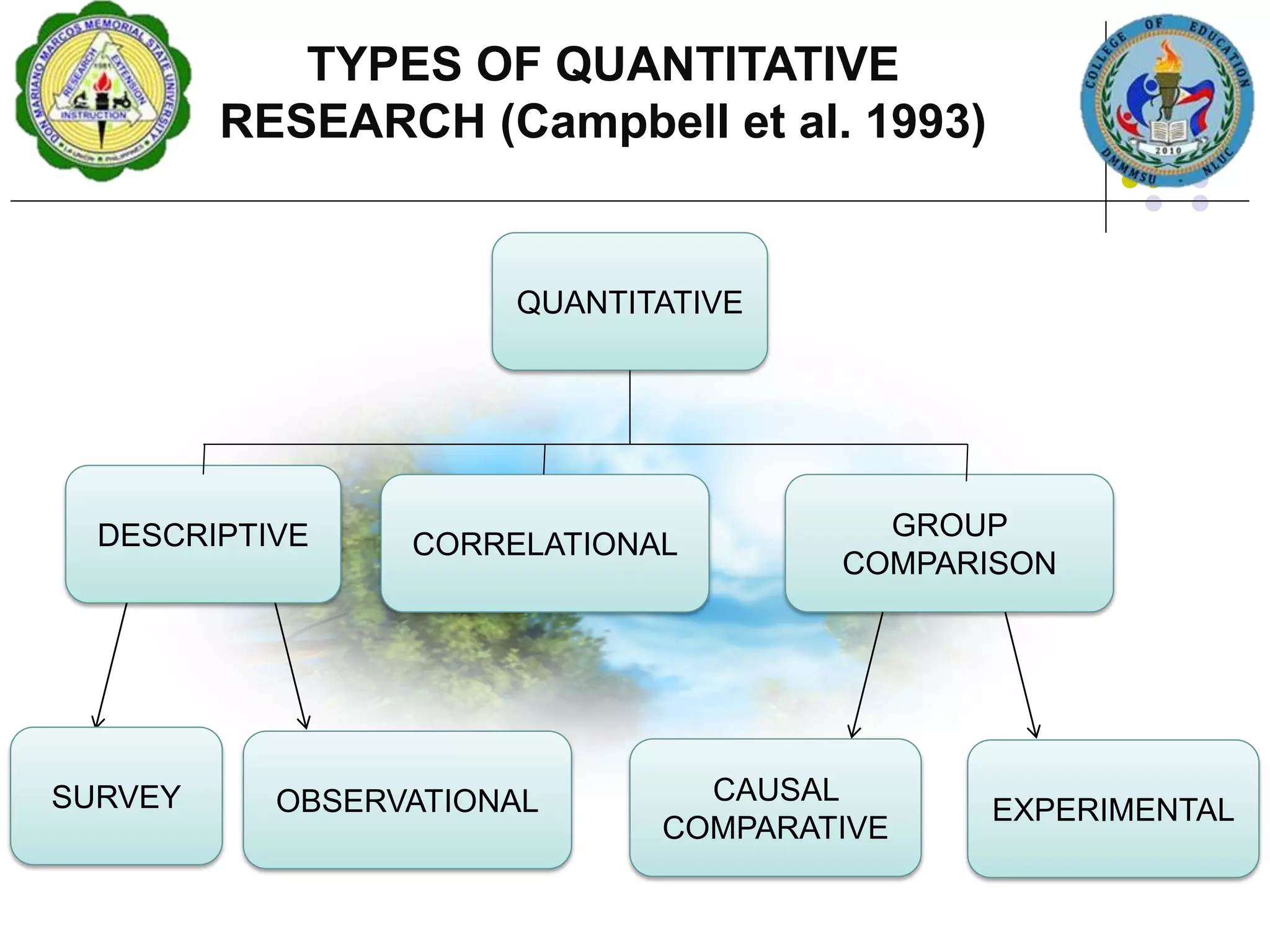
TYPES OF QUANTITATIVE
RESEARCH (Campbell et al. 1993)
QUANTITATIVE
DESCRIPTIVE CORRELATIONAL
GROUP
COMPARISON
SURVEY OBSERVATIONAL CAUSAL
COMPARATIVE
EXPERIMENTAL
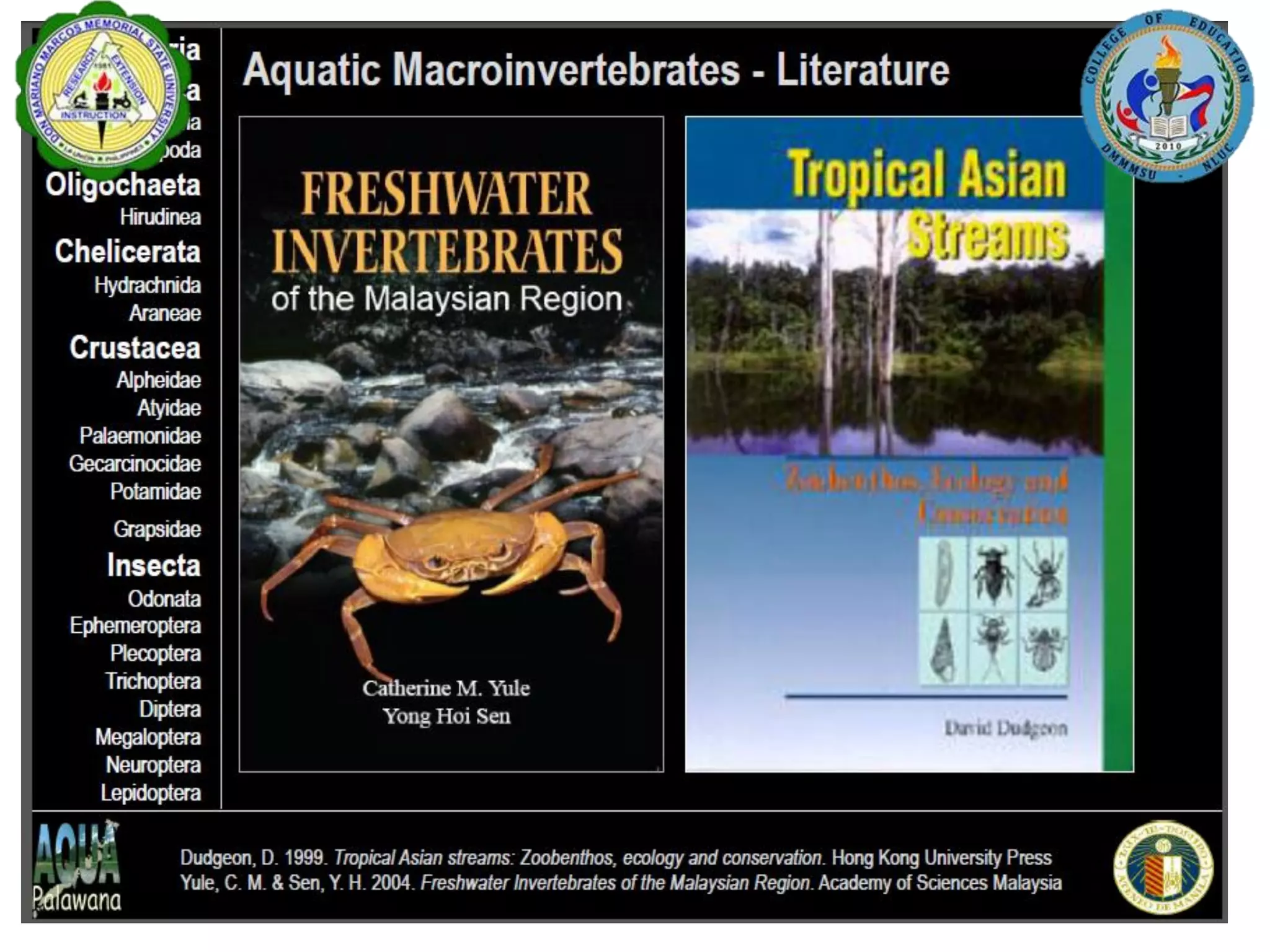
 INSTRUMENT DEVELOPMENT
 When you go to conduct quantitative research
(e.g. freshwater invertebrates biodiversity study),
you may find that the instrument that you are
using doesn‟t seem to fit, therefore, you need to
develop your own instrument.
 DOCUMENT / CONTENT ANALYSIS
 Contrasting and combining results from different
studies. This is where meta-analysis is
categorized. (E.g. historical sequence in
taxonomy and systematics)
ADDITIONAL DESIGNS
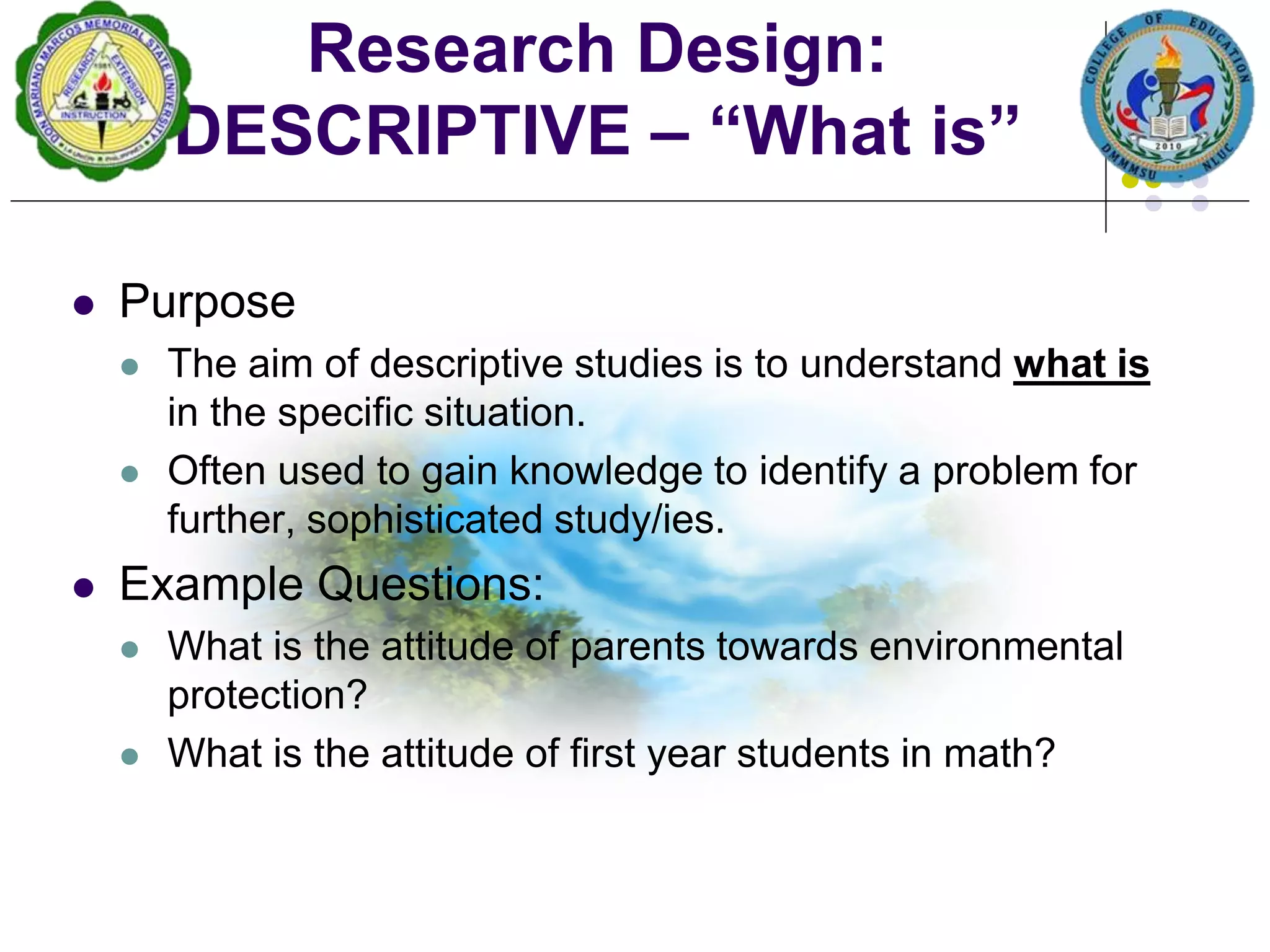
 Purpose
 The aim of descriptive studies is to understand what is
in the specific situation.
 Often used to gain knowledge to identify a problem for
further, sophisticated study/ies.
 Example Questions:
 What is the attitude of parents towards environmental
protection?
 What is the attitude of first year students in math?
Research Design:
DESCRIPTIVE – “What is”
 Survey
 A written document such
as a questionnaire or
interview
Research Design:
DESCRIPTIVE – “What is”
 2 Basic Kinds of Survey Research
 Longitudinal designs – study of a population over a period of time.
 E.g. “Perspective of parents to natural calamities in 2013 (Ondoy), 2014
(Yolanda), 2015.
 Cross-sectional designs – study at one point in time.
 E.g. “Knowledge, Attitude and Practices of Fishermen in Coastal
Resource Management in the two Selected Communities of Pangasinan)
 Observational
 Observing to gather data
on which to base a
conclusion
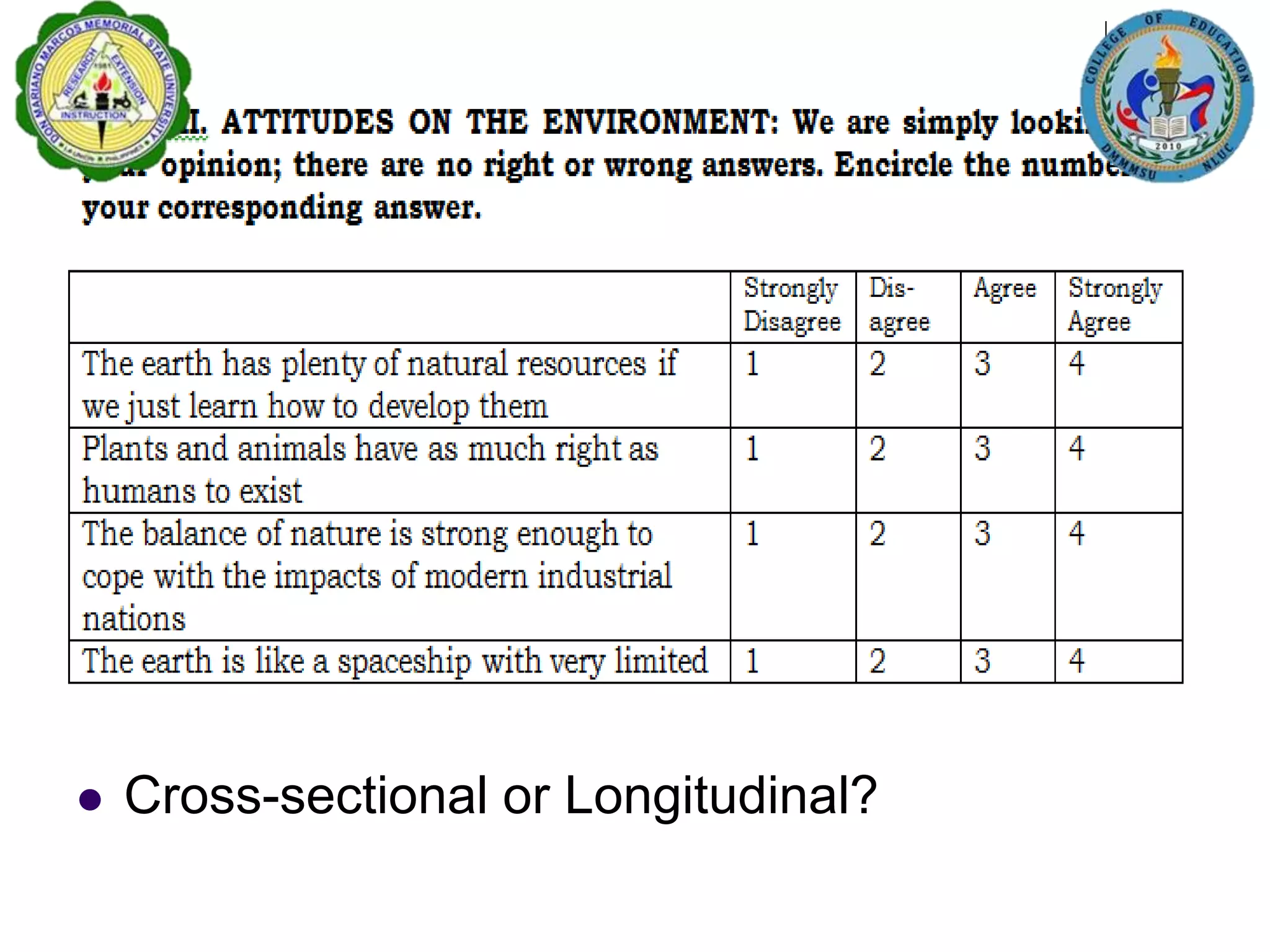
 Cross-sectional or Longitudinal?
 CROSS-SECTIONAL
 Assessment of the Attitudes of First Year
Students in their Basic Math Subject
 Attitudes are surveyed once and are analyzed
 LONGITUDINAL DESIGNS
 Assessment of the Attitudes of CE Students from
First Year to Fourth Year
 Attitudes are surveyed once a year, for four years.
OTHER EXAMPLES
 Purpose
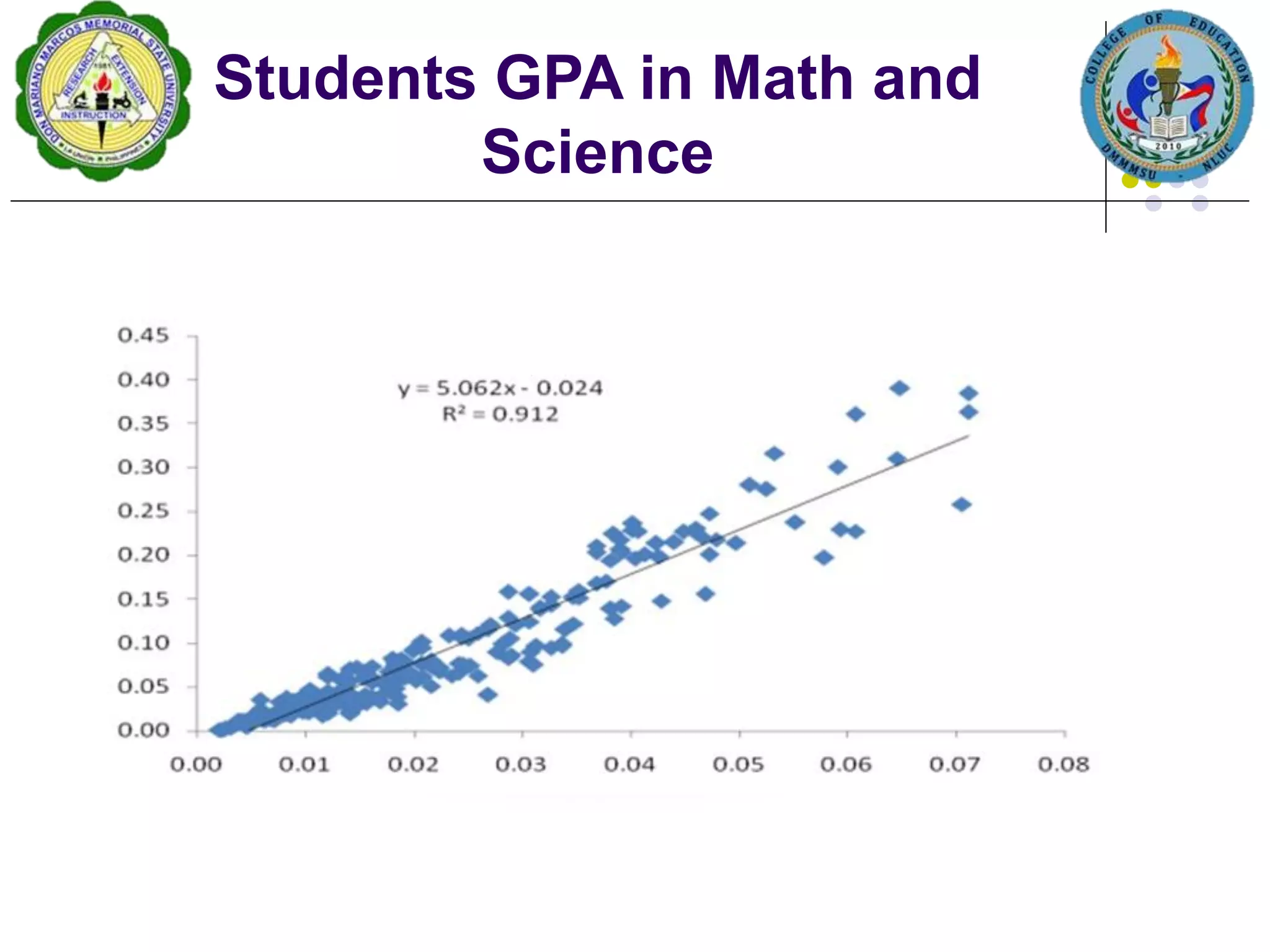
 Extent of relationship of two or more variables.
 Cannot make statements about cause and effect.
 Questions:
 Is there a relationship between students GPA in
biology and students GPA in math.
Research Design:
Correlational
Students GPA in Math and
Science
 Purpose
 Non-experimental in which preexisting groups are
compared on some dependent variable.
 Examine possible cause and effect relationship from
variables that exist.
 Used when researcher finds it too difficult, unethical, or
impossible to manipulate the independent variables.
 Questions:
 Is there a difference in the environmental protection
perspective of IPs and non-IPs while participating in an
8-week environmental education course?
Research Design:
Causal-Comparative– “Ex Post
Facto”
Research Design:
Causal-Comparative– “Ex Post
Facto”
Like descriptive study…
• Phenomenon is not manipulated
Unlike descriptive study…
• Examine „possible‟ cause and effect
• More specific pre-existing independent variable
Remember
• „possible‟ cause and effect
• Too many threats to validity
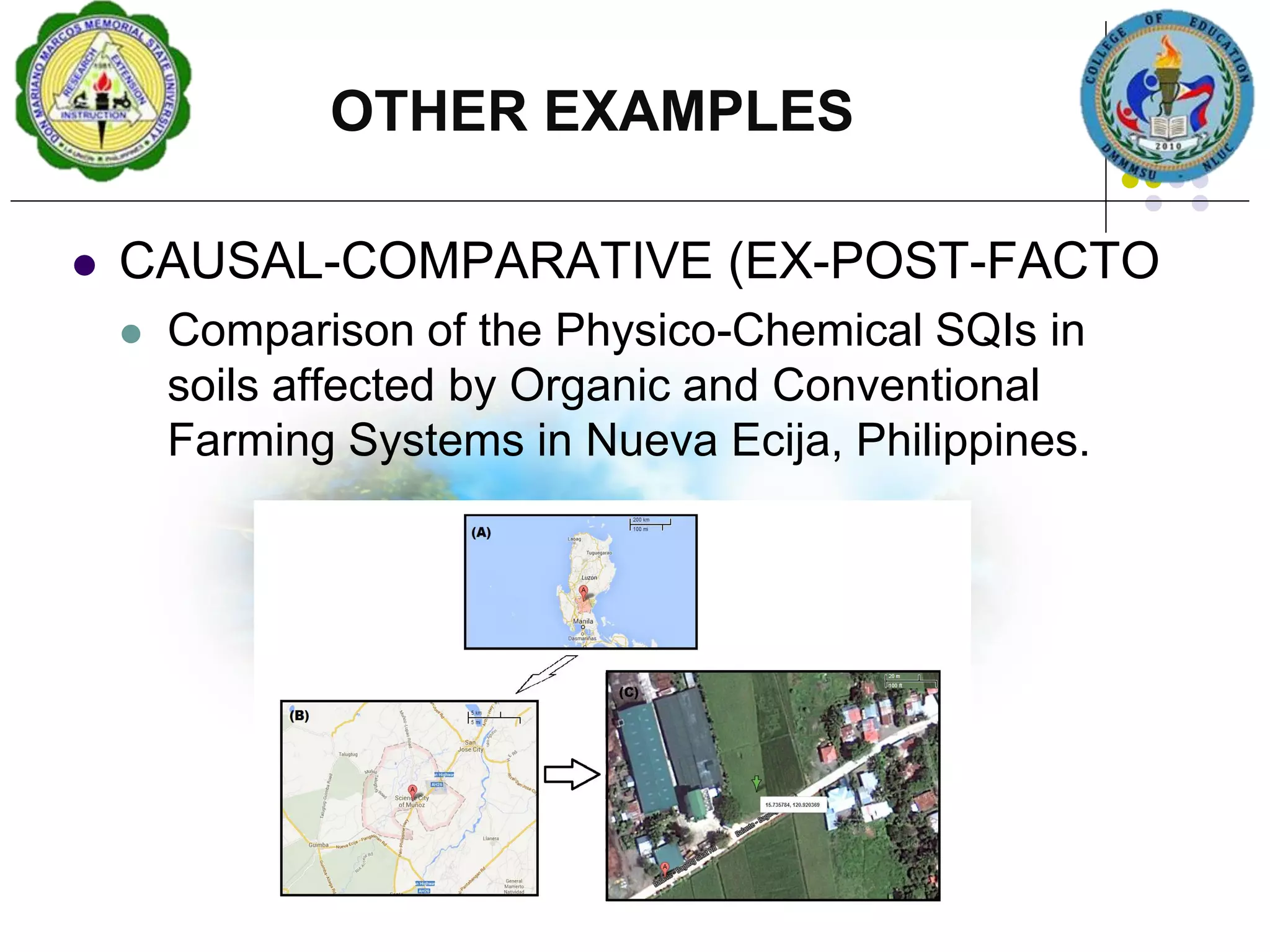
 CAUSAL-COMPARATIVE (EX-POST-FACTO
 Comparison of the Physico-Chemical SQIs in
soils affected by Organic and Conventional
Farming Systems in Nueva Ecija, Philippines.
OTHER EXAMPLES
 Campbell and Stanley (1963) purported that
there are 3 types of experimental studies
 Pre-experimental
 True experimental
 Quasi experimental
 The distinguishing characteristic of all
experimental designs is the researcher‟s
manipulation of the independent variable.
Research Design:
EXPERIMENTAL
 Purpose
 Examine the cause and effect relationship between
variables.
 Expose one or more experimental groups to one or
more treatment conditions and compare the results to
one or more control groups not receiving the
treatment.
 The experimental design and randomization
eliminates most threats to internal validity. It is the
most rigorous design.
Research Design:
TRUE EXPERIMENTAL
 Question
 Does personal tutoring give effect to the GPA of
graduating students?
 Three (3) Treatments:
 Control – graduating students with no personal tutoring
 T1 – graduating students with one a week personal tutoring
 T2 – graduating students with twice a week personal tutoring
 T3 – graduating students with thrice a week personal tutoring
 Experimental Units (for each treatments)
 random selection of the graduating students
 (replication) two or three replicates.
 GPA are of the control and the three treatment groups
are compared
Experimental Design:
TRUE EXPERIMENTAL
 Subtypes of True Experimental Design
 Post test only design
 X O
 O
 Pre test Post test Equivalent Group Design
 O X O
 O O
 Solomon Four
 X O
 O
 O X O
 O O
Experimental Design:
TRUE EXPERIMENTAL
3 Characteristics:
1. Manipulation
2. Control
3. Randomization
Research Design:
CHOOSING A DESIGN
Concerned with….
relationship Comparing differences
between specific
independent variables
correlational I Will NOT
manipulate
the
independent
variable?
I Will manipulate the independent
variable?
Causal
comparative
True
Experimental
I will use a
control group
My subjects will
be randomly
assigned
“what is” descriptive
QUALITATIVE
RESEARCH METHOD
 Case Study
 A puzzle that has to be solved.
 A detective story that has to be uncovered
Research Design: Case
Study
 NATURAL PHENOMENA
Research Design: Case
Study
 Case Study
 → “An intensive analysis of an individual unit (e.g.
person, group, or event) stressing developmental
factors in relation to context.” - Flyvbjerg, 2011
Research Design: Case
Study
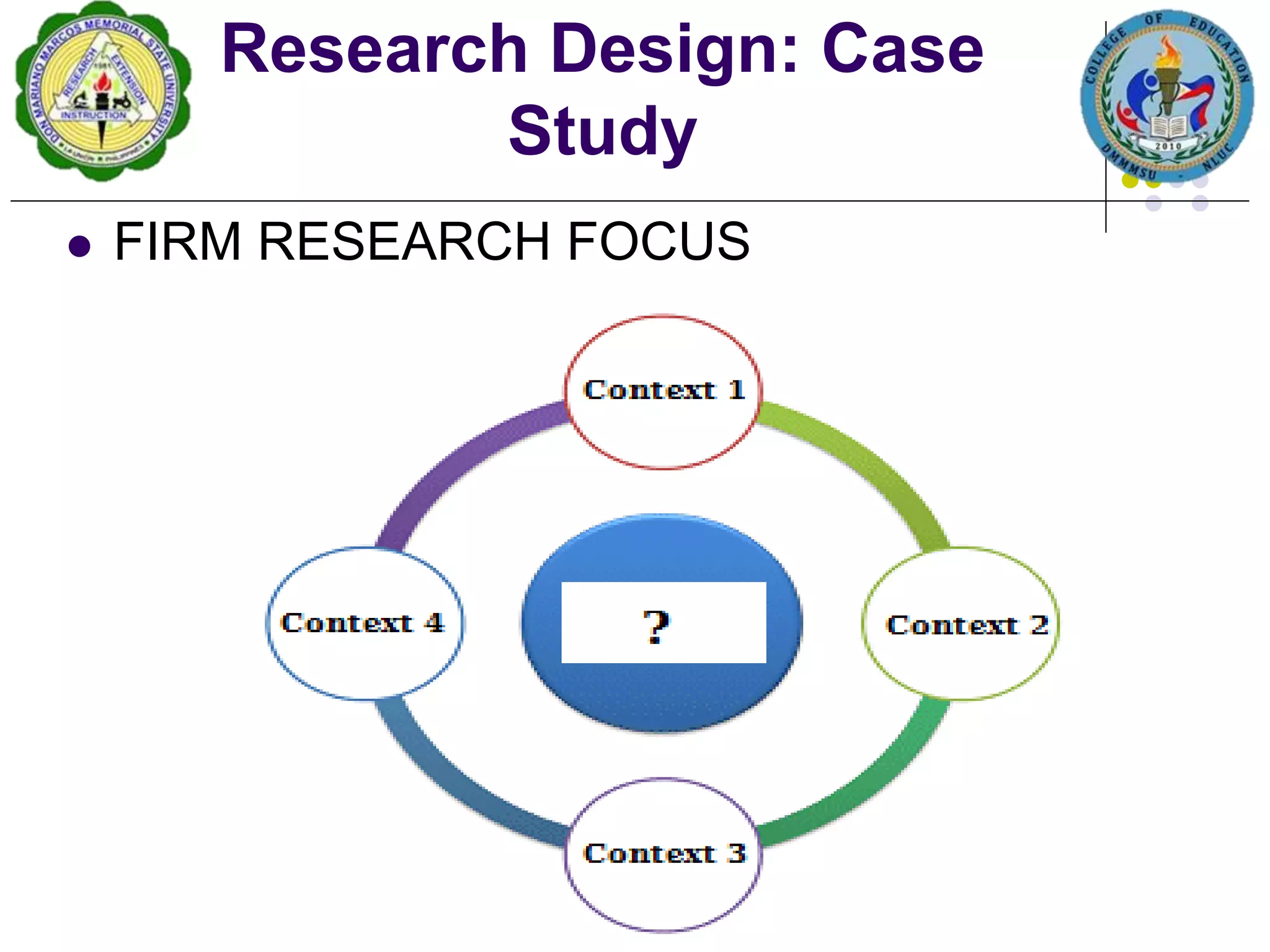
 FIRM RESEARCH FOCUS
Research Design: Case
Study
 Case Study Characteristics
 1. Very limited number of variables.
 2. Does NOT follow a rigid protocol.
 3. Involves an in-depth, longitudinal
examination of a single instance or event.
Research Design: Case
Study
Research Design: Field
Studies
 DEFINITION
 Non-experimental scientific inquiries aimed at
discovering the relations and interactions among
attitudes, values, perceptions and behaviors of
individuals and groups
 Investigator cannot manipulate variables
Research Design: Field
Studies
Research Design: Field
Studies
 Historical Note:
 In 1978 Adeline Levine, professor of Sociology at
the University at Buffalo visited the Love Canal
days after it was declared a national disaster.
After speaking with local residents and
government officials, Levine was motivated to
research the psychosocial impact of toxic
waste dump site on the local community. Her
published book, Love Canal: Science, Politics,
and People (1982) examined the crisis at Love
Canal by following the development of local
community organizations and scrutinizing the
government's response.
Research Design: Field
Studies
 QUALITATIVE NATURE OF HER RESEARCH
 “Motivated by curiosity I visited the Love Canal for the first time nine
days after it was declared a health hazard... The situation was very
chaotic at that time. On that first visit I saw people moving out of their
well-kept homes, met a pregnant woman convinced she was carrying
a monster; spoke to another woman afraid that her daughter would be
unable to bear children; saw worried men and women lined up to get
information from newly established government offices; talked to some
of the government workers trying to bring some order out of the chaos;
and met the young woman (Lois Gibbs) who was suddenly thrust into
prominence as the leader of a brand new citizen's organization”.
 THREE TYPES OF QUALITATIVE FIELD
STUDY DESIGN
 1.) Direct Observation
 Rather than actively engaging members of a setting
in conversations or interviews, the direct observer
strives to be unobtrusive and detached from the
setting
Research Design: Field
Studies
 THREE TYPES OF QUALITATIVE FIELD
STUDY DESIGN
 2.) Participant Observation
 The researcher develops an understanding of the
composition of a particular setting or society by
taking part in the everyday routines and rituals
alongside its members
Research Design: Field
Studies
 THREE TYPES OF QUALITATIVE FIELD
STUDY DESIGN
 3.) Qualitative Interview
 Qualitative interviews are a type of field research
method that elicits information and data by directly
asking questions of members
 Three primary types of qualitative interview:
 informal, conversational;
 semi-structured; standardized,
 open-ended
Research Design: Field
Studies
SOMETHING TO THINK ABOUT
“Research is not a prolific, money-making
scheme but the promise of societal
transformation that it brings to the table is more
than enough for us to get involved in doing it.”
~Jomar Aban~
THANK YOU FOR LISTENING!

Different Methods of Research

  • 1.
    DIFFERENT METHODS OF RESEARCH JOMARL. ABAN CE-SEd Research Facilitator jomar_d2@yahoo.com (+63) 999 598 4194 HOW TO CITE: Aban, J. L. (2015). Different Methods of Research. DON MARIANO MARCOS MEMORIAL STATE UNIVERSITY - North La Union Campus (College of Education) Research capability and productivity building seminar-workshop 2015. July 16, 2015.
  • 2.
    ITERATIVE NATURE OFRESEARCHES NATURAL SCIENCE RESEARCH e.g. Ecological Studies SOCIAL SCIENCE RESEARCH e.g. Behavior and attitudes QUANTITATIVE OBSERVATIONAL EXPERIMENTAL QUALITATIVE CASE STUDY EDUCATIONAL RESEARCH e.g. Problem-Solving QUALITATIVE / QUANTITATIVE ACTION RESEARCH
  • 3.
     Research Method Generalized and established ways of approaching research questions  E.g. qualitative vs quantitative method  Research Design  Involves determining how your chosen method will be applied to answer your research questions.  Relationship  Choice of research methods and design should be thought of as a reciprocal process. RESEARCH METHOD VS RESEARCH DESIGN
  • 4.
     Research Design A „blueprint‟ that guides the decision as to:  When and how to collect data?  What data and from whom?  How to analyze?  Examine relationships Mixed research design? Is it possible? RESEARCH METHOD VS RESEARCH DESIGN
  • 5.
  • 6.
    TYPES OF QUANTITATIVE RESEARCH(Campbell et al. 1993) QUANTITATIVE DESCRIPTIVE CORRELATIONAL GROUP COMPARISON SURVEY OBSERVATIONAL CAUSAL COMPARATIVE EXPERIMENTAL
  • 7.
     INSTRUMENT DEVELOPMENT When you go to conduct quantitative research (e.g. freshwater invertebrates biodiversity study), you may find that the instrument that you are using doesn‟t seem to fit, therefore, you need to develop your own instrument.  DOCUMENT / CONTENT ANALYSIS  Contrasting and combining results from different studies. This is where meta-analysis is categorized. (E.g. historical sequence in taxonomy and systematics) ADDITIONAL DESIGNS
  • 10.
     Purpose  Theaim of descriptive studies is to understand what is in the specific situation.  Often used to gain knowledge to identify a problem for further, sophisticated study/ies.  Example Questions:  What is the attitude of parents towards environmental protection?  What is the attitude of first year students in math? Research Design: DESCRIPTIVE – “What is”
  • 11.
     Survey  Awritten document such as a questionnaire or interview Research Design: DESCRIPTIVE – “What is”  2 Basic Kinds of Survey Research  Longitudinal designs – study of a population over a period of time.  E.g. “Perspective of parents to natural calamities in 2013 (Ondoy), 2014 (Yolanda), 2015.  Cross-sectional designs – study at one point in time.  E.g. “Knowledge, Attitude and Practices of Fishermen in Coastal Resource Management in the two Selected Communities of Pangasinan)  Observational  Observing to gather data on which to base a conclusion
  • 12.
  • 13.
     CROSS-SECTIONAL  Assessmentof the Attitudes of First Year Students in their Basic Math Subject  Attitudes are surveyed once and are analyzed  LONGITUDINAL DESIGNS  Assessment of the Attitudes of CE Students from First Year to Fourth Year  Attitudes are surveyed once a year, for four years. OTHER EXAMPLES
  • 14.
     Purpose  Extentof relationship of two or more variables.  Cannot make statements about cause and effect.  Questions:  Is there a relationship between students GPA in biology and students GPA in math. Research Design: Correlational
  • 15.
    Students GPA inMath and Science
  • 16.
     Purpose  Non-experimentalin which preexisting groups are compared on some dependent variable.  Examine possible cause and effect relationship from variables that exist.  Used when researcher finds it too difficult, unethical, or impossible to manipulate the independent variables.  Questions:  Is there a difference in the environmental protection perspective of IPs and non-IPs while participating in an 8-week environmental education course? Research Design: Causal-Comparative– “Ex Post Facto”
  • 17.
    Research Design: Causal-Comparative– “ExPost Facto” Like descriptive study… • Phenomenon is not manipulated Unlike descriptive study… • Examine „possible‟ cause and effect • More specific pre-existing independent variable Remember • „possible‟ cause and effect • Too many threats to validity
  • 18.
     CAUSAL-COMPARATIVE (EX-POST-FACTO Comparison of the Physico-Chemical SQIs in soils affected by Organic and Conventional Farming Systems in Nueva Ecija, Philippines. OTHER EXAMPLES
  • 20.
     Campbell andStanley (1963) purported that there are 3 types of experimental studies  Pre-experimental  True experimental  Quasi experimental  The distinguishing characteristic of all experimental designs is the researcher‟s manipulation of the independent variable. Research Design: EXPERIMENTAL
  • 21.
     Purpose  Examinethe cause and effect relationship between variables.  Expose one or more experimental groups to one or more treatment conditions and compare the results to one or more control groups not receiving the treatment.  The experimental design and randomization eliminates most threats to internal validity. It is the most rigorous design. Research Design: TRUE EXPERIMENTAL
  • 22.
     Question  Doespersonal tutoring give effect to the GPA of graduating students?  Three (3) Treatments:  Control – graduating students with no personal tutoring  T1 – graduating students with one a week personal tutoring  T2 – graduating students with twice a week personal tutoring  T3 – graduating students with thrice a week personal tutoring  Experimental Units (for each treatments)  random selection of the graduating students  (replication) two or three replicates.  GPA are of the control and the three treatment groups are compared Experimental Design: TRUE EXPERIMENTAL
  • 23.
     Subtypes ofTrue Experimental Design  Post test only design  X O  O  Pre test Post test Equivalent Group Design  O X O  O O  Solomon Four  X O  O  O X O  O O Experimental Design: TRUE EXPERIMENTAL 3 Characteristics: 1. Manipulation 2. Control 3. Randomization
  • 24.
    Research Design: CHOOSING ADESIGN Concerned with…. relationship Comparing differences between specific independent variables correlational I Will NOT manipulate the independent variable? I Will manipulate the independent variable? Causal comparative True Experimental I will use a control group My subjects will be randomly assigned “what is” descriptive
  • 25.
  • 26.
     Case Study A puzzle that has to be solved.  A detective story that has to be uncovered Research Design: Case Study
  • 27.
  • 28.
     Case Study → “An intensive analysis of an individual unit (e.g. person, group, or event) stressing developmental factors in relation to context.” - Flyvbjerg, 2011 Research Design: Case Study
  • 29.
     FIRM RESEARCHFOCUS Research Design: Case Study
  • 30.
     Case StudyCharacteristics  1. Very limited number of variables.  2. Does NOT follow a rigid protocol.  3. Involves an in-depth, longitudinal examination of a single instance or event. Research Design: Case Study
  • 31.
  • 32.
     DEFINITION  Non-experimentalscientific inquiries aimed at discovering the relations and interactions among attitudes, values, perceptions and behaviors of individuals and groups  Investigator cannot manipulate variables Research Design: Field Studies
  • 33.
    Research Design: Field Studies Historical Note:  In 1978 Adeline Levine, professor of Sociology at the University at Buffalo visited the Love Canal days after it was declared a national disaster. After speaking with local residents and government officials, Levine was motivated to research the psychosocial impact of toxic waste dump site on the local community. Her published book, Love Canal: Science, Politics, and People (1982) examined the crisis at Love Canal by following the development of local community organizations and scrutinizing the government's response.
  • 34.
    Research Design: Field Studies QUALITATIVE NATURE OF HER RESEARCH  “Motivated by curiosity I visited the Love Canal for the first time nine days after it was declared a health hazard... The situation was very chaotic at that time. On that first visit I saw people moving out of their well-kept homes, met a pregnant woman convinced she was carrying a monster; spoke to another woman afraid that her daughter would be unable to bear children; saw worried men and women lined up to get information from newly established government offices; talked to some of the government workers trying to bring some order out of the chaos; and met the young woman (Lois Gibbs) who was suddenly thrust into prominence as the leader of a brand new citizen's organization”.
  • 35.
     THREE TYPESOF QUALITATIVE FIELD STUDY DESIGN  1.) Direct Observation  Rather than actively engaging members of a setting in conversations or interviews, the direct observer strives to be unobtrusive and detached from the setting Research Design: Field Studies
  • 36.
     THREE TYPESOF QUALITATIVE FIELD STUDY DESIGN  2.) Participant Observation  The researcher develops an understanding of the composition of a particular setting or society by taking part in the everyday routines and rituals alongside its members Research Design: Field Studies
  • 37.
     THREE TYPESOF QUALITATIVE FIELD STUDY DESIGN  3.) Qualitative Interview  Qualitative interviews are a type of field research method that elicits information and data by directly asking questions of members  Three primary types of qualitative interview:  informal, conversational;  semi-structured; standardized,  open-ended Research Design: Field Studies
  • 38.
    SOMETHING TO THINKABOUT “Research is not a prolific, money-making scheme but the promise of societal transformation that it brings to the table is more than enough for us to get involved in doing it.” ~Jomar Aban~ THANK YOU FOR LISTENING!