Downloaded 10 times



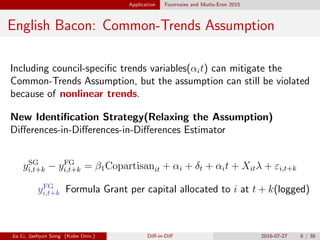
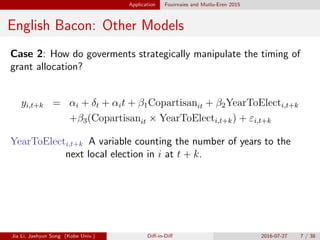
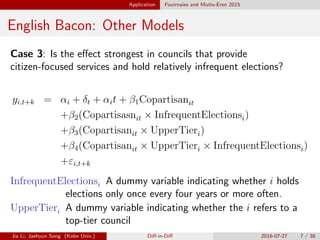
![Application Fouirnaies and Mutlu-Eren 2015
English Bacon: Comparing the Two Groups
We are interested in comparing the Specific Grant(SG) allocated to
the local councils(Copartisanit = 1) and the others.
Identification Strategy
E[SGit|Copartisanit = 1] E[SGit|Copartisanit = 0]
Omitted Variable Bias
Economic growth
) Specific Grant #
) More votes to the prime minister’s party
Jia Li, Jaehyun Song (Kobe Univ.) Di↵-in-Di↵ 2016-07-27 4 / 38](https://image.slidesharecdn.com/rm3-lec15-dd-160727053629/85/Differences-in-Differences-5-320.jpg)













![Synthetic Control Method
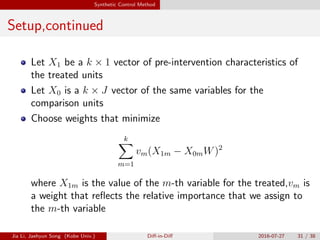
Setup,continued
Choose W⇤
= (w⇤
2, . . . , wJ + 1⇤
) 2 [0, 1]J
,adding to 1 to minimize
distance in pretreatment characteristics between treated and
weighted average of controls
Treatment e↵ect estimated by the simple di↵erence
ˆ↵1t = Y 1
1t
PJ+1
j=2 w⇤
j Yjt for t = T0 + 1, . . . , T1
Jia Li, Jaehyun Song (Kobe Univ.) Di↵-in-Di↵ 2016-07-27 32 / 38](https://image.slidesharecdn.com/rm3-lec15-dd-160727053629/85/Differences-in-Differences-43-320.jpg)

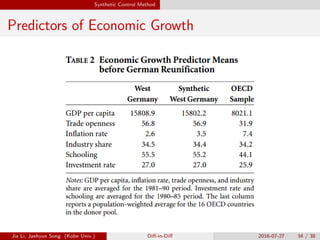


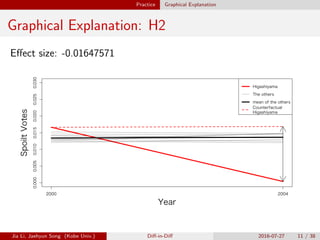
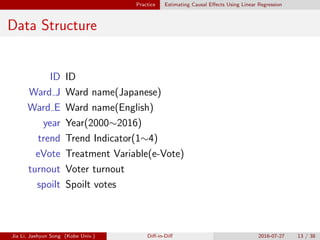
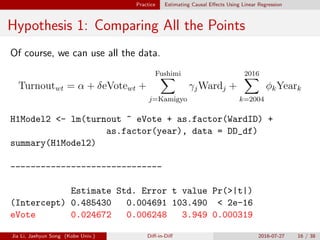
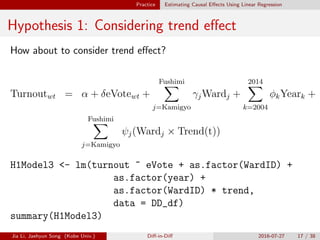
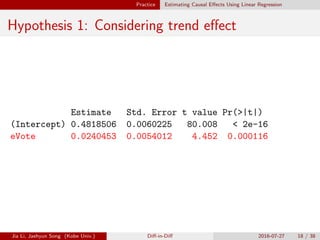
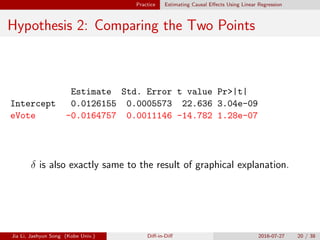
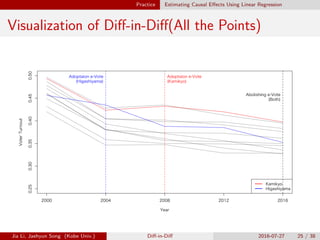
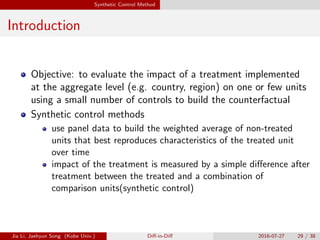
The document discusses differences-in-differences (DID) estimation and provides examples of its application. It first reviews DID and its identifying assumptions. It then analyzes a study that uses DID to examine whether governments allocate more resources to councils controlled by their party. Next, it uses DID graphs and linear regression models to estimate the causal effects of electronic voting on voter turnout and spoiled votes in Kyoto, Japan. Standard errors in DID estimation and the synthetic control method are also briefly discussed.


