Student of BMU
Rohtak
By :-NEERAJ SINDHU
B.tech, MBA (Finance
& Marketing)
Capital Structure
BY THE END OF THIS SESSION
WE WOULD BE ABLE TO LEARN
 Capital Structure
 Features of Capital Structure
 Factors affecting capital
structure
 Merits and Demerits
Meaning of Capital Structure
• The mix of the different sources of long
term funds in the total capital of the
company
• Equity
• Preference shares
• Debentures
• Retained earning
Capital can be raised by 2 means
1. Ownership securities
. Equity Shares
. Preference Shares
2. Creditor ship Securities
- Debentures/Bonds
Features of Capital Structure
 Return
Minimum Risk
Simplicity
Flexibility
Capacity
Control
Features of Capital Structure
• Return –
Management is to provide the
maximum earnings to the equity shareholders. It
can be obtained by minimising the cost of issue
and the cost of financing.
• Minimum Risk-
It should involve minimum
possible risk of loss of control. Thus, it, should
be least risk.
• Simplicity –
As far as possible capital structure
must be simple. It is easy to manage it. Thus it
should be convenient.
• Flexibility –
The capital structure should be
flexible. It should be possible for a company to
adapt its capital structure with a minimum cost.
• Capacity –
The capital structure should be
determined within the debt capacity of the
company, and this capacity should not be
exceeded. The debt capacity of a company
depends on its ability to generate future cash
flow.
• Control –
The capital structure should involve
minimum risk of loss of control of the company.
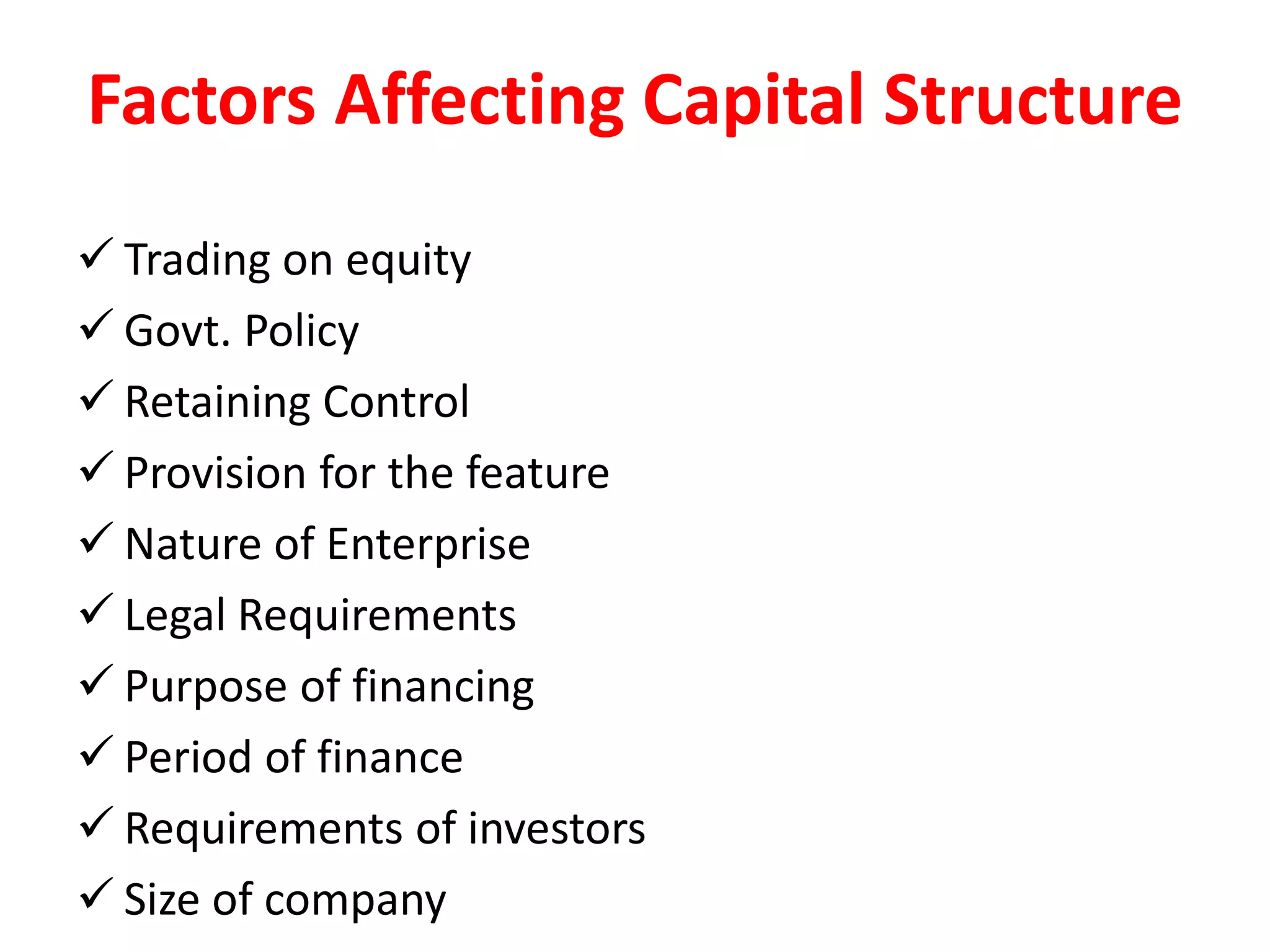
Factors Affecting Capital Structure
 Trading on equity
 Govt. Policy
 Retaining Control
 Provision for the feature
 Nature of Enterprise
 Legal Requirements
 Purpose of financing
 Period of finance
 Requirements of investors
 Size of company
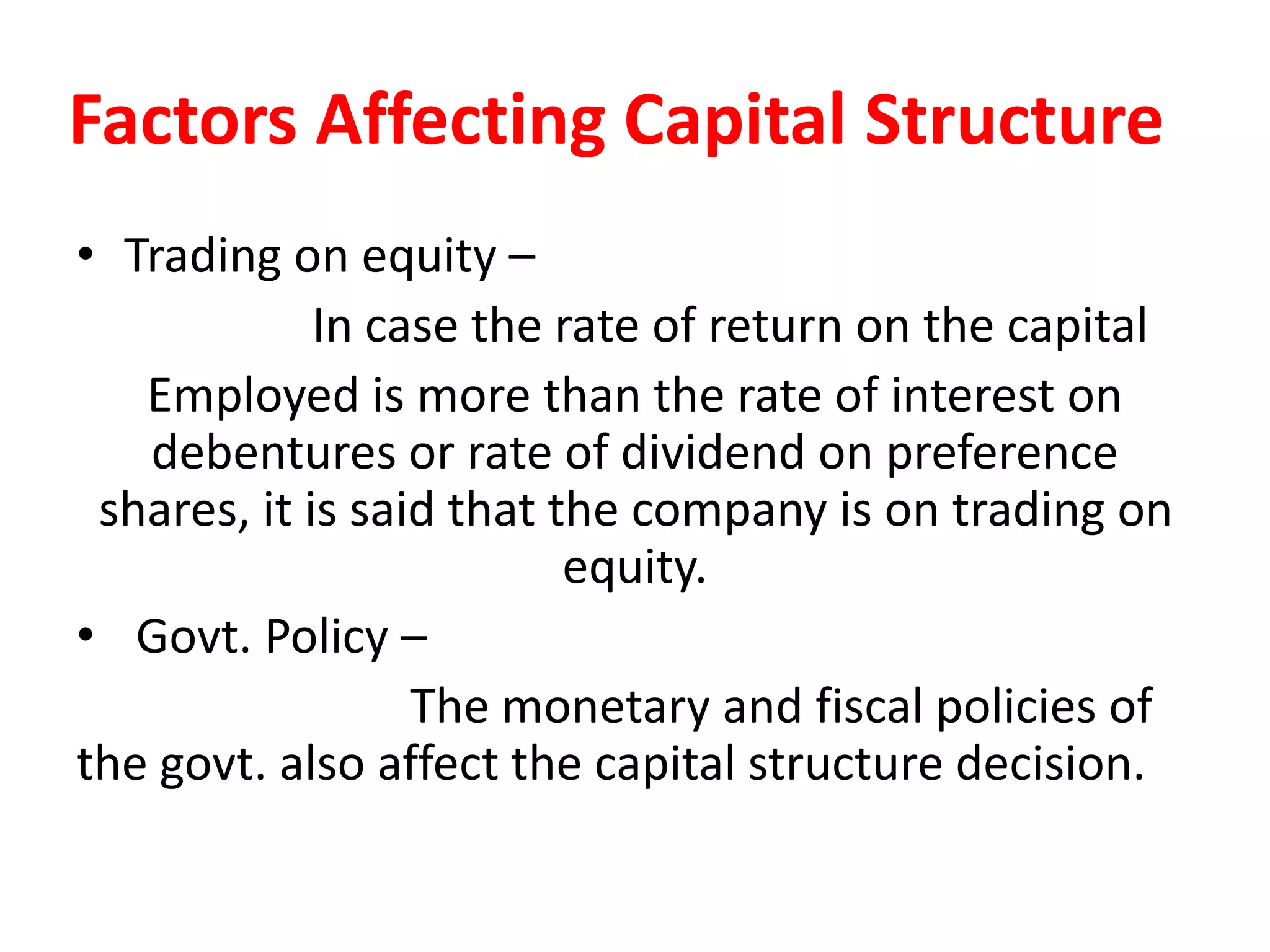
Factors Affecting Capital Structure
• Trading on equity –
In case the rate of return on the capital
Employed is more than the rate of interest on
debentures or rate of dividend on preference
shares, it is said that the company is on trading on
equity.
• Govt. Policy –
The monetary and fiscal policies of
the govt. also affect the capital structure decision.
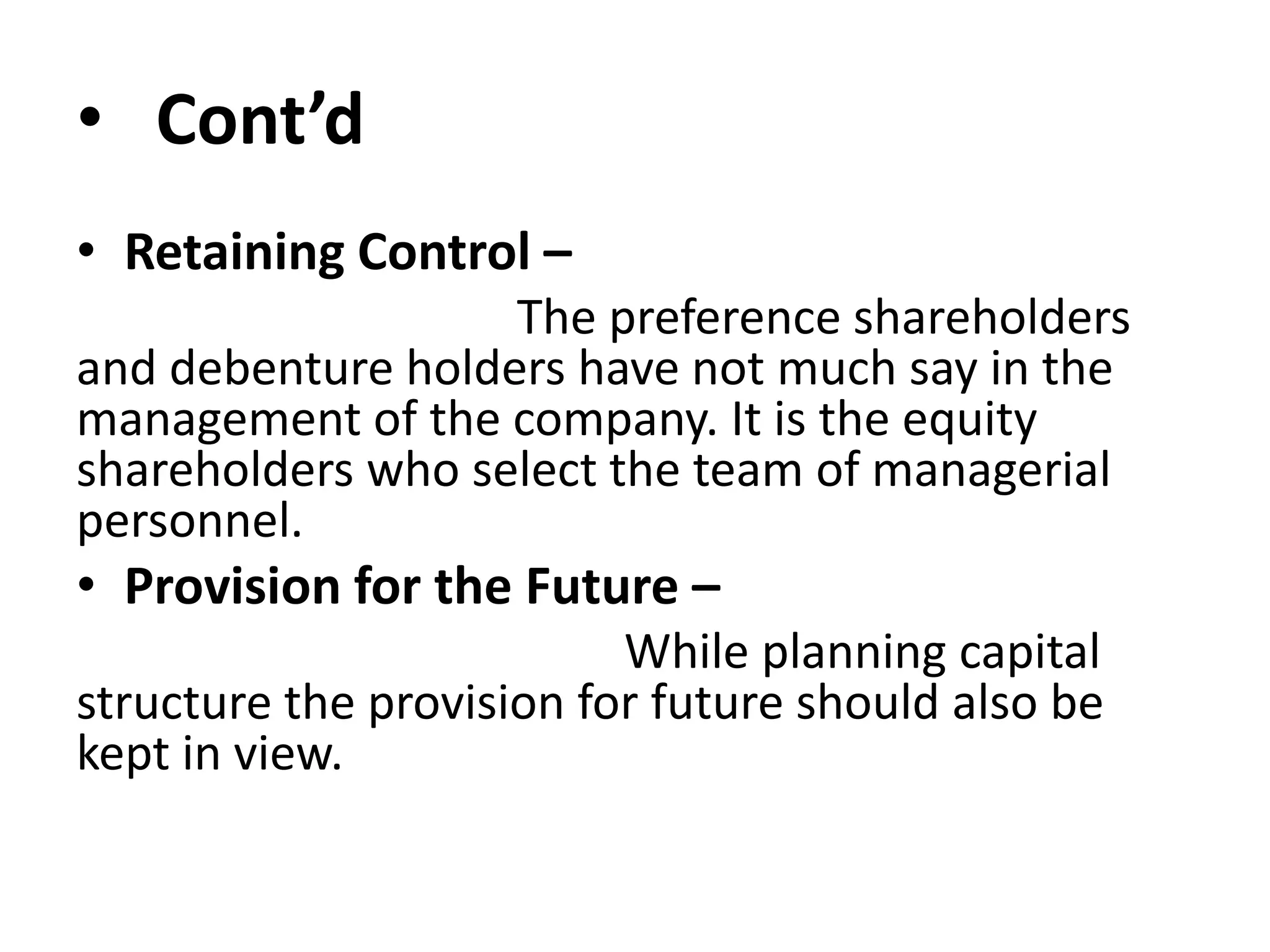
• Cont’d
• Retaining Control –
The preference shareholders
and debenture holders have not much say in the
management of the company. It is the equity
shareholders who select the team of managerial
personnel.
• Provision for the Future –
While planning capital
structure the provision for future should also be
kept in view.
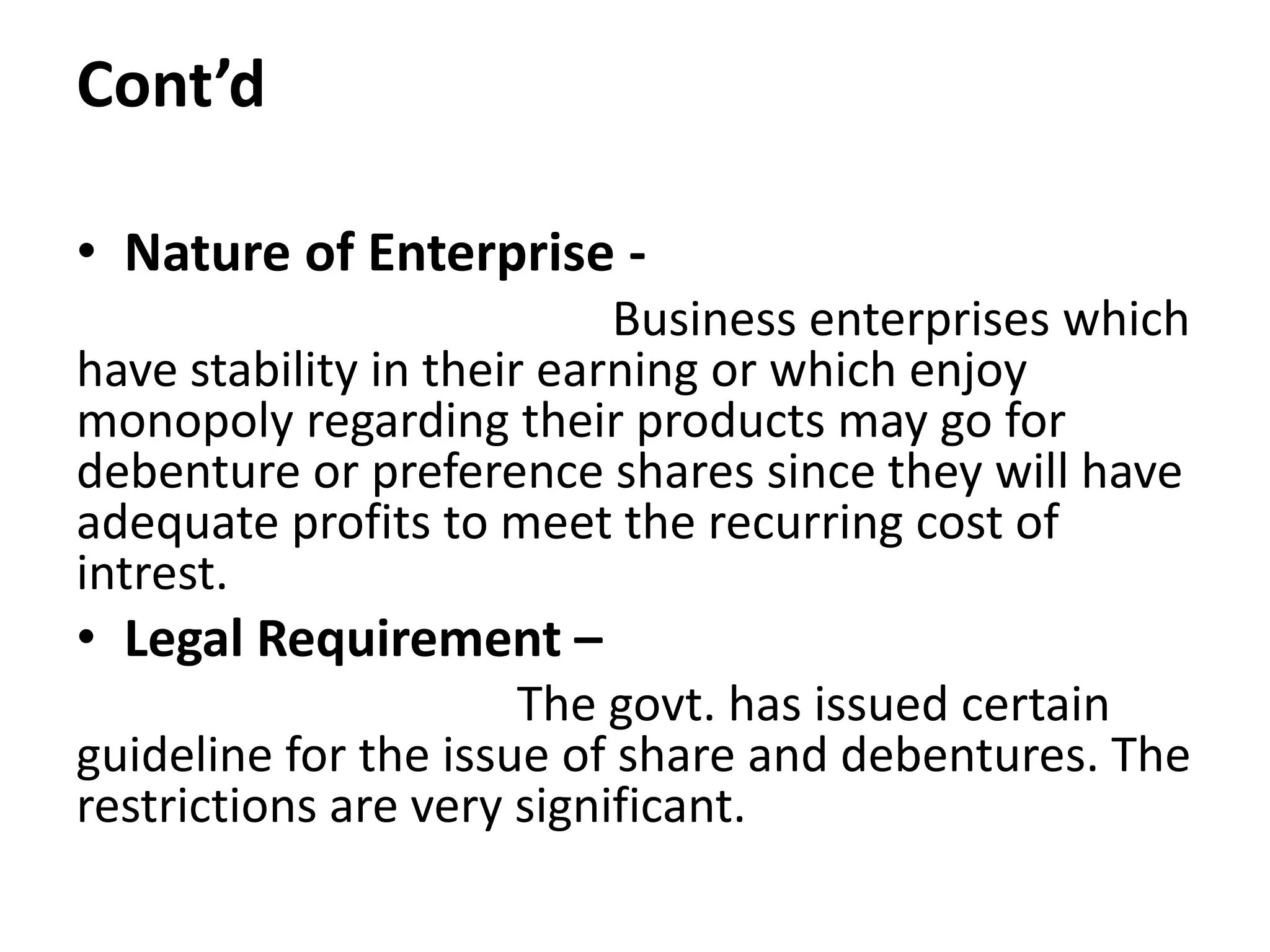
Cont’d
• Nature of Enterprise -
Business enterprises which
have stability in their earning or which enjoy
monopoly regarding their products may go for
debenture or preference shares since they will have
adequate profits to meet the recurring cost of
intrest.
• Legal Requirement –
The govt. has issued certain
guideline for the issue of share and debentures. The
restrictions are very significant.
Cont’d
• Purpose of financing –
The purpose of
financing also to same extent after the capital
structure of the company. In case funds are
required for some directly productive purposes.
Ex. Purchase of new machinery, the company
can afford to rise the funds by issue of
debenture . On the other hand funds are
required for non-productive purpose.
Cont’d
• Period of finance –
The period which finance is
required also effect the determination of capital
structure of companies. In case funds are required,
say for 3 or 10 years, it will appropriate to rise them
by issue of debenture rather then by issue of
shares. However if the funds are required are more
or less permanently, it will be appropriate to ruse
them by issue of equity share.
• Requirements of investors –
Different types of
securities are to be issued for different classes of
investors. Equity share are best suited for
investors who are very cautious while
preference share are suitable for investors who
are not very cautious.
• Size of company -
Companies which are of small
size have to really upon the owners funds for
financing. Large companiesare considered to be
less
When company has only Equity shares
• Merits:
• No fixed liability –
Equity share do not create any
fixed liability in respect of payment of dividend.
• No charge on assets –
Equity shares do not create
any charge or mortgage on the assets or property of
the company. Therefore, in times of need the
company can use its assets to rise loans.
Cont’d
• No liability to redeem –
Capital raised through equity
shares does not have to be repaid until the company itself
is would up, this would be long-range planning in respect
of the company.
• Voting control right –
Equity shares entitle the owner to
control and manage the company. Equity shares are
greatly preferred by bold and risk-loving investors.
Because owners of equity share are real owner of a
company.
Cont’d
• Trading on the equity –
The company runs on
risk of magnifying losses in bad periods through
trading on the equity.
• Easy and economical –
To obtain capital by the
issue of equity share is economical. It can be
very easily procured. Without creating any
charge on the property of the company.
Demerits
• Signal of capitalisation –
If promoter miscalculates
in working out financial requirement of a company.
The company may land in a situation where it has a
large surplus of capital.
• High cost of fund raising –
As many bold and risk
loving investors is always small. The company has to
spend much time and money to rise equity capital.
Cont’d
• Absence of close control: In a company which is
financed largely by equity shares. The number of
equity shareholders will be quite large. As such it
would become difficult to have effective management
and control of its affairs due to wide diffusion of
ownership.
• No Investment by Cautious Investors: Cautious and
risk bearing investors keep away from equity shares
because of uncertainty of return and fear about safety
of capital. Thus the company is denied the opportunity
to raise funds from such investors whose number is
admittedly quite large.
When a company has both equity and
preference shares:
• Merits:
1. Wider coverage: The company with both equity
and preference shares will appeal to a wider
variety of investors. Those of the investors who
love to take risk and desire to manage as well as
control the company, can opt for equity shares.
2. Elastic capital structure: The capital structure of
the company can be made more elastic and
more economical.
Cont’d
3. Closer control: Preference shares generally do
not carry any voting rights. Thus equity
shareholders can manage and control the
company without interference from any quarter.
4. Over capitalisation remedied: The company
may take remedial step for over capitalisation by
the redeemption of redeemable preference
shares.
Demerits
1. Dilution of trading on equity: The company with
both equity and preference shares can trade on
the equity, but not to any significant extent.
2. Absence of close control: In case the company
makes any default in paying dividend to
preference shareholder, they will earn the right
to attend the general meeting and to vote on
matters affecting their interests.

Capital structure by NEERAJ SINDHU

  • 1.
    Student of BMU Rohtak By:-NEERAJ SINDHU B.tech, MBA (Finance & Marketing) Capital Structure
  • 2.
    BY THE ENDOF THIS SESSION WE WOULD BE ABLE TO LEARN  Capital Structure  Features of Capital Structure  Factors affecting capital structure  Merits and Demerits
  • 3.
    Meaning of CapitalStructure • The mix of the different sources of long term funds in the total capital of the company • Equity • Preference shares • Debentures • Retained earning
  • 4.
    Capital can beraised by 2 means 1. Ownership securities . Equity Shares . Preference Shares 2. Creditor ship Securities - Debentures/Bonds
  • 5.
    Features of CapitalStructure  Return Minimum Risk Simplicity Flexibility Capacity Control
  • 6.
    Features of CapitalStructure • Return – Management is to provide the maximum earnings to the equity shareholders. It can be obtained by minimising the cost of issue and the cost of financing. • Minimum Risk- It should involve minimum possible risk of loss of control. Thus, it, should be least risk.
  • 7.
    • Simplicity – Asfar as possible capital structure must be simple. It is easy to manage it. Thus it should be convenient. • Flexibility – The capital structure should be flexible. It should be possible for a company to adapt its capital structure with a minimum cost.
  • 8.
    • Capacity – Thecapital structure should be determined within the debt capacity of the company, and this capacity should not be exceeded. The debt capacity of a company depends on its ability to generate future cash flow. • Control – The capital structure should involve minimum risk of loss of control of the company.
  • 9.
    Factors Affecting CapitalStructure  Trading on equity  Govt. Policy  Retaining Control  Provision for the feature  Nature of Enterprise  Legal Requirements  Purpose of financing  Period of finance  Requirements of investors  Size of company
  • 10.
    Factors Affecting CapitalStructure • Trading on equity – In case the rate of return on the capital Employed is more than the rate of interest on debentures or rate of dividend on preference shares, it is said that the company is on trading on equity. • Govt. Policy – The monetary and fiscal policies of the govt. also affect the capital structure decision.
  • 11.
    • Cont’d • RetainingControl – The preference shareholders and debenture holders have not much say in the management of the company. It is the equity shareholders who select the team of managerial personnel. • Provision for the Future – While planning capital structure the provision for future should also be kept in view.
  • 12.
    Cont’d • Nature ofEnterprise - Business enterprises which have stability in their earning or which enjoy monopoly regarding their products may go for debenture or preference shares since they will have adequate profits to meet the recurring cost of intrest. • Legal Requirement – The govt. has issued certain guideline for the issue of share and debentures. The restrictions are very significant.
  • 13.
    Cont’d • Purpose offinancing – The purpose of financing also to same extent after the capital structure of the company. In case funds are required for some directly productive purposes. Ex. Purchase of new machinery, the company can afford to rise the funds by issue of debenture . On the other hand funds are required for non-productive purpose.
  • 14.
    Cont’d • Period offinance – The period which finance is required also effect the determination of capital structure of companies. In case funds are required, say for 3 or 10 years, it will appropriate to rise them by issue of debenture rather then by issue of shares. However if the funds are required are more or less permanently, it will be appropriate to ruse them by issue of equity share.
  • 15.
    • Requirements ofinvestors – Different types of securities are to be issued for different classes of investors. Equity share are best suited for investors who are very cautious while preference share are suitable for investors who are not very cautious.
  • 16.
    • Size ofcompany - Companies which are of small size have to really upon the owners funds for financing. Large companiesare considered to be less
  • 17.
    When company hasonly Equity shares • Merits: • No fixed liability – Equity share do not create any fixed liability in respect of payment of dividend. • No charge on assets – Equity shares do not create any charge or mortgage on the assets or property of the company. Therefore, in times of need the company can use its assets to rise loans.
  • 18.
    Cont’d • No liabilityto redeem – Capital raised through equity shares does not have to be repaid until the company itself is would up, this would be long-range planning in respect of the company. • Voting control right – Equity shares entitle the owner to control and manage the company. Equity shares are greatly preferred by bold and risk-loving investors. Because owners of equity share are real owner of a company.
  • 19.
    Cont’d • Trading onthe equity – The company runs on risk of magnifying losses in bad periods through trading on the equity. • Easy and economical – To obtain capital by the issue of equity share is economical. It can be very easily procured. Without creating any charge on the property of the company.
  • 20.
    Demerits • Signal ofcapitalisation – If promoter miscalculates in working out financial requirement of a company. The company may land in a situation where it has a large surplus of capital. • High cost of fund raising – As many bold and risk loving investors is always small. The company has to spend much time and money to rise equity capital.
  • 21.
    Cont’d • Absence ofclose control: In a company which is financed largely by equity shares. The number of equity shareholders will be quite large. As such it would become difficult to have effective management and control of its affairs due to wide diffusion of ownership. • No Investment by Cautious Investors: Cautious and risk bearing investors keep away from equity shares because of uncertainty of return and fear about safety of capital. Thus the company is denied the opportunity to raise funds from such investors whose number is admittedly quite large.
  • 22.
    When a companyhas both equity and preference shares: • Merits: 1. Wider coverage: The company with both equity and preference shares will appeal to a wider variety of investors. Those of the investors who love to take risk and desire to manage as well as control the company, can opt for equity shares. 2. Elastic capital structure: The capital structure of the company can be made more elastic and more economical.
  • 23.
    Cont’d 3. Closer control:Preference shares generally do not carry any voting rights. Thus equity shareholders can manage and control the company without interference from any quarter. 4. Over capitalisation remedied: The company may take remedial step for over capitalisation by the redeemption of redeemable preference shares.
  • 24.
    Demerits 1. Dilution oftrading on equity: The company with both equity and preference shares can trade on the equity, but not to any significant extent. 2. Absence of close control: In case the company makes any default in paying dividend to preference shareholder, they will earn the right to attend the general meeting and to vote on matters affecting their interests.