BANYAN TREE SCHOOL
JAGDISHPUR AMETHI
SEMINAR TOPIC
ELECTRIC GENERATOR
SUBMITTED TO
MR. MANOJ SRIVASTVA
(HOD,PHYSICS DEPARTMENT)
UNDER THE SUPERVISION
OF
MR. ALOK MISHRA
SUBMITTED BY
HIMANSHU DUBEY
CONTENT
• INTRODUCTION
• HISTORY
• PARTS AND FUNCTION
• EFFICIENCY
• RESULT
• WORKING
• LOSSES
• USES
INTRODUCTION
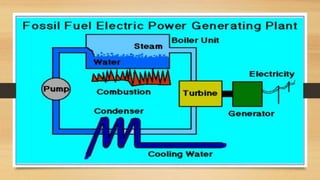
• AC generator is a machine that converts mechanical energy
into electrical energy. The AC Generator’s input supply
is mechanical energy supplied by steam turbines, gas
turbines and combustion engines. The output is
alternating electrical power in the form of alternating
voltage and current.
• AC generators work on the principle of Faraday’s law of
electromagnetic induction, which states that
electromotive force – EMF or voltage – is generated in a
current-carrying conductor that cuts a uniform magnetic
field. This can either be achieved by rotating a
conducting coil in a static magnetic field or rotating
the magnetic field containing the stationary conductor.
The preferred arrangement is to keep the coil stationary
because it is easier to draw induced alternating current
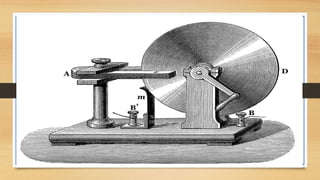
Faraday disk generator
• The operating principle of electromagnetic generators was
discovered in the years of 1831–1832 by Michael Faraday. The
principle, later called Faraday's law, is that an electromotive force is
generated in an electrical conductor which encircles a
varying magnetic flux.
• Brage also built the first electromagnetic generator, called
the Faraday disk; a type of homopolar generator, using
a copper disc rotating between the poles of a horseshoe magnet. It
produced a small DC voltage.
• This design was inefficient, due to self-cancelling counterflows
of current in regions of the disk that were not under the influence of
the magnetic field. While current was induced directly underneath
the magnet, the current would circulate backwards in regions that
were outside the influence of the magnetic field. This counterflow
limited the power output to the pickup wires and induced waste
HISTORY
PARTS AND FUNCTION
• FIELD
• The field in an AC generator consists of coils of conductors within
the generator that receive a voltage from a source (called
excitation) and produce a magnetic flux.
• The magnetic flux in the field cuts the armature to produce a
voltage. This voltage is ultimately the output voltage of the AC
generator.
•
ARMATURE
• The armature is the part of an AC generator in which voltage is
produced.
• This component consists of many coils of wire that are large
.
•PRIME MOVER
•The prime mover is the component that is used to drive the AC
generator.
•The prime mover may be any type of rotating machine, such as a
diesel engine, a steam turbine, or a motor.
•ROTOR
•The rotor is driven by the generator’s prime mover, which may be a
steam turbine, gas turbine, or diesel engine. Depending on the type
of generator, this component may be the armature or the field.
•STATOR
•Like the rotor, this component may be the armature or the field,
depending on the type of generator.
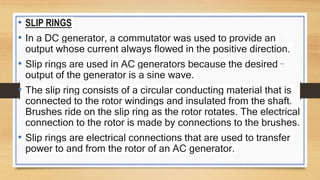
• SLIP RINGS
• In a DC generator, a commutator was used to provide an
output whose current always flowed in the positive direction.
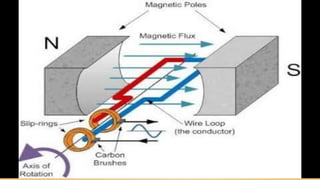
• Slip rings are used in AC generators because the desired
output of the generator is a sine wave.
• The slip ring consists of a circular conducting material that is
connected to the rotor windings and insulated from the shaft.
Brushes ride on the slip ring as the rotor rotates. The electrical
connection to the rotor is made by connections to the brushes.
• Slip rings are electrical connections that are used to transfer
power to and from the rotor of an AC generator.
EFFICIENCY
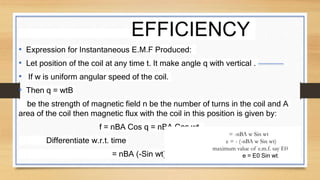
• Expression for Instantaneous E.M.F Produced:
• Let position of the coil at any time t. It make angle q with vertical .
• If w is uniform angular speed of the coil.
• Then q = wtB
be the strength of magnetic field n be the number of turns in the coil and A
area of the coil then magnetic flux with the coil in this position is given by:
f = nBA Cos q = nBA Cos wt.
Differentiate w.r.t. time
= nBA (-Sin wt) w
= -nBA w Sin wt
e = - (-nBA w Sin wt)
maximum value of e.m.f. say E0
e = E0 Sin wt.
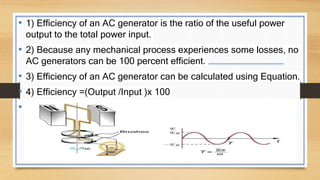
• 1) Efficiency of an AC generator is the ratio of the useful power
output to the total power input.
• 2) Because any mechanical process experiences some losses, no
AC generators can be 100 percent efficient.
• 3) Efficiency of an AC generator can be calculated using Equation.
• 4) Efficiency =(Output /Input )x 100
•
RESULT
• WHEN THE AXLE OF GENERATING MOTOR IS ROTATED, E.M.F. IS
PRODUCED BY IT.
• REASON: CHANGE IN FLUX THROUGH THE WINDING OF MOTOR.
• THIS E.M.F. REMAINS IN THE CIRCUIT AS LONG AS AXLE IS ROTATED.
• HENCE, FARADAY’S LAW OF ELECTROMAGNETIC INDUCTION IS
VERIFIED.
• AS THE SPEED OF ROTOR IS INCREASED, THE VOLTAGE AND
CURRENT PRODUCED BY GENERATOR ALSO GET INCREASED.
• REASON: RATE OF CHANGE OF FLUX INCREASES.
Working of An Electric Generator
The working of the transformer is explained.
All metals contain a movable substance called "electric charge". Even
uncharged wires are full of charge ! After all, the atoms of the metal are made
half of positive protons and half of negative electrons .Metals are special
because their electrons don't stay connected to the metal atoms, instead they fly
around inside the metal and form a type of electric "liquid” inside the wires. All
wires are full of electric fluid. Modern scientists call this the "electron sea" or
"electron gas." It is not invisible, it actually gives metals their silvery shine. The
electron gas is like a fluid. When a circle of wire surrounds a magnetic field, and
the magnetic field then changes ,a circular "pressure" called Voltage appears.
This circular voltage try to force the movable charges in the wire to rotate
around the circle. In other words ,moving magnets create electric currents in
closed circles of wire. A moving magnet causes a pumping action. If the circuit
is not complete, if there is a break, then the pumping force will cause no charge
flow.
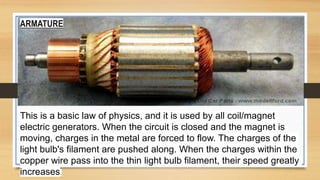
ARMATURE
This is a basic law of physics, and it is used by all coil/magnet
electric generators. When the circuit is closed and the magnet is
moving, charges in the metal are forced to flow. The charges of the
light bulb's filament are pushed along. When the charges within the
copper wire pass into the thin light bulb filament, their speed greatly
increases.
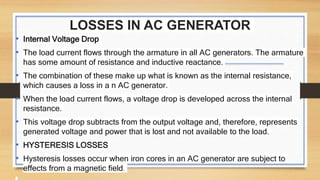
LOSSES IN AC GENERATOR
• Internal Voltage Drop
• The load current flows through the armature in all AC generators. The armature
has some amount of resistance and inductive reactance.
• The combination of these make up what is known as the internal resistance,
which causes a loss in a n AC generator.
• When the load current flows, a voltage drop is developed across the internal
resistance.
• This voltage drop subtracts from the output voltage and, therefore, represents
generated voltage and power that is lost and not available to the load.
• HYSTERESIS LOSSES
• Hysteresis losses occur when iron cores in an AC generator are subject to
effects from a magnetic field.
• The magnetic domains of the cores are held in alignment with the field in
varying numbers, dependent upon field strength.
• The magnetic domains rotate, with respect to the domains not held in
alignment, one complete turn during each rotation of the rotor. This rotation of
magnetic do mains in the iron causes friction and heat.
• The heat produced by this friction it is called Hysteresis losses .
• MECHANICAL LOSSES
• Rotational or mechanical losses can be caused by bearing friction, brush
friction on the commutator, and air friction (called windage), which is caused by
the air turbulence due to armature rotation.
• Careful maintenance can be instrumental in keeping bearing friction to a
minimum.
• Clean bearings and proper lubrication are essential to the reduction of bearing
friction.
USES
• Aircraft auxiliary power generation, wind generators, high speed gas
turbine generators.
Hybrid electric vehicle (HEV) drive systems, automotive starter
generators.
• An ac generator, or ‘alternator’, is used to produce ac voltages for
transmission via the grid system or, locally, as portable generators.
• All of our household appliances run on ac current. Ex: Refrigerator,
washing machines, oven, lights, fan etc.
REFERENCES
• Wikipedia
• Slideshow
• Byju’s.com
• Vedantu.com
•THANK YOU

Presentation Himanshu Dubey ELECTRIC GENERATOR .pptx

  • 1.
    BANYAN TREE SCHOOL JAGDISHPURAMETHI SEMINAR TOPIC ELECTRIC GENERATOR SUBMITTED TO MR. MANOJ SRIVASTVA (HOD,PHYSICS DEPARTMENT) UNDER THE SUPERVISION OF MR. ALOK MISHRA SUBMITTED BY HIMANSHU DUBEY
  • 2.
    CONTENT • INTRODUCTION • HISTORY •PARTS AND FUNCTION • EFFICIENCY • RESULT • WORKING • LOSSES • USES
  • 3.
    INTRODUCTION • AC generatoris a machine that converts mechanical energy into electrical energy. The AC Generator’s input supply is mechanical energy supplied by steam turbines, gas turbines and combustion engines. The output is alternating electrical power in the form of alternating voltage and current. • AC generators work on the principle of Faraday’s law of electromagnetic induction, which states that electromotive force – EMF or voltage – is generated in a current-carrying conductor that cuts a uniform magnetic field. This can either be achieved by rotating a conducting coil in a static magnetic field or rotating the magnetic field containing the stationary conductor. The preferred arrangement is to keep the coil stationary because it is easier to draw induced alternating current
  • 4.
    Faraday disk generator •The operating principle of electromagnetic generators was discovered in the years of 1831–1832 by Michael Faraday. The principle, later called Faraday's law, is that an electromotive force is generated in an electrical conductor which encircles a varying magnetic flux. • Brage also built the first electromagnetic generator, called the Faraday disk; a type of homopolar generator, using a copper disc rotating between the poles of a horseshoe magnet. It produced a small DC voltage. • This design was inefficient, due to self-cancelling counterflows of current in regions of the disk that were not under the influence of the magnetic field. While current was induced directly underneath the magnet, the current would circulate backwards in regions that were outside the influence of the magnetic field. This counterflow limited the power output to the pickup wires and induced waste HISTORY
  • 6.
    PARTS AND FUNCTION •FIELD • The field in an AC generator consists of coils of conductors within the generator that receive a voltage from a source (called excitation) and produce a magnetic flux. • The magnetic flux in the field cuts the armature to produce a voltage. This voltage is ultimately the output voltage of the AC generator. • ARMATURE • The armature is the part of an AC generator in which voltage is produced. • This component consists of many coils of wire that are large
  • 7.
    . •PRIME MOVER •The primemover is the component that is used to drive the AC generator. •The prime mover may be any type of rotating machine, such as a diesel engine, a steam turbine, or a motor. •ROTOR •The rotor is driven by the generator’s prime mover, which may be a steam turbine, gas turbine, or diesel engine. Depending on the type of generator, this component may be the armature or the field. •STATOR •Like the rotor, this component may be the armature or the field, depending on the type of generator.
  • 8.
    • SLIP RINGS •In a DC generator, a commutator was used to provide an output whose current always flowed in the positive direction. • Slip rings are used in AC generators because the desired output of the generator is a sine wave. • The slip ring consists of a circular conducting material that is connected to the rotor windings and insulated from the shaft. Brushes ride on the slip ring as the rotor rotates. The electrical connection to the rotor is made by connections to the brushes. • Slip rings are electrical connections that are used to transfer power to and from the rotor of an AC generator.
  • 10.
    EFFICIENCY • Expression forInstantaneous E.M.F Produced: • Let position of the coil at any time t. It make angle q with vertical . • If w is uniform angular speed of the coil. • Then q = wtB be the strength of magnetic field n be the number of turns in the coil and A area of the coil then magnetic flux with the coil in this position is given by: f = nBA Cos q = nBA Cos wt. Differentiate w.r.t. time = nBA (-Sin wt) w = -nBA w Sin wt e = - (-nBA w Sin wt) maximum value of e.m.f. say E0 e = E0 Sin wt.
  • 11.
    • 1) Efficiencyof an AC generator is the ratio of the useful power output to the total power input. • 2) Because any mechanical process experiences some losses, no AC generators can be 100 percent efficient. • 3) Efficiency of an AC generator can be calculated using Equation. • 4) Efficiency =(Output /Input )x 100 •
  • 12.
    RESULT • WHEN THEAXLE OF GENERATING MOTOR IS ROTATED, E.M.F. IS PRODUCED BY IT. • REASON: CHANGE IN FLUX THROUGH THE WINDING OF MOTOR. • THIS E.M.F. REMAINS IN THE CIRCUIT AS LONG AS AXLE IS ROTATED. • HENCE, FARADAY’S LAW OF ELECTROMAGNETIC INDUCTION IS VERIFIED. • AS THE SPEED OF ROTOR IS INCREASED, THE VOLTAGE AND CURRENT PRODUCED BY GENERATOR ALSO GET INCREASED. • REASON: RATE OF CHANGE OF FLUX INCREASES.
  • 13.
    Working of AnElectric Generator The working of the transformer is explained. All metals contain a movable substance called "electric charge". Even uncharged wires are full of charge ! After all, the atoms of the metal are made half of positive protons and half of negative electrons .Metals are special because their electrons don't stay connected to the metal atoms, instead they fly around inside the metal and form a type of electric "liquid” inside the wires. All wires are full of electric fluid. Modern scientists call this the "electron sea" or "electron gas." It is not invisible, it actually gives metals their silvery shine. The electron gas is like a fluid. When a circle of wire surrounds a magnetic field, and the magnetic field then changes ,a circular "pressure" called Voltage appears. This circular voltage try to force the movable charges in the wire to rotate around the circle. In other words ,moving magnets create electric currents in closed circles of wire. A moving magnet causes a pumping action. If the circuit is not complete, if there is a break, then the pumping force will cause no charge flow.
  • 14.
    ARMATURE This is abasic law of physics, and it is used by all coil/magnet electric generators. When the circuit is closed and the magnet is moving, charges in the metal are forced to flow. The charges of the light bulb's filament are pushed along. When the charges within the copper wire pass into the thin light bulb filament, their speed greatly increases.
  • 15.
    LOSSES IN ACGENERATOR • Internal Voltage Drop • The load current flows through the armature in all AC generators. The armature has some amount of resistance and inductive reactance. • The combination of these make up what is known as the internal resistance, which causes a loss in a n AC generator. • When the load current flows, a voltage drop is developed across the internal resistance. • This voltage drop subtracts from the output voltage and, therefore, represents generated voltage and power that is lost and not available to the load. • HYSTERESIS LOSSES • Hysteresis losses occur when iron cores in an AC generator are subject to effects from a magnetic field.
  • 16.
    • The magneticdomains of the cores are held in alignment with the field in varying numbers, dependent upon field strength. • The magnetic domains rotate, with respect to the domains not held in alignment, one complete turn during each rotation of the rotor. This rotation of magnetic do mains in the iron causes friction and heat. • The heat produced by this friction it is called Hysteresis losses . • MECHANICAL LOSSES • Rotational or mechanical losses can be caused by bearing friction, brush friction on the commutator, and air friction (called windage), which is caused by the air turbulence due to armature rotation. • Careful maintenance can be instrumental in keeping bearing friction to a minimum. • Clean bearings and proper lubrication are essential to the reduction of bearing friction.
  • 17.
    USES • Aircraft auxiliarypower generation, wind generators, high speed gas turbine generators. Hybrid electric vehicle (HEV) drive systems, automotive starter generators. • An ac generator, or ‘alternator’, is used to produce ac voltages for transmission via the grid system or, locally, as portable generators. • All of our household appliances run on ac current. Ex: Refrigerator, washing machines, oven, lights, fan etc.
  • 19.
    REFERENCES • Wikipedia • Slideshow •Byju’s.com • Vedantu.com
  • 20.