Jumaa Mosbah Adwan
Pediatric
Diabetes Mellitus
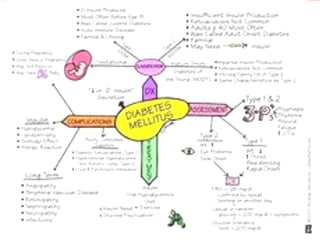
Diabetes mellitus
• Characterized by a total or partial deficiency
of hormone insulin .
• Sufficient amount of insulin are either not produce
or the body is unable to use the insulin that is
produce .
• Peak incidence in early adolescence
Classification of DM
1- Types 1 diabetes
According the causes
• Most common type of diabetes in children
• Arises when a person with a genetic predisposition
• Also be Known as :
- insulin dependent diabetes mellitus (IDDM)
- juvenile diabetes
- brittle diabetes
- sugar diabetes
• There are tow form of type diabetes 1
- idiopathic type 1 – disease with no known cause
- immune mediated diabetes – an autoimmune disorder in which the body’s
immune system destroys , or attempts to destroy ,the B-cells in the pancreas that
produce insulin.
• Arises because of insulin resistance
• Not common among children
• Affected persons may or may not require
insulin injection
2- Type 2 diabetes
3- maturity-onset diabetes of the young
(MODY)
• Similar to type 2 DM
• May be seen on obese teens
• May be controlled with oral hypoglycemic agent
and diet modification
. most pediatric patient have type 1 diabetes
mellitus life time dependence on exogenous
insulin
• Juvenile diabetes mellitus is a chronic metabolic
disorder resulting from absolute lack of insulin
• Abnormal metabolism of carbohydrate , protein
and fat
Manifestation
• Symptom may resemble flu symptoms ,gastroenteritis , and
appendicitis .
• Hyperglycemia and acidosis which produce weight loss and
polyphagia, polydipsia , polyuria .
• Blurred vision
• Nausea and vomiting
• Abdominal pain
• Irritability and mood change
Management
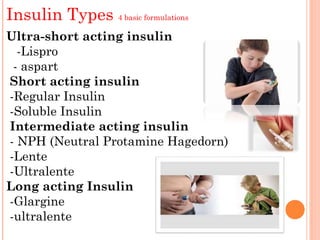
Insulin Types 4 basic formulations
Ultra-short acting insulin
-Lispro
- aspart
Short acting insulin
-Regular Insulin
-Soluble Insulin
Intermediate acting insulin
- NPH (Neutral Protamine Hagedorn)
-Lente
-Ultralente
Long acting Insulin
-Glargine
-ultralente
INSULIN THERAPY
• Insulin Replacement:
- Insulin DOSE (0.75-1.0 U/kg S/C)
- (Range = 0.5 - 1.2 U/kg)
• Total daily dose divided into
-NPH (2/3rd of total)
-Regular (1/3rd of total)
- 2/3rd of daily dose- before breakfast
- 1/3rd - evening
Insulin injection site
• Outer arm
• Abdomen
• Hip area
• Thigh
Subcotinuos layer
DIET
Recent dietary recommendations
• Carbohydrates
• Should provide 50-55% of daily energy intake;
• no more than 10% of carbohydrates should be from sucrose or other
refined carbohydrates
• Fat - Should provide 30-35% of daily energy intake
• Protein - Should provide 10-15% of daily energy
intake
Exercise
• Important aspect of diabetes management
• Real benefits for a child with diabetes
• No form of exercise, including competitive sports,
should be forbidden to the diabetic child
• 25 min aerobic exercise- encourage regular daily
exercise
Patient and Parent Education
Education is a continuing process involving the child,
family, and all members of the diabetes team
• Recognition and treat hypoglycemia
• How to mix insulin
• How to inject / change sites
• How to store insulin
• How to check BSR/urine tests
• Increase dose in acute illness
• Complications
BLOOD SUGAR MONITORING
• 4 readings (before meal, before snack and in middle of
night 3:00 am)
• 2 readings (before breakfast , before dinner)
- Good Control:
• Fasting and Preprandial BSR – 70 - 150mg/dl
• Postprandial BSR – 180-200mg/dl
• 3:00 am Value – 65mg/dl
HbA1c Level
(GLYCATED HEMOGLOBIN)
• HbA1c -best method for medium/long-term
diabetic control monitoring
• Target HbA1c <7.5% (regardless of age)
• Reflects average blood glucose level in preceding 2-3 months
HbA1c level Control
Intense
control
≤7%
Average8-9%
Minimal
control
≥11%
FOLLOW UP
• Monitor Growth
• Blood pressure
• School progress
• Dietary compliance
• HbA1c level
• Joint mobility
• Fundus examination
• Thyroid function test
• Check insulin site
Complications
•Injection -site hypertrophy
•Retinopathy
•Cataracts
•Gastroparesis
•Hypertension
•Progressive renal failure
•Early coronary artery disease
•Peripheral vascular disease
•Peripheral and autonomic neuropathy
•Increased risk of infection
• Brittle Diabetes Mellitus : marked fluctuation in blood sugar
despite frequent adjustment of doses
• Diabetic Ketoacidosis
• Neuropathy
• Nephropathy
• Retinopathy and Blindness
• Hyperosmolar Diabetic Coma
• Lipoatrophy
• Growth Retardation and Emotional problem
HYPOGLYCEMIA
• Major complication
• Blood sugar level < 60mg/dl
• Sign / Symptoms:
Behavior changes ,palpitation, pallor , diplopia , sweating
,nausea , vomiting , hunger, disorientation tremors, may progress
to convulsion and coma
• Treatment: lump of sugar, sweet drink
• Severe hypoglycemia : Inj. Glucagon
DIABETIC KETOACIDOSIS
(DKA)
>300mg/dlHyperglyce
mia
>3mmol/lKetonemia
Plasma
ketone
<15meq/lAcidosis
Bicarbonate
+veKetonuria
PRESENTATION OF DKA
• Polyuria , Polydipsia , Weight loss
• Acutely ill patient with fruity
smell
• due to ketosis
• Nausea , Vomiting , Lethargy
• Hyperventilation , Dehydration
• Abdominal Pain
• Drowsiness or Coma
DKA MANAGEMENT
1. ABC
2. Correction of fluid and electrolyte
3. Correction of metabolic acidosis
4. Provision of adequate insulin to prevent ketosis and decrease
hyperglycemia
5. Prevention and monitoring of complications
6. Identification of precipitating factors
7. Insulin regimen
8. Teaching of sick days
Kussmaul respiration
• Hyperventilation characteristic of metabolic
acidosis , resulting from respiratory system’s
attempt to eliminate excess co2 by increse depth
and rate
References
• "Diabetes Blue Circle Symbol". International Diabetes Federation. 17
March 2006. Archived from the original on 5 August 2007.
• Ripsin CM, Kang H, Urban RJ (January 2009). "Management of blood
glucose in type 2 diabetes mellitus" (PDF). American Family
Physician. 79 (1): 29–36. PMID 19145963. Archived (PDF) from the
original on 2013-05-05.
• Lambert P, Bingley PJ (2002). "What is Type 1 Diabetes?". Medicine. 30:
1–5. doi:10.1383/medc.30.1.1.28264.
• "Definition of Diabetes mellitus". MedicineNet. Retrieved 2019-11-04
• Dr .sheeren hamadneh ,slide presentation .
Summary
• The most common of diabetes in children and teens is type 1 . It was called juvenile diabetes . With
type one diabetes the pancreas dose not make insulin. Insulin is a hormone the help glucose or
sugar get into cell give energy , without insulin too much sugar stays in the blood .
• Type 2 diabetes used to be called adult onset diabetes , but now is becoming more common in
children and teens , due to increase the obesity . With type 2 diabetes the body dose not make or
use insulin well .
• Children have a high risk of type 2 diabetes if they are overweight and have obesity , have a family
history of diabetes or are not active
• Tow lower the risk of type 2 diabetes in children :
- have theme maintain a health weight
- be sure they are physically active
- have them eat smaller portions of health food
- limit time with TV , computer , bad ,phone ,video
• Children and teens have type 2 diabetes may be controlled with diet and exercise . If not , patient will
need to take oral diabetes medicines or insulin
• Children and teens with type 1 diabetes may need to take insulin , to control DM :
- child should take insulin as prescribed
- child should eat a healthy , balanced diet with accurate carbohydrate counts
- child should check blood sugar level as prescribed
Any question

Dm pediatric

  • 1.
  • 2.
    Diabetes mellitus • Characterizedby a total or partial deficiency of hormone insulin . • Sufficient amount of insulin are either not produce or the body is unable to use the insulin that is produce . • Peak incidence in early adolescence
  • 4.
    Classification of DM 1-Types 1 diabetes According the causes • Most common type of diabetes in children • Arises when a person with a genetic predisposition • Also be Known as : - insulin dependent diabetes mellitus (IDDM) - juvenile diabetes - brittle diabetes - sugar diabetes • There are tow form of type diabetes 1 - idiopathic type 1 – disease with no known cause - immune mediated diabetes – an autoimmune disorder in which the body’s immune system destroys , or attempts to destroy ,the B-cells in the pancreas that produce insulin.
  • 5.
    • Arises becauseof insulin resistance • Not common among children • Affected persons may or may not require insulin injection 2- Type 2 diabetes
  • 6.
    3- maturity-onset diabetesof the young (MODY) • Similar to type 2 DM • May be seen on obese teens • May be controlled with oral hypoglycemic agent and diet modification
  • 7.
    . most pediatricpatient have type 1 diabetes mellitus life time dependence on exogenous insulin • Juvenile diabetes mellitus is a chronic metabolic disorder resulting from absolute lack of insulin • Abnormal metabolism of carbohydrate , protein and fat
  • 8.
    Manifestation • Symptom mayresemble flu symptoms ,gastroenteritis , and appendicitis . • Hyperglycemia and acidosis which produce weight loss and polyphagia, polydipsia , polyuria . • Blurred vision • Nausea and vomiting • Abdominal pain • Irritability and mood change
  • 9.
  • 10.
    Insulin Types 4basic formulations Ultra-short acting insulin -Lispro - aspart Short acting insulin -Regular Insulin -Soluble Insulin Intermediate acting insulin - NPH (Neutral Protamine Hagedorn) -Lente -Ultralente Long acting Insulin -Glargine -ultralente
  • 11.
    INSULIN THERAPY • InsulinReplacement: - Insulin DOSE (0.75-1.0 U/kg S/C) - (Range = 0.5 - 1.2 U/kg) • Total daily dose divided into -NPH (2/3rd of total) -Regular (1/3rd of total) - 2/3rd of daily dose- before breakfast - 1/3rd - evening
  • 12.
    Insulin injection site •Outer arm • Abdomen • Hip area • Thigh Subcotinuos layer
  • 13.
    DIET Recent dietary recommendations •Carbohydrates • Should provide 50-55% of daily energy intake; • no more than 10% of carbohydrates should be from sucrose or other refined carbohydrates • Fat - Should provide 30-35% of daily energy intake • Protein - Should provide 10-15% of daily energy intake
  • 14.
    Exercise • Important aspectof diabetes management • Real benefits for a child with diabetes • No form of exercise, including competitive sports, should be forbidden to the diabetic child • 25 min aerobic exercise- encourage regular daily exercise
  • 15.
    Patient and ParentEducation Education is a continuing process involving the child, family, and all members of the diabetes team • Recognition and treat hypoglycemia • How to mix insulin • How to inject / change sites • How to store insulin • How to check BSR/urine tests • Increase dose in acute illness • Complications
  • 16.
    BLOOD SUGAR MONITORING •4 readings (before meal, before snack and in middle of night 3:00 am) • 2 readings (before breakfast , before dinner) - Good Control: • Fasting and Preprandial BSR – 70 - 150mg/dl • Postprandial BSR – 180-200mg/dl • 3:00 am Value – 65mg/dl
  • 17.
    HbA1c Level (GLYCATED HEMOGLOBIN) •HbA1c -best method for medium/long-term diabetic control monitoring • Target HbA1c <7.5% (regardless of age) • Reflects average blood glucose level in preceding 2-3 months HbA1c level Control Intense control ≤7% Average8-9% Minimal control ≥11%
  • 18.
    FOLLOW UP • MonitorGrowth • Blood pressure • School progress • Dietary compliance • HbA1c level • Joint mobility • Fundus examination • Thyroid function test • Check insulin site
  • 19.
    Complications •Injection -site hypertrophy •Retinopathy •Cataracts •Gastroparesis •Hypertension •Progressiverenal failure •Early coronary artery disease •Peripheral vascular disease •Peripheral and autonomic neuropathy •Increased risk of infection
  • 20.
    • Brittle DiabetesMellitus : marked fluctuation in blood sugar despite frequent adjustment of doses • Diabetic Ketoacidosis • Neuropathy • Nephropathy • Retinopathy and Blindness • Hyperosmolar Diabetic Coma • Lipoatrophy • Growth Retardation and Emotional problem
  • 21.
    HYPOGLYCEMIA • Major complication •Blood sugar level < 60mg/dl • Sign / Symptoms: Behavior changes ,palpitation, pallor , diplopia , sweating ,nausea , vomiting , hunger, disorientation tremors, may progress to convulsion and coma • Treatment: lump of sugar, sweet drink • Severe hypoglycemia : Inj. Glucagon
  • 22.
    DIABETIC KETOACIDOSIS (DKA) >300mg/dlHyperglyce mia >3mmol/lKetonemia Plasma ketone <15meq/lAcidosis Bicarbonate +veKetonuria PRESENTATION OFDKA • Polyuria , Polydipsia , Weight loss • Acutely ill patient with fruity smell • due to ketosis • Nausea , Vomiting , Lethargy • Hyperventilation , Dehydration • Abdominal Pain • Drowsiness or Coma
  • 23.
    DKA MANAGEMENT 1. ABC 2.Correction of fluid and electrolyte 3. Correction of metabolic acidosis 4. Provision of adequate insulin to prevent ketosis and decrease hyperglycemia 5. Prevention and monitoring of complications 6. Identification of precipitating factors 7. Insulin regimen 8. Teaching of sick days
  • 24.
    Kussmaul respiration • Hyperventilationcharacteristic of metabolic acidosis , resulting from respiratory system’s attempt to eliminate excess co2 by increse depth and rate
  • 25.
    References • "Diabetes BlueCircle Symbol". International Diabetes Federation. 17 March 2006. Archived from the original on 5 August 2007. • Ripsin CM, Kang H, Urban RJ (January 2009). "Management of blood glucose in type 2 diabetes mellitus" (PDF). American Family Physician. 79 (1): 29–36. PMID 19145963. Archived (PDF) from the original on 2013-05-05. • Lambert P, Bingley PJ (2002). "What is Type 1 Diabetes?". Medicine. 30: 1–5. doi:10.1383/medc.30.1.1.28264. • "Definition of Diabetes mellitus". MedicineNet. Retrieved 2019-11-04 • Dr .sheeren hamadneh ,slide presentation .
  • 26.
    Summary • The mostcommon of diabetes in children and teens is type 1 . It was called juvenile diabetes . With type one diabetes the pancreas dose not make insulin. Insulin is a hormone the help glucose or sugar get into cell give energy , without insulin too much sugar stays in the blood . • Type 2 diabetes used to be called adult onset diabetes , but now is becoming more common in children and teens , due to increase the obesity . With type 2 diabetes the body dose not make or use insulin well . • Children have a high risk of type 2 diabetes if they are overweight and have obesity , have a family history of diabetes or are not active • Tow lower the risk of type 2 diabetes in children : - have theme maintain a health weight - be sure they are physically active - have them eat smaller portions of health food - limit time with TV , computer , bad ,phone ,video • Children and teens have type 2 diabetes may be controlled with diet and exercise . If not , patient will need to take oral diabetes medicines or insulin • Children and teens with type 1 diabetes may need to take insulin , to control DM : - child should take insulin as prescribed - child should eat a healthy , balanced diet with accurate carbohydrate counts - child should check blood sugar level as prescribed
  • 28.