Diabetes MellitusPower Point Presentation by: Type 1 Diabetes: Erin BorglundIntroduction to Health PsychologyPS-222-01
What is Diabetes?Diabetes can occur when the pancreas does not produce enough or any insulin or does not use it properly causing elevated blood sugarsHyperglycemiaInsulin: a hormone that helps to control blood sugar levels. Three types of diabetes: Type 1, Type 2, and Gestational.
Type 1 DiabetesAlso known as Insulin-Dependent and Juvenile Onset DiabetesDiagnosis typically occurs in childhood or adolescenceAutoimmune disorder: Insulin producing cells within the pancreas are attacked by the immune system causing high amounts of glucose in the blood. Accounts for between 5% and 10% of diagnosis'. Taking insulin (either by injection or pump) is a mandatory part of type 1 diabetes treatment.
Symptoms of Type 1 DiabetesWarning signs of type 1 diabetes may occur suddenly and include: Extreme thirstFrequent urinationDrowsiness or lethargyIncreased appetiteSudden weight loss Sudden vision changesSugar in the urineFruity odor on the breathHeavy or labored breathingStupor or unconsciousness
Potential Psychological Effects of Type 1 DiabetesDepressionStressLow Self EsteemPreoccupation with Health-Related ThoughtsAnxietySocial AnxietyManagement techniques among adolescents were greatly influenced by psychosocial factors, including cognitive and interpersonal aspects.
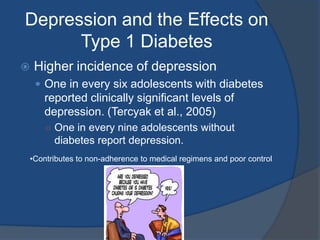
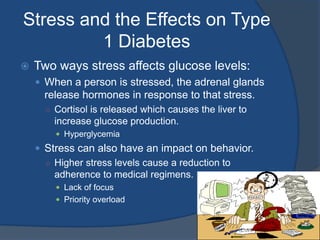
Depression and the Effects on Type 1 DiabetesHigher incidence of depressionOne in every six adolescents with diabetes reported clinically significant levels of depression. (Tercyak et al., 2005)One in every nine adolescents without diabetes report depression.Contributes to non-adherence to medical regimens and poor controlStress and the Effects on Type 1 DiabetesTwo ways stress affects glucose levels:When a person is stressed, the adrenal glands release hormones in response to that stress.Cortisol is released which causes the liver to increase glucose production. Hyperglycemia Stress can also have an impact on behavior.Higher stress levels cause a reduction to adherence to medical regimens.Lack of focusPriority overload
Self Esteem and Type 1 DiabetesStudies show that females will refrain from inject insulin due to a fear of gaining weight. Illness becomes part of an individuals personal identity. Diagnosis of diabetes can lead to feeling different or not normal when compared to peers.Often try to redefine their identity. Cole et al. conducted a study that showed that young children believed diabetes was the fault of the individual. Younger children were also less likely to accept individuals with diabetes.Also, children perceived diabetes to be contagious. Not being accepted by peers can lead to low self esteem.
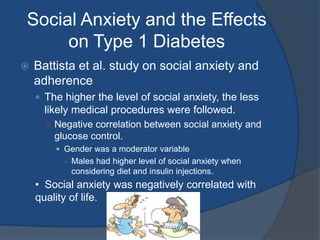
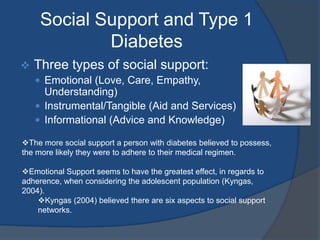
Social Anxiety and the Effects on Type 1 DiabetesBattista et al. study on social anxiety and adherenceThe higher the level of social anxiety, the less likely medical procedures were followed. Negative correlation between social anxiety and glucose control. Gender was a moderator variableMales had higher level of social anxiety when considering diet and insulin injections. Social anxiety was negatively correlated with quality of life.Social Support and Type 1 DiabetesThree types of social support: Emotional (Love, Care, Empathy, Understanding)Instrumental/Tangible (Aid and Services)Informational (Advice and Knowledge) The more social support a person with diabetes believed to possess, the more likely they were to adhere to their medical regimen.
Emotional Support seems to have the greatest effect, in regards to adherence, when considering the adolescent population (Kyngas, 2004).
Kyngas (2004) believed there are six aspects to social support networks. Social Support ContinuedParentalOriented toward all aspects of everyday lifeRelationships that involved open discussion and active communication were more beneficial to emotional coping and adherence. Simply asking about disease management was not conducive to adherence or positive coping strategies. PeersSharing experiences of growing up with a person who also has a chronic disorder allowed for feelings of support, care and understanding. Emotional well-being improved.Conversations with friends that did not have a chronic illness did not usually involve the disease.Having a significant other is importantLeads to feeling accepted and desirable, which increases self esteem.Health Care ProvidersAssist in understanding the disease prognosis and management. Nurses took the time to listen and understand the life situations and feelings of the adolescent. Adolescents felt that doctors were only there for discussion of management and prognosis'.
Social Support ContinuedSchoolTeachers typically knew about the students illness, but continued to treat them in the same way as the other students. A level of comfort was achieved when assurance that the school nurse knew about the disease and how to handle them in emergencies.Classmates: EncouragementTeasingNegative Persuasion TechnologyChat rooms, especially, allow for  anonymous and nonjudgmental communication. PetsComforted adolescents when they were sad or felt lonely.
ImplicationsRevision of the Diabetes Management Health Care TeamInclude Psychologists or CounselorsEducation ProgramsSchools HospitalsIt is important for everyone involved in a person with diabetes’ care to understand the individuals’ life circumstances and how diabetes fits into their lives.
ReferencesBattista, A. M., Hart, T. A., Greco, L., & Gloizer, J. (2009). Type 1 diabetes among adolescents: Reduced diabetes self-care caused by social fear and fear of hypoglycemia. The Diabetes Educator,  35(3), 465-475.Cole, K. L., Roberts, M.C., & McNeal, R. E. (1996). Children's perceptions of ill peers: Effects of disease, grade, and impact variables. Children’s Health Care, 25(2),  107-115.Dovey-Pierce, G., Doherty, Y., & May, C. (2007). The influence of diabetes upon adolescent and young adult development: A qualitative study. British Journal of Health Psychology, 12(1), 75-91.Kyngas, H. (2004). Support network of adolescents with chronic disease: Adolescents’ perspective. Nursing and Health Sciences, 6(4), 287-293.Sarafino, E.P. & Smith, T.W. (2011). Health Psychology: Biopsychosocial Interactions.  Hoboken, New Jersey: John Wiley and Sons, Inc.Tercyak, K. P., Beville, K. W., Walker, L. R., Prahlad, S., Cogen, F. R., Sobel, D. O., & Streisand, R. (2005).  Health attitudes, beliefs, and risk behaviors among adolescents and young adults with type 1 diabetes. Children’s Health Care, 34(3), 165-180.
Type 1 Diabetes

Type 1 Diabetes

  • 1.
    Diabetes MellitusPower PointPresentation by: Type 1 Diabetes: Erin BorglundIntroduction to Health PsychologyPS-222-01
  • 2.
    What is Diabetes?Diabetescan occur when the pancreas does not produce enough or any insulin or does not use it properly causing elevated blood sugarsHyperglycemiaInsulin: a hormone that helps to control blood sugar levels. Three types of diabetes: Type 1, Type 2, and Gestational.
  • 3.
    Type 1 DiabetesAlsoknown as Insulin-Dependent and Juvenile Onset DiabetesDiagnosis typically occurs in childhood or adolescenceAutoimmune disorder: Insulin producing cells within the pancreas are attacked by the immune system causing high amounts of glucose in the blood. Accounts for between 5% and 10% of diagnosis'. Taking insulin (either by injection or pump) is a mandatory part of type 1 diabetes treatment.
  • 4.
    Symptoms of Type1 DiabetesWarning signs of type 1 diabetes may occur suddenly and include: Extreme thirstFrequent urinationDrowsiness or lethargyIncreased appetiteSudden weight loss Sudden vision changesSugar in the urineFruity odor on the breathHeavy or labored breathingStupor or unconsciousness
  • 5.
    Potential Psychological Effectsof Type 1 DiabetesDepressionStressLow Self EsteemPreoccupation with Health-Related ThoughtsAnxietySocial AnxietyManagement techniques among adolescents were greatly influenced by psychosocial factors, including cognitive and interpersonal aspects.
  • 6.
    Depression and theEffects on Type 1 DiabetesHigher incidence of depressionOne in every six adolescents with diabetes reported clinically significant levels of depression. (Tercyak et al., 2005)One in every nine adolescents without diabetes report depression.Contributes to non-adherence to medical regimens and poor controlStress and the Effects on Type 1 DiabetesTwo ways stress affects glucose levels:When a person is stressed, the adrenal glands release hormones in response to that stress.Cortisol is released which causes the liver to increase glucose production. Hyperglycemia Stress can also have an impact on behavior.Higher stress levels cause a reduction to adherence to medical regimens.Lack of focusPriority overload
  • 7.
    Self Esteem andType 1 DiabetesStudies show that females will refrain from inject insulin due to a fear of gaining weight. Illness becomes part of an individuals personal identity. Diagnosis of diabetes can lead to feeling different or not normal when compared to peers.Often try to redefine their identity. Cole et al. conducted a study that showed that young children believed diabetes was the fault of the individual. Younger children were also less likely to accept individuals with diabetes.Also, children perceived diabetes to be contagious. Not being accepted by peers can lead to low self esteem.
  • 8.
    Social Anxiety andthe Effects on Type 1 DiabetesBattista et al. study on social anxiety and adherenceThe higher the level of social anxiety, the less likely medical procedures were followed. Negative correlation between social anxiety and glucose control. Gender was a moderator variableMales had higher level of social anxiety when considering diet and insulin injections. Social anxiety was negatively correlated with quality of life.Social Support and Type 1 DiabetesThree types of social support: Emotional (Love, Care, Empathy, Understanding)Instrumental/Tangible (Aid and Services)Informational (Advice and Knowledge) The more social support a person with diabetes believed to possess, the more likely they were to adhere to their medical regimen.
  • 9.
    Emotional Support seemsto have the greatest effect, in regards to adherence, when considering the adolescent population (Kyngas, 2004).
  • 10.
    Kyngas (2004) believedthere are six aspects to social support networks. Social Support ContinuedParentalOriented toward all aspects of everyday lifeRelationships that involved open discussion and active communication were more beneficial to emotional coping and adherence. Simply asking about disease management was not conducive to adherence or positive coping strategies. PeersSharing experiences of growing up with a person who also has a chronic disorder allowed for feelings of support, care and understanding. Emotional well-being improved.Conversations with friends that did not have a chronic illness did not usually involve the disease.Having a significant other is importantLeads to feeling accepted and desirable, which increases self esteem.Health Care ProvidersAssist in understanding the disease prognosis and management. Nurses took the time to listen and understand the life situations and feelings of the adolescent. Adolescents felt that doctors were only there for discussion of management and prognosis'.
  • 11.
    Social Support ContinuedSchoolTeacherstypically knew about the students illness, but continued to treat them in the same way as the other students. A level of comfort was achieved when assurance that the school nurse knew about the disease and how to handle them in emergencies.Classmates: EncouragementTeasingNegative Persuasion TechnologyChat rooms, especially, allow for anonymous and nonjudgmental communication. PetsComforted adolescents when they were sad or felt lonely.
  • 12.
    ImplicationsRevision of theDiabetes Management Health Care TeamInclude Psychologists or CounselorsEducation ProgramsSchools HospitalsIt is important for everyone involved in a person with diabetes’ care to understand the individuals’ life circumstances and how diabetes fits into their lives.
  • 13.
    ReferencesBattista, A. M.,Hart, T. A., Greco, L., & Gloizer, J. (2009). Type 1 diabetes among adolescents: Reduced diabetes self-care caused by social fear and fear of hypoglycemia. The Diabetes Educator, 35(3), 465-475.Cole, K. L., Roberts, M.C., & McNeal, R. E. (1996). Children's perceptions of ill peers: Effects of disease, grade, and impact variables. Children’s Health Care, 25(2), 107-115.Dovey-Pierce, G., Doherty, Y., & May, C. (2007). The influence of diabetes upon adolescent and young adult development: A qualitative study. British Journal of Health Psychology, 12(1), 75-91.Kyngas, H. (2004). Support network of adolescents with chronic disease: Adolescents’ perspective. Nursing and Health Sciences, 6(4), 287-293.Sarafino, E.P. & Smith, T.W. (2011). Health Psychology: Biopsychosocial Interactions. Hoboken, New Jersey: John Wiley and Sons, Inc.Tercyak, K. P., Beville, K. W., Walker, L. R., Prahlad, S., Cogen, F. R., Sobel, D. O., & Streisand, R. (2005). Health attitudes, beliefs, and risk behaviors among adolescents and young adults with type 1 diabetes. Children’s Health Care, 34(3), 165-180.