Disseminated Intravascular
Coagulation
Definition of DIC
A pathological condition associated with activation
of both:
• Coagulation system and
• Fibrinolytic one
It should be considered as a secondary phenomena of
an underlying disease as …………………………….
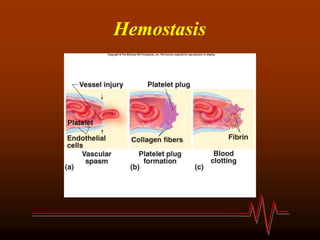
Hemostasis
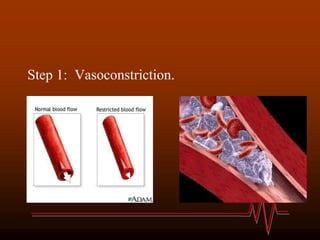
Step 1: Vasoconstriction.
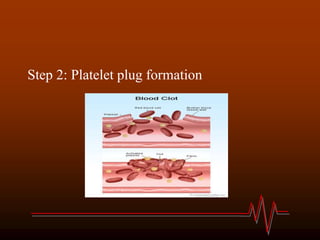
Step 2: Platelet plug formation
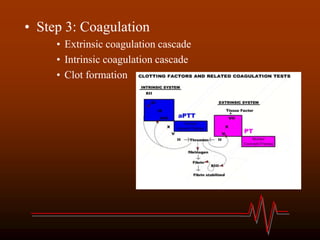
• Step 3: Coagulation
• Extrinsic coagulation cascade
• Intrinsic coagulation cascade
• Clot formation
Causes
• Sepsis (an infection in the bloodstream)
• Surgery and trauma
• Cancer
• Serious complications of pregnancy and
childbirth
Common Obstetric Conditions
• Inadequate replacement of blood loss
• Pre-eclampsia-Eclampsia….HELP syndrome
• Ante partum hge (abruptio placenta and P.P.)
• I U F D when prolonged more than 4 weeks
• Blood transfusion when massive or incompatible
• Septic abortion or massive tissue injury
• Amniotic fluid embolism
Two types of DIC :
Acute DIC begins with clotting in the small
blood vessels and quickly leads to serious
bleeding.
Chronic DIC causes blood clotting, but it
usually doesn't lead to bleeding. Cancer is
the most common cause of chronic DIC
Pathogenesis
• The most accepted theory is the Cascade
theory in which there is activation of both
Extrinsic and Intrinsic pathways leading to
activation of factor xa leading to formation
of thrombin from prothrombin to form
fibrin from fibrinogen
• With associated activation of fibrinolytic
system as a protective mechanism.
Path physiology, continued
Decrease in platelets count is a result of :
1. Consumption
2. Aggregation of platelets
Path physiology, continued
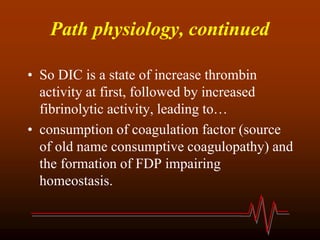
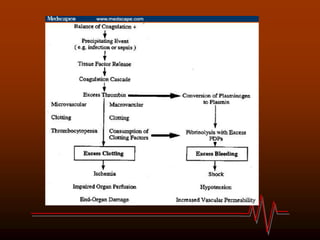
• So DIC is a state of increase thrombin
activity at first, followed by increased
fibrinolytic activity, leading to…
• consumption of coagulation factor (source
of old name consumptive coagulopathy) and
the formation of FDP impairing
homeostasis.
Path physiology, continued
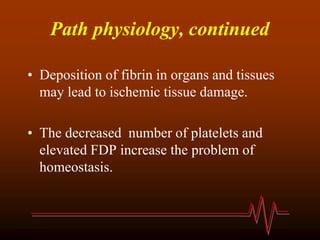
• Deposition of fibrin in organs and tissues
may lead to ischemic tissue damage.
• The decreased number of platelets and
elevated FDP increase the problem of
homeostasis.
Symptoms of DIC
It is variable according to the cause, the
presentation of the primary cause with:
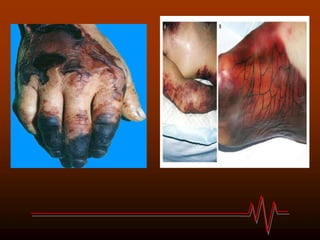
• Generalized or localized hemorrhage
• Peticheae
• Thromboembolc manifestation, organ failure as:
liver, lung, kidneys, brain and frank gangrene have
been described.
• Chronic DIC, (that occurs with IUFD) may be
asymptomatic.
Diagnosis
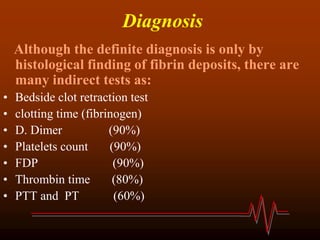
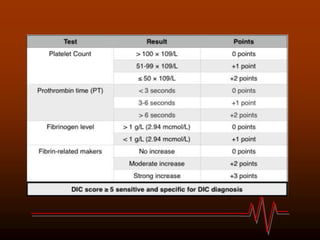
Although the definite diagnosis is only by
histological finding of fibrin deposits, there are
many indirect tests as:
• Bedside clot retraction test
• clotting time (fibrinogen)
• D. Dimer (90%)
• Platelets count (90%)
• FDP (90%)
• Thrombin time (80%)
• PTT and PT (60%)
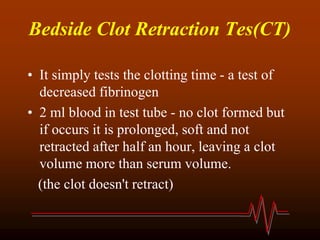
Bedside Clot Retraction Tes(CT)
• It simply tests the clotting time - a test of
decreased fibrinogen
• 2 ml blood in test tube - no clot formed but
if occurs it is prolonged, soft and not
retracted after half an hour, leaving a clot
volume more than serum volume.
(the clot doesn't retract)
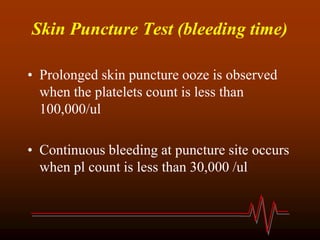
Skin Puncture Test (bleeding time)
• Prolonged skin puncture ooze is observed
when the platelets count is less than
100,000/ul
• Continuous bleeding at puncture site occurs
when pl count is less than 30,000 /ul
Other laboratory tests
• Platelets count decreases in 90% of cases
(count less than 100,000/dl)
• PT, which measures the time required by
extrinsic pathway, elevated in 80% of DIC
• PPT which measure the time required by
intrinsic pathway - not helpful.
• Thrombin time elevated in 80% of cases
Other laboratory tests
• Fibrinogen level/ less than150mg. This is
present in 70% of cases.
• Fibrin split product >40ug/dl, 90% of cases
• D-Diamer - an antigen formed as a result of
plasmin digestion, elevated in 90%of cases.
Treatment of DIC
• Essentially treat the underlying cause. In most
cases prompt termination of pregnancy is
required.
• Supportive therapy should be directed to the
correction of shock, acidosis and tissue ischemia.
• Cardiopulmonary support including inotropic
therapy, blood transfusion and assisted ventilation
Treatment
• Careful monitoring of fluid balance
• Serial evaluation of coagulation parameters
• If sepsis is suspected, antibiotic is indicated
with evacuation of the septic focus
Obtain and send 2 blood samples:
1) To blood bank for grouping and cross
matching
2) To lab to obtain baseline for Hb, Htc,
PT, PTT, platelet count and fibrinogen
levels
DIC Treatment
• Treatment of hypovolemia should be
applied according to the guideline of
National Institute of Health.
• Crystalloid first
• Plenty blood transfusion
• Treat hypothermia
• Red cell transfusion, if bleeding.
(anticipated)
Wies et al2007
Treatment of Coagulopathy
• FFP for a prolonged PT - The idea is to keep it 2 to 3
seconds from control, (it contains coagulation factors),
each unit volume is 250ml
2-Cryoprecipitate
• For a fibrinogen level less than 100 mg/dL. it is a fresh
frozen plasma concentrate, (each bag volume is 10ml),
contains 100mg fibrinogen raising f by 10mg/dl.
1-Fresh Frozen PASMA
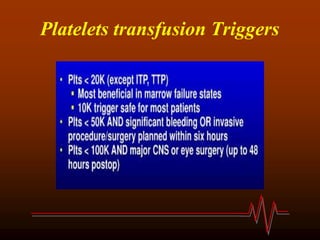
Platelet Transfusion
• Transfuse platelets for platelet counts less
than 20,000/mm3in active bleeding or less
than 50,000 if c s is planned.
• The rate of pl transfusion is one unit to
every 10 kg/body w.
Treat Coagulopathy
• Parental vitamin k and folic acid as pt of
DICare deficient in these vitamins
• There is much data not in favor of use of the
antifibrinolytic drugs
• In DIC 10 UNITES OF CRYOPPT, FOE
2/3 UNITE OF FF PLASMA SHOUID BE
READY
Role of Heparin in low dose
• Although there is a controversy in regards to
giving a low dose of LMWH, its idea is to stop the
consumption of coagulation factors, however its
role is established in case of chronic DIC, (as in
case IUFD of single twin for example or any case
of IUFD before termination with follow up with
fibrinogen level)
• Full dose if thrombosis is definitely diagnosed
Prognosis
• Most cases of obstetric DIC will improve
with delivery of the fetus or evacuation of
the uterus
• This improved prognosis seems to be
related to the recent advance in critical care
Conclusion
• DIC is a secondary phenomena, therefore it
is mostly predictable
• It occurs in an acute or chronic form,
therefore it can be anticipated in the later
form.
• The commonest cause is inadequate
resuscitation, therefore it is preventable by
early intervention.
Take Home Message
DIC can be predicted and
even prevented in most of
the cases.
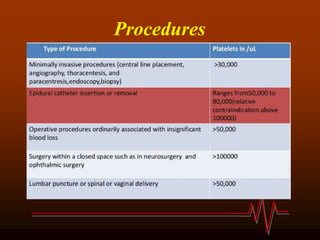
Procedures
Platelets transfusion Triggers
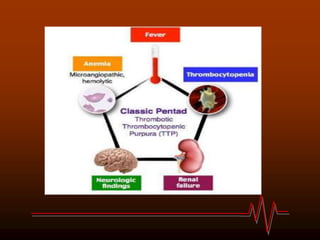
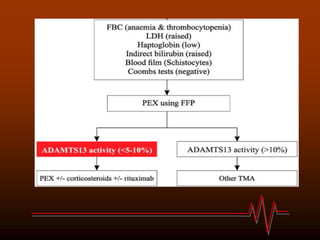
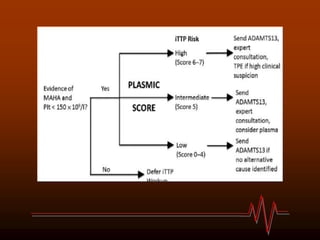
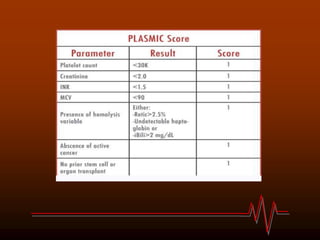
TTP
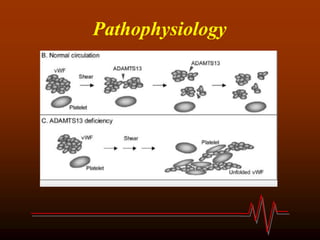
Pathophysiology
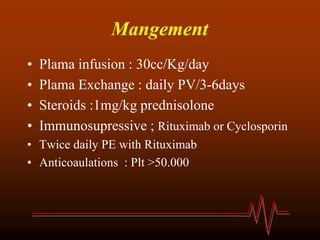
Mangement
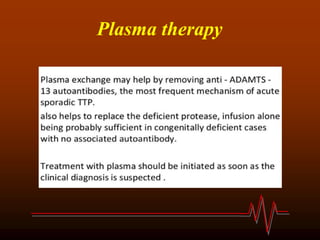
• Plama infusion : 30cc/Kg/day
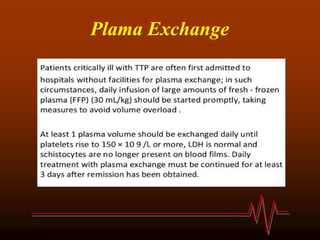
• Plama Exchange : daily PV/3-6days
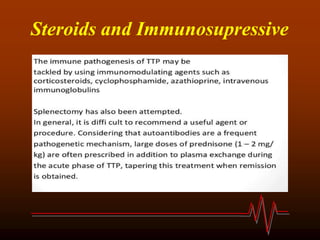
• Steroids :1mg/kg prednisolone
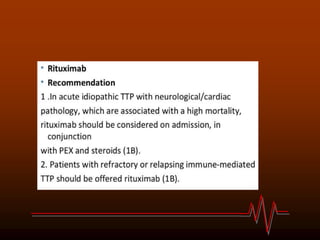
• Immunosupressive ; Rituximab or Cyclosporin
• Twice daily PE with Rituximab
• Anticoaulations : Plt >50.000
Plasma therapy
Plama Exchange
Steroids and Immunosupressive
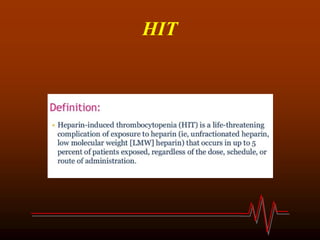
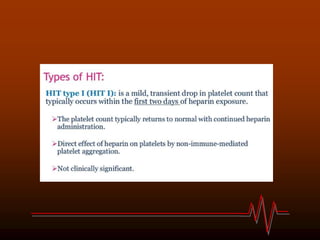
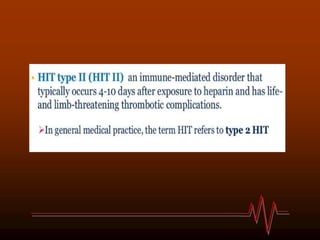
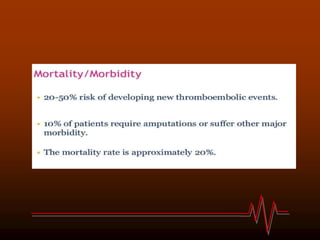
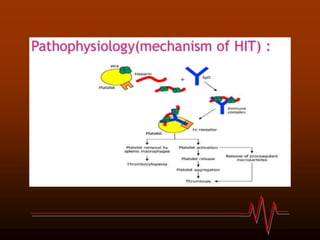
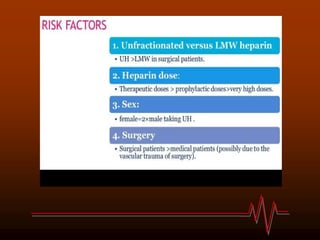
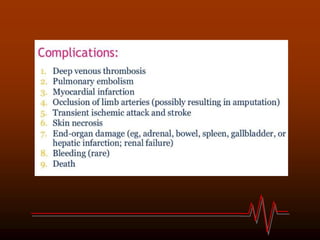
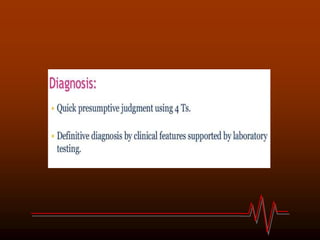
HIT
Thank you

DIC.ppt

  • 1.
  • 3.
    Definition of DIC Apathological condition associated with activation of both: • Coagulation system and • Fibrinolytic one It should be considered as a secondary phenomena of an underlying disease as …………………………….
  • 4.
  • 5.
  • 6.
    Step 2: Plateletplug formation
  • 7.
    • Step 3:Coagulation • Extrinsic coagulation cascade • Intrinsic coagulation cascade • Clot formation
  • 8.
    Causes • Sepsis (aninfection in the bloodstream) • Surgery and trauma • Cancer • Serious complications of pregnancy and childbirth
  • 9.
    Common Obstetric Conditions •Inadequate replacement of blood loss • Pre-eclampsia-Eclampsia….HELP syndrome • Ante partum hge (abruptio placenta and P.P.) • I U F D when prolonged more than 4 weeks • Blood transfusion when massive or incompatible • Septic abortion or massive tissue injury • Amniotic fluid embolism
  • 10.
    Two types ofDIC : Acute DIC begins with clotting in the small blood vessels and quickly leads to serious bleeding. Chronic DIC causes blood clotting, but it usually doesn't lead to bleeding. Cancer is the most common cause of chronic DIC
  • 11.
    Pathogenesis • The mostaccepted theory is the Cascade theory in which there is activation of both Extrinsic and Intrinsic pathways leading to activation of factor xa leading to formation of thrombin from prothrombin to form fibrin from fibrinogen • With associated activation of fibrinolytic system as a protective mechanism.
  • 12.
    Path physiology, continued Decreasein platelets count is a result of : 1. Consumption 2. Aggregation of platelets
  • 13.
    Path physiology, continued •So DIC is a state of increase thrombin activity at first, followed by increased fibrinolytic activity, leading to… • consumption of coagulation factor (source of old name consumptive coagulopathy) and the formation of FDP impairing homeostasis.
  • 14.
    Path physiology, continued •Deposition of fibrin in organs and tissues may lead to ischemic tissue damage. • The decreased number of platelets and elevated FDP increase the problem of homeostasis.
  • 16.
    Symptoms of DIC Itis variable according to the cause, the presentation of the primary cause with: • Generalized or localized hemorrhage • Peticheae • Thromboembolc manifestation, organ failure as: liver, lung, kidneys, brain and frank gangrene have been described. • Chronic DIC, (that occurs with IUFD) may be asymptomatic.
  • 17.
    Diagnosis Although the definitediagnosis is only by histological finding of fibrin deposits, there are many indirect tests as: • Bedside clot retraction test • clotting time (fibrinogen) • D. Dimer (90%) • Platelets count (90%) • FDP (90%) • Thrombin time (80%) • PTT and PT (60%)
  • 19.
    Bedside Clot RetractionTes(CT) • It simply tests the clotting time - a test of decreased fibrinogen • 2 ml blood in test tube - no clot formed but if occurs it is prolonged, soft and not retracted after half an hour, leaving a clot volume more than serum volume. (the clot doesn't retract)
  • 20.
    Skin Puncture Test(bleeding time) • Prolonged skin puncture ooze is observed when the platelets count is less than 100,000/ul • Continuous bleeding at puncture site occurs when pl count is less than 30,000 /ul
  • 21.
    Other laboratory tests •Platelets count decreases in 90% of cases (count less than 100,000/dl) • PT, which measures the time required by extrinsic pathway, elevated in 80% of DIC • PPT which measure the time required by intrinsic pathway - not helpful. • Thrombin time elevated in 80% of cases
  • 22.
    Other laboratory tests •Fibrinogen level/ less than150mg. This is present in 70% of cases. • Fibrin split product >40ug/dl, 90% of cases • D-Diamer - an antigen formed as a result of plasmin digestion, elevated in 90%of cases.
  • 23.
    Treatment of DIC •Essentially treat the underlying cause. In most cases prompt termination of pregnancy is required. • Supportive therapy should be directed to the correction of shock, acidosis and tissue ischemia. • Cardiopulmonary support including inotropic therapy, blood transfusion and assisted ventilation
  • 24.
    Treatment • Careful monitoringof fluid balance • Serial evaluation of coagulation parameters • If sepsis is suspected, antibiotic is indicated with evacuation of the septic focus
  • 25.
    Obtain and send2 blood samples: 1) To blood bank for grouping and cross matching 2) To lab to obtain baseline for Hb, Htc, PT, PTT, platelet count and fibrinogen levels
  • 26.
    DIC Treatment • Treatmentof hypovolemia should be applied according to the guideline of National Institute of Health. • Crystalloid first • Plenty blood transfusion • Treat hypothermia • Red cell transfusion, if bleeding. (anticipated) Wies et al2007
  • 27.
    Treatment of Coagulopathy •FFP for a prolonged PT - The idea is to keep it 2 to 3 seconds from control, (it contains coagulation factors), each unit volume is 250ml 2-Cryoprecipitate • For a fibrinogen level less than 100 mg/dL. it is a fresh frozen plasma concentrate, (each bag volume is 10ml), contains 100mg fibrinogen raising f by 10mg/dl. 1-Fresh Frozen PASMA
  • 28.
    Platelet Transfusion • Transfuseplatelets for platelet counts less than 20,000/mm3in active bleeding or less than 50,000 if c s is planned. • The rate of pl transfusion is one unit to every 10 kg/body w.
  • 29.
    Treat Coagulopathy • Parentalvitamin k and folic acid as pt of DICare deficient in these vitamins • There is much data not in favor of use of the antifibrinolytic drugs • In DIC 10 UNITES OF CRYOPPT, FOE 2/3 UNITE OF FF PLASMA SHOUID BE READY
  • 30.
    Role of Heparinin low dose • Although there is a controversy in regards to giving a low dose of LMWH, its idea is to stop the consumption of coagulation factors, however its role is established in case of chronic DIC, (as in case IUFD of single twin for example or any case of IUFD before termination with follow up with fibrinogen level) • Full dose if thrombosis is definitely diagnosed
  • 31.
    Prognosis • Most casesof obstetric DIC will improve with delivery of the fetus or evacuation of the uterus • This improved prognosis seems to be related to the recent advance in critical care
  • 32.
    Conclusion • DIC isa secondary phenomena, therefore it is mostly predictable • It occurs in an acute or chronic form, therefore it can be anticipated in the later form. • The commonest cause is inadequate resuscitation, therefore it is preventable by early intervention.
  • 33.
    Take Home Message DICcan be predicted and even prevented in most of the cases.
  • 40.
  • 41.
  • 42.
  • 44.
  • 48.
    Mangement • Plama infusion: 30cc/Kg/day • Plama Exchange : daily PV/3-6days • Steroids :1mg/kg prednisolone • Immunosupressive ; Rituximab or Cyclosporin • Twice daily PE with Rituximab • Anticoaulations : Plt >50.000
  • 49.
  • 50.
  • 51.
  • 53.
  • 68.