The Study Of Diabetic
Nephropathy With AtraSentan
(SONAR Trial)
Prem Mohan Jha
10/29/2019 1
Published in THE LANCET Journal,
VOLUME 393, ISSUE 10184, P1937-1947,
MAY 11, 2019
10/29/2019 2
INDTRODUCTION
• Endothelin receptor antagonists reduces albuminuria
and blood pressure, like ACEi & ARBs.
• But it also causes sodium retention, which may leads
to increased risk of heart failure in patients with
chronic kidney disease and diabetes.
10/29/2019 3
INDTRODUCTION
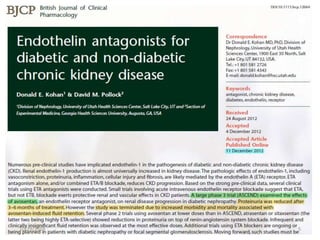
• A previous trial (ASCEND Trial, published in 2012) using
Avosentan, a non-selective endothelin receptor antagonist, in
patients with diabetes and chronic kidney disease, was
Stopped Prematurely because of an increased incidence of
heart failure.
• ATRASENTAN is a selective Endothelin-A receptor Antagonist.
10/29/2019 4
10/29/2019 5
• The SONAR trial designed to assess the
efficacy and safety of Atrasentan in
patients with T2DM and CKD.
10/29/2019 6
METHODS
10/29/2019 7
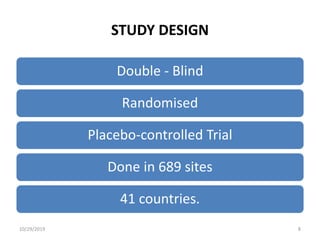
STUDY DESIGN
Double - Blind
Randomised
Placebo-controlled Trial
Done in 689 sites
41 countries.
10/29/2019 8
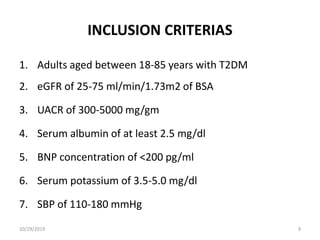
INCLUSION CRITERIAS
1. Adults aged between 18-85 years with T2DM
2. eGFR of 25-75 ml/min/1.73m2 of BSA
3. UACR of 300-5000 mg/gm
4. Serum albumin of at least 2.5 mg/dl
5. BNP concentration of <200 pg/ml
6. Serum potassium of 3.5-5.0 mg/dl
7. SBP of 110-180 mmHg
10/29/2019 9
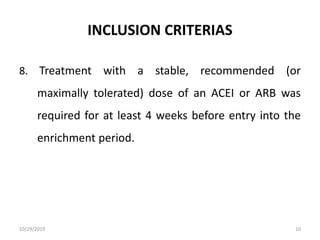
INCLUSION CRITERIAS
8. Treatment with a stable, recommended (or
maximally tolerated) dose of an ACEI or ARB was
required for at least 4 weeks before entry into the
enrichment period.
10/29/2019 10
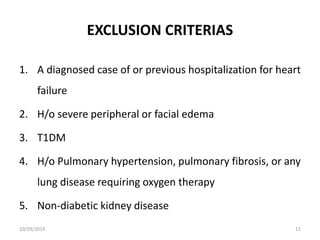
EXCLUSION CRITERIAS
1. A diagnosed case of or previous hospitalization for heart
failure
2. H/o severe peripheral or facial edema
3. T1DM
4. H/o Pulmonary hypertension, pulmonary fibrosis, or any
lung disease requiring oxygen therapy
5. Non-diabetic kidney disease
10/29/2019 11
PROCEDURE
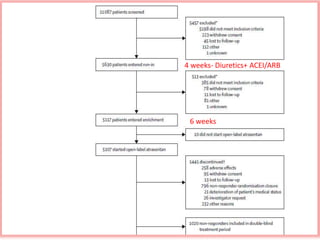
 The eligible patients enterered a 4 week run in period followed by
6-weeks of Enrichment period, during which they received open-
label treatment with Atrasentan at dose of 0.75mg/day.
 The Enrichment period was used To Identify Atrasentan
Responders.
 Defined as patients with at least a 30% reduction in UACR, who did not
have substantial fluid retention, and did not have an increase in
s.creatinine of >0.5 mg/dl or >20% from baseline.
10/29/2019 12
PROCEDURE
• After 6 weeks, all responders who continued to meet eligible
criteria were Randomly assigned to continue atrasentan 0.75mg
daily or switch to placebo.
• After randomisation, in-person study visits were done after 1
month and 3 months, then every 3 months thereafter.
• And a last follow-up visit was done 45 days after the last dose of
study drug to assess effects and adverse effects of drug.
10/29/2019 13
10/29/2019 14
4 weeks- Diuretics+ ACEI/ARB
6 weeks
10/29/2019 15
OUTCOME MEASURES
10/29/2019 16
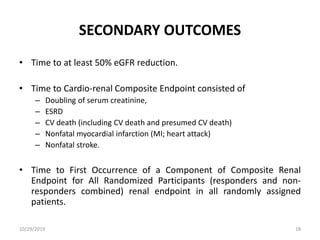
PRIMARY OUTCOMES
• Efficacy of atrasentan in delaying the
progression of CKD, defined as the time from
randomization to the first occurrence of any of
the following components of a composite:
– Doubling of serum creatinine
– Onset of end stage renal disease (eGFR < 15
ml/min, chronic dialysis,renal transplantation)
– Death from kidney failure.
10/29/2019 17
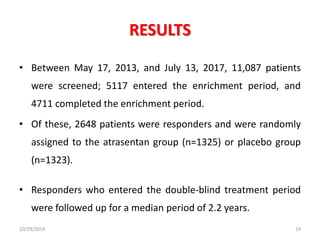
SECONDARY OUTCOMES
• Time to at least 50% eGFR reduction.
• Time to Cardio-renal Composite Endpoint consisted of
– Doubling of serum creatinine,
– ESRD
– CV death (including CV death and presumed CV death)
– Nonfatal myocardial infarction (MI; heart attack)
– Nonfatal stroke.
• Time to First Occurrence of a Component of Composite Renal
Endpoint for All Randomized Participants (responders and non-
responders combined) renal endpoint in all randomly assigned
patients.
10/29/2019 18
RESULTS
• Between May 17, 2013, and July 13, 2017, 11,087 patients
were screened; 5117 entered the enrichment period, and
4711 completed the enrichment period.
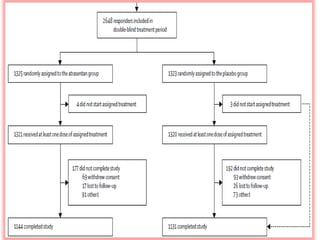
• Of these, 2648 patients were responders and were randomly
assigned to the atrasentan group (n=1325) or placebo group
(n=1323).
• Responders who entered the double-blind treatment period
were followed up for a median period of 2.2 years.
10/29/2019 19
BASELINE CHARACTERISTICS
Remarkably, 75% of them were men, with about a third being Asian but
only 5% being black.
Mean duration of diabetes was about 16 years, and
a third of them had retinopathy.
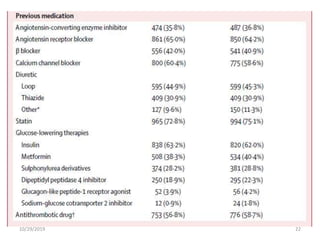
The mean blood pressure was not bad (~ 136/75) and
ARBs:ACEi were used in a 2:1 ratio overall.
Mean GFR was ~ 45 and the median ACR was 800 mg/g.
During follow-up, 260 (19.6%) of 1325 patients in the atrasentan group and 251
(19.0%) of 1323 in the placebo group discontinued treatment prematurely.
10/29/2019 20
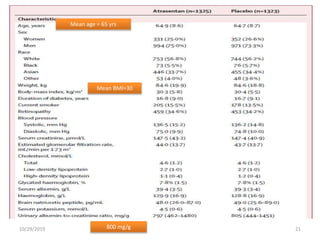
10/29/2019 21
Mean age = 65 yrs
Mean BMI=30
800 mg/g
10/29/2019 22
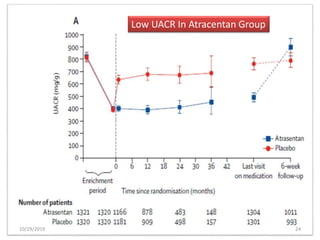
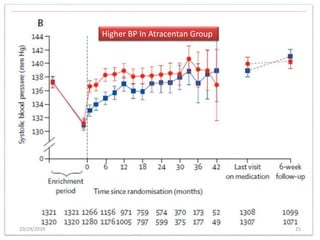
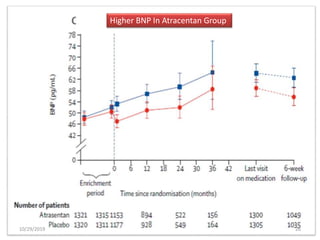
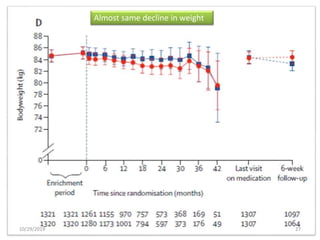
During Study Period Trends Of
UACR, SBP, BNP & Body weight:
10/29/2019 23
10/29/2019 24
Low UACR In Atracentan Group
10/29/2019 25
Higher BP In Atracentan Group
10/29/2019 26
Higher BNP In Atracentan Group
10/29/2019 27
Almost same decline in weight
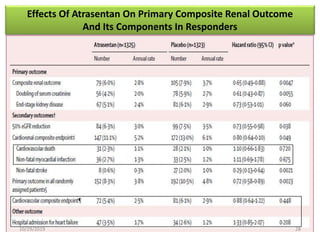
Effects Of Atrasentan On Primary Composite Renal Outcome
And Its Components In Responders
10/29/2019 28
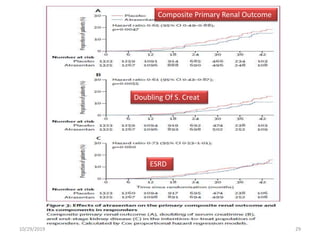
10/29/2019 29
Composite Primary Renal Outcome
Doubling Of S. Creat
ESRD
10/29/2019 30
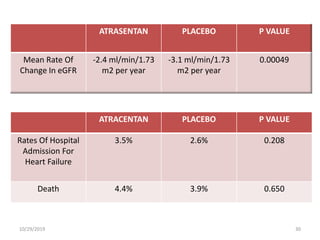
ATRACENTAN PLACEBO P VALUE
Rates Of Hospital
Admission For
Heart Failure
3.5% 2.6% 0.208
Death 4.4% 3.9% 0.650
ATRASENTAN PLACEBO P VALUE
Mean Rate Of
Change In eGFR
-2.4 ml/min/1.73
m2 per year
-3.1 ml/min/1.73
m2 per year
0.00049
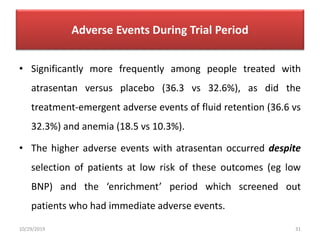
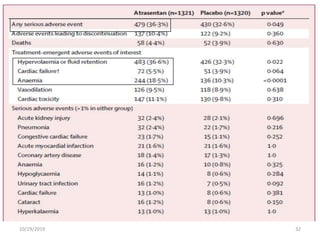
Adverse Events During Trial Period
• Significantly more frequently among people treated with
atrasentan versus placebo (36.3 vs 32.6%), as did the
treatment-emergent adverse events of fluid retention (36.6 vs
32.3%) and anemia (18.5 vs 10.3%).
• The higher adverse events with atrasentan occurred despite
selection of patients at low risk of these outcomes (eg low
BNP) and the ‘enrichment’ period which screened out
patients who had immediate adverse events.
10/29/2019 31
10/29/2019 32
DISCUSSION
• Guidelines recommended use of ACEi and ARBs as well as
optimised BP and glycemic control to minimise renal risk
in patients with T2DM & albuminuria.
• However, Increased expression of Endothelin-1 has also
been implicated in progressive loss of renal function
these patients.
10/29/2019 33
DISCUSSION
• Increase in renal endothelin-1 in DKD is stimulated by
multiple factors, like acidosis, angiotensin-2,
dyslipidemia, hypoxia, growth factors, inflammatory
cytokines, oxidative stress, insulin and hyperglycemia.
• In turn, endothelin-1 exerts multiple patho-physiological
effects, including injury to vasculature (enhanced vaso-
reactivity and pro-coagulation), podocytes (nephron
shedding, cytoskeletal dysruption and proteinuria),
tubulointerstitial fibrosis, mesangial proliferation and
maxtrix expansion, as well as promoting inflamatory cell
infilteration.
10/29/2019 34
DISCUSSION
• In experimental studies, ET-receptor antagonists
improved renal morphology & function, and reduced
proteinuria through multiple mechanisms, including
attenuated damage to mesangial cells, podocytes, renal
tubules and glycocalyx, & also reduces BP.
• The findings from this trial support the value of
atrasentan in protecting kidney function in carefully
selected patients with T2DM & CKD, who are responders
to an initial reduction in albuminuria with short term ET-
receptor blockers.
10/29/2019 35
Limitations Of This Trial
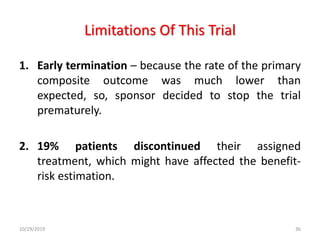
1. Early termination – because the rate of the primary
composite outcome was much lower than
expected, so, sponsor decided to stop the trial
prematurely.
2. 19% patients discontinued their assigned
treatment, which might have affected the benefit-
risk estimation.
10/29/2019 36
SUMMARY
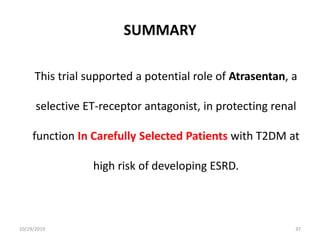
This trial supported a potential role of Atrasentan, a
selective ET-receptor antagonist, in protecting renal
function In Carefully Selected Patients with T2DM at
high risk of developing ESRD.
10/29/2019 37
Thank You
10/29/2019 38

Sonar trial

  • 1.
    The Study OfDiabetic Nephropathy With AtraSentan (SONAR Trial) Prem Mohan Jha 10/29/2019 1
  • 2.
    Published in THELANCET Journal, VOLUME 393, ISSUE 10184, P1937-1947, MAY 11, 2019 10/29/2019 2
  • 3.
    INDTRODUCTION • Endothelin receptorantagonists reduces albuminuria and blood pressure, like ACEi & ARBs. • But it also causes sodium retention, which may leads to increased risk of heart failure in patients with chronic kidney disease and diabetes. 10/29/2019 3
  • 4.
    INDTRODUCTION • A previoustrial (ASCEND Trial, published in 2012) using Avosentan, a non-selective endothelin receptor antagonist, in patients with diabetes and chronic kidney disease, was Stopped Prematurely because of an increased incidence of heart failure. • ATRASENTAN is a selective Endothelin-A receptor Antagonist. 10/29/2019 4
  • 5.
  • 6.
    • The SONARtrial designed to assess the efficacy and safety of Atrasentan in patients with T2DM and CKD. 10/29/2019 6
  • 7.
  • 8.
    STUDY DESIGN Double -Blind Randomised Placebo-controlled Trial Done in 689 sites 41 countries. 10/29/2019 8
  • 9.
    INCLUSION CRITERIAS 1. Adultsaged between 18-85 years with T2DM 2. eGFR of 25-75 ml/min/1.73m2 of BSA 3. UACR of 300-5000 mg/gm 4. Serum albumin of at least 2.5 mg/dl 5. BNP concentration of <200 pg/ml 6. Serum potassium of 3.5-5.0 mg/dl 7. SBP of 110-180 mmHg 10/29/2019 9
  • 10.
    INCLUSION CRITERIAS 8. Treatmentwith a stable, recommended (or maximally tolerated) dose of an ACEI or ARB was required for at least 4 weeks before entry into the enrichment period. 10/29/2019 10
  • 11.
    EXCLUSION CRITERIAS 1. Adiagnosed case of or previous hospitalization for heart failure 2. H/o severe peripheral or facial edema 3. T1DM 4. H/o Pulmonary hypertension, pulmonary fibrosis, or any lung disease requiring oxygen therapy 5. Non-diabetic kidney disease 10/29/2019 11
  • 12.
    PROCEDURE  The eligiblepatients enterered a 4 week run in period followed by 6-weeks of Enrichment period, during which they received open- label treatment with Atrasentan at dose of 0.75mg/day.  The Enrichment period was used To Identify Atrasentan Responders.  Defined as patients with at least a 30% reduction in UACR, who did not have substantial fluid retention, and did not have an increase in s.creatinine of >0.5 mg/dl or >20% from baseline. 10/29/2019 12
  • 13.
    PROCEDURE • After 6weeks, all responders who continued to meet eligible criteria were Randomly assigned to continue atrasentan 0.75mg daily or switch to placebo. • After randomisation, in-person study visits were done after 1 month and 3 months, then every 3 months thereafter. • And a last follow-up visit was done 45 days after the last dose of study drug to assess effects and adverse effects of drug. 10/29/2019 13

  • 14.
    10/29/2019 14 4 weeks-Diuretics+ ACEI/ARB 6 weeks
  • 15.
  • 16.
  • 17.
    PRIMARY OUTCOMES • Efficacyof atrasentan in delaying the progression of CKD, defined as the time from randomization to the first occurrence of any of the following components of a composite: – Doubling of serum creatinine – Onset of end stage renal disease (eGFR < 15 ml/min, chronic dialysis,renal transplantation) – Death from kidney failure. 10/29/2019 17
  • 18.
    SECONDARY OUTCOMES • Timeto at least 50% eGFR reduction. • Time to Cardio-renal Composite Endpoint consisted of – Doubling of serum creatinine, – ESRD – CV death (including CV death and presumed CV death) – Nonfatal myocardial infarction (MI; heart attack) – Nonfatal stroke. • Time to First Occurrence of a Component of Composite Renal Endpoint for All Randomized Participants (responders and non- responders combined) renal endpoint in all randomly assigned patients. 10/29/2019 18
  • 19.
    RESULTS • Between May17, 2013, and July 13, 2017, 11,087 patients were screened; 5117 entered the enrichment period, and 4711 completed the enrichment period. • Of these, 2648 patients were responders and were randomly assigned to the atrasentan group (n=1325) or placebo group (n=1323). • Responders who entered the double-blind treatment period were followed up for a median period of 2.2 years. 10/29/2019 19
  • 20.
    BASELINE CHARACTERISTICS Remarkably, 75%of them were men, with about a third being Asian but only 5% being black. Mean duration of diabetes was about 16 years, and a third of them had retinopathy. The mean blood pressure was not bad (~ 136/75) and ARBs:ACEi were used in a 2:1 ratio overall. Mean GFR was ~ 45 and the median ACR was 800 mg/g. During follow-up, 260 (19.6%) of 1325 patients in the atrasentan group and 251 (19.0%) of 1323 in the placebo group discontinued treatment prematurely. 10/29/2019 20
  • 21.
    10/29/2019 21 Mean age= 65 yrs Mean BMI=30 800 mg/g
  • 22.
  • 23.
    During Study PeriodTrends Of UACR, SBP, BNP & Body weight: 10/29/2019 23
  • 24.
    10/29/2019 24 Low UACRIn Atracentan Group
  • 25.
    10/29/2019 25 Higher BPIn Atracentan Group
  • 26.
    10/29/2019 26 Higher BNPIn Atracentan Group
  • 27.
    10/29/2019 27 Almost samedecline in weight
  • 28.
    Effects Of AtrasentanOn Primary Composite Renal Outcome And Its Components In Responders 10/29/2019 28
  • 29.
    10/29/2019 29 Composite PrimaryRenal Outcome Doubling Of S. Creat ESRD
  • 30.
    10/29/2019 30 ATRACENTAN PLACEBOP VALUE Rates Of Hospital Admission For Heart Failure 3.5% 2.6% 0.208 Death 4.4% 3.9% 0.650 ATRASENTAN PLACEBO P VALUE Mean Rate Of Change In eGFR -2.4 ml/min/1.73 m2 per year -3.1 ml/min/1.73 m2 per year 0.00049
  • 31.
    Adverse Events DuringTrial Period • Significantly more frequently among people treated with atrasentan versus placebo (36.3 vs 32.6%), as did the treatment-emergent adverse events of fluid retention (36.6 vs 32.3%) and anemia (18.5 vs 10.3%). • The higher adverse events with atrasentan occurred despite selection of patients at low risk of these outcomes (eg low BNP) and the ‘enrichment’ period which screened out patients who had immediate adverse events. 10/29/2019 31
  • 32.
  • 33.
    DISCUSSION • Guidelines recommendeduse of ACEi and ARBs as well as optimised BP and glycemic control to minimise renal risk in patients with T2DM & albuminuria. • However, Increased expression of Endothelin-1 has also been implicated in progressive loss of renal function these patients. 10/29/2019 33
  • 34.
    DISCUSSION • Increase inrenal endothelin-1 in DKD is stimulated by multiple factors, like acidosis, angiotensin-2, dyslipidemia, hypoxia, growth factors, inflammatory cytokines, oxidative stress, insulin and hyperglycemia. • In turn, endothelin-1 exerts multiple patho-physiological effects, including injury to vasculature (enhanced vaso- reactivity and pro-coagulation), podocytes (nephron shedding, cytoskeletal dysruption and proteinuria), tubulointerstitial fibrosis, mesangial proliferation and maxtrix expansion, as well as promoting inflamatory cell infilteration. 10/29/2019 34
  • 35.
    DISCUSSION • In experimentalstudies, ET-receptor antagonists improved renal morphology & function, and reduced proteinuria through multiple mechanisms, including attenuated damage to mesangial cells, podocytes, renal tubules and glycocalyx, & also reduces BP. • The findings from this trial support the value of atrasentan in protecting kidney function in carefully selected patients with T2DM & CKD, who are responders to an initial reduction in albuminuria with short term ET- receptor blockers. 10/29/2019 35
  • 36.
    Limitations Of ThisTrial 1. Early termination – because the rate of the primary composite outcome was much lower than expected, so, sponsor decided to stop the trial prematurely. 2. 19% patients discontinued their assigned treatment, which might have affected the benefit- risk estimation. 10/29/2019 36
  • 37.
    SUMMARY This trial supporteda potential role of Atrasentan, a selective ET-receptor antagonist, in protecting renal function In Carefully Selected Patients with T2DM at high risk of developing ESRD. 10/29/2019 37
  • 38.