• A CASE STUDY ON
• DIABETIC FOOT
PREPARED BY
MARTIN SHAJI
Pharm d
PATIENT DEMOGRAPHY
• Patient name –Mr. x OP no. –163008
• Admission date- 03-12- 19
• Age-69
• Sex-m
• Department- Endocrinology
GENERAL EXAMINATIONS
1. Physical examination: patient conscious and coherent
Vital signs:
Temperature (o F): afebrile
Pulse rate (/min): 90beats
Blood Pressure (mm of Hg):130/90mm of Hg
RR:21/min
2. Systems Examination:
CVS: S1, S2 +
RS: NVBSP
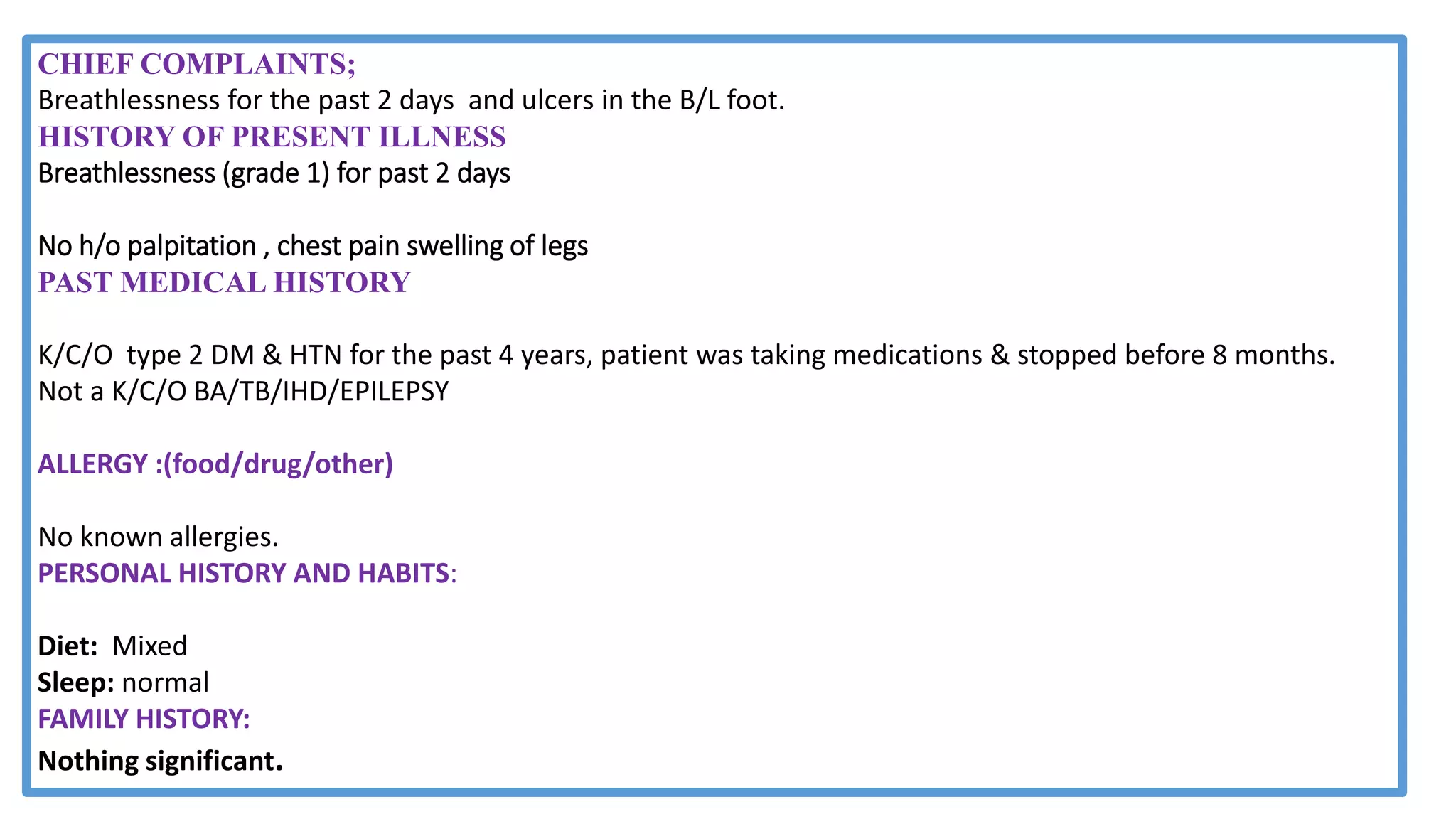
CHIEF COMPLAINTS;
Breathlessness for the past 2 days and ulcers in the B/L foot.
HISTORY OF PRESENT ILLNESS
Breathlessness (grade 1) for past 2 days
No h/o palpitation , chest pain swelling of legs
PAST MEDICAL HISTORY
K/C/O type 2 DM & HTN for the past 4 years, patient was taking medications & stopped before 8 months.
Not a K/C/O BA/TB/IHD/EPILEPSY
ALLERGY :(food/drug/other)
No known allergies.
PERSONAL HISTORY AND HABITS:
Diet: Mixed
Sleep: normal
FAMILY HISTORY:
Nothing significant.
S.
No
Parameter Value Normal range
COMPLETE BLOOD COUNT
1 HEAMOGLOBIN 10.1g/dl 13-17g/dl
2 DC P-41.6 L-286 E-2 M-5 B-0.4 P-40-60 L-20-40 E-1-6 M-2-6
3 WBC 6150 cells/ cumm 4000-11000 cells/cumm
4 PCV 30.8% 37-46%
RENAL PROFILE
5 FBS 200 mg/dl 70-110mg/dl
6 BUN 17 mg/dl 7-18 mg/dl
7 CREATININE 0.9mg/dl 0.6-1.3mg/dl
8 SODIUM 139mmol/l 134-144mmol/dl
9 POTASSIUM 3.6mmol/dl 3.5-5mmol/dl
10 CHLORIDE 103mmol/l 96-108mmol/dl
11 BICARBONATE 26mmol/dl 21-28mmol/dl
LAB INVESTIGATIONS
LIVER FUNCTION TEST
Total bilirubin 0.4mg/dl 0.1-1mg/dl
Direct bilirubin 0.1mgldl 0-0.3mg/dl
SGPT 32U/L 0-35U/L
SGOT 40U/L 0-35U/L
PROTEIN 6.5 6.4-8.2
ALBUMIN 4.1 3.4-5
GLOBULIN 4.6 2-3.5
SUBJECTIVE EVALUATION
A 69 years old MALE patient was consulted with the complaints of breathlessness
(grade 1) for the past two days and ulcers in the B/L leg .
OBJECTIVE EVALUATION
On Examination, the patient was conscious & coherent. Lab data reveals that elevated
blood glucose level and SGPT along with this parameters such as haemoglobin and PCV
found to be decreased.
ASSESSMENT:
Based on subjective & objective evaluation the physician confirmed it as
Diabetic foot ulcer.
SOAP NOTES
CONFIRMATORY DIAGNOSIS;
DIABETIC FOOT
DRUG CHART
Si
no
Drugs Dose Route Frequency Duration
1 Inj . Human mixtrad ( insulin ) 30/70
100[iU] in 1mL
sc 1-1-1 5days
2 T . Neurobion forte ( vit B12) 2g oral 1-0-1 5 days
3 Inj . TT 0.5 cc IV Stat -
4 Tab . Tramadol 100 mg oral 1-0-1 5 days
5 Tab . Pantocid 40 mg Oral 1-0-0 5 days
6. Cream diafoot sb --- Topical 2-3 times a day 2 weeks
Inj. Human mixtrad (insulin) :
it is used to reduce the blood glucose level it should be administered once daily
subcutaneously before food . It may produce hypoglycaemia. If the dose increase do change
the site of injection since, it occur some local fibrosis or allergic reactions .
T. Neurobioneforte {vitamin B4 +vitamin B6+vitamin B6}:
It is a mixture of multi vitamin . It should be taken twice daily after food .it may produce
drowsiness and numbness of feet.
Inj . Tetanus toxoid {TT} :
It is a drug used to control infection . It promote active immunity it may produce swelling of
lips or tongue .
Inj . Pantocid :
it is an antiulcer drug it is administered once daily for 5 days . It may produce sweating
dizziness ,or dry mouth.
Inj . Tramadol :
it s used to relive pain . It is administered twice daily before food for 5 days . It may produce
sweating dizziness or dry mouth .
REGARDING MEDICATION
- Diafoot SB Cream can be applied externally from knee to toe 2- 3 times a day or
as directed by the physician
- Before application, wash your foot with warm water and dry properly
- Diafoot SB Cream contains Allantoin Topical, Dimethicone Topical, Liquid Paraffin
Topical, Propylene Glycol Topical, Shea Butter and Urea Topical as active
ingredients. It helps to treat the affected skin without affecting serum
osmolality. It also softens the hyperkeratosis areas.
PHARMACIST INTERVENTIONS
1. The prescription was rational.
2. No DDI or ADRs were found
PATIENT COUNSELLING-
Instructions for the patient.
Tips to Take Care of Your Feet
•Check your feet every day.
•Wash your feet every day.
•Smooth corns and calluses gently.
•Trim your toenails straight across.
•Wear shoes and socks at all times.
•Protect your feet from hot and cold.
•Keep the blood flowing to your feet.
•Get a foot check at every health care visit
DISCUSSION
A diabetic foot is a foot that exhibits any pathology that results directly
from diabetes mellitus or any long-term (or "chronic") complication
of diabetes mellitus.
Over time, diabetes may cause nerve damage, also
called diabetic neuropathy, that can cause tingling and pain, and can make you
lose feeling in your feet. When you lose feeling in your feet, you may not feel a
pebble inside your sock or a blister on your foot, which can lead to cuts and
sores. Cuts and sores can become infected.
Diabetes also can lower the amount of blood flow in your feet. Not having
enough blood flowing to your legs and feet can make it hard for a sore or an
infection to heal. Sometimes, a bad infection never heals. The infection might
lead to gangrene.
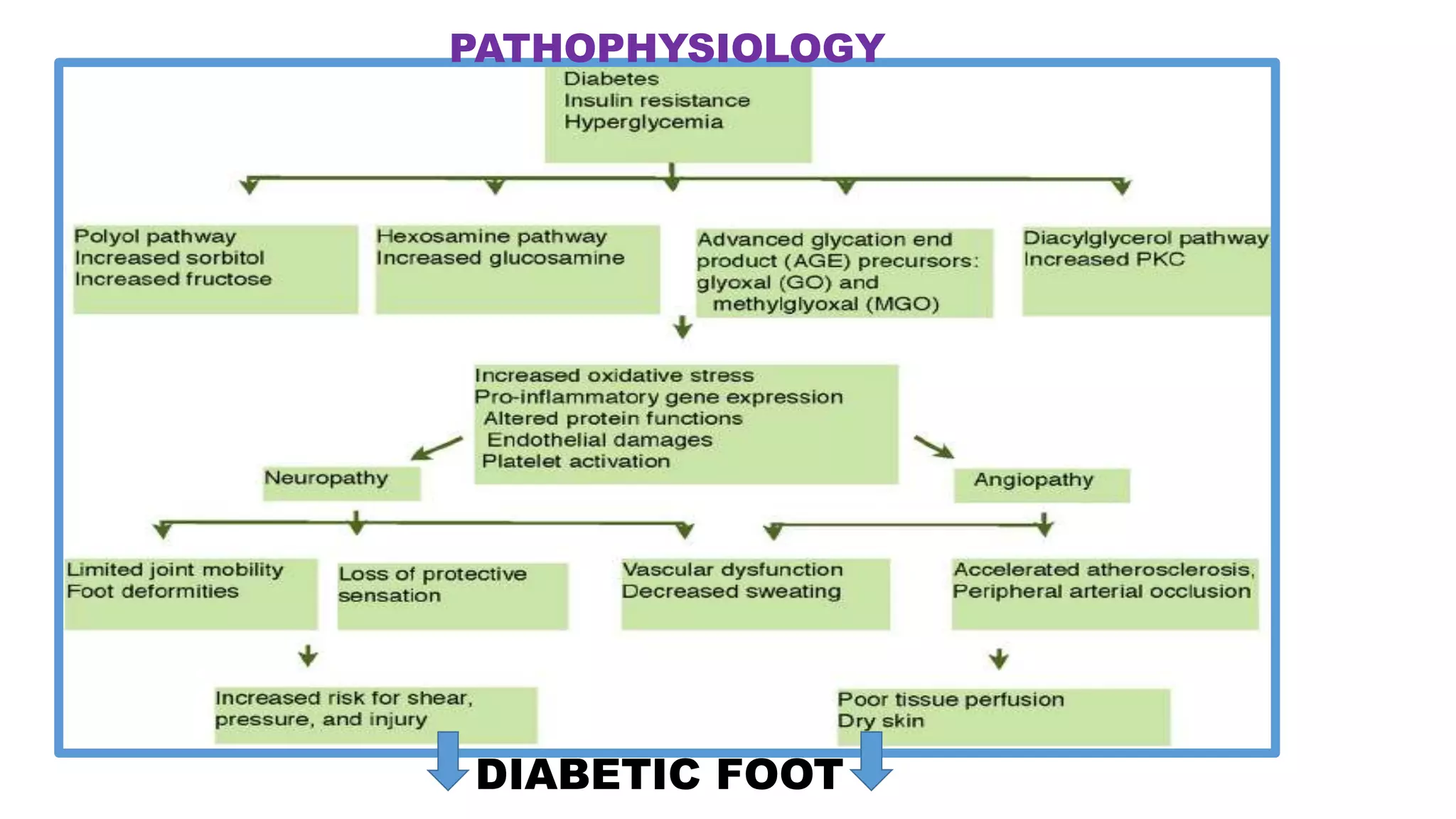
DIABETIC FOOT
PATHOPHYSIOLOGY
a case presentation on diabetic foot/ case study on diabetic foot.

a case presentation on diabetic foot/ case study on diabetic foot.

  • 1.
    • A CASESTUDY ON • DIABETIC FOOT PREPARED BY MARTIN SHAJI Pharm d
  • 2.
    PATIENT DEMOGRAPHY • Patientname –Mr. x OP no. –163008 • Admission date- 03-12- 19 • Age-69 • Sex-m • Department- Endocrinology
  • 3.
    GENERAL EXAMINATIONS 1. Physicalexamination: patient conscious and coherent Vital signs: Temperature (o F): afebrile Pulse rate (/min): 90beats Blood Pressure (mm of Hg):130/90mm of Hg RR:21/min 2. Systems Examination: CVS: S1, S2 + RS: NVBSP
  • 4.
    CHIEF COMPLAINTS; Breathlessness forthe past 2 days and ulcers in the B/L foot. HISTORY OF PRESENT ILLNESS Breathlessness (grade 1) for past 2 days No h/o palpitation , chest pain swelling of legs PAST MEDICAL HISTORY K/C/O type 2 DM & HTN for the past 4 years, patient was taking medications & stopped before 8 months. Not a K/C/O BA/TB/IHD/EPILEPSY ALLERGY :(food/drug/other) No known allergies. PERSONAL HISTORY AND HABITS: Diet: Mixed Sleep: normal FAMILY HISTORY: Nothing significant.
  • 5.
    S. No Parameter Value Normalrange COMPLETE BLOOD COUNT 1 HEAMOGLOBIN 10.1g/dl 13-17g/dl 2 DC P-41.6 L-286 E-2 M-5 B-0.4 P-40-60 L-20-40 E-1-6 M-2-6 3 WBC 6150 cells/ cumm 4000-11000 cells/cumm 4 PCV 30.8% 37-46% RENAL PROFILE 5 FBS 200 mg/dl 70-110mg/dl 6 BUN 17 mg/dl 7-18 mg/dl 7 CREATININE 0.9mg/dl 0.6-1.3mg/dl 8 SODIUM 139mmol/l 134-144mmol/dl 9 POTASSIUM 3.6mmol/dl 3.5-5mmol/dl 10 CHLORIDE 103mmol/l 96-108mmol/dl 11 BICARBONATE 26mmol/dl 21-28mmol/dl LAB INVESTIGATIONS
  • 6.
    LIVER FUNCTION TEST Totalbilirubin 0.4mg/dl 0.1-1mg/dl Direct bilirubin 0.1mgldl 0-0.3mg/dl SGPT 32U/L 0-35U/L SGOT 40U/L 0-35U/L PROTEIN 6.5 6.4-8.2 ALBUMIN 4.1 3.4-5 GLOBULIN 4.6 2-3.5
  • 7.
    SUBJECTIVE EVALUATION A 69years old MALE patient was consulted with the complaints of breathlessness (grade 1) for the past two days and ulcers in the B/L leg . OBJECTIVE EVALUATION On Examination, the patient was conscious & coherent. Lab data reveals that elevated blood glucose level and SGPT along with this parameters such as haemoglobin and PCV found to be decreased. ASSESSMENT: Based on subjective & objective evaluation the physician confirmed it as Diabetic foot ulcer. SOAP NOTES
  • 8.
  • 9.
    DRUG CHART Si no Drugs DoseRoute Frequency Duration 1 Inj . Human mixtrad ( insulin ) 30/70 100[iU] in 1mL sc 1-1-1 5days 2 T . Neurobion forte ( vit B12) 2g oral 1-0-1 5 days 3 Inj . TT 0.5 cc IV Stat - 4 Tab . Tramadol 100 mg oral 1-0-1 5 days 5 Tab . Pantocid 40 mg Oral 1-0-0 5 days 6. Cream diafoot sb --- Topical 2-3 times a day 2 weeks
  • 10.
    Inj. Human mixtrad(insulin) : it is used to reduce the blood glucose level it should be administered once daily subcutaneously before food . It may produce hypoglycaemia. If the dose increase do change the site of injection since, it occur some local fibrosis or allergic reactions . T. Neurobioneforte {vitamin B4 +vitamin B6+vitamin B6}: It is a mixture of multi vitamin . It should be taken twice daily after food .it may produce drowsiness and numbness of feet. Inj . Tetanus toxoid {TT} : It is a drug used to control infection . It promote active immunity it may produce swelling of lips or tongue . Inj . Pantocid : it is an antiulcer drug it is administered once daily for 5 days . It may produce sweating dizziness ,or dry mouth. Inj . Tramadol : it s used to relive pain . It is administered twice daily before food for 5 days . It may produce sweating dizziness or dry mouth . REGARDING MEDICATION
  • 11.
    - Diafoot SBCream can be applied externally from knee to toe 2- 3 times a day or as directed by the physician - Before application, wash your foot with warm water and dry properly - Diafoot SB Cream contains Allantoin Topical, Dimethicone Topical, Liquid Paraffin Topical, Propylene Glycol Topical, Shea Butter and Urea Topical as active ingredients. It helps to treat the affected skin without affecting serum osmolality. It also softens the hyperkeratosis areas.
  • 12.
    PHARMACIST INTERVENTIONS 1. Theprescription was rational. 2. No DDI or ADRs were found
  • 13.
    PATIENT COUNSELLING- Instructions forthe patient. Tips to Take Care of Your Feet •Check your feet every day. •Wash your feet every day. •Smooth corns and calluses gently. •Trim your toenails straight across. •Wear shoes and socks at all times. •Protect your feet from hot and cold. •Keep the blood flowing to your feet. •Get a foot check at every health care visit
  • 14.
    DISCUSSION A diabetic footis a foot that exhibits any pathology that results directly from diabetes mellitus or any long-term (or "chronic") complication of diabetes mellitus. Over time, diabetes may cause nerve damage, also called diabetic neuropathy, that can cause tingling and pain, and can make you lose feeling in your feet. When you lose feeling in your feet, you may not feel a pebble inside your sock or a blister on your foot, which can lead to cuts and sores. Cuts and sores can become infected. Diabetes also can lower the amount of blood flow in your feet. Not having enough blood flowing to your legs and feet can make it hard for a sore or an infection to heal. Sometimes, a bad infection never heals. The infection might lead to gangrene.
  • 15.