Dr. Jorge Avalos
Diabetes
gestacional
medicina
materno
fetal
HNDAC
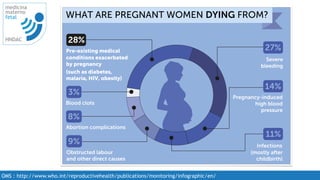
WHAT ARE PREGNANT WOMEN DYING FROM?
Pre-existing medical
conditions exacerbated
by pregnancy
(such as diabetes,
malaria, HIV, obesity)
28%
14%
Pregnancy-induced
high blood
pressure
Severe
bleeding
27%
9%
Obstructed labour
and other direct causes
Blood clots
Abortion complications
Infections
(mostly after
childbirth)
11%
3%
8%
OMS : http://www.who.int/reproductivehealth/publications/monitoring/infographic/en/
medicina
materno
fetal
HNDAC
medicina
materno
fetal
HNDAC
% Prevalence of Adult Obesity (BMI ≥ 30 kg/m ²)
1960’s – 90’s
<5%
5-9.9%
10-14.9%
15-19.9%
20-24.9%
25+ %
© World Obesity Federation, London October 2014. No reproduction without permission. For
permissions please email obesity@worldobesity.org with detail of use for reproduction. For the
most recent data available please view the adult maps and click on the country of interest at
www.worldobesity.org
medicina
materno
fetal
HNDAC
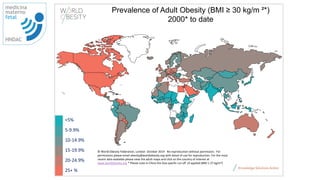
Prevalence of Adult Obesity (BMI ≥ 30 kg/m ²*)
2000* to date
<5%
5-9.9%
10-14.9%
15-19.9%
20-24.9%
25+ %
© World Obesity Federation, London October 2014 No reproduction without permission. For
permissions please email obesity@worldobesity.org with detail of use for reproduction. For the most
recent data available please view the adult maps and click on the country of interest at
www.worldobesity.org * Please note in China the Asia specfic cut off of applied (BMI ≥ 27 kg/m²)
http://www.worldobesity.org/
medicina
materno
fetal
HNDAC
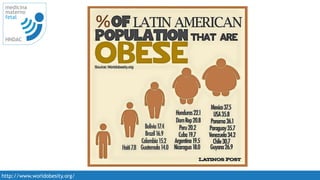
http://www.worldobesity.org/
medicina
materno
fetal
HNDAC
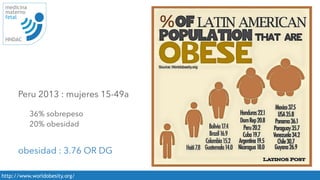
36% sobrepeso
20% obesidad
Peru 2013 : mujeres 15-49a
obesidad : 3.76 OR DG
Gestational Diabetes, Maternal Obesity, and the NCD Burden . CLINICAL OBSTETRICS AND GYNECOLOGY Volume 56, Number 3 2014

medicina
materno
fetal
HNDAC
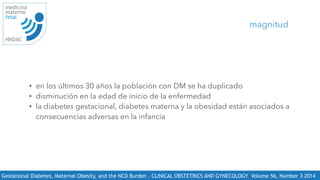
• en los últimos 30 años la población con DM se ha duplicado
• disminución en la edad de inicio de la enfermedad
• la diabetes gestacional, diabetes materna y la obesidad están asociados a
consecuencias adversas en la infancia
magnitud
Los grandes síndromes obstétricos
Diabetes gestacional, RCIU y toxemia
9
medicina
materno
fetal
HNDAC
Los grandes síndromes obstétricos
Diabetes gestacional, RCIU y toxemia
10
medicina
materno
fetal
HNDAC
Adversamente interactua
con la unidad materno-
feto
sub-clinica a clinica con
compromiso fetal
11
medicina
materno
fetal
HNDAC
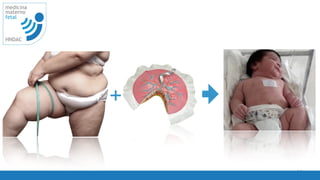
+
12
medicina
materno
fetal
HNDAC
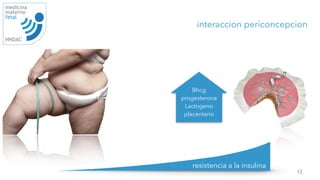
resistencia a la insulina
Bhcg
progesterona
Lactogeno
placentario
interaccion periconcepcion
13
medicina
materno
fetal
HNDAC
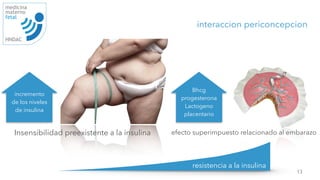
resistencia a la insulina
Bhcg
progesterona
Lactogeno
placentario
incremento
de los niveles
de insulina
Insensibilidad preexistente a la insulina efecto superimpuesto relacionado al embarazo
interaccion periconcepcion
14
medicina
materno
fetal
HNDAC
severidad
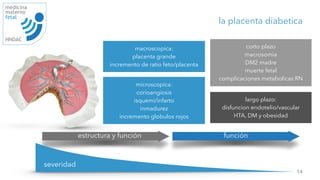
la placenta diabetica
estructura y función función
macroscopica:
placenta grande
incremento de ratio feto/placenta
microscopica:
corioangiosis
isquemi/infarto
inmadurez
incremento globulos rojos
largo plazo:
disfuncion endotelio/vascular
HTA, DM y obesidad
corto plazo
macrosomia
DM2 madre
muerte fetal
complicaciones metabolicas RN
15
medicina
materno
fetal
HNDAC
dialogo: feto-placenta
proteccion o respuestas adaptativas
garantizar el desarrollo fetal en un medio estable
obesity are independent risk factors for neonatal perc
The higher neonatal body fat is of key importance
being seems to be determined very early in the life cy
Fig. 1. Proportion (%) of body fat in neonates born to pregnancies wit
with gestational diabetes mellitus (GDM). GDM neonates have more bo
also with appropriate-for-gestational age birth weight (AGA). No data
16
medicina
materno
fetal
HNDAC
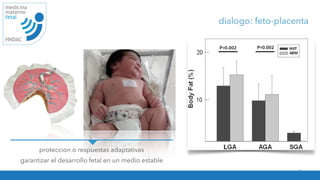
dialogo: feto-placenta
proteccion o respuestas adaptativas
garantizar el desarrollo fetal en un medio estable
obesity are independent risk factors for neonatal percentage body fat and contribute additively [19
The higher neonatal body fat is of key importance because the number of adipocytes for a huma
being seems to be determined very early in the life cycle if not already in utero [20]. The trajectory
Fig. 1. Proportion (%) of body fat in neonates born to pregnancies with normal glucose tolerance of the mother (NGT) and moth
with gestational diabetes mellitus (GDM). GDM neonates have more body fat not only when born large-for-gestational age (LGA) b
also with appropriate-for-gestational age birth weight (AGA). No data are available for small-for-gestational age (SGA) neonates
GDM pregnancies (left panel). Neonates from lean (BMI < 25) mothers have a lower percentage body fat than their counterpa
born to overweight (BMI  25) mothers (right panel). Data taken from Refs. [15,18].
17
medicina
materno
fetal
HNDAC
The Feto-placental Dialogue and Diabesity. Best Practice  Research Clinical Obstetrics and Gynaecology 29 (2015)
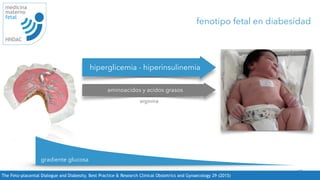
fenotipo fetal en diabesidad
hiperglicemia - hiperinsulinemia
aminoacidos y acidos grasos
arginina
gradiente glucosa
18
medicina
materno
fetal
HNDAC
The Feto-placental Dialogue and Diabesity. Best Practice  Research Clinical Obstetrics and Gynaecology 29 (2015)
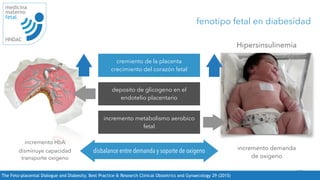
fenotipo fetal en diabesidad
Hipersinsulinemia
cremiento de la placenta
crecimiento del corazón fetal
deposito de glicogeno en el
endotelio placentario
incremento metabolismo aerobico
fetal
incremento demanda
de oxigeno
incremento HbA
disminuye capacidad
transporte oxigeno
disbalance entre demanda y soporte de oxigeno
19
medicina
materno
fetal
HNDAC
The Feto-placental Dialogue and Diabesity. Best Practice  Research Clinical Obstetrics and Gynaecology 29 (2015)
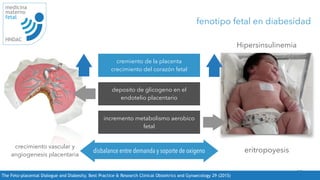
fenotipo fetal en diabesidad
Hipersinsulinemia
cremiento de la placenta
crecimiento del corazón fetal
deposito de glicogeno en el
endotelio placentario
incremento metabolismo aerobico
fetal
eritropoyesis
crecimiento vascular y
angiogenesis placentaria
disbalance entre demanda y soporte de oxigeno
20
medicina
materno
fetal
HNDAC
The Feto-placental Dialogue and Diabesity. Best Practice  Research Clinical Obstetrics and Gynaecology 29 (2015)
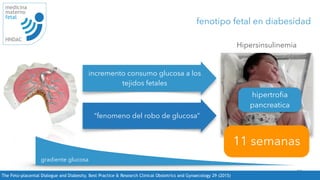
fenotipo fetal en diabesidad
Hipersinsulinemia
gradiente glucosa
incremento consumo glucosa a los
tejidos fetales
hipertrofia
pancreatica
“fenomeno del robo de glucosa”
11 semanas
21
medicina
materno
fetal
HNDAC
The Feto-placental Dialogue and Diabesity. Best Practice  Research Clinical Obstetrics and Gynaecology 29 (2015)
defined as diabetes. Any elevation in maternal glucose and/or insulin early in gestation modifies
placental growth and development. These alterations in the placenta may or may not (unclear yet)
imply a change in transplacental glucose transfer, which along with a higher glucose concentration
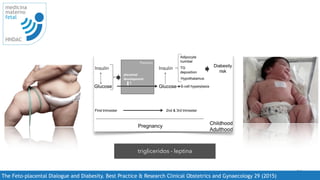
Fig. 2. The mothereplacentaefetus dialogue. The scheme links early maternal metabolism to neonatal adiposity and obesity risk in
later life. For details, see text.
G. Desoye, M. van Poppel / Best Practice  Research Clinical Obstetrics and Gynaecology 29 (2015) 15e23 19
trigliceridos - leptina
22
medicina
materno
fetal
HNDAC
+
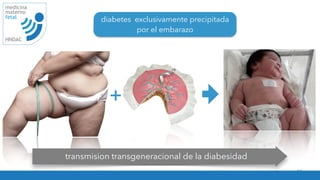
transmision transgeneracional de la diabesidad
diabetes exclusivamente precipitada
por el embarazo
23
medicina
materno
fetal
HNDAC
The Feto-placental Dialogue and Diabesity. Best Practice  Research Clinical Obstetrics and Gynaecology 29 (2015)
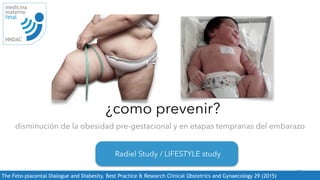
¿como prevenir?
disminución de la obesidad pre-gestacional y en etapas tempranas del embarazo
Radiel Study / LIFESTYLE study
The first trimester: Prediction and prevention of the great obstetrical syndromes.Best Practice  Research Clinical Obstetrics and Gynaecology 29 (2015)
medicina
materno
fetal
HNDAC
ospital, London, UK
methods
ing all
oblems
, 1901,
s urged
ertaken
empted
his led
tuted a
played
nal and
ury.
issued
ending
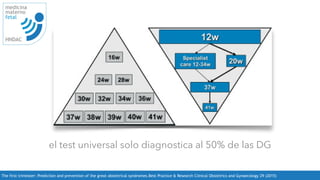
Figure 1—Pyramid of prenatal care: past (left) and future (right)
FETAL ANEUPLOIDIES
el test universal solo diagnostica al 50% de las DG
Prediccion y prevencion de DMG
prevenir incrementos leves de glucosa 1T
prevenir riesgo de DM2 en la gestante
25
medicina
materno
fetal
HNDAC
The first trimester: Prediction and prevention of the great obstetrical syndromes.Best Practice  Research Clinical Obstetrics and Gynaecology 29 (2015)
26
medicina
materno
fetal
HNDAC
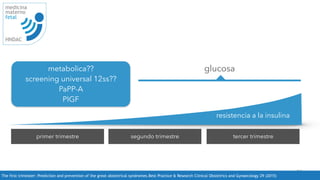
The first trimester: Prediction and prevention of the great obstetrical syndromes.Best Practice  Research Clinical Obstetrics and Gynaecology 29 (2015)
resistencia a la insulina
primer trimestre tercer trimestresegundo trimestre
glucosametabolica??
screening universal 12ss??
PaPP-A
PIGF
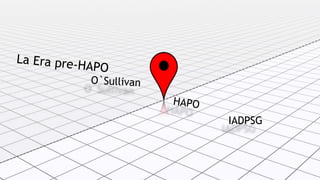
HAPO
La Era pre-HAPO
IADPSG
O`Sullivan
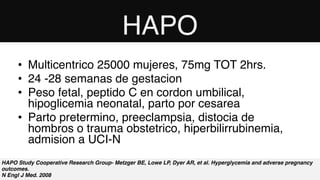
HAPO Study Cooperative Research Group- Metzger BE, Lowe LP, Dyer AR, et al. Hyperglycemia and adverse pregnancy
outcomes.

N Engl J Med. 2008
• Multicentrico 25000 mujeres, 75mg TOT 2hrs.
• 24 -28 semanas de gestacion
• Peso fetal, peptido C en cordon umbilical,
hipoglicemia neonatal, parto por cesarea
• Parto pretermino, preeclampsia, distocia de
hombros o trauma obstetrico, hiperbilirrubinemia,
admision a UCI-N
HAPO
HAPO Study Cooperative Research Group- Metzger BE, Lowe LP, Dyer AR, et al. Hyperglycemia and adverse pregnancy
outcomes.

N Engl J Med. 2008
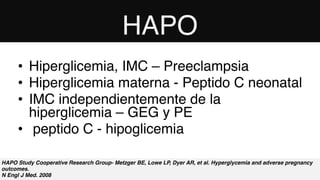
• Hiperglicemia, IMC – Preeclampsia
• Hiperglicemia materna - Peptido C neonatal
• IMC independientemente de la
hiperglicemia – GEG y PE
• peptido C - hipoglicemia
HAPO
ACOG

American College Obstetrics and Ginecology
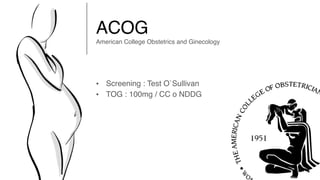
• Screening : Test O`Sullivan
• TOG : 100mg / CC o NDDG
IADPSG

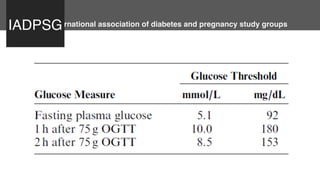
International association of diabetes and pregnancy study groups
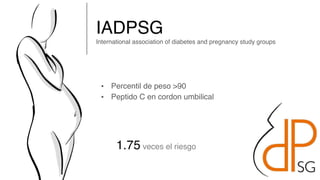
• Percentil de peso 90
• Peptido C en cordon umbilical
1.75 veces el riesgo
International association of diabetes and pregnancy study groupsIADPSG

Diabetes gestacional

  • 1.
  • 2.
  • 3.
    WHAT ARE PREGNANTWOMEN DYING FROM? Pre-existing medical conditions exacerbated by pregnancy (such as diabetes, malaria, HIV, obesity) 28% 14% Pregnancy-induced high blood pressure Severe bleeding 27% 9% Obstructed labour and other direct causes Blood clots Abortion complications Infections (mostly after childbirth) 11% 3% 8% OMS : http://www.who.int/reproductivehealth/publications/monitoring/infographic/en/ medicina materno fetal HNDAC
  • 4.
    medicina materno fetal HNDAC % Prevalence ofAdult Obesity (BMI ≥ 30 kg/m ²) 1960’s – 90’s <5% 5-9.9% 10-14.9% 15-19.9% 20-24.9% 25+ % © World Obesity Federation, London October 2014. No reproduction without permission. For permissions please email obesity@worldobesity.org with detail of use for reproduction. For the most recent data available please view the adult maps and click on the country of interest at www.worldobesity.org
  • 5.
    medicina materno fetal HNDAC Prevalence of AdultObesity (BMI ≥ 30 kg/m ²*) 2000* to date <5% 5-9.9% 10-14.9% 15-19.9% 20-24.9% 25+ % © World Obesity Federation, London October 2014 No reproduction without permission. For permissions please email obesity@worldobesity.org with detail of use for reproduction. For the most recent data available please view the adult maps and click on the country of interest at www.worldobesity.org * Please note in China the Asia specfic cut off of applied (BMI ≥ 27 kg/m²)
  • 6.
  • 7.
  • 8.
    Gestational Diabetes, MaternalObesity, and the NCD Burden . CLINICAL OBSTETRICS AND GYNECOLOGY Volume 56, Number 3 2014
 medicina materno fetal HNDAC • en los últimos 30 años la población con DM se ha duplicado • disminución en la edad de inicio de la enfermedad • la diabetes gestacional, diabetes materna y la obesidad están asociados a consecuencias adversas en la infancia magnitud
  • 9.
    Los grandes síndromesobstétricos Diabetes gestacional, RCIU y toxemia 9 medicina materno fetal HNDAC
  • 10.
    Los grandes síndromesobstétricos Diabetes gestacional, RCIU y toxemia 10 medicina materno fetal HNDAC Adversamente interactua con la unidad materno- feto sub-clinica a clinica con compromiso fetal
  • 11.
  • 12.
    12 medicina materno fetal HNDAC resistencia a lainsulina Bhcg progesterona Lactogeno placentario interaccion periconcepcion
  • 13.
    13 medicina materno fetal HNDAC resistencia a lainsulina Bhcg progesterona Lactogeno placentario incremento de los niveles de insulina Insensibilidad preexistente a la insulina efecto superimpuesto relacionado al embarazo interaccion periconcepcion
  • 14.
    14 medicina materno fetal HNDAC severidad la placenta diabetica estructuray función función macroscopica: placenta grande incremento de ratio feto/placenta microscopica: corioangiosis isquemi/infarto inmadurez incremento globulos rojos largo plazo: disfuncion endotelio/vascular HTA, DM y obesidad corto plazo macrosomia DM2 madre muerte fetal complicaciones metabolicas RN
  • 15.
    15 medicina materno fetal HNDAC dialogo: feto-placenta proteccion orespuestas adaptativas garantizar el desarrollo fetal en un medio estable obesity are independent risk factors for neonatal perc The higher neonatal body fat is of key importance being seems to be determined very early in the life cy Fig. 1. Proportion (%) of body fat in neonates born to pregnancies wit with gestational diabetes mellitus (GDM). GDM neonates have more bo also with appropriate-for-gestational age birth weight (AGA). No data
  • 16.
    16 medicina materno fetal HNDAC dialogo: feto-placenta proteccion orespuestas adaptativas garantizar el desarrollo fetal en un medio estable obesity are independent risk factors for neonatal percentage body fat and contribute additively [19 The higher neonatal body fat is of key importance because the number of adipocytes for a huma being seems to be determined very early in the life cycle if not already in utero [20]. The trajectory Fig. 1. Proportion (%) of body fat in neonates born to pregnancies with normal glucose tolerance of the mother (NGT) and moth with gestational diabetes mellitus (GDM). GDM neonates have more body fat not only when born large-for-gestational age (LGA) b also with appropriate-for-gestational age birth weight (AGA). No data are available for small-for-gestational age (SGA) neonates GDM pregnancies (left panel). Neonates from lean (BMI < 25) mothers have a lower percentage body fat than their counterpa born to overweight (BMI 25) mothers (right panel). Data taken from Refs. [15,18].
  • 17.
    17 medicina materno fetal HNDAC The Feto-placental Dialogueand Diabesity. Best Practice Research Clinical Obstetrics and Gynaecology 29 (2015) fenotipo fetal en diabesidad hiperglicemia - hiperinsulinemia aminoacidos y acidos grasos arginina gradiente glucosa
  • 18.
    18 medicina materno fetal HNDAC The Feto-placental Dialogueand Diabesity. Best Practice Research Clinical Obstetrics and Gynaecology 29 (2015) fenotipo fetal en diabesidad Hipersinsulinemia cremiento de la placenta crecimiento del corazón fetal deposito de glicogeno en el endotelio placentario incremento metabolismo aerobico fetal incremento demanda de oxigeno incremento HbA disminuye capacidad transporte oxigeno disbalance entre demanda y soporte de oxigeno
  • 19.
    19 medicina materno fetal HNDAC The Feto-placental Dialogueand Diabesity. Best Practice Research Clinical Obstetrics and Gynaecology 29 (2015) fenotipo fetal en diabesidad Hipersinsulinemia cremiento de la placenta crecimiento del corazón fetal deposito de glicogeno en el endotelio placentario incremento metabolismo aerobico fetal eritropoyesis crecimiento vascular y angiogenesis placentaria disbalance entre demanda y soporte de oxigeno
  • 20.
    20 medicina materno fetal HNDAC The Feto-placental Dialogueand Diabesity. Best Practice Research Clinical Obstetrics and Gynaecology 29 (2015) fenotipo fetal en diabesidad Hipersinsulinemia gradiente glucosa incremento consumo glucosa a los tejidos fetales hipertrofia pancreatica “fenomeno del robo de glucosa” 11 semanas
  • 21.
    21 medicina materno fetal HNDAC The Feto-placental Dialogueand Diabesity. Best Practice Research Clinical Obstetrics and Gynaecology 29 (2015) defined as diabetes. Any elevation in maternal glucose and/or insulin early in gestation modifies placental growth and development. These alterations in the placenta may or may not (unclear yet) imply a change in transplacental glucose transfer, which along with a higher glucose concentration Fig. 2. The mothereplacentaefetus dialogue. The scheme links early maternal metabolism to neonatal adiposity and obesity risk in later life. For details, see text. G. Desoye, M. van Poppel / Best Practice Research Clinical Obstetrics and Gynaecology 29 (2015) 15e23 19 trigliceridos - leptina
  • 22.
    22 medicina materno fetal HNDAC + transmision transgeneracional dela diabesidad diabetes exclusivamente precipitada por el embarazo
  • 23.
    23 medicina materno fetal HNDAC The Feto-placental Dialogueand Diabesity. Best Practice Research Clinical Obstetrics and Gynaecology 29 (2015) ¿como prevenir? disminución de la obesidad pre-gestacional y en etapas tempranas del embarazo Radiel Study / LIFESTYLE study
  • 24.
    The first trimester:Prediction and prevention of the great obstetrical syndromes.Best Practice Research Clinical Obstetrics and Gynaecology 29 (2015) medicina materno fetal HNDAC ospital, London, UK methods ing all oblems , 1901, s urged ertaken empted his led tuted a played nal and ury. issued ending Figure 1—Pyramid of prenatal care: past (left) and future (right) FETAL ANEUPLOIDIES el test universal solo diagnostica al 50% de las DG
  • 25.
    Prediccion y prevencionde DMG prevenir incrementos leves de glucosa 1T prevenir riesgo de DM2 en la gestante 25 medicina materno fetal HNDAC The first trimester: Prediction and prevention of the great obstetrical syndromes.Best Practice Research Clinical Obstetrics and Gynaecology 29 (2015) The first trimester: Prediction and prevention of the great obstetrical syndromes.Best Practice Research Clinical Obstetrics and Gynaecology 29 (2015)
  • 26.
    26 medicina materno fetal HNDAC The first trimester:Prediction and prevention of the great obstetrical syndromes.Best Practice Research Clinical Obstetrics and Gynaecology 29 (2015) resistencia a la insulina primer trimestre tercer trimestresegundo trimestre glucosametabolica?? screening universal 12ss?? PaPP-A PIGF
  • 27.
  • 28.
    HAPO Study CooperativeResearch Group- Metzger BE, Lowe LP, Dyer AR, et al. Hyperglycemia and adverse pregnancy outcomes.
 N Engl J Med. 2008 • Multicentrico 25000 mujeres, 75mg TOT 2hrs. • 24 -28 semanas de gestacion • Peso fetal, peptido C en cordon umbilical, hipoglicemia neonatal, parto por cesarea • Parto pretermino, preeclampsia, distocia de hombros o trauma obstetrico, hiperbilirrubinemia, admision a UCI-N HAPO
  • 29.
    HAPO Study CooperativeResearch Group- Metzger BE, Lowe LP, Dyer AR, et al. Hyperglycemia and adverse pregnancy outcomes.
 N Engl J Med. 2008 • Hiperglicemia, IMC – Preeclampsia • Hiperglicemia materna - Peptido C neonatal • IMC independientemente de la hiperglicemia – GEG y PE • peptido C - hipoglicemia HAPO
  • 30.
    ACOG
 American College Obstetricsand Ginecology • Screening : Test O`Sullivan • TOG : 100mg / CC o NDDG
  • 31.
    IADPSG
 International association ofdiabetes and pregnancy study groups • Percentil de peso 90 • Peptido C en cordon umbilical 1.75 veces el riesgo
  • 32.
    International association ofdiabetes and pregnancy study groupsIADPSG