Gestational
Diabetes Mellitus
(GDM)
Training, Madhya Pradesh
1-2 April, 2016
Presentation title Date 1
Dr Sachin Chittawar DM (Endocrinology)
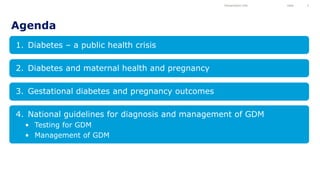
1. Diabetes – a public health crisis
2. Diabetes and maternal health and pregnancy
3. Gestational diabetes and pregnancy outcomes
4. National guidelines for diagnosis and management of GDM
• Testing for GDM
• Management of GDM
Agenda
Presentation title Date 2
Presentation title Date 3
Diabetes
a public health crisis
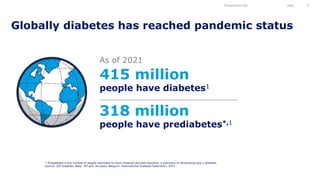
Globally diabetes has reached pandemic status
Presentation title Date 4
415 million
people have diabetes1
As of 2021
318 million
people have prediabetes*,1
* Prediabetes is the number of people estimated to have impaired glucose tolerance, a precursor to developing type 2 diabetes
Source: IDF Diabetes Atlas, 7th edn. Brussels, Belgium: International Diabetes Federation, 2015
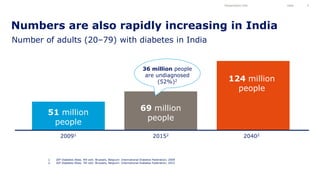
Numbers are also rapidly increasing in India
Presentation title Date 5
Number of adults (20–79) with diabetes in India
20091 20152 20402
124 million
people
69 million
people
51 million
people
1. IDF Diabetes Atlas, 4th edn. Brussels, Belgium: International Diabetes Federation, 2009
2. IDF Diabetes Atlas, 7th edn. Brussels, Belgium: International Diabetes Federation, 2015
36 million people
are undiagnosed
(52%)2
Diabetes is associated with serious complications
Presentation title Date 6
Consistently high blood glucose levels can lead to serious disease affecting the heart and
blood vessels, eyes, kidneys and nerves
STROKE
Strokes are up
to four times
as likely
BLINDNESS
Diabetes is a
leading cause
of blindness
HEART ATTACK
Heart attack is
three times as
likely
KIDNEY FAILURE
Total kidney
failure is three
times as likely
AMPUTATION
Diabetes is a leading
cause of non-
traumatic lower-limb
amputations
Source: IDF Diabetes Atlas, 7th edn. Brussels, Belgium: International Diabetes Federation, 2015
The costs to society are high
Presentation title Date 7
Healthcare costs for people with diabetes are two- to three-fold higher than for people
without diabetes and the costs are increasing
1. IDF Diabetes Atlas, 7th edn. Brussels, Belgium: International Diabetes Federation, 2015
2. IDF Diabetes Atlas, 4th edn. Brussels, Belgium: International Diabetes Federation, 2009
3. IDF Diabetes Atlas, 6th edn. Brussels, Belgium: International Diabetes Federation, 2013
* Estimated global diabetes-related healthcare expenditure1
12%
88%
12% of global healthcare expenditure
was for diabetes in 2015
$376
billion2
$548
billion3
$673
billion1
$802
billion1
2009 2013 2015 2040
Global diabetes healthcare expenditure has increased 79%
since 2009
79%
increase
*
$6.5 billion
in India2
Presentation title Date 8
What does diabetes
have to do with
maternal health and
pregnancy?
Hyperglycaemia in pregnancy can
be classified as:
Presentation title Date 9
Diabetes in Pregnancy (DIP) Gestational Diabetes (GDM)
Diabetes detected
prior to pregnancy
(Type 1 and Type 2)
Diabetes first
detected in
pregnancy
(Type 1 and Type 2)
Diabetes continues post delivery
Pregnant women who have never had
diabetes but who have high blood glucose
levels during pregnancy
Transient and disappears after birth
Source: IDF Diabetes Atlas, 7th edn. Brussels, Belgium: International Diabetes Federation, 2015
Hod M, Kapur A, Sacks DA, et al. The International Federation of Gynecology and Obstetrics (FIGO) Initiative on gestational diabetes mellitus: A pragmatic guide for diagnosis,
management, and care. International Journal of Gynecology and Obstetrics: the official organ of the International Federation of Gynecology and Obstetrics. 2015;131:S173.
Gestational diabetes is the most common cause of
hyperglycaemia in pregnancy1
Gestational Diabetes March 2016 10
1. International Diabetes Federation. IDF Diabetes Atlas, 7th edn. Brussels, Belgium: International Diabetes Federation, 2015.
2. Feig DS, Corcoy R, Jensen DM, et al. Diabetes in pregnancy outcomes: A systematic review and proposed codification of definitions.
Diabetes/metabolism research and reviews. 2015;31(7):680–690.
15% of cases
Diabetes in pregnancy2
DIP maybe either pre-
existing diabetes (type 1
or type 2) antedating
pregnancy, or diabetes first
detected during pregnancy
85% of cases
Gestational diabetes2
Glucose intolerance with
first onset during
pregnancy
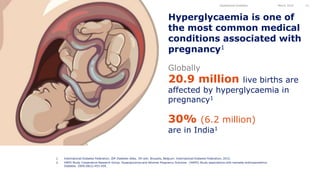
Hyperglycaemia is one of
the most common medical
conditions associated with
pregnancy1
Gestational Diabetes March 2016 11
1. International Diabetes Federation. IDF Diabetes Atlas, 7th edn. Brussels, Belgium: International Diabetes Federation, 2015.
2. HAPO Study Cooperative Research Group. Hyperglycemia and Adverse Pregnancy Outcome (HAPO) Study associations with neonatal anthropometrics.
Diabetes. 2009;58(2):453-459.
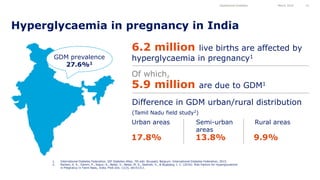
20.9 million live births are
affected by hyperglycaemia in
pregnancy1
Globally
30% (6.2 million)
are in India1
Hyperglycaemia in pregnancy in India
Gestational Diabetes March 2016 12
1. International Diabetes Federation. IDF Diabetes Atlas, 7th edn. Brussels, Belgium: International Diabetes Federation, 2015.
2. Nielsen, K. K., Damm, P., Kapur, A., Balaji, V., Balaji, M. S., Seshiah, V., & Bygbjerg, I. C. (2016). Risk Factors for Hyperglycaemia
in Pregnancy in Tamil Nadu, India. PloS one, 11(3), e0151311.
6.2 million live births are affected by
hyperglycaemia in pregnancy1
5.9 million are due to GDM1
Difference in GDM urban/rural distribution
(Tamil Nadu field study2)
Urban areas Semi-urban
areas
Rural areas
17.8% 13.8% 9.9%
Of which,
GDM prevalence
27.6%1
Presentation title Date 13
How does GDM impact
pregnancy outcomes?
Food for thought!!!
All are diabetogenic in GDM except
• 1) hPL
• 2) Progesterone
• 3) GH
• 4) increase in insulin
• 5) Beta cell failure.
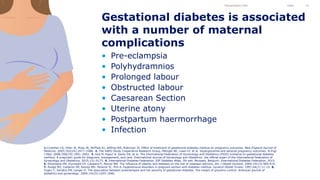
• Pre-eclampsia
• Polyhydramnios
• Prolonged labour
• Obstructed labour
• Caesarean Section
• Uterine atony
• Postpartum haermorrhage
• Infection
Gestational diabetes is associated
with a number of maternal
complications
Presentation title Date 15
1.Crowther CA, Hiller JE, Moss JR, McPhee AJ, Jeffries WS, Robinson JS. Effect of treatment of gestational diabetes mellitus on pregnancy outcomes. New England Journal of
Medicine. 2005;352(24):2477–2486. 2. The HAPO Study Cooperative Research Group, Metzger BE, Lowe LP, et al. Hyperglycemia and adverse pregnancy outcomes. N Engl
J Med. 2008;358(19):1991–2002. 3. Hod M, Kapur A, Sacks DA, et al. The International Federation of Gynecology and Obstetrics (FIGO) Initiative on gestational diabetes
mellitus: A pragmatic guide for diagnosis, management, and care. International Journal of Gynecology and Obstetrics: the official organ of the International Federation of
Gynecology and Obstetrics. 2015;131:S173. 4. International Diabetes Federation. IDF Diabetes Atlas, 7th edn. Brussels, Belgium: International Diabetes Federation, 2015.
5. Ehrenberg HM, Durnwald CP, Catalano P, Mercer BM. The influence of obesity and diabetes on the risk of cesarean delivery. Am J Obstet Gynecol. 2004;191(3):969-974.
7. Rudge MV, Calderon IM, Ramos MD, Peracoli JC, Pim A. Hypertensive disorders in pregnant women with diabetes mellitus. Gynecol Obstet Invest. 1997;44(1):11-15. 8.
Yogev Y, Xenakis EM, Langer O. The association between preeclampsia and the severity of gestational diabetes: the impact of glycemic control. American journal of
obstetrics and gynecology. 2004;191(5):1655-1660.
• Congenital anomalies
• Intra Uterine Growth Restriction (IUGR)
• Increase in still-births
• Macrosomia
• Increased respiratory problems
• Jaundice
• Shoulder dystocia
• Birth injuries
• Neonatal hypoglycaemia
• Infant respiratory distress syndrome
Gestational diabetes is associated
with a number of consequences for
the foetus
Presentation title Date 16
1.Crowther CA, Hiller JE, Moss JR, McPhee AJ, Jeffries WS, Robinson JS. Effect of treatment of gestational diabetes mellitus on pregnancy outcomes. New England Journal
of Medicine. 2005;352(24):2477–2486. 2. The HAPO Study Cooperative Research Group, Metzger BE, Lowe LP, et al. Hyperglycemia and adverse pregnancy outcomes. N
Engl J Med. 2008;358(19):1991–2002. 3. Hod M, Kapur A, Sacks DA, et al. The International Federation of Gynecology and Obstetrics (FIGO) Initiative on gestational
diabetes mellitus: A pragmatic guide for diagnosis, management, and care. International Journal of Gynecology and Obstetrics: the official organ of the International
Federation of Gynecology and Obstetrics. 2015;131:S173. 4. International Diabetes Federation. IDF Diabetes Atlas, 7th edn. Brussels, Belgium: International Diabetes
Federation, 2015. 5.
Children born to mothers with GDM are
up to 8-times more likely to develop
type 2 diabetes and obesity in their
teens or early adulthood.
Gestational diabetes also increases the risk for
type 2 diabetes in both mother and child
Presentation title Date 17
Approximately 50% of women with
GDM go on to develop type 2 diabetes
within five year of pregnancy.
SOURCES: 1. Kim C, Newton KM, Knopp RH. Gestational Diabetes and the Incidence of Type 2 Diabetes: A
Systematic Review, Diabetes Care 25, 2002. 2. Clausen TD, Mathiesen ER, Hansen T, et al. High prevalence of
type 2 diabetes and pre-diabetes in adult offspring of women with gestational diabetes mellitus or type 1
diabetes the role of intrauterine hyperglycemia. Diabetes care. 2008;31(2): 340-346 3. Hod M, Kapur A, Sacks
DA, et al. The International Federation of Gynecology and Obstetrics (FIGO) l of Gynecology and Obstetrics.
2015;131:S137 4. International Diabetes Federation. IDF Diabetes Atlas, 7th edn. Brussels, Belgium:
International Diabetes Federation, 2015.
All of this goes hand in hand with a
general rise of the diabetes pandemic
Presentation title Date 18
Globally recognised risk factors
Gestational diabetes risk factors
Presentation title Date 19
• Personal history of IGT or GDM in a
previous pregnancy
• Ethnicity
• Family history of diabetes, especially in
first degree relatives
• BMI >30 kg/m2
• Maternal age >25 years of age
• Previous delivery of a baby >9 pounds
(4.1 kg)
• Previous unexplained perinatal loss
• Glycosuria at the first prenatal visit
• Medical condition/setting associated with
development of diabetes, such as metabolic
syndrome, polycystic ovary syndrome
(PCOS), current use of glucocorticoids,
hypertension
SOURCES: 1. Solomon, et al. (1997). A prospective study of pregravid determinants of gestational diabetes mellitus. Jama,
278(13), 1078-1083. 2. Kim, C, et al. (2009). Does frank diabetes in first-degree relatives of a pregnant woman affect the
likelihood of her developing gestational diabetes mellitus or nongestational diabetes?. American journal of obstetrics and
gynecology, 201(6), 576-e1. 2. Hedderson, et al. (2008). Body mass index and weight gain prior to pregnancy and risk of
gestational diabetes mellitus. American journal of obstetrics and gynecology, 198(4), 409-e1.
Risk increases when multiple risk factors are present
Food for thought!!!
Exercise increases all except
• Insulin secretion.
• Insulin independent glucose consumption.
• AmP kinase activity.
• Insulin resistance.
• Insulin sensitivity.
In a recent study (2015) from Tamil Nadu,
globally recognised risk factors were not
significant:1
Although risk factors, to some extent, point to
additional risk among certain women, testing
according to risk factors would imply missing
out on 20-30% of hypoglycaemia in pregnancy
cases1
GDM risk factors
Presentation title Date 21
Source: Nielsen, K. K., Damm, P., Kapur, A., Balaji, V., Balaji, M. S., Seshiah, V., & Bygbjerg, I. C.
(2016). Risk Factors for Hyperglycaemia in Pregnancy in Tamil Nadu, India. PloS one, 11(3), e0151311.
“In India… studies indicate that GDM may be
associated with increasing socio-economic
status, and similar trends have been found for
type 2 diabetes.”
GDM risk factors
Presentation title Date 22
Source: Nielsen, K. K., Damm, P., Kapur, A., Balaji, V., Balaji, M. S., Seshiah, V., & Bygbjerg, I. C.
(2016). Risk Factors for Hyperglycaemia in Pregnancy in Tamil Nadu, India. PloS one, 11(3), e0151311.
“…among women attending the rural health
centre a doubling in income caused an 80%
increased risk of HIP [hyperglycaemia in
pregnancy].”
Screening and diagnostic testing for diabetes are performed because
identifying pregnant women with diabetes followed by
appropriate therapy can decrease feotal and maternal
morbidity, particularly macrosomia, shoulder dystocia,
and pre-eclampsia.
Universal testing for GDM is recommended1
Screening and diagnostic testing
Presentation title Date 23
Sources: 1. National Guidelines for Diagnosis & Management of Gestational Diabetes Mellitus
Food for thought!!!
• What is optimal blood sugars in pregnancy?
• Fasting >100,PP >150.
• Fasting >95,PP >140.
• Fasting <95,PP <140.
• Fasting ≤92,PP ≤ 120.
• None of the above.
Presentation title Date 25
Are there national guidelines
for diagnosis and management
of GDM?
National Guidelines for
Diagnosis & Management of
Gestational Diabetes Mellitus
Presentation title Date 26
Available at:
www.nrhmorissa.gov.in/writereaddata/Upload/Doc
uments/National%20Guidelines%20for%20Diagno
sis%20&%20Management%20of%20Gestational%
20Diabetes%20Mellitus.pdf
Testing for GDM
Presentation title Date 27
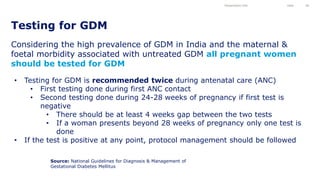
Considering the high prevalence of GDM in India and the maternal &
foetal morbidity associated with untreated GDM all pregnant women
should be tested for GDM
Testing for GDM
Presentation title Date 28
• Testing for GDM is recommended twice during antenatal care (ANC)
• First testing done during first ANC contact
• Second testing done during 24-28 weeks of pregnancy if first test is
negative
• There should be at least 4 weeks gap between the two tests
• If a woman presents beyond 28 weeks of pregnancy only one test is
done
• If the test is positive at any point, protocol management should be followed
Source: National Guidelines for Diagnosis & Management of
Gestational Diabetes Mellitus
Testing for GDM – protocol of investigations
Presentation title Date 29
Source: National Guidelines for Diagnosis & Management of Gestational Diabetes Mellitus
All pregnant women in the community
Testing for GDM at 1st Antenatal visit
(75 g oral glucose - 2 hr Plasma Glucose value)
Manage as GDM as
per guidelines
Negative (2 hr PG <140mg/dl)
Repeat Testing at 24-28 weeks
Positive (2 hr PG ≥ 140
mg/dl)
Negative (2 hr PG <
140mg/dl)
Manage as normal ANC
Manage as GDM as per
guidelines
Positive (2 hr PG ≥ 140
mg/dl)
• Single step testing using 75 g Oral Glucose Tolerance Test (OGTT) and
measuring plasma glucose 2 hours after ingestion
• 75 g glucose to be given orally after dissolving in approximately 300 ml
water whether woman comes in fasting or non-fasting state
• Intake of solution has to be completed within 5 min.
• A plasma standardised glucometer should be used to evaluate blood glucose
2 hours after the oral glucose load
• If vomiting occurs within 30 min of oral glucose intake the test has to be
repeated the next day. If vomiting occurs after 30 minutes the test continues
• The threshold plasma glucose level of ≥140 mg/dL is taken as cut off for
diagnosis of GDM
Methodology: Test for diagnosis
Presentation title Date 30
Source: National Guidelines for Diagnosis & Management of Gestational Diabetes Mellitus
Food for thought!!!
True about insulin resistance (IR) ?
1) Increases by 50-60 % in 2-3 rd trimester.
2) Insulin sensitivity increases by 50-60 % in 2-3 rd trimester.
3) IR increases in late first trimester.
4) IR decreases in third trimester
Management of GDM
Presentation title Date 32
GDM is managed initially with Medical Nutrition Therapy (MNT) and if not
controlled with MNT, insulin therapy is added to the MNT
Management of GDM
Presentation title Date 33
Pregnant woman with GDM
Medical Nutrition Therapy
2 hr Post Prandial Plasma
Glucose (PPPG)
2 weeks
≥ 120 mg/dl
Start Insulin Therapy
< 120 mg/dl
Continue MNT
• Monitor FBG & 2 hr PPPG every 3rd day or more
frequently till Insulin dose adjusted to maintain normal
plasma glucose levels
• Monitor 2 hr PPPG once weekly
Monitor 2 hr PPPG
• Up to 28 wks: Once in 2 weeks
• After 28 wks: Once a week
Source: National Guidelines for Diagnosis & Management of Gestational Diabetes Mellitus
• In most cases GDM can be managed
by Medical Nutrition Therapy (MNT)
• Principles of MNT
• MNT for GDM primarily involves a
carbohydrate controlled balanced meal
plan
• Nutrition assessment should be
individualised
• Maternal weight gain is the important
measure in follow up visits to determine
whether energy intake is adequate to
support fetal growth
Medical Nutrition Therapy (MNT)
Overall Principles
Presentation title Date 34
Source: National Guidelines for Diagnosis & Management of Gestational Diabetes Mellitus, page
11.
• Carbohydrate foods are essential for a healthy diet for mother and baby.
• Once digested, carbohydrate foods are broken down to glucose, which goes into
the blood stream. The type, amount and frequency of carbohydrate intake has a
major influence on blood glucose readings.
• Large amounts of carbohydrate foods eaten at one time will lead to high blood
glucose level and should be avoided. It is better to spread carbohydrate foods
over 3 small meals and 2-3 snacks each day than taking 3 large meals.
• Complex carbohydrates (e.g. whole grain cereals) should be preferred over
simple carbohydrates like foods with lots of added sugar or honey or foods that
are made from refined white flour.
• Counting the number of carbohydrates serves that a mother eats during the
days will help her to eat the right amount.
Medical Nutrition Therapy (MNT)
Careful Selection of Carbohydrates
Presentation title Date 35
Source: National Guidelines for Diagnosis & Management of Gestational Diabetes
Mellitus, page 11.
• Saturated fat intake (ghee, butter, coconut oil,
palm oil, red meat, organ meat, full cream milk
etc.) should be less than 10% of total calories
and dietary cholesterol should be less than 300
mg/day. In obese and overweight patients, a
lower fat diet overall can help slow down the
rate of weight gain.
• Recommendations
• Use less fat in cooking and avoid frying of foods
• Using low-fat dairy products in place of whole milk
or full cream products
• Choose low-fat snack (e.g. fresh fruit) instead of
high-fat snacks (cakes, biscuits etc.)
• Use lean mean instead of read meat
Medical Nutrition Therapy (MNT)
Understanding Fat Intake During Pregnancy
Presentation title Date 36
Source: National Guidelines for Diagnosis & Management of Gestational Diabetes
Mellitus
For more details, see: Sample Diet Chart and Food
Exchange Chart for MNT in the National GDM Guidelines.
• When and What
• Insulin therapy is the accepted medical management of
pregnant women with GDM not controlled on MNT in 2 weeks
• The National Guidelines recommend the use of Human
Premix insulin 30/70. Oral tablets for diabetes treatment in
pregnancy are not to be given as they are not considered
safe.
• All pregnant women in whom MNT fails to achieve a 2 hr
PPPG <120 mg/dL are started on insulin, along with MNT
• In case of very high 2 hr PPPG:
• If 2 hr PPPG is >200 mg/dL at diagnosis, starting dose of
insulin should be 8 units pre-mixed insulin
• The dose to be adjusted on follow-up and at the same time
MNT has been followed. Frequency of monitoring to be
decided by the treating Physician/Gynaecologist/Medical
Officer.
• If the pregnant women requires more than 20 units
insulin/day, she should be referred to a higher healthcare
centre.
Insulin Therapy
Presentation title Date 37
Source: National Guidelines for Diagnosis & Management of
Gestational Diabetes Mellitus
Food for thought!!!
Insulin approved in Pregnancy are all except ?
• Lispro( Humalog, Humalog mix25, Humalog mix 50)
• Aspart
• Detemir , NPH.
• Glargine , Gluilisin(Apidra), Degludec, Rizodeg.
Human insulin
pmol/min
00:0002:0004:0006:0008:0010:0012:0014:0016:0018:0020:0022:0000:00
200
400
Time
22:00
Meals
Adapted from Polonsky et al. N Engl J Med 1988;318:1231–9
Healthy
insulin response
Soluble
human
insulin
NPH
insulin
SC
Insulin
repl.
NPH, neutral protamine Hagedorn; SC, subcutaneous
Traditional insulin products do not mimic
the healthy insulin response
Insulin Aspart: A step ahead…
Periello. Diabet Med 2005;22:606–11
PPG Insulin
*p<0.05 vs. human insulin
Mean
serum
glucose
(mmol/l)
6
8
10
12
14
0
0 30 60 90 120 150 180 210 240
*
Time (min)
100
200
300
400
0
500
600
Insulin
(pmol/l)
0 30 60 90 120 150 180 210 240
*
Time (min)
Insulin Aspart
Human insulin
Insulin Aspart has a more physiological profile compared to
Human Insulins with improved PPG control
Insulin aspart +
NPH (n=157)
HI + NPH
(n=165)
n E Rate n E Rate
Major 38 113 1.4 35 174 2.1
Minor 148 7197 86.4 148 7944 94.5
Symptoms
only
85 1055 12.7 85 742 8.8
Insulin aspart use in pregnancy
Better PPG control compared to human insulin
Safe for the mother: fewer Hypoglycaemic episodes during pregnancy
Safe for foetus: Significantly lower risk of preterm deliveries
Overall Better foetal outcomes
Mathiesen et al. Diabetes Care 2007;30:771–6, Hod et al. Am J Obstet Gynecol 2008;198:e1–7
Another Question
Which is correct as per color coding of insulin
syringe?
1.Red color is 40 IU syringe.
2.Orange for 100 IU syringe.
3.Blue for 500 IU syringe.
4.None of the above
5.All of the above
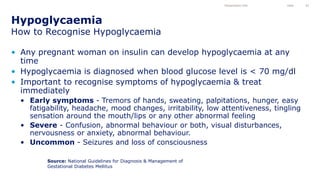
• Any pregnant woman on insulin can develop hypoglycaemia at any
time
• Hypoglycaemia is diagnosed when blood glucose level is < 70 mg/dl
• Important to recognise symptoms of hypoglycaemia & treat
immediately
• Early symptoms - Tremors of hands, sweating, palpitations, hunger, easy
fatigability, headache, mood changes, irritability, low attentiveness, tingling
sensation around the mouth/lips or any other abnormal feeling
• Severe - Confusion, abnormal behaviour or both, visual disturbances,
nervousness or anxiety, abnormal behaviour.
• Uncommon - Seizures and loss of consciousness
Hypoglycaemia
How to Recognise Hypoglycaemia
Presentation title Date 43
Source: National Guidelines for Diagnosis & Management of
Gestational Diabetes Mellitus
• Ask the pregnant women to take 3 TSF of glucose powder (15-20 grams) dissolved
in a glass of water
• After taking oral glucose, she must take rest & avoid any physical activity
• 15 minutes after taking glucose, she must eat one chapati with vegetable/rice/one
• glass of milk/idli/fruits/anything eatable which is available
• If hypoglycaemia continues, repeat same amount of glucose and wait
• If glucose is not available, take one of the following: Sugar - 6 TSF in a glass of
water/fruit juice/honey/anything which is sweet/any food
• Take rest, eat regularly and check blood glucose if possible
• If the pregnant woman develops >1 episode of hypoglycaemia in a day, she should
consult any doctor
• immediately
Hypoglycaemia
How to Manage Hypoglycaemia
Presentation title Date 44
Source: National Guidelines for Diagnosis & Management of
Gestational Diabetes Mellitus
Lowering episodes of hypoglycaemia with the use of
right insulin therapy
Heller et al. J Diabetes 2013; 5:482-491
Per-trial and overall analysis of all nocturnal hypoglycaemic episodes
IAsp, insulin aspart
NPH, neutral protamine Hagedorn
RHI, regular human insulin
0.1 10
Favours IAsp + NPH Favours RHI + NPH
Trial
Treatment difference
(%) [95% CI] P
1
Type 1
Type 1 and Type 2
All
Test of heterogeneity: P=0.092
Type 2
035
036
064
065
066
1634
037
1198
Fixed effects
Random effects
0.75 [0.60; 0.93] 0.01
0.69 [0.56; 0.86] <0.001
0.79 [0.59; 1.06] 0.11
0.79 [0.59; 1.06]
0.83 [0.50; 1.38]
0.12
0.97 [0.59; 1.58] 0.89
0.54 [0.24; 1.22] 0.14
0.68 [0.16; 2.85] 0.59
0.76 [0.67; 0.85] <0.001
0.76 [0.67; 0.85] <0.001
0.48
Lower rate of nocturnal hypoglycaemic episodes with insulin
aspart vs human insulin
• Antenatal care of a pregnant woman with GDM should be provided by a gynaecologist, if available.
• If GDM is diagnosed before 20 weeks of pregnancy, a foetal anatomical survey by USG should be performed at
18-20 weeks.
• For all pregnancies with GDM, a foetal growth scan should be performed at 28-30 weeks gestation & repeated at
34-36 weeks gestation. There should be at least 3 weeks gap between the two ultrasounds and it should include
fetal biometry & amniotic fluid estimation.
• Pregnant women with GDM in whom blood glucose level is well controlled and there are no complications, should
go for routine antenatal care as per GoI guidelines.
• In pregnant women with GDM having uncontrolled blood glucose level or any other complication of pregnancy,
the frequency of antenatal visits should be increased to every 2 weeks in second trimester and every week in
third trimester.
• Monitor for abnormal foetal growth (macrosomia/growth restriction) and polyhydramnios at each ANC visit PW
with GDM to be diligently monitored for hypertension in pregnancy, proteinuria and other obstetric complications
• In pregnant women with GDM between 24-34 weeks of gestation and requiring early delivery, antenatal steroids
should be given as per GoI guidelines i.e. Inj. Dexamethasone 6 mg IM 12 hourly for 2 days. More vigilant
monitoring of blood glucose levels should be done for next 72 hours following injection. In case of raised blood
glucose levels during this period, adjustment of insulin dose should be made accordingly.
Special Obstetric Care for Women with GDM
Antenatal Care
Presentation title Date 46
Source: National Guidelines for Diagnosis & Management of
Gestational Diabetes Mellitus
• Pregnant women with GDM are at an increased risk for foetal death in
utero and this risk is increased in PW requiring medical management.
Hence vigilant foetal surveillance is required.
• Foetal heart should be monitored by auscultation on each antenatal visit.
• The pregnant woman should be explained about Daily Fetal Activity
Assessment
• Woman to lie down on her side after a meal and note how long it takes for the
foetus to kick 10 times.
• If the foetus does not kick 10 times within 2 hrs, she should immediately
consult a healthcare worker and if required should be referred to a higher centre
for further evaluation.
Foetal surveillance in pregnant woman with GDM
Presentation title Date 47
Source: National Guidelines for Diagnosis & Management of
Gestational Diabetes Mellitus
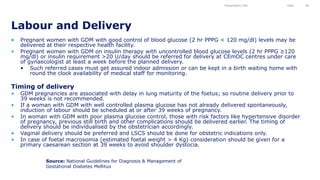
• Pregnant women with GDM with good control of blood glucose (2 hr PPPG < 120 mg/dl) levels may be
delivered at their respective health facility.
• Pregnant women with GDM on insulin therapy with uncontrolled blood glucose levels (2 hr PPPG ≥120
mg/dl) or insulin requirement >20 U/day should be referred for delivery at CEmOC centres under care
of gynaecologist at least a week before the planned delivery.
• Such referred cases must get assured indoor admission or can be kept in a birth waiting home with
round the clock availability of medical staff for monitoring.
Timing of delivery
• GDM pregnancies are associated with delay in lung maturity of the foetus; so routine delivery prior to
39 weeks is not recommended.
• If a woman with GDM with well controlled plasma glucose has not already delivered spontaneously,
induction of labour should be scheduled at or after 39 weeks of pregnancy.
• In woman with GDM with poor plasma glucose control, those with risk factors like hypertensive disorder
of pregnancy, previous still birth and other complications should be delivered earlier. The timing of
delivery should be individualised by the obstetrician accordingly.
• Vaginal delivery should be preferred and LSCS should be done for obstetric indications only.
• In case of foetal macrosomia (estimated foetal weight > 4 Kg) consideration should be given for a
primary caesarean section at 39 weeks to avoid shoulder dystocia.
Labour and Delivery
Presentation title Date 48
Source: National Guidelines for Diagnosis & Management of
Gestational Diabetes Mellitus
• Pregnant women with GDM on insulin
require plasma glucose monitoring
during labour by a glucometer.
• The morning dose of insulin is withheld
on the day of induction/labour and the
PW should be started on 2 hourly
monitoring of plasma glucose.
• IV infusion with normal saline (NS) to
be started and regular insulin to be
added according to blood glucose levels
as per the table to t to the right
Special precaution during labour
Presentation title Date 49
Source: National Guidelines for Diagnosis & Management of
Gestational Diabetes Mellitus
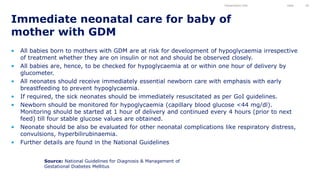
• All babies born to mothers with GDM are at risk for development of hypoglycaemia irrespective
of treatment whether they are on insulin or not and should be observed closely.
• All babies are, hence, to be checked for hypoglycaemia at or within one hour of delivery by
glucometer.
• All neonates should receive immediately essential newborn care with emphasis with early
breastfeeding to prevent hypoglycaemia.
• If required, the sick neonates should be immediately resuscitated as per GoI guidelines.
• Newborn should be monitored for hypoglycaemia (capillary blood glucose <44 mg/dl).
Monitoring should be started at 1 hour of delivery and continued every 4 hours (prior to next
feed) till four stable glucose values are obtained.
• Neonate should be also be evaluated for other neonatal complications like respiratory distress,
convulsions, hyperbilirubinaemia.
• Further details are found in the National Guidelines
Immediate neonatal care for baby of
mother with GDM
Presentation title Date 50
Source: National Guidelines for Diagnosis & Management of
Gestational Diabetes Mellitus
• Immediate postpartum care women with GDM is not different from women without GDM
but these women are at high risk to develop Type 2 Diabetes mellitus in future.
• Maternal glucose levels usually return to normal after delivery.
• Nevertheless, a FPG & 2 hr PPPG is performed on the 3rd day of delivery at the place of
delivery. For this reason, GDM cases are not discharged after 48 hours unlike other
normal PNC cases.
• 6 weeks post partum: 75 g GTT at 6 weeks to evaluate glycaemic status of woman.
• Cut offs for normal blood glucose values are:
• Fasting plasma glucose: ≥ 126 mg/dl
• 75 g OGTT 2 hour plasma glucose
• Normal: < 140 mg/dl
• IGT: 140-199mg/dl
• Diabetes: ≥ 200 mg/dl
Post-delivery follow-up of women with GDM
Presentation title Date 51
Source: National Guidelines for Diagnosis & Management of
Gestational Diabetes Mellitus
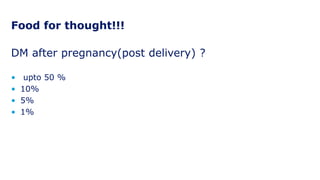
Food for thought!!!
DM after pregnancy(post delivery) ?
• upto 50 %
• 10%
• 5%
• 1%
Bringing blood glucose in good control is almost entirely in the hands of the
pregnant woman with GDM
It is important that:
• The pregnant woman understands both the short- and the long-term potential
consequences of her condition (for her and her unborn child)
• Her family (husband and in-laws) understand what GDM is and why a change in
the woman’s/family’s dietary habits may be necessary
• The pregnant woman understands the importance of attending the clinic for
observation and follow-up
• The pregnant woman understands that, while GDM is transitional, both her and her
child at at increased risk of type 2 diabetes in the future
Patient Education - Key to good outcomes
Presentation title Date 53
Additional and detailed information and guidance
is available
Presentation title Date 54
Available at:
www.nrhmorissa.gov.in/writereaddata/U
pload/Documents/National%20Guidelines
%20for%20Diagnosis%20&%20Manage
ment%20of%20Gestational%20Diabetes
%20Mellitus.pdf
National Guidelines for Diagnosis & Management of Gestational
Diabetes Mellitus
Includes detailed information on:
• Evidence
• Technical guidelines on testing & management of GDM
• Operational aspects of GDM Programme
• Records & Registers
• Monitoring and Quality Assurance
• Outcome measures to be assessed
• Tools and resources related to:
• MNT, reporting, Migration form, Referral slip, Glucometer
specifications and calibration
Together we can ensure better
maternal health and pregnancy
outcomes…
... and curb the increasing
type 2 diabetes epidemic
Presentation title Date 55

10225385.ppt

  • 1.
    Gestational Diabetes Mellitus (GDM) Training, MadhyaPradesh 1-2 April, 2016 Presentation title Date 1 Dr Sachin Chittawar DM (Endocrinology)
  • 2.
    1. Diabetes –a public health crisis 2. Diabetes and maternal health and pregnancy 3. Gestational diabetes and pregnancy outcomes 4. National guidelines for diagnosis and management of GDM • Testing for GDM • Management of GDM Agenda Presentation title Date 2
  • 3.
    Presentation title Date3 Diabetes a public health crisis
  • 4.
    Globally diabetes hasreached pandemic status Presentation title Date 4 415 million people have diabetes1 As of 2021 318 million people have prediabetes*,1 * Prediabetes is the number of people estimated to have impaired glucose tolerance, a precursor to developing type 2 diabetes Source: IDF Diabetes Atlas, 7th edn. Brussels, Belgium: International Diabetes Federation, 2015
  • 5.
    Numbers are alsorapidly increasing in India Presentation title Date 5 Number of adults (20–79) with diabetes in India 20091 20152 20402 124 million people 69 million people 51 million people 1. IDF Diabetes Atlas, 4th edn. Brussels, Belgium: International Diabetes Federation, 2009 2. IDF Diabetes Atlas, 7th edn. Brussels, Belgium: International Diabetes Federation, 2015 36 million people are undiagnosed (52%)2
  • 6.
    Diabetes is associatedwith serious complications Presentation title Date 6 Consistently high blood glucose levels can lead to serious disease affecting the heart and blood vessels, eyes, kidneys and nerves STROKE Strokes are up to four times as likely BLINDNESS Diabetes is a leading cause of blindness HEART ATTACK Heart attack is three times as likely KIDNEY FAILURE Total kidney failure is three times as likely AMPUTATION Diabetes is a leading cause of non- traumatic lower-limb amputations Source: IDF Diabetes Atlas, 7th edn. Brussels, Belgium: International Diabetes Federation, 2015
  • 7.
    The costs tosociety are high Presentation title Date 7 Healthcare costs for people with diabetes are two- to three-fold higher than for people without diabetes and the costs are increasing 1. IDF Diabetes Atlas, 7th edn. Brussels, Belgium: International Diabetes Federation, 2015 2. IDF Diabetes Atlas, 4th edn. Brussels, Belgium: International Diabetes Federation, 2009 3. IDF Diabetes Atlas, 6th edn. Brussels, Belgium: International Diabetes Federation, 2013 * Estimated global diabetes-related healthcare expenditure1 12% 88% 12% of global healthcare expenditure was for diabetes in 2015 $376 billion2 $548 billion3 $673 billion1 $802 billion1 2009 2013 2015 2040 Global diabetes healthcare expenditure has increased 79% since 2009 79% increase * $6.5 billion in India2
  • 8.
    Presentation title Date8 What does diabetes have to do with maternal health and pregnancy?
  • 9.
    Hyperglycaemia in pregnancycan be classified as: Presentation title Date 9 Diabetes in Pregnancy (DIP) Gestational Diabetes (GDM) Diabetes detected prior to pregnancy (Type 1 and Type 2) Diabetes first detected in pregnancy (Type 1 and Type 2) Diabetes continues post delivery Pregnant women who have never had diabetes but who have high blood glucose levels during pregnancy Transient and disappears after birth Source: IDF Diabetes Atlas, 7th edn. Brussels, Belgium: International Diabetes Federation, 2015 Hod M, Kapur A, Sacks DA, et al. The International Federation of Gynecology and Obstetrics (FIGO) Initiative on gestational diabetes mellitus: A pragmatic guide for diagnosis, management, and care. International Journal of Gynecology and Obstetrics: the official organ of the International Federation of Gynecology and Obstetrics. 2015;131:S173.
  • 10.
    Gestational diabetes isthe most common cause of hyperglycaemia in pregnancy1 Gestational Diabetes March 2016 10 1. International Diabetes Federation. IDF Diabetes Atlas, 7th edn. Brussels, Belgium: International Diabetes Federation, 2015. 2. Feig DS, Corcoy R, Jensen DM, et al. Diabetes in pregnancy outcomes: A systematic review and proposed codification of definitions. Diabetes/metabolism research and reviews. 2015;31(7):680–690. 15% of cases Diabetes in pregnancy2 DIP maybe either pre- existing diabetes (type 1 or type 2) antedating pregnancy, or diabetes first detected during pregnancy 85% of cases Gestational diabetes2 Glucose intolerance with first onset during pregnancy
  • 11.
    Hyperglycaemia is oneof the most common medical conditions associated with pregnancy1 Gestational Diabetes March 2016 11 1. International Diabetes Federation. IDF Diabetes Atlas, 7th edn. Brussels, Belgium: International Diabetes Federation, 2015. 2. HAPO Study Cooperative Research Group. Hyperglycemia and Adverse Pregnancy Outcome (HAPO) Study associations with neonatal anthropometrics. Diabetes. 2009;58(2):453-459. 20.9 million live births are affected by hyperglycaemia in pregnancy1 Globally 30% (6.2 million) are in India1
  • 12.
    Hyperglycaemia in pregnancyin India Gestational Diabetes March 2016 12 1. International Diabetes Federation. IDF Diabetes Atlas, 7th edn. Brussels, Belgium: International Diabetes Federation, 2015. 2. Nielsen, K. K., Damm, P., Kapur, A., Balaji, V., Balaji, M. S., Seshiah, V., & Bygbjerg, I. C. (2016). Risk Factors for Hyperglycaemia in Pregnancy in Tamil Nadu, India. PloS one, 11(3), e0151311. 6.2 million live births are affected by hyperglycaemia in pregnancy1 5.9 million are due to GDM1 Difference in GDM urban/rural distribution (Tamil Nadu field study2) Urban areas Semi-urban areas Rural areas 17.8% 13.8% 9.9% Of which, GDM prevalence 27.6%1
  • 13.
    Presentation title Date13 How does GDM impact pregnancy outcomes?
  • 14.
    Food for thought!!! Allare diabetogenic in GDM except • 1) hPL • 2) Progesterone • 3) GH • 4) increase in insulin • 5) Beta cell failure.
  • 15.
    • Pre-eclampsia • Polyhydramnios •Prolonged labour • Obstructed labour • Caesarean Section • Uterine atony • Postpartum haermorrhage • Infection Gestational diabetes is associated with a number of maternal complications Presentation title Date 15 1.Crowther CA, Hiller JE, Moss JR, McPhee AJ, Jeffries WS, Robinson JS. Effect of treatment of gestational diabetes mellitus on pregnancy outcomes. New England Journal of Medicine. 2005;352(24):2477–2486. 2. The HAPO Study Cooperative Research Group, Metzger BE, Lowe LP, et al. Hyperglycemia and adverse pregnancy outcomes. N Engl J Med. 2008;358(19):1991–2002. 3. Hod M, Kapur A, Sacks DA, et al. The International Federation of Gynecology and Obstetrics (FIGO) Initiative on gestational diabetes mellitus: A pragmatic guide for diagnosis, management, and care. International Journal of Gynecology and Obstetrics: the official organ of the International Federation of Gynecology and Obstetrics. 2015;131:S173. 4. International Diabetes Federation. IDF Diabetes Atlas, 7th edn. Brussels, Belgium: International Diabetes Federation, 2015. 5. Ehrenberg HM, Durnwald CP, Catalano P, Mercer BM. The influence of obesity and diabetes on the risk of cesarean delivery. Am J Obstet Gynecol. 2004;191(3):969-974. 7. Rudge MV, Calderon IM, Ramos MD, Peracoli JC, Pim A. Hypertensive disorders in pregnant women with diabetes mellitus. Gynecol Obstet Invest. 1997;44(1):11-15. 8. Yogev Y, Xenakis EM, Langer O. The association between preeclampsia and the severity of gestational diabetes: the impact of glycemic control. American journal of obstetrics and gynecology. 2004;191(5):1655-1660.
  • 16.
    • Congenital anomalies •Intra Uterine Growth Restriction (IUGR) • Increase in still-births • Macrosomia • Increased respiratory problems • Jaundice • Shoulder dystocia • Birth injuries • Neonatal hypoglycaemia • Infant respiratory distress syndrome Gestational diabetes is associated with a number of consequences for the foetus Presentation title Date 16 1.Crowther CA, Hiller JE, Moss JR, McPhee AJ, Jeffries WS, Robinson JS. Effect of treatment of gestational diabetes mellitus on pregnancy outcomes. New England Journal of Medicine. 2005;352(24):2477–2486. 2. The HAPO Study Cooperative Research Group, Metzger BE, Lowe LP, et al. Hyperglycemia and adverse pregnancy outcomes. N Engl J Med. 2008;358(19):1991–2002. 3. Hod M, Kapur A, Sacks DA, et al. The International Federation of Gynecology and Obstetrics (FIGO) Initiative on gestational diabetes mellitus: A pragmatic guide for diagnosis, management, and care. International Journal of Gynecology and Obstetrics: the official organ of the International Federation of Gynecology and Obstetrics. 2015;131:S173. 4. International Diabetes Federation. IDF Diabetes Atlas, 7th edn. Brussels, Belgium: International Diabetes Federation, 2015. 5.
  • 17.
    Children born tomothers with GDM are up to 8-times more likely to develop type 2 diabetes and obesity in their teens or early adulthood. Gestational diabetes also increases the risk for type 2 diabetes in both mother and child Presentation title Date 17 Approximately 50% of women with GDM go on to develop type 2 diabetes within five year of pregnancy. SOURCES: 1. Kim C, Newton KM, Knopp RH. Gestational Diabetes and the Incidence of Type 2 Diabetes: A Systematic Review, Diabetes Care 25, 2002. 2. Clausen TD, Mathiesen ER, Hansen T, et al. High prevalence of type 2 diabetes and pre-diabetes in adult offspring of women with gestational diabetes mellitus or type 1 diabetes the role of intrauterine hyperglycemia. Diabetes care. 2008;31(2): 340-346 3. Hod M, Kapur A, Sacks DA, et al. The International Federation of Gynecology and Obstetrics (FIGO) l of Gynecology and Obstetrics. 2015;131:S137 4. International Diabetes Federation. IDF Diabetes Atlas, 7th edn. Brussels, Belgium: International Diabetes Federation, 2015.
  • 18.
    All of thisgoes hand in hand with a general rise of the diabetes pandemic Presentation title Date 18
  • 19.
    Globally recognised riskfactors Gestational diabetes risk factors Presentation title Date 19 • Personal history of IGT or GDM in a previous pregnancy • Ethnicity • Family history of diabetes, especially in first degree relatives • BMI >30 kg/m2 • Maternal age >25 years of age • Previous delivery of a baby >9 pounds (4.1 kg) • Previous unexplained perinatal loss • Glycosuria at the first prenatal visit • Medical condition/setting associated with development of diabetes, such as metabolic syndrome, polycystic ovary syndrome (PCOS), current use of glucocorticoids, hypertension SOURCES: 1. Solomon, et al. (1997). A prospective study of pregravid determinants of gestational diabetes mellitus. Jama, 278(13), 1078-1083. 2. Kim, C, et al. (2009). Does frank diabetes in first-degree relatives of a pregnant woman affect the likelihood of her developing gestational diabetes mellitus or nongestational diabetes?. American journal of obstetrics and gynecology, 201(6), 576-e1. 2. Hedderson, et al. (2008). Body mass index and weight gain prior to pregnancy and risk of gestational diabetes mellitus. American journal of obstetrics and gynecology, 198(4), 409-e1. Risk increases when multiple risk factors are present
  • 20.
    Food for thought!!! Exerciseincreases all except • Insulin secretion. • Insulin independent glucose consumption. • AmP kinase activity. • Insulin resistance. • Insulin sensitivity.
  • 21.
    In a recentstudy (2015) from Tamil Nadu, globally recognised risk factors were not significant:1 Although risk factors, to some extent, point to additional risk among certain women, testing according to risk factors would imply missing out on 20-30% of hypoglycaemia in pregnancy cases1 GDM risk factors Presentation title Date 21 Source: Nielsen, K. K., Damm, P., Kapur, A., Balaji, V., Balaji, M. S., Seshiah, V., & Bygbjerg, I. C. (2016). Risk Factors for Hyperglycaemia in Pregnancy in Tamil Nadu, India. PloS one, 11(3), e0151311.
  • 22.
    “In India… studiesindicate that GDM may be associated with increasing socio-economic status, and similar trends have been found for type 2 diabetes.” GDM risk factors Presentation title Date 22 Source: Nielsen, K. K., Damm, P., Kapur, A., Balaji, V., Balaji, M. S., Seshiah, V., & Bygbjerg, I. C. (2016). Risk Factors for Hyperglycaemia in Pregnancy in Tamil Nadu, India. PloS one, 11(3), e0151311. “…among women attending the rural health centre a doubling in income caused an 80% increased risk of HIP [hyperglycaemia in pregnancy].”
  • 23.
    Screening and diagnostictesting for diabetes are performed because identifying pregnant women with diabetes followed by appropriate therapy can decrease feotal and maternal morbidity, particularly macrosomia, shoulder dystocia, and pre-eclampsia. Universal testing for GDM is recommended1 Screening and diagnostic testing Presentation title Date 23 Sources: 1. National Guidelines for Diagnosis & Management of Gestational Diabetes Mellitus
  • 24.
    Food for thought!!! •What is optimal blood sugars in pregnancy? • Fasting >100,PP >150. • Fasting >95,PP >140. • Fasting <95,PP <140. • Fasting ≤92,PP ≤ 120. • None of the above.
  • 25.
    Presentation title Date25 Are there national guidelines for diagnosis and management of GDM?
  • 26.
    National Guidelines for Diagnosis& Management of Gestational Diabetes Mellitus Presentation title Date 26 Available at: www.nrhmorissa.gov.in/writereaddata/Upload/Doc uments/National%20Guidelines%20for%20Diagno sis%20&%20Management%20of%20Gestational% 20Diabetes%20Mellitus.pdf
  • 27.
  • 28.
    Considering the highprevalence of GDM in India and the maternal & foetal morbidity associated with untreated GDM all pregnant women should be tested for GDM Testing for GDM Presentation title Date 28 • Testing for GDM is recommended twice during antenatal care (ANC) • First testing done during first ANC contact • Second testing done during 24-28 weeks of pregnancy if first test is negative • There should be at least 4 weeks gap between the two tests • If a woman presents beyond 28 weeks of pregnancy only one test is done • If the test is positive at any point, protocol management should be followed Source: National Guidelines for Diagnosis & Management of Gestational Diabetes Mellitus
  • 29.
    Testing for GDM– protocol of investigations Presentation title Date 29 Source: National Guidelines for Diagnosis & Management of Gestational Diabetes Mellitus All pregnant women in the community Testing for GDM at 1st Antenatal visit (75 g oral glucose - 2 hr Plasma Glucose value) Manage as GDM as per guidelines Negative (2 hr PG <140mg/dl) Repeat Testing at 24-28 weeks Positive (2 hr PG ≥ 140 mg/dl) Negative (2 hr PG < 140mg/dl) Manage as normal ANC Manage as GDM as per guidelines Positive (2 hr PG ≥ 140 mg/dl)
  • 30.
    • Single steptesting using 75 g Oral Glucose Tolerance Test (OGTT) and measuring plasma glucose 2 hours after ingestion • 75 g glucose to be given orally after dissolving in approximately 300 ml water whether woman comes in fasting or non-fasting state • Intake of solution has to be completed within 5 min. • A plasma standardised glucometer should be used to evaluate blood glucose 2 hours after the oral glucose load • If vomiting occurs within 30 min of oral glucose intake the test has to be repeated the next day. If vomiting occurs after 30 minutes the test continues • The threshold plasma glucose level of ≥140 mg/dL is taken as cut off for diagnosis of GDM Methodology: Test for diagnosis Presentation title Date 30 Source: National Guidelines for Diagnosis & Management of Gestational Diabetes Mellitus
  • 31.
    Food for thought!!! Trueabout insulin resistance (IR) ? 1) Increases by 50-60 % in 2-3 rd trimester. 2) Insulin sensitivity increases by 50-60 % in 2-3 rd trimester. 3) IR increases in late first trimester. 4) IR decreases in third trimester
  • 32.
  • 33.
    GDM is managedinitially with Medical Nutrition Therapy (MNT) and if not controlled with MNT, insulin therapy is added to the MNT Management of GDM Presentation title Date 33 Pregnant woman with GDM Medical Nutrition Therapy 2 hr Post Prandial Plasma Glucose (PPPG) 2 weeks ≥ 120 mg/dl Start Insulin Therapy < 120 mg/dl Continue MNT • Monitor FBG & 2 hr PPPG every 3rd day or more frequently till Insulin dose adjusted to maintain normal plasma glucose levels • Monitor 2 hr PPPG once weekly Monitor 2 hr PPPG • Up to 28 wks: Once in 2 weeks • After 28 wks: Once a week Source: National Guidelines for Diagnosis & Management of Gestational Diabetes Mellitus
  • 34.
    • In mostcases GDM can be managed by Medical Nutrition Therapy (MNT) • Principles of MNT • MNT for GDM primarily involves a carbohydrate controlled balanced meal plan • Nutrition assessment should be individualised • Maternal weight gain is the important measure in follow up visits to determine whether energy intake is adequate to support fetal growth Medical Nutrition Therapy (MNT) Overall Principles Presentation title Date 34 Source: National Guidelines for Diagnosis & Management of Gestational Diabetes Mellitus, page 11.
  • 35.
    • Carbohydrate foodsare essential for a healthy diet for mother and baby. • Once digested, carbohydrate foods are broken down to glucose, which goes into the blood stream. The type, amount and frequency of carbohydrate intake has a major influence on blood glucose readings. • Large amounts of carbohydrate foods eaten at one time will lead to high blood glucose level and should be avoided. It is better to spread carbohydrate foods over 3 small meals and 2-3 snacks each day than taking 3 large meals. • Complex carbohydrates (e.g. whole grain cereals) should be preferred over simple carbohydrates like foods with lots of added sugar or honey or foods that are made from refined white flour. • Counting the number of carbohydrates serves that a mother eats during the days will help her to eat the right amount. Medical Nutrition Therapy (MNT) Careful Selection of Carbohydrates Presentation title Date 35 Source: National Guidelines for Diagnosis & Management of Gestational Diabetes Mellitus, page 11.
  • 36.
    • Saturated fatintake (ghee, butter, coconut oil, palm oil, red meat, organ meat, full cream milk etc.) should be less than 10% of total calories and dietary cholesterol should be less than 300 mg/day. In obese and overweight patients, a lower fat diet overall can help slow down the rate of weight gain. • Recommendations • Use less fat in cooking and avoid frying of foods • Using low-fat dairy products in place of whole milk or full cream products • Choose low-fat snack (e.g. fresh fruit) instead of high-fat snacks (cakes, biscuits etc.) • Use lean mean instead of read meat Medical Nutrition Therapy (MNT) Understanding Fat Intake During Pregnancy Presentation title Date 36 Source: National Guidelines for Diagnosis & Management of Gestational Diabetes Mellitus For more details, see: Sample Diet Chart and Food Exchange Chart for MNT in the National GDM Guidelines.
  • 37.
    • When andWhat • Insulin therapy is the accepted medical management of pregnant women with GDM not controlled on MNT in 2 weeks • The National Guidelines recommend the use of Human Premix insulin 30/70. Oral tablets for diabetes treatment in pregnancy are not to be given as they are not considered safe. • All pregnant women in whom MNT fails to achieve a 2 hr PPPG <120 mg/dL are started on insulin, along with MNT • In case of very high 2 hr PPPG: • If 2 hr PPPG is >200 mg/dL at diagnosis, starting dose of insulin should be 8 units pre-mixed insulin • The dose to be adjusted on follow-up and at the same time MNT has been followed. Frequency of monitoring to be decided by the treating Physician/Gynaecologist/Medical Officer. • If the pregnant women requires more than 20 units insulin/day, she should be referred to a higher healthcare centre. Insulin Therapy Presentation title Date 37 Source: National Guidelines for Diagnosis & Management of Gestational Diabetes Mellitus
  • 38.
    Food for thought!!! Insulinapproved in Pregnancy are all except ? • Lispro( Humalog, Humalog mix25, Humalog mix 50) • Aspart • Detemir , NPH. • Glargine , Gluilisin(Apidra), Degludec, Rizodeg.
  • 39.
    Human insulin pmol/min 00:0002:0004:0006:0008:0010:0012:0014:0016:0018:0020:0022:0000:00 200 400 Time 22:00 Meals Adapted fromPolonsky et al. N Engl J Med 1988;318:1231–9 Healthy insulin response Soluble human insulin NPH insulin SC Insulin repl. NPH, neutral protamine Hagedorn; SC, subcutaneous Traditional insulin products do not mimic the healthy insulin response
  • 40.
    Insulin Aspart: Astep ahead… Periello. Diabet Med 2005;22:606–11 PPG Insulin *p<0.05 vs. human insulin Mean serum glucose (mmol/l) 6 8 10 12 14 0 0 30 60 90 120 150 180 210 240 * Time (min) 100 200 300 400 0 500 600 Insulin (pmol/l) 0 30 60 90 120 150 180 210 240 * Time (min) Insulin Aspart Human insulin Insulin Aspart has a more physiological profile compared to Human Insulins with improved PPG control
  • 41.
    Insulin aspart + NPH(n=157) HI + NPH (n=165) n E Rate n E Rate Major 38 113 1.4 35 174 2.1 Minor 148 7197 86.4 148 7944 94.5 Symptoms only 85 1055 12.7 85 742 8.8 Insulin aspart use in pregnancy Better PPG control compared to human insulin Safe for the mother: fewer Hypoglycaemic episodes during pregnancy Safe for foetus: Significantly lower risk of preterm deliveries Overall Better foetal outcomes Mathiesen et al. Diabetes Care 2007;30:771–6, Hod et al. Am J Obstet Gynecol 2008;198:e1–7
  • 42.
    Another Question Which iscorrect as per color coding of insulin syringe? 1.Red color is 40 IU syringe. 2.Orange for 100 IU syringe. 3.Blue for 500 IU syringe. 4.None of the above 5.All of the above
  • 43.
    • Any pregnantwoman on insulin can develop hypoglycaemia at any time • Hypoglycaemia is diagnosed when blood glucose level is < 70 mg/dl • Important to recognise symptoms of hypoglycaemia & treat immediately • Early symptoms - Tremors of hands, sweating, palpitations, hunger, easy fatigability, headache, mood changes, irritability, low attentiveness, tingling sensation around the mouth/lips or any other abnormal feeling • Severe - Confusion, abnormal behaviour or both, visual disturbances, nervousness or anxiety, abnormal behaviour. • Uncommon - Seizures and loss of consciousness Hypoglycaemia How to Recognise Hypoglycaemia Presentation title Date 43 Source: National Guidelines for Diagnosis & Management of Gestational Diabetes Mellitus
  • 44.
    • Ask thepregnant women to take 3 TSF of glucose powder (15-20 grams) dissolved in a glass of water • After taking oral glucose, she must take rest & avoid any physical activity • 15 minutes after taking glucose, she must eat one chapati with vegetable/rice/one • glass of milk/idli/fruits/anything eatable which is available • If hypoglycaemia continues, repeat same amount of glucose and wait • If glucose is not available, take one of the following: Sugar - 6 TSF in a glass of water/fruit juice/honey/anything which is sweet/any food • Take rest, eat regularly and check blood glucose if possible • If the pregnant woman develops >1 episode of hypoglycaemia in a day, she should consult any doctor • immediately Hypoglycaemia How to Manage Hypoglycaemia Presentation title Date 44 Source: National Guidelines for Diagnosis & Management of Gestational Diabetes Mellitus
  • 45.
    Lowering episodes ofhypoglycaemia with the use of right insulin therapy Heller et al. J Diabetes 2013; 5:482-491 Per-trial and overall analysis of all nocturnal hypoglycaemic episodes IAsp, insulin aspart NPH, neutral protamine Hagedorn RHI, regular human insulin 0.1 10 Favours IAsp + NPH Favours RHI + NPH Trial Treatment difference (%) [95% CI] P 1 Type 1 Type 1 and Type 2 All Test of heterogeneity: P=0.092 Type 2 035 036 064 065 066 1634 037 1198 Fixed effects Random effects 0.75 [0.60; 0.93] 0.01 0.69 [0.56; 0.86] <0.001 0.79 [0.59; 1.06] 0.11 0.79 [0.59; 1.06] 0.83 [0.50; 1.38] 0.12 0.97 [0.59; 1.58] 0.89 0.54 [0.24; 1.22] 0.14 0.68 [0.16; 2.85] 0.59 0.76 [0.67; 0.85] <0.001 0.76 [0.67; 0.85] <0.001 0.48 Lower rate of nocturnal hypoglycaemic episodes with insulin aspart vs human insulin
  • 46.
    • Antenatal careof a pregnant woman with GDM should be provided by a gynaecologist, if available. • If GDM is diagnosed before 20 weeks of pregnancy, a foetal anatomical survey by USG should be performed at 18-20 weeks. • For all pregnancies with GDM, a foetal growth scan should be performed at 28-30 weeks gestation & repeated at 34-36 weeks gestation. There should be at least 3 weeks gap between the two ultrasounds and it should include fetal biometry & amniotic fluid estimation. • Pregnant women with GDM in whom blood glucose level is well controlled and there are no complications, should go for routine antenatal care as per GoI guidelines. • In pregnant women with GDM having uncontrolled blood glucose level or any other complication of pregnancy, the frequency of antenatal visits should be increased to every 2 weeks in second trimester and every week in third trimester. • Monitor for abnormal foetal growth (macrosomia/growth restriction) and polyhydramnios at each ANC visit PW with GDM to be diligently monitored for hypertension in pregnancy, proteinuria and other obstetric complications • In pregnant women with GDM between 24-34 weeks of gestation and requiring early delivery, antenatal steroids should be given as per GoI guidelines i.e. Inj. Dexamethasone 6 mg IM 12 hourly for 2 days. More vigilant monitoring of blood glucose levels should be done for next 72 hours following injection. In case of raised blood glucose levels during this period, adjustment of insulin dose should be made accordingly. Special Obstetric Care for Women with GDM Antenatal Care Presentation title Date 46 Source: National Guidelines for Diagnosis & Management of Gestational Diabetes Mellitus
  • 47.
    • Pregnant womenwith GDM are at an increased risk for foetal death in utero and this risk is increased in PW requiring medical management. Hence vigilant foetal surveillance is required. • Foetal heart should be monitored by auscultation on each antenatal visit. • The pregnant woman should be explained about Daily Fetal Activity Assessment • Woman to lie down on her side after a meal and note how long it takes for the foetus to kick 10 times. • If the foetus does not kick 10 times within 2 hrs, she should immediately consult a healthcare worker and if required should be referred to a higher centre for further evaluation. Foetal surveillance in pregnant woman with GDM Presentation title Date 47 Source: National Guidelines for Diagnosis & Management of Gestational Diabetes Mellitus
  • 48.
    • Pregnant womenwith GDM with good control of blood glucose (2 hr PPPG < 120 mg/dl) levels may be delivered at their respective health facility. • Pregnant women with GDM on insulin therapy with uncontrolled blood glucose levels (2 hr PPPG ≥120 mg/dl) or insulin requirement >20 U/day should be referred for delivery at CEmOC centres under care of gynaecologist at least a week before the planned delivery. • Such referred cases must get assured indoor admission or can be kept in a birth waiting home with round the clock availability of medical staff for monitoring. Timing of delivery • GDM pregnancies are associated with delay in lung maturity of the foetus; so routine delivery prior to 39 weeks is not recommended. • If a woman with GDM with well controlled plasma glucose has not already delivered spontaneously, induction of labour should be scheduled at or after 39 weeks of pregnancy. • In woman with GDM with poor plasma glucose control, those with risk factors like hypertensive disorder of pregnancy, previous still birth and other complications should be delivered earlier. The timing of delivery should be individualised by the obstetrician accordingly. • Vaginal delivery should be preferred and LSCS should be done for obstetric indications only. • In case of foetal macrosomia (estimated foetal weight > 4 Kg) consideration should be given for a primary caesarean section at 39 weeks to avoid shoulder dystocia. Labour and Delivery Presentation title Date 48 Source: National Guidelines for Diagnosis & Management of Gestational Diabetes Mellitus
  • 49.
    • Pregnant womenwith GDM on insulin require plasma glucose monitoring during labour by a glucometer. • The morning dose of insulin is withheld on the day of induction/labour and the PW should be started on 2 hourly monitoring of plasma glucose. • IV infusion with normal saline (NS) to be started and regular insulin to be added according to blood glucose levels as per the table to t to the right Special precaution during labour Presentation title Date 49 Source: National Guidelines for Diagnosis & Management of Gestational Diabetes Mellitus
  • 50.
    • All babiesborn to mothers with GDM are at risk for development of hypoglycaemia irrespective of treatment whether they are on insulin or not and should be observed closely. • All babies are, hence, to be checked for hypoglycaemia at or within one hour of delivery by glucometer. • All neonates should receive immediately essential newborn care with emphasis with early breastfeeding to prevent hypoglycaemia. • If required, the sick neonates should be immediately resuscitated as per GoI guidelines. • Newborn should be monitored for hypoglycaemia (capillary blood glucose <44 mg/dl). Monitoring should be started at 1 hour of delivery and continued every 4 hours (prior to next feed) till four stable glucose values are obtained. • Neonate should be also be evaluated for other neonatal complications like respiratory distress, convulsions, hyperbilirubinaemia. • Further details are found in the National Guidelines Immediate neonatal care for baby of mother with GDM Presentation title Date 50 Source: National Guidelines for Diagnosis & Management of Gestational Diabetes Mellitus
  • 51.
    • Immediate postpartumcare women with GDM is not different from women without GDM but these women are at high risk to develop Type 2 Diabetes mellitus in future. • Maternal glucose levels usually return to normal after delivery. • Nevertheless, a FPG & 2 hr PPPG is performed on the 3rd day of delivery at the place of delivery. For this reason, GDM cases are not discharged after 48 hours unlike other normal PNC cases. • 6 weeks post partum: 75 g GTT at 6 weeks to evaluate glycaemic status of woman. • Cut offs for normal blood glucose values are: • Fasting plasma glucose: ≥ 126 mg/dl • 75 g OGTT 2 hour plasma glucose • Normal: < 140 mg/dl • IGT: 140-199mg/dl • Diabetes: ≥ 200 mg/dl Post-delivery follow-up of women with GDM Presentation title Date 51 Source: National Guidelines for Diagnosis & Management of Gestational Diabetes Mellitus
  • 52.
    Food for thought!!! DMafter pregnancy(post delivery) ? • upto 50 % • 10% • 5% • 1%
  • 53.
    Bringing blood glucosein good control is almost entirely in the hands of the pregnant woman with GDM It is important that: • The pregnant woman understands both the short- and the long-term potential consequences of her condition (for her and her unborn child) • Her family (husband and in-laws) understand what GDM is and why a change in the woman’s/family’s dietary habits may be necessary • The pregnant woman understands the importance of attending the clinic for observation and follow-up • The pregnant woman understands that, while GDM is transitional, both her and her child at at increased risk of type 2 diabetes in the future Patient Education - Key to good outcomes Presentation title Date 53
  • 54.
    Additional and detailedinformation and guidance is available Presentation title Date 54 Available at: www.nrhmorissa.gov.in/writereaddata/U pload/Documents/National%20Guidelines %20for%20Diagnosis%20&%20Manage ment%20of%20Gestational%20Diabetes %20Mellitus.pdf National Guidelines for Diagnosis & Management of Gestational Diabetes Mellitus Includes detailed information on: • Evidence • Technical guidelines on testing & management of GDM • Operational aspects of GDM Programme • Records & Registers • Monitoring and Quality Assurance • Outcome measures to be assessed • Tools and resources related to: • MNT, reporting, Migration form, Referral slip, Glucometer specifications and calibration
  • 55.
    Together we canensure better maternal health and pregnancy outcomes… ... and curb the increasing type 2 diabetes epidemic Presentation title Date 55