Diabetes Mellitus
    Lora Stowitzky
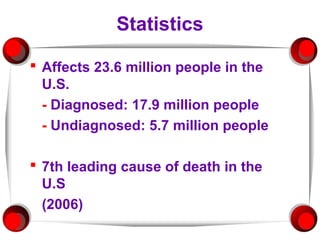
Statistics

 Affects 23.6 million people in the
  U.S.
  - Diagnosed: 17.9 million people
  - Undiagnosed: 5.7 million people

 7th leading cause of death in the
  U.S
  (2006)
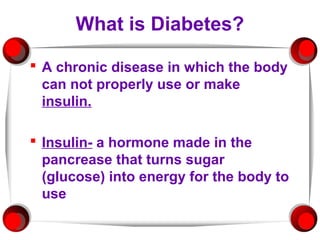
What is Diabetes?

 A chronic disease in which the body
  can not properly use or make
  insulin.

 Insulin- a hormone made in the
  pancrease that turns sugar
  (glucose) into energy for the body to
  use
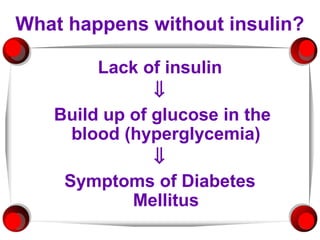
What happens without insulin?

        Lack of insulin
               ⇓
   Build up of glucose in the
     blood (hyperglycemia)
               ⇓
    Symptoms of Diabetes
            Mellitus
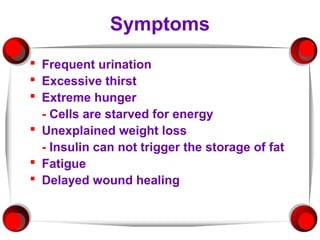
Symptoms
 Frequent urination
 Excessive thirst
 Extreme hunger
  - Cells are starved for energy
 Unexplained weight loss
  - Insulin can not trigger the storage of fat
 Fatigue
 Delayed wound healing
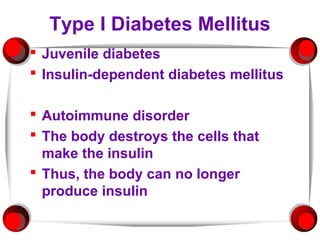
Type I Diabetes Mellitus
 Juvenile diabetes
 Insulin-dependent diabetes mellitus

 Autoimmune disorder
 The body destroys the cells that
  make the insulin
 Thus, the body can no longer
  produce insulin
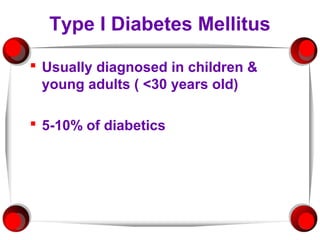
Type I Diabetes Mellitus

 Usually diagnosed in children &
  young adults ( <30 years old)

 5-10% of diabetics
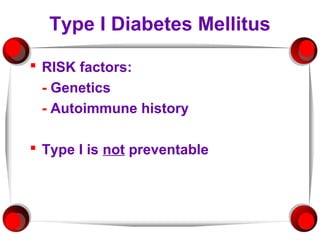
Type I Diabetes Mellitus

 RISK factors:
  - Genetics
  - Autoimmune history

 Type I is not preventable
Type I Treatment

   Glucose monitoring often
   Insulin injections
   Exercise
   Diet
   Follow up with doctor
   Educate yourself!
Type II Diabetes Mellitus
 Non-insulin dependent diabetes
  mellitus

 Body makes insulin but most cells
  do not use insulin properly
 Insulin resistance
 Slowly, the pancreas stops making
  insulin.
Type II Diabetes Mellitus

 90-95 % of diabetics
 RISK factors
  - Older age
  - Family history
  - Obesity
  - Physical Inactivity
  - Race and Ethnicity
Type II Risk Factors

 Obesity & Inactivity
  - Studies find a relationship between
    weight/activity level and Type II
  - Seeing an increase in Type II
    diabetes in children
Type II Diabetes Mellitus

 Race & Ethnicity
  - African Americans
  - Hispanic/Latino Americans
  - American Indians
  - Asian Americans
  - Pacific Islanders
Type II Prevention

 If have risk factors, prevent or delay
  the onset of Type II…
  - Healthy diet
  - Moderately intense exercise
    (walking 2 1/2 hours each week)
Type II Treatment

 Goal: Control blood sugar (glucose)
  - Glucose monitoring often
  - Oral medicine / Insulin injections
  - Diet
  - Exercise / Weight management
  - Follow up with doctor
  - Educate yourself!
Diet - Carb Counting

 Carbohydrates raise blood glucose
  levels
 Keep track of how many carbs you
  eat and set a limit for yourself
 Limit depends on your activity level
  and medications
 Talk to your doctor!
Diet - Create your plate

 Divide plate into 3 sections
  - Large section - non-starch veggies
    (spinach, cabbage, mushrooms)
  - Small section - starch
    (potatoes, whole grain breads)
  - Small section - meat
    (turkey, tuna, lean pork)
Diet - Individualized

 No one diet is appropriate for every
  diabetic person
 Work with your doctor to come up
  with a diet that is right for your
  situation
Complications of Diabetes
   Heart disease
   Blindness
   Kidney damage
   Diabetic neuropathy / nerve damage

 Prevent complications by managing
  your glucose level, diet, and
  activity!
Diabetes Awareness

 November is American Diabetes
  Month
 November 14 is World Diabetes Day
For more information:
     www.cdc.gov
     www.diabetes.org
     www.ndep.nih.gov
Websites

 http://www.cdc.gov/diabetes/consu
  mer/index.htm
 http://www.emedicinehealth.com/dia
  betes/article_em.htm#Diabetes
  %20Overview
 http://www.diabetes.org/

Diabetes

  • 1.
    Diabetes Mellitus Lora Stowitzky
  • 2.
    Statistics  Affects 23.6million people in the U.S. - Diagnosed: 17.9 million people - Undiagnosed: 5.7 million people  7th leading cause of death in the U.S (2006)
  • 3.
    What is Diabetes? A chronic disease in which the body can not properly use or make insulin.  Insulin- a hormone made in the pancrease that turns sugar (glucose) into energy for the body to use
  • 4.
    What happens withoutinsulin? Lack of insulin ⇓ Build up of glucose in the blood (hyperglycemia) ⇓ Symptoms of Diabetes Mellitus
  • 5.
    Symptoms  Frequent urination Excessive thirst  Extreme hunger - Cells are starved for energy  Unexplained weight loss - Insulin can not trigger the storage of fat  Fatigue  Delayed wound healing
  • 6.
    Type I DiabetesMellitus  Juvenile diabetes  Insulin-dependent diabetes mellitus  Autoimmune disorder  The body destroys the cells that make the insulin  Thus, the body can no longer produce insulin
  • 7.
    Type I DiabetesMellitus  Usually diagnosed in children & young adults ( <30 years old)  5-10% of diabetics
  • 8.
    Type I DiabetesMellitus  RISK factors: - Genetics - Autoimmune history  Type I is not preventable
  • 9.
    Type I Treatment  Glucose monitoring often  Insulin injections  Exercise  Diet  Follow up with doctor  Educate yourself!
  • 10.
    Type II DiabetesMellitus  Non-insulin dependent diabetes mellitus  Body makes insulin but most cells do not use insulin properly  Insulin resistance  Slowly, the pancreas stops making insulin.
  • 11.
    Type II DiabetesMellitus  90-95 % of diabetics  RISK factors - Older age - Family history - Obesity - Physical Inactivity - Race and Ethnicity
  • 12.
    Type II RiskFactors  Obesity & Inactivity - Studies find a relationship between weight/activity level and Type II - Seeing an increase in Type II diabetes in children
  • 13.
    Type II DiabetesMellitus  Race & Ethnicity - African Americans - Hispanic/Latino Americans - American Indians - Asian Americans - Pacific Islanders
  • 14.
    Type II Prevention If have risk factors, prevent or delay the onset of Type II… - Healthy diet - Moderately intense exercise (walking 2 1/2 hours each week)
  • 15.
    Type II Treatment Goal: Control blood sugar (glucose) - Glucose monitoring often - Oral medicine / Insulin injections - Diet - Exercise / Weight management - Follow up with doctor - Educate yourself!
  • 16.
    Diet - CarbCounting  Carbohydrates raise blood glucose levels  Keep track of how many carbs you eat and set a limit for yourself  Limit depends on your activity level and medications  Talk to your doctor!
  • 17.
    Diet - Createyour plate  Divide plate into 3 sections - Large section - non-starch veggies (spinach, cabbage, mushrooms) - Small section - starch (potatoes, whole grain breads) - Small section - meat (turkey, tuna, lean pork)
  • 18.
    Diet - Individualized No one diet is appropriate for every diabetic person  Work with your doctor to come up with a diet that is right for your situation
  • 19.
    Complications of Diabetes  Heart disease  Blindness  Kidney damage  Diabetic neuropathy / nerve damage  Prevent complications by managing your glucose level, diet, and activity!
  • 20.
    Diabetes Awareness  Novemberis American Diabetes Month  November 14 is World Diabetes Day For more information: www.cdc.gov www.diabetes.org www.ndep.nih.gov
  • 21.
    Websites  http://www.cdc.gov/diabetes/consu mer/index.htm  http://www.emedicinehealth.com/dia betes/article_em.htm#Diabetes %20Overview  http://www.diabetes.org/