e4sv.org
THE SMART VILLAGES INITIATIVE
Dr John Holmes
Senior Research Fellow, Oxford Univ.
26th August 2015
e4sv.org
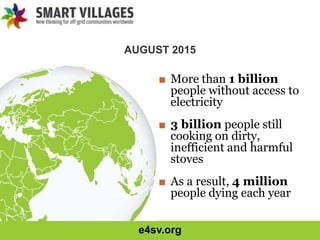
AUGUST 2015
■ More than 1 billion
people without access to
electricity
■ 3 billion people still
cooking on dirty,
inefficient and harmful
stoves
■ As a result, 4 million
people dying each year
e4sv.org
UN SE4ALL INITIATIVE
■ Ensure universal access to modern energy
services by 2030
e4sv.org
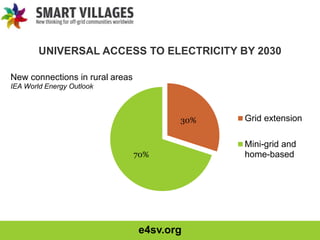
UNIVERSAL ACCESS TO ELECTRICITY BY 2030
30%
70%
New connections in rural areas
IEA World Energy Outlook
Grid extension
Mini-grid and
home-based
e4sv.org
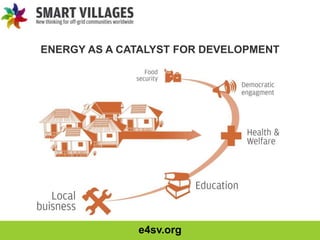
ENERGY AS A CATALYST FOR DEVELOPMENT
e4sv.org
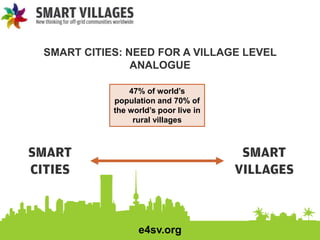
SMART CITIES: NEED FOR A VILLAGE LEVEL
ANALOGUE
SMART
VILLAGES
SMART
CITIES
47% of world’s
population and 70% of
the world’s poor live in
rural villages
e4sv.org
SMART VILLAGES: SOME KEY FEATURES
Education and health services
 ICT connectivity: distance learning and world’s knowledge base
 Modern health services and tele-medicine
Foster entrepreneurship in provision and use of energy services
 Capture more of the agricultural value chain
 Create new businesses
Through ICT connectivity, participate in governance processes
 At local, regional and national levels
 Creating smart communities with strong rural/urban linkages
Building more resilient communities better able to
respond to shocks
 Clean water and sanitation
 Affordable and nutritious food
e4sv.org
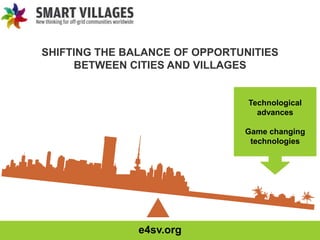
SHIFTING THE BALANCE OF OPPORTUNITIES
BETWEEN CITIES AND VILLAGES
Technological
advances
Game changing
technologies
e4sv.org
THE SMART VILLAGES INITIATIVE
Focus: local solutions for rural communities: mini/micro-
grid and home-based approaches
Policy advice: an insightful, ‘view from the frontline’ of
the challenges of village energy provision for
development, and how they can be overcome
Engagement: bringing together the key players:
scientists, entrepreneurs, villagers, NGO’s, financers,
regulators and policy makers etc:
 What are the barriers?
 How can they be overcome?
 What messages to funders and policy makers?
e4sv.org
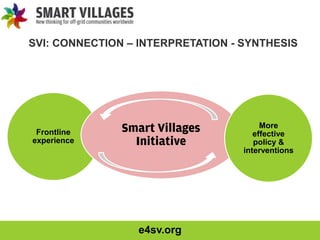
Frontline
experience
Smart Villages
Initiative
More
effective
policy &
interventions
SVI: CONNECTION – INTERPRETATION - SYNTHESIS
e4sv.org
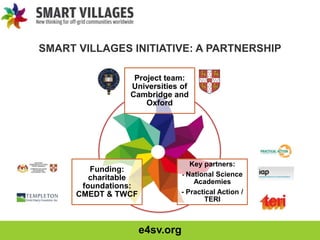
Project team:
Universities of
Cambridge and
Oxford
Key partners:
- National Science
Academies
- Practical Action /
TERI
Funding:
charitable
foundations:
CMEDT & TWCF
SMART VILLAGES INITIATIVE: A PARTNERSHIP
e4sv.org
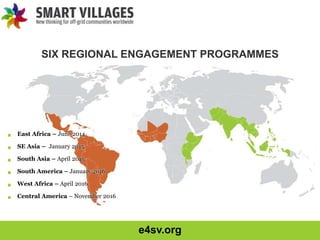
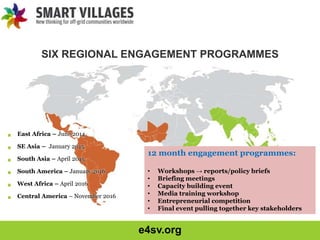
SIX REGIONAL ENGAGEMENT PROGRAMMES
 East Africa – June 2014
 SE Asia – January 2015
 South Asia – April 2015
 South America – January 2016
 West Africa – April 2016
 Central America – November 2016
e4sv.org
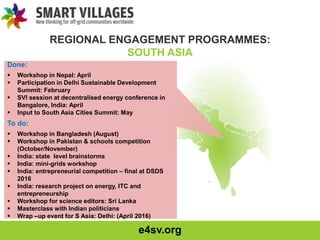
SIX REGIONAL ENGAGEMENT PROGRAMMES
 East Africa – June 2014
 SE Asia – January 2015
 South Asia – April 2015
 South America – January 2016
 West Africa – April 2016
 Central America – November 2016
12 month engagement programmes:
• Workshops → reports/policy briefs
• Briefing meetings
• Capacity building event
• Media training workshop
• Entrepreneurial competition
• Final event pulling together key stakeholders
e4sv.org
REGIONAL ENGAGEMENT PROGRAMMES:
SOUTH ASIA
Done:
 Workshop in Nepal: April
 Participation in Delhi Sustainable Development
Summit: February
 SVI session at decentralised energy conference in
Bangalore, India: April
 Input to South Asia Cities Summit: May
To do:
 Workshop in Bangladesh (August)
 Workshop in Pakistan & schools competition
(October/November)
 India: state level brainstorms
 India: mini-grids workshop
 India: entrepreneurial competition – final at DSDS
2016
 India: research project on energy, ITC and
entrepreneurship
 Workshop for science editors: Sri Lanka
 Masterclass with Indian politicians
 Wrap –up event for S Asia: Delhi: (April 2016)
e4sv.org
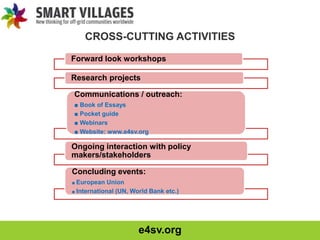
CROSS-CUTTING ACTIVITIES
Forward look workshops
Research projects
Communications / outreach:
■ Book of Essays
■ Pocket guide
■ Webinars
■ Website: www.e4sv.org
Ongoing interaction with policy
makers/stakeholders
Concluding events:
■ European Union
■ International (UN, World Bank etc.)
e4sv.org
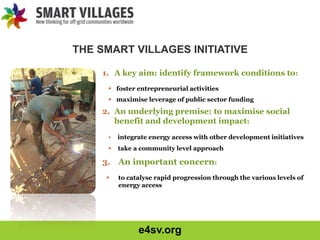
THE SMART VILLAGES INITIATIVE
1. A key aim: identify framework conditions to:
 foster entrepreneurial activities
 maximise leverage of public sector funding
2. An underlying premise: to maximise social
benefit and development impact:
 integrate energy access with other development initiatives
 take a community level approach
3. An important concern:
 to catalyse rapid progression through the various levels of
energy access
e4sv.org
SUSTAINABLE DEVELOPMENT GOALS
Goal 7. Ensure access to affordable, reliable,
sustainable and modern energy for all
■ 7.1 By 2030, ensure universal access to affordable,
reliable and modern energy services
■ 7.2 By 2030, increase substantially the share of
renewable energy in the global energy mix
■ 7.3 By 2030, double the global rate of improvement in
energy efficiency
e4sv.org
GOAL 7: MEANS OF IMPLEMENTATION TARGETS
■ 7.a By 2030, enhance international cooperation to facilitate access
to clean energy research and technology, including renewable
energy, energy efficiency and advanced and cleaner fossil-fuel
technology, and promote investment in energy infrastructure and
clean energy technology.
■ 7.b By 2030, expand infrastructure and upgrade technology for
supplying modern and sustainable energy services for all in
developing countries, in particular least developed countries, land
locked developing countries and small island developing States in
accordance with their respective programmes of action.
→ Investment in Energy Infrastructure
→ Research and Technology
e4sv.org
INVESTMENT IN ENERGY INFRASTRUCTURE
■ Maximise leverage of public sector funding:
■ additional US$ 50 billion + every year
■ need access to all sources of financing including international climate funds
■ Supportive policy and regulatory frameworks:
 plea from entrepreneurs: less red tape and some breathing space
 nurture home grown enterprises: business incubation / advisory support services
■ Integrate with other development initiatives:
 associated investments in healthcare, education, clean water/sanitation etc.
 investment in new enterprises and increased productivity of existing income
generating activities
e4sv.org
INVESTMENT IN ENERGY INFRASTRUCTURE (2)
 Access to affordable finance:
 investment capital for mini-grid developers: support to de-risk and lower interest
rates
 working capital for SMEs to accelerate roll-out of SHS and solar lights
 novel financing schemes/business models for end-users
 Public-private-community partnerships:
 community ownership and involvement necessary for success: key investment
 identify, train and support local champions
 important role of rural energy agencies to facilitate connections
e4sv.org
RESEARCH AND TECHNOLOGY
■ Expanding the range of accessible services/appliances:
■ energy escalator approach to higher powers: TV, fridge, sewing machine etc.
■ low energy appliances
■ Reducing costs / increasing durability:
■ key contribution to economic viability
■ potential future breakthroughs: e.g. printable organic solar cells
■ need for focus on enhancing batteries: cost and lifetime
■ poor quality products: quality assurance mechanisms
■ Scale of electricity systems:
■ home/institution based
■ small clusters of houses: DC nano-grids
■ village-level AC mini-grids
■ Research and development:
■ more applied research: improved links between university researchers & SMEs
■ need for: improved control systems, ‘plug-and-play’ technologies, recycling
e4sv.org
GOAL 17: STRENGTHEN THE MEANS OF
IMPLEMENTATION…
■ Need for better collaboration:
 a confusion/competition of funders
 put in place frameworks for cooperation
■ Value of sharing of information & experiences:
 across East Africa and with other regions: role for the Smart Villages Initiative
 case studies of smart villages: value as integrating concept
 government/donor funded datasets of wind, hydro etc. potential
 Focus on capacity building:
 systematic analysis across all stages and actors: training schemes to plug gaps
 Develop approaches to monitor/evaluate development outcomes
e4sv.org
Thank you for your attention
www.e4sv.org | info@e4sv.org | @e4SmartVillages