DH TOOLS
Introduction to Text Analysis


         Cameron Buckner
    Visiting Assistant Professor
    Department of Philosophy
        cjbuckner@uh.edu
Our Initiative
• Promote, facilitate, interact
  • Reading group                   • Tools workshops
  • Speaker series                  • Grantwriting support
  • Infrastructure advocacy


            http://www.uh.edu/class/digitalhumanities/
Roadmap
Goal today: Analyze texts using cutting-edge analyses
from computational psycholinguistics with an off-the-shelf
tool, word2word

1.   What can you do with text analysis?
2.   A little bit of theory: Semantic spaces
3.   BEAGLE: The holographic lexicon
4.   MDS: Visualizing multidimensional networks
5.   Examples
6.   Hands-on play
What is DH?
• Computation and interpretation
  • The use of computational tools for the
    production, exploration, analysis, and
    dissemination of humanistic knowledge
      • Thread common between new and old:
        pattern recognition
• Includes
  •   Digitization and archiving, markup
  •   Analysis & visualization
  •   Search & dissemination
  •   Pedagogy
Methods of Text Analysis I
• Statistical analysis, information extraction, machine
  learning
  • Syntactic: word frequencies (Google n-grams), vocabulary
    usage, stylometry (authorship and genre), Pagerank


     http://www.nytimes.com/interactive/2012/09/06/us/politics/conventio
     n-word-counts.html
Methods of Text Analysis II
• Semantic: tf-idf, latent semantic analysis, latent dirichlet
  allocation, entropy-based measures, ontologies
  • Aim to model relevance, semantic similarity, taxonomic
    relationships, object properties and relations
Reminders
• Be creative and have fun, but if you want to publish…
• Be principled:
  • Junk in, junk out
  • Always know assumptions required by a method
     • Analyses should hold up under trivial transformations of data
       representation
  • Be prepared for pragmatic design decisions
  • Go in with hypotheses and structured questions
  • Confirm with careful humanistic interpretation
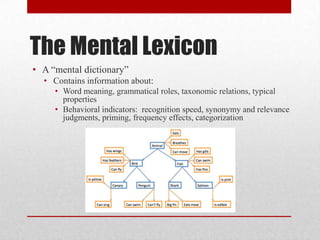
The Mental Lexicon
• A “mental dictionary”
  • Contains information about:
     • Word meaning, grammatical roles, taxonomic relations, typical
       properties
     • Behavioral indicators: recognition speed, synonymy and relevance
       judgments, priming, frequency effects, categorization
BEAGLE
• A model that learns (unsupervised) a holographic mental
  lexicon automatically from text
• History: Two approaches to semantic analysis
  • Co-occurrence based measures (“bag of words”, LSA, tf-
    idf)
     • Good at determining relevance, bad at determining roles and
       relations
  • Order-based measures (n-gram models, generative
    grammars, hidden Markov models)
     • Good at identifying grammatical and structural relations, bad at
       identifying relevance and meaning
• Challenge: Can the two be combined?
Context + Role
• Assumption: People acquire an
  idiosyncratic mental lexicon from
  patterns of co-occurrence and syntactic
  relationships they encounter in natural
  language.
  • “You shall know a word by both the
    company it keeps and how it keeps it.”
• Goal: If we could build a representation
  of a text’s context/role distributions, we
  could predict the structure of a mental
  lexicon that produced a corpus and/or
  that would be produced by it
  • Texts as “mental fingerprints”
How
Holograms
  Work
Basic Vector Approach
1. Start with a multi-dimensional vector space
2. Each term meaning is initially represented by a random,
   constant environment vector and an empty memory
   vector
3. Associations between terms can be represented by adding or
   averaging their environment vectors into their memory
   vectors
4. Each time terms co-occur, their memory vectors become
   closer in multi-dimensional similarity space
Representing Order Info
• Convolution: compressing outer-product matrix of two
  term vectors so that the product contains recoverable
  information about both
• Example: z = x * y
  • Association vector z contains information about both x and
    y
  • Can (approximately) reconstruct source vector y by probing
    z (deconvolution) with x (and vice versa)
• Combined BEAGLE memory vector: Context memory
  comes from vector addition, and order information comes
  from n-gram binding using convolution
Combined Memory Vector


•   m = memory vector
•   e = initial random environment vector
•   p = position in sentence
•   lambda = constant chunking factor (size of n-gram window)
•   bind i,j = a non-commutative convolution of constant order
    vector with other environment vectors in n-gram
Resonance retrieval…
So, BEAGLE method
1. Choose number of dimensions for vector space, size of
   n-gram window for order info
2. Clean up source documents using standard NLP (stop
   words, stemmers, etc.)
3. Learn context and order vectors from corpus, combine
4. Select words of interest
5. Visualize multi-dimensional space using favorite
   method (e.g. MDS)
Limitations of BEAGLE
• Only considers 1-sentence windows
• Lexical ambiguity
• Valence (e.g. synonyms, antonyms)
MDS
• A way to view a multi-dimensional similarity space
• Collapses multi-dimensional space in way that tries to
  mutually preserve distances between vectors
  • Collapsing dimensions often reveals most significant
    [higher-order] dimensions
Uses
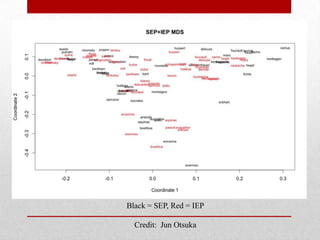
• How do two academic reference works compare in their
  coverage of a discipline?
  • Biases? Overlap?


                                                      InPhO-
                                                     Semantics
                                                      Credit:
                                                      Robert
                                                       Rose
Black = SEP, Red = IEP

  Credit: Jun Otsuka
Political rhetoric
• What can we learn from the “semantic space” derived
  from a party or candidate’s rhetoric?
  •   Central issues?
  •   Key comparisons?
  •   Ideological focus/big tent?
  •   Location on ideological spectrum?
• Example: compare speeches from Republican and
  Democratic political conventions
Heat Map: Terms most diagnostic of a speech’s being delivered by a Democrat
“Hotter” indicates more diagnostic in comparison. Hottest terms =
aarp, experience, affordable, abuelo, billionaires, afghanistan, beijing, biofuels, aliens
Character Analysis
• Moretti: “protagonist is the character that minimized the
  sum of the distances to all other vertices”
  • (But Moretti did it by hand!)
Character similarity analysis from A Dance with Dragons
Acknowledgements
  InPhO Team


               Brent Kievet-Kylar
                  word2word


                  Mike Jones
                  BEAGLE

DH Tools Workshop #1: Text Analysis

  • 1.
    DH TOOLS Introduction toText Analysis Cameron Buckner Visiting Assistant Professor Department of Philosophy cjbuckner@uh.edu
  • 2.
    Our Initiative • Promote,facilitate, interact • Reading group • Tools workshops • Speaker series • Grantwriting support • Infrastructure advocacy http://www.uh.edu/class/digitalhumanities/
  • 3.
    Roadmap Goal today: Analyzetexts using cutting-edge analyses from computational psycholinguistics with an off-the-shelf tool, word2word 1. What can you do with text analysis? 2. A little bit of theory: Semantic spaces 3. BEAGLE: The holographic lexicon 4. MDS: Visualizing multidimensional networks 5. Examples 6. Hands-on play
  • 4.
    What is DH? •Computation and interpretation • The use of computational tools for the production, exploration, analysis, and dissemination of humanistic knowledge • Thread common between new and old: pattern recognition • Includes • Digitization and archiving, markup • Analysis & visualization • Search & dissemination • Pedagogy
  • 5.
    Methods of TextAnalysis I • Statistical analysis, information extraction, machine learning • Syntactic: word frequencies (Google n-grams), vocabulary usage, stylometry (authorship and genre), Pagerank http://www.nytimes.com/interactive/2012/09/06/us/politics/conventio n-word-counts.html
  • 6.
    Methods of TextAnalysis II • Semantic: tf-idf, latent semantic analysis, latent dirichlet allocation, entropy-based measures, ontologies • Aim to model relevance, semantic similarity, taxonomic relationships, object properties and relations
  • 7.
    Reminders • Be creativeand have fun, but if you want to publish… • Be principled: • Junk in, junk out • Always know assumptions required by a method • Analyses should hold up under trivial transformations of data representation • Be prepared for pragmatic design decisions • Go in with hypotheses and structured questions • Confirm with careful humanistic interpretation
  • 8.
    The Mental Lexicon •A “mental dictionary” • Contains information about: • Word meaning, grammatical roles, taxonomic relations, typical properties • Behavioral indicators: recognition speed, synonymy and relevance judgments, priming, frequency effects, categorization
  • 9.
    BEAGLE • A modelthat learns (unsupervised) a holographic mental lexicon automatically from text • History: Two approaches to semantic analysis • Co-occurrence based measures (“bag of words”, LSA, tf- idf) • Good at determining relevance, bad at determining roles and relations • Order-based measures (n-gram models, generative grammars, hidden Markov models) • Good at identifying grammatical and structural relations, bad at identifying relevance and meaning • Challenge: Can the two be combined?
  • 10.
    Context + Role •Assumption: People acquire an idiosyncratic mental lexicon from patterns of co-occurrence and syntactic relationships they encounter in natural language. • “You shall know a word by both the company it keeps and how it keeps it.” • Goal: If we could build a representation of a text’s context/role distributions, we could predict the structure of a mental lexicon that produced a corpus and/or that would be produced by it • Texts as “mental fingerprints”
  • 11.
  • 12.
    Basic Vector Approach 1.Start with a multi-dimensional vector space 2. Each term meaning is initially represented by a random, constant environment vector and an empty memory vector 3. Associations between terms can be represented by adding or averaging their environment vectors into their memory vectors 4. Each time terms co-occur, their memory vectors become closer in multi-dimensional similarity space
  • 13.
    Representing Order Info •Convolution: compressing outer-product matrix of two term vectors so that the product contains recoverable information about both • Example: z = x * y • Association vector z contains information about both x and y • Can (approximately) reconstruct source vector y by probing z (deconvolution) with x (and vice versa) • Combined BEAGLE memory vector: Context memory comes from vector addition, and order information comes from n-gram binding using convolution
  • 16.
    Combined Memory Vector • m = memory vector • e = initial random environment vector • p = position in sentence • lambda = constant chunking factor (size of n-gram window) • bind i,j = a non-commutative convolution of constant order vector with other environment vectors in n-gram
  • 19.
  • 20.
    So, BEAGLE method 1.Choose number of dimensions for vector space, size of n-gram window for order info 2. Clean up source documents using standard NLP (stop words, stemmers, etc.) 3. Learn context and order vectors from corpus, combine 4. Select words of interest 5. Visualize multi-dimensional space using favorite method (e.g. MDS)
  • 21.
    Limitations of BEAGLE •Only considers 1-sentence windows • Lexical ambiguity • Valence (e.g. synonyms, antonyms)
  • 22.
    MDS • A wayto view a multi-dimensional similarity space • Collapses multi-dimensional space in way that tries to mutually preserve distances between vectors • Collapsing dimensions often reveals most significant [higher-order] dimensions
  • 23.
    Uses • How dotwo academic reference works compare in their coverage of a discipline? • Biases? Overlap? InPhO- Semantics Credit: Robert Rose
  • 24.
    Black = SEP,Red = IEP Credit: Jun Otsuka
  • 25.
    Political rhetoric • Whatcan we learn from the “semantic space” derived from a party or candidate’s rhetoric? • Central issues? • Key comparisons? • Ideological focus/big tent? • Location on ideological spectrum? • Example: compare speeches from Republican and Democratic political conventions
  • 26.
    Heat Map: Termsmost diagnostic of a speech’s being delivered by a Democrat “Hotter” indicates more diagnostic in comparison. Hottest terms = aarp, experience, affordable, abuelo, billionaires, afghanistan, beijing, biofuels, aliens
  • 27.
    Character Analysis • Moretti:“protagonist is the character that minimized the sum of the distances to all other vertices” • (But Moretti did it by hand!)
  • 28.
    Character similarity analysisfrom A Dance with Dragons
  • 29.
    Acknowledgements InPhOTeam Brent Kievet-Kylar word2word Mike Jones BEAGLE

Editor's Notes

  • #10 You shall know a word by the company it keepsYou shall know a word by the company it keeps and how it keeps it
  • #12 If you have a photographic medium that can record and reproduce not only the amount of light that strikes it but also its direction, then you can represent multiple dimensions of an object simultaneously and recall the desired dimensions by shining reconstruction beam at different angles.
  • #13 Snow/slow
  • #24 SEP = Stanford Encyclopedia of Philosophy, IEP = Internet Encyclopedia of Philosophy
  • #25 Analysis method = LSA
  • #27 Analysis computed on composite transcripts from 2012 Democratic and Republican national conventions.