Technical seminar
on
Natural Language Processing
By
Sai Mohit Talasila
15P81A0553
4th year CSE
How many of you have used this?
Introduction
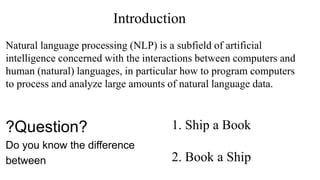
Natural language processing (NLP) is a subfield of artificial
intelligence concerned with the interactions between computers and
human (natural) languages, in particular how to program computers
to process and analyze large amounts of natural language data.
?Question?
Do you know the difference
between
1. Ship a Book
2. Book a Ship
Introduction
1. Ship a Book 2. Book a Ship
By the end of this, you'll be able to understand how we use
NLP techniques to process this information!
Technical Background
• As technology is advancing, humans want to evolve at a faster
pace.
• To accomodate this moto, humans have developed machines as a
replacement to do the most-repeated, non-logical tasks for humans.
• Thereby saving them their time and energy which can be used for
other productive purposes
• To help a machine understand the human language, NLP(Natural
Language Processing) techniques have been developed.
• These techniques are helpful for machines to understand the
command of a human, process the information and provide the
desired output!
Architecture
Description(techniques)
Stemming
Segmentation
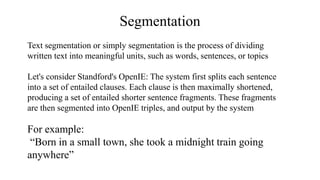
Text segmentation or simply segmentation is the process of dividing
written text into meaningful units, such as words, sentences, or topics
Let's consider Standford's OpenIE: The system first splits each sentence
into a set of entailed clauses. Each clause is then maximally shortened,
producing a set of entailed shorter sentence fragments. These fragments
are then segmented into OpenIE triples, and output by the system
For example:
“Born in a small town, she took a midnight train going
anywhere”
Segmentation
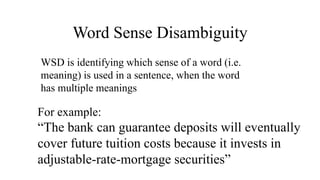
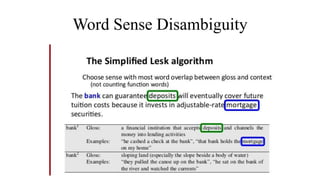
Word Sense Disambiguity
For example:
“The bank can guarantee deposits will eventually
cover future tuition costs because it invests in
adjustable-rate-mortgage securities”
WSD is identifying which sense of a word (i.e.
meaning) is used in a sentence, when the word
has multiple meanings
Word Sense Disambiguity
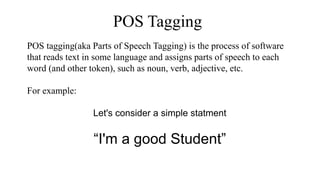
POS Tagging
POS tagging(aka Parts of Speech Tagging) is the process of software
that reads text in some language and assigns parts of speech to each
word (and other token), such as noun, verb, adjective, etc.
For example:
Let's consider a simple statment
“I'm a good Student”
POS Tagging
Contextual Analysis
Contextual analysis is a process of inferring the meaning of an
unfamiliar word by scrutinizing the text surrounding it
The contextual analysis helps to assess the text, for example, in
its historical, cultural or social context.
Let's consider an example:
A frustrated news reader requests his angry boss
“Not to rain on my parade”
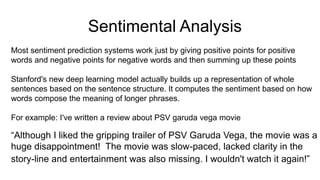
Sentimental Analysis
Most sentiment prediction systems work just by giving positive points for positive
words and negative points for negative words and then summing up these points
Stanford's new deep learning model actually builds up a representation of whole
sentences based on the sentence structure. It computes the sentiment based on how
words compose the meaning of longer phrases.
For example: I've written a review about PSV garuda vega movie
“Although I liked the gripping trailer of PSV Garuda Vega, the movie was a
huge disappointment! The movie was slow-paced, lacked clarity in the
story-line and entertainment was also missing. I wouldn't watch it again!”
Stanford's Sentimental Analyser
Stanford's CoreNLP Demonstration
Real time Application
Conclusion
• Natural Language Processing (NLP) is a sub-field of
Artificial Intelligence that is focused on enabling
computers to understand and process human languages,
to get computers closer to a human-level understanding
of language.
Thank You
Any queries?

Natural language processing PPT presentation

  • 1.
    Technical seminar on Natural LanguageProcessing By Sai Mohit Talasila 15P81A0553 4th year CSE
  • 2.
    How many ofyou have used this?
  • 3.
    Introduction Natural language processing(NLP) is a subfield of artificial intelligence concerned with the interactions between computers and human (natural) languages, in particular how to program computers to process and analyze large amounts of natural language data. ?Question? Do you know the difference between 1. Ship a Book 2. Book a Ship
  • 4.
    Introduction 1. Ship aBook 2. Book a Ship By the end of this, you'll be able to understand how we use NLP techniques to process this information!
  • 5.
    Technical Background • Astechnology is advancing, humans want to evolve at a faster pace. • To accomodate this moto, humans have developed machines as a replacement to do the most-repeated, non-logical tasks for humans. • Thereby saving them their time and energy which can be used for other productive purposes • To help a machine understand the human language, NLP(Natural Language Processing) techniques have been developed. • These techniques are helpful for machines to understand the command of a human, process the information and provide the desired output!
  • 6.
  • 7.
  • 8.
  • 9.
    Segmentation Text segmentation orsimply segmentation is the process of dividing written text into meaningful units, such as words, sentences, or topics Let's consider Standford's OpenIE: The system first splits each sentence into a set of entailed clauses. Each clause is then maximally shortened, producing a set of entailed shorter sentence fragments. These fragments are then segmented into OpenIE triples, and output by the system For example: “Born in a small town, she took a midnight train going anywhere”
  • 10.
  • 11.
    Word Sense Disambiguity Forexample: “The bank can guarantee deposits will eventually cover future tuition costs because it invests in adjustable-rate-mortgage securities” WSD is identifying which sense of a word (i.e. meaning) is used in a sentence, when the word has multiple meanings
  • 12.
  • 13.
    POS Tagging POS tagging(akaParts of Speech Tagging) is the process of software that reads text in some language and assigns parts of speech to each word (and other token), such as noun, verb, adjective, etc. For example: Let's consider a simple statment “I'm a good Student”
  • 14.
  • 15.
    Contextual Analysis Contextual analysisis a process of inferring the meaning of an unfamiliar word by scrutinizing the text surrounding it The contextual analysis helps to assess the text, for example, in its historical, cultural or social context. Let's consider an example: A frustrated news reader requests his angry boss “Not to rain on my parade”
  • 16.
    Sentimental Analysis Most sentimentprediction systems work just by giving positive points for positive words and negative points for negative words and then summing up these points Stanford's new deep learning model actually builds up a representation of whole sentences based on the sentence structure. It computes the sentiment based on how words compose the meaning of longer phrases. For example: I've written a review about PSV garuda vega movie “Although I liked the gripping trailer of PSV Garuda Vega, the movie was a huge disappointment! The movie was slow-paced, lacked clarity in the story-line and entertainment was also missing. I wouldn't watch it again!”
  • 17.
  • 18.
  • 19.
  • 20.
    Conclusion • Natural LanguageProcessing (NLP) is a sub-field of Artificial Intelligence that is focused on enabling computers to understand and process human languages, to get computers closer to a human-level understanding of language.
  • 21.
  • 22.