Natural Language Processing in Augmentative
and Alternative Communication
S.R.Jhanani#1
, S.Divya#2
#
Department of Information technology, Meenakshi Sundararajan Engineering College,
Chennai – 600 024, Tamil Nadu, India
1
jhanani21@gmail.com
2
divya.msecit@gmail.com
Abstract — This paper presents a study on Natural Language
Processing (NLP), Alternative and Augmentative
Communication (AAC) and highlights about the role of
NATURAL LANGUAGE PROCESSING IN
AUGMENTATIVE AND ALTERNATIVE
COMMUNICATION. Natural Language Processing is one of
the major branches of Artificial Intelligence (AI) which is
mainly linked to the concept of ‘human-computer
interaction’, conversion of humans’ natural language into a
machine-understandable form for the computer. The
computer analyses and understands this input which is our
natural communication language with the help of various
methods and communicates in human language.
Augmentative and Alternative Communication describes
various methods of non-verbal communication. It is usually
useful for speech-impaired people. After a brief description on
the basic concepts involved, this paper will guide you through
the levels, approaches (based on suitability) and evaluation
criteria of Natural Language Processing, description of AAC
and provide an insight about the role of NLP in Augmentative
and Alternative Communication. Artificial Intelligence (AI)
aims to achieve ‘human-like language processing’, making
computers as intelligent as people. So we can say relationship
of Artificial Intelligence and Augmentative communication is
symbiotic.
Keywords - Artificial Intelligence, Augmentative
communication, human-computer interaction, Natural
Language Processing
I. INTRODUCTION
Artificial Intelligence (AI) is the ‘fifth generation’ of
computers which aims at development of intelligent
machines. This field can be defined as “the study and
design of intelligent agents”. Here ‘intelligent agents’ are
machines that observe the environment and do only the
things which maximize their chance of success. The main
hitch with AI is its disability of communication, reasoning
and knowledge. Current approaches consist of statistical
methods, computational intelligence and traditional
symbolic AI. Tools used include mathematical
optimization, logic, economics and probability. The main
problem has been broken down into many sub problems.
This has in turn lead to the development of many sub-
fields, one of them being “Natural Language Processing”.
Each sub-field focuses on finding solutions for the
particular problem.
II. NATURAL LANGUAGE PROCESSING
Natural Language Processing is a form of human-
computer interaction. This field is a combined derivative
of the fields Artificial Intelligence and Linguistics. The
main challenge in this field is to make the computers
understand and obtain meaning from our natural language.
The input is our natural language. The computers analyse,
understand, process the natural language. This event
encompasses the automation of linguistic forms, activities
or methods of communication such as conversation,
reading, writing, lip reading etc. This involves texts at one
or more linguistic levels and involves the complete study
and analysis of it. This field of study facilitate the
computers to engage in communication using natural
language that is not particularly restricted to speech, print,
signing and writing. This has a wide range of applications.
History of NLP starts from 1950’s when Alan Turing
published his article on “Computing Machinery and
Intelligence” that proposed the “Turing Test” which is a
set standard for intelligence. Some successful NLP systems
in 1960’s were SHRDLU, ELIZA. “Conceptual
ontologies” structured real-world information into machine
understandable data in 1970’s: MARGIE, SAM, PAM,
TaleSpin, and QUALM. During 1980’s first statistical
machine translation was developed namely Chatterbot.
Until this period these NLP machines were mainly
developed using complex sets of hand-written rules. Then a
major progress came through the introduction of machine
learning algorithms. Early machine learning algorithms
were based on decision trees which became increasingly
tiresome later. Next came the statistical models which
made probabilistic decisions on real-valued attributes of the
input. Example of a statistical model is the cache language
model. Recent research increasingly focuses on
unsupervised and semi-supervised learning algorithms
which learn from data that is not provided with the required
answers and produces less accurate results.
The goal of NLP as stated above is “to achieve human-like
language processing”. Here the term processing is entirely
different from understanding. A full NLP system can :
A. Paraphrase the input text
B. Translate it into other language.
C. Answer questions on it.
D. Draw conclusions from it.
While there have been some ground-breaking achievements
of NLP systems in the first three goals, the fourth still
remains the goal of NLP.
III. LEVELS OF NLP
Also referred as the synchronic model of language, this
model conveys exactly what happens within the NLP
system. It is distinguished from the initial sequential
model which tells that the levels of human language
processing follow a sequential approach. According to
psycholinguistic research this process is dynamic that is
levels can interact with one another and introspection
exposes that humans use the higher level information to
assist the processing of lower level information. We can
understand it as “the more capable an NLP system is, the
more levels of language it will use”
A. Phonology
This level is about the interpretation of speech
sounds within and across words. There are 3 rules
always associated with phonological analysis
1) Phonetic rules : for sounds within words
2) Phonemic rules : for variation of
pronunciation when words are spoken
together
3) Prosodic rules : for fluctuation in stress and
intonation across a sentence
The sound waves of input are analysed, encoded
for interpretation.
B. Morphology
Deals with the componential nature of words that
are composed of morphemes (smallest unit of
meaning) . NLP system breaks down a word into
its morphemes to understand it. Example:
premodified = pre+modify+ed
C. Lexical
At this level, meanings of individual words are
interpreted. First each word is assigned a single
part-of-speech tag. Some words which can
function as more than one part are assigned the
most probable part-of-speech tag on the basis of
their context. Words with only one meaning are
replaced with a semantic representation of that
meaning. A single lexical unit is decomposed into
its basic properties. This makes it possible to unify
meanings across words for complex interpretation.
Example: suggest a good book that children can
read.
((Class – book) (Properties – large) (Purpose
(Predication (class – read) (Object – people))))
D. Syntactic
Grammatical structure of the sentence is
uncovered by analyzing the words. So this needs a
parser and a grammar. The output is the sentence
representation with structural dependency within
the words. Not all NLP applications require a full
parse of sentences, so the remaining challenges in
those applications for which phrasal and clausal
dependencies are sufficient. Syntax is of great use
as order and dependency give the meaning.
Example: ‘The dog chased the cat’ and ‘The cat
chased the dog’
E. Semantic
This determines the possible meanings of a
sentence by concentrating on word-level meanings
in the sentence including the semantic
disambiguation of words. This allows only one
sense of polysemous words to be selected and
included in the semantic representation of
sentence. Semantic level does the disambiguation
if information from other words of the sentence is
needed. Some require information on the
frequency of each sense, or in general usage,
consideration of local context or pragmatic
knowledge.
F. Discourse
This level works with units of text longer than a
sentence. Concentrates on properties of the text as
a whole and makes connection between
components sentences that convey meaning. Two
types of processing can occur:
1) Anaphora Resolution : replacing semantically
vacant words with appropriate entity
2) Discourse/text Structure : determines
functions of sentences in the text. A report
can be deconstructed into discourse
components – lead, main, story, events,
quotes, results.
G. Pragmatic
This level’s aim is to clarify how extra meaning is
understood without encoding it. It requires world
knowledge and is all about the use of language in
situations and uses context over and above the
contents of the text for understanding.
Example: The government refused to release the
film as it was concerned about the communal
violence
Fig. 1 Connection between the levels of NLP
Fig. 2 Data Flow Diagram
IV. APPROACHES IN NLP
This section examines each of these approaches in terms of
their foundations, typical techniques, differences in
processing and system aspects, and their robustness,
flexibility, and suitability for various tasks.
A. Symbolic
This approach dominated the field for a long time.
it is based on explicit depiction of facts about
language through well-understood knowledge
schemes and algorithms. It performs deep analysis
of linguistic phenomena. Logic or Rule based
system is an example of this. The inference engine
selects and executes a rule if it is satisfied.
Another example is semantic networks where
knowledge is represented by nodes (set of objects)
and labelled links (relations between nodes).
Highly connected concepts – direct links and
weakly connected concepts – intervening
concepts.
B. Statistical
They usually coexisted with the symbolic
approach but gained popularity in 1980’s. Use
observable data as primary source of evidence. As
the name indicates they put into use many
mathematical techniques and large texts of
corpora for developing generalized models
without incorporating world knowledge. One such
finite automation model is the Hidden Markov
Model (HMM). Output produced by each state has
a definitive probability. Used in tasks like speech
recognition, lexical acquisition, parsing, part-of-
speech tagging, statistical machine translation,
grammar learning, etc.
C. Connectionist
These first appeared in 1960’s and received heavy
criticism. They overcame that in 1980’s by
demonstrating the utility of neural networks in
NLP. They are similar to statistical approach. The
difference is that former combines statistical
learning with various theories of representation
and allows transformation, inference and logic
formulae manipulation. The architectures are less
constrained and hence linguistic models are harder
to observe. Simply put, it is a network of
interconnected simple processing units with
knowledge in weights of the connection between
units. Local interaction resulting in global
behaviour leads to computation. They are of two
types:
1) Localist Models: relations between concepts
are encoded by weights of connection
between them but not labelled. Performs
word-sense disambiguation
2) Distributed Models: concept is depicted as a
function of simultaneous activation of
multiple units. Well suited for NLP tasks
syntactic parsing, associative retrieval.
V. STAGES OF NLP
NLP is basically a three stage process, the three stages
being
A. Parsing
B. Translating
C. Generating input contents
The output of every stage is fed as the input to the next
stage of the system. The natural language processing works
based on semantic structures and generations. Hence, the
first step is to find out the possible interpretations for the
input through the semantic parser . The problem here is that
a word can fall under several semantic classifications. With
a sub frame designed for every word as in input, the
semantic type is designed and is substituted to the word to
develop the interpretations. For instance, ‘take’ can be
replaced by ‘get’ and ‘from’.
The translator serves as the middleware to the system. The
main use of this stage is to create placeholders for the
words in the translator’s dictionary and covert the words
with probable structural translations. Syntactic realization
takes place at the second stage of the natural language
processing. The generator phase is primarily responsible
for the sentence generation based on the knowledge of
specific language. The result becomes the final component
of the entire system. Lexical classification and generation
take place at this final stage. The output of the NLP system
directs the patient with the right options and translations for
their doubts
VI. EVALUATION TYPES AND CRITERIA
To determine if the system meets the goals/needs of its
end-users, qualities of the algorithms are measured. Criteria
include evaluation data and evaluation metrics enables
solution comparison. Different types are
A. Intrinsic vs. Extrinsic Evaluation
Former characterizes the performance of an
isolated NLP with reference to a gold standard
(already pre-defined). Latter considers the system
as an embedded system or helping with a precise
function for human user. It is then characterized in
terms of overall task.
B. Black-box vs. Glass box Evaluation
Black-box evaluation measures parameters
concerned with quality of process (speed,
reliability, resource consumption, etc) and quality
of result (accuracy) while running the NLP system
on a data. Glass box evaluation sees the system
design, algorithm efficiency, linguistic resources.
This type is more informative but is complicated.
C. Automatic vs. Manual Evaluation
The former referred as “objective evaluation”
evaluates by comparing the system output with
pre-defined gold standard and can be repeated
many times. Manual evaluation referred as
“subjective evaluation” is done by human judges
who estimate the quality by a sample of its output.
There is a considerable variation in their ratings.
VII. AUGMENTATIVE AND ALTERNATIVE
COMMUNICATION (AAC)
Augmentative and alternative communication (AAC) is a
way for an individual to communicate when he/she does
not have the physical ability to use verbal speech or
writing. AAC systems are designed to help people express
their thoughts, needs, wants and ideas. AAC can range
from a simple set of pictures, symbols on the
communication board up to a computer system that is
programmed to speak with words or messages. AAC is
used by those with the range of speech and language
impairments common causes for severe disabilities include
congenital conditions such as cerebral palsy, intellectual
impairment and autism and acquired conditions such as
amyotrophic lateral sclerosis and parkinson’s disease. AAC
can help people who cannot talk at all. Using AAC can
also help decrease inappropriate behaviour such as crying
(of differently abled people) which cannot be done easy
with device.
Fig. 3 Person using the AAC device with touch-entry
There are a wide variety of ways to access ACC. Access is
the way where individuals makes selection on a
communication board or a speech generating device. Some
of the access methods used for the AAC include direct
selection by pointing or reaching or scanning using a
switch connected to the device. An AAC user can indicate
a series of numbers through an eye gaze communication
board in order to convey a word.
AAC are broadly divided into two broad groups, known as
unaided and aided forms of communication. Unaided
forms of communication consist of non verbal means of
natural communications including gestures and facial
expressions as well as manual signs and American Sign
Language (ASL). Aided forms of communication consist
of those approaches that require some additional external
support such as a communication board with visual-graphic
symbols that is of pictures, photographs, line drawings,
blissymbols (developed by Charles K.Bliss in 1949 as an
ideographic writing containing several hundred symbols),
printed words, traditional orthography that stands for what
an individual wants to express or a sophisticated computer
with symbols, words, letters, icons that speaks for its user
either by synthetically produced speech or recorded natural
speech.
Fig. 4 Person using the AAC device with keypad
VIII. ROLE OF NLP IN AUGMENTATIVE AND
ALTERNATIVE COMMUNICATION
The main concepts that are common to both AAC and NLP
are
A. Text Generation
This is the process of generating natural language
from the machine represented knowledge base and
linguistics. It is more like a translator. Examples
are systems that generate letters.
B. Speech Recognition
This determines the textual representation of the
speech from the audio that is provided as input.
C. Text to Speech Synthesis
This converts the normal language text into
speech whereas systems convert it into symbolic
representations, etc. The tool used is speech
synthesizer.
D. Information Retrieval
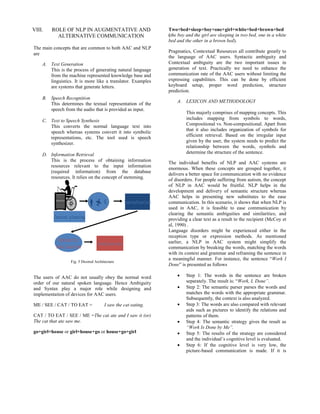
This is the process of obtaining information
resources relevant to the input information
(required information) from the database
resources. It relies on the concept of stemming.
Fig. 5 Desired Architecture
The users of AAC do not usually obey the normal word
order of our natural spoken language. Hence Ambiguity
and Syntax play a major role while designing and
implementation of devices for AAC users.
ME / SEE / CAT / TO EAT = I saw the cat eating.
CAT / TO EAT / SEE / ME =The cat ate and I saw it (or)
The cat that ate saw me.
go+girl+house or girl+house+go or house+go+girl
ROLE OF NLP IN AUGMENTATIVE AND
ALTERNATIVE COMMUNICATION
The main concepts that are common to both AAC and NLP
process of generating natural language
from the machine represented knowledge base and
linguistics. It is more like a translator. Examples
This determines the textual representation of the
the audio that is provided as input.
This converts the normal language text into
speech whereas systems convert it into symbolic
representations, etc. The tool used is speech
process of obtaining information
resources relevant to the input information
(required information) from the database
resources. It relies on the concept of stemming.
The users of AAC do not usually obey the normal word
of our natural spoken language. Hence Ambiguity
and Syntax play a major role while designing and
I saw the cat eating.
cat ate and I saw it (or)
house+go+girl
Two+bed+sleep+boy+one+girl+white+bed+brown+bed
(the boy and the girl are sleeping in two bed, one in a white
bed and the other in a brown bed).
Pragmatics, Contextual Resources all contribute greatly to
the language of AAC users. Syntactic ambiguity and
Contextual ambiguity are the two important issues in
generation of text. Practically we need to enhance the
communication rate of the AAC users without limi
expressing capabilities. This can be done by efficient
keyboard setup, proper word prediction, structure
prediction.
A. LEXICON AND METHODOLOGY
This majorly comprises of mapping concepts. This
includes mapping from symbols to words,
Compositional vs. Non-compositional. Apart from
that it also includes organization of symbols for
efficient retrieval. Based on the irregular input
given by the user, the system needs to predict the
relationship between the words, symbols and
determine the structure of t
The individual benefits of NLP and AAC systems are
enormous. When these concepts are grouped together, it
delivers a better space for communication with no evidence
of disorders. For people suffering from autism, the concept
of NLP in AAC would be fruitful. NLP helps in the
development and delivery of semantic structure whereas
AAC helps in presenting new substitutes to the ease
communication. In this scenario, it shows that when NLP is
used in AAC, it is feasible to ease communication by
clearing the semantic ambiguities and similarities; and
providing a clear text as a result to the recipient (McCoy et
al, 1990) .
Language disorders might be experienced either in the
reception type or expression methods. As mentioned
earlier, a NLP in AAC system might simplify the
communication by breaking the words, matching the words
with its context and grammar and reframing the sentence in
a meaningful manner. For instance, the sentence “
Done” is presented as follows
 Step 1: The words in the sent
separately. The result is: “Work, I, Done”
 Step 2: The semantic parser parses the words and
matches the words with the appropriate grammar.
Subsequently, the context is also analyzed.
 Step 3: The words are also compared with relevant
aids such as pictures to identify the relations and
patterns of them.
 Step 4: The semantic strategy gives the result as
“Work Is Done by Me”.
 Step 5: The results of the strategy are considered
and the individual’s cognitive level is evaluated.
 Step 6: If the cognitive level is very low, the
picture-based communication is made. If it is
Two+bed+sleep+boy+one+girl+white+bed+brown+bed
the boy and the girl are sleeping in two bed, one in a white
, Contextual Resources all contribute greatly to
the language of AAC users. Syntactic ambiguity and
Contextual ambiguity are the two important issues in
generation of text. Practically we need to enhance the
communication rate of the AAC users without limiting the
expressing capabilities. This can be done by efficient
keyboard setup, proper word prediction, structure
LEXICON AND METHODOLOGY
This majorly comprises of mapping concepts. This
includes mapping from symbols to words,
compositional. Apart from
that it also includes organization of symbols for
efficient retrieval. Based on the irregular input
given by the user, the system needs to predict the
relationship between the words, symbols and
determine the structure of the sentence.
The individual benefits of NLP and AAC systems are
enormous. When these concepts are grouped together, it
delivers a better space for communication with no evidence
of disorders. For people suffering from autism, the concept
d be fruitful. NLP helps in the
development and delivery of semantic structure whereas
AAC helps in presenting new substitutes to the ease
communication. In this scenario, it shows that when NLP is
used in AAC, it is feasible to ease communication by
ing the semantic ambiguities and similarities; and
providing a clear text as a result to the recipient (McCoy et
Language disorders might be experienced either in the
reception type or expression methods. As mentioned
system might simplify the
communication by breaking the words, matching the words
with its context and grammar and reframing the sentence in
a meaningful manner. For instance, the sentence “Work I
Step 1: The words in the sentence are broken
Work, I, Done”.
Step 2: The semantic parser parses the words and
matches the words with the appropriate grammar.
Subsequently, the context is also analyzed.
Step 3: The words are also compared with relevant
s such as pictures to identify the relations and
Step 4: The semantic strategy gives the result as
Step 5: The results of the strategy are considered
and the individual’s cognitive level is evaluated.
Step 6: If the cognitive level is very low, the
based communication is made. If it is
medium, then paper based or even speech
communication can be made to convey the end
result.
In this process, the steps 1, 2 and 4 are carried out by NLP
and the purpose of the process is accomplished when NLP
is involved in AAC to deliver the result based on the
intended recipient’s cognitive level.
NLP in AAC is often considered as the best interface to
communicate with the patients (McCoy et al, 1990) . A
the mere aim of the system is to relieve the person with
disorders and enhance the efficiency, the machine
translation is used in case of NLP; and the AAC system
covers the phonetic and lexical ambiguities faced by the
patient. In most of the cases, the patients feel the linguistic
ambiguity either due to the context or phonetics used by
the speaker in the oral communication. When written
communication is taken into consideration, grammar,
lexical levels and type of narration might confuse the
readers.
IX. ASSISTIVE TECHNIQUES FOR TEXT
ENTRY – COMPANSION
This scheme includes abbreviation expansion, character
prediction, word and string prediction, reduced
disambiguation and special keywords, symbolic entry and
coding methods. This method was named ‘Compan
after research. It was designed to process and
spontaneous language constructions such that the group of
uninflected content words would be expanded
automatically into a full phrase or sentence. It can
compared to predictive sms-texts.
When the user enters the starting letters ‘di’ of the word
intended, a menu of words are presented based on the
initial characters. The user can select the word required
with the single selection action rather than having to
perform series of actions to complete typing the full word.
A 12-key solves the ambiguity caused by the multi
character keys with different layouts and character
assignments can be assembled which differ from cell
phones. Such reduced layouts are designed for people
whose disabilities mean that a small number of large keys
is easier to access and use large number of small keys.
medium, then paper based or even speech-based
communication can be made to convey the end
In this process, the steps 1, 2 and 4 are carried out by NLP
nd the purpose of the process is accomplished when NLP
is involved in AAC to deliver the result based on the
NLP in AAC is often considered as the best interface to
communicate with the patients (McCoy et al, 1990) . As
the mere aim of the system is to relieve the person with
disorders and enhance the efficiency, the machine
translation is used in case of NLP; and the AAC system
covers the phonetic and lexical ambiguities faced by the
patients feel the linguistic
ambiguity either due to the context or phonetics used by
the speaker in the oral communication. When written
communication is taken into consideration, grammar,
lexical levels and type of narration might confuse the
ASSISTIVE TECHNIQUES FOR TEXT
COMPANSION
This scheme includes abbreviation expansion, character
prediction, word and string prediction, reduced
disambiguation and special keywords, symbolic entry and
coding methods. This method was named ‘Compansion’
rocess and expand
spontaneous language constructions such that the group of
uninflected content words would be expanded
automatically into a full phrase or sentence. It can be
the user enters the starting letters ‘di’ of the word
intended, a menu of words are presented based on the
initial characters. The user can select the word required
with the single selection action rather than having to
te typing the full word.
key solves the ambiguity caused by the multi-
character keys with different layouts and character-key
assignments can be assembled which differ from cell
phones. Such reduced layouts are designed for people
ean that a small number of large keys
is easier to access and use large number of small keys.
Fig. 6 Compansion - Text Entry
Other recent development is the Dasher system which is a
text entry interface driven by continuous pointing gestures.
It can be operated by eye-trackers, joysticks and touch
screen thus useful for people with special needs.
tracking version of Dasher allows an experienced user to
write text as fast as normal handwriting
minute; using a mouse, experienced u
words per minute.” These input rates are very appropriate
for those writing text as an off-line task (for example in the
composition of essays or other written documents) and will
also assist when new statements need to be entered duri
conversation.
X. ASSESSMENT OF NLP TO AAC
AAC is a widespread system that is commonly used among
the patients with autism, language understanding is
apraxia. Children with serious disorders associated with
phonology fail to have proper communicatio
So, the AAC system tends not only to serve as an aid for
communication but also to improve the language
intelligibility. As language influences the overall
development and cognitive understanding of a child, the
AAC systems are developed with this perspective.
There are certain issues faced by the people in the case of
AAC. There are no pre-stored samples to the patients in the
AAC systems whereas the application of NLP to AAC can
enable better interpretation and automatic content
maintenance, which resolves the above problem. The other
point is that there is no option for dynamic choice of the
vocabulary in an AAC system. The language representation
of NLP appears to be easier, no matter whether it is a
picture-based system or alphabet-
based system.
There are two major fields where NLP to AAC system can
prove to be high; and they include interface design and the
word prediction. The future applications are more relied on
NLP due to the main reason that the word predic
better sense to the outputs of the AAC system. This implies
that the success rate is high and there is a huge potential for
these applications in the near future. The evaluations that
Text Entry
Other recent development is the Dasher system which is a
text entry interface driven by continuous pointing gestures.
trackers, joysticks and touch-
screen thus useful for people with special needs. The eye-
tracking version of Dasher allows an experienced user to
write text as fast as normal handwriting - 25 words per
minute; using a mouse, experienced users can write at 39
words per minute.” These input rates are very appropriate
line task (for example in the
composition of essays or other written documents) and will
also assist when new statements need to be entered during
ASSESSMENT OF NLP TO AAC
AAC is a widespread system that is commonly used among
the patients with autism, language understanding issues and
. Children with serious disorders associated with
phonology fail to have proper communication interaction.
So, the AAC system tends not only to serve as an aid for
communication but also to improve the language
intelligibility. As language influences the overall
development and cognitive understanding of a child, the
h this perspective.
There are certain issues faced by the people in the case of
stored samples to the patients in the
AAC systems whereas the application of NLP to AAC can
enable better interpretation and automatic content
ce, which resolves the above problem. The other
point is that there is no option for dynamic choice of the
vocabulary in an AAC system. The language representation
of NLP appears to be easier, no matter whether it is a
-based system or voice
There are two major fields where NLP to AAC system can
prove to be high; and they include interface design and the
word prediction. The future applications are more relied on
NLP due to the main reason that the word prediction adds
better sense to the outputs of the AAC system. This implies
that the success rate is high and there is a huge potential for
these applications in the near future. The evaluations that
have been conducted so far on these applications have
clearly denoted that the next generation of technology is to
rely on these applications and there are greater chances for
the affected people / patients to overcome the disorders at a
rapid pace (Hill, 2011) . So, it is highly recommended to
utilize these applications and also spread the idea to those
patients with language / communication disorders.
XI. CONCLUSION
From what we saw we can confidently state that Natural
Language Processing can be effectively integrated into
Augmentative and Alternative Communication. Though
data collection poses as an issue here, techniques are
developed to overcome this. The aim of this research is to
make the AAC systems more flexible, expressive tools
with enhanced rate of computation when it is incorporated
with NLP methodologies. This can provide a floodgate of
opportunities for speech-impaired, autistic and differently
abled people. People with speech and language disorders
expect a high level of clarity in the information presented
and the AAC system does assure clarity through different
means. When the patient accesses the AAC system, he /
she tends to receive multiple formats of a sentence so that
there is a consistency in the information delivered and
relevance of the words used. The communication aids are
generally chosen depending on the patient’s abilities. The
application of NLP in AAC is expected to develop a new
world of communication in terms of clarity and ease in
understanding and capabilities.
REFERENCES
[1] Christopher D. Manning, Hinrich Schütze: Foundations of
Statistical Natural Language Processing, MIT
Press (1999), ISBN 978-0-262-13360-9, p. xxxi
[2] Laplante, Phillip (2007). What Every Engineer Should Know
about Software Engineering. Boca Raton: CRC. ISBN 978-0-
8493-7228-5. Retrieved 2011-01-21.
[3] Roger Schank, 1969, A conceptual dependency parser for
natural language Proceedings of the 1969 conference on
Computational linguistics, Sång-Säby, Sweden pages 1-3
[4] McCorduck 2004, p. 286, Crevier 1993, pp. 76−79, Russell &
Norvig 2003, p. 19
[5] SWEBOK executive editors, Alain Abran, James W. Moore ;
editors, Pierre Bourque, Robert Dupuis. (2004). Pierre Bourque
and Robert Dupuis, ed. Guide to the Software Engineering
Body of Knowledge - 2004 Version. IEEE Computer Society.
pp. 1–1. ISBN 0-7695-2330-7.
[6] "Debian GNU/Linux Licenses". Ohloh. Retrieved 27 March
2009.
[7] Yucong Duan, Christophe Cruz (2011), Formalizing Semantic
of Natural Language through Conceptualization from
Existence. International Journal of Innovation, Management
and Technology(2011) 2 (1), pp. 37-42.
[8] McQuail, Denis. (2005). Mcquail's Mass Communication
Theory. 5th ed. London: SAGE Publications.
[9] Lenzo, Kevin (Summer 1998). "Infobots and Purl". The Perl
Journal 3 (2). Retrieved 2010-07-26.
[10] Jurafsky, James (2008). Speech and Language Processing. An
Introduction to Natural Language Processing, Computational
Linguistics, and Speech Recognition (in English) (2nd ed.).
Upper Saddle River (N.J.): Prentice Hall.
[11] Fossett, Brenda; Mirenda, P. (2009). "Augmentative and
Alternative Communication". In S. L. Odom, R. H. Horner &
M. E. Snell. Handbook of Developmental Disabilities. Guilford
Press. pp. 330–366. ISBN 978-1-60623-248-4.
[12] Reddington, J.; Tintarev, N. (2011). "Automatically generating
stories from sensor data".Proceedings of the 15th international
conference on Intelligent user interfaces - IUI '11.
p. 407.doi:10.1145/1943403.1943477. ISBN 9781450304191.

NLPinAAC

  • 1.
    Natural Language Processingin Augmentative and Alternative Communication S.R.Jhanani#1 , S.Divya#2 # Department of Information technology, Meenakshi Sundararajan Engineering College, Chennai – 600 024, Tamil Nadu, India 1 jhanani21@gmail.com 2 divya.msecit@gmail.com Abstract — This paper presents a study on Natural Language Processing (NLP), Alternative and Augmentative Communication (AAC) and highlights about the role of NATURAL LANGUAGE PROCESSING IN AUGMENTATIVE AND ALTERNATIVE COMMUNICATION. Natural Language Processing is one of the major branches of Artificial Intelligence (AI) which is mainly linked to the concept of ‘human-computer interaction’, conversion of humans’ natural language into a machine-understandable form for the computer. The computer analyses and understands this input which is our natural communication language with the help of various methods and communicates in human language. Augmentative and Alternative Communication describes various methods of non-verbal communication. It is usually useful for speech-impaired people. After a brief description on the basic concepts involved, this paper will guide you through the levels, approaches (based on suitability) and evaluation criteria of Natural Language Processing, description of AAC and provide an insight about the role of NLP in Augmentative and Alternative Communication. Artificial Intelligence (AI) aims to achieve ‘human-like language processing’, making computers as intelligent as people. So we can say relationship of Artificial Intelligence and Augmentative communication is symbiotic. Keywords - Artificial Intelligence, Augmentative communication, human-computer interaction, Natural Language Processing I. INTRODUCTION Artificial Intelligence (AI) is the ‘fifth generation’ of computers which aims at development of intelligent machines. This field can be defined as “the study and design of intelligent agents”. Here ‘intelligent agents’ are machines that observe the environment and do only the things which maximize their chance of success. The main hitch with AI is its disability of communication, reasoning and knowledge. Current approaches consist of statistical methods, computational intelligence and traditional symbolic AI. Tools used include mathematical optimization, logic, economics and probability. The main problem has been broken down into many sub problems. This has in turn lead to the development of many sub- fields, one of them being “Natural Language Processing”. Each sub-field focuses on finding solutions for the particular problem. II. NATURAL LANGUAGE PROCESSING Natural Language Processing is a form of human- computer interaction. This field is a combined derivative of the fields Artificial Intelligence and Linguistics. The main challenge in this field is to make the computers understand and obtain meaning from our natural language. The input is our natural language. The computers analyse, understand, process the natural language. This event encompasses the automation of linguistic forms, activities or methods of communication such as conversation, reading, writing, lip reading etc. This involves texts at one or more linguistic levels and involves the complete study and analysis of it. This field of study facilitate the computers to engage in communication using natural language that is not particularly restricted to speech, print, signing and writing. This has a wide range of applications. History of NLP starts from 1950’s when Alan Turing published his article on “Computing Machinery and Intelligence” that proposed the “Turing Test” which is a set standard for intelligence. Some successful NLP systems in 1960’s were SHRDLU, ELIZA. “Conceptual ontologies” structured real-world information into machine understandable data in 1970’s: MARGIE, SAM, PAM, TaleSpin, and QUALM. During 1980’s first statistical machine translation was developed namely Chatterbot. Until this period these NLP machines were mainly developed using complex sets of hand-written rules. Then a major progress came through the introduction of machine learning algorithms. Early machine learning algorithms were based on decision trees which became increasingly tiresome later. Next came the statistical models which made probabilistic decisions on real-valued attributes of the input. Example of a statistical model is the cache language model. Recent research increasingly focuses on unsupervised and semi-supervised learning algorithms which learn from data that is not provided with the required answers and produces less accurate results.
  • 2.
    The goal ofNLP as stated above is “to achieve human-like language processing”. Here the term processing is entirely different from understanding. A full NLP system can : A. Paraphrase the input text B. Translate it into other language. C. Answer questions on it. D. Draw conclusions from it. While there have been some ground-breaking achievements of NLP systems in the first three goals, the fourth still remains the goal of NLP. III. LEVELS OF NLP Also referred as the synchronic model of language, this model conveys exactly what happens within the NLP system. It is distinguished from the initial sequential model which tells that the levels of human language processing follow a sequential approach. According to psycholinguistic research this process is dynamic that is levels can interact with one another and introspection exposes that humans use the higher level information to assist the processing of lower level information. We can understand it as “the more capable an NLP system is, the more levels of language it will use” A. Phonology This level is about the interpretation of speech sounds within and across words. There are 3 rules always associated with phonological analysis 1) Phonetic rules : for sounds within words 2) Phonemic rules : for variation of pronunciation when words are spoken together 3) Prosodic rules : for fluctuation in stress and intonation across a sentence The sound waves of input are analysed, encoded for interpretation. B. Morphology Deals with the componential nature of words that are composed of morphemes (smallest unit of meaning) . NLP system breaks down a word into its morphemes to understand it. Example: premodified = pre+modify+ed C. Lexical At this level, meanings of individual words are interpreted. First each word is assigned a single part-of-speech tag. Some words which can function as more than one part are assigned the most probable part-of-speech tag on the basis of their context. Words with only one meaning are replaced with a semantic representation of that meaning. A single lexical unit is decomposed into its basic properties. This makes it possible to unify meanings across words for complex interpretation. Example: suggest a good book that children can read. ((Class – book) (Properties – large) (Purpose (Predication (class – read) (Object – people)))) D. Syntactic Grammatical structure of the sentence is uncovered by analyzing the words. So this needs a parser and a grammar. The output is the sentence representation with structural dependency within the words. Not all NLP applications require a full parse of sentences, so the remaining challenges in those applications for which phrasal and clausal dependencies are sufficient. Syntax is of great use as order and dependency give the meaning. Example: ‘The dog chased the cat’ and ‘The cat chased the dog’ E. Semantic This determines the possible meanings of a sentence by concentrating on word-level meanings in the sentence including the semantic disambiguation of words. This allows only one sense of polysemous words to be selected and included in the semantic representation of sentence. Semantic level does the disambiguation if information from other words of the sentence is needed. Some require information on the frequency of each sense, or in general usage, consideration of local context or pragmatic knowledge. F. Discourse This level works with units of text longer than a sentence. Concentrates on properties of the text as a whole and makes connection between components sentences that convey meaning. Two types of processing can occur: 1) Anaphora Resolution : replacing semantically vacant words with appropriate entity 2) Discourse/text Structure : determines functions of sentences in the text. A report can be deconstructed into discourse components – lead, main, story, events, quotes, results. G. Pragmatic This level’s aim is to clarify how extra meaning is understood without encoding it. It requires world knowledge and is all about the use of language in situations and uses context over and above the contents of the text for understanding. Example: The government refused to release the film as it was concerned about the communal violence
  • 3.
    Fig. 1 Connectionbetween the levels of NLP Fig. 2 Data Flow Diagram IV. APPROACHES IN NLP This section examines each of these approaches in terms of their foundations, typical techniques, differences in processing and system aspects, and their robustness, flexibility, and suitability for various tasks. A. Symbolic This approach dominated the field for a long time. it is based on explicit depiction of facts about language through well-understood knowledge schemes and algorithms. It performs deep analysis of linguistic phenomena. Logic or Rule based system is an example of this. The inference engine selects and executes a rule if it is satisfied. Another example is semantic networks where knowledge is represented by nodes (set of objects) and labelled links (relations between nodes). Highly connected concepts – direct links and weakly connected concepts – intervening concepts. B. Statistical They usually coexisted with the symbolic approach but gained popularity in 1980’s. Use observable data as primary source of evidence. As the name indicates they put into use many mathematical techniques and large texts of corpora for developing generalized models without incorporating world knowledge. One such finite automation model is the Hidden Markov Model (HMM). Output produced by each state has a definitive probability. Used in tasks like speech recognition, lexical acquisition, parsing, part-of- speech tagging, statistical machine translation, grammar learning, etc. C. Connectionist These first appeared in 1960’s and received heavy criticism. They overcame that in 1980’s by demonstrating the utility of neural networks in NLP. They are similar to statistical approach. The difference is that former combines statistical learning with various theories of representation and allows transformation, inference and logic formulae manipulation. The architectures are less constrained and hence linguistic models are harder to observe. Simply put, it is a network of interconnected simple processing units with knowledge in weights of the connection between units. Local interaction resulting in global behaviour leads to computation. They are of two types: 1) Localist Models: relations between concepts are encoded by weights of connection between them but not labelled. Performs word-sense disambiguation 2) Distributed Models: concept is depicted as a function of simultaneous activation of multiple units. Well suited for NLP tasks syntactic parsing, associative retrieval. V. STAGES OF NLP NLP is basically a three stage process, the three stages being A. Parsing B. Translating C. Generating input contents The output of every stage is fed as the input to the next stage of the system. The natural language processing works based on semantic structures and generations. Hence, the first step is to find out the possible interpretations for the input through the semantic parser . The problem here is that a word can fall under several semantic classifications. With a sub frame designed for every word as in input, the semantic type is designed and is substituted to the word to develop the interpretations. For instance, ‘take’ can be replaced by ‘get’ and ‘from’. The translator serves as the middleware to the system. The main use of this stage is to create placeholders for the words in the translator’s dictionary and covert the words
  • 4.
    with probable structuraltranslations. Syntactic realization takes place at the second stage of the natural language processing. The generator phase is primarily responsible for the sentence generation based on the knowledge of specific language. The result becomes the final component of the entire system. Lexical classification and generation take place at this final stage. The output of the NLP system directs the patient with the right options and translations for their doubts VI. EVALUATION TYPES AND CRITERIA To determine if the system meets the goals/needs of its end-users, qualities of the algorithms are measured. Criteria include evaluation data and evaluation metrics enables solution comparison. Different types are A. Intrinsic vs. Extrinsic Evaluation Former characterizes the performance of an isolated NLP with reference to a gold standard (already pre-defined). Latter considers the system as an embedded system or helping with a precise function for human user. It is then characterized in terms of overall task. B. Black-box vs. Glass box Evaluation Black-box evaluation measures parameters concerned with quality of process (speed, reliability, resource consumption, etc) and quality of result (accuracy) while running the NLP system on a data. Glass box evaluation sees the system design, algorithm efficiency, linguistic resources. This type is more informative but is complicated. C. Automatic vs. Manual Evaluation The former referred as “objective evaluation” evaluates by comparing the system output with pre-defined gold standard and can be repeated many times. Manual evaluation referred as “subjective evaluation” is done by human judges who estimate the quality by a sample of its output. There is a considerable variation in their ratings. VII. AUGMENTATIVE AND ALTERNATIVE COMMUNICATION (AAC) Augmentative and alternative communication (AAC) is a way for an individual to communicate when he/she does not have the physical ability to use verbal speech or writing. AAC systems are designed to help people express their thoughts, needs, wants and ideas. AAC can range from a simple set of pictures, symbols on the communication board up to a computer system that is programmed to speak with words or messages. AAC is used by those with the range of speech and language impairments common causes for severe disabilities include congenital conditions such as cerebral palsy, intellectual impairment and autism and acquired conditions such as amyotrophic lateral sclerosis and parkinson’s disease. AAC can help people who cannot talk at all. Using AAC can also help decrease inappropriate behaviour such as crying (of differently abled people) which cannot be done easy with device. Fig. 3 Person using the AAC device with touch-entry There are a wide variety of ways to access ACC. Access is the way where individuals makes selection on a communication board or a speech generating device. Some of the access methods used for the AAC include direct selection by pointing or reaching or scanning using a switch connected to the device. An AAC user can indicate a series of numbers through an eye gaze communication board in order to convey a word. AAC are broadly divided into two broad groups, known as unaided and aided forms of communication. Unaided forms of communication consist of non verbal means of natural communications including gestures and facial expressions as well as manual signs and American Sign Language (ASL). Aided forms of communication consist of those approaches that require some additional external support such as a communication board with visual-graphic symbols that is of pictures, photographs, line drawings, blissymbols (developed by Charles K.Bliss in 1949 as an ideographic writing containing several hundred symbols), printed words, traditional orthography that stands for what an individual wants to express or a sophisticated computer with symbols, words, letters, icons that speaks for its user either by synthetically produced speech or recorded natural speech. Fig. 4 Person using the AAC device with keypad
  • 5.
    VIII. ROLE OFNLP IN AUGMENTATIVE AND ALTERNATIVE COMMUNICATION The main concepts that are common to both AAC and NLP are A. Text Generation This is the process of generating natural language from the machine represented knowledge base and linguistics. It is more like a translator. Examples are systems that generate letters. B. Speech Recognition This determines the textual representation of the speech from the audio that is provided as input. C. Text to Speech Synthesis This converts the normal language text into speech whereas systems convert it into symbolic representations, etc. The tool used is speech synthesizer. D. Information Retrieval This is the process of obtaining information resources relevant to the input information (required information) from the database resources. It relies on the concept of stemming. Fig. 5 Desired Architecture The users of AAC do not usually obey the normal word order of our natural spoken language. Hence Ambiguity and Syntax play a major role while designing and implementation of devices for AAC users. ME / SEE / CAT / TO EAT = I saw the cat eating. CAT / TO EAT / SEE / ME =The cat ate and I saw it (or) The cat that ate saw me. go+girl+house or girl+house+go or house+go+girl ROLE OF NLP IN AUGMENTATIVE AND ALTERNATIVE COMMUNICATION The main concepts that are common to both AAC and NLP process of generating natural language from the machine represented knowledge base and linguistics. It is more like a translator. Examples This determines the textual representation of the the audio that is provided as input. This converts the normal language text into speech whereas systems convert it into symbolic representations, etc. The tool used is speech process of obtaining information resources relevant to the input information (required information) from the database resources. It relies on the concept of stemming. The users of AAC do not usually obey the normal word of our natural spoken language. Hence Ambiguity and Syntax play a major role while designing and I saw the cat eating. cat ate and I saw it (or) house+go+girl Two+bed+sleep+boy+one+girl+white+bed+brown+bed (the boy and the girl are sleeping in two bed, one in a white bed and the other in a brown bed). Pragmatics, Contextual Resources all contribute greatly to the language of AAC users. Syntactic ambiguity and Contextual ambiguity are the two important issues in generation of text. Practically we need to enhance the communication rate of the AAC users without limi expressing capabilities. This can be done by efficient keyboard setup, proper word prediction, structure prediction. A. LEXICON AND METHODOLOGY This majorly comprises of mapping concepts. This includes mapping from symbols to words, Compositional vs. Non-compositional. Apart from that it also includes organization of symbols for efficient retrieval. Based on the irregular input given by the user, the system needs to predict the relationship between the words, symbols and determine the structure of t The individual benefits of NLP and AAC systems are enormous. When these concepts are grouped together, it delivers a better space for communication with no evidence of disorders. For people suffering from autism, the concept of NLP in AAC would be fruitful. NLP helps in the development and delivery of semantic structure whereas AAC helps in presenting new substitutes to the ease communication. In this scenario, it shows that when NLP is used in AAC, it is feasible to ease communication by clearing the semantic ambiguities and similarities; and providing a clear text as a result to the recipient (McCoy et al, 1990) . Language disorders might be experienced either in the reception type or expression methods. As mentioned earlier, a NLP in AAC system might simplify the communication by breaking the words, matching the words with its context and grammar and reframing the sentence in a meaningful manner. For instance, the sentence “ Done” is presented as follows  Step 1: The words in the sent separately. The result is: “Work, I, Done”  Step 2: The semantic parser parses the words and matches the words with the appropriate grammar. Subsequently, the context is also analyzed.  Step 3: The words are also compared with relevant aids such as pictures to identify the relations and patterns of them.  Step 4: The semantic strategy gives the result as “Work Is Done by Me”.  Step 5: The results of the strategy are considered and the individual’s cognitive level is evaluated.  Step 6: If the cognitive level is very low, the picture-based communication is made. If it is Two+bed+sleep+boy+one+girl+white+bed+brown+bed the boy and the girl are sleeping in two bed, one in a white , Contextual Resources all contribute greatly to the language of AAC users. Syntactic ambiguity and Contextual ambiguity are the two important issues in generation of text. Practically we need to enhance the communication rate of the AAC users without limiting the expressing capabilities. This can be done by efficient keyboard setup, proper word prediction, structure LEXICON AND METHODOLOGY This majorly comprises of mapping concepts. This includes mapping from symbols to words, compositional. Apart from that it also includes organization of symbols for efficient retrieval. Based on the irregular input given by the user, the system needs to predict the relationship between the words, symbols and determine the structure of the sentence. The individual benefits of NLP and AAC systems are enormous. When these concepts are grouped together, it delivers a better space for communication with no evidence of disorders. For people suffering from autism, the concept d be fruitful. NLP helps in the development and delivery of semantic structure whereas AAC helps in presenting new substitutes to the ease communication. In this scenario, it shows that when NLP is used in AAC, it is feasible to ease communication by ing the semantic ambiguities and similarities; and providing a clear text as a result to the recipient (McCoy et Language disorders might be experienced either in the reception type or expression methods. As mentioned system might simplify the communication by breaking the words, matching the words with its context and grammar and reframing the sentence in a meaningful manner. For instance, the sentence “Work I Step 1: The words in the sentence are broken Work, I, Done”. Step 2: The semantic parser parses the words and matches the words with the appropriate grammar. Subsequently, the context is also analyzed. Step 3: The words are also compared with relevant s such as pictures to identify the relations and Step 4: The semantic strategy gives the result as Step 5: The results of the strategy are considered and the individual’s cognitive level is evaluated. Step 6: If the cognitive level is very low, the based communication is made. If it is
  • 6.
    medium, then paperbased or even speech communication can be made to convey the end result. In this process, the steps 1, 2 and 4 are carried out by NLP and the purpose of the process is accomplished when NLP is involved in AAC to deliver the result based on the intended recipient’s cognitive level. NLP in AAC is often considered as the best interface to communicate with the patients (McCoy et al, 1990) . A the mere aim of the system is to relieve the person with disorders and enhance the efficiency, the machine translation is used in case of NLP; and the AAC system covers the phonetic and lexical ambiguities faced by the patient. In most of the cases, the patients feel the linguistic ambiguity either due to the context or phonetics used by the speaker in the oral communication. When written communication is taken into consideration, grammar, lexical levels and type of narration might confuse the readers. IX. ASSISTIVE TECHNIQUES FOR TEXT ENTRY – COMPANSION This scheme includes abbreviation expansion, character prediction, word and string prediction, reduced disambiguation and special keywords, symbolic entry and coding methods. This method was named ‘Compan after research. It was designed to process and spontaneous language constructions such that the group of uninflected content words would be expanded automatically into a full phrase or sentence. It can compared to predictive sms-texts. When the user enters the starting letters ‘di’ of the word intended, a menu of words are presented based on the initial characters. The user can select the word required with the single selection action rather than having to perform series of actions to complete typing the full word. A 12-key solves the ambiguity caused by the multi character keys with different layouts and character assignments can be assembled which differ from cell phones. Such reduced layouts are designed for people whose disabilities mean that a small number of large keys is easier to access and use large number of small keys. medium, then paper based or even speech-based communication can be made to convey the end In this process, the steps 1, 2 and 4 are carried out by NLP nd the purpose of the process is accomplished when NLP is involved in AAC to deliver the result based on the NLP in AAC is often considered as the best interface to communicate with the patients (McCoy et al, 1990) . As the mere aim of the system is to relieve the person with disorders and enhance the efficiency, the machine translation is used in case of NLP; and the AAC system covers the phonetic and lexical ambiguities faced by the patients feel the linguistic ambiguity either due to the context or phonetics used by the speaker in the oral communication. When written communication is taken into consideration, grammar, lexical levels and type of narration might confuse the ASSISTIVE TECHNIQUES FOR TEXT COMPANSION This scheme includes abbreviation expansion, character prediction, word and string prediction, reduced disambiguation and special keywords, symbolic entry and coding methods. This method was named ‘Compansion’ rocess and expand spontaneous language constructions such that the group of uninflected content words would be expanded automatically into a full phrase or sentence. It can be the user enters the starting letters ‘di’ of the word intended, a menu of words are presented based on the initial characters. The user can select the word required with the single selection action rather than having to te typing the full word. key solves the ambiguity caused by the multi- character keys with different layouts and character-key assignments can be assembled which differ from cell phones. Such reduced layouts are designed for people ean that a small number of large keys is easier to access and use large number of small keys. Fig. 6 Compansion - Text Entry Other recent development is the Dasher system which is a text entry interface driven by continuous pointing gestures. It can be operated by eye-trackers, joysticks and touch screen thus useful for people with special needs. tracking version of Dasher allows an experienced user to write text as fast as normal handwriting minute; using a mouse, experienced u words per minute.” These input rates are very appropriate for those writing text as an off-line task (for example in the composition of essays or other written documents) and will also assist when new statements need to be entered duri conversation. X. ASSESSMENT OF NLP TO AAC AAC is a widespread system that is commonly used among the patients with autism, language understanding is apraxia. Children with serious disorders associated with phonology fail to have proper communicatio So, the AAC system tends not only to serve as an aid for communication but also to improve the language intelligibility. As language influences the overall development and cognitive understanding of a child, the AAC systems are developed with this perspective. There are certain issues faced by the people in the case of AAC. There are no pre-stored samples to the patients in the AAC systems whereas the application of NLP to AAC can enable better interpretation and automatic content maintenance, which resolves the above problem. The other point is that there is no option for dynamic choice of the vocabulary in an AAC system. The language representation of NLP appears to be easier, no matter whether it is a picture-based system or alphabet- based system. There are two major fields where NLP to AAC system can prove to be high; and they include interface design and the word prediction. The future applications are more relied on NLP due to the main reason that the word predic better sense to the outputs of the AAC system. This implies that the success rate is high and there is a huge potential for these applications in the near future. The evaluations that Text Entry Other recent development is the Dasher system which is a text entry interface driven by continuous pointing gestures. trackers, joysticks and touch- screen thus useful for people with special needs. The eye- tracking version of Dasher allows an experienced user to write text as fast as normal handwriting - 25 words per minute; using a mouse, experienced users can write at 39 words per minute.” These input rates are very appropriate line task (for example in the composition of essays or other written documents) and will also assist when new statements need to be entered during ASSESSMENT OF NLP TO AAC AAC is a widespread system that is commonly used among the patients with autism, language understanding issues and . Children with serious disorders associated with phonology fail to have proper communication interaction. So, the AAC system tends not only to serve as an aid for communication but also to improve the language intelligibility. As language influences the overall development and cognitive understanding of a child, the h this perspective. There are certain issues faced by the people in the case of stored samples to the patients in the AAC systems whereas the application of NLP to AAC can enable better interpretation and automatic content ce, which resolves the above problem. The other point is that there is no option for dynamic choice of the vocabulary in an AAC system. The language representation of NLP appears to be easier, no matter whether it is a -based system or voice There are two major fields where NLP to AAC system can prove to be high; and they include interface design and the word prediction. The future applications are more relied on NLP due to the main reason that the word prediction adds better sense to the outputs of the AAC system. This implies that the success rate is high and there is a huge potential for these applications in the near future. The evaluations that
  • 7.
    have been conductedso far on these applications have clearly denoted that the next generation of technology is to rely on these applications and there are greater chances for the affected people / patients to overcome the disorders at a rapid pace (Hill, 2011) . So, it is highly recommended to utilize these applications and also spread the idea to those patients with language / communication disorders. XI. CONCLUSION From what we saw we can confidently state that Natural Language Processing can be effectively integrated into Augmentative and Alternative Communication. Though data collection poses as an issue here, techniques are developed to overcome this. The aim of this research is to make the AAC systems more flexible, expressive tools with enhanced rate of computation when it is incorporated with NLP methodologies. This can provide a floodgate of opportunities for speech-impaired, autistic and differently abled people. People with speech and language disorders expect a high level of clarity in the information presented and the AAC system does assure clarity through different means. When the patient accesses the AAC system, he / she tends to receive multiple formats of a sentence so that there is a consistency in the information delivered and relevance of the words used. The communication aids are generally chosen depending on the patient’s abilities. The application of NLP in AAC is expected to develop a new world of communication in terms of clarity and ease in understanding and capabilities. REFERENCES [1] Christopher D. Manning, Hinrich Schütze: Foundations of Statistical Natural Language Processing, MIT Press (1999), ISBN 978-0-262-13360-9, p. xxxi [2] Laplante, Phillip (2007). What Every Engineer Should Know about Software Engineering. Boca Raton: CRC. ISBN 978-0- 8493-7228-5. Retrieved 2011-01-21. [3] Roger Schank, 1969, A conceptual dependency parser for natural language Proceedings of the 1969 conference on Computational linguistics, Sång-Säby, Sweden pages 1-3 [4] McCorduck 2004, p. 286, Crevier 1993, pp. 76−79, Russell & Norvig 2003, p. 19 [5] SWEBOK executive editors, Alain Abran, James W. Moore ; editors, Pierre Bourque, Robert Dupuis. (2004). Pierre Bourque and Robert Dupuis, ed. Guide to the Software Engineering Body of Knowledge - 2004 Version. IEEE Computer Society. pp. 1–1. ISBN 0-7695-2330-7. [6] "Debian GNU/Linux Licenses". Ohloh. Retrieved 27 March 2009. [7] Yucong Duan, Christophe Cruz (2011), Formalizing Semantic of Natural Language through Conceptualization from Existence. International Journal of Innovation, Management and Technology(2011) 2 (1), pp. 37-42. [8] McQuail, Denis. (2005). Mcquail's Mass Communication Theory. 5th ed. London: SAGE Publications. [9] Lenzo, Kevin (Summer 1998). "Infobots and Purl". The Perl Journal 3 (2). Retrieved 2010-07-26. [10] Jurafsky, James (2008). Speech and Language Processing. An Introduction to Natural Language Processing, Computational Linguistics, and Speech Recognition (in English) (2nd ed.). Upper Saddle River (N.J.): Prentice Hall. [11] Fossett, Brenda; Mirenda, P. (2009). "Augmentative and Alternative Communication". In S. L. Odom, R. H. Horner & M. E. Snell. Handbook of Developmental Disabilities. Guilford Press. pp. 330–366. ISBN 978-1-60623-248-4. [12] Reddington, J.; Tintarev, N. (2011). "Automatically generating stories from sensor data".Proceedings of the 15th international conference on Intelligent user interfaces - IUI '11. p. 407.doi:10.1145/1943403.1943477. ISBN 9781450304191.