■ Old Englishliterature,
literature written in Old
English c. 650–c. 1100.
■ Beowulf is the oldest
surviving Germanic epic
and the longest Old
English poem; it was
likely composed between
700 and 750. Other
great works of Old
English poetry include
The Wanderer, The
Seafarer, The Battle of
Maldon, and The Dream
of the Rood. This poetry
is alliterative; one of its
features is the kenning, a
metaphorical phrase
used in place of a
common noun (e.g.,
“swan road” for “sea”).
5.
What’s Beowulf about?
■Beowulf, heroic poem, the highest achievement of Old English
literature and the earliest European vernacular epic. The work
deals with events of the early 6th century, and, while the date of its
composition is uncertain, some scholars believe that it was written
in the 8th century.
Plot
■ Beowulf falls into two parts. It opens in Denmark, where King
Hrothgar has a splendid mead hall known as Heorot, a place of
celebration and much merriment. However, the joyous noise
angers Grendel, an evil monster living in a nearby swamp. For 12
years the creature terrorizes Heorot with nightly visits in which he
carries off Hrothgar’s warriors and devours them.
6.
After learning ofthe Danes’ trouble, young Beowulf, a prince of the Geats
in what is now southern Sweden, arrives with a small band of retainers
and offers to rid Heorot of its monster. Hrothgar is astonished at the little-
known hero’s daring but welcomes him.
After an evening of feasting, much courtesy, and some discourtesy—at
one point, one of Hrothgar’s men insults Beowulf—the king retires, leaving
Beowulf in charge. During the night, Grendel comes from the moors, rips
open the heavy doors, and devours one of the sleeping Geats. He then
grapples with Beowulf, who refuses to use a weapon. Beowulf grips one of
Grendel’s hands with such force that the monster finally wrenches himself
free only when his arm is torn off at the shoulder. Mortally wounded,
Grendel returns to his swamp and dies. Beowulf then displays the
monster’s arm in Heorot for all to see.
7.
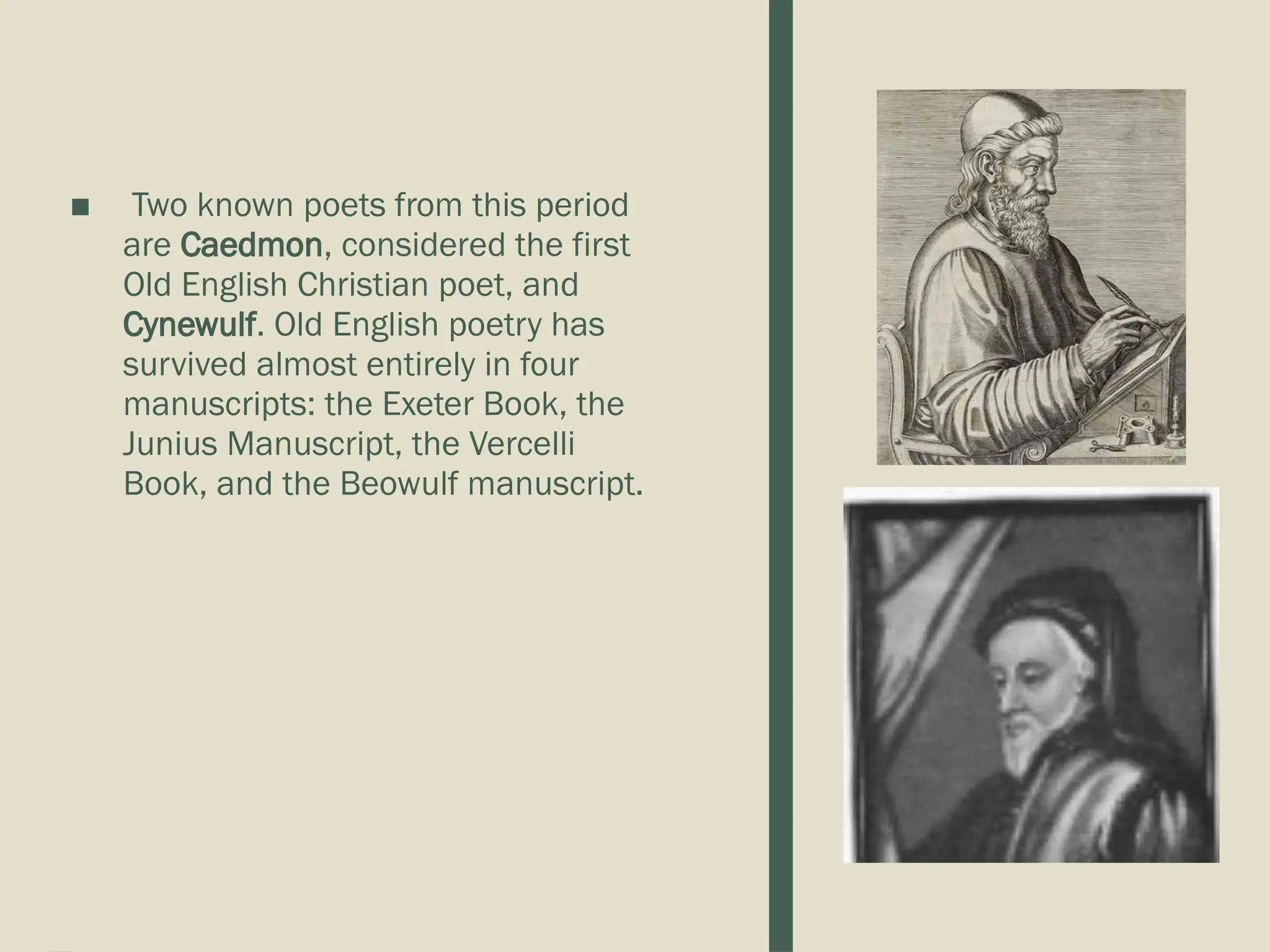
■ Two knownpoets from this period
are Caedmon, considered the first
Old English Christian poet, and
Cynewulf. Old English poetry has
survived almost entirely in four
manuscripts: the Exeter Book, the
Junius Manuscript, the Vercelli
Book, and the Beowulf manuscript.
8.
■ Old Englishprose works include legal writings, medical tracts,
religious texts, and translations from Latin and other
languages. Particularly notable is the Anglo-Saxon Chronicle,
a historical record begun about the time of King Alfred’s reign
(871–899) and continuing for more than three centuries.
■ Medieval literatureis defined
broadly as any work written in Latin
or the vernacular between c. 476-
1500, including philosophy,
religious treatises, legal texts, as
well as works of the imagination.
More narrowly, however, the term
applies to literary works of poetry,
drama, romance, epic prose, and
histories written in the vernacular,
though some histories were in
Latin.
11.
■ While itmay seem odd to find histories included with forms of
fiction, it should be remembered that many 'histories' of the
Middle Ages contain elements of myth, fable, and legend and,
in some cases, were largely the creations of imaginative writers.
■ The Norman Conquest of 1066 established French as the
language of literature and transformed the English language
from Old English (in use c. 500-1100) to Middle English (c.
1100-1500). The stories written during both these eras were
originally medieval folklore, tales transmitted orally, and since
most of the population was illiterate, books continued to be
read out loud to an audience.
12.
■ Literacy ratesrose during the 15th century, and with the
development of the printing press, more books became
available. The act of reading by one's self for personal
pleasure became more common and this changed the way
writers wrote. Thomas Malory's Le Morte D'Arthur (written
1469, published 1485) is the earliest novel in the west – a
work written for an individual audience with layers of personal
meaning and symbolism – and set the foundation for the
development of the novel as recognized in the present day.
13.
■ The CanterburyTales consists of the General
Prologue, The Knight’s Tale, The Miller’s Tale,
The Reeve’s Tale, The Cook’s Tale, The Man
of Law’s Tale, The Wife of Bath’s Tale, The
Friar’s Tale, The Summoner’s Tale, The
Clerk’s Tale, The Merchant’s Tale, The
Squire’s Tale, The Franklin’s Tale, The
Second Nun’s Tale, The Canon’s Yeoman’s
Tale, The Physician’s Tale, The Pardoner’s
Tale, The Shipman’s Tale, The Prioress’s Tale,
The Tale of Sir Thopas, The Tale of Melibeus
(in prose), The Monk’s Tale, The Nun’s
Priest’s Tale, The Manciple’s Tale, and The
Parson’s Tale (in prose), and ends with
“Chaucer’s Retraction.” Not all the tales are
complete; several contain their own
prologues or epilogues.
14.
Renaissance (16th–17th
Century)
■ Time:16th–17th Century
■ Characteristics: Revival of arts, humanism, focus on emotion
■ Key Writers: William Shakespeare, Christopher Marlowe,
Edmund Spenser
■ Key Works: Hamlet, Doctor Faustus, The Faerie Queene
15.
■ In atradition of literature remarkable for its exacting and
brilliant achievements, the Elizabethan and early Stuart
periods have been said to represent the most brilliant century
of all. (The reign of Elizabeth I began in 1558 and ended with
her death in 160she was succeeded by the Stuart king James
VI of Scotland, who took the title James I of England as well.
English literature of his reign as James I, from 1603 to 1625,
is properly called Jacobean.) These years produced a gallery
of authors of genius, some of whom have never been
surpassed, and conferred on scores of lesser talents the
enviable ability to write with fluency, imagination, and verve.
16.
Elizabethan
literature
Elizabethan literature, bodyof works
written during the reign of Elizabeth I
of England (1558–1603), probably the
most splendid age in the history of
English literature, during which such
writers as Sir Philip Sidney, Edmund
Spenser, Roger Ascham, Richard
Hooker, Christopher Marlowe, and
William Shakespeare flourished. The
epithet Elizabethan is merely a
chronological reference and does not
describe any special characteristic of
the writing.
17.
■ The barelydisguised social ferment
was accompanied by an intellectual
revolution, as the medieval
synthesis collapsed before the new
science, new religion, and new
humanism. While modern
mechanical technologies were
pressed into service by the Stuarts
to create the scenic wonders of the
court masque, the discoveries of
astronomers and explorers were
redrawing the cosmos in a way that
was profoundly disturbing.
18.
■ The majorityof people were more immediately affected by the
religious revolutions of the 16th century. A person in early
adulthood at the accession of Elizabeth in 1558 would, by her
death in 1603, have been vouchsafed an unusually
disillusioning insight into the duty owed by private conscience
to the needs of the state. The Tudor church hierarchy was an
instrument of social and political control, yet the mid-century
controversies over the faith had already wrecked any easy
confidence in the authority of doctrines and forms and had
taught people to inquire carefully into the rationale of their
own beliefs (as John Donne does in his third satire [c. 1596]).
19.
■ The Elizabethanecclesiastical compromise was the object of
continual criticism, from radicals both within (who desired
progressive reforms, such as the abolition of bishops) and without
(who desired the return of England to the Roman Catholic fold), but
the incipient liberalism of individuals such as John Milton and the
scholar and churchman William Chillingworth was held in check by
the majority’s unwillingness to tolerate a plurality of religions in a
supposedly unitary state. Nor was the Calvinist orthodoxy that
cradled most English writers comforting, for it told them that they
were corrupt, unfree, unable to earn their own salvations, and
subject to heavenly judgments that were arbitrary and absolute.
Calvinism deeply affects the world of the Jacobean tragedies,
whose heroes are not masters of their fates but victims of divine
purposes that are terrifying yet inscrutable.
20.
■ The Elizabethanage saw the flowering of poetry (the sonnet,
the Spenserian stanza, dramatic blank verse), was a golden
age of drama (especially for the plays of Shakespeare), and
inspired a wide variety of splendid prose (from historical
chronicles, versions of the Holy Scriptures, pamphlets, and
literary criticism to the first English novels). From about the
beginning of the 17th century a sudden darkening of tone
became noticeable in most forms of literary expression,
especially in drama, and the change more or less coincided
with the death of Elizabeth.
■ English literature from 1603 to 1625 is properly called
Jacobean, after the new monarch, James I. But, insofar as
16th-century themes and patterns were carried over into the
17th century, the writing from the earlier part of his reign, at
least, is sometimes referred to by the amalgam “Jacobethan.”
21.
William
Shakespeare
■ William Shakespeare(baptized
April 26, 1564, Stratford-upon-
Avon, Warwickshire, England—died
April 23, 1616, Stratford-upon-
Avon) was a poet, dramatist, and
actor often called the English
national poet. He is considered by
many to be the greatest dramatist
of all time.
22.
HAMLET
■ Hamlet isconsidered among the "most
powerful and influential tragedies in the
English language", with a story capable
of "seemingly endless retelling and
adaptation by others".
■ It is widely considered one of the
greatest plays of all time. Three different
early versions of the play are extant: the
First Quarto (Q1, 1603); the Second
Quarto (Q2, 1604); and the First Folio
(F1, 1623). Each version includes lines
and passages missing from the others.
23.
PLOT
■ On adark winter night, a ghost walks the ramparts of Elsinore
Castle in Denmark. Discovered first by a pair of watchmen,
then by the scholar Horatio, the ghost resembles the recently
deceased King Hamlet, whose brother Claudius has inherited
the throne and married the king’s widow, Queen Gertrude.
When Horatio and the watchmen bring Prince Hamlet, the
son of Gertrude and the dead king, to see the ghost, it speaks
to him, declaring ominously that it is indeed his father’s spirit,
and that he was murdered by none other than Claudius.
Ordering Hamlet to seek revenge on the man who usurped his
throne and married his wife, the ghost disappears with the
dawn.
25.
CHRISTOPHER
MARLOWE
■ Christopher Marlowe(baptized Feb. 26,
1564, Canterbury, Kent, Eng.—died May 30,
1593, Deptford, near London) was an
Elizabethan poet and Shakespeare’s most
important predecessor in English drama,
who is noted especially for his
establishment of dramatic blank verse.
■ After 1587 Marlowe was in London, writing
for the theatres, occasionally getting into
trouble with the authorities because of his
violent and disreputable behaviour, and
probably also engaging himself from time to
time in government service.
26.
■ Marlowe wona dangerous reputation for “atheism,” but this
could, in Elizabeth I’s time, indicate merely unorthodox
religious opinions. In Robert Greene’s deathbed tract,
Greenes groats-worth of witte, Marlowe is referred to as a
“famous gracer of Tragedians” and is reproved for having
said, like Greene himself, “There is no god” and for having
studied “pestilent Machiuilian pollicie.”
27.
Dr. Fautus
■ DoctorFaustus is a scholar living in
Wittenberg, Germany. Feeling that he has
reached the ends of all traditional
studies, he decides to pursue magic, and
has his servant Wagner bring him Valdes
and Cornelius, two men who can teach
him how to perform magic incantations.
Two angels (a Good Angel and an Evil
Angel) appear. The Good Angel tries to
convince Faustus not to pursue unholy
magic, but the Evil Angel encourages him
to delve into sorcery. Valdes and
Cornelius give Faustus spell-books and
Faustus is excited to begin casting spells
and summoning spirits.
28.
EDMUND
SPENSER
■ Edmund Spenser(born 1552/53,
London, England—died January 13,
1599, London) was an English
poet whose long allegorical poem
The Faerie Queene is one of the
greatest in the English language. It
was written in what came to be
called the Spenserian stanza.
29.
■ Spenser wasconsidered in his day to be the greatest of
English poets, who had glorified England and its language by
his long allegorical poem The Faerie Queene, just as Virgil had
glorified Rome and the Latin tongue by his epic poem the
Aeneid.
Spenser had a strong influence upon his immediate successors,
and the sensuous features of his poetic style, as well as his nine-
line stanza form, were later admired and imitated by such poets
as Lord Byron and Percy Bysshe Shelley in the Romantic period of
the late 18th and early 19th centuries. He is widely studied today
as one of the chief begetters of the English literary Renaissance
and as a master who embodied in poetic myth a view of the
virtuous life in a Christian universe.
30.
Baroque (17th Century)
■Time: 17th Century
■ Characteristics: Complexity, pessimism, themes of death and
religion
■ Key Writers: John Milton, John Donne
■ Key Works: Paradise Lost, A Valediction: Forbidding Mourning
31.
Baroque literature (late
16th–18thcentury)
It is a style of writing that emerged during the Baroque period,
characterized by its elaborate language, complex metaphors,
dramatic contrasts, and deep emotional intensity. It often
reflected the turbulence and grandeur of the time, influenced by
religious conflicts, exploration, and political shifts.
32.
Key Features ofBritish
Baroque Literature:
Elaborate Language and Imagery – Writers used complex
metaphors, rich symbolism, and intricate syntax.
Religious and Philosophical Themes – Many works explored
divine justice, free will, and human frailty.
Dramatic and Theatrical Elements – Heightened emotion,
grandeur, and contrast were common, especially in drama.
33.
.
Dramatic and TheatricalElements – Heightened emotion,
grandeur, and contrast were common, especially in drama.
Metaphysical Conceits – Extended metaphors blending the
physical and spiritual worlds, particularly in poetry.
34.
Notable Baroque Writersand
Works:
1. John Milton (1608–1674)
Paradise Lost (1667) – An epic poem exploring the fall of man,
divine justice, and redemption with grand, ornate language.
Paradise Regained (1671) – A theological sequel to Paradise Lost
focusing on Christ’s temptation in the wilderness.
Samson Agonistes (1671) – A tragic closet drama using Greek
dramatic elements and Baroque intensity.
35.
John Donne (1572–1631)
Aleading metaphysical poet whose works combine Baroque
complexity with deep emotional and intellectual engagement.
Holy Sonnets – A series of religious poems exploring faith, death,
and divine love.
The Flea – A witty poem using extended metaphor to discuss love
and desire.
36.
George Herbert (1593–1633)
TheTemple – A collection of religious poems using intricate metaphors
and visual poetry to explore devotion and faith.
4. Richard Crashaw (1613–1649)
Steps to the Temple – Baroque-style devotional poetry, marked by
intense imagery and mysticism.
37.
Andrew Marvell (1621–1678)
ToHis Coy Mistress – A poem blending wit, passion, and elaborate imagery in the tradition of metaphysical
poetry.
His poetry often balanced political themes with Baroque literary elements.
6. John Dryden (1631–1700)
Absalom and Achitophel – A political allegory in heroic couplets.
Mac Flecknoe – A satirical poem with dramatic contrasts.
All for Love – A reworking of Shakespeare’s Antony and Cleopatra, emphasizing Baroque drama and grandeur.
38.
Baroque Drama inEngland:
During the Restoration (1660 onward), British drama took on
Baroque elements of spectacle, elaborate language, and grand
emotions.
John Dryden – All for Love (1677) emphasized Baroque theatricality.
William Davenant – The Siege of Rhodes (1656), an early example of
English opera, mixed poetry, music, and drama.
Restoration Comedies – Playwrights like William Congreve (The Way
of the World) and George Etherege (The Man of Mode) used wit and
irony, though their style leaned more toward the later Rococo.
39.
Conclusion
British Baroque literatureis best seen in its religious poetry, epic
works, and grand theatrical productions. While England did not
develop a distinct Baroque literary movement like Spain or Italy,
the influence of Baroque aesthetics is evident in the elaborate,
dramatic, and intellectually rich works of Milton, Donne, Dryden,
and others.
40.
Enlightenment (18th Century)
■Time: 18th Century
■ Characteristics: Focus on reason, knowledge, social criticism
■ Key Writers: Jonathan Swift, Alexander Pope
■ Key Works: Gulliver’s Travels, The Rape of the Lock
41.
Romanticism (Late 18th–
Early 19th Century)
■ Time: Late 18th – Early 19th Century
■ Characteristics: Emphasis on emotion, nature, imagination
■ Key Writers: William Wordsworth, Samuel Taylor Coleridge,
Lord Byron, Percy Bysshe Shelley, John Keats
■ Key Works: The Rime of the Ancient Mariner, Don Juan,
Prometheus Unbound, Ode to a Nightingale
42.
Victorianism (19th Century)
■Time: 19th Century
■ Characteristics: Social issues, morality, industrial change
■ Key Writers: Charles Dickens, George Eliot, Thomas Hardy,
The Brontë Sisters
■ Key Works: Oliver Twist, Middlemarch, Tess of the
d'Urbervilles, Jane Eyre, Wuthering Heights
43.
Modernism (Late 19th
Century– Early 20th Century)
■ Time: Late 19th Century – Early 20th Century
■ Characteristics: Experimentation with narrative forms,
fragmented perspectives
■ Key Writers: James Joyce, Virginia Woolf, T.S. Eliot
■ Key Works: Ulysses, Mrs. Dalloway, The Waste Land
44.
Postmodernism (Mid-20th
Century –Present)
■ Time: Mid-20th Century – Present
■ Characteristics: Skepticism, relativism, irony, genre-blending
■ Key Writers: Salman Rushdie, Angela Carter, Julian Barnes
■ Key Works: Midnight’s Children, The Bloody Chamber, Arthur
& George




![■ The majority of people were more immediately affected by the
religious revolutions of the 16th century. A person in early
adulthood at the accession of Elizabeth in 1558 would, by her
death in 1603, have been vouchsafed an unusually
disillusioning insight into the duty owed by private conscience
to the needs of the state. The Tudor church hierarchy was an
instrument of social and political control, yet the mid-century
controversies over the faith had already wrecked any easy
confidence in the authority of doctrines and forms and had
taught people to inquire carefully into the rationale of their
own beliefs (as John Donne does in his third satire [c. 1596]).](https://image.slidesharecdn.com/britishliterarymovements-250512030243-d51ed9c4/75/British-Literary-Movements-pptx-18-2048.jpg)


