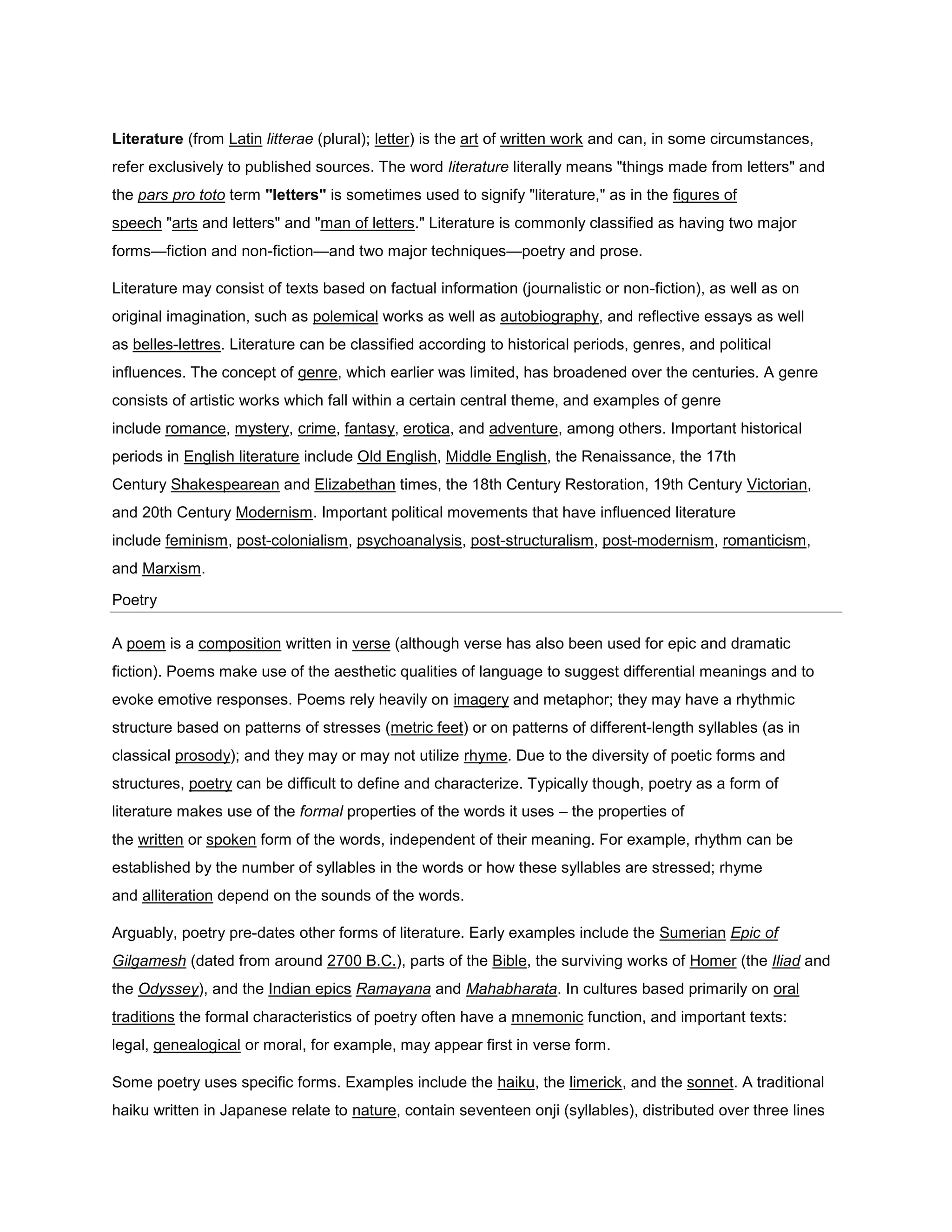
Literature (from Latin litterae (plural); letter) is the art of written work and can, in some circumstances,
refer exclusively to published sources. The word literature literally means "things made from letters" and
the pars pro toto term "letters" is sometimes used to signify "literature," as in the figures of
speech "arts and letters" and "man of letters." Literature is commonly classified as having two major
forms—fiction and non-fiction—and two major techniques—poetry and prose.

Literature may consist of texts based on factual information (journalistic or non-fiction), as well as on
original imagination, such as polemical works as well as autobiography, and reflective essays as well
as belles-lettres. Literature can be classified according to historical periods, genres, and political
influences. The concept of genre, which earlier was limited, has broadened over the centuries. A genre
consists of artistic works which fall within a certain central theme, and examples of genre
include romance, mystery, crime, fantasy, erotica, and adventure, among others. Important historical
periods in English literature include Old English, Middle English, the Renaissance, the 17th
Century Shakespearean and Elizabethan times, the 18th Century Restoration, 19th Century Victorian,
and 20th Century Modernism. Important political movements that have influenced literature
include feminism, post-colonialism, psychoanalysis, post-structuralism, post-modernism, romanticism,
and Marxism.

Poetry

A poem is a composition written in verse (although verse has also been used for epic and dramatic
fiction). Poems make use of the aesthetic qualities of language to suggest differential meanings and to
evoke emotive responses. Poems rely heavily on imagery and metaphor; they may have a rhythmic
structure based on patterns of stresses (metric feet) or on patterns of different-length syllables (as in
classical prosody); and they may or may not utilize rhyme. Due to the diversity of poetic forms and
structures, poetry can be difficult to define and characterize. Typically though, poetry as a form of
literature makes use of the formal properties of the words it uses – the properties of
the written or spoken form of the words, independent of their meaning. For example, rhythm can be
established by the number of syllables in the words or how these syllables are stressed; rhyme
and alliteration depend on the sounds of the words.

Arguably, poetry pre-dates other forms of literature. Early examples include the Sumerian Epic of
Gilgamesh (dated from around 2700 B.C.), parts of the Bible, the surviving works of Homer (the Iliad and
the Odyssey), and the Indian epics Ramayana and Mahabharata. In cultures based primarily on oral
traditions the formal characteristics of poetry often have a mnemonic function, and important texts:
legal, genealogical or moral, for example, may appear first in verse form.

Some poetry uses specific forms. Examples include the haiku, the limerick, and the sonnet. A traditional
haiku written in Japanese relate to nature, contain seventeen onji (syllables), distributed over three lines
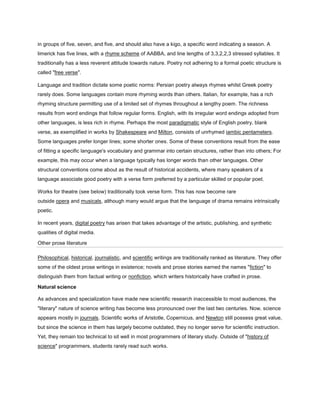
in groups of five, seven, and five, and should also have a kigo, a specific word indicating a season. A
limerick has five lines, with a rhyme scheme of AABBA, and line lengths of 3,3,2,2,3 stressed syllables. It
traditionally has a less reverent attitude towards nature. Poetry not adhering to a formal poetic structure is
called "free verse".

Language and tradition dictate some poetic norms: Persian poetry always rhymes whilst Greek poetry
rarely does. Some languages contain more rhyming words than others. Italian, for example, has a rich
rhyming structure permitting use of a limited set of rhymes throughout a lengthy poem. The richness
results from word endings that follow regular forms. English, with its irregular word endings adopted from
other languages, is less rich in rhyme. Perhaps the most paradigmatic style of English poetry, blank
verse, as exemplified in works by Shakespeare and Milton, consists of unrhymed iambic pentameters.
Some languages prefer longer lines; some shorter ones. Some of these conventions result from the ease
of fitting a specific language's vocabulary and grammar into certain structures, rather than into others; For
example, this may occur when a language typically has longer words than other languages. Other
structural conventions come about as the result of historical accidents, where many speakers of a
language associate good poetry with a verse form preferred by a particular skilled or popular poet.

Works for theatre (see below) traditionally took verse form. This has now become rare
outside opera and musicals, although many would argue that the language of drama remains intrinsically
poetic.

In recent years, digital poetry has arisen that takes advantage of the artistic, publishing, and synthetic
qualities of digital media.

Other prose literature

Philosophical, historical, journalistic, and scientific writings are traditionally ranked as literature. They offer
some of the oldest prose writings in existence; novels and prose stories earned the names "fiction" to
distinguish them from factual writing or nonfiction, which writers historically have crafted in prose.

Natural science

As advances and specialization have made new scientific research inaccessible to most audiences, the
"literary" nature of science writing has become less pronounced over the last two centuries. Now, science
appears mostly in journals. Scientific works of Aristotle, Copernicus, and Newton still possess great value,
but since the science in them has largely become outdated, they no longer serve for scientific instruction.
Yet, they remain too technical to sit well in most programmers of literary study. Outside of "history of
science" programmers, students rarely read such works.
[edit]Philosophy

Philosophy, too, has become an increasingly academic discipline. More of its practitioners lament this
situation than occurs with the sciences; nonetheless most new philosophical work appears in academic
journals. Major philosophers through history—Plato, Aristotle,
Socrates, Augustine, Descartes, Kierkegaard, Nietzsche—have become as canonical as any writers.
Some recent philosophy works are argued to merit the title "literature", such as some of the works
by Simon Blackburn; but much of it does not, and some areas, such as logic, have become extremely
technical to a degree similar to that of mathematics.

[edit]History

A great deal of historical writing ranks as literature, particularly the genre known as creative nonfiction. So
can a great deal of journalism, such as literary journalism. However these areas have become extremely
large, and often have a primarily utilitarian purpose: to record data or convey immediate information. As a
result the writing in these fields often lacks a literary quality, although it often and in its better moments
has that quality. Major "literary" historians include Herodotus, Thucydides and Procopius, all of whom
count as canonical literary figures.

[edit]Law

Law offers a less clear case. Some writings of Plato and Aristotle, the law tables
of Hammurabi of Babylon, or even the early parts of the Bible could be seen as legal literature. Roman
civil law as codified in the Corpus Juris Civilis during the reign of Justinian I of theByzantine Empire has a
reputation as significant literature. The founding documents of many countries,
including Constitutions and Law Codes, can count as literature; however, most legal writings rarely exhibit
much literary merit, as they tend to be rather garrulous.

[edit]Drama


A magic carpet, was a legendary carpet that can be used to transport persons who are on it
instantaneously or quickly to their destination in the stories of the One Thousand and One Nights.
A play or drama offers another classical literary form that has continued to evolve over the years. It
generally comprises chiefly dialogue betweencharacters, and usually aims at dramatic /
theatrical performance (see theatre) rather than at reading. During the 18th and 19th
centuries, opera developed as a combination of poetry, drama, and music. Nearly all drama took verse
form until comparatively recently. Shakespeare could be considered drama. Romeo and Juliet, for
example, is a classic romantic drama generally accepted as literature.

Greek drama exemplifies the earliest form of drama of which we have substantial knowledge. Tragedy, as
a dramatic genre, developed as a performance associated with religious and civic festivals, typically
enacting or developing upon well-known historical or mythological themes. Tragedies generally presented
very serious themes. With the advent of newer technologies, scripts written for non-stage media have
been added to this form.War of the Worlds (radio) in 1938 saw the advent of literature written for radio
broadcast, and many works of Drama have been adapted for film or television. Conversely, television,
film, and radio literature have been adapted to printed or electronic media.

Genres of literature

Further information: List of literary genres

Literary genre is a mode of categorizing literature. The term originates from French, designating a
                          [4]
proposed type or class.         However, such classes are subject to change, and have been used in different
ways in different periods and traditions.


Importance of Literature

It is a curious and prevalent opinion that literature, like all art, is a mere play of imagination,
pleasing enough, like a new novel, but without any serious or practical importance. Nothing
could be farther from the truth. Literature preserves the ideals of a people; and ideals--love, faith,
duty, friendship, freedom, reverence--are the part of human life most worthy of preservation. The
Greeks were a marvelous people; yet of all their mighty works we cherish only a few ideals,--
ideals of beauty in perishable stone, and ideals of truth in imperishable prose and poetry. It was
simply the ideals of the Greeks and Hebrews and Romans, preserved in their literature, which
made them what they were, and which determined their value to future generations. Our
democracy, the boast of all English-speaking nations, is a dream; not the doubtful and sometimes
disheartening spectacle presented in our legislative halls, but the lovely and immortal ideal of a
free and equal manhood, preserved as a most precious heritage in every great literature from the
Greeks to the Anglo-Saxons. All our arts, our sciences, even our inventions are founded squarely
upon ideals; for under every invention is still the dream of Beowulf, that man may overcome the
forces of nature; and the foundation of all our sciences and discoveries is the immortal dream
that men "shall be as gods, knowing good and evil."
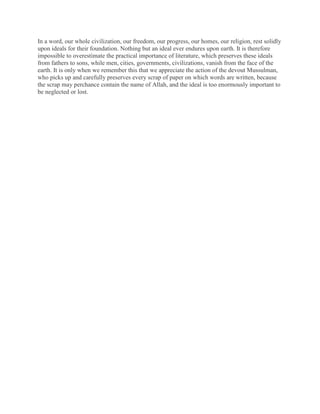
In a word, our whole civilization, our freedom, our progress, our homes, our religion, rest solidly
upon ideals for their foundation. Nothing but an ideal ever endures upon earth. It is therefore
impossible to overestimate the practical importance of literature, which preserves these ideals
from fathers to sons, while men, cities, governments, civilizations, vanish from the face of the
earth. It is only when we remember this that we appreciate the action of the devout Mussulman,
who picks up and carefully preserves every scrap of paper on which words are written, because
the scrap may perchance contain the name of Allah, and the ideal is too enormously important to
be neglected or lost.

Literature

  • 1.
    Literature (from Latinlitterae (plural); letter) is the art of written work and can, in some circumstances, refer exclusively to published sources. The word literature literally means "things made from letters" and the pars pro toto term "letters" is sometimes used to signify "literature," as in the figures of speech "arts and letters" and "man of letters." Literature is commonly classified as having two major forms—fiction and non-fiction—and two major techniques—poetry and prose. Literature may consist of texts based on factual information (journalistic or non-fiction), as well as on original imagination, such as polemical works as well as autobiography, and reflective essays as well as belles-lettres. Literature can be classified according to historical periods, genres, and political influences. The concept of genre, which earlier was limited, has broadened over the centuries. A genre consists of artistic works which fall within a certain central theme, and examples of genre include romance, mystery, crime, fantasy, erotica, and adventure, among others. Important historical periods in English literature include Old English, Middle English, the Renaissance, the 17th Century Shakespearean and Elizabethan times, the 18th Century Restoration, 19th Century Victorian, and 20th Century Modernism. Important political movements that have influenced literature include feminism, post-colonialism, psychoanalysis, post-structuralism, post-modernism, romanticism, and Marxism. Poetry A poem is a composition written in verse (although verse has also been used for epic and dramatic fiction). Poems make use of the aesthetic qualities of language to suggest differential meanings and to evoke emotive responses. Poems rely heavily on imagery and metaphor; they may have a rhythmic structure based on patterns of stresses (metric feet) or on patterns of different-length syllables (as in classical prosody); and they may or may not utilize rhyme. Due to the diversity of poetic forms and structures, poetry can be difficult to define and characterize. Typically though, poetry as a form of literature makes use of the formal properties of the words it uses – the properties of the written or spoken form of the words, independent of their meaning. For example, rhythm can be established by the number of syllables in the words or how these syllables are stressed; rhyme and alliteration depend on the sounds of the words. Arguably, poetry pre-dates other forms of literature. Early examples include the Sumerian Epic of Gilgamesh (dated from around 2700 B.C.), parts of the Bible, the surviving works of Homer (the Iliad and the Odyssey), and the Indian epics Ramayana and Mahabharata. In cultures based primarily on oral traditions the formal characteristics of poetry often have a mnemonic function, and important texts: legal, genealogical or moral, for example, may appear first in verse form. Some poetry uses specific forms. Examples include the haiku, the limerick, and the sonnet. A traditional haiku written in Japanese relate to nature, contain seventeen onji (syllables), distributed over three lines
  • 2.
    in groups offive, seven, and five, and should also have a kigo, a specific word indicating a season. A limerick has five lines, with a rhyme scheme of AABBA, and line lengths of 3,3,2,2,3 stressed syllables. It traditionally has a less reverent attitude towards nature. Poetry not adhering to a formal poetic structure is called "free verse". Language and tradition dictate some poetic norms: Persian poetry always rhymes whilst Greek poetry rarely does. Some languages contain more rhyming words than others. Italian, for example, has a rich rhyming structure permitting use of a limited set of rhymes throughout a lengthy poem. The richness results from word endings that follow regular forms. English, with its irregular word endings adopted from other languages, is less rich in rhyme. Perhaps the most paradigmatic style of English poetry, blank verse, as exemplified in works by Shakespeare and Milton, consists of unrhymed iambic pentameters. Some languages prefer longer lines; some shorter ones. Some of these conventions result from the ease of fitting a specific language's vocabulary and grammar into certain structures, rather than into others; For example, this may occur when a language typically has longer words than other languages. Other structural conventions come about as the result of historical accidents, where many speakers of a language associate good poetry with a verse form preferred by a particular skilled or popular poet. Works for theatre (see below) traditionally took verse form. This has now become rare outside opera and musicals, although many would argue that the language of drama remains intrinsically poetic. In recent years, digital poetry has arisen that takes advantage of the artistic, publishing, and synthetic qualities of digital media. Other prose literature Philosophical, historical, journalistic, and scientific writings are traditionally ranked as literature. They offer some of the oldest prose writings in existence; novels and prose stories earned the names "fiction" to distinguish them from factual writing or nonfiction, which writers historically have crafted in prose. Natural science As advances and specialization have made new scientific research inaccessible to most audiences, the "literary" nature of science writing has become less pronounced over the last two centuries. Now, science appears mostly in journals. Scientific works of Aristotle, Copernicus, and Newton still possess great value, but since the science in them has largely become outdated, they no longer serve for scientific instruction. Yet, they remain too technical to sit well in most programmers of literary study. Outside of "history of science" programmers, students rarely read such works.
  • 3.
    [edit]Philosophy Philosophy, too, hasbecome an increasingly academic discipline. More of its practitioners lament this situation than occurs with the sciences; nonetheless most new philosophical work appears in academic journals. Major philosophers through history—Plato, Aristotle, Socrates, Augustine, Descartes, Kierkegaard, Nietzsche—have become as canonical as any writers. Some recent philosophy works are argued to merit the title "literature", such as some of the works by Simon Blackburn; but much of it does not, and some areas, such as logic, have become extremely technical to a degree similar to that of mathematics. [edit]History A great deal of historical writing ranks as literature, particularly the genre known as creative nonfiction. So can a great deal of journalism, such as literary journalism. However these areas have become extremely large, and often have a primarily utilitarian purpose: to record data or convey immediate information. As a result the writing in these fields often lacks a literary quality, although it often and in its better moments has that quality. Major "literary" historians include Herodotus, Thucydides and Procopius, all of whom count as canonical literary figures. [edit]Law Law offers a less clear case. Some writings of Plato and Aristotle, the law tables of Hammurabi of Babylon, or even the early parts of the Bible could be seen as legal literature. Roman civil law as codified in the Corpus Juris Civilis during the reign of Justinian I of theByzantine Empire has a reputation as significant literature. The founding documents of many countries, including Constitutions and Law Codes, can count as literature; however, most legal writings rarely exhibit much literary merit, as they tend to be rather garrulous. [edit]Drama A magic carpet, was a legendary carpet that can be used to transport persons who are on it instantaneously or quickly to their destination in the stories of the One Thousand and One Nights.
  • 4.
    A play ordrama offers another classical literary form that has continued to evolve over the years. It generally comprises chiefly dialogue betweencharacters, and usually aims at dramatic / theatrical performance (see theatre) rather than at reading. During the 18th and 19th centuries, opera developed as a combination of poetry, drama, and music. Nearly all drama took verse form until comparatively recently. Shakespeare could be considered drama. Romeo and Juliet, for example, is a classic romantic drama generally accepted as literature. Greek drama exemplifies the earliest form of drama of which we have substantial knowledge. Tragedy, as a dramatic genre, developed as a performance associated with religious and civic festivals, typically enacting or developing upon well-known historical or mythological themes. Tragedies generally presented very serious themes. With the advent of newer technologies, scripts written for non-stage media have been added to this form.War of the Worlds (radio) in 1938 saw the advent of literature written for radio broadcast, and many works of Drama have been adapted for film or television. Conversely, television, film, and radio literature have been adapted to printed or electronic media. Genres of literature Further information: List of literary genres Literary genre is a mode of categorizing literature. The term originates from French, designating a [4] proposed type or class. However, such classes are subject to change, and have been used in different ways in different periods and traditions. Importance of Literature It is a curious and prevalent opinion that literature, like all art, is a mere play of imagination, pleasing enough, like a new novel, but without any serious or practical importance. Nothing could be farther from the truth. Literature preserves the ideals of a people; and ideals--love, faith, duty, friendship, freedom, reverence--are the part of human life most worthy of preservation. The Greeks were a marvelous people; yet of all their mighty works we cherish only a few ideals,-- ideals of beauty in perishable stone, and ideals of truth in imperishable prose and poetry. It was simply the ideals of the Greeks and Hebrews and Romans, preserved in their literature, which made them what they were, and which determined their value to future generations. Our democracy, the boast of all English-speaking nations, is a dream; not the doubtful and sometimes disheartening spectacle presented in our legislative halls, but the lovely and immortal ideal of a free and equal manhood, preserved as a most precious heritage in every great literature from the Greeks to the Anglo-Saxons. All our arts, our sciences, even our inventions are founded squarely upon ideals; for under every invention is still the dream of Beowulf, that man may overcome the forces of nature; and the foundation of all our sciences and discoveries is the immortal dream that men "shall be as gods, knowing good and evil."
  • 5.
    In a word,our whole civilization, our freedom, our progress, our homes, our religion, rest solidly upon ideals for their foundation. Nothing but an ideal ever endures upon earth. It is therefore impossible to overestimate the practical importance of literature, which preserves these ideals from fathers to sons, while men, cities, governments, civilizations, vanish from the face of the earth. It is only when we remember this that we appreciate the action of the devout Mussulman, who picks up and carefully preserves every scrap of paper on which words are written, because the scrap may perchance contain the name of Allah, and the ideal is too enormously important to be neglected or lost.