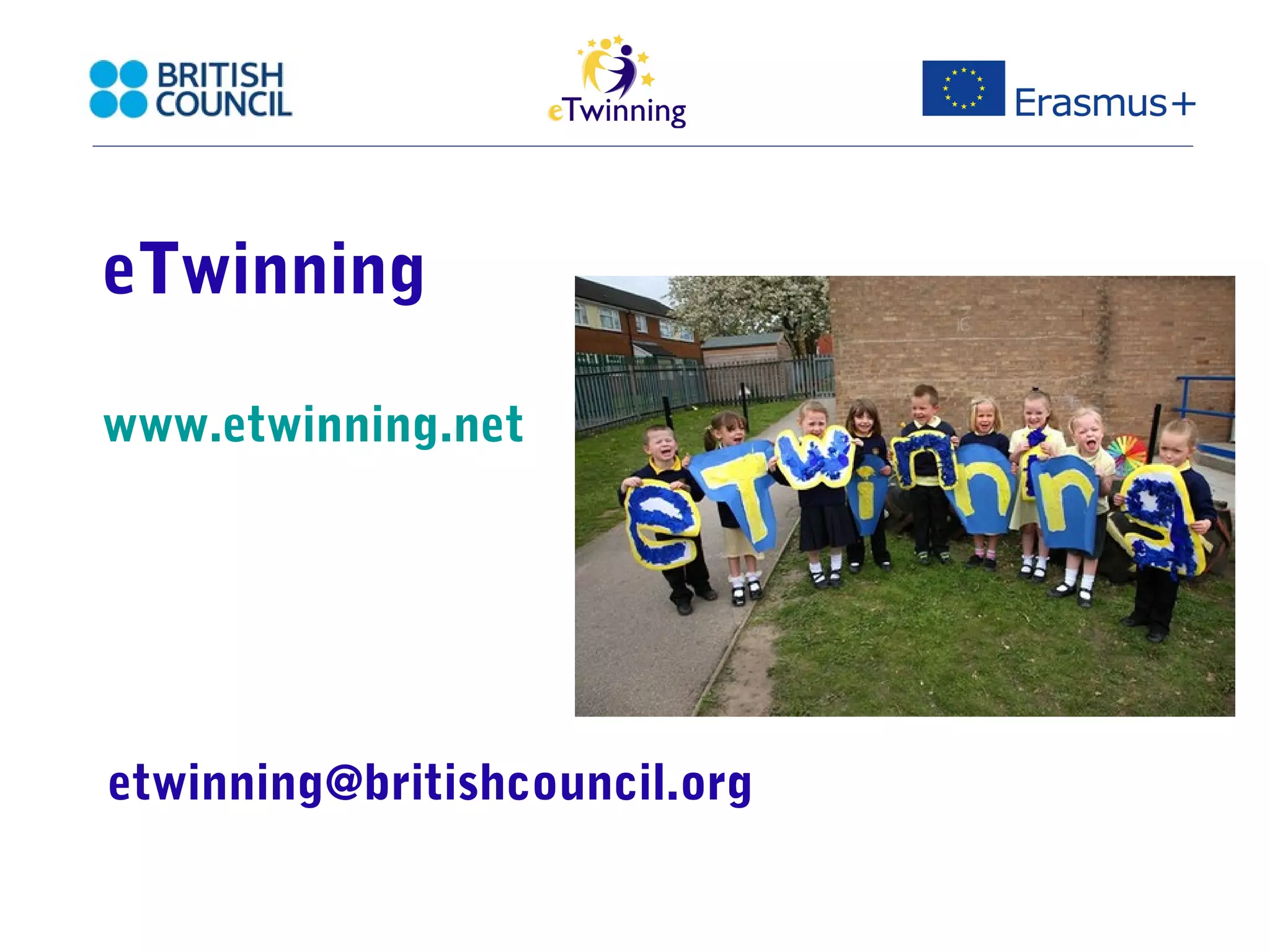
eTwinning 
www.etwinning.net 
etwinning@britishcouncil.org
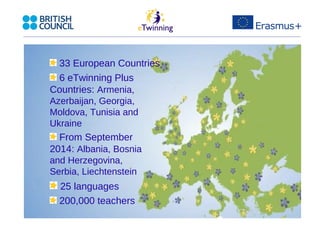
33 European Countries 
6 eTwinning Plus 
Countries: Armenia, 
Azerbaijan, Georgia, 
Moldova, Tunisia and 
Ukraine 
From September 
2014: Albania, Bosnia 
and Herzegovina, 
Serbia, Liechtenstein 
25 languages 
200,000 teachers
Resources 
Safe environment 
Partner-finding tool 
Project space 
Support 
Awards 
Professional Development opportunities
Aims of eTwinning 
Facilitate collaboration between teachers in different 
countries in Europe 
Allow teachers and pupils to work together online 
using various tools 
Provide a multilingual platform for online work in 25 
languages 
Make it easy to use ICT in education
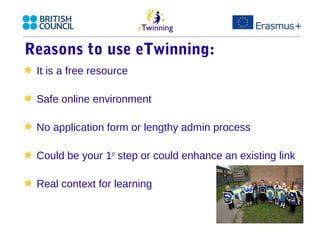
Reasons to use eTwinning: 
It is a free resource 
Safe online environment 
No application form or lengthy admin process 
Could be your 1st step or could enhance an existing link 
Real context for learning
National eTwinning
Support 
etwinning@britishcouncil.org 
@etwinninguk

eTwinning

Editor's Notes

  • #2 E twinning supports Erasmus +, particularly those new to international working, by providing a free platform for teachers to connect, share and collaborate on joint projects across Europe. Ideas can be developed, tested, monitored and evaluated before going through lengthy process of E+ form. eTwinning is a free, flexible, easy to use resource for enhancing the use of ICT across all areas of the curriculum
  • #3 Funded in the UK by the European Commission and BIS The British Council is the National Support Service (NSS) for eTwinning in the UK. A total of 43 eTwinning countries 33 European Countries: All EU member states can participate Plus Norway, Iceland, Turkey, Switzerland & FYR Macedonia. From 2013 with the introduction of Etwinning plus 6 neighbouring countries can now participate: Armenai, Azerbaijan, Georgia, Moldova, Tunisia and Ukraine From September 2014 - Albania, Bosnia and Herzegovina, Serbia, Liechtenstein can now participate 25 Languages eTwinning website available in 25 languages to make it easier for all teachers across Europe to use eTwinning, not just those who are fluent in English. You can change the display language of the website on the home page at www.etwinning.net. There is a support team for every European country Teachers Teacher numbers are constantly changing Projects eTwinning project numbers are constantly changing as teachers join eTwinning & start/finish collaborative projects at any time
  • #4 Resources: Hundreds of categorised project ideas publically available for working with students aged 3-18 across various subject areas e.g. ‘Statistics and You’, Maths and Sciences, Age group 3-13 Safe environment: Online community of over 160, 000 teachers from 42 countries Partner-finding tool: Once registered you can search online for partner schools and create joint projects Project space: Once you’ve registered a project your project will be given it’s own virtual classroom where you can upload files, photos, videos, blogs, and wikis etc and use the live chat facility Support: There is a complete package of free online resources available to support partnerships Awards: Schools can apply for a Quality Label for their project and can use this work as part of their application for the International Schools Award Professional Development opportunities As well as online networking with other teachers online, there are online learning opportunities and webinars
  • #7 Since the launching of eTwinning in 2005, only schools from different countries could start a project together. eTwinning has now decided to run a pilot and open the platform to single country projects to encourage collaboration of teachers and students from the same country. This will be especially interesting for countries with decentralized competences for school education, with more than one official language or a network of schools abroad. New eTwinners and less experienced teachers will take advantage of this new opportunity as well, because it gives them the possibility to familiarize with collaborative learning and the eTwinning platform in their own languagebefore making the leap into international projects.  The countries involved in the pilot the current school year 2014-2015 are: Austria, Belgium, Bulgaria, Croatia, Cyprus, Czech Republic, Denmark, Estonia, Finland, Former Yugoslav Republic of Macedonia, France, Germany, Greece, Hungary, Iceland, Ireland, Italy, Latvia, Lithuania, Luxembourg, Malta, Netherlands, Norway, Poland, Portugal, Slovakia, Slovenia, Spain, Sweden, Turkey and United Kingdom.   Single country projects cannot be granted European Quality Labels and European Prizes. However, recognition and awards can be organized at country level.