
DEVELOPING A SUSTAINABLE
TRAINING PLAN
D E V E LO P IN G S U S TA IN A B LE T R A IN IN G
O p e n i n g R e m a r k s
• We all know employee training program is
important to your Agency.
• Is training a chore you get around to
someday?
D E V E LO P IN G S U S TA IN A B LE T R A IN IN G
R e s u l t s o f N o T r a i n i n g P r o g r a m
What are some negative results of not having
a training program:
• Cost to you in client satisfaction
• Cost to you in delivery of service
• Liability costs when a caseworker is not informed
D E V E LO P IN G S U S TA IN A B LE T R A IN IN G
P r o f e s s i o n a l L e a r n i n g F r a m e w o r k a n d S t r a t e g i e s
Are you experiencing the following
workplace issues?
• High staff turnover?
• High absenteeism?
• Low motivation and/or productivity?
• Employees who resist change?
• On the job accidents?
• Difficulty meeting your department goals?
D E V E LO P IN G S U S TA IN A B LE T R A IN IN G
P r o f e s s i o n a l L e a r n i n g F r a m e w o r k a n d S t r a t e g i e s
“Money spent on the brain is
never spent in Vain.”
Joe Griffith
D E V E LO P IN G A S U S TA IN A B LE T R A IN IN G P LA N
P r o f e s s i o n a l L e a r n i n g F r a m e w o r k a n d S t r a t e g i e s
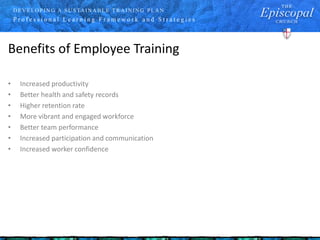
Benefits of Employee Training
• Increased productivity
• Better health and safety records
• Higher retention rate
• More vibrant and engaged workforce
• Better team performance
• Increased participation and communication
• Increased worker confidence
D E V E LO P IN G A S U S TA IN A B LE T R A IN IN G P LA N
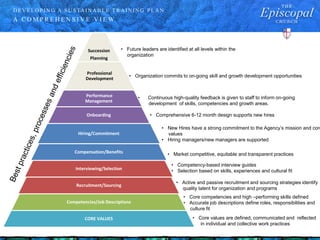
A C O M P R E H E N S I V E V I E W
Succession
Planning
Professional
Development
Performance
Management
Onboarding
Hiring/Commitment
Compensation/Benefits
Interviewing/Selection
Recruitment/Sourcing
Competencies/Job Descriptions
CORE VALUES
• Future leaders are identified at all levels within the
organization
• Organization commits to on-going skill and growth development opportunities
• Continuous high-quality feedback is given to staff to inform on-going
development of skills, competencies and growth areas.
• Comprehensive 6-12 month design supports new hires
• New Hires have a strong commitment to the Agency’s mission and core
values
• Hiring managers/new managers are supported
• Market competitive, equitable and transparent practices
• Competency-based interview guides
• Selection based on skills, experiences and cultural fit
• Active and passive recruitment and sourcing strategies identify
quality talent for organization and programs
• Core competencies and high –performing skills defined
• Accurate job descriptions define roles, responsibilities and
culture fit
• Core values are defined, communicated and reflected
in individual and collective work practices
D E V E LO P IN G S U S TA IN A B LE T R A IN IN G
P r o f e s s i o n a l L e a r n i n g F r a m e w o r k a n d S t r a t e g i e s
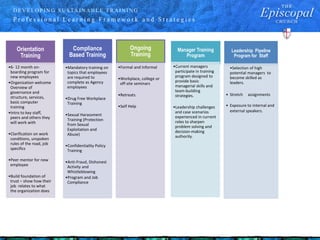
Orientation
Training
•6- 12 month on-
boarding program for
new employees
•Organization welcome
Overview of
governance and
structure, services,
basic computer
training
•Intro to key staff,
peers and others they
will work with
•Clarification on work
conditions, unspoken
rules of the road, job
specifics
•Peer mentor for new
employee
•Build foundation of
trust – show how their
job relates to what
the organization does
Ongoing
Training
•Formal and Informal
•Workplace, college or
off-site seminars
•Retreats
•Self Help
Compliance
Based Training
•Mandatory training on
topics that employees
are required to
complete as Agency
employees
•Drug Free Workplace
Training
•Sexual Harassment
Training (Protection
from Sexual
Exploitation and
Abuse)
•Confidentiality Policy
Training
•Anti-Fraud, Dishonest
Activity and
Whistleblowing
•Program and Job
Compliance
Leadership Pipeline
Program for Staff
•Selection of high
potential managers to
become skilled as
leaders.
• Stretch assignments
• Exposure to internal and
external speakers.
Manager Training
Program
•Current managers
participate in training
program designed to
provide basic
managerial skills and
team-building
strategies.
•Leadership challenges
and case scenarios
experienced in current
roles to sharpen
problem solving and
decision-making
authority.
D E V E LO P IN G S U S TA IN A B LE T R A IN IN G
P r o f e s s i o n a l L e a r n i n g F r a m e w o r k a n d S t r a t e g i e s
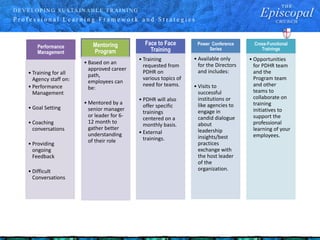
Performance
Management
• Training for all
Agency staff on:
• Performance
Management
• Goal Setting
• Coaching
conversations
• Providing
ongoing
Feedback
• Difficult
Conversations
Mentoring
Program
• Based on an
approved career
path,
employees can
be:
• Mentored by a
senior manager
or leader for 6-
12 month to
gather better
understanding
of their role
Face to Face
Training
• Training
requested from
PDHR on
various topics of
need for teams.
• PDHR will also
offer specific
trainings
centered on a
monthly basis.
• External
trainings.
Power Conference
Series
• Available only
for the Directors
and includes:
• Visits to
successful
institutions or
like agencies to
engage in
candid dialogue
about
leadership
insights/best
practices
exchange with
the host leader
of the
organization.
Cross-Functional
Trainings
• Opportunities
for PDHR team
and the
Program team
and other
teams to
collaborate on
training
initiatives to
support the
professional
learning of your
employees.
D E V E LO P IN G A S U S TA IN A B LE T R A IN IN G P LA N
T h e o r y o f A c t i o n
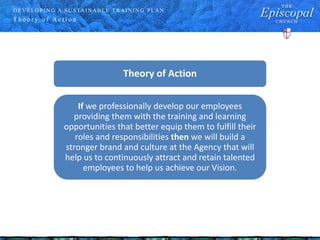
Theory of Action
If we professionally develop our employees
providing them with the training and learning
opportunities that better equip them to fulfill their
roles and responsibilities then we will build a
stronger brand and culture at the Agency that will
help us to continuously attract and retain talented
employees to help us achieve our Vision.

Developing a Sustainable Training Plan

  • 1.
  • 2.
    D E VE LO P IN G S U S TA IN A B LE T R A IN IN G O p e n i n g R e m a r k s • We all know employee training program is important to your Agency. • Is training a chore you get around to someday?
  • 3.
    D E VE LO P IN G S U S TA IN A B LE T R A IN IN G R e s u l t s o f N o T r a i n i n g P r o g r a m What are some negative results of not having a training program: • Cost to you in client satisfaction • Cost to you in delivery of service • Liability costs when a caseworker is not informed
  • 4.
    D E VE LO P IN G S U S TA IN A B LE T R A IN IN G P r o f e s s i o n a l L e a r n i n g F r a m e w o r k a n d S t r a t e g i e s Are you experiencing the following workplace issues? • High staff turnover? • High absenteeism? • Low motivation and/or productivity? • Employees who resist change? • On the job accidents? • Difficulty meeting your department goals?
  • 5.
    D E VE LO P IN G S U S TA IN A B LE T R A IN IN G P r o f e s s i o n a l L e a r n i n g F r a m e w o r k a n d S t r a t e g i e s “Money spent on the brain is never spent in Vain.” Joe Griffith
  • 6.
    D E VE LO P IN G A S U S TA IN A B LE T R A IN IN G P LA N P r o f e s s i o n a l L e a r n i n g F r a m e w o r k a n d S t r a t e g i e s Benefits of Employee Training • Increased productivity • Better health and safety records • Higher retention rate • More vibrant and engaged workforce • Better team performance • Increased participation and communication • Increased worker confidence
  • 7.
    D E VE LO P IN G A S U S TA IN A B LE T R A IN IN G P LA N A C O M P R E H E N S I V E V I E W Succession Planning Professional Development Performance Management Onboarding Hiring/Commitment Compensation/Benefits Interviewing/Selection Recruitment/Sourcing Competencies/Job Descriptions CORE VALUES • Future leaders are identified at all levels within the organization • Organization commits to on-going skill and growth development opportunities • Continuous high-quality feedback is given to staff to inform on-going development of skills, competencies and growth areas. • Comprehensive 6-12 month design supports new hires • New Hires have a strong commitment to the Agency’s mission and core values • Hiring managers/new managers are supported • Market competitive, equitable and transparent practices • Competency-based interview guides • Selection based on skills, experiences and cultural fit • Active and passive recruitment and sourcing strategies identify quality talent for organization and programs • Core competencies and high –performing skills defined • Accurate job descriptions define roles, responsibilities and culture fit • Core values are defined, communicated and reflected in individual and collective work practices
  • 8.
    D E VE LO P IN G S U S TA IN A B LE T R A IN IN G P r o f e s s i o n a l L e a r n i n g F r a m e w o r k a n d S t r a t e g i e s Orientation Training •6- 12 month on- boarding program for new employees •Organization welcome Overview of governance and structure, services, basic computer training •Intro to key staff, peers and others they will work with •Clarification on work conditions, unspoken rules of the road, job specifics •Peer mentor for new employee •Build foundation of trust – show how their job relates to what the organization does Ongoing Training •Formal and Informal •Workplace, college or off-site seminars •Retreats •Self Help Compliance Based Training •Mandatory training on topics that employees are required to complete as Agency employees •Drug Free Workplace Training •Sexual Harassment Training (Protection from Sexual Exploitation and Abuse) •Confidentiality Policy Training •Anti-Fraud, Dishonest Activity and Whistleblowing •Program and Job Compliance Leadership Pipeline Program for Staff •Selection of high potential managers to become skilled as leaders. • Stretch assignments • Exposure to internal and external speakers. Manager Training Program •Current managers participate in training program designed to provide basic managerial skills and team-building strategies. •Leadership challenges and case scenarios experienced in current roles to sharpen problem solving and decision-making authority.
  • 9.
    D E VE LO P IN G S U S TA IN A B LE T R A IN IN G P r o f e s s i o n a l L e a r n i n g F r a m e w o r k a n d S t r a t e g i e s Performance Management • Training for all Agency staff on: • Performance Management • Goal Setting • Coaching conversations • Providing ongoing Feedback • Difficult Conversations Mentoring Program • Based on an approved career path, employees can be: • Mentored by a senior manager or leader for 6- 12 month to gather better understanding of their role Face to Face Training • Training requested from PDHR on various topics of need for teams. • PDHR will also offer specific trainings centered on a monthly basis. • External trainings. Power Conference Series • Available only for the Directors and includes: • Visits to successful institutions or like agencies to engage in candid dialogue about leadership insights/best practices exchange with the host leader of the organization. Cross-Functional Trainings • Opportunities for PDHR team and the Program team and other teams to collaborate on training initiatives to support the professional learning of your employees.
  • 10.
    D E VE LO P IN G A S U S TA IN A B LE T R A IN IN G P LA N T h e o r y o f A c t i o n Theory of Action If we professionally develop our employees providing them with the training and learning opportunities that better equip them to fulfill their roles and responsibilities then we will build a stronger brand and culture at the Agency that will help us to continuously attract and retain talented employees to help us achieve our Vision.

Editor's Notes

  • #3 Would you take a flight without a trained pilot? Or want your loved ones cared for by an untrained emergency medical technician? What excuses do you have? I’m too busy?, my ee’s are not interested; I can’t afford it; I’ve tried it once before it did not work. Have I touched a familiar chord.
  • #5 A yes to any of these questions may suggest you have an essential skills development issue within your agency.
  • #6 Prompt for next slide – So if you spend money developing people what are the benefits
  • #7 Develops knowledge and skill that make ee’s more productive and efficient Learn to work in ways that avoid accident, lawsuits, and government fines. When ee’s realize you are investing in them, they reciprocate with loyalty Training instills pride in product and service and is key to the organization’s growth and stability Opens minds to new approaches and thinking about their jobs Increased participation and communication knowledgeable ee’s make fewer mistakes
  • #8 Core Values- important part of defining the nature of any organizational culture, also important part of any strategy; they help define your philosophy or approach as a church/organization. Competencies/Job Descriptions – Have a template that identifies tasks, duties and responsibilities and performance standards – indicators f what the job accomplish and how performance is measured in the key areas of the job description Recruitment/Sourcing – using job descriptions as key – desired qualifications, details of the job applications process, overview of the agency, EEOC. (Passive recruiting = Employers often actively seek passive candidates for employment, especially when they are seeking candidates with very specific skills and experience – linked in ; social networking or other on-line sights. Interviewing/Selection - creating a hiring process that is not only effective but saves time money and reduces legal exposure Having a policy and practice around hiring and guidelines on lawful and unlawful pre-employment inquiries – i.e., Immigration Reform and Control Acts, Sexual orientation, religious, appearance and weight. Compensation/Benefits - to maintain a competitive edge why candidates decline job offers - because they see no professional development or growth in the organization.  Provides great justification as to why training is important for attracting and retaining staff. Hiring and Commitment – Shared values and beliefs of your workforce – culture of the agency as viewed by the people in it, affects attraction, and retention of a competitive ee Onboarding/Orientation – Why we are in business; some basics about our product and services; customer care; where do we go from here and are you coming along for the journey Performance Management Professional Development – Increased competition- need for highly trained workforce to meet those competitive challenges Rapid changes in technology – Job related knowledge goes out of date quickly today. Succession Planning – Look for future leadership capabilities in staff and in new hires – the young person you hire today may be running the company tomorrow.
  • #9 Orientation – temptation to skip the Orientation are many – brimming schedules are the top of the list. A successful orientation is well planned An on-going process, not just a 1-day event. Information should be given to the new ee closest to the time it is needed. Have a checklist need to know specifics of how to carry out your duties, also rules and expectations of the Agency before you can succeed in the workplace. Orientation should be consistent throughout the agencies The agency orientation program should support the Agency HR mission of establishing and maintaining an effective, diverse, and motivated workforce. Compliance Based Training - – New government regulations pertaining to the workplace often require compliance education and training on these subject, FMLA, etc. Ongoing Training - ee’s frequently develop a greater sense of self-worth, dignity and well being. - ee’s feel they are part of your company family - demonstrates your interested in their professional development and skill enhancement - helps to create a reputation of a great place to work Manager Training Programs – support and build the foundation Leadership Pipeline – Succession planning A quote by John Maxwell – “The pessimist complains abut the wind. The optimist expects it to change. The leader adjusts the sails.”
  • #10 Mentoring Program – it gives younger professionals the career champion they need, allows more seasoned employees access to fresh perspectives, and can help improve the company culture and increase productivity. For the process to be most successful, start with good planning and ensure that the program is aligned with the organization's goals.
  • #11 Foster a positive workplace culture and environment Cultivate opportunities for growth, training and professional development Avoid a hiring process that is ponderous and lengthy - don’t let good ones get away 4. Be clear about job responsibilities, goals, and the rewards for top performance