Agriculture and
Agri-Food Canada
Agriculture et
Agroalimentaire Canada
J.Y. Yang and C.F. Drury
Harrow Research and Development Centre
Agriculture and Agri-Food Canada
Harrow Ontario, N0R 1G0, Canada
Developing a Reactive Nitrogen
Model for Canadian Agricultural
Land
Canada
The 72th SWCS International Annual Conference, Madison, Wisconsin,
July 30-Aug 2, 2017
Agriculture and Agri-Food Canada
Agriculture and
Agri-Food Canada
Agriculture et
Agroalimentaire Canada
Canada
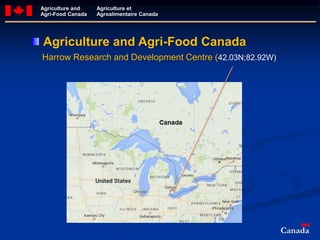
Harrow Research and Development Centre (42.03N;82.92W)
1 Introduction
2 Reactive N model
N inputs
N outputs
Data sources
Scale-up Methodology
3 Results and discussion
4 Summary
Table of contents
Canada has ≈ 60 million ha of farmland, about 1.6
Mt fertilizer N is used, and 1.3 Mt biological N
fixation by legumes, and 1.1 Mt manure N is
produced each year (2000 - 2011).
About 30-60% of N input was lost via
- Greenhouse gas (N2O, NO)
- Ammonia emission (NH3)
- N leaching and runoff (NO3)
Introduction
Reactive N model
Reactive N model and assumption
At given region, N input = N output in a yearly cycle,
assuming soil organic N is stable.
Reactive N model is the updated version of the
Canadian Agricultural Nitrogen Budget (CANB) v4.0
model
The CANB v4.0 model was used to estimate two Agro-
Environmental Indicators at Canadian Farmland 1981-
2011
Reference: Yang et al., 2013. Ecological Modelling 267, 26-38
N food = N removal by food and fiber crops by humans
N feed = N removal by animal feed
N loss = N2O + NH3 + NO3 (leaching + runoff)
RSN = Residual soil Inorganic Nitrogen present in the soil
after harvest
N input = N fert + N fix + N depo + Nfix_min
N output = N food + N feed + N loss + RSN
N fert = N input from fertilizer
N fix = Biological N fixation and residual N mineralization
N depo = Dry and wet N deposition from atmosphere
N fix_min = N mineralization from legume crop residue
Reactive N model
Reactive N model
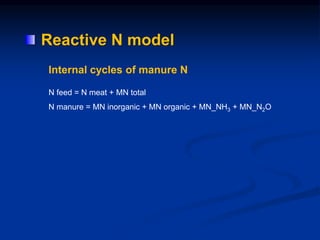
N feed = N meat + MN total
N manure = MN inorganic + MN organic + MN_NH3 + MN_N2O
Internal cycles of manure N
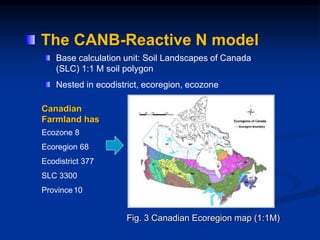
Fig. 3 Canadian Ecoregion map (1:1M)
Canadian
Farmland has
Ecozone 8
Ecoregion 68
Ecodistrict 377
SLC 3300
Province10
Base calculation unit: Soil Landscapes of Canada
(SLC) 1:1 M soil polygon
Nested in ecodistrict, ecoregion, ecozone
The CANB-Reactive N model
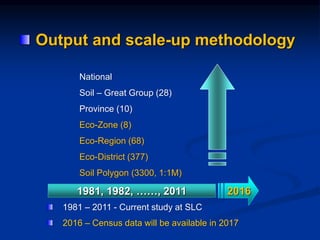
National
Soil – Great Group (28)
Province (10)
Eco-Zone (8)
Eco-Region (68)
Eco-District (377)
Soil Polygon (3300, 1:1M)
1981 – 2011 - Current study at SLC
20161981, 1982, ……, 2011
2016 – Census data will be available in 2017
Output and scale-up methodology
Data sources
At Soil Landscape of Canada scale
At Eco-district scale
At Provincial scale
At National (Canadian) scale
At Soil Great Group scale
Examples of N data
at SLC scale
Fertilizer N
Biological N fixation
Crop yields
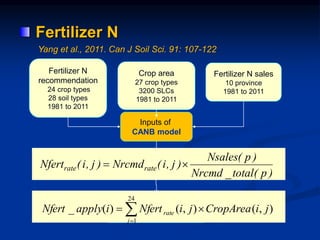
Fertilizer N
recommendation
24 crop types
28 soil types
1981 to 2011
Inputs of
CANB model
Adjust fertilizer N rate to equal the total provincial N sale
Calculate total fertilizer N
application
Crop area
27 crop types
3200 SLCs
1981 to 2011
Fertilizer N sales
10 province
1981 to 2011
)p(total_Nrcmd
)p(Nsales
)j,i(Nrcmd)j,i(Nfert raterate 
Fertilizer N
Yang et al., 2011. Can J Soil Sci. 91: 107-122


24
1
),(),()(_
j
rate jiCropAreajiNfertiapplyNfert
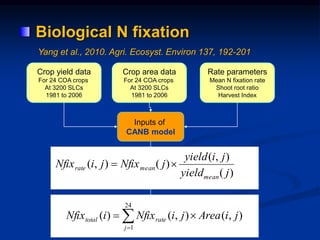
Crop yield data
For 24 COA crops
At 3200 SLCs
1981 to 2006
Inputs of
CANB model
N fixation rate
adjustment
N fixation
calculation
Crop area data
For 24 COA crops
At 3200 SLCs
1981 to 2006
Rate parameters
Mean N fixation rate
Shoot root ratio
Harvest Index


24
1
),(),()(
j
ratetotal jiAreajiNfixiNfix
)(
),(
)(),(
jyield
jiyield
jNfixjiNfix
mean
meanrate 
Biological N fixation
Yang et al., 2010. Agri. Ecosyst. Environ 137, 192-201
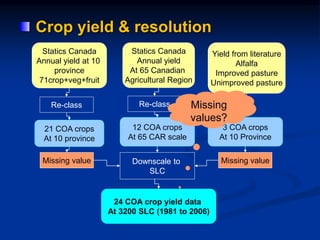
Statics Canada
Annual yield
At 65 Canadian
Agricultural Region
12 COA crops
At 65 CAR scale
Re-class
Downscale to
SLC
Statics Canada
Annual yield at 10
province
71crop+veg+fruit
21 COA crops
At 10 province
Re-class
Missing value
24 COA crop yield data
At 3200 SLC (1981 to 2006)
Yield from literature
Alfalfa
Improved pasture
Unimproved pasture
Missing value
3 COA crops
At 10 Province
Crop yield & resolution
Missing
values?
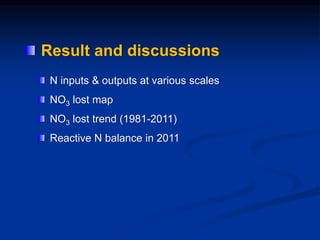
Result and discussions
N inputs & outputs at various scales
NO3 lost map
NO3 lost trend (1981-2011)
Reactive N balance in 2011
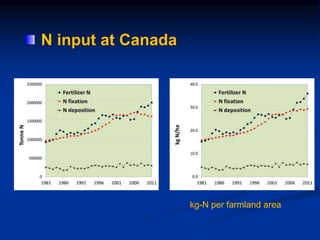
N input at Canada
kg-N per farmland area
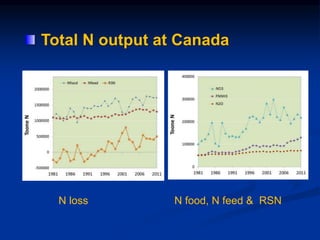
Total N output at Canada
N loss N food, N feed & RSN
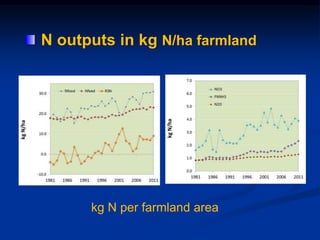
N outputs in kg N/ha farmland
kg N per farmland area
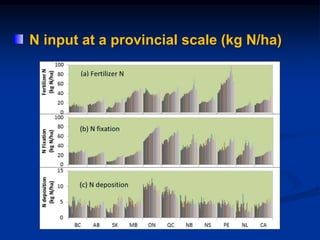
N input at a provincial scale (kg N/ha)
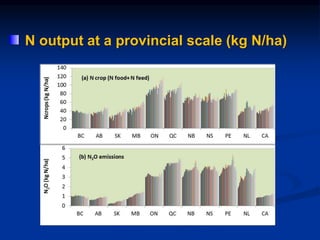
N output at a provincial scale (kg N/ha)
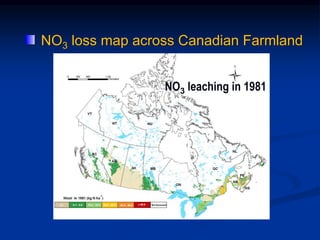
NO3 loss map across Canadian Farmland
NO3 leaching in 1981
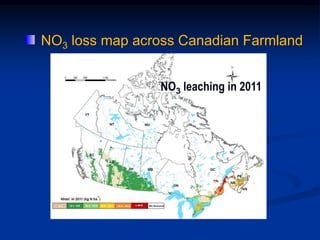
NO3 loss map across Canadian Farmland
NO3 leaching in 2011
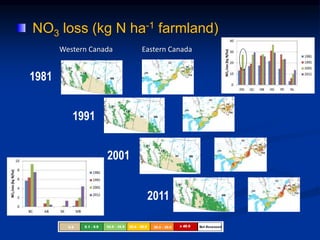
NO3 loss (kg N ha-1 farmland)
1981
1991
2001
2011
Western Canada Eastern Canada
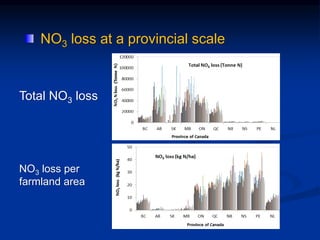
NO3 loss at a provincial scale
Total NO3 loss
NO3 loss per
farmland area
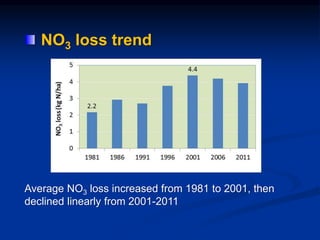
NO3 loss trend
Average NO3 loss increased from 1981 to 2001, then
declined linearly from 2001-2011
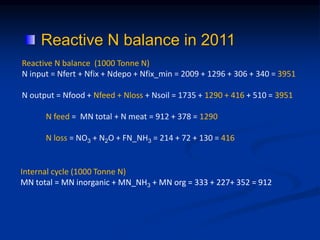
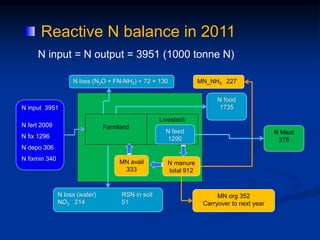
Reactive N balance in 2011
Reactive N balance (1000 Tonne N)
N input = Nfert + Nfix + Ndepo + Nfix_min = 2009 + 1296 + 306 + 340 = 3951
N output = Nfood + Nfeed + Nloss + Nsoil = 1735 + 1290 + 416 + 510 = 3951
Internal cycle (1000 Tonne N)
MN total = MN inorganic + MN_NH3 + MN org = 333 + 227+ 352 = 912
N feed = MN total + N meat = 912 + 378 = 1290
N loss = NO3 + N2O + FN_NH3 = 214 + 72 + 130 = 416
Reactive N balance in 2011
N input 3951
N fert 2009
N fix 1296
N depo 306
N fixmin 340
Farmland
Livestock
N loss (water) RSN in soil
NO3 214 51
N input = N output = 3951 (1000 tonne N)
N feed
1290
N food
1735
N Meat
378
N manure
total 912
N loss (N2O + FN-NH3) = 72 + 130 MN_NH3 227
MN org 352
Carryover to next year
MN avail
333
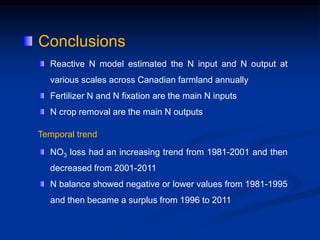
Reactive N model estimated the N input and N output at
various scales across Canadian farmland annually
Fertilizer N and N fixation are the main N inputs
N crop removal are the main N outputs
Conclusions
NO3 loss had an increasing trend from 1981-2001 and then
decreased from 2001-2011
N balance showed negative or lower values from 1981-1995
and then became a surplus from 1996 to 2011
Temporal trend
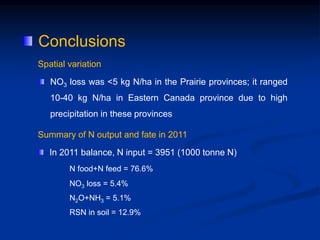
Conclusions
NO3 loss was <5 kg N/ha in the Prairie provinces; it ranged
10-40 kg N/ha in Eastern Canada province due to high
precipitation in these provinces
Spatial variation
In 2011 balance, N input = 3951 (1000 tonne N)
N food+N feed = 76.6%
NO3 loss = 5.4%
N2O+NH3 = 5.1%
RSN in soil = 12.9%
Summary of N output and fate in 2011
Agriculture and
Agri-Food Canada
Agriculture et
Agroalimentaire Canada
Canada
AAFC Sustainability Metrics
Funding Support
Acknowledgements
Thank you

Developing a Reactive Nitrogen Model

  • 1.
    Agriculture and Agri-Food Canada Agricultureet Agroalimentaire Canada J.Y. Yang and C.F. Drury Harrow Research and Development Centre Agriculture and Agri-Food Canada Harrow Ontario, N0R 1G0, Canada Developing a Reactive Nitrogen Model for Canadian Agricultural Land Canada The 72th SWCS International Annual Conference, Madison, Wisconsin, July 30-Aug 2, 2017
  • 2.
    Agriculture and Agri-FoodCanada Agriculture and Agri-Food Canada Agriculture et Agroalimentaire Canada Canada Harrow Research and Development Centre (42.03N;82.92W)
  • 3.
    1 Introduction 2 ReactiveN model N inputs N outputs Data sources Scale-up Methodology 3 Results and discussion 4 Summary Table of contents
  • 4.
    Canada has ≈60 million ha of farmland, about 1.6 Mt fertilizer N is used, and 1.3 Mt biological N fixation by legumes, and 1.1 Mt manure N is produced each year (2000 - 2011). About 30-60% of N input was lost via - Greenhouse gas (N2O, NO) - Ammonia emission (NH3) - N leaching and runoff (NO3) Introduction
  • 5.
    Reactive N model ReactiveN model and assumption At given region, N input = N output in a yearly cycle, assuming soil organic N is stable. Reactive N model is the updated version of the Canadian Agricultural Nitrogen Budget (CANB) v4.0 model The CANB v4.0 model was used to estimate two Agro- Environmental Indicators at Canadian Farmland 1981- 2011 Reference: Yang et al., 2013. Ecological Modelling 267, 26-38
  • 6.
    N food =N removal by food and fiber crops by humans N feed = N removal by animal feed N loss = N2O + NH3 + NO3 (leaching + runoff) RSN = Residual soil Inorganic Nitrogen present in the soil after harvest N input = N fert + N fix + N depo + Nfix_min N output = N food + N feed + N loss + RSN N fert = N input from fertilizer N fix = Biological N fixation and residual N mineralization N depo = Dry and wet N deposition from atmosphere N fix_min = N mineralization from legume crop residue Reactive N model
  • 7.
    Reactive N model Nfeed = N meat + MN total N manure = MN inorganic + MN organic + MN_NH3 + MN_N2O Internal cycles of manure N
  • 8.
    Fig. 3 CanadianEcoregion map (1:1M) Canadian Farmland has Ecozone 8 Ecoregion 68 Ecodistrict 377 SLC 3300 Province10 Base calculation unit: Soil Landscapes of Canada (SLC) 1:1 M soil polygon Nested in ecodistrict, ecoregion, ecozone The CANB-Reactive N model
  • 9.
    National Soil – GreatGroup (28) Province (10) Eco-Zone (8) Eco-Region (68) Eco-District (377) Soil Polygon (3300, 1:1M) 1981 – 2011 - Current study at SLC 20161981, 1982, ……, 2011 2016 – Census data will be available in 2017 Output and scale-up methodology
  • 10.
    Data sources At SoilLandscape of Canada scale At Eco-district scale At Provincial scale At National (Canadian) scale At Soil Great Group scale
  • 11.
    Examples of Ndata at SLC scale Fertilizer N Biological N fixation Crop yields
  • 12.
    Fertilizer N recommendation 24 croptypes 28 soil types 1981 to 2011 Inputs of CANB model Adjust fertilizer N rate to equal the total provincial N sale Calculate total fertilizer N application Crop area 27 crop types 3200 SLCs 1981 to 2011 Fertilizer N sales 10 province 1981 to 2011 )p(total_Nrcmd )p(Nsales )j,i(Nrcmd)j,i(Nfert raterate  Fertilizer N Yang et al., 2011. Can J Soil Sci. 91: 107-122   24 1 ),(),()(_ j rate jiCropAreajiNfertiapplyNfert
  • 13.
    Crop yield data For24 COA crops At 3200 SLCs 1981 to 2006 Inputs of CANB model N fixation rate adjustment N fixation calculation Crop area data For 24 COA crops At 3200 SLCs 1981 to 2006 Rate parameters Mean N fixation rate Shoot root ratio Harvest Index   24 1 ),(),()( j ratetotal jiAreajiNfixiNfix )( ),( )(),( jyield jiyield jNfixjiNfix mean meanrate  Biological N fixation Yang et al., 2010. Agri. Ecosyst. Environ 137, 192-201
  • 14.
    Statics Canada Annual yield At65 Canadian Agricultural Region 12 COA crops At 65 CAR scale Re-class Downscale to SLC Statics Canada Annual yield at 10 province 71crop+veg+fruit 21 COA crops At 10 province Re-class Missing value 24 COA crop yield data At 3200 SLC (1981 to 2006) Yield from literature Alfalfa Improved pasture Unimproved pasture Missing value 3 COA crops At 10 Province Crop yield & resolution Missing values?
  • 15.
    Result and discussions Ninputs & outputs at various scales NO3 lost map NO3 lost trend (1981-2011) Reactive N balance in 2011
  • 16.
    N input atCanada kg-N per farmland area
  • 17.
    Total N outputat Canada N loss N food, N feed & RSN
  • 18.
    N outputs inkg N/ha farmland kg N per farmland area
  • 19.
    N input ata provincial scale (kg N/ha)
  • 20.
    N output ata provincial scale (kg N/ha)
  • 21.
    NO3 loss mapacross Canadian Farmland NO3 leaching in 1981
  • 22.
    NO3 loss mapacross Canadian Farmland NO3 leaching in 2011
  • 23.
    NO3 loss (kgN ha-1 farmland) 1981 1991 2001 2011 Western Canada Eastern Canada
  • 24.
    NO3 loss ata provincial scale Total NO3 loss NO3 loss per farmland area
  • 25.
    NO3 loss trend AverageNO3 loss increased from 1981 to 2001, then declined linearly from 2001-2011
  • 26.
    Reactive N balancein 2011 Reactive N balance (1000 Tonne N) N input = Nfert + Nfix + Ndepo + Nfix_min = 2009 + 1296 + 306 + 340 = 3951 N output = Nfood + Nfeed + Nloss + Nsoil = 1735 + 1290 + 416 + 510 = 3951 Internal cycle (1000 Tonne N) MN total = MN inorganic + MN_NH3 + MN org = 333 + 227+ 352 = 912 N feed = MN total + N meat = 912 + 378 = 1290 N loss = NO3 + N2O + FN_NH3 = 214 + 72 + 130 = 416
  • 27.
    Reactive N balancein 2011 N input 3951 N fert 2009 N fix 1296 N depo 306 N fixmin 340 Farmland Livestock N loss (water) RSN in soil NO3 214 51 N input = N output = 3951 (1000 tonne N) N feed 1290 N food 1735 N Meat 378 N manure total 912 N loss (N2O + FN-NH3) = 72 + 130 MN_NH3 227 MN org 352 Carryover to next year MN avail 333
  • 28.
    Reactive N modelestimated the N input and N output at various scales across Canadian farmland annually Fertilizer N and N fixation are the main N inputs N crop removal are the main N outputs Conclusions NO3 loss had an increasing trend from 1981-2001 and then decreased from 2001-2011 N balance showed negative or lower values from 1981-1995 and then became a surplus from 1996 to 2011 Temporal trend
  • 29.
    Conclusions NO3 loss was<5 kg N/ha in the Prairie provinces; it ranged 10-40 kg N/ha in Eastern Canada province due to high precipitation in these provinces Spatial variation In 2011 balance, N input = 3951 (1000 tonne N) N food+N feed = 76.6% NO3 loss = 5.4% N2O+NH3 = 5.1% RSN in soil = 12.9% Summary of N output and fate in 2011
  • 30.
    Agriculture and Agri-Food Canada Agricultureet Agroalimentaire Canada Canada AAFC Sustainability Metrics Funding Support Acknowledgements Thank you