Modifying water management
     for rice production
BUT	
  
 Rice	
  is	
  not	
  just	
  a	
  vic1m	
  of	
  
          climate	
  change,	
  
it	
  is	
  also	
  one	
  of	
  the	
  causes	
  
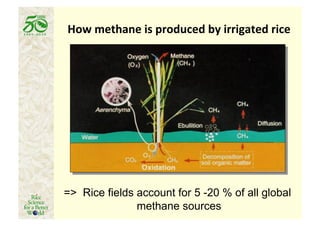
How	
  methane	
  is	
  produced	
  by	
  irrigated	
  rice	


=> Rice fields account for 5 -20 % of all global
               methane sources
‘Closed Chamber‘ Method
Diurnal patterns


Pooled field data, Buendia et al. 1997
Relevance for CCAFS?

One of the Fund Council comments:

o Articulate potential contribution to
 development of global standards for
 measuring GHG emissions from
 agriculture
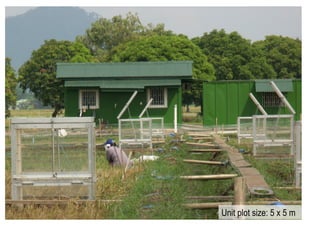
Unit plot size: 5 x 5 m
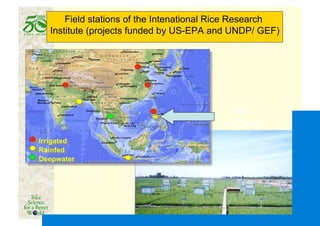
Field stations of the Intenational Rice Research
  Institute (projects funded by US-EPA and UNDP/ GEF)


                                         IRRI/
                                       Los Banos
Irrigated
Rainfed
Deepwater
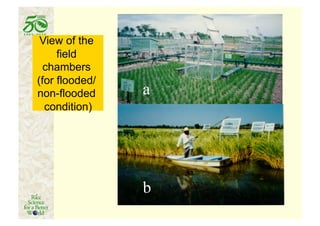
View of the
     field
  chambers
(for flooded/
non-flooded
  condition)
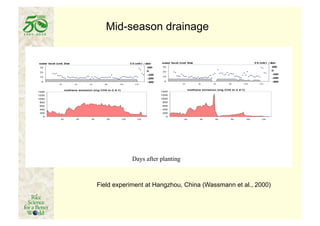
Mid-season drainage


            Days after planting


Field experiment at Hangzhou, China (Wassmann et al., 2000)
‘Site-Specific Nutrient
Management’ (SSNM)
                     Applying nutrients as
                      and when needed

                     Adjusting nutrient
                      application to crop
                      needs in given
                      location and season


Leaf Color Chart
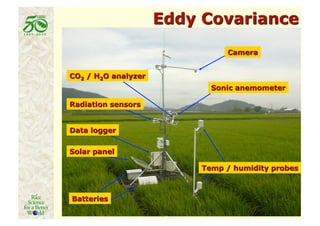
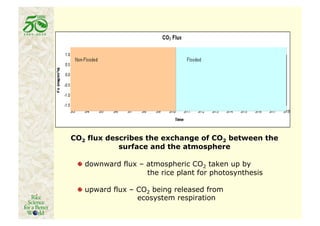
"   downward flux – atmospheric CO2 taken up by
                    the rice plant for photosynthesis

"   upward flux – CO2 being released from
                  ecosystem respiration
Modelling emissions using DNDC model
               (DeNitrification-DeComposition)

Inputs
SOIL
Texture, pH,                                         => for 28 crops
C and N content

CLIMATE
Temp., rainfall

MANAGEMENT
N inputs, tillage,
irrigation etc.
                     Outputs
                     EMISSIONS (CO2, CH4 , N2O, NO, NO2, NH3 )

                     WATER BALANCE (Evaporation, transpiration)
from Li et al.
    2000             SOIL PROFILES (C and N contents, moisture etc.)

                     CROP PHENOLOGY (biomass etc)
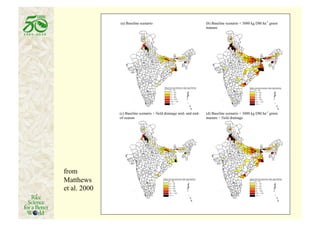
from
Matthews
et al. 2000
Conclusion

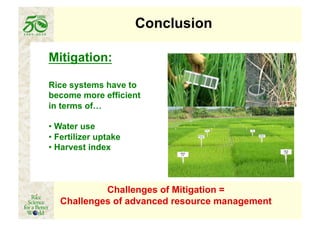
Mitigation:

Rice systems have to
become more efficient
in terms of…

•  Water use
•  Fertilizer uptake
•  Harvest index


            Challenges of Mitigation =
   Challenges of advanced resource management

Wassmann - Modifying water management for rice production

  • 1.
    Modifying water management for rice production
  • 2.
    BUT   Rice  is  not  just  a  vic1m  of   climate  change,   it  is  also  one  of  the  causes  
  • 3.
    How  methane  is  produced  by  irrigated  rice   => Rice fields account for 5 -20 % of all global methane sources
  • 4.
  • 5.
    Diurnal patterns Pooled fielddata, Buendia et al. 1997
  • 6.
    Relevance for CCAFS? Oneof the Fund Council comments: o Articulate potential contribution to development of global standards for measuring GHG emissions from agriculture
  • 7.
  • 8.
    Field stations ofthe Intenational Rice Research Institute (projects funded by US-EPA and UNDP/ GEF) IRRI/ Los Banos Irrigated Rainfed Deepwater
  • 9.
    View of the field chambers (for flooded/ non-flooded condition)
  • 10.
    Mid-season drainage Days after planting Field experiment at Hangzhou, China (Wassmann et al., 2000)
  • 12.
    ‘Site-Specific Nutrient Management’ (SSNM)   Applying nutrients as and when needed   Adjusting nutrient application to crop needs in given location and season Leaf Color Chart
  • 15.
    "   downwardflux – atmospheric CO2 taken up by the rice plant for photosynthesis "   upward flux – CO2 being released from ecosystem respiration
  • 16.
    Modelling emissions usingDNDC model (DeNitrification-DeComposition) Inputs SOIL Texture, pH, => for 28 crops C and N content CLIMATE Temp., rainfall MANAGEMENT N inputs, tillage, irrigation etc. Outputs EMISSIONS (CO2, CH4 , N2O, NO, NO2, NH3 ) WATER BALANCE (Evaporation, transpiration) from Li et al. 2000 SOIL PROFILES (C and N contents, moisture etc.) CROP PHENOLOGY (biomass etc)
  • 17.
  • 18.
    Conclusion Mitigation: Rice systems haveto become more efficient in terms of… •  Water use •  Fertilizer uptake •  Harvest index Challenges of Mitigation = Challenges of advanced resource management