TIMELINE OF DEVELOPMENT OF THE
PERIODIC TABLE
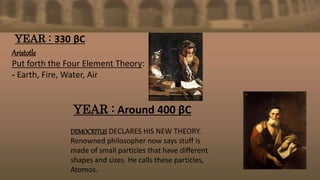
YEAR : 330 βC
Aristotle
Put forth the Four Element Theory:
- Earth, Fire, Water, Air
YEAR : Αround 400 βC
DEMOCRITUS DECLARES HIS NEW THEORY.
Renowned philosopher now says stuff is
made of small particles that have different
shapes and sizes. He calls these particles,
Atomos.
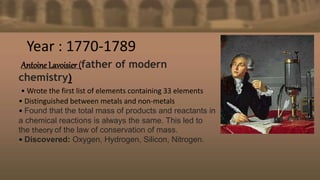
Antoine Lavoisier (father of modern
chemistry)
• Wrote the first list of elements containing 33 elements
• Distinguished between metals and non-metals
• Found that the total mass of products and reactants in
a chemical reactions is always the same. This led to
the theory of the law of conservation of mass.
• Discovered: Oxygen, Hydrogen, Silicon, Nitrogen.
Year : 1770-1789
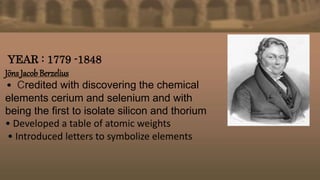
YEAR : 1779 -1848
Jöns Jacob Berzelius
• Credited with discovering the chemical
elements cerium and selenium and with
being the first to isolate silicon and thorium
• Developed a table of atomic weights
• Introduced letters to symbolize elements
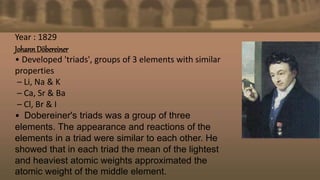
Year : 1829
JohannDöbereiner
• Developed 'triads', groups of 3 elements with similar
properties
– Li, Na & K
– Ca, Sr & Ba
– Cl, Br & I
• Dobereiner's triads was a group of three
elements. The appearance and reactions of the
elements in a triad were similar to each other. He
showed that in each triad the mean of the lightest
and heaviest atomic weights approximated the
atomic weight of the middle element.
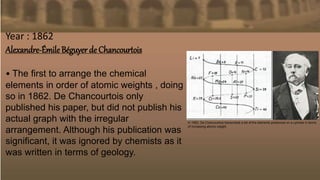
Year : 1862
Alexandre-Émile Béguyer de Chancourtois
• The first to arrange the chemical
elements in order of atomic weights , doing
so in 1862. De Chancourtois only
published his paper, but did not publish his
actual graph with the irregular
arrangement. Although his publication was
significant, it was ignored by chemists as it
was written in terms of geology.
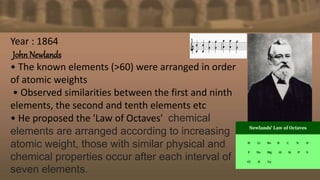
Year : 1864
John Newlands
• The known elements (>60) were arranged in order
of atomic weights
• Observed similarities between the first and ninth
elements, the second and tenth elements etc
• He proposed the 'Law of Octaves' chemical
elements are arranged according to increasing
atomic weight, those with similar physical and
chemical properties occur after each interval of
seven elements.
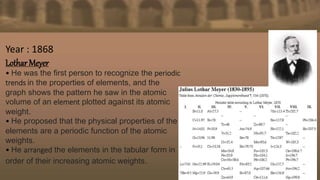
Year : 1868
Lothar Meyer
• He was the first person to recognize the periodic
trends in the properties of elements, and the
graph shows the pattern he saw in the atomic
volume of an element plotted against its atomic
weight.
• He proposed that the physical properties of the
elements are a periodic function of the atomic
weights.
• He arranged the elements in the tabular form in
order of their increasing atomic weights.
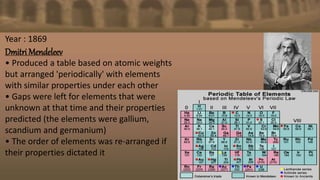
Year : 1869
Dmitri Mendeleev
• Produced a table based on atomic weights
but arranged 'periodically' with elements
with similar properties under each other
• Gaps were left for elements that were
unknown at that time and their properties
predicted (the elements were gallium,
scandium and germanium)
• The order of elements was re-arranged if
their properties dictated it
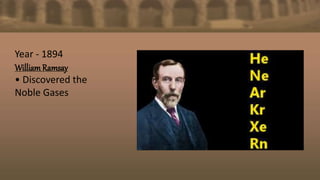
Year - 1894
WilliamRamsay
• Discovered the
Noble Gases
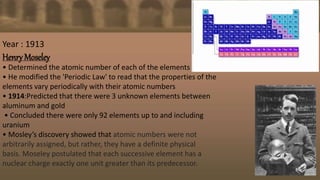
Year : 1913
Henry Moseley
• Determined the atomic number of each of the elements
• He modified the 'Periodic Law' to read that the properties of the
elements vary periodically with their atomic numbers
• 1914:Predicted that there were 3 unknown elements between
aluminum and gold
• Concluded there were only 92 elements up to and including
uranium
• Mosley’s discovery showed that atomic numbers were not
arbitrarily assigned, but rather, they have a definite physical
basis. Moseley postulated that each successive element has a
nuclear charge exactly one unit greater than its predecessor.
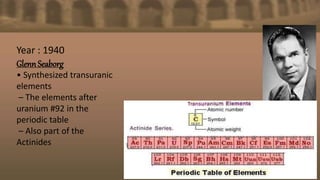
Year : 1940
Glenn Seaborg
• Synthesized transuranic
elements
– The elements after
uranium #92 in the
periodic table
– Also part of the
Actinides
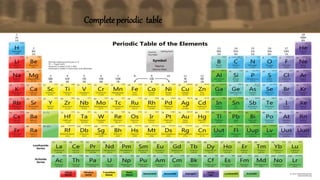
Complete periodic table
PERIODIC TABLE VIDEO
Developement of periodic table

Developement of periodic table

  • 1.
    TIMELINE OF DEVELOPMENTOF THE PERIODIC TABLE
  • 2.
    YEAR : 330βC Aristotle Put forth the Four Element Theory: - Earth, Fire, Water, Air YEAR : Αround 400 βC DEMOCRITUS DECLARES HIS NEW THEORY. Renowned philosopher now says stuff is made of small particles that have different shapes and sizes. He calls these particles, Atomos.
  • 3.
    Antoine Lavoisier (fatherof modern chemistry) • Wrote the first list of elements containing 33 elements • Distinguished between metals and non-metals • Found that the total mass of products and reactants in a chemical reactions is always the same. This led to the theory of the law of conservation of mass. • Discovered: Oxygen, Hydrogen, Silicon, Nitrogen. Year : 1770-1789
  • 4.
    YEAR : 1779-1848 Jöns Jacob Berzelius • Credited with discovering the chemical elements cerium and selenium and with being the first to isolate silicon and thorium • Developed a table of atomic weights • Introduced letters to symbolize elements
  • 5.
    Year : 1829 JohannDöbereiner •Developed 'triads', groups of 3 elements with similar properties – Li, Na & K – Ca, Sr & Ba – Cl, Br & I • Dobereiner's triads was a group of three elements. The appearance and reactions of the elements in a triad were similar to each other. He showed that in each triad the mean of the lightest and heaviest atomic weights approximated the atomic weight of the middle element.
  • 6.
    Year : 1862 Alexandre-ÉmileBéguyer de Chancourtois • The first to arrange the chemical elements in order of atomic weights , doing so in 1862. De Chancourtois only published his paper, but did not publish his actual graph with the irregular arrangement. Although his publication was significant, it was ignored by chemists as it was written in terms of geology.
  • 7.
    Year : 1864 JohnNewlands • The known elements (>60) were arranged in order of atomic weights • Observed similarities between the first and ninth elements, the second and tenth elements etc • He proposed the 'Law of Octaves' chemical elements are arranged according to increasing atomic weight, those with similar physical and chemical properties occur after each interval of seven elements.
  • 8.
    Year : 1868 LotharMeyer • He was the first person to recognize the periodic trends in the properties of elements, and the graph shows the pattern he saw in the atomic volume of an element plotted against its atomic weight. • He proposed that the physical properties of the elements are a periodic function of the atomic weights. • He arranged the elements in the tabular form in order of their increasing atomic weights.
  • 9.
    Year : 1869 DmitriMendeleev • Produced a table based on atomic weights but arranged 'periodically' with elements with similar properties under each other • Gaps were left for elements that were unknown at that time and their properties predicted (the elements were gallium, scandium and germanium) • The order of elements was re-arranged if their properties dictated it
  • 10.
    Year - 1894 WilliamRamsay •Discovered the Noble Gases
  • 11.
    Year : 1913 HenryMoseley • Determined the atomic number of each of the elements • He modified the 'Periodic Law' to read that the properties of the elements vary periodically with their atomic numbers • 1914:Predicted that there were 3 unknown elements between aluminum and gold • Concluded there were only 92 elements up to and including uranium • Mosley’s discovery showed that atomic numbers were not arbitrarily assigned, but rather, they have a definite physical basis. Moseley postulated that each successive element has a nuclear charge exactly one unit greater than its predecessor.
  • 12.
    Year : 1940 GlennSeaborg • Synthesized transuranic elements – The elements after uranium #92 in the periodic table – Also part of the Actinides
  • 13.
  • 14.