CliffsQuickReview™
Writing: Grammar,
Usage, and Style
By Jean Eggenschwiler, M.A.
and Emily Dotson Biggs
An International Data Group Company
Cleveland, OH • Indianapolis, IN • New York, NY
CliffsQuickReview™
Writing: Grammar, Usage, and Style
Published by
Hungry Minds, Inc.
909 Third Avenue
New York, NY 10022
www.hungryminds.com
www.cliffsnotes.com
Copyright © 2001 Hungry Minds, Inc. All rights reserved. No part of this book, including interior design, cover design, and icons, may be reproduced or
transmitted in any form, by any means (electronic, photocopying, recording, or otherwise) without the prior written permission of the publisher.
Library of Congress Control Number: 2001024142
ISBN: 0-7645-6393-9
Printed in the United States of America
10 9 8 7 6 5 4 3 2 1
1O/QZ/QV/QR/IN
Distributed in the United States by Hungry Minds, Inc.
Distributed by CDG Books Canada Inc. for Canada; by Transworld Publishers Limited in the United Kingdom; by IDG Norge Books for Norway; by IDG
Sweden Books for Sweden; by IDG Books Australia Publishing Corporation Pty. Ltd. for Australia and New Zealand; by TransQuest Publishers Pte Ltd. for
Singapore, Malaysia, Thailand, Indonesia, and Hong Kong; by Gotop Information Inc. for Taiwan; by ICG Muse, Inc. for Japan; by Intersoft for South Africa;
by Eyrolles for France; by International Thomson Publishing for Germany, Austria and Switzerland; by Distribuidora Cuspide for Argentina; by LR Interna-
tional for Brazil; by Galileo Libros for Chile; by Ediciones ZETA S.C.R. Ltda. for Peru; by WS Computer Publishing Corporation, Inc., for the Philippines;
by Contemporanea de Ediciones for Venezuela; by Express Computer Distributors for the Caribbean and West Indies; by Micronesia Media Distributor, Inc.
for Micronesia; by Chips Computadoras S.A. de C.V. for Mexico; by Editorial Norma de Panama S.A. for Panama; by American Bookshops for Finland.
For general information on Hungry Minds’ products and services in the U.S., please call our Customer Care department at 800-762-2974.
For reseller information, including discounts and premium sales, please call our Reseller Customer Care department at 800-434-3422.
For information on where to purchase Hungry Minds’ products outside the U.S., please contact our International Sales department at 317-572-3993 or fax
317-572-4002.
For consumer information on foreign language translations, please contact our Customer Care department at 800-434-3422, fax 317-572-4002, or e-mail
rights@hungryminds.com.
For information on licensing foreign or domestic rights, please contact our Sub-Rights Customer Care department at 212-884-5000.
For sales inquiries and special prices for bulk quantities, please contact our Order Services department at 800-434-3422 or write to Hungry Minds, Inc., Attn:
Customer Care department, 10475 Crosspoint Boulevard, Indianapolis, IN 46256.
For information on using Hungry Minds’ products and services in the classroom or for ordering examination copies, please contact our Educational Sales
department at 800-434-2086 or fax 317-572-4005.
[non-travel titles] Please contact our Public Relations department at 212-884-5163 for press review copies or 212-884-5000 for author interviews and other
publicity information or fax 212-884-5400.
For authorization to photocopy items for corporate, personal, or educational use, please contact Copyright Clearance Center, 222 Rosewood Drive, Danvers,
MA 01923, or fax 978-750-4470.
LIMIT OF LIABILITY/DISCLAIMER OF WARRANTY: THE PUBLISHER AND AUTHOR HAVE USED THEIR BEST EFFORTS IN PREPARING
THIS BOOK. THE PUBLISHER AND AUTHOR MAKE NO REPRESENTATIONS OR WARRANTIES WITH RESPECT TO THE ACCURACY
OR COMPLETENESS OF THE CONTENTS OF THIS BOOK AND SPECIFICALLY DISCLAIM ANY IMPLIED WARRANTIES OF
MERCHANTABILITY OR FITNESS FOR A PARTICULAR PURPOSE. THERE ARE NO WARRANTIES WHICH EXTEND BEYOND THE
DESCRIPTIONS CONTAINED IN THIS PARAGRAPH. NO WARRANTY MAY BE CREATED OR EXTENDED BY SALES REPRESENTATIVES
OR WRITTEN SALES MATERIALS. THE ACCURACY AND COMPLETENESS OF THE INFORMATION PROVIDED HEREIN AND THE
OPINIONS STATED HEREIN ARE NOT GUARANTEED OR WARRANTED TO PRODUCE ANY PARTICULAR RESULTS, AND THE ADVICE
AND STRATEGIES CONTAINED HEREIN MAY NOT BE SUITABLE FOR EVERY INDIVIDUAL. NEITHER THE PUBLISHER NOR AUTHOR
SHALL BE LIABLE FOR ANY LOSS OF PROFIT OR ANY OTHER COMMERCIAL DAMAGES, INCLUDING BUT NOT LIMITED TO
SPECIAL, INCIDENTAL, CONSEQUENTIAL, OR OTHER DAMAGES.
Trademarks: [Insert third party trademarks from book title or included logos here] Cliffs, CliffsNotes, CliffsNotes, Inc. logo and all related logos and trade
dress are registered trademarks or trademarks of Hungry Minds, Inc., in the United States and other countries. All other brand names and product names
used in this book are trade names, service marks, trademarks, or registered trademarks of their respective owners. Hungry Minds, Inc., is not associated with
any product or vendor mentioned in this book.
About the Authors
Jean Eggenschwiler, MA is a graduate of U. C.
Berkeley and Stanford University. She has taught
English and Composition in high school and
worked as a business editor and writer.
Emily Dotson Biggs is a graduate of the Univer-
sity of North Carolina and Murray State Univer-
sity. She is currently an adjunct instructor at
Paducah Community College and Murray State
University and has taught English to students
from kindergarten to college.
Publisher’s Acknowledgments
Editorial
Project Editor: Howard Gelman
Acquisitions Editor: Sherry Gomoll
Copy Editor: Howard Gelman
Editorial Administrator: Michelle Hacker
Production
Indexer: TECHBOOKS Production Services
Proofreader: TECHBOOKS Production Services
Hungry Minds Indianapolis Production Services
Note: If you purchased this book without a cover you
should be aware that this book is stolen property. It was
reported as "unsold and destroyed" to the publisher, and
neither the author nor the publisher has received any pay-
ment for this "stripped book."
is a trademark of
Hungry Minds, Inc.
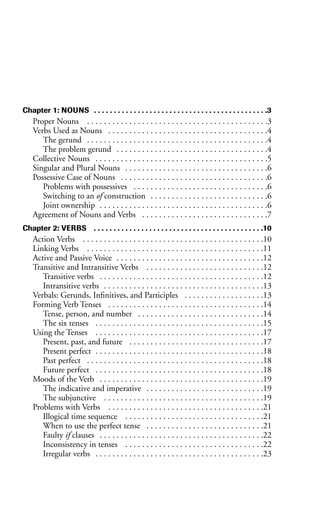
Chapter 1: NOUNS . . . . . . . . . . . . . . . . . . . . . . . . . . . . . . . . . . . . . . . . . . . .3
Proper Nouns . . . . . . . . . . . . . . . . . . . . . . . . . . . . . . . . . . . . . . . . . . .3
Verbs Used as Nouns . . . . . . . . . . . . . . . . . . . . . . . . . . . . . . . . . . . . . .4
The gerund . . . . . . . . . . . . . . . . . . . . . . . . . . . . . . . . . . . . . . . . . . .4
The problem gerund . . . . . . . . . . . . . . . . . . . . . . . . . . . . . . . . . . . .4
Collective Nouns . . . . . . . . . . . . . . . . . . . . . . . . . . . . . . . . . . . . . . . . .5
Singular and Plural Nouns . . . . . . . . . . . . . . . . . . . . . . . . . . . . . . . . . .6
Possessive Case of Nouns . . . . . . . . . . . . . . . . . . . . . . . . . . . . . . . . . . .6
Problems with possessives . . . . . . . . . . . . . . . . . . . . . . . . . . . . . . . .6
Switching to an of construction . . . . . . . . . . . . . . . . . . . . . . . . . . . .6
Joint ownership . . . . . . . . . . . . . . . . . . . . . . . . . . . . . . . . . . . . . . . .6
Agreement of Nouns and Verbs . . . . . . . . . . . . . . . . . . . . . . . . . . . . . .7
Chapter 2: VERBS . . . . . . . . . . . . . . . . . . . . . . . . . . . . . . . . . . . . . . . . . . .10
Action Verbs . . . . . . . . . . . . . . . . . . . . . . . . . . . . . . . . . . . . . . . . . . .10
Linking Verbs . . . . . . . . . . . . . . . . . . . . . . . . . . . . . . . . . . . . . . . . . .11
Active and Passive Voice . . . . . . . . . . . . . . . . . . . . . . . . . . . . . . . . . . .12
Transitive and Intransitive Verbs . . . . . . . . . . . . . . . . . . . . . . . . . . . .12
Transitive verbs . . . . . . . . . . . . . . . . . . . . . . . . . . . . . . . . . . . . . . .12
Intransitive verbs . . . . . . . . . . . . . . . . . . . . . . . . . . . . . . . . . . . . . .13
Verbals: Gerunds, Infinitives, and Participles . . . . . . . . . . . . . . . . . . .13
Forming Verb Tenses . . . . . . . . . . . . . . . . . . . . . . . . . . . . . . . . . . . . .14
Tense, person, and number . . . . . . . . . . . . . . . . . . . . . . . . . . . . . .14
The six tenses . . . . . . . . . . . . . . . . . . . . . . . . . . . . . . . . . . . . . . . .15
Using the Tenses . . . . . . . . . . . . . . . . . . . . . . . . . . . . . . . . . . . . . . . .17
Present, past, and future . . . . . . . . . . . . . . . . . . . . . . . . . . . . . . . .17
Present perfect . . . . . . . . . . . . . . . . . . . . . . . . . . . . . . . . . . . . . . . .18
Past perfect . . . . . . . . . . . . . . . . . . . . . . . . . . . . . . . . . . . . . . . . . .18
Future perfect . . . . . . . . . . . . . . . . . . . . . . . . . . . . . . . . . . . . . . . .18
Moods of the Verb . . . . . . . . . . . . . . . . . . . . . . . . . . . . . . . . . . . . . . .19
The indicative and imperative . . . . . . . . . . . . . . . . . . . . . . . . . . . .19
The subjunctive . . . . . . . . . . . . . . . . . . . . . . . . . . . . . . . . . . . . . .19
Problems with Verbs . . . . . . . . . . . . . . . . . . . . . . . . . . . . . . . . . . . . .21
Illogical time sequence . . . . . . . . . . . . . . . . . . . . . . . . . . . . . . . . .21
When to use the perfect tense . . . . . . . . . . . . . . . . . . . . . . . . . . . .21
Faulty if clauses . . . . . . . . . . . . . . . . . . . . . . . . . . . . . . . . . . . . . . .22
Inconsistency in tenses . . . . . . . . . . . . . . . . . . . . . . . . . . . . . . . . .22
Irregular verbs . . . . . . . . . . . . . . . . . . . . . . . . . . . . . . . . . . . . . . . .23
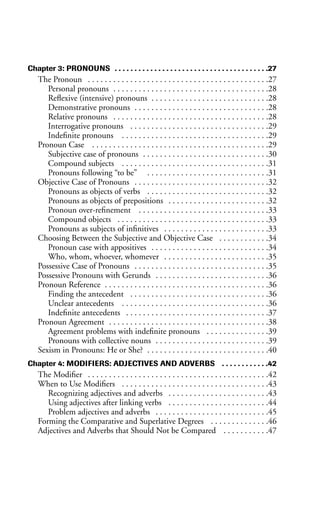
Chapter 3: PRONOUNS . . . . . . . . . . . . . . . . . . . . . . . . . . . . . . . . . . . . . . .27
The Pronoun . . . . . . . . . . . . . . . . . . . . . . . . . . . . . . . . . . . . . . . . . . .27
Personal pronouns . . . . . . . . . . . . . . . . . . . . . . . . . . . . . . . . . . . . .28
Reflexive (intensive) pronouns . . . . . . . . . . . . . . . . . . . . . . . . . . . .28
Demonstrative pronouns . . . . . . . . . . . . . . . . . . . . . . . . . . . . . . . .28
Relative pronouns . . . . . . . . . . . . . . . . . . . . . . . . . . . . . . . . . . . . .28
Interrogative pronouns . . . . . . . . . . . . . . . . . . . . . . . . . . . . . . . . .29
Indefinite pronouns . . . . . . . . . . . . . . . . . . . . . . . . . . . . . . . . . . .29
Pronoun Case . . . . . . . . . . . . . . . . . . . . . . . . . . . . . . . . . . . . . . . . . .29
Subjective case of pronouns . . . . . . . . . . . . . . . . . . . . . . . . . . . . . .30
Compound subjects . . . . . . . . . . . . . . . . . . . . . . . . . . . . . . . . . . .31
Pronouns following “to be” . . . . . . . . . . . . . . . . . . . . . . . . . . . . .31
Objective Case of Pronouns . . . . . . . . . . . . . . . . . . . . . . . . . . . . . . . .32
Pronouns as objects of verbs . . . . . . . . . . . . . . . . . . . . . . . . . . . . .32
Pronouns as objects of prepositions . . . . . . . . . . . . . . . . . . . . . . . .32
Pronoun over-refinement . . . . . . . . . . . . . . . . . . . . . . . . . . . . . . .33
Compound objects . . . . . . . . . . . . . . . . . . . . . . . . . . . . . . . . . . . .33
Pronouns as subjects of infinitives . . . . . . . . . . . . . . . . . . . . . . . . .33
Choosing Between the Subjective and Objective Case . . . . . . . . . . . .34
Pronoun case with appositives . . . . . . . . . . . . . . . . . . . . . . . . . . . .34
Who, whom, whoever, whomever . . . . . . . . . . . . . . . . . . . . . . . . .35
Possessive Case of Pronouns . . . . . . . . . . . . . . . . . . . . . . . . . . . . . . . .35
Possessive Pronouns with Gerunds . . . . . . . . . . . . . . . . . . . . . . . . . . .36
Pronoun Reference . . . . . . . . . . . . . . . . . . . . . . . . . . . . . . . . . . . . . . .36
Finding the antecedent . . . . . . . . . . . . . . . . . . . . . . . . . . . . . . . . .36
Unclear antecedents . . . . . . . . . . . . . . . . . . . . . . . . . . . . . . . . . . .36
Indefinite antecedents . . . . . . . . . . . . . . . . . . . . . . . . . . . . . . . . . .37
Pronoun Agreement . . . . . . . . . . . . . . . . . . . . . . . . . . . . . . . . . . . . . .38
Agreement problems with indefinite pronouns . . . . . . . . . . . . . . .39
Pronouns with collective nouns . . . . . . . . . . . . . . . . . . . . . . . . . . .39
Sexism in Pronouns: He or She? . . . . . . . . . . . . . . . . . . . . . . . . . . . . .40
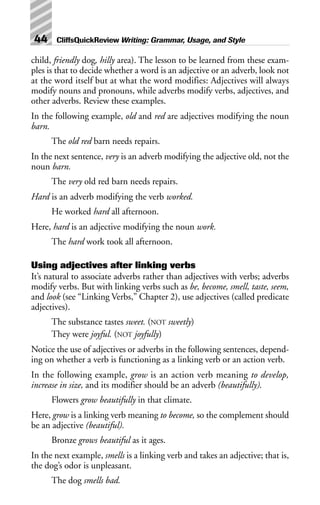
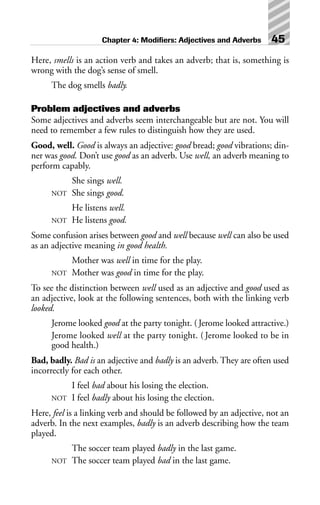
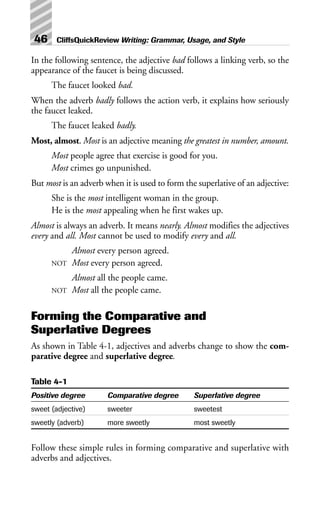
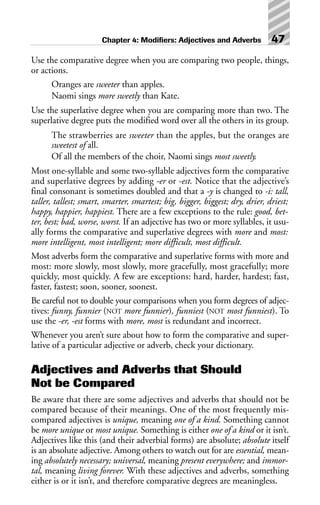
Chapter 4: MODIFIERS: ADJECTIVES AND ADVERBS . . . . . . . . . . . .42
The Modifier . . . . . . . . . . . . . . . . . . . . . . . . . . . . . . . . . . . . . . . . . . .42
When to Use Modifiers . . . . . . . . . . . . . . . . . . . . . . . . . . . . . . . . . . .43
Recognizing adjectives and adverbs . . . . . . . . . . . . . . . . . . . . . . . .43
Using adjectives after linking verbs . . . . . . . . . . . . . . . . . . . . . . . .44
Problem adjectives and adverbs . . . . . . . . . . . . . . . . . . . . . . . . . . .45
Forming the Comparative and Superlative Degrees . . . . . . . . . . . . . .46
Adjectives and Adverbs that Should Not be Compared . . . . . . . . . . .47
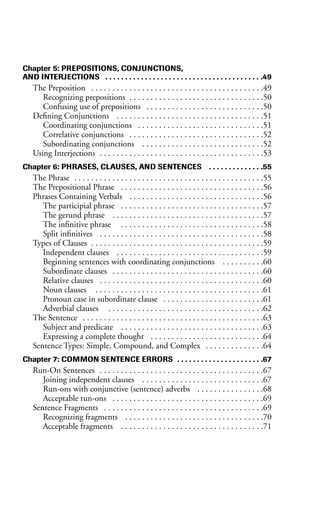
Chapter 5: PREPOSITIONS, CONJUNCTIONS,
AND INTERJECTIONS . . . . . . . . . . . . . . . . . . . . . . . . . . . . . . . . . . . . . . . .49
The Preposition . . . . . . . . . . . . . . . . . . . . . . . . . . . . . . . . . . . . . . . . .49
Recognizing prepositions . . . . . . . . . . . . . . . . . . . . . . . . . . . . . . . .50
Confusing use of prepositions . . . . . . . . . . . . . . . . . . . . . . . . . . . .50
Defining Conjunctions . . . . . . . . . . . . . . . . . . . . . . . . . . . . . . . . . . .51
Coordinating conjunctions . . . . . . . . . . . . . . . . . . . . . . . . . . . . . .51
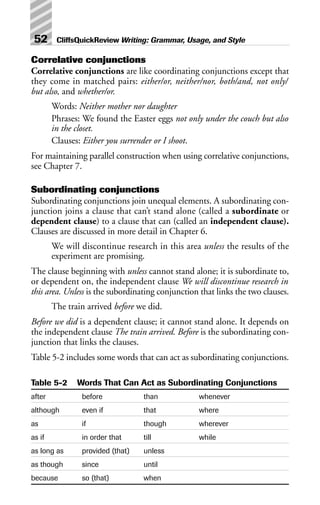
Correlative conjunctions . . . . . . . . . . . . . . . . . . . . . . . . . . . . . . . .52
Subordinating conjunctions . . . . . . . . . . . . . . . . . . . . . . . . . . . . .52
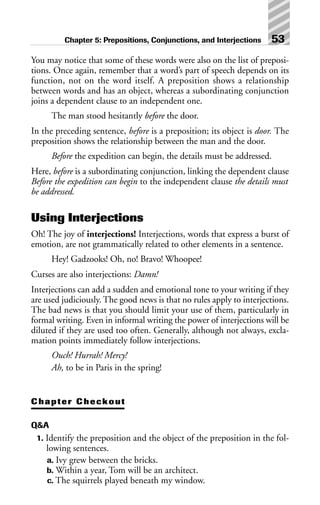
Using Interjections . . . . . . . . . . . . . . . . . . . . . . . . . . . . . . . . . . . . . . .53
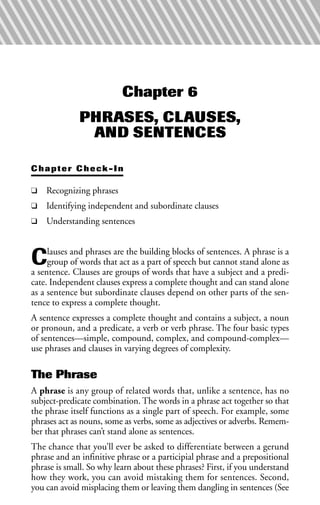
Chapter 6: PHRASES, CLAUSES, AND SENTENCES . . . . . . . . . . . . . .55
The Phrase . . . . . . . . . . . . . . . . . . . . . . . . . . . . . . . . . . . . . . . . . . . . .55
The Prepositional Phrase . . . . . . . . . . . . . . . . . . . . . . . . . . . . . . . . . .56
Phrases Containing Verbals . . . . . . . . . . . . . . . . . . . . . . . . . . . . . . . .56
The participial phrase . . . . . . . . . . . . . . . . . . . . . . . . . . . . . . . . . .57
The gerund phrase . . . . . . . . . . . . . . . . . . . . . . . . . . . . . . . . . . . .57
The infinitive phrase . . . . . . . . . . . . . . . . . . . . . . . . . . . . . . . . . .58
Split infinitives . . . . . . . . . . . . . . . . . . . . . . . . . . . . . . . . . . . . . . .58
Types of Clauses . . . . . . . . . . . . . . . . . . . . . . . . . . . . . . . . . . . . . . . . .59
Independent clauses . . . . . . . . . . . . . . . . . . . . . . . . . . . . . . . . . . .59
Beginning sentences with coordinating conjunctions . . . . . . . . . .60
Subordinate clauses . . . . . . . . . . . . . . . . . . . . . . . . . . . . . . . . . . . .60
Relative clauses . . . . . . . . . . . . . . . . . . . . . . . . . . . . . . . . . . . . . . .60
Noun clauses . . . . . . . . . . . . . . . . . . . . . . . . . . . . . . . . . . . . . . . .61
Pronoun case in subordinate clause . . . . . . . . . . . . . . . . . . . . . . . .61
Adverbial clauses . . . . . . . . . . . . . . . . . . . . . . . . . . . . . . . . . . . . .62
The Sentence . . . . . . . . . . . . . . . . . . . . . . . . . . . . . . . . . . . . . . . . . . .63
Subject and predicate . . . . . . . . . . . . . . . . . . . . . . . . . . . . . . . . . .63
Expressing a complete thought . . . . . . . . . . . . . . . . . . . . . . . . . . .64
Sentence Types: Simple, Compound, and Complex . . . . . . . . . . . . . .64
Chapter 7: COMMON SENTENCE ERRORS . . . . . . . . . . . . . . . . . . . . . .67
Run-On Sentences . . . . . . . . . . . . . . . . . . . . . . . . . . . . . . . . . . . . . . .67
Joining independent clauses . . . . . . . . . . . . . . . . . . . . . . . . . . . . .67
Run-ons with conjunctive (sentence) adverbs . . . . . . . . . . . . . . . .68
Acceptable run-ons . . . . . . . . . . . . . . . . . . . . . . . . . . . . . . . . . . . .69
Sentence Fragments . . . . . . . . . . . . . . . . . . . . . . . . . . . . . . . . . . . . . .69
Recognizing fragments . . . . . . . . . . . . . . . . . . . . . . . . . . . . . . . . .70
Acceptable fragments . . . . . . . . . . . . . . . . . . . . . . . . . . . . . . . . . .71
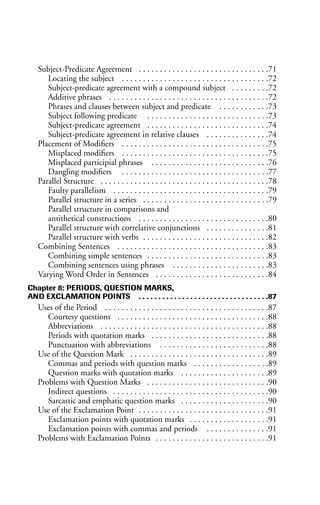
Subject-Predicate Agreement . . . . . . . . . . . . . . . . . . . . . . . . . . . . . . .71
Locating the subject . . . . . . . . . . . . . . . . . . . . . . . . . . . . . . . . . . .72
Subject-predicate agreement with a compound subject . . . . . . . . .72
Additive phrases . . . . . . . . . . . . . . . . . . . . . . . . . . . . . . . . . . . . . .72
Phrases and clauses between subject and predicate . . . . . . . . . . . .73
Subject following predicate . . . . . . . . . . . . . . . . . . . . . . . . . . . . .73
Subject-predicate agreement . . . . . . . . . . . . . . . . . . . . . . . . . . . . .74
Subject-predicate agreement in relative clauses . . . . . . . . . . . . . . .74
Placement of Modifiers . . . . . . . . . . . . . . . . . . . . . . . . . . . . . . . . . . .75
Misplaced modifiers . . . . . . . . . . . . . . . . . . . . . . . . . . . . . . . . . . .75
Misplaced participial phrases . . . . . . . . . . . . . . . . . . . . . . . . . . . .76
Dangling modifiers . . . . . . . . . . . . . . . . . . . . . . . . . . . . . . . . . . .77
Parallel Structure . . . . . . . . . . . . . . . . . . . . . . . . . . . . . . . . . . . . . . . .78
Faulty parallelism . . . . . . . . . . . . . . . . . . . . . . . . . . . . . . . . . . . . .79
Parallel structure in a series . . . . . . . . . . . . . . . . . . . . . . . . . . . . . .79
Parallel structure in comparisons and
antithetical constructions . . . . . . . . . . . . . . . . . . . . . . . . . . . . . . .80
Parallel structure with correlative conjunctions . . . . . . . . . . . . . . .81
Parallel structure with verbs . . . . . . . . . . . . . . . . . . . . . . . . . . . . . .82
Combining Sentences . . . . . . . . . . . . . . . . . . . . . . . . . . . . . . . . . . . .83
Combining simple sentences . . . . . . . . . . . . . . . . . . . . . . . . . . . . .83
Combining sentences using phrases . . . . . . . . . . . . . . . . . . . . . . .83
Varying Word Order in Sentences . . . . . . . . . . . . . . . . . . . . . . . . . . .84
Chapter 8: PERIODS, QUESTION MARKS,
AND EXCLAMATION POINTS . . . . . . . . . . . . . . . . . . . . . . . . . . . . . . . . .87
Uses of the Period . . . . . . . . . . . . . . . . . . . . . . . . . . . . . . . . . . . . . . .87
Courtesy questions . . . . . . . . . . . . . . . . . . . . . . . . . . . . . . . . . . . .88
Abbreviations . . . . . . . . . . . . . . . . . . . . . . . . . . . . . . . . . . . . . . . .88
Periods with quotation marks . . . . . . . . . . . . . . . . . . . . . . . . . . . .88
Punctuation with abbreviations . . . . . . . . . . . . . . . . . . . . . . . . . .88
Use of the Question Mark . . . . . . . . . . . . . . . . . . . . . . . . . . . . . . . . .89
Commas and periods with question marks . . . . . . . . . . . . . . . . . .89
Question marks with quotation marks . . . . . . . . . . . . . . . . . . . . .89
Problems with Question Marks . . . . . . . . . . . . . . . . . . . . . . . . . . . . .90
Indirect questions . . . . . . . . . . . . . . . . . . . . . . . . . . . . . . . . . . . . .90
Sarcastic and emphatic question marks . . . . . . . . . . . . . . . . . . . . .90
Use of the Exclamation Point . . . . . . . . . . . . . . . . . . . . . . . . . . . . . . .91
Exclamation points with quotation marks . . . . . . . . . . . . . . . . . . .91
Exclamation points with commas and periods . . . . . . . . . . . . . . .91
Problems with Exclamation Points . . . . . . . . . . . . . . . . . . . . . . . . . . .91
Chapter 9: COMMAS, SEMICOLONS, AND COLONS . . . . . . . . . . . . .93
Uses of the Comma . . . . . . . . . . . . . . . . . . . . . . . . . . . . . . . . . . . . . .93
Joining independent clauses . . . . . . . . . . . . . . . . . . . . . . . . . . . . .94
After Introductory clauses . . . . . . . . . . . . . . . . . . . . . . . . . . . . . . .95
After introductory phrases . . . . . . . . . . . . . . . . . . . . . . . . . . . . . .95
To set off interrupting elements . . . . . . . . . . . . . . . . . . . . . . . . . .96
With restrictive and nonrestrictive elements . . . . . . . . . . . . . . . . .97
With appositives . . . . . . . . . . . . . . . . . . . . . . . . . . . . . . . . . . . . . .98
Between items in a series . . . . . . . . . . . . . . . . . . . . . . . . . . . . . . . .99
Between modifiers in a series . . . . . . . . . . . . . . . . . . . . . . . . . . . .100
Commas with quotation marks . . . . . . . . . . . . . . . . . . . . . . . . . .101
Miscellaneous uses of the comma . . . . . . . . . . . . . . . . . . . . . . . .101
Problems with Commas . . . . . . . . . . . . . . . . . . . . . . . . . . . . . . . . . .102
Uses of the Semicolon . . . . . . . . . . . . . . . . . . . . . . . . . . . . . . . . . . .102
Joining independent clauses . . . . . . . . . . . . . . . . . . . . . . . . . . . .102
Between items in a series . . . . . . . . . . . . . . . . . . . . . . . . . . . . . . .103
Semicolons with quotation marks . . . . . . . . . . . . . . . . . . . . . . . .104
Problems with semicolons . . . . . . . . . . . . . . . . . . . . . . . . . . . . . .104
Uses of the Colon . . . . . . . . . . . . . . . . . . . . . . . . . . . . . . . . . . . . . .104
Introducing a quotation or formal statement . . . . . . . . . . . . . . . .105
Introducing a restatement or explanation . . . . . . . . . . . . . . . . . .105
Colons with quotation marks . . . . . . . . . . . . . . . . . . . . . . . . . . .106
Miscellaneous uses of the colon . . . . . . . . . . . . . . . . . . . . . . . . . .106
Problems with Colons . . . . . . . . . . . . . . . . . . . . . . . . . . . . . . . . . . .106
Chapter 10: DASHES, PARENTHESES,
AND QUOTATION MARKS . . . . . . . . . . . . . . . . . . . . . . . . . . . . . . . . . . .108
Uses of the Dash . . . . . . . . . . . . . . . . . . . . . . . . . . . . . . . . . . . . . . .108
Interrupting a sentence . . . . . . . . . . . . . . . . . . . . . . . . . . . . . . . .108
Introducing a restatement or explanation . . . . . . . . . . . . . . . . . .109
Dashes with commas . . . . . . . . . . . . . . . . . . . . . . . . . . . . . . . . . .109
Dashes with quotation marks . . . . . . . . . . . . . . . . . . . . . . . . . . .109
Problems with Dashes . . . . . . . . . . . . . . . . . . . . . . . . . . . . . . . . . . .109
Uses of Parentheses . . . . . . . . . . . . . . . . . . . . . . . . . . . . . . . . . . . . .110
Setting off incidental information . . . . . . . . . . . . . . . . . . . . . . . .110
Other punctuation marks with parentheses . . . . . . . . . . . . . . . . .110
Punctuation within parentheses . . . . . . . . . . . . . . . . . . . . . . . . . .111
Miscellaneous uses of parentheses . . . . . . . . . . . . . . . . . . . . . . . .111
When to use brackets . . . . . . . . . . . . . . . . . . . . . . . . . . . . . . . . .111
Problems with Parentheses . . . . . . . . . . . . . . . . . . . . . . . . . . . . . . . .112
Uses of Quotation Marks . . . . . . . . . . . . . . . . . . . . . . . . . . . . . . . . .112
Direct quotations . . . . . . . . . . . . . . . . . . . . . . . . . . . . . . . . . . . .112
Quotations within quotations . . . . . . . . . . . . . . . . . . . . . . . . . . .112
Miscellaneous uses of quotation marks . . . . . . . . . . . . . . . . . . . .113
A summary of the rules . . . . . . . . . . . . . . . . . . . . . . . . . . . . . . .113
Using an ellipsis . . . . . . . . . . . . . . . . . . . . . . . . . . . . . . . . . . . . .114
Problems with Quotation Marks . . . . . . . . . . . . . . . . . . . . . . . . . . .114
Chapter 11: IDIOMS, CLICHÉS, JARGON,
AND FADDISH LANGUAGE . . . . . . . . . . . . . . . . . . . . . . . . . . . . . . . . . .116
The Idiom . . . . . . . . . . . . . . . . . . . . . . . . . . . . . . . . . . . . . . . . . . .116
Figurative idioms . . . . . . . . . . . . . . . . . . . . . . . . . . . . . . . . . . . .117
Prepositional idioms . . . . . . . . . . . . . . . . . . . . . . . . . . . . . . . . . .117
Selected list of prepositional idioms . . . . . . . . . . . . . . . . . . . . . .117
The Cliché . . . . . . . . . . . . . . . . . . . . . . . . . . . . . . . . . . . . . . . . . . .120
Mixing clichés . . . . . . . . . . . . . . . . . . . . . . . . . . . . . . . . . . . . . . .121
Avoiding clichés . . . . . . . . . . . . . . . . . . . . . . . . . . . . . . . . . . . . .121
Using clichés in new ways . . . . . . . . . . . . . . . . . . . . . . . . . . . . . .121
Jargon . . . . . . . . . . . . . . . . . . . . . . . . . . . . . . . . . . . . . . . . . . . . . . .122
Negative connotations of jargon . . . . . . . . . . . . . . . . . . . . . . . . .122
Avoiding jargon . . . . . . . . . . . . . . . . . . . . . . . . . . . . . . . . . . . . . .122
Faddish Words . . . . . . . . . . . . . . . . . . . . . . . . . . . . . . . . . . . . . . . . .122
Slang . . . . . . . . . . . . . . . . . . . . . . . . . . . . . . . . . . . . . . . . . . . . . . . .123
The Euphemism . . . . . . . . . . . . . . . . . . . . . . . . . . . . . . . . . . . . . . .123
Avoiding euphemisms . . . . . . . . . . . . . . . . . . . . . . . . . . . . . . . . .124
Selected list of euphemisms . . . . . . . . . . . . . . . . . . . . . . . . . . . . .124
Chapter 12: COMPOUND WORDS AND WORDINESS . . . . . . . . . . .127
Spelling of Compound Words . . . . . . . . . . . . . . . . . . . . . . . . . . . . .127
Current trend in spelling compound words . . . . . . . . . . . . . . . . .128
Compound adjectives . . . . . . . . . . . . . . . . . . . . . . . . . . . . . . . . .128
Compound adverbs . . . . . . . . . . . . . . . . . . . . . . . . . . . . . . . . . . .128
Words with Prefixes and Suffixes . . . . . . . . . . . . . . . . . . . . . . . . . . .128
Wordy Expressions . . . . . . . . . . . . . . . . . . . . . . . . . . . . . . . . . . . . . .129
Redundant expressions . . . . . . . . . . . . . . . . . . . . . . . . . . . . . . . .129
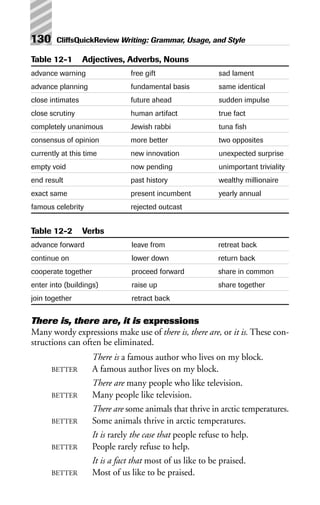
Selected list of redundant expressions . . . . . . . . . . . . . . . . . . . . .129
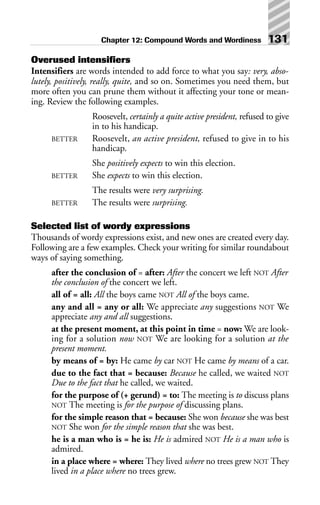
There is, there are, it is expressions . . . . . . . . . . . . . . . . . . . . . . . .130
Overused intensifiers . . . . . . . . . . . . . . . . . . . . . . . . . . . . . . . . . .131
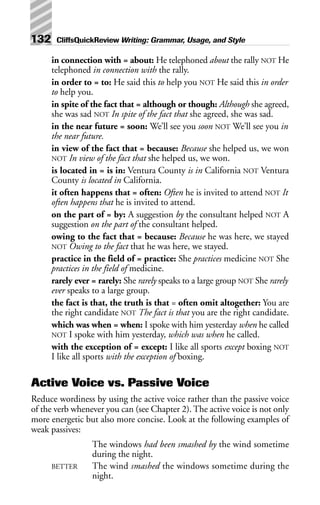
Selected list of wordy expressions . . . . . . . . . . . . . . . . . . . . . . . .131
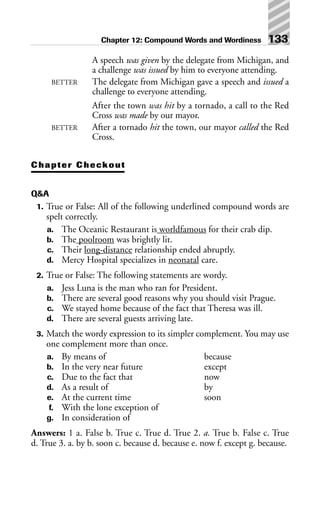
Active Voice vs. Passive Voice . . . . . . . . . . . . . . . . . . . . . . . . . . . . . .132
Chapter 13: PREWRITING: HOW TO BEGIN
A WRITING ASSIGNMENT . . . . . . . . . . . . . . . . . . . . . . . . . . . . . . . . . . .134
The Steps in Writing . . . . . . . . . . . . . . . . . . . . . . . . . . . . . . . . . . . .134
Types of Writing . . . . . . . . . . . . . . . . . . . . . . . . . . . . . . . . . . . . . . .135
Understanding Your Assignment . . . . . . . . . . . . . . . . . . . . . . . . . . .136
Understanding Your Audience . . . . . . . . . . . . . . . . . . . . . . . . . . . . .136
Guidelines for Choosing a Topic . . . . . . . . . . . . . . . . . . . . . . . . . . .138
Topic vs. thesis . . . . . . . . . . . . . . . . . . . . . . . . . . . . . . . . . . . . . .139
Writing a thesis statement . . . . . . . . . . . . . . . . . . . . . . . . . . . . . .139
Avoiding fallacies . . . . . . . . . . . . . . . . . . . . . . . . . . . . . . . . . . . .140
The Main Idea in Narratives and Personal Essays . . . . . . . . . . . . . . .141
Chapter 14: PREWRITING: HOW TO RESEARCH
AND ORGANIZE . . . . . . . . . . . . . . . . . . . . . . . . . . . . . . . . . . . . . . . . . . . .143
Finding Examples and Evidence . . . . . . . . . . . . . . . . . . . . . . . . . . . .143
Brainstorming, taking notes, and outlining . . . . . . . . . . . . . . . . .144
Using the computer for research . . . . . . . . . . . . . . . . . . . . . . . . .144
The Importance of Specific Details . . . . . . . . . . . . . . . . . . . . . . . . .145
Plagiarism . . . . . . . . . . . . . . . . . . . . . . . . . . . . . . . . . . . . . . . . . .145
Quoting and paraphrasing . . . . . . . . . . . . . . . . . . . . . . . . . . . . .145
The Writing Assignment . . . . . . . . . . . . . . . . . . . . . . . . . . . . . . . . .146
The research paper . . . . . . . . . . . . . . . . . . . . . . . . . . . . . . . . . . .147
Essays arguing a position from a single text . . . . . . . . . . . . . . . . .147
Essays analyzing a literary work . . . . . . . . . . . . . . . . . . . . . . . . . .147
Narrative, descriptive, and autobiographical essays . . . . . . . . . . .148
Chapter 15: WRITING . . . . . . . . . . . . . . . . . . . . . . . . . . . . . . . . . . . . . . .150
Working from a Thesis Statement . . . . . . . . . . . . . . . . . . . . . . . . . .150
Spatial or chronological organization . . . . . . . . . . . . . . . . . . . . . .151
Dividing a subject into categories . . . . . . . . . . . . . . . . . . . . . . . .152
Organizing essays of comparison . . . . . . . . . . . . . . . . . . . . . . . . .153
Inductive or deductive patterns of organization . . . . . . . . . . . . . .154
Order of examples and evidence . . . . . . . . . . . . . . . . . . . . . . . . .154
Connecting paragraphs in an essay . . . . . . . . . . . . . . . . . . . . . . .155
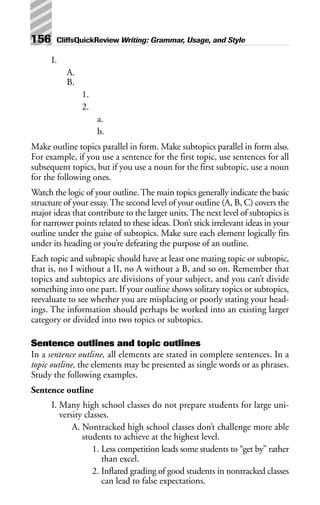
Outlining . . . . . . . . . . . . . . . . . . . . . . . . . . . . . . . . . . . . . . . . . . . . .155
Informal outlines . . . . . . . . . . . . . . . . . . . . . . . . . . . . . . . . . . . . .155
Formal outlines . . . . . . . . . . . . . . . . . . . . . . . . . . . . . . . . . . . . . .155
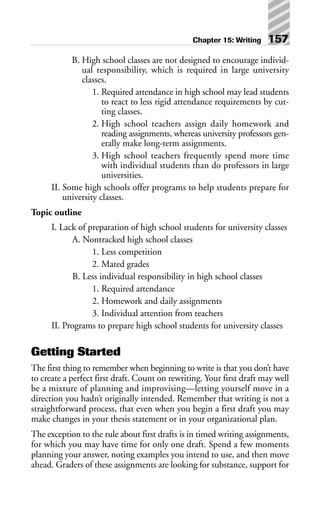
Sentence outlines and topic outlines . . . . . . . . . . . . . . . . . . . . . .156
Getting Started . . . . . . . . . . . . . . . . . . . . . . . . . . . . . . . . . . . . . . . .157
Introductions . . . . . . . . . . . . . . . . . . . . . . . . . . . . . . . . . . . . . . . . . .158
What to avoid in introductions . . . . . . . . . . . . . . . . . . . . . . . . . .158
Suggestions for introductions . . . . . . . . . . . . . . . . . . . . . . . . . . .159
The Paragraph . . . . . . . . . . . . . . . . . . . . . . . . . . . . . . . . . . . . . . . . .161
Paragraph length . . . . . . . . . . . . . . . . . . . . . . . . . . . . . . . . . . . . .161
Paragraph unity . . . . . . . . . . . . . . . . . . . . . . . . . . . . . . . . . . . . . .162
Paragraph coherence . . . . . . . . . . . . . . . . . . . . . . . . . . . . . . . . . .163
Connecting sentences through ideas . . . . . . . . . . . . . . . . . . . . . .163
Connecting with words and phrases . . . . . . . . . . . . . . . . . . . . . .164
Conclusions . . . . . . . . . . . . . . . . . . . . . . . . . . . . . . . . . . . . . . . . . . .166
What to avoid . . . . . . . . . . . . . . . . . . . . . . . . . . . . . . . . . . . . . . .166
Suggestions for conclusions . . . . . . . . . . . . . . . . . . . . . . . . . . . . .167
Chapter 16: REVISING AND EDITING . . . . . . . . . . . . . . . . . . . . . . . . . .169
Titles . . . . . . . . . . . . . . . . . . . . . . . . . . . . . . . . . . . . . . . . . . . . . . . . .169
Reviewing the First Draft . . . . . . . . . . . . . . . . . . . . . . . . . . . . . . . . .170
Preparing the Final Draft . . . . . . . . . . . . . . . . . . . . . . . . . . . . . . . . .171
Writing and editing a draft . . . . . . . . . . . . . . . . . . . . . . . . . . . . . .171
Spell-checking, grammer-checking, and
search-and-replace functions . . . . . . . . . . . . . . . . . . . . . . . . . . . .172
Layout of the final draft . . . . . . . . . . . . . . . . . . . . . . . . . . . . . . . .172
Checklist . . . . . . . . . . . . . . . . . . . . . . . . . . . . . . . . . . . . . . . . . . . . . .173
Purpose, audience, and tone . . . . . . . . . . . . . . . . . . . . . . . . . . . . .173
Examples, evidence, and details . . . . . . . . . . . . . . . . . . . . . . . . . .173
Structure . . . . . . . . . . . . . . . . . . . . . . . . . . . . . . . . . . . . . . . . . . .174
Language and style . . . . . . . . . . . . . . . . . . . . . . . . . . . . . . . . . . . .174
Sentence construction . . . . . . . . . . . . . . . . . . . . . . . . . . . . . . . . .174
Grammer . . . . . . . . . . . . . . . . . . . . . . . . . . . . . . . . . . . . . . . . . . .175
CQR Review . . . . . . . . . . . . . . . . . . . . . . . . . . . . . . . . . . . . . . . . . . . . . . .177
CQR Resource Center . . . . . . . . . . . . . . . . . . . . . . . . . . . . . . . . . . . . . . .183
GLOSSARY . . . . . . . . . . . . . . . . . . . . . . . . . . . . . . . . . . . . . . . . . . . . . . . .185
Appendix: FREQUENTLY CONFUSED WORDS . . . . . . . . . . . . . . . . . .192
INDEX . . . . . . . . . . . . . . . . . . . . . . . . . . . . . . . . . . . . . . . . . . . . . . . . . . . . .207
Chapter 1
NOUNS
Chapter Check-In
❑ Identifying proper nouns and gerunds
❑ Using collective nouns to identify groups
❑ Understanding singular and plural nouns
❑ Using possessive nouns to show ownership
❑ Making nouns and verbs agree
Anoun is a part of speech that names a person, place, or thing. Many
different kinds of nouns are used in the English language. Some are
specific for people, places, or events, and some represent groups or collec-
tions. Some nouns aren’t even nouns; they’re verbs acting like nouns in
sentences.
Nouns can be singular, referring to one thing, or plural, referring to more
than one thing. Nouns can be possessive as well; possessive nouns indicate
ownership or a close relationship. Regardless of the type, nouns should
always agree with their verbs in sentences; use singular verbs with singu-
lar nouns and plural verbs with plural nouns. You have to know how a
noun works in order to write an effective sentence.
Proper Nouns
If a noun names a specific person or place, or a particular event or group,
it is called a proper noun and is always capitalized. Some examples are
Eleanor Roosevelt, Niagara Falls, Dracula, the Federal Bureau of Investiga-
tion, the Great Depression, and Desert Storm. This seems simple enough.
Unfortunately, some writers assign proper-noun status fairly indiscrimi-
nately to other words, sprinkling capital letters freely throughout their
prose. For example, the Manhattan Project is appropriately capitalized
because it is a historic project, the name given to the specific wartime effort
to design and build the first nuclear weapons. But project should not be cap-
italized when referring to a club’s project to clean up the campus. Similarly,
the Great Depression should be capitalized because it refers to the specific his-
torical period of economic failure that began with the stock market collapse
in 1929. When the word depression refers to other economic hard times,
however, it is not a proper noun but a common noun and should not be
capitalized. Some flexibility in capitalizing nouns is acceptable. A writer may
have a valid reason for capitalizing a particular term, for example, and some
companies use style guides that dictate capital letters for job titles such as
manager. But often the use of a capital outside the basic rule is an effort to
give a word an air of importance, and you should avoid it.
Verbs Used as Nouns
One special case is when a verb is used as a noun. Here the verb form is
altered and it serves the same function as a noun in the sentence. This type
of noun is called a gerund.
The gerund
A noun created from the -ing form of a verb is called a gerund. Like other
nouns, gerunds act as subjects and objects in sentences.
Sleeping sometimes serves as an escape from studying.
The gerunds sleeping and studying are -ing forms of the verbs sleep and study.
Sleeping is the noun functioning as the subject of this sentence, and study-
ing is an object (in this case, the object of a preposition—see Chapter 5).
The problem gerund
Gerunds can sometimes be difficult to use properly in a sentence. What
problems will you have with gerunds?
■ When a noun or pronoun precedes a gerund, use the possessive case
of the noun or pronoun. (For the possessive case of the pronoun, see
Chapter 3).
Jane’s sleeping was sometimes an escape from studying.
■ Even when you think that the word before the gerund looks like an
object, use the possessive case.
Jane was annoyed by Bill’s studying.
NOT Jane was annoyed by Bill studying.
4 CliffsQuickReview Writing: Grammar, Usage, and Style
Collective Nouns
A word that stands for a group of things is called a collective noun. In
fact, the word group itself is a collective noun. Here are a few others: club,
team, committee, furniture, jury, Congress, swarm, herd.
Usually these nouns are treated as singular, since the emphasis is on a unit
rather than its parts.
The team is going on the bus.
The committee wants to find a solution to the problem.
But when you want to emphasize the individual parts of a group, you may
treat a collective noun as plural.
The team have argued about going on the bus.
The committee want different solutions to the problem.
If the plural sounds awkward, try rewriting.
The team members have argued about going on the bus.
Committee members disagree about solutions to the problem.
Singular and Plural Nouns
The term number refers to whether a noun is singular or plural. Most
nouns can be either, depending on whether you are talking about one thing
(dog) or more than one (dogs). You know the basic rule of adding -s to make
the plural of a noun, and you also know that many nouns don’t follow that
rule—for example, sheep (singular), sheep (plural); enemy, enemies; wharf,
wharves, hero, heroes, goose, geese, and so on. You should check your dictio-
nary if you’re not sure about a plural. Do not add -’s to a singular form to
make it plural, even if the noun you are using is a family name: the Taylors,
not the Taylor’s; donkeys, not donkey’s; taxis, not taxi’s.
The singular and plural forms of some nouns with Latin and Greek end-
ings can cause trouble. The noun data, for example, is actually a plural;
datum is the singular.
The final datum is not consistent with the preceding data, which are
positive.
Although today the plural data is widely treated as singular, keep the dis-
tinction, particularly in scientific writing.
Here are some other examples of Latin and Greek singular and plural words:
bacterium, bacteria, criterion, criteria, medium, media; alumnus (masculine
Chapter 1: Nouns 5
singular)/alumni (masculine plural), alumna (feminine singular)/alumnae
(feminine plural). If you are writing about television, use medium. If you
are writing about radio, television, and the press, use media.
Possessive Case of Nouns
The possessive case of a noun is used to show ownership (Allan’s car, my
sister’s house) or another close relationship (the chairman’s friends, the cup’s
handle, the university’s position).
Problems with possessives
What causes problems with possessive nouns is uncertainty: Do I add an -’s
or just an apostrophe? Follow this rule: for singular nouns, add ’s, even if
the noun ends in an -s or -z sound: dog’s, house’s, Wes’s, Keats’s. But make an
exception when an added -s would lead to three closely bunched s or z
sounds (Jesus’, Ulysses’) or in names of more than one syllable with an unac-
cented ending pronounced -eez (Empedocles’, Socrates’, Euripides’). Greek
names often fall into this category.
For most plural possessive nouns, add an apostrophe alone: several months’
bills, many Rumanians’ apartments, the encyclopedias’ differences, the Rolling
Stones’ travel plans. If a plural noun doesn’t end in -s, add -’s, just as you
would with a singular noun: women’s issues, mice’s tails.
Switching to an of construction
When a possessive noun sounds awkward, use an of construction instead.
This is a safe and often preferable way to indicate the relationship: the top
of the page instead of the page’s top; the lawn of the building on the corner
instead of the building on the comer’s lawn, the main characters of Pride and
Prejudice instead of Pride and Prejudice’s main characters; the novels of Dick-
ens instead of Dickens’s novels.
Joint ownership
One last word about possessive nouns: When you are indicating joint own-
ership, give the possessive form to the final name only, such as Abbott and
Costello’s movies; Tom and Dawn’s dinner party; Smith, Wilson, and Nelson’s
partnership.
6 CliffsQuickReview Writing: Grammar, Usage, and Style
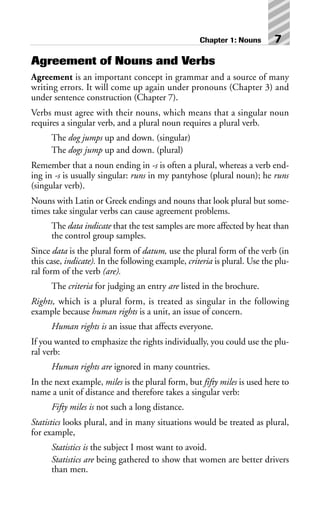
Agreement of Nouns and Verbs
Agreement is an important concept in grammar and a source of many
writing errors. It will come up again under pronouns (Chapter 3) and
under sentence construction (Chapter 7).
Verbs must agree with their nouns, which means that a singular noun
requires a singular verb, and a plural noun requires a plural verb.
The dog jumps up and down. (singular)
The dogs jump up and down. (plural)
Remember that a noun ending in -s is often a plural, whereas a verb end-
ing in -s is usually singular: runs in my pantyhose (plural noun); he runs
(singular verb).
Nouns with Latin or Greek endings and nouns that look plural but some-
times take singular verbs can cause agreement problems.
The data indicate that the test samples are more affected by heat than
the control group samples.
Since data is the plural form of datum, use the plural form of the verb (in
this case, indicate). In the following example, criteria is plural. Use the plu-
ral form of the verb (are).
The criteria for judging an entry are listed in the brochure.
Rights, which is a plural form, is treated as singular in the following
example because human rights is a unit, an issue of concern.
Human rights is an issue that affects everyone.
If you wanted to emphasize the rights individually, you could use the plu-
ral verb:
Human rights are ignored in many countries.
In the next example, miles is the plural form, but fifty miles is used here to
name a unit of distance and therefore takes a singular verb:
Fifty miles is not such a long distance.
Statistics looks plural, and in many situations would be treated as plural,
for example,
Statistics is the subject I most want to avoid.
Statistics are being gathered to show that women are better drivers
than men.
Chapter 1: Nouns 7
In the first example, statistics refers to a subject of study, so the singular is
appropriate.
Among other frequently used nouns that can take either a singular or
plural verb, depending on whether the emphasis is on a single unit or
individual items, are number, majority, and minority.
The number of people coming is surprising.
A number of people are coming.
A number like five thousand is what he had in mind.
With number, use this rule. If it is preceded by the, always use the singu-
lar. If it is preceded by a, use the singular or plural, depending on whether
you are thinking of a single unit or individual items.
With majority and minority, the key is to decide whether you want to
emphasize individual people or things or whether you want to emphasize
the single unit.
The majority is opposed to the measure. (singular = single unit)
A minority of the younger people refuse to concede the point.
(plural = individuals)
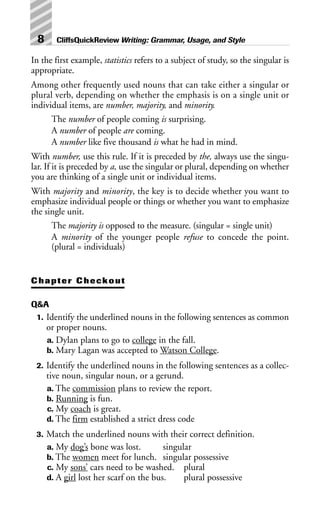
Chapter Checkout
Q&A
1. Identify the underlined nouns in the following sentences as common
or proper nouns.
a. Dylan plans to go to college in the fall.
b. Mary Lagan was accepted to Watson College.
2. Identify the underlined nouns in the following sentences as a collec-
tive noun, singular noun, or a gerund.
a. The commission plans to review the report.
b. Running is fun.
c. My coach is great.
d. The firm established a strict dress code
3. Match the underlined nouns with their correct definition.
a. My dog’s bone was lost. singular
b. The women meet for lunch. singular possessive
c. My sons’ cars need to be washed. plural
d. A girl lost her scarf on the bus. plural possessive
8 CliffsQuickReview Writing: Grammar, Usage, and Style
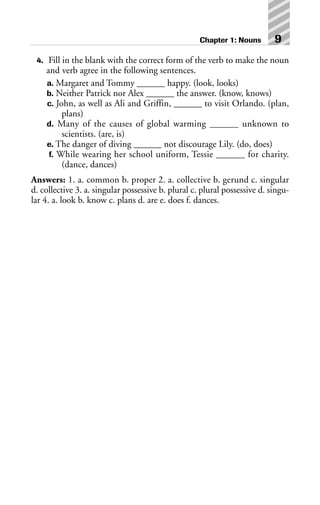
4. Fill in the blank with the correct form of the verb to make the noun
and verb agree in the following sentences.
a. Margaret and Tommy ______ happy. (look, looks)
b. Neither Patrick nor Alex ______ the answer. (know, knows)
c. John, as well as Ali and Griffin, ______ to visit Orlando. (plan,
plans)
d. Many of the causes of global warming ______ unknown to
scientists. (are, is)
e. The danger of diving ______ not discourage Lily. (do, does)
f. While wearing her school uniform, Tessie ______ for charity.
(dance, dances)
Answers: 1. a. common b. proper 2. a. collective b. gerund c. singular
d. collective 3. a. singular possessive b. plural c. plural possessive d. singu-
lar 4. a. look b. know c. plans d. are e. does f. dances.
Chapter 1: Nouns 9
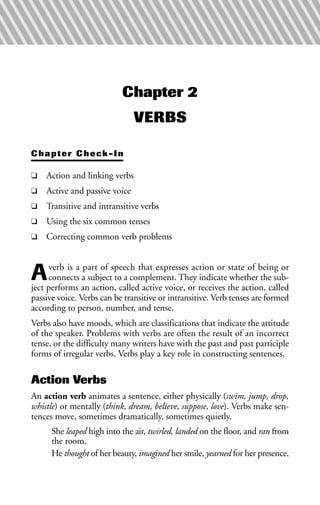
Chapter 2
VERBS
Chapter Check-In
❑ Action and linking verbs
❑ Active and passive voice
❑ Transitive and intransitive verbs
❑ Using the six common tenses
❑ Correcting common verb problems
Averb is a part of speech that expresses action or state of being or
connects a subject to a complement. They indicate whether the sub-
ject performs an action, called active voice, or receives the action, called
passive voice. Verbs can be transitive or intransitive. Verb tenses are formed
according to person, number, and tense.
Verbs also have moods, which are classifications that indicate the attitude
of the speaker. Problems with verbs are often the result of an incorrect
tense, or the difficulty many writers have with the past and past participle
forms of irregular verbs. Verbs play a key role in constructing sentences.
Action Verbs
An action verb animates a sentence, either physically (swim, jump, drop,
whistle) or mentally (think, dream, believe, suppose, love). Verbs make sen-
tences move, sometimes dramatically, sometimes quietly.
She leaped high into the air, twirled, landed on the floor, and ran from
the room.
He thought of her beauty, imagined her smile, yearned for her presence.
Linking Verbs
Some verbs don’t express action but help complete statements about the
subject by describing or identifying it. These verbs are called linking verbs.
Diane is happy.
Clement feels hot.
Maria is a doctor.
The music sounds good.
The sentences don’t tell you what Diane, Clement, Maria, and the music
did but rather what they are. Linking verbs “link” their subjects to a clas-
sification, state of being, or quality. In the sentences above, happy, hot, doc-
tor, and good are called complements of the linking verbs (see Chapter 3).
Table 2-1 lists common linking verbs.
Table 2-1 Common Linking Verbs
appear grow smell
be look sound
become remain taste
feel seem
Some of these verbs can be both linking and action verbs.
Clement felt hot. (linking verb)
Clement felt along the wall for the light switch. (action verb)
The dog smelled bad. (linking verb)
The dog smelled the man’s boots. (action verb)
A quick way to tell whether a verb is functioning as a linking verb is to see
whether you can replace it with a form of the verb to be and still have a
reasonable sentence. For example, test the two sentences above by replac-
ing smelled with was.
The dog was bad. (yes)
The dog was the man’s boots. (no)
Linking verbs operate differently than action verbs. First, while action verbs
are modified by adverbs, linking verbs are followed by adjectives.
This cheese smells strong.
NOT This cheese smells strongly.
Chapter 2: Verbs 11
This rule is discussed in Chapter 4.
Also, a pronoun following the linking verb to be should be in the subjec-
tive case rather than the objective case.
It was she.
NOT It was her.
This rule is discussed in Chapter 3.
Active and Passive Voice
The term voice refers to the form of a verb indicating whether the subject
performs an action (active voice) or receives the action (passive voice).
Mary smashed the ball over the net. (active voice)
The ball was smashed over the net by Mary. (passive voice)
Use the active voice whenever you can; it conveys more energy than the
passive voice and also results in more concise writing. (See Chapter 13.)
Use the passive voice, however, when you don’t know the actor, when you
don’t want to name the actor, or when you want to emphasize the person
or thing acted upon rather than the actor. The passive voice is often appro-
priate in scientific writing.
When we returned, the car had been towed.
I regret that a mistake was made.
Gold was discovered there early in the last century.
His mother was rushed to the hospital by the police.
A change in structure was found in the experimental group.
Transitive and Intransitive Verbs
A transitive verb, used with a direct object, transmits action to an object
and may also have an indirect object, which indicates to or for whom the
action is done. In contrast, an intransitive verb never takes an object.
Transitive verbs
A transitive verb takes a direct object; that is, the verb transmits action
to an object.
He sent the letter. (letter = direct object of sent)
She gave the lecture. (lecture = direct object of gave)
12 CliffsQuickReview Writing: Grammar, Usage, and Style
In these sentences, something is being done to an object.
A transitive verb can also have an indirect object that precedes the direct
object. The indirect object tells to or for whom the action is done, although
the words to and for are not used. In the following examples, notice the
difference between the direct and indirect objects.
The direct object (letter) receives the action (sent). The indirect object
(Robert) is the person to whom the letter is sent.
He sent Robert the letter.
The direct object (lecture) receives the action (gave). The indirect object
(class) is the group to whom the lecture is given.
She gave her class the lecture.
Learn to recognize words that are direct and indirect objects of verbs. When
these words are pronouns, they must be in the objective case. See Chap-
ter 3 for an explanation of pronoun cases.
Intransitive verbs
An intransitive verb does not take an object.
She sleeps too much.
He complains frequently.
In these sentences, nothing receives the action of the verbs sleep and
complain.
Many verbs can be either transitive or intransitive.
She sings every day. (no object = intransitive)
She sings spirituals. (spirituals receives the action of sings = transitive)
Verbals: Gerunds, Infinitives,
and Participles
In one sense, the three verbals—gerunds, infinitives, and participles—
should not be covered in this section on verbs. Although formed from
verbs, verbals are never used alone as the action words in sentences; instead,
they function as nouns, adjectives, or adverbs. These verbals are important
in phrases (discussed in Chapter 6).
Chapter 2: Verbs 13
■ The gerund (see Chapter 1) ends in -ing and functions as a noun.
Jumping is fun.
He liked skiing.
■ The infinitive is the base form of a verb with to. Usually it also func-
tions as a noun, although it can be an adjective or adverb.
To jump is fun. (noun; subject of is)
I like to ski. (noun; object of like)
She had a suggestion to offer.(adjective modifying suggestion)
He called to warn her. (adverb modifying called )
■ A participle is a verb that ends in -ing (present participle) or -ed, -d,
-t, -en, -n (past participle). Participles may function as adjectives,
describing or modifying nouns.
The dancing bear entertained the crowd.
The beaten man hobbled into the woods.
■ But participles have another function. Used with helping verbs such
as to be and to have, they form several verb tenses.
She is thinking of the children.
The boat had been cleaned before they arrived.
Forming Verb Tenses
To write correctly, you need to know both how to form verb tenses and
when to use them. Verb tenses are formed according to person, number,
and tense. They are the key to coherent sentence structure.
Tense, person, and number
Person refers to the subject or object of the verb. Number identifies whether
a verb is singular or plural. A few terms will help you to understand how
verb tenses are formed.
■ Tense: refers to time; when is the action (or state of being) of the verb
taking place?
■ Person: refers to the person (or thing) that is a subject or object.
First person: I, we go; she spoke to me, us
14 CliffsQuickReview Writing: Grammar, Usage, and Style
Second person: you, you (all) go; she spoke to you, you (all)
Third person: he, she, it goes, they go; she spoke to him, her,
it, them
■ Number: simply refers to whether a verb is singular (he goes) or plural
(they go)
In the sentence The horse runs in the pasture, runs is the third-person
singular of the present tense of the verb run.
The six tenses
Although there are more, six tenses are commonly used in English.
■ Present: action going on now
■ Past: action that is over
■ Future: action that has yet to take place
■ Present perfect: action in past time in relation to present time
■ Past perfect: action in past time in relation to another past time
■ Future perfect: action in a future time in relation to another time
farther in the future
Definitions of the perfect tenses are difficult to understand without exam-
ples. Tables 2-2, 2-3, 2-4, 2-5, 2-6, and 2-7 show the regular verb to walk
and the irregular verb to be in the six tenses. Regular verbs, like to walk,
form the past tense and the perfect tenses by adding -d or -ed to the pre-
sent tense. But like to be, many English verbs are irregular, forming their
past tenses in various ways. A list of frequently used irregular verbs is pro-
vided at the end of the chapter.
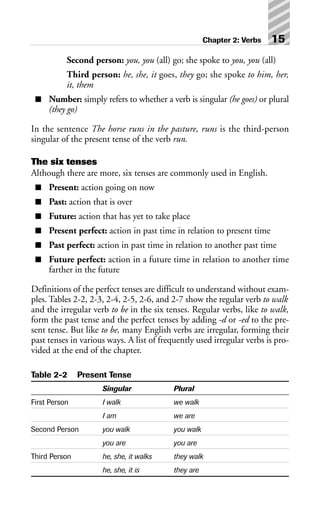
Table 2-2 Present Tense
Singular Plural
First Person I walk we walk
I am we are
Second Person you walk you walk
you are you are
Third Person he, she, it walks they walk
he, she, it is they are
Chapter 2: Verbs 15
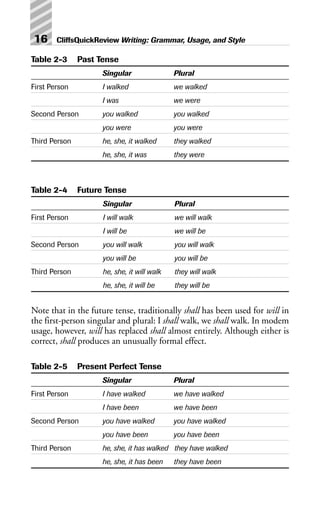
Table 2-3 Past Tense
Singular Plural
First Person I walked we walked
I was we were
Second Person you walked you walked
you were you were
Third Person he, she, it walked they walked
he, she, it was they were
Table 2-4 Future Tense
Singular Plural
First Person I will walk we will walk
I will be we will be
Second Person you will walk you will walk
you will be you will be
Third Person he, she, it will walk they will walk
he, she, it will be they will be
Note that in the future tense, traditionally shall has been used for will in
the first-person singular and plural: I shall walk, we shall walk. In modem
usage, however, will has replaced shall almost entirely. Although either is
correct, shall produces an unusually formal effect.
Table 2-5 Present Perfect Tense
Singular Plural
First Person I have walked we have walked
I have been we have been
Second Person you have walked you have walked
you have been you have been
Third Person he, she, it has walked they have walked
he, she, it has been they have been
16 CliffsQuickReview Writing: Grammar, Usage, and Style
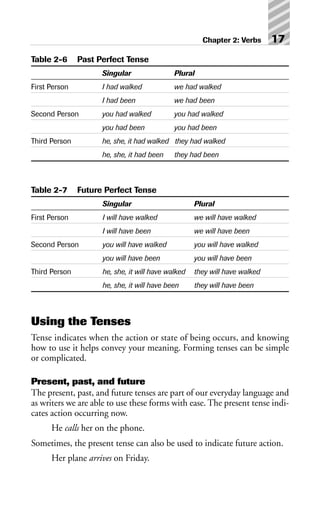
Table 2-6 Past Perfect Tense
Singular Plural
First Person I had walked we had walked
I had been we had been
Second Person you had walked you had walked
you had been you had been
Third Person he, she, it had walked they had walked
he, she, it had been they had been
Table 2-7 Future Perfect Tense
Singular Plural
First Person I will have walked we will have walked
I will have been we will have been
Second Person you will have walked you will have walked
you will have been you will have been
Third Person he, she, it will have walked they will have walked
he, she, it will have been they will have been
Using the Tenses
Tense indicates when the action or state of being occurs, and knowing
how to use it helps convey your meaning. Forming tenses can be simple
or complicated.
Present, past, and future
The present, past, and future tenses are part of our everyday language and
as writers we are able to use these forms with ease. The present tense indi-
cates action occurring now.
He calls her on the phone.
Sometimes, the present tense can also be used to indicate future action.
Her plane arrives on Friday.
Chapter 2: Verbs 17
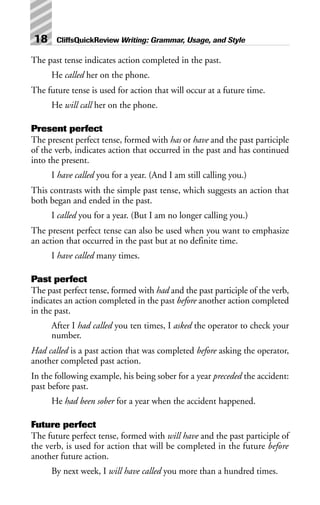
The past tense indicates action completed in the past.
He called her on the phone.
The future tense is used for action that will occur at a future time.
He will call her on the phone.
Present perfect
The present perfect tense, formed with has or have and the past participle
of the verb, indicates action that occurred in the past and has continued
into the present.
I have called you for a year. (And I am still calling you.)
This contrasts with the simple past tense, which suggests an action that
both began and ended in the past.
I called you for a year. (But I am no longer calling you.)
The present perfect tense can also be used when you want to emphasize
an action that occurred in the past but at no definite time.
I have called many times.
Past perfect
The past perfect tense, formed with had and the past participle of the verb,
indicates an action completed in the past before another action completed
in the past.
After I had called you ten times, I asked the operator to check your
number.
Had called is a past action that was completed before asking the operator,
another completed past action.
In the following example, his being sober for a year preceded the accident:
past before past.
He had been sober for a year when the accident happened.
Future perfect
The future perfect tense, formed with will have and the past participle of
the verb, is used for action that will be completed in the future before
another future action.
By next week, I will have called you more than a hundred times.
18 CliffsQuickReview Writing: Grammar, Usage, and Style
Calling more than a hundred times will take place before next week. In the
following example, his achieving sobriety for a year will precede the future
arrival of his daughter.
He will have been sober for a year by the time his daughter arrives.
Moods of the Verb
Verb moods are classifications that indicate the attitude of the speaker.
Verbs have three moods—the indicative, the imperative, and the
subjunctive.
The indicative and imperative
The indicative and the imperative moods are easy to understand. You use
the indicative mood in most statements and questions.
He walks every day after lunch.
Does he believe in the good effects of exercise?
You use the imperative in requests and commands. Imperative statements
have an understood subject of you and therefore take second-person verbs.
Sit down. ([You] sit down.)
Please take a number. ([You] please take a number.)
The subjunctive
The tenses of the subjunctive mood are formed differently from the indica-
tive tenses, and the subjunctive is used in special kinds of statements. Today,
the most common use of the subjunctive mood is in contrary-to-fact or
hypothetical statements. In your own writing, you must decide which state-
ments should be in the subjunctive. If something is likely to happen, use
the indicative. If something is purely hypothetical, or contrary to fact, use
the subjunctive.
■ Present tense subjunctive
If I were king, you would be queen. (In the subjunctive, were is
used for all persons.)
If he worked, he could earn high wages.
■ Past tense subjunctive
If I had been king, you would have been queen.
If he had worked, he could have earned high wages.
Chapter 2: Verbs 19
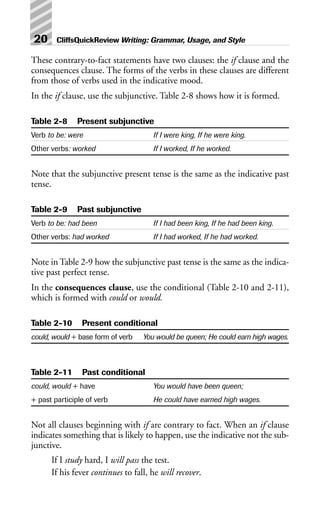
These contrary-to-fact statements have two clauses: the if clause and the
consequences clause. The forms of the verbs in these clauses are different
from those of verbs used in the indicative mood.
In the if clause, use the subjunctive. Table 2-8 shows how it is formed.
Table 2-8 Present subjunctive
Verb to be: were If I were king, If he were king.
Other verbs: worked If I worked, If he worked.
Note that the subjunctive present tense is the same as the indicative past
tense.
Table 2-9 Past subjunctive
Verb to be: had been If I had been king, If he had been king.
Other verbs: had worked If I had worked, If he had worked.
Note in Table 2-9 how the subjunctive past tense is the same as the indica-
tive past perfect tense.
In the consequences clause, use the conditional (Table 2-10 and 2-11),
which is formed with could or would.
Table 2-10 Present conditional
could, would + base form of verb You would be queen; He could earn high wages.
Table 2-11 Past conditional
could, would + have You would have been queen;
+ past participle of verb He could have earned high wages.
Not all clauses beginning with if are contrary to fact. When an if clause
indicates something that is likely to happen, use the indicative not the sub-
junctive.
If I study hard, I will pass the test.
If his fever continues to fall, he will recover.
20 CliffsQuickReview Writing: Grammar, Usage, and Style
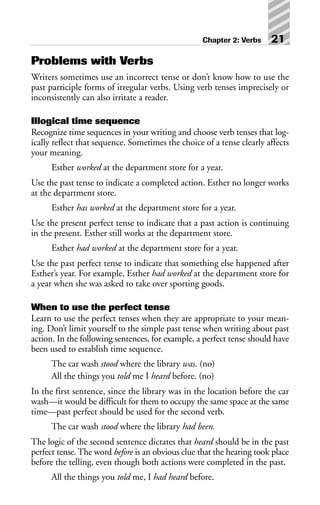
Problems with Verbs
Writers sometimes use an incorrect tense or don’t know how to use the
past participle forms of irregular verbs. Using verb tenses imprecisely or
inconsistently can also irritate a reader.
Illogical time sequence
Recognize time sequences in your writing and choose verb tenses that log-
ically reflect that sequence. Sometimes the choice of a tense clearly affects
your meaning.
Esther worked at the department store for a year.
Use the past tense to indicate a completed action. Esther no longer works
at the department store.
Esther has worked at the department store for a year.
Use the present perfect tense to indicate that a past action is continuing
in the present. Esther still works at the department store.
Esther had worked at the department store for a year.
Use the past perfect tense to indicate that something else happened after
Esther’s year. For example, Esther had worked at the department store for
a year when she was asked to take over sporting goods.
When to use the perfect tense
Learn to use the perfect tenses when they are appropriate to your mean-
ing. Don’t limit yourself to the simple past tense when writing about past
action. In the following sentences, for example, a perfect tense should have
been used to establish time sequence.
The car wash stood where the library was. (no)
All the things you told me I heard before. (no)
In the first sentence, since the library was in the location before the car
wash—it would be difficult for them to occupy the same space at the same
time—past perfect should be used for the second verb.
The car wash stood where the library had been.
The logic of the second sentence dictates that heard should be in the past
perfect tense. The word before is an obvious clue that the hearing took place
before the telling, even though both actions were completed in the past.
All the things you told me, I had heard before.
Chapter 2: Verbs 21
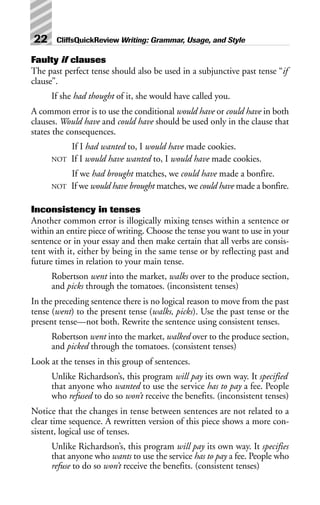
Faulty if clauses
The past perfect tense should also be used in a subjunctive past tense “if
clause”.
If she had thought of it, she would have called you.
A common error is to use the conditional would have or could have in both
clauses. Would have and could have should be used only in the clause that
states the consequences.
If I had wanted to, I would have made cookies.
NOT If I would have wanted to, I would have made cookies.
If we had brought matches, we could have made a bonfire.
NOT If we would have brought matches, we could have made a bonfire.
Inconsistency in tenses
Another common error is illogically mixing tenses within a sentence or
within an entire piece of writing. Choose the tense you want to use in your
sentence or in your essay and then make certain that all verbs are consis-
tent with it, either by being in the same tense or by reflecting past and
future times in relation to your main tense.
Robertson went into the market, walks over to the produce section,
and picks through the tomatoes. (inconsistent tenses)
In the preceding sentence there is no logical reason to move from the past
tense (went) to the present tense (walks, picks). Use the past tense or the
present tense—not both. Rewrite the sentence using consistent tenses.
Robertson went into the market, walked over to the produce section,
and picked through the tomatoes. (consistent tenses)
Look at the tenses in this group of sentences.
Unlike Richardson’s, this program will pay its own way. It specified
that anyone who wanted to use the service has to pay a fee. People
who refused to do so won’t receive the benefits. (inconsistent tenses)
Notice that the changes in tense between sentences are not related to a
clear time sequence. A rewritten version of this piece shows a more con-
sistent, logical use of tenses.
Unlike Richardson’s, this program will pay its own way. It specifies
that anyone who wants to use the service has to pay a fee. People who
refuse to do so won’t receive the benefits. (consistent tenses)
22 CliffsQuickReview Writing: Grammar, Usage, and Style
In this version, all verb tenses except the first (will pay) and last (won’t
receive = will not receive) are in the present tense. The future tense is appro-
priately used for the first and last verbs because these verbs indicate future
consequences.
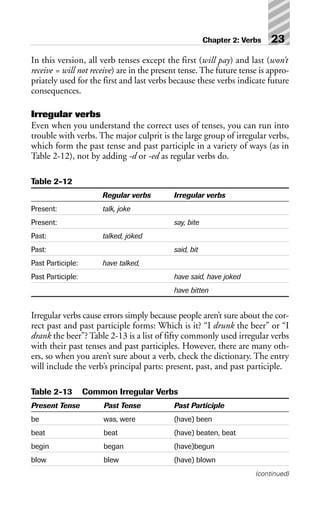
Irregular verbs
Even when you understand the correct uses of tenses, you can run into
trouble with verbs. The major culprit is the large group of irregular verbs,
which form the past tense and past participle in a variety of ways (as in
Table 2-12), not by adding -d or -ed as regular verbs do.
Table 2-12
Regular verbs Irregular verbs
Present: talk, joke
Present: say, bite
Past: talked, joked
Past: said, bit
Past Participle: have talked,
Past Participle: have said, have joked
have bitten
Irregular verbs cause errors simply because people aren’t sure about the cor-
rect past and past participle forms: Which is it? “I drunk the beer” or “I
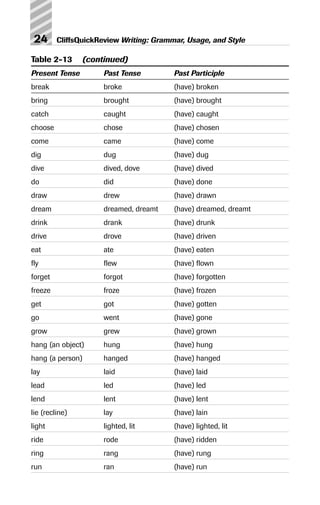
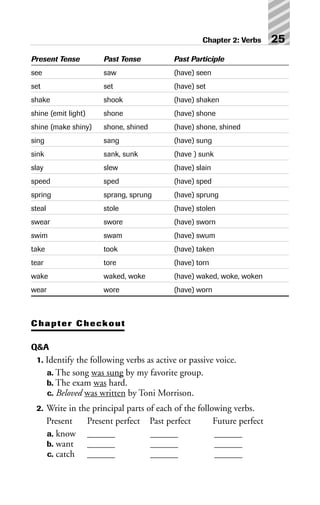
drank the beer”? Table 2-13 is a list of fifty commonly used irregular verbs
with their past tenses and past participles. However, there are many oth-
ers, so when you aren’t sure about a verb, check the dictionary. The entry
will include the verb’s principal parts: present, past, and past participle.
Table 2-13 Common Irregular Verbs
Present Tense Past Tense Past Participle
be was, were (have) been
beat beat (have) beaten, beat
begin began (have)begun
blow blew (have) blown
(continued)
Chapter 2: Verbs 23
Table 2-13 (continued)
Present Tense Past Tense Past Participle
break broke (have) broken
bring brought (have) brought
catch caught (have) caught
choose chose (have) chosen
come came (have) come
dig dug (have) dug
dive dived, dove (have) dived
do did (have) done
draw drew (have) drawn
dream dreamed, dreamt (have) dreamed, dreamt
drink drank (have) drunk
drive drove (have) driven
eat ate (have) eaten
fly flew (have) flown
forget forgot (have) forgotten
freeze froze (have) frozen
get got (have) gotten
go went (have) gone
grow grew (have) grown
hang (an object) hung (have) hung
hang (a person) hanged (have) hanged
lay laid (have) laid
lead led (have) led
lend lent (have) lent
lie (recline) lay (have) lain
light lighted, lit (have) lighted, lit
ride rode (have) ridden
ring rang (have) rung
run ran (have) run
24 CliffsQuickReview Writing: Grammar, Usage, and Style
Present Tense Past Tense Past Participle
see saw (have) seen
set set (have) set
shake shook (have) shaken
shine (emit light) shone (have) shone
shine (make shiny) shone, shined (have) shone, shined
sing sang (have) sung
sink sank, sunk (have ) sunk
slay slew (have) slain
speed sped (have) sped
spring sprang, sprung (have) sprung
steal stole (have) stolen
swear swore (have) sworn
swim swam (have) swum
take took (have) taken
tear tore (have) torn
wake waked, woke (have) waked, woke, woken
wear wore (have) worn
Chapter Checkout
Q&A
1. Identify the following verbs as active or passive voice.
a. The song was sung by my favorite group.
b. The exam was hard.
c. Beloved was written by Toni Morrison.
2. Write in the principal parts of each of the following verbs.
Present Present perfect Past perfect Future perfect
a. know ______ ______ ______
b. want ______ ______ ______
c. catch ______ ______ ______
Chapter 2: Verbs 25
3. Identify the underlined verb tense.
a. Emily will have lost ten pounds by spring.
b. Susie, determined to see the world, went to Alaska.
c. I had gone before Yassine arrived.
d. Lillie, a master gardener, will plant beans next year.
4. Supply the missing verb for the following sentences. The appropri-
ate verb is provided in parentheses.
a. Jerome and Theresa ______ five years this November. (marry)
b. Don ______ to New Orleans last February. (go)
c. Mother ______ when she sees what Erik has done. (proud)
d. We are grateful for the customers who ______us this year.
(support)
5. True or False: The following underlined verbs are all action verbs.
a. David called on Friday.
b. Stop!
c. Peggy was never late for class.
Answers: 1. a. passive b. active c. passive 2. a. have known/has known, had
known, will have known b. have wanted/has wanted, had wanted, will have
wanted c. have caught/has caught, had caught, will have caught 3. a. future
perfect b. past c. past perfect d. future 4. a. have been married b. went
c. will be proud d. have supported. 5. a. passive b. active c. passive.
26 CliffsQuickReview Writing: Grammar, Usage, and Style
Chapter 3
PRONOUNS
Chapter Check-In
❑ Identifying pronouns
❑ Knowing when to use subjective or objective case
❑ Making pronoun references clear
❑ Creating pronoun agreement
❑ Avoiding sexist pronouns
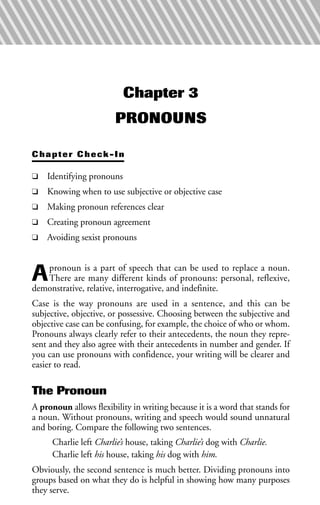
Apronoun is a part of speech that can be used to replace a noun.
There are many different kinds of pronouns: personal, reflexive,
demonstrative, relative, interrogative, and indefinite.
Case is the way pronouns are used in a sentence, and this can be
subjective, objective, or possessive. Choosing between the subjective and
objective case can be confusing, for example, the choice of who or whom.
Pronouns always clearly refer to their antecedents, the noun they repre-
sent and they also agree with their antecedents in number and gender. If
you can use pronouns with confidence, your writing will be clearer and
easier to read.
The Pronoun
A pronoun allows flexibility in writing because it is a word that stands for
a noun. Without pronouns, writing and speech would sound unnatural
and boring. Compare the following two sentences.
Charlie left Charlie’s house, taking Charlie’s dog with Charlie.
Charlie left his house, taking his dog with him.
Obviously, the second sentence is much better. Dividing pronouns into
groups based on what they do is helpful in showing how many purposes
they serve.
Personal pronouns
The personal pronouns (I, me, he, she, it, etc.) stand for one or more per-
sons or things and differ in form depending on their case, that is, how they
are used in a phrase, clause, or sentence. For example, when acting as a
subject, the first person singular pronoun is I. When acting as an object,
I becomes me.
Reflexive (intensive) pronouns
The reflexive, or intensive, pronouns combine some of the personal
pronouns with -self or -selves (myself, himself, themselves, etc.). Reflexive
pronouns are used to reflect nouns or pronouns, as in He hurt himself, or
to provide emphasis, as in I myself don’t believe it. Don’t use reflexive
pronouns as subjects and objects, however.
Tom and I don’t like it.
NOT Tom and myself don’t like it.
Bob doesn’t like Harold or me.
NOT Bob doesn’t like Harold or myself.
Demonstrative pronouns
The demonstrative pronouns (this, that, these, those) single out what you
are talking about.
These are the ones we want, but this is the most economical choice.
When they stand alone in place of nouns, these words are pronouns. But
when they precede nouns, they are adjectives: this wagon, that dog, these words.
Relative pronouns
The relative pronouns (who, whom, which, that) introduce clauses that
describe nouns or pronouns.
The professor who wrote the textbook is teaching the class.
The storm that caused the blackout has moved east.
Relative clauses are discussed in detail in Chapter 6.
The current trend is toward using the relative pronouns that and which inter-
changeably, although many teachers and editors prefer that a distinction be
made. Use that when the clause that follows it is restrictive, that is, when it
is necessary to define your subject. Use which when the clause that follows
it is nonrestrictive, that is, when it adds information that isn’t necessary to
28 CliffsQuickReview Writing: Grammar, Usage, and Style
define your subject. For a complete explanation of restrictive and non-
restrictive clauses, see Chapter 9.
The car that hit her was green.
NOT The car which hit her was green.
The relative clause that hit her restricts or limits the subject car. The infor-
mation in the clause is necessary to the main statement.
The car, which I bought a week ago, gets good mileage.
NOT The car, that I bought a week ago, gets good mileage.
The clause which I bought a week ago adds information about the subject
that isn’t necessary to our understanding of the main statement that the
car gets good mileage.
Use commas with a which clause but not with a that clause. (See
Chapter 9 for commas with restrictive and nonrestrictive clauses.)
Interrogative pronouns
The interrogative pronouns (who whom, whose, which, what) introduce
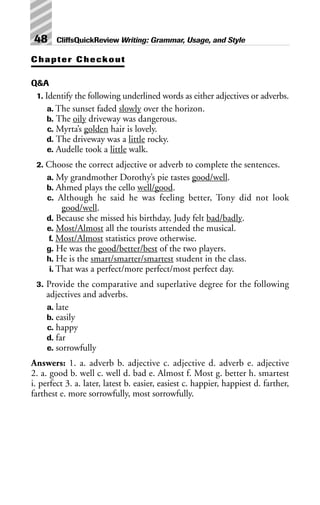
questions.
Which is the best one to choose?
Who asked the question, “To whom does this belong?”
Indefinite pronouns
Indefinite pronouns don’t specify the persons or things they refer to. The
most frequently used indefinite pronouns are all, any, anybody, anyone,
both, each, either, everybody, everyone, few, many, neither, nobody, none,
no one, one, several, some, somebody, someone. There are many others
(for example, others here is an indefinite pronoun). Like other pronouns
(here, other is an adjective), indefinite pronouns stand in for nouns, even
if those nouns aren’t specified.
Many are called but few are chosen.
Nobody likes a tattletale.
Pronoun Case
Case refers to the way a noun or pronoun is used in a sentence. When it
is the subject of a verb, it is in the subjective case (the term nominative
can also be used for subjective case though we will use subjective case only).
When it is the object of a verb or a preposition, it is in the objective case.
Chapter 3: Pronouns 29
When it possesses something, it is in the possessive case.
With nouns, the subjective and objective cases aren’t a problem because
nouns have the same form whether they are subjects or objects.
The frog ate the bee. The bee stung the frog.
Regardless of what’s happening to the frog or the bee, the nouns frog and
bee don’t change form.
Some pronouns, however, take different forms depending on whether they
are subjects or objects. These pronouns are listed in Table 3-1.
Table 3-1: Subjective and objective pronouns
Subjective case Objective case
I me
he him
she her
we us
they them
who, whoever whom, whomever
In the sentence Tension existed between Franklin and Winston, there is no
confusion about what case to use for Franklin or Winston. But what about
in this sentence?
Tension existed between Franklin and him.
Is him right? Or should it be he? (The pronoun is the object of the prepo-
sition between, so him is correct.).
Subjective case of pronouns
Pronouns are used as subjects of verbs. Use the subjective case of pronouns
when the pronoun is the subject of a verb.
I drive to work.
He enjoys dancing.
We bought the lodge.
They are fighting over the property line.
The man who won the game was the guest of honor.
30 CliffsQuickReview Writing: Grammar, Usage, and Style
Compound subjects
When there are compound subjects, that is, more than one actor, don’t
be confused. Pronouns should still be in the subjective case.
Eileen and he (NOT Eileen and him) enjoy dancing.
The Harrisons and they (NOT The Harrisons and them) are fighting
over the property line.
To keep from making pronoun case errors in sentences with compound
subjects, drop the subject that is a noun and read the sentence with the
pronoun alone. You would never say Him enjoy dancing or Them are fight-
ing over the property line. You’ll see immediately that the subjective forms
he and they are correct.
Pronouns following “to be”
You should also use the subjective case of pronouns after forms of the verb
to be.
It is I who chose the location.
The man who called the police was he.
The real criminals are we ourselves.
The winners were they and the Rudermans.
The man who phoned was who?
The word after a form of to be is called a complement. (It is also some-
times called a predicate nominative or predicate adjective).
Unlike words following action verbs, a complement of a linking verb is
not an object, a receiver of action. Instead, the complement identifies or
refers to the subject. Compare the following two sentences.
The president saw Mr. Komine.
The president was Mr. Komine.
In the first sentence, Mr. Komine is an object that receives the president’s
action of seeing. If a pronoun were to be substituted for Mr. Komine, the
pronoun would be in the objective case: him. But in the second sentence,
Mr. Komine isn’t receiving any action; Mr. Komine identities the subject,
that is, the president. The correct pronoun to substitute for Mr. Komine
in this sentence would be he.
Pronoun complements can cause case problems. As the rule says, the sub-
jective form of a pronoun is correct after to be, but sometimes it may sound
unnatural or awkwardly formal.
Chapter 3: Pronouns 31
It is I.
I am she.
The person I chose was he.
The winners were they.
The best way to handle awkward-sounding constructions is to look for a
better way to say the same thing. For example,
They were the winners.
OR They won. (better)
He was the person I chose.
OR I chose him. (better)
In informal speech and writing, modern usage allows It is me or It’s me.
Objective pronouns after to be are also gaining some acceptance in other
constructions. When you are writing formally, either stay with the estab-
lished rule or rewrite the sentence to avoid an awkward correctness.
Objective Case of Pronouns
When a pronoun is the object of the verb or preposition it is in the objec-
tive case. (See Chapter 2 for direct and indirect objects.)
Pronouns as objects of verbs
Use the objective case of pronouns when the pronoun is a direct or
indirect object of a verb.
Gilbertson nominated me for secretary. (direct object of nominated)
The news hit them hard. (direct object of hit)
Jennifer gave him the house and car. (indirect object of gave)
Robert Chang told us and them the same incredible story. (indirect
objects of told)
Pronouns as objects of prepositions
You should also use the objective case of pronouns when the pronoun is an
object of a preposition. (Prepositions are discussed in detail in Chapter 5.)
The man pulled a blanket over the children and us. (object of the
preposition over)
The man for whom they waited never arrived. (They waited for
whom: object of the preposition for)
32 CliffsQuickReview Writing: Grammar, Usage, and Style
Pronoun over-refinement
Choosing between you and me vs. between you and I should be easy. Some
people incorrectly believe that the subjective forms are more correct—
that I is actually superior to me. Where this idea comes from is a mystery—
perhaps from having It’s me corrected to It is I or from recognizing obvious
bad grammar, as in Me and him really like you. But don’t be influenced by
a misguided idea of refinement. The objective case has a clear purpose as
the rules show, and not to use it when you should reveals your lack of knowl-
edge. The phrase for You and I and between you and I are common mistakes
that are probably due to over-refinement. The pronouns in these phrases
are objects of prepositions, and therefore for you and me and between you
and me are correct.
Compound objects
Watch out for pronoun case when you have a compound object. Remem-
ber that when an object is more than one person, it is still an object.
Pronouns should be in the objective case.
The ceremony will be given for Tucker, Martinez, and me. (NOT for
Tucker, Martinez, and 1)
Without Kate and me (NOT Without Kate and I ), the book wouldn’t
have been published.
The dean nominated Nelson and me (NOT Nelson and I ) to serve on
the committee.
You can check for pronoun cases in such situations by reading the sen-
tences with the pronoun object alone: The ceremony will be given for I;
Without I, the book wouldn’t have been published; The dean nominated I to
serve on the committee. The mistakes show up quickly. Me is obviously the
right form of the pronoun in these three sentences.
Pronouns as subjects of infinitives
When a pronoun is the subject of an infinitive (the basic verb with to: to
swim, to drive, etc.), use the objective case for the pronoun. This rule
shouldn’t cause you any problems. Your ear will tell you the objective case
is correct.
He wanted her to drive the car.
Bradford liked them to leave early.
Chapter 3: Pronouns 33
Choosing Between the Subjective and
Objective Case
Choosing between the subjective and objective case is sometimes compli-
cated by appositives, and the as or than construction. The confusion over
the choice of who or whom is a good example of this problem.
Pronoun case with appositives
An appositive is a word or group of words that restates or identifies the
noun or pronoun it is next to: My sister Hephzibah; John, the gardener, our
friend Carlos; We, the people. The presence of an appositive doesn’t change
the rule for pronoun case; that is, use the subjective case for subjects and
the objective case for objects.
The decision to close the pool was a setback for us swimmers. (NOT
we swimmers)
The best way to make sure you have chosen the correct pronoun case is to
read the sentence without the appositive: The decision to close the pool was
a setback for we. Once again, you can see immediately that us is the right
pronoun to use.
Pronoun case after as, than. Choosing the right pronoun case after as or
than can be difficult.
Look at the following two sentences.
You respect Professor Morrow more than I.
You respect Professor Morrow more than me.
Depending on the meaning, either choice could be correct. If the writer
means You respect Professor Morrow more than I (respect Professor Morrow),
then the first sentence is correct. If the writer means You respect Professor
Morrow more than (you respect) me, then the second sentence is correct.
The key to choosing the right pronoun case is to supply mentally the miss-
ing part of the clause.
Did you work as hard as they? (worked)
I like Ed better than he. (likes Ed)
I like Ed better than him. (than I like him)
They are smarter than we. (are)
If a sentence sounds awkward to you—for example, They are smarter than
we—you can avoid the problem by actually supplying the missing word:
They are smarter than we are.
34 CliffsQuickReview Writing: Grammar, Usage, and Style
Who, whom, whoever, whomever
These pronouns cause so much anxiety that they are being treated sepa-
rately, even though the rules about case are the same as those for I, he, she,
we, and they.
As a subject, choose who or whoever.
He was the man who won the game. (subject of won)
Whoever wants the paper can have it. (subject of wants)
As an object, choose whom or whomever.
He was a person around whom controversy swirled. (object of the
preposition around)
Whomever will you invite? (You will invite whomever: direct object)
In informal speech and writing whom is used infrequently. At the begin-
ning of questions, for example, who is substituted for whom, even when
whom would be grammatically correct.
Who will you marry? (You will marry whom.)
Who did he ask? (He did ask whom.)
Even some standardized tests have given up who/whom questions. Who
knows? Maybe whom will disappear from the language someday. Does this
mean you should feel free to ignore it? Probably not yet, at least in formal
writing. It is still safer to maintain the distinction between who and
whom—and maintain it correctly.
Possessive Case of Pronouns
The possessive case of nouns is formed with an apostrophe: Keesha’s
costume, the wolf’s fangs (See Chapter 1). But personal pronouns and the
relative pronoun who change form to indicate possession.
My house is bigger than your house.
His anger evaporated in the face of her explanation.
The bulldog bared its teeth at us.
Our decision affected their plans.
The economist, whose book had received good reviews, agreed to
speak.
No mother tried harder to help than hers.
Your plans are more definite than ours.
Chapter 3: Pronouns 35
Remember that possessive-case nouns and pronouns are different; posses-
sive pronouns do not have apostrophes. You have to distinguish between its,
it’s, and whose, who’s.The possessive of it is its, NOT it’s; the possessive of who
is whose, NOT who’s. It’s and who’s are contractions (it’s = it is; who’s = who is).
The cat lost its whiskers. (NOT it’s whiskers)
It’s (It is) Friday!
The boy whose mother (NOT who’s mother) called left the meeting.
Who’s (Who is) the author of the book?
Possessive Pronouns with Gerunds
Use a possessive pronoun with a gerund, the verb form that functions as
a noun (See Chapter 1). This rule is broken frequently, with many writers
using the objective rather than the possessive case.
I didn’t like his going (NOT him going) to New York without me.
Their smiling (NOT Them smiling) irritated her.
Please forgive our intruding. (NOT us intruding)
Pronoun Reference
Pronouns always refer to the noun they represent, their antecedent. If you
understand how pronouns relate to nouns, you can avoid confusion in
your writing.
Finding the antecedent
Remember that pronouns stand in for nouns. An antecedent is the
noun—or group of words acting as a noun—that a pronoun refers to.
Notice the antecedents in the following example.
Kelly lifted Mickey into the air and then set him down.
The debt plagued John and Sandy. It ruined any chance they had for
a peaceful relationship.
Neither of these examples would make a reader wonder who or what is
being talked about. Him in the first example is Mickey, It and they in the
second example are debt and John and Sandy.
Unclear antecedents
In the following sentences, locate the antecedents of the pronouns.
The counselor was speaking to Dave, and he looked unhappy.
36 CliffsQuickReview Writing: Grammar, Usage, and Style
Who looked unhappy in this sentence—the counselor or Dave? In the fol-
lowing sentence, did the maids clean the girls or the rooms?
After the girls left the hotel rooms, the maids cleaned them.
In the second example, your good sense tells you the maids cleaned the
rooms and didn’t clean the girls. But although sometimes you can count
on context or good sense to help you figure out which pronoun goes with
which antecedent, you shouldn’t have to. And what about in the first sen-
tence? No clue exists as to whether the counselor or Dave looked unhappy.
These are examples of ambiguous pronoun references, and you should
avoid them in your writing.
You can solve the problem in various ways, including changing the sen-
tence structure or eliminating the pronoun, as in the following sentences.
The counselor was speaking to Dave, who looked unhappy.
After the girls left, the maids cleaned the hotel rooms.
Be sure to read your sentences carefully to make sure that you have avoided
unclear pronoun references.
Indefinite antecedents
More subtle errors occur when you use a pronoun reference that is too
general or indefinite or one that exists only in your mind.
I told Uncle Richard, Aunt Gretchen, and then Father, which infu-
riated Gary.
Did telling all three people infuriate Gary, or was it only telling Father?
Rewrite the sentence to make your meaning clear.
First I told Uncle Richard and Aunt Gretchen. Then I told
Father, which infuriated Gary.
OR My telling Uncle Richard, Aunt Gretchen, and then Father
infuriated Gary.
In the following sentence, no antecedent exists for them. The writer is
thinking “bagels” but not specifying them. Bagel shop is not a correct
antecedent for them. To solve the problem, substitute bagels for them.
Although Mark likes working at the bagel shop, he never eats them
himself.
In the next sentence, the antecedent for It is vague. Was it just the sky that
filled the observer with hope and joy? A hint in rewriting: Substitute The
scene for It.
Chapter 3: Pronouns 37
The hills were lush green, the trees in full bloom, the sky a brilliant
blue. It filled me with hope and joy.
What is the exact antecedent for This in the following sentence?
The paper was too long, too general, and too filled with pretentious
language. This meant Joe had to rewrite it.
A possible rewrite might be as follows.
The paper was too long, too general, and too filled with pretentious
language. These problems meant that Joe had to rewrite it.
Don’t try to remedy a vague pronoun reference by changing the pronoun,
as in the following example.
The paper was too long, too general, and too filled with pretentious
language, which meant Joe had to rewrite it.
The reference for which is as indefinite as was the reference for this, and so
the problem has not been solved.
The vague this and the indefinite it are so common in writing that they
often go unnoticed. It can be used as an indefinite indicator occasionally:
It’s true, It is raining, It is a ten minute drive to the school. But don’t overdo
this construction. For vivid writing, nail down your pronouns with good,
clear antecedents.
Pronoun Agreement
A pronoun must agree with its antecedent in number (singular or plural)
and gender (masculine or feminine).
In this sentence, Harold is the antecedent of his, he’d, and his.
Harold, after saying goodbye to his family, discovered he’d lost his
wallet.
In the following sentence, Garcias is the antecedent of they, even though
it follows the pronoun.
Until they buy the house, the Garcias are staying in a hotel.
Look at the next example. Here, Peterson and Mancini is a compound
antecedent, which requires the plural pronoun their.
Peterson and Mancini took their cue from the senator.
38 CliffsQuickReview Writing: Grammar, Usage, and Style
Agreement problems with indefinite pronouns
Indefinite pronouns cause many agreement problems. Some pronouns
(several, few, both, and many) are clearly plural and take both plural verbs
and plural pronouns.
Several are expected to give up their rooms.
Both tell their parents the truth.
Some pronouns may “feel” plural, but are singular and take singular verbs
and pronouns. In this group are each, either, neither, everyone, everybody,
no one, nobody, anyone, anybody, someone, and somebody.
Each is responsible for his or her (NOT their) own ticket.
Everyone wants to get his or her (NOT their) name in the paper.
When the use of a singular form would lead to a statement that doesn’t
make sense, you should use a plural form. For example, in the sentence
Everyone left the lecture because he thought it was boring, they would be a
better choice than he for the pronoun. However, the general rule is to use
singular forms of verbs and pronouns with these indefinite pronouns.
Some indefinite pronouns (none, any, some, all, most) fall into an “either/or”
category; and they may take singular or plural verbs and pronouns, depend-
ing on meaning. Sometimes the distinction is subtle.
None of the men was hurt. (not one = singular)
None of the men were hurt. (no men = plural)
Some is better than none. (some = a quantity = singular)
Some are delicious. (some = a number of things = plural)
All is well. (all = the sum of all things singular)
All are well. (all = a number of people plural)
If a plural meaning is not clear from the context, use singular verbs and
pronouns.
Pronouns with collective nouns
Collective nouns can also require either singular or plural verbs and sin-
gular or plural pronouns, depending on meaning.
The team plays according to its schedule. (emphasize unit = singular)
The team couldn’t agree on their goals. (emphasize individuals =
plural)
Chapter 3: Pronouns 39
However, if you are uncertain, choose a singular verb and a singular pro-
noun, or rewrite the sentence to make it clearly plural.
The team members couldn’t agree on their goals.
Sexism in Pronouns: He or She?
When the gender of a pronoun antecedent is unknown, or when the
antecedent represents both sexes, which third person singular pronoun
should you use—he or she? Traditionally, he has been the automatic choice.
The diplomatic person keeps his opinion to himself.
The reader himself will decide whether he wants to accept Smith’s
premise.
For the past several years, however, some people have objected to this one-
sided view of things. But remedying it hasn’t been easy, and usage experts
don’t agree on one solution. Here are some ways of handling the problem.
■ When possible, rewrite sentences using third person plural forms.
Diplomatic people keep their opinions to themselves.
■ Use he or she.
The reader will decide whether he or she wishes to accept Smith’s
premise.
■ Use he/she or s/he.
The reader will decide whether he/she (or s/he) wishes to accept
Smith’s premise.
■ Continue to use he throughout a piece of writing.
■ Use she instead of he throughout a piece of writing.
■ Alternate between he and she within a piece of writing.
■ Use their even when the antecedent is singular.
A ticket holder must check their number.
This book recommends using third person plural whenever that solution
is possible and he or she when the plural form is awkward or inappropri-
ate. However, constant repetition of he or she slows the flow of a sentence,
and you risk annoying your reader if you use the phrase too often.
40 CliffsQuickReview Writing: Grammar, Usage, and Style
The solutions aren’t ideal, but they seem less likely to offend than choos-
ing either he or she exclusively and less confusing than alternating between
them. The recommended solutions also prevent your being accused of
making a grammatical blunder by using a plural pronoun with a singular
antecedent (choice 7). Finally, he or she is preferable to the bureaucratic-
sounding he/she or the unpronounceable s/he.
Chapter Checkout
Q&A
1. Choose the correct pronoun to complete the sentences.
a. Nicole and she/her bought a new car.
b. The teacher who fell was who/whom?
c. He never knew that it was I/me who loved him.
d. The dolphin swam under the trainer and I/me.
e. My aunt knitted a sweater for Joan and she/her.
f. The president for who/whom we voted won.
2. In the following sentences identify the pronoun and state whether it
is demonstrative, interrogative, relative, or reflexive.
a. Which is the better bargain?
b. Celia braced herself for the winter blast.
c. That was James’s greatest achievement.
d. The author who lived in Memphis has died.
3. Underline the pronouns in the following sentences and label them
subjective, possessive, or objective.
a. Melinda had read the book, and she anticipated the movie.
b. With the exception of the conductor, no one saw them arrive.
c. When the rose bloomed in November, it was lovely.
d. That mug is mine.
Answers: 1. a. she b. who c. I d. me e. her f. whom 2. a. which, interrog-
ative b. herself, reflexive c. That, demonstrative d. who, relative. 3. a. she,
subjective b. them, objective c. it, subjective d. mine, possessive.
Chapter 3: Pronouns 41
Chapter 4
MODIFIERS: ADJECTIVES
AND ADVERBS
Chapter Check-In
❑ Using adjectives and adverbs
❑ Distinguishing between adjectives and adverbs
❑ Avoiding problems with adjectives and adverbs
❑ Showing degree with comparatives and superlatives
Adjectives and adverbs are parts of speech commonly called modifiers.
An adjective modifies a noun or pronoun and an adverb modifies a
verb, adjective, or another adverb.
Some adjectives and adverbs require memorizing a few rules. For example,
bad is always used as an adjective, while badly is an adverb. Adjectives and
adverbs can also be used to show comparative or superlative degree. By
adding -er you can compare two people, things, or an action, or by adding
-est you can compare more than two things. You can make your sentences
more precise and interesting by using appropriate adjectives and adverbs.
The Modifier
A modifier describes or limits another word or group of words. To cor-
rectly identify the modifier as an adjective or adverb, it is important to
identify the word the adjective or adverb is modifying.
An adjective modifies a noun or pronoun. In the following sentence,
orange is an adjective modifying the noun curtains, and cool is an adjective
modifying the noun breeze.
The orange curtains billowed in the cool breeze.
In the next example, happy is an adjective modifying the pronoun I; this
kind of adjective, one following a linking verb, is called a predicate adjec-
tive. Thoughtful is an adjective modifying the noun gesture.
I am happy because of his thoughtful gesture.
An adverb modifies a verb, an adjective, or another adverb. Adverbs answer
questions such as how, how much, when, where, and why. In the following
sentence, sadly modifies the verb smiled and answers the question “How
did he smile?”
He smiled sadly.
In the next example, immediately answers the question “When did they
come?”
They came immediately.
Here answers the question “Where did she walk?”
She walked here.
Very modifies the adjective bright: “How bright were the curtains?”
The orange curtains were very bright.
Remarkably modifies the adverb quickly: “How quickly did he crawl?”
He crawled remarkably quickly.
When to Use Modifiers
Adjectives and adverbs don’t form the core of sentences as nouns and verbs
do, but they give sentences texture and precision. Without adjectives and
adverbs, you wouldn’t know what color the curtains were, how the man
crawled, when they came, etc. Use adjectives and adverbs when they make
a contribution to what you are saying. For example, in “He smiled sadly,”
you know his smile is not like the usual happy smile. Sadly performs a
function. On the other hand, in “He screamed loudly,” does the adverb
add anything to the verb? Is there such a thing as a soft or quiet scream?
Here, loudly is unnecessary. Avoid using adjectives and adverbs that don’t
tell us anything or that state the obvious.
Recognizing adjectives and adverbs
Adverbs often end in -1y (remarkably, quickly, happily, slowly), but not
always (here, there, fast, late, hard ). And some adjectives end in -1y (a lively
Chapter 4: Modifiers: Adjectives and Adverbs 43
child, friendly dog, hilly area). The lesson to be learned from these exam-
ples is that to decide whether a word is an adjective or an adverb, look not
at the word itself but at what the word modifies: Adjectives will always
modify nouns and pronouns, while adverbs modify verbs, adjectives, and
other adverbs. Review these examples.
In the following example, old and red are adjectives modifying the noun
barn.
The old red barn needs repairs.
In the next sentence, very is an adverb modifying the adjective old, not the
noun barn.
The very old red barn needs repairs.
Hard is an adverb modifying the verb worked.
He worked hard all afternoon.
Here, hard is an adjective modifying the noun work.
The hard work took all afternoon.
Using adjectives after linking verbs
It’s natural to associate adverbs rather than adjectives with verbs; adverbs
modify verbs. But with linking verbs such as be, become, smell, taste, seem,
and look (see “Linking Verbs,” Chapter 2), use adjectives (called predicate
adjectives).
The substance tastes sweet. (NOT sweetly)
They were joyful. (NOT joyfully)
Notice the use of adjectives or adverbs in the following sentences, depend-
ing on whether a verb is functioning as a linking verb or an action verb.
In the following example, grow is an action verb meaning to develop,
increase in size, and its modifier should be an adverb (beautifully).
Flowers grow beautifully in that climate.
Here, grow is a linking verb meaning to become, so the complement should
be an adjective (beautiful).
Bronze grows beautiful as it ages.
In the next example, smells is a linking verb and takes an adjective; that is,
the dog’s odor is unpleasant.
The dog smells bad.
44 CliffsQuickReview Writing: Grammar, Usage, and Style
Here, smells is an action verb and takes an adverb; that is, something is
wrong with the dog’s sense of smell.
The dog smells badly.
Problem adjectives and adverbs
Some adjectives and adverbs seem interchangeable but are not. You will
need to remember a few rules to distinguish how they are used.
Good, well. Good is always an adjective: good bread; good vibrations; din-
ner was good. Don’t use good as an adverb. Use well, an adverb meaning to
perform capably.
She sings well.
NOT She sings good.
He listens well.
NOT He listens good.
Some confusion arises between good and well because well can also be used
as an adjective meaning in good health.
Mother was well in time for the play.
NOT Mother was good in time for the play.
To see the distinction between well used as an adjective and good used as
an adjective, look at the following sentences, both with the linking verb
looked.
Jerome looked good at the party tonight. (Jerome looked attractive.)
Jerome looked well at the party tonight. ( Jerome looked to be in
good health.)
Bad, badly. Bad is an adjective and badly is an adverb. They are often used
incorrectly for each other.
I feel bad about his losing the election.
NOT I feel badly about his losing the election.
Here, feel is a linking verb and should be followed by an adjective, not an
adverb. In the next examples, badly is an adverb describing how the team
played.
The soccer team played badly in the last game.
NOT The soccer team played bad in the last game.
Chapter 4: Modifiers: Adjectives and Adverbs 45
In the following sentence, the adjective bad follows a linking verb, so the
appearance of the faucet is being discussed.
The faucet looked bad.
When the adverb badly follows the action verb, it explains how seriously
the faucet leaked.
The faucet leaked badly.
Most, almost. Most is an adjective meaning the greatest in number, amount.
Most people agree that exercise is good for you.
Most crimes go unpunished.
But most is an adverb when it is used to form the superlative of an adjective:
She is the most intelligent woman in the group.
He is the most appealing when he first wakes up.
Almost is always an adverb. It means nearly. Almost modifies the adjectives
every and all. Most cannot be used to modify every and all.
Almost every person agreed.
NOT Most every person agreed.
Almost all the people came.
NOT Most all the people came.
Forming the Comparative and
Superlative Degrees
As shown in Table 4-1, adjectives and adverbs change to show the com-
parative degree and superlative degree.
Table 4-1
Positive degree Comparative degree Superlative degree
sweet (adjective) sweeter sweetest
sweetly (adverb) more sweetly most sweetly
Follow these simple rules in forming comparative and superlative with
adverbs and adjectives.
46 CliffsQuickReview Writing: Grammar, Usage, and Style
Use the comparative degree when you are comparing two people, things,
or actions.
Oranges are sweeter than apples.
Naomi sings more sweetly than Kate.
Use the superlative degree when you are comparing more than two. The
superlative degree puts the modified word over all the others in its group.
The strawberries are sweeter than the apples, but the oranges are
sweetest of all.
Of all the members of the choir, Naomi sings most sweetly.
Most one-syllable and some two-syllable adjectives form the comparative
and superlative degrees by adding -er or -est. Notice that the adjective’s
final consonant is sometimes doubled and that a -y is changed to -i: tall,
taller, tallest; smart, smarter, smartest; big, bigger, biggest; dry, drier, driest;
happy, happier, happiest. There are a few exceptions to the rule: good, bet-
ter, best; bad, worse, worst. If an adjective has two or more syllables, it usu-
ally forms the comparative and superlative degrees with more and most:
more intelligent, most intelligent; more difficult, most difficult.
Most adverbs form the comparative and superlative forms with more and
most: more slowly, most slowly, more gracefully, most gracefully; more
quickly, most quickly. A few are exceptions: hard, harder, hardest; fast,
faster, fastest; soon, sooner, soonest.
Be careful not to double your comparisons when you form degrees of adjec-
tives: funny, funnier (NOT more funnier), funniest (NOT most funniest). To
use the -er, -est forms with more, most is redundant and incorrect.
Whenever you aren’t sure about how to form the comparative and super-
lative of a particular adjective or adverb, check your dictionary.
Adjectives and Adverbs that Should
Not be Compared
Be aware that there are some adjectives and adverbs that should not be
compared because of their meanings. One of the most frequently mis-
compared adjectives is unique, meaning one of a kind. Something cannot
be more unique or most unique. Something is either one of a kind or it isn’t.
Adjectives like this (and their adverbial forms) are absolute; absolute itself
is an absolute adjective. Among others to watch out for are essential, mean-
ing absolutely necessary; universal, meaning present everywhere; and immor-
tal, meaning living forever. With these adjectives and adverbs, something
either is or it isn’t, and therefore comparative degrees are meaningless.
Chapter 4: Modifiers: Adjectives and Adverbs 47
Chapter Checkout
Q&A
1. Identify the following underlined words as either adjectives or adverbs.
a. The sunset faded slowly over the horizon.
b. The oily driveway was dangerous.
c. Myrta’s golden hair is lovely.
d. The driveway was a little rocky.
e. Audelle took a little walk.
2. Choose the correct adjective or adverb to complete the sentences.
a. My grandmother Dorothy’s pie tastes good/well.
b. Ahmed plays the cello well/good.
c. Although he said he was feeling better, Tony did not look
good/well.
d. Because she missed his birthday, Judy felt bad/badly.
e. Most/Almost all the tourists attended the musical.
f. Most/Almost statistics prove otherwise.
g. He was the good/better/best of the two players.
h. He is the smart/smarter/smartest student in the class.
i. That was a perfect/more perfect/most perfect day.
3. Provide the comparative and superlative degree for the following
adjectives and adverbs.
a. late
b. easily
c. happy
d. far
e. sorrowfully
Answers: 1. a. adverb b. adjective c. adjective d. adverb e. adjective
2. a. good b. well c. well d. bad e. Almost f. Most g. better h. smartest
i. perfect 3. a. later, latest b. easier, easiest c. happier, happiest d. farther,
farthest e. more sorrowfully, most sorrowfully.
48 CliffsQuickReview Writing: Grammar, Usage, and Style
Chapter 5
PREPOSITIONS,
CONJUNCTIONS, AND
INTERJECTIONS
Chapter Check-In
❑ Recognizing prepositions
❑ Learning the rules for prepositions
❑ Understanding conjunctions
❑ Knowing how to use interjections
Prepositions, conjunctions and interjections are the connecting elements in
sentences. Finding the link between words is the secret to identifying prepo-
sitions. The two most important rules about using prepositions are avoid using
excess prepositions and avoid ending sentences with prepositions.
Conjunctions are parts of speech that connect words, phrases, or clauses.
There are three types of conjunctions: coordinating, correlative, and sub-
ordinating. They are the key to logically constructed sentences.
Interjections are used to express powerful or sudden emotion and are usu-
ally not grammatically connected to any other sentence. While there are
no formal rules for interjections, they are most effective if used sparingly.
The Preposition
A preposition shows the relationship between a noun or pronoun and
another noun or pronoun.
The cat under the fence.
The cat between the fence and the house.
Everyone except the girl in the blue dress.
A letter about us.
The italicized words in the preceding phrases are prepositions; the under-
lined words are objects of the prepositions. When the object is a pro-
noun, remember that the pronoun should be in the objective case (see
Chapter 3).
Recognizing prepositions
How do you recognize a preposition? It’s sometimes not easy. Prepositions
aren’t as obvious as nouns and verbs. Look for a word that establishes a cer-
tain kind of relationship with another word. For example, in the previous
phrases, how is cat related to fence? The cat is under the fence. How is
Everyone related to the girl? The girl is left out of the group Everyone. How
is girl related to dress? She is in it. Table 5-1 shows several words commonly
used as prepositions.
Table 5-1 Words Commonly Used as Prepositions
about before down off under
above behind during on underneath
across below except out until
after beneath for over unto
against beside from past up
along between in since upon
among beyond into through with
around by like to within
at concerning of toward without
Some prepositions, called compound prepositions, are made up of more
than one word, such as according to, because of, in front of, instead of, in
spite of, and next to.
Confusing use of prepositions
The unnecessary use of prepositions is a common error. Be careful not to
use a preposition where it isn’t needed.
Where have you been?
NOT Where have you been at?
Where is Robert going?
NOT Where is Robert going to?
50 CliffsQuickReview Writing: Grammar, Usage, and Style
Also, don’t use two prepositions when you need only one.
Don’t go near the water
NOT Don’t go near to the water.
The book fell off the table.
NOT The book fell off of the table.
Ending a sentence with a preposition can cause problems. The rule that a
sentence should never end with a preposition is no longer strictly enforced.
Still, many writers avoid ending sentences with prepositions, which is gen-
erally a good idea. But use your own judgment. If you feel ending with a
preposition makes a particular sentence more natural, do so and don’t
worry about it.
It is a comment to which I will not respond.
COMPARED TO It is a comment I will not respond to.
I bought a pen with which to write.
COMPARED TO I bought a pen to write with.
Defining Conjunctions
Conjunctions are words that join or link elements. Like prepositions, they
get a job done rather than add excitement to your writing. But choosing
the right conjunction makes the logic of your thought clear. For example,
which of the following two sentences creates the more logical connection?
I’ve always disliked history, and I have never failed a test.
I’ve always disliked history, but I have never failed a test.
Because the two clauses suggest contradictory ideas, but provides a more
logical connection than and.
Coordinating conjunctions
The coordinating conjunctions are and, but, for, nor, or, so, and yet. These
conjunctions join words, phrases, or clauses that are grammatically equal
in rank.
Words: Mother and daughter, tea and toast
Phrases: We found the Easter eggs under the couch and in the closet.
Clauses: He likes me, but I don’t care.
Each clause (He likes me and I don’t care) can stand alone. The two clauses
are grammatically equal.
Chapter 5: Prepositions, Conjunctions, and Interjections 51
Correlative conjunctions
Correlative conjunctions are like coordinating conjunctions except that
they come in matched pairs: either/or, neither/nor, both/and, not only/
but also, and whether/or.
Words: Neither mother nor daughter
Phrases: We found the Easter eggs not only under the couch but also
in the closet.
Clauses: Either you surrender or I shoot.
For maintaining parallel construction when using correlative conjunctions,
see Chapter 7.
Subordinating conjunctions
Subordinating conjunctions join unequal elements. A subordinating con-
junction joins a clause that can’t stand alone (called a subordinate or
dependent clause) to a clause that can (called an independent clause).
Clauses are discussed in more detail in Chapter 6.
We will discontinue research in this area unless the results of the
experiment are promising.
The clause beginning with unless cannot stand alone; it is subordinate to,
or dependent on, the independent clause We will discontinue research in
this area. Unless is the subordinating conjunction that links the two clauses.
The train arrived before we did.
Before we did is a dependent clause; it cannot stand alone. It depends on
the independent clause The train arrived. Before is the subordinating con-
junction that links the clauses.
Table 5-2 includes some words that can act as subordinating conjunctions.
Table 5-2 Words That Can Act as Subordinating Conjunctions
after before than whenever
although even if that where
as if though wherever
as if in order that till while
as long as provided (that) unless
as though since until
because so (that) when
52 CliffsQuickReview Writing: Grammar, Usage, and Style
You may notice that some of these words were also on the list of preposi-
tions. Once again, remember that a word’s part of speech depends on its
function, not on the word itself. A preposition shows a relationship
between words and has an object, whereas a subordinating conjunction
joins a dependent clause to an independent one.
The man stood hesitantly before the door.
In the preceding sentence, before is a preposition; its object is door. The
preposition shows the relationship between the man and the door.
Before the expedition can begin, the details must be addressed.
Here, before is a subordinating conjunction, linking the dependent clause
Before the expedition can begin to the independent clause the details must
be addressed.
Using Interjections
Oh! The joy of interjections! Interjections, words that express a burst of
emotion, are not grammatically related to other elements in a sentence.
Hey! Gadzooks! Oh, no! Bravo! Whoopee!
Curses are also interjections: Damn!
Interjections can add a sudden and emotional tone to your writing if they
are used judiciously. The good news is that no rules apply to interjections.
The bad news is that you should limit your use of them, particularly in
formal writing. Even in informal writing the power of interjections will be
diluted if they are used too often. Generally, although not always, excla-
mation points immediately follow interjections.
Ouch! Hurrah! Mercy!
Ah, to be in Paris in the spring!
Chapter Checkout
Q&A
1. Identify the preposition and the object of the preposition in the fol-
lowing sentences.
a. Ivy grew between the bricks.
b. Within a year, Tom will be an architect.
c. The squirrels played beneath my window.
Chapter 5: Prepositions, Conjunctions, and Interjections 53
2. True or False: All of the following sentences are grammatically cor-
rect uses of prepositions.
a. Would you like to come with me?
b. Where did you graduate from?
c. He lives near by the stream.
d. I cannot decide between Libertarians and Democrats.
e. I left my glasses beside of my book.
f. He is involved by his music.
g. Be quiet and listen at the instructions.
h. We split the reward among three children.
3. Match the underlined word with the correct conjunction.
a. We were surprised, yet we laughed. Coordinating
b. Whenever she reads, Moesha takes notes. Correlative
c. Not only was he cold, but also hungry. Subordinating
4. Underline the interjections in the following passage:
Mary and Lisa were determined to surprise Staci on her birth-
day. “ Oh Boy! She will never guess what we have planned,”
exclaimed Mary. Lisa, who seemed lost in thought, suddenly
cried, “Hey! We forgot to order a cake.” “Oh, No!,” Mary gasped.
Answers: 1. a. between, bricks b. within, year c. beneath, window
2. a. True b. False c. False d. True e. False f. False g. False h. True 3. a. Coor-
dinating b. Subordinating c. Correlative 4. Oh, Boy!, Hey!, Oh, No!
54 CliffsQuickReview Writing: Grammar, Usage, and Style
Chapter 6
PHRASES, CLAUSES,
AND SENTENCES
Chapter Check-In
❑ Recognizing phrases
❑ Identifying independent and subordinate clauses
❑ Understanding sentences
Clauses and phrases are the building blocks of sentences. A phrase is a
group of words that act as a part of speech but cannot stand alone as
a sentence. Clauses are groups of words that have a subject and a predi-
cate. Independent clauses express a complete thought and can stand alone
as a sentence but subordinate clauses depend on other parts of the sen-
tence to express a complete thought.
A sentence expresses a complete thought and contains a subject, a noun
or pronoun, and a predicate, a verb or verb phrase. The four basic types
of sentences—simple, compound, complex, and compound-complex—
use phrases and clauses in varying degrees of complexity.
The Phrase
A phrase is any group of related words that, unlike a sentence, has no
subject-predicate combination. The words in a phrase act together so that
the phrase itself functions as a single part of speech. For example, some
phrases act as nouns, some as verbs, some as adjectives or adverbs. Remem-
ber that phrases can’t stand alone as sentences.
The chance that you’ll ever be asked to differentiate between a gerund
phrase and an infinitive phrase or a participial phrase and a prepositional
phrase is small. So why learn about these phrases? First, if you understand
how they work, you can avoid mistaking them for sentences. Second,
you can avoid misplacing them or leaving them dangling in sentences (See
Chapter 7). Third, you can learn to use them effectively in combining sen-
tences. A series of short, choppy sentences can be turned into a more
mature, effective sentence by using phrases and clauses (See Chapter 6).
The Prepositional Phrase
The most common phrase is the prepositional phrase. You’ll find these
phrases everywhere—in sentences, clauses, and even in other phrases. Each
prepositional phrase begins with a preposition (in, of, by, from, for, etc.; see
Chapter 5 for a more complete list) and includes a noun or pronoun that
is the object of the preposition.
in the room
of the people
by the river
from the teacher
for the party
The object of a preposition can have its own modifiers, which also are part
of the prepositional phrase.
in the smoky, crowded room
of the remaining few people
by the rushing river
from the tired and frustrated teacher
for the midnight victory party
Prepositional phrases function as either adjectives or adverbs.
The woman in the trench coat pulled out her cellular phone.
The prepositional phrase here acts as an adjective describing the noun
woman.
Most of the audience snoozed during the tedious performance.
The prepositional phrase here acts as an adverb modifying the verb snoozed.
Phrases Containing Verbals
To understand phrases containing gerunds, infinitives and participles see
Chapter 2 for a complete review of verbals. Briefly, these verbals act as
nouns, adjectives, and adverbs in sentences.
56 CliffsQuickReview Writing: Grammar, Usage, and Style
The participial phrase
A participial phrase begins with a past or present participle and is fol-
lowed by its objects and modifiers. Like participles alone, participial phrases
are used as adjectives.
Sniffing the fresh air, Jim realized he had found paradise.
In the preceding sentence, the present participle sniffing introduces the
participial phrase, which includes the participle’s object (air) and its mod-
ifiers (the, fresh). This participial phrase acts as an adjective modifying the
subject of the sentence (Jim).
The soldiers, trapped by the enemy, threw down their guns.
Here, the past participle trapped introduces the participial phrase trapped
by the enemy. The entire phrase acts as an adjective modifying the subject
of the sentence (soldiers). Notice the phrase-within-a-phrase here. By the
enemy is a prepositional phrase modifying the participle trapped. Remem-
ber that phrases can act as modifiers in other phrases.
The gerund phrase
At first, a gerund phrase may look like a participial phrase because gerund
phrases begin with the -ing form of a verb (riding, seeing, talking, etc.) and
have objects and modifiers. But a gerund phrase always acts as a noun in
a sentence, not as an adjective. Like other nouns, a gerund phrase can serve
as the subject of a sentence, the object of a verb or preposition, or the com-
plement of a linking verb.
In the following example, the gerund phrase Riding the black stallion acts
as a noun and is the subject of the verb terrified.
Riding the black stallion terrified Hugh.
In the next sentence, the gerund phrase seeing the suspect is the direct object
of the verb reported. Notice that the entire phrase, not just the word
suspect, is the direct object.
The police officer reported seeing the suspect.
Here, the gerund phrase talking often and loudly is the object of the prepo-
sition by.
The senator made his reputation by talking often and loudly.
Chapter 6: Phrases, Clauses, and Sentences 57
In the final example, Calling Uncle Roberto is a gerund phrase acting as the
subject of the sentence. Asking for trouble is a gerund phrase acting as a
complement of the linking verb is.
Calling Uncle Roberto is asking for trouble.
The infinitive phrase
An infinitive phrase contains an infinitive (for example, to sleep, to have
slept, to consider, to throw) and its objects and modifiers. Infinitive phrases
usually function as nouns, though they can be used as adjectives and
adverbs.
In this sentence, To sleep all night is an infinitive phrase acting as a noun.
It is the subject of this sentence.
To sleep all night was his only wish.
Here, To take an unpopular stand is an infinitive phrase acting as a noun.
It is the direct object of the predicate didn’t want.
The representatives didn’t want to take an unpopular stand.
Next, the infinitive phrase to spend foolishly acts as an adjective modifying
the noun money.
He had plenty of money to spend foolishly.
In the following sentence, the infinitive phrase to clear her mind acts as an
adverb modifying drove. It answers the question “Why did she drive?”
After the confrontation, she drove miles to clear her mind.
Split infinitives
Breaking up an infinitive with one or more adverbs is called splitting an
infinitive. Splitting an infinitive isn’t considered the grammatical sin it
used to be, but most careful writers still don’t split infinitives unless they
have a reason to do so.
They taught her to spend money wisely.
NOT They taught her to wisely spend money.
Sometimes, however, not splitting an infinitive is almost impossible.
We expect the population to more than double over the next twenty
years.
58 CliffsQuickReview Writing: Grammar, Usage, and Style
Other times, not splitting an infinitive causes ambiguity or sounds unnat-
ural. In these cases, don’t worry about breaking the old rule; clarity and
smoothness take precedence over unsplit infinitives.
In this sentence, does further modify Russian efforts or discuss?
We wanted to discuss further Russian efforts to modernize.
Splitting the infinitive makes the sentence clearer.
BETTER We wanted to further discuss Russian efforts to modernize.
Splitting the infinitive in the following sentence makes it
less stilted, more natural.
He planned to take quickly the children to another room.
BETTER He planned to quickly take the children to another room.
Types of Clauses
Like a phrase, a clause is a group of related words, but unlike a phrase, a
clause has a subject and predicate. An independent clause, along with hav-
ing a subject and predicate, expresses a complete thought and can stand alone
as a sentence. On the contrary, a subordinate or dependent clause does not
express a complete thought and therefore is not a sentence. A subordinate
clause standing alone is the most common type of sentence fragment.
Independent clauses
He saw her; The Washingtons hurried home, Free speech has a price. Gram-
matically complete statements like these are sentences and can stand alone.
When they are part of longer sentences, they are referred to as indepen-
dent (or main) clauses.
Two or more independent clauses can be joined by using coordinating con-
junctions (and, but, for, nor, or, so, and yet) or by using semicolons. The
most important thing to remember is that an independent clause can stand
alone as a complete sentence.
In the following example the independent clause is a simple sentence.
Erica brushed her long, raven hair.
Here, the coordinating conjunction and joins two independent clauses:
Fernando left, and Erica brushed her long, raven hair.
Chapter 6: Phrases, Clauses, and Sentences 59
Here, a semicolon joins two independent clauses:
Fernando left; Erica brushed her long, raven hair.
All sentences must include at least one independent clause.
After she told Fernando to leave, Erica brushed her long, raven hair.
The independent clause is preceded by a clause that can’t stand alone.
Erica brushed her long, raven hair while she waited for Fernando to
leave.
The independent clause is followed by a clause that can’t stand alone.
Beginning sentences with coordinating conjunctions
Any of the coordinating conjunctions (and, but, or, nor, for, so, yet) can be
used to join an independent clause to another independent clause. But can
you begin a sentence with one of these conjunctions?
No one knew what to do. But everyone agreed that something should
be done.
An old rule says that you shouldn’t. But beginning a sentence with a coor-
dinating conjunction is widely accepted today. (Notice the preceding sen-
tence, for example.) Sometimes beginning a sentence this way creates
exactly the effect you want; it separates the clause and yet draws attention
to its relationship with the previous clause. Use this technique when it
works for you. If you’re confronted with an advocate of the old rule, you’ll
have no trouble finding support for your position from the best writers
and usage experts.
Subordinate clauses
A subordinate clause has a subject and predicate but, unlike an inde-
pendent clause, cannot stand by itself. It depends on something else to
express a complete thought, which is why it is also called a dependent
clause. Some subordinate clauses are introduced by relative pronouns (who,
whom, that, which, what, whose) and some by subordinating conjunctions
(although, because, if, unless, when, etc.). Subordinate clauses function in
sentences as adjectives, nouns, and adverbs.
Relative clauses
A relative clause begins with a relative pronoun and functions as an
adjective.
60 CliffsQuickReview Writing: Grammar, Usage, and Style
In the following sentence, the relative pronoun that is the subject of its
clause and won is the predicate. This clause couldn’t stand by itself. Its role
in the complete sentence is to modify novel, the subject of the indepen-
dent clause.
The novel that won the Pulitzer Prize didn’t sell well when it was first
published.
In the next example, which is the relative pronoun that begins the subor-
dinate clause. Celebrities is the subject of the clause and attended is the pred-
icate. In the complete sentence, this clause functions as an adjective
describing ceremony.
The ceremony, which several celebrities attended, received intense
coverage.
Note that in a relative clause the relative pronoun is sometimes the sub-
ject of the clause, as in the following sentence, and sometimes the object,
as in the next sentence.
Arthur, who comes to the games every week, offered to be scorekeeper.
Who is the subject of the clause and comes is the predicate. The clause mod-
ifies Arthur.
In the following sentence, mother is the subject of the clause, adored is the
predicate, and whom is the direct object of adored. Again, the clause mod-
ifies Arthur.
Arthur, whom the team mother adored, was asked to be scorekeeper.
Noun clauses
A noun clause serves as a noun in a sentence.
What I want for dinner is a hamburger. (subject of the predicate is)
The host told us how he escaped. (object of the predicate told)
The vacation is what I need most. (complement of the linking verb is)
Give it to whoever arrives first. (object of the preposition to)
Pronoun case in subordinate clause
Who, whom, whoever, whomever. In deciding which case of who you should
use in a clause, remember this important rule: The case of the pronoun is
governed by the role it plays in its own clause, not by its relation to the rest
of the sentence. Choosing the right case of pronoun can be especially con-
fusing because the pronoun may appear to have more than one function.
Look at the following sentence.
Chapter 6: Phrases, Clauses, and Sentences 61
They gave the money to whoever presented the winning ticket.
At first, you may be tempted to think whomever rather than whoever should
be the pronoun here, on the assumption that it is the object of the prepo-
sition to. But in fact the entire clause, not whoever, is the object of the
preposition. Refer to the basic rule: The case should be based on the pro-
noun’s role within its own clause. In this clause, whoever is the subject of
the verb presented. (A good way to determine the right pronoun case is to
forget everything but the clause itself: whoever presented the winning ticket,
yes; whomever presented the winning ticket, no.)
The following two sentences show more dramatically how you must focus
on the clause rather than the complete sentence in choosing the right pro-
noun case.
We asked whomever we saw for a reaction to the play.
We asked whoever called us to call back later.
In each sentence the clause is the direct object of asked. But in the first
sentence, whomever is correct because within its clause it is the object of
saw, while in the second sentence, whoever is correct because it is the sub-
ject of called.
Adverbial clauses
Many subordinate clauses begin with subordinating conjunctions called
adverbial clauses. Examples of these conjunctions are because, unless, if,
when, and although. For a more complete list, see Chapter 5. What these
conjunctions have in common is that they make the clauses that follow
them unable to stand alone. The clauses act as adverbs, answering ques-
tions like how, when, where, why, to what extent, and under what conditions.
While Mauna Loa was erupting and spewing fountains of lava into the
air, we drove away as quickly as we could.
In the preceding sentence, while is a subordinating conjunction introduc-
ing the adverbial clause; the subject of the clause is Mauna Loa and the
predicate is was erupting and [was] spewing. This clause is dependent
because it is an incomplete thought. What happened while the volcano was
erupting? The independent clause we drove away as quickly as we could
completes the thought. The adverbial clause answers the question “When
did we drive?”
In the following sentence, because introduces the adverbial clause in which
van is the subject and needed the predicate. This clause is an incomplete
thought. What happened because the van needed repairs? The independent
62 CliffsQuickReview Writing: Grammar, Usage, and Style
clause The group of tourists decided to have lunch in the village is necessary to
complete the thought. Again, the subordinate clause as a whole acts as an
adverb, telling why the tourists decided to have lunch in the village.
The group of tourists decided to have lunch in the village because the
van needed repairs.
The Sentence
The standard definition of a sentence is that it is a group of words con-
taining a subject and a predicate and expressing a complete thought. But
for this definition to be helpful, you must be able to recognize a subject
and a predicate and understand what is meant by “a complete thought.”
Subject and predicate
A sentence has a subject (what or whom the sentence is about) and a pred-
icate. The predicate tells what the subject does or is or what is done to the
subject (for example, The books were left outside). The simple subject is
a noun or pronoun. The complete subject is this noun or pronoun and
the words that modify it. The simple predicate is a verb or verb phrase
(for example, has walked, will have walked). The complete predicate is
the verb or verb phrase and the words that modify or complete it.
In this example, Fred is both the simple and the complete subject of the
sentence. Shot is the simple predicate. Shot Guido is the complete predicate:
the verb shot and its direct object Guido. (For direct object, see Chapter 2.)
Fred shot Guido.
In the following example, man is the simple subject. The angry old man in
pajamas is the complete subject. Stood is the verb; stood on the porch is the
complete predicate.
The angry old man in pajamas stood on the porch.
In this sentence, The argument that money is a burden is the complete sub-
ject. Argument is the simple subject modified by the adjective clause that
money is a burden. The rest of the sentence is the complete predicate. The
simple predicate is the verb originated.
The argument that money is a burden probably originated with a rich
man who was trying to counter the envy of a poor man.
In the first sentence, subject and predicate are easy to identify. In the sec-
ond sentence, you can still pick out the simple subject and verb fairly eas-
ily, despite the modifiers. But the third sentence is more complicated. As
Chapter 6: Phrases, Clauses, and Sentences 63
you begin to write more sophisticated sentences, the simple subject and
simple predicate may seem to get lost in a web of modifying words, phrases,
and clauses. To ensure that you have a complete sentence, however, you
still should be able to identify the core noun or pronoun and the core verb
or verb phrase.
Expressing a complete thought
In addition to having a subject and predicate, a sentence must be able to
stand on its own. It can’t depend on something else to express a complete
thought. Look at the following examples.
He jumped.
This is a grammatically complete sentence, though perhaps not an inter-
esting one. It has a subject (he) and a predicate (jumped). It expresses a
complete thought—you know what happened. You might want to know
more about the person—who he is or why he jumped, for example. You
might want to know more about the jump itself—when it occurred, how
high it was, and so on. But the basic action is complete: He jumped.
The next example is an incomplete sentence. It still has a subject (he) and
a predicate (jumped), but the presence of When keeps this group of words
from being a complete thought: What happened when he jumped?
When he jumped.
The following sentence is still an incomplete sentence. Now, you know
something about where he jumped, but the thought is still incomplete:
What happened when he jumped high into the air?
When he jumped high into the air.
The next example is a complete sentence again. The question “What hap-
pened when he jumped?” has been answered: he looked as if he were flying.
Even if the phrase high into the air were to be deleted, the thought would
be complete.
When he jumped high into the air, he looked as if he were flying.
Sentence Types: Simple, Compound,
and Complex
Your ability to vary sentence types in your writing will allow you to con-
trol the pacing and clarity of your paragraphs. Using a variety of sentence
types also makes for more interesting reading.
64 CliffsQuickReview Writing: Grammar, Usage, and Style
A simple sentence has one independent clause and no subordinate clauses.
Old-growth forests in the United States are disappearing.
Citizens must act.
A compound sentence has two or more independent clauses, joined by
coordinating conjunctions, and no subordinate clauses.
Old-growth forests in the United States are disappearing, and citizens
must act. (two independent clauses joined by and)
A complex sentence contains one independent clause and one or more
subordinate clauses.
Because old growth forests in the United States are fast disappearing, cit-
izens must act now. (Because old growth forests in the United States are
fast disappearing = subordinate clause beginning with subordinating
conjunction; citizens must act now = independent clause)
Forests that have existed for thousands of years are in danger. (that have
existed for thousands of years = subordinate clause beginning with rel-
ative pronoun; Forests . . . are in danger = independent clause)
A compound-complex sentence joins two or more independent clauses
with one or more subordinate clauses.
Forests that have existed for thousands of years are in danger, and citi-
zens must take action. (Forests are in danger and citizens must take
action = independent clauses; that have existed for thousands of years
= subordinate clause)
Make use of all these types of sentences. Don’t string together a long series
of simple sentences, but, on the other hand, don’t always write compound
and complex sentences. Try beginning with a simple sentence, or try fol-
lowing several long compound and complex sentences with a simple one.
It can have a surprisingly forceful effect.
Because America seemed to provide limitless natural resources, until
the second half of this century we spent them freely. We mined for
minerals, diverted rivers, and cut down trees, many of which had
been growing for thousands of years before the first settlers arrived.
Over the years, America’s wilderness has given way to prosperous
cities, and skyscrapers have replaced giant old trees. America has
succeeded. But now we are paying the price.
Chapter 6: Phrases, Clauses, and Sentences 65
Chapter Checkout
Q&A
1. Identify the following underlined phrases as prepositional phrase, par-
ticipial phrase, gerund phrase, or infinitive phrase.
a. Dreaming about mice is my cat Mocha’s favorite hobby.
b. Kevin wants to make the world a better place.
c. Lying on his bed, Richard felt better.
d. Ted sneezed in church.
e. Dr. Tucker planned to have read that book.
2. Identify the function of the underlined dependent clauses.
a. When my father called from Israel, Mother threw down her knit-
ting and hurried to answer the phone.
b. The prom, which is usually held in May, was delayed by the late
snowstorm.
c. Whoever adjusted my seat must have been tall.
3. True or False: All of the following are independent clauses.
a. Sherry smiled.
b. The Russian impressionist collection, with all their dramatic col-
ors and themes.
c. To have been loved is to have known joy and pain
4. Underline the complete subject in the following sentences.
a. My cousin Andy, a shy man, was married last summer.
b. The office will be closed on Thursday.
c. Get ready!
5. Underline the complete predicate in the following sentences.
a. Through the quiet, dark streets came Lizz, determined not to get
lost.
b. After a deep winter sleep, the bears emerged hesitantly.
c. Andrei visited the Grand Canyon last summer.
Answers: 1. a. gerund b. infinitive c. participial d. prepositional e. infini-
tive. 2. a. Adverb b. Adjective c. Noun. 3. a. True b. False c. True. 4. a. My
cousin Andy, a shy young man b. The office c. You (implied subject).
5. a. Through the quiet, dark streets came, determined not to get lost
b. After a deep winter sleep, emerged hesitantly c. visited the Grand
Canyon last summer.
66 CliffsQuickReview Writing: Grammar, Usage, and Style
Chapter 7
COMMON SENTENCE ERRORS
Chapter Check-In
❑ Avoiding run-on sentences
❑ Identifying and correcting sentence fragments
❑ Checking subject-predicate agreement
❑ Preventing misplaced modifiers
❑ Following parallel structure
Once you understand what a sentence is, you’ll be able to tell what works
and what doesn’t work. To avoid errors like run-on sentences and frag-
ments, you should learn to recognize how complete sentences are put
together. Other errors, such as lack of subject-predicate agreement, mis-
placed modifiers, faulty parallelism, and style problems like wordiness,
require careful attention to the way words function within a sentence. As a
critical reviewer of your own writing, you’ll be able to avoid these mistakes.
Run-On Sentences
One of the most common mistakes with independent clauses is joining them
without the proper punctuation. This error is called a run-on sentence
or comma splice. An independent clause standing alone should end in
a period, question mark, or exclamation point.
Joining independent clauses
If you want to join independent clauses, however, you should use a semi-
colon or one of the seven coordinating conjunctions between them (see
Chapter 5). A comma should precede the coordinating conjunction, but
a comma without a conjunction is not sufficient.
He drove off in the Mercedes, Erica watched him go. (no)
This is a run-on sentence, or comma splice. A comma alone cannot join
independent clauses.
He drove off in the Mercedes. Erica watched him go. (yes)
Here, the independent clauses are separate sentences. Each ends correctly
with a period.
He drove off in the Mercedes; Erica watched him go. (yes)
The two independent clauses are correctly joined with a semicolon.
He drove off in the Mercedes, and Erica watched him go. (yes)
The two independent clauses are correctly joined with a coordinating con-
junction (and) preceded by a comma.
Run-ons with conjunctive (sentence) adverbs
Watch out for another kind of run-on sentence. Some words look like
coordinating conjunctions but aren’t. These words cannot be used to join
independent clauses with a comma. Remember that the only time you can
join independent clauses with a comma and not be guilty of a run-on sen-
tence is when one of the seven coordinating conjunctions (and, but, for,
nor, or, so, yet) follows the comma.
The impostors—words that look suspiciously like coordinating conjunc-
tions but are actually adverbs—we called conjunctive adverbs or sentence
adverbs. The use of a comma to join a clause beginning with one of these
words is widespread in business and official writing, but no matter how
common the practice, it still creates a run-on, and most teachers and edi-
tors won’t accept it. Table 7-1 shows a few of the words to watch out for.
Table 7-1 Conjunctive Adverbs
also moreover
besides nevertheless
consequently otherwise
further, furthermore similarly
hence then
however therefore
indeed thus
likewise
68 CliffsQuickReview Writing: Grammar, Usage, and Style
Some transitional phrases pose the same problem—for example, as a result,
even so, for example, in other words, on the contrary. If you keep in mind the
rule that independent clauses can be joined with a comma only when the
comma is followed by one of the seven coordinating conjunctions, you
should be able to avoid these tricky run-ons.
Scientists were convinced by the evidence; however, the Food
and Drug Administration was slow to respond.
NOT Scientists were convinced by the evidence, however, the Food
and Drug Administration was slow to respond.
The hurricane damaged the arena. Nevertheless, the game was
played on schedule.
NOT The hurricane damaged the arena, nevertheless, the game was
played on schedule.
Folic acid appears to exert a protective effect. For example, one
study showed that it cut the rate of neural tube defects by two-
thirds.
NOT Folic acid appears to exert a protective effect, for example, one
study showed that it cut the rate of neural tube defects by two-
thirds.
Acceptable run-ons
Run-on sentences such as the ones described above are basic errors. Occa-
sionally, however, joining independent clauses with only a comma may be
acceptable—for example, when the clauses are very short and have the
same form, when the tone is easy and conversational, or when you feel that
the rhythm of your sentence calls for it.
Live by the sword, die by the sword.
They smiled, they touched, they kissed.
I hardly recognized her, she was so thin. (A because is understood here.)
But be very careful about creating an intentional run-on. Have a good rea-
son to do so; don’t break such a basic sentence rule lightly.
Sentence Fragments
Most sentence fragments are phrases, or subordinate clauses, or combi-
nations of the two. Don’t ever let length be your guide, for a sentence can
be two words (He jumps) and a fragment fifty.
Chapter 7: Common Sentence Errors 69
Recognizing fragments
At first glance, a sentence fragment may look like a sentence because it
begins with a capital letter and ends with a period. When you look more
closely, however, you’ll see that the group of words is missing one or more
of the three elements required to make it a sentence: a subject, a predicate,
and a grammatically complete thought.
Unless you want more coverage than the newspaper story. (fragment)
This is a subordinate clause. It is missing an independent clause that would
complete the thought.
Unless you want more coverage than the newspaper story, we have
made all the arrangements. (sentence)
When you write sentences beginning with subordinating conjunctions,
make sure that you have an independent clause following the subordinate
clause.
We saw the boys standing there. Laughing and throwing cans all over
the front lawn. (fragment)
A sentence here is followed by a fragment, a participial phrase that cannot
stand alone. The problem could be solved if the period after there were
changed to a comma.
He pointed at Mrs. Wolfe. The woman who wore the hard hat and
the tool belt. (fragment)
The pronoun who makes this a relative clause that can’t stand alone. It acts
as an appositive (see Chapter 3) identifying Mrs. Wolfe, and it should be
joined to the main clause with a comma.
The chairman of the committee, whose term was dependent on his party’s
being in power, which was, according to most of the polls, unlikely to be
the case after the next general election. (fragment)
This is a more complicated fragment, consisting of a subject and two sub-
ordinate clauses, each containing phrases. You don’t need to identify all
the elements in this fragment, but realize that a predicate for the subject
of the sentence (chairman) is missing. To make a complete sentence, add
a predicate, for example, insisted on bringing the motion to a vote.
The last example is typical of the sophisticated fragments that might escape
your notice. Keep your eye on the three key requirements: subject, predi-
cate, complete thought. It’s particularly important to check a complicated
sentence you’ve written just to make sure it isn’t a complicated fragment
instead.
70 CliffsQuickReview Writing: Grammar, Usage, and Style
Acceptable fragments
Some sentence fragments are acceptable, although a teacher may prefer
that you avoid all of them while learning to write. Intentional fragments
can be found throughout good writing.
In dialogue, to use an obvious example, fragments are appropriately
conversational.
“Where are you going?” I asked.
“Out for a walk.” She glowered at me.
Experienced writers also use fragments occasionally to create a particular
effect, make a point emphatically, or answer a question they’ve asked:
Many of the people who drove by refused to stop and help. But not
all of them.
Scorcese had offered me a bit part in the movie. The chance of a life-
time! And she wanted me to turn it down.
Why should you consider a two-year rather than a four-year college?
For many reasons.
Before you consider using an intentional fragment, be sure you understand
correct sentence structure, as an unintentional fragment is a glaring error.
Also, be sure using a fragment is warranted: Could you achieve the effect
you’re after without it? In the second example above, a dash after movie
would achieve the same effect that the fragment does.
Scorcese had offered me a bit part in the movie—the chance of a
lifetime!
Subject-Predicate Agreement
Noun-verb agreement is discussed in Chapter 1. Which verb to choose for
particular pronouns (for example, everyone, each, anyone) is discussed in
Chapter 3. But to make sure that you don’t have subject-predicate agree-
ment problems in a complete sentence, you must know more than that
the noun team usually takes a singular verb, that the noun criteria takes a
plural verb, or that everyone, each, and anyone take singular verbs. Within
a sentence are distractions that can make you misidentify subject and pred-
icate, leading to an agreement problem. Remember that a predicate (verb)
must agree in person and number with its subject, regardless of other ele-
ments in a sentence.
Chapter 7: Common Sentence Errors 71
Locating the subject
Your first job is to locate the subject of the sentence. To do this, find the
verb, the action word or the state-of-being word, and then determine who
or what is being talked about. Then ask yourself, “Is the subject first, sec-
ond, or third person (I/we; you; he, she, it/they)? Is the subject singular or
plural?” When you’ve answered these questions, you will know which form
the verb should take. Singular subjects take singular verbs, and plural sub-
jects take plural verbs.
Subject-predicate agreement with a compound subject
In sentences with more than one subject, the word and usually appears
between the elements.
Use a plural verb with a compound subject.
Drinking a glass of milk and soaking in the tub help me fall
asleep.
NOT Drinking a glass of milk and soaking in the tub helps me fall
asleep.
A concerned teacher and a vigilant parent urge her to take the
exam.
NOT A concerned teacher and a vigilant parent urges her to take the
exam.
If each or every precedes a compound subject, however, treat the subject as
singular.
Each dog and cat is to be fed twice a day.
Every house and garage has been searched.
Additive phrases
An additive phrase sometimes makes a sentence look as if it has a com-
pound subject. Examples of these phrases are accompanied by, along with,
as well as, in addition to, including, and together with. When you use one
of them, you are thinking of more than one person or thing. But gram-
matically these phrases aren’t conjunctions like and. They are actually mod-
ifying the subject, not making it compound. Therefore, do not choose a
plural verb because of one of these modifying phrases.
President Ford, accompanied by his advisors, was en route to
Europe.
NOT President Ford, accompanied by his advisors, were en route to
Europe.
The instructor, along with the class, is angry about the room
change.
72 CliffsQuickReview Writing: Grammar, Usage, and Style
NOT The instructor, along with the class, are angry about the room
change.
Phrases and clauses between subject and predicate
Watch out for phrases and clauses that come between the subject and pred-
icate of your sentence. Such interruptions can throw you off. To make sure
you have the right person and number for the verb, mentally eliminate
intervening phrases and clauses.
The speech that provoked the subsequent activities and caused
the closing of the university was filled with inaccuracies.
NOT The speech that provoked the subsequent activities and caused
the closing of the university were filled with inaccuracies.
Find the predicate (was/were filled) and ask yourself, “What was filled with
inaccuracies?” This question will help you locate the subject (speech). By
eliminating the intervening clauses, you have speech was filled.
Subject following predicate
Although the standard word order in an English sentence is subject-verb-
object, exceptions abound.
Don’t count on word order in identifying your subject.
Off in the comer, out of plain sight, sits the famous artist. (predicate-
subject)
If you decide to put a subject after a verb, be sure to check agreement.
In the doorway wait the head of the mob and two of his thugs.
NOT In the doorway waits the head of the mob and two of his thugs.
Because the subject is compound, you need the plural form of the verb.
In the construction there is or there are, there is never the subject. Because
these constructions tend to be dead weight, it is best to limit them (See
Chapter 11). If you do use a there is or a there are, however, remember that
your subject will follow the predicate. Choose is if the subject is singular,
are if the subject is plural.
There are millions of people who would rather be poor than ask
for government help.
NOT There is (or There’s) millions of people who would rather be
poor than ask for government help.
(But why not Millions of people would rather be poor than ask for govern-
ment help?)
Chapter 7: Common Sentence Errors 73
Subject-predicate agreement
The conjunctions or, either . . . or, and neither . . . nor ask you to choose
between things rather than add things (unlike and16). If both elements
are singular, use a singular verb. If both elements are plural, use a plural
verb. If one element is singular and one is plural, choose the verb to agree
with the element closest to it.
The director or the assistant director is planning to be on location.
NOT The director or the assistant director are planning to be on
location.
In the previous examples, both elements are singular and therefore the verb
is singular. In the following example, one element (coach) is singular and
one (members) is plural. Since the plural is closer to the verb, the verb
should be plural (were).
Either the coach or the team members were responsible for the
dispute.
NOT Either the coach or the team members was responsible for the
dispute.
It is better when using a subject with one singular and one plural element
to put the plural closest to the verb or to rewrite the sentence entirely to
avoid awkwardness.
Subject-predicate agreement in relative clauses
Agreement problems can occur in relative clauses using which, that, or, one
of those who.
The verb in a relative clause must agree with the relative pronoun’s
antecedent (the word the pronoun stands for). Always ask yourself what
the relative pronoun refers to.
He decided to write novels, which are his favorite form.
NOT He decided to write novels, which is his favorite form.
Novels is the antecedent of which, and therefore the verb must be plural
(are). A common mistake is to choose the verb that agrees with the com-
plement in the relative clause (form). Remember that the complement is
not the antecedent of the pronoun.
The construction one of those who causes confusion when it comes to
subject-verb agreement in the relative clause. Decide whether one or those
is the antecedent of who in choosing the right verb.
In the following sentence, the antecedent is bosses, and therefore the plu-
ral verb believe is correct.
74 CliffsQuickReview Writing: Grammar, Usage, and Style
Connie is one of those bosses who believe in giving their employees free-
dom to make decisions.
The addition of only makes it clear that the antecedent is one rather than
bosses, and therefore the singular verb believes is appropriate.
Connie is the only one of the bosses who believes in giving her employ-
ees freedom to make decisions.
When you use a one of those who construction, look at the clause begin-
ning with who and then decide what the antecedent is. In most cases you
will decide on the plural form of the verb.
Dr. Wolfe is one of those teachers who entertain students as well as
teach them.
One of those business owners who believe in putting the customer first,
Jim won the loyalty of the community.
Note that while the case of the pronoun (who or whom) depends on the pro-
noun’s role in its own clause (see Chapter 6), the number of the verb depends
on the pronoun’s antecedent.
Placement of Modifiers
Keep related parts of a sentence together to avoid the common mistake of
a misplaced modifier. If it isn’t clear in a sentence exactly which term a
modifier applies to, it is a misplaced modifier.
Misplaced modifiers
Any kind of modifier can be misplaced: an adjective, an adverb, a phrase
or clause acting as an adjective or adverb. If you put a modifier in a place
it doesn’t belong, you risk confusion, awkwardness, and even unintentional
humor.
He saw a truck in the driveway that was red and black. (misplaced
modifier)
If red and black are the colors of the truck rather than the driveway, write
the sentence so that this is clear.
He saw a red and black truck in the driveway.
In the next sentence, it’s doubtful that Anna wanted to be cremated before
she died, but the placement of the adverbial phrase suggests that’s just what
she wanted.
Chapter 7: Common Sentence Errors 75
Perhaps anticipating what modern science would discover, Anna
Anderson, who claimed to be the missing Anastasia, requested she
be cremated before her death. (misplaced modifier)
Rewrite the sentence to make it clear that the phrase before her death mod-
ifies requested, not cremated.
Perhaps anticipating what modern science would discover, Anna
Anderson, who claimed to be the missing Anastasia, requested before
her death that she be cremated.
In the following sentence, the placement of the modifier by Friday leaves
us with a question: Did we know by Friday, or would we call for a strike
by Friday?
We knew by Friday we would call for a strike. (unclear modifier)
To avoid any possible confusion, add that.
We knew that by Friday we would call for a strike.
OR We knew by Friday that we would call for a strike. (depending on
your meaning)
In these examples, the suggested rewritten versions are not the only pos-
sible ways to correct the problem. Play around with your own sentences
when you find confusing modifiers; you may not only correct the prob-
lem but also improve the sentence by making it more concise or changing
its emphasis.
Remember that the placement of even a simple modifier can change the
meaning of a sentence. Watch the effect of the placement of not below.
Not all the home-team players were available.
All the home-team players were not available.
In the first sentence, maybe the home team could still limp along through
a game. In the second, the game would definitely be canceled.
Misplaced participial phrases
Among the most common misplaced modifiers are participial phrases.
Beginning writers often overlook whether the subject of the participial
phrase is clear to the reader.
Advancing across the desolate plains, the hot sun burned the pioneers.
(misplaced modifier)
If not the sun but the pioneers are advancing, make this clear.
76 CliffsQuickReview Writing: Grammar, Usage, and Style
Advancing across the desolate plains, the pioneers were burned by
the hot sun.
OR The hot sun burned the pioneers advancing across the desolate plains.
(if you want to avoid the passive voice)
No matter how you decide to rewrite the sentence, you must make sure
the modifier is modifying the right word.
In the following example, the placement of on the hillside between build-
ings and the participial phrase constructed of highly flammable materials
doesn’t cause serious confusion; we probably realize that it is the buildings
that are constructed of highly flammable materials, not the hillside.
The buildings on the hillside constructed of highly flammable materi-
als were destroyed first. (misplaced modifier)
But improve the sentence by placing the modifier next to the word that it
modifies:
On the hillside, the buildings constructed of highly flammable materi-
als were destroyed first.
In the next example, the question is: In his glass case, was the collector pre-
serving the ancient woman or only her teeth?
The teeth of the ancient woman preserved in a glass case were the pride
of his collection. (unclear modifier)
If the answer is her teeth, then rewrite the sentence to better place the par-
ticipial phrase preserved in a glass case.
The ancient woman’s teeth, preserved in a glass case, were the pride
of his collection,
OR Preserved in a glass case, the teeth of the ancient woman were the
pride of his collection.
Dangling modifiers
Dangling modifiers are similar to misplaced modifiers except that the
modifier isn’t just separated from the word it modifies; it is missing the
word it modifies. The writer has the term being modified in mind—but
not on paper.
Having eaten dinner, the idea of a cheeseburger was unappealing.
(dangling modifier)
The dangling participle is the most notorious of the dangling modifiers.
In this example, the participial phrase Having eaten dinner has nothing to
Chapter 7: Common Sentence Errors 77
modify; it certainly is not modifying idea or cheeseburger. One way to cor-
rect the problem is simply to add the missing word.
Having eaten dinner, I found the idea of a cheeseburger unappealing.
In the following example, the participial phrase Studying the lecture notes
dangles in this sentence.
Studying the lecture notes, the ecosystem became clear. (dangling
modifier)
It doesn’t modify ecosystem. Rewrite the sentence.
The ecosystem became clear when I studied the lecture notes.
In the next sentence, the infinitive phrase To win the election is lacking a
word to modify; it cannot modify money.
To win the election, money is essential. (dangling modifier)
Rewrite the sentence to add an appropriate subject.
To win the election, a candidate needs money.
In the following sentence,When upset and sad is an elliptical clause, mean-
ing that a word or words have been omitted. In this clause, a subject and
verb are missing; they are implied but not stated: When (she was) upset
and sad.
When upset and sad, her room was her refuge. (dangling modifier)
Elliptical clauses are acceptable, but a subject must follow one or the clause
will dangle.
When upset and sad, she used her room as a refuge.
Parallel Structure
Parallelism in sentences refers to matching grammatical structures. Ele-
ments in a sentence that have the same function or express similar ideas
should be grammatically parallel, or grammatically matched. Parallelism
is used effectively as a rhetorical device throughout literature and in
speeches, advertising copy, and popular songs.
I sighed as a lover, I obeyed as a son.—Edward Gibbon
Reading is to the mind what exercise is to the body.—Joseph Addison
Blessed is the man that walketh not in the counsel of the ungodly,
nor standeth in the way of sinners, nor sinith in the seat of the
scornful.—The Book of Psalms 1:1
78 CliffsQuickReview Writing: Grammar, Usage, and Style
Ask not what your country can do for you; ask what you can do for
your country.—John F. Kennedy
Parallelism lends balance and grace to writing. It can make a sentence
memorable. But even in prose not destined for greatness, parallelism is
important.
Faulty parallelism
A failure to create grammatically parallel structures when they are appro-
priate is referred to as faulty parallelism. Notice the difference between
correct parallel structure and faulty parallelism.
What counts isn’t how you look but how you behave.
NOT What counts isn’t how you look but your behavior.
The president promises to reform health care, preserve social
security, and balance the budget.
NOT The president promises to reform health care, preserve social
security, and a balanced budget.
Check for faulty parallelism in your own writing. Nouns should be paral-
lel with nouns, participles with participles, gerunds with gerunds, infini-
tives with infinitives, clauses with clauses, and so on. Be particularly vigilant
in the following situations.
Parallel structure in a series
When your sentence includes a series, make sure you have not used
different grammatical structures for the items.
He described skiing in the Alps, swimming in the Adriatic, and
the drive across the Sahara Desert. (faulty parallelism)
He described skiing in the Alps, swimming in the Adriatic, and
driving across the Sahara Desert. (parallel)
In the parallel version, all the elements in the series begin with gerunds:
skiing, swimming, driving. In the nonparallel version, the final element is
a noun but not a gerund.
The elements would remain parallel in the correct version even if the
phrases following the gerunds were changed or omitted. The length of
the items in the series does not affect the parallel structure.
He described skiing, swimming in the Adriatic, and driving across the
desert. (parallel)
Chapter 7: Common Sentence Errors 79
It doesn’t matter what grammatical structure you choose for your series as
long as you remain with it consistently.
Eleanor liked to have a beer, exchange stories with her pals, and watch
the men walk by. (parallel)
Eleanor liked having a beer, exchanging stories with her pals, and
watching the men walk by. (parallel)
When you use words such as to, a, an, his, her, or their with items in a series,
you can use the word with the first item, thus having it apply to all the
items, or you can repeat it with each item. However, if you repeat it, you
must do so with all the items, not just some of them.
Eleanor liked to have a beer, to exchange stories with her pals, and
to watch the men walk by. (parallel)
Eleanor liked to have a beer, exchange stories with her pals, and
to watch the men walk by. (not parallel)
He liked their courage, stamina, and style. (parallel)
He liked their courage, their stamina, and their style. (parallel)
He liked their courage, stamina, and their style. (not parallel)
She saw a van, car, and pick-up collide. (parallel)
She saw a van, a car, and a pick-up collide. (parallel)
She saw a van, a car, and pick-up collide. (not parallel)
Parallel structure in comparisons and
antithetical constructions
When you are comparing things in a sentence, obviously parallelism will
be important. Make sure that the elements you are comparing or con-
trasting are grammatically parallel:
He spoke more of being ambassador than of being president.
NOT He spoke more of his term as ambassador than being president.
The schools in the suburbs are better than the schools in the inner
city.
NOT The schools in the suburbs are better than the inner city.
In the second sentence, schools are being contrasted to the inner city. What
the writer wants to contrast are schools in the suburbs with schools in the
inner city.
In antithetical constructions, something is true of one thing but not
another. But not and rather than are used to set up these constructions,
80 CliffsQuickReview Writing: Grammar, Usage, and Style
and, as with comparisons, both parts of an antithetical construction should
be parallel.
The administration approved the student’s right to drop the
class but not to meet with the professor.
NOT The administration approved the student’s right to drop the
class but not meeting with the professor.
The committee chose to table the motion rather than to vote
on it.
NOT The committee chose to table the motion rather than voting
on it.
Parallel structure with correlative conjunctions
Errors in parallel structure often occur with correlative conjunctions:
either . . . or; neither . . . nor; both . . . and; not only . . . but also;
whether . . . or. The grammatical structure following the second half of the
correlative should mirror the grammatical structure following the first half.
The scientists disputed not only the newspaper article but also the
university’s official statement. (parallel: phrase with phrase)
The scientists disputed not only the newspaper article but also they
disputed the university’s official statement. (faulty parallelism: phrase
with clause)
Either I like the job or I don’t like it. (parallel: clause matched with
clause)
Either I like the job or I don’t. (parallel: clause matched with clause)
Either I like the job or not. (faulty parallelism: clause matched with
adverb)
I have neither the patience to complete it nor the desire to complete it.
(parallel: noun phrase with noun phrase)
I have neither the patience to complete it nor do I desire to complete it.
(faulty parallelism: phrase matched with clause)
You can improve this sentence even more:
I have neither the patience nor the desire to complete it.
Patience and desire are both nouns, and the phrase to complete it can serve
both of them.
Be sure that any element you want to repeat appears after the first half of
the correlative conjunction. Look at the position of as in the following
examples. In the second sentence, as appears before either and is repeated
after or, which makes the construction not parallel.
Chapter 7: Common Sentence Errors 81
They acted either as individual citizens or as members of the
committee,
NOT They acted as either individual citizens or as members of the
committee.
In the following example, the last sentence, we expected appears before the
first half of the correlative conjunction and should not be repeated after
the second half.
We expected not only to be late but also to be exhausted.
OR We expected to be not only late but also exhausted.
(better)
BUT NOT We expected not only to be late but also we expected to be
exhausted.
Parallel structure with verbs
When you have more than one verb in a sentence, be sure to make the
verbs parallel by not shifting tenses unnecessarily (See Chapter 3). Also,
don’t shift from an active to a passive verb.
Kate prepared the speech on the plane and delivered it at the confer-
ence. (parallel: both verbs are active)
Kate prepared the speech on the plane, and it was delivered by her at
the conference. (faulty parallelism: active and passive verb)
Sometimes sentences use a single verb form with two helping verbs. Look
at the following example.
We can, and I promise we will, ensure that this does not occur.
(correct)
This sentence is correct because both can and will are correct with the base
verb ensure. But look at this example.
Robert has in the past and will in the future continue to support the
measure. (incorrect)
To support belongs with will continue, but not with has. If you read the sen-
tence without and will in the future continue, you will see this immediately:
Robert has in the past to support the measure. Rewrite the sentence to include
a participial form for has.
Robert has in the past supported, and will in the future
continue to support, the measure.
OR Just as Robert has supported this measure in the past, he will
continue to support it in the future.
82 CliffsQuickReview Writing: Grammar, Usage, and Style
When writing paragraphs, vary your sentences in type and length. Either a
series of choppy sentences or a string of long sentences can bore or frustrate
a reader. Experiment too with different word order within your sentences.
Combining Sentences
Writers, particularly inexperienced ones, sometimes create a series of short
sentences that sound choppy and lack good connections. If you can vary
the length and complexity of your sentences, you will increase your reader’s
interest in your ideas.
Combining simple sentences
If you have written a series of simple sentences, try alternate methods of
combining them to vary the pacing of the paragraph.
Look at the following example.
Old-growth forests are disappearing. Citizens should take action. For
example, wood substitutes are becoming more available. People can
ask their contractors to use these substitutes.
These simple sentences can be combined to make compound and com-
plex sentences.
Old-growth forests are disappearing, and citizens should take action.
For example, people can ask their contractors to use wood substi-
tutes, which are becoming more available.
Be sure when you combine simple sentences that you let meaning be your
guide. For example, use a complex sentence if you want to make one idea
subordinate to another and a compound sentence if you want to join ideas
of equal weight. In the example above, the first two clauses are of equal
weight: the forests are disappearing, and people should do something about
it. In the second sentence, the main idea is that people should ask their
contractors to use wood substitutes; the subordinate point is that these
substitutes are becoming more available.
Review coordinating conjunctions, subordinating conjunctions (Chap-
ter 5) and conjunctive adverbs (Chapter 7), to see the relationships you
can show when combining sentences.
Combining sentences using phrases
You can combine short sentences by using phrases as well as clauses.
(Review different types of phrases in Chapter 6.) Look at the following
example.
Chapter 7: Common Sentence Errors 83
Scientists first identify the defective gene. Then they can create a
screening test. Physicians can use this screening test to diagnose the
condition early.
BETTER After identifying the defective gene, scientists can develop
a screening test to help physicians diagnose the condition
early.
Notice that in the second version the participial phrase After identifying
the defective gene and the infinitive phrase to help physicians diagnose the
condition early, turn three choppy sentences into one smooth one.
Varying Word Order in Sentences
Instead of beginning every sentence with the simple subject, try beginning
with a modifier, an appositive, or the main verb. You can also try delaying
completion of your main statement or interrupting sentences with paren-
thetical elements. Look at the following examples.
Begin with a single-word modifier.
Suddenly the wind rushed into the room.
INSTEAD OF The wind suddenly rushed into the room.
Begin with a modifying phrase or clause.
Unregulated and easily accessible, the Internet is a pow-
erful force.
INSTEAD OF The Internet, unregulated and easily accessible, is a pow-
erful force.
In front of an audience, she was a star.
INSTEAD OF She was a star in front of an audience.
When the manager told me what the apartment cost, I
decided living at home with Mom and Dad wasn’t so
bad.
INSTEAD OF I decided living at home with Mom and Dad wasn’t so
bad when the manager told me what the apartment cost.
Begin with an appositive (See Chapter 3).
A frequently misdiagnosed condition, iron overload can
lead to serious diseases.
INSTEAD OF Iron overload, a frequently misdiagnosed condition, can
lead to serious diseases.
84 CliffsQuickReview Writing: Grammar, Usage, and Style
Put the verb before the subject
Directly in front of him stood his father
INSTEAD OF His father stood directly in front of him.
Greater than the novel’s shortcomings are its strengths.
INSTEAD OF The novel’s strengths are greater than its shortcomings.
Delay completing your main statement.
We saw the ballot measure, so important to the students,
the faculty, and indeed everyone in the community, lose
by a one-percent margin.
INSTEAD OF We saw the ballot measure lose by a one-percent margin
even though it was so important to the students, the
faculty, and indeed everyone in the community.
Insert an interruption—a surprise element—in a sentence; use parenthe-
ses or dashes.
My home town—it is closer to being a junction than a town—recently
acquired its first traffic light.
Never sacrifice meaning or clarity for variety, however. And remember that
any technique you use for sentence variety will be self-defeating if you use
it too often in a short piece of writing.
Chapter Checkout
Q&A
1. Identify the following as RO (run-on), Frag (fragment), or C correct
sentence.
a. Dr. Jamal Washington, a brilliant cardiologist, invented a surgical
procedure that is still used in hospitals today.
b. Although nothing prepared Miranda for the long week waiting for
her test scores.
c. Even though Jeff knew the birds were rare, he hoped they would
survive, his mother treasured them.
2. Circle the correct verb form in the sentences.
a. Neither Bill nor Eleanor is/are ready for the holidays.
b. Harold as well as Jimmy drive/drives a new truck.
c. Jenny, distracted by the falling snow, do/does not notice the
traffic.
Chapter 7: Common Sentence Errors 85
3. Select the best answer to correct the part of the sentence that is
underlined:
a. Running the five mile marathon, the rain began to drizzle and Wes-
ley stopped.
1. the rain began to drizzle so Wesley stopped.
2. Wesley stopped, being as the rain began to drizzle
3. Wesley, the rain drizzling, stopped.
4. Wesley felt the rain drizzling and stopped.
b. Determined to propose properly, Shawn decided to get a job that
would pay more, which would allow him to invest in a new suit
by providing more money, and to plan for a romantic evening.
1. by providing more money, and to plan
2. by providing more money, and planning
3. to provide more money, and planning
c. His growing suspicion about Mrs. Baylor’s affair arose not from
any specific event, but developed over the summer.
1. arose not from any specific event but developed
2. did not arise from any specific event but developed
3. was not arising from any specific event but developed
Answers: 1. a. C b. Frag c. RO 2. a. is b. drives c. does 3. a. 4 b. 1 c. 2.
86 CliffsQuickReview Writing: Grammar, Usage, and Style
Chapter 8
PERIODS, QUESTION MARKS,
AND EXCLAMATION POINTS
Chapter Check-In
❑ Understanding when to use periods
❑ Avoiding problems with question marks
❑ Creating emphasis with exclamation points
As you write, you make use of periods, question marks, or exclamation
points to end your sentences. Periods are used to complete most sen-
tences while question marks end sentences that ask questions. Exclama-
tion marks indicate statements of strong emphasis or emotion either in a
command, an interjection, or a strongly worded sentence. Exclamation
points, like dashes and parentheses, should be used sparingly for the great-
est impact. You need to learn some basic rules in order to use these punc-
tuation marks correctly.
Uses of the Period
Use periods to end complete sentences that are statements, commands
and requests, or mild exclamations. There are a few simple rules in using
the period as in the following examples.
He spends winters in Florida and summers in Cape Cod.
Please open your books to the third chapter.
How odd it is to see Robert sitting in his father’s place.
Don’t use periods at the end of phrases or dependent clauses. If you do,
you create sentence fragments.
When she visits cities in the East, Mrs. Tuhy expects bad weather.
NOT When she visits cities in the East. Mrs. Tuhy expects bad weather.
Courtesy questions
If a question is asked as a courtesy, you can use either a question mark or
a period. Although the difference in tone is slight, the period makes the
question more routine and general, the question mark more directed and
personal.
Would you please take your seat before the bell.
Would you please take your seat before the bell?
Abbreviations
Most common abbreviations end in a period: Mr., Mrs., a.m., etc., Tues.,
Sept. But other abbreviations are written without a period, and modern
practice is shifting more in that direction. In general, you can omit peri-
ods for abbreviations written in capital letters (FBI, CIA, IOU, NBC) if
the abbreviation doesn’t appear to spell out another word. For example,
USA is acceptable, but M.A. should include periods, since it could be mis-
taken for a capitalization of the slang word ma. Most abbreviations that
end in a lower-case letter should still be written with periods: i.e., Dr., yr.,
mo. Exceptions to this rule include mph, rpm, and metric measurement
abbreviations such as ml, cm, gm. Do not use periods with zip code abbre-
viations for states: AL, AZ, CA, NY, WY, etc. If you are uncertain about
using periods with a particular abbreviation, check a dictionary or style
guide.
Periods with quotation marks
Always keep periods inside quotation marks, whether or not they are part
of the quotation.
Katie Jane said, “I didn’t take the money.”
Mr. Wolfe insisted on referring to his young girlfriend as his “little
tootsie pop.”
In the first sentence, the period is part of the quoted sentence. In the sec-
ond sentence the phrase “little tootsie pop” does not end in a period, but
the period for the complete sentence still correctly appears within the quo-
tation marks.
Punctuation with abbreviations
If a sentence ends with an abbreviation, use only one period.
88 CliffsQuickReview Writing: Grammar, Usage, and Style
He introduced his friend as Harold Ruiz, M.D.
Tula told her mother, “I won’t be satisfied until I earn my Ph.D.”
Use of the Question Mark
Obviously, the role of the question mark is to end a question. The ques-
tion mark immediately follows the question, even when one question inter-
rupts or comes after a statement. For optional use of question marks with
courtesy questions, see the beginning of this Chapter.
Who knows?
I spoke to her—don’t you remember?—and she still refused to come.
No doubt Mildred thought she was doing the right thing, but can’t
we agree she was wrong?
An exception to this rule occurs when the question is followed by a phrase
or clause that modifies it. Then, put the question mark at the end of the
statement.
How could the mother be so certain of the driver’s identity, consid-
ering the shock she must have felt at seeing her own daughter lying in
the road?
Commas and periods with question marks
After a question mark, don’t use a period or comma, even if your sentence
would normally call for one. Too much punctuation can confuse the reader
as in the following examples.
Later Kevin understood what Gretchen meant when she asked,
“Why me?”
NOT Later Kevin understood what Gretchen meant when she asked,
“Why me?”.
“Do you want to go?” Patty asked.
NOT “Do you want to go?”, Patty asked.
Questions that end with abbreviations are an exception.
Was it at precisely 4 a.m.?
Question marks with quotation marks
If the material being quoted is a question, put the question mark within
the quotation marks.
Chapter 8: Periods, Question Marks, and Exclamation Points 89
“Do you think I’ll get the job?” Susannah asked.
David looked around and said, “Who can speak for the old man?”
If the quotation is not a question, put the question mark outside the quo-
tation marks. If the quoted material would normally end with a period,
drop the period.
Who was it that said, “All that glitters is not gold”?
NOT Who was it that said, “All that glitters is not gold.”?
Problems with Question Marks
Two problem situations involving the use of question marks are the indi-
rect question and the sarcastic, or emphatic question. These are special
cases that require you to be clear about your intent.
Indirect questions
When a question is being reported rather than directly asked, it ends with
a period rather than a question mark. Compare the following sentences.
Ethan asked, “What made the sky so brilliant tonight?” (direct
question)
Ethan asked what made the sky so brilliant tonight. (indirect
question)
Sarcastic and emphatic question marks
Don’t use question marks to indicate sarcasm (as in the first sentence). If
you feel an overpowering need to call attention to the use of sarcasm, you
can consider using quotation marks (as in the second sentence).
The actor said his interest in the orphans was purely altruistic (?)
and that the presence of the photographers was coincidental. (not
advisable)
The actor said his interest in the orphans was “purely altruistic” and
that the presence of the photographers was coincidental. (better)
The phrase “purely altruistic” is probably a direct quote from the actor any-
way. But be careful when using quotation marks to indicate tone; see the
warnings in Chapter 10.
Never be tempted to use more than one question mark for the sake of
emphasis.
90 CliffsQuickReview Writing: Grammar, Usage, and Style
Do you really want to risk your life skydiving?
NOT Do you really want to risk your life skydiving??
The use of really makes the point.
Use of the Exclamation Point
Exclamation points follow interjections (see Chapter 5) and other expres-
sions of strong feeling. They may also be used to lend force to a command.
What a mess!
The lights! The music! The dazzling costumes! My eyes and ears
couldn’t get enough of the spectacle.
Sit down and shut your mouth! Now!
An exclamation point is particularly useful if you’re writing dialogue
because it shows the feeling behind a statement.
Exclamation points with quotation marks
If the material being quoted is an exclamation, put the exclamation mark
within the quotation marks.
“I hate you!” she screamed.
“What rubbish!” he said, leaving the room.
If an exclamation includes a quotation that is not an exclamation, put the
mark outside the quotation marks.
For the last time, stop calling me your “darling little boy”!
Exclamation points with commas and periods
After an exclamation point, omit a comma or a period.
“You adorable thing!” he gushed.
NOT “You adorable thing!,” he gushed.
What a terrible way to end our trip!
NOT What a terrible way to end our trip!.
Problems with Exclamation Points
In formal writing, be careful. Overuse of exclamation points not only dulls
their effect, but also characterizes an immature style.
Chapter 8: Periods, Question Marks, and Exclamation Points 91
The film’s last scene poignantly showed that his battle had been
for nothing, that he had lost her and his dream forever.
NOT The film’s last scene was so poignant! You knew he’d lost her
forever. His dream was dead!
Also, avoid using an exclamation point in parentheses to indicate sarcasm
or irony; instead, rely on good writing to create the desired effect.
Mother believed Mary’s problem could be solved with a new
dress, and she refused to discuss the issue further.
NOT Mother believed Mary’s problem could be solved with a new
dress (!), and she refused to discuss the issue further.
Chapter Checkout
Q&A
1. Insert the question mark or exclamation point in the correct location
in the following sentences. If further punctuation is not needed write
NP in the blank.
a. “Hey ___”___ Rebecca cried.
b. Chip asked, “When does the bus leave ___”___
c. The candidate claimed the embezzlement was accidental ______,
but we knew better.
d. Sick of winter, Susan asked when the snow would stop ______
2. Insert a period, question mark, or quotation mark in the appropriate
blank. If punctuation is not needed write NP.
a. “Surprise ______” Mrs. Farrell’s class cried in unison______
b. Amanda’s birthday is Monday______—have you forgotten______
c. Mr. Hughes said, “The car will be ready today___”___
3. True or False: The following sentences are all correct uses of periods.
a. He lied about his health. He wanted to protect her feelings.
b. Even though she lost. Anna was a good sport.
c. Mr. Spence told Tom, “Leave your plans with our client.’.
d. He told us, “Natasha is now working on her M.A.”.
e. Evelyn called Caleb Jones, M.D.
Answers: 1. a. !, NP b. ?, NP c. NP d. period 2. a. !, period b. NP, ?
c. period, NP 3. a. True b. False c. False d. False e. True.
92 CliffsQuickReview Writing: Grammar, Usage, and Style
Chapter 9
COMMAS, SEMICOLONS,
AND COLONS
Chapter Check-In
❑ Learning the rules for commas
❑ Using semicolons in sentences
❑ Introducing the colon
Commas are useful for indicating pauses or brief breaks within your
ideas. They add pacing to your sentences and make them clearer.
Many beginning writers either neglect to use or overuse commas, which
complicates their sentences, or can sometimes obscure their meaning. The
rules for commas are simple and not difficult to learn.
The semicolon and colon are often confused and sometimes overused. The
main rule for these punctuation marks is to use them sparingly. Semicolons
join independent clauses and items in a series, and colons are used to intro-
duce a list, a quote or formal statement; and to introduce a restatement or
explanation. Once you master the rules for effective punctuation, your
writing will improve accordingly.
Uses of the Comma
Commas are always used to join independent clauses, after introductory
clauses and phrases, to set off interruptions within the sentence, with non-
restrictive phrases and clauses, and between items or modifiers in a series.
There are some special situations in which commas should also be used.
For example, use commas with quotations, dates, addresses, locations, and
numbers with four or more digits. Commas should never be used around
restrictive clauses or to separate a subject and verb, or a verb and its direct
object.
The best way to approach commas is, first, to recognize that they signal a
pause, and, second, to know which rules can be bent without jarring or
misleading your reader and which ones cannot. The comma is the most
frequently used internal punctuation in sentences, and people have more
questions about it than about any other punctuation mark. One reason is
that different editors have different opinions about when a comma is
needed. You’re likely to read one book in which commas abound and
another in which they are scarce. Generally, the trend has been towards
lighter punctuation, and this trend means fewer commas. Rules that you
may have learned in grammar school have been bent and are still bending.
Sometimes a comma is absolutely necessary to ensure the meaning of a
sentence, as in the following examples.
Because I wanted to help, Dr. Hodges, I pulled the car over to the side
of the road.
Because I wanted to help Dr. Hodges, I pulled the car over to the side
of the road.
In the first sentence, the pair of commas indicates that Dr. Hodges is being
addressed. In the second sentence, Dr. Hodges is the object of the help.
Most situations, however, aren’t this clear cut.
Joining independent clauses
Generally, when you join independent clauses with a coordinating con-
junction, precede the conjunction with a comma.
Lenin never answered these charges, but soon afterward he was com-
pelled to give up part of the money.
The novel lacks fully developed characters, and the plot is filled with
unlikely coincidences.
If the two independent clauses are short and closely related, you may use
a comma or omit it, depending on whether or not you want to indicate a
pause.
It was an admirable scheme and it would work.
OR It was an admirable scheme, and it would work.
The night was cold and the sky was clear.
NOT The night was cold, and the sky was clear.
Remember that when you do use a comma between independent clauses,
it must be accompanied by one of the coordinating conjunctions. If it isn’t,
you create a run-on sentence (see Chapter 7).
94 CliffsQuickReview Writing: Grammar, Usage, and Style
It had been a tumultuous year that had taken everybody by
surprise, and it left the revolutionaries worse off than they had
been before.
NOT It had been a tumultuous year that had taken everybody by
surprise, it left the revolutionaries worse off than they had been
before.
After introductory clauses
It is customary to use a comma after an introductory adverbial clause. (For
adverbial clauses, see Chapter 6.) With a lengthy clause, the comma is
essential.
After she walked into the room, we stopped gossiping.
If you receive inappropriate material, acknowledge it by explaining to
the correspondent why the material won’t see print.
With today’s trend towards light punctuation, you may omit the comma if
the subordinate clause is short, and if there is no possibility for confusion.
When she arrived we stopped gossiping.
After I was sixteen I was allowed to stay out until midnight.
Be sure that omitting a comma will not lead your reader to a momentary
misunderstanding. Look at the example below.
When we are cooking children cannot come into the kitchen. (no)
When we are cooking, children cannot come into the kitchen. (yes)
Without a comma, your reader may suspect you of cannibalism.
After introductory phrases
Remember that, unlike a clause, a phrase is a group of words without a
subject and a predicate (see Chapter 6).
If an introductory phrase is more than a few words, it’s a good idea to fol-
low it with a comma. And always use a comma if there is any possibility
of misunderstanding a sentence without one.
By taking the initiative to seek out story leads, a reporter will make a
good impression on the editor.
At the beginning of the visiting professor’s lecture, most of the students
were wide awake.
Unlike so many performances of the symphony, this one was spirited
and lively.
Before eating, Jack always runs on the beach.
Chapter 9: Commas, Semicolons, and Colons 95
Note that the introductory phrase in the last example, although short, would
lead to a momentary misunderstanding if the comma were omitted.
A participial phrase at the beginning of a sentence is always followed by a
comma.
Smiling and shaking hands, the senator worked her way through the
crowd.
Do not confuse a participial phrase with a gerund phrase, however (see
Chapter 6). A gerund phrase that begins a sentence would not be followed
by a comma. Compare the following two sentences.
Thinking of the consequences, she agreed not to release the memo to
the press. (introductory participial phrase, modifying she: use a
comma)
Thinking of the consequences gave her a tremendous headache. (gerund
phrase, functioning as the subject of the sentence: do not use a
comma)
Use of a comma after most short introductory phrases is optional.
Later that day Jack and Linda drove to the ocean.
After the main course I was too full for dessert.
For some unknown reason the car wouldn’t start.
The best way to decide whether to use a comma is to read your sentence
aloud and see whether you pause distinctly after the introductory phrase.
Use a comma if you do.
To set off interrupting elements
Some phrases, clauses, and terms interrupt the flow of a sentence and
should be enclosed in commas. Examples of these interrupters are con-
junctive adverbs, transitional phrases (see Chapter 7), and names in direct
address.
Conjunctive adverbs and transitional phrases—such as consequently, as a
matter of fact, of course, therefore, on the other hand, for example, how-
ever, to tell the truth, moreover—are usually followed by commas when
they begin sentences.
For example, you shouldn’t use the solution on soft surfaces.
Therefore, he refused to go with us.
When they interrupt a sentence, they are usually enclosed in commas.
96 CliffsQuickReview Writing: Grammar, Usage, and Style
As the project moves along, of course, you will be given greater
independence.
One who is strong at research, for example, might be assigned to the
library.
Know what your intention is. If you want the reader to pause, use the
commas. If you don’t, omit them. Look at the following two examples.
The committee, therefore, agreed to hear the students.
The committee therefore agreed to hear the students.
Both sentences are correct. In the second sentence the expression would
be read as part of the flow of the sentence, not as an interrupter.
A name or expression used in direct address is always followed by a comma,
or enclosed in commas when it interrupts the sentence.
Friends, I am here to ask for your support.
I tell you, Mr. Smith, I will not be forced into this by you or anyone.
Yes, readers, I am telling you the truth.
Other interrupters may also require commas. Check your sentence for ele-
ments outside the main flow of the sentence and enclose them in commas.
It is too early, I believe, to call in the police.
The historical tour, we were led to believe, was organized by experts.
Dashes and parentheses can also be used to set off some kinds of inter-
rupting elements (see Chapter 10), but commas are better when you want
to draw less attention to an interruption.
With restrictive and nonrestrictive elements
Look at the following two sentences. In the first sentence, who arrived yes-
terday is a restrictive clause, that is, one that restricts, limits, or defines the
subject of the sentence. In the second sentence, the same clause is non-
restrictive, that is, it doesn’t restrict or narrow the meaning but instead adds
information. In the simplest terms, a restrictive element is essential to the
reader’s understanding; a nonrestrictive element is not.
The women who arrived yesterday toured the island this afternoon.
The women, who arrived yesterday, toured the island this afternoon.
In the first sentence, who arrived yesterday defines exactly which women
are the subject of the sentence, separating them from all other women. In
the second sentence, however, the information who arrived yesterday is not
Chapter 9: Commas, Semicolons, and Colons 97
necessary to the sentence. It does not separate the women from all other
women. The clause adds information, but the information isn’t essential
to our knowing which women are being discussed. It is you, as writer, who
must decide which kind of information you intend to give.
Commas make all the difference in meaning here. Restrictive (or essen-
tial) elements shouldn’t be enclosed in commas, while nonrestrictive (or
nonessential) elements should be. Review the following sentences.
The workers who went on strike were replaced. (restrictive)
The workers, who went on strike, were replaced. (nonrestrictive)
In the first sentence, only some workers were replaced. The absence of
commas restricts the subject to only those workers who went on strike. In
the second sentence, all the workers were replaced. The information that
they went on strike is not essential; it doesn’t define exactly which work-
ers were replaced.
In the following sentence, the phrase who are over fifty is essential in lim-
iting the subject men and therefore should not be enclosed in commas.
The second sentence means that all men are over fifty, which is absurd.
Men who are over fifty have difficulty finding a new job.
NOT Men, who are over fifty, have difficulty finding a new job.
Whether to use commas around modifying elements is based entirely on
whether the element is restrictive (essential or limiting) or nonrestrictive
(added information).
My brother, who is thirteen, watches television more than he reads.
(added information)
The man who took the pictures is being sued for invasion of privacy.
(essential)
Cats, more independent than dogs, are good pets for people who work
all day. (added information)
Cats who are fussy eaters are a trial to their owners. (essential)
My brother, swimming in the ocean, saw a shark. (added information)
People swimming in the ocean should watch for sharks. (essential)
With appositives
Appositives are words that restate or identify a noun or pronoun (see
Chapter 3). When appositives, are nonrestrictive, they are enclosed in
commas.
98 CliffsQuickReview Writing: Grammar, Usage, and Style
Kublai Khan, grandson of Genghis, was the first Mongol emperor of
all China.
Jack Kerouac, one of the most famous of the Beat Generation writers,
came to symbolize the era he wrote about.
Patricia Mack, my old friend from college, became a successful writer.
Sometimes, however, an appositive is essential because it limits the sub-
ject. It must not, therefore, be enclosed in commas. Look at the following
examples.
Shakespeare’s play Hamlet was probably written about 1600.
NOT Shakespeare’s play, Hamlet, was probably written about 1600.
In this example, if you enclose Hamlet in commas, you suggest that
Shakespeare wrote only one play. Obviously, the appositive Hamlet is
restrictive; it limits the subject play.
Between items in a series
Use commas to separate items in a series. Although some editors feel that
it is acceptable to omit the final comma in a series—journalists and busi-
ness writers frequently do—it is safer not to.
He bought a dishwasher, microwave, refrigerator, and washer from the
outlet.
Her play is filled with coincidences, false anticipations, and non-
responsive dialogue.
Omitting a final comma may create ambiguity, and since you should be
consistent throughout a piece of writing, why not consistently use the final
comma and avoid possible problems?
Hair, clothing and jewelry all send messages to a prospective employer.
(acceptable)
Hair, clothing, and jewelry all send messages to a prospective
employer. (better)
She told us about the subway, the elevators at Bloomingdale’s and
the Metropolitan Museum of Art. (ambiguous: the elevators at
both Bloomingdale’s and the Metropolitan Museum or just at
Bloomingdale’s?)
She told us about the subway, the elevators at Bloomingdale’s, and the
Metropolitan Museum of Art. (better)
Chapter 9: Commas, Semicolons, and Colons 99
Don’t use commas if all items in a series are joined by and or or
He asked to see Martha and Helen and Eileen.
NOT He asked to see Martha, and Helen, and Eileen.
Between modifiers in a series
Modifiers in a series are usually separated with commas. But don’t put a
comma between the final modifier and the word it modifies.
It was a dark, gloomy, forbidding house.
NOT It was a dark, gloomy, forbidding, house.
In this example, all three modifiers—dark, gloomy, and forbidding—
modify house.
Sometimes, however, what seems to be a modifier is actually part of the
element being modified. Look at the following examples.
He is a tall, good-looking, intelligent young man.
Young man, not just man, is the element being modified. Therefore, don’t
use a comma after intelligent.
They bought a beautiful, spacious summer home.
Summer home, not just home, is being modified. Don’t use a comma after
spacious.
To test whether you should use a comma before the last adjective in a series,
see if it makes sense to reverse the order of the adjectives. If you can reverse
them without changing the meaning or eliminating sense, then use com-
mas between them. If you can’t, don’t.
It was a dark, gloomy, forbidding house.
It was a forbidding, dark, gloomy house. (no change in meaning)
The order of the adjectives can change; therefore, use commas between
them.
They bought a beautiful, spacious summer home.
They bought a summer, beautiful, spacious home. (does not make
sense)
By changing the order of the adjectives, the sentence becomes nonsensi-
cal. Therefore, you would not use a comma between spacious and summer.
100 CliffsQuickReview Writing: Grammar, Usage, and Style
Commas with quotation marks
Commas go inside quotation marks, whether or not they are part of the
quotation.
He called her “that fiend from Hell,” and he sent a series of threaten-
ing letters.
“I can’t believe you ate the entire watermelon,” she said.
Miscellaneous uses of the comma
There are some special situations where you should use commas. For
example, commas are used in the following instances:
■ To present quotations, with he said, she muttered, etc.
He said, “Let’s go.”
“Wait a while,” she said, “and I will.”
■ Between items in dates and addresses (except between state and zip
code)
1328 Say Road, Santa Paula, CA 93060
December 10, 1902
■ Between cities and counties, cities and states, states and countries
Boise, Idaho
■ To set off items in dates and addresses within sentences
December 10, 1902, is his birthday.
He lived at 23 Park Street, Boise, Idaho, until he left for Chiapas,
Mexico.
■ In numbers of more than four digits
50,000
293,456,678
■ After salutations and closings in letters
Dear Judith,
Yours truly,
■ To enclose a title or degree
Jeff Nelson, LL.D., spoke at the dinner.
Chapter 9: Commas, Semicolons, and Colons 101
Problems with Commas
The main mistake people make with commas is putting them where they
absolutely don’t belong.
Don’t use commas around restrictive elements.
The novel Naked Lunch was banned from the school library.
NOT The novel, Naked Lunch, was banned from the school library.
Don’t separate subject from verb with a comma.
The girl in the window is not my sister.
NOT The girl in the window, is not my sister.
Don’t separate a verb and a direct object or complement with a comma.
I saw immediately the mistake I had made.
NOT I saw immediately, the mistake I had made.
When your sentence includes paired elements—for example, with correl-
ative conjunctions—don’t use a comma to separate them.
I wanted either a trip to Europe or a new Mercedes.
NOT I wanted either a trip to Europe, or a new Mercedes.
In other situations when you are unsure about using a comma, don’t add
one out of insecurity. Check the rules first, and if the answer isn’t there,
count on your own ear to tell you when a pause is important.
Uses of the Semicolon
Beginning writers often mistakenly use semicolons to connect fragments
or sentences that really should have been two separate sentences. Use the
semicolon to connect two independent clauses or a series of items.
Joining independent clauses
A semicolon is much like a period, but whereas a period keeps two inde-
pendent clauses apart and turns them into separate sentences, a semicolon
joins them to show a close connection. Compare the following examples.
I helped the committee all I could. I even searched the back issues of
the paper to find evidence.
I helped the committee all I could; I even searched the back issues of
the paper to find evidence.
102 CliffsQuickReview Writing: Grammar, Usage, and Style
I helped the committee all I could, and I even searched the back issues
of the paper to find evidence.
All three examples are correct. The semicolon emphasizes a close relation-
ship between the two independent clauses.
Often you’ll find a conjunctive adverb or transitional phrase (see Chapter 7)
in the clause following a semicolon, since those words point out the rela-
tionship between the clauses.
The results of the inquiry were unclear; however, the head of the pro-
ject resigned.
Some people continued to support us; others, on the other hand,
refused to speak to us.
Indicators like these aren’t required. But don’t use a semicolon unless you
want to emphasize the close connection between clauses.
It was time to vote; we were sick of the endless wrangling. (yes)
It was time to vote; the secretary carried lunch in and put it on the
table. (no, unless the vote concerns lunch)
You may follow a semicolon that divides independent clauses with one of
the seven coordinating conjunctions (see Chapter 5), although it is not
necessary to do so as it is when you separate independent clauses with a
comma.
That night the timber wolf appeared to revive; but when we woke in
the morning, full of hope that we had saved it, we were saddened to
find its body at the edge of the clearing.
It would be perfectly correct to use a comma before but in this example;
the semicolon, however, creates a stronger pause. Also, because there are
already two commas in the second clause, a semicolon in desirable, since
it indicates the main break in the sentence.
Between items in a series
In a series, use a semicolon between items if the items are particularly long,
or if they themselves contain commas.
The planning committee included David H. Takahashi, president
of the Kiwanis Club; Leroy Carter, head of the local merchants
group; Romana Gilbert, editor of the local paper; and Irma
Quintero, Spanish department chairperson at the junior college.
Jesse Stone’s report states that the college, plagued by financial wor-
ries, cannot fulfill these needs; that the community response, while
Chapter 9: Commas, Semicolons, and Colons 103
positive, has not resulted in substantial donations; and that charita-
ble organizations, service clubs, and private donors have been over-
whelmed with similar requests.
Notice that when semicolons are used in series, the series’ items do not
have to be independent clauses.
Semicolons with quotation marks
Follow this rule when dealing with quotation marks: always place semi-
colons outside the quotation mark.
He asked me to be quiet and mind my “atrocious manners”; I told
him I’d say what I pleased.
Mrs. Coot wanted to use words like “prohibit” and “forbid”; to devise
strong, painful punishments for infractions; to publish this book of
rules as soon as possible; and, in a bountiful gesture, to distribute it
to the orphans on Christmas Eve along with their gruel.
Problems with semicolons
Except when used to separate items in a series, a semicolon must be fol-
lowed by an independent clause or you create a sentence fragment.
I expected to win the debate; even if my opponent had more experi-
ence. (sentence fragment)
I had studied the subject thoroughly; and researched even the minor
points. (sentence fragment)
These sentences could be corrected either by changing punctuation or by
making the second clause independent.
I expected to win the debate, even if my opponent had more
experience.
I had studied the subject thoroughly; I had researched even the minor
points.
Uses of the Colon
A colon is used to introduce a list. It can be a formal introduction using
as follows, or less formal.
The ceremony to honor Dr. Mills included everything: a moving
introduction, a recitation of her achievements, a series of testimoni-
als, and a stirring forecast of her future in the new position.
104 CliffsQuickReview Writing: Grammar, Usage, and Style
The questions were as follows: Where did you last work? For
how long? What was your job title? What were your primary
achievements?
As follows and following are clear indications that a colon is appropriate,
but as the first example shows, these formal introductory elements aren’t
required. Also, use a lower-case letter after the colon unless your list is made
up of complete statements, as in the second example.
Introducing a quotation or formal statement
The colon is used to introduce a quotation or formal statement. An inde-
pendent clause must precede the colon. The statement following the colon
begins with a capital letter.
Remember this: Don’t waste time, don’t waste money, but—most
important of all—don’t waste your energies and talents.
The speaker made the following observation: “In the future, commu-
nication between people all over the world will lead not to an
enriched culture but to a homogenous one.”
Introducing a restatement or explanation
A colon may be used between two independent clauses when the second
clause explains or restates the first clause.
The program was an unqualified success: hundreds of people attended.
These shoes are the best: they are durable, inexpensive, and stylish.
Notice that when the colon is used in this way, it may be followed by a
lower-case letter, just as a semicolon would be.
To test whether you should use a semicolon or a colon between clauses,
ask yourself whether you could insert the phrase that is after the mark. If
you can, use a colon; if you can’t, use a semicolon.
These shoes are the best: that is, they are durable, inexpensive, and
stylish. (yes)
A colon is appropriate in the previous example. The phrase can be inserted
here. The second clause explains the first clause. The phrase that is doesn’t
work in the next sentence. A semicolon is appropriate.
He struggled for years; that is, success finally arrived. (no)
He struggled for years; success finally arrived. (yes)
Chapter 9: Commas, Semicolons, and Colons 105
Colons with quotation marks
Follow this rule when using quotes in a sentence: always place colons
outside quotation marks.
The article was called “The Last Word”: it was his definitive
statement.
This statement is from an article called “Good Advice”: “Before you
decide to marry a man, check out his relationship with his mother.”
Miscellaneous uses of the colon
You also need to learn some special cases for using a colon. A colon is used
in the following situations:
■ To separate hours and minutes when writing the time
4:15 p.m.
8:00 a.m.
■ To separate volume and number, or volume and page number of a
magazine
Entertainment Weekly VI:4
Newsweek 87:53-56
■ To separate chapter and verse numbers for biblical passages
Matthew 4:16
■ To introduce a subtitle
Jane Austen: A Feminist’s View
■ To end the salutation of a business letter
Dear Dr. Aguinaldo:
Problems with Colons
Don’t use a colon to separate sentence elements that belong together, such
as an action verb from its objects or a linking verb from its complements.
The university sent us catalogues, maps, housing applications,
and transportation information.
NOT The university sent us: catalogues, maps, housing applications,
and transportation information.
106 CliffsQuickReview Writing: Grammar, Usage, and Style
The four things I want are success in business, a happy
marriage, creative fulfillment, and peace of mind.
NOT The four things I want are: success in business, a happy
marriage, creative fulfillment, and peace of mind.
Chapter Checkout
Q&A
1. Place commas in the appropriate locations in the sentences below.
a. Derek and Barbara who both graduated from Princeton are expect-
ing their first baby a girl in April.
b. My new sister-in-law Hong Anh will be flying in from Hanoi
Vietnam today.
c. Even though the weather was warm the seeds did not sprout.
d. I read about the Mayans a fascinating culture in Mexico.
e. As a matter of fact the loggerhead turtles are endangered.
f. Sabitha said “Call before noon.”
2. Identify whether the following sentences require an (S) semicolon or
a (C) colon.
a. To be a good hostess, you must consider food everyone loves to eat
at parties.
b. The award show featured rap musicians, pop musicians, two
alternative bands, and even some jazz artists.
c. I cleaned my room thoroughly I even cleaned out the closet.
d. He is thoughtful he never forgets my birthday.
3. True or False: The following sentences are all correct uses of commas.
a. “Don’t be late,” she exclaimed.
b. The ship, City on the Sea, docked last night.
c. The hospital, on the hill, is where I was born.
d. Betty cautiously held, the antique vase.
e. William Sheehy, our postman, was born in Ireland.
Answers: 1. a. Derek and Barbara, who both graduated from Princeton,
are expecting their first baby, a girl, in April. b. My new sister-in-law, Hong
Anh, will be flying in from Hanoi, Vietnam today. c. Even though the
weather was warm, the seeds did not sprout. d. I read about the Mayans,
a fascinating culture in Mexico. e. As a matter of fact, the loggerhead
turtles are endangered. f. Sabitha said, “Call before noon.” 2. a. Semicolon
b. Colon c. Colon d. Semicolon 3. a. True b. False c. True d. False e. True.
Chapter 9: Commas, Semicolons, and Colons 107
Chapter 10
DASHES, PARENTHESES, AND
QUOTATION MARKS
Chapter Check-In
❑ Knowing when to use a dash
❑ Using parentheses correctly
❑ Learning the rules for quotation marks
Dashes and parentheses are interruptions within the sentence that can
provide extra information. In many cases they may be necessary and
valuable additions. Brackets are used only when inserting material into
parentheses or around a word or phrase of your own that is added to a
quote.
Beginning writers are sometimes tempted to overuse these devices. Gen-
erally, your writing should be direct and well organized, which means you
will use dashes or parentheses sparingly.
Uses of the Dash
Think of the dash as indicating an interruption you want to draw atten-
tion to. Other punctuation marks—commas and parentheses—serve sim-
ilar purposes. Commas are more neutral, and parentheses are usually used
with information that is clearly incidental.
Interrupting a sentence
If you want to interrupt your sentence with a phrase or clause, consider using
a dash, or if your sentence continues after the interruption, a pair of dashes.
She was extraordinarily tall—the tallest woman I’d ever seen.
She walked in—the tallest woman I’d ever seen—and took a seat at
the counter.
Introducing a restatement or explanation
Like a colon, a dash can be used to introduce an explanation or restate-
ment in place of expressions such as that is, in other words, or namely. Begin
the clause after the dash with a lower-case letter.
The reporter relentlessly pursued the woman—he was determined to
get her to respond.
Although the colon and dash are frequently interchangeable in this func-
tion, the dash is less formal.
Dashes with commas
When you use dashes to set off interrupting elements in a sentence, omit
commas.
She saw her sisters—all five of them—standing in front of the
building.
NOT She saw her sisters,—all five of them—, standing in front of the
building.
Dashes with quotation marks
If a dash is not part of the quoted material, put it outside the quotation
marks. Omit commas.
“He wants the money”—I paused for effect—“and he wants it now.”
A dash can be used to indicate unfinished dialogue. Put the dash within
the quotation marks and omit commas or periods.
“Help! Help! I can’t seem to—” She fell to the ground, gasping for
breath.
Problems with Dashes
If you like dashes, you’ll be tempted to use them too often. Remember
that they are more noticeable than commas. Then remember a basic rule:
Don’t let a punctuation mark become a distraction.
When you type, don’t confuse a dash with a hyphen. A dash is typed
with two hyphens, no space between them, or typed as a dash with a word
processor.
Ms. Persinger--the most important official in the city--okayed
the plan.
OR Ms. Persinger—the most important official in the city—okayed
the plan. (better)
Chapter 10: Dashes, Parentheses, and Quotation Marks 109
NOT Ms. Persinger-the most important official in the city-okayed
the plan.
Uses of Parentheses
Parentheses are a pair of signs ( ) helpful in marking off text. You use
parentheses in specific situations that can be covered by a few simple rules.
Setting off incidental information
Parentheses are used to enclose incidental information, such as a passing
comment, a minor example or addition, or a brief explanation. As with
the dash, the decision to use parentheses is your judgment call. Sometimes
commas or dashes might be a better choice.
Some of the local store owners (Mr. Kwan and Ms. Lawson, for
example) insisted that the street be widened,
OR Some of the local store owners—Mr. Kwan and Ms. Lawson,
for example—insisted that the street be widened.
Roger Worthington (a poorly drawn character in the novel )
reveals the secret in the last chapter.
OR Roger Worthington, a poorly drawn character in the novel,
reveals the secret in the last chapter.
Other punctuation marks with parentheses
Don’t put any punctuation mark before parentheses, and put a comma
after the closing parenthesis only if your sentence would call for the comma
anyway.
Use a pointed stick (a pencil with the lead point broken off works well)
or a similar tool.
No comma appears before or after the parentheses. If you were to remove
the parenthetical remark, the remaining sentence would not need a comma:
Use a pointed stick or a similar tool.
Banging the wall and screaming (unrestrained by his father, I might
add), Sam was acting like a brat.
In the preceding sentence, no comma appears before the parentheses. A
comma follows the parentheses because if you were to remove the paren-
thetical comment, the remaining sentence would require a comma: Bang-
ing the wall and screaming, Sam was acting like a brat.
110 CliffsQuickReview Writing: Grammar, Usage, and Style
Punctuation within parentheses
If your parentheses enclose a sentence-within-a-sentence, don’t use a period
within the parentheses. Do, however, use a question mark or an exclama-
tion point if it is called for.
Mother love (hers was fierce) ruined the young boy’s life.
They finally said (why couldn’t they have admitted it earlier?) that she
had been there.
The wedding reception (what a fiasco!) ended abruptly.
If the parentheses enclose a complete sentence that stands alone, keep the
period within the parentheses.
(Her father was the only one who didn’t attend.)
Miscellaneous uses of parentheses
You’ll need to learn how to use parentheses in special situations. For exam-
ple, use parentheses to enclose a date or a citation.
Sir William Walton (1902–1983) composed the oratorio Belshaz-
zar’s Feast.
According to the reports of her contemporaries, she was a mediocre
critic and a worse artist (Travis, 26–62).
In scientific, business, or legal writing, parentheses are used to restate a
number. Be sure this use is justified. In most prose, it is not, and it creates
an inappropriately official tone.
The bill is due and payable in thirty (30) days. (acceptable)
My grandfather knew my grandmother for sixty (60) years. (not
appropriate)
When to use brackets
Brackets are a special case and are used in specific situations. Use brack-
ets to insert something into a sentence that is already in parentheses.
(Don’t forget, however, that the joints will be filled with grout [see
page 46].)
Also use brackets when you want to insert an explanatory word or note
within a quotation.
“Mel [Gibson] is one of my best customers,” the street vendor
bragged.
Chapter 10: Dashes, Parentheses, and Quotation Marks 111
Problems with Parentheses
Like dashes, parentheses are punctuation marks with high visibility, so
don’t overuse them. If you find yourself putting much information in
parentheses, check the way you have organized your material. Generally,
your writing should be straightforward, not filled with asides or passing
comments.
Uses of Quotation Marks
Quotation marks are used to indicate the beginning and end of a quote.
They tell the reader when you’ve used written material from other sources
or direct speech.
Direct quotations
A direct quotation is when you’ve used an item verbatim from another
text. Use quotation marks at the beginning and end of a direct quotation.
“You are the last person on earth I’d ask,” she told him.
When you are incorporating a short quotation into a paper or thesis, use
quotation marks and quote the material exactly.
As film critic Pauline Kael writes, “At his greatest, Jean Renoir expresses
the beauty in our common humanity—the desires and hopes, the absur-
dities and follies, that we all, to one degree or another, share.”
In a double-spaced paper, indent and single space quotations longer than
five typed lines.
Quotations within quotations
Use single quotation marks within double ones to indicate a quotation
within a quotation.
“My father began by saying, ‘I refuse to listen to any excuses,’” he told
the psychiatrist.
If you are indenting and single spacing a quoted passage, however, use the
same marks that appear in the passage. In the following example, the writer
is quoting a passage from the critic Martin Esslin who in turn is quoting
the playwright Ionesco.
Martin Esslin describes Ionesco’s attitude towards spontaneity in this
passage:
112 CliffsQuickReview Writing: Grammar, Usage, and Style
Ionesco regards spontaneity as an important creative element. “I have
no ideas before I write a play. I have them when I have written the play
or while I am not writing at all. I believe that artistic creation is spon-
taneous. It certainly is so for me.” But this does not mean that he con-
siders his writing to be meaningless or without significance. On the
contrary, the workings of the spontaneous imagination are a cogni-
tive process, an exploration.
Miscellaneous uses of quotation marks
Except to indicate direct quotations, use quotation marks sparingly. How-
ever, there are a few other possible uses of quotation marks.
Distancing yourself from an offensive term or expression.
The disappointed body builder blamed the “fat slobs” who judged
the contest.
Referring to a word as a word.
He used the term “irregardless,” not realizing that no such word exists.
Indicating a nickname written as part of a formal name.
Ray “Shorty” Johannsen was the men’s unanimous choice for
chairman.
Setting off titles of poems, essays, and articles that are part of a longer work.
(For this use, as for bibliographical and footnote information, check to see
whether you are required to use a particular style guide for what you are
writing.)
A summary of the rules
One of the biggest problems with quotation marks is knowing whether
another mark, such as a period or comma, goes inside or outside the quo-
tation marks. Following is a summary of the rules:
■ Put periods and commas inside quotation marks, whether or not they
are part of the quotation.
■ Put question marks, exclamation points, and dashes inside quotation
marks if they are part of the quotation, outside the quotation marks
if they are not.
■ Put colons and semicolons outside quotation marks.
For examples, look under the individual punctuation marks covered in this
section.
Chapter 10: Dashes, Parentheses, and Quotation Marks 113
Using an ellipsis
An ellipsis indicates an omission from a quotation. This mark consists of
spaced periods.
A three-dot ellipsis indicates that you are omitting something from a sen-
tence that continues after the ellipsis.
He writes, “The wise collector should probably just bite the bullet . . .
and acquire both paintings.”
The phrase “or mortgage the house” has been omitted from this quotation.
Use four dots if you are omitting the last part of a quoted sentence that
ends in a period but what remains is still a complete thought. The first dot
comes immediately after the sentence and has no space before it. It func-
tions as a period. The following three dots are spaced and indicate that
material has been omitted. If the original sentence ended in a question
mark or exclamation point, substitute that mark for the first dot.
The author advises, “In analyzing nonverbal signals, look at the total
pattern of behavior rather than just one symbol. . . . ”
The phrase “before making a decision,” which ended the sentence, has
been omitted from this quotation.
You can also use the four-dot ellipsis whenever your quotation skips mate-
rial and then goes on to a new sentence. But make sure that your four-dot
ellipsis has an independent clause on each side of it.
Problems with Quotation Marks
Aside from understanding how to use other punctuation marks with quo-
tation marks, you shouldn’t have much difficulty—if you keep one thing
in mind. Reserve quotation marks for direct quotations and for the other
uses indicated above. Don’t use quotation marks around the title of your
paper. Don’t use them to signal—and somehow justify—the use of clichés
or slang expressions. Don’t use them to indicate that you are being clever
or cute. In fact, don’t use them to call attention to your tone at all unless
you find it absolutely necessary to do so. You must be the judge, and you
must be a harsh one. A piece of writing peppered with questionable quo-
tation marks indicates an amateurish style.
114 CliffsQuickReview Writing: Grammar, Usage, and Style
Chapter Checkout
Q&A
1. Choose the correct location for punctuation in the following sen-
tences. If punctuation is not needed write NP in the blank.
a. Minh stated, “The results are in___”____
b. The study revealed, “Wages are down . . .___”___
c. He cried, “Hold the door___”___
d. Bridget asked, “When will we stop __”___
e. “Now is the time___”___we must act today___
2. True or False: The following sentences could be corrected by the addi-
tion of a dash or a parentheses.
a. Lost in the museum the second one we visited Mark never
panicked.
b. Even though Carlton was well qualified, he lost the election.
c. My cousin Sara is a dancer a great dancer.
d. Mrs. Millick was rude and not for the first time to my wife.
3. True or False: The following sentences are all correct usages of quo-
tation marks.
a. The term “generation X” was coined recently.
b. As the movie ended, he whispered, “Let’s go.”
c. Dr. Schwartz cited a study which claimed, “Life exists on Mars.”
d. Claire read aloud, “When playing basketball the key is
endurance. . . . ”
Answers: 1. a. Minh stated, “The results are in.” NP b. The study revealed,
“Wages are down. . . .” NP c. He cried, “Hold the door!” NP d. Bridget
asked, “When will we stop?” NP e. “Now is the time.”; we must act today.
2 a. True b. False c. True d. True 3. a. True b. True c. True d. False.
Chapter 10: Dashes, Parentheses, and Quotation Marks 115
Chapter 11
IDIOMS, CLICHÉS, JARGON,
AND FADDISH LANGUAGE
Chapter Check-In
❑ Recognizing idioms
❑ Learning how to use clichés
❑ Avoiding jargon, faddish language, and slang
❑ Identifying euphemisms
As a writer, you must choose your language carefully. Unclear or care-
less language affects your ability to communicate. It is important for
you to recognize words or expressions that weaken your message in order
to avoid them in your writing.
Idioms are expressions that do not have a literal meaning, but establish
their connotation by the way they are used in speech. Clichés are expres-
sions that are so commonly used they fail to impart any real impact on
your sentence. Jargon is the specialized, often technical, language of a par-
ticular field or profession. Slang is the informal language of conversation,
which includes contractions, faddish language, and other casual language.
Euphemisms are mild or softer words or phrases used to blunt the effect
of more direct or unpleasant words or phrases. If you know when to use
or avoid these expressions, your writing will be more effective.
The Idiom
An idiom is an accepted phrase or expression that doesn’t follow the usual
patterns of the language or that has a meaning other than the literal.
Phrases that, when dissected, don’t seem to make much sense, are often
idiomatic. For example, when you read “They can’t come up with the
answer,” or “The director stood up for herself,” or “They promise to drop
you a line,” you know what the writer means. But if you look up each word
in one of these expressions, the meaning of the expression as a whole isn’t
obvious.
Idioms aren’t something you memorize; it would take you a lifetime. If
English is your native language, you’ve already learned thousands of them
naturally so that you don’t need to question what they mean—or how they
mean what they mean. But when you try to learn the idioms of another
language, or when you ask someone who is trying to learn English, you
find that idioms can be a real challenge.
Figurative idioms
Figurative idioms are expressions so common you don’t question their
source: let the cat out of the bag; he has a monkey on his back; it’s the straw
that broke the camel’s back; you’re splitting hairs; the ball’s in your court; etc.
Many figurative idioms have become clichés. You can use them occasion-
ally, when they do a job for you—but don’t overuse them. Also, be sure
you know what they mean and that you use them correctly. Don’t make
the mistake of the real-estate agent who told her client, “The monkey’s in
your court now.”
Prepositional idioms
The most common idiom is an expression that depends on the choice of
a particular preposition. The choice may seem arbitrary. For example, why
do we say “She put up with him” rather than “She put on with him”? “At
home” rather than “in home” ? Why is it “sick of him” rather than “sick
from him”? No logical reason—the expressions are idiomatic. Notice in addi-
tion that many words take different prepositions to form different idioms.
For example to wait on someone is different from to wait for someone.
Prepositional idioms don’t follow rules you can memorize. Fortunately,
you don’t need rules. You can usually rely on your own ear and your own
experience. When you’re in doubt about the right preposition for an expres-
sion, check a good dictionary. The entry for a word sometimes gives you
a phrase showing which preposition to use. When the word is associated
with several idioms, they are often listed at the end of the entry. For exam-
ple, after definitions of come in Webster’s New Twentieth Century Dictio-
nary, you’ll find a list of idioms and their meanings: to come about, to come
across, to come along, to come around, to come between, etc.
Selected list of prepositional idioms
Although far from complete, this list illustrates the importance of prepo-
sitions in forming idioms.
Chapter 11: Idioms, Clichés, Jargon, and Faddish Language 117
accompanied by (in the company of)—The reporter was accompa-
nied by his lawyer.
accompanied with (linked with)—Martinez accompanied his speech
with a series of photographs.
accountable for (responsible for)—I am accountable for the errors
in the book.
accountable to (answerable to someone)—I am accountable to the
board of directors.
accuse of (not with)—He accused the speaker of lying.
adapt from (a model)—He adapted the design from one he had seen
in Europe.
adapt to (a situation, an environment)—The children soon adapted
to the new school.
admit of (allow)—The conflict doesn’t admit of an easy resolution.
admit to, into (a place, a group)—He was admitted into the secret
organization.
admit to (confess)—Dr. Allan admitted to having sent the card.
agree on or upon (something)—We agreed on a date for the
meeting.
agree to (do something)—We agree to pay the damages.
agree with (people, opinions)—The women who were polled agreed
with the judge.
analogous to (something similar)—Their marriage is analogous to a
war that no one wins.
angry at (things)—We’re angry at the lack of attention the proposal
received.
angry with (people)—We’re angry with the people who lied to us
about their support.
annoyed at or with (a person)—The doctor was annoyed at her
nurse for the interruption.
annoyed by (something)—The doctor was annoyed by the constant
interruptions.
apprehensive for (concerned for)—They are apprehensive for the
stranded travelers.
apprehensive of (a danger)—The townspeople are apprehensive of
the approaching storm.
assist at (an event)—He assisted at the service.
118 CliffsQuickReview Writing: Grammar, Usage, and Style
assist with (someone or something)—Mr. Nguyen assisted with the
refreshments and the flowers.
based on (not in)—The decision was based on our experience with
the media.
bored by, with (not of)—He was bored by their speeches and bored
with his job.
comply with (not to)— If you comply with the rules, you’ll be
accepted.
contend for (a position, a prize)—The candidates have contended
for the office twice.
contend with (an obstacle)—The candidate has to contend with his
lack of personal charm.
defect in (things)—The defect in the system was its inflexibility.
defect of (people, qualities)—A defect of conscience caused his action.
depart for (not to, a destination)—They depart for England
tomorrow.
depart from (a destination, a tradition)—They departed from their
routine today.
differ from (something)—The first version differs from the second.
differ with (someone)—I differ with you on that issue.
end in (a state, a feeling)—The relationship ended in sorrow.
end with (something)—I think the world will end with a bang, not
a whimper.
enter into (an agreement)—We entered into the alliance filled with
hope. (Compare enter meaning to go into, which takes no preposi-
tion: We entered the room.)
fired from (not off of, a job)—He was fired from his job on Friday.
grateful for (a benefit)—I am grateful for my musical talent.
grateful to (a person)—I am grateful to you for the help.
impatient at (a delay)—They were impatient at having to wait so
long.
impatient for (a result)—We are impatient for an answer from the
administration.
impatient with (a person)—He was impatient with the clerk.
intervene between (the disputants)—I intervened between them
before they came to blows.
intervene in (a dispute)—I intervened in the fight.
Chapter 11: Idioms, Clichés, Jargon, and Faddish Language 119
invest in (something or someone)—We invested our hopes in the
new leader.
invest with (a quality)—He invested her with every virtue.
mastery of (a subject)—She demonstrated her mastery of
mathematics.
mastery over (a person)—She demonstrated her mastery over her
opponent.
part from (leave)—I parted from the group early this year.
part with (a possession)—I parted with the Rolls-Royce reluctantly.
reconcile to (an outcome)—They reconciled themselves to failure.
reconcile with (a person)—He reconciled with his parents after they
talked.
suspect of (not with)—I am suspected of shoplifting.
true to (form; a person; a belief)—They are true to their principles.
true with (an edge, a line)—This metal plate should be true with
the threshold.
The Cliché
Clichés are trite, overused expressions, many of which rely on figurative
language. In the beginning, no expression is a cliché; it’s a fresh way of say-
ing something. Pretty as a picture, old as the hills, and smart as a whip were
once, hard as it is to believe, new and exciting comparisons, but through
overuse, they’ve become tiresome, and most writers know enough to avoid
them. Notice, however, that less obvious examples turn up frequently in
newspapers, in magazines, or on television. For example, someone may be
following his dream, while someone else may be trying to burst his bubble.
Sometimes what you see is what you get, but other times you meet people
who have a hidden agenda. Watch out for real-life superheroes, unsung heroes,
human dynamos, living legends, people who push the panic button, people
who live in glass houses, and even the man in the street.
Other types of overused phrases. Along with stale figures of speech are
phrases that have been used so often they are clichés: agonizing reappraisal,
contributing factor, first and foremost, grave danger, grieving widow, grisly
murder, in the final analysis, integral part, once and for all, one step closer, the
be-all and end-all, tried and true, vital role, unforeseen obstacles, and so on.
Faddish words also quickly become overused, so beware of them.
120 CliffsQuickReview Writing: Grammar, Usage, and Style
Mixing clichés
A television newswoman described a man as having signed his own death
knell. Her error illustrates what can happen to a cliché. The newswoman
no doubt meant signed his own death warrant, an overused expression that
means to cause one’s own destruction through a particular act. But she con-
fused that expression with another, sounding the death knell, which means
to announce the end of something, or, by extension, to cause the end of some-
thing, as in “Cutting off the funds sounded the death knell for the strug-
gling program.” Literally, a knell is the sound of a bell ringing slowly, as at
a funeral. Obviously, you don’t sign a knell.
What happened here was that the newswoman grabbed a familiar phrase
and used it without being sure of its meaning or, worse, without caring
about its meaning. Clichés invite writers and speakers to use them in what
is a knee-jerk reaction. Lack of awareness—frequently the villain in bad
writing—leads to mistakes. Sometimes the mistakes are funny, as in “He
really gets my dandruff up” instead of “He really gets my dander up.” (Dan-
der means anger or temper, the expression to get one’s dander up means to
lose one’s temper, become enraged.)
Avoiding clichés
Before you use any expression or description that sounds familiar to you,
think about it carefully. Is there a better way to say what you want to say?
Would it be better simply to use literal language than to rely on an expres-
sion that is old hat? He was enraged, rather than he was hopping mad or
mad as a wet hen, for example? But whatever you do, don’t use a cliché and
then apologize for it, for example, Pardon my use of the cliché, but it’s true
that all that glitters is not gold. The apology does nothing but draw atten-
tion to the tired expression.
Using clichés in new ways
Finally, sometimes clichés get new life with a witty turn or a surprising
application. For example, the actress Tallulah Bankhead twisted a standard
expression when she said, “There is less to this than meets the eye,” and
H. Rap Brown did it with his line “Violence is as American as cherry pie.”
If you can use a trite expression or cliché in a new, surprising way, you are
overcoming the predictability that is its stock in trade. But, as with all
attempts at cleverness, be sure that you’re achieving the effect you want
and not just making a bad joke.
Chapter 11: Idioms, Clichés, Jargon, and Faddish Language 121
Jargon
One definition of jargon is that it is the specialized language of a partic-
ular field or profession—psychology, sociology, economics, literature,
mathematics, biology, anthropology, and so on. When you are writing a
paper in a particular field, you can use the specialized terms that are
accepted and understood in that field. In fact, you will probably have to.
Negative connotations of jargon
The term jargon has other, less neutral definitions, and the connotations
of the term are almost always negative. Jargon can seem like gibberish, lan-
guage unintelligible to most people. When a special term arises because it
describes or explains or categorizes something in a helpful way, it is accept-
able, but when jargon becomes a way of making something sound more
scientific or complex than it really is, it should be avoided. Jargon is some-
times merely doubletalk and is also often responsible for wordy, heavy-
handed sentences.
Avoiding jargon
In your writing, avoid using specialized terms from a particular field unless
you are writing in or about that field. For example, you can talk about
computers interfacing more appropriately than about people interfacing. Risk-
averse investments is a tolerable phrase; risk-averse children should be
changed to children who are afraid to take risks. Don’t use a specialized term
like paranoia, which in psychiatry is a mental disorder characterized by
delusions, to describe people’s lack of ease around strangers or a parent’s
nervousness about a child. Be careful of scientific terms (critical constants,
entropy, genotype, etc.). These specialized terms have distinct meanings, and
if you borrow them to describe other phenomena, you may be making a
mistake. At the very least, you may confuse your reader.
Faddish Words
Faddish words are words that you suddenly see and hear everywhere.
Commentators, advertisers, public relations people, educators, business
people, and so on pick up or coin terms that then enjoy a moment (or
longer) in the sun: dysfunctional, parenting, syndrome, ethnicity, decision-
making, cultural diversity, dialogue (as a verb), viable, counterproductive,
entrepreneurial, etc. Some of them last, some fade, some disappear alto-
gether. Faddish words can quickly become overused expressions.
122 CliffsQuickReview Writing: Grammar, Usage, and Style
Slang
Most people who write formal reports and essays avoid slang, which is
usually an appropriate thing to do. In an analysis of post-Cold-War Rus-
sia, it would be inappropriate, for example, to talk about heavy-duty prob-
lems or describe the situation as the pits. Writing about the injuries of
accident victims, you wouldn’t say they grossed me out or that the
paramedics’ response was totally awesome, even though you might use
expressions like these when talking to a friend.
Sometimes slang can be used in writing, however. In dialogue, it can
quickly characterize a speaker. In a humorous piece, a slang word like freak
(as in neatness freak) might work. Remember, though, that slang words lose
their vigor and quickly become outdated—the cat’s pajamas, keen, swell,
hip, groovy, etc. As with all language, when you use slang, know what you
are doing and why you are doing it.
The Euphemism
A euphemism is a mild or roundabout word or phrase used in place of
one considered painful or offensive—for example, golden years for old age
or economically disadvantaged for poor. Other kinds of euphemisms, rather
than covering up, inflate or magnify, making something sound more
important or grander than it is: technical representative for salesperson, for
example, or handcrafted for handmade.
People use euphemisms to protect themselves and others from the hard
facts of life—for example, senior citizen for old person, discomfort for pain,
pass away for die. People also use euphemisms like sleeping together, having
a relationship, or going to the bathroom to be polite. In social settings,
euphemisms like these can be justified as preserving the amenities.
But people use euphemisms for dangerous reasons too—to cover up or
prettify motives and events. For example, the phrase a strategic movement
to the rear sounds less humiliating than retreat. A preemptive strike is much
more acceptable than a sneak attack. Politicians misspeak themselves rather
than make gross errors of fact, or they describe previous statements as
currently inoperative rather than admit that they lied. Corporate executives
restructure or downsize rather than lay off or fire employees. The euphemism
human resource department for what used to be a personnel department
attempts to humanize the people who have to deal firsthand with firing
employees. Perhaps it is also intended to persuade employees that the
business sees them as people, not just personnel. Public relations profes-
sionals (a euphemistic job title for those who project a sympathetic image
Chapter 11: Idioms, Clichés, Jargon, and Faddish Language 123
for institutions and individuals willing to pay them) come up with creative
ways to make something sound better (or less bad) than it is.
Euphemisms and doubletalk are closely related. A phrase in doubletalk,
like a euphemism, is a roundabout way of saying something. It can be hard
to figure out what a statement in doubletalk means, which is what its orig-
inators had in mind. Often more sinister than a euphemism, doubletalk
is almost always intended to confuse or deceive.
Avoiding euphemisms
Socially, you may need to use some euphemisms if you don’t want to be
ostracized or thought insensitive. In your writing, however, strive to be
direct. Beware the temptation to be overly polite, to cover up hard facts,
or to inflate something by using a euphemistic term. Question euphemisms
and doubletalk statements created by others; don’t perpetuate them in your
own writing. You should communicate to your readers not only as clearly
but also as truthfully as you can.
Selected list of euphemisms
Euphemisms are everywhere, and more are born each day. This brief list
should make you think about the various reasons they exist.
au naturel: naked
categorical inaccuracy: lie
character line: wrinkle
clarify: sometimes used euphemistically to mean one is retracting a
previous statement
collateral damage: in a bombing, civilian casualties and destruction
of civilian buildings
comfort station: public toilet
correctional facility: prison
(the) departed: the dead person; died
direct mail: unsolicited mail; junk mail
disincentive: penalty; reprisal
disinformation: lie
electronic surveillance: wiretapping and bugging
ethnic cleansing: eliminating people from racial or national back-
grounds different from your own; eliminating is itself a euphemism
for deporting, or killing
expecting: pregnant
124 CliffsQuickReview Writing: Grammar, Usage, and Style
fabricate: make up
freedom fighters: rebels fighting a government seen as hostile to
one’s own interests
friendly fire: artillery fire from one’s own forces that accidentally or
mistakenly wounds or kills someone on one’s own side
funeral director: an undertaker
furlough (employees): lay off
happy hour: time set aside for drinking, usually in late afternoon
honorarium: payment
imbibe: drink
indisposed: ill (being)
intimate: having sexual intercourse
inventory leakage: theft
job action: a strike or work slow-down
landfill: garbage or garbage dump
message: commercial: a message from our sponsor
mobile home: trailer
negative patient care outcome: the patient died
neutralize: to take out of action, to kill
out-placement: help from the company that fired you to find a
new job
out-source: for cost-saving purposes, to farm out work to outside
workers to whom no benefits need be paid rather than hire full-time
workers with benefits
pacify: to repress or destroy an enemy
personal flotation device: life preserver on an airplane
personal representative: salesperson
position: job
preowned: used, for example, used car
relocation center: an American-style prison camp used to hold
Japanese-Americans during World War II
remains: dead body
revenue enhancements: taxes
reverse engineering: taking something apart to see how it works and
then copying it
stress-producing stimulus: electric shock
Chapter 11: Idioms, Clichés, Jargon, and Faddish Language 125
surreptitious entry: break-in
therapeutic misadventure: surgeon’s error
visually challenged: blind, challenged has become part of a host of
euphemisms both serious and humorous (for example, chronologi-
cally challenged for old)
Chapter Checkout
Q&A
1. Choose the correct idiom to complete the following sentences.
a. Carlos was reconciled to/with the biologist, who was his mentor.
b. Ryan agreed on/to/with sharing the cost of the vacation.
c. Clearly frustrated, the swimmer was annoyed at/by the judge’s
scores.
2. Do the following sentences contain an example of either jargon, fad-
dish words, or slang? Answer yes or no.
a. It’s cool to wear those colors this year.
b. My hard drive crashed last night because the graphics card was
overloaded.
c. The results of her findings will have long lasting repercussions
throughout the psychiatric community.
3. Underline the cliché in the following sentences.
a. The weight lifter was as strong as an ox.
b. Sharp as a tack, Rosita never lost at chess.
c. After the initial questions, the inquest was smooth sailing for
him.
4. Match the euphemism to its corresponding word.
a. position incorrect
b. disincentive move
c. downsizing job
d. pass away penalty
e. imbibe die
f. relocation lay off / fire
g. misinformed drink
Answers: 1. a. with b. to c. by 2. a. yes b. yes c. no 3. a. strong as an ox
b. sharp as a tack c. smooth sailing 4. a. job b. penalty c. lay off/fire
d. die e. drink f. move g. incorrect.
126 CliffsQuickReview Writing: Grammar, Usage, and Style
Chapter 12
COMPOUND WORDS
AND WORDINESS
Chapter Check-In
❑ Mastering compound words
❑ Using too many words
❑ Avoiding redundancy
Effective writing requires more than just correct vocabulary. You must
also spell words correctly. Most word processing software has a spelling
correction feature, but you should also invest in a good dictionary to reduce
spelling mistakes and find word definitions.
Be aware of the impact of the words you choose. Words have specific mean-
ings and should not be repeated without a good reason. Unnecessary or
repeated words and phrases make writing seem cluttered. You can avoid
wordiness by using the active voice, which is a more direct way to phrase
your sentences. Proper spelling and careful word choice are essential ingre-
dients for good writing.
Spelling of Compound Words
Compound words are a spelling problem, not a vocabulary problem; to
hyphenate or not to hyphenate is usually the issue. Unfortunately, there’s
no simple answer. Compound words are sometimes spelled solid (halfback,
oversight, torchbearer, halfhearted, midweek), sometimes written as separate
words (top hat, decision maker, reddish orange), and sometimes hyphenated
(half-moon, self-knowledge, one-half, able-bodied). Also, over time some
words lose their hyphens and are spelled solid. Some rules apply, but there
are too many to memorize, with too many exceptions. For example, while
wagon train and pool table are each written as two words, wagonload and
poolroom are each written as one, with no rule to explain the difference.
The best thing to do when you aren’t sure is to consult an unabridged
dictionary. If the compound is a noun, you have a good chance of finding
it. If it’s an adjective, your chances are fair. If you can’t find the word you’re
looking for, you can try applying some general principles.
Current trend in spelling compound words
The current trend is away from hyphens, as in handshake, notebook, tax-
payer, poolroom, crosswalk, etc. When a compound is temporary (that is,
used for a particular purpose or not in the dictionary), you can either
hyphenate it or spell it as two words: quasi-normal, pool cover.
Compound adjectives
Many, but not all, compound adjectives are hyphenated when they appear
before nouns (cross-country trip, full-length mirror, half-baked scheme but
midweek meeting, worldwide circulation, halfhearted support). Again, check
your dictionary. When a compound adjective is temporary and not in the
dictionary, it is customary to hyphenate it: horseshoe-shaped driveway, top-
ranked athlete, velvet-trimmed coat. Using a hyphen is especially important
if the compound adjective could mislead a reader. For example, fast-
moving van means a van that is going fast, whereas fast moving van means
a moving van that is going fast.
When a compound adjective follows a noun, the hyphen is omitted: The
athlete was top ranked; The driveway was horseshoe shaped; The coat was
velvet trimmed; The van was fast moving.
Compound adverbs
While most compound adverbs are written as two words (distributed all
over, going full speed), those adverbial compounds beginning with over or
under are spelled solid (overeagerly, underhandedly). Adverbial compounds
consisting of spelled-out fractions are hyphenated: two-thirds completed.
Words with Prefixes and Suffixes
Today, words with prefixes and suffixes, with a few exceptions, are spelled
solid whether they are nouns, verbs, adjectives, or adverbs. Among the most
common prefixes and suffixes are anti (antiwar), bi (bilingual), co (coau-
thor), counter (counterclockwise), extra (extrasensory), inter (internecine), intra
(intramural), mid (midlevel), mini (minivan), multi (multimedia), neo (neo-
realism), non (nonbeliever), over (override), post (postwar), pre (prefabricated),
128 CliffsQuickReview Writing: Grammar, Usage, and Style
pseudo (pseudoscientific), re (reexamine), semi (semiconductor), sub (substan-
dard), trans (transatlantic), un (unexamined), and under (undervalued).
You can make exceptions to this trend. Check a dictionary first, and, if the
word is not there, it is customary to use a hyphen in these situations.
■ The second element is capitalized: anti-British, mid-Victorian (BUT
transatlantic).
■ There might be confusion with another word: recover vs. re-cover.
■ The second element consists of more than one word: non-church-
attending.
■ The prefix ends with the same letter that begins the root word:
anti-intellectual (but reenter, reexamine).
■ The combination creates an odd or confusing form that could be
misread (pro-life vs. prolife).
Wordy Expressions
A redundant expression says the same thing twice, and doubletalk avoids
getting directly to the point. Both are examples of wordy expressions. Other
such expressions use more than one word when one will do—for exam-
ple, in the vicinity of instead of near—not necessarily to mislead or cover
up but because a writer is careless or afraid to write simply.
Redundant expressions
In writing, redundancy means conveying the same meaning twice. Like
other kinds of wordiness, redundancy makes writing fat. Sometimes peo-
ple use redundant expressions because they don’t recognize the precise def-
inition of a word. For example, close proximity is redundant because
proximity by itself means nearness. Can there be any other kind of nearness
than close nearness? Other times people fall into redundant expressions
because they don’t pay enough attention to what they are writing—for
example, small in size, few in number, or red in color.
Selected list of redundant expressions
Look for redundant expressions and you’ll find them easily. Tables 12-1
and 12-2 present a short list to get you started. When you write, check
your drafts to make sure you are getting the full value of the words you
choose and not adding unnecessary ones.
Chapter 12: Compound Words and Wordiness 129
Table 12-1 Adjectives, Adverbs, Nouns
advance warning free gift sad lament
advance planning fundamental basis same identical
close intimates future ahead sudden impulse
close scrutiny human artifact true fact
completely unanimous Jewish rabbi tuna fish
consensus of opinion more better two opposites
currently at this time new innovation unexpected surprise
empty void now pending unimportant triviality
end result past history wealthy millionaire
exact same present incumbent yearly annual
famous celebrity rejected outcast
Table 12-2 Verbs
advance forward leave from retreat back
continue on lower down return back
cooperate together proceed forward share in common
enter into (buildings) raise up share together
join together retract back
There is, there are, it is expressions
Many wordy expressions make use of there is, there are, or it is. These con-
structions can often be eliminated.
There is a famous author who lives on my block.
BETTER A famous author lives on my block.
There are many people who like television.
BETTER Many people like television.
There are some animals that thrive in arctic temperatures.
BETTER Some animals thrive in arctic temperatures.
It is rarely the case that people refuse to help.
BETTER People rarely refuse to help.
It is a fact that most of us like to be praised.
BETTER Most of us like to be praised.
130 CliffsQuickReview Writing: Grammar, Usage, and Style
Overused intensifiers
Intensifiers are words intended to add force to what you say: very, abso-
lutely, positively, really, quite, and so on. Sometimes you need them, but
more often you can prune them without it affecting your tone or mean-
ing. Review the following examples.
Roosevelt, certainly a quite active president, refused to give
in to his handicap.
BETTER Roosevelt, an active president, refused to give in to his
handicap.
She positively expects to win this election.
BETTER She expects to win this election.
The results were very surprising.
BETTER The results were surprising.
Selected list of wordy expressions
Thousands of wordy expressions exist, and new ones are created every day.
Following are a few examples. Check your writing for similar roundabout
ways of saying something.
after the conclusion of = after: After the concert we left NOT After
the conclusion of the concert we left.
all of = all: All the boys came NOT All of the boys came.
any and all = any or all: We appreciate any suggestions NOT We
appreciate any and all suggestions.
at the present moment, at this point in time = now: We are look-
ing for a solution now NOT We are looking for a solution at the
present moment.
by means of = by: He came by car NOT He came by means of a car.
due to the fact that = because: Because he called, we waited NOT
Due to the fact that he called, we waited.
for the purpose of (+ gerund) = to: The meeting is to discuss plans
NOT The meeting is for the purpose of discussing plans.
for the simple reason that = because: She won because she was best
NOT She won for the simple reason that she was best.
he is a man who is = he is: He is admired NOT He is a man who is
admired.
in a place where = where: They lived where no trees grew NOT They
lived in a place where no trees grew.
Chapter 12: Compound Words and Wordiness 131
in connection with = about: He telephoned about the rally NOT He
telephoned in connection with the rally.
in order to = to: He said this to help you NOT He said this in order
to help you.
in spite of the fact that = although or though: Although she agreed,
she was sad NOT In spite of the fact that she agreed, she was sad.
in the near future = soon: We’ll see you soon NOT We’ll see you in
the near future.
in view of the fact that = because: Because she helped us, we won
NOT In view of the fact that she helped us, we won.
is located in = is in: Ventura County is in California NOT Ventura
County is located in California.
it often happens that = often: Often he is invited to attend NOT It
often happens that he is invited to attend.
on the part of = by: A suggestion by the consultant helped NOT A
suggestion on the part of the consultant helped.
owing to the fact that = because: Because he was here, we stayed
NOT Owing to the fact that he was here, we stayed.
practice in the field of = practice: She practices medicine NOT She
practices in the field of medicine.
rarely ever = rarely: She rarely speaks to a large group NOT She rarely
ever speaks to a large group.
the fact is that, the truth is that = often omit altogether: You are
the right candidate NOT The fact is that you are the right candidate.
which was when = when: I spoke with him yesterday when he called
NOT I spoke with him yesterday, which was when he called.
with the exception of = except: I like all sports except boxing NOT
I like all sports with the exception of boxing.
Active Voice vs. Passive Voice
Reduce wordiness by using the active voice rather than the passive voice
of the verb whenever you can (see Chapter 2). The active voice is not only
more energetic but also more concise. Look at the following examples of
weak passives:
The windows had been smashed by the wind sometime
during the night.
BETTER The wind smashed the windows sometime during the
night.
132 CliffsQuickReview Writing: Grammar, Usage, and Style
A speech was given by the delegate from Michigan, and
a challenge was issued by him to everyone attending.
BETTER The delegate from Michigan gave a speech and issued a
challenge to everyone attending.
After the town was hit by a tornado, a call to the Red
Cross was made by our mayor.
BETTER After a tornado hit the town, our mayor called the Red
Cross.
Chapter Checkout
Q&A
1. True or False: All of the following underlined compound words are
spelt correctly.
a. The Oceanic Restaurant is worldfamous for their crab dip.
b. The poolroom was brightly lit.
c. Their long-distance relationship ended abruptly.
d. Mercy Hospital specializes in neonatal care.
2. True or False: The following statements are wordy.
a. Jess Luna is the man who ran for President.
b. There are several good reasons why you should visit Prague.
c. We stayed home because of the fact that Theresa was ill.
d. There are several guests arriving late.
3. Match the wordy expression to its simpler complement. You may use
one complement more than once.
a. By means of because
b. In the very near future except
c. Due to the fact that now
d. As a result of by
e. At the current time soon
f. With the lone exception of
g. In consideration of
Answers: 1 a. False b. True c. True d. True 2. a. True b. False c. True
d. True 3. a. by b. soon c. because d. because e. now f. except g. because.
Chapter 12: Compound Words and Wordiness 133
Chapter 13
PREWRITING: HOW TO BEGIN
A WRITING ASSIGNMENT
Chapter Check-In
❑ Defining the writing process
❑ Determining your audience
❑ Selecting a topic
❑ Creating a thesis
Writing is a process. The formula good writers follow consists of
prewriting, writing, and rewriting, or revising and editing. This
allows their work to emerge in a series of small manageable steps.
Your main purpose in writing is to inform, persuade, or entertain. Defin-
ing your purpose or goal is the first step. Select a topic that is narrow
enough to be explained within your page limitations. A thesis, unlike a
topic, is a single statement that makes an assertion about a topic. It is
usually placed somewhere in the introduction of an essay. Often, a thesis
sentence will give the reader a clear overview of the essay by stating the
main ideas. Generally, if you choose a topic that is interesting to you, then
your reader will find it interesting too.
The Steps in Writing
Although it is a process, writing doesn’t progress as neatly from one step
to the next as does, for example, baking a cake or changing a tire. Roughly
speaking, when you write you
■ Decide on a topic (or have a topic assigned to you)
■ Explore ideas about the topic through thinking, reading, listening,
and so on
■ Formulate a thesis or main idea and decide what points you want to
make to support it
■ Select details and examples (from reading, research, personal
experience)
■ Decide on the order in which you’ll present your ideas and examples
■ Write a first draft; edit and revise for content, style, and writing
mechanics; write a final draft
At any time during this process, you may need to stop and go back several
steps. For example, when you’re selecting details and examples, you may
realize your topic is too broad or your thesis statement weak. Or when
you’re organizing your points, you may see that the thesis you thought you
were developing isn’t the one that you are developing. Often the act of
writing itself generates new ideas you may want to pursue. Even as late as
your final draft you may decide that the organization isn’t working, or you
may spot a flaw in your argument that causes you to throw out much of
what you’ve written and rework the rest. The most realistic way to view
writing is not as a straight line but as a back-and-forward movement. Take
that into account when deciding how long you’ll need to finish a writing
assignment.
Types of Writing
The writing you’re required to do in your lifetime varies—for example,
timed writings and essay questions on exams; autobiographical essays for
college applications; high-school and college papers on a variety of subjects;
business letters, proposals, and reports related to your work. In most of
your writing you’ll be doing one of the following:
■ Describing a person, place, or thing
■ Telling a story or recounting an incident
■ Reporting information
■ Providing instructions or explaining a process
■ Arguing a position or proving a point
■ Analyzing something—a text, a theory, an attitude, or an event
Chapter 13: Prewriting: How to Begin a Writing Assignment 135
The techniques you use will overlap. For example, if you’re writing a
descriptive essay about your Aunt Gladys, you might narrate an incident
that reveals her personality.
Most—though not all—college writing assignments focus on argument
and analysis. But within an essay arguing a position, you might use descrip-
tive and narrative techniques. In a paper taking a stand against capital pun-
ishment, you might include a vivid description of a gas chamber, or recount
the steps of an execution, or even narrate an incident. In choosing your
approach to any writing task, be guided by your purpose and the best way
to fulfill it.
Understanding Your Assignment
If you’re given a writing assignment, fulfilling it is your main purpose.
Understand what you are asked to do. In an examination question, for
example, if you’re asked to analyze how an author’s techniques contribute
to his theme, and if you describe the theme thoroughly but don’t discuss
the techniques, then you’ve failed to fulfill the assignment. Or if in a psy-
chology class you’re asked to compare and contrast two recent theories
about selective amnesia, and you write five pages on one of the theories
and only half a page on the other, you probably haven’t done what is
required.
Writing on the job is no different. For example, if you need to write a test-
ing protocol for a new product, you should include such things as a detailed
description of the testing samples and the control group, the conditions
of testing, materials and equipment, all the steps of the tests, relevant for-
mulas and equations, and the methods to be used in evaluating results. If
after the testing your manager asks for a summary of the results, you should
provide them as clearly, honestly, and succinctly as you can. You may need
to include a brief explanation of the tests, but you won’t want to give a
blow-by-blow account.
Whether you’re writing in school or at work, make sure that you under-
stand your task. Then, in planning what you’ll write, aim everything you
say at achieving that purpose.
Understanding Your Audience
For whom are you writing? Before you begin, think about your audience.
A reader is at the other end of your writing, and you should keep that
reader in mind.
136 CliffsQuickReview Writing: Grammar, Usage, and Style
Student writers sometimes think that their audience is a stuffy instructor
who will be impressed by big words and long sentences. But most teachers
know good, clear writing when they see it. Most can distinguish between
solid content and inflated trivia. If you have little to say but dress it up in
overblown prose with commas in all the right places, you won’t fare as well
as someone who has something to say and says it clearly, even with a few
mechanical errors.
The reason you’re writing and the audience you’re writing for are closely
related, so be realistic. If you’re writing a letter to a surfing magazine prais-
ing a new board, you’ll use different language and a different tone than
you will in a college paper on Mikhail Gorbachev’s success in attempting
to modernize Russia in the late 1980s. Though both audiences want to
understand and be interested in what you write, they’ll expect and respond
to different styles. Changing your language, style, or tone to meet specific
circumstances is fine. But don’t make the mistake of thinking that you can
be straightforward in the letter to the surfing magazine while you should
strive to sound important in the paper on Gorbachev.
Ask yourself some specific questions about your audience before you begin.
Among some things to consider
■ Are you writing for people in a particular field, such as psychol-
ogy, English literature, or genetics? Can you assume knowledge of
the terminology and concepts you’ll be using, or do you need to
define them in the paper? Will you need to provide extensive back-
ground information on the subject you plan to discuss, or will a brief
summary be enough?
■ What expectations does your audience have? An audience of
marine biologists will have different expectations from an article on
marine biology than will a general audience, for example.
■ Are you writing for someone who insists on certain writing
practices or who has pet peeves? One instructor may require a
five-paragraph essay, or another may forbid the use of intentional
sentence fragments. Be aware of any requirements or restrictions. On
grammar, punctuation, and usage questions, if you aren’t sure about
a particular instructor, you’re safest taking a conservative path.
■ What is the reading level of your audience? Instructions and expla-
nations written for fourth graders shouldn’t include college-level
vocabulary, for example.
Chapter 13: Prewriting: How to Begin a Writing Assignment 137
■ Are you writing for an audience that is likely to agree or disagree
with your point of view? Consider this question if you’re writing an
argumentative or editorial piece. It can make a difference in the lan-
guage you select, the amount of proof you offer, and the tone you
use. An editorial for a small-town paper on the importance of family
values, for example, is less likely to encounter resistance from the audi-
ence than an editorial on legalizing drugs.
Guidelines for Choosing a Topic
Often you’re assigned a topic to write about or asked to choose among
several. When you must create your own, keep in mind these points.
■ Choose a topic appropriate to the length of your paper. Gener-
ally, students pick topics that are too broad to be adequately covered.
Narrow topics lead to close observation, while broad topics lead to
generalizations and sketchy development. If you’re writing a five-page
paper, don’t write on the history of women’s rights; instead, write
about one incident in the history of women’s rights. Even a personal
or descriptive essay will be better if you choose a narrow topic—my
childhood in a small town, for example, rather than my childhood,
or my uncle’s barn, rather than the Midwest.
■ Avoid a topic that will tempt you to summarize rather than to
discuss or analyze. Don’t choose the plot of Macbeth but how the final
scene of Macbeth illustrates the play’s theme. The second topic is nar-
rower and less likely to lead to summary. When considering a topic,
ask yourself if it can lead to a reasonable thesis.
■ Choose a topic that interests you. If you don’t care about limiting
cigarette advertising, don’t select it as a topic for a persuasive essay.
You’ll have more to say and write better on something you care about.
■ If your assignment requires research, choose a topic on which you
can find material. Even when you aren’t writing a research paper,
make sure that you’ve picked a subject that you can develop with suf-
ficient details.
■ After you’ve picked a topic, don’t be afraid to change it if it isn’t
working out. Instructors would rather you write a good essay than
that you grind out pages on something you realize was a bad choice.
138 CliffsQuickReview Writing: Grammar, Usage, and Style
Topic vs. thesis
Don’t confuse a topic with a main idea or thesis. The topic provides the
subject; the thesis makes an assertion about that subject. Here are a few
examples of topics that might be assigned to a college student:
Compare and contrast X’s poem “To a Wolf” with Y’s poem “The
Happy Meercat.” Consider both theme and technique.
Discuss the following statement: “No matter how much we may
deplore human rights violations in China, the United States should
not impose sanctions on the Chinese government.” Do you agree or
disagree? Support your opinion.
Analyze Shakespeare’s use of clothing imagery in King Lear.
Describe an incident in your life that caused you to change an opin-
ion or attitude.
“The Civil War had much more to do with economics than with
morality.” Do you agree or disagree with this statement? Support
your opinion.
Two of these topics (the second and fifth) ask the writer to argue a posi-
tion. A sentence expressing that position is a thesis statement. A thesis
statement for the second topic might be, Imposing sanctions on China would
be a mistake because it would hurt the American economy, because sanctions
are notoriously unsuccessful as a way to force change, and because the United
States should not interfere in the internal policies of other countries.
While the remaining three topics don’t ask the writer to take a position,
for a good essay on any of these topics, the writer should formulate a
thesis. A thesis statement for the first might be, Although both poet X and
poet Y show appreciation for their subjects, poet X’s Wolf symbolizes the sepa-
ration between humans and other animals, while poet Y’s Meercat symbolizes
the connection between all living things. With this thesis statement, the writer
makes a point about the topic and sets up a direction for the essay.
Writing a thesis statement
Whenever you write a paper analyzing, discussing, comparing, identify-
ing causes or effects, or arguing a position, you should be able to write a
thesis statement. You can refine and improve it as you go along, but try to
begin with a one-sentence statement. A thesis statement can help you steer
a straight course, avoiding the danger of digression.
Chapter 13: Prewriting: How to Begin a Writing Assignment 139
Make your thesis statement say something. Don’t be satisfied with weak
generalities that fail to zero in on your main point. The following are exam-
ples of pseudo-thesis statements:
Poets X and Y make important points about animals in their poems
“To a Wolf” and “The Happy Meercat.”
People hold different opinions as to whether it is wise to impose sanc-
tions on China because of their human rights violations.
Shakespeare uses quite a bit of clothing imagery in King Lear.
None of these statements provides a clear direction for an essay because
the assertions they make are so vague, they are useless. A better thesis state-
ment for the third example might be, Clothing images in King Lear reflect
the development of Lear from a man blinded by appearances to a man able to
face the naked truth. Remember that the creation of a thesis statement is
important to the way you approach your topic, helping you direct your
thinking as well as your writing.
Avoiding fallacies
As you write be careful to avoid logic fallacies and ideological reasoning.
Logic fallacies are problems in thinking or connecting ideas. Common fal-
lacies include:
■ Ad Hominem: Also called name-calling, this fallacy is an attack either
directly or indirectly on a person.
Bob can’t be right because he is an idiot.
■ Bandwagon/Celebrity Appeal: This is a fallacy that implies the
reader should agree with a premise because a majority or a particu-
larly significant person agrees with the premise.
As everyone knows, this bill will help our children.
■ Either/Or Reasoning: Assuming that there can be only one cause or
one solution in an issue.
The only way to keep our children safe is to ban video games.
■ Slippery Slope: Assuming that because one minor fact is true, then
a larger premise must be too, despite any further proof.
Congressman Smith voted against tax increases last week; there-
fore, Congressman Smith will always be against tax increases.
140 CliffsQuickReview Writing: Grammar, Usage, and Style
■ Ad Populum: Arguing based upon emotional appeals rather than
facts.
All true Americans want to ban this book.
■ Circular Reasoning: Presents as reasons a restatement of the
problem.
There are not enough parking spaces because there are too many
cars.
Ideological reasoning is the use of cultural, religious, or moral values and
beliefs to prove a position. While there is nothing wrong with making per-
sonal judgments in this way, you should always be aware that your audi-
ence might not share your ideological views. To reach the greatest number
of individuals you should avoid making ideological reasons the founda-
tion of your arguments.
The Main Idea in Narratives
and Personal Essays
Narrative and personal essays also require a main or controlling idea to
help you focus and direct your writing. For example, consider this topic:
Describe an incident in your life that caused you to change an opinion or atti-
tude. Before you begin writing, create a sentence that will both identify
the incident you plan to narrate and describe the change it caused. Below
are some examples of main idea statements.
The divorce of my parents when I was seven changed my view that
adults were infallible and always in control of their own lives.
When I was six, my cat Edward died; and I began to mistrust the
reassurances of doctors, a mistrust that has remained with me ever
since.
Changing high schools when I was fifteen made me realize for
the first time that the fear of an experience is often worse than the
reality.
When you write your paper, you may decide to suggest your main idea
indirectly rather than state it. But making yourself create a statement is
still a good idea.
Chapter 13: Prewriting: How to Begin a Writing Assignment 141
Chapter Checkout
Q&A
1. Identify the potential problems with the following thesis statements.
a. World religions are remarkably similar.
b. Gun Control is the only way to stop violence in schools.
c. The invention of the television destroyed the American family.
d. Brad should not be president of the garden club because he is a
jerk.
e. Rock music is bad because it is against my religion.
2. Identify the following as Topic TP or Thesis TH.
a. Medieval harp music performed in Italy
b. Aids research on patients who were diagnosed before 1985
c. Smoking should be banned in public places.
d. Aids funding is insufficient to meet the needs of researchers.
3. True or False: All of the following statements about writing are true.
a. Writing is a process.
b. All writing is done for one purpose.
c. Audience is important in writing.
d. Topics should be chosen based upon what impresses teachers.
e. A thesis is a topic spelled out in a full sentence.
f. A thesis should never be based on logic fallacies.
Answers: 1. a. Unless you are writing a book, this topic is too broad
b. This is a fallacy because it assumes that there is only one solution.
c. This is a fallacy because it assumes that the one event caused another
simply because of chronological order. d. This is a fallacy because it is
name-calling. e. This is a fallacy because it argues from an ideological posi-
tion that all readers may not share. 2 a. TP b. TP c. TH d. TH. 3 a. True
b. False c. True d. False e. False f. True.
142 CliffsQuickReview Writing: Grammar, Usage, and Style
Chapter 14
PREWRITING: HOW TO
RESEARCH AND ORGANIZE
Chapter Check-In
❑ Researching effectively
❑ Organizing ideas to support a thesis
❑ Planning the essay
Once you have narrowed your topic and established a working thesis,
you can start researching your essay. You may want to begin by writ-
ing what you know about the topic before you head to the library or the
Internet. Generally, information that is assumed to be common knowl-
edge does not have to be identified. However, you should identify, either
by quote or citation, all specific phrasing that comes from another writer.
Paraphrasing is a valuable way to summarize long passages or ideas from
other writers.
Write an outline to focus and develop the main ideas that support or
explain your thesis. You can organize your ideas in a variety of spatial or
chronological ways. If you make your outline detailed, then the body of
the essay should be easy to write. While a written outline can seem like
extra work, it is a valuable, almost essential, key to writing a good first
draft.
Finding Examples and Evidence
When you have a topic, you begin thinking of what you’ll say. Write a the-
sis statement to organize your thinking. Before you start writing, take notes.
For personal essays, write down your thoughts, observations, memories,
and experiences. When analyzing a text, take notes on the significant sec-
tions or underline them. For most other essays, read materials with an eye
to finding details, examples, and illustrations to support your main idea.
If you want to use quotations, write them down accurately. Remember
that you’ll need to footnote tiny facts, ideas, or quotations you borrow
from other sources, so be sure to include bibliographical information in
your notes. Some of what you write down will probably never appear in
your essay. Your notes might even include questions that occur to you as
you read, possibilities you want to explore, warnings to yourself, or
reminders to check further on certain points. This stage of preparing a
paper is not only to ensure that you have examples and evidence but also
to help you think in more detail about your topic and thesis.
Brainstorming, taking notes, and outlining
Begin the process by trying freewriting on the computer. You can get ideas
down quickly and legibly and save them as a brainstorming file; later, you
can import parts of this file into your first draft. Take notes on the com-
puter too, being sure to include the information you’ll need to cite refer-
ences. Word-processing programs can format and place footnotes when
you’re at the point of preparing your final draft, but of course you are
responsible for accurately recording the sources of your information. If
your writing project requires a bibliography, start a list of your references.
Later you can easily add to and rearrange the list.
Most programs have a feature that allows you to create a formal outline
according to a style you choose, such as roman numerals for headings,
alpha characters for first-level subheadings, and so on. If you go back into
your outline to add a heading or subheading, the program will automati-
cally update your outline designations. Changing an outline on your com-
puter is so simple that you can experiment with different organizational
plans.
Using the computer for research
With a computer, you can gain access to thousands of documents and
databases, some in portable form on CD-ROMs (disks that store large
amounts of information) and some directly online. You can call up jour-
nal and newspaper articles, abstracts, a variety of encyclopedias and dic-
tionaries, and much more. Through the Internet (which includes the
World Wide Web), you can view databases on many subjects and have
access to library archival materials. The challenge is to know what there is
and how to search for it. So much information is available online that you
may feel overwhelmed and frustrated. Before you use the Internet to do
serious research, it’s a good idea to get some training. How-to books and
classes are available, as are Internet directories that steer you in the right
direction. Once you are online, search systems (or search engines)—to
144 CliffsQuickReview Writing: Grammar, Usage, and Style
which you enter key words—help you navigate. When you use informa-
tion from electronic sources in a paper, consult a current style guide (such
as the MLA Handbook for Writers of Research Papers, Fourth Edition) on
the correct forms for citing it in footnotes and a bibliography.
The Importance of Specific Details
A frequent mistake in writing is failing to provide specific examples, evi-
dence, or details to support an idea or thesis. In an essay about a poem,
for example, it isn’t enough to say that the author’s language creates a dark,
gloomy atmosphere; you must cite particular words and images that
demonstrate this effect. In an essay arguing that magnet schools in cities
improve education for minority students, you must provide some
evidence—statistics, anecdotes, and so on. In a timed writing on the state-
ment, We learn more from our failures than our successes, you shouldn’t
merely reflect on the statement; you should cite examples from your life,
or from the news, or from history.
Remember that essays filled with general unsupported statements are not
only unconvincing, but also uninteresting.
Plagiarism
As you take notes, be aware that when you write your paper you must cite
any sources you use, so record the information you’ll need for footnotes.
Consult a style guide for proper footnoting and preparation of a bibliog-
raphy. You’ll be guilty of plagiarism if you don’t properly give credit for
words or ideas that you borrow from others.
Most people understand that they can’t steal exact words from a source,
but some believe that paraphrasing—simply borrowing an idea—is accept-
able. Generally, it isn’t. While you don’t need to footnote well-known ideas
such as evolution or easily accessible facts such as the date of the first moon
landing, you should document less generally known ideas or opinions (for
example, a news analyst’s assessment of a Supreme Court decision), and
less accessible facts (such as the number of motorcycles sold in the United
States in a given year). Deciding what to footnote is sometimes a gray area,
but play it safe. If you have doubts, cite your source.
Quoting and paraphrasing
When should you use quotations in a paper, and when should you para-
phrase information instead? If you want to make a point about an author’s
language or style,—as in the analysis of a literary work—use quotations.
Chapter 14: Prewriting: How to Research and Organize 145
But don’t quote an entire stanza if you are going to comment on only two
words, and don’t give up your responsibility to discuss a character simply
by quoting a descriptive passage from a novel.
If your interest is in the information a source conveys rather than in the
author’s expression, consider paraphrasing (putting the information in your
own words) rather than quoting, particularly if the relevant passage is long
and includes material you don’t need. The question to ask is, “Why am I
choosing to include this quotation?” If you have a good reason—an
author’s language or tone, for example, or a particularly apt expression—
go ahead. But often you’re after only the information or part of the
information.
Consider the following passage:
Community-based policing has given rise to several important ques-
tions, among them the following: Should police officers address social
problems that extend beyond particular crimes? Some experts on
police reform say yes, while others say no. Although there is agree-
ment that having police officers walk regular beats can decrease com-
munity suspicion and deter lawbreakers, the experts who are against
greater involvement feel that giving police a broader responibility by
expecting them to deal with problems such as urban decay and irre-
sponsible parenting is unrealistic and ultimately undesirable.
If you’re writing about attitudes towards police reform, why not paraphrase
the point that relates to your topic as shown in the following paragraph?
Police-reform experts disagree about many issues, including whether
or not police should involve themselves in social issues that go
beyond their direct responsibility to deter crime and apprehend
lawbreakers.
Don’t pad a paper with quotations to add to its length (you’ll irritate the
instructor) and don’t quote heavily to prove that you’ve read a source and
have evidence for your points. Paraphrasing works just as well. One cau-
tion, however. Paraphrasing a source requires correct citation (footnoting)
just as quotation does.
The Writing Assignment
All assignments are not identical, and you can use different strategies as
you approach each writing task. The main purpose of your project may be
research, argument, analysis, or narrative. In each of these areas you can
learn some basic skills that will make the work easier.
146 CliffsQuickReview Writing: Grammar, Usage, and Style
The research paper
Don’t regard a research paper as unlike other writing assignments. As in
other essays, you should have a topic, a thesis, an introduction, good orga-
nization, unified and coherent paragraphs, transitions, and so on. A
research paper should not consist of footnoted facts loosely strung together.
However, unlike other essays, a research paper depends on the use and cita-
tion of several sources of information, such as reference books, books
related to your subject, relevant journal and magazine articles, speeches,
and lectures. During the information-gathering period, get to know your
library well. If available, check electronic databases. Learn how to locate a
variety of materials that will give you a thorough (not one-sided) view of
your topic. (See “Using the computer for research.”) When you do find
information, take careful notes that include bibliographical information
about your source.
Practices for footnoting and preparing a bibliography vary. Therefore, when
you’re assigned a research paper, ask your instructor to recommend a style
guide. Several general guides are available, as well as more specific ones
designed for particular fields, among them language and literature, biol-
ogy, business, history, and law.
Essays arguing a position from a single text
If your assignment is to write about a single text—for example, to take a
position on an article in favor of regulating the Internet—read the text
more than once. Look up terms you’re uncertain about. Mark points that
seem unclear or issues that may require research, and include outside
research if is allowed by the assignment. (If you do use material from other
sources, be sure to cite them, just as you would in a research paper.)
Determine the strongest and weakest arguments in the article. After study-
ing the text carefully, decide whether you agree or disagree with the author’s
position. Remember that when you write your paper, you should provide
a brief, fair summary of that position, whether you’re agreeing with it or
not. In an argumentative essay you must support your own viewpoint and
answer the opposition.
Essays analyzing a literary work
When you’re asked to analyze a literary work, or one aspect of a literary
work, stay close to the text. Read it and, if possible, reread it. Your first job
is to interpret meaning, which can take some time. Once you feel com-
fortable with your interpretation, take notes or mark the text with an eye
Chapter 14: Prewriting: How to Research and Organize 147
to finding support for your topic and thesis. You’ll be using quotations in
your paper, so indicate those passages or lines that might be particularly
effective.
Generally, when you write an essay on a nonliterary text, you focus on con-
tent, concentrating on the author’s information and the quality of his or
her arguments. When you write about a literary text, however, you must
also pay close attention to the author’s technique. If you don’t already know
such terms as meter, image, metaphor, simile, diction, flat character, and irony,
check a glossary of literary terms. In your notes include specific words and
images from the text, observations about structure (a poem’s rhyme scheme,
for example, or a novel’s subplot), point of view, and tone. Remember,
however, that when you discuss formal features like these in your essay,
you should relate them to a point you are making, usually about the
author’s theme or purpose. Don’t risk having your reader ask, “So what if
the rhyme scheme changes in the last stanza?”
Narrative, descriptive, and autobiographical essays
For some essays, you’ll use your own thoughts, observations, and experi-
ences, without reference to a text. But as with essays of argument and anal-
ysis, you need to gather information to develop your main ideas, and taking
notes is a good way to do it. Before beginning an essay describing your
Aunt Gladys, for example, write down all the details you can about her,
including any anecdotes that reveal her characteristics. At this point don’t
worry about organizing your observations. Remember that you’re gather-
ing information. If you haven’t yet written a sentence stating a main idea,
try to do so now. (For example, Although Aunt Gladys prides herself on being
no trouble to anyone, she finds ways to get everyone in the family to do what
she wants, or Aunt Gladys looks like a little old lady, but she acts like a teenage
girl.) Without a controlling idea, your essay will be a list of details with
nothing to unify them or give them purpose.
When a college application asks for an essay about yourself, your purpose
will be to describe the traits, experiences, interests, achievements, and goals
that show you’re a good candidate for college admission. First, take notes
about yourself—whatever you can think of. Be sure to consider things that
emphasize your individuality. In going over your notes later, you may
decide not to include the no-hit Little League softball game you pitched
when you were nine, or every fast-food job you’ve ever had; but by mak-
ing a complete list, you can look for patterns that will help you organize
148 CliffsQuickReview Writing: Grammar, Usage, and Style
your essay. When it comes time to put your points in order, throw out
unnecessary details, consolidating and summarizing—for example, men-
tioning that you held five fast-food jobs (but not specifying each employer)
while attending high school and becoming class valedictorian.
Chapter Checkout
Q&A
1. Determine whether the following passages should be quoted or
paraphrased.
a. “It was the best of times; it was the worst of times.” (Dickens 1)
b. “Dr. Kamdibe knew that he was close to his discovery in early
February. By the following April, even the media had been alerted
to the revolutionary work his lab was conducting. Finally, in June,
the cure was announced.” (Smith 32).
c. “Shall I compare thee to a summer’s day?” (Shakespeare 18).
2. Suggest a pattern of organization based upon the following essay
assignments.
a. Write about the life of Martin Luther King.
b. Write about the two presidential candidates.
c. Explain why auto fatalities are down this year.
d. Explain why laughter is the best medicine.
3. True or False: The following statements are all true about writing.
a. You will use all of the material you find when you research.
b. You do not have to cite new information that you find in a cur-
rent magazine or Internet site.
c. When in doubt, it is better to cite your sources.
d. Paraphrases should be used to summarize long passages in your
essays.
e. Numerous long quotations are necessary in good essays.
f. Outlines are essential for good essays.
ANSWERS: 1. a. quote b. paraphrase c. quote 2. a. Chronological: birth
to death b. Comparison and/or contrast c. Inductive organization leading
to a conclusion d. Deductive organization giving specific examples to prove
this fact. 3. a. False b. False c. True d. True e. False f. True.
Chapter 14: Prewriting: How to Research and Organize 149
Chapter 15
WRITING
Chapter Check-In
❑ Drafting an interesting and leading introduction
❑ Creating good paragraphs
❑ Developing organized outlines
❑ Writing powerful conclusions
Acommon misconception about writing is that the first draft must be
perfect. However, even excellent writers create multiple drafts before
they feel content with their writing. In the first draft, focus on introduc-
tions, connecting ideas within paragraphs, and conclusions.
A good introduction catches the reader’s attention and then provides a gen-
eral orientation to the topic. You can interest the reader by using quota-
tions, anecdotes, questions or addressing the reader directly. Paragraphs
develop a single idea in a series of connected sentences. A unified paragraph
stays focused on a single idea and is coherent and well developed. Your
final statement should bring all of your points to their logical conclusion.
You can leave the reader pondering your essay by using a quotation, a
reference back to a point or question made in the introduction, or a story
that emphasizes your thesis.
Working from a Thesis Statement
The first thing to look at when you’re ready to organize your paper is your
main idea or thesis statement. Putting yourself in a reader’s place, imagine
how you would expect to see the main idea developed. Then look at the
notes you’ve taken. If you used your thesis statement as a guide in gather-
ing information, you should see a pattern.
Look at the following thesis statement:
Imposing sanctions on China would be a mistake because it would
hurt the American economy, because sanctions are notoriously
unsuccessful as a way to force change, and because the United States
should not interfere in the internal policies of other countries.
This statement suggests that the paper will be divided into three main
parts; it even indicates an order for those sections. When you go through
your notes, decide where each note most logically fits. For example, a note
about U.S. clothing manufacturers’ increasing use of Chinese labor would
fit into section one, and a note about the failure of sanctions in the Mid-
dle East in section two.
Of course, things aren’t usually this neat. Your thesis statement might not
be this precise, or the kind of essay you’re writing might not lend itself to
such an easy division. But starting from the moment you look at your topic
and decide on your main idea, you should be thinking about ways to
develop it. This thinking leads you to your organizing principle.
A review of some common methods of organization will help you. Remem-
ber, however, to avoid an overly rigid approach. After you begin to write,
you may realize that your plan needs to be changed. Writing itself, often
generates new ideas, or suggests a different direction.
Spatial or chronological organization
Some topics lend themselves to organization based on space or time. A
descriptive essay might work well if you begin with a distant view and move
closer—first describe how a barn looks from the road, for example, then
describe the view you see when you stand directly in front of the barn,
then describe the view (and smell and sounds) when standing inside the
barn door, and completing your description with what you see when you
climb the ladder into the loft.
In the narration of an event and in some kinds of technical writing—
describing a process, for example—you write about events in the order
they occur. Often dividing your material into stages avoids the “and then,
and then, and then!” effect. If you were writing about making a ceramic
vase, you could divide the process into three main stages—selecting and
preparing the clay, forming and refining the shape of the vase on the
potter’s wheel, and glazing the piece and firing it in a kiln. The detailed
steps in making the vase could then be organized sequentially under these
sections.
Chapter 15: Writing 151
Dividing a subject into categories
Just as you can divide a process into stages, you can divide a subject into
categories. When you look over your notes, and using your thesis state-
ment as a guide, see if logical groupings emerge. Look at the following
topic and thesis statement, written by a fictional student.
TOPIC Write a paper addressing an environmental concern and
suggesting ideas for a solution.
THESIS The United States is losing its forests, and the solution is
everyone’s responsibility.
Note that the second half of this thesis statement is weak: the solution is
everyone’s responsibility is a vague assertion.
In looking over his notes, the student quickly identifies those that relate
to the first part of the thesis statement (Less than 10 percent of US. old-
growth forests remain, U.S. consumption of wood is up 30 percent since 1930,
and so on). However, when he looks at the rest of his notes, he finds he has
everything from Logging bans have been effective in many areas to Don’t use
disposable diapers, to Agricultural waste can be effectively processed to make
building materials that provide excellent insulation.
At this point he decides to create categories. He finds that many notes are
related to simple, everyday actions that can help reduce wood and paper
consumption (no disposable diapers, e-mail instead of memos, cloth bags
instead of paper bags, recycling newspapers, etc.). Still others cover alterna-
tives for wood, such as agricultural waste, engineered wood manufactured
by the forest-products industry, the use of steel studs in construction rather than
wooden ones, a method of wall forming called “rammed earth construction,”
and so on. Then he notices that several notes relate to government
actions—logging bans, wilderness designations, Forest Service reforms, etc. He
decides to use three general classifications as a principle of organization:
I. Problem
II. Solutions
A. Consumer actions
B. Alternatives to wood
C. Government regulations
He may decide to change the order of the classifications when he writes
his paper, but for now he has a principle of organization.
152 CliffsQuickReview Writing: Grammar, Usage, and Style
If some notes don’t fit into these classifications, he may want to add another
category, or add some subsections. For example, if several notes deal with
actions by major conservation groups, he may want to add a division under
Solutions called Conservation group activities. Or, if he finds some notes
relating to disadvantages of wood alternatives, he may add some subtopics
under B, for example, price, stability, public perception.
Dividing material into categories is one of the most basic forms of orga-
nization. Make sure the categories are appropriate to the purpose of your
paper and that you have sufficient information under each one.
Organizing essays of comparison
Sometimes students have problems with topics that ask them to compare
and contrast two things. After gathering information on each thing, they
fail to focus on the similarities and dissimilarities between them.
When your topic involves comparison, you can organize in either of two
ways. First, you can discuss each thing separately and then include a sec-
tion in which you draw comparisons and contrasts between them. With
this organization, if you were comparing and contrasting two poems, you
would write first about one—covering, for example, theme, language,
images, tone, and rhyme scheme—and then about the other, covering the
same areas. In a third section you would make a series of statements com-
paring and contrasting major aspects of the poems. If you choose this
method, make your separate discussions of the poems parallel—that is, for
the second poem, address points in the same order you used for the first
poem. Also, in the third section of the paper, avoid simply repeating what
you said in sections one and two.
A second way of organizing requires you to decide first which aspects of
the poems you want to compare and contrast (theme, language, and
imagery) and then to structure your essay according to these. For exam-
ple, if you begin with theme, you state the themes of both poems and com-
pare them. Then you compare the language of the two poems, then the
imagery, then the tone, and so on. Two advantages of this type of organi-
zation are, first, you are forced to focus on similarities and dissimilarities
and less likely to include material that isn’t pertinent and, second, you
avoid repetition by eliminating a separate compare-and-contrast section.
You can also combine these two types of organization. For example, you
may want to discuss each poem’s theme separately, and then move into a
point-by-point comparison of the other aspects of the poem (language,
imagery, tone, and so on).
Chapter 15: Writing 153
Inductive or deductive patterns of organization
In a logical argument, the pattern in which you present evidence and then
draw a general conclusion is called inductive. This term can also be used
to describe a method of approaching your material, particularly in an essay
presenting an argument. You are using this method in an essay even when
you state the general conclusion first and present the supporting evidence
in successive paragraphs. In fact, in essays it is customary to begin with the
general conclusion as a thesis statement:
EVIDENCE The student action committee failed to achieve a
quorum in all six of its last meetings.
During the past year, the student action committee has proposed
four plans for changing the grievance procedure and has been unable
to adopt any of them.
According to last month’s poll in the student newspaper, 85 percent
of the respondents had not heard of the student action committee.
Two openings on the committee have remained unfilled for eight
months because no one has applied for membership.
CONCLUSION The student action committee is an ineffective
voice for students at this university.
(Note: In an essay, this would be a thesis statement.)
Another type of organization borrowed from logical argument is called
deductive. With this pattern you begin with a generalization and then apply
it to specific instances. In a timed writing, you might be given a statement
such as It’s better to be safe than sorry or Beauty is in the eye of the beholder
and then asked to agree or disagree, providing examples that support your
view. With such essays, you aren’t proving or disproving the truth of a
statement, but offering an opinion and then supporting it with examples.
For example, if you begin with a generalization such as Beauty is in the eye
of the beholder, you could cite instances such as different standards for
human beauty in different cultures, or different views of beauty in archi-
tecture from era to era. You could also use examples from your own expe-
rience, such as your brother’s appreciation of desert landscapes contrasted
to your boredom with them.
Order of examples and evidence
Within any overall pattern of organization, you must decide on the spe-
cific order of your examples and evidence. The best plan is to save your
most important point or most convincing piece of evidence for last. The
154 CliffsQuickReview Writing: Grammar, Usage, and Style
last position is the most emphatic, and a reader will expect you to build to
your strongest point. Saving the best for last isn’t a rule; you must decide,
based on your thesis and the evidence and examples you’ve collected, which
order works best. But do remember that you want to avoid having your
essay trail off with a trivial example or weak argument.
Connecting paragraphs in an essay
Your essay should move from paragraph to paragraph smoothly, each point
growing out of the preceding one. If you are shifting direction or moving
to a different point, prepare your reader with a transition. Achieving con-
tinuity in your essay is similar to achieving continuity in a paragraph.
Outlining
Creating an outline, either a formal or an informal one, helps you stay
with your organizational plan. Sometimes an outline helps you see prob-
lems in your original plan, and you can eliminate them before you’ve spent
time writing.
If you prefer writing papers without an outline, try an experiment. Create
an outline after a paper is finished to see if your organization is clear and
logical. This exercise may make you decide that outlining is a good idea.
Informal outlines
An informal outline can be little more than a list of your main points. You
can refine it by following each main point with notations of the evidence
or examples that support it. You are, in effect, grouping your notes. A sim-
ple outline like this is often all you need. It is especially valuable for timed
writings or essay exams. Thinking your approach through before you
begin—and jotting your thoughts down—will help you avoid rambling
and moving away from the assignment.
Formal outlines
You may want to prepare a more formal outline. Sometimes you may even
be asked to submit an outline with a writing assignment. Following are a
few guidelines:
Use roman numerals for main topics. Alternate letters and Arabic numer-
als for subtopics. Indent subtopics.
Chapter 15: Writing 155
I.
A.
B.
1.
2.
a.
b.
Make outline topics parallel in form. Make subtopics parallel in form also.
For example, if you use a sentence for the first topic, use sentences for all
subsequent topics, but if you use a noun for the first subtopic, use a noun
for the following ones.
Watch the logic of your outline.The main topics generally indicate the basic
structure of your essay.The second level of your outline (A, B, C) covers the
major ideas that contribute to the larger units.The next level of subtopics is
for narrower points related to these ideas. Don’t stick irrelevant ideas in your
outline under the guise of subtopics. Make sure each element logically fits
under its heading or you’re defeating the purpose of an outline.
Each topic and subtopic should have at least one mating topic or subtopic,
that is, no I without a II, no A without a B, and so on. Remember that
topics and subtopics are divisions of your subject, and you can’t divide
something into one part. If your outline shows solitary topics or subtopics,
reevaluate to see whether you are misplacing or poorly stating your head-
ings. The information should perhaps be worked into an existing larger
category or divided into two topics or subtopics.
Sentence outlines and topic outlines
In a sentence outline, all elements are stated in complete sentences. In a
topic outline, the elements may be presented as single words or as phrases.
Study the following examples.
Sentence outline
I. Many high school classes do not prepare students for large uni-
versity classes.
A. Nontracked high school classes don’t challenge more able
students to achieve at the highest level.
1. Less competition leads some students to “get by” rather
than excel.
2. Inflated grading of good students in nontracked classes
can lead to false expectations.
156 CliffsQuickReview Writing: Grammar, Usage, and Style
B. High school classes are not designed to encourage individ-
ual responsibility, which is required in large university
classes.
1. Required attendance in high school may lead students
to react to less rigid attendance requirements by cut-
ting classes.
2. High school teachers assign daily homework and
reading assignments, whereas university professors gen-
erally make long-term assignments.
3. High school teachers frequently spend more time
with individual students than do professors in large
universities.
II. Some high schools offer programs to help students prepare for
university classes.
Topic outline
I. Lack of preparation of high school students for university classes
A. Nontracked high school classes
1. Less competition
2. Mated grades
B. Less individual responsibility in high school classes
1. Required attendance
2. Homework and daily assignments
3. Individual attention from teachers
II. Programs to prepare high school students for university classes
Getting Started
The first thing to remember when beginning to write is that you don’t have
to create a perfect first draft. Count on rewriting. Your first draft may well
be a mixture of planning and improvising—letting yourself move in a
direction you hadn’t originally intended. Remember that writing is not a
straightforward process, that even when you begin a first draft you may
make changes in your thesis statement or in your organizational plan.
The exception to the rule about first drafts is in timed writing assignments,
for which you may have time for only one draft. Spend a few moments
planning your answer, noting examples you intend to use, and then move
ahead. Graders of these assignments are looking for substance, support for
Chapter 15: Writing 157
your points, clarity, and overall correctness; they will not penalize you for
small mechanical errors or for less-than-perfect organization.
Introductions
The opening paragraph of argumentative or analytical papers should both
indicate your purpose and establish your tone. The paragraph does not
need to be a certain length, though it should be well developed. (For timed
writings, an introductory statement rather than a paragraph is sufficient.)
An introduction should draw your readers into the paper and make them
confident about what you have to say. If you are discussing a particular
book, article, or work of art, include its title and author in your opening
paragraph.
If you have trouble with introductions, consider coming back to write
yours after you have written the rest of your paper. Because an introduc-
tion sets the tone as well as introduces the topic, it is better to wait than
to churn out a few stale, mechanical sentences.
What to avoid in introductions
Introductions, like all beginnings, are important for setting the tone of
your essay. There is no one right way to begin a paper, but there are some
things you should keep in mind.
■ Avoid obvious general statements or platitudes.
Drug use is an important issue in high schools today.
Capital punishment is a very controversial subject.
■ Avoid weak or thinly veiled restatements of the assignment.
It is illuminating to trace the clothing imagery in King Lear.
A person can make many interesting points in comparing the
poems “The Happy Meercat” and “Ode to a Wolf.”
■ Avoid flat statements of the thesis or main idea, particularly using I
or in this essay.
In this paper I will show that the emphasis on winning an
Olympic medal is dangerous for young athletes.
This essay will cover the many opportunities available to young
people who choose computer science as a major.
158 CliffsQuickReview Writing: Grammar, Usage, and Style
■ Avoid definition of a term that doesn’t require defining or that leads
nowhere.
The novel Silas Marner by George Eliot is about a man who is
a miser. What is a miser? According to the definition in Webster’s
New World Dictionary, a miser is “a greedy, stingy person who
hoards money for its own sake.”
None of these openings make a reader want to continue reading.
Suggestions for introductions
An introduction should lead naturally into the rest of your paper and be
appropriate to its subject and tone. Some suggestions for openings follow,
but use judgment in applying them. Although beginning with an anec-
dote can be effective for some papers, don’t force one where it doesn’t
belong. A story about your indecisive father is not the best way to begin a
paper analyzing the character of Hamlet.
Use a relevant quotation from the work you are discussing.
“I am encompassed by a wall, high and hard and stone, with only
my brainy nails to tear it down. And I cannot do it.” Kerewin
Holmes, one of the main characters in Keri Hulme’s novel The Bone
People, describes herself as both physically and emotionally alone in
a tower she has built by the New Zealand Sea. Throughout the novel
Hulme uses concrete images—the tower, muteness, physical beat-
ings, the ocean—to suggest her characters’ isolation from each other
and the community around them.
Provide background or context for your thesis statement.
Until the second half of this century, Americans spent the country’s
natural resources freely. They mined for minerals, diverted rivers,
replaced wilderness with cities and towns. In the process they cut
down forests that had been in place for thousands of years. Now, as
the twenty-first century approaches, the reality that progress has its
price is obvious to almost everyone. Only ten percent of old-growth
forests in the United States remain intact, with demand for wood
products expected to grow by fifty percent in the next fifty years. The
country is in danger of losing its forests altogether unless citizens pur-
sue solutions from everyday recycling to using wood alternatives to
actively supporting government regulations.
Chapter 15: Writing 159
Ask a question that leads to your thesis statement.
Is the United States still a country where the middle class thrives? Strong
evidence suggests that the traditional American view of a successful
middle class is fading. At the very least, the prospects for someone
who stands in the economic middle have significantly changed since
the 1970s. Twenty-five years ago middle-class people expected to
own their own homes in the suburbs and send their children to col-
lege. Today, for many people, these expectations have become more
like distant dreams. Two factors—a growing disparity in wages within
the labor force and rising prices for real estate and goods—suggest
that the middle class is a less comfortable place to be than it was for
the previous generation.
Begin with a relevant anecdote that leads to your thesis statement.
Doug was the star in my high school senior class. He captained the
football team, dated the best looking girls, charmed the teachers, and
managed to get A’s and B’s seemingly without studying. When he
headed off to a big Midwestern university, we weren’t surprised. But
when he was home again a year later on academic probation, many
of us wondered what could have happened. Doug told me candidly
that his year at the university was far removed from anything he’d
experienced in high school. Quite simply, his small, noncompetitive
high school classes hadn’t prepared him for a large, impersonal uni-
versity where the professors didn’t know his name, let alone his role
as a big man on campus. I believe programs to help students like
Doug make the transition from high school to college could help
reduce the high failure rate among college freshmen.
Speak directly to your readers. Ask them to imagine themselves in a situ-
ation you create.
Imagine being escorted into a room and asked to disrobe every time
you want to take an airplane trip. Picture someone in a uniform
grilling you about your background or even hooking you up to a lie
detector. Such scenarios seem impossible in America, but experts
agree that the United States may be forced to take extreme measures
to combat increasing domestic terrorism.
Your own particular topic may suggest to you any number of creative
beginnings. Try to go beyond the obvious. For example, which of the fol-
lowing two openings for an essay on the qualities of a good mate is more
likely to catch a reader’s interest?
STUDENT 1 It is important to look for many qualities in the person
you choose to spend your life with.
160 CliffsQuickReview Writing: Grammar, Usage, and Style
STUDENT 2 Finding a mate is hard enough. Finding a mate you’re
happy with may seem close to impossible.
The Paragraph
A paragraph develops one idea with a series of logically connected
sentences. Most paragraphs function as small essays themselves, each
with a main topic (stated or implied) and several related sentences that
support it.
How many paragraphs do you need in your paper? That depends on what
you have to say. The idea that an essay should consist of five paragraphs—
an introduction, three paragraphs of examples, and a conclusion—is much
too rigid, though students first learning to write are sometimes taught this.
You may well have more than three examples or points to make, and you
may have an example or point that requires several paragraphs of devel-
opment in itself. Don’t limit yourself. Let your particular topic and sup-
porting points guide you in creating your paragraphs.
Paragraph length
Paragraphs vary in length. For example, short paragraphs (one to three sen-
tences) are used in newspaper stories where the emphasis is on reporting
information without discussion, or in technical writing where the empha-
sis is on presenting facts such as statistics and measurements without anal-
ysis. Written dialogue also consists of short paragraphs, with a new
paragraph for each change of speaker. In an essay, a short paragraph can
also be effectively used for dramatic effect or transition.
But the reconciliation was never to take place. Her grandmother died
as Jane was driving home from the airport.
Generally, however, avoid a series of very short paragraphs in your essays.
They suggest poor development of an idea.
On the other hand, paragraphs a page or more in length are difficult for
most readers, who like to see a subject divided into shorter segments. Look
carefully at long paragraphs to see whether you have gone beyond cover-
ing one idea or are guilty of repetition, wordiness, or rambling. Don’t arbi-
trarily split a long paragraph in half by indenting a particular sentence,
however. Make sure that each paragraph meets the requirement of a sin-
gle main idea with sentences that support it.
Chapter 15: Writing 161
Paragraph unity
A unified paragraph is one that focuses on one idea and one idea only.
Look at the following example of a paragraph that lacks unity.
Identification of particular genes can lead to better medicine. For
example, recently scientists identified a defective gene that appears
to cause hemochromatosis, or iron overload. Iron overload is fairly
easily cured if it is recognized and treated early, but currently it is
often misdiagnosed because it mimics more familiar conditions. The
problem is that when not treated in time, iron overload leads to a
variety of diseases, from diabetes to liver cancer. The identification
of the faulty gene can prevent misdiagnosis by allowing physicians,
through a screening test, to identify patients who carry it and treat
them before the condition becomes too advanced. It is interesting
that most people don’t realize the exact role of iron in the body. They
know that it is important for their health, but few are aware that only
about ten percent of the iron in food is normally absorbed by the
small intestine. Most of the rest is tied up in hemoglobin, which car-
ries oxygen from the lungs.
The first sentence of the paragraph presents the main idea that identifica-
tion of genes leads to improved medical care. This idea is developed by the
example of how the identification of a gene causing iron overload can lead
to better diagnosis and early treatment. In the italicized sentence the para-
graph begins to wander. It is a topic sentence for a different paragraph, one
about the role of iron in the body and not about a benefit of genetic research.
Sometimes a sentence or two buried in the middle of a paragraph can break
its unity, as in the following example.
Moving out of my parents’ house and into an apartment didn’t bring
me the uncomplicated joy that I had expected. First of all, I had to
struggle to make the rent every month, and the landlord was much
less understanding than my parents. Then I realized I had to do my
own laundry, clean up the place now and then, and fix my own meals.
One nice thing about my mother is that she is an excellent cook. She even
attended a French cooking school before she married my father. It’s true
that I liked the greater freedom I had in my apartment—no one con-
stantly asking me what time I’d be home, no one nagging me about
cleaning up my room or raking the front lawn—but I wasn’t thrilled
with spending most of a Saturday getting rid of a cockroach infesta-
tion, or Sunday night doing three loads of smelly laundry.
Notice how the italicized sentences interrupt the flow of the paragraph,
which is really about the down side of leaving home and not about the
writer’s mother.
162 CliffsQuickReview Writing: Grammar, Usage, and Style
To test the unity of your paragraphs, locate your topic sentence (if you
have left it unstated, be clear on your paragraph’s main idea) and then test
the other sentences to see if they are developing that particular idea or if
they are wandering off in another direction.
Paragraph coherence
Along with developing a single idea, a paragraph should be well organized.
You can use many of the same principles—chronology, inductive and
deductive patterns, and so on—that you use to organize complete essays.
Once you’ve decided on the order of your details, make sure the connec-
tions between sentences in the paragraph are clear. The smooth, logical
flow of a paragraph is called paragraph coherence. Write each sentence
with the previous one in mind.
Connecting sentences through ideas
Connect your sentences through their content, by picking up something
from one and carrying it into the next.
Follow a sentence that makes a general point with a specific, clear illus-
tration of that point. Look at the following example.
The gap in pay between people with basic skills and people without
them seems to be widening. In one comparison, the pay difference
between women of varied mathematical skills had grown from $.93
an hour in 1978 to $1.71 an hour in 1986.
Here, the second sentence is a clear illustration of the point made in the
first sentence. But look at how coherence can be lost in a paragraph.
The gap in pay between people with basic skills and people without
them seems to be widening. Women are now playing a more impor-
tant role in the work force than they have since World War II, when
many had to fill the positions of men who were overseas. The pay
difference between women of varied mathematical skills has grown
considerably, from $.93 an hour in 1978 to $1.71 an hour in 1986.
In this example, the second sentence is not clearly connected to the first.
Sentence three returns to the subject, but the continuity of the idea has
been weakened.
You can also use one sentence to reflect or comment on the previous sen-
tence, as in the following example.
The idea that in America hard work leads to financial success has
been one of our most successful exports. For decades immigrants
Chapter 15: Writing 163
have arrived on American soil with a dream that here they can have
what was impossible in their home countries, where they were lim-
ited by class structure or few opportunities.
Be sure in reviewing your paragraph that such reflections logically follow
from the previous statement. Here, immigrants arriving with the precon-
ceived notion that they will succeed, is tied to the point in the first sen-
tence that the American dream has been a successful export.
You can also connect sentences by asking a question and following it with
an answer or making a statement and following it with a question.
Why should the government invest in research? Research leads to
technological advances that create employment, as was shown in the
years following World War II.
Polls indicate that many Americans favor regulation of the Internet.
Are they willing to pay both with their tax dollars and their
freedoms?
The sentences in these two examples are linked by words as well as by ideas.
In the first example, the word research has been picked up from the ques-
tion and repeated in the answer. In the second example, the pronoun they
in the question has its antecedent (Americans) in the previous statement.
Connecting with words and phrases
Achieving paragraph coherence by connecting ideas is your first step. But
as indicated in the last two examples, words and phrases can help
strengthen the connection between sentences.
■ Use a pronoun whose antecedent appears in the previous sentence.
Gabriel Garcia Marquez suspends the laws of reality in his nov-
els. He creates bizarre and even magical situations that reveal
character in surprising ways.
■ Repeat a key word or phrase.
The idea of a perfect society, though never realized, continues
to intrigue political philosophers. None of these philosophers seem
to agree on where perfection lies.
■ Use a synonym.
According to my research, physical beauty is still considered a
more important asset for women than for men. Looks are every-
thing, according to several girls I spoke to, while the boys I inter-
viewed felt that their athletic prowess and social status were at
least as important as their appearance.
164 CliffsQuickReview Writing: Grammar, Usage, and Style
■ Use word patterns, such as first, second, third, and so on.
The reasons for the dean’s announcing his decision today are
clear. First, students will recognize that he is listening to their
concerns. Second, faculty will applaud the end of a disruptive
period of indecision. Third, wealthy and influential alumni—
though not particularly pleased by all the details of the plan—
will be overjoyed that the controversy will be off the front page
of the paper.
■ Use transitional words and phrases. Many words and phrases signal
connections between sentences in a paragraph or between paragraphs
in a paper. Look at the italicized words in the following sentences.
The main character worships her. Later, his adoration turns to
hatred.
The church stood at the top of the hill. Below stretched miles of
orchards.
She treated him well. For example, she bought him a car and new
clothes.
The product promised he’d grow new hair. But all he grew was
a rash.
Hamlet disdained Ophelia. As a result, she killed herself.
Elizabeth was angry at Darcy. In fact, she wanted nothing to do
with him.
The plan is too expensive. Furthermore, it won’t work.
No one volunteered to help. In other words, no one cared.
In the preceding examples, the italicized words or phrases explicitly con-
nect the second sentence to the first by creating a particular relationship.
Vary the transitional words you use.
Following is a list of words classified according to the relationships they
suggest.
Time or place: above, across from, adjacent to, afterward, before,
behind, below, beyond, earlier, elsewhere, farther on, here, in the dis-
tance, near by, next to, opposite to, to the left, to the right
Example: for example, for instance, specifically, to be specific
Contrast: but, however, nevertheless, on the contrary, on the other hand
Similarity: similarly, in the same way, equally important
Chapter 15: Writing 165
Consequence: accordingly, as a result, consequently, therefore
Emphasis: indeed, in fact, of course
Amplification: and, again, also, further, furthermore, in addition,
moreover, too
Restatement: in other words, more simply stated, that is, to clarify
Summary and conclusion: altogether, finally, in conclusion, in short,
to summarize
Conclusions
How should you end your paper? Writing a proper conclusion is like tying
a ribbon around a gift package. It’s the last thing you do, but it also gives
your final effort a finishing touch. If your ending works, your reader will
feel satisfied.
What to avoid
Before you can write your conclusion you should know what to avoid.
Here are some common errors.
■ Don’t introduce a new topic. For example, if your essay has been
about the loss of forests and possible solutions for the high con-
sumption of wood products, don’t end with a paragraph about
another environmental concern, such as the disappearance of the
California condor.
■ Don’t trail off with a weak statement or a statement leaving your
reader up in the air.
The Internet, free of regulation, has opened a world of infor-
mation and ideas to everyone. Children enjoy learning at the
computer.
■ Don’t simply repeat your thesis or main idea in the same words.
Thus, as stated earlier, clothing imagery shows the changes in
King Lear throughout the play.
■ Don’t apologize for or suggest doubts about your thesis.
For a variety of reasons, middle-class expectations in the 1990s
differ from those in the 1970s. It is possible, however, that the
difference is not particularly illuminating about life in the United
States.
166 CliffsQuickReview Writing: Grammar, Usage, and Style
You may use a brief concluding sentence instead of a formal conclusion in
a simple or short paper (up to five pages, for example). Formal conclusions
can sometimes be superfluous and even insulting to the reader’s intelli-
gence, particularly if the conclusion is a long summary of what he or she
just read. Instead, end your paper with your best point, using a strong final
sentence.
Suggestions for conclusions
The two most important things a conclusion should do is give your read-
ers a sense of completion and leave them with a strong impression. You
can do this with a single statement or with a paragraph. If you do write a
concluding paragraph, consider these possibilities.
End with an appropriate quotation:
Throughout the novel the characters suffer both from their isolation
and from their attempts to end it. Kerewin burns her tower, Joe
beats his son and goes to prison, and Simon—who barely survives
the beating—must painfully find his way back to those he loves.
Recurring images dramatize their journeys, which end in a reconcil-
iation between being alone and being part of a community. Kerewin
describes the home that will now take the place of her lonely tower:
“I decided on a shell-shape, a regular spiral of rooms expanding
around the decapitated Tower . . . privacy, apartness, but all con-
nected and all part of the whole.”
Notice that in this example the writer also pulls loose ends together and
briefly refers to the thesis.
Without directly repeating your thesis, come full circle by relating the final
paragraph to a point you made in your introduction.
Preserving old-growth forests and finding substitutes for wood should
concern everyone who cares about the environment. The days when
Americans could view this country as an unlimited provider of
resources are as gone as roaming herds of buffalo and pioneers in
covered wagons.
End with a story related to your thesis.
On a recent trip to the airport, I stood at the ticket counter behind
an angry woman. It seems she’d forgotten her photo ID and was
being told by the attendant that she couldn’t fly without it. After
calling the clerk a storm trooper and threatening to sue the airline,
she turned to me indignantly. “You tell me. Do I look like the kind
of person who would blow up a plane?” I didn’t answer, since the
Chapter 15: Writing 167
question seemed rhetorical. I wondered, though, how in the future
this woman would react to a fifteen-minute interview about herself,
or to a uniformed attendant patting her down.
Another way to conclude a paper is to summarize your points. But because
summaries aren’t particularly interesting conclusions, consider one only if
your paper is fairly long and if one would be helpful to your reader. Keep
summaries brief and avoid wishy-washy final sentences, such as For all
these reasons, the Internet should not be regulated.
Chapter Checkout
Q&A
1. Evaluate the following introductions as (E) effective or (I) ineffective.
a. “You live by the sword; you die by the sword.”
b. In this essay I will prove smoking is dangerous.
c. Who are the homeless in America?
d. Homelessness is a big problem.
2. Evaluate the following concluding sentences as (E) effective or (I)
ineffective.
a. Although not all of my conclusions are supportable, I still think
this law is dangerous.
b. As stated above, global warming is a serious concern.
c. For all these reasons, my position is correct.
3. True or False: All of the following statements about paragraphs are
true.
a. Paragraphs should be divided based on the ideas which they
contain.
b. Paragraphs should always be five sentences long.
c. Paragraphs have unity if they are focused on a single idea.
d. A single word or phrase can be a unifying focus for an entire
paragraph.
Answers: 1. a. E b. I c. E d. I. 2 a. I b. I c. I. 3. a. True b. False c. True
d. True.
168 CliffsQuickReview Writing: Grammar, Usage, and Style
Chapter 16
REVISING AND EDITING
Chapter Check-In
❑ Creating essay titles
❑ Reviewing your first draft
❑ Editing to correct grammar and mechanics
❑ Using a revision checklist to prepare a final draft
Since titles are important, choose one that is interesting and informa-
tive. Consider the formality of the writing assignment and the audi-
ence when selecting a title for your work. Try reading your draft aloud,
and if possible, ask someone you trust to review your essay.
After the review is completed, edit and revise the essay. Editing, which can
be done with most computers and word processors, involves looking at
the grammatical and mechanical content of your work. Revising means
looking not only at grammar, but also the overall effect of the essay.
Editing and revising ensure that the final draft is appropriate for the
assignment and audience, grammatically and mechanically correct,
well organized and supported, and well crafted.
Titles
While you’re writing an essay, if you have a good idea for a title, write it
down. But often the best time to choose a title is when you’ve completed
a first draft and read it over. You’ll have a more complete picture of your
essay. Be creative, but don’t overdo it. For example, if you’re writing a paper
about deforestation, “Knock on Wood” might seem clever, but it doesn’t
accurately fit the topic.
Use good judgment when you choose a title. Consider the tone of your
essay and your audience. “No More Mr. Nice Guy” might be a good title
for a personal essay on the loss of your gullibility, but think twice before
using it as the title of your analytical paper on Shakespeare’s character
Macbeth. (It’s true, however, that one instructor who had received dozens
of papers with unimaginative titles reacted well to the student who called
hers “Dial ‘M’ for Murder: The Character of Macbeth.” )
The best advice is to take a middle road. Avoid both dullness and strained
cleverness. Consider a good quotation from a work you are writing about,
an effective phrase from your own essay, or an appropriate figure of speech:
“Sleep No More”: The Role of Macbeth’s Conscience
RATHER THAN Macbeth’s Conscience
“I’m Nobody” Finding Emily Dickinson in her
Poetry
RATHER THAN Emily Dickinson and her Poetry
Gaining Safety or Losing Freedom: The Debate over
Airport Security Measures
RATHER THAN Airport Security Measures
Only Skin Deep?
RATHER THAN The Importance of Beauty to Today’s Woman
Fit to be Tried: An Examination of the McNaughton
Rule
RATHER THAN Judging Legal Sanity
Reviewing the First Draft
When you read your first draft, you will probably make your most exten-
sive revisions. Here are a few suggestions that can help you in reviewing
your first draft.
■ If possible, leave some time between writing the first draft and review-
ing it. Your objectivity will improve.
■ Try reading your paper aloud to yourself; sometimes your ear catches
problems your eye misses.
■ Ask someone to read your draft and offer suggestions. Choose a reader
you can trust to be honest and fair. And remember: You are looking
for an objective opinion, not simply reassurance. Judge your reader’s
suggestions carefully, and decide for yourself their value, and whether
or not to act on them.
170 CliffsQuickReview Writing: Grammar, Usage, and Style
■ Remember that nothing is unchangeable. Until preparation of your
final draft, you can change your thesis, your organization, your
emphasis, your tone, and so on. A review of your first draft should
not be limited to minor mechanical errors.
■ Use a revision checklist to make sure you’ve reviewed your draft
thoroughly.
Preparing the Final Draft
You may be able to move directly from your revised first draft to a final
draft, but careful writers often prepare several drafts before they are ready
to call a piece finished. Within your time constraints, follow their exam-
ple. As you rewrite, you may continue to discover wordy constructions,
poor connections, awkward sentences, and so on. Only when you’re satis-
fied that you’ve done your best should you prepare the final draft.
Writing and editing a draft
The computer allows you to produce a legible first draft that’s easy to
change by using a few basic functions, such as delete, insert, merge, block,
and move. When you try making changes to a handwritten draft, on the
other hand, you can end up with something so messy it’s indecipherable.
If you want to change a word-processed draft but aren’t certain whether
you’ll want to keep the changes, save both your original and your revised
drafts under different file names and decide later which you want to use—
or import parts of one into the other. You can also re-order the paragraphs
in a paper with a few keystrokes.
You can do much of your editing directly on the screen. If you think of a
better way to say what you’ve just said, make the change immediately and
move on. For more global editing, however, many writers like to print out
sections or complete drafts, mark them up by hand, and then go back to
the computer to input the changes. This method has advantages. Work-
ing on the screen limits you to a small section of text; scrolling back and
forth in the document can be confusing, and it’s difficult to get a begin-
ning-to-end picture of what you’ve written. Another advantage of print-
ing out your document is that it forces you to slow down and read carefully.
Sometimes, because you can write so quickly on a computer, your fingers
may get ahead of your thoughts. Remember that good writing requires
deliberation and judgment, and that you should always review a computer
draft closely.
Chapter 16: Revising and Editing 171
Spell-checking, grammar-checking, and
search-and-replace functions
A spell-check function is useful for catching misspelled words, typos, and
accidental repetitions (the the). But be careful. The checker won’t signal a
word that is actually a word, even if it isn’t the one you intended—for
example, when you inadvertently type form for from. Spell-checking also
doesn’t distinguish between homonyms, so if you have trouble with its and
it’s, it won’t help you. Consider the spell-checker as an aid, not a replace-
ment for your own careful proofreading.
Grammar or style-checkers require even more caution because grammar
and style are less clear-cut than spelling. Many writers don’t use these func-
tions at all, and unless you already have a good grasp of grammar, they can
be confusing or misleading. For example, the checkers will catch pronoun
agreement and reference errors but not dangling participles or faulty par-
allelism. Some checkers flag possible homonym confusions, usage prob-
lems (literal used incorrectly, for example), and passive constructions, but
they also signal every sentence beginning with But, all contractions, and
every sentence ending with a preposition—“errors” that current usage gen-
erally permits. If you use a checking function, do so critically. Don’t auto-
matically change a passive construction, or restructure a sentence ending
with a preposition, for example, simply because the checker flags it.
A search-and-replace feature in word-processing programs lets you correct
a particular error throughout your paper automatically. If you find you’ve
misspelled a person’s name, you can spell it correctly and ask the program
to locate every instance of the name in your 25-page document and replace
it with the correct version. Just be sure that the error is one that you want
replaced in the same way every time.
Layout of the final draft
With word processing, you can produce a final draft that looks profes-
sional. Choose from different type fonts, use boldface type and italics, cen-
ter titles with a stroke, create headings of different sizes, and use bullets or
other symbols to highlight your points. You can create properly formatted
and numbered footnotes, and place them correctly by selecting a footnote
option and consistent page numbers by selecting automatic page num-
bering. If it’s appropriate, you might want to present some materials in
tables, charts, or graphs—which are easy to create with most programs.
You can even import graphics. One note of warning: Don’t confuse a good-
looking paper with a well-written one. Although your readers may be favor-
ably disposed towards documents that are nice to look at, word-processing
features can’t compensate for meager content or poorly expressed ideas.
172 CliffsQuickReview Writing: Grammar, Usage, and Style
Checklist
Good writing often comes after revision and rewriting. If you can view
your work critically, you will be able to improve it. Use the following check-
list before you write a final draft.
Purpose, audience, and tone
These three elements deal with the overall effect of your essay and should
guide you throughout your writing.
■ If I am writing in response to an assignment, does my essay fulfill all
parts of the assignment?
■ Is my topic too broad?
■ Do I state my thesis or main idea early in the paper? If I don’t state a
thesis or main idea, is it clearly implied so that there can be no mis-
take about my purpose?
■ Is my thesis or main idea interesting? If this is an essay of argument,
is my thesis statement fair? Do I take opposing viewpoints into
account?
■ Have I thought about my audience? Does my audience have any
special requirements? Is my tone appropriate to my audience and
purpose?
■ Is my tone consistent throughout the essay?
Examples, evidence, and details
These are specific details in the writing process. When you read your essay,
you can determine whether you have used these elements well.
■ Have I adequately developed my thesis or main idea? Do I use spe-
cific details rather than generalities?
■ Are my examples and evidence accurate, relevant, and convincing?
■ Do I use quotations appropriately? Is too much of my paper quota-
tion? Do I paraphrase carefully?
■ Do I cite sources for the words and ideas of others?
Chapter 16: Revising and Editing 173
Structure
Use an outline to determine the structure of your paper, but be aware that
you may need to alter it as you write. Keep in mind the following:
■ Do I have a principle of organization? Do I avoid repetition and
digressions?
■ Is my organization appropriate to my topic and thesis?
■ Do I adequately introduce and conclude my paper?
■ Are my paragraphs well developed, unified, and coherent?
■ Does one paragraph grow out of another? Do I use transitions?
■ Are my examples, evidence, and details in the best order? Do I save
the strongest point for last?
Language and style
Rely on a dictionary and your word-processing tools to help you with lan-
guage and style. Ask yourself some questions.
■ Have I chosen my words carefully? Am I sure of meanings?
■ Is my language appropriate to my purpose, tone, and audience?
■ Have I avoided wordy expressions? euphemisms? clichés?
■ Have I avoided pretentious language?
■ Have I used idioms correctly?
■ Have I followed the guidelines of current written usage?
■ Have I avoided sexism in the use of nouns and pronouns?
■ Have I preferred the active to the passive voice of the verb?
Sentence construction
Use your editing and revision skills to make sure your sentences are well
constructed. Keep the following in mind:
■ Are my sentences correct? Have I avoided both fragments and
run-ons?
■ Are my modifiers in the right place? Do I have any dangling modifiers?
■ Do my subjects and predicates agree in number?
174 CliffsQuickReview Writing: Grammar, Usage, and Style
■ Do I keep parallel constructions parallel?
■ Have I avoided short, choppy sentences?
■ Do I combine sentences effectively?
■ Are my sentences varied in length and structure? Do I avoid
monotony?
Grammar
Use this book to augment your grammar skills and keep in mind the
following:
■ Have I checked
spelling (including correct plural forms, hyphenation)
capitalization
correct use and consistency of verb tenses
agreement (nouns, verbs, pronouns)
pronoun cases
pronoun antecedents
use of adjectives with linking verbs
comparative degrees of adjectives and adverbs
■ Does my punctuation make my meaning clear? Have I followed
punctuation rules?
■ Commas with nonrestrictive elements; no commas with restrictive
elements
■ Commas with interrupting elements, with introductory phrases and
clauses when necessary, between series items, between independent
clauses
■ Correct use of periods and question marks
■ Correct use (and not overuse) of exclamation points
■ Correct use of semicolons and colons
■ Correct use (and not overuse) of dashes and parentheses
■ Correct use (and not overuse) of quotation marks
■ Correct use of other punctuation with quotation marks
Chapter 16: Revising and Editing 175
Chapter Checkout
Q&A
1. Evaluate the following titles as (E) effective or (I) ineffective.
a. Capital Punishment
b. Skiing Vail: Tips for the Best Vacation on the Slopes
c. The Magical World of Entomology: Bugs
d. “The Philadelphia Story”: Cary Grant’s Finest Film
2. Identify whether the following steps in the writing process should be
done in the (1) first draft or in the (2) final draft stage.
a. Writing a conclusion
b. Creating a title
c. Writing an introduction
d. Checking spelling
3. True or False: All of the following are revision considerations.
a. Am I doing the correct assignment?
b. Have I considered the audience?
c. Do I have a minimum of five supporting main ideas?
d. Do I use transitions between and within paragraphs?
e. Have I checked spelling and grammar?
Answers: 1. a. I b. E. c. I d. E. 2. a. 1 b. 2 c. 1 d. 2. 3. a. True
b. True c. False d. True e. True.
176 CliffsQuickReview Writing: Grammar, Usage, and Style
CQR REVIEW
Use this CQR Review to practice what you’ve learned in this book and to
build your confidence in the grammar, usage and style skills necessary for
good writing. After you work through the review questions, the problem
solving exercises, and the fun and useful practice projects, you will be well
on your way to achieving your goal of writing well.
Q&A
Chapter 1-5
1. Identify the part of speech of the underlined word(s) in the follow-
ing sentences.
a. Judy and Tony plan to visit Ireland again this year.
b. Will mother go with them this time?
c. The daisies are a little wilted, but still pretty.
d. She went reluctantly to the gym.
e. To love him is to accept his eccentricities.
f. Arriving before the others, Edward was very eager to get to work.
Chapter 6-7
2. Identify the common sentence errors in the sentences below. If there
are no errors write N in the blank.
a. Although he had excellent test scores, Stan did not think his
application was impressive since he had not participated in any
extra curricular activities. _____
b. I am waiting for the bus it started to rain. _____
c. The hushed colors and heavier textures of Nicholas Razinski in
his later, often called his darker or more mature period. _____
d. In order to book the trip we had to wait for the agent and have
patience. _____
Chapter 8-10
3. Fill in the blank: Add correct punctuation to the following sentences.
If punctuation is not needed write N in the blank.
a. I have labeled all the plants by kingdom and phylum This
will aid us in the following research review and
presentation of our science project
b. Does she know although it does not really matter
about the reward for the lost child
c. “Stop ” she exclaimed in terror
d. “This product is flammable ” Erik read aloud
Chapter 11
4. Multiple Choice: Choose the correct word to complete the sentences
below.
a. The market correction should not effect/affect home sales in the
year ahead.
b. Beside/Besides, I am getting a new computer next month.
c. It’s/Its not quite as cold as the report predicted.
d. The diversity of it’s/its students was a strength of the program.
e. Lay/Lie your glasses where you can see them.
f. My cat, Minka, lays/lies at the foot of the bed each night.
g. She lay/laid the perfume on my desk yesterday.
h. Yesterday he lay/laid down for a nap on the porch swing.
i. He spotted there/their/they’re mistake immediately.
j. There/Their/They’re are only a few participants in the study.
k. There/Their/They’re the best friends we have in town.
Chapter 12
5. True or False: The following sentences are not wordy.
a. Being the woman in the front office, Carol was accustomed to
frequent intrusions.
b. We stayed until after the conclusion of the movie to see the
credits.
c. Although the rain never relented, Claire played in the tennis tour-
nament all day.
d. The fact is that few are aware of the importance of the wetlands.
e. Because of her new haircut, she felt like a different person.
178 CliffsQuickReview: Writing Grammar, Usage, and Style
Chapter 13-14
6. Identify the following as topic (TP) or thesis (TH).
a. The Luddite movement in England had a tremendous impact
on labor relations.
b. The popularity of Marxism in Universities despite the fall of
Communism in Eastern Europe.
c. The Pre-Raphaelite brotherhood and the art of Dante Gabriel
Rossetti.
d. Origami is a beautiful art form that requires simplicity and
precision.
Chapter 15-16
7. True or False: All of the following statements about writing are true.
a. Writers should acknowledge by citation or quotation all infor-
mation they borrow.
b. Introductions should never state the thesis main ideas directly.
c. Conclusions should repeat the information in the introduction.
d. Paragraphs should break when their focus changes.
e. Titles should be a rewording of the thesis sentence.
f. Correcting spelling and grammar are all that are necessary once
you have a first draft.
Answers: 1. a. proper noun b. pronoun replacing unknown noun
c. adverb modifying the adjective wilted d. adverb modifying the
verb went e. abstract noun f. adjective modifying Edward. 2. a. N
b. Run on c. fragment d. faulty parallelism. 3. a. I have labeled all
the plants by kingdom and phylum period or semicolon This will
aid us in the following areas colon research comma review comma
and N presentation of our science project period b. Does she know
comma or dash although it does not really matter comma or
dash about the reward for the lost child question mark c. “Stop
exclamation point ” she exclaimed in terror period d. “This prod-
uct is flammable comma ” N Erik read aloud period. 4. a. affect
b Beside c. It’s d. its e. Lay f. lies g. laid h. lay i. their j. There
k. They’re. 5. a. False b. False c. True d. False e. True. 6. a. TH
b. TP c. TP d. TH. (See Chapter 14 for additional help with topic
and thesis sentences.) 7. a. True b. False c. False d. True e. False
f. False.
CQR Review 179
Critical Thinking
Chapter 1
1. Collective nouns do what?
2. How do you make subjects and verbs agree?
3. What is the difference between plural and possessive?
Chapter 2
4. What is an infinitive?
5. What is a gerund?
Chapter 3
6. When do you use who and when do you use whom?
Chapter 4–5
7. What is the difference between comparative and superlative adjec-
tives and adverbs?
Chapter 6
8. What is the difference between an independent and a subordinate
clause?
Chapter 7
9. How do you correct a run-on sentence?
10. What is a sentence fragment?
Chapter 8
11. When should you use an exclamation point?
Chapter 9
12. When do you use a colon and when do you use a semicolon?
Chapter 10
13. Where does punctuation belong in a quotation?
180 CliffsQuickReview: Writing Grammar, Usage, and Style
Chapter 11
14. What are idioms and how do you use them correctly?
Chapter 12
15. How do you spell compound adjectives and adverbs?
Chapter 13-14
16. What should you do before you start writing?
17. Why is an outline important?
18. How do you avoid plagiarism?
Chapter 15–16
19. What should a good introduction do?
20. What does a good conclusion do?
21. What is the purpose of revision and editing?
Real-World Scenarios
1. Write an essay about capital punishment. Discuss the steps that you
will take to complete this assignment.
2. How would you outline an essay for a paper about the life of Gandhi?
How would this be different from an outline for a paper that argues
against gun control?
3. You learn a lot about a new topic from one very good book. How do
you decide what to quote, what to paraphrase, and what to cite in
your essay?
Answers: 1.To begin, identify the purpose, audience and narrow
your topic. For example, one approach to this assignment might be
to write an argument to persuade the readers of a newspaper to sup-
port capital punishment for a specific crime. Next, you will need a
thesis or sentence that makes an assertion about your topic. Then,
you will begin researching and organizing your ideas. A good writer
would then outline and begin writing using the outline as their
guide. Finally, you should revise and edit, creating new drafts of
CQR Review 181
your writing, to correct mistakes and improve the organization and
style. 2. The purpose of the essay often dictates the organization and
outline format. The essay about Gandhi is an informative essay. The
traditional way to organize an informative essay about an individ-
ual’s life is to move chronologically from birth to death. The gun
control argument has a persuasive, not an informative, purpose. As
a result, it should not be organized around a chronological history
of gun control measures. A better strategy would be to organize the
essay around a series of reasons or main ideas that prove your posi-
tion. The outlines and organization are different because the pur-
pose of the assignments is different. 3. Anytime you are using ideas
or words from another writer you must identify this with a quota-
tion or citation. The one exception to this rule is that information
considered common knowledge does not need to be identified.
What this means is that you should first determine whether the
information you want to use in your essay is information that the
average person would know. If it is not, then you must use a cita-
tion to let the reader know where the information came from even
if you are not directly quoting the other author. Quotes should gen-
erally be used to provide additional support to your ideas, or when
the quotation is so eloquent or powerful that a paraphrase would
not provide the same result. Paraphrases are generally used to sum-
marize or explain long passages from another author’s work. Decid-
ing when to use each is a stylistic consideration that can vary
dramatically with each writer. A good rule to remember is that you
never want to use so many quotes that it looks as though the other
author is writing your paper.
Practice Projects
1. Talk to people who are good writers and ask them what they think
are good writing strategies.
2. Keep copies of everything you write and periodically review your writ-
ing to revise, edit, and improve it.
3. Ask a friend to read your writing or visit a writing center to get feed-
back about your writing.
4. Take a writing class and get involved! Practice will always improve
your writing.
182 CliffsQuickReview: Writing Grammar, Usage, and Style
CQR RESOURCE CENTER
CQR Resource Center offers the best resources available in print and online
to help you study and review the core concepts of grammar, usage and
style. You can find additional resources, plus study tips and tools to help
test your knowledge, at www.cliffsnotes.com.
Books
This CliffsNotes book is one of many great books about writing. If you
are interested in additional resources, then we suggest the following
publications:
The Elements of Style, by Strunk, et al., is a popular guide in high schools
with students and teachers alike. Allyn & Bacon, $6.95.
The Chicago Manual of Style: The Essential Guide for Writers, Editors and
Publishers, (14th Edition), has set the standard since 1909 for editing
primarily in periodicals (magazines, journals, newspapers). University
of Chicago Press, $45.00.
Publication Manual of the American Psychological Association, (4th Edition),
is the essential reference guide for writers in the fields of behavioral
and social sciences. American Psychological Association, $21.95.
MLA Handbook for Writers of Research Papers, (5th Edition), will answer
any question you might have about writing a research paper on a
topic in the humanities. Modern Languages Association, $14.75.
The Gregg Reference Manual, by William A. Sabin, is an indispensable
resource for business writers. McGraw Hill Text, $27.28.
How To Say It: Choice Words, Phrases, Sentences, and Paragraphs for Every
Situation, by Rosalie Maggio, provides some wonderful models of
business and personal letters for any situation. Prentice Hall Press,
$15.95.
Bird by Bird: Some Instructions on Writing and Life, by Anne Lamott,
provides some useful and witty observations about the writing process
and practical exercises to improve your writing. Anchor, $12.95.
The Writer’s Idea Book, by Jack Heffron, suggests numerous writing
exercises to improve your confidence and your writing style. Writers
Digest Books, $18.99.
Sin and Syntax: How to Craft Wickedly Effective Prose, by Constance Hale,
focuses on the relationship between grammar and style in writing.
Broadway Books, $16.00.
Hungry Minds also has three Web sites that you can visit to read about all
the books we publish:
■ www.cliffsnotes.com
■ www.dummies.com
■ www.hungryminds.com
Internet
W. Strunk Elements of Style, www.bartleby.com/141/index.html,
provides online answers to all your style questions based upon the
guidelines outlined in their famous handbook.
Harvard University Writing Center, www.fas.harvard.edu/
~wricntr/wtools.html, provides an on-line book, writing
handouts, and links to writing resources.
www.library.com, will connect you with libraries across the country and
links to homework helpers in every subject.
Next time you are on the Internet, don’t forget to drop by www.
cliffsnotes.com. We created an online Resource Center that you can
use today, tomorrow, and beyond.
184 CliffsQuickReview Writing: Grammar, Usage, and Style
action verb a verb that animates
a sentence, either physically or
mentally.
active voice see voice.
additive phrase an expression
typically set off with commas, that
while it seems to be part of the sub-
ject is not, and therefore does not
change the number of the verb.
adjective a word that modifies a
noun, pronoun.
adverb a word that modifies a
noun, pronoun, or another adverb.
adverbial clause subordinate
clauses that begin with subordinate
conjunctions; they function as
adverbs within the sentence and
cannot stand alone as sentences.
agreement see pronoun agreement
or subject-predicate agreement.
antecedent the noun or group of
words acting as a noun to which the
pronoun refers.
appositive a word or group of
words that restates or identifies the
noun or pronoun it is next to.
audience refers to the reader at the
other end of your writing; you should
consider your audience’s position and
experiences when deciding on the
appropriate language, style, and tone
for your essay.
case refers to the way a noun or
pronoun is used in a phrase, clause,
or sentence; case can be subjective,
objective, or possessive.
clause a group of related words,
but unlike a phrase, a clause has a
subject and predicate.
cliché trite, overused expressions,
many of which rely on figurative
language and should be avoided in
writing.
collective noun a word that stands
for a group of things is called a col-
lective noun.
colon used primarily when intro-
ducing a list, introducing a quotation
or formal statement, or introducing
a restatement or explanation.
comma the most frequently used
internal punctuation in sentences;
commas are used after introductory
clauses and phrases, with restrictive
and nonrestrictive elements, with
appositives, between items in a series,
between modifiers in a series, to join
independent clauses, and to set off
interrupting elements.
comma splice see run-on sentence.
comparative degree used with
adjectives and adverbs to compare
two people, things, or actions.
Glossary
complement (predicate nominative
or predicate adjective) an element
in a predicate that identifies or des-
cribes the subject; a complement can
be either a noun (called a predicate
noun or predicate nominative), or an
adjective (called a predicate adjective).
complete predicate the verb or
verb phrase and the words that
modify or complete it.
complete subject the noun or
pronoun and the words that modify
or complete it.
complex sentence contains one
independent clause and one or more
subordinate clauses.
compound adjectives adjectives
that are hyphenated when they
appear before a noun.
compound adverbs while most
compound adverbs are written as two
words, those beginning with over or
under are spelled as one word.
compound preposition preposi-
tions made up of more than one
word.
compound sentence has two or
more independent clauses, joined by
coordinating conjunctions, and no
subordinate clauses.
compound subjects refers to more
than one actor in a sentence.
compound word combination of
two words can create a spelling prob-
lem; a dictionary is your best guide
to correct spelling.
compound-complex sentence
joins two or more independent
clauses with one or more subordinate
clauses.
conclusions the final paragraph or
paragraphs of an essay, and should
give a reader a sense of completion.
conjunction words that join or
link elements.
conjunctive (sentence) adverbs
words that look like coordinating
conjunctions but are actually adverbs.
coordinating conjunction (and,
but, for, nor, or, so, and yet) join
words, phrases, or clauses that are
grammatically equal in rank.
correlative conjunction conjunc-
tions that come in matched pairs,
like not only/but also.
dangling modifiers are similar to
misplaced modifiers except that the
modifier is not just separated from
the word it modifies; it is missing
the word it modifies.
dash a punctuation device used to
interrupt a sentence, or introduce a
restatement or explanation.
demonstrative pronoun (this,
that, these, those) single out what you
are talking about.
direct object a noun that receives
the action of the sentence but that is
not the subject.
draft a written version of an essay;
most writers create multiple drafts in
the process of writing.
186 CliffsQuickReview Writing: Grammar, Usage, and Style
ellipsis indicates an omission from
a quotation.
elliptical clause a clause in which
a word or words have been omitted.
euphemism a mild or roundabout
word or phrase used in place of one
considered painful or offensive.
exclamation point follow interjec-
tions and other expressions of strong
feeling; they may also lend force to a
command.
faddish words terms that appear
suddenly and become very popular
in language; some last, some fade,
and some disappear altogether.
faulty parallelism a failure to cre-
ate grammatically parallel structures
when appropriate, is referred to as
faulty parallelism.
figurative idiom expressions so
common that they have become
clichés.
future perfect a verb tense that
indicates action in a future time in
relation to another time farther in
the future; it is formed with will have
and the past participle of the verb.
future tense a verb tense that indi-
cates the action has yet to take place.
gerund a noun created from the
-ing form of a verb; gerunds act as
subjects and objects in sentences.
gerund phrase phrases that begin
with the -ing form of a verb and
have objects and modifiers; a gerund
phrase always acts as a noun in a
sentence, not as an adjective.
idiom an accepted phrase or
expression that doesn’t follow the
usual patterns of language, or has a
meaning other than the literal.
imperative refers to the mood
of the verb used in requests and
commands.
indefinite pronouns (all, any, he,
she, it, and so on) stand in for nouns
but do not specify the persons or
things to which they refer.
independent clause a clause that
contains a subject and a predicate,
expresses a complete thought, and
can stand alone as a sentence.
indicative refers to a mood of the
verb that is used in most statements
and questions.
indirect object tells to or for
whom an action is done, although
the words to and for are not used; it
is used with a transitive verb and
precedes the direct object.
indirect question a question that
is being reported rather than asked
and ends with a period rather than a
question mark.
infinitive the base form of a verb
with to, and that usually functions as
a noun, although it can be an adjec-
tive or adverb.
infinitive phrase a phrase con-
taining an infinitive and its objects
and modifiers; infinitive phrases usu-
ally function as nouns, although
they can be used as adjectives and
adverbs.
Glossary 187
intensifiers words intended to add
force to what you say.
interjection words that express a
burst of emotion but are not gram-
matically related to other elements
in a sentence.
interrogative pronoun (who,
whom, whose, which, what) introduce
questions.
intransitive verb verbs that do not
take an object.
introduction beginnings of
essays that establish the purpose
and tone; introductions should
attract the reader’s attention and
guide the reader naturally into the
rest of the paper.
irregular verb verbs that form the
past tense and past participle in a
variety of ways, but not by adding
-d or -ed as regular verbs do.
jargon the specialized language of
a field or profession.
linking verb verbs that do not
convey action but help complete
statements about the subject by
describing or identifying it.
misplaced modifier modifiers
that do not clearly relate to the word
they are modifying.
modifier describes or limits
another word or group of words.
mood refers to the manner or atti-
tude of the speaker which the verb
intends to convey; verbs have three
moods: indicative, imperative, or
subjunctive.
noun a word that names a person,
place, or thing, and can be either
concrete or abstract.
noun clause a clause that serves as
a noun in a sentence.
number refers to whether a noun
or verb is singular or plural.
object of the preposition a noun
or pronoun that follows a preposition
and completes the prepositional
phrase.
objective case when a noun or
pronoun is the object of a verb, it is
in the objective case.
outline establishes an overall pat-
tern of organization for an essay; they
may be formal or informal but are
essential to good writing.
paragraph develops one idea with
a series of logically connected sen-
tences and may vary in length.
paragraph coherence the smooth
logical flow of a paragraph.
paragraph unity a paragraph that
focuses on one idea and one idea
only.
parallelism refers to matching
grammatical structures; elements in
a sentence that have the same func-
tion or express similar ideas should
be grammatically parallel, or gram-
matically matched.
paraphrase involves borrowing an
idea that you rephrase in your own
words.
parentheses punctuation devices
used to set off incidental information.
188 CliffsQuickReview Writing: Grammar, Usage, and Style
participle a verb that ends in -ing
(present participle) or -ed, -d, -t, -en,
-n (past participle).
participial phrase begins with a
past or present participle and is fol-
lowed by its object and modifiers;
participial phrases are used as
adjectives.
parts of speech there are eight
parts of speech: noun, verb, pronoun,
adjective, adverb, preposition, con-
junction, and interjection.
passive voice see voice.
past perfect a verb tense indicating
action in past times in relation to
another past time; it is formed with
had and the past participle of the
verb.
past tense a verb tense indicating
that an action is finished or com-
plete.
period punctuation device used
with statements, requests, mild
exclamations, courtesy questions,
and abbreviations.
person refers to the person (or
thing) that is a subject or object;
person can be either first (I, me, my,
mine), second (you, your), or third
(he, she, him, her, it, they).
personal pronoun (I, me, he, she,
it, and so on) stand in for one or
more persons or things and differ in
form depending upon their case.
phrase a group of related words
that have no subject-predicate com-
bination and cannot stand alone as a
sentence.
plagiarism the use of another
writer’s words or ideas without
acknowledging that person’s
contribution.
possessive case the case of a noun
or pronoun used to show ownership.
predicate part of a sentence that
tells what the subject does or is, or
what is done to the subject.
preposition shows the relationship
between a noun or pronoun and
another noun or pronoun.
prepositional idiom an expression
that depends on the choice of a par-
ticular preposition.
prepositional phrase a phrase
that begins with a preposition and
includes a noun or pronoun that is
the object of the preposition.
present perfect a verb tense that
indicates action in past time in rela-
tion to present time; it is formed
with has or have and the past partici-
ple of the verb.
present tense a verb tense that
indicates the action is occurring
now.
pronoun a word that stands in for
a noun.
pronoun agreement a pronoun
must agree with its antecedent in
number (singular or plural) and
gender (masculine or feminine).
pronoun case refers to the way a
pronoun is used in a sentence (see
objective case, possessive case, subjective
[nominative] case).
Glossary 189
proper noun names a specific per-
son or place, or a particular event or
group and is always capitalized.
punctuation helps a reader make
sense of what you write; punctuation
devices include periods, question
marks, exclamation points, commas,
semicolons, colons, dashes, paren-
theses, and brackets.
question mark used to end
questions.
quotation marks used to indicate
to the reader that the words or sen-
tences within the quotation marks
are borrowed from another writer.
redundancy the unnecessary repe-
tition of words, phrases, or ideas in
writing.
reflexive (intensive) pronoun
combines a personal pronoun with
-self or -selves in order to reflect
nouns or pronouns, or to provide
emphasis.
relative clause a clause that begins
with a relative pronoun and func-
tions as an adjective.
relative pronoun (who, whom,
which, that) introduce clauses that
describe nouns or pronouns.
run-on sentence or comma splice
is an error in which two indepen-
dent clauses are joined without the
proper punctuation.
semicolon punctuation device
used to join independent clauses
between items in a series.
sentence a group of words con-
taining a subject and a predicate and
expressing a complete thought.
sentence fragment a group of
words that is missing a subject, a
predicate, or does not express a com-
plete thought.
simple predicate a verb or verb
phrase.
simple sentence has one indepen-
dent clause and no subordinate
clauses.
simple subject a noun or
pronoun.
slang conversational or informal
language, which should generally be
avoided in formal writing.
split infinitives breaking up an
infinitive with one or more adverbs.
subject part of a sentence that tells
what or whom the sentence is about.
subjective (nominative) case
when a noun or pronoun is the
subject of a verb.
subject-predicate agreement a
predicate must agree in person and
in number with its subject, regard-
less of other elements in a sentence.
subordinate (dependant) clause
a clause that does not express a
complete thought and is not a sen-
tence; it depends upon something
else to express a complete thought.
subjunctive refers to the mood of
the verb used in sentences that are
contrary-to-fact or hypothetical.
subordinating conjunctions join
subordinate clauses to independent
clauses.
190 CliffsQuickReview Writing: Grammar, Usage, and Style
superlative degree used with
adjectives and adverbs to compare
more than two things, people, or
actions.
tense refers to the time in which
the action, or state of being of the
verb, is taking place.
topic the general idea or area of an
essay; provides the subject of the
essay.
transitive verbs a verb that takes a
direct object; that is, the verb trans-
mits action to an object.
thesis a sentence or group of sen-
tences that make an assertion about
the topic; it is usually found in the
introduction and may be directly
stated or implied.
verb conveys the action performed
by a subject, expresses the state of
that subject, or links the subject to a
complement.
verb agreement see subject-
predicate agreement.
verbal words derived from
verbs but that function differently
from a verb (see gerund, infinitive,
participle).
voice refers to the form of a verb
indicating whether the subject per-
forms the action (active voice) or
receives the action (passive voice).
wordy expression expressions that
say the same thing twice or avoid
getting directly to the point.
Glossary 191
Appendix
FREQUENTLY CONFUSED WORDS
Some words are easy to confuse, and choosing the right word is impor-
tant. Words that sound alike can be spelled differently, and words that
are not acceptable usage are mistakenly used for the appropriate words.
You may have to choose between words that are very similar but not inter-
changeable. Always check a dictionary if you are uncertain about using a
word. However, you should remember that words can sometimes develop
a different meaning over time. This appendix provides a valuable list of
many of the commonly confused words that frustrate writers.
a, an: Use the article a before words that begin with consonant sounds and
words that begin with a “yew” sound: a bag, a plan, a historic treaty, a union,
a one-armed man (one is pronounced as if it begins with a w). Use an before
words that begin with a vowel sound: an advertisement, an hour (the h is
silent), an NBC executive (NBC sounds as if it begins with e).
alot, a lot: A lot is a colloquial expression meaning very much or very many;
avoid using it in formal writing. Alot is a misspelling of a lot.
a while, awhile: These words mean essentially the same thing, but there
is a distinction to be aware of. While means period of time, and therefore
it is correct to write He left for a while. However, awhile means for a period
of time, with the for as part of the definition. Therefore, it is correct to write
He waited awhile but not He waited for awhile.
accept, except: Accept means to receive or to agree with: I accept the gift;
I accept your proposal. Except as a preposition means leaving out or (as a
verb) to exclude: Everyone except you is invited; He was excepted from the
requirement.
adapt, adopt: When you adapt something, you change it to suit a pur-
pose, such as adapting a novel for a screenplay, or adapting yourself to a
new environment. When you adopt something, you take it as it is and
make it your own. For example, the local chapter of a club may adopt its
national organization’s constitution.
adverse, averse: Adverse means unfavorable. Adverse conditions make a trip
unlikely. Averse means disinclined or reluctant: The secretaries are averse to
changing the dress code.
advice, advise: Advice is a noun: Take my advice. Advise is a verb: I advise
you not to go.
affect, effect: The most common mistake here is to confuse the verb affect
with the noun effect. The verb affect means to influence, while the noun
effect means result. The decision to strike affects us all because the effect of a
strike at this time will be devastating. (If you can put the in front of it, the
word is effect.) Less frequently, effect is used as a verb meaning to bring
about, to accomplish: Harris effected a change in company policy. Still less fre-
quently, and with the accent on the first syllable, affect is used as a noun
meaning an emotion or mood as a factor in behavior or a stimulus arousing
an emotion or mood. The use of this noun is limited to psychology.
aid, aide: Aid means assistance (noun) and to assist (verb). It doesn’t mean
a person who is an assistant. That word is aide: Her aide spoke to the press.
all ready, already: All ready means all prepared. I am all ready to go on the
picnic. Already means by or before the given or implied time: I was already
aware that the plan wouldn’t work.
all right, alright: All right, meaning safe, is correct; His performance was
all right. Alright is an incorrect spelling.
all together, altogether: All together means all at one time or in one place:
When we rescued the five men, they were all together on the ledge. Altogether
means completely, in all. Altogether, we rescued five men.
allude, refer: To allude to something is to speak of it without specifically
mentioning it: When he said his father was unable to care for himself, he was
probably alluding to the filthy house and empty refrigerator. To refer to some-
thing is to mention it directly: He referred to the filthy house and empty
refrigerator as evidence that his father couldn’t live alone.
allusion, illusion, delusion: An allusion is an indirect reference: When
she spoke of Robert’s listening to the ghost of his father, it was an allusion to
Hamlet’s behavior in Shakespeare’s play. An illusion is a false idea or unreal
image: The security system created the illusion that they were safe. A delusion
is a false belief, usually pathological: Suffering from the delusion that he was
Superman, he tried to fly.
altar, alter: The noun altar is a platform used for sacred purposes, while
the verb alter means to change: Reverend Wolfe asked them not to alter the
altar.
Appendix: Frequently Confused Words 193
alternate, alternative; alternately, alternatively: Alternate as an adjec-
tive means every other. They meet on alternate Mondays. Alternative means
providing a choice between things: The alternative plan is to meet on alter-
nate Tuesdays.
As adverbs, alternately means one after the other, whereas alternatively
means one or the other: The day was alternately sunny and stormy, He could
have decided to stay home or, alternatively, to dress lightly but carry a raincoat
and umbrella.
amid, amidst: You may use either. Amid is more common in America,
and amidst is more common in Britain.
among, between: In general, use between for two items or people and
among for more than two items or people: The money was to be divided
between Romy and Jonathan; The money was to be divided among Romy,
Jonathan, and Brian. Among suggests a looser relationship than between,
and therefore when three or more things are brought into a close, recip-
rocal relationship, such as they would be with a treaty, between is better
than among: The treaty between Germany, France, and Italy was never
ratified,
amount, number: Amount refers to a bulk or mass: No amount of money
would be enough. Number refers to individual countable items: He took a
large number of stamps and not He took a large amount of stamps.
analysis, analyzation: Always use analysis: Bradford’s analysis (not
analyzation) of the situation is inadequate in several ways.
any one, anyone: Use any one when you are referring to a particular per-
son or thing: Any one of the three girls is qualified. Otherwise, use anyone:
Anyone can pick up a free copy.
any way, anyway, anyways: Use any way as an adjective-noun pair. I can’t
think of any way we can lose. Anyway is an adverb meaning in any case:
Our star player was sick, but we won the game anyway. Anyways is sub-
standard and always incorrect in formal writing.
avenge, revenge: To avenge is to punish a wrong with the idea of seeing
justice done. Revenge is harsher and/or less concerned with justice than
with retaliating by inflicting harm: Her father avenged her death by work-
ing to have the man arrested, tried, and convicted, while her boyfriend took
revenge by killing the man’s wife.
194 CliffsQuickReview Writing: Grammar, Usage, and Style
average, mean, median: Statistically, the average of a group of numbers
is the result of dividing their sum by the number of quantities in the group.
(For example, the average of 3, 4, 6, and 7 is 20 divided by 4, or 5.) Aver-
age is also used outside statistics to mean ordinary, typical. The mean is the
same as the average. (For example, the mean temperature of a day whose
low is 30 degrees and whose high is 60 degrees is 45 degrees—30 plus 60
is 90 divided by 2 equals 45.) The median is the point in a series of ascend-
ing or descending numbers where half the numbers in the series are on
one side and half on the other. (For example, in the series 5, 7, 9, 12, and
16, the median is 9.)
beside, besides: Beside means next to, at the side of, besides means in addi-
tion to: Besides, I don’t want to spend my life beside the dump.
biannual, biennial: Biannual means twice a year, biennial means every
two years.
bimonthly, biweekly: Bimonthly can mean either every two months or
twice a month. Biweekly can mean either every two weeks or twice a week.
Because of these dual meanings, it is clearer to use terms such as twice a
month and every two months instead.
bloc, block: Use block except when referring to a coalition of people or
nations. Then the word is bloc: The gun-control bloc (not block) defeated
the amendment.
can, may: Can means having the power to do something and may means
having permission to do it. However, current usage allows the use of both
to indicate permission: The president says Mr. Downie can speak at the meet-
ing, The president says Mr. Downie may speak at the meeting. May is more
formal, but can is not wrong.
capital, capitol: Use capital when referring to the city that is the seat of
a government; use capitol when referring to the building where a legisla-
ture meets: The capital of California is Sacramento. When we arrived there,
we toured the capitol and other government buildings.
censor, censure: To censor something is to edit, remove, or prohibit it
because it is judged objectionable; to censure someone is to strongly con-
demn him or her as wrong: The vice principal censured the class president
for her fiery speech, but he didn’t censor the speech.
cite, site, sight: Cite is a verb meaning to summon before a court of law, to
mention by way of example, or to officially mention as meritorious: I am cit-
ing you for creating a public nuisance; I cited the first chapter of the book as
Appendix: Frequently Confused Words 195
proof of my argument; The young officer was cited for bravery. Site is a noun
meaning location or scene: We drove quickly to the site of the murder. Sight
is also a noun, meaning the ability to see or something seen. From the hill,
the stormy ocean was a beautiful sight.
compare with, compare to; contrast with, contrast to: To compare
things means to cite their similarities, differences, or both. To contrast
means to cite differences.
Use compare to when stating a likeness between things: The final scene in
the novel can be compared to the final scene in the play, since both show a rec-
onciliation of opposing forces. Use compare with when showing similarities,
differences, or both: Compared with what was budgeted for prisons, the
amount budgeted for crime prevention was small, but both amounts were up
from last year’s.
Use contrast to when showing things with opposite characteristics: The
Smiths’ peaceful marriage is in contrast to the Nelsons’ bitter relationship.
Use contrast with when juxtaposing things to illustrate their differences:
They contrasted Mr. Headley’s plan for bringing in new businesses with
Ms. Friedman’s.
complement, compliment: As a noun, complement means something
which completes or perfects something else, and, as a verb, to accompany or
complete something else: His creativity was the perfect complement to her deter-
mination, The wine complemented the main course. Compliment as a noun
means something said in praise, and as a verb to praise: Her compliment about
his dancing pleased him, he in turn complimented her on her gracefulness.
compose, comprise: Compose means to make up. Two senators from each
state compose the U.S. Senate. Comprise means to include: The U.S. Senate
comprises two senators from each state. The most common mistake is to use
comprise for compose. Remember that the whole comprises the parts, not the
other way around. Also, don’t use the phrase is comprised of.
conscience, consciousness: Conscience is an inner voice, a sense of right
and wrong, whereas consciousness is simply awareness, or the ability to
think and feel: Consciousness of the old woman’s plight didn’t seem to bother
his conscience. The adjectival forms are conscientious, which means scrupu-
lous, painstaking, or acting in accordance with conscience, and conscious,
which means awake or aware.
contemptible, contemptuous: Contemptible means deserving contempt,
while contemptuous means showing or feeling contempt: We were con-
temptuous of their feeble explanation for their contemptible behavior toward
the animals.
196 CliffsQuickReview Writing: Grammar, Usage, and Style
continual, continuous: Something that is continual is repeated often.
Something that is continuous goes on without interruption: I made con-
tinual requests for a seat change because of the baby’s continuous crying.
council, counsel: Council, a noun, is a committee or an administrative
body. Counsel as a noun is advice, an exchange of ideas, or a lawyer or group
of lawyers: Her counsel advised her that she should first seek counsel from an
expert and then approach the town council. Council is never a verb. Counsel
as a verb means to give advice. She counseled him to increase his investments
in the stock market.
denote, connote: Denote refers to the dictionary definition of a word:
The noun “rose” denotes a particular flower. Connote means what a word
may imply or suggest. For example, the noun rose can connote youth,
beauty, the impermanence of beauty, freshness, etc. Connotations include
all the suggestions and overtones that are beyond a word’s dictionary
definition.
device, devise: A device (noun) is an instrument, either something con-
crete like a can opener or something abstract like a plan. Devise, a verb,
means to create or fashion a device: They devised an ingenious device for
pitting olives.
different from, different than: When comparing two things, use
different from: The movie is different from (not than) the book, My goals
are different from (not than) yours. If different introduces a subordinate
clause, use the subordinating conjunction than: The true story was
different than I had believed.
dilemma, problem: Don’t use dilemma carelessly to mean problem. A
dilemma means a choice between two unattractive alternatives: Her dilemma
was whether to put up with her neighbor’s noise or to give up the inexpensive
apartment. A problem doesn’t necessarily involve such a choice: The prob-
lem of how to provide universal health care plagued us, not The dilemma of
how to provide universal health care plagued us.
discreet, discrete: If you are discreet you are careful about what you do
and say; you show prudence and good judgment. Discrete, however, means
separate and distinct. It was discreet of the maid to divide the laundry into
discrete piles, one of Bob’s clothes and one of Tony’s.
disinterested, uninterested: Disinterested means impartial, and
uninterested means lacking interest. A jury that is disinterested is desirable;
a jury that is uninterested is not, because the members may doze off
during the trial.
Appendix: Frequently Confused Words 197
dual, duel: Dual is an adjective meaning double or twofold, while duel is
a noun meaning a fight or contest.
e.g., i.e: The abbreviation e.g. (from the Latin exempli gratia) means for
example. Do not confuse it with the abbreviation i.e. (from the Latin id
est), which means that is (to say).Use e.g. (which should be preceded and
followed by commas) when you are citing some but not all examples: He
took many camping items with him, e.g., a tent, a cooking stove, a lantern,
and a sleeping bag. Do not use etc. with e.g. because the idea of more exam-
ples than are being cited is already present in e.g. Use i.e., also enclosed in
commas, when you are presenting an equivalent of the preceding term:
He will study the document, i.e., the committee’s official confirmation. In a
formal essay you should write out for example and that is rather than using
the abbreviations.
emigrate, immigrate: When you leave a country, you emigrate from it.
When you come into a country, you immigrate to it: His parents, who
emigrated from Russia, immigrated to the United States.
eminent, imminent, emanate: Eminent means prominent, while
imminent means about to happen: The eminent lawyer was in imminent
danger of being shot. Emanate means to issue from a source: A ghostly light
emanated from the cloud.
entitled, titled: Use entitled to mean the right to have or do something: The
Doyles were entitled to the money. Do not use it to mean titled. The book is
titled (not entitled) The Habitats of Wolves.
envelop, envelope: Envelop is a verb meaning to cover completely or sur-
round: The fog envelops the town. Envelope is a noun meaning something
that covers, such as an envelope for a letter.
envy, jealousy: Although sometimes used synonymously, envy and
jealousy have different meanings. Envy is the desire for something that
someone else has, or a feeling of ill will over another’s advantages in
general: My envy of your success has made me bitter. Jealousy is a resentful
suspicion that someone else has what rightfully belongs to the jealous
person: Out of jealousy, he followed his wife; The favored treatment of the
daughter created jealousy in the son.
et al., etc.,: The abbreviation et al. (Latin et alit) means and others. It,
rather than etc., should be used to refer to additional people: The research
paper was prepared by S. Robinson, F Lupu, I Alderson, et al. Use this abbre-
viation only in informal writing and in bibliographical entries or similar
citations. The abbreviation etc. (Latin et cetera) also means and others, but
it is used with things, not people: Don’t forget to collect test papers, pencils,
198 CliffsQuickReview Writing: Grammar, Usage, and Style
scratch pads, etc. Although etcetera or etc. is acceptable in instructional texts
with many examples or in informal reports, use and so forth in the text of
a formal essay. If you use the phrase such as before a list of items, don’t use
etc.: Gym equipment, such as basketballs, nets, and towels, will be provided
not Gym equipment, such as basketballs, nets, towels, etc., will be provided.
every one, everyone: Every one means each one of a group of particular
items or people: Every one of those people who came to the party early left drunk.
Everyone means all, everybody: Everyone left the party drunk.
farther, further: Use farther in referring to physical distance: I walked
farther than you. Otherwise, use further: I will question the suspect further;
She went further with her claims.
faze, phase: Faze is a verb meaning to disturb or daunt, phase is a noun
meaning a period or stage: This phase of her son’s behavior didn’t faze her. As
a verb, phase (with in) means to introduce or carry out in stages: They phased
in the new equipment at the plant.
fewer, less: Use fewer for individual countable items or people; use less
for bulk or quantity: We expected fewer (not less) people to come; They stole
less (not fewer) than twenty dollars. (Here, twenty dollars is a single quan-
tity, a lump sum.)
flair, flare: If you have a flair for something, you have a natural talent for
it: Her flair for putting people at ease impressed us. A flare is a flame or bright
light. Flare as verb means to blaze brightly or burst out suddenly. Flair is
never a verb.
flaunt, flout: Flaunt means to make a gaudy or defiant display of something.
It is sometimes confused with flout, which means to scorn or mock: He
flouted (not flaunted) convention by wearing jeans to the black-tie dinner; She
flaunted (not flouted) her company car in front of the clerks.
forward, foreword: Forward means ahead, or at or toward the front. Don’t
use it when you mean foreword, an introductory statement at the begin-
ning of a book.
fortunate, fortuitous: Fortunate means lucky, having good fortune. For-
tuitous means happening by chance. A fortuitous event isn’t necessarily
favorable: It was merely fortuitous that she was standing at the cliff’s edge
when the landslide began, but she was fortunate enough to escape death.
fulsome, abundant: Don’t use fulsome when you mean abundant (pro-
fuse or great quantity). Fulsome means excessive or offensive. Therefore,
receiving fulsome praise for an action is not something to be happy about,
while receiving abundant praise is.
Appendix: Frequently Confused Words 199
gamut, gauntlet: Gamut means the entire range or extent: His reactions ran
the gamut from rage to apathy. Don’t confuse this word with gauntlet.
Gauntlet has two meanings. First, it refers to a glove which in the days of
chivalry was thrown to the ground to announce a challenge. Therefore,
throwing down the gauntlet has become a figure of speech meaning to chal-
lenge: A fifty-year-old woman entered the race, thus throwing down the gaunt-
let before the younger runners. Second, gauntlet was also once a form of
punishment in which a person ran between two rows of men who struck
him. It has also become a figure of speech: In trying to promote her idea,
she was forced to run the gauntlet between those who thought it was too ambi-
tious and those who thought it wasn’t ambitious enough.
grisly, grizzly: A crime is grisly (that is, ghastly, terrifying). A bear, or
someone whose hair is partially gray, is grizzly: Meeting a grizzly bear in
the woods could be a grisly experience.
hanged, hung: Although the usual past and past participle of hang is
hung, hanged is still preferred when referring to people: We hung the paint-
ings yesterday BUT We hanged the murderer last week.
historic, historical: If something is historic, it figures in history. If some-
thing is historical, it pertains to history. Betsy Ross’s home is a historic
building, the Alamo is a historic site, the moon landing is a historic event.
On the other hand, you may take a historical tour of Washington, read a
historical novel by Irving Stone, or buy a book of historical maps.
ignorant, stupid: Don’t use stupid when you mean ignorant. If you are
ignorant of something, you simply don’t know it: I was ignorant of the
plans to rebuild the area when I suggested we make some repairs. If you are
stupid, you are lacking normal intelligence: Because he was considered
stupid, he was not allowed to join the corps.
implicit, tacit, explicit: Implicit means implied or unstated; however, it
can also mean without reservation, which sometimes causes confusion. In
a statement such as The consequences of the action were implicit in the let-
ter, it is obvious that the meaning is implied. But the meaning is ambigu-
ous in a statement such as Their trust in the committee was implicit. Does
implicit mean the trust was implied rather than stated, or does it mean the
trust was beyond question? It would be better to say either Their trust in
the committee was left implicit (that is, unstated) or Their trust in the com-
mittee was absolute. Tacit means unspoken, not expressed openly, and is there-
fore similar to one of the meanings of implicit. Tacit, however, is used in
reference to speech rather than general expression: Although he didn’t specif-
ically address her, his speech gave her the tacit approval she needed to continue
200 CliffsQuickReview Writing: Grammar, Usage, and Style
her project. Explicit is the opposite of implicit, means clearly stated: The
professor was explicit in presenting the course requirements.
imply, infer: Imply means to suggest something indirectly. Infer means to
conclude from facts or indications. If I imply by yawning that I’m tired, you
might infer that I want you to leave. Think of implying as done by the actor,
inferring as done by the receiver.
The most common error is to use infer when imply is correct: To influence
the buyer, the owner implied (not inferred) that the property would increase
in value within a few months; All the reports implied (not inferred) that the
death was a suicide.
incredible, incredulous: Incredible means unbelievable or so astonish-
ing as to seem unbelievable, whereas incredulous means skeptical or unbe-
lieving: We were incredulous as we listened to his incredible story about
being abducted by aliens. Avoid the colloquial (and imprecise) use of
incredible to mean striking or very, as in That’s an incredible dress you’re
wearing, or I was incredibly sad.
inflammable, flammable: Inflammable and flammable both mean eas-
ily set on fire, will burn readily. Because people might think inflammable
means not easily set on fire (as inactive means not active, incoherent means
not coherent, etc.), those who deal with fires and fire insurance argue that
flammable should be used for warning signs and labels.
irregardless, regardless: The use of irregardless has become an epidemic,
but it is not an acceptable word. The word is always regardless: Regard-
less of what you think, the changes will be made. With people who know lan-
guage, irregardless is a glaring error.
its, it’s: Its is the possessive of it: The tree lost its leaves. It’s is a contraction
meaning it is: It’s too bad we can’t come.
lay, lie: These verbs cause trouble for many people. If you mean repose,
use lie. If you mean set or put, use lay. An easy way to remember which
one to use is to recognize that lie does not take an object and lay does: I
lie down for a nap everyday, The dog lies by the fire; I lay the paper on the
table, I lay myself down (here myself becomes the object). The past tense and
the past participles of lie are lay and lain: I lay down for a nap yesterday, I
have lain down every afternoon this week. The past and past participle of lay
are laid and laid: I laid the paper on the table yesterday; I have laid it in the
same spot for years.
lead, led (verbs): Led is the past tense of lead: Last week he led the march;
I usually lead it, but I was ill.
Appendix: Frequently Confused Words 201
libel, slander: Legally, slander means to defame someone orally, as in a speech
or public remark. Libel is to defame someone by any other means, such as
in print, pictures, films, or signs.
like, as: Both as and like can be used as prepositions: He sleeps like a baby;
We see this as an alternative. But only as is a subordinating conjunction, so
when you are introducing a clause, don’t use like: The storm started after
lunch, just as (not like) I said it would, He smiled as (not like) his brother
used to when I gave advice.
lightning, lightening: Lightning is a flash of light. Lightening means
getting lighter.
limp, limpid: Don’t use limpid as a synonym for limp. Limpid means
crystal clear, not wilted or lacking in stiffness or backbone (limp): Instead
of the limp (not limpid), frail young girl who had come to our door, we were
now faced with a strong, self-confident woman with a steady, limpid gaze.
literally, figuratively: Literally means true to the meaning of the words, or
precisely as stated. It is often misused to mean almost or definitely, as in I
literally died when he chose me. If you literally died, you would be talking
from beyond the grave. In the sentence I literally died when he chose me,
died is being used not literally but figuratively, that is, as a metaphor for
the overwhelming reaction you experienced. To convey your emotion
metaphorically, you could say, I almost died when he chose me. Use literally
only when referring to the meaning precisely as stated: By blocking the door,
he literally refused to let anyone leave the room; The literal subject of the poem
is the flowers, but the poet is using them figuratively to represent the imper-
manence of beauty.
loath, loathe: Loath is an adjective meaning reluctant. Loathe is a verb
meaning to despise. I am loath to admit that I loathe David.
lose, loose: Lose means to be unable to find. Loose, an adjective, means
unrestrained or inexact: I lose the loose change I keep in my pocket; The poem
loses its power in such a loose translation. Loose is used less frequently as a
verb. It means to set free or make less tight. She loosed the snake into the crowd;
He loosed (more commonly, loosened) the victim’s clothing.
nauseous, nauseated: When you’re sick to your stomach, you’re
nauseated. The thing that made you sick—for example, rotten meat—
is nauseous. Twirling the baby and throwing him up in the air makes
him nauseated (not nauseous). The baby would be nauseous only if the
sight of him made someone else feel nauseated.
202 CliffsQuickReview Writing: Grammar, Usage, and Style
noisome, noisy: Noisome is not a fancy version of noisy. Noisome means
harmful or offensive, especially related to smell.
oral, verbal, written: Oral means uttered, spoken. Verbal means of, in, or
by means of words, whether the words are spoken or written. An oral agree-
ment is an unwritten agreement. A verbal agreement can be either a spo-
ken or written agreement. To avoid confusion, use oral or written instead
of the ambiguous verbal. Reserve verbal for situations in which you are dis-
tinguishing communication in words from other types of communication,
such as sign language and body movements.
passed, past: Passed is a verb: I passed the test; We passed the old barn on
our way here. Past is either a noun, an adjective, or a preposition—but
never a verb: The past haunts us; His past sins caught up with him; The lake
lies past the barn.
precede, proceed: Precede means to go before in time, place, rank, etc.: His
remarks preceded the musical program. Proceed means to move forward:
Before we proceed, we should be sure of the rules. Since the meaning of pro-
ceed includes the idea of moving forward, don’t use it as a fancy word for
go, particularly in situations when the movement isn’t forward: They went
back (or returned) to the car not They proceeded back to the car.
predominant, predominate: Predominant is an adjective meaning hav-
ing authority or influence over others, being superior, or being most frequent:
The predominant group at the convention was opposed to his candidacy, and
therefore he lost. The predominant reason they gave for their opposition was
his moral character. Predominate is a verb meaning to be dominant. Noise
and confusion predominated at the convention.
preventive, preventative: Preventive and preventative mean the same
thing—something that prevents—but choose preventive: Our goal is to take
preventive measures so that a riot after the game will be unlikely.
principal, principle: Principal as an adjective means first in importance.
As a noun, principal means the head of a school. The principal reason that
Nelson was chosen to be principal of our school was her dedication. Principle
is a noun meaning a fundamental truth or law upon which others are based,
or a rule of conduct: The principal’s principles were questioned by the parent
group.
prone, supine: If you are prone, you are lying face downward. If you are
supine, you are lying face upward.
Appendix: Frequently Confused Words 203
prostate, prostrate: The prostate is a male gland. Prostrate, an adjective,
means lying prone or overcome. The common misuse is prostrate for prostate:
He has recovered from prostate cancer BUT She was prostrate from the heat.
ravage, ravish: Ravage means to destroy violently or to devastate, while
ravish means to abduct, to rape, or to transport with joy or delight: The troops
ravaged (not ravished) all the cities they entered; The villain ravished (not
ravaged) the beautiful maiden; The soprano’s voice ravished (not ravaged) his
ears and left him with a beatific smile.
rebut, refute: The common error is to use refute for rebut. When you rebut
an opponent’s argument, you speak or write against it. When you refute
an argument, you actually disprove it. Whether you have refuted your
opponent’s argument is often a matter of opinion. Avoid using it loosely:
The government spokesperson rebutted (not refuted) the argument that the
war on drugs had been a disaster.
recur, reoccur: Recur and reoccur mean the same thing—to happen again.
But careful writers make a fine distinction. Reoccur is used to mean to hap-
pen one more time, while recur indicates a repetition more than once, usually
according to a schedule or pattern: Her terror reoccurred when she saw her
attacker in the courtroom, but The recurring movement of the tides changed
the shoreline.
regretfully, regrettably: Regretfully means filled with regret. Don’t use it
in place of regrettably, which means in a manner that calls for regret. Regret-
tably (not regretfully), the militia was too late to save the small village. The
soldiers watched regretfully as the buildings burned.
reticent, reluctant: Don’t use reticent as a synonym for reluctant.
Reticent means disinclined to speak, not just disinclined or unwilling (reluc-
tant): The group was reticent about its reluctance to admit new members.
shall, will: Will has generally replaced shall in modern usage. In the future
tense I and we can be accompanied by shall rather than will, but will is
more common. Shall is also sometimes used to indicate a commanding
tone (You shall eat everything on your plate), or determination (We shall
overcome).Will is acceptable in these cases; shall creates a more formal effect.
sit, set: Sit usually doesn’t take an object: I sit down. Set usually does: I set
the book down. Don’t use them interchangeably: Set (not Sit) that load down
and sit (not set) down and talk to me. Sit can take an object when it means
to cause to sit, to seat: I sat Grandpa in the easy chair and called the doctor.
Set doesn’t take an object when it means to sit on eggs; to become firm (Let
the cement set overnight); to begin to move (We set forth yesterday); or to sink
below the horizon (The sun sets).
204 CliffsQuickReview Writing: Grammar, Usage, and Style
some time, sometime, sometimes: Some time is a span of time: Some
time passed before she came in. Sometime means at an unspecified time: We
should get together sometime. Sometimes means at times: Sometimes I’m so
nervous I can’t sleep.
stationary, stationery: Confusion of these two words is a spelling prob-
lem: Stationary means still, at rest; stationery is paper.
tack, tact: One meaning of the noun tack is a course of action or policy,
especially one differing from a preceding course, as in the sentence He decided
to take a different tack. A common mistake is to use the noun tact in such
contexts. Tact means, among other things, sensitive skill in dealing with
people, or diplomacy.
than, then: Don’t use then (which means at that time) in comparisons.
Use than: He is wiser than (not then) his father was then.
their, there, they’re: Their is the possessive form of they; there usually
refers to place or is used in impersonal constructions (there is, there are);
they’re is a contraction of they are. Notice the correct uses of these words
in the following sentence: There is no question that their friends live there
and that they’re willing to help.
themselves, theirselves: Themselves, which is an emphatic form of them,
is correct, as in, The authors themselves left the theater; theirselves is not
acceptable usage.
thus, thusly: Use thus, meaning in this way, not thusly; as in, Thus, it
came to pass.
to, too: To has several meanings, the first being toward. Too means also or
more than enough: I walked to the river, which was too wild for me to swim
in. My father thought so too.
tortuous, torturous: Tortuous means full of twists and turns: a tortuous
mountain road, a tortuous plot. Torturous means severely painful, agoniz-
ing. The trek across the Sahara was torturous.
toward, towards: You may use either, but toward is used more frequently
in America, while towards is used more often in Britain.
usage, use, utilize: Usage means established practice. Don’t use it as a sub-
stitute for the noun use: Use (not Usage) of gloves is recommended. A more
common tendency is to replace the verb use with utilize and the noun use
with utilization, but this is not recommended. Prefer use: We want to use
(not utilize) our assets wisely, Use (not Utilization) of out-of-date equipment
has become a major problem.
Appendix: Frequently Confused Words 205
waive, wave: The correct expression is to waive one’s rights not to wave one’s
rights. Waive means to relinquish; wave means move to and fro.
weather, whether: Weather is the state of the atmosphere, while whether
means if.
whose, who’s: Whose is the possessive of who. Who’s is a contraction of
who is: Who’s going to tell me whose jacket this is?
your, you’re: Your is the possessive of you. You’re is a contraction of you
are: You’re certain this is your jacket?
206 CliffsQuickReview Writing: Grammar, Usage, and Style
Index
A
a/an, 192
abbreviations, 88–89
abundant/fulsome, 199
accept/except, 192
action verbs, 10, 185
active voice, 12, 132–133, 185
final draft and, 174
verbs, 10
ad hominem fallacy, 140
ad populum fallacy, 141
adapt/adopt, 192
additive phrases, 72, 185
adjectives, 42, 185
adverbs, 43
comparative degree, 46–47
comparisons, 47
compound, 128
infinitive phrases, 58
linking verbs, 44–45
participial phrases, 57
prepositional phrases, 56
recognizing, 43–44
superlative degree, 46–47
wordy expressions, 130
adopt/adapt, 192
adverbial clauses, 62–63, 185
adverbs, 42, 185
comparative degree, 46–47
comparisons, 47
compound, 128
infinitive phrases, 58
prepositional phrases, 56
recognizing, 43–44
superlative degree, 46–47
wordy expressions, 130
adverse/averse, 193
advice/advise, 193
affect/effect, 193
agreement, 185
final draft and, 174
nouns/verbs, 7–8
pronouns, 38–40
subject and, 72
subject-predicate, 71–75, 190
aid/aide, 193
all ready/already, 193
allude/refer, 193
allusion/illusion/delusion, 193
almost/most, 46
alot/a lot, 192
already/all ready, 193
alright/all right, 193
altar/alter, 193
alternate/alternative/alternately/
alternatively, 193
altogether/all together, 193
amid/amidst, 193
among/between, 193
amount/number, 193
analysis/analyzation, 193
analysis of literary work, writing, 147–148
antecedents, 185
pronouns and, 36–38
antithetical constructions, parallel structure
and, 80–81
anyone/any one, 193
anyway/any way/anyways, 193
apostrophes, 5–6
appositives, 185
commas and, 98–99
pronoun case, 34
arguments, essays, 147
as/like, 202
assignments, writing, 136
final draft and, 173
audience
final draft editing and, 173
writing and, 136–138, 185
autobiographical essays, 148–149
avenge/revenge, 193
average/mean/median, 195
averse/adverse, 193
awhile/a while, 192
B
bad/badly, 45–46
bandwagon fallacy, 140
beside/besides, 195
between/among, 193
208 CliffsQuickReview Writing: Grammar, Usage, and Style
biannual/biennial, 195
bibliographies, 147
biennial/biannual, 195
bimonthly/biweekly, 195
bloc/block, 195
books, reference, 183–184
brackets, 111. See also parentheses
brainstorming, writing and, 144
C
can/may, 195
capital/capitol, 195
capitalization, proper nouns, 3–4
case, 185
pronouns, 29–32
categories, writing and, 152–153
celebrity appeal fallacy, 140
censor/censure, 195
checklist for final draft, 173
chronological organization of writing, 151
circular reasoning fallacy, 141
citations, parentheses, 111
cite/site/sight, 195–196
clauses, 55, 185
adverbial, 62–63
dependent, 59, 60
elliptical, 78
independent, 59–60
noun, 61
relative, 60–61
subject-predicate agreement, 73
subordinate, 59, 60
cliches, 120–121, 185
final draft and, 174
collective nouns, 5, 185
pronount agreement, 39–40
colons, 104–107, 185
final draft, 175
quotation marks, 113
comma splices, 185. See run-on sentences
commas, 93–94, 101–102, 185
appositives, 98–99
coordinating conjunctions, 67–68
dashes and, 109
exclamation points, 91
final draft, 175
independent clauses, joining, 94–95
independent clauses and, 67–68
interrupting elements, 96–97
introductory clauses, 95
introductory phrases, 95–96
nonrestrictive elements, 97–98
parentheses and, 110
question marks, 89
quotation marks, 101, 113
restrictive elements, 97–98
series, 99–100
comparative degree, 46–47, 185
compare/contrast usage, 196
comparisons, parallel structure, 80–81
complement/compliment, 196
complements, 186
to be, 31–32
linking verbs, 11
complete thoughts, 64
complex sentences, 65, 186
compose/comprise, 196
compound adjectives, 128, 186
compound adverbs, 128, 186
compound objects, pronouns and, 33
compound prepositions, 50, 186
compound sentences, 65, 186
compound subjects, 186
additive phrases, 72
pronouns and, 31
subject-predicate agreement, 72
compound words, 127–128, 186
compound-complex sentences, 65, 186
computer-aided editing, 171–173
conclusions in writing, 166–168, 186
final draft and, 174
conditional verbs, 20
confused words, 192–206
conjuctive adverbs, 186
conjunctions, 51–53, 186
conjunctive adverbs, commas and, 96–97
connote/denote, 197
conscience/consciousness, 196
contemptible/contemptuous, 196
continual/continuous, 197
coordinating conjunctions, 51, 186
beginning sentences with, 60
independent clauses, joining, 67
correlative conjunctions, 52
parallel structure and, 81–82
council/counsel, 197
courtesy questions, periods and, 88
D
dangling modifiers, 77–78, 186
dashes, 108–110, 186
commas and, 109
final draft, 175
hyphens, 109–110
quotation marks, 113
dates, parentheses, 111
deductive patterns of organization, 154
delusion/allusion/illusion, 193
Index 209
demonstrative pronouns, 28, 186
denote/connote, 197
dependent clauses, 59
conjunctions, 52–53
periods, 87
descriptive essays, 148–149
details, final draft, 173
device/devise, 197
dialog, fragments and, 69
different from/than, 197
dilemma/problem, 197
direct object, 12–13, 186
direct quotations, 112
discreet/discrete, 197
disinterested/uninterested, 197
doubletalk, 124
drafts, 186
dual/duel, 198
E
editing drafts, 171–172
effect/affect, 193
e.g/i.e., 198
either/or reasoning fallacy, 140
ellipsis, 187
quotation marks and, 114
elliptical clauses, 78, 187
emanate/eminent/imminent, 198
emigrate/immigrate, 198
emphatic question marks, 90–91
entitled/titled, 198
envelop/envelope, 198
envy/jealousy, 198
essays
analysis of literary work, 147–148
arguments, 147
comparison, organizing, 153
main idea, 141
paragraph connection, 155
et al./etc., 198–199
euphemisms, 123–126, 174, 187
everyone/every one, 199
evidence, writing and, 143–145
final draft, 173
order, 154–155
except/accept, 192
exclamation point, 91–92, 187
final draft, 175
parentheses and, 111
quotation marks, 113
explanations
colons, 105
dashes, 109
explicit/implicit/tacit, 200–201
F
faddish words, 122, 187
farther/further, 199
faulty parallelism, 187
faze/phase, 199
fewer/less, 199
figurative idioms, 117, 187
figuratively/literally, 202
final draft, 171–175
first draft review, 170
flair/flare, 199
flaunt/flout, 199
footnotes, 147
formal outlines, 155–156
formal statements, colons, 105
fortunate/fortuitous, 199
forward/foreward, 199
fragments, 69–71, 190
final draft and, 174
fulsome/abundant, 199
future perfect tense, 15, 17, 18–19, 187
future tense, 15, 16, 17–18, 187
G
gamut/gauntlet, 200
gerund phrases, 57–58, 187
gerunds, 4, 13–14, 56, 187
possessive pronouns, 36
good/well, 45
grammar-checking
computer-aided, 172
final draft, 175
grisly/grizzly, 200
H
hanged/hung, 200
he or she, 40–41
historic/historical, 200
homonyms, spell-checkers and, 172
hung/hanged, 200
hyphens
compound words and, 127–128
dashes and, 109–110
prefixes, 129
I
I vs me, 33
idioms, 116–120, 187
final draft and, 174
i.e./e.g., 198
if clauses, verbs, 22
210 CliffsQuickReview Writing: Grammar, Usage, and Style
ignorant/stupid, 200
illusion/allusion/delusion, 193
immigrate/emigrate, 198
imminent/eminent/emanate, 198
imperative mood, verbs, 19, 187
implicit/tacit/explicit, 200–201
imply/infer, 201
incidental information, parentheses and, 110
incomplete sentences, 64
incredible/incredulous, 201
indefinite antecedents, 37–38
indefinite pronouns, 29, 39, 187
independent clauses, 59–60, 187
commas and, 94–95
conjunctions, 52–53
joining, 67–68
semicolons, 102–103
indicative mood, verbs, 19, 187
indirect object, 13, 187
indirect question, 90, 187
inductive patterns of organization, 154
infer/imply, 201
infinitive phrases, 58, 187
split infinitives, 58–59
infinitives, 13–14, 56, 187
pronouns and, 33
inflammable/flammable, 201
informal outlines, 155
intensifiers, 188
overused, 131
intensive pronouns, 28
interjections, 53, 188
interrogative pronouns, 29, 188
interrupting elements
commas and, 96–97
dashes and, 108–109
intransitive verbs, 12–13, 188
introductions, writing and, 158–161, 188
final draft, 174
introductory clauses, commas, 95
introductory phrases
commas and, 95–96
dashes, 109
irregardless/regardless, 201
irregular verbs, 23–25, 188
it is expressions, 130
items in a series. See series
its/it’s, 201
J
jargon, 122, 188
jealousy/envy, 198
joint ownership, possessive nouns, 6
L
language, 173
final draft, 174
lay/lie, 201
lead/led, 201
less/fewer, 199
libel/slander, 202
lie/lay, 201
lightning/lightening, 202
like/as, 202
limp/limpid, 202
linking verbs, 11–12, 188
adjectives and, 44–45
literally/figuratively, 202
loath/loathe, 202
logic fallacies in writing, 140
lose/loose, 202
M
main idea, 141
may/can, 195
me vs I, 33
mean/median/average, 195
misplaced modifiers, 75–78, 188
mixing cliches, 121
modifiers, 188. See adjectives; adverbs
commas and, 100
dangling, 77–78
final draft and, 174
misplaced, 75–78
mood, 188
mood of verbs, 19–20
most/almost, 46
N
narrative essays, 148–149
narratives, main idea, 141
nauseous/nauseated, 202
noisome/noisy, 202
nonrestrictive elements, commas and, 97–98
note taking, writing and, 144
noun clauses, 61, 188
nouns, 188
adjectives, 42–43
agreement with verbs, 7–8
collective, 5
of construction, 6
gerunds, 4
infinitive phrases, 58
plural, 5–6
possessive case, 6
prepositions, 49–51
Index 211
proper nouns, 3–4
singular, 5–6
verbs as, 4
wordy expressions, 130
number/amount, 193
numbers, 188
parentheses, 111
O
object
intransitive verbs, 13
prepositions, 50
sentence, 63
object of the preposition, 188
objective case, pronouns, 29, 30, 32–33, 188
of construction, possessive nouns, 6
offensive terms, quotation marks and, 113
oral/verbal/written, 203
organization, final draft and, 174
organization, writing, 150–153
deductive/inductive patterns of
organization, 154
essays of comparison, 153
outlining, writing and, 144, 155–157, 188
P
paragraph coherence, 188
final draft and, 174
paragraph unity, 188
final draft and, 174
paragraphs, 161–166, 188
parallelism, 78–83, 187, 188
final draft, 175
paraphrasing in writing, 145–146, 188
final draft and, 173
parentheses, 110–112, 188. See also brackets
commas and, 110
final draft, 175
participial phrases, 57, 189
fragments and, 69
misplaced, 76–77
participles, 13–14, 56, 189
parts of speech, 189
passed/past, 203
passive voice, 12, 132–133, 189
final draft and, 174
verbs, 10
past perfect tense, 15, 17, 18, 189
past tense, 15, 16, 17–18, 189
perfect tense, 21–22
periods, 87–89, 189
abbreviations, 88
courtesy questions, 88
exclamation points, 91
final draft, 175
parentheses and, 111
question marks, 89
quotation marks, 113
quotation marks and, 88
person, 189
verb tense, 14
personal pronouns, 28, 189
phase/faze, 199
phrases, 55–56, 189
combining sentences, 83–84
gerund, 57–58
idioms, 116–120
infinitive, 58
participial, 57
periods and, 87
prepositional, 56
subject-predicate agreement, 73
transitional, 69
verbals, 56–59
plagiarism, writing and, 145, 189
planning writing, 134–135
plural nouns, 5–6
plurals, collective nouns, 5
possessive case, pronouns, 30, 35–36, 189
possessive nouns, 6
precede/proceed, 203
predicate, 63–64, 189
predominant/predominate, 203
prefixes, 128–129
prepositional idioms, 117, 189
listing, 117–120
prepositional phrases, 56, 189
prepositions, 49–51, 189
compound, 50
confusing use, 50–51
objects, 50
pronouns as objects, 32
recognizing, 50
present perfect tense, 15, 16, 18, 189
present tense, 15, 17–18, 189
pretentious language, 174
preventive/preventative, 203
principal/principle, 203
problem/dilemma, 197
proceed/precede, 203
prone/supine, 203
pronoun agreement, 189
pronouns, 27, 189
adjectives, 42–43
agreement, 38–40
antecedents, 36–38
appositives, 34
to be, 31–32
212 CliffsQuickReview Writing: Grammar, Usage, and Style
pronouns (continued)
case, 29–32, 189
compound objects, 33
compound subjects, 31
demonstrative, 28
I vs me, 33
indefinite, 29
infinitives and, 33
intensive, 28
interrogative, 29
objective, 29, 32–33
objects of prepositions, 32
objects of verbs, 32
personal pronouns, 28
possessive, 30
possessive case, 35–36
prepositions, 49–51
references, 36–38
reflexive, 28
relative, 28–29, 60–61
sexism, 40–41
subjective, 29, 30
subordinate clauses, 61–62
who, whom, whoever, whomever, 35
proper nouns, 3–4, 190
prostate/prostrate, 204
punctuation, 190
abbreviations, 88–89
final draft, 175
purpose, final draft editing and, 173
Q
question marks, 89–91, 190
final draft, 175
parentheses and, 111
quotation marks, 113
questions, courtesy questions, 88
quotation marks, 112–114, 190
colons, 106
commas and, 101
dashes and, 109
ellipsis and, 114
exclamation points, 91
final draft, 175
periods and, 88
question marks, 89–90
semicolons, 104
quotations
colons, 105
final draft and, 173
quotations within quotations, 112–113
quoting in writing, 145–146
R
ravage/ravish, 204
reading aloud, first draft, 170
rebut/refute, 204
recur/reoccur, 204
redundancy, 190
redundant expressions, 129
refer/allude, 193
references
books, 183–184
Web sites, 184
referencing pronouns, 36–38
reflexive pronouns, 28, 190
refute/rebut, 204
regardless, 201
regretfully/regrettably, 204
relative clauses, 60–61, 190
subject-predicate agreement, 74–75
relative pronouns, 28–29, 190
repetition, final draft and, 174
research
computer aided, 144–145
evidence, 143–145
examples, 143–145
research papers, 147
restatements
colons, 105
dashes, 109
restrictive elements, commas and, 97–98
reticent/reluctant, 204
revenge/avenge, 193
revising titles, 169–170
run-on sentences, 67–69, 190
conjunctive adverbs, 68–69
S
sarcastic question marks, 90–91
search-and-replace functions, computer, 172
semicolons, 190
final draft, 175
independent clauses, 68
independent clauses, joining, 102–103
quotation marks, 104, 113
series, 103–104
sentence outlines, 156–157
sentences, 190
combining, 83–84
complete, 64
complete thoughts, 64
complex, 65
compound, 65
compound-complex, 65
connecting, 163–164
Index 213
construction, 173, 174–175
fragments, 69–71, 190
incomplete, 64
parallel structure, 78–83
predicate, 63–64
run-on, 67–69
simple, 65, 190
subject, 63–64
word order, 84–85
series
commas, 99–100
modifiers, commas and, 100
parallel structure, 79–80
semicolons, 103–104
set/sit, 204
sexism, pronouns, 40–41
final draft and, 174
shall/will, 204
sight/site/cite, 195–196
simple predicate, 63, 190
simple sentences, 65, 190
combining, 83
simple subject, 63, 190
singular nouns, 5–6
sit/set, 204
site/cite/sight, 195–196
slander/libel, 202
slang, 123, 190
slippery slope fallacy, 140
sometime/some time, 205
sources, final draft and, 173
spatial organization of writing, 151
spell-checking, computer, 172
split infinitives, 58–59, 190
stationary/stationery, 205
structure, 173
final draft, 174
stupid/ignorant, 200
style, 173
final draft, 174
style guides, research papers, 147
subject, 63–64
agreement and, 72
subject-predicate agreement, 190
subjective case, pronouns, 29, 30, 190
versus object case, 34–35
subjects, 190
subjunctive mood, verbs, 19–20, 190
subordinate clauses, 60, 190
conjunctions, 52–53
fragments and, 69
pronoun case, 61–62
subordinating conjunctions, 52–53, 190
fragments and, 69
suffixes, 128–129
superlative degree, 46–47, 190
T
tacit/implicit/explicit, 200–201
tack/tact, 205
tenses, verbs, 14–19, 21, 190
if clauses, 22
inconsistency, 22–23
than/then, 205
their/there/they’re, 205
themselves/theirselves, 205
there is/there are expressions, 130
thesis, 190
final draft and, 173
first draft review and, 171
topic comparison, 139
thesis statement, 139–140
essays of comparison, 153
working from, 150–155
thus/thusly, 205
titled/entitled, 198
titles, 113
revision and, 169–170
to/too, 205
tone, final draft editing and, 173
topic outlines, 156–157
topics, writing and, 134–135, 190
final draft, 173
selection guidelines, 138
thesis comparison, 139
tortuous/torturous, 205
toward/towards, 205
transitional phrases, 69
commas and, 96–97
final draft and, 174
transitive verbs, 12–13, 190
U
unified paragraphs, 162–163
uninterested/disinterested, 197
utilize/use/usage, 205
V
verbal/written/oral, 203
verbals, 190
phrases, 56–59
verbs, 10, 190
action, 10
active voice, 10
adverbs, 43
agreement, 190
agreement with nouns, 7–8
complements, linking verbs, 11
214 CliffsQuickReview Writing: Grammar, Usage, and Style
verbs (continued)
conditional, 20
if clauses, 22
imperative mood, 19
inconsistency with tense, 22–23
indicative mood, 19
intransitive, 12–13
irregular, 23–25
linking verbs, 11–12
mood, 19–20
as nouns, 4
parallel structure, 82–83
passive voice, 10
subjunctive mood, 19–20
tense, 21
tenses, 14–19
transitive, 12–13
wordy expressions, 130
voice, 12, 190
W
waive/wave, 206
weather/whether, 206
Web sites, 184
well/good, 45
whether/weather, 206
who, whom, whoever, whomever, 35
whose/who’s, 206
will/shall, 204
word order, 84–85
word-processing, drafts and, 171–173
word use, 173
final draft and, 174
wordy expressions, 129–132, 190
final draft and, 174
writing
audience, 136–138
brainstorming, 144
categories, 152–153
chronological organization, 151
conclusions, 166–168
details, 145–146
evidence and, 143–145
ideological reasoning, 141
introductions, 158–161
logic fallacies, 140
main idea, 141
note taking, 144
outlining, 144, 155–157
paragraphs, 161–166
paraphrasing, 145–146
plagiarism, 145
planning, 134–135
quoting in, 145–146
research papers, 147
sentence connection, 163–164
spatial organization, 151
steps in, 134–135
thesis statement, 139–140
types, 135–136
written/verbal/oral, 203
Y
your/you’re, 206

Grammar, Usage and Style

  • 1.
    CliffsQuickReview™ Writing: Grammar, Usage, andStyle By Jean Eggenschwiler, M.A. and Emily Dotson Biggs An International Data Group Company Cleveland, OH • Indianapolis, IN • New York, NY
  • 2.
    CliffsQuickReview™ Writing: Grammar, Usage,and Style Published by Hungry Minds, Inc. 909 Third Avenue New York, NY 10022 www.hungryminds.com www.cliffsnotes.com Copyright © 2001 Hungry Minds, Inc. All rights reserved. No part of this book, including interior design, cover design, and icons, may be reproduced or transmitted in any form, by any means (electronic, photocopying, recording, or otherwise) without the prior written permission of the publisher. Library of Congress Control Number: 2001024142 ISBN: 0-7645-6393-9 Printed in the United States of America 10 9 8 7 6 5 4 3 2 1 1O/QZ/QV/QR/IN Distributed in the United States by Hungry Minds, Inc. Distributed by CDG Books Canada Inc. for Canada; by Transworld Publishers Limited in the United Kingdom; by IDG Norge Books for Norway; by IDG Sweden Books for Sweden; by IDG Books Australia Publishing Corporation Pty. Ltd. for Australia and New Zealand; by TransQuest Publishers Pte Ltd. for Singapore, Malaysia, Thailand, Indonesia, and Hong Kong; by Gotop Information Inc. for Taiwan; by ICG Muse, Inc. for Japan; by Intersoft for South Africa; by Eyrolles for France; by International Thomson Publishing for Germany, Austria and Switzerland; by Distribuidora Cuspide for Argentina; by LR Interna- tional for Brazil; by Galileo Libros for Chile; by Ediciones ZETA S.C.R. Ltda. for Peru; by WS Computer Publishing Corporation, Inc., for the Philippines; by Contemporanea de Ediciones for Venezuela; by Express Computer Distributors for the Caribbean and West Indies; by Micronesia Media Distributor, Inc. for Micronesia; by Chips Computadoras S.A. de C.V. for Mexico; by Editorial Norma de Panama S.A. for Panama; by American Bookshops for Finland. For general information on Hungry Minds’ products and services in the U.S., please call our Customer Care department at 800-762-2974. For reseller information, including discounts and premium sales, please call our Reseller Customer Care department at 800-434-3422. For information on where to purchase Hungry Minds’ products outside the U.S., please contact our International Sales department at 317-572-3993 or fax 317-572-4002. For consumer information on foreign language translations, please contact our Customer Care department at 800-434-3422, fax 317-572-4002, or e-mail rights@hungryminds.com. For information on licensing foreign or domestic rights, please contact our Sub-Rights Customer Care department at 212-884-5000. For sales inquiries and special prices for bulk quantities, please contact our Order Services department at 800-434-3422 or write to Hungry Minds, Inc., Attn: Customer Care department, 10475 Crosspoint Boulevard, Indianapolis, IN 46256. For information on using Hungry Minds’ products and services in the classroom or for ordering examination copies, please contact our Educational Sales department at 800-434-2086 or fax 317-572-4005. [non-travel titles] Please contact our Public Relations department at 212-884-5163 for press review copies or 212-884-5000 for author interviews and other publicity information or fax 212-884-5400. For authorization to photocopy items for corporate, personal, or educational use, please contact Copyright Clearance Center, 222 Rosewood Drive, Danvers, MA 01923, or fax 978-750-4470. LIMIT OF LIABILITY/DISCLAIMER OF WARRANTY: THE PUBLISHER AND AUTHOR HAVE USED THEIR BEST EFFORTS IN PREPARING THIS BOOK. THE PUBLISHER AND AUTHOR MAKE NO REPRESENTATIONS OR WARRANTIES WITH RESPECT TO THE ACCURACY OR COMPLETENESS OF THE CONTENTS OF THIS BOOK AND SPECIFICALLY DISCLAIM ANY IMPLIED WARRANTIES OF MERCHANTABILITY OR FITNESS FOR A PARTICULAR PURPOSE. THERE ARE NO WARRANTIES WHICH EXTEND BEYOND THE DESCRIPTIONS CONTAINED IN THIS PARAGRAPH. NO WARRANTY MAY BE CREATED OR EXTENDED BY SALES REPRESENTATIVES OR WRITTEN SALES MATERIALS. THE ACCURACY AND COMPLETENESS OF THE INFORMATION PROVIDED HEREIN AND THE OPINIONS STATED HEREIN ARE NOT GUARANTEED OR WARRANTED TO PRODUCE ANY PARTICULAR RESULTS, AND THE ADVICE AND STRATEGIES CONTAINED HEREIN MAY NOT BE SUITABLE FOR EVERY INDIVIDUAL. NEITHER THE PUBLISHER NOR AUTHOR SHALL BE LIABLE FOR ANY LOSS OF PROFIT OR ANY OTHER COMMERCIAL DAMAGES, INCLUDING BUT NOT LIMITED TO SPECIAL, INCIDENTAL, CONSEQUENTIAL, OR OTHER DAMAGES. Trademarks: [Insert third party trademarks from book title or included logos here] Cliffs, CliffsNotes, CliffsNotes, Inc. logo and all related logos and trade dress are registered trademarks or trademarks of Hungry Minds, Inc., in the United States and other countries. All other brand names and product names used in this book are trade names, service marks, trademarks, or registered trademarks of their respective owners. Hungry Minds, Inc., is not associated with any product or vendor mentioned in this book. About the Authors Jean Eggenschwiler, MA is a graduate of U. C. Berkeley and Stanford University. She has taught English and Composition in high school and worked as a business editor and writer. Emily Dotson Biggs is a graduate of the Univer- sity of North Carolina and Murray State Univer- sity. She is currently an adjunct instructor at Paducah Community College and Murray State University and has taught English to students from kindergarten to college. Publisher’s Acknowledgments Editorial Project Editor: Howard Gelman Acquisitions Editor: Sherry Gomoll Copy Editor: Howard Gelman Editorial Administrator: Michelle Hacker Production Indexer: TECHBOOKS Production Services Proofreader: TECHBOOKS Production Services Hungry Minds Indianapolis Production Services Note: If you purchased this book without a cover you should be aware that this book is stolen property. It was reported as "unsold and destroyed" to the publisher, and neither the author nor the publisher has received any pay- ment for this "stripped book." is a trademark of Hungry Minds, Inc.
  • 3.
    Chapter 1: NOUNS. . . . . . . . . . . . . . . . . . . . . . . . . . . . . . . . . . . . . . . . . . . .3 Proper Nouns . . . . . . . . . . . . . . . . . . . . . . . . . . . . . . . . . . . . . . . . . . .3 Verbs Used as Nouns . . . . . . . . . . . . . . . . . . . . . . . . . . . . . . . . . . . . . .4 The gerund . . . . . . . . . . . . . . . . . . . . . . . . . . . . . . . . . . . . . . . . . . .4 The problem gerund . . . . . . . . . . . . . . . . . . . . . . . . . . . . . . . . . . . .4 Collective Nouns . . . . . . . . . . . . . . . . . . . . . . . . . . . . . . . . . . . . . . . . .5 Singular and Plural Nouns . . . . . . . . . . . . . . . . . . . . . . . . . . . . . . . . . .6 Possessive Case of Nouns . . . . . . . . . . . . . . . . . . . . . . . . . . . . . . . . . . .6 Problems with possessives . . . . . . . . . . . . . . . . . . . . . . . . . . . . . . . .6 Switching to an of construction . . . . . . . . . . . . . . . . . . . . . . . . . . . .6 Joint ownership . . . . . . . . . . . . . . . . . . . . . . . . . . . . . . . . . . . . . . . .6 Agreement of Nouns and Verbs . . . . . . . . . . . . . . . . . . . . . . . . . . . . . .7 Chapter 2: VERBS . . . . . . . . . . . . . . . . . . . . . . . . . . . . . . . . . . . . . . . . . . .10 Action Verbs . . . . . . . . . . . . . . . . . . . . . . . . . . . . . . . . . . . . . . . . . . .10 Linking Verbs . . . . . . . . . . . . . . . . . . . . . . . . . . . . . . . . . . . . . . . . . .11 Active and Passive Voice . . . . . . . . . . . . . . . . . . . . . . . . . . . . . . . . . . .12 Transitive and Intransitive Verbs . . . . . . . . . . . . . . . . . . . . . . . . . . . .12 Transitive verbs . . . . . . . . . . . . . . . . . . . . . . . . . . . . . . . . . . . . . . .12 Intransitive verbs . . . . . . . . . . . . . . . . . . . . . . . . . . . . . . . . . . . . . .13 Verbals: Gerunds, Infinitives, and Participles . . . . . . . . . . . . . . . . . . .13 Forming Verb Tenses . . . . . . . . . . . . . . . . . . . . . . . . . . . . . . . . . . . . .14 Tense, person, and number . . . . . . . . . . . . . . . . . . . . . . . . . . . . . .14 The six tenses . . . . . . . . . . . . . . . . . . . . . . . . . . . . . . . . . . . . . . . .15 Using the Tenses . . . . . . . . . . . . . . . . . . . . . . . . . . . . . . . . . . . . . . . .17 Present, past, and future . . . . . . . . . . . . . . . . . . . . . . . . . . . . . . . .17 Present perfect . . . . . . . . . . . . . . . . . . . . . . . . . . . . . . . . . . . . . . . .18 Past perfect . . . . . . . . . . . . . . . . . . . . . . . . . . . . . . . . . . . . . . . . . .18 Future perfect . . . . . . . . . . . . . . . . . . . . . . . . . . . . . . . . . . . . . . . .18 Moods of the Verb . . . . . . . . . . . . . . . . . . . . . . . . . . . . . . . . . . . . . . .19 The indicative and imperative . . . . . . . . . . . . . . . . . . . . . . . . . . . .19 The subjunctive . . . . . . . . . . . . . . . . . . . . . . . . . . . . . . . . . . . . . .19 Problems with Verbs . . . . . . . . . . . . . . . . . . . . . . . . . . . . . . . . . . . . .21 Illogical time sequence . . . . . . . . . . . . . . . . . . . . . . . . . . . . . . . . .21 When to use the perfect tense . . . . . . . . . . . . . . . . . . . . . . . . . . . .21 Faulty if clauses . . . . . . . . . . . . . . . . . . . . . . . . . . . . . . . . . . . . . . .22 Inconsistency in tenses . . . . . . . . . . . . . . . . . . . . . . . . . . . . . . . . .22 Irregular verbs . . . . . . . . . . . . . . . . . . . . . . . . . . . . . . . . . . . . . . . .23
  • 4.
    Chapter 3: PRONOUNS. . . . . . . . . . . . . . . . . . . . . . . . . . . . . . . . . . . . . . .27 The Pronoun . . . . . . . . . . . . . . . . . . . . . . . . . . . . . . . . . . . . . . . . . . .27 Personal pronouns . . . . . . . . . . . . . . . . . . . . . . . . . . . . . . . . . . . . .28 Reflexive (intensive) pronouns . . . . . . . . . . . . . . . . . . . . . . . . . . . .28 Demonstrative pronouns . . . . . . . . . . . . . . . . . . . . . . . . . . . . . . . .28 Relative pronouns . . . . . . . . . . . . . . . . . . . . . . . . . . . . . . . . . . . . .28 Interrogative pronouns . . . . . . . . . . . . . . . . . . . . . . . . . . . . . . . . .29 Indefinite pronouns . . . . . . . . . . . . . . . . . . . . . . . . . . . . . . . . . . .29 Pronoun Case . . . . . . . . . . . . . . . . . . . . . . . . . . . . . . . . . . . . . . . . . .29 Subjective case of pronouns . . . . . . . . . . . . . . . . . . . . . . . . . . . . . .30 Compound subjects . . . . . . . . . . . . . . . . . . . . . . . . . . . . . . . . . . .31 Pronouns following “to be” . . . . . . . . . . . . . . . . . . . . . . . . . . . . .31 Objective Case of Pronouns . . . . . . . . . . . . . . . . . . . . . . . . . . . . . . . .32 Pronouns as objects of verbs . . . . . . . . . . . . . . . . . . . . . . . . . . . . .32 Pronouns as objects of prepositions . . . . . . . . . . . . . . . . . . . . . . . .32 Pronoun over-refinement . . . . . . . . . . . . . . . . . . . . . . . . . . . . . . .33 Compound objects . . . . . . . . . . . . . . . . . . . . . . . . . . . . . . . . . . . .33 Pronouns as subjects of infinitives . . . . . . . . . . . . . . . . . . . . . . . . .33 Choosing Between the Subjective and Objective Case . . . . . . . . . . . .34 Pronoun case with appositives . . . . . . . . . . . . . . . . . . . . . . . . . . . .34 Who, whom, whoever, whomever . . . . . . . . . . . . . . . . . . . . . . . . .35 Possessive Case of Pronouns . . . . . . . . . . . . . . . . . . . . . . . . . . . . . . . .35 Possessive Pronouns with Gerunds . . . . . . . . . . . . . . . . . . . . . . . . . . .36 Pronoun Reference . . . . . . . . . . . . . . . . . . . . . . . . . . . . . . . . . . . . . . .36 Finding the antecedent . . . . . . . . . . . . . . . . . . . . . . . . . . . . . . . . .36 Unclear antecedents . . . . . . . . . . . . . . . . . . . . . . . . . . . . . . . . . . .36 Indefinite antecedents . . . . . . . . . . . . . . . . . . . . . . . . . . . . . . . . . .37 Pronoun Agreement . . . . . . . . . . . . . . . . . . . . . . . . . . . . . . . . . . . . . .38 Agreement problems with indefinite pronouns . . . . . . . . . . . . . . .39 Pronouns with collective nouns . . . . . . . . . . . . . . . . . . . . . . . . . . .39 Sexism in Pronouns: He or She? . . . . . . . . . . . . . . . . . . . . . . . . . . . . .40 Chapter 4: MODIFIERS: ADJECTIVES AND ADVERBS . . . . . . . . . . . .42 The Modifier . . . . . . . . . . . . . . . . . . . . . . . . . . . . . . . . . . . . . . . . . . .42 When to Use Modifiers . . . . . . . . . . . . . . . . . . . . . . . . . . . . . . . . . . .43 Recognizing adjectives and adverbs . . . . . . . . . . . . . . . . . . . . . . . .43 Using adjectives after linking verbs . . . . . . . . . . . . . . . . . . . . . . . .44 Problem adjectives and adverbs . . . . . . . . . . . . . . . . . . . . . . . . . . .45 Forming the Comparative and Superlative Degrees . . . . . . . . . . . . . .46 Adjectives and Adverbs that Should Not be Compared . . . . . . . . . . .47
  • 5.
    Chapter 5: PREPOSITIONS,CONJUNCTIONS, AND INTERJECTIONS . . . . . . . . . . . . . . . . . . . . . . . . . . . . . . . . . . . . . . . .49 The Preposition . . . . . . . . . . . . . . . . . . . . . . . . . . . . . . . . . . . . . . . . .49 Recognizing prepositions . . . . . . . . . . . . . . . . . . . . . . . . . . . . . . . .50 Confusing use of prepositions . . . . . . . . . . . . . . . . . . . . . . . . . . . .50 Defining Conjunctions . . . . . . . . . . . . . . . . . . . . . . . . . . . . . . . . . . .51 Coordinating conjunctions . . . . . . . . . . . . . . . . . . . . . . . . . . . . . .51 Correlative conjunctions . . . . . . . . . . . . . . . . . . . . . . . . . . . . . . . .52 Subordinating conjunctions . . . . . . . . . . . . . . . . . . . . . . . . . . . . .52 Using Interjections . . . . . . . . . . . . . . . . . . . . . . . . . . . . . . . . . . . . . . .53 Chapter 6: PHRASES, CLAUSES, AND SENTENCES . . . . . . . . . . . . . .55 The Phrase . . . . . . . . . . . . . . . . . . . . . . . . . . . . . . . . . . . . . . . . . . . . .55 The Prepositional Phrase . . . . . . . . . . . . . . . . . . . . . . . . . . . . . . . . . .56 Phrases Containing Verbals . . . . . . . . . . . . . . . . . . . . . . . . . . . . . . . .56 The participial phrase . . . . . . . . . . . . . . . . . . . . . . . . . . . . . . . . . .57 The gerund phrase . . . . . . . . . . . . . . . . . . . . . . . . . . . . . . . . . . . .57 The infinitive phrase . . . . . . . . . . . . . . . . . . . . . . . . . . . . . . . . . .58 Split infinitives . . . . . . . . . . . . . . . . . . . . . . . . . . . . . . . . . . . . . . .58 Types of Clauses . . . . . . . . . . . . . . . . . . . . . . . . . . . . . . . . . . . . . . . . .59 Independent clauses . . . . . . . . . . . . . . . . . . . . . . . . . . . . . . . . . . .59 Beginning sentences with coordinating conjunctions . . . . . . . . . .60 Subordinate clauses . . . . . . . . . . . . . . . . . . . . . . . . . . . . . . . . . . . .60 Relative clauses . . . . . . . . . . . . . . . . . . . . . . . . . . . . . . . . . . . . . . .60 Noun clauses . . . . . . . . . . . . . . . . . . . . . . . . . . . . . . . . . . . . . . . .61 Pronoun case in subordinate clause . . . . . . . . . . . . . . . . . . . . . . . .61 Adverbial clauses . . . . . . . . . . . . . . . . . . . . . . . . . . . . . . . . . . . . .62 The Sentence . . . . . . . . . . . . . . . . . . . . . . . . . . . . . . . . . . . . . . . . . . .63 Subject and predicate . . . . . . . . . . . . . . . . . . . . . . . . . . . . . . . . . .63 Expressing a complete thought . . . . . . . . . . . . . . . . . . . . . . . . . . .64 Sentence Types: Simple, Compound, and Complex . . . . . . . . . . . . . .64 Chapter 7: COMMON SENTENCE ERRORS . . . . . . . . . . . . . . . . . . . . . .67 Run-On Sentences . . . . . . . . . . . . . . . . . . . . . . . . . . . . . . . . . . . . . . .67 Joining independent clauses . . . . . . . . . . . . . . . . . . . . . . . . . . . . .67 Run-ons with conjunctive (sentence) adverbs . . . . . . . . . . . . . . . .68 Acceptable run-ons . . . . . . . . . . . . . . . . . . . . . . . . . . . . . . . . . . . .69 Sentence Fragments . . . . . . . . . . . . . . . . . . . . . . . . . . . . . . . . . . . . . .69 Recognizing fragments . . . . . . . . . . . . . . . . . . . . . . . . . . . . . . . . .70 Acceptable fragments . . . . . . . . . . . . . . . . . . . . . . . . . . . . . . . . . .71
  • 6.
    Subject-Predicate Agreement .. . . . . . . . . . . . . . . . . . . . . . . . . . . . . .71 Locating the subject . . . . . . . . . . . . . . . . . . . . . . . . . . . . . . . . . . .72 Subject-predicate agreement with a compound subject . . . . . . . . .72 Additive phrases . . . . . . . . . . . . . . . . . . . . . . . . . . . . . . . . . . . . . .72 Phrases and clauses between subject and predicate . . . . . . . . . . . .73 Subject following predicate . . . . . . . . . . . . . . . . . . . . . . . . . . . . .73 Subject-predicate agreement . . . . . . . . . . . . . . . . . . . . . . . . . . . . .74 Subject-predicate agreement in relative clauses . . . . . . . . . . . . . . .74 Placement of Modifiers . . . . . . . . . . . . . . . . . . . . . . . . . . . . . . . . . . .75 Misplaced modifiers . . . . . . . . . . . . . . . . . . . . . . . . . . . . . . . . . . .75 Misplaced participial phrases . . . . . . . . . . . . . . . . . . . . . . . . . . . .76 Dangling modifiers . . . . . . . . . . . . . . . . . . . . . . . . . . . . . . . . . . .77 Parallel Structure . . . . . . . . . . . . . . . . . . . . . . . . . . . . . . . . . . . . . . . .78 Faulty parallelism . . . . . . . . . . . . . . . . . . . . . . . . . . . . . . . . . . . . .79 Parallel structure in a series . . . . . . . . . . . . . . . . . . . . . . . . . . . . . .79 Parallel structure in comparisons and antithetical constructions . . . . . . . . . . . . . . . . . . . . . . . . . . . . . . .80 Parallel structure with correlative conjunctions . . . . . . . . . . . . . . .81 Parallel structure with verbs . . . . . . . . . . . . . . . . . . . . . . . . . . . . . .82 Combining Sentences . . . . . . . . . . . . . . . . . . . . . . . . . . . . . . . . . . . .83 Combining simple sentences . . . . . . . . . . . . . . . . . . . . . . . . . . . . .83 Combining sentences using phrases . . . . . . . . . . . . . . . . . . . . . . .83 Varying Word Order in Sentences . . . . . . . . . . . . . . . . . . . . . . . . . . .84 Chapter 8: PERIODS, QUESTION MARKS, AND EXCLAMATION POINTS . . . . . . . . . . . . . . . . . . . . . . . . . . . . . . . . .87 Uses of the Period . . . . . . . . . . . . . . . . . . . . . . . . . . . . . . . . . . . . . . .87 Courtesy questions . . . . . . . . . . . . . . . . . . . . . . . . . . . . . . . . . . . .88 Abbreviations . . . . . . . . . . . . . . . . . . . . . . . . . . . . . . . . . . . . . . . .88 Periods with quotation marks . . . . . . . . . . . . . . . . . . . . . . . . . . . .88 Punctuation with abbreviations . . . . . . . . . . . . . . . . . . . . . . . . . .88 Use of the Question Mark . . . . . . . . . . . . . . . . . . . . . . . . . . . . . . . . .89 Commas and periods with question marks . . . . . . . . . . . . . . . . . .89 Question marks with quotation marks . . . . . . . . . . . . . . . . . . . . .89 Problems with Question Marks . . . . . . . . . . . . . . . . . . . . . . . . . . . . .90 Indirect questions . . . . . . . . . . . . . . . . . . . . . . . . . . . . . . . . . . . . .90 Sarcastic and emphatic question marks . . . . . . . . . . . . . . . . . . . . .90 Use of the Exclamation Point . . . . . . . . . . . . . . . . . . . . . . . . . . . . . . .91 Exclamation points with quotation marks . . . . . . . . . . . . . . . . . . .91 Exclamation points with commas and periods . . . . . . . . . . . . . . .91 Problems with Exclamation Points . . . . . . . . . . . . . . . . . . . . . . . . . . .91
  • 7.
    Chapter 9: COMMAS,SEMICOLONS, AND COLONS . . . . . . . . . . . . .93 Uses of the Comma . . . . . . . . . . . . . . . . . . . . . . . . . . . . . . . . . . . . . .93 Joining independent clauses . . . . . . . . . . . . . . . . . . . . . . . . . . . . .94 After Introductory clauses . . . . . . . . . . . . . . . . . . . . . . . . . . . . . . .95 After introductory phrases . . . . . . . . . . . . . . . . . . . . . . . . . . . . . .95 To set off interrupting elements . . . . . . . . . . . . . . . . . . . . . . . . . .96 With restrictive and nonrestrictive elements . . . . . . . . . . . . . . . . .97 With appositives . . . . . . . . . . . . . . . . . . . . . . . . . . . . . . . . . . . . . .98 Between items in a series . . . . . . . . . . . . . . . . . . . . . . . . . . . . . . . .99 Between modifiers in a series . . . . . . . . . . . . . . . . . . . . . . . . . . . .100 Commas with quotation marks . . . . . . . . . . . . . . . . . . . . . . . . . .101 Miscellaneous uses of the comma . . . . . . . . . . . . . . . . . . . . . . . .101 Problems with Commas . . . . . . . . . . . . . . . . . . . . . . . . . . . . . . . . . .102 Uses of the Semicolon . . . . . . . . . . . . . . . . . . . . . . . . . . . . . . . . . . .102 Joining independent clauses . . . . . . . . . . . . . . . . . . . . . . . . . . . .102 Between items in a series . . . . . . . . . . . . . . . . . . . . . . . . . . . . . . .103 Semicolons with quotation marks . . . . . . . . . . . . . . . . . . . . . . . .104 Problems with semicolons . . . . . . . . . . . . . . . . . . . . . . . . . . . . . .104 Uses of the Colon . . . . . . . . . . . . . . . . . . . . . . . . . . . . . . . . . . . . . .104 Introducing a quotation or formal statement . . . . . . . . . . . . . . . .105 Introducing a restatement or explanation . . . . . . . . . . . . . . . . . .105 Colons with quotation marks . . . . . . . . . . . . . . . . . . . . . . . . . . .106 Miscellaneous uses of the colon . . . . . . . . . . . . . . . . . . . . . . . . . .106 Problems with Colons . . . . . . . . . . . . . . . . . . . . . . . . . . . . . . . . . . .106 Chapter 10: DASHES, PARENTHESES, AND QUOTATION MARKS . . . . . . . . . . . . . . . . . . . . . . . . . . . . . . . . . . .108 Uses of the Dash . . . . . . . . . . . . . . . . . . . . . . . . . . . . . . . . . . . . . . .108 Interrupting a sentence . . . . . . . . . . . . . . . . . . . . . . . . . . . . . . . .108 Introducing a restatement or explanation . . . . . . . . . . . . . . . . . .109 Dashes with commas . . . . . . . . . . . . . . . . . . . . . . . . . . . . . . . . . .109 Dashes with quotation marks . . . . . . . . . . . . . . . . . . . . . . . . . . .109 Problems with Dashes . . . . . . . . . . . . . . . . . . . . . . . . . . . . . . . . . . .109 Uses of Parentheses . . . . . . . . . . . . . . . . . . . . . . . . . . . . . . . . . . . . .110 Setting off incidental information . . . . . . . . . . . . . . . . . . . . . . . .110 Other punctuation marks with parentheses . . . . . . . . . . . . . . . . .110 Punctuation within parentheses . . . . . . . . . . . . . . . . . . . . . . . . . .111 Miscellaneous uses of parentheses . . . . . . . . . . . . . . . . . . . . . . . .111 When to use brackets . . . . . . . . . . . . . . . . . . . . . . . . . . . . . . . . .111 Problems with Parentheses . . . . . . . . . . . . . . . . . . . . . . . . . . . . . . . .112
  • 8.
    Uses of QuotationMarks . . . . . . . . . . . . . . . . . . . . . . . . . . . . . . . . .112 Direct quotations . . . . . . . . . . . . . . . . . . . . . . . . . . . . . . . . . . . .112 Quotations within quotations . . . . . . . . . . . . . . . . . . . . . . . . . . .112 Miscellaneous uses of quotation marks . . . . . . . . . . . . . . . . . . . .113 A summary of the rules . . . . . . . . . . . . . . . . . . . . . . . . . . . . . . .113 Using an ellipsis . . . . . . . . . . . . . . . . . . . . . . . . . . . . . . . . . . . . .114 Problems with Quotation Marks . . . . . . . . . . . . . . . . . . . . . . . . . . .114 Chapter 11: IDIOMS, CLICHÉS, JARGON, AND FADDISH LANGUAGE . . . . . . . . . . . . . . . . . . . . . . . . . . . . . . . . . .116 The Idiom . . . . . . . . . . . . . . . . . . . . . . . . . . . . . . . . . . . . . . . . . . .116 Figurative idioms . . . . . . . . . . . . . . . . . . . . . . . . . . . . . . . . . . . .117 Prepositional idioms . . . . . . . . . . . . . . . . . . . . . . . . . . . . . . . . . .117 Selected list of prepositional idioms . . . . . . . . . . . . . . . . . . . . . .117 The Cliché . . . . . . . . . . . . . . . . . . . . . . . . . . . . . . . . . . . . . . . . . . .120 Mixing clichés . . . . . . . . . . . . . . . . . . . . . . . . . . . . . . . . . . . . . . .121 Avoiding clichés . . . . . . . . . . . . . . . . . . . . . . . . . . . . . . . . . . . . .121 Using clichés in new ways . . . . . . . . . . . . . . . . . . . . . . . . . . . . . .121 Jargon . . . . . . . . . . . . . . . . . . . . . . . . . . . . . . . . . . . . . . . . . . . . . . .122 Negative connotations of jargon . . . . . . . . . . . . . . . . . . . . . . . . .122 Avoiding jargon . . . . . . . . . . . . . . . . . . . . . . . . . . . . . . . . . . . . . .122 Faddish Words . . . . . . . . . . . . . . . . . . . . . . . . . . . . . . . . . . . . . . . . .122 Slang . . . . . . . . . . . . . . . . . . . . . . . . . . . . . . . . . . . . . . . . . . . . . . . .123 The Euphemism . . . . . . . . . . . . . . . . . . . . . . . . . . . . . . . . . . . . . . .123 Avoiding euphemisms . . . . . . . . . . . . . . . . . . . . . . . . . . . . . . . . .124 Selected list of euphemisms . . . . . . . . . . . . . . . . . . . . . . . . . . . . .124 Chapter 12: COMPOUND WORDS AND WORDINESS . . . . . . . . . . .127 Spelling of Compound Words . . . . . . . . . . . . . . . . . . . . . . . . . . . . .127 Current trend in spelling compound words . . . . . . . . . . . . . . . . .128 Compound adjectives . . . . . . . . . . . . . . . . . . . . . . . . . . . . . . . . .128 Compound adverbs . . . . . . . . . . . . . . . . . . . . . . . . . . . . . . . . . . .128 Words with Prefixes and Suffixes . . . . . . . . . . . . . . . . . . . . . . . . . . .128 Wordy Expressions . . . . . . . . . . . . . . . . . . . . . . . . . . . . . . . . . . . . . .129 Redundant expressions . . . . . . . . . . . . . . . . . . . . . . . . . . . . . . . .129 Selected list of redundant expressions . . . . . . . . . . . . . . . . . . . . .129 There is, there are, it is expressions . . . . . . . . . . . . . . . . . . . . . . . .130 Overused intensifiers . . . . . . . . . . . . . . . . . . . . . . . . . . . . . . . . . .131 Selected list of wordy expressions . . . . . . . . . . . . . . . . . . . . . . . .131 Active Voice vs. Passive Voice . . . . . . . . . . . . . . . . . . . . . . . . . . . . . .132 Chapter 13: PREWRITING: HOW TO BEGIN A WRITING ASSIGNMENT . . . . . . . . . . . . . . . . . . . . . . . . . . . . . . . . . . .134 The Steps in Writing . . . . . . . . . . . . . . . . . . . . . . . . . . . . . . . . . . . .134 Types of Writing . . . . . . . . . . . . . . . . . . . . . . . . . . . . . . . . . . . . . . .135
  • 9.
    Understanding Your Assignment. . . . . . . . . . . . . . . . . . . . . . . . . . .136 Understanding Your Audience . . . . . . . . . . . . . . . . . . . . . . . . . . . . .136 Guidelines for Choosing a Topic . . . . . . . . . . . . . . . . . . . . . . . . . . .138 Topic vs. thesis . . . . . . . . . . . . . . . . . . . . . . . . . . . . . . . . . . . . . .139 Writing a thesis statement . . . . . . . . . . . . . . . . . . . . . . . . . . . . . .139 Avoiding fallacies . . . . . . . . . . . . . . . . . . . . . . . . . . . . . . . . . . . .140 The Main Idea in Narratives and Personal Essays . . . . . . . . . . . . . . .141 Chapter 14: PREWRITING: HOW TO RESEARCH AND ORGANIZE . . . . . . . . . . . . . . . . . . . . . . . . . . . . . . . . . . . . . . . . . . . .143 Finding Examples and Evidence . . . . . . . . . . . . . . . . . . . . . . . . . . . .143 Brainstorming, taking notes, and outlining . . . . . . . . . . . . . . . . .144 Using the computer for research . . . . . . . . . . . . . . . . . . . . . . . . .144 The Importance of Specific Details . . . . . . . . . . . . . . . . . . . . . . . . .145 Plagiarism . . . . . . . . . . . . . . . . . . . . . . . . . . . . . . . . . . . . . . . . . .145 Quoting and paraphrasing . . . . . . . . . . . . . . . . . . . . . . . . . . . . .145 The Writing Assignment . . . . . . . . . . . . . . . . . . . . . . . . . . . . . . . . .146 The research paper . . . . . . . . . . . . . . . . . . . . . . . . . . . . . . . . . . .147 Essays arguing a position from a single text . . . . . . . . . . . . . . . . .147 Essays analyzing a literary work . . . . . . . . . . . . . . . . . . . . . . . . . .147 Narrative, descriptive, and autobiographical essays . . . . . . . . . . .148 Chapter 15: WRITING . . . . . . . . . . . . . . . . . . . . . . . . . . . . . . . . . . . . . . .150 Working from a Thesis Statement . . . . . . . . . . . . . . . . . . . . . . . . . .150 Spatial or chronological organization . . . . . . . . . . . . . . . . . . . . . .151 Dividing a subject into categories . . . . . . . . . . . . . . . . . . . . . . . .152 Organizing essays of comparison . . . . . . . . . . . . . . . . . . . . . . . . .153 Inductive or deductive patterns of organization . . . . . . . . . . . . . .154 Order of examples and evidence . . . . . . . . . . . . . . . . . . . . . . . . .154 Connecting paragraphs in an essay . . . . . . . . . . . . . . . . . . . . . . .155 Outlining . . . . . . . . . . . . . . . . . . . . . . . . . . . . . . . . . . . . . . . . . . . . .155 Informal outlines . . . . . . . . . . . . . . . . . . . . . . . . . . . . . . . . . . . . .155 Formal outlines . . . . . . . . . . . . . . . . . . . . . . . . . . . . . . . . . . . . . .155 Sentence outlines and topic outlines . . . . . . . . . . . . . . . . . . . . . .156 Getting Started . . . . . . . . . . . . . . . . . . . . . . . . . . . . . . . . . . . . . . . .157 Introductions . . . . . . . . . . . . . . . . . . . . . . . . . . . . . . . . . . . . . . . . . .158 What to avoid in introductions . . . . . . . . . . . . . . . . . . . . . . . . . .158 Suggestions for introductions . . . . . . . . . . . . . . . . . . . . . . . . . . .159 The Paragraph . . . . . . . . . . . . . . . . . . . . . . . . . . . . . . . . . . . . . . . . .161 Paragraph length . . . . . . . . . . . . . . . . . . . . . . . . . . . . . . . . . . . . .161 Paragraph unity . . . . . . . . . . . . . . . . . . . . . . . . . . . . . . . . . . . . . .162 Paragraph coherence . . . . . . . . . . . . . . . . . . . . . . . . . . . . . . . . . .163 Connecting sentences through ideas . . . . . . . . . . . . . . . . . . . . . .163 Connecting with words and phrases . . . . . . . . . . . . . . . . . . . . . .164
  • 10.
    Conclusions . .. . . . . . . . . . . . . . . . . . . . . . . . . . . . . . . . . . . . . . . . .166 What to avoid . . . . . . . . . . . . . . . . . . . . . . . . . . . . . . . . . . . . . . .166 Suggestions for conclusions . . . . . . . . . . . . . . . . . . . . . . . . . . . . .167 Chapter 16: REVISING AND EDITING . . . . . . . . . . . . . . . . . . . . . . . . . .169 Titles . . . . . . . . . . . . . . . . . . . . . . . . . . . . . . . . . . . . . . . . . . . . . . . . .169 Reviewing the First Draft . . . . . . . . . . . . . . . . . . . . . . . . . . . . . . . . .170 Preparing the Final Draft . . . . . . . . . . . . . . . . . . . . . . . . . . . . . . . . .171 Writing and editing a draft . . . . . . . . . . . . . . . . . . . . . . . . . . . . . .171 Spell-checking, grammer-checking, and search-and-replace functions . . . . . . . . . . . . . . . . . . . . . . . . . . . .172 Layout of the final draft . . . . . . . . . . . . . . . . . . . . . . . . . . . . . . . .172 Checklist . . . . . . . . . . . . . . . . . . . . . . . . . . . . . . . . . . . . . . . . . . . . . .173 Purpose, audience, and tone . . . . . . . . . . . . . . . . . . . . . . . . . . . . .173 Examples, evidence, and details . . . . . . . . . . . . . . . . . . . . . . . . . .173 Structure . . . . . . . . . . . . . . . . . . . . . . . . . . . . . . . . . . . . . . . . . . .174 Language and style . . . . . . . . . . . . . . . . . . . . . . . . . . . . . . . . . . . .174 Sentence construction . . . . . . . . . . . . . . . . . . . . . . . . . . . . . . . . .174 Grammer . . . . . . . . . . . . . . . . . . . . . . . . . . . . . . . . . . . . . . . . . . .175 CQR Review . . . . . . . . . . . . . . . . . . . . . . . . . . . . . . . . . . . . . . . . . . . . . . .177 CQR Resource Center . . . . . . . . . . . . . . . . . . . . . . . . . . . . . . . . . . . . . . .183 GLOSSARY . . . . . . . . . . . . . . . . . . . . . . . . . . . . . . . . . . . . . . . . . . . . . . . .185 Appendix: FREQUENTLY CONFUSED WORDS . . . . . . . . . . . . . . . . . .192 INDEX . . . . . . . . . . . . . . . . . . . . . . . . . . . . . . . . . . . . . . . . . . . . . . . . . . . . .207
  • 11.
    Chapter 1 NOUNS Chapter Check-In ❑Identifying proper nouns and gerunds ❑ Using collective nouns to identify groups ❑ Understanding singular and plural nouns ❑ Using possessive nouns to show ownership ❑ Making nouns and verbs agree Anoun is a part of speech that names a person, place, or thing. Many different kinds of nouns are used in the English language. Some are specific for people, places, or events, and some represent groups or collec- tions. Some nouns aren’t even nouns; they’re verbs acting like nouns in sentences. Nouns can be singular, referring to one thing, or plural, referring to more than one thing. Nouns can be possessive as well; possessive nouns indicate ownership or a close relationship. Regardless of the type, nouns should always agree with their verbs in sentences; use singular verbs with singu- lar nouns and plural verbs with plural nouns. You have to know how a noun works in order to write an effective sentence. Proper Nouns If a noun names a specific person or place, or a particular event or group, it is called a proper noun and is always capitalized. Some examples are Eleanor Roosevelt, Niagara Falls, Dracula, the Federal Bureau of Investiga- tion, the Great Depression, and Desert Storm. This seems simple enough. Unfortunately, some writers assign proper-noun status fairly indiscrimi- nately to other words, sprinkling capital letters freely throughout their prose. For example, the Manhattan Project is appropriately capitalized
  • 12.
    because it isa historic project, the name given to the specific wartime effort to design and build the first nuclear weapons. But project should not be cap- italized when referring to a club’s project to clean up the campus. Similarly, the Great Depression should be capitalized because it refers to the specific his- torical period of economic failure that began with the stock market collapse in 1929. When the word depression refers to other economic hard times, however, it is not a proper noun but a common noun and should not be capitalized. Some flexibility in capitalizing nouns is acceptable. A writer may have a valid reason for capitalizing a particular term, for example, and some companies use style guides that dictate capital letters for job titles such as manager. But often the use of a capital outside the basic rule is an effort to give a word an air of importance, and you should avoid it. Verbs Used as Nouns One special case is when a verb is used as a noun. Here the verb form is altered and it serves the same function as a noun in the sentence. This type of noun is called a gerund. The gerund A noun created from the -ing form of a verb is called a gerund. Like other nouns, gerunds act as subjects and objects in sentences. Sleeping sometimes serves as an escape from studying. The gerunds sleeping and studying are -ing forms of the verbs sleep and study. Sleeping is the noun functioning as the subject of this sentence, and study- ing is an object (in this case, the object of a preposition—see Chapter 5). The problem gerund Gerunds can sometimes be difficult to use properly in a sentence. What problems will you have with gerunds? ■ When a noun or pronoun precedes a gerund, use the possessive case of the noun or pronoun. (For the possessive case of the pronoun, see Chapter 3). Jane’s sleeping was sometimes an escape from studying. ■ Even when you think that the word before the gerund looks like an object, use the possessive case. Jane was annoyed by Bill’s studying. NOT Jane was annoyed by Bill studying. 4 CliffsQuickReview Writing: Grammar, Usage, and Style
  • 13.
    Collective Nouns A wordthat stands for a group of things is called a collective noun. In fact, the word group itself is a collective noun. Here are a few others: club, team, committee, furniture, jury, Congress, swarm, herd. Usually these nouns are treated as singular, since the emphasis is on a unit rather than its parts. The team is going on the bus. The committee wants to find a solution to the problem. But when you want to emphasize the individual parts of a group, you may treat a collective noun as plural. The team have argued about going on the bus. The committee want different solutions to the problem. If the plural sounds awkward, try rewriting. The team members have argued about going on the bus. Committee members disagree about solutions to the problem. Singular and Plural Nouns The term number refers to whether a noun is singular or plural. Most nouns can be either, depending on whether you are talking about one thing (dog) or more than one (dogs). You know the basic rule of adding -s to make the plural of a noun, and you also know that many nouns don’t follow that rule—for example, sheep (singular), sheep (plural); enemy, enemies; wharf, wharves, hero, heroes, goose, geese, and so on. You should check your dictio- nary if you’re not sure about a plural. Do not add -’s to a singular form to make it plural, even if the noun you are using is a family name: the Taylors, not the Taylor’s; donkeys, not donkey’s; taxis, not taxi’s. The singular and plural forms of some nouns with Latin and Greek end- ings can cause trouble. The noun data, for example, is actually a plural; datum is the singular. The final datum is not consistent with the preceding data, which are positive. Although today the plural data is widely treated as singular, keep the dis- tinction, particularly in scientific writing. Here are some other examples of Latin and Greek singular and plural words: bacterium, bacteria, criterion, criteria, medium, media; alumnus (masculine Chapter 1: Nouns 5
  • 14.
    singular)/alumni (masculine plural),alumna (feminine singular)/alumnae (feminine plural). If you are writing about television, use medium. If you are writing about radio, television, and the press, use media. Possessive Case of Nouns The possessive case of a noun is used to show ownership (Allan’s car, my sister’s house) or another close relationship (the chairman’s friends, the cup’s handle, the university’s position). Problems with possessives What causes problems with possessive nouns is uncertainty: Do I add an -’s or just an apostrophe? Follow this rule: for singular nouns, add ’s, even if the noun ends in an -s or -z sound: dog’s, house’s, Wes’s, Keats’s. But make an exception when an added -s would lead to three closely bunched s or z sounds (Jesus’, Ulysses’) or in names of more than one syllable with an unac- cented ending pronounced -eez (Empedocles’, Socrates’, Euripides’). Greek names often fall into this category. For most plural possessive nouns, add an apostrophe alone: several months’ bills, many Rumanians’ apartments, the encyclopedias’ differences, the Rolling Stones’ travel plans. If a plural noun doesn’t end in -s, add -’s, just as you would with a singular noun: women’s issues, mice’s tails. Switching to an of construction When a possessive noun sounds awkward, use an of construction instead. This is a safe and often preferable way to indicate the relationship: the top of the page instead of the page’s top; the lawn of the building on the corner instead of the building on the comer’s lawn, the main characters of Pride and Prejudice instead of Pride and Prejudice’s main characters; the novels of Dick- ens instead of Dickens’s novels. Joint ownership One last word about possessive nouns: When you are indicating joint own- ership, give the possessive form to the final name only, such as Abbott and Costello’s movies; Tom and Dawn’s dinner party; Smith, Wilson, and Nelson’s partnership. 6 CliffsQuickReview Writing: Grammar, Usage, and Style
  • 15.
    Agreement of Nounsand Verbs Agreement is an important concept in grammar and a source of many writing errors. It will come up again under pronouns (Chapter 3) and under sentence construction (Chapter 7). Verbs must agree with their nouns, which means that a singular noun requires a singular verb, and a plural noun requires a plural verb. The dog jumps up and down. (singular) The dogs jump up and down. (plural) Remember that a noun ending in -s is often a plural, whereas a verb end- ing in -s is usually singular: runs in my pantyhose (plural noun); he runs (singular verb). Nouns with Latin or Greek endings and nouns that look plural but some- times take singular verbs can cause agreement problems. The data indicate that the test samples are more affected by heat than the control group samples. Since data is the plural form of datum, use the plural form of the verb (in this case, indicate). In the following example, criteria is plural. Use the plu- ral form of the verb (are). The criteria for judging an entry are listed in the brochure. Rights, which is a plural form, is treated as singular in the following example because human rights is a unit, an issue of concern. Human rights is an issue that affects everyone. If you wanted to emphasize the rights individually, you could use the plu- ral verb: Human rights are ignored in many countries. In the next example, miles is the plural form, but fifty miles is used here to name a unit of distance and therefore takes a singular verb: Fifty miles is not such a long distance. Statistics looks plural, and in many situations would be treated as plural, for example, Statistics is the subject I most want to avoid. Statistics are being gathered to show that women are better drivers than men. Chapter 1: Nouns 7
  • 16.
    In the firstexample, statistics refers to a subject of study, so the singular is appropriate. Among other frequently used nouns that can take either a singular or plural verb, depending on whether the emphasis is on a single unit or individual items, are number, majority, and minority. The number of people coming is surprising. A number of people are coming. A number like five thousand is what he had in mind. With number, use this rule. If it is preceded by the, always use the singu- lar. If it is preceded by a, use the singular or plural, depending on whether you are thinking of a single unit or individual items. With majority and minority, the key is to decide whether you want to emphasize individual people or things or whether you want to emphasize the single unit. The majority is opposed to the measure. (singular = single unit) A minority of the younger people refuse to concede the point. (plural = individuals) Chapter Checkout Q&A 1. Identify the underlined nouns in the following sentences as common or proper nouns. a. Dylan plans to go to college in the fall. b. Mary Lagan was accepted to Watson College. 2. Identify the underlined nouns in the following sentences as a collec- tive noun, singular noun, or a gerund. a. The commission plans to review the report. b. Running is fun. c. My coach is great. d. The firm established a strict dress code 3. Match the underlined nouns with their correct definition. a. My dog’s bone was lost. singular b. The women meet for lunch. singular possessive c. My sons’ cars need to be washed. plural d. A girl lost her scarf on the bus. plural possessive 8 CliffsQuickReview Writing: Grammar, Usage, and Style
  • 17.
    4. Fill inthe blank with the correct form of the verb to make the noun and verb agree in the following sentences. a. Margaret and Tommy ______ happy. (look, looks) b. Neither Patrick nor Alex ______ the answer. (know, knows) c. John, as well as Ali and Griffin, ______ to visit Orlando. (plan, plans) d. Many of the causes of global warming ______ unknown to scientists. (are, is) e. The danger of diving ______ not discourage Lily. (do, does) f. While wearing her school uniform, Tessie ______ for charity. (dance, dances) Answers: 1. a. common b. proper 2. a. collective b. gerund c. singular d. collective 3. a. singular possessive b. plural c. plural possessive d. singu- lar 4. a. look b. know c. plans d. are e. does f. dances. Chapter 1: Nouns 9
  • 18.
    Chapter 2 VERBS Chapter Check-In ❑Action and linking verbs ❑ Active and passive voice ❑ Transitive and intransitive verbs ❑ Using the six common tenses ❑ Correcting common verb problems Averb is a part of speech that expresses action or state of being or connects a subject to a complement. They indicate whether the sub- ject performs an action, called active voice, or receives the action, called passive voice. Verbs can be transitive or intransitive. Verb tenses are formed according to person, number, and tense. Verbs also have moods, which are classifications that indicate the attitude of the speaker. Problems with verbs are often the result of an incorrect tense, or the difficulty many writers have with the past and past participle forms of irregular verbs. Verbs play a key role in constructing sentences. Action Verbs An action verb animates a sentence, either physically (swim, jump, drop, whistle) or mentally (think, dream, believe, suppose, love). Verbs make sen- tences move, sometimes dramatically, sometimes quietly. She leaped high into the air, twirled, landed on the floor, and ran from the room. He thought of her beauty, imagined her smile, yearned for her presence.
  • 19.
    Linking Verbs Some verbsdon’t express action but help complete statements about the subject by describing or identifying it. These verbs are called linking verbs. Diane is happy. Clement feels hot. Maria is a doctor. The music sounds good. The sentences don’t tell you what Diane, Clement, Maria, and the music did but rather what they are. Linking verbs “link” their subjects to a clas- sification, state of being, or quality. In the sentences above, happy, hot, doc- tor, and good are called complements of the linking verbs (see Chapter 3). Table 2-1 lists common linking verbs. Table 2-1 Common Linking Verbs appear grow smell be look sound become remain taste feel seem Some of these verbs can be both linking and action verbs. Clement felt hot. (linking verb) Clement felt along the wall for the light switch. (action verb) The dog smelled bad. (linking verb) The dog smelled the man’s boots. (action verb) A quick way to tell whether a verb is functioning as a linking verb is to see whether you can replace it with a form of the verb to be and still have a reasonable sentence. For example, test the two sentences above by replac- ing smelled with was. The dog was bad. (yes) The dog was the man’s boots. (no) Linking verbs operate differently than action verbs. First, while action verbs are modified by adverbs, linking verbs are followed by adjectives. This cheese smells strong. NOT This cheese smells strongly. Chapter 2: Verbs 11
  • 20.
    This rule isdiscussed in Chapter 4. Also, a pronoun following the linking verb to be should be in the subjec- tive case rather than the objective case. It was she. NOT It was her. This rule is discussed in Chapter 3. Active and Passive Voice The term voice refers to the form of a verb indicating whether the subject performs an action (active voice) or receives the action (passive voice). Mary smashed the ball over the net. (active voice) The ball was smashed over the net by Mary. (passive voice) Use the active voice whenever you can; it conveys more energy than the passive voice and also results in more concise writing. (See Chapter 13.) Use the passive voice, however, when you don’t know the actor, when you don’t want to name the actor, or when you want to emphasize the person or thing acted upon rather than the actor. The passive voice is often appro- priate in scientific writing. When we returned, the car had been towed. I regret that a mistake was made. Gold was discovered there early in the last century. His mother was rushed to the hospital by the police. A change in structure was found in the experimental group. Transitive and Intransitive Verbs A transitive verb, used with a direct object, transmits action to an object and may also have an indirect object, which indicates to or for whom the action is done. In contrast, an intransitive verb never takes an object. Transitive verbs A transitive verb takes a direct object; that is, the verb transmits action to an object. He sent the letter. (letter = direct object of sent) She gave the lecture. (lecture = direct object of gave) 12 CliffsQuickReview Writing: Grammar, Usage, and Style
  • 21.
    In these sentences,something is being done to an object. A transitive verb can also have an indirect object that precedes the direct object. The indirect object tells to or for whom the action is done, although the words to and for are not used. In the following examples, notice the difference between the direct and indirect objects. The direct object (letter) receives the action (sent). The indirect object (Robert) is the person to whom the letter is sent. He sent Robert the letter. The direct object (lecture) receives the action (gave). The indirect object (class) is the group to whom the lecture is given. She gave her class the lecture. Learn to recognize words that are direct and indirect objects of verbs. When these words are pronouns, they must be in the objective case. See Chap- ter 3 for an explanation of pronoun cases. Intransitive verbs An intransitive verb does not take an object. She sleeps too much. He complains frequently. In these sentences, nothing receives the action of the verbs sleep and complain. Many verbs can be either transitive or intransitive. She sings every day. (no object = intransitive) She sings spirituals. (spirituals receives the action of sings = transitive) Verbals: Gerunds, Infinitives, and Participles In one sense, the three verbals—gerunds, infinitives, and participles— should not be covered in this section on verbs. Although formed from verbs, verbals are never used alone as the action words in sentences; instead, they function as nouns, adjectives, or adverbs. These verbals are important in phrases (discussed in Chapter 6). Chapter 2: Verbs 13
  • 22.
    ■ The gerund(see Chapter 1) ends in -ing and functions as a noun. Jumping is fun. He liked skiing. ■ The infinitive is the base form of a verb with to. Usually it also func- tions as a noun, although it can be an adjective or adverb. To jump is fun. (noun; subject of is) I like to ski. (noun; object of like) She had a suggestion to offer.(adjective modifying suggestion) He called to warn her. (adverb modifying called ) ■ A participle is a verb that ends in -ing (present participle) or -ed, -d, -t, -en, -n (past participle). Participles may function as adjectives, describing or modifying nouns. The dancing bear entertained the crowd. The beaten man hobbled into the woods. ■ But participles have another function. Used with helping verbs such as to be and to have, they form several verb tenses. She is thinking of the children. The boat had been cleaned before they arrived. Forming Verb Tenses To write correctly, you need to know both how to form verb tenses and when to use them. Verb tenses are formed according to person, number, and tense. They are the key to coherent sentence structure. Tense, person, and number Person refers to the subject or object of the verb. Number identifies whether a verb is singular or plural. A few terms will help you to understand how verb tenses are formed. ■ Tense: refers to time; when is the action (or state of being) of the verb taking place? ■ Person: refers to the person (or thing) that is a subject or object. First person: I, we go; she spoke to me, us 14 CliffsQuickReview Writing: Grammar, Usage, and Style
  • 23.
    Second person: you,you (all) go; she spoke to you, you (all) Third person: he, she, it goes, they go; she spoke to him, her, it, them ■ Number: simply refers to whether a verb is singular (he goes) or plural (they go) In the sentence The horse runs in the pasture, runs is the third-person singular of the present tense of the verb run. The six tenses Although there are more, six tenses are commonly used in English. ■ Present: action going on now ■ Past: action that is over ■ Future: action that has yet to take place ■ Present perfect: action in past time in relation to present time ■ Past perfect: action in past time in relation to another past time ■ Future perfect: action in a future time in relation to another time farther in the future Definitions of the perfect tenses are difficult to understand without exam- ples. Tables 2-2, 2-3, 2-4, 2-5, 2-6, and 2-7 show the regular verb to walk and the irregular verb to be in the six tenses. Regular verbs, like to walk, form the past tense and the perfect tenses by adding -d or -ed to the pre- sent tense. But like to be, many English verbs are irregular, forming their past tenses in various ways. A list of frequently used irregular verbs is pro- vided at the end of the chapter. Table 2-2 Present Tense Singular Plural First Person I walk we walk I am we are Second Person you walk you walk you are you are Third Person he, she, it walks they walk he, she, it is they are Chapter 2: Verbs 15
  • 24.
    Table 2-3 PastTense Singular Plural First Person I walked we walked I was we were Second Person you walked you walked you were you were Third Person he, she, it walked they walked he, she, it was they were Table 2-4 Future Tense Singular Plural First Person I will walk we will walk I will be we will be Second Person you will walk you will walk you will be you will be Third Person he, she, it will walk they will walk he, she, it will be they will be Note that in the future tense, traditionally shall has been used for will in the first-person singular and plural: I shall walk, we shall walk. In modem usage, however, will has replaced shall almost entirely. Although either is correct, shall produces an unusually formal effect. Table 2-5 Present Perfect Tense Singular Plural First Person I have walked we have walked I have been we have been Second Person you have walked you have walked you have been you have been Third Person he, she, it has walked they have walked he, she, it has been they have been 16 CliffsQuickReview Writing: Grammar, Usage, and Style
  • 25.
    Table 2-6 PastPerfect Tense Singular Plural First Person I had walked we had walked I had been we had been Second Person you had walked you had walked you had been you had been Third Person he, she, it had walked they had walked he, she, it had been they had been Table 2-7 Future Perfect Tense Singular Plural First Person I will have walked we will have walked I will have been we will have been Second Person you will have walked you will have walked you will have been you will have been Third Person he, she, it will have walked they will have walked he, she, it will have been they will have been Using the Tenses Tense indicates when the action or state of being occurs, and knowing how to use it helps convey your meaning. Forming tenses can be simple or complicated. Present, past, and future The present, past, and future tenses are part of our everyday language and as writers we are able to use these forms with ease. The present tense indi- cates action occurring now. He calls her on the phone. Sometimes, the present tense can also be used to indicate future action. Her plane arrives on Friday. Chapter 2: Verbs 17
  • 26.
    The past tenseindicates action completed in the past. He called her on the phone. The future tense is used for action that will occur at a future time. He will call her on the phone. Present perfect The present perfect tense, formed with has or have and the past participle of the verb, indicates action that occurred in the past and has continued into the present. I have called you for a year. (And I am still calling you.) This contrasts with the simple past tense, which suggests an action that both began and ended in the past. I called you for a year. (But I am no longer calling you.) The present perfect tense can also be used when you want to emphasize an action that occurred in the past but at no definite time. I have called many times. Past perfect The past perfect tense, formed with had and the past participle of the verb, indicates an action completed in the past before another action completed in the past. After I had called you ten times, I asked the operator to check your number. Had called is a past action that was completed before asking the operator, another completed past action. In the following example, his being sober for a year preceded the accident: past before past. He had been sober for a year when the accident happened. Future perfect The future perfect tense, formed with will have and the past participle of the verb, is used for action that will be completed in the future before another future action. By next week, I will have called you more than a hundred times. 18 CliffsQuickReview Writing: Grammar, Usage, and Style
  • 27.
    Calling more thana hundred times will take place before next week. In the following example, his achieving sobriety for a year will precede the future arrival of his daughter. He will have been sober for a year by the time his daughter arrives. Moods of the Verb Verb moods are classifications that indicate the attitude of the speaker. Verbs have three moods—the indicative, the imperative, and the subjunctive. The indicative and imperative The indicative and the imperative moods are easy to understand. You use the indicative mood in most statements and questions. He walks every day after lunch. Does he believe in the good effects of exercise? You use the imperative in requests and commands. Imperative statements have an understood subject of you and therefore take second-person verbs. Sit down. ([You] sit down.) Please take a number. ([You] please take a number.) The subjunctive The tenses of the subjunctive mood are formed differently from the indica- tive tenses, and the subjunctive is used in special kinds of statements. Today, the most common use of the subjunctive mood is in contrary-to-fact or hypothetical statements. In your own writing, you must decide which state- ments should be in the subjunctive. If something is likely to happen, use the indicative. If something is purely hypothetical, or contrary to fact, use the subjunctive. ■ Present tense subjunctive If I were king, you would be queen. (In the subjunctive, were is used for all persons.) If he worked, he could earn high wages. ■ Past tense subjunctive If I had been king, you would have been queen. If he had worked, he could have earned high wages. Chapter 2: Verbs 19
  • 28.
    These contrary-to-fact statementshave two clauses: the if clause and the consequences clause. The forms of the verbs in these clauses are different from those of verbs used in the indicative mood. In the if clause, use the subjunctive. Table 2-8 shows how it is formed. Table 2-8 Present subjunctive Verb to be: were If I were king, If he were king. Other verbs: worked If I worked, If he worked. Note that the subjunctive present tense is the same as the indicative past tense. Table 2-9 Past subjunctive Verb to be: had been If I had been king, If he had been king. Other verbs: had worked If I had worked, If he had worked. Note in Table 2-9 how the subjunctive past tense is the same as the indica- tive past perfect tense. In the consequences clause, use the conditional (Table 2-10 and 2-11), which is formed with could or would. Table 2-10 Present conditional could, would + base form of verb You would be queen; He could earn high wages. Table 2-11 Past conditional could, would + have You would have been queen; + past participle of verb He could have earned high wages. Not all clauses beginning with if are contrary to fact. When an if clause indicates something that is likely to happen, use the indicative not the sub- junctive. If I study hard, I will pass the test. If his fever continues to fall, he will recover. 20 CliffsQuickReview Writing: Grammar, Usage, and Style
  • 29.
    Problems with Verbs Writerssometimes use an incorrect tense or don’t know how to use the past participle forms of irregular verbs. Using verb tenses imprecisely or inconsistently can also irritate a reader. Illogical time sequence Recognize time sequences in your writing and choose verb tenses that log- ically reflect that sequence. Sometimes the choice of a tense clearly affects your meaning. Esther worked at the department store for a year. Use the past tense to indicate a completed action. Esther no longer works at the department store. Esther has worked at the department store for a year. Use the present perfect tense to indicate that a past action is continuing in the present. Esther still works at the department store. Esther had worked at the department store for a year. Use the past perfect tense to indicate that something else happened after Esther’s year. For example, Esther had worked at the department store for a year when she was asked to take over sporting goods. When to use the perfect tense Learn to use the perfect tenses when they are appropriate to your mean- ing. Don’t limit yourself to the simple past tense when writing about past action. In the following sentences, for example, a perfect tense should have been used to establish time sequence. The car wash stood where the library was. (no) All the things you told me I heard before. (no) In the first sentence, since the library was in the location before the car wash—it would be difficult for them to occupy the same space at the same time—past perfect should be used for the second verb. The car wash stood where the library had been. The logic of the second sentence dictates that heard should be in the past perfect tense. The word before is an obvious clue that the hearing took place before the telling, even though both actions were completed in the past. All the things you told me, I had heard before. Chapter 2: Verbs 21
  • 30.
    Faulty if clauses Thepast perfect tense should also be used in a subjunctive past tense “if clause”. If she had thought of it, she would have called you. A common error is to use the conditional would have or could have in both clauses. Would have and could have should be used only in the clause that states the consequences. If I had wanted to, I would have made cookies. NOT If I would have wanted to, I would have made cookies. If we had brought matches, we could have made a bonfire. NOT If we would have brought matches, we could have made a bonfire. Inconsistency in tenses Another common error is illogically mixing tenses within a sentence or within an entire piece of writing. Choose the tense you want to use in your sentence or in your essay and then make certain that all verbs are consis- tent with it, either by being in the same tense or by reflecting past and future times in relation to your main tense. Robertson went into the market, walks over to the produce section, and picks through the tomatoes. (inconsistent tenses) In the preceding sentence there is no logical reason to move from the past tense (went) to the present tense (walks, picks). Use the past tense or the present tense—not both. Rewrite the sentence using consistent tenses. Robertson went into the market, walked over to the produce section, and picked through the tomatoes. (consistent tenses) Look at the tenses in this group of sentences. Unlike Richardson’s, this program will pay its own way. It specified that anyone who wanted to use the service has to pay a fee. People who refused to do so won’t receive the benefits. (inconsistent tenses) Notice that the changes in tense between sentences are not related to a clear time sequence. A rewritten version of this piece shows a more con- sistent, logical use of tenses. Unlike Richardson’s, this program will pay its own way. It specifies that anyone who wants to use the service has to pay a fee. People who refuse to do so won’t receive the benefits. (consistent tenses) 22 CliffsQuickReview Writing: Grammar, Usage, and Style
  • 31.
    In this version,all verb tenses except the first (will pay) and last (won’t receive = will not receive) are in the present tense. The future tense is appro- priately used for the first and last verbs because these verbs indicate future consequences. Irregular verbs Even when you understand the correct uses of tenses, you can run into trouble with verbs. The major culprit is the large group of irregular verbs, which form the past tense and past participle in a variety of ways (as in Table 2-12), not by adding -d or -ed as regular verbs do. Table 2-12 Regular verbs Irregular verbs Present: talk, joke Present: say, bite Past: talked, joked Past: said, bit Past Participle: have talked, Past Participle: have said, have joked have bitten Irregular verbs cause errors simply because people aren’t sure about the cor- rect past and past participle forms: Which is it? “I drunk the beer” or “I drank the beer”? Table 2-13 is a list of fifty commonly used irregular verbs with their past tenses and past participles. However, there are many oth- ers, so when you aren’t sure about a verb, check the dictionary. The entry will include the verb’s principal parts: present, past, and past participle. Table 2-13 Common Irregular Verbs Present Tense Past Tense Past Participle be was, were (have) been beat beat (have) beaten, beat begin began (have)begun blow blew (have) blown (continued) Chapter 2: Verbs 23
  • 32.
    Table 2-13 (continued) PresentTense Past Tense Past Participle break broke (have) broken bring brought (have) brought catch caught (have) caught choose chose (have) chosen come came (have) come dig dug (have) dug dive dived, dove (have) dived do did (have) done draw drew (have) drawn dream dreamed, dreamt (have) dreamed, dreamt drink drank (have) drunk drive drove (have) driven eat ate (have) eaten fly flew (have) flown forget forgot (have) forgotten freeze froze (have) frozen get got (have) gotten go went (have) gone grow grew (have) grown hang (an object) hung (have) hung hang (a person) hanged (have) hanged lay laid (have) laid lead led (have) led lend lent (have) lent lie (recline) lay (have) lain light lighted, lit (have) lighted, lit ride rode (have) ridden ring rang (have) rung run ran (have) run 24 CliffsQuickReview Writing: Grammar, Usage, and Style
  • 33.
    Present Tense PastTense Past Participle see saw (have) seen set set (have) set shake shook (have) shaken shine (emit light) shone (have) shone shine (make shiny) shone, shined (have) shone, shined sing sang (have) sung sink sank, sunk (have ) sunk slay slew (have) slain speed sped (have) sped spring sprang, sprung (have) sprung steal stole (have) stolen swear swore (have) sworn swim swam (have) swum take took (have) taken tear tore (have) torn wake waked, woke (have) waked, woke, woken wear wore (have) worn Chapter Checkout Q&A 1. Identify the following verbs as active or passive voice. a. The song was sung by my favorite group. b. The exam was hard. c. Beloved was written by Toni Morrison. 2. Write in the principal parts of each of the following verbs. Present Present perfect Past perfect Future perfect a. know ______ ______ ______ b. want ______ ______ ______ c. catch ______ ______ ______ Chapter 2: Verbs 25
  • 34.
    3. Identify theunderlined verb tense. a. Emily will have lost ten pounds by spring. b. Susie, determined to see the world, went to Alaska. c. I had gone before Yassine arrived. d. Lillie, a master gardener, will plant beans next year. 4. Supply the missing verb for the following sentences. The appropri- ate verb is provided in parentheses. a. Jerome and Theresa ______ five years this November. (marry) b. Don ______ to New Orleans last February. (go) c. Mother ______ when she sees what Erik has done. (proud) d. We are grateful for the customers who ______us this year. (support) 5. True or False: The following underlined verbs are all action verbs. a. David called on Friday. b. Stop! c. Peggy was never late for class. Answers: 1. a. passive b. active c. passive 2. a. have known/has known, had known, will have known b. have wanted/has wanted, had wanted, will have wanted c. have caught/has caught, had caught, will have caught 3. a. future perfect b. past c. past perfect d. future 4. a. have been married b. went c. will be proud d. have supported. 5. a. passive b. active c. passive. 26 CliffsQuickReview Writing: Grammar, Usage, and Style
  • 35.
    Chapter 3 PRONOUNS Chapter Check-In ❑Identifying pronouns ❑ Knowing when to use subjective or objective case ❑ Making pronoun references clear ❑ Creating pronoun agreement ❑ Avoiding sexist pronouns Apronoun is a part of speech that can be used to replace a noun. There are many different kinds of pronouns: personal, reflexive, demonstrative, relative, interrogative, and indefinite. Case is the way pronouns are used in a sentence, and this can be subjective, objective, or possessive. Choosing between the subjective and objective case can be confusing, for example, the choice of who or whom. Pronouns always clearly refer to their antecedents, the noun they repre- sent and they also agree with their antecedents in number and gender. If you can use pronouns with confidence, your writing will be clearer and easier to read. The Pronoun A pronoun allows flexibility in writing because it is a word that stands for a noun. Without pronouns, writing and speech would sound unnatural and boring. Compare the following two sentences. Charlie left Charlie’s house, taking Charlie’s dog with Charlie. Charlie left his house, taking his dog with him. Obviously, the second sentence is much better. Dividing pronouns into groups based on what they do is helpful in showing how many purposes they serve.
  • 36.
    Personal pronouns The personalpronouns (I, me, he, she, it, etc.) stand for one or more per- sons or things and differ in form depending on their case, that is, how they are used in a phrase, clause, or sentence. For example, when acting as a subject, the first person singular pronoun is I. When acting as an object, I becomes me. Reflexive (intensive) pronouns The reflexive, or intensive, pronouns combine some of the personal pronouns with -self or -selves (myself, himself, themselves, etc.). Reflexive pronouns are used to reflect nouns or pronouns, as in He hurt himself, or to provide emphasis, as in I myself don’t believe it. Don’t use reflexive pronouns as subjects and objects, however. Tom and I don’t like it. NOT Tom and myself don’t like it. Bob doesn’t like Harold or me. NOT Bob doesn’t like Harold or myself. Demonstrative pronouns The demonstrative pronouns (this, that, these, those) single out what you are talking about. These are the ones we want, but this is the most economical choice. When they stand alone in place of nouns, these words are pronouns. But when they precede nouns, they are adjectives: this wagon, that dog, these words. Relative pronouns The relative pronouns (who, whom, which, that) introduce clauses that describe nouns or pronouns. The professor who wrote the textbook is teaching the class. The storm that caused the blackout has moved east. Relative clauses are discussed in detail in Chapter 6. The current trend is toward using the relative pronouns that and which inter- changeably, although many teachers and editors prefer that a distinction be made. Use that when the clause that follows it is restrictive, that is, when it is necessary to define your subject. Use which when the clause that follows it is nonrestrictive, that is, when it adds information that isn’t necessary to 28 CliffsQuickReview Writing: Grammar, Usage, and Style
  • 37.
    define your subject.For a complete explanation of restrictive and non- restrictive clauses, see Chapter 9. The car that hit her was green. NOT The car which hit her was green. The relative clause that hit her restricts or limits the subject car. The infor- mation in the clause is necessary to the main statement. The car, which I bought a week ago, gets good mileage. NOT The car, that I bought a week ago, gets good mileage. The clause which I bought a week ago adds information about the subject that isn’t necessary to our understanding of the main statement that the car gets good mileage. Use commas with a which clause but not with a that clause. (See Chapter 9 for commas with restrictive and nonrestrictive clauses.) Interrogative pronouns The interrogative pronouns (who whom, whose, which, what) introduce questions. Which is the best one to choose? Who asked the question, “To whom does this belong?” Indefinite pronouns Indefinite pronouns don’t specify the persons or things they refer to. The most frequently used indefinite pronouns are all, any, anybody, anyone, both, each, either, everybody, everyone, few, many, neither, nobody, none, no one, one, several, some, somebody, someone. There are many others (for example, others here is an indefinite pronoun). Like other pronouns (here, other is an adjective), indefinite pronouns stand in for nouns, even if those nouns aren’t specified. Many are called but few are chosen. Nobody likes a tattletale. Pronoun Case Case refers to the way a noun or pronoun is used in a sentence. When it is the subject of a verb, it is in the subjective case (the term nominative can also be used for subjective case though we will use subjective case only). When it is the object of a verb or a preposition, it is in the objective case. Chapter 3: Pronouns 29
  • 38.
    When it possessessomething, it is in the possessive case. With nouns, the subjective and objective cases aren’t a problem because nouns have the same form whether they are subjects or objects. The frog ate the bee. The bee stung the frog. Regardless of what’s happening to the frog or the bee, the nouns frog and bee don’t change form. Some pronouns, however, take different forms depending on whether they are subjects or objects. These pronouns are listed in Table 3-1. Table 3-1: Subjective and objective pronouns Subjective case Objective case I me he him she her we us they them who, whoever whom, whomever In the sentence Tension existed between Franklin and Winston, there is no confusion about what case to use for Franklin or Winston. But what about in this sentence? Tension existed between Franklin and him. Is him right? Or should it be he? (The pronoun is the object of the prepo- sition between, so him is correct.). Subjective case of pronouns Pronouns are used as subjects of verbs. Use the subjective case of pronouns when the pronoun is the subject of a verb. I drive to work. He enjoys dancing. We bought the lodge. They are fighting over the property line. The man who won the game was the guest of honor. 30 CliffsQuickReview Writing: Grammar, Usage, and Style
  • 39.
    Compound subjects When thereare compound subjects, that is, more than one actor, don’t be confused. Pronouns should still be in the subjective case. Eileen and he (NOT Eileen and him) enjoy dancing. The Harrisons and they (NOT The Harrisons and them) are fighting over the property line. To keep from making pronoun case errors in sentences with compound subjects, drop the subject that is a noun and read the sentence with the pronoun alone. You would never say Him enjoy dancing or Them are fight- ing over the property line. You’ll see immediately that the subjective forms he and they are correct. Pronouns following “to be” You should also use the subjective case of pronouns after forms of the verb to be. It is I who chose the location. The man who called the police was he. The real criminals are we ourselves. The winners were they and the Rudermans. The man who phoned was who? The word after a form of to be is called a complement. (It is also some- times called a predicate nominative or predicate adjective). Unlike words following action verbs, a complement of a linking verb is not an object, a receiver of action. Instead, the complement identifies or refers to the subject. Compare the following two sentences. The president saw Mr. Komine. The president was Mr. Komine. In the first sentence, Mr. Komine is an object that receives the president’s action of seeing. If a pronoun were to be substituted for Mr. Komine, the pronoun would be in the objective case: him. But in the second sentence, Mr. Komine isn’t receiving any action; Mr. Komine identities the subject, that is, the president. The correct pronoun to substitute for Mr. Komine in this sentence would be he. Pronoun complements can cause case problems. As the rule says, the sub- jective form of a pronoun is correct after to be, but sometimes it may sound unnatural or awkwardly formal. Chapter 3: Pronouns 31
  • 40.
    It is I. Iam she. The person I chose was he. The winners were they. The best way to handle awkward-sounding constructions is to look for a better way to say the same thing. For example, They were the winners. OR They won. (better) He was the person I chose. OR I chose him. (better) In informal speech and writing, modern usage allows It is me or It’s me. Objective pronouns after to be are also gaining some acceptance in other constructions. When you are writing formally, either stay with the estab- lished rule or rewrite the sentence to avoid an awkward correctness. Objective Case of Pronouns When a pronoun is the object of the verb or preposition it is in the objec- tive case. (See Chapter 2 for direct and indirect objects.) Pronouns as objects of verbs Use the objective case of pronouns when the pronoun is a direct or indirect object of a verb. Gilbertson nominated me for secretary. (direct object of nominated) The news hit them hard. (direct object of hit) Jennifer gave him the house and car. (indirect object of gave) Robert Chang told us and them the same incredible story. (indirect objects of told) Pronouns as objects of prepositions You should also use the objective case of pronouns when the pronoun is an object of a preposition. (Prepositions are discussed in detail in Chapter 5.) The man pulled a blanket over the children and us. (object of the preposition over) The man for whom they waited never arrived. (They waited for whom: object of the preposition for) 32 CliffsQuickReview Writing: Grammar, Usage, and Style
  • 41.
    Pronoun over-refinement Choosing betweenyou and me vs. between you and I should be easy. Some people incorrectly believe that the subjective forms are more correct— that I is actually superior to me. Where this idea comes from is a mystery— perhaps from having It’s me corrected to It is I or from recognizing obvious bad grammar, as in Me and him really like you. But don’t be influenced by a misguided idea of refinement. The objective case has a clear purpose as the rules show, and not to use it when you should reveals your lack of knowl- edge. The phrase for You and I and between you and I are common mistakes that are probably due to over-refinement. The pronouns in these phrases are objects of prepositions, and therefore for you and me and between you and me are correct. Compound objects Watch out for pronoun case when you have a compound object. Remem- ber that when an object is more than one person, it is still an object. Pronouns should be in the objective case. The ceremony will be given for Tucker, Martinez, and me. (NOT for Tucker, Martinez, and 1) Without Kate and me (NOT Without Kate and I ), the book wouldn’t have been published. The dean nominated Nelson and me (NOT Nelson and I ) to serve on the committee. You can check for pronoun cases in such situations by reading the sen- tences with the pronoun object alone: The ceremony will be given for I; Without I, the book wouldn’t have been published; The dean nominated I to serve on the committee. The mistakes show up quickly. Me is obviously the right form of the pronoun in these three sentences. Pronouns as subjects of infinitives When a pronoun is the subject of an infinitive (the basic verb with to: to swim, to drive, etc.), use the objective case for the pronoun. This rule shouldn’t cause you any problems. Your ear will tell you the objective case is correct. He wanted her to drive the car. Bradford liked them to leave early. Chapter 3: Pronouns 33
  • 42.
    Choosing Between theSubjective and Objective Case Choosing between the subjective and objective case is sometimes compli- cated by appositives, and the as or than construction. The confusion over the choice of who or whom is a good example of this problem. Pronoun case with appositives An appositive is a word or group of words that restates or identifies the noun or pronoun it is next to: My sister Hephzibah; John, the gardener, our friend Carlos; We, the people. The presence of an appositive doesn’t change the rule for pronoun case; that is, use the subjective case for subjects and the objective case for objects. The decision to close the pool was a setback for us swimmers. (NOT we swimmers) The best way to make sure you have chosen the correct pronoun case is to read the sentence without the appositive: The decision to close the pool was a setback for we. Once again, you can see immediately that us is the right pronoun to use. Pronoun case after as, than. Choosing the right pronoun case after as or than can be difficult. Look at the following two sentences. You respect Professor Morrow more than I. You respect Professor Morrow more than me. Depending on the meaning, either choice could be correct. If the writer means You respect Professor Morrow more than I (respect Professor Morrow), then the first sentence is correct. If the writer means You respect Professor Morrow more than (you respect) me, then the second sentence is correct. The key to choosing the right pronoun case is to supply mentally the miss- ing part of the clause. Did you work as hard as they? (worked) I like Ed better than he. (likes Ed) I like Ed better than him. (than I like him) They are smarter than we. (are) If a sentence sounds awkward to you—for example, They are smarter than we—you can avoid the problem by actually supplying the missing word: They are smarter than we are. 34 CliffsQuickReview Writing: Grammar, Usage, and Style
  • 43.
    Who, whom, whoever,whomever These pronouns cause so much anxiety that they are being treated sepa- rately, even though the rules about case are the same as those for I, he, she, we, and they. As a subject, choose who or whoever. He was the man who won the game. (subject of won) Whoever wants the paper can have it. (subject of wants) As an object, choose whom or whomever. He was a person around whom controversy swirled. (object of the preposition around) Whomever will you invite? (You will invite whomever: direct object) In informal speech and writing whom is used infrequently. At the begin- ning of questions, for example, who is substituted for whom, even when whom would be grammatically correct. Who will you marry? (You will marry whom.) Who did he ask? (He did ask whom.) Even some standardized tests have given up who/whom questions. Who knows? Maybe whom will disappear from the language someday. Does this mean you should feel free to ignore it? Probably not yet, at least in formal writing. It is still safer to maintain the distinction between who and whom—and maintain it correctly. Possessive Case of Pronouns The possessive case of nouns is formed with an apostrophe: Keesha’s costume, the wolf’s fangs (See Chapter 1). But personal pronouns and the relative pronoun who change form to indicate possession. My house is bigger than your house. His anger evaporated in the face of her explanation. The bulldog bared its teeth at us. Our decision affected their plans. The economist, whose book had received good reviews, agreed to speak. No mother tried harder to help than hers. Your plans are more definite than ours. Chapter 3: Pronouns 35
  • 44.
    Remember that possessive-casenouns and pronouns are different; posses- sive pronouns do not have apostrophes. You have to distinguish between its, it’s, and whose, who’s.The possessive of it is its, NOT it’s; the possessive of who is whose, NOT who’s. It’s and who’s are contractions (it’s = it is; who’s = who is). The cat lost its whiskers. (NOT it’s whiskers) It’s (It is) Friday! The boy whose mother (NOT who’s mother) called left the meeting. Who’s (Who is) the author of the book? Possessive Pronouns with Gerunds Use a possessive pronoun with a gerund, the verb form that functions as a noun (See Chapter 1). This rule is broken frequently, with many writers using the objective rather than the possessive case. I didn’t like his going (NOT him going) to New York without me. Their smiling (NOT Them smiling) irritated her. Please forgive our intruding. (NOT us intruding) Pronoun Reference Pronouns always refer to the noun they represent, their antecedent. If you understand how pronouns relate to nouns, you can avoid confusion in your writing. Finding the antecedent Remember that pronouns stand in for nouns. An antecedent is the noun—or group of words acting as a noun—that a pronoun refers to. Notice the antecedents in the following example. Kelly lifted Mickey into the air and then set him down. The debt plagued John and Sandy. It ruined any chance they had for a peaceful relationship. Neither of these examples would make a reader wonder who or what is being talked about. Him in the first example is Mickey, It and they in the second example are debt and John and Sandy. Unclear antecedents In the following sentences, locate the antecedents of the pronouns. The counselor was speaking to Dave, and he looked unhappy. 36 CliffsQuickReview Writing: Grammar, Usage, and Style
  • 45.
    Who looked unhappyin this sentence—the counselor or Dave? In the fol- lowing sentence, did the maids clean the girls or the rooms? After the girls left the hotel rooms, the maids cleaned them. In the second example, your good sense tells you the maids cleaned the rooms and didn’t clean the girls. But although sometimes you can count on context or good sense to help you figure out which pronoun goes with which antecedent, you shouldn’t have to. And what about in the first sen- tence? No clue exists as to whether the counselor or Dave looked unhappy. These are examples of ambiguous pronoun references, and you should avoid them in your writing. You can solve the problem in various ways, including changing the sen- tence structure or eliminating the pronoun, as in the following sentences. The counselor was speaking to Dave, who looked unhappy. After the girls left, the maids cleaned the hotel rooms. Be sure to read your sentences carefully to make sure that you have avoided unclear pronoun references. Indefinite antecedents More subtle errors occur when you use a pronoun reference that is too general or indefinite or one that exists only in your mind. I told Uncle Richard, Aunt Gretchen, and then Father, which infu- riated Gary. Did telling all three people infuriate Gary, or was it only telling Father? Rewrite the sentence to make your meaning clear. First I told Uncle Richard and Aunt Gretchen. Then I told Father, which infuriated Gary. OR My telling Uncle Richard, Aunt Gretchen, and then Father infuriated Gary. In the following sentence, no antecedent exists for them. The writer is thinking “bagels” but not specifying them. Bagel shop is not a correct antecedent for them. To solve the problem, substitute bagels for them. Although Mark likes working at the bagel shop, he never eats them himself. In the next sentence, the antecedent for It is vague. Was it just the sky that filled the observer with hope and joy? A hint in rewriting: Substitute The scene for It. Chapter 3: Pronouns 37
  • 46.
    The hills werelush green, the trees in full bloom, the sky a brilliant blue. It filled me with hope and joy. What is the exact antecedent for This in the following sentence? The paper was too long, too general, and too filled with pretentious language. This meant Joe had to rewrite it. A possible rewrite might be as follows. The paper was too long, too general, and too filled with pretentious language. These problems meant that Joe had to rewrite it. Don’t try to remedy a vague pronoun reference by changing the pronoun, as in the following example. The paper was too long, too general, and too filled with pretentious language, which meant Joe had to rewrite it. The reference for which is as indefinite as was the reference for this, and so the problem has not been solved. The vague this and the indefinite it are so common in writing that they often go unnoticed. It can be used as an indefinite indicator occasionally: It’s true, It is raining, It is a ten minute drive to the school. But don’t overdo this construction. For vivid writing, nail down your pronouns with good, clear antecedents. Pronoun Agreement A pronoun must agree with its antecedent in number (singular or plural) and gender (masculine or feminine). In this sentence, Harold is the antecedent of his, he’d, and his. Harold, after saying goodbye to his family, discovered he’d lost his wallet. In the following sentence, Garcias is the antecedent of they, even though it follows the pronoun. Until they buy the house, the Garcias are staying in a hotel. Look at the next example. Here, Peterson and Mancini is a compound antecedent, which requires the plural pronoun their. Peterson and Mancini took their cue from the senator. 38 CliffsQuickReview Writing: Grammar, Usage, and Style
  • 47.
    Agreement problems withindefinite pronouns Indefinite pronouns cause many agreement problems. Some pronouns (several, few, both, and many) are clearly plural and take both plural verbs and plural pronouns. Several are expected to give up their rooms. Both tell their parents the truth. Some pronouns may “feel” plural, but are singular and take singular verbs and pronouns. In this group are each, either, neither, everyone, everybody, no one, nobody, anyone, anybody, someone, and somebody. Each is responsible for his or her (NOT their) own ticket. Everyone wants to get his or her (NOT their) name in the paper. When the use of a singular form would lead to a statement that doesn’t make sense, you should use a plural form. For example, in the sentence Everyone left the lecture because he thought it was boring, they would be a better choice than he for the pronoun. However, the general rule is to use singular forms of verbs and pronouns with these indefinite pronouns. Some indefinite pronouns (none, any, some, all, most) fall into an “either/or” category; and they may take singular or plural verbs and pronouns, depend- ing on meaning. Sometimes the distinction is subtle. None of the men was hurt. (not one = singular) None of the men were hurt. (no men = plural) Some is better than none. (some = a quantity = singular) Some are delicious. (some = a number of things = plural) All is well. (all = the sum of all things singular) All are well. (all = a number of people plural) If a plural meaning is not clear from the context, use singular verbs and pronouns. Pronouns with collective nouns Collective nouns can also require either singular or plural verbs and sin- gular or plural pronouns, depending on meaning. The team plays according to its schedule. (emphasize unit = singular) The team couldn’t agree on their goals. (emphasize individuals = plural) Chapter 3: Pronouns 39
  • 48.
    However, if youare uncertain, choose a singular verb and a singular pro- noun, or rewrite the sentence to make it clearly plural. The team members couldn’t agree on their goals. Sexism in Pronouns: He or She? When the gender of a pronoun antecedent is unknown, or when the antecedent represents both sexes, which third person singular pronoun should you use—he or she? Traditionally, he has been the automatic choice. The diplomatic person keeps his opinion to himself. The reader himself will decide whether he wants to accept Smith’s premise. For the past several years, however, some people have objected to this one- sided view of things. But remedying it hasn’t been easy, and usage experts don’t agree on one solution. Here are some ways of handling the problem. ■ When possible, rewrite sentences using third person plural forms. Diplomatic people keep their opinions to themselves. ■ Use he or she. The reader will decide whether he or she wishes to accept Smith’s premise. ■ Use he/she or s/he. The reader will decide whether he/she (or s/he) wishes to accept Smith’s premise. ■ Continue to use he throughout a piece of writing. ■ Use she instead of he throughout a piece of writing. ■ Alternate between he and she within a piece of writing. ■ Use their even when the antecedent is singular. A ticket holder must check their number. This book recommends using third person plural whenever that solution is possible and he or she when the plural form is awkward or inappropri- ate. However, constant repetition of he or she slows the flow of a sentence, and you risk annoying your reader if you use the phrase too often. 40 CliffsQuickReview Writing: Grammar, Usage, and Style
  • 49.
    The solutions aren’tideal, but they seem less likely to offend than choos- ing either he or she exclusively and less confusing than alternating between them. The recommended solutions also prevent your being accused of making a grammatical blunder by using a plural pronoun with a singular antecedent (choice 7). Finally, he or she is preferable to the bureaucratic- sounding he/she or the unpronounceable s/he. Chapter Checkout Q&A 1. Choose the correct pronoun to complete the sentences. a. Nicole and she/her bought a new car. b. The teacher who fell was who/whom? c. He never knew that it was I/me who loved him. d. The dolphin swam under the trainer and I/me. e. My aunt knitted a sweater for Joan and she/her. f. The president for who/whom we voted won. 2. In the following sentences identify the pronoun and state whether it is demonstrative, interrogative, relative, or reflexive. a. Which is the better bargain? b. Celia braced herself for the winter blast. c. That was James’s greatest achievement. d. The author who lived in Memphis has died. 3. Underline the pronouns in the following sentences and label them subjective, possessive, or objective. a. Melinda had read the book, and she anticipated the movie. b. With the exception of the conductor, no one saw them arrive. c. When the rose bloomed in November, it was lovely. d. That mug is mine. Answers: 1. a. she b. who c. I d. me e. her f. whom 2. a. which, interrog- ative b. herself, reflexive c. That, demonstrative d. who, relative. 3. a. she, subjective b. them, objective c. it, subjective d. mine, possessive. Chapter 3: Pronouns 41
  • 50.
    Chapter 4 MODIFIERS: ADJECTIVES ANDADVERBS Chapter Check-In ❑ Using adjectives and adverbs ❑ Distinguishing between adjectives and adverbs ❑ Avoiding problems with adjectives and adverbs ❑ Showing degree with comparatives and superlatives Adjectives and adverbs are parts of speech commonly called modifiers. An adjective modifies a noun or pronoun and an adverb modifies a verb, adjective, or another adverb. Some adjectives and adverbs require memorizing a few rules. For example, bad is always used as an adjective, while badly is an adverb. Adjectives and adverbs can also be used to show comparative or superlative degree. By adding -er you can compare two people, things, or an action, or by adding -est you can compare more than two things. You can make your sentences more precise and interesting by using appropriate adjectives and adverbs. The Modifier A modifier describes or limits another word or group of words. To cor- rectly identify the modifier as an adjective or adverb, it is important to identify the word the adjective or adverb is modifying. An adjective modifies a noun or pronoun. In the following sentence, orange is an adjective modifying the noun curtains, and cool is an adjective modifying the noun breeze. The orange curtains billowed in the cool breeze.
  • 51.
    In the nextexample, happy is an adjective modifying the pronoun I; this kind of adjective, one following a linking verb, is called a predicate adjec- tive. Thoughtful is an adjective modifying the noun gesture. I am happy because of his thoughtful gesture. An adverb modifies a verb, an adjective, or another adverb. Adverbs answer questions such as how, how much, when, where, and why. In the following sentence, sadly modifies the verb smiled and answers the question “How did he smile?” He smiled sadly. In the next example, immediately answers the question “When did they come?” They came immediately. Here answers the question “Where did she walk?” She walked here. Very modifies the adjective bright: “How bright were the curtains?” The orange curtains were very bright. Remarkably modifies the adverb quickly: “How quickly did he crawl?” He crawled remarkably quickly. When to Use Modifiers Adjectives and adverbs don’t form the core of sentences as nouns and verbs do, but they give sentences texture and precision. Without adjectives and adverbs, you wouldn’t know what color the curtains were, how the man crawled, when they came, etc. Use adjectives and adverbs when they make a contribution to what you are saying. For example, in “He smiled sadly,” you know his smile is not like the usual happy smile. Sadly performs a function. On the other hand, in “He screamed loudly,” does the adverb add anything to the verb? Is there such a thing as a soft or quiet scream? Here, loudly is unnecessary. Avoid using adjectives and adverbs that don’t tell us anything or that state the obvious. Recognizing adjectives and adverbs Adverbs often end in -1y (remarkably, quickly, happily, slowly), but not always (here, there, fast, late, hard ). And some adjectives end in -1y (a lively Chapter 4: Modifiers: Adjectives and Adverbs 43
  • 52.
    child, friendly dog,hilly area). The lesson to be learned from these exam- ples is that to decide whether a word is an adjective or an adverb, look not at the word itself but at what the word modifies: Adjectives will always modify nouns and pronouns, while adverbs modify verbs, adjectives, and other adverbs. Review these examples. In the following example, old and red are adjectives modifying the noun barn. The old red barn needs repairs. In the next sentence, very is an adverb modifying the adjective old, not the noun barn. The very old red barn needs repairs. Hard is an adverb modifying the verb worked. He worked hard all afternoon. Here, hard is an adjective modifying the noun work. The hard work took all afternoon. Using adjectives after linking verbs It’s natural to associate adverbs rather than adjectives with verbs; adverbs modify verbs. But with linking verbs such as be, become, smell, taste, seem, and look (see “Linking Verbs,” Chapter 2), use adjectives (called predicate adjectives). The substance tastes sweet. (NOT sweetly) They were joyful. (NOT joyfully) Notice the use of adjectives or adverbs in the following sentences, depend- ing on whether a verb is functioning as a linking verb or an action verb. In the following example, grow is an action verb meaning to develop, increase in size, and its modifier should be an adverb (beautifully). Flowers grow beautifully in that climate. Here, grow is a linking verb meaning to become, so the complement should be an adjective (beautiful). Bronze grows beautiful as it ages. In the next example, smells is a linking verb and takes an adjective; that is, the dog’s odor is unpleasant. The dog smells bad. 44 CliffsQuickReview Writing: Grammar, Usage, and Style
  • 53.
    Here, smells isan action verb and takes an adverb; that is, something is wrong with the dog’s sense of smell. The dog smells badly. Problem adjectives and adverbs Some adjectives and adverbs seem interchangeable but are not. You will need to remember a few rules to distinguish how they are used. Good, well. Good is always an adjective: good bread; good vibrations; din- ner was good. Don’t use good as an adverb. Use well, an adverb meaning to perform capably. She sings well. NOT She sings good. He listens well. NOT He listens good. Some confusion arises between good and well because well can also be used as an adjective meaning in good health. Mother was well in time for the play. NOT Mother was good in time for the play. To see the distinction between well used as an adjective and good used as an adjective, look at the following sentences, both with the linking verb looked. Jerome looked good at the party tonight. (Jerome looked attractive.) Jerome looked well at the party tonight. ( Jerome looked to be in good health.) Bad, badly. Bad is an adjective and badly is an adverb. They are often used incorrectly for each other. I feel bad about his losing the election. NOT I feel badly about his losing the election. Here, feel is a linking verb and should be followed by an adjective, not an adverb. In the next examples, badly is an adverb describing how the team played. The soccer team played badly in the last game. NOT The soccer team played bad in the last game. Chapter 4: Modifiers: Adjectives and Adverbs 45
  • 54.
    In the followingsentence, the adjective bad follows a linking verb, so the appearance of the faucet is being discussed. The faucet looked bad. When the adverb badly follows the action verb, it explains how seriously the faucet leaked. The faucet leaked badly. Most, almost. Most is an adjective meaning the greatest in number, amount. Most people agree that exercise is good for you. Most crimes go unpunished. But most is an adverb when it is used to form the superlative of an adjective: She is the most intelligent woman in the group. He is the most appealing when he first wakes up. Almost is always an adverb. It means nearly. Almost modifies the adjectives every and all. Most cannot be used to modify every and all. Almost every person agreed. NOT Most every person agreed. Almost all the people came. NOT Most all the people came. Forming the Comparative and Superlative Degrees As shown in Table 4-1, adjectives and adverbs change to show the com- parative degree and superlative degree. Table 4-1 Positive degree Comparative degree Superlative degree sweet (adjective) sweeter sweetest sweetly (adverb) more sweetly most sweetly Follow these simple rules in forming comparative and superlative with adverbs and adjectives. 46 CliffsQuickReview Writing: Grammar, Usage, and Style
  • 55.
    Use the comparativedegree when you are comparing two people, things, or actions. Oranges are sweeter than apples. Naomi sings more sweetly than Kate. Use the superlative degree when you are comparing more than two. The superlative degree puts the modified word over all the others in its group. The strawberries are sweeter than the apples, but the oranges are sweetest of all. Of all the members of the choir, Naomi sings most sweetly. Most one-syllable and some two-syllable adjectives form the comparative and superlative degrees by adding -er or -est. Notice that the adjective’s final consonant is sometimes doubled and that a -y is changed to -i: tall, taller, tallest; smart, smarter, smartest; big, bigger, biggest; dry, drier, driest; happy, happier, happiest. There are a few exceptions to the rule: good, bet- ter, best; bad, worse, worst. If an adjective has two or more syllables, it usu- ally forms the comparative and superlative degrees with more and most: more intelligent, most intelligent; more difficult, most difficult. Most adverbs form the comparative and superlative forms with more and most: more slowly, most slowly, more gracefully, most gracefully; more quickly, most quickly. A few are exceptions: hard, harder, hardest; fast, faster, fastest; soon, sooner, soonest. Be careful not to double your comparisons when you form degrees of adjec- tives: funny, funnier (NOT more funnier), funniest (NOT most funniest). To use the -er, -est forms with more, most is redundant and incorrect. Whenever you aren’t sure about how to form the comparative and super- lative of a particular adjective or adverb, check your dictionary. Adjectives and Adverbs that Should Not be Compared Be aware that there are some adjectives and adverbs that should not be compared because of their meanings. One of the most frequently mis- compared adjectives is unique, meaning one of a kind. Something cannot be more unique or most unique. Something is either one of a kind or it isn’t. Adjectives like this (and their adverbial forms) are absolute; absolute itself is an absolute adjective. Among others to watch out for are essential, mean- ing absolutely necessary; universal, meaning present everywhere; and immor- tal, meaning living forever. With these adjectives and adverbs, something either is or it isn’t, and therefore comparative degrees are meaningless. Chapter 4: Modifiers: Adjectives and Adverbs 47
  • 56.
    Chapter Checkout Q&A 1. Identifythe following underlined words as either adjectives or adverbs. a. The sunset faded slowly over the horizon. b. The oily driveway was dangerous. c. Myrta’s golden hair is lovely. d. The driveway was a little rocky. e. Audelle took a little walk. 2. Choose the correct adjective or adverb to complete the sentences. a. My grandmother Dorothy’s pie tastes good/well. b. Ahmed plays the cello well/good. c. Although he said he was feeling better, Tony did not look good/well. d. Because she missed his birthday, Judy felt bad/badly. e. Most/Almost all the tourists attended the musical. f. Most/Almost statistics prove otherwise. g. He was the good/better/best of the two players. h. He is the smart/smarter/smartest student in the class. i. That was a perfect/more perfect/most perfect day. 3. Provide the comparative and superlative degree for the following adjectives and adverbs. a. late b. easily c. happy d. far e. sorrowfully Answers: 1. a. adverb b. adjective c. adjective d. adverb e. adjective 2. a. good b. well c. well d. bad e. Almost f. Most g. better h. smartest i. perfect 3. a. later, latest b. easier, easiest c. happier, happiest d. farther, farthest e. more sorrowfully, most sorrowfully. 48 CliffsQuickReview Writing: Grammar, Usage, and Style
  • 57.
    Chapter 5 PREPOSITIONS, CONJUNCTIONS, AND INTERJECTIONS ChapterCheck-In ❑ Recognizing prepositions ❑ Learning the rules for prepositions ❑ Understanding conjunctions ❑ Knowing how to use interjections Prepositions, conjunctions and interjections are the connecting elements in sentences. Finding the link between words is the secret to identifying prepo- sitions. The two most important rules about using prepositions are avoid using excess prepositions and avoid ending sentences with prepositions. Conjunctions are parts of speech that connect words, phrases, or clauses. There are three types of conjunctions: coordinating, correlative, and sub- ordinating. They are the key to logically constructed sentences. Interjections are used to express powerful or sudden emotion and are usu- ally not grammatically connected to any other sentence. While there are no formal rules for interjections, they are most effective if used sparingly. The Preposition A preposition shows the relationship between a noun or pronoun and another noun or pronoun. The cat under the fence. The cat between the fence and the house. Everyone except the girl in the blue dress. A letter about us.
  • 58.
    The italicized wordsin the preceding phrases are prepositions; the under- lined words are objects of the prepositions. When the object is a pro- noun, remember that the pronoun should be in the objective case (see Chapter 3). Recognizing prepositions How do you recognize a preposition? It’s sometimes not easy. Prepositions aren’t as obvious as nouns and verbs. Look for a word that establishes a cer- tain kind of relationship with another word. For example, in the previous phrases, how is cat related to fence? The cat is under the fence. How is Everyone related to the girl? The girl is left out of the group Everyone. How is girl related to dress? She is in it. Table 5-1 shows several words commonly used as prepositions. Table 5-1 Words Commonly Used as Prepositions about before down off under above behind during on underneath across below except out until after beneath for over unto against beside from past up along between in since upon among beyond into through with around by like to within at concerning of toward without Some prepositions, called compound prepositions, are made up of more than one word, such as according to, because of, in front of, instead of, in spite of, and next to. Confusing use of prepositions The unnecessary use of prepositions is a common error. Be careful not to use a preposition where it isn’t needed. Where have you been? NOT Where have you been at? Where is Robert going? NOT Where is Robert going to? 50 CliffsQuickReview Writing: Grammar, Usage, and Style
  • 59.
    Also, don’t usetwo prepositions when you need only one. Don’t go near the water NOT Don’t go near to the water. The book fell off the table. NOT The book fell off of the table. Ending a sentence with a preposition can cause problems. The rule that a sentence should never end with a preposition is no longer strictly enforced. Still, many writers avoid ending sentences with prepositions, which is gen- erally a good idea. But use your own judgment. If you feel ending with a preposition makes a particular sentence more natural, do so and don’t worry about it. It is a comment to which I will not respond. COMPARED TO It is a comment I will not respond to. I bought a pen with which to write. COMPARED TO I bought a pen to write with. Defining Conjunctions Conjunctions are words that join or link elements. Like prepositions, they get a job done rather than add excitement to your writing. But choosing the right conjunction makes the logic of your thought clear. For example, which of the following two sentences creates the more logical connection? I’ve always disliked history, and I have never failed a test. I’ve always disliked history, but I have never failed a test. Because the two clauses suggest contradictory ideas, but provides a more logical connection than and. Coordinating conjunctions The coordinating conjunctions are and, but, for, nor, or, so, and yet. These conjunctions join words, phrases, or clauses that are grammatically equal in rank. Words: Mother and daughter, tea and toast Phrases: We found the Easter eggs under the couch and in the closet. Clauses: He likes me, but I don’t care. Each clause (He likes me and I don’t care) can stand alone. The two clauses are grammatically equal. Chapter 5: Prepositions, Conjunctions, and Interjections 51
  • 60.
    Correlative conjunctions Correlative conjunctionsare like coordinating conjunctions except that they come in matched pairs: either/or, neither/nor, both/and, not only/ but also, and whether/or. Words: Neither mother nor daughter Phrases: We found the Easter eggs not only under the couch but also in the closet. Clauses: Either you surrender or I shoot. For maintaining parallel construction when using correlative conjunctions, see Chapter 7. Subordinating conjunctions Subordinating conjunctions join unequal elements. A subordinating con- junction joins a clause that can’t stand alone (called a subordinate or dependent clause) to a clause that can (called an independent clause). Clauses are discussed in more detail in Chapter 6. We will discontinue research in this area unless the results of the experiment are promising. The clause beginning with unless cannot stand alone; it is subordinate to, or dependent on, the independent clause We will discontinue research in this area. Unless is the subordinating conjunction that links the two clauses. The train arrived before we did. Before we did is a dependent clause; it cannot stand alone. It depends on the independent clause The train arrived. Before is the subordinating con- junction that links the clauses. Table 5-2 includes some words that can act as subordinating conjunctions. Table 5-2 Words That Can Act as Subordinating Conjunctions after before than whenever although even if that where as if though wherever as if in order that till while as long as provided (that) unless as though since until because so (that) when 52 CliffsQuickReview Writing: Grammar, Usage, and Style
  • 61.
    You may noticethat some of these words were also on the list of preposi- tions. Once again, remember that a word’s part of speech depends on its function, not on the word itself. A preposition shows a relationship between words and has an object, whereas a subordinating conjunction joins a dependent clause to an independent one. The man stood hesitantly before the door. In the preceding sentence, before is a preposition; its object is door. The preposition shows the relationship between the man and the door. Before the expedition can begin, the details must be addressed. Here, before is a subordinating conjunction, linking the dependent clause Before the expedition can begin to the independent clause the details must be addressed. Using Interjections Oh! The joy of interjections! Interjections, words that express a burst of emotion, are not grammatically related to other elements in a sentence. Hey! Gadzooks! Oh, no! Bravo! Whoopee! Curses are also interjections: Damn! Interjections can add a sudden and emotional tone to your writing if they are used judiciously. The good news is that no rules apply to interjections. The bad news is that you should limit your use of them, particularly in formal writing. Even in informal writing the power of interjections will be diluted if they are used too often. Generally, although not always, excla- mation points immediately follow interjections. Ouch! Hurrah! Mercy! Ah, to be in Paris in the spring! Chapter Checkout Q&A 1. Identify the preposition and the object of the preposition in the fol- lowing sentences. a. Ivy grew between the bricks. b. Within a year, Tom will be an architect. c. The squirrels played beneath my window. Chapter 5: Prepositions, Conjunctions, and Interjections 53
  • 62.
    2. True orFalse: All of the following sentences are grammatically cor- rect uses of prepositions. a. Would you like to come with me? b. Where did you graduate from? c. He lives near by the stream. d. I cannot decide between Libertarians and Democrats. e. I left my glasses beside of my book. f. He is involved by his music. g. Be quiet and listen at the instructions. h. We split the reward among three children. 3. Match the underlined word with the correct conjunction. a. We were surprised, yet we laughed. Coordinating b. Whenever she reads, Moesha takes notes. Correlative c. Not only was he cold, but also hungry. Subordinating 4. Underline the interjections in the following passage: Mary and Lisa were determined to surprise Staci on her birth- day. “ Oh Boy! She will never guess what we have planned,” exclaimed Mary. Lisa, who seemed lost in thought, suddenly cried, “Hey! We forgot to order a cake.” “Oh, No!,” Mary gasped. Answers: 1. a. between, bricks b. within, year c. beneath, window 2. a. True b. False c. False d. True e. False f. False g. False h. True 3. a. Coor- dinating b. Subordinating c. Correlative 4. Oh, Boy!, Hey!, Oh, No! 54 CliffsQuickReview Writing: Grammar, Usage, and Style
  • 63.
    Chapter 6 PHRASES, CLAUSES, ANDSENTENCES Chapter Check-In ❑ Recognizing phrases ❑ Identifying independent and subordinate clauses ❑ Understanding sentences Clauses and phrases are the building blocks of sentences. A phrase is a group of words that act as a part of speech but cannot stand alone as a sentence. Clauses are groups of words that have a subject and a predi- cate. Independent clauses express a complete thought and can stand alone as a sentence but subordinate clauses depend on other parts of the sen- tence to express a complete thought. A sentence expresses a complete thought and contains a subject, a noun or pronoun, and a predicate, a verb or verb phrase. The four basic types of sentences—simple, compound, complex, and compound-complex— use phrases and clauses in varying degrees of complexity. The Phrase A phrase is any group of related words that, unlike a sentence, has no subject-predicate combination. The words in a phrase act together so that the phrase itself functions as a single part of speech. For example, some phrases act as nouns, some as verbs, some as adjectives or adverbs. Remem- ber that phrases can’t stand alone as sentences. The chance that you’ll ever be asked to differentiate between a gerund phrase and an infinitive phrase or a participial phrase and a prepositional phrase is small. So why learn about these phrases? First, if you understand how they work, you can avoid mistaking them for sentences. Second, you can avoid misplacing them or leaving them dangling in sentences (See
  • 64.
    Chapter 7). Third,you can learn to use them effectively in combining sen- tences. A series of short, choppy sentences can be turned into a more mature, effective sentence by using phrases and clauses (See Chapter 6). The Prepositional Phrase The most common phrase is the prepositional phrase. You’ll find these phrases everywhere—in sentences, clauses, and even in other phrases. Each prepositional phrase begins with a preposition (in, of, by, from, for, etc.; see Chapter 5 for a more complete list) and includes a noun or pronoun that is the object of the preposition. in the room of the people by the river from the teacher for the party The object of a preposition can have its own modifiers, which also are part of the prepositional phrase. in the smoky, crowded room of the remaining few people by the rushing river from the tired and frustrated teacher for the midnight victory party Prepositional phrases function as either adjectives or adverbs. The woman in the trench coat pulled out her cellular phone. The prepositional phrase here acts as an adjective describing the noun woman. Most of the audience snoozed during the tedious performance. The prepositional phrase here acts as an adverb modifying the verb snoozed. Phrases Containing Verbals To understand phrases containing gerunds, infinitives and participles see Chapter 2 for a complete review of verbals. Briefly, these verbals act as nouns, adjectives, and adverbs in sentences. 56 CliffsQuickReview Writing: Grammar, Usage, and Style
  • 65.
    The participial phrase Aparticipial phrase begins with a past or present participle and is fol- lowed by its objects and modifiers. Like participles alone, participial phrases are used as adjectives. Sniffing the fresh air, Jim realized he had found paradise. In the preceding sentence, the present participle sniffing introduces the participial phrase, which includes the participle’s object (air) and its mod- ifiers (the, fresh). This participial phrase acts as an adjective modifying the subject of the sentence (Jim). The soldiers, trapped by the enemy, threw down their guns. Here, the past participle trapped introduces the participial phrase trapped by the enemy. The entire phrase acts as an adjective modifying the subject of the sentence (soldiers). Notice the phrase-within-a-phrase here. By the enemy is a prepositional phrase modifying the participle trapped. Remem- ber that phrases can act as modifiers in other phrases. The gerund phrase At first, a gerund phrase may look like a participial phrase because gerund phrases begin with the -ing form of a verb (riding, seeing, talking, etc.) and have objects and modifiers. But a gerund phrase always acts as a noun in a sentence, not as an adjective. Like other nouns, a gerund phrase can serve as the subject of a sentence, the object of a verb or preposition, or the com- plement of a linking verb. In the following example, the gerund phrase Riding the black stallion acts as a noun and is the subject of the verb terrified. Riding the black stallion terrified Hugh. In the next sentence, the gerund phrase seeing the suspect is the direct object of the verb reported. Notice that the entire phrase, not just the word suspect, is the direct object. The police officer reported seeing the suspect. Here, the gerund phrase talking often and loudly is the object of the prepo- sition by. The senator made his reputation by talking often and loudly. Chapter 6: Phrases, Clauses, and Sentences 57
  • 66.
    In the finalexample, Calling Uncle Roberto is a gerund phrase acting as the subject of the sentence. Asking for trouble is a gerund phrase acting as a complement of the linking verb is. Calling Uncle Roberto is asking for trouble. The infinitive phrase An infinitive phrase contains an infinitive (for example, to sleep, to have slept, to consider, to throw) and its objects and modifiers. Infinitive phrases usually function as nouns, though they can be used as adjectives and adverbs. In this sentence, To sleep all night is an infinitive phrase acting as a noun. It is the subject of this sentence. To sleep all night was his only wish. Here, To take an unpopular stand is an infinitive phrase acting as a noun. It is the direct object of the predicate didn’t want. The representatives didn’t want to take an unpopular stand. Next, the infinitive phrase to spend foolishly acts as an adjective modifying the noun money. He had plenty of money to spend foolishly. In the following sentence, the infinitive phrase to clear her mind acts as an adverb modifying drove. It answers the question “Why did she drive?” After the confrontation, she drove miles to clear her mind. Split infinitives Breaking up an infinitive with one or more adverbs is called splitting an infinitive. Splitting an infinitive isn’t considered the grammatical sin it used to be, but most careful writers still don’t split infinitives unless they have a reason to do so. They taught her to spend money wisely. NOT They taught her to wisely spend money. Sometimes, however, not splitting an infinitive is almost impossible. We expect the population to more than double over the next twenty years. 58 CliffsQuickReview Writing: Grammar, Usage, and Style
  • 67.
    Other times, notsplitting an infinitive causes ambiguity or sounds unnat- ural. In these cases, don’t worry about breaking the old rule; clarity and smoothness take precedence over unsplit infinitives. In this sentence, does further modify Russian efforts or discuss? We wanted to discuss further Russian efforts to modernize. Splitting the infinitive makes the sentence clearer. BETTER We wanted to further discuss Russian efforts to modernize. Splitting the infinitive in the following sentence makes it less stilted, more natural. He planned to take quickly the children to another room. BETTER He planned to quickly take the children to another room. Types of Clauses Like a phrase, a clause is a group of related words, but unlike a phrase, a clause has a subject and predicate. An independent clause, along with hav- ing a subject and predicate, expresses a complete thought and can stand alone as a sentence. On the contrary, a subordinate or dependent clause does not express a complete thought and therefore is not a sentence. A subordinate clause standing alone is the most common type of sentence fragment. Independent clauses He saw her; The Washingtons hurried home, Free speech has a price. Gram- matically complete statements like these are sentences and can stand alone. When they are part of longer sentences, they are referred to as indepen- dent (or main) clauses. Two or more independent clauses can be joined by using coordinating con- junctions (and, but, for, nor, or, so, and yet) or by using semicolons. The most important thing to remember is that an independent clause can stand alone as a complete sentence. In the following example the independent clause is a simple sentence. Erica brushed her long, raven hair. Here, the coordinating conjunction and joins two independent clauses: Fernando left, and Erica brushed her long, raven hair. Chapter 6: Phrases, Clauses, and Sentences 59
  • 68.
    Here, a semicolonjoins two independent clauses: Fernando left; Erica brushed her long, raven hair. All sentences must include at least one independent clause. After she told Fernando to leave, Erica brushed her long, raven hair. The independent clause is preceded by a clause that can’t stand alone. Erica brushed her long, raven hair while she waited for Fernando to leave. The independent clause is followed by a clause that can’t stand alone. Beginning sentences with coordinating conjunctions Any of the coordinating conjunctions (and, but, or, nor, for, so, yet) can be used to join an independent clause to another independent clause. But can you begin a sentence with one of these conjunctions? No one knew what to do. But everyone agreed that something should be done. An old rule says that you shouldn’t. But beginning a sentence with a coor- dinating conjunction is widely accepted today. (Notice the preceding sen- tence, for example.) Sometimes beginning a sentence this way creates exactly the effect you want; it separates the clause and yet draws attention to its relationship with the previous clause. Use this technique when it works for you. If you’re confronted with an advocate of the old rule, you’ll have no trouble finding support for your position from the best writers and usage experts. Subordinate clauses A subordinate clause has a subject and predicate but, unlike an inde- pendent clause, cannot stand by itself. It depends on something else to express a complete thought, which is why it is also called a dependent clause. Some subordinate clauses are introduced by relative pronouns (who, whom, that, which, what, whose) and some by subordinating conjunctions (although, because, if, unless, when, etc.). Subordinate clauses function in sentences as adjectives, nouns, and adverbs. Relative clauses A relative clause begins with a relative pronoun and functions as an adjective. 60 CliffsQuickReview Writing: Grammar, Usage, and Style
  • 69.
    In the followingsentence, the relative pronoun that is the subject of its clause and won is the predicate. This clause couldn’t stand by itself. Its role in the complete sentence is to modify novel, the subject of the indepen- dent clause. The novel that won the Pulitzer Prize didn’t sell well when it was first published. In the next example, which is the relative pronoun that begins the subor- dinate clause. Celebrities is the subject of the clause and attended is the pred- icate. In the complete sentence, this clause functions as an adjective describing ceremony. The ceremony, which several celebrities attended, received intense coverage. Note that in a relative clause the relative pronoun is sometimes the sub- ject of the clause, as in the following sentence, and sometimes the object, as in the next sentence. Arthur, who comes to the games every week, offered to be scorekeeper. Who is the subject of the clause and comes is the predicate. The clause mod- ifies Arthur. In the following sentence, mother is the subject of the clause, adored is the predicate, and whom is the direct object of adored. Again, the clause mod- ifies Arthur. Arthur, whom the team mother adored, was asked to be scorekeeper. Noun clauses A noun clause serves as a noun in a sentence. What I want for dinner is a hamburger. (subject of the predicate is) The host told us how he escaped. (object of the predicate told) The vacation is what I need most. (complement of the linking verb is) Give it to whoever arrives first. (object of the preposition to) Pronoun case in subordinate clause Who, whom, whoever, whomever. In deciding which case of who you should use in a clause, remember this important rule: The case of the pronoun is governed by the role it plays in its own clause, not by its relation to the rest of the sentence. Choosing the right case of pronoun can be especially con- fusing because the pronoun may appear to have more than one function. Look at the following sentence. Chapter 6: Phrases, Clauses, and Sentences 61
  • 70.
    They gave themoney to whoever presented the winning ticket. At first, you may be tempted to think whomever rather than whoever should be the pronoun here, on the assumption that it is the object of the prepo- sition to. But in fact the entire clause, not whoever, is the object of the preposition. Refer to the basic rule: The case should be based on the pro- noun’s role within its own clause. In this clause, whoever is the subject of the verb presented. (A good way to determine the right pronoun case is to forget everything but the clause itself: whoever presented the winning ticket, yes; whomever presented the winning ticket, no.) The following two sentences show more dramatically how you must focus on the clause rather than the complete sentence in choosing the right pro- noun case. We asked whomever we saw for a reaction to the play. We asked whoever called us to call back later. In each sentence the clause is the direct object of asked. But in the first sentence, whomever is correct because within its clause it is the object of saw, while in the second sentence, whoever is correct because it is the sub- ject of called. Adverbial clauses Many subordinate clauses begin with subordinating conjunctions called adverbial clauses. Examples of these conjunctions are because, unless, if, when, and although. For a more complete list, see Chapter 5. What these conjunctions have in common is that they make the clauses that follow them unable to stand alone. The clauses act as adverbs, answering ques- tions like how, when, where, why, to what extent, and under what conditions. While Mauna Loa was erupting and spewing fountains of lava into the air, we drove away as quickly as we could. In the preceding sentence, while is a subordinating conjunction introduc- ing the adverbial clause; the subject of the clause is Mauna Loa and the predicate is was erupting and [was] spewing. This clause is dependent because it is an incomplete thought. What happened while the volcano was erupting? The independent clause we drove away as quickly as we could completes the thought. The adverbial clause answers the question “When did we drive?” In the following sentence, because introduces the adverbial clause in which van is the subject and needed the predicate. This clause is an incomplete thought. What happened because the van needed repairs? The independent 62 CliffsQuickReview Writing: Grammar, Usage, and Style
  • 71.
    clause The groupof tourists decided to have lunch in the village is necessary to complete the thought. Again, the subordinate clause as a whole acts as an adverb, telling why the tourists decided to have lunch in the village. The group of tourists decided to have lunch in the village because the van needed repairs. The Sentence The standard definition of a sentence is that it is a group of words con- taining a subject and a predicate and expressing a complete thought. But for this definition to be helpful, you must be able to recognize a subject and a predicate and understand what is meant by “a complete thought.” Subject and predicate A sentence has a subject (what or whom the sentence is about) and a pred- icate. The predicate tells what the subject does or is or what is done to the subject (for example, The books were left outside). The simple subject is a noun or pronoun. The complete subject is this noun or pronoun and the words that modify it. The simple predicate is a verb or verb phrase (for example, has walked, will have walked). The complete predicate is the verb or verb phrase and the words that modify or complete it. In this example, Fred is both the simple and the complete subject of the sentence. Shot is the simple predicate. Shot Guido is the complete predicate: the verb shot and its direct object Guido. (For direct object, see Chapter 2.) Fred shot Guido. In the following example, man is the simple subject. The angry old man in pajamas is the complete subject. Stood is the verb; stood on the porch is the complete predicate. The angry old man in pajamas stood on the porch. In this sentence, The argument that money is a burden is the complete sub- ject. Argument is the simple subject modified by the adjective clause that money is a burden. The rest of the sentence is the complete predicate. The simple predicate is the verb originated. The argument that money is a burden probably originated with a rich man who was trying to counter the envy of a poor man. In the first sentence, subject and predicate are easy to identify. In the sec- ond sentence, you can still pick out the simple subject and verb fairly eas- ily, despite the modifiers. But the third sentence is more complicated. As Chapter 6: Phrases, Clauses, and Sentences 63
  • 72.
    you begin towrite more sophisticated sentences, the simple subject and simple predicate may seem to get lost in a web of modifying words, phrases, and clauses. To ensure that you have a complete sentence, however, you still should be able to identify the core noun or pronoun and the core verb or verb phrase. Expressing a complete thought In addition to having a subject and predicate, a sentence must be able to stand on its own. It can’t depend on something else to express a complete thought. Look at the following examples. He jumped. This is a grammatically complete sentence, though perhaps not an inter- esting one. It has a subject (he) and a predicate (jumped). It expresses a complete thought—you know what happened. You might want to know more about the person—who he is or why he jumped, for example. You might want to know more about the jump itself—when it occurred, how high it was, and so on. But the basic action is complete: He jumped. The next example is an incomplete sentence. It still has a subject (he) and a predicate (jumped), but the presence of When keeps this group of words from being a complete thought: What happened when he jumped? When he jumped. The following sentence is still an incomplete sentence. Now, you know something about where he jumped, but the thought is still incomplete: What happened when he jumped high into the air? When he jumped high into the air. The next example is a complete sentence again. The question “What hap- pened when he jumped?” has been answered: he looked as if he were flying. Even if the phrase high into the air were to be deleted, the thought would be complete. When he jumped high into the air, he looked as if he were flying. Sentence Types: Simple, Compound, and Complex Your ability to vary sentence types in your writing will allow you to con- trol the pacing and clarity of your paragraphs. Using a variety of sentence types also makes for more interesting reading. 64 CliffsQuickReview Writing: Grammar, Usage, and Style
  • 73.
    A simple sentencehas one independent clause and no subordinate clauses. Old-growth forests in the United States are disappearing. Citizens must act. A compound sentence has two or more independent clauses, joined by coordinating conjunctions, and no subordinate clauses. Old-growth forests in the United States are disappearing, and citizens must act. (two independent clauses joined by and) A complex sentence contains one independent clause and one or more subordinate clauses. Because old growth forests in the United States are fast disappearing, cit- izens must act now. (Because old growth forests in the United States are fast disappearing = subordinate clause beginning with subordinating conjunction; citizens must act now = independent clause) Forests that have existed for thousands of years are in danger. (that have existed for thousands of years = subordinate clause beginning with rel- ative pronoun; Forests . . . are in danger = independent clause) A compound-complex sentence joins two or more independent clauses with one or more subordinate clauses. Forests that have existed for thousands of years are in danger, and citi- zens must take action. (Forests are in danger and citizens must take action = independent clauses; that have existed for thousands of years = subordinate clause) Make use of all these types of sentences. Don’t string together a long series of simple sentences, but, on the other hand, don’t always write compound and complex sentences. Try beginning with a simple sentence, or try fol- lowing several long compound and complex sentences with a simple one. It can have a surprisingly forceful effect. Because America seemed to provide limitless natural resources, until the second half of this century we spent them freely. We mined for minerals, diverted rivers, and cut down trees, many of which had been growing for thousands of years before the first settlers arrived. Over the years, America’s wilderness has given way to prosperous cities, and skyscrapers have replaced giant old trees. America has succeeded. But now we are paying the price. Chapter 6: Phrases, Clauses, and Sentences 65
  • 74.
    Chapter Checkout Q&A 1. Identifythe following underlined phrases as prepositional phrase, par- ticipial phrase, gerund phrase, or infinitive phrase. a. Dreaming about mice is my cat Mocha’s favorite hobby. b. Kevin wants to make the world a better place. c. Lying on his bed, Richard felt better. d. Ted sneezed in church. e. Dr. Tucker planned to have read that book. 2. Identify the function of the underlined dependent clauses. a. When my father called from Israel, Mother threw down her knit- ting and hurried to answer the phone. b. The prom, which is usually held in May, was delayed by the late snowstorm. c. Whoever adjusted my seat must have been tall. 3. True or False: All of the following are independent clauses. a. Sherry smiled. b. The Russian impressionist collection, with all their dramatic col- ors and themes. c. To have been loved is to have known joy and pain 4. Underline the complete subject in the following sentences. a. My cousin Andy, a shy man, was married last summer. b. The office will be closed on Thursday. c. Get ready! 5. Underline the complete predicate in the following sentences. a. Through the quiet, dark streets came Lizz, determined not to get lost. b. After a deep winter sleep, the bears emerged hesitantly. c. Andrei visited the Grand Canyon last summer. Answers: 1. a. gerund b. infinitive c. participial d. prepositional e. infini- tive. 2. a. Adverb b. Adjective c. Noun. 3. a. True b. False c. True. 4. a. My cousin Andy, a shy young man b. The office c. You (implied subject). 5. a. Through the quiet, dark streets came, determined not to get lost b. After a deep winter sleep, emerged hesitantly c. visited the Grand Canyon last summer. 66 CliffsQuickReview Writing: Grammar, Usage, and Style
  • 75.
    Chapter 7 COMMON SENTENCEERRORS Chapter Check-In ❑ Avoiding run-on sentences ❑ Identifying and correcting sentence fragments ❑ Checking subject-predicate agreement ❑ Preventing misplaced modifiers ❑ Following parallel structure Once you understand what a sentence is, you’ll be able to tell what works and what doesn’t work. To avoid errors like run-on sentences and frag- ments, you should learn to recognize how complete sentences are put together. Other errors, such as lack of subject-predicate agreement, mis- placed modifiers, faulty parallelism, and style problems like wordiness, require careful attention to the way words function within a sentence. As a critical reviewer of your own writing, you’ll be able to avoid these mistakes. Run-On Sentences One of the most common mistakes with independent clauses is joining them without the proper punctuation. This error is called a run-on sentence or comma splice. An independent clause standing alone should end in a period, question mark, or exclamation point. Joining independent clauses If you want to join independent clauses, however, you should use a semi- colon or one of the seven coordinating conjunctions between them (see Chapter 5). A comma should precede the coordinating conjunction, but a comma without a conjunction is not sufficient. He drove off in the Mercedes, Erica watched him go. (no)
  • 76.
    This is arun-on sentence, or comma splice. A comma alone cannot join independent clauses. He drove off in the Mercedes. Erica watched him go. (yes) Here, the independent clauses are separate sentences. Each ends correctly with a period. He drove off in the Mercedes; Erica watched him go. (yes) The two independent clauses are correctly joined with a semicolon. He drove off in the Mercedes, and Erica watched him go. (yes) The two independent clauses are correctly joined with a coordinating con- junction (and) preceded by a comma. Run-ons with conjunctive (sentence) adverbs Watch out for another kind of run-on sentence. Some words look like coordinating conjunctions but aren’t. These words cannot be used to join independent clauses with a comma. Remember that the only time you can join independent clauses with a comma and not be guilty of a run-on sen- tence is when one of the seven coordinating conjunctions (and, but, for, nor, or, so, yet) follows the comma. The impostors—words that look suspiciously like coordinating conjunc- tions but are actually adverbs—we called conjunctive adverbs or sentence adverbs. The use of a comma to join a clause beginning with one of these words is widespread in business and official writing, but no matter how common the practice, it still creates a run-on, and most teachers and edi- tors won’t accept it. Table 7-1 shows a few of the words to watch out for. Table 7-1 Conjunctive Adverbs also moreover besides nevertheless consequently otherwise further, furthermore similarly hence then however therefore indeed thus likewise 68 CliffsQuickReview Writing: Grammar, Usage, and Style
  • 77.
    Some transitional phrasespose the same problem—for example, as a result, even so, for example, in other words, on the contrary. If you keep in mind the rule that independent clauses can be joined with a comma only when the comma is followed by one of the seven coordinating conjunctions, you should be able to avoid these tricky run-ons. Scientists were convinced by the evidence; however, the Food and Drug Administration was slow to respond. NOT Scientists were convinced by the evidence, however, the Food and Drug Administration was slow to respond. The hurricane damaged the arena. Nevertheless, the game was played on schedule. NOT The hurricane damaged the arena, nevertheless, the game was played on schedule. Folic acid appears to exert a protective effect. For example, one study showed that it cut the rate of neural tube defects by two- thirds. NOT Folic acid appears to exert a protective effect, for example, one study showed that it cut the rate of neural tube defects by two- thirds. Acceptable run-ons Run-on sentences such as the ones described above are basic errors. Occa- sionally, however, joining independent clauses with only a comma may be acceptable—for example, when the clauses are very short and have the same form, when the tone is easy and conversational, or when you feel that the rhythm of your sentence calls for it. Live by the sword, die by the sword. They smiled, they touched, they kissed. I hardly recognized her, she was so thin. (A because is understood here.) But be very careful about creating an intentional run-on. Have a good rea- son to do so; don’t break such a basic sentence rule lightly. Sentence Fragments Most sentence fragments are phrases, or subordinate clauses, or combi- nations of the two. Don’t ever let length be your guide, for a sentence can be two words (He jumps) and a fragment fifty. Chapter 7: Common Sentence Errors 69
  • 78.
    Recognizing fragments At firstglance, a sentence fragment may look like a sentence because it begins with a capital letter and ends with a period. When you look more closely, however, you’ll see that the group of words is missing one or more of the three elements required to make it a sentence: a subject, a predicate, and a grammatically complete thought. Unless you want more coverage than the newspaper story. (fragment) This is a subordinate clause. It is missing an independent clause that would complete the thought. Unless you want more coverage than the newspaper story, we have made all the arrangements. (sentence) When you write sentences beginning with subordinating conjunctions, make sure that you have an independent clause following the subordinate clause. We saw the boys standing there. Laughing and throwing cans all over the front lawn. (fragment) A sentence here is followed by a fragment, a participial phrase that cannot stand alone. The problem could be solved if the period after there were changed to a comma. He pointed at Mrs. Wolfe. The woman who wore the hard hat and the tool belt. (fragment) The pronoun who makes this a relative clause that can’t stand alone. It acts as an appositive (see Chapter 3) identifying Mrs. Wolfe, and it should be joined to the main clause with a comma. The chairman of the committee, whose term was dependent on his party’s being in power, which was, according to most of the polls, unlikely to be the case after the next general election. (fragment) This is a more complicated fragment, consisting of a subject and two sub- ordinate clauses, each containing phrases. You don’t need to identify all the elements in this fragment, but realize that a predicate for the subject of the sentence (chairman) is missing. To make a complete sentence, add a predicate, for example, insisted on bringing the motion to a vote. The last example is typical of the sophisticated fragments that might escape your notice. Keep your eye on the three key requirements: subject, predi- cate, complete thought. It’s particularly important to check a complicated sentence you’ve written just to make sure it isn’t a complicated fragment instead. 70 CliffsQuickReview Writing: Grammar, Usage, and Style
  • 79.
    Acceptable fragments Some sentencefragments are acceptable, although a teacher may prefer that you avoid all of them while learning to write. Intentional fragments can be found throughout good writing. In dialogue, to use an obvious example, fragments are appropriately conversational. “Where are you going?” I asked. “Out for a walk.” She glowered at me. Experienced writers also use fragments occasionally to create a particular effect, make a point emphatically, or answer a question they’ve asked: Many of the people who drove by refused to stop and help. But not all of them. Scorcese had offered me a bit part in the movie. The chance of a life- time! And she wanted me to turn it down. Why should you consider a two-year rather than a four-year college? For many reasons. Before you consider using an intentional fragment, be sure you understand correct sentence structure, as an unintentional fragment is a glaring error. Also, be sure using a fragment is warranted: Could you achieve the effect you’re after without it? In the second example above, a dash after movie would achieve the same effect that the fragment does. Scorcese had offered me a bit part in the movie—the chance of a lifetime! Subject-Predicate Agreement Noun-verb agreement is discussed in Chapter 1. Which verb to choose for particular pronouns (for example, everyone, each, anyone) is discussed in Chapter 3. But to make sure that you don’t have subject-predicate agree- ment problems in a complete sentence, you must know more than that the noun team usually takes a singular verb, that the noun criteria takes a plural verb, or that everyone, each, and anyone take singular verbs. Within a sentence are distractions that can make you misidentify subject and pred- icate, leading to an agreement problem. Remember that a predicate (verb) must agree in person and number with its subject, regardless of other ele- ments in a sentence. Chapter 7: Common Sentence Errors 71
  • 80.
    Locating the subject Yourfirst job is to locate the subject of the sentence. To do this, find the verb, the action word or the state-of-being word, and then determine who or what is being talked about. Then ask yourself, “Is the subject first, sec- ond, or third person (I/we; you; he, she, it/they)? Is the subject singular or plural?” When you’ve answered these questions, you will know which form the verb should take. Singular subjects take singular verbs, and plural sub- jects take plural verbs. Subject-predicate agreement with a compound subject In sentences with more than one subject, the word and usually appears between the elements. Use a plural verb with a compound subject. Drinking a glass of milk and soaking in the tub help me fall asleep. NOT Drinking a glass of milk and soaking in the tub helps me fall asleep. A concerned teacher and a vigilant parent urge her to take the exam. NOT A concerned teacher and a vigilant parent urges her to take the exam. If each or every precedes a compound subject, however, treat the subject as singular. Each dog and cat is to be fed twice a day. Every house and garage has been searched. Additive phrases An additive phrase sometimes makes a sentence look as if it has a com- pound subject. Examples of these phrases are accompanied by, along with, as well as, in addition to, including, and together with. When you use one of them, you are thinking of more than one person or thing. But gram- matically these phrases aren’t conjunctions like and. They are actually mod- ifying the subject, not making it compound. Therefore, do not choose a plural verb because of one of these modifying phrases. President Ford, accompanied by his advisors, was en route to Europe. NOT President Ford, accompanied by his advisors, were en route to Europe. The instructor, along with the class, is angry about the room change. 72 CliffsQuickReview Writing: Grammar, Usage, and Style
  • 81.
    NOT The instructor,along with the class, are angry about the room change. Phrases and clauses between subject and predicate Watch out for phrases and clauses that come between the subject and pred- icate of your sentence. Such interruptions can throw you off. To make sure you have the right person and number for the verb, mentally eliminate intervening phrases and clauses. The speech that provoked the subsequent activities and caused the closing of the university was filled with inaccuracies. NOT The speech that provoked the subsequent activities and caused the closing of the university were filled with inaccuracies. Find the predicate (was/were filled) and ask yourself, “What was filled with inaccuracies?” This question will help you locate the subject (speech). By eliminating the intervening clauses, you have speech was filled. Subject following predicate Although the standard word order in an English sentence is subject-verb- object, exceptions abound. Don’t count on word order in identifying your subject. Off in the comer, out of plain sight, sits the famous artist. (predicate- subject) If you decide to put a subject after a verb, be sure to check agreement. In the doorway wait the head of the mob and two of his thugs. NOT In the doorway waits the head of the mob and two of his thugs. Because the subject is compound, you need the plural form of the verb. In the construction there is or there are, there is never the subject. Because these constructions tend to be dead weight, it is best to limit them (See Chapter 11). If you do use a there is or a there are, however, remember that your subject will follow the predicate. Choose is if the subject is singular, are if the subject is plural. There are millions of people who would rather be poor than ask for government help. NOT There is (or There’s) millions of people who would rather be poor than ask for government help. (But why not Millions of people would rather be poor than ask for govern- ment help?) Chapter 7: Common Sentence Errors 73
  • 82.
    Subject-predicate agreement The conjunctionsor, either . . . or, and neither . . . nor ask you to choose between things rather than add things (unlike and16). If both elements are singular, use a singular verb. If both elements are plural, use a plural verb. If one element is singular and one is plural, choose the verb to agree with the element closest to it. The director or the assistant director is planning to be on location. NOT The director or the assistant director are planning to be on location. In the previous examples, both elements are singular and therefore the verb is singular. In the following example, one element (coach) is singular and one (members) is plural. Since the plural is closer to the verb, the verb should be plural (were). Either the coach or the team members were responsible for the dispute. NOT Either the coach or the team members was responsible for the dispute. It is better when using a subject with one singular and one plural element to put the plural closest to the verb or to rewrite the sentence entirely to avoid awkwardness. Subject-predicate agreement in relative clauses Agreement problems can occur in relative clauses using which, that, or, one of those who. The verb in a relative clause must agree with the relative pronoun’s antecedent (the word the pronoun stands for). Always ask yourself what the relative pronoun refers to. He decided to write novels, which are his favorite form. NOT He decided to write novels, which is his favorite form. Novels is the antecedent of which, and therefore the verb must be plural (are). A common mistake is to choose the verb that agrees with the com- plement in the relative clause (form). Remember that the complement is not the antecedent of the pronoun. The construction one of those who causes confusion when it comes to subject-verb agreement in the relative clause. Decide whether one or those is the antecedent of who in choosing the right verb. In the following sentence, the antecedent is bosses, and therefore the plu- ral verb believe is correct. 74 CliffsQuickReview Writing: Grammar, Usage, and Style
  • 83.
    Connie is oneof those bosses who believe in giving their employees free- dom to make decisions. The addition of only makes it clear that the antecedent is one rather than bosses, and therefore the singular verb believes is appropriate. Connie is the only one of the bosses who believes in giving her employ- ees freedom to make decisions. When you use a one of those who construction, look at the clause begin- ning with who and then decide what the antecedent is. In most cases you will decide on the plural form of the verb. Dr. Wolfe is one of those teachers who entertain students as well as teach them. One of those business owners who believe in putting the customer first, Jim won the loyalty of the community. Note that while the case of the pronoun (who or whom) depends on the pro- noun’s role in its own clause (see Chapter 6), the number of the verb depends on the pronoun’s antecedent. Placement of Modifiers Keep related parts of a sentence together to avoid the common mistake of a misplaced modifier. If it isn’t clear in a sentence exactly which term a modifier applies to, it is a misplaced modifier. Misplaced modifiers Any kind of modifier can be misplaced: an adjective, an adverb, a phrase or clause acting as an adjective or adverb. If you put a modifier in a place it doesn’t belong, you risk confusion, awkwardness, and even unintentional humor. He saw a truck in the driveway that was red and black. (misplaced modifier) If red and black are the colors of the truck rather than the driveway, write the sentence so that this is clear. He saw a red and black truck in the driveway. In the next sentence, it’s doubtful that Anna wanted to be cremated before she died, but the placement of the adverbial phrase suggests that’s just what she wanted. Chapter 7: Common Sentence Errors 75
  • 84.
    Perhaps anticipating whatmodern science would discover, Anna Anderson, who claimed to be the missing Anastasia, requested she be cremated before her death. (misplaced modifier) Rewrite the sentence to make it clear that the phrase before her death mod- ifies requested, not cremated. Perhaps anticipating what modern science would discover, Anna Anderson, who claimed to be the missing Anastasia, requested before her death that she be cremated. In the following sentence, the placement of the modifier by Friday leaves us with a question: Did we know by Friday, or would we call for a strike by Friday? We knew by Friday we would call for a strike. (unclear modifier) To avoid any possible confusion, add that. We knew that by Friday we would call for a strike. OR We knew by Friday that we would call for a strike. (depending on your meaning) In these examples, the suggested rewritten versions are not the only pos- sible ways to correct the problem. Play around with your own sentences when you find confusing modifiers; you may not only correct the prob- lem but also improve the sentence by making it more concise or changing its emphasis. Remember that the placement of even a simple modifier can change the meaning of a sentence. Watch the effect of the placement of not below. Not all the home-team players were available. All the home-team players were not available. In the first sentence, maybe the home team could still limp along through a game. In the second, the game would definitely be canceled. Misplaced participial phrases Among the most common misplaced modifiers are participial phrases. Beginning writers often overlook whether the subject of the participial phrase is clear to the reader. Advancing across the desolate plains, the hot sun burned the pioneers. (misplaced modifier) If not the sun but the pioneers are advancing, make this clear. 76 CliffsQuickReview Writing: Grammar, Usage, and Style
  • 85.
    Advancing across thedesolate plains, the pioneers were burned by the hot sun. OR The hot sun burned the pioneers advancing across the desolate plains. (if you want to avoid the passive voice) No matter how you decide to rewrite the sentence, you must make sure the modifier is modifying the right word. In the following example, the placement of on the hillside between build- ings and the participial phrase constructed of highly flammable materials doesn’t cause serious confusion; we probably realize that it is the buildings that are constructed of highly flammable materials, not the hillside. The buildings on the hillside constructed of highly flammable materi- als were destroyed first. (misplaced modifier) But improve the sentence by placing the modifier next to the word that it modifies: On the hillside, the buildings constructed of highly flammable materi- als were destroyed first. In the next example, the question is: In his glass case, was the collector pre- serving the ancient woman or only her teeth? The teeth of the ancient woman preserved in a glass case were the pride of his collection. (unclear modifier) If the answer is her teeth, then rewrite the sentence to better place the par- ticipial phrase preserved in a glass case. The ancient woman’s teeth, preserved in a glass case, were the pride of his collection, OR Preserved in a glass case, the teeth of the ancient woman were the pride of his collection. Dangling modifiers Dangling modifiers are similar to misplaced modifiers except that the modifier isn’t just separated from the word it modifies; it is missing the word it modifies. The writer has the term being modified in mind—but not on paper. Having eaten dinner, the idea of a cheeseburger was unappealing. (dangling modifier) The dangling participle is the most notorious of the dangling modifiers. In this example, the participial phrase Having eaten dinner has nothing to Chapter 7: Common Sentence Errors 77
  • 86.
    modify; it certainlyis not modifying idea or cheeseburger. One way to cor- rect the problem is simply to add the missing word. Having eaten dinner, I found the idea of a cheeseburger unappealing. In the following example, the participial phrase Studying the lecture notes dangles in this sentence. Studying the lecture notes, the ecosystem became clear. (dangling modifier) It doesn’t modify ecosystem. Rewrite the sentence. The ecosystem became clear when I studied the lecture notes. In the next sentence, the infinitive phrase To win the election is lacking a word to modify; it cannot modify money. To win the election, money is essential. (dangling modifier) Rewrite the sentence to add an appropriate subject. To win the election, a candidate needs money. In the following sentence,When upset and sad is an elliptical clause, mean- ing that a word or words have been omitted. In this clause, a subject and verb are missing; they are implied but not stated: When (she was) upset and sad. When upset and sad, her room was her refuge. (dangling modifier) Elliptical clauses are acceptable, but a subject must follow one or the clause will dangle. When upset and sad, she used her room as a refuge. Parallel Structure Parallelism in sentences refers to matching grammatical structures. Ele- ments in a sentence that have the same function or express similar ideas should be grammatically parallel, or grammatically matched. Parallelism is used effectively as a rhetorical device throughout literature and in speeches, advertising copy, and popular songs. I sighed as a lover, I obeyed as a son.—Edward Gibbon Reading is to the mind what exercise is to the body.—Joseph Addison Blessed is the man that walketh not in the counsel of the ungodly, nor standeth in the way of sinners, nor sinith in the seat of the scornful.—The Book of Psalms 1:1 78 CliffsQuickReview Writing: Grammar, Usage, and Style
  • 87.
    Ask not whatyour country can do for you; ask what you can do for your country.—John F. Kennedy Parallelism lends balance and grace to writing. It can make a sentence memorable. But even in prose not destined for greatness, parallelism is important. Faulty parallelism A failure to create grammatically parallel structures when they are appro- priate is referred to as faulty parallelism. Notice the difference between correct parallel structure and faulty parallelism. What counts isn’t how you look but how you behave. NOT What counts isn’t how you look but your behavior. The president promises to reform health care, preserve social security, and balance the budget. NOT The president promises to reform health care, preserve social security, and a balanced budget. Check for faulty parallelism in your own writing. Nouns should be paral- lel with nouns, participles with participles, gerunds with gerunds, infini- tives with infinitives, clauses with clauses, and so on. Be particularly vigilant in the following situations. Parallel structure in a series When your sentence includes a series, make sure you have not used different grammatical structures for the items. He described skiing in the Alps, swimming in the Adriatic, and the drive across the Sahara Desert. (faulty parallelism) He described skiing in the Alps, swimming in the Adriatic, and driving across the Sahara Desert. (parallel) In the parallel version, all the elements in the series begin with gerunds: skiing, swimming, driving. In the nonparallel version, the final element is a noun but not a gerund. The elements would remain parallel in the correct version even if the phrases following the gerunds were changed or omitted. The length of the items in the series does not affect the parallel structure. He described skiing, swimming in the Adriatic, and driving across the desert. (parallel) Chapter 7: Common Sentence Errors 79
  • 88.
    It doesn’t matterwhat grammatical structure you choose for your series as long as you remain with it consistently. Eleanor liked to have a beer, exchange stories with her pals, and watch the men walk by. (parallel) Eleanor liked having a beer, exchanging stories with her pals, and watching the men walk by. (parallel) When you use words such as to, a, an, his, her, or their with items in a series, you can use the word with the first item, thus having it apply to all the items, or you can repeat it with each item. However, if you repeat it, you must do so with all the items, not just some of them. Eleanor liked to have a beer, to exchange stories with her pals, and to watch the men walk by. (parallel) Eleanor liked to have a beer, exchange stories with her pals, and to watch the men walk by. (not parallel) He liked their courage, stamina, and style. (parallel) He liked their courage, their stamina, and their style. (parallel) He liked their courage, stamina, and their style. (not parallel) She saw a van, car, and pick-up collide. (parallel) She saw a van, a car, and a pick-up collide. (parallel) She saw a van, a car, and pick-up collide. (not parallel) Parallel structure in comparisons and antithetical constructions When you are comparing things in a sentence, obviously parallelism will be important. Make sure that the elements you are comparing or con- trasting are grammatically parallel: He spoke more of being ambassador than of being president. NOT He spoke more of his term as ambassador than being president. The schools in the suburbs are better than the schools in the inner city. NOT The schools in the suburbs are better than the inner city. In the second sentence, schools are being contrasted to the inner city. What the writer wants to contrast are schools in the suburbs with schools in the inner city. In antithetical constructions, something is true of one thing but not another. But not and rather than are used to set up these constructions, 80 CliffsQuickReview Writing: Grammar, Usage, and Style
  • 89.
    and, as withcomparisons, both parts of an antithetical construction should be parallel. The administration approved the student’s right to drop the class but not to meet with the professor. NOT The administration approved the student’s right to drop the class but not meeting with the professor. The committee chose to table the motion rather than to vote on it. NOT The committee chose to table the motion rather than voting on it. Parallel structure with correlative conjunctions Errors in parallel structure often occur with correlative conjunctions: either . . . or; neither . . . nor; both . . . and; not only . . . but also; whether . . . or. The grammatical structure following the second half of the correlative should mirror the grammatical structure following the first half. The scientists disputed not only the newspaper article but also the university’s official statement. (parallel: phrase with phrase) The scientists disputed not only the newspaper article but also they disputed the university’s official statement. (faulty parallelism: phrase with clause) Either I like the job or I don’t like it. (parallel: clause matched with clause) Either I like the job or I don’t. (parallel: clause matched with clause) Either I like the job or not. (faulty parallelism: clause matched with adverb) I have neither the patience to complete it nor the desire to complete it. (parallel: noun phrase with noun phrase) I have neither the patience to complete it nor do I desire to complete it. (faulty parallelism: phrase matched with clause) You can improve this sentence even more: I have neither the patience nor the desire to complete it. Patience and desire are both nouns, and the phrase to complete it can serve both of them. Be sure that any element you want to repeat appears after the first half of the correlative conjunction. Look at the position of as in the following examples. In the second sentence, as appears before either and is repeated after or, which makes the construction not parallel. Chapter 7: Common Sentence Errors 81
  • 90.
    They acted eitheras individual citizens or as members of the committee, NOT They acted as either individual citizens or as members of the committee. In the following example, the last sentence, we expected appears before the first half of the correlative conjunction and should not be repeated after the second half. We expected not only to be late but also to be exhausted. OR We expected to be not only late but also exhausted. (better) BUT NOT We expected not only to be late but also we expected to be exhausted. Parallel structure with verbs When you have more than one verb in a sentence, be sure to make the verbs parallel by not shifting tenses unnecessarily (See Chapter 3). Also, don’t shift from an active to a passive verb. Kate prepared the speech on the plane and delivered it at the confer- ence. (parallel: both verbs are active) Kate prepared the speech on the plane, and it was delivered by her at the conference. (faulty parallelism: active and passive verb) Sometimes sentences use a single verb form with two helping verbs. Look at the following example. We can, and I promise we will, ensure that this does not occur. (correct) This sentence is correct because both can and will are correct with the base verb ensure. But look at this example. Robert has in the past and will in the future continue to support the measure. (incorrect) To support belongs with will continue, but not with has. If you read the sen- tence without and will in the future continue, you will see this immediately: Robert has in the past to support the measure. Rewrite the sentence to include a participial form for has. Robert has in the past supported, and will in the future continue to support, the measure. OR Just as Robert has supported this measure in the past, he will continue to support it in the future. 82 CliffsQuickReview Writing: Grammar, Usage, and Style
  • 91.
    When writing paragraphs,vary your sentences in type and length. Either a series of choppy sentences or a string of long sentences can bore or frustrate a reader. Experiment too with different word order within your sentences. Combining Sentences Writers, particularly inexperienced ones, sometimes create a series of short sentences that sound choppy and lack good connections. If you can vary the length and complexity of your sentences, you will increase your reader’s interest in your ideas. Combining simple sentences If you have written a series of simple sentences, try alternate methods of combining them to vary the pacing of the paragraph. Look at the following example. Old-growth forests are disappearing. Citizens should take action. For example, wood substitutes are becoming more available. People can ask their contractors to use these substitutes. These simple sentences can be combined to make compound and com- plex sentences. Old-growth forests are disappearing, and citizens should take action. For example, people can ask their contractors to use wood substi- tutes, which are becoming more available. Be sure when you combine simple sentences that you let meaning be your guide. For example, use a complex sentence if you want to make one idea subordinate to another and a compound sentence if you want to join ideas of equal weight. In the example above, the first two clauses are of equal weight: the forests are disappearing, and people should do something about it. In the second sentence, the main idea is that people should ask their contractors to use wood substitutes; the subordinate point is that these substitutes are becoming more available. Review coordinating conjunctions, subordinating conjunctions (Chap- ter 5) and conjunctive adverbs (Chapter 7), to see the relationships you can show when combining sentences. Combining sentences using phrases You can combine short sentences by using phrases as well as clauses. (Review different types of phrases in Chapter 6.) Look at the following example. Chapter 7: Common Sentence Errors 83
  • 92.
    Scientists first identifythe defective gene. Then they can create a screening test. Physicians can use this screening test to diagnose the condition early. BETTER After identifying the defective gene, scientists can develop a screening test to help physicians diagnose the condition early. Notice that in the second version the participial phrase After identifying the defective gene and the infinitive phrase to help physicians diagnose the condition early, turn three choppy sentences into one smooth one. Varying Word Order in Sentences Instead of beginning every sentence with the simple subject, try beginning with a modifier, an appositive, or the main verb. You can also try delaying completion of your main statement or interrupting sentences with paren- thetical elements. Look at the following examples. Begin with a single-word modifier. Suddenly the wind rushed into the room. INSTEAD OF The wind suddenly rushed into the room. Begin with a modifying phrase or clause. Unregulated and easily accessible, the Internet is a pow- erful force. INSTEAD OF The Internet, unregulated and easily accessible, is a pow- erful force. In front of an audience, she was a star. INSTEAD OF She was a star in front of an audience. When the manager told me what the apartment cost, I decided living at home with Mom and Dad wasn’t so bad. INSTEAD OF I decided living at home with Mom and Dad wasn’t so bad when the manager told me what the apartment cost. Begin with an appositive (See Chapter 3). A frequently misdiagnosed condition, iron overload can lead to serious diseases. INSTEAD OF Iron overload, a frequently misdiagnosed condition, can lead to serious diseases. 84 CliffsQuickReview Writing: Grammar, Usage, and Style
  • 93.
    Put the verbbefore the subject Directly in front of him stood his father INSTEAD OF His father stood directly in front of him. Greater than the novel’s shortcomings are its strengths. INSTEAD OF The novel’s strengths are greater than its shortcomings. Delay completing your main statement. We saw the ballot measure, so important to the students, the faculty, and indeed everyone in the community, lose by a one-percent margin. INSTEAD OF We saw the ballot measure lose by a one-percent margin even though it was so important to the students, the faculty, and indeed everyone in the community. Insert an interruption—a surprise element—in a sentence; use parenthe- ses or dashes. My home town—it is closer to being a junction than a town—recently acquired its first traffic light. Never sacrifice meaning or clarity for variety, however. And remember that any technique you use for sentence variety will be self-defeating if you use it too often in a short piece of writing. Chapter Checkout Q&A 1. Identify the following as RO (run-on), Frag (fragment), or C correct sentence. a. Dr. Jamal Washington, a brilliant cardiologist, invented a surgical procedure that is still used in hospitals today. b. Although nothing prepared Miranda for the long week waiting for her test scores. c. Even though Jeff knew the birds were rare, he hoped they would survive, his mother treasured them. 2. Circle the correct verb form in the sentences. a. Neither Bill nor Eleanor is/are ready for the holidays. b. Harold as well as Jimmy drive/drives a new truck. c. Jenny, distracted by the falling snow, do/does not notice the traffic. Chapter 7: Common Sentence Errors 85
  • 94.
    3. Select thebest answer to correct the part of the sentence that is underlined: a. Running the five mile marathon, the rain began to drizzle and Wes- ley stopped. 1. the rain began to drizzle so Wesley stopped. 2. Wesley stopped, being as the rain began to drizzle 3. Wesley, the rain drizzling, stopped. 4. Wesley felt the rain drizzling and stopped. b. Determined to propose properly, Shawn decided to get a job that would pay more, which would allow him to invest in a new suit by providing more money, and to plan for a romantic evening. 1. by providing more money, and to plan 2. by providing more money, and planning 3. to provide more money, and planning c. His growing suspicion about Mrs. Baylor’s affair arose not from any specific event, but developed over the summer. 1. arose not from any specific event but developed 2. did not arise from any specific event but developed 3. was not arising from any specific event but developed Answers: 1. a. C b. Frag c. RO 2. a. is b. drives c. does 3. a. 4 b. 1 c. 2. 86 CliffsQuickReview Writing: Grammar, Usage, and Style
  • 95.
    Chapter 8 PERIODS, QUESTIONMARKS, AND EXCLAMATION POINTS Chapter Check-In ❑ Understanding when to use periods ❑ Avoiding problems with question marks ❑ Creating emphasis with exclamation points As you write, you make use of periods, question marks, or exclamation points to end your sentences. Periods are used to complete most sen- tences while question marks end sentences that ask questions. Exclama- tion marks indicate statements of strong emphasis or emotion either in a command, an interjection, or a strongly worded sentence. Exclamation points, like dashes and parentheses, should be used sparingly for the great- est impact. You need to learn some basic rules in order to use these punc- tuation marks correctly. Uses of the Period Use periods to end complete sentences that are statements, commands and requests, or mild exclamations. There are a few simple rules in using the period as in the following examples. He spends winters in Florida and summers in Cape Cod. Please open your books to the third chapter. How odd it is to see Robert sitting in his father’s place. Don’t use periods at the end of phrases or dependent clauses. If you do, you create sentence fragments. When she visits cities in the East, Mrs. Tuhy expects bad weather. NOT When she visits cities in the East. Mrs. Tuhy expects bad weather.
  • 96.
    Courtesy questions If aquestion is asked as a courtesy, you can use either a question mark or a period. Although the difference in tone is slight, the period makes the question more routine and general, the question mark more directed and personal. Would you please take your seat before the bell. Would you please take your seat before the bell? Abbreviations Most common abbreviations end in a period: Mr., Mrs., a.m., etc., Tues., Sept. But other abbreviations are written without a period, and modern practice is shifting more in that direction. In general, you can omit peri- ods for abbreviations written in capital letters (FBI, CIA, IOU, NBC) if the abbreviation doesn’t appear to spell out another word. For example, USA is acceptable, but M.A. should include periods, since it could be mis- taken for a capitalization of the slang word ma. Most abbreviations that end in a lower-case letter should still be written with periods: i.e., Dr., yr., mo. Exceptions to this rule include mph, rpm, and metric measurement abbreviations such as ml, cm, gm. Do not use periods with zip code abbre- viations for states: AL, AZ, CA, NY, WY, etc. If you are uncertain about using periods with a particular abbreviation, check a dictionary or style guide. Periods with quotation marks Always keep periods inside quotation marks, whether or not they are part of the quotation. Katie Jane said, “I didn’t take the money.” Mr. Wolfe insisted on referring to his young girlfriend as his “little tootsie pop.” In the first sentence, the period is part of the quoted sentence. In the sec- ond sentence the phrase “little tootsie pop” does not end in a period, but the period for the complete sentence still correctly appears within the quo- tation marks. Punctuation with abbreviations If a sentence ends with an abbreviation, use only one period. 88 CliffsQuickReview Writing: Grammar, Usage, and Style
  • 97.
    He introduced hisfriend as Harold Ruiz, M.D. Tula told her mother, “I won’t be satisfied until I earn my Ph.D.” Use of the Question Mark Obviously, the role of the question mark is to end a question. The ques- tion mark immediately follows the question, even when one question inter- rupts or comes after a statement. For optional use of question marks with courtesy questions, see the beginning of this Chapter. Who knows? I spoke to her—don’t you remember?—and she still refused to come. No doubt Mildred thought she was doing the right thing, but can’t we agree she was wrong? An exception to this rule occurs when the question is followed by a phrase or clause that modifies it. Then, put the question mark at the end of the statement. How could the mother be so certain of the driver’s identity, consid- ering the shock she must have felt at seeing her own daughter lying in the road? Commas and periods with question marks After a question mark, don’t use a period or comma, even if your sentence would normally call for one. Too much punctuation can confuse the reader as in the following examples. Later Kevin understood what Gretchen meant when she asked, “Why me?” NOT Later Kevin understood what Gretchen meant when she asked, “Why me?”. “Do you want to go?” Patty asked. NOT “Do you want to go?”, Patty asked. Questions that end with abbreviations are an exception. Was it at precisely 4 a.m.? Question marks with quotation marks If the material being quoted is a question, put the question mark within the quotation marks. Chapter 8: Periods, Question Marks, and Exclamation Points 89
  • 98.
    “Do you thinkI’ll get the job?” Susannah asked. David looked around and said, “Who can speak for the old man?” If the quotation is not a question, put the question mark outside the quo- tation marks. If the quoted material would normally end with a period, drop the period. Who was it that said, “All that glitters is not gold”? NOT Who was it that said, “All that glitters is not gold.”? Problems with Question Marks Two problem situations involving the use of question marks are the indi- rect question and the sarcastic, or emphatic question. These are special cases that require you to be clear about your intent. Indirect questions When a question is being reported rather than directly asked, it ends with a period rather than a question mark. Compare the following sentences. Ethan asked, “What made the sky so brilliant tonight?” (direct question) Ethan asked what made the sky so brilliant tonight. (indirect question) Sarcastic and emphatic question marks Don’t use question marks to indicate sarcasm (as in the first sentence). If you feel an overpowering need to call attention to the use of sarcasm, you can consider using quotation marks (as in the second sentence). The actor said his interest in the orphans was purely altruistic (?) and that the presence of the photographers was coincidental. (not advisable) The actor said his interest in the orphans was “purely altruistic” and that the presence of the photographers was coincidental. (better) The phrase “purely altruistic” is probably a direct quote from the actor any- way. But be careful when using quotation marks to indicate tone; see the warnings in Chapter 10. Never be tempted to use more than one question mark for the sake of emphasis. 90 CliffsQuickReview Writing: Grammar, Usage, and Style
  • 99.
    Do you reallywant to risk your life skydiving? NOT Do you really want to risk your life skydiving?? The use of really makes the point. Use of the Exclamation Point Exclamation points follow interjections (see Chapter 5) and other expres- sions of strong feeling. They may also be used to lend force to a command. What a mess! The lights! The music! The dazzling costumes! My eyes and ears couldn’t get enough of the spectacle. Sit down and shut your mouth! Now! An exclamation point is particularly useful if you’re writing dialogue because it shows the feeling behind a statement. Exclamation points with quotation marks If the material being quoted is an exclamation, put the exclamation mark within the quotation marks. “I hate you!” she screamed. “What rubbish!” he said, leaving the room. If an exclamation includes a quotation that is not an exclamation, put the mark outside the quotation marks. For the last time, stop calling me your “darling little boy”! Exclamation points with commas and periods After an exclamation point, omit a comma or a period. “You adorable thing!” he gushed. NOT “You adorable thing!,” he gushed. What a terrible way to end our trip! NOT What a terrible way to end our trip!. Problems with Exclamation Points In formal writing, be careful. Overuse of exclamation points not only dulls their effect, but also characterizes an immature style. Chapter 8: Periods, Question Marks, and Exclamation Points 91
  • 100.
    The film’s lastscene poignantly showed that his battle had been for nothing, that he had lost her and his dream forever. NOT The film’s last scene was so poignant! You knew he’d lost her forever. His dream was dead! Also, avoid using an exclamation point in parentheses to indicate sarcasm or irony; instead, rely on good writing to create the desired effect. Mother believed Mary’s problem could be solved with a new dress, and she refused to discuss the issue further. NOT Mother believed Mary’s problem could be solved with a new dress (!), and she refused to discuss the issue further. Chapter Checkout Q&A 1. Insert the question mark or exclamation point in the correct location in the following sentences. If further punctuation is not needed write NP in the blank. a. “Hey ___”___ Rebecca cried. b. Chip asked, “When does the bus leave ___”___ c. The candidate claimed the embezzlement was accidental ______, but we knew better. d. Sick of winter, Susan asked when the snow would stop ______ 2. Insert a period, question mark, or quotation mark in the appropriate blank. If punctuation is not needed write NP. a. “Surprise ______” Mrs. Farrell’s class cried in unison______ b. Amanda’s birthday is Monday______—have you forgotten______ c. Mr. Hughes said, “The car will be ready today___”___ 3. True or False: The following sentences are all correct uses of periods. a. He lied about his health. He wanted to protect her feelings. b. Even though she lost. Anna was a good sport. c. Mr. Spence told Tom, “Leave your plans with our client.’. d. He told us, “Natasha is now working on her M.A.”. e. Evelyn called Caleb Jones, M.D. Answers: 1. a. !, NP b. ?, NP c. NP d. period 2. a. !, period b. NP, ? c. period, NP 3. a. True b. False c. False d. False e. True. 92 CliffsQuickReview Writing: Grammar, Usage, and Style
  • 101.
    Chapter 9 COMMAS, SEMICOLONS, ANDCOLONS Chapter Check-In ❑ Learning the rules for commas ❑ Using semicolons in sentences ❑ Introducing the colon Commas are useful for indicating pauses or brief breaks within your ideas. They add pacing to your sentences and make them clearer. Many beginning writers either neglect to use or overuse commas, which complicates their sentences, or can sometimes obscure their meaning. The rules for commas are simple and not difficult to learn. The semicolon and colon are often confused and sometimes overused. The main rule for these punctuation marks is to use them sparingly. Semicolons join independent clauses and items in a series, and colons are used to intro- duce a list, a quote or formal statement; and to introduce a restatement or explanation. Once you master the rules for effective punctuation, your writing will improve accordingly. Uses of the Comma Commas are always used to join independent clauses, after introductory clauses and phrases, to set off interruptions within the sentence, with non- restrictive phrases and clauses, and between items or modifiers in a series. There are some special situations in which commas should also be used. For example, use commas with quotations, dates, addresses, locations, and numbers with four or more digits. Commas should never be used around restrictive clauses or to separate a subject and verb, or a verb and its direct object.
  • 102.
    The best wayto approach commas is, first, to recognize that they signal a pause, and, second, to know which rules can be bent without jarring or misleading your reader and which ones cannot. The comma is the most frequently used internal punctuation in sentences, and people have more questions about it than about any other punctuation mark. One reason is that different editors have different opinions about when a comma is needed. You’re likely to read one book in which commas abound and another in which they are scarce. Generally, the trend has been towards lighter punctuation, and this trend means fewer commas. Rules that you may have learned in grammar school have been bent and are still bending. Sometimes a comma is absolutely necessary to ensure the meaning of a sentence, as in the following examples. Because I wanted to help, Dr. Hodges, I pulled the car over to the side of the road. Because I wanted to help Dr. Hodges, I pulled the car over to the side of the road. In the first sentence, the pair of commas indicates that Dr. Hodges is being addressed. In the second sentence, Dr. Hodges is the object of the help. Most situations, however, aren’t this clear cut. Joining independent clauses Generally, when you join independent clauses with a coordinating con- junction, precede the conjunction with a comma. Lenin never answered these charges, but soon afterward he was com- pelled to give up part of the money. The novel lacks fully developed characters, and the plot is filled with unlikely coincidences. If the two independent clauses are short and closely related, you may use a comma or omit it, depending on whether or not you want to indicate a pause. It was an admirable scheme and it would work. OR It was an admirable scheme, and it would work. The night was cold and the sky was clear. NOT The night was cold, and the sky was clear. Remember that when you do use a comma between independent clauses, it must be accompanied by one of the coordinating conjunctions. If it isn’t, you create a run-on sentence (see Chapter 7). 94 CliffsQuickReview Writing: Grammar, Usage, and Style
  • 103.
    It had beena tumultuous year that had taken everybody by surprise, and it left the revolutionaries worse off than they had been before. NOT It had been a tumultuous year that had taken everybody by surprise, it left the revolutionaries worse off than they had been before. After introductory clauses It is customary to use a comma after an introductory adverbial clause. (For adverbial clauses, see Chapter 6.) With a lengthy clause, the comma is essential. After she walked into the room, we stopped gossiping. If you receive inappropriate material, acknowledge it by explaining to the correspondent why the material won’t see print. With today’s trend towards light punctuation, you may omit the comma if the subordinate clause is short, and if there is no possibility for confusion. When she arrived we stopped gossiping. After I was sixteen I was allowed to stay out until midnight. Be sure that omitting a comma will not lead your reader to a momentary misunderstanding. Look at the example below. When we are cooking children cannot come into the kitchen. (no) When we are cooking, children cannot come into the kitchen. (yes) Without a comma, your reader may suspect you of cannibalism. After introductory phrases Remember that, unlike a clause, a phrase is a group of words without a subject and a predicate (see Chapter 6). If an introductory phrase is more than a few words, it’s a good idea to fol- low it with a comma. And always use a comma if there is any possibility of misunderstanding a sentence without one. By taking the initiative to seek out story leads, a reporter will make a good impression on the editor. At the beginning of the visiting professor’s lecture, most of the students were wide awake. Unlike so many performances of the symphony, this one was spirited and lively. Before eating, Jack always runs on the beach. Chapter 9: Commas, Semicolons, and Colons 95
  • 104.
    Note that theintroductory phrase in the last example, although short, would lead to a momentary misunderstanding if the comma were omitted. A participial phrase at the beginning of a sentence is always followed by a comma. Smiling and shaking hands, the senator worked her way through the crowd. Do not confuse a participial phrase with a gerund phrase, however (see Chapter 6). A gerund phrase that begins a sentence would not be followed by a comma. Compare the following two sentences. Thinking of the consequences, she agreed not to release the memo to the press. (introductory participial phrase, modifying she: use a comma) Thinking of the consequences gave her a tremendous headache. (gerund phrase, functioning as the subject of the sentence: do not use a comma) Use of a comma after most short introductory phrases is optional. Later that day Jack and Linda drove to the ocean. After the main course I was too full for dessert. For some unknown reason the car wouldn’t start. The best way to decide whether to use a comma is to read your sentence aloud and see whether you pause distinctly after the introductory phrase. Use a comma if you do. To set off interrupting elements Some phrases, clauses, and terms interrupt the flow of a sentence and should be enclosed in commas. Examples of these interrupters are con- junctive adverbs, transitional phrases (see Chapter 7), and names in direct address. Conjunctive adverbs and transitional phrases—such as consequently, as a matter of fact, of course, therefore, on the other hand, for example, how- ever, to tell the truth, moreover—are usually followed by commas when they begin sentences. For example, you shouldn’t use the solution on soft surfaces. Therefore, he refused to go with us. When they interrupt a sentence, they are usually enclosed in commas. 96 CliffsQuickReview Writing: Grammar, Usage, and Style
  • 105.
    As the projectmoves along, of course, you will be given greater independence. One who is strong at research, for example, might be assigned to the library. Know what your intention is. If you want the reader to pause, use the commas. If you don’t, omit them. Look at the following two examples. The committee, therefore, agreed to hear the students. The committee therefore agreed to hear the students. Both sentences are correct. In the second sentence the expression would be read as part of the flow of the sentence, not as an interrupter. A name or expression used in direct address is always followed by a comma, or enclosed in commas when it interrupts the sentence. Friends, I am here to ask for your support. I tell you, Mr. Smith, I will not be forced into this by you or anyone. Yes, readers, I am telling you the truth. Other interrupters may also require commas. Check your sentence for ele- ments outside the main flow of the sentence and enclose them in commas. It is too early, I believe, to call in the police. The historical tour, we were led to believe, was organized by experts. Dashes and parentheses can also be used to set off some kinds of inter- rupting elements (see Chapter 10), but commas are better when you want to draw less attention to an interruption. With restrictive and nonrestrictive elements Look at the following two sentences. In the first sentence, who arrived yes- terday is a restrictive clause, that is, one that restricts, limits, or defines the subject of the sentence. In the second sentence, the same clause is non- restrictive, that is, it doesn’t restrict or narrow the meaning but instead adds information. In the simplest terms, a restrictive element is essential to the reader’s understanding; a nonrestrictive element is not. The women who arrived yesterday toured the island this afternoon. The women, who arrived yesterday, toured the island this afternoon. In the first sentence, who arrived yesterday defines exactly which women are the subject of the sentence, separating them from all other women. In the second sentence, however, the information who arrived yesterday is not Chapter 9: Commas, Semicolons, and Colons 97
  • 106.
    necessary to thesentence. It does not separate the women from all other women. The clause adds information, but the information isn’t essential to our knowing which women are being discussed. It is you, as writer, who must decide which kind of information you intend to give. Commas make all the difference in meaning here. Restrictive (or essen- tial) elements shouldn’t be enclosed in commas, while nonrestrictive (or nonessential) elements should be. Review the following sentences. The workers who went on strike were replaced. (restrictive) The workers, who went on strike, were replaced. (nonrestrictive) In the first sentence, only some workers were replaced. The absence of commas restricts the subject to only those workers who went on strike. In the second sentence, all the workers were replaced. The information that they went on strike is not essential; it doesn’t define exactly which work- ers were replaced. In the following sentence, the phrase who are over fifty is essential in lim- iting the subject men and therefore should not be enclosed in commas. The second sentence means that all men are over fifty, which is absurd. Men who are over fifty have difficulty finding a new job. NOT Men, who are over fifty, have difficulty finding a new job. Whether to use commas around modifying elements is based entirely on whether the element is restrictive (essential or limiting) or nonrestrictive (added information). My brother, who is thirteen, watches television more than he reads. (added information) The man who took the pictures is being sued for invasion of privacy. (essential) Cats, more independent than dogs, are good pets for people who work all day. (added information) Cats who are fussy eaters are a trial to their owners. (essential) My brother, swimming in the ocean, saw a shark. (added information) People swimming in the ocean should watch for sharks. (essential) With appositives Appositives are words that restate or identify a noun or pronoun (see Chapter 3). When appositives, are nonrestrictive, they are enclosed in commas. 98 CliffsQuickReview Writing: Grammar, Usage, and Style
  • 107.
    Kublai Khan, grandsonof Genghis, was the first Mongol emperor of all China. Jack Kerouac, one of the most famous of the Beat Generation writers, came to symbolize the era he wrote about. Patricia Mack, my old friend from college, became a successful writer. Sometimes, however, an appositive is essential because it limits the sub- ject. It must not, therefore, be enclosed in commas. Look at the following examples. Shakespeare’s play Hamlet was probably written about 1600. NOT Shakespeare’s play, Hamlet, was probably written about 1600. In this example, if you enclose Hamlet in commas, you suggest that Shakespeare wrote only one play. Obviously, the appositive Hamlet is restrictive; it limits the subject play. Between items in a series Use commas to separate items in a series. Although some editors feel that it is acceptable to omit the final comma in a series—journalists and busi- ness writers frequently do—it is safer not to. He bought a dishwasher, microwave, refrigerator, and washer from the outlet. Her play is filled with coincidences, false anticipations, and non- responsive dialogue. Omitting a final comma may create ambiguity, and since you should be consistent throughout a piece of writing, why not consistently use the final comma and avoid possible problems? Hair, clothing and jewelry all send messages to a prospective employer. (acceptable) Hair, clothing, and jewelry all send messages to a prospective employer. (better) She told us about the subway, the elevators at Bloomingdale’s and the Metropolitan Museum of Art. (ambiguous: the elevators at both Bloomingdale’s and the Metropolitan Museum or just at Bloomingdale’s?) She told us about the subway, the elevators at Bloomingdale’s, and the Metropolitan Museum of Art. (better) Chapter 9: Commas, Semicolons, and Colons 99
  • 108.
    Don’t use commasif all items in a series are joined by and or or He asked to see Martha and Helen and Eileen. NOT He asked to see Martha, and Helen, and Eileen. Between modifiers in a series Modifiers in a series are usually separated with commas. But don’t put a comma between the final modifier and the word it modifies. It was a dark, gloomy, forbidding house. NOT It was a dark, gloomy, forbidding, house. In this example, all three modifiers—dark, gloomy, and forbidding— modify house. Sometimes, however, what seems to be a modifier is actually part of the element being modified. Look at the following examples. He is a tall, good-looking, intelligent young man. Young man, not just man, is the element being modified. Therefore, don’t use a comma after intelligent. They bought a beautiful, spacious summer home. Summer home, not just home, is being modified. Don’t use a comma after spacious. To test whether you should use a comma before the last adjective in a series, see if it makes sense to reverse the order of the adjectives. If you can reverse them without changing the meaning or eliminating sense, then use com- mas between them. If you can’t, don’t. It was a dark, gloomy, forbidding house. It was a forbidding, dark, gloomy house. (no change in meaning) The order of the adjectives can change; therefore, use commas between them. They bought a beautiful, spacious summer home. They bought a summer, beautiful, spacious home. (does not make sense) By changing the order of the adjectives, the sentence becomes nonsensi- cal. Therefore, you would not use a comma between spacious and summer. 100 CliffsQuickReview Writing: Grammar, Usage, and Style
  • 109.
    Commas with quotationmarks Commas go inside quotation marks, whether or not they are part of the quotation. He called her “that fiend from Hell,” and he sent a series of threaten- ing letters. “I can’t believe you ate the entire watermelon,” she said. Miscellaneous uses of the comma There are some special situations where you should use commas. For example, commas are used in the following instances: ■ To present quotations, with he said, she muttered, etc. He said, “Let’s go.” “Wait a while,” she said, “and I will.” ■ Between items in dates and addresses (except between state and zip code) 1328 Say Road, Santa Paula, CA 93060 December 10, 1902 ■ Between cities and counties, cities and states, states and countries Boise, Idaho ■ To set off items in dates and addresses within sentences December 10, 1902, is his birthday. He lived at 23 Park Street, Boise, Idaho, until he left for Chiapas, Mexico. ■ In numbers of more than four digits 50,000 293,456,678 ■ After salutations and closings in letters Dear Judith, Yours truly, ■ To enclose a title or degree Jeff Nelson, LL.D., spoke at the dinner. Chapter 9: Commas, Semicolons, and Colons 101
  • 110.
    Problems with Commas Themain mistake people make with commas is putting them where they absolutely don’t belong. Don’t use commas around restrictive elements. The novel Naked Lunch was banned from the school library. NOT The novel, Naked Lunch, was banned from the school library. Don’t separate subject from verb with a comma. The girl in the window is not my sister. NOT The girl in the window, is not my sister. Don’t separate a verb and a direct object or complement with a comma. I saw immediately the mistake I had made. NOT I saw immediately, the mistake I had made. When your sentence includes paired elements—for example, with correl- ative conjunctions—don’t use a comma to separate them. I wanted either a trip to Europe or a new Mercedes. NOT I wanted either a trip to Europe, or a new Mercedes. In other situations when you are unsure about using a comma, don’t add one out of insecurity. Check the rules first, and if the answer isn’t there, count on your own ear to tell you when a pause is important. Uses of the Semicolon Beginning writers often mistakenly use semicolons to connect fragments or sentences that really should have been two separate sentences. Use the semicolon to connect two independent clauses or a series of items. Joining independent clauses A semicolon is much like a period, but whereas a period keeps two inde- pendent clauses apart and turns them into separate sentences, a semicolon joins them to show a close connection. Compare the following examples. I helped the committee all I could. I even searched the back issues of the paper to find evidence. I helped the committee all I could; I even searched the back issues of the paper to find evidence. 102 CliffsQuickReview Writing: Grammar, Usage, and Style
  • 111.
    I helped thecommittee all I could, and I even searched the back issues of the paper to find evidence. All three examples are correct. The semicolon emphasizes a close relation- ship between the two independent clauses. Often you’ll find a conjunctive adverb or transitional phrase (see Chapter 7) in the clause following a semicolon, since those words point out the rela- tionship between the clauses. The results of the inquiry were unclear; however, the head of the pro- ject resigned. Some people continued to support us; others, on the other hand, refused to speak to us. Indicators like these aren’t required. But don’t use a semicolon unless you want to emphasize the close connection between clauses. It was time to vote; we were sick of the endless wrangling. (yes) It was time to vote; the secretary carried lunch in and put it on the table. (no, unless the vote concerns lunch) You may follow a semicolon that divides independent clauses with one of the seven coordinating conjunctions (see Chapter 5), although it is not necessary to do so as it is when you separate independent clauses with a comma. That night the timber wolf appeared to revive; but when we woke in the morning, full of hope that we had saved it, we were saddened to find its body at the edge of the clearing. It would be perfectly correct to use a comma before but in this example; the semicolon, however, creates a stronger pause. Also, because there are already two commas in the second clause, a semicolon in desirable, since it indicates the main break in the sentence. Between items in a series In a series, use a semicolon between items if the items are particularly long, or if they themselves contain commas. The planning committee included David H. Takahashi, president of the Kiwanis Club; Leroy Carter, head of the local merchants group; Romana Gilbert, editor of the local paper; and Irma Quintero, Spanish department chairperson at the junior college. Jesse Stone’s report states that the college, plagued by financial wor- ries, cannot fulfill these needs; that the community response, while Chapter 9: Commas, Semicolons, and Colons 103
  • 112.
    positive, has notresulted in substantial donations; and that charita- ble organizations, service clubs, and private donors have been over- whelmed with similar requests. Notice that when semicolons are used in series, the series’ items do not have to be independent clauses. Semicolons with quotation marks Follow this rule when dealing with quotation marks: always place semi- colons outside the quotation mark. He asked me to be quiet and mind my “atrocious manners”; I told him I’d say what I pleased. Mrs. Coot wanted to use words like “prohibit” and “forbid”; to devise strong, painful punishments for infractions; to publish this book of rules as soon as possible; and, in a bountiful gesture, to distribute it to the orphans on Christmas Eve along with their gruel. Problems with semicolons Except when used to separate items in a series, a semicolon must be fol- lowed by an independent clause or you create a sentence fragment. I expected to win the debate; even if my opponent had more experi- ence. (sentence fragment) I had studied the subject thoroughly; and researched even the minor points. (sentence fragment) These sentences could be corrected either by changing punctuation or by making the second clause independent. I expected to win the debate, even if my opponent had more experience. I had studied the subject thoroughly; I had researched even the minor points. Uses of the Colon A colon is used to introduce a list. It can be a formal introduction using as follows, or less formal. The ceremony to honor Dr. Mills included everything: a moving introduction, a recitation of her achievements, a series of testimoni- als, and a stirring forecast of her future in the new position. 104 CliffsQuickReview Writing: Grammar, Usage, and Style
  • 113.
    The questions wereas follows: Where did you last work? For how long? What was your job title? What were your primary achievements? As follows and following are clear indications that a colon is appropriate, but as the first example shows, these formal introductory elements aren’t required. Also, use a lower-case letter after the colon unless your list is made up of complete statements, as in the second example. Introducing a quotation or formal statement The colon is used to introduce a quotation or formal statement. An inde- pendent clause must precede the colon. The statement following the colon begins with a capital letter. Remember this: Don’t waste time, don’t waste money, but—most important of all—don’t waste your energies and talents. The speaker made the following observation: “In the future, commu- nication between people all over the world will lead not to an enriched culture but to a homogenous one.” Introducing a restatement or explanation A colon may be used between two independent clauses when the second clause explains or restates the first clause. The program was an unqualified success: hundreds of people attended. These shoes are the best: they are durable, inexpensive, and stylish. Notice that when the colon is used in this way, it may be followed by a lower-case letter, just as a semicolon would be. To test whether you should use a semicolon or a colon between clauses, ask yourself whether you could insert the phrase that is after the mark. If you can, use a colon; if you can’t, use a semicolon. These shoes are the best: that is, they are durable, inexpensive, and stylish. (yes) A colon is appropriate in the previous example. The phrase can be inserted here. The second clause explains the first clause. The phrase that is doesn’t work in the next sentence. A semicolon is appropriate. He struggled for years; that is, success finally arrived. (no) He struggled for years; success finally arrived. (yes) Chapter 9: Commas, Semicolons, and Colons 105
  • 114.
    Colons with quotationmarks Follow this rule when using quotes in a sentence: always place colons outside quotation marks. The article was called “The Last Word”: it was his definitive statement. This statement is from an article called “Good Advice”: “Before you decide to marry a man, check out his relationship with his mother.” Miscellaneous uses of the colon You also need to learn some special cases for using a colon. A colon is used in the following situations: ■ To separate hours and minutes when writing the time 4:15 p.m. 8:00 a.m. ■ To separate volume and number, or volume and page number of a magazine Entertainment Weekly VI:4 Newsweek 87:53-56 ■ To separate chapter and verse numbers for biblical passages Matthew 4:16 ■ To introduce a subtitle Jane Austen: A Feminist’s View ■ To end the salutation of a business letter Dear Dr. Aguinaldo: Problems with Colons Don’t use a colon to separate sentence elements that belong together, such as an action verb from its objects or a linking verb from its complements. The university sent us catalogues, maps, housing applications, and transportation information. NOT The university sent us: catalogues, maps, housing applications, and transportation information. 106 CliffsQuickReview Writing: Grammar, Usage, and Style
  • 115.
    The four thingsI want are success in business, a happy marriage, creative fulfillment, and peace of mind. NOT The four things I want are: success in business, a happy marriage, creative fulfillment, and peace of mind. Chapter Checkout Q&A 1. Place commas in the appropriate locations in the sentences below. a. Derek and Barbara who both graduated from Princeton are expect- ing their first baby a girl in April. b. My new sister-in-law Hong Anh will be flying in from Hanoi Vietnam today. c. Even though the weather was warm the seeds did not sprout. d. I read about the Mayans a fascinating culture in Mexico. e. As a matter of fact the loggerhead turtles are endangered. f. Sabitha said “Call before noon.” 2. Identify whether the following sentences require an (S) semicolon or a (C) colon. a. To be a good hostess, you must consider food everyone loves to eat at parties. b. The award show featured rap musicians, pop musicians, two alternative bands, and even some jazz artists. c. I cleaned my room thoroughly I even cleaned out the closet. d. He is thoughtful he never forgets my birthday. 3. True or False: The following sentences are all correct uses of commas. a. “Don’t be late,” she exclaimed. b. The ship, City on the Sea, docked last night. c. The hospital, on the hill, is where I was born. d. Betty cautiously held, the antique vase. e. William Sheehy, our postman, was born in Ireland. Answers: 1. a. Derek and Barbara, who both graduated from Princeton, are expecting their first baby, a girl, in April. b. My new sister-in-law, Hong Anh, will be flying in from Hanoi, Vietnam today. c. Even though the weather was warm, the seeds did not sprout. d. I read about the Mayans, a fascinating culture in Mexico. e. As a matter of fact, the loggerhead turtles are endangered. f. Sabitha said, “Call before noon.” 2. a. Semicolon b. Colon c. Colon d. Semicolon 3. a. True b. False c. True d. False e. True. Chapter 9: Commas, Semicolons, and Colons 107
  • 116.
    Chapter 10 DASHES, PARENTHESES,AND QUOTATION MARKS Chapter Check-In ❑ Knowing when to use a dash ❑ Using parentheses correctly ❑ Learning the rules for quotation marks Dashes and parentheses are interruptions within the sentence that can provide extra information. In many cases they may be necessary and valuable additions. Brackets are used only when inserting material into parentheses or around a word or phrase of your own that is added to a quote. Beginning writers are sometimes tempted to overuse these devices. Gen- erally, your writing should be direct and well organized, which means you will use dashes or parentheses sparingly. Uses of the Dash Think of the dash as indicating an interruption you want to draw atten- tion to. Other punctuation marks—commas and parentheses—serve sim- ilar purposes. Commas are more neutral, and parentheses are usually used with information that is clearly incidental. Interrupting a sentence If you want to interrupt your sentence with a phrase or clause, consider using a dash, or if your sentence continues after the interruption, a pair of dashes. She was extraordinarily tall—the tallest woman I’d ever seen. She walked in—the tallest woman I’d ever seen—and took a seat at the counter.
  • 117.
    Introducing a restatementor explanation Like a colon, a dash can be used to introduce an explanation or restate- ment in place of expressions such as that is, in other words, or namely. Begin the clause after the dash with a lower-case letter. The reporter relentlessly pursued the woman—he was determined to get her to respond. Although the colon and dash are frequently interchangeable in this func- tion, the dash is less formal. Dashes with commas When you use dashes to set off interrupting elements in a sentence, omit commas. She saw her sisters—all five of them—standing in front of the building. NOT She saw her sisters,—all five of them—, standing in front of the building. Dashes with quotation marks If a dash is not part of the quoted material, put it outside the quotation marks. Omit commas. “He wants the money”—I paused for effect—“and he wants it now.” A dash can be used to indicate unfinished dialogue. Put the dash within the quotation marks and omit commas or periods. “Help! Help! I can’t seem to—” She fell to the ground, gasping for breath. Problems with Dashes If you like dashes, you’ll be tempted to use them too often. Remember that they are more noticeable than commas. Then remember a basic rule: Don’t let a punctuation mark become a distraction. When you type, don’t confuse a dash with a hyphen. A dash is typed with two hyphens, no space between them, or typed as a dash with a word processor. Ms. Persinger--the most important official in the city--okayed the plan. OR Ms. Persinger—the most important official in the city—okayed the plan. (better) Chapter 10: Dashes, Parentheses, and Quotation Marks 109
  • 118.
    NOT Ms. Persinger-themost important official in the city-okayed the plan. Uses of Parentheses Parentheses are a pair of signs ( ) helpful in marking off text. You use parentheses in specific situations that can be covered by a few simple rules. Setting off incidental information Parentheses are used to enclose incidental information, such as a passing comment, a minor example or addition, or a brief explanation. As with the dash, the decision to use parentheses is your judgment call. Sometimes commas or dashes might be a better choice. Some of the local store owners (Mr. Kwan and Ms. Lawson, for example) insisted that the street be widened, OR Some of the local store owners—Mr. Kwan and Ms. Lawson, for example—insisted that the street be widened. Roger Worthington (a poorly drawn character in the novel ) reveals the secret in the last chapter. OR Roger Worthington, a poorly drawn character in the novel, reveals the secret in the last chapter. Other punctuation marks with parentheses Don’t put any punctuation mark before parentheses, and put a comma after the closing parenthesis only if your sentence would call for the comma anyway. Use a pointed stick (a pencil with the lead point broken off works well) or a similar tool. No comma appears before or after the parentheses. If you were to remove the parenthetical remark, the remaining sentence would not need a comma: Use a pointed stick or a similar tool. Banging the wall and screaming (unrestrained by his father, I might add), Sam was acting like a brat. In the preceding sentence, no comma appears before the parentheses. A comma follows the parentheses because if you were to remove the paren- thetical comment, the remaining sentence would require a comma: Bang- ing the wall and screaming, Sam was acting like a brat. 110 CliffsQuickReview Writing: Grammar, Usage, and Style
  • 119.
    Punctuation within parentheses Ifyour parentheses enclose a sentence-within-a-sentence, don’t use a period within the parentheses. Do, however, use a question mark or an exclama- tion point if it is called for. Mother love (hers was fierce) ruined the young boy’s life. They finally said (why couldn’t they have admitted it earlier?) that she had been there. The wedding reception (what a fiasco!) ended abruptly. If the parentheses enclose a complete sentence that stands alone, keep the period within the parentheses. (Her father was the only one who didn’t attend.) Miscellaneous uses of parentheses You’ll need to learn how to use parentheses in special situations. For exam- ple, use parentheses to enclose a date or a citation. Sir William Walton (1902–1983) composed the oratorio Belshaz- zar’s Feast. According to the reports of her contemporaries, she was a mediocre critic and a worse artist (Travis, 26–62). In scientific, business, or legal writing, parentheses are used to restate a number. Be sure this use is justified. In most prose, it is not, and it creates an inappropriately official tone. The bill is due and payable in thirty (30) days. (acceptable) My grandfather knew my grandmother for sixty (60) years. (not appropriate) When to use brackets Brackets are a special case and are used in specific situations. Use brack- ets to insert something into a sentence that is already in parentheses. (Don’t forget, however, that the joints will be filled with grout [see page 46].) Also use brackets when you want to insert an explanatory word or note within a quotation. “Mel [Gibson] is one of my best customers,” the street vendor bragged. Chapter 10: Dashes, Parentheses, and Quotation Marks 111
  • 120.
    Problems with Parentheses Likedashes, parentheses are punctuation marks with high visibility, so don’t overuse them. If you find yourself putting much information in parentheses, check the way you have organized your material. Generally, your writing should be straightforward, not filled with asides or passing comments. Uses of Quotation Marks Quotation marks are used to indicate the beginning and end of a quote. They tell the reader when you’ve used written material from other sources or direct speech. Direct quotations A direct quotation is when you’ve used an item verbatim from another text. Use quotation marks at the beginning and end of a direct quotation. “You are the last person on earth I’d ask,” she told him. When you are incorporating a short quotation into a paper or thesis, use quotation marks and quote the material exactly. As film critic Pauline Kael writes, “At his greatest, Jean Renoir expresses the beauty in our common humanity—the desires and hopes, the absur- dities and follies, that we all, to one degree or another, share.” In a double-spaced paper, indent and single space quotations longer than five typed lines. Quotations within quotations Use single quotation marks within double ones to indicate a quotation within a quotation. “My father began by saying, ‘I refuse to listen to any excuses,’” he told the psychiatrist. If you are indenting and single spacing a quoted passage, however, use the same marks that appear in the passage. In the following example, the writer is quoting a passage from the critic Martin Esslin who in turn is quoting the playwright Ionesco. Martin Esslin describes Ionesco’s attitude towards spontaneity in this passage: 112 CliffsQuickReview Writing: Grammar, Usage, and Style
  • 121.
    Ionesco regards spontaneityas an important creative element. “I have no ideas before I write a play. I have them when I have written the play or while I am not writing at all. I believe that artistic creation is spon- taneous. It certainly is so for me.” But this does not mean that he con- siders his writing to be meaningless or without significance. On the contrary, the workings of the spontaneous imagination are a cogni- tive process, an exploration. Miscellaneous uses of quotation marks Except to indicate direct quotations, use quotation marks sparingly. How- ever, there are a few other possible uses of quotation marks. Distancing yourself from an offensive term or expression. The disappointed body builder blamed the “fat slobs” who judged the contest. Referring to a word as a word. He used the term “irregardless,” not realizing that no such word exists. Indicating a nickname written as part of a formal name. Ray “Shorty” Johannsen was the men’s unanimous choice for chairman. Setting off titles of poems, essays, and articles that are part of a longer work. (For this use, as for bibliographical and footnote information, check to see whether you are required to use a particular style guide for what you are writing.) A summary of the rules One of the biggest problems with quotation marks is knowing whether another mark, such as a period or comma, goes inside or outside the quo- tation marks. Following is a summary of the rules: ■ Put periods and commas inside quotation marks, whether or not they are part of the quotation. ■ Put question marks, exclamation points, and dashes inside quotation marks if they are part of the quotation, outside the quotation marks if they are not. ■ Put colons and semicolons outside quotation marks. For examples, look under the individual punctuation marks covered in this section. Chapter 10: Dashes, Parentheses, and Quotation Marks 113
  • 122.
    Using an ellipsis Anellipsis indicates an omission from a quotation. This mark consists of spaced periods. A three-dot ellipsis indicates that you are omitting something from a sen- tence that continues after the ellipsis. He writes, “The wise collector should probably just bite the bullet . . . and acquire both paintings.” The phrase “or mortgage the house” has been omitted from this quotation. Use four dots if you are omitting the last part of a quoted sentence that ends in a period but what remains is still a complete thought. The first dot comes immediately after the sentence and has no space before it. It func- tions as a period. The following three dots are spaced and indicate that material has been omitted. If the original sentence ended in a question mark or exclamation point, substitute that mark for the first dot. The author advises, “In analyzing nonverbal signals, look at the total pattern of behavior rather than just one symbol. . . . ” The phrase “before making a decision,” which ended the sentence, has been omitted from this quotation. You can also use the four-dot ellipsis whenever your quotation skips mate- rial and then goes on to a new sentence. But make sure that your four-dot ellipsis has an independent clause on each side of it. Problems with Quotation Marks Aside from understanding how to use other punctuation marks with quo- tation marks, you shouldn’t have much difficulty—if you keep one thing in mind. Reserve quotation marks for direct quotations and for the other uses indicated above. Don’t use quotation marks around the title of your paper. Don’t use them to signal—and somehow justify—the use of clichés or slang expressions. Don’t use them to indicate that you are being clever or cute. In fact, don’t use them to call attention to your tone at all unless you find it absolutely necessary to do so. You must be the judge, and you must be a harsh one. A piece of writing peppered with questionable quo- tation marks indicates an amateurish style. 114 CliffsQuickReview Writing: Grammar, Usage, and Style
  • 123.
    Chapter Checkout Q&A 1. Choosethe correct location for punctuation in the following sen- tences. If punctuation is not needed write NP in the blank. a. Minh stated, “The results are in___”____ b. The study revealed, “Wages are down . . .___”___ c. He cried, “Hold the door___”___ d. Bridget asked, “When will we stop __”___ e. “Now is the time___”___we must act today___ 2. True or False: The following sentences could be corrected by the addi- tion of a dash or a parentheses. a. Lost in the museum the second one we visited Mark never panicked. b. Even though Carlton was well qualified, he lost the election. c. My cousin Sara is a dancer a great dancer. d. Mrs. Millick was rude and not for the first time to my wife. 3. True or False: The following sentences are all correct usages of quo- tation marks. a. The term “generation X” was coined recently. b. As the movie ended, he whispered, “Let’s go.” c. Dr. Schwartz cited a study which claimed, “Life exists on Mars.” d. Claire read aloud, “When playing basketball the key is endurance. . . . ” Answers: 1. a. Minh stated, “The results are in.” NP b. The study revealed, “Wages are down. . . .” NP c. He cried, “Hold the door!” NP d. Bridget asked, “When will we stop?” NP e. “Now is the time.”; we must act today. 2 a. True b. False c. True d. True 3. a. True b. True c. True d. False. Chapter 10: Dashes, Parentheses, and Quotation Marks 115
  • 124.
    Chapter 11 IDIOMS, CLICHÉS,JARGON, AND FADDISH LANGUAGE Chapter Check-In ❑ Recognizing idioms ❑ Learning how to use clichés ❑ Avoiding jargon, faddish language, and slang ❑ Identifying euphemisms As a writer, you must choose your language carefully. Unclear or care- less language affects your ability to communicate. It is important for you to recognize words or expressions that weaken your message in order to avoid them in your writing. Idioms are expressions that do not have a literal meaning, but establish their connotation by the way they are used in speech. Clichés are expres- sions that are so commonly used they fail to impart any real impact on your sentence. Jargon is the specialized, often technical, language of a par- ticular field or profession. Slang is the informal language of conversation, which includes contractions, faddish language, and other casual language. Euphemisms are mild or softer words or phrases used to blunt the effect of more direct or unpleasant words or phrases. If you know when to use or avoid these expressions, your writing will be more effective. The Idiom An idiom is an accepted phrase or expression that doesn’t follow the usual patterns of the language or that has a meaning other than the literal. Phrases that, when dissected, don’t seem to make much sense, are often idiomatic. For example, when you read “They can’t come up with the answer,” or “The director stood up for herself,” or “They promise to drop you a line,” you know what the writer means. But if you look up each word
  • 125.
    in one ofthese expressions, the meaning of the expression as a whole isn’t obvious. Idioms aren’t something you memorize; it would take you a lifetime. If English is your native language, you’ve already learned thousands of them naturally so that you don’t need to question what they mean—or how they mean what they mean. But when you try to learn the idioms of another language, or when you ask someone who is trying to learn English, you find that idioms can be a real challenge. Figurative idioms Figurative idioms are expressions so common you don’t question their source: let the cat out of the bag; he has a monkey on his back; it’s the straw that broke the camel’s back; you’re splitting hairs; the ball’s in your court; etc. Many figurative idioms have become clichés. You can use them occasion- ally, when they do a job for you—but don’t overuse them. Also, be sure you know what they mean and that you use them correctly. Don’t make the mistake of the real-estate agent who told her client, “The monkey’s in your court now.” Prepositional idioms The most common idiom is an expression that depends on the choice of a particular preposition. The choice may seem arbitrary. For example, why do we say “She put up with him” rather than “She put on with him”? “At home” rather than “in home” ? Why is it “sick of him” rather than “sick from him”? No logical reason—the expressions are idiomatic. Notice in addi- tion that many words take different prepositions to form different idioms. For example to wait on someone is different from to wait for someone. Prepositional idioms don’t follow rules you can memorize. Fortunately, you don’t need rules. You can usually rely on your own ear and your own experience. When you’re in doubt about the right preposition for an expres- sion, check a good dictionary. The entry for a word sometimes gives you a phrase showing which preposition to use. When the word is associated with several idioms, they are often listed at the end of the entry. For exam- ple, after definitions of come in Webster’s New Twentieth Century Dictio- nary, you’ll find a list of idioms and their meanings: to come about, to come across, to come along, to come around, to come between, etc. Selected list of prepositional idioms Although far from complete, this list illustrates the importance of prepo- sitions in forming idioms. Chapter 11: Idioms, Clichés, Jargon, and Faddish Language 117
  • 126.
    accompanied by (inthe company of)—The reporter was accompa- nied by his lawyer. accompanied with (linked with)—Martinez accompanied his speech with a series of photographs. accountable for (responsible for)—I am accountable for the errors in the book. accountable to (answerable to someone)—I am accountable to the board of directors. accuse of (not with)—He accused the speaker of lying. adapt from (a model)—He adapted the design from one he had seen in Europe. adapt to (a situation, an environment)—The children soon adapted to the new school. admit of (allow)—The conflict doesn’t admit of an easy resolution. admit to, into (a place, a group)—He was admitted into the secret organization. admit to (confess)—Dr. Allan admitted to having sent the card. agree on or upon (something)—We agreed on a date for the meeting. agree to (do something)—We agree to pay the damages. agree with (people, opinions)—The women who were polled agreed with the judge. analogous to (something similar)—Their marriage is analogous to a war that no one wins. angry at (things)—We’re angry at the lack of attention the proposal received. angry with (people)—We’re angry with the people who lied to us about their support. annoyed at or with (a person)—The doctor was annoyed at her nurse for the interruption. annoyed by (something)—The doctor was annoyed by the constant interruptions. apprehensive for (concerned for)—They are apprehensive for the stranded travelers. apprehensive of (a danger)—The townspeople are apprehensive of the approaching storm. assist at (an event)—He assisted at the service. 118 CliffsQuickReview Writing: Grammar, Usage, and Style
  • 127.
    assist with (someoneor something)—Mr. Nguyen assisted with the refreshments and the flowers. based on (not in)—The decision was based on our experience with the media. bored by, with (not of)—He was bored by their speeches and bored with his job. comply with (not to)— If you comply with the rules, you’ll be accepted. contend for (a position, a prize)—The candidates have contended for the office twice. contend with (an obstacle)—The candidate has to contend with his lack of personal charm. defect in (things)—The defect in the system was its inflexibility. defect of (people, qualities)—A defect of conscience caused his action. depart for (not to, a destination)—They depart for England tomorrow. depart from (a destination, a tradition)—They departed from their routine today. differ from (something)—The first version differs from the second. differ with (someone)—I differ with you on that issue. end in (a state, a feeling)—The relationship ended in sorrow. end with (something)—I think the world will end with a bang, not a whimper. enter into (an agreement)—We entered into the alliance filled with hope. (Compare enter meaning to go into, which takes no preposi- tion: We entered the room.) fired from (not off of, a job)—He was fired from his job on Friday. grateful for (a benefit)—I am grateful for my musical talent. grateful to (a person)—I am grateful to you for the help. impatient at (a delay)—They were impatient at having to wait so long. impatient for (a result)—We are impatient for an answer from the administration. impatient with (a person)—He was impatient with the clerk. intervene between (the disputants)—I intervened between them before they came to blows. intervene in (a dispute)—I intervened in the fight. Chapter 11: Idioms, Clichés, Jargon, and Faddish Language 119
  • 128.
    invest in (somethingor someone)—We invested our hopes in the new leader. invest with (a quality)—He invested her with every virtue. mastery of (a subject)—She demonstrated her mastery of mathematics. mastery over (a person)—She demonstrated her mastery over her opponent. part from (leave)—I parted from the group early this year. part with (a possession)—I parted with the Rolls-Royce reluctantly. reconcile to (an outcome)—They reconciled themselves to failure. reconcile with (a person)—He reconciled with his parents after they talked. suspect of (not with)—I am suspected of shoplifting. true to (form; a person; a belief)—They are true to their principles. true with (an edge, a line)—This metal plate should be true with the threshold. The Cliché Clichés are trite, overused expressions, many of which rely on figurative language. In the beginning, no expression is a cliché; it’s a fresh way of say- ing something. Pretty as a picture, old as the hills, and smart as a whip were once, hard as it is to believe, new and exciting comparisons, but through overuse, they’ve become tiresome, and most writers know enough to avoid them. Notice, however, that less obvious examples turn up frequently in newspapers, in magazines, or on television. For example, someone may be following his dream, while someone else may be trying to burst his bubble. Sometimes what you see is what you get, but other times you meet people who have a hidden agenda. Watch out for real-life superheroes, unsung heroes, human dynamos, living legends, people who push the panic button, people who live in glass houses, and even the man in the street. Other types of overused phrases. Along with stale figures of speech are phrases that have been used so often they are clichés: agonizing reappraisal, contributing factor, first and foremost, grave danger, grieving widow, grisly murder, in the final analysis, integral part, once and for all, one step closer, the be-all and end-all, tried and true, vital role, unforeseen obstacles, and so on. Faddish words also quickly become overused, so beware of them. 120 CliffsQuickReview Writing: Grammar, Usage, and Style
  • 129.
    Mixing clichés A televisionnewswoman described a man as having signed his own death knell. Her error illustrates what can happen to a cliché. The newswoman no doubt meant signed his own death warrant, an overused expression that means to cause one’s own destruction through a particular act. But she con- fused that expression with another, sounding the death knell, which means to announce the end of something, or, by extension, to cause the end of some- thing, as in “Cutting off the funds sounded the death knell for the strug- gling program.” Literally, a knell is the sound of a bell ringing slowly, as at a funeral. Obviously, you don’t sign a knell. What happened here was that the newswoman grabbed a familiar phrase and used it without being sure of its meaning or, worse, without caring about its meaning. Clichés invite writers and speakers to use them in what is a knee-jerk reaction. Lack of awareness—frequently the villain in bad writing—leads to mistakes. Sometimes the mistakes are funny, as in “He really gets my dandruff up” instead of “He really gets my dander up.” (Dan- der means anger or temper, the expression to get one’s dander up means to lose one’s temper, become enraged.) Avoiding clichés Before you use any expression or description that sounds familiar to you, think about it carefully. Is there a better way to say what you want to say? Would it be better simply to use literal language than to rely on an expres- sion that is old hat? He was enraged, rather than he was hopping mad or mad as a wet hen, for example? But whatever you do, don’t use a cliché and then apologize for it, for example, Pardon my use of the cliché, but it’s true that all that glitters is not gold. The apology does nothing but draw atten- tion to the tired expression. Using clichés in new ways Finally, sometimes clichés get new life with a witty turn or a surprising application. For example, the actress Tallulah Bankhead twisted a standard expression when she said, “There is less to this than meets the eye,” and H. Rap Brown did it with his line “Violence is as American as cherry pie.” If you can use a trite expression or cliché in a new, surprising way, you are overcoming the predictability that is its stock in trade. But, as with all attempts at cleverness, be sure that you’re achieving the effect you want and not just making a bad joke. Chapter 11: Idioms, Clichés, Jargon, and Faddish Language 121
  • 130.
    Jargon One definition ofjargon is that it is the specialized language of a partic- ular field or profession—psychology, sociology, economics, literature, mathematics, biology, anthropology, and so on. When you are writing a paper in a particular field, you can use the specialized terms that are accepted and understood in that field. In fact, you will probably have to. Negative connotations of jargon The term jargon has other, less neutral definitions, and the connotations of the term are almost always negative. Jargon can seem like gibberish, lan- guage unintelligible to most people. When a special term arises because it describes or explains or categorizes something in a helpful way, it is accept- able, but when jargon becomes a way of making something sound more scientific or complex than it really is, it should be avoided. Jargon is some- times merely doubletalk and is also often responsible for wordy, heavy- handed sentences. Avoiding jargon In your writing, avoid using specialized terms from a particular field unless you are writing in or about that field. For example, you can talk about computers interfacing more appropriately than about people interfacing. Risk- averse investments is a tolerable phrase; risk-averse children should be changed to children who are afraid to take risks. Don’t use a specialized term like paranoia, which in psychiatry is a mental disorder characterized by delusions, to describe people’s lack of ease around strangers or a parent’s nervousness about a child. Be careful of scientific terms (critical constants, entropy, genotype, etc.). These specialized terms have distinct meanings, and if you borrow them to describe other phenomena, you may be making a mistake. At the very least, you may confuse your reader. Faddish Words Faddish words are words that you suddenly see and hear everywhere. Commentators, advertisers, public relations people, educators, business people, and so on pick up or coin terms that then enjoy a moment (or longer) in the sun: dysfunctional, parenting, syndrome, ethnicity, decision- making, cultural diversity, dialogue (as a verb), viable, counterproductive, entrepreneurial, etc. Some of them last, some fade, some disappear alto- gether. Faddish words can quickly become overused expressions. 122 CliffsQuickReview Writing: Grammar, Usage, and Style
  • 131.
    Slang Most people whowrite formal reports and essays avoid slang, which is usually an appropriate thing to do. In an analysis of post-Cold-War Rus- sia, it would be inappropriate, for example, to talk about heavy-duty prob- lems or describe the situation as the pits. Writing about the injuries of accident victims, you wouldn’t say they grossed me out or that the paramedics’ response was totally awesome, even though you might use expressions like these when talking to a friend. Sometimes slang can be used in writing, however. In dialogue, it can quickly characterize a speaker. In a humorous piece, a slang word like freak (as in neatness freak) might work. Remember, though, that slang words lose their vigor and quickly become outdated—the cat’s pajamas, keen, swell, hip, groovy, etc. As with all language, when you use slang, know what you are doing and why you are doing it. The Euphemism A euphemism is a mild or roundabout word or phrase used in place of one considered painful or offensive—for example, golden years for old age or economically disadvantaged for poor. Other kinds of euphemisms, rather than covering up, inflate or magnify, making something sound more important or grander than it is: technical representative for salesperson, for example, or handcrafted for handmade. People use euphemisms to protect themselves and others from the hard facts of life—for example, senior citizen for old person, discomfort for pain, pass away for die. People also use euphemisms like sleeping together, having a relationship, or going to the bathroom to be polite. In social settings, euphemisms like these can be justified as preserving the amenities. But people use euphemisms for dangerous reasons too—to cover up or prettify motives and events. For example, the phrase a strategic movement to the rear sounds less humiliating than retreat. A preemptive strike is much more acceptable than a sneak attack. Politicians misspeak themselves rather than make gross errors of fact, or they describe previous statements as currently inoperative rather than admit that they lied. Corporate executives restructure or downsize rather than lay off or fire employees. The euphemism human resource department for what used to be a personnel department attempts to humanize the people who have to deal firsthand with firing employees. Perhaps it is also intended to persuade employees that the business sees them as people, not just personnel. Public relations profes- sionals (a euphemistic job title for those who project a sympathetic image Chapter 11: Idioms, Clichés, Jargon, and Faddish Language 123
  • 132.
    for institutions andindividuals willing to pay them) come up with creative ways to make something sound better (or less bad) than it is. Euphemisms and doubletalk are closely related. A phrase in doubletalk, like a euphemism, is a roundabout way of saying something. It can be hard to figure out what a statement in doubletalk means, which is what its orig- inators had in mind. Often more sinister than a euphemism, doubletalk is almost always intended to confuse or deceive. Avoiding euphemisms Socially, you may need to use some euphemisms if you don’t want to be ostracized or thought insensitive. In your writing, however, strive to be direct. Beware the temptation to be overly polite, to cover up hard facts, or to inflate something by using a euphemistic term. Question euphemisms and doubletalk statements created by others; don’t perpetuate them in your own writing. You should communicate to your readers not only as clearly but also as truthfully as you can. Selected list of euphemisms Euphemisms are everywhere, and more are born each day. This brief list should make you think about the various reasons they exist. au naturel: naked categorical inaccuracy: lie character line: wrinkle clarify: sometimes used euphemistically to mean one is retracting a previous statement collateral damage: in a bombing, civilian casualties and destruction of civilian buildings comfort station: public toilet correctional facility: prison (the) departed: the dead person; died direct mail: unsolicited mail; junk mail disincentive: penalty; reprisal disinformation: lie electronic surveillance: wiretapping and bugging ethnic cleansing: eliminating people from racial or national back- grounds different from your own; eliminating is itself a euphemism for deporting, or killing expecting: pregnant 124 CliffsQuickReview Writing: Grammar, Usage, and Style
  • 133.
    fabricate: make up freedomfighters: rebels fighting a government seen as hostile to one’s own interests friendly fire: artillery fire from one’s own forces that accidentally or mistakenly wounds or kills someone on one’s own side funeral director: an undertaker furlough (employees): lay off happy hour: time set aside for drinking, usually in late afternoon honorarium: payment imbibe: drink indisposed: ill (being) intimate: having sexual intercourse inventory leakage: theft job action: a strike or work slow-down landfill: garbage or garbage dump message: commercial: a message from our sponsor mobile home: trailer negative patient care outcome: the patient died neutralize: to take out of action, to kill out-placement: help from the company that fired you to find a new job out-source: for cost-saving purposes, to farm out work to outside workers to whom no benefits need be paid rather than hire full-time workers with benefits pacify: to repress or destroy an enemy personal flotation device: life preserver on an airplane personal representative: salesperson position: job preowned: used, for example, used car relocation center: an American-style prison camp used to hold Japanese-Americans during World War II remains: dead body revenue enhancements: taxes reverse engineering: taking something apart to see how it works and then copying it stress-producing stimulus: electric shock Chapter 11: Idioms, Clichés, Jargon, and Faddish Language 125
  • 134.
    surreptitious entry: break-in therapeuticmisadventure: surgeon’s error visually challenged: blind, challenged has become part of a host of euphemisms both serious and humorous (for example, chronologi- cally challenged for old) Chapter Checkout Q&A 1. Choose the correct idiom to complete the following sentences. a. Carlos was reconciled to/with the biologist, who was his mentor. b. Ryan agreed on/to/with sharing the cost of the vacation. c. Clearly frustrated, the swimmer was annoyed at/by the judge’s scores. 2. Do the following sentences contain an example of either jargon, fad- dish words, or slang? Answer yes or no. a. It’s cool to wear those colors this year. b. My hard drive crashed last night because the graphics card was overloaded. c. The results of her findings will have long lasting repercussions throughout the psychiatric community. 3. Underline the cliché in the following sentences. a. The weight lifter was as strong as an ox. b. Sharp as a tack, Rosita never lost at chess. c. After the initial questions, the inquest was smooth sailing for him. 4. Match the euphemism to its corresponding word. a. position incorrect b. disincentive move c. downsizing job d. pass away penalty e. imbibe die f. relocation lay off / fire g. misinformed drink Answers: 1. a. with b. to c. by 2. a. yes b. yes c. no 3. a. strong as an ox b. sharp as a tack c. smooth sailing 4. a. job b. penalty c. lay off/fire d. die e. drink f. move g. incorrect. 126 CliffsQuickReview Writing: Grammar, Usage, and Style
  • 135.
    Chapter 12 COMPOUND WORDS ANDWORDINESS Chapter Check-In ❑ Mastering compound words ❑ Using too many words ❑ Avoiding redundancy Effective writing requires more than just correct vocabulary. You must also spell words correctly. Most word processing software has a spelling correction feature, but you should also invest in a good dictionary to reduce spelling mistakes and find word definitions. Be aware of the impact of the words you choose. Words have specific mean- ings and should not be repeated without a good reason. Unnecessary or repeated words and phrases make writing seem cluttered. You can avoid wordiness by using the active voice, which is a more direct way to phrase your sentences. Proper spelling and careful word choice are essential ingre- dients for good writing. Spelling of Compound Words Compound words are a spelling problem, not a vocabulary problem; to hyphenate or not to hyphenate is usually the issue. Unfortunately, there’s no simple answer. Compound words are sometimes spelled solid (halfback, oversight, torchbearer, halfhearted, midweek), sometimes written as separate words (top hat, decision maker, reddish orange), and sometimes hyphenated (half-moon, self-knowledge, one-half, able-bodied). Also, over time some words lose their hyphens and are spelled solid. Some rules apply, but there are too many to memorize, with too many exceptions. For example, while wagon train and pool table are each written as two words, wagonload and poolroom are each written as one, with no rule to explain the difference.
  • 136.
    The best thingto do when you aren’t sure is to consult an unabridged dictionary. If the compound is a noun, you have a good chance of finding it. If it’s an adjective, your chances are fair. If you can’t find the word you’re looking for, you can try applying some general principles. Current trend in spelling compound words The current trend is away from hyphens, as in handshake, notebook, tax- payer, poolroom, crosswalk, etc. When a compound is temporary (that is, used for a particular purpose or not in the dictionary), you can either hyphenate it or spell it as two words: quasi-normal, pool cover. Compound adjectives Many, but not all, compound adjectives are hyphenated when they appear before nouns (cross-country trip, full-length mirror, half-baked scheme but midweek meeting, worldwide circulation, halfhearted support). Again, check your dictionary. When a compound adjective is temporary and not in the dictionary, it is customary to hyphenate it: horseshoe-shaped driveway, top- ranked athlete, velvet-trimmed coat. Using a hyphen is especially important if the compound adjective could mislead a reader. For example, fast- moving van means a van that is going fast, whereas fast moving van means a moving van that is going fast. When a compound adjective follows a noun, the hyphen is omitted: The athlete was top ranked; The driveway was horseshoe shaped; The coat was velvet trimmed; The van was fast moving. Compound adverbs While most compound adverbs are written as two words (distributed all over, going full speed), those adverbial compounds beginning with over or under are spelled solid (overeagerly, underhandedly). Adverbial compounds consisting of spelled-out fractions are hyphenated: two-thirds completed. Words with Prefixes and Suffixes Today, words with prefixes and suffixes, with a few exceptions, are spelled solid whether they are nouns, verbs, adjectives, or adverbs. Among the most common prefixes and suffixes are anti (antiwar), bi (bilingual), co (coau- thor), counter (counterclockwise), extra (extrasensory), inter (internecine), intra (intramural), mid (midlevel), mini (minivan), multi (multimedia), neo (neo- realism), non (nonbeliever), over (override), post (postwar), pre (prefabricated), 128 CliffsQuickReview Writing: Grammar, Usage, and Style
  • 137.
    pseudo (pseudoscientific), re(reexamine), semi (semiconductor), sub (substan- dard), trans (transatlantic), un (unexamined), and under (undervalued). You can make exceptions to this trend. Check a dictionary first, and, if the word is not there, it is customary to use a hyphen in these situations. ■ The second element is capitalized: anti-British, mid-Victorian (BUT transatlantic). ■ There might be confusion with another word: recover vs. re-cover. ■ The second element consists of more than one word: non-church- attending. ■ The prefix ends with the same letter that begins the root word: anti-intellectual (but reenter, reexamine). ■ The combination creates an odd or confusing form that could be misread (pro-life vs. prolife). Wordy Expressions A redundant expression says the same thing twice, and doubletalk avoids getting directly to the point. Both are examples of wordy expressions. Other such expressions use more than one word when one will do—for exam- ple, in the vicinity of instead of near—not necessarily to mislead or cover up but because a writer is careless or afraid to write simply. Redundant expressions In writing, redundancy means conveying the same meaning twice. Like other kinds of wordiness, redundancy makes writing fat. Sometimes peo- ple use redundant expressions because they don’t recognize the precise def- inition of a word. For example, close proximity is redundant because proximity by itself means nearness. Can there be any other kind of nearness than close nearness? Other times people fall into redundant expressions because they don’t pay enough attention to what they are writing—for example, small in size, few in number, or red in color. Selected list of redundant expressions Look for redundant expressions and you’ll find them easily. Tables 12-1 and 12-2 present a short list to get you started. When you write, check your drafts to make sure you are getting the full value of the words you choose and not adding unnecessary ones. Chapter 12: Compound Words and Wordiness 129
  • 138.
    Table 12-1 Adjectives,Adverbs, Nouns advance warning free gift sad lament advance planning fundamental basis same identical close intimates future ahead sudden impulse close scrutiny human artifact true fact completely unanimous Jewish rabbi tuna fish consensus of opinion more better two opposites currently at this time new innovation unexpected surprise empty void now pending unimportant triviality end result past history wealthy millionaire exact same present incumbent yearly annual famous celebrity rejected outcast Table 12-2 Verbs advance forward leave from retreat back continue on lower down return back cooperate together proceed forward share in common enter into (buildings) raise up share together join together retract back There is, there are, it is expressions Many wordy expressions make use of there is, there are, or it is. These con- structions can often be eliminated. There is a famous author who lives on my block. BETTER A famous author lives on my block. There are many people who like television. BETTER Many people like television. There are some animals that thrive in arctic temperatures. BETTER Some animals thrive in arctic temperatures. It is rarely the case that people refuse to help. BETTER People rarely refuse to help. It is a fact that most of us like to be praised. BETTER Most of us like to be praised. 130 CliffsQuickReview Writing: Grammar, Usage, and Style
  • 139.
    Overused intensifiers Intensifiers arewords intended to add force to what you say: very, abso- lutely, positively, really, quite, and so on. Sometimes you need them, but more often you can prune them without it affecting your tone or mean- ing. Review the following examples. Roosevelt, certainly a quite active president, refused to give in to his handicap. BETTER Roosevelt, an active president, refused to give in to his handicap. She positively expects to win this election. BETTER She expects to win this election. The results were very surprising. BETTER The results were surprising. Selected list of wordy expressions Thousands of wordy expressions exist, and new ones are created every day. Following are a few examples. Check your writing for similar roundabout ways of saying something. after the conclusion of = after: After the concert we left NOT After the conclusion of the concert we left. all of = all: All the boys came NOT All of the boys came. any and all = any or all: We appreciate any suggestions NOT We appreciate any and all suggestions. at the present moment, at this point in time = now: We are look- ing for a solution now NOT We are looking for a solution at the present moment. by means of = by: He came by car NOT He came by means of a car. due to the fact that = because: Because he called, we waited NOT Due to the fact that he called, we waited. for the purpose of (+ gerund) = to: The meeting is to discuss plans NOT The meeting is for the purpose of discussing plans. for the simple reason that = because: She won because she was best NOT She won for the simple reason that she was best. he is a man who is = he is: He is admired NOT He is a man who is admired. in a place where = where: They lived where no trees grew NOT They lived in a place where no trees grew. Chapter 12: Compound Words and Wordiness 131
  • 140.
    in connection with= about: He telephoned about the rally NOT He telephoned in connection with the rally. in order to = to: He said this to help you NOT He said this in order to help you. in spite of the fact that = although or though: Although she agreed, she was sad NOT In spite of the fact that she agreed, she was sad. in the near future = soon: We’ll see you soon NOT We’ll see you in the near future. in view of the fact that = because: Because she helped us, we won NOT In view of the fact that she helped us, we won. is located in = is in: Ventura County is in California NOT Ventura County is located in California. it often happens that = often: Often he is invited to attend NOT It often happens that he is invited to attend. on the part of = by: A suggestion by the consultant helped NOT A suggestion on the part of the consultant helped. owing to the fact that = because: Because he was here, we stayed NOT Owing to the fact that he was here, we stayed. practice in the field of = practice: She practices medicine NOT She practices in the field of medicine. rarely ever = rarely: She rarely speaks to a large group NOT She rarely ever speaks to a large group. the fact is that, the truth is that = often omit altogether: You are the right candidate NOT The fact is that you are the right candidate. which was when = when: I spoke with him yesterday when he called NOT I spoke with him yesterday, which was when he called. with the exception of = except: I like all sports except boxing NOT I like all sports with the exception of boxing. Active Voice vs. Passive Voice Reduce wordiness by using the active voice rather than the passive voice of the verb whenever you can (see Chapter 2). The active voice is not only more energetic but also more concise. Look at the following examples of weak passives: The windows had been smashed by the wind sometime during the night. BETTER The wind smashed the windows sometime during the night. 132 CliffsQuickReview Writing: Grammar, Usage, and Style
  • 141.
    A speech wasgiven by the delegate from Michigan, and a challenge was issued by him to everyone attending. BETTER The delegate from Michigan gave a speech and issued a challenge to everyone attending. After the town was hit by a tornado, a call to the Red Cross was made by our mayor. BETTER After a tornado hit the town, our mayor called the Red Cross. Chapter Checkout Q&A 1. True or False: All of the following underlined compound words are spelt correctly. a. The Oceanic Restaurant is worldfamous for their crab dip. b. The poolroom was brightly lit. c. Their long-distance relationship ended abruptly. d. Mercy Hospital specializes in neonatal care. 2. True or False: The following statements are wordy. a. Jess Luna is the man who ran for President. b. There are several good reasons why you should visit Prague. c. We stayed home because of the fact that Theresa was ill. d. There are several guests arriving late. 3. Match the wordy expression to its simpler complement. You may use one complement more than once. a. By means of because b. In the very near future except c. Due to the fact that now d. As a result of by e. At the current time soon f. With the lone exception of g. In consideration of Answers: 1 a. False b. True c. True d. True 2. a. True b. False c. True d. True 3. a. by b. soon c. because d. because e. now f. except g. because. Chapter 12: Compound Words and Wordiness 133
  • 142.
    Chapter 13 PREWRITING: HOWTO BEGIN A WRITING ASSIGNMENT Chapter Check-In ❑ Defining the writing process ❑ Determining your audience ❑ Selecting a topic ❑ Creating a thesis Writing is a process. The formula good writers follow consists of prewriting, writing, and rewriting, or revising and editing. This allows their work to emerge in a series of small manageable steps. Your main purpose in writing is to inform, persuade, or entertain. Defin- ing your purpose or goal is the first step. Select a topic that is narrow enough to be explained within your page limitations. A thesis, unlike a topic, is a single statement that makes an assertion about a topic. It is usually placed somewhere in the introduction of an essay. Often, a thesis sentence will give the reader a clear overview of the essay by stating the main ideas. Generally, if you choose a topic that is interesting to you, then your reader will find it interesting too. The Steps in Writing Although it is a process, writing doesn’t progress as neatly from one step to the next as does, for example, baking a cake or changing a tire. Roughly speaking, when you write you ■ Decide on a topic (or have a topic assigned to you) ■ Explore ideas about the topic through thinking, reading, listening, and so on
  • 143.
    ■ Formulate athesis or main idea and decide what points you want to make to support it ■ Select details and examples (from reading, research, personal experience) ■ Decide on the order in which you’ll present your ideas and examples ■ Write a first draft; edit and revise for content, style, and writing mechanics; write a final draft At any time during this process, you may need to stop and go back several steps. For example, when you’re selecting details and examples, you may realize your topic is too broad or your thesis statement weak. Or when you’re organizing your points, you may see that the thesis you thought you were developing isn’t the one that you are developing. Often the act of writing itself generates new ideas you may want to pursue. Even as late as your final draft you may decide that the organization isn’t working, or you may spot a flaw in your argument that causes you to throw out much of what you’ve written and rework the rest. The most realistic way to view writing is not as a straight line but as a back-and-forward movement. Take that into account when deciding how long you’ll need to finish a writing assignment. Types of Writing The writing you’re required to do in your lifetime varies—for example, timed writings and essay questions on exams; autobiographical essays for college applications; high-school and college papers on a variety of subjects; business letters, proposals, and reports related to your work. In most of your writing you’ll be doing one of the following: ■ Describing a person, place, or thing ■ Telling a story or recounting an incident ■ Reporting information ■ Providing instructions or explaining a process ■ Arguing a position or proving a point ■ Analyzing something—a text, a theory, an attitude, or an event Chapter 13: Prewriting: How to Begin a Writing Assignment 135
  • 144.
    The techniques youuse will overlap. For example, if you’re writing a descriptive essay about your Aunt Gladys, you might narrate an incident that reveals her personality. Most—though not all—college writing assignments focus on argument and analysis. But within an essay arguing a position, you might use descrip- tive and narrative techniques. In a paper taking a stand against capital pun- ishment, you might include a vivid description of a gas chamber, or recount the steps of an execution, or even narrate an incident. In choosing your approach to any writing task, be guided by your purpose and the best way to fulfill it. Understanding Your Assignment If you’re given a writing assignment, fulfilling it is your main purpose. Understand what you are asked to do. In an examination question, for example, if you’re asked to analyze how an author’s techniques contribute to his theme, and if you describe the theme thoroughly but don’t discuss the techniques, then you’ve failed to fulfill the assignment. Or if in a psy- chology class you’re asked to compare and contrast two recent theories about selective amnesia, and you write five pages on one of the theories and only half a page on the other, you probably haven’t done what is required. Writing on the job is no different. For example, if you need to write a test- ing protocol for a new product, you should include such things as a detailed description of the testing samples and the control group, the conditions of testing, materials and equipment, all the steps of the tests, relevant for- mulas and equations, and the methods to be used in evaluating results. If after the testing your manager asks for a summary of the results, you should provide them as clearly, honestly, and succinctly as you can. You may need to include a brief explanation of the tests, but you won’t want to give a blow-by-blow account. Whether you’re writing in school or at work, make sure that you under- stand your task. Then, in planning what you’ll write, aim everything you say at achieving that purpose. Understanding Your Audience For whom are you writing? Before you begin, think about your audience. A reader is at the other end of your writing, and you should keep that reader in mind. 136 CliffsQuickReview Writing: Grammar, Usage, and Style
  • 145.
    Student writers sometimesthink that their audience is a stuffy instructor who will be impressed by big words and long sentences. But most teachers know good, clear writing when they see it. Most can distinguish between solid content and inflated trivia. If you have little to say but dress it up in overblown prose with commas in all the right places, you won’t fare as well as someone who has something to say and says it clearly, even with a few mechanical errors. The reason you’re writing and the audience you’re writing for are closely related, so be realistic. If you’re writing a letter to a surfing magazine prais- ing a new board, you’ll use different language and a different tone than you will in a college paper on Mikhail Gorbachev’s success in attempting to modernize Russia in the late 1980s. Though both audiences want to understand and be interested in what you write, they’ll expect and respond to different styles. Changing your language, style, or tone to meet specific circumstances is fine. But don’t make the mistake of thinking that you can be straightforward in the letter to the surfing magazine while you should strive to sound important in the paper on Gorbachev. Ask yourself some specific questions about your audience before you begin. Among some things to consider ■ Are you writing for people in a particular field, such as psychol- ogy, English literature, or genetics? Can you assume knowledge of the terminology and concepts you’ll be using, or do you need to define them in the paper? Will you need to provide extensive back- ground information on the subject you plan to discuss, or will a brief summary be enough? ■ What expectations does your audience have? An audience of marine biologists will have different expectations from an article on marine biology than will a general audience, for example. ■ Are you writing for someone who insists on certain writing practices or who has pet peeves? One instructor may require a five-paragraph essay, or another may forbid the use of intentional sentence fragments. Be aware of any requirements or restrictions. On grammar, punctuation, and usage questions, if you aren’t sure about a particular instructor, you’re safest taking a conservative path. ■ What is the reading level of your audience? Instructions and expla- nations written for fourth graders shouldn’t include college-level vocabulary, for example. Chapter 13: Prewriting: How to Begin a Writing Assignment 137
  • 146.
    ■ Are youwriting for an audience that is likely to agree or disagree with your point of view? Consider this question if you’re writing an argumentative or editorial piece. It can make a difference in the lan- guage you select, the amount of proof you offer, and the tone you use. An editorial for a small-town paper on the importance of family values, for example, is less likely to encounter resistance from the audi- ence than an editorial on legalizing drugs. Guidelines for Choosing a Topic Often you’re assigned a topic to write about or asked to choose among several. When you must create your own, keep in mind these points. ■ Choose a topic appropriate to the length of your paper. Gener- ally, students pick topics that are too broad to be adequately covered. Narrow topics lead to close observation, while broad topics lead to generalizations and sketchy development. If you’re writing a five-page paper, don’t write on the history of women’s rights; instead, write about one incident in the history of women’s rights. Even a personal or descriptive essay will be better if you choose a narrow topic—my childhood in a small town, for example, rather than my childhood, or my uncle’s barn, rather than the Midwest. ■ Avoid a topic that will tempt you to summarize rather than to discuss or analyze. Don’t choose the plot of Macbeth but how the final scene of Macbeth illustrates the play’s theme. The second topic is nar- rower and less likely to lead to summary. When considering a topic, ask yourself if it can lead to a reasonable thesis. ■ Choose a topic that interests you. If you don’t care about limiting cigarette advertising, don’t select it as a topic for a persuasive essay. You’ll have more to say and write better on something you care about. ■ If your assignment requires research, choose a topic on which you can find material. Even when you aren’t writing a research paper, make sure that you’ve picked a subject that you can develop with suf- ficient details. ■ After you’ve picked a topic, don’t be afraid to change it if it isn’t working out. Instructors would rather you write a good essay than that you grind out pages on something you realize was a bad choice. 138 CliffsQuickReview Writing: Grammar, Usage, and Style
  • 147.
    Topic vs. thesis Don’tconfuse a topic with a main idea or thesis. The topic provides the subject; the thesis makes an assertion about that subject. Here are a few examples of topics that might be assigned to a college student: Compare and contrast X’s poem “To a Wolf” with Y’s poem “The Happy Meercat.” Consider both theme and technique. Discuss the following statement: “No matter how much we may deplore human rights violations in China, the United States should not impose sanctions on the Chinese government.” Do you agree or disagree? Support your opinion. Analyze Shakespeare’s use of clothing imagery in King Lear. Describe an incident in your life that caused you to change an opin- ion or attitude. “The Civil War had much more to do with economics than with morality.” Do you agree or disagree with this statement? Support your opinion. Two of these topics (the second and fifth) ask the writer to argue a posi- tion. A sentence expressing that position is a thesis statement. A thesis statement for the second topic might be, Imposing sanctions on China would be a mistake because it would hurt the American economy, because sanctions are notoriously unsuccessful as a way to force change, and because the United States should not interfere in the internal policies of other countries. While the remaining three topics don’t ask the writer to take a position, for a good essay on any of these topics, the writer should formulate a thesis. A thesis statement for the first might be, Although both poet X and poet Y show appreciation for their subjects, poet X’s Wolf symbolizes the sepa- ration between humans and other animals, while poet Y’s Meercat symbolizes the connection between all living things. With this thesis statement, the writer makes a point about the topic and sets up a direction for the essay. Writing a thesis statement Whenever you write a paper analyzing, discussing, comparing, identify- ing causes or effects, or arguing a position, you should be able to write a thesis statement. You can refine and improve it as you go along, but try to begin with a one-sentence statement. A thesis statement can help you steer a straight course, avoiding the danger of digression. Chapter 13: Prewriting: How to Begin a Writing Assignment 139
  • 148.
    Make your thesisstatement say something. Don’t be satisfied with weak generalities that fail to zero in on your main point. The following are exam- ples of pseudo-thesis statements: Poets X and Y make important points about animals in their poems “To a Wolf” and “The Happy Meercat.” People hold different opinions as to whether it is wise to impose sanc- tions on China because of their human rights violations. Shakespeare uses quite a bit of clothing imagery in King Lear. None of these statements provides a clear direction for an essay because the assertions they make are so vague, they are useless. A better thesis state- ment for the third example might be, Clothing images in King Lear reflect the development of Lear from a man blinded by appearances to a man able to face the naked truth. Remember that the creation of a thesis statement is important to the way you approach your topic, helping you direct your thinking as well as your writing. Avoiding fallacies As you write be careful to avoid logic fallacies and ideological reasoning. Logic fallacies are problems in thinking or connecting ideas. Common fal- lacies include: ■ Ad Hominem: Also called name-calling, this fallacy is an attack either directly or indirectly on a person. Bob can’t be right because he is an idiot. ■ Bandwagon/Celebrity Appeal: This is a fallacy that implies the reader should agree with a premise because a majority or a particu- larly significant person agrees with the premise. As everyone knows, this bill will help our children. ■ Either/Or Reasoning: Assuming that there can be only one cause or one solution in an issue. The only way to keep our children safe is to ban video games. ■ Slippery Slope: Assuming that because one minor fact is true, then a larger premise must be too, despite any further proof. Congressman Smith voted against tax increases last week; there- fore, Congressman Smith will always be against tax increases. 140 CliffsQuickReview Writing: Grammar, Usage, and Style
  • 149.
    ■ Ad Populum:Arguing based upon emotional appeals rather than facts. All true Americans want to ban this book. ■ Circular Reasoning: Presents as reasons a restatement of the problem. There are not enough parking spaces because there are too many cars. Ideological reasoning is the use of cultural, religious, or moral values and beliefs to prove a position. While there is nothing wrong with making per- sonal judgments in this way, you should always be aware that your audi- ence might not share your ideological views. To reach the greatest number of individuals you should avoid making ideological reasons the founda- tion of your arguments. The Main Idea in Narratives and Personal Essays Narrative and personal essays also require a main or controlling idea to help you focus and direct your writing. For example, consider this topic: Describe an incident in your life that caused you to change an opinion or atti- tude. Before you begin writing, create a sentence that will both identify the incident you plan to narrate and describe the change it caused. Below are some examples of main idea statements. The divorce of my parents when I was seven changed my view that adults were infallible and always in control of their own lives. When I was six, my cat Edward died; and I began to mistrust the reassurances of doctors, a mistrust that has remained with me ever since. Changing high schools when I was fifteen made me realize for the first time that the fear of an experience is often worse than the reality. When you write your paper, you may decide to suggest your main idea indirectly rather than state it. But making yourself create a statement is still a good idea. Chapter 13: Prewriting: How to Begin a Writing Assignment 141
  • 150.
    Chapter Checkout Q&A 1. Identifythe potential problems with the following thesis statements. a. World religions are remarkably similar. b. Gun Control is the only way to stop violence in schools. c. The invention of the television destroyed the American family. d. Brad should not be president of the garden club because he is a jerk. e. Rock music is bad because it is against my religion. 2. Identify the following as Topic TP or Thesis TH. a. Medieval harp music performed in Italy b. Aids research on patients who were diagnosed before 1985 c. Smoking should be banned in public places. d. Aids funding is insufficient to meet the needs of researchers. 3. True or False: All of the following statements about writing are true. a. Writing is a process. b. All writing is done for one purpose. c. Audience is important in writing. d. Topics should be chosen based upon what impresses teachers. e. A thesis is a topic spelled out in a full sentence. f. A thesis should never be based on logic fallacies. Answers: 1. a. Unless you are writing a book, this topic is too broad b. This is a fallacy because it assumes that there is only one solution. c. This is a fallacy because it assumes that the one event caused another simply because of chronological order. d. This is a fallacy because it is name-calling. e. This is a fallacy because it argues from an ideological posi- tion that all readers may not share. 2 a. TP b. TP c. TH d. TH. 3 a. True b. False c. True d. False e. False f. True. 142 CliffsQuickReview Writing: Grammar, Usage, and Style
  • 151.
    Chapter 14 PREWRITING: HOWTO RESEARCH AND ORGANIZE Chapter Check-In ❑ Researching effectively ❑ Organizing ideas to support a thesis ❑ Planning the essay Once you have narrowed your topic and established a working thesis, you can start researching your essay. You may want to begin by writ- ing what you know about the topic before you head to the library or the Internet. Generally, information that is assumed to be common knowl- edge does not have to be identified. However, you should identify, either by quote or citation, all specific phrasing that comes from another writer. Paraphrasing is a valuable way to summarize long passages or ideas from other writers. Write an outline to focus and develop the main ideas that support or explain your thesis. You can organize your ideas in a variety of spatial or chronological ways. If you make your outline detailed, then the body of the essay should be easy to write. While a written outline can seem like extra work, it is a valuable, almost essential, key to writing a good first draft. Finding Examples and Evidence When you have a topic, you begin thinking of what you’ll say. Write a the- sis statement to organize your thinking. Before you start writing, take notes. For personal essays, write down your thoughts, observations, memories, and experiences. When analyzing a text, take notes on the significant sec- tions or underline them. For most other essays, read materials with an eye to finding details, examples, and illustrations to support your main idea.
  • 152.
    If you wantto use quotations, write them down accurately. Remember that you’ll need to footnote tiny facts, ideas, or quotations you borrow from other sources, so be sure to include bibliographical information in your notes. Some of what you write down will probably never appear in your essay. Your notes might even include questions that occur to you as you read, possibilities you want to explore, warnings to yourself, or reminders to check further on certain points. This stage of preparing a paper is not only to ensure that you have examples and evidence but also to help you think in more detail about your topic and thesis. Brainstorming, taking notes, and outlining Begin the process by trying freewriting on the computer. You can get ideas down quickly and legibly and save them as a brainstorming file; later, you can import parts of this file into your first draft. Take notes on the com- puter too, being sure to include the information you’ll need to cite refer- ences. Word-processing programs can format and place footnotes when you’re at the point of preparing your final draft, but of course you are responsible for accurately recording the sources of your information. If your writing project requires a bibliography, start a list of your references. Later you can easily add to and rearrange the list. Most programs have a feature that allows you to create a formal outline according to a style you choose, such as roman numerals for headings, alpha characters for first-level subheadings, and so on. If you go back into your outline to add a heading or subheading, the program will automati- cally update your outline designations. Changing an outline on your com- puter is so simple that you can experiment with different organizational plans. Using the computer for research With a computer, you can gain access to thousands of documents and databases, some in portable form on CD-ROMs (disks that store large amounts of information) and some directly online. You can call up jour- nal and newspaper articles, abstracts, a variety of encyclopedias and dic- tionaries, and much more. Through the Internet (which includes the World Wide Web), you can view databases on many subjects and have access to library archival materials. The challenge is to know what there is and how to search for it. So much information is available online that you may feel overwhelmed and frustrated. Before you use the Internet to do serious research, it’s a good idea to get some training. How-to books and classes are available, as are Internet directories that steer you in the right direction. Once you are online, search systems (or search engines)—to 144 CliffsQuickReview Writing: Grammar, Usage, and Style
  • 153.
    which you enterkey words—help you navigate. When you use informa- tion from electronic sources in a paper, consult a current style guide (such as the MLA Handbook for Writers of Research Papers, Fourth Edition) on the correct forms for citing it in footnotes and a bibliography. The Importance of Specific Details A frequent mistake in writing is failing to provide specific examples, evi- dence, or details to support an idea or thesis. In an essay about a poem, for example, it isn’t enough to say that the author’s language creates a dark, gloomy atmosphere; you must cite particular words and images that demonstrate this effect. In an essay arguing that magnet schools in cities improve education for minority students, you must provide some evidence—statistics, anecdotes, and so on. In a timed writing on the state- ment, We learn more from our failures than our successes, you shouldn’t merely reflect on the statement; you should cite examples from your life, or from the news, or from history. Remember that essays filled with general unsupported statements are not only unconvincing, but also uninteresting. Plagiarism As you take notes, be aware that when you write your paper you must cite any sources you use, so record the information you’ll need for footnotes. Consult a style guide for proper footnoting and preparation of a bibliog- raphy. You’ll be guilty of plagiarism if you don’t properly give credit for words or ideas that you borrow from others. Most people understand that they can’t steal exact words from a source, but some believe that paraphrasing—simply borrowing an idea—is accept- able. Generally, it isn’t. While you don’t need to footnote well-known ideas such as evolution or easily accessible facts such as the date of the first moon landing, you should document less generally known ideas or opinions (for example, a news analyst’s assessment of a Supreme Court decision), and less accessible facts (such as the number of motorcycles sold in the United States in a given year). Deciding what to footnote is sometimes a gray area, but play it safe. If you have doubts, cite your source. Quoting and paraphrasing When should you use quotations in a paper, and when should you para- phrase information instead? If you want to make a point about an author’s language or style,—as in the analysis of a literary work—use quotations. Chapter 14: Prewriting: How to Research and Organize 145
  • 154.
    But don’t quotean entire stanza if you are going to comment on only two words, and don’t give up your responsibility to discuss a character simply by quoting a descriptive passage from a novel. If your interest is in the information a source conveys rather than in the author’s expression, consider paraphrasing (putting the information in your own words) rather than quoting, particularly if the relevant passage is long and includes material you don’t need. The question to ask is, “Why am I choosing to include this quotation?” If you have a good reason—an author’s language or tone, for example, or a particularly apt expression— go ahead. But often you’re after only the information or part of the information. Consider the following passage: Community-based policing has given rise to several important ques- tions, among them the following: Should police officers address social problems that extend beyond particular crimes? Some experts on police reform say yes, while others say no. Although there is agree- ment that having police officers walk regular beats can decrease com- munity suspicion and deter lawbreakers, the experts who are against greater involvement feel that giving police a broader responibility by expecting them to deal with problems such as urban decay and irre- sponsible parenting is unrealistic and ultimately undesirable. If you’re writing about attitudes towards police reform, why not paraphrase the point that relates to your topic as shown in the following paragraph? Police-reform experts disagree about many issues, including whether or not police should involve themselves in social issues that go beyond their direct responsibility to deter crime and apprehend lawbreakers. Don’t pad a paper with quotations to add to its length (you’ll irritate the instructor) and don’t quote heavily to prove that you’ve read a source and have evidence for your points. Paraphrasing works just as well. One cau- tion, however. Paraphrasing a source requires correct citation (footnoting) just as quotation does. The Writing Assignment All assignments are not identical, and you can use different strategies as you approach each writing task. The main purpose of your project may be research, argument, analysis, or narrative. In each of these areas you can learn some basic skills that will make the work easier. 146 CliffsQuickReview Writing: Grammar, Usage, and Style
  • 155.
    The research paper Don’tregard a research paper as unlike other writing assignments. As in other essays, you should have a topic, a thesis, an introduction, good orga- nization, unified and coherent paragraphs, transitions, and so on. A research paper should not consist of footnoted facts loosely strung together. However, unlike other essays, a research paper depends on the use and cita- tion of several sources of information, such as reference books, books related to your subject, relevant journal and magazine articles, speeches, and lectures. During the information-gathering period, get to know your library well. If available, check electronic databases. Learn how to locate a variety of materials that will give you a thorough (not one-sided) view of your topic. (See “Using the computer for research.”) When you do find information, take careful notes that include bibliographical information about your source. Practices for footnoting and preparing a bibliography vary. Therefore, when you’re assigned a research paper, ask your instructor to recommend a style guide. Several general guides are available, as well as more specific ones designed for particular fields, among them language and literature, biol- ogy, business, history, and law. Essays arguing a position from a single text If your assignment is to write about a single text—for example, to take a position on an article in favor of regulating the Internet—read the text more than once. Look up terms you’re uncertain about. Mark points that seem unclear or issues that may require research, and include outside research if is allowed by the assignment. (If you do use material from other sources, be sure to cite them, just as you would in a research paper.) Determine the strongest and weakest arguments in the article. After study- ing the text carefully, decide whether you agree or disagree with the author’s position. Remember that when you write your paper, you should provide a brief, fair summary of that position, whether you’re agreeing with it or not. In an argumentative essay you must support your own viewpoint and answer the opposition. Essays analyzing a literary work When you’re asked to analyze a literary work, or one aspect of a literary work, stay close to the text. Read it and, if possible, reread it. Your first job is to interpret meaning, which can take some time. Once you feel com- fortable with your interpretation, take notes or mark the text with an eye Chapter 14: Prewriting: How to Research and Organize 147
  • 156.
    to finding supportfor your topic and thesis. You’ll be using quotations in your paper, so indicate those passages or lines that might be particularly effective. Generally, when you write an essay on a nonliterary text, you focus on con- tent, concentrating on the author’s information and the quality of his or her arguments. When you write about a literary text, however, you must also pay close attention to the author’s technique. If you don’t already know such terms as meter, image, metaphor, simile, diction, flat character, and irony, check a glossary of literary terms. In your notes include specific words and images from the text, observations about structure (a poem’s rhyme scheme, for example, or a novel’s subplot), point of view, and tone. Remember, however, that when you discuss formal features like these in your essay, you should relate them to a point you are making, usually about the author’s theme or purpose. Don’t risk having your reader ask, “So what if the rhyme scheme changes in the last stanza?” Narrative, descriptive, and autobiographical essays For some essays, you’ll use your own thoughts, observations, and experi- ences, without reference to a text. But as with essays of argument and anal- ysis, you need to gather information to develop your main ideas, and taking notes is a good way to do it. Before beginning an essay describing your Aunt Gladys, for example, write down all the details you can about her, including any anecdotes that reveal her characteristics. At this point don’t worry about organizing your observations. Remember that you’re gather- ing information. If you haven’t yet written a sentence stating a main idea, try to do so now. (For example, Although Aunt Gladys prides herself on being no trouble to anyone, she finds ways to get everyone in the family to do what she wants, or Aunt Gladys looks like a little old lady, but she acts like a teenage girl.) Without a controlling idea, your essay will be a list of details with nothing to unify them or give them purpose. When a college application asks for an essay about yourself, your purpose will be to describe the traits, experiences, interests, achievements, and goals that show you’re a good candidate for college admission. First, take notes about yourself—whatever you can think of. Be sure to consider things that emphasize your individuality. In going over your notes later, you may decide not to include the no-hit Little League softball game you pitched when you were nine, or every fast-food job you’ve ever had; but by mak- ing a complete list, you can look for patterns that will help you organize 148 CliffsQuickReview Writing: Grammar, Usage, and Style
  • 157.
    your essay. Whenit comes time to put your points in order, throw out unnecessary details, consolidating and summarizing—for example, men- tioning that you held five fast-food jobs (but not specifying each employer) while attending high school and becoming class valedictorian. Chapter Checkout Q&A 1. Determine whether the following passages should be quoted or paraphrased. a. “It was the best of times; it was the worst of times.” (Dickens 1) b. “Dr. Kamdibe knew that he was close to his discovery in early February. By the following April, even the media had been alerted to the revolutionary work his lab was conducting. Finally, in June, the cure was announced.” (Smith 32). c. “Shall I compare thee to a summer’s day?” (Shakespeare 18). 2. Suggest a pattern of organization based upon the following essay assignments. a. Write about the life of Martin Luther King. b. Write about the two presidential candidates. c. Explain why auto fatalities are down this year. d. Explain why laughter is the best medicine. 3. True or False: The following statements are all true about writing. a. You will use all of the material you find when you research. b. You do not have to cite new information that you find in a cur- rent magazine or Internet site. c. When in doubt, it is better to cite your sources. d. Paraphrases should be used to summarize long passages in your essays. e. Numerous long quotations are necessary in good essays. f. Outlines are essential for good essays. ANSWERS: 1. a. quote b. paraphrase c. quote 2. a. Chronological: birth to death b. Comparison and/or contrast c. Inductive organization leading to a conclusion d. Deductive organization giving specific examples to prove this fact. 3. a. False b. False c. True d. True e. False f. True. Chapter 14: Prewriting: How to Research and Organize 149
  • 158.
    Chapter 15 WRITING Chapter Check-In ❑Drafting an interesting and leading introduction ❑ Creating good paragraphs ❑ Developing organized outlines ❑ Writing powerful conclusions Acommon misconception about writing is that the first draft must be perfect. However, even excellent writers create multiple drafts before they feel content with their writing. In the first draft, focus on introduc- tions, connecting ideas within paragraphs, and conclusions. A good introduction catches the reader’s attention and then provides a gen- eral orientation to the topic. You can interest the reader by using quota- tions, anecdotes, questions or addressing the reader directly. Paragraphs develop a single idea in a series of connected sentences. A unified paragraph stays focused on a single idea and is coherent and well developed. Your final statement should bring all of your points to their logical conclusion. You can leave the reader pondering your essay by using a quotation, a reference back to a point or question made in the introduction, or a story that emphasizes your thesis. Working from a Thesis Statement The first thing to look at when you’re ready to organize your paper is your main idea or thesis statement. Putting yourself in a reader’s place, imagine how you would expect to see the main idea developed. Then look at the notes you’ve taken. If you used your thesis statement as a guide in gather- ing information, you should see a pattern.
  • 159.
    Look at thefollowing thesis statement: Imposing sanctions on China would be a mistake because it would hurt the American economy, because sanctions are notoriously unsuccessful as a way to force change, and because the United States should not interfere in the internal policies of other countries. This statement suggests that the paper will be divided into three main parts; it even indicates an order for those sections. When you go through your notes, decide where each note most logically fits. For example, a note about U.S. clothing manufacturers’ increasing use of Chinese labor would fit into section one, and a note about the failure of sanctions in the Mid- dle East in section two. Of course, things aren’t usually this neat. Your thesis statement might not be this precise, or the kind of essay you’re writing might not lend itself to such an easy division. But starting from the moment you look at your topic and decide on your main idea, you should be thinking about ways to develop it. This thinking leads you to your organizing principle. A review of some common methods of organization will help you. Remem- ber, however, to avoid an overly rigid approach. After you begin to write, you may realize that your plan needs to be changed. Writing itself, often generates new ideas, or suggests a different direction. Spatial or chronological organization Some topics lend themselves to organization based on space or time. A descriptive essay might work well if you begin with a distant view and move closer—first describe how a barn looks from the road, for example, then describe the view you see when you stand directly in front of the barn, then describe the view (and smell and sounds) when standing inside the barn door, and completing your description with what you see when you climb the ladder into the loft. In the narration of an event and in some kinds of technical writing— describing a process, for example—you write about events in the order they occur. Often dividing your material into stages avoids the “and then, and then, and then!” effect. If you were writing about making a ceramic vase, you could divide the process into three main stages—selecting and preparing the clay, forming and refining the shape of the vase on the potter’s wheel, and glazing the piece and firing it in a kiln. The detailed steps in making the vase could then be organized sequentially under these sections. Chapter 15: Writing 151
  • 160.
    Dividing a subjectinto categories Just as you can divide a process into stages, you can divide a subject into categories. When you look over your notes, and using your thesis state- ment as a guide, see if logical groupings emerge. Look at the following topic and thesis statement, written by a fictional student. TOPIC Write a paper addressing an environmental concern and suggesting ideas for a solution. THESIS The United States is losing its forests, and the solution is everyone’s responsibility. Note that the second half of this thesis statement is weak: the solution is everyone’s responsibility is a vague assertion. In looking over his notes, the student quickly identifies those that relate to the first part of the thesis statement (Less than 10 percent of US. old- growth forests remain, U.S. consumption of wood is up 30 percent since 1930, and so on). However, when he looks at the rest of his notes, he finds he has everything from Logging bans have been effective in many areas to Don’t use disposable diapers, to Agricultural waste can be effectively processed to make building materials that provide excellent insulation. At this point he decides to create categories. He finds that many notes are related to simple, everyday actions that can help reduce wood and paper consumption (no disposable diapers, e-mail instead of memos, cloth bags instead of paper bags, recycling newspapers, etc.). Still others cover alterna- tives for wood, such as agricultural waste, engineered wood manufactured by the forest-products industry, the use of steel studs in construction rather than wooden ones, a method of wall forming called “rammed earth construction,” and so on. Then he notices that several notes relate to government actions—logging bans, wilderness designations, Forest Service reforms, etc. He decides to use three general classifications as a principle of organization: I. Problem II. Solutions A. Consumer actions B. Alternatives to wood C. Government regulations He may decide to change the order of the classifications when he writes his paper, but for now he has a principle of organization. 152 CliffsQuickReview Writing: Grammar, Usage, and Style
  • 161.
    If some notesdon’t fit into these classifications, he may want to add another category, or add some subsections. For example, if several notes deal with actions by major conservation groups, he may want to add a division under Solutions called Conservation group activities. Or, if he finds some notes relating to disadvantages of wood alternatives, he may add some subtopics under B, for example, price, stability, public perception. Dividing material into categories is one of the most basic forms of orga- nization. Make sure the categories are appropriate to the purpose of your paper and that you have sufficient information under each one. Organizing essays of comparison Sometimes students have problems with topics that ask them to compare and contrast two things. After gathering information on each thing, they fail to focus on the similarities and dissimilarities between them. When your topic involves comparison, you can organize in either of two ways. First, you can discuss each thing separately and then include a sec- tion in which you draw comparisons and contrasts between them. With this organization, if you were comparing and contrasting two poems, you would write first about one—covering, for example, theme, language, images, tone, and rhyme scheme—and then about the other, covering the same areas. In a third section you would make a series of statements com- paring and contrasting major aspects of the poems. If you choose this method, make your separate discussions of the poems parallel—that is, for the second poem, address points in the same order you used for the first poem. Also, in the third section of the paper, avoid simply repeating what you said in sections one and two. A second way of organizing requires you to decide first which aspects of the poems you want to compare and contrast (theme, language, and imagery) and then to structure your essay according to these. For exam- ple, if you begin with theme, you state the themes of both poems and com- pare them. Then you compare the language of the two poems, then the imagery, then the tone, and so on. Two advantages of this type of organi- zation are, first, you are forced to focus on similarities and dissimilarities and less likely to include material that isn’t pertinent and, second, you avoid repetition by eliminating a separate compare-and-contrast section. You can also combine these two types of organization. For example, you may want to discuss each poem’s theme separately, and then move into a point-by-point comparison of the other aspects of the poem (language, imagery, tone, and so on). Chapter 15: Writing 153
  • 162.
    Inductive or deductivepatterns of organization In a logical argument, the pattern in which you present evidence and then draw a general conclusion is called inductive. This term can also be used to describe a method of approaching your material, particularly in an essay presenting an argument. You are using this method in an essay even when you state the general conclusion first and present the supporting evidence in successive paragraphs. In fact, in essays it is customary to begin with the general conclusion as a thesis statement: EVIDENCE The student action committee failed to achieve a quorum in all six of its last meetings. During the past year, the student action committee has proposed four plans for changing the grievance procedure and has been unable to adopt any of them. According to last month’s poll in the student newspaper, 85 percent of the respondents had not heard of the student action committee. Two openings on the committee have remained unfilled for eight months because no one has applied for membership. CONCLUSION The student action committee is an ineffective voice for students at this university. (Note: In an essay, this would be a thesis statement.) Another type of organization borrowed from logical argument is called deductive. With this pattern you begin with a generalization and then apply it to specific instances. In a timed writing, you might be given a statement such as It’s better to be safe than sorry or Beauty is in the eye of the beholder and then asked to agree or disagree, providing examples that support your view. With such essays, you aren’t proving or disproving the truth of a statement, but offering an opinion and then supporting it with examples. For example, if you begin with a generalization such as Beauty is in the eye of the beholder, you could cite instances such as different standards for human beauty in different cultures, or different views of beauty in archi- tecture from era to era. You could also use examples from your own expe- rience, such as your brother’s appreciation of desert landscapes contrasted to your boredom with them. Order of examples and evidence Within any overall pattern of organization, you must decide on the spe- cific order of your examples and evidence. The best plan is to save your most important point or most convincing piece of evidence for last. The 154 CliffsQuickReview Writing: Grammar, Usage, and Style
  • 163.
    last position isthe most emphatic, and a reader will expect you to build to your strongest point. Saving the best for last isn’t a rule; you must decide, based on your thesis and the evidence and examples you’ve collected, which order works best. But do remember that you want to avoid having your essay trail off with a trivial example or weak argument. Connecting paragraphs in an essay Your essay should move from paragraph to paragraph smoothly, each point growing out of the preceding one. If you are shifting direction or moving to a different point, prepare your reader with a transition. Achieving con- tinuity in your essay is similar to achieving continuity in a paragraph. Outlining Creating an outline, either a formal or an informal one, helps you stay with your organizational plan. Sometimes an outline helps you see prob- lems in your original plan, and you can eliminate them before you’ve spent time writing. If you prefer writing papers without an outline, try an experiment. Create an outline after a paper is finished to see if your organization is clear and logical. This exercise may make you decide that outlining is a good idea. Informal outlines An informal outline can be little more than a list of your main points. You can refine it by following each main point with notations of the evidence or examples that support it. You are, in effect, grouping your notes. A sim- ple outline like this is often all you need. It is especially valuable for timed writings or essay exams. Thinking your approach through before you begin—and jotting your thoughts down—will help you avoid rambling and moving away from the assignment. Formal outlines You may want to prepare a more formal outline. Sometimes you may even be asked to submit an outline with a writing assignment. Following are a few guidelines: Use roman numerals for main topics. Alternate letters and Arabic numer- als for subtopics. Indent subtopics. Chapter 15: Writing 155
  • 164.
    I. A. B. 1. 2. a. b. Make outline topicsparallel in form. Make subtopics parallel in form also. For example, if you use a sentence for the first topic, use sentences for all subsequent topics, but if you use a noun for the first subtopic, use a noun for the following ones. Watch the logic of your outline.The main topics generally indicate the basic structure of your essay.The second level of your outline (A, B, C) covers the major ideas that contribute to the larger units.The next level of subtopics is for narrower points related to these ideas. Don’t stick irrelevant ideas in your outline under the guise of subtopics. Make sure each element logically fits under its heading or you’re defeating the purpose of an outline. Each topic and subtopic should have at least one mating topic or subtopic, that is, no I without a II, no A without a B, and so on. Remember that topics and subtopics are divisions of your subject, and you can’t divide something into one part. If your outline shows solitary topics or subtopics, reevaluate to see whether you are misplacing or poorly stating your head- ings. The information should perhaps be worked into an existing larger category or divided into two topics or subtopics. Sentence outlines and topic outlines In a sentence outline, all elements are stated in complete sentences. In a topic outline, the elements may be presented as single words or as phrases. Study the following examples. Sentence outline I. Many high school classes do not prepare students for large uni- versity classes. A. Nontracked high school classes don’t challenge more able students to achieve at the highest level. 1. Less competition leads some students to “get by” rather than excel. 2. Inflated grading of good students in nontracked classes can lead to false expectations. 156 CliffsQuickReview Writing: Grammar, Usage, and Style
  • 165.
    B. High schoolclasses are not designed to encourage individ- ual responsibility, which is required in large university classes. 1. Required attendance in high school may lead students to react to less rigid attendance requirements by cut- ting classes. 2. High school teachers assign daily homework and reading assignments, whereas university professors gen- erally make long-term assignments. 3. High school teachers frequently spend more time with individual students than do professors in large universities. II. Some high schools offer programs to help students prepare for university classes. Topic outline I. Lack of preparation of high school students for university classes A. Nontracked high school classes 1. Less competition 2. Mated grades B. Less individual responsibility in high school classes 1. Required attendance 2. Homework and daily assignments 3. Individual attention from teachers II. Programs to prepare high school students for university classes Getting Started The first thing to remember when beginning to write is that you don’t have to create a perfect first draft. Count on rewriting. Your first draft may well be a mixture of planning and improvising—letting yourself move in a direction you hadn’t originally intended. Remember that writing is not a straightforward process, that even when you begin a first draft you may make changes in your thesis statement or in your organizational plan. The exception to the rule about first drafts is in timed writing assignments, for which you may have time for only one draft. Spend a few moments planning your answer, noting examples you intend to use, and then move ahead. Graders of these assignments are looking for substance, support for Chapter 15: Writing 157
  • 166.
    your points, clarity,and overall correctness; they will not penalize you for small mechanical errors or for less-than-perfect organization. Introductions The opening paragraph of argumentative or analytical papers should both indicate your purpose and establish your tone. The paragraph does not need to be a certain length, though it should be well developed. (For timed writings, an introductory statement rather than a paragraph is sufficient.) An introduction should draw your readers into the paper and make them confident about what you have to say. If you are discussing a particular book, article, or work of art, include its title and author in your opening paragraph. If you have trouble with introductions, consider coming back to write yours after you have written the rest of your paper. Because an introduc- tion sets the tone as well as introduces the topic, it is better to wait than to churn out a few stale, mechanical sentences. What to avoid in introductions Introductions, like all beginnings, are important for setting the tone of your essay. There is no one right way to begin a paper, but there are some things you should keep in mind. ■ Avoid obvious general statements or platitudes. Drug use is an important issue in high schools today. Capital punishment is a very controversial subject. ■ Avoid weak or thinly veiled restatements of the assignment. It is illuminating to trace the clothing imagery in King Lear. A person can make many interesting points in comparing the poems “The Happy Meercat” and “Ode to a Wolf.” ■ Avoid flat statements of the thesis or main idea, particularly using I or in this essay. In this paper I will show that the emphasis on winning an Olympic medal is dangerous for young athletes. This essay will cover the many opportunities available to young people who choose computer science as a major. 158 CliffsQuickReview Writing: Grammar, Usage, and Style
  • 167.
    ■ Avoid definitionof a term that doesn’t require defining or that leads nowhere. The novel Silas Marner by George Eliot is about a man who is a miser. What is a miser? According to the definition in Webster’s New World Dictionary, a miser is “a greedy, stingy person who hoards money for its own sake.” None of these openings make a reader want to continue reading. Suggestions for introductions An introduction should lead naturally into the rest of your paper and be appropriate to its subject and tone. Some suggestions for openings follow, but use judgment in applying them. Although beginning with an anec- dote can be effective for some papers, don’t force one where it doesn’t belong. A story about your indecisive father is not the best way to begin a paper analyzing the character of Hamlet. Use a relevant quotation from the work you are discussing. “I am encompassed by a wall, high and hard and stone, with only my brainy nails to tear it down. And I cannot do it.” Kerewin Holmes, one of the main characters in Keri Hulme’s novel The Bone People, describes herself as both physically and emotionally alone in a tower she has built by the New Zealand Sea. Throughout the novel Hulme uses concrete images—the tower, muteness, physical beat- ings, the ocean—to suggest her characters’ isolation from each other and the community around them. Provide background or context for your thesis statement. Until the second half of this century, Americans spent the country’s natural resources freely. They mined for minerals, diverted rivers, replaced wilderness with cities and towns. In the process they cut down forests that had been in place for thousands of years. Now, as the twenty-first century approaches, the reality that progress has its price is obvious to almost everyone. Only ten percent of old-growth forests in the United States remain intact, with demand for wood products expected to grow by fifty percent in the next fifty years. The country is in danger of losing its forests altogether unless citizens pur- sue solutions from everyday recycling to using wood alternatives to actively supporting government regulations. Chapter 15: Writing 159
  • 168.
    Ask a questionthat leads to your thesis statement. Is the United States still a country where the middle class thrives? Strong evidence suggests that the traditional American view of a successful middle class is fading. At the very least, the prospects for someone who stands in the economic middle have significantly changed since the 1970s. Twenty-five years ago middle-class people expected to own their own homes in the suburbs and send their children to col- lege. Today, for many people, these expectations have become more like distant dreams. Two factors—a growing disparity in wages within the labor force and rising prices for real estate and goods—suggest that the middle class is a less comfortable place to be than it was for the previous generation. Begin with a relevant anecdote that leads to your thesis statement. Doug was the star in my high school senior class. He captained the football team, dated the best looking girls, charmed the teachers, and managed to get A’s and B’s seemingly without studying. When he headed off to a big Midwestern university, we weren’t surprised. But when he was home again a year later on academic probation, many of us wondered what could have happened. Doug told me candidly that his year at the university was far removed from anything he’d experienced in high school. Quite simply, his small, noncompetitive high school classes hadn’t prepared him for a large, impersonal uni- versity where the professors didn’t know his name, let alone his role as a big man on campus. I believe programs to help students like Doug make the transition from high school to college could help reduce the high failure rate among college freshmen. Speak directly to your readers. Ask them to imagine themselves in a situ- ation you create. Imagine being escorted into a room and asked to disrobe every time you want to take an airplane trip. Picture someone in a uniform grilling you about your background or even hooking you up to a lie detector. Such scenarios seem impossible in America, but experts agree that the United States may be forced to take extreme measures to combat increasing domestic terrorism. Your own particular topic may suggest to you any number of creative beginnings. Try to go beyond the obvious. For example, which of the fol- lowing two openings for an essay on the qualities of a good mate is more likely to catch a reader’s interest? STUDENT 1 It is important to look for many qualities in the person you choose to spend your life with. 160 CliffsQuickReview Writing: Grammar, Usage, and Style
  • 169.
    STUDENT 2 Findinga mate is hard enough. Finding a mate you’re happy with may seem close to impossible. The Paragraph A paragraph develops one idea with a series of logically connected sentences. Most paragraphs function as small essays themselves, each with a main topic (stated or implied) and several related sentences that support it. How many paragraphs do you need in your paper? That depends on what you have to say. The idea that an essay should consist of five paragraphs— an introduction, three paragraphs of examples, and a conclusion—is much too rigid, though students first learning to write are sometimes taught this. You may well have more than three examples or points to make, and you may have an example or point that requires several paragraphs of devel- opment in itself. Don’t limit yourself. Let your particular topic and sup- porting points guide you in creating your paragraphs. Paragraph length Paragraphs vary in length. For example, short paragraphs (one to three sen- tences) are used in newspaper stories where the emphasis is on reporting information without discussion, or in technical writing where the empha- sis is on presenting facts such as statistics and measurements without anal- ysis. Written dialogue also consists of short paragraphs, with a new paragraph for each change of speaker. In an essay, a short paragraph can also be effectively used for dramatic effect or transition. But the reconciliation was never to take place. Her grandmother died as Jane was driving home from the airport. Generally, however, avoid a series of very short paragraphs in your essays. They suggest poor development of an idea. On the other hand, paragraphs a page or more in length are difficult for most readers, who like to see a subject divided into shorter segments. Look carefully at long paragraphs to see whether you have gone beyond cover- ing one idea or are guilty of repetition, wordiness, or rambling. Don’t arbi- trarily split a long paragraph in half by indenting a particular sentence, however. Make sure that each paragraph meets the requirement of a sin- gle main idea with sentences that support it. Chapter 15: Writing 161
  • 170.
    Paragraph unity A unifiedparagraph is one that focuses on one idea and one idea only. Look at the following example of a paragraph that lacks unity. Identification of particular genes can lead to better medicine. For example, recently scientists identified a defective gene that appears to cause hemochromatosis, or iron overload. Iron overload is fairly easily cured if it is recognized and treated early, but currently it is often misdiagnosed because it mimics more familiar conditions. The problem is that when not treated in time, iron overload leads to a variety of diseases, from diabetes to liver cancer. The identification of the faulty gene can prevent misdiagnosis by allowing physicians, through a screening test, to identify patients who carry it and treat them before the condition becomes too advanced. It is interesting that most people don’t realize the exact role of iron in the body. They know that it is important for their health, but few are aware that only about ten percent of the iron in food is normally absorbed by the small intestine. Most of the rest is tied up in hemoglobin, which car- ries oxygen from the lungs. The first sentence of the paragraph presents the main idea that identifica- tion of genes leads to improved medical care. This idea is developed by the example of how the identification of a gene causing iron overload can lead to better diagnosis and early treatment. In the italicized sentence the para- graph begins to wander. It is a topic sentence for a different paragraph, one about the role of iron in the body and not about a benefit of genetic research. Sometimes a sentence or two buried in the middle of a paragraph can break its unity, as in the following example. Moving out of my parents’ house and into an apartment didn’t bring me the uncomplicated joy that I had expected. First of all, I had to struggle to make the rent every month, and the landlord was much less understanding than my parents. Then I realized I had to do my own laundry, clean up the place now and then, and fix my own meals. One nice thing about my mother is that she is an excellent cook. She even attended a French cooking school before she married my father. It’s true that I liked the greater freedom I had in my apartment—no one con- stantly asking me what time I’d be home, no one nagging me about cleaning up my room or raking the front lawn—but I wasn’t thrilled with spending most of a Saturday getting rid of a cockroach infesta- tion, or Sunday night doing three loads of smelly laundry. Notice how the italicized sentences interrupt the flow of the paragraph, which is really about the down side of leaving home and not about the writer’s mother. 162 CliffsQuickReview Writing: Grammar, Usage, and Style
  • 171.
    To test theunity of your paragraphs, locate your topic sentence (if you have left it unstated, be clear on your paragraph’s main idea) and then test the other sentences to see if they are developing that particular idea or if they are wandering off in another direction. Paragraph coherence Along with developing a single idea, a paragraph should be well organized. You can use many of the same principles—chronology, inductive and deductive patterns, and so on—that you use to organize complete essays. Once you’ve decided on the order of your details, make sure the connec- tions between sentences in the paragraph are clear. The smooth, logical flow of a paragraph is called paragraph coherence. Write each sentence with the previous one in mind. Connecting sentences through ideas Connect your sentences through their content, by picking up something from one and carrying it into the next. Follow a sentence that makes a general point with a specific, clear illus- tration of that point. Look at the following example. The gap in pay between people with basic skills and people without them seems to be widening. In one comparison, the pay difference between women of varied mathematical skills had grown from $.93 an hour in 1978 to $1.71 an hour in 1986. Here, the second sentence is a clear illustration of the point made in the first sentence. But look at how coherence can be lost in a paragraph. The gap in pay between people with basic skills and people without them seems to be widening. Women are now playing a more impor- tant role in the work force than they have since World War II, when many had to fill the positions of men who were overseas. The pay difference between women of varied mathematical skills has grown considerably, from $.93 an hour in 1978 to $1.71 an hour in 1986. In this example, the second sentence is not clearly connected to the first. Sentence three returns to the subject, but the continuity of the idea has been weakened. You can also use one sentence to reflect or comment on the previous sen- tence, as in the following example. The idea that in America hard work leads to financial success has been one of our most successful exports. For decades immigrants Chapter 15: Writing 163
  • 172.
    have arrived onAmerican soil with a dream that here they can have what was impossible in their home countries, where they were lim- ited by class structure or few opportunities. Be sure in reviewing your paragraph that such reflections logically follow from the previous statement. Here, immigrants arriving with the precon- ceived notion that they will succeed, is tied to the point in the first sen- tence that the American dream has been a successful export. You can also connect sentences by asking a question and following it with an answer or making a statement and following it with a question. Why should the government invest in research? Research leads to technological advances that create employment, as was shown in the years following World War II. Polls indicate that many Americans favor regulation of the Internet. Are they willing to pay both with their tax dollars and their freedoms? The sentences in these two examples are linked by words as well as by ideas. In the first example, the word research has been picked up from the ques- tion and repeated in the answer. In the second example, the pronoun they in the question has its antecedent (Americans) in the previous statement. Connecting with words and phrases Achieving paragraph coherence by connecting ideas is your first step. But as indicated in the last two examples, words and phrases can help strengthen the connection between sentences. ■ Use a pronoun whose antecedent appears in the previous sentence. Gabriel Garcia Marquez suspends the laws of reality in his nov- els. He creates bizarre and even magical situations that reveal character in surprising ways. ■ Repeat a key word or phrase. The idea of a perfect society, though never realized, continues to intrigue political philosophers. None of these philosophers seem to agree on where perfection lies. ■ Use a synonym. According to my research, physical beauty is still considered a more important asset for women than for men. Looks are every- thing, according to several girls I spoke to, while the boys I inter- viewed felt that their athletic prowess and social status were at least as important as their appearance. 164 CliffsQuickReview Writing: Grammar, Usage, and Style
  • 173.
    ■ Use wordpatterns, such as first, second, third, and so on. The reasons for the dean’s announcing his decision today are clear. First, students will recognize that he is listening to their concerns. Second, faculty will applaud the end of a disruptive period of indecision. Third, wealthy and influential alumni— though not particularly pleased by all the details of the plan— will be overjoyed that the controversy will be off the front page of the paper. ■ Use transitional words and phrases. Many words and phrases signal connections between sentences in a paragraph or between paragraphs in a paper. Look at the italicized words in the following sentences. The main character worships her. Later, his adoration turns to hatred. The church stood at the top of the hill. Below stretched miles of orchards. She treated him well. For example, she bought him a car and new clothes. The product promised he’d grow new hair. But all he grew was a rash. Hamlet disdained Ophelia. As a result, she killed herself. Elizabeth was angry at Darcy. In fact, she wanted nothing to do with him. The plan is too expensive. Furthermore, it won’t work. No one volunteered to help. In other words, no one cared. In the preceding examples, the italicized words or phrases explicitly con- nect the second sentence to the first by creating a particular relationship. Vary the transitional words you use. Following is a list of words classified according to the relationships they suggest. Time or place: above, across from, adjacent to, afterward, before, behind, below, beyond, earlier, elsewhere, farther on, here, in the dis- tance, near by, next to, opposite to, to the left, to the right Example: for example, for instance, specifically, to be specific Contrast: but, however, nevertheless, on the contrary, on the other hand Similarity: similarly, in the same way, equally important Chapter 15: Writing 165
  • 174.
    Consequence: accordingly, asa result, consequently, therefore Emphasis: indeed, in fact, of course Amplification: and, again, also, further, furthermore, in addition, moreover, too Restatement: in other words, more simply stated, that is, to clarify Summary and conclusion: altogether, finally, in conclusion, in short, to summarize Conclusions How should you end your paper? Writing a proper conclusion is like tying a ribbon around a gift package. It’s the last thing you do, but it also gives your final effort a finishing touch. If your ending works, your reader will feel satisfied. What to avoid Before you can write your conclusion you should know what to avoid. Here are some common errors. ■ Don’t introduce a new topic. For example, if your essay has been about the loss of forests and possible solutions for the high con- sumption of wood products, don’t end with a paragraph about another environmental concern, such as the disappearance of the California condor. ■ Don’t trail off with a weak statement or a statement leaving your reader up in the air. The Internet, free of regulation, has opened a world of infor- mation and ideas to everyone. Children enjoy learning at the computer. ■ Don’t simply repeat your thesis or main idea in the same words. Thus, as stated earlier, clothing imagery shows the changes in King Lear throughout the play. ■ Don’t apologize for or suggest doubts about your thesis. For a variety of reasons, middle-class expectations in the 1990s differ from those in the 1970s. It is possible, however, that the difference is not particularly illuminating about life in the United States. 166 CliffsQuickReview Writing: Grammar, Usage, and Style
  • 175.
    You may usea brief concluding sentence instead of a formal conclusion in a simple or short paper (up to five pages, for example). Formal conclusions can sometimes be superfluous and even insulting to the reader’s intelli- gence, particularly if the conclusion is a long summary of what he or she just read. Instead, end your paper with your best point, using a strong final sentence. Suggestions for conclusions The two most important things a conclusion should do is give your read- ers a sense of completion and leave them with a strong impression. You can do this with a single statement or with a paragraph. If you do write a concluding paragraph, consider these possibilities. End with an appropriate quotation: Throughout the novel the characters suffer both from their isolation and from their attempts to end it. Kerewin burns her tower, Joe beats his son and goes to prison, and Simon—who barely survives the beating—must painfully find his way back to those he loves. Recurring images dramatize their journeys, which end in a reconcil- iation between being alone and being part of a community. Kerewin describes the home that will now take the place of her lonely tower: “I decided on a shell-shape, a regular spiral of rooms expanding around the decapitated Tower . . . privacy, apartness, but all con- nected and all part of the whole.” Notice that in this example the writer also pulls loose ends together and briefly refers to the thesis. Without directly repeating your thesis, come full circle by relating the final paragraph to a point you made in your introduction. Preserving old-growth forests and finding substitutes for wood should concern everyone who cares about the environment. The days when Americans could view this country as an unlimited provider of resources are as gone as roaming herds of buffalo and pioneers in covered wagons. End with a story related to your thesis. On a recent trip to the airport, I stood at the ticket counter behind an angry woman. It seems she’d forgotten her photo ID and was being told by the attendant that she couldn’t fly without it. After calling the clerk a storm trooper and threatening to sue the airline, she turned to me indignantly. “You tell me. Do I look like the kind of person who would blow up a plane?” I didn’t answer, since the Chapter 15: Writing 167
  • 176.
    question seemed rhetorical.I wondered, though, how in the future this woman would react to a fifteen-minute interview about herself, or to a uniformed attendant patting her down. Another way to conclude a paper is to summarize your points. But because summaries aren’t particularly interesting conclusions, consider one only if your paper is fairly long and if one would be helpful to your reader. Keep summaries brief and avoid wishy-washy final sentences, such as For all these reasons, the Internet should not be regulated. Chapter Checkout Q&A 1. Evaluate the following introductions as (E) effective or (I) ineffective. a. “You live by the sword; you die by the sword.” b. In this essay I will prove smoking is dangerous. c. Who are the homeless in America? d. Homelessness is a big problem. 2. Evaluate the following concluding sentences as (E) effective or (I) ineffective. a. Although not all of my conclusions are supportable, I still think this law is dangerous. b. As stated above, global warming is a serious concern. c. For all these reasons, my position is correct. 3. True or False: All of the following statements about paragraphs are true. a. Paragraphs should be divided based on the ideas which they contain. b. Paragraphs should always be five sentences long. c. Paragraphs have unity if they are focused on a single idea. d. A single word or phrase can be a unifying focus for an entire paragraph. Answers: 1. a. E b. I c. E d. I. 2 a. I b. I c. I. 3. a. True b. False c. True d. True. 168 CliffsQuickReview Writing: Grammar, Usage, and Style
  • 177.
    Chapter 16 REVISING ANDEDITING Chapter Check-In ❑ Creating essay titles ❑ Reviewing your first draft ❑ Editing to correct grammar and mechanics ❑ Using a revision checklist to prepare a final draft Since titles are important, choose one that is interesting and informa- tive. Consider the formality of the writing assignment and the audi- ence when selecting a title for your work. Try reading your draft aloud, and if possible, ask someone you trust to review your essay. After the review is completed, edit and revise the essay. Editing, which can be done with most computers and word processors, involves looking at the grammatical and mechanical content of your work. Revising means looking not only at grammar, but also the overall effect of the essay. Editing and revising ensure that the final draft is appropriate for the assignment and audience, grammatically and mechanically correct, well organized and supported, and well crafted. Titles While you’re writing an essay, if you have a good idea for a title, write it down. But often the best time to choose a title is when you’ve completed a first draft and read it over. You’ll have a more complete picture of your essay. Be creative, but don’t overdo it. For example, if you’re writing a paper about deforestation, “Knock on Wood” might seem clever, but it doesn’t accurately fit the topic. Use good judgment when you choose a title. Consider the tone of your essay and your audience. “No More Mr. Nice Guy” might be a good title for a personal essay on the loss of your gullibility, but think twice before
  • 178.
    using it asthe title of your analytical paper on Shakespeare’s character Macbeth. (It’s true, however, that one instructor who had received dozens of papers with unimaginative titles reacted well to the student who called hers “Dial ‘M’ for Murder: The Character of Macbeth.” ) The best advice is to take a middle road. Avoid both dullness and strained cleverness. Consider a good quotation from a work you are writing about, an effective phrase from your own essay, or an appropriate figure of speech: “Sleep No More”: The Role of Macbeth’s Conscience RATHER THAN Macbeth’s Conscience “I’m Nobody” Finding Emily Dickinson in her Poetry RATHER THAN Emily Dickinson and her Poetry Gaining Safety or Losing Freedom: The Debate over Airport Security Measures RATHER THAN Airport Security Measures Only Skin Deep? RATHER THAN The Importance of Beauty to Today’s Woman Fit to be Tried: An Examination of the McNaughton Rule RATHER THAN Judging Legal Sanity Reviewing the First Draft When you read your first draft, you will probably make your most exten- sive revisions. Here are a few suggestions that can help you in reviewing your first draft. ■ If possible, leave some time between writing the first draft and review- ing it. Your objectivity will improve. ■ Try reading your paper aloud to yourself; sometimes your ear catches problems your eye misses. ■ Ask someone to read your draft and offer suggestions. Choose a reader you can trust to be honest and fair. And remember: You are looking for an objective opinion, not simply reassurance. Judge your reader’s suggestions carefully, and decide for yourself their value, and whether or not to act on them. 170 CliffsQuickReview Writing: Grammar, Usage, and Style
  • 179.
    ■ Remember thatnothing is unchangeable. Until preparation of your final draft, you can change your thesis, your organization, your emphasis, your tone, and so on. A review of your first draft should not be limited to minor mechanical errors. ■ Use a revision checklist to make sure you’ve reviewed your draft thoroughly. Preparing the Final Draft You may be able to move directly from your revised first draft to a final draft, but careful writers often prepare several drafts before they are ready to call a piece finished. Within your time constraints, follow their exam- ple. As you rewrite, you may continue to discover wordy constructions, poor connections, awkward sentences, and so on. Only when you’re satis- fied that you’ve done your best should you prepare the final draft. Writing and editing a draft The computer allows you to produce a legible first draft that’s easy to change by using a few basic functions, such as delete, insert, merge, block, and move. When you try making changes to a handwritten draft, on the other hand, you can end up with something so messy it’s indecipherable. If you want to change a word-processed draft but aren’t certain whether you’ll want to keep the changes, save both your original and your revised drafts under different file names and decide later which you want to use— or import parts of one into the other. You can also re-order the paragraphs in a paper with a few keystrokes. You can do much of your editing directly on the screen. If you think of a better way to say what you’ve just said, make the change immediately and move on. For more global editing, however, many writers like to print out sections or complete drafts, mark them up by hand, and then go back to the computer to input the changes. This method has advantages. Work- ing on the screen limits you to a small section of text; scrolling back and forth in the document can be confusing, and it’s difficult to get a begin- ning-to-end picture of what you’ve written. Another advantage of print- ing out your document is that it forces you to slow down and read carefully. Sometimes, because you can write so quickly on a computer, your fingers may get ahead of your thoughts. Remember that good writing requires deliberation and judgment, and that you should always review a computer draft closely. Chapter 16: Revising and Editing 171
  • 180.
    Spell-checking, grammar-checking, and search-and-replacefunctions A spell-check function is useful for catching misspelled words, typos, and accidental repetitions (the the). But be careful. The checker won’t signal a word that is actually a word, even if it isn’t the one you intended—for example, when you inadvertently type form for from. Spell-checking also doesn’t distinguish between homonyms, so if you have trouble with its and it’s, it won’t help you. Consider the spell-checker as an aid, not a replace- ment for your own careful proofreading. Grammar or style-checkers require even more caution because grammar and style are less clear-cut than spelling. Many writers don’t use these func- tions at all, and unless you already have a good grasp of grammar, they can be confusing or misleading. For example, the checkers will catch pronoun agreement and reference errors but not dangling participles or faulty par- allelism. Some checkers flag possible homonym confusions, usage prob- lems (literal used incorrectly, for example), and passive constructions, but they also signal every sentence beginning with But, all contractions, and every sentence ending with a preposition—“errors” that current usage gen- erally permits. If you use a checking function, do so critically. Don’t auto- matically change a passive construction, or restructure a sentence ending with a preposition, for example, simply because the checker flags it. A search-and-replace feature in word-processing programs lets you correct a particular error throughout your paper automatically. If you find you’ve misspelled a person’s name, you can spell it correctly and ask the program to locate every instance of the name in your 25-page document and replace it with the correct version. Just be sure that the error is one that you want replaced in the same way every time. Layout of the final draft With word processing, you can produce a final draft that looks profes- sional. Choose from different type fonts, use boldface type and italics, cen- ter titles with a stroke, create headings of different sizes, and use bullets or other symbols to highlight your points. You can create properly formatted and numbered footnotes, and place them correctly by selecting a footnote option and consistent page numbers by selecting automatic page num- bering. If it’s appropriate, you might want to present some materials in tables, charts, or graphs—which are easy to create with most programs. You can even import graphics. One note of warning: Don’t confuse a good- looking paper with a well-written one. Although your readers may be favor- ably disposed towards documents that are nice to look at, word-processing features can’t compensate for meager content or poorly expressed ideas. 172 CliffsQuickReview Writing: Grammar, Usage, and Style
  • 181.
    Checklist Good writing oftencomes after revision and rewriting. If you can view your work critically, you will be able to improve it. Use the following check- list before you write a final draft. Purpose, audience, and tone These three elements deal with the overall effect of your essay and should guide you throughout your writing. ■ If I am writing in response to an assignment, does my essay fulfill all parts of the assignment? ■ Is my topic too broad? ■ Do I state my thesis or main idea early in the paper? If I don’t state a thesis or main idea, is it clearly implied so that there can be no mis- take about my purpose? ■ Is my thesis or main idea interesting? If this is an essay of argument, is my thesis statement fair? Do I take opposing viewpoints into account? ■ Have I thought about my audience? Does my audience have any special requirements? Is my tone appropriate to my audience and purpose? ■ Is my tone consistent throughout the essay? Examples, evidence, and details These are specific details in the writing process. When you read your essay, you can determine whether you have used these elements well. ■ Have I adequately developed my thesis or main idea? Do I use spe- cific details rather than generalities? ■ Are my examples and evidence accurate, relevant, and convincing? ■ Do I use quotations appropriately? Is too much of my paper quota- tion? Do I paraphrase carefully? ■ Do I cite sources for the words and ideas of others? Chapter 16: Revising and Editing 173
  • 182.
    Structure Use an outlineto determine the structure of your paper, but be aware that you may need to alter it as you write. Keep in mind the following: ■ Do I have a principle of organization? Do I avoid repetition and digressions? ■ Is my organization appropriate to my topic and thesis? ■ Do I adequately introduce and conclude my paper? ■ Are my paragraphs well developed, unified, and coherent? ■ Does one paragraph grow out of another? Do I use transitions? ■ Are my examples, evidence, and details in the best order? Do I save the strongest point for last? Language and style Rely on a dictionary and your word-processing tools to help you with lan- guage and style. Ask yourself some questions. ■ Have I chosen my words carefully? Am I sure of meanings? ■ Is my language appropriate to my purpose, tone, and audience? ■ Have I avoided wordy expressions? euphemisms? clichés? ■ Have I avoided pretentious language? ■ Have I used idioms correctly? ■ Have I followed the guidelines of current written usage? ■ Have I avoided sexism in the use of nouns and pronouns? ■ Have I preferred the active to the passive voice of the verb? Sentence construction Use your editing and revision skills to make sure your sentences are well constructed. Keep the following in mind: ■ Are my sentences correct? Have I avoided both fragments and run-ons? ■ Are my modifiers in the right place? Do I have any dangling modifiers? ■ Do my subjects and predicates agree in number? 174 CliffsQuickReview Writing: Grammar, Usage, and Style
  • 183.
    ■ Do Ikeep parallel constructions parallel? ■ Have I avoided short, choppy sentences? ■ Do I combine sentences effectively? ■ Are my sentences varied in length and structure? Do I avoid monotony? Grammar Use this book to augment your grammar skills and keep in mind the following: ■ Have I checked spelling (including correct plural forms, hyphenation) capitalization correct use and consistency of verb tenses agreement (nouns, verbs, pronouns) pronoun cases pronoun antecedents use of adjectives with linking verbs comparative degrees of adjectives and adverbs ■ Does my punctuation make my meaning clear? Have I followed punctuation rules? ■ Commas with nonrestrictive elements; no commas with restrictive elements ■ Commas with interrupting elements, with introductory phrases and clauses when necessary, between series items, between independent clauses ■ Correct use of periods and question marks ■ Correct use (and not overuse) of exclamation points ■ Correct use of semicolons and colons ■ Correct use (and not overuse) of dashes and parentheses ■ Correct use (and not overuse) of quotation marks ■ Correct use of other punctuation with quotation marks Chapter 16: Revising and Editing 175
  • 184.
    Chapter Checkout Q&A 1. Evaluatethe following titles as (E) effective or (I) ineffective. a. Capital Punishment b. Skiing Vail: Tips for the Best Vacation on the Slopes c. The Magical World of Entomology: Bugs d. “The Philadelphia Story”: Cary Grant’s Finest Film 2. Identify whether the following steps in the writing process should be done in the (1) first draft or in the (2) final draft stage. a. Writing a conclusion b. Creating a title c. Writing an introduction d. Checking spelling 3. True or False: All of the following are revision considerations. a. Am I doing the correct assignment? b. Have I considered the audience? c. Do I have a minimum of five supporting main ideas? d. Do I use transitions between and within paragraphs? e. Have I checked spelling and grammar? Answers: 1. a. I b. E. c. I d. E. 2. a. 1 b. 2 c. 1 d. 2. 3. a. True b. True c. False d. True e. True. 176 CliffsQuickReview Writing: Grammar, Usage, and Style
  • 185.
    CQR REVIEW Use thisCQR Review to practice what you’ve learned in this book and to build your confidence in the grammar, usage and style skills necessary for good writing. After you work through the review questions, the problem solving exercises, and the fun and useful practice projects, you will be well on your way to achieving your goal of writing well. Q&A Chapter 1-5 1. Identify the part of speech of the underlined word(s) in the follow- ing sentences. a. Judy and Tony plan to visit Ireland again this year. b. Will mother go with them this time? c. The daisies are a little wilted, but still pretty. d. She went reluctantly to the gym. e. To love him is to accept his eccentricities. f. Arriving before the others, Edward was very eager to get to work. Chapter 6-7 2. Identify the common sentence errors in the sentences below. If there are no errors write N in the blank. a. Although he had excellent test scores, Stan did not think his application was impressive since he had not participated in any extra curricular activities. _____ b. I am waiting for the bus it started to rain. _____ c. The hushed colors and heavier textures of Nicholas Razinski in his later, often called his darker or more mature period. _____ d. In order to book the trip we had to wait for the agent and have patience. _____
  • 186.
    Chapter 8-10 3. Fillin the blank: Add correct punctuation to the following sentences. If punctuation is not needed write N in the blank. a. I have labeled all the plants by kingdom and phylum This will aid us in the following research review and presentation of our science project b. Does she know although it does not really matter about the reward for the lost child c. “Stop ” she exclaimed in terror d. “This product is flammable ” Erik read aloud Chapter 11 4. Multiple Choice: Choose the correct word to complete the sentences below. a. The market correction should not effect/affect home sales in the year ahead. b. Beside/Besides, I am getting a new computer next month. c. It’s/Its not quite as cold as the report predicted. d. The diversity of it’s/its students was a strength of the program. e. Lay/Lie your glasses where you can see them. f. My cat, Minka, lays/lies at the foot of the bed each night. g. She lay/laid the perfume on my desk yesterday. h. Yesterday he lay/laid down for a nap on the porch swing. i. He spotted there/their/they’re mistake immediately. j. There/Their/They’re are only a few participants in the study. k. There/Their/They’re the best friends we have in town. Chapter 12 5. True or False: The following sentences are not wordy. a. Being the woman in the front office, Carol was accustomed to frequent intrusions. b. We stayed until after the conclusion of the movie to see the credits. c. Although the rain never relented, Claire played in the tennis tour- nament all day. d. The fact is that few are aware of the importance of the wetlands. e. Because of her new haircut, she felt like a different person. 178 CliffsQuickReview: Writing Grammar, Usage, and Style
  • 187.
    Chapter 13-14 6. Identifythe following as topic (TP) or thesis (TH). a. The Luddite movement in England had a tremendous impact on labor relations. b. The popularity of Marxism in Universities despite the fall of Communism in Eastern Europe. c. The Pre-Raphaelite brotherhood and the art of Dante Gabriel Rossetti. d. Origami is a beautiful art form that requires simplicity and precision. Chapter 15-16 7. True or False: All of the following statements about writing are true. a. Writers should acknowledge by citation or quotation all infor- mation they borrow. b. Introductions should never state the thesis main ideas directly. c. Conclusions should repeat the information in the introduction. d. Paragraphs should break when their focus changes. e. Titles should be a rewording of the thesis sentence. f. Correcting spelling and grammar are all that are necessary once you have a first draft. Answers: 1. a. proper noun b. pronoun replacing unknown noun c. adverb modifying the adjective wilted d. adverb modifying the verb went e. abstract noun f. adjective modifying Edward. 2. a. N b. Run on c. fragment d. faulty parallelism. 3. a. I have labeled all the plants by kingdom and phylum period or semicolon This will aid us in the following areas colon research comma review comma and N presentation of our science project period b. Does she know comma or dash although it does not really matter comma or dash about the reward for the lost child question mark c. “Stop exclamation point ” she exclaimed in terror period d. “This prod- uct is flammable comma ” N Erik read aloud period. 4. a. affect b Beside c. It’s d. its e. Lay f. lies g. laid h. lay i. their j. There k. They’re. 5. a. False b. False c. True d. False e. True. 6. a. TH b. TP c. TP d. TH. (See Chapter 14 for additional help with topic and thesis sentences.) 7. a. True b. False c. False d. True e. False f. False. CQR Review 179
  • 188.
    Critical Thinking Chapter 1 1.Collective nouns do what? 2. How do you make subjects and verbs agree? 3. What is the difference between plural and possessive? Chapter 2 4. What is an infinitive? 5. What is a gerund? Chapter 3 6. When do you use who and when do you use whom? Chapter 4–5 7. What is the difference between comparative and superlative adjec- tives and adverbs? Chapter 6 8. What is the difference between an independent and a subordinate clause? Chapter 7 9. How do you correct a run-on sentence? 10. What is a sentence fragment? Chapter 8 11. When should you use an exclamation point? Chapter 9 12. When do you use a colon and when do you use a semicolon? Chapter 10 13. Where does punctuation belong in a quotation? 180 CliffsQuickReview: Writing Grammar, Usage, and Style
  • 189.
    Chapter 11 14. Whatare idioms and how do you use them correctly? Chapter 12 15. How do you spell compound adjectives and adverbs? Chapter 13-14 16. What should you do before you start writing? 17. Why is an outline important? 18. How do you avoid plagiarism? Chapter 15–16 19. What should a good introduction do? 20. What does a good conclusion do? 21. What is the purpose of revision and editing? Real-World Scenarios 1. Write an essay about capital punishment. Discuss the steps that you will take to complete this assignment. 2. How would you outline an essay for a paper about the life of Gandhi? How would this be different from an outline for a paper that argues against gun control? 3. You learn a lot about a new topic from one very good book. How do you decide what to quote, what to paraphrase, and what to cite in your essay? Answers: 1.To begin, identify the purpose, audience and narrow your topic. For example, one approach to this assignment might be to write an argument to persuade the readers of a newspaper to sup- port capital punishment for a specific crime. Next, you will need a thesis or sentence that makes an assertion about your topic. Then, you will begin researching and organizing your ideas. A good writer would then outline and begin writing using the outline as their guide. Finally, you should revise and edit, creating new drafts of CQR Review 181
  • 190.
    your writing, tocorrect mistakes and improve the organization and style. 2. The purpose of the essay often dictates the organization and outline format. The essay about Gandhi is an informative essay. The traditional way to organize an informative essay about an individ- ual’s life is to move chronologically from birth to death. The gun control argument has a persuasive, not an informative, purpose. As a result, it should not be organized around a chronological history of gun control measures. A better strategy would be to organize the essay around a series of reasons or main ideas that prove your posi- tion. The outlines and organization are different because the pur- pose of the assignments is different. 3. Anytime you are using ideas or words from another writer you must identify this with a quota- tion or citation. The one exception to this rule is that information considered common knowledge does not need to be identified. What this means is that you should first determine whether the information you want to use in your essay is information that the average person would know. If it is not, then you must use a cita- tion to let the reader know where the information came from even if you are not directly quoting the other author. Quotes should gen- erally be used to provide additional support to your ideas, or when the quotation is so eloquent or powerful that a paraphrase would not provide the same result. Paraphrases are generally used to sum- marize or explain long passages from another author’s work. Decid- ing when to use each is a stylistic consideration that can vary dramatically with each writer. A good rule to remember is that you never want to use so many quotes that it looks as though the other author is writing your paper. Practice Projects 1. Talk to people who are good writers and ask them what they think are good writing strategies. 2. Keep copies of everything you write and periodically review your writ- ing to revise, edit, and improve it. 3. Ask a friend to read your writing or visit a writing center to get feed- back about your writing. 4. Take a writing class and get involved! Practice will always improve your writing. 182 CliffsQuickReview: Writing Grammar, Usage, and Style
  • 191.
    CQR RESOURCE CENTER CQRResource Center offers the best resources available in print and online to help you study and review the core concepts of grammar, usage and style. You can find additional resources, plus study tips and tools to help test your knowledge, at www.cliffsnotes.com. Books This CliffsNotes book is one of many great books about writing. If you are interested in additional resources, then we suggest the following publications: The Elements of Style, by Strunk, et al., is a popular guide in high schools with students and teachers alike. Allyn & Bacon, $6.95. The Chicago Manual of Style: The Essential Guide for Writers, Editors and Publishers, (14th Edition), has set the standard since 1909 for editing primarily in periodicals (magazines, journals, newspapers). University of Chicago Press, $45.00. Publication Manual of the American Psychological Association, (4th Edition), is the essential reference guide for writers in the fields of behavioral and social sciences. American Psychological Association, $21.95. MLA Handbook for Writers of Research Papers, (5th Edition), will answer any question you might have about writing a research paper on a topic in the humanities. Modern Languages Association, $14.75. The Gregg Reference Manual, by William A. Sabin, is an indispensable resource for business writers. McGraw Hill Text, $27.28. How To Say It: Choice Words, Phrases, Sentences, and Paragraphs for Every Situation, by Rosalie Maggio, provides some wonderful models of business and personal letters for any situation. Prentice Hall Press, $15.95. Bird by Bird: Some Instructions on Writing and Life, by Anne Lamott, provides some useful and witty observations about the writing process and practical exercises to improve your writing. Anchor, $12.95.
  • 192.
    The Writer’s IdeaBook, by Jack Heffron, suggests numerous writing exercises to improve your confidence and your writing style. Writers Digest Books, $18.99. Sin and Syntax: How to Craft Wickedly Effective Prose, by Constance Hale, focuses on the relationship between grammar and style in writing. Broadway Books, $16.00. Hungry Minds also has three Web sites that you can visit to read about all the books we publish: ■ www.cliffsnotes.com ■ www.dummies.com ■ www.hungryminds.com Internet W. Strunk Elements of Style, www.bartleby.com/141/index.html, provides online answers to all your style questions based upon the guidelines outlined in their famous handbook. Harvard University Writing Center, www.fas.harvard.edu/ ~wricntr/wtools.html, provides an on-line book, writing handouts, and links to writing resources. www.library.com, will connect you with libraries across the country and links to homework helpers in every subject. Next time you are on the Internet, don’t forget to drop by www. cliffsnotes.com. We created an online Resource Center that you can use today, tomorrow, and beyond. 184 CliffsQuickReview Writing: Grammar, Usage, and Style
  • 193.
    action verb averb that animates a sentence, either physically or mentally. active voice see voice. additive phrase an expression typically set off with commas, that while it seems to be part of the sub- ject is not, and therefore does not change the number of the verb. adjective a word that modifies a noun, pronoun. adverb a word that modifies a noun, pronoun, or another adverb. adverbial clause subordinate clauses that begin with subordinate conjunctions; they function as adverbs within the sentence and cannot stand alone as sentences. agreement see pronoun agreement or subject-predicate agreement. antecedent the noun or group of words acting as a noun to which the pronoun refers. appositive a word or group of words that restates or identifies the noun or pronoun it is next to. audience refers to the reader at the other end of your writing; you should consider your audience’s position and experiences when deciding on the appropriate language, style, and tone for your essay. case refers to the way a noun or pronoun is used in a phrase, clause, or sentence; case can be subjective, objective, or possessive. clause a group of related words, but unlike a phrase, a clause has a subject and predicate. cliché trite, overused expressions, many of which rely on figurative language and should be avoided in writing. collective noun a word that stands for a group of things is called a col- lective noun. colon used primarily when intro- ducing a list, introducing a quotation or formal statement, or introducing a restatement or explanation. comma the most frequently used internal punctuation in sentences; commas are used after introductory clauses and phrases, with restrictive and nonrestrictive elements, with appositives, between items in a series, between modifiers in a series, to join independent clauses, and to set off interrupting elements. comma splice see run-on sentence. comparative degree used with adjectives and adverbs to compare two people, things, or actions. Glossary
  • 194.
    complement (predicate nominative orpredicate adjective) an element in a predicate that identifies or des- cribes the subject; a complement can be either a noun (called a predicate noun or predicate nominative), or an adjective (called a predicate adjective). complete predicate the verb or verb phrase and the words that modify or complete it. complete subject the noun or pronoun and the words that modify or complete it. complex sentence contains one independent clause and one or more subordinate clauses. compound adjectives adjectives that are hyphenated when they appear before a noun. compound adverbs while most compound adverbs are written as two words, those beginning with over or under are spelled as one word. compound preposition preposi- tions made up of more than one word. compound sentence has two or more independent clauses, joined by coordinating conjunctions, and no subordinate clauses. compound subjects refers to more than one actor in a sentence. compound word combination of two words can create a spelling prob- lem; a dictionary is your best guide to correct spelling. compound-complex sentence joins two or more independent clauses with one or more subordinate clauses. conclusions the final paragraph or paragraphs of an essay, and should give a reader a sense of completion. conjunction words that join or link elements. conjunctive (sentence) adverbs words that look like coordinating conjunctions but are actually adverbs. coordinating conjunction (and, but, for, nor, or, so, and yet) join words, phrases, or clauses that are grammatically equal in rank. correlative conjunction conjunc- tions that come in matched pairs, like not only/but also. dangling modifiers are similar to misplaced modifiers except that the modifier is not just separated from the word it modifies; it is missing the word it modifies. dash a punctuation device used to interrupt a sentence, or introduce a restatement or explanation. demonstrative pronoun (this, that, these, those) single out what you are talking about. direct object a noun that receives the action of the sentence but that is not the subject. draft a written version of an essay; most writers create multiple drafts in the process of writing. 186 CliffsQuickReview Writing: Grammar, Usage, and Style
  • 195.
    ellipsis indicates anomission from a quotation. elliptical clause a clause in which a word or words have been omitted. euphemism a mild or roundabout word or phrase used in place of one considered painful or offensive. exclamation point follow interjec- tions and other expressions of strong feeling; they may also lend force to a command. faddish words terms that appear suddenly and become very popular in language; some last, some fade, and some disappear altogether. faulty parallelism a failure to cre- ate grammatically parallel structures when appropriate, is referred to as faulty parallelism. figurative idiom expressions so common that they have become clichés. future perfect a verb tense that indicates action in a future time in relation to another time farther in the future; it is formed with will have and the past participle of the verb. future tense a verb tense that indi- cates the action has yet to take place. gerund a noun created from the -ing form of a verb; gerunds act as subjects and objects in sentences. gerund phrase phrases that begin with the -ing form of a verb and have objects and modifiers; a gerund phrase always acts as a noun in a sentence, not as an adjective. idiom an accepted phrase or expression that doesn’t follow the usual patterns of language, or has a meaning other than the literal. imperative refers to the mood of the verb used in requests and commands. indefinite pronouns (all, any, he, she, it, and so on) stand in for nouns but do not specify the persons or things to which they refer. independent clause a clause that contains a subject and a predicate, expresses a complete thought, and can stand alone as a sentence. indicative refers to a mood of the verb that is used in most statements and questions. indirect object tells to or for whom an action is done, although the words to and for are not used; it is used with a transitive verb and precedes the direct object. indirect question a question that is being reported rather than asked and ends with a period rather than a question mark. infinitive the base form of a verb with to, and that usually functions as a noun, although it can be an adjec- tive or adverb. infinitive phrase a phrase con- taining an infinitive and its objects and modifiers; infinitive phrases usu- ally function as nouns, although they can be used as adjectives and adverbs. Glossary 187
  • 196.
    intensifiers words intendedto add force to what you say. interjection words that express a burst of emotion but are not gram- matically related to other elements in a sentence. interrogative pronoun (who, whom, whose, which, what) introduce questions. intransitive verb verbs that do not take an object. introduction beginnings of essays that establish the purpose and tone; introductions should attract the reader’s attention and guide the reader naturally into the rest of the paper. irregular verb verbs that form the past tense and past participle in a variety of ways, but not by adding -d or -ed as regular verbs do. jargon the specialized language of a field or profession. linking verb verbs that do not convey action but help complete statements about the subject by describing or identifying it. misplaced modifier modifiers that do not clearly relate to the word they are modifying. modifier describes or limits another word or group of words. mood refers to the manner or atti- tude of the speaker which the verb intends to convey; verbs have three moods: indicative, imperative, or subjunctive. noun a word that names a person, place, or thing, and can be either concrete or abstract. noun clause a clause that serves as a noun in a sentence. number refers to whether a noun or verb is singular or plural. object of the preposition a noun or pronoun that follows a preposition and completes the prepositional phrase. objective case when a noun or pronoun is the object of a verb, it is in the objective case. outline establishes an overall pat- tern of organization for an essay; they may be formal or informal but are essential to good writing. paragraph develops one idea with a series of logically connected sen- tences and may vary in length. paragraph coherence the smooth logical flow of a paragraph. paragraph unity a paragraph that focuses on one idea and one idea only. parallelism refers to matching grammatical structures; elements in a sentence that have the same func- tion or express similar ideas should be grammatically parallel, or gram- matically matched. paraphrase involves borrowing an idea that you rephrase in your own words. parentheses punctuation devices used to set off incidental information. 188 CliffsQuickReview Writing: Grammar, Usage, and Style
  • 197.
    participle a verbthat ends in -ing (present participle) or -ed, -d, -t, -en, -n (past participle). participial phrase begins with a past or present participle and is fol- lowed by its object and modifiers; participial phrases are used as adjectives. parts of speech there are eight parts of speech: noun, verb, pronoun, adjective, adverb, preposition, con- junction, and interjection. passive voice see voice. past perfect a verb tense indicating action in past times in relation to another past time; it is formed with had and the past participle of the verb. past tense a verb tense indicating that an action is finished or com- plete. period punctuation device used with statements, requests, mild exclamations, courtesy questions, and abbreviations. person refers to the person (or thing) that is a subject or object; person can be either first (I, me, my, mine), second (you, your), or third (he, she, him, her, it, they). personal pronoun (I, me, he, she, it, and so on) stand in for one or more persons or things and differ in form depending upon their case. phrase a group of related words that have no subject-predicate com- bination and cannot stand alone as a sentence. plagiarism the use of another writer’s words or ideas without acknowledging that person’s contribution. possessive case the case of a noun or pronoun used to show ownership. predicate part of a sentence that tells what the subject does or is, or what is done to the subject. preposition shows the relationship between a noun or pronoun and another noun or pronoun. prepositional idiom an expression that depends on the choice of a par- ticular preposition. prepositional phrase a phrase that begins with a preposition and includes a noun or pronoun that is the object of the preposition. present perfect a verb tense that indicates action in past time in rela- tion to present time; it is formed with has or have and the past partici- ple of the verb. present tense a verb tense that indicates the action is occurring now. pronoun a word that stands in for a noun. pronoun agreement a pronoun must agree with its antecedent in number (singular or plural) and gender (masculine or feminine). pronoun case refers to the way a pronoun is used in a sentence (see objective case, possessive case, subjective [nominative] case). Glossary 189
  • 198.
    proper noun namesa specific per- son or place, or a particular event or group and is always capitalized. punctuation helps a reader make sense of what you write; punctuation devices include periods, question marks, exclamation points, commas, semicolons, colons, dashes, paren- theses, and brackets. question mark used to end questions. quotation marks used to indicate to the reader that the words or sen- tences within the quotation marks are borrowed from another writer. redundancy the unnecessary repe- tition of words, phrases, or ideas in writing. reflexive (intensive) pronoun combines a personal pronoun with -self or -selves in order to reflect nouns or pronouns, or to provide emphasis. relative clause a clause that begins with a relative pronoun and func- tions as an adjective. relative pronoun (who, whom, which, that) introduce clauses that describe nouns or pronouns. run-on sentence or comma splice is an error in which two indepen- dent clauses are joined without the proper punctuation. semicolon punctuation device used to join independent clauses between items in a series. sentence a group of words con- taining a subject and a predicate and expressing a complete thought. sentence fragment a group of words that is missing a subject, a predicate, or does not express a com- plete thought. simple predicate a verb or verb phrase. simple sentence has one indepen- dent clause and no subordinate clauses. simple subject a noun or pronoun. slang conversational or informal language, which should generally be avoided in formal writing. split infinitives breaking up an infinitive with one or more adverbs. subject part of a sentence that tells what or whom the sentence is about. subjective (nominative) case when a noun or pronoun is the subject of a verb. subject-predicate agreement a predicate must agree in person and in number with its subject, regard- less of other elements in a sentence. subordinate (dependant) clause a clause that does not express a complete thought and is not a sen- tence; it depends upon something else to express a complete thought. subjunctive refers to the mood of the verb used in sentences that are contrary-to-fact or hypothetical. subordinating conjunctions join subordinate clauses to independent clauses. 190 CliffsQuickReview Writing: Grammar, Usage, and Style
  • 199.
    superlative degree usedwith adjectives and adverbs to compare more than two things, people, or actions. tense refers to the time in which the action, or state of being of the verb, is taking place. topic the general idea or area of an essay; provides the subject of the essay. transitive verbs a verb that takes a direct object; that is, the verb trans- mits action to an object. thesis a sentence or group of sen- tences that make an assertion about the topic; it is usually found in the introduction and may be directly stated or implied. verb conveys the action performed by a subject, expresses the state of that subject, or links the subject to a complement. verb agreement see subject- predicate agreement. verbal words derived from verbs but that function differently from a verb (see gerund, infinitive, participle). voice refers to the form of a verb indicating whether the subject per- forms the action (active voice) or receives the action (passive voice). wordy expression expressions that say the same thing twice or avoid getting directly to the point. Glossary 191
  • 200.
    Appendix FREQUENTLY CONFUSED WORDS Somewords are easy to confuse, and choosing the right word is impor- tant. Words that sound alike can be spelled differently, and words that are not acceptable usage are mistakenly used for the appropriate words. You may have to choose between words that are very similar but not inter- changeable. Always check a dictionary if you are uncertain about using a word. However, you should remember that words can sometimes develop a different meaning over time. This appendix provides a valuable list of many of the commonly confused words that frustrate writers. a, an: Use the article a before words that begin with consonant sounds and words that begin with a “yew” sound: a bag, a plan, a historic treaty, a union, a one-armed man (one is pronounced as if it begins with a w). Use an before words that begin with a vowel sound: an advertisement, an hour (the h is silent), an NBC executive (NBC sounds as if it begins with e). alot, a lot: A lot is a colloquial expression meaning very much or very many; avoid using it in formal writing. Alot is a misspelling of a lot. a while, awhile: These words mean essentially the same thing, but there is a distinction to be aware of. While means period of time, and therefore it is correct to write He left for a while. However, awhile means for a period of time, with the for as part of the definition. Therefore, it is correct to write He waited awhile but not He waited for awhile. accept, except: Accept means to receive or to agree with: I accept the gift; I accept your proposal. Except as a preposition means leaving out or (as a verb) to exclude: Everyone except you is invited; He was excepted from the requirement. adapt, adopt: When you adapt something, you change it to suit a pur- pose, such as adapting a novel for a screenplay, or adapting yourself to a new environment. When you adopt something, you take it as it is and make it your own. For example, the local chapter of a club may adopt its national organization’s constitution.
  • 201.
    adverse, averse: Adversemeans unfavorable. Adverse conditions make a trip unlikely. Averse means disinclined or reluctant: The secretaries are averse to changing the dress code. advice, advise: Advice is a noun: Take my advice. Advise is a verb: I advise you not to go. affect, effect: The most common mistake here is to confuse the verb affect with the noun effect. The verb affect means to influence, while the noun effect means result. The decision to strike affects us all because the effect of a strike at this time will be devastating. (If you can put the in front of it, the word is effect.) Less frequently, effect is used as a verb meaning to bring about, to accomplish: Harris effected a change in company policy. Still less fre- quently, and with the accent on the first syllable, affect is used as a noun meaning an emotion or mood as a factor in behavior or a stimulus arousing an emotion or mood. The use of this noun is limited to psychology. aid, aide: Aid means assistance (noun) and to assist (verb). It doesn’t mean a person who is an assistant. That word is aide: Her aide spoke to the press. all ready, already: All ready means all prepared. I am all ready to go on the picnic. Already means by or before the given or implied time: I was already aware that the plan wouldn’t work. all right, alright: All right, meaning safe, is correct; His performance was all right. Alright is an incorrect spelling. all together, altogether: All together means all at one time or in one place: When we rescued the five men, they were all together on the ledge. Altogether means completely, in all. Altogether, we rescued five men. allude, refer: To allude to something is to speak of it without specifically mentioning it: When he said his father was unable to care for himself, he was probably alluding to the filthy house and empty refrigerator. To refer to some- thing is to mention it directly: He referred to the filthy house and empty refrigerator as evidence that his father couldn’t live alone. allusion, illusion, delusion: An allusion is an indirect reference: When she spoke of Robert’s listening to the ghost of his father, it was an allusion to Hamlet’s behavior in Shakespeare’s play. An illusion is a false idea or unreal image: The security system created the illusion that they were safe. A delusion is a false belief, usually pathological: Suffering from the delusion that he was Superman, he tried to fly. altar, alter: The noun altar is a platform used for sacred purposes, while the verb alter means to change: Reverend Wolfe asked them not to alter the altar. Appendix: Frequently Confused Words 193
  • 202.
    alternate, alternative; alternately,alternatively: Alternate as an adjec- tive means every other. They meet on alternate Mondays. Alternative means providing a choice between things: The alternative plan is to meet on alter- nate Tuesdays. As adverbs, alternately means one after the other, whereas alternatively means one or the other: The day was alternately sunny and stormy, He could have decided to stay home or, alternatively, to dress lightly but carry a raincoat and umbrella. amid, amidst: You may use either. Amid is more common in America, and amidst is more common in Britain. among, between: In general, use between for two items or people and among for more than two items or people: The money was to be divided between Romy and Jonathan; The money was to be divided among Romy, Jonathan, and Brian. Among suggests a looser relationship than between, and therefore when three or more things are brought into a close, recip- rocal relationship, such as they would be with a treaty, between is better than among: The treaty between Germany, France, and Italy was never ratified, amount, number: Amount refers to a bulk or mass: No amount of money would be enough. Number refers to individual countable items: He took a large number of stamps and not He took a large amount of stamps. analysis, analyzation: Always use analysis: Bradford’s analysis (not analyzation) of the situation is inadequate in several ways. any one, anyone: Use any one when you are referring to a particular per- son or thing: Any one of the three girls is qualified. Otherwise, use anyone: Anyone can pick up a free copy. any way, anyway, anyways: Use any way as an adjective-noun pair. I can’t think of any way we can lose. Anyway is an adverb meaning in any case: Our star player was sick, but we won the game anyway. Anyways is sub- standard and always incorrect in formal writing. avenge, revenge: To avenge is to punish a wrong with the idea of seeing justice done. Revenge is harsher and/or less concerned with justice than with retaliating by inflicting harm: Her father avenged her death by work- ing to have the man arrested, tried, and convicted, while her boyfriend took revenge by killing the man’s wife. 194 CliffsQuickReview Writing: Grammar, Usage, and Style
  • 203.
    average, mean, median:Statistically, the average of a group of numbers is the result of dividing their sum by the number of quantities in the group. (For example, the average of 3, 4, 6, and 7 is 20 divided by 4, or 5.) Aver- age is also used outside statistics to mean ordinary, typical. The mean is the same as the average. (For example, the mean temperature of a day whose low is 30 degrees and whose high is 60 degrees is 45 degrees—30 plus 60 is 90 divided by 2 equals 45.) The median is the point in a series of ascend- ing or descending numbers where half the numbers in the series are on one side and half on the other. (For example, in the series 5, 7, 9, 12, and 16, the median is 9.) beside, besides: Beside means next to, at the side of, besides means in addi- tion to: Besides, I don’t want to spend my life beside the dump. biannual, biennial: Biannual means twice a year, biennial means every two years. bimonthly, biweekly: Bimonthly can mean either every two months or twice a month. Biweekly can mean either every two weeks or twice a week. Because of these dual meanings, it is clearer to use terms such as twice a month and every two months instead. bloc, block: Use block except when referring to a coalition of people or nations. Then the word is bloc: The gun-control bloc (not block) defeated the amendment. can, may: Can means having the power to do something and may means having permission to do it. However, current usage allows the use of both to indicate permission: The president says Mr. Downie can speak at the meet- ing, The president says Mr. Downie may speak at the meeting. May is more formal, but can is not wrong. capital, capitol: Use capital when referring to the city that is the seat of a government; use capitol when referring to the building where a legisla- ture meets: The capital of California is Sacramento. When we arrived there, we toured the capitol and other government buildings. censor, censure: To censor something is to edit, remove, or prohibit it because it is judged objectionable; to censure someone is to strongly con- demn him or her as wrong: The vice principal censured the class president for her fiery speech, but he didn’t censor the speech. cite, site, sight: Cite is a verb meaning to summon before a court of law, to mention by way of example, or to officially mention as meritorious: I am cit- ing you for creating a public nuisance; I cited the first chapter of the book as Appendix: Frequently Confused Words 195
  • 204.
    proof of myargument; The young officer was cited for bravery. Site is a noun meaning location or scene: We drove quickly to the site of the murder. Sight is also a noun, meaning the ability to see or something seen. From the hill, the stormy ocean was a beautiful sight. compare with, compare to; contrast with, contrast to: To compare things means to cite their similarities, differences, or both. To contrast means to cite differences. Use compare to when stating a likeness between things: The final scene in the novel can be compared to the final scene in the play, since both show a rec- onciliation of opposing forces. Use compare with when showing similarities, differences, or both: Compared with what was budgeted for prisons, the amount budgeted for crime prevention was small, but both amounts were up from last year’s. Use contrast to when showing things with opposite characteristics: The Smiths’ peaceful marriage is in contrast to the Nelsons’ bitter relationship. Use contrast with when juxtaposing things to illustrate their differences: They contrasted Mr. Headley’s plan for bringing in new businesses with Ms. Friedman’s. complement, compliment: As a noun, complement means something which completes or perfects something else, and, as a verb, to accompany or complete something else: His creativity was the perfect complement to her deter- mination, The wine complemented the main course. Compliment as a noun means something said in praise, and as a verb to praise: Her compliment about his dancing pleased him, he in turn complimented her on her gracefulness. compose, comprise: Compose means to make up. Two senators from each state compose the U.S. Senate. Comprise means to include: The U.S. Senate comprises two senators from each state. The most common mistake is to use comprise for compose. Remember that the whole comprises the parts, not the other way around. Also, don’t use the phrase is comprised of. conscience, consciousness: Conscience is an inner voice, a sense of right and wrong, whereas consciousness is simply awareness, or the ability to think and feel: Consciousness of the old woman’s plight didn’t seem to bother his conscience. The adjectival forms are conscientious, which means scrupu- lous, painstaking, or acting in accordance with conscience, and conscious, which means awake or aware. contemptible, contemptuous: Contemptible means deserving contempt, while contemptuous means showing or feeling contempt: We were con- temptuous of their feeble explanation for their contemptible behavior toward the animals. 196 CliffsQuickReview Writing: Grammar, Usage, and Style
  • 205.
    continual, continuous: Somethingthat is continual is repeated often. Something that is continuous goes on without interruption: I made con- tinual requests for a seat change because of the baby’s continuous crying. council, counsel: Council, a noun, is a committee or an administrative body. Counsel as a noun is advice, an exchange of ideas, or a lawyer or group of lawyers: Her counsel advised her that she should first seek counsel from an expert and then approach the town council. Council is never a verb. Counsel as a verb means to give advice. She counseled him to increase his investments in the stock market. denote, connote: Denote refers to the dictionary definition of a word: The noun “rose” denotes a particular flower. Connote means what a word may imply or suggest. For example, the noun rose can connote youth, beauty, the impermanence of beauty, freshness, etc. Connotations include all the suggestions and overtones that are beyond a word’s dictionary definition. device, devise: A device (noun) is an instrument, either something con- crete like a can opener or something abstract like a plan. Devise, a verb, means to create or fashion a device: They devised an ingenious device for pitting olives. different from, different than: When comparing two things, use different from: The movie is different from (not than) the book, My goals are different from (not than) yours. If different introduces a subordinate clause, use the subordinating conjunction than: The true story was different than I had believed. dilemma, problem: Don’t use dilemma carelessly to mean problem. A dilemma means a choice between two unattractive alternatives: Her dilemma was whether to put up with her neighbor’s noise or to give up the inexpensive apartment. A problem doesn’t necessarily involve such a choice: The prob- lem of how to provide universal health care plagued us, not The dilemma of how to provide universal health care plagued us. discreet, discrete: If you are discreet you are careful about what you do and say; you show prudence and good judgment. Discrete, however, means separate and distinct. It was discreet of the maid to divide the laundry into discrete piles, one of Bob’s clothes and one of Tony’s. disinterested, uninterested: Disinterested means impartial, and uninterested means lacking interest. A jury that is disinterested is desirable; a jury that is uninterested is not, because the members may doze off during the trial. Appendix: Frequently Confused Words 197
  • 206.
    dual, duel: Dualis an adjective meaning double or twofold, while duel is a noun meaning a fight or contest. e.g., i.e: The abbreviation e.g. (from the Latin exempli gratia) means for example. Do not confuse it with the abbreviation i.e. (from the Latin id est), which means that is (to say).Use e.g. (which should be preceded and followed by commas) when you are citing some but not all examples: He took many camping items with him, e.g., a tent, a cooking stove, a lantern, and a sleeping bag. Do not use etc. with e.g. because the idea of more exam- ples than are being cited is already present in e.g. Use i.e., also enclosed in commas, when you are presenting an equivalent of the preceding term: He will study the document, i.e., the committee’s official confirmation. In a formal essay you should write out for example and that is rather than using the abbreviations. emigrate, immigrate: When you leave a country, you emigrate from it. When you come into a country, you immigrate to it: His parents, who emigrated from Russia, immigrated to the United States. eminent, imminent, emanate: Eminent means prominent, while imminent means about to happen: The eminent lawyer was in imminent danger of being shot. Emanate means to issue from a source: A ghostly light emanated from the cloud. entitled, titled: Use entitled to mean the right to have or do something: The Doyles were entitled to the money. Do not use it to mean titled. The book is titled (not entitled) The Habitats of Wolves. envelop, envelope: Envelop is a verb meaning to cover completely or sur- round: The fog envelops the town. Envelope is a noun meaning something that covers, such as an envelope for a letter. envy, jealousy: Although sometimes used synonymously, envy and jealousy have different meanings. Envy is the desire for something that someone else has, or a feeling of ill will over another’s advantages in general: My envy of your success has made me bitter. Jealousy is a resentful suspicion that someone else has what rightfully belongs to the jealous person: Out of jealousy, he followed his wife; The favored treatment of the daughter created jealousy in the son. et al., etc.,: The abbreviation et al. (Latin et alit) means and others. It, rather than etc., should be used to refer to additional people: The research paper was prepared by S. Robinson, F Lupu, I Alderson, et al. Use this abbre- viation only in informal writing and in bibliographical entries or similar citations. The abbreviation etc. (Latin et cetera) also means and others, but it is used with things, not people: Don’t forget to collect test papers, pencils, 198 CliffsQuickReview Writing: Grammar, Usage, and Style
  • 207.
    scratch pads, etc.Although etcetera or etc. is acceptable in instructional texts with many examples or in informal reports, use and so forth in the text of a formal essay. If you use the phrase such as before a list of items, don’t use etc.: Gym equipment, such as basketballs, nets, and towels, will be provided not Gym equipment, such as basketballs, nets, towels, etc., will be provided. every one, everyone: Every one means each one of a group of particular items or people: Every one of those people who came to the party early left drunk. Everyone means all, everybody: Everyone left the party drunk. farther, further: Use farther in referring to physical distance: I walked farther than you. Otherwise, use further: I will question the suspect further; She went further with her claims. faze, phase: Faze is a verb meaning to disturb or daunt, phase is a noun meaning a period or stage: This phase of her son’s behavior didn’t faze her. As a verb, phase (with in) means to introduce or carry out in stages: They phased in the new equipment at the plant. fewer, less: Use fewer for individual countable items or people; use less for bulk or quantity: We expected fewer (not less) people to come; They stole less (not fewer) than twenty dollars. (Here, twenty dollars is a single quan- tity, a lump sum.) flair, flare: If you have a flair for something, you have a natural talent for it: Her flair for putting people at ease impressed us. A flare is a flame or bright light. Flare as verb means to blaze brightly or burst out suddenly. Flair is never a verb. flaunt, flout: Flaunt means to make a gaudy or defiant display of something. It is sometimes confused with flout, which means to scorn or mock: He flouted (not flaunted) convention by wearing jeans to the black-tie dinner; She flaunted (not flouted) her company car in front of the clerks. forward, foreword: Forward means ahead, or at or toward the front. Don’t use it when you mean foreword, an introductory statement at the begin- ning of a book. fortunate, fortuitous: Fortunate means lucky, having good fortune. For- tuitous means happening by chance. A fortuitous event isn’t necessarily favorable: It was merely fortuitous that she was standing at the cliff’s edge when the landslide began, but she was fortunate enough to escape death. fulsome, abundant: Don’t use fulsome when you mean abundant (pro- fuse or great quantity). Fulsome means excessive or offensive. Therefore, receiving fulsome praise for an action is not something to be happy about, while receiving abundant praise is. Appendix: Frequently Confused Words 199
  • 208.
    gamut, gauntlet: Gamutmeans the entire range or extent: His reactions ran the gamut from rage to apathy. Don’t confuse this word with gauntlet. Gauntlet has two meanings. First, it refers to a glove which in the days of chivalry was thrown to the ground to announce a challenge. Therefore, throwing down the gauntlet has become a figure of speech meaning to chal- lenge: A fifty-year-old woman entered the race, thus throwing down the gaunt- let before the younger runners. Second, gauntlet was also once a form of punishment in which a person ran between two rows of men who struck him. It has also become a figure of speech: In trying to promote her idea, she was forced to run the gauntlet between those who thought it was too ambi- tious and those who thought it wasn’t ambitious enough. grisly, grizzly: A crime is grisly (that is, ghastly, terrifying). A bear, or someone whose hair is partially gray, is grizzly: Meeting a grizzly bear in the woods could be a grisly experience. hanged, hung: Although the usual past and past participle of hang is hung, hanged is still preferred when referring to people: We hung the paint- ings yesterday BUT We hanged the murderer last week. historic, historical: If something is historic, it figures in history. If some- thing is historical, it pertains to history. Betsy Ross’s home is a historic building, the Alamo is a historic site, the moon landing is a historic event. On the other hand, you may take a historical tour of Washington, read a historical novel by Irving Stone, or buy a book of historical maps. ignorant, stupid: Don’t use stupid when you mean ignorant. If you are ignorant of something, you simply don’t know it: I was ignorant of the plans to rebuild the area when I suggested we make some repairs. If you are stupid, you are lacking normal intelligence: Because he was considered stupid, he was not allowed to join the corps. implicit, tacit, explicit: Implicit means implied or unstated; however, it can also mean without reservation, which sometimes causes confusion. In a statement such as The consequences of the action were implicit in the let- ter, it is obvious that the meaning is implied. But the meaning is ambigu- ous in a statement such as Their trust in the committee was implicit. Does implicit mean the trust was implied rather than stated, or does it mean the trust was beyond question? It would be better to say either Their trust in the committee was left implicit (that is, unstated) or Their trust in the com- mittee was absolute. Tacit means unspoken, not expressed openly, and is there- fore similar to one of the meanings of implicit. Tacit, however, is used in reference to speech rather than general expression: Although he didn’t specif- ically address her, his speech gave her the tacit approval she needed to continue 200 CliffsQuickReview Writing: Grammar, Usage, and Style
  • 209.
    her project. Explicitis the opposite of implicit, means clearly stated: The professor was explicit in presenting the course requirements. imply, infer: Imply means to suggest something indirectly. Infer means to conclude from facts or indications. If I imply by yawning that I’m tired, you might infer that I want you to leave. Think of implying as done by the actor, inferring as done by the receiver. The most common error is to use infer when imply is correct: To influence the buyer, the owner implied (not inferred) that the property would increase in value within a few months; All the reports implied (not inferred) that the death was a suicide. incredible, incredulous: Incredible means unbelievable or so astonish- ing as to seem unbelievable, whereas incredulous means skeptical or unbe- lieving: We were incredulous as we listened to his incredible story about being abducted by aliens. Avoid the colloquial (and imprecise) use of incredible to mean striking or very, as in That’s an incredible dress you’re wearing, or I was incredibly sad. inflammable, flammable: Inflammable and flammable both mean eas- ily set on fire, will burn readily. Because people might think inflammable means not easily set on fire (as inactive means not active, incoherent means not coherent, etc.), those who deal with fires and fire insurance argue that flammable should be used for warning signs and labels. irregardless, regardless: The use of irregardless has become an epidemic, but it is not an acceptable word. The word is always regardless: Regard- less of what you think, the changes will be made. With people who know lan- guage, irregardless is a glaring error. its, it’s: Its is the possessive of it: The tree lost its leaves. It’s is a contraction meaning it is: It’s too bad we can’t come. lay, lie: These verbs cause trouble for many people. If you mean repose, use lie. If you mean set or put, use lay. An easy way to remember which one to use is to recognize that lie does not take an object and lay does: I lie down for a nap everyday, The dog lies by the fire; I lay the paper on the table, I lay myself down (here myself becomes the object). The past tense and the past participles of lie are lay and lain: I lay down for a nap yesterday, I have lain down every afternoon this week. The past and past participle of lay are laid and laid: I laid the paper on the table yesterday; I have laid it in the same spot for years. lead, led (verbs): Led is the past tense of lead: Last week he led the march; I usually lead it, but I was ill. Appendix: Frequently Confused Words 201
  • 210.
    libel, slander: Legally,slander means to defame someone orally, as in a speech or public remark. Libel is to defame someone by any other means, such as in print, pictures, films, or signs. like, as: Both as and like can be used as prepositions: He sleeps like a baby; We see this as an alternative. But only as is a subordinating conjunction, so when you are introducing a clause, don’t use like: The storm started after lunch, just as (not like) I said it would, He smiled as (not like) his brother used to when I gave advice. lightning, lightening: Lightning is a flash of light. Lightening means getting lighter. limp, limpid: Don’t use limpid as a synonym for limp. Limpid means crystal clear, not wilted or lacking in stiffness or backbone (limp): Instead of the limp (not limpid), frail young girl who had come to our door, we were now faced with a strong, self-confident woman with a steady, limpid gaze. literally, figuratively: Literally means true to the meaning of the words, or precisely as stated. It is often misused to mean almost or definitely, as in I literally died when he chose me. If you literally died, you would be talking from beyond the grave. In the sentence I literally died when he chose me, died is being used not literally but figuratively, that is, as a metaphor for the overwhelming reaction you experienced. To convey your emotion metaphorically, you could say, I almost died when he chose me. Use literally only when referring to the meaning precisely as stated: By blocking the door, he literally refused to let anyone leave the room; The literal subject of the poem is the flowers, but the poet is using them figuratively to represent the imper- manence of beauty. loath, loathe: Loath is an adjective meaning reluctant. Loathe is a verb meaning to despise. I am loath to admit that I loathe David. lose, loose: Lose means to be unable to find. Loose, an adjective, means unrestrained or inexact: I lose the loose change I keep in my pocket; The poem loses its power in such a loose translation. Loose is used less frequently as a verb. It means to set free or make less tight. She loosed the snake into the crowd; He loosed (more commonly, loosened) the victim’s clothing. nauseous, nauseated: When you’re sick to your stomach, you’re nauseated. The thing that made you sick—for example, rotten meat— is nauseous. Twirling the baby and throwing him up in the air makes him nauseated (not nauseous). The baby would be nauseous only if the sight of him made someone else feel nauseated. 202 CliffsQuickReview Writing: Grammar, Usage, and Style
  • 211.
    noisome, noisy: Noisomeis not a fancy version of noisy. Noisome means harmful or offensive, especially related to smell. oral, verbal, written: Oral means uttered, spoken. Verbal means of, in, or by means of words, whether the words are spoken or written. An oral agree- ment is an unwritten agreement. A verbal agreement can be either a spo- ken or written agreement. To avoid confusion, use oral or written instead of the ambiguous verbal. Reserve verbal for situations in which you are dis- tinguishing communication in words from other types of communication, such as sign language and body movements. passed, past: Passed is a verb: I passed the test; We passed the old barn on our way here. Past is either a noun, an adjective, or a preposition—but never a verb: The past haunts us; His past sins caught up with him; The lake lies past the barn. precede, proceed: Precede means to go before in time, place, rank, etc.: His remarks preceded the musical program. Proceed means to move forward: Before we proceed, we should be sure of the rules. Since the meaning of pro- ceed includes the idea of moving forward, don’t use it as a fancy word for go, particularly in situations when the movement isn’t forward: They went back (or returned) to the car not They proceeded back to the car. predominant, predominate: Predominant is an adjective meaning hav- ing authority or influence over others, being superior, or being most frequent: The predominant group at the convention was opposed to his candidacy, and therefore he lost. The predominant reason they gave for their opposition was his moral character. Predominate is a verb meaning to be dominant. Noise and confusion predominated at the convention. preventive, preventative: Preventive and preventative mean the same thing—something that prevents—but choose preventive: Our goal is to take preventive measures so that a riot after the game will be unlikely. principal, principle: Principal as an adjective means first in importance. As a noun, principal means the head of a school. The principal reason that Nelson was chosen to be principal of our school was her dedication. Principle is a noun meaning a fundamental truth or law upon which others are based, or a rule of conduct: The principal’s principles were questioned by the parent group. prone, supine: If you are prone, you are lying face downward. If you are supine, you are lying face upward. Appendix: Frequently Confused Words 203
  • 212.
    prostate, prostrate: Theprostate is a male gland. Prostrate, an adjective, means lying prone or overcome. The common misuse is prostrate for prostate: He has recovered from prostate cancer BUT She was prostrate from the heat. ravage, ravish: Ravage means to destroy violently or to devastate, while ravish means to abduct, to rape, or to transport with joy or delight: The troops ravaged (not ravished) all the cities they entered; The villain ravished (not ravaged) the beautiful maiden; The soprano’s voice ravished (not ravaged) his ears and left him with a beatific smile. rebut, refute: The common error is to use refute for rebut. When you rebut an opponent’s argument, you speak or write against it. When you refute an argument, you actually disprove it. Whether you have refuted your opponent’s argument is often a matter of opinion. Avoid using it loosely: The government spokesperson rebutted (not refuted) the argument that the war on drugs had been a disaster. recur, reoccur: Recur and reoccur mean the same thing—to happen again. But careful writers make a fine distinction. Reoccur is used to mean to hap- pen one more time, while recur indicates a repetition more than once, usually according to a schedule or pattern: Her terror reoccurred when she saw her attacker in the courtroom, but The recurring movement of the tides changed the shoreline. regretfully, regrettably: Regretfully means filled with regret. Don’t use it in place of regrettably, which means in a manner that calls for regret. Regret- tably (not regretfully), the militia was too late to save the small village. The soldiers watched regretfully as the buildings burned. reticent, reluctant: Don’t use reticent as a synonym for reluctant. Reticent means disinclined to speak, not just disinclined or unwilling (reluc- tant): The group was reticent about its reluctance to admit new members. shall, will: Will has generally replaced shall in modern usage. In the future tense I and we can be accompanied by shall rather than will, but will is more common. Shall is also sometimes used to indicate a commanding tone (You shall eat everything on your plate), or determination (We shall overcome).Will is acceptable in these cases; shall creates a more formal effect. sit, set: Sit usually doesn’t take an object: I sit down. Set usually does: I set the book down. Don’t use them interchangeably: Set (not Sit) that load down and sit (not set) down and talk to me. Sit can take an object when it means to cause to sit, to seat: I sat Grandpa in the easy chair and called the doctor. Set doesn’t take an object when it means to sit on eggs; to become firm (Let the cement set overnight); to begin to move (We set forth yesterday); or to sink below the horizon (The sun sets). 204 CliffsQuickReview Writing: Grammar, Usage, and Style
  • 213.
    some time, sometime,sometimes: Some time is a span of time: Some time passed before she came in. Sometime means at an unspecified time: We should get together sometime. Sometimes means at times: Sometimes I’m so nervous I can’t sleep. stationary, stationery: Confusion of these two words is a spelling prob- lem: Stationary means still, at rest; stationery is paper. tack, tact: One meaning of the noun tack is a course of action or policy, especially one differing from a preceding course, as in the sentence He decided to take a different tack. A common mistake is to use the noun tact in such contexts. Tact means, among other things, sensitive skill in dealing with people, or diplomacy. than, then: Don’t use then (which means at that time) in comparisons. Use than: He is wiser than (not then) his father was then. their, there, they’re: Their is the possessive form of they; there usually refers to place or is used in impersonal constructions (there is, there are); they’re is a contraction of they are. Notice the correct uses of these words in the following sentence: There is no question that their friends live there and that they’re willing to help. themselves, theirselves: Themselves, which is an emphatic form of them, is correct, as in, The authors themselves left the theater; theirselves is not acceptable usage. thus, thusly: Use thus, meaning in this way, not thusly; as in, Thus, it came to pass. to, too: To has several meanings, the first being toward. Too means also or more than enough: I walked to the river, which was too wild for me to swim in. My father thought so too. tortuous, torturous: Tortuous means full of twists and turns: a tortuous mountain road, a tortuous plot. Torturous means severely painful, agoniz- ing. The trek across the Sahara was torturous. toward, towards: You may use either, but toward is used more frequently in America, while towards is used more often in Britain. usage, use, utilize: Usage means established practice. Don’t use it as a sub- stitute for the noun use: Use (not Usage) of gloves is recommended. A more common tendency is to replace the verb use with utilize and the noun use with utilization, but this is not recommended. Prefer use: We want to use (not utilize) our assets wisely, Use (not Utilization) of out-of-date equipment has become a major problem. Appendix: Frequently Confused Words 205
  • 214.
    waive, wave: Thecorrect expression is to waive one’s rights not to wave one’s rights. Waive means to relinquish; wave means move to and fro. weather, whether: Weather is the state of the atmosphere, while whether means if. whose, who’s: Whose is the possessive of who. Who’s is a contraction of who is: Who’s going to tell me whose jacket this is? your, you’re: Your is the possessive of you. You’re is a contraction of you are: You’re certain this is your jacket? 206 CliffsQuickReview Writing: Grammar, Usage, and Style
  • 215.
    Index A a/an, 192 abbreviations, 88–89 abundant/fulsome,199 accept/except, 192 action verbs, 10, 185 active voice, 12, 132–133, 185 final draft and, 174 verbs, 10 ad hominem fallacy, 140 ad populum fallacy, 141 adapt/adopt, 192 additive phrases, 72, 185 adjectives, 42, 185 adverbs, 43 comparative degree, 46–47 comparisons, 47 compound, 128 infinitive phrases, 58 linking verbs, 44–45 participial phrases, 57 prepositional phrases, 56 recognizing, 43–44 superlative degree, 46–47 wordy expressions, 130 adopt/adapt, 192 adverbial clauses, 62–63, 185 adverbs, 42, 185 comparative degree, 46–47 comparisons, 47 compound, 128 infinitive phrases, 58 prepositional phrases, 56 recognizing, 43–44 superlative degree, 46–47 wordy expressions, 130 adverse/averse, 193 advice/advise, 193 affect/effect, 193 agreement, 185 final draft and, 174 nouns/verbs, 7–8 pronouns, 38–40 subject and, 72 subject-predicate, 71–75, 190 aid/aide, 193 all ready/already, 193 allude/refer, 193 allusion/illusion/delusion, 193 almost/most, 46 alot/a lot, 192 already/all ready, 193 alright/all right, 193 altar/alter, 193 alternate/alternative/alternately/ alternatively, 193 altogether/all together, 193 amid/amidst, 193 among/between, 193 amount/number, 193 analysis/analyzation, 193 analysis of literary work, writing, 147–148 antecedents, 185 pronouns and, 36–38 antithetical constructions, parallel structure and, 80–81 anyone/any one, 193 anyway/any way/anyways, 193 apostrophes, 5–6 appositives, 185 commas and, 98–99 pronoun case, 34 arguments, essays, 147 as/like, 202 assignments, writing, 136 final draft and, 173 audience final draft editing and, 173 writing and, 136–138, 185 autobiographical essays, 148–149 avenge/revenge, 193 average/mean/median, 195 averse/adverse, 193 awhile/a while, 192 B bad/badly, 45–46 bandwagon fallacy, 140 beside/besides, 195 between/among, 193
  • 216.
    208 CliffsQuickReview Writing:Grammar, Usage, and Style biannual/biennial, 195 bibliographies, 147 biennial/biannual, 195 bimonthly/biweekly, 195 bloc/block, 195 books, reference, 183–184 brackets, 111. See also parentheses brainstorming, writing and, 144 C can/may, 195 capital/capitol, 195 capitalization, proper nouns, 3–4 case, 185 pronouns, 29–32 categories, writing and, 152–153 celebrity appeal fallacy, 140 censor/censure, 195 checklist for final draft, 173 chronological organization of writing, 151 circular reasoning fallacy, 141 citations, parentheses, 111 cite/site/sight, 195–196 clauses, 55, 185 adverbial, 62–63 dependent, 59, 60 elliptical, 78 independent, 59–60 noun, 61 relative, 60–61 subject-predicate agreement, 73 subordinate, 59, 60 cliches, 120–121, 185 final draft and, 174 collective nouns, 5, 185 pronount agreement, 39–40 colons, 104–107, 185 final draft, 175 quotation marks, 113 comma splices, 185. See run-on sentences commas, 93–94, 101–102, 185 appositives, 98–99 coordinating conjunctions, 67–68 dashes and, 109 exclamation points, 91 final draft, 175 independent clauses, joining, 94–95 independent clauses and, 67–68 interrupting elements, 96–97 introductory clauses, 95 introductory phrases, 95–96 nonrestrictive elements, 97–98 parentheses and, 110 question marks, 89 quotation marks, 101, 113 restrictive elements, 97–98 series, 99–100 comparative degree, 46–47, 185 compare/contrast usage, 196 comparisons, parallel structure, 80–81 complement/compliment, 196 complements, 186 to be, 31–32 linking verbs, 11 complete thoughts, 64 complex sentences, 65, 186 compose/comprise, 196 compound adjectives, 128, 186 compound adverbs, 128, 186 compound objects, pronouns and, 33 compound prepositions, 50, 186 compound sentences, 65, 186 compound subjects, 186 additive phrases, 72 pronouns and, 31 subject-predicate agreement, 72 compound words, 127–128, 186 compound-complex sentences, 65, 186 computer-aided editing, 171–173 conclusions in writing, 166–168, 186 final draft and, 174 conditional verbs, 20 confused words, 192–206 conjuctive adverbs, 186 conjunctions, 51–53, 186 conjunctive adverbs, commas and, 96–97 connote/denote, 197 conscience/consciousness, 196 contemptible/contemptuous, 196 continual/continuous, 197 coordinating conjunctions, 51, 186 beginning sentences with, 60 independent clauses, joining, 67 correlative conjunctions, 52 parallel structure and, 81–82 council/counsel, 197 courtesy questions, periods and, 88 D dangling modifiers, 77–78, 186 dashes, 108–110, 186 commas and, 109 final draft, 175 hyphens, 109–110 quotation marks, 113 dates, parentheses, 111 deductive patterns of organization, 154 delusion/allusion/illusion, 193
  • 217.
    Index 209 demonstrative pronouns,28, 186 denote/connote, 197 dependent clauses, 59 conjunctions, 52–53 periods, 87 descriptive essays, 148–149 details, final draft, 173 device/devise, 197 dialog, fragments and, 69 different from/than, 197 dilemma/problem, 197 direct object, 12–13, 186 direct quotations, 112 discreet/discrete, 197 disinterested/uninterested, 197 doubletalk, 124 drafts, 186 dual/duel, 198 E editing drafts, 171–172 effect/affect, 193 e.g/i.e., 198 either/or reasoning fallacy, 140 ellipsis, 187 quotation marks and, 114 elliptical clauses, 78, 187 emanate/eminent/imminent, 198 emigrate/immigrate, 198 emphatic question marks, 90–91 entitled/titled, 198 envelop/envelope, 198 envy/jealousy, 198 essays analysis of literary work, 147–148 arguments, 147 comparison, organizing, 153 main idea, 141 paragraph connection, 155 et al./etc., 198–199 euphemisms, 123–126, 174, 187 everyone/every one, 199 evidence, writing and, 143–145 final draft, 173 order, 154–155 except/accept, 192 exclamation point, 91–92, 187 final draft, 175 parentheses and, 111 quotation marks, 113 explanations colons, 105 dashes, 109 explicit/implicit/tacit, 200–201 F faddish words, 122, 187 farther/further, 199 faulty parallelism, 187 faze/phase, 199 fewer/less, 199 figurative idioms, 117, 187 figuratively/literally, 202 final draft, 171–175 first draft review, 170 flair/flare, 199 flaunt/flout, 199 footnotes, 147 formal outlines, 155–156 formal statements, colons, 105 fortunate/fortuitous, 199 forward/foreward, 199 fragments, 69–71, 190 final draft and, 174 fulsome/abundant, 199 future perfect tense, 15, 17, 18–19, 187 future tense, 15, 16, 17–18, 187 G gamut/gauntlet, 200 gerund phrases, 57–58, 187 gerunds, 4, 13–14, 56, 187 possessive pronouns, 36 good/well, 45 grammar-checking computer-aided, 172 final draft, 175 grisly/grizzly, 200 H hanged/hung, 200 he or she, 40–41 historic/historical, 200 homonyms, spell-checkers and, 172 hung/hanged, 200 hyphens compound words and, 127–128 dashes and, 109–110 prefixes, 129 I I vs me, 33 idioms, 116–120, 187 final draft and, 174 i.e./e.g., 198 if clauses, verbs, 22
  • 218.
    210 CliffsQuickReview Writing:Grammar, Usage, and Style ignorant/stupid, 200 illusion/allusion/delusion, 193 immigrate/emigrate, 198 imminent/eminent/emanate, 198 imperative mood, verbs, 19, 187 implicit/tacit/explicit, 200–201 imply/infer, 201 incidental information, parentheses and, 110 incomplete sentences, 64 incredible/incredulous, 201 indefinite antecedents, 37–38 indefinite pronouns, 29, 39, 187 independent clauses, 59–60, 187 commas and, 94–95 conjunctions, 52–53 joining, 67–68 semicolons, 102–103 indicative mood, verbs, 19, 187 indirect object, 13, 187 indirect question, 90, 187 inductive patterns of organization, 154 infer/imply, 201 infinitive phrases, 58, 187 split infinitives, 58–59 infinitives, 13–14, 56, 187 pronouns and, 33 inflammable/flammable, 201 informal outlines, 155 intensifiers, 188 overused, 131 intensive pronouns, 28 interjections, 53, 188 interrogative pronouns, 29, 188 interrupting elements commas and, 96–97 dashes and, 108–109 intransitive verbs, 12–13, 188 introductions, writing and, 158–161, 188 final draft, 174 introductory clauses, commas, 95 introductory phrases commas and, 95–96 dashes, 109 irregardless/regardless, 201 irregular verbs, 23–25, 188 it is expressions, 130 items in a series. See series its/it’s, 201 J jargon, 122, 188 jealousy/envy, 198 joint ownership, possessive nouns, 6 L language, 173 final draft, 174 lay/lie, 201 lead/led, 201 less/fewer, 199 libel/slander, 202 lie/lay, 201 lightning/lightening, 202 like/as, 202 limp/limpid, 202 linking verbs, 11–12, 188 adjectives and, 44–45 literally/figuratively, 202 loath/loathe, 202 logic fallacies in writing, 140 lose/loose, 202 M main idea, 141 may/can, 195 me vs I, 33 mean/median/average, 195 misplaced modifiers, 75–78, 188 mixing cliches, 121 modifiers, 188. See adjectives; adverbs commas and, 100 dangling, 77–78 final draft and, 174 misplaced, 75–78 mood, 188 mood of verbs, 19–20 most/almost, 46 N narrative essays, 148–149 narratives, main idea, 141 nauseous/nauseated, 202 noisome/noisy, 202 nonrestrictive elements, commas and, 97–98 note taking, writing and, 144 noun clauses, 61, 188 nouns, 188 adjectives, 42–43 agreement with verbs, 7–8 collective, 5 of construction, 6 gerunds, 4 infinitive phrases, 58 plural, 5–6 possessive case, 6 prepositions, 49–51
  • 219.
    Index 211 proper nouns,3–4 singular, 5–6 verbs as, 4 wordy expressions, 130 number/amount, 193 numbers, 188 parentheses, 111 O object intransitive verbs, 13 prepositions, 50 sentence, 63 object of the preposition, 188 objective case, pronouns, 29, 30, 32–33, 188 of construction, possessive nouns, 6 offensive terms, quotation marks and, 113 oral/verbal/written, 203 organization, final draft and, 174 organization, writing, 150–153 deductive/inductive patterns of organization, 154 essays of comparison, 153 outlining, writing and, 144, 155–157, 188 P paragraph coherence, 188 final draft and, 174 paragraph unity, 188 final draft and, 174 paragraphs, 161–166, 188 parallelism, 78–83, 187, 188 final draft, 175 paraphrasing in writing, 145–146, 188 final draft and, 173 parentheses, 110–112, 188. See also brackets commas and, 110 final draft, 175 participial phrases, 57, 189 fragments and, 69 misplaced, 76–77 participles, 13–14, 56, 189 parts of speech, 189 passed/past, 203 passive voice, 12, 132–133, 189 final draft and, 174 verbs, 10 past perfect tense, 15, 17, 18, 189 past tense, 15, 16, 17–18, 189 perfect tense, 21–22 periods, 87–89, 189 abbreviations, 88 courtesy questions, 88 exclamation points, 91 final draft, 175 parentheses and, 111 question marks, 89 quotation marks, 113 quotation marks and, 88 person, 189 verb tense, 14 personal pronouns, 28, 189 phase/faze, 199 phrases, 55–56, 189 combining sentences, 83–84 gerund, 57–58 idioms, 116–120 infinitive, 58 participial, 57 periods and, 87 prepositional, 56 subject-predicate agreement, 73 transitional, 69 verbals, 56–59 plagiarism, writing and, 145, 189 planning writing, 134–135 plural nouns, 5–6 plurals, collective nouns, 5 possessive case, pronouns, 30, 35–36, 189 possessive nouns, 6 precede/proceed, 203 predicate, 63–64, 189 predominant/predominate, 203 prefixes, 128–129 prepositional idioms, 117, 189 listing, 117–120 prepositional phrases, 56, 189 prepositions, 49–51, 189 compound, 50 confusing use, 50–51 objects, 50 pronouns as objects, 32 recognizing, 50 present perfect tense, 15, 16, 18, 189 present tense, 15, 17–18, 189 pretentious language, 174 preventive/preventative, 203 principal/principle, 203 problem/dilemma, 197 proceed/precede, 203 prone/supine, 203 pronoun agreement, 189 pronouns, 27, 189 adjectives, 42–43 agreement, 38–40 antecedents, 36–38 appositives, 34 to be, 31–32
  • 220.
    212 CliffsQuickReview Writing:Grammar, Usage, and Style pronouns (continued) case, 29–32, 189 compound objects, 33 compound subjects, 31 demonstrative, 28 I vs me, 33 indefinite, 29 infinitives and, 33 intensive, 28 interrogative, 29 objective, 29, 32–33 objects of prepositions, 32 objects of verbs, 32 personal pronouns, 28 possessive, 30 possessive case, 35–36 prepositions, 49–51 references, 36–38 reflexive, 28 relative, 28–29, 60–61 sexism, 40–41 subjective, 29, 30 subordinate clauses, 61–62 who, whom, whoever, whomever, 35 proper nouns, 3–4, 190 prostate/prostrate, 204 punctuation, 190 abbreviations, 88–89 final draft, 175 purpose, final draft editing and, 173 Q question marks, 89–91, 190 final draft, 175 parentheses and, 111 quotation marks, 113 questions, courtesy questions, 88 quotation marks, 112–114, 190 colons, 106 commas and, 101 dashes and, 109 ellipsis and, 114 exclamation points, 91 final draft, 175 periods and, 88 question marks, 89–90 semicolons, 104 quotations colons, 105 final draft and, 173 quotations within quotations, 112–113 quoting in writing, 145–146 R ravage/ravish, 204 reading aloud, first draft, 170 rebut/refute, 204 recur/reoccur, 204 redundancy, 190 redundant expressions, 129 refer/allude, 193 references books, 183–184 Web sites, 184 referencing pronouns, 36–38 reflexive pronouns, 28, 190 refute/rebut, 204 regardless, 201 regretfully/regrettably, 204 relative clauses, 60–61, 190 subject-predicate agreement, 74–75 relative pronouns, 28–29, 190 repetition, final draft and, 174 research computer aided, 144–145 evidence, 143–145 examples, 143–145 research papers, 147 restatements colons, 105 dashes, 109 restrictive elements, commas and, 97–98 reticent/reluctant, 204 revenge/avenge, 193 revising titles, 169–170 run-on sentences, 67–69, 190 conjunctive adverbs, 68–69 S sarcastic question marks, 90–91 search-and-replace functions, computer, 172 semicolons, 190 final draft, 175 independent clauses, 68 independent clauses, joining, 102–103 quotation marks, 104, 113 series, 103–104 sentence outlines, 156–157 sentences, 190 combining, 83–84 complete, 64 complete thoughts, 64 complex, 65 compound, 65 compound-complex, 65 connecting, 163–164
  • 221.
    Index 213 construction, 173,174–175 fragments, 69–71, 190 incomplete, 64 parallel structure, 78–83 predicate, 63–64 run-on, 67–69 simple, 65, 190 subject, 63–64 word order, 84–85 series commas, 99–100 modifiers, commas and, 100 parallel structure, 79–80 semicolons, 103–104 set/sit, 204 sexism, pronouns, 40–41 final draft and, 174 shall/will, 204 sight/site/cite, 195–196 simple predicate, 63, 190 simple sentences, 65, 190 combining, 83 simple subject, 63, 190 singular nouns, 5–6 sit/set, 204 site/cite/sight, 195–196 slander/libel, 202 slang, 123, 190 slippery slope fallacy, 140 sometime/some time, 205 sources, final draft and, 173 spatial organization of writing, 151 spell-checking, computer, 172 split infinitives, 58–59, 190 stationary/stationery, 205 structure, 173 final draft, 174 stupid/ignorant, 200 style, 173 final draft, 174 style guides, research papers, 147 subject, 63–64 agreement and, 72 subject-predicate agreement, 190 subjective case, pronouns, 29, 30, 190 versus object case, 34–35 subjects, 190 subjunctive mood, verbs, 19–20, 190 subordinate clauses, 60, 190 conjunctions, 52–53 fragments and, 69 pronoun case, 61–62 subordinating conjunctions, 52–53, 190 fragments and, 69 suffixes, 128–129 superlative degree, 46–47, 190 T tacit/implicit/explicit, 200–201 tack/tact, 205 tenses, verbs, 14–19, 21, 190 if clauses, 22 inconsistency, 22–23 than/then, 205 their/there/they’re, 205 themselves/theirselves, 205 there is/there are expressions, 130 thesis, 190 final draft and, 173 first draft review and, 171 topic comparison, 139 thesis statement, 139–140 essays of comparison, 153 working from, 150–155 thus/thusly, 205 titled/entitled, 198 titles, 113 revision and, 169–170 to/too, 205 tone, final draft editing and, 173 topic outlines, 156–157 topics, writing and, 134–135, 190 final draft, 173 selection guidelines, 138 thesis comparison, 139 tortuous/torturous, 205 toward/towards, 205 transitional phrases, 69 commas and, 96–97 final draft and, 174 transitive verbs, 12–13, 190 U unified paragraphs, 162–163 uninterested/disinterested, 197 utilize/use/usage, 205 V verbal/written/oral, 203 verbals, 190 phrases, 56–59 verbs, 10, 190 action, 10 active voice, 10 adverbs, 43 agreement, 190 agreement with nouns, 7–8 complements, linking verbs, 11
  • 222.
    214 CliffsQuickReview Writing:Grammar, Usage, and Style verbs (continued) conditional, 20 if clauses, 22 imperative mood, 19 inconsistency with tense, 22–23 indicative mood, 19 intransitive, 12–13 irregular, 23–25 linking verbs, 11–12 mood, 19–20 as nouns, 4 parallel structure, 82–83 passive voice, 10 subjunctive mood, 19–20 tense, 21 tenses, 14–19 transitive, 12–13 wordy expressions, 130 voice, 12, 190 W waive/wave, 206 weather/whether, 206 Web sites, 184 well/good, 45 whether/weather, 206 who, whom, whoever, whomever, 35 whose/who’s, 206 will/shall, 204 word order, 84–85 word-processing, drafts and, 171–173 word use, 173 final draft and, 174 wordy expressions, 129–132, 190 final draft and, 174 writing audience, 136–138 brainstorming, 144 categories, 152–153 chronological organization, 151 conclusions, 166–168 details, 145–146 evidence and, 143–145 ideological reasoning, 141 introductions, 158–161 logic fallacies, 140 main idea, 141 note taking, 144 outlining, 144, 155–157 paragraphs, 161–166 paraphrasing, 145–146 plagiarism, 145 planning, 134–135 quoting in, 145–146 research papers, 147 sentence connection, 163–164 spatial organization, 151 steps in, 134–135 thesis statement, 139–140 types, 135–136 written/verbal/oral, 203 Y your/you’re, 206