A SURVEY : ENHANCEMENT AND
COUNTERMEASURES OF FINGERPRINT
AUTHENTICATION SYSTEM
PRESENTED BY :
ANIK LAL T S
M.TECH (CYBER SECURITY)
NCERC, PAMPADY
KERALA
PAPER ID : NCRTCC18021
TABLE OF CONTENTS
 INTRODUCTION
 RELATED WORKS
 SPOOFING - ATTACKS, ERRORS
 ANTISPOOFING
 ENHANCEMENT METHODS
 CONCLUSION
 REFERENCES
INTRODUCTION
 Fingerprint Identification is the procedure of authorization using the
impressions made by the minutiae - ridge formations on the fingertips.
 Main advantage is that they free the user from passwords that may be
stolen or forgotten.
 Fingerprints can be indicated by a massive counts of features, including
the overall ridge flow pattern, ridge frequency, location of singular points.
 Unique flow of ridge patterns remains unchanged.
 Fingerprint scanners have been introduced in order to take the inputs via
physical body parts.
 Fingerprint scanner are classified by other sectors which determine their
neatness, contrast and distortion.
 It is the security of the data and images which are exchanged with the
scanner and the connected computer.
 The scanner technologies are: optical and capacitive state.
RELATED WORKS
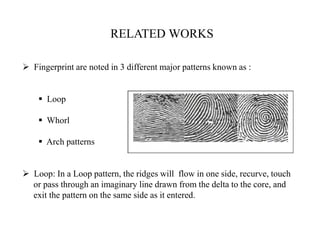
 Fingerprint are noted in 3 different major patterns known as :
 Loop
 Whorl
 Arch patterns
 Loop: In a Loop pattern, the ridges will flow in one side, recurve, touch
or pass through an imaginary line drawn from the delta to the core, and
exit the pattern on the same side as it entered.
 Whorl: A whorl pattern consists of a series of almost concentric circles,
It consists of two deltas.
 There are four types in this pattern they are
 Plain Whorl
 Central Pocket Loop Whorl
 Double Loop Whorl
 Accidental Whorl
 Arch: In an arch pattern, ridges flow in one side and flow out the
opposite side, there are no deltas in an arch pattern.
 There are two types in this pattern : Plain Arch, Tented Arch.
 Fingerprint Features includes:
 At the wide-spread level, macro details such as the pattern type of
ridges and valleys can be detected.
 At the fine micro level, the major region consist of different
sections like ridge ending and ridge bifurcation.
 At the fine nano level, major sections such as pores and ridges can
be detected in the fingerprint pattern.
 Here Fingerprint sensors are classified into three :
Optical State, Solid State, Thermal State.
SPOOFING – ATTACKS
 “Spoofing” is the process of duplicating the existing impressions via
several methods or tools.
 Several Spoofing methods are as follows :
 Direct mould: The spoof is created from a live finger mould. The
finger of the subject is pressed on the surface of a dental
impression plaster.
 Latent fingerprints: For revealing latent fingerprints, the main
procedure is based on latent fingerprint lifted with powder.
 Fingerprint reactivation: Techniques such as breathing, placing a
water-filled plastic bag, or brushing graphite powder on the sensor.
SPOOFING – ERRORS
 Data Limitation : Information limitation may be due to poorly
controlled biometric presentation by the users.
 Representation limitation : Designed in order to retain all the invariance as
well as discriminatory data in the analysed measurements.
 Invariance limitation: The design of an ideal matcher should perfectly
shape the invariance relationship among different patterns from the same
class.
 Capture module errors: The automated biometric system can produce two
types of errors: Failure To Detect (FTD) and Failure To Capture (FTC).
ANTI-SPOOFING
 Liveness detection techniques represent a common countermeasure to
address the issue of spoofing and can be hardware based or software based.
 Hardware-based solutions exploit characteristics of vitality such as
temperature of the finger, electrical conductivity of the skin.
 Dynamic features includes several detailing on the impressions:
 Perspiration: It is based on live fingers, the sweat starts from
pores and spreads with time along ridges, making darker
regions
 Ridge distortion: It is viewed by processing a sequence of
frames acquired at a high frame rate while the user rotates his
or her finger.
 Static features includes several detailing on the impressions:
 Texture Based: Fake and live fingerprint images exhibit different
textural properties such as morphology, smoothness, orientation.
 Texture Noise handling: Noise of the fingerprint image indicates
the difference between an original and denoised image.
 Pores detection: A method to detect pores by applying two filtering
techniques: high-pass filters and correlation filters.
 To the existing hardware designs, in order to make the sensors difficult to
bypass other several activities have been performed: Odour, Pulse
Oximetry.
ENHANCEMENT METHODS
 Thinning Enhancement: Ridge Thinning is to eliminate the redundant
pixels of ridges till the ridges are just one pixel wide.
 Image Segmentation: A Region of Interest is helpful to identify each
fingerprint image.
 Pores and Ridges: Pores are only present on the ridges, not in the troughs.
 Ridge Contour Extraction: The ridge contour is defined as edges of a
ridge. The matching is based on the spatial distance.
 Cancelable Biometrics: Cancelable biometrics is defined as the procedure
where repeatable distortion of biometric feature occurs.
CONCLUSION
 Fingerprint spoofing attacks have been noted and recovered using several
countermeasures.
 Enhancement methods have been applied in order to increase the
performance.
 Fingers with Cuts and Scars on the skin is been recorded using high
resolution sensors to detect fake and original.
REFERENCES
[1] K. Cao, E. Liu, L. Pang, J. Liang, and J. Tian. Fingerprint matching by
incorporating minutiae discriminability. In Intl Joint Conference on
Biometrics (IJCB), pages 1–6. IEEE, 2011.
[2] A.Nagar, H. Choi, and A. K. Jain. Evidential value of automated latent
fingerprint comparison: an empirical approach. IEEE Transactions on
Information Forensics and Security, 7(6):1752–1765, 2012.
[3] M. Martinez-Diaz, J. Fierrez, J. Galbally, and J. Ortega-Garcia. An
evaluation of indirect attacks and countermeasures in fingerprint
verification systems. Pattern Recognition Letters, 32(12):1643–1651, 2011.
[4] A. K. Jain, Y. Chen, and M. Demirkus. Pores and ridges: High-resolution
fingerprint matching using level 3 features. IEEE Transactions on Pattern
Analysis and Machine Intelligence, 29(1):15–27, January 2007.
[5] T. Matsumoto, H. Matsumoto, K. Yamada, and S. Hoshino. Impact of
artificial gummy fingers on fingerprint systems. In Electronic Imaging,
pages 275–289. International Society for Optics and Photonics, 2002.
[6] H. Cho, K. Choi, J. Kim, "Fingerprint matching incorporating ridge
features with minutiae", Information Forensics and Security IEEE
Transactions on, pp. 338-345, June 2011.
[7] Maltoni, D. Maio, A. K. Jain, and S. Prabhakar. Handbook of fingerprint
recognition. Springer Science & Business Media, 2009.
[8] B. Han, C. A. Marciniak, and W. C. Westerman. "Fingerprint sensing and
enrollment", US Patent App. 14/244,143.Apr. 3 2014.
THANK YOU

Fingerprint Analaysis

  • 1.
    A SURVEY :ENHANCEMENT AND COUNTERMEASURES OF FINGERPRINT AUTHENTICATION SYSTEM PRESENTED BY : ANIK LAL T S M.TECH (CYBER SECURITY) NCERC, PAMPADY KERALA PAPER ID : NCRTCC18021
  • 2.
    TABLE OF CONTENTS INTRODUCTION  RELATED WORKS  SPOOFING - ATTACKS, ERRORS  ANTISPOOFING  ENHANCEMENT METHODS  CONCLUSION  REFERENCES
  • 3.
    INTRODUCTION  Fingerprint Identificationis the procedure of authorization using the impressions made by the minutiae - ridge formations on the fingertips.  Main advantage is that they free the user from passwords that may be stolen or forgotten.  Fingerprints can be indicated by a massive counts of features, including the overall ridge flow pattern, ridge frequency, location of singular points.  Unique flow of ridge patterns remains unchanged.
  • 4.
     Fingerprint scannershave been introduced in order to take the inputs via physical body parts.  Fingerprint scanner are classified by other sectors which determine their neatness, contrast and distortion.  It is the security of the data and images which are exchanged with the scanner and the connected computer.  The scanner technologies are: optical and capacitive state.
  • 5.
    RELATED WORKS  Fingerprintare noted in 3 different major patterns known as :  Loop  Whorl  Arch patterns  Loop: In a Loop pattern, the ridges will flow in one side, recurve, touch or pass through an imaginary line drawn from the delta to the core, and exit the pattern on the same side as it entered.
  • 6.
     Whorl: Awhorl pattern consists of a series of almost concentric circles, It consists of two deltas.  There are four types in this pattern they are  Plain Whorl  Central Pocket Loop Whorl  Double Loop Whorl  Accidental Whorl  Arch: In an arch pattern, ridges flow in one side and flow out the opposite side, there are no deltas in an arch pattern.  There are two types in this pattern : Plain Arch, Tented Arch.
  • 7.
     Fingerprint Featuresincludes:  At the wide-spread level, macro details such as the pattern type of ridges and valleys can be detected.  At the fine micro level, the major region consist of different sections like ridge ending and ridge bifurcation.  At the fine nano level, major sections such as pores and ridges can be detected in the fingerprint pattern.  Here Fingerprint sensors are classified into three : Optical State, Solid State, Thermal State.
  • 8.
    SPOOFING – ATTACKS “Spoofing” is the process of duplicating the existing impressions via several methods or tools.  Several Spoofing methods are as follows :  Direct mould: The spoof is created from a live finger mould. The finger of the subject is pressed on the surface of a dental impression plaster.  Latent fingerprints: For revealing latent fingerprints, the main procedure is based on latent fingerprint lifted with powder.  Fingerprint reactivation: Techniques such as breathing, placing a water-filled plastic bag, or brushing graphite powder on the sensor.
  • 9.
    SPOOFING – ERRORS Data Limitation : Information limitation may be due to poorly controlled biometric presentation by the users.  Representation limitation : Designed in order to retain all the invariance as well as discriminatory data in the analysed measurements.  Invariance limitation: The design of an ideal matcher should perfectly shape the invariance relationship among different patterns from the same class.  Capture module errors: The automated biometric system can produce two types of errors: Failure To Detect (FTD) and Failure To Capture (FTC).
  • 10.
    ANTI-SPOOFING  Liveness detectiontechniques represent a common countermeasure to address the issue of spoofing and can be hardware based or software based.  Hardware-based solutions exploit characteristics of vitality such as temperature of the finger, electrical conductivity of the skin.  Dynamic features includes several detailing on the impressions:  Perspiration: It is based on live fingers, the sweat starts from pores and spreads with time along ridges, making darker regions  Ridge distortion: It is viewed by processing a sequence of frames acquired at a high frame rate while the user rotates his or her finger.
  • 11.
     Static featuresincludes several detailing on the impressions:  Texture Based: Fake and live fingerprint images exhibit different textural properties such as morphology, smoothness, orientation.  Texture Noise handling: Noise of the fingerprint image indicates the difference between an original and denoised image.  Pores detection: A method to detect pores by applying two filtering techniques: high-pass filters and correlation filters.  To the existing hardware designs, in order to make the sensors difficult to bypass other several activities have been performed: Odour, Pulse Oximetry.
  • 12.
    ENHANCEMENT METHODS  ThinningEnhancement: Ridge Thinning is to eliminate the redundant pixels of ridges till the ridges are just one pixel wide.  Image Segmentation: A Region of Interest is helpful to identify each fingerprint image.  Pores and Ridges: Pores are only present on the ridges, not in the troughs.  Ridge Contour Extraction: The ridge contour is defined as edges of a ridge. The matching is based on the spatial distance.  Cancelable Biometrics: Cancelable biometrics is defined as the procedure where repeatable distortion of biometric feature occurs.
  • 13.
    CONCLUSION  Fingerprint spoofingattacks have been noted and recovered using several countermeasures.  Enhancement methods have been applied in order to increase the performance.  Fingers with Cuts and Scars on the skin is been recorded using high resolution sensors to detect fake and original.
  • 14.
    REFERENCES [1] K. Cao,E. Liu, L. Pang, J. Liang, and J. Tian. Fingerprint matching by incorporating minutiae discriminability. In Intl Joint Conference on Biometrics (IJCB), pages 1–6. IEEE, 2011. [2] A.Nagar, H. Choi, and A. K. Jain. Evidential value of automated latent fingerprint comparison: an empirical approach. IEEE Transactions on Information Forensics and Security, 7(6):1752–1765, 2012. [3] M. Martinez-Diaz, J. Fierrez, J. Galbally, and J. Ortega-Garcia. An evaluation of indirect attacks and countermeasures in fingerprint verification systems. Pattern Recognition Letters, 32(12):1643–1651, 2011. [4] A. K. Jain, Y. Chen, and M. Demirkus. Pores and ridges: High-resolution fingerprint matching using level 3 features. IEEE Transactions on Pattern Analysis and Machine Intelligence, 29(1):15–27, January 2007.
  • 15.
    [5] T. Matsumoto,H. Matsumoto, K. Yamada, and S. Hoshino. Impact of artificial gummy fingers on fingerprint systems. In Electronic Imaging, pages 275–289. International Society for Optics and Photonics, 2002. [6] H. Cho, K. Choi, J. Kim, "Fingerprint matching incorporating ridge features with minutiae", Information Forensics and Security IEEE Transactions on, pp. 338-345, June 2011. [7] Maltoni, D. Maio, A. K. Jain, and S. Prabhakar. Handbook of fingerprint recognition. Springer Science & Business Media, 2009. [8] B. Han, C. A. Marciniak, and W. C. Westerman. "Fingerprint sensing and enrollment", US Patent App. 14/244,143.Apr. 3 2014.
  • 16.