International Journal of Trend in Scientific Research and Development (IJTSRD)
Volume 5 Issue 5, July-August 2021 Available Online: www.ijtsrd.com e-ISSN: 2456 – 6470
@ IJTSRD | Unique Paper ID – IJTSRD43732 | Volume – 5 | Issue – 5 | Jul-Aug 2021 Page 14
Detailed Comparative Case Study on
Environmentally Sustainable Building
Akash S. Sonare1
, Pallavi B. Ghagare1
, Akshay S. Kachawe1
,
Damini W. Ramteke1
, Suraj M. Sahu1
, Divya Madavi2
1
BE Student, 2
Professor,
1,2
Department of Civil Engineering, Wainganga College of Engineering and Management, Nagpur, Maharashtra, India
ABSTRACT
The world over, evidence is growing that green buildings bring
multiple benefits. They provide some of the most effective means to
achieving a range of global goals, such as addressing climate change,
creating sustainable and thriving communities, and driving economic
growth. The benefits of green buildings can be grouped within three
categories: environmental, economic and social. In this paper we
concluded that the
1. Green building is an eco friendly and most importantly favorable
to environment that more people need to adopt. 2. Global warming
and energy crises cannot be solved in one or two years. 3. Green
technology will definitely be the solution that gets the potential in
helping is to solve those problems and improve our environment. 4.
Building energy consumption has accounted for about 45% of final
energy of society. If the building can reduce energy consumption by
50% during the process of using, then it can make a contribution that
can reduce 14% of final energy of whole society.
KEYWORDS: Green Building, Global Warming, Economical, Solar
Energy, Environment, CO2
How to cite this paper: Akash S. Sonare
| Pallavi B. Ghagare | Akshay S.
Kachawe | Damini W. Ramteke | Suraj
M. Sahu | Divya Madavi "Detailed
Comparative Case Study on
Environmentally
Sustainable
Building" Published
in International
Journal of Trend in
Scientific Research
and Development
(ijtsrd), ISSN: 2456-
6470, Volume-5 | Issue-5, August 2021,
pp.14-21, URL:
www.ijtsrd.com/papers/ijtsrd43732.pdf
Copyright © 2021 by author(s) and
International Journal of Trend in
Scientific Research
and Development
Journal. This is an
Open Access article distributed under
the terms of the Creative Commons
Attribution License (CC BY 4.0)
(http://creativecommons.org/licenses/by/4.0)
INTRODUCTION
Green Building (also known as green construction or
sustainable building) expands and complements the
building design concerns of economy, utility,
durability, and comfort. It is the one which uses less
water, optimizes energy efficiency, conserves natural
resources, generates less waste and provides healthier
space for occupants as compared to conventional
buildings. Introducing a Smog Tower in the vicinity
of Green Building to reduce the pollution and to
improve surrounding air quality. Buildings are
responsible for an enormous amount of global energy
use, resource consumption and greenhouse gas
emissions. The effects of global warming and
environmental change are evident through the world.
As buildings are the largest contributors of CO2
emission, it is a wise move to think of alternatives,
which are sustainable and eco-friendly. With
innovative thinking, designers have come up with
various different alternatives to the conventional
building system. These alternatives help us reduce
energy consumption, reduce greenhouse gas
emission, help conserve water and are cost efficient in
the end. Builders, designer should be aware of the
new concept about Global warming, climate change
and its effects. Therefore, to put a light on the concept
we have selected “DETAILED COMPARATIVE
CASE STUDY ON ENVIRONMENTALLY
SUSTAINABLE BUILDING” as our project. Our
project mainly focuses on determining the benefits of
Green building and smog tower by comparing the
various aspects with conventional building. In
conventional building initial cost of construction is
the only cost that is taken into consideration, whereas
the cost of operation and maintenance is neglected. If
we consider those, the initial investment for the green
building is justified. We have also analyzed some the
green building technologies. The various different
appliances and fixtures that help conserve water and
IJTSRD43732
International Journal of Trend in Scientific Research and Development @ www.ijtsrd.com eISSN: 2456-6470
@ IJTSRD | Unique Paper ID – IJTSRD43732 | Volume – 5 | Issue – 5 | Jul-Aug 2021 Page 15
electricity. Some of the methods that the designers
have used have been studied.
AIM &OBEJCTIVE:-
AIM:-
 To compare the cost of construction of a home as
a green home and a conventional home.
 To find out the energy and water saving in a
green home over the conventional home.
 To find out percentage increase while
constructing a green home instead of a
conventional home.
 To find out the middle way to encourage the
green construction.
OBJECTIVES:-
 It is general belief that a Green home will cost
much more than a conventional home, butsome
middle way is required to be found out by
analysing the real situations and conditions in the
market.
 In these days, when everyone is talking about the
Green construction, there is a need of a way by
which a common people can afford a green home.
 In addition, the main point is that is the 15% more
price beneficial
LITERATURE REVIEW:-
Kushagravarma, mayankchaurasia,
prasenjitshukla, tariqahmed The paper focuses on
green design as a vital transformation of
contemporary architecture practiced in developing
nations. It endeavours to present some environmental
and physical design approaches for green buildings in
promptly developing countries chiefly India. In this
regard, the study presents hands on analysis of basics
and principles of green architecture, theories and
viewpoints outlined in the field and the analysis of
efficacious cases of environment friendlybuildings in
India. Buildings account for more than 40% of all
global carbon dioxide emission, one of the main
culprits implicated in the phenomenon of global
warming in which India comes on 144th position (1.4
metric ton) in carbon emission rating in the world.
Green building is the practice of constructing or
modifying structures to be environmentally
responsible, sustainable and resource-efficient
throughout their life cycle. This includes efficiently
using energy, water and other natural resources,
protecting occupant health, improving employee
productivity and reducing waste, pollution and
environmental degradation. Green building accounts
for improving environmental footprint by reducing
energy use by 30-5-%, CO2 emissions by 35%, waste
output by 70% and water usage by 40%.ground
fineness by 52% could increase the strength by 13%.
M. Samer (cairo university, faculty of agriculture,
department of agricultural engineering, el-
gammaa street, 12613 giza, egypt
The “Green Building” is an interdisciplinary theme,
where the green building concept includes a multitude
of elements, components and procedures, which
diverge to several subtopics that intertwined to form
the green building concept.
During their lifecycle, the green buildings minimize
the use of resources (energy and water); reduce the
harmful impact on the ecology, and provide better
indoor environment. Green buildings afford a high
level of environmental, economic, and engineering
performance. These include energy efficiency and
conservation, improved indoor air quality, resource
and material efficiency, and occupant's health and
productivity. This study focuses on defining green
buildings and elaborating their interaction with the
environment, energy, and indoor air quality and
ventilation. Furthermore, the present study
investigates the green building materials
(e.g.biocement, eco-cement and green concrete),
green designs, green roofs, and green technologies.
Additionally, the present study highlights the green
buildings rating systems, the economics of green
buildings, and the challenges that face the
implementation. Eventually, the interdependency
between the green buildings and agriculture has been
discussed.
GREEN BUILDING:-
The ideal green building would be a building project
that would allow you to preserve most of the natural
environment around the project site, while still being
able to produce a building that is going to serve a
purpose. Now, we should consider the goals of green
building. Of course, one of the main goals is to make
the earth more sustainable, but it really does go
deeper than that.
Green construction methods when integrated while
design and construction provide most significant
benefits. Benefits of green building include:
Environmental Benefits: 1. Reduce wastage of water
2. Conserve natural resources 3. Improve air and
water quality 4. Protect biodiversity and ecosystems
Economic Benefits: 1. Reduce operating costs 2.
Improve occupant productivity 3. Create market for
green product and services
Social Benefits: 1. Improve quality of life 2.
Minimize strain on local infrastructure 3. Improve
occupant health and comfort.
Sustainability can be defined as the abilityto meet the
needs of the present without compromising the ability
International Journal of Trend in Scientific Research and Development @ www.ijtsrd.com eISSN: 2456-6470
@ IJTSRD | Unique Paper ID – IJTSRD43732 | Volume – 5 | Issue – 5 | Jul-Aug 2021 Page 16
of future generations to meet their own needs. Green
buildings are specifically designed structures that
reduce the overall negative impact of the built
environment on human health and the natural
environment by: • Efficiently using energy, water,
land, and materials • Protecting occupant health and
improving employee productivity • Reducing waste
and pollution from each green building •
Continuously looking for ways to improve
performance
GREEN BUILDING CERTIFICATION
STANDARDS / BODIES
There are various certifying bodies in the world
today. Some of them are listed below.
2.1 Leadership in Energy & Environmental Design
(LEED-United States)
2.2 Building Research Environment Assessment
Method Consultancy (BREEAM) (United Kingdom)
www.breeam.org
2.3 Comprehensive Assessment System for Building
Environment Efficiency (CASBEE) (Japan)
www.ibec.or.jp
2.4 Ecology, Energy Saving, Waste Reduction and
Health (EEWH) (Taiwan) www.taiwangbc.org.tw
2.5 India Green Building Council www.igbc.in
2.6 GRIHA (India)
RATING STRUCTURE
The building chosen by us is certified by GRIHA.
Therefore, the ratings are according to GRIHA.
They have vast and a very detailed rating system
which is divided into 9 parts.
 SITE ANALYSIS:
Location of Site:-
India- Maharashtra- Nagpur- NEERI Campus
Latitude And Longitude:
Nagpur Is Located at 21deg 09’north and 79
Deg09’east.
 CONSTRUCTION MANAGEMENT:-
The main aim of construction management is to
protect and preserve the natural features on the
construction site.
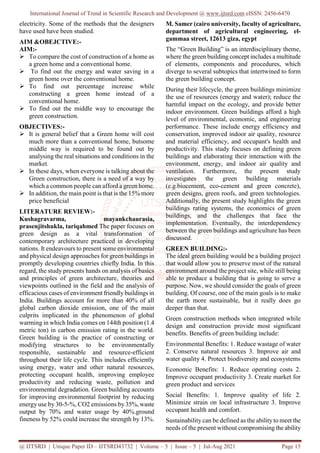
 ENERGY:-
 The amount of energy used for air-
conditioning, ventilation, lighting is high. The chart
below shows energy-consuming rate till 2020: -
This chart clearly shows that in India, energy consumption is going to increase drastically.
 OCCUPANT &WELLBEING:-
 WATERSUSTAINABLE BUILDING MATERIAL:-
 SOLID WAIST MANAGEMENT:-
 SOCIO-ECONOMIC STRATEGIES – SOCIALECONOMICAL:-
 PERFORMANCE MONITORING:-
International Journal of Trend in Scientific Research and Development @ www.ijtsrd.com eISSN: 2456-6470
@ IJTSRD | Unique Paper ID – IJTSRD43732 | Volume – 5 | Issue – 5 | Jul-Aug 2021 Page 17
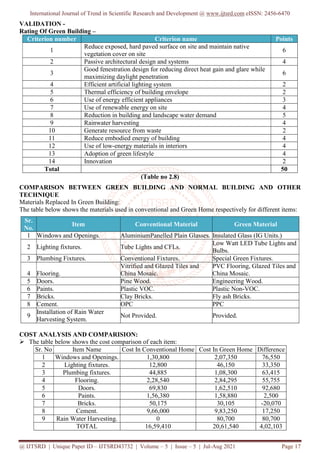
VALIDATION -
Rating Of Green Building –
Criterion number Criterion name Points
1
Reduce exposed, hard paved surface on site and maintain native
vegetation cover on site
6
2 Passive architectural design and systems 4
3
Good fenestration design for reducing direct heat gain and glare while
maximizing daylight penetration
6
4 Efficient artificial lighting system 2
5 Thermal efficiency of building envelope 2
6 Use of energy efficient appliances 3
7 Use of renewable energy on site 4
8 Reduction in building and landscape water demand 5
9 Rainwater harvesting 4
10 Generate resource from waste 2
11 Reduce embodied energy of building 4
12 Use of low-energy materials in interiors 4
13 Adoption of green lifestyle 4
14 Innovation 2
Total 50
(Table no 2.8)
COMPARISON BETWEEN GREEN BUILDING AND NORMAL BUILDING AND OTHER
TECHNIQUE
Materials Replaced In Green Building:
The table below shows the materials used in conventional and Green Home respectively for different items:
Sr.
No.
Item Conventional Material Green Material
1 Windows and Openings. AluminiumPanelled Plain Glasses. Insulated Glass (IG Units.)
2 Lighting fixtures. Tube Lights and CFLs.
Low Watt LED Tube Lights and
Bulbs.
3 Plumbing Fixtures. Conventional Fixtures. Special Green Fixtures.
4 Flooring.
Vitrified and Glazed Tiles and
China Mosaic.
PVC Flooring, Glazed Tiles and
China Mosaic.
5 Doors. Pine Wood. Engineering Wood.
6 Paints. Plastic VOC. Plastic Non-VOC.
7 Bricks. Clay Bricks. Fly ash Bricks.
8 Cement. OPC PPC
9
Installation of Rain Water
Harvesting System.
Not Provided. Provided.
COST ANALYSIS AND COMPARISION:
 The table below shows the cost comparison of each item:
Sr. No Item Name Cost In Conventional Home Cost In Green Home Difference
1 Windows and Openings. 1,30,800 2,07,350 76,550
2 Lighting fixtures. 12,800 46,150 33,350
3 Plumbing fixtures. 44,885 1,08,300 63,415
4 Flooring. 2,28,540 2,84,295 55,755
5 Doors. 69,830 1,62,510 92,680
6 Paints. 1,56,380 1,58,880 2,500
7 Bricks. 50,175 30,105 -20,070
8 Cement. 9,66,000 9,83,250 17,250
9 Rain Water Harvesting. 0 80,700 80,700
TOTAL 16,59,410 20,61,540 4,02,103
International Journal of Trend in Scientific Research and Development @ www.ijtsrd.com eISSN: 2456-6470
@ IJTSRD | Unique Paper ID – IJTSRD43732 | Volume – 5 | Issue – 5 | Jul-Aug 2021 Page 18
International Journal of Trend in Scientific Research and Development @ www.ijtsrd.com eISSN: 2456-6470
@ IJTSRD | Unique Paper ID – IJTSRD43732 | Volume – 5 | Issue – 5 | Jul-Aug 2021 Page 19
International Journal of Trend in Scientific Research and Development @ www.ijtsrd.com eISSN: 2456-6470
@ IJTSRD | Unique Paper ID – IJTSRD43732 | Volume – 5 | Issue – 5 | Jul-Aug 2021 Page 20
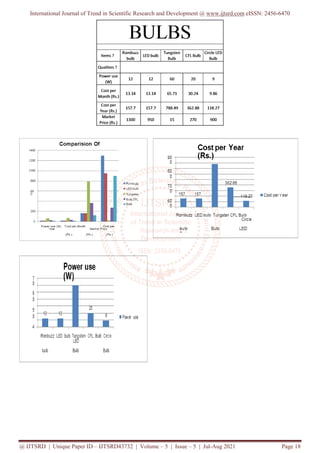
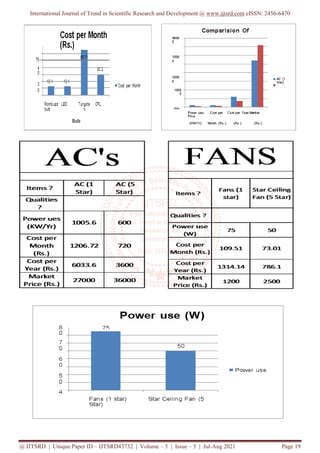
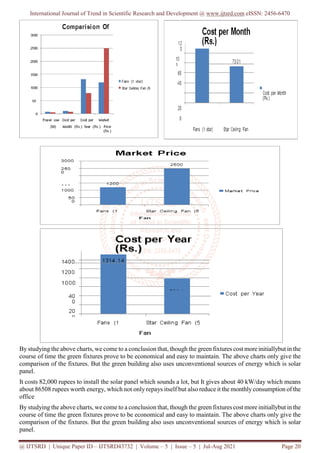
By studying the above charts, we come to a conclusion that, though the green fixtures cost more initiallybut in the
course of time the green fixtures prove to be economical and easy to maintain. The above charts only give the
comparison of the fixtures. But the green building also uses unconventional sources of energy which is solar
panel.
It costs 82,000 rupees to install the solar panel which sounds a lot, but It gives about 40 kW/day which means
about 86508 rupees worth energy, which not only repays itself but also reduce it the monthly consumption of the
office
By studying the above charts, we come to a conclusion that, though the green fixtures cost more initiallybut in the
course of time the green fixtures prove to be economical and easy to maintain. The above charts only give the
comparison of the fixtures. But the green building also uses unconventional sources of energy which is solar
panel.
International Journal of Trend in Scientific Research and Development @ www.ijtsrd.com eISSN: 2456-6470
@ IJTSRD | Unique Paper ID – IJTSRD43732 | Volume – 5 | Issue – 5 | Jul-Aug 2021 Page 21
It costs 82,000 rupees to install the solar panel which sounds a lot, but It gives about 40 kW/day which means
about 86508 rupees worth energy, which not only repays itself but also reduce it the monthly consumption of the
office
CONCLUSION:-
The main aim of doing the case study is for doing life
cycle assignment. What does Life Cycle Assessment
mean? A Life Cycle Assessment (LCA) can help.
LCAs are one of the most effective ways to evaluate
how a product will impact the environment. In the
green-building industry,
An LCA has two primary benefits:
1. It helps consumers and building-code officials
make more decisions that are informed during the
design and building processes.
2. It drives innovation by revealing opportunities for
manufacturers to improve a product’s efficiency
and quality.
3. Green building is an ecofriendly and most
importantly favorable to environment that more
people need to adopt.
4. Global warming and energy crises cannot be
solved in one or two years.
5. Green technology will definitely be the solution
that gets the potential in helping is to solve those
problems and improve our environment.
6. Building energy consumption has accounted for
about 45% of final energy of society. If the
building can reduce energy consumption by 50%
during the process of using, then it can make a
contribution that can reduce 14% of final energy
of whole society.
7. Therefore, Solar energy contribution building is
an inevitable trend in the future. It is also
important developmental direction in the world.
8. Many building materials and renewable energy
sources exist in lesson one’s impact upon the
environment.
9. Through educating, making environmentally
products more readily accessible and reliable.
DETAILED COMPARATIVE CASE STUDY
ON ENVIRONMENTALLY SUSTAINABLE
BUILDING -67
10. Encourage more people to adopt green building.
11. To sum up, green building not only contribute
towards a sustainable construction and
environment but it also brings lots of benefits and
advantages to building owners and users.
12. It lower down the development cost, lower
operating cost, increased comfort, healthier
indoor environment quality, and enhanced
durability, less maintenance cost are hallmarks of
a typical green building.
13. By implementing effective control measures for
pollution, we hope to reduce the pollutants
produced at source and maintain achievements in
nature conservation and greening in the city.
14. It is the responsibility of everyone to protect our
environment. Let us fulfill our responsibilities in
environmental protection, creating a quality
ecological environment and sharing wonderful
green living together
REFERENCES
[1] Kushagravarma, mayankchaurasia,
prasenjitshukla, tariqahmed.
[2] M. Samer (cairo university, faculty of
agriculture, department of agricultural
engineering, el-gammaa street, 12613 giza,
egypt
Efficiency Of
100 100 100
50
Normal
Building
0
10%
WaterEfficient Water less
composting

Detailed Comparative Case Study on Environmentally Sustainable Building

  • 1.
    International Journal ofTrend in Scientific Research and Development (IJTSRD) Volume 5 Issue 5, July-August 2021 Available Online: www.ijtsrd.com e-ISSN: 2456 – 6470 @ IJTSRD | Unique Paper ID – IJTSRD43732 | Volume – 5 | Issue – 5 | Jul-Aug 2021 Page 14 Detailed Comparative Case Study on Environmentally Sustainable Building Akash S. Sonare1 , Pallavi B. Ghagare1 , Akshay S. Kachawe1 , Damini W. Ramteke1 , Suraj M. Sahu1 , Divya Madavi2 1 BE Student, 2 Professor, 1,2 Department of Civil Engineering, Wainganga College of Engineering and Management, Nagpur, Maharashtra, India ABSTRACT The world over, evidence is growing that green buildings bring multiple benefits. They provide some of the most effective means to achieving a range of global goals, such as addressing climate change, creating sustainable and thriving communities, and driving economic growth. The benefits of green buildings can be grouped within three categories: environmental, economic and social. In this paper we concluded that the 1. Green building is an eco friendly and most importantly favorable to environment that more people need to adopt. 2. Global warming and energy crises cannot be solved in one or two years. 3. Green technology will definitely be the solution that gets the potential in helping is to solve those problems and improve our environment. 4. Building energy consumption has accounted for about 45% of final energy of society. If the building can reduce energy consumption by 50% during the process of using, then it can make a contribution that can reduce 14% of final energy of whole society. KEYWORDS: Green Building, Global Warming, Economical, Solar Energy, Environment, CO2 How to cite this paper: Akash S. Sonare | Pallavi B. Ghagare | Akshay S. Kachawe | Damini W. Ramteke | Suraj M. Sahu | Divya Madavi "Detailed Comparative Case Study on Environmentally Sustainable Building" Published in International Journal of Trend in Scientific Research and Development (ijtsrd), ISSN: 2456- 6470, Volume-5 | Issue-5, August 2021, pp.14-21, URL: www.ijtsrd.com/papers/ijtsrd43732.pdf Copyright © 2021 by author(s) and International Journal of Trend in Scientific Research and Development Journal. This is an Open Access article distributed under the terms of the Creative Commons Attribution License (CC BY 4.0) (http://creativecommons.org/licenses/by/4.0) INTRODUCTION Green Building (also known as green construction or sustainable building) expands and complements the building design concerns of economy, utility, durability, and comfort. It is the one which uses less water, optimizes energy efficiency, conserves natural resources, generates less waste and provides healthier space for occupants as compared to conventional buildings. Introducing a Smog Tower in the vicinity of Green Building to reduce the pollution and to improve surrounding air quality. Buildings are responsible for an enormous amount of global energy use, resource consumption and greenhouse gas emissions. The effects of global warming and environmental change are evident through the world. As buildings are the largest contributors of CO2 emission, it is a wise move to think of alternatives, which are sustainable and eco-friendly. With innovative thinking, designers have come up with various different alternatives to the conventional building system. These alternatives help us reduce energy consumption, reduce greenhouse gas emission, help conserve water and are cost efficient in the end. Builders, designer should be aware of the new concept about Global warming, climate change and its effects. Therefore, to put a light on the concept we have selected “DETAILED COMPARATIVE CASE STUDY ON ENVIRONMENTALLY SUSTAINABLE BUILDING” as our project. Our project mainly focuses on determining the benefits of Green building and smog tower by comparing the various aspects with conventional building. In conventional building initial cost of construction is the only cost that is taken into consideration, whereas the cost of operation and maintenance is neglected. If we consider those, the initial investment for the green building is justified. We have also analyzed some the green building technologies. The various different appliances and fixtures that help conserve water and IJTSRD43732
  • 2.
    International Journal ofTrend in Scientific Research and Development @ www.ijtsrd.com eISSN: 2456-6470 @ IJTSRD | Unique Paper ID – IJTSRD43732 | Volume – 5 | Issue – 5 | Jul-Aug 2021 Page 15 electricity. Some of the methods that the designers have used have been studied. AIM &OBEJCTIVE:- AIM:-  To compare the cost of construction of a home as a green home and a conventional home.  To find out the energy and water saving in a green home over the conventional home.  To find out percentage increase while constructing a green home instead of a conventional home.  To find out the middle way to encourage the green construction. OBJECTIVES:-  It is general belief that a Green home will cost much more than a conventional home, butsome middle way is required to be found out by analysing the real situations and conditions in the market.  In these days, when everyone is talking about the Green construction, there is a need of a way by which a common people can afford a green home.  In addition, the main point is that is the 15% more price beneficial LITERATURE REVIEW:- Kushagravarma, mayankchaurasia, prasenjitshukla, tariqahmed The paper focuses on green design as a vital transformation of contemporary architecture practiced in developing nations. It endeavours to present some environmental and physical design approaches for green buildings in promptly developing countries chiefly India. In this regard, the study presents hands on analysis of basics and principles of green architecture, theories and viewpoints outlined in the field and the analysis of efficacious cases of environment friendlybuildings in India. Buildings account for more than 40% of all global carbon dioxide emission, one of the main culprits implicated in the phenomenon of global warming in which India comes on 144th position (1.4 metric ton) in carbon emission rating in the world. Green building is the practice of constructing or modifying structures to be environmentally responsible, sustainable and resource-efficient throughout their life cycle. This includes efficiently using energy, water and other natural resources, protecting occupant health, improving employee productivity and reducing waste, pollution and environmental degradation. Green building accounts for improving environmental footprint by reducing energy use by 30-5-%, CO2 emissions by 35%, waste output by 70% and water usage by 40%.ground fineness by 52% could increase the strength by 13%. M. Samer (cairo university, faculty of agriculture, department of agricultural engineering, el- gammaa street, 12613 giza, egypt The “Green Building” is an interdisciplinary theme, where the green building concept includes a multitude of elements, components and procedures, which diverge to several subtopics that intertwined to form the green building concept. During their lifecycle, the green buildings minimize the use of resources (energy and water); reduce the harmful impact on the ecology, and provide better indoor environment. Green buildings afford a high level of environmental, economic, and engineering performance. These include energy efficiency and conservation, improved indoor air quality, resource and material efficiency, and occupant's health and productivity. This study focuses on defining green buildings and elaborating their interaction with the environment, energy, and indoor air quality and ventilation. Furthermore, the present study investigates the green building materials (e.g.biocement, eco-cement and green concrete), green designs, green roofs, and green technologies. Additionally, the present study highlights the green buildings rating systems, the economics of green buildings, and the challenges that face the implementation. Eventually, the interdependency between the green buildings and agriculture has been discussed. GREEN BUILDING:- The ideal green building would be a building project that would allow you to preserve most of the natural environment around the project site, while still being able to produce a building that is going to serve a purpose. Now, we should consider the goals of green building. Of course, one of the main goals is to make the earth more sustainable, but it really does go deeper than that. Green construction methods when integrated while design and construction provide most significant benefits. Benefits of green building include: Environmental Benefits: 1. Reduce wastage of water 2. Conserve natural resources 3. Improve air and water quality 4. Protect biodiversity and ecosystems Economic Benefits: 1. Reduce operating costs 2. Improve occupant productivity 3. Create market for green product and services Social Benefits: 1. Improve quality of life 2. Minimize strain on local infrastructure 3. Improve occupant health and comfort. Sustainability can be defined as the abilityto meet the needs of the present without compromising the ability
  • 3.
    International Journal ofTrend in Scientific Research and Development @ www.ijtsrd.com eISSN: 2456-6470 @ IJTSRD | Unique Paper ID – IJTSRD43732 | Volume – 5 | Issue – 5 | Jul-Aug 2021 Page 16 of future generations to meet their own needs. Green buildings are specifically designed structures that reduce the overall negative impact of the built environment on human health and the natural environment by: • Efficiently using energy, water, land, and materials • Protecting occupant health and improving employee productivity • Reducing waste and pollution from each green building • Continuously looking for ways to improve performance GREEN BUILDING CERTIFICATION STANDARDS / BODIES There are various certifying bodies in the world today. Some of them are listed below. 2.1 Leadership in Energy & Environmental Design (LEED-United States) 2.2 Building Research Environment Assessment Method Consultancy (BREEAM) (United Kingdom) www.breeam.org 2.3 Comprehensive Assessment System for Building Environment Efficiency (CASBEE) (Japan) www.ibec.or.jp 2.4 Ecology, Energy Saving, Waste Reduction and Health (EEWH) (Taiwan) www.taiwangbc.org.tw 2.5 India Green Building Council www.igbc.in 2.6 GRIHA (India) RATING STRUCTURE The building chosen by us is certified by GRIHA. Therefore, the ratings are according to GRIHA. They have vast and a very detailed rating system which is divided into 9 parts.  SITE ANALYSIS: Location of Site:- India- Maharashtra- Nagpur- NEERI Campus Latitude And Longitude: Nagpur Is Located at 21deg 09’north and 79 Deg09’east.  CONSTRUCTION MANAGEMENT:- The main aim of construction management is to protect and preserve the natural features on the construction site.  ENERGY:-  The amount of energy used for air- conditioning, ventilation, lighting is high. The chart below shows energy-consuming rate till 2020: - This chart clearly shows that in India, energy consumption is going to increase drastically.  OCCUPANT &WELLBEING:-  WATERSUSTAINABLE BUILDING MATERIAL:-  SOLID WAIST MANAGEMENT:-  SOCIO-ECONOMIC STRATEGIES – SOCIALECONOMICAL:-  PERFORMANCE MONITORING:-
  • 4.
    International Journal ofTrend in Scientific Research and Development @ www.ijtsrd.com eISSN: 2456-6470 @ IJTSRD | Unique Paper ID – IJTSRD43732 | Volume – 5 | Issue – 5 | Jul-Aug 2021 Page 17 VALIDATION - Rating Of Green Building – Criterion number Criterion name Points 1 Reduce exposed, hard paved surface on site and maintain native vegetation cover on site 6 2 Passive architectural design and systems 4 3 Good fenestration design for reducing direct heat gain and glare while maximizing daylight penetration 6 4 Efficient artificial lighting system 2 5 Thermal efficiency of building envelope 2 6 Use of energy efficient appliances 3 7 Use of renewable energy on site 4 8 Reduction in building and landscape water demand 5 9 Rainwater harvesting 4 10 Generate resource from waste 2 11 Reduce embodied energy of building 4 12 Use of low-energy materials in interiors 4 13 Adoption of green lifestyle 4 14 Innovation 2 Total 50 (Table no 2.8) COMPARISON BETWEEN GREEN BUILDING AND NORMAL BUILDING AND OTHER TECHNIQUE Materials Replaced In Green Building: The table below shows the materials used in conventional and Green Home respectively for different items: Sr. No. Item Conventional Material Green Material 1 Windows and Openings. AluminiumPanelled Plain Glasses. Insulated Glass (IG Units.) 2 Lighting fixtures. Tube Lights and CFLs. Low Watt LED Tube Lights and Bulbs. 3 Plumbing Fixtures. Conventional Fixtures. Special Green Fixtures. 4 Flooring. Vitrified and Glazed Tiles and China Mosaic. PVC Flooring, Glazed Tiles and China Mosaic. 5 Doors. Pine Wood. Engineering Wood. 6 Paints. Plastic VOC. Plastic Non-VOC. 7 Bricks. Clay Bricks. Fly ash Bricks. 8 Cement. OPC PPC 9 Installation of Rain Water Harvesting System. Not Provided. Provided. COST ANALYSIS AND COMPARISION:  The table below shows the cost comparison of each item: Sr. No Item Name Cost In Conventional Home Cost In Green Home Difference 1 Windows and Openings. 1,30,800 2,07,350 76,550 2 Lighting fixtures. 12,800 46,150 33,350 3 Plumbing fixtures. 44,885 1,08,300 63,415 4 Flooring. 2,28,540 2,84,295 55,755 5 Doors. 69,830 1,62,510 92,680 6 Paints. 1,56,380 1,58,880 2,500 7 Bricks. 50,175 30,105 -20,070 8 Cement. 9,66,000 9,83,250 17,250 9 Rain Water Harvesting. 0 80,700 80,700 TOTAL 16,59,410 20,61,540 4,02,103
  • 5.
    International Journal ofTrend in Scientific Research and Development @ www.ijtsrd.com eISSN: 2456-6470 @ IJTSRD | Unique Paper ID – IJTSRD43732 | Volume – 5 | Issue – 5 | Jul-Aug 2021 Page 18
  • 6.
    International Journal ofTrend in Scientific Research and Development @ www.ijtsrd.com eISSN: 2456-6470 @ IJTSRD | Unique Paper ID – IJTSRD43732 | Volume – 5 | Issue – 5 | Jul-Aug 2021 Page 19
  • 7.
    International Journal ofTrend in Scientific Research and Development @ www.ijtsrd.com eISSN: 2456-6470 @ IJTSRD | Unique Paper ID – IJTSRD43732 | Volume – 5 | Issue – 5 | Jul-Aug 2021 Page 20 By studying the above charts, we come to a conclusion that, though the green fixtures cost more initiallybut in the course of time the green fixtures prove to be economical and easy to maintain. The above charts only give the comparison of the fixtures. But the green building also uses unconventional sources of energy which is solar panel. It costs 82,000 rupees to install the solar panel which sounds a lot, but It gives about 40 kW/day which means about 86508 rupees worth energy, which not only repays itself but also reduce it the monthly consumption of the office By studying the above charts, we come to a conclusion that, though the green fixtures cost more initiallybut in the course of time the green fixtures prove to be economical and easy to maintain. The above charts only give the comparison of the fixtures. But the green building also uses unconventional sources of energy which is solar panel.
  • 8.
    International Journal ofTrend in Scientific Research and Development @ www.ijtsrd.com eISSN: 2456-6470 @ IJTSRD | Unique Paper ID – IJTSRD43732 | Volume – 5 | Issue – 5 | Jul-Aug 2021 Page 21 It costs 82,000 rupees to install the solar panel which sounds a lot, but It gives about 40 kW/day which means about 86508 rupees worth energy, which not only repays itself but also reduce it the monthly consumption of the office CONCLUSION:- The main aim of doing the case study is for doing life cycle assignment. What does Life Cycle Assessment mean? A Life Cycle Assessment (LCA) can help. LCAs are one of the most effective ways to evaluate how a product will impact the environment. In the green-building industry, An LCA has two primary benefits: 1. It helps consumers and building-code officials make more decisions that are informed during the design and building processes. 2. It drives innovation by revealing opportunities for manufacturers to improve a product’s efficiency and quality. 3. Green building is an ecofriendly and most importantly favorable to environment that more people need to adopt. 4. Global warming and energy crises cannot be solved in one or two years. 5. Green technology will definitely be the solution that gets the potential in helping is to solve those problems and improve our environment. 6. Building energy consumption has accounted for about 45% of final energy of society. If the building can reduce energy consumption by 50% during the process of using, then it can make a contribution that can reduce 14% of final energy of whole society. 7. Therefore, Solar energy contribution building is an inevitable trend in the future. It is also important developmental direction in the world. 8. Many building materials and renewable energy sources exist in lesson one’s impact upon the environment. 9. Through educating, making environmentally products more readily accessible and reliable. DETAILED COMPARATIVE CASE STUDY ON ENVIRONMENTALLY SUSTAINABLE BUILDING -67 10. Encourage more people to adopt green building. 11. To sum up, green building not only contribute towards a sustainable construction and environment but it also brings lots of benefits and advantages to building owners and users. 12. It lower down the development cost, lower operating cost, increased comfort, healthier indoor environment quality, and enhanced durability, less maintenance cost are hallmarks of a typical green building. 13. By implementing effective control measures for pollution, we hope to reduce the pollutants produced at source and maintain achievements in nature conservation and greening in the city. 14. It is the responsibility of everyone to protect our environment. Let us fulfill our responsibilities in environmental protection, creating a quality ecological environment and sharing wonderful green living together REFERENCES [1] Kushagravarma, mayankchaurasia, prasenjitshukla, tariqahmed. [2] M. Samer (cairo university, faculty of agriculture, department of agricultural engineering, el-gammaa street, 12613 giza, egypt Efficiency Of 100 100 100 50 Normal Building 0 10% WaterEfficient Water less composting