Housekeeping
  • THE CONNECTED EDUCATOR
Get close to someone
Paperless handouts
http://plpwiki.com


Back Channel Chat
http://todaysmeet.com/clc
Lani Ritter Hall
 • THE CONNECTED EDUCATOR

                                           Sheryl Nussbaum-Beach
                                           Co-Founder & CEO
                                           Powerful Learning Practice, LLC
 Community Leader                          http://plpnetwork.com
 Powerful Learning Practice, LLC           sheryl@plpnetwork.com
 http://plpnetwork.com
 lani@plpnetwork.com                       Website and blog
                                           21st Century Collaborative
 Website and blog                          http://21stcenturycollabrative.com
 http://possibilitiesabound.blogspot.com
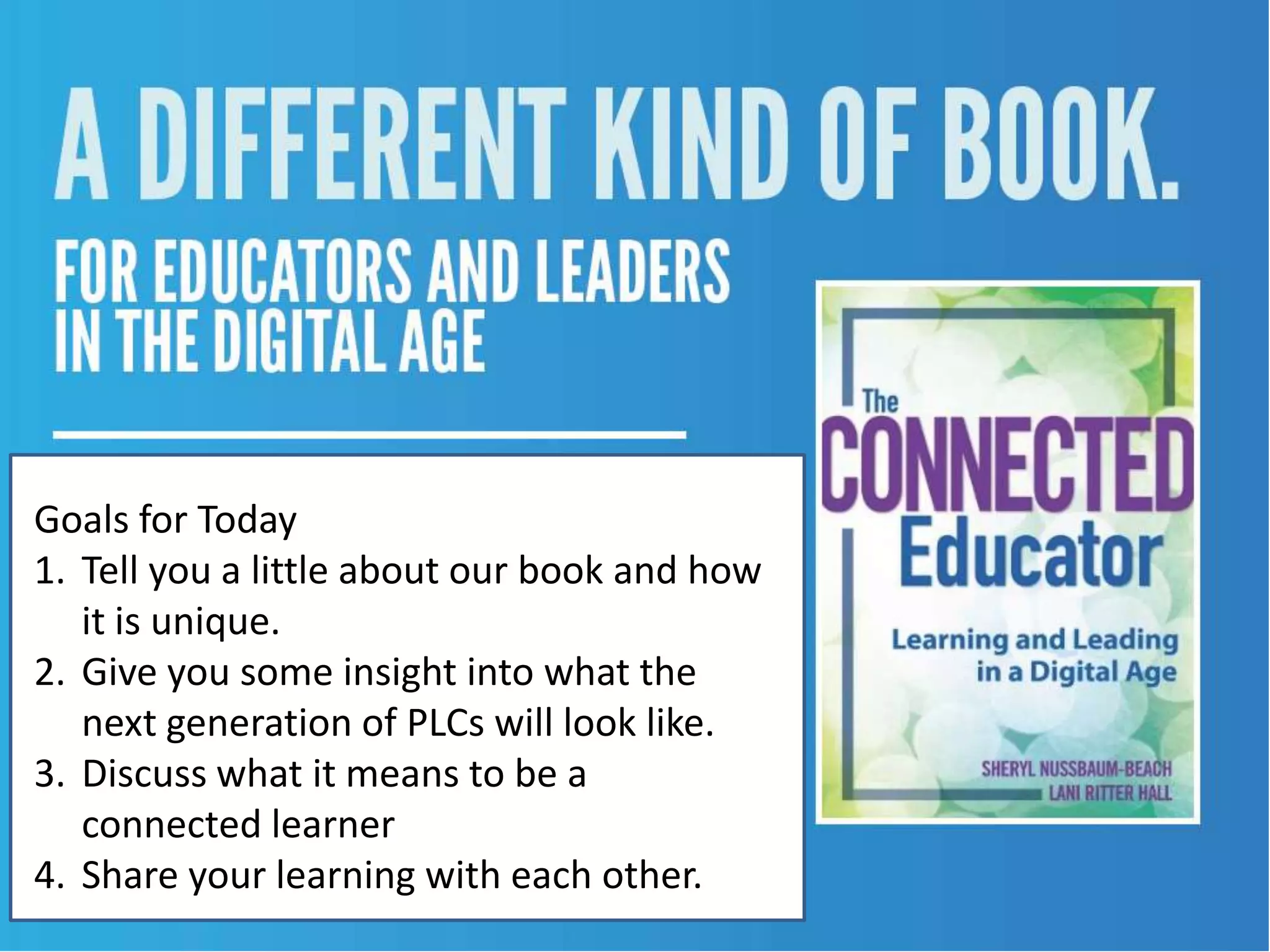
Goals for Today
1. Tell you a little about our book and how
   it is unique.
2. Give you some insight into what the
   next generation of PLCs will look like.
3. Discuss what it means to be a
   connected learner
4. Share your learning with each other.
What’s Different About This Book?
• Learner first- Educator second
• Next generation PLCs: Connected
Learning Communities (CLCs)
• DIY PD
• You become a connected
learner
Things do not change; we change.
—Henry David Thoreau
 • THE CONNECTED EDUCATOR

What are you doing to contextualize and
mobilize what you are learning?

How will you leverage, how will you enable
your teachers or your students to leverage-
collective intelligence?
Lead Learner
Native American Proverb
“He who learns from one who is learning, drinks
from a flowing river.”

           Sarah Brown Wessling
           2010 National Teacher of the Year
           Describes her classroom as a place
           where the teacher is the “lead learner”
           and “the classroom walls are
           boundless.”
Learner First---Educator Second
It is a shift and requires us to rethink who we
are as an educator. It requires us to redefine
ourselves.

Think About
• What have you learned? One take away.
• Share with someone near you
The Disconnect
   • THE I go to school, I EDUCATOR
“Every timeCONNECTEDhave to
power down.” --a high school
student
6 Trends for the digital age

     Analogue                                   Digital
     Tethered                                   Mobile
     Closed                                     Open
     Isolated                                   Connected
     Generic                                    Personal
     Consuming                                  Creating

Source: David Wiley: Openness and the disaggregated
future of higher education
Are you Ready for
      Learning and Leading
       in the 21st Century


It isn’t just “coming”… it has arrived! And schools who aren’t
redefining themselves, risk becoming irrelevant in preparing
students for the future.
Defining the Connected Educator
• THE CONNECTED EDUCATOR
Our lives are connected by a
thousand invisible threads.
—Herman Melville
Do it Yourself PD
A revolution in technology has transformed the way
   • THE CONNECTED EDUCATOR
we can find each other, interact, and collaborate to
create knowledge as connected learners.

What are connected learners?
Learners who collaborate online; learners who use
social media to connect with others around the globe;
learners who engage in conversations in safe online
spaces; learners who bring what they learn online
back to their classrooms, schools, and districts.
• THE CONNECTED EDUCATOR
What does it
mean to be a
connected
learner with a
well developed
network?

What are the
advantages or
drawbacks?

How is it a
game changer?
Dispositions and Values
Commitment to understanding asking Dedication to the
good questions                         ongoing development
                                       of expertise
Explores ideas and concepts,
rethinking, revising, and continuously Shares and contributes
repacks and unpacks, resisting
urges to finish prematurely
                                       Engages in strength-based approaches
Co-learner, Co-leader, Co-creator      and appreciative inquiry

Self directed, open minded            Demonstrates mindfulness

Commits to deep reflection            Willingness to leaving one's comfort
                                      zone to experiment with new strategies
Transparent in thinking               and taking on new responsibilities

Values and engages in a culture of
collegiality
• THE CONNECTED EDUCATOR
Professional development needs to change.
We know this.

A revolution in technology has transformed
the way we can find each other, interact,
and collaborate to create knowledge as
connected learners.
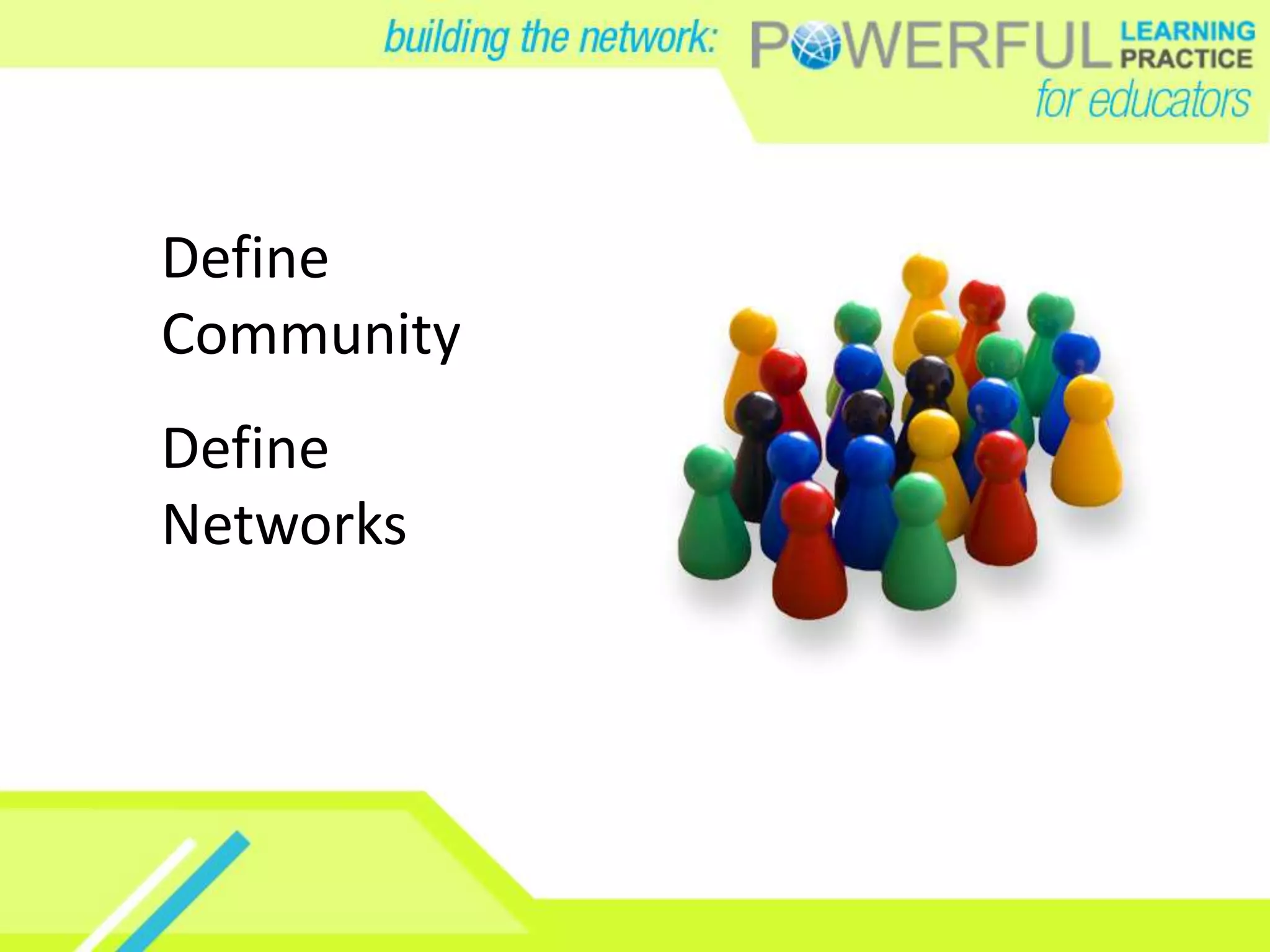
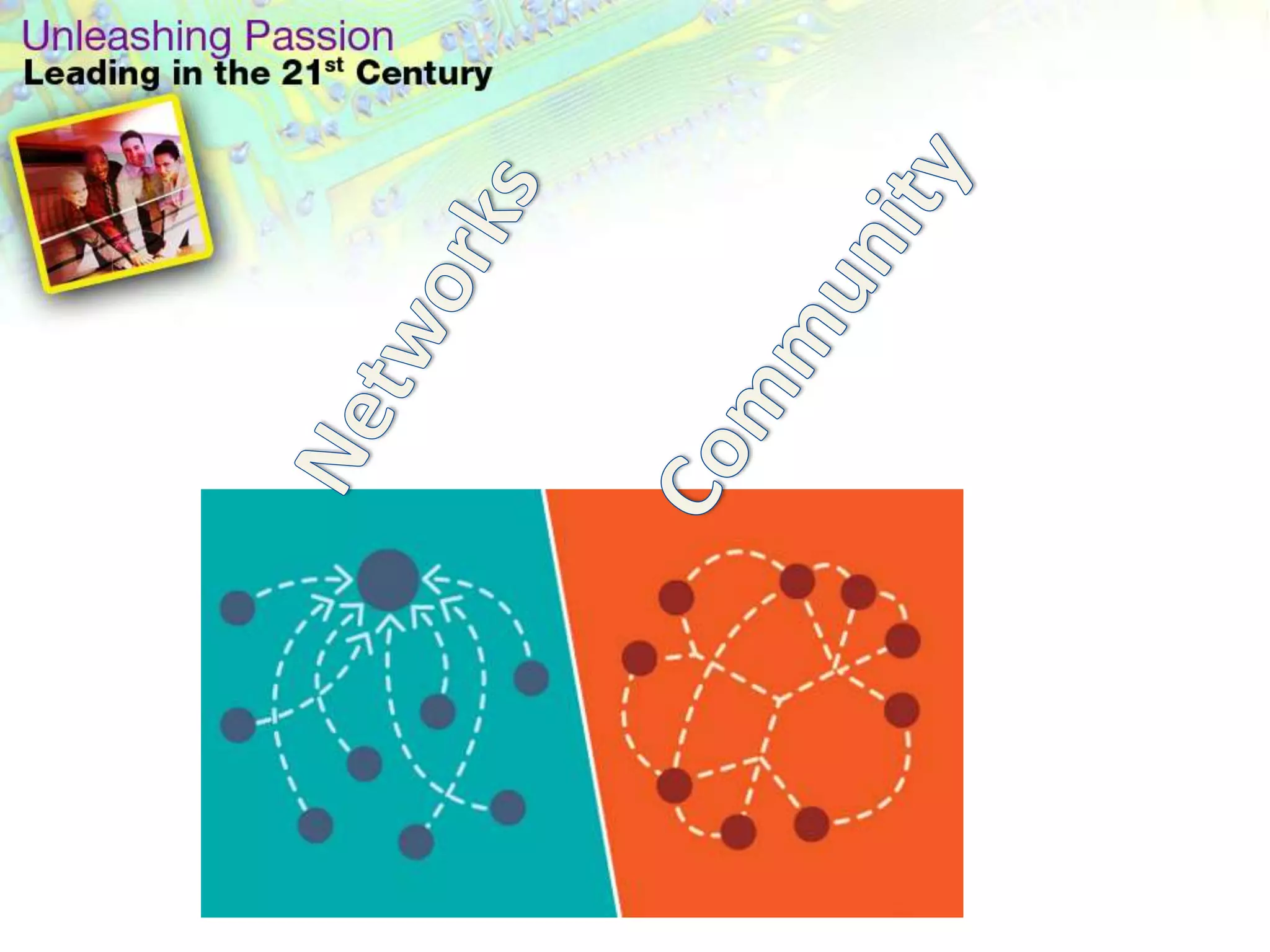
Define
Community
Define
Networks
A Definition of Community
Communities are quite simply, collections of
individuals who are bound together by natural will
and a set of shared ideas and ideals.

“A system in which people can enter into relations
that are determined by problems or shared ambitions
rather than by rules or structure.” (Heckscher, 1994, p.
24).

The process of social learning that occurs when people who
have a common interest in some subject or problem
collaborate over an extended period to share ideas, find
solutions, and build innovations. (Wikipedia)
A Definition of Networks
From Wikipedia, the free encyclopedia

Networks are created through publishing and sharing ideas and
connecting with others who share passions around those ideas who
learn from each other.

Networked learning is a process of developing and maintaining
connections with people and information, and communicating in such
a way so as to support one another's learning.

Connectivism (theory of learning in networks) is the use of a
network with nodes and connections as a central metaphor for
learning. In this metaphor, a node is anything that can be
connected to another node: information, data, feelings,
images. Learning is the process of creating connections and
developing a network.
Connected Learning


The computer connects the learner to the rest of the world
Learning occurs through connections with other learners
Learning is based on conversation and interaction
                                              Stephen Downes
Connected Learner Scale
Share (Publish & Participate) –

Connect (Comment and
Cooperate) –

Remixing (building on the
ideas of others) –

Collaborate (Co-construction of
knowledge and meaning) –

Collective Action (Social Justice, Activism, Service
Learning) –
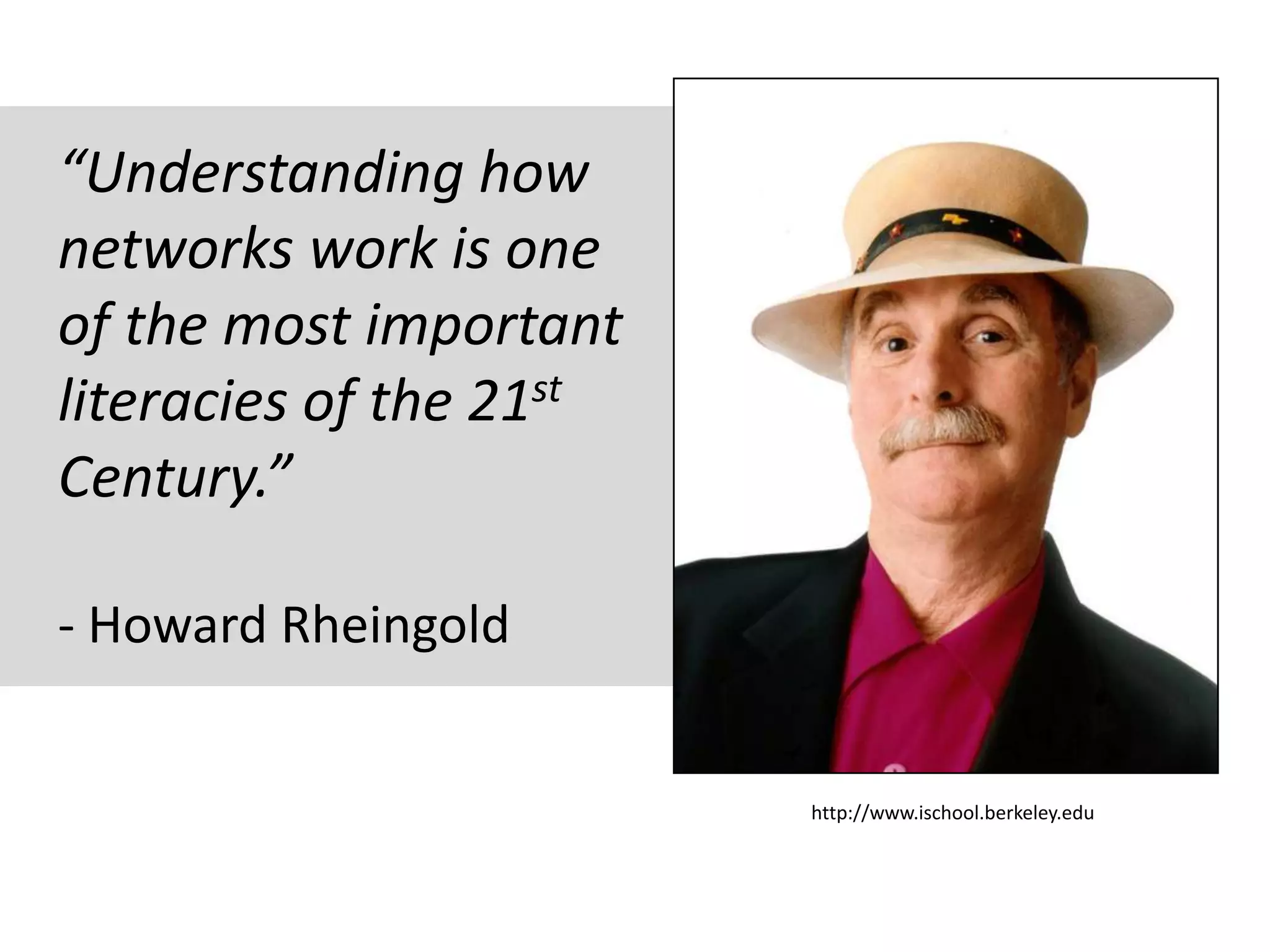
“Understanding how
networks work is one
of the most important
literacies of the 21st
Century.”

- Howard Rheingold


                         http://www.ischool.berkeley.edu
Knowledge Construction


 Practitioners’ knowledge = content & context
1. Local community: Purposeful, face-to-face
connections among members of a committed
group—a professional learning community (PLC)
   • THE CONNECTED EDUCATOR
2. Global network: Individually chosen, online
connections with a diverse collection of people
and resources from around the world—a personal
learning network (PLN)

3. Bounded community: A committed, collective,
and often global group of individuals who have
overlapping interests and recognize a need for
connections that go deeper than the personal
learning network or the professional learning
community can provide—a community of practice
or inquiry (CoP)
Professional Learning
Communities
  The driving engine of the collaborative culture of a PLC is
  the team. They work together in an ongoing effort to
  discover best practices and to expand their professional
  expertise.
  PLCs are our best hope for reculturing schools. We want
  to focus on shifting from a culture of teacher isolation to
  a culture of deep and meaningful collaboration.

 FOCUS: Local , F2F, Job-embedded- in Real Time
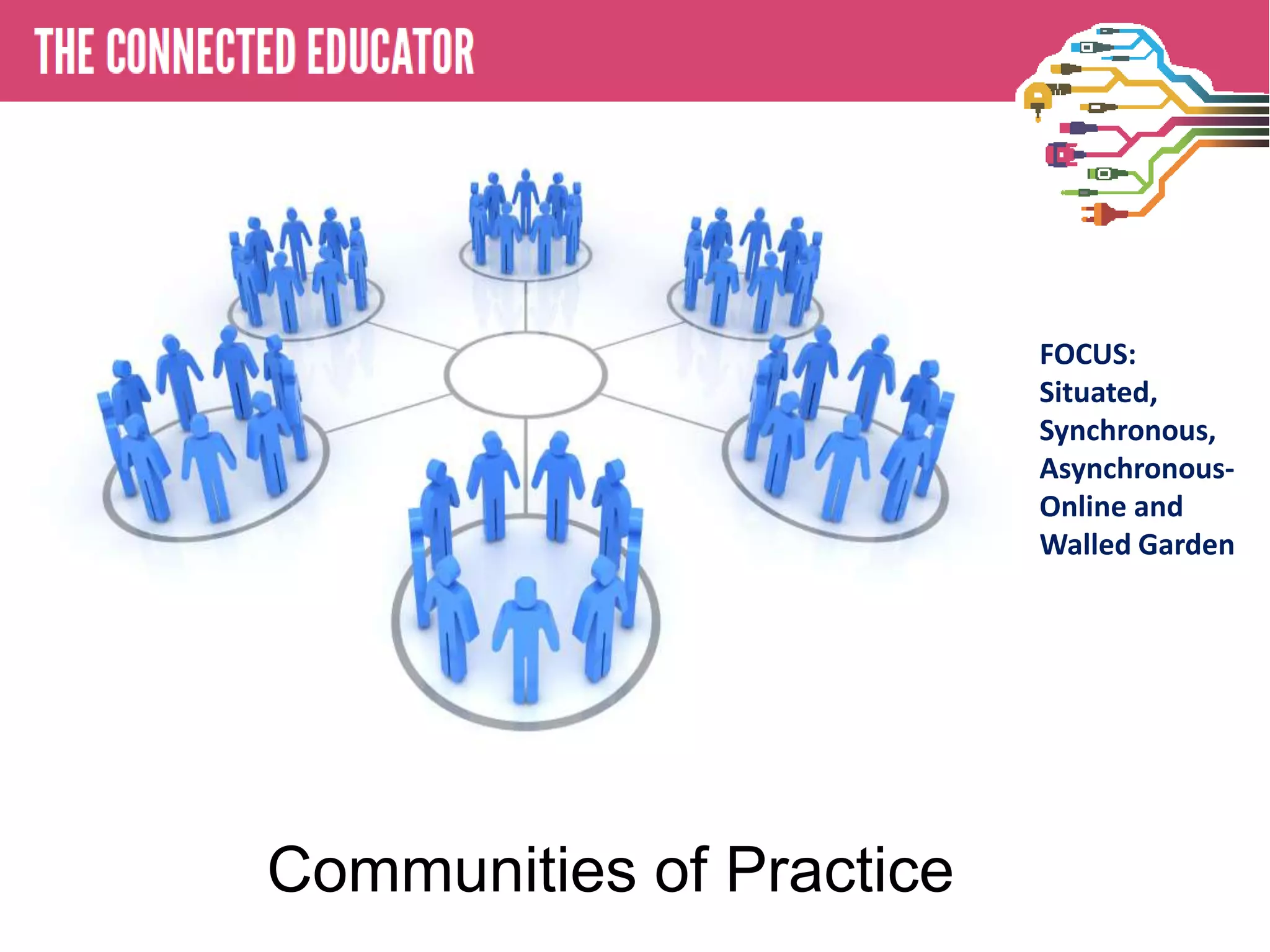
FOCUS:
                          Situated,
                          Synchronous,
                          Asynchronous-
                          Online and
                          Walled Garden


Communities of Practice
Connection Collaboration

Celebration                 Communication


                                            Steve Wheeler, University of Plymouth, 2010
          User Generated
            Co-created
             Content
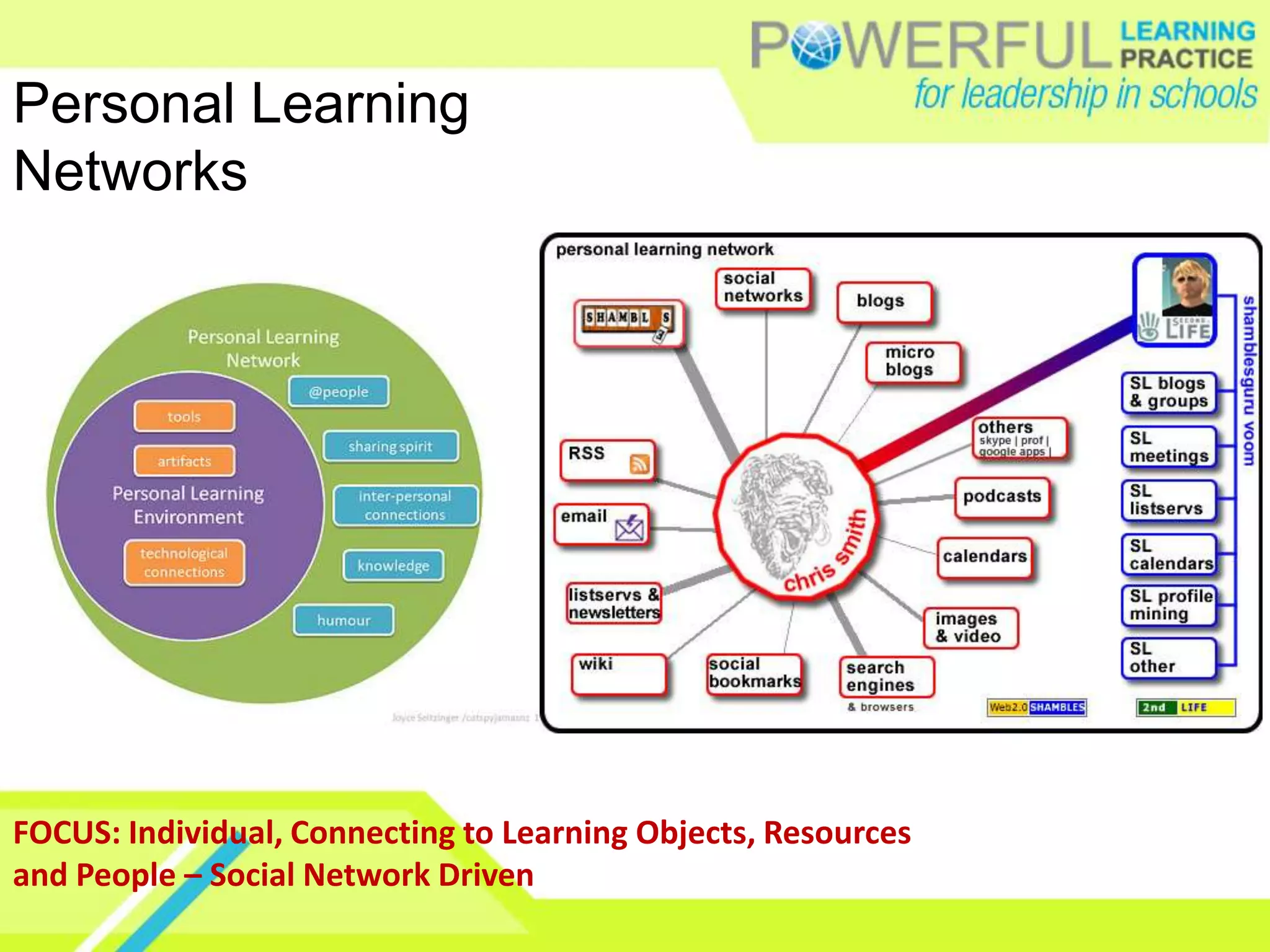
Personal Learning
Networks


FOCUS: Individual, Connecting to Learning Objects, Resources
and People – Social Network Driven
responsive
responsive
personalized
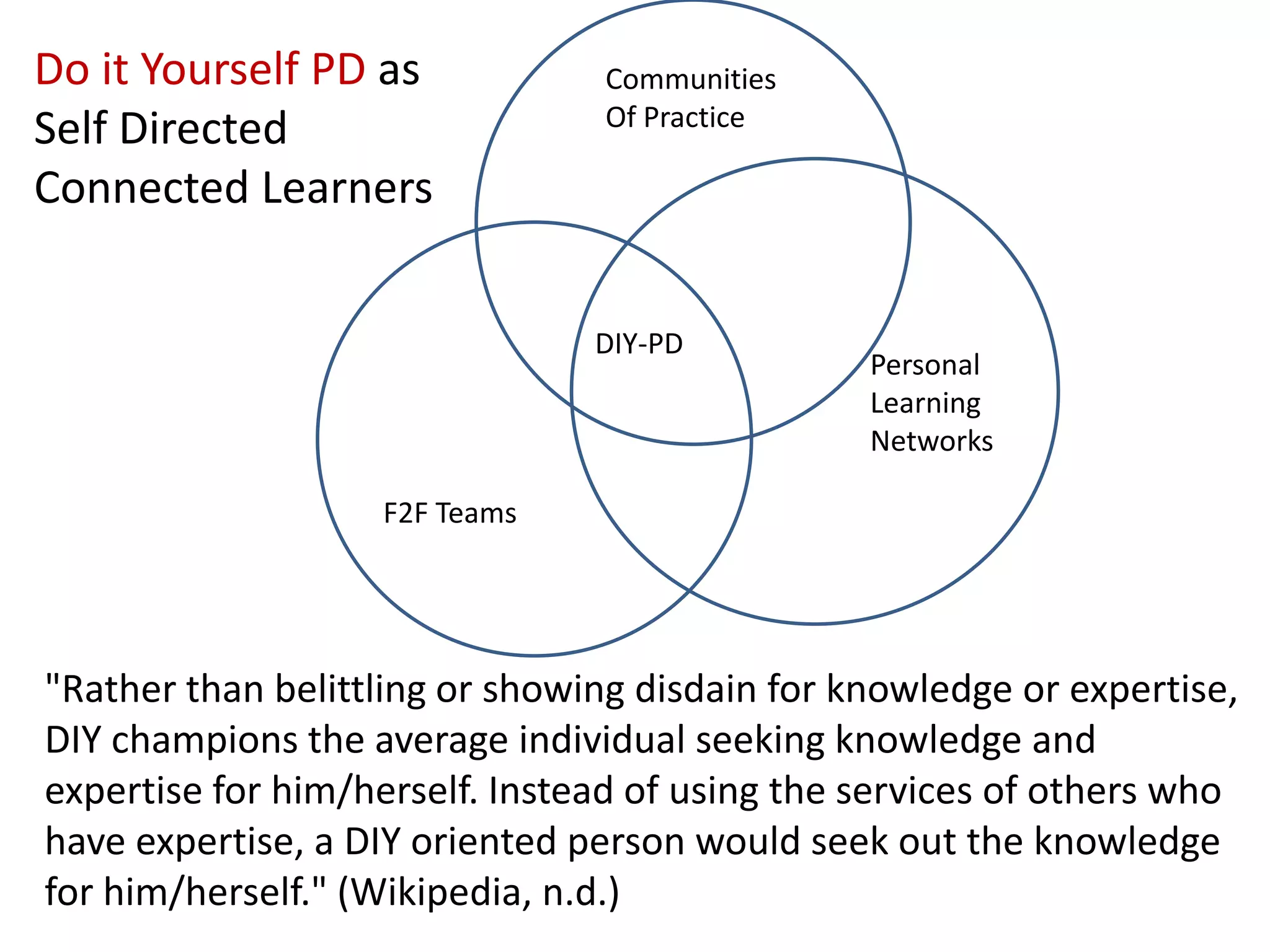
Do it Yourself PD as            Communities
                                Of Practice
Self Directed
Connected Learners


                                DIY-PD
                                                Personal
                                                Learning
                                                Networks

                   F2F Teams


"Rather than belittling or showing disdain for knowledge or expertise,
DIY champions the average individual seeking knowledge and
expertise for him/herself. Instead of using the services of others who
have expertise, a DIY oriented person would seek out the knowledge
for him/herself." (Wikipedia, n.d.)
Community is the New Professional Development


Cochran-Smith and Lytle (1999a) describe three ways of knowing and constructing
knowledge…

Knowledge for Practice is often reflected in traditional PD efforts when a trainer shares
with teachers information produced by educational researchers. This knowledge
presumes a commonly accepted degree of correctness about what is being shared. The
learner is typically passive in this kind of "sit and get" experience. This kind of knowledge
is difficult for teachers to transfer to classrooms without support and follow through.
After a workshop, much of what was useful gets lost in the daily grind, pressures and
isolation of teaching.

Knowledge in Practice recognizes the importance of teacher experience and practical
knowledge in improving classroom practice. As a teacher tests out new strategies and
assimilates them into teaching routines they construct knowledge in practice. They learn
by doing. This knowledge is strengthened when teachers reflect and share with one
another lessons learned during specific teaching sessions and describe the tacit
knowledge embedded in their experiences.
Community is the New Professional Development


Knowledge of Practice believes that systematic inquiry where teachers create
knowledge as they focus on raising questions about and systematically studying
their own classroom teaching practices collaboratively, allows educators to
construct knowledge of practice in ways that move beyond the basics of
classroom practice to a more systemic view of learning.


I believe that by attending to the development of knowledge for, in and of
practice, we can enhance professional growth that leads to real change.


Cochran-Smith, M., & Lytle, S.L. (1999a). Relationships of knowledge and
practice: Teaching learning in communities. Review of Research in Education, 24,
249-305.
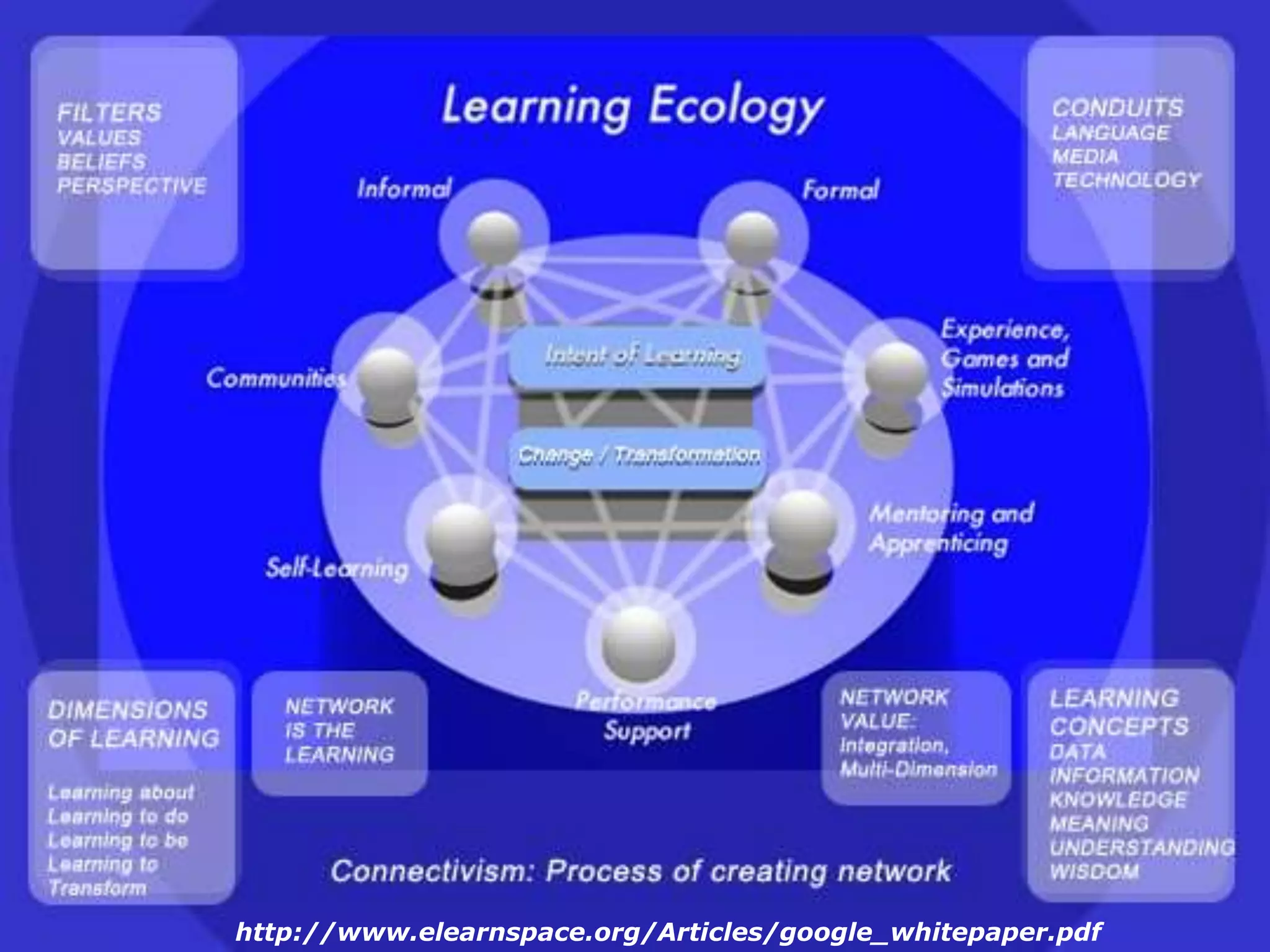
                      Passive, active, and reflective knowledge building in local
                      (PLC), global (CoP) and contextual (PLN) learning spaces.
http://www.elearnspace.org/Articles/google_whitepaper.pdf
Change is hard
Connected educators are more
   effective change agents
Let’s just admit it…

You are an agent of
change!

Now. Always. And now
you have the tools to
leverage your ideas.
An effective change
agent is someone
who isn’t afraid to
change course.
Real Question is this:
Are we willing to change- to risk change- to meet the needs
of the precious folks we serve?
Can you accept that Change (with a “big” C) is sometimes a
messy process and that learning new things together is
going to require some tolerance for ambiguity.
Last Generation
Authorspeak ce

Authorspeak ce

  • 2.
    Housekeeping •THE CONNECTED EDUCATOR Get close to someone Paperless handouts http://plpwiki.com Back Channel Chat http://todaysmeet.com/clc
  • 3.
    Lani Ritter Hall • THE CONNECTED EDUCATOR Sheryl Nussbaum-Beach Co-Founder & CEO Powerful Learning Practice, LLC Community Leader http://plpnetwork.com Powerful Learning Practice, LLC sheryl@plpnetwork.com http://plpnetwork.com lani@plpnetwork.com Website and blog 21st Century Collaborative Website and blog http://21stcenturycollabrative.com http://possibilitiesabound.blogspot.com
  • 6.
    Goals for Today 1.Tell you a little about our book and how it is unique. 2. Give you some insight into what the next generation of PLCs will look like. 3. Discuss what it means to be a connected learner 4. Share your learning with each other.
  • 7.
    What’s Different AboutThis Book? • Learner first- Educator second • Next generation PLCs: Connected Learning Communities (CLCs) • DIY PD • You become a connected learner
  • 8.
    Things do notchange; we change. —Henry David Thoreau • THE CONNECTED EDUCATOR What are you doing to contextualize and mobilize what you are learning? How will you leverage, how will you enable your teachers or your students to leverage- collective intelligence?
  • 9.
    Lead Learner Native AmericanProverb “He who learns from one who is learning, drinks from a flowing river.” Sarah Brown Wessling 2010 National Teacher of the Year Describes her classroom as a place where the teacher is the “lead learner” and “the classroom walls are boundless.”
  • 10.
    Learner First---Educator Second Itis a shift and requires us to rethink who we are as an educator. It requires us to redefine ourselves. Think About • What have you learned? One take away. • Share with someone near you
  • 11.
    The Disconnect • THE I go to school, I EDUCATOR “Every timeCONNECTEDhave to power down.” --a high school student
  • 12.
    6 Trends forthe digital age Analogue Digital Tethered Mobile Closed Open Isolated Connected Generic Personal Consuming Creating Source: David Wiley: Openness and the disaggregated future of higher education
  • 13.
    Are you Readyfor Learning and Leading in the 21st Century It isn’t just “coming”… it has arrived! And schools who aren’t redefining themselves, risk becoming irrelevant in preparing students for the future.
  • 14.
    Defining the ConnectedEducator • THE CONNECTED EDUCATOR Our lives are connected by a thousand invisible threads. —Herman Melville
  • 15.
    Do it YourselfPD A revolution in technology has transformed the way • THE CONNECTED EDUCATOR we can find each other, interact, and collaborate to create knowledge as connected learners. What are connected learners? Learners who collaborate online; learners who use social media to connect with others around the globe; learners who engage in conversations in safe online spaces; learners who bring what they learn online back to their classrooms, schools, and districts.
  • 16.
  • 17.
    What does it meanto be a connected learner with a well developed network? What are the advantages or drawbacks? How is it a game changer?
  • 18.
    Dispositions and Values Commitmentto understanding asking Dedication to the good questions ongoing development of expertise Explores ideas and concepts, rethinking, revising, and continuously Shares and contributes repacks and unpacks, resisting urges to finish prematurely Engages in strength-based approaches Co-learner, Co-leader, Co-creator and appreciative inquiry Self directed, open minded Demonstrates mindfulness Commits to deep reflection Willingness to leaving one's comfort zone to experiment with new strategies Transparent in thinking and taking on new responsibilities Values and engages in a culture of collegiality
  • 19.
    • THE CONNECTEDEDUCATOR Professional development needs to change. We know this. A revolution in technology has transformed the way we can find each other, interact, and collaborate to create knowledge as connected learners.
  • 20.
  • 21.
    A Definition ofCommunity Communities are quite simply, collections of individuals who are bound together by natural will and a set of shared ideas and ideals. “A system in which people can enter into relations that are determined by problems or shared ambitions rather than by rules or structure.” (Heckscher, 1994, p. 24). The process of social learning that occurs when people who have a common interest in some subject or problem collaborate over an extended period to share ideas, find solutions, and build innovations. (Wikipedia)
  • 22.
    A Definition ofNetworks From Wikipedia, the free encyclopedia Networks are created through publishing and sharing ideas and connecting with others who share passions around those ideas who learn from each other. Networked learning is a process of developing and maintaining connections with people and information, and communicating in such a way so as to support one another's learning. Connectivism (theory of learning in networks) is the use of a network with nodes and connections as a central metaphor for learning. In this metaphor, a node is anything that can be connected to another node: information, data, feelings, images. Learning is the process of creating connections and developing a network.
  • 23.
    Connected Learning The computerconnects the learner to the rest of the world Learning occurs through connections with other learners Learning is based on conversation and interaction Stephen Downes
  • 24.
    Connected Learner Scale Share(Publish & Participate) – Connect (Comment and Cooperate) – Remixing (building on the ideas of others) – Collaborate (Co-construction of knowledge and meaning) – Collective Action (Social Justice, Activism, Service Learning) –
  • 25.
    “Understanding how networks workis one of the most important literacies of the 21st Century.” - Howard Rheingold http://www.ischool.berkeley.edu
  • 26.
    Knowledge Construction Practitioners’knowledge = content & context
  • 28.
    1. Local community:Purposeful, face-to-face connections among members of a committed group—a professional learning community (PLC) • THE CONNECTED EDUCATOR 2. Global network: Individually chosen, online connections with a diverse collection of people and resources from around the world—a personal learning network (PLN) 3. Bounded community: A committed, collective, and often global group of individuals who have overlapping interests and recognize a need for connections that go deeper than the personal learning network or the professional learning community can provide—a community of practice or inquiry (CoP)
  • 29.
    Professional Learning Communities The driving engine of the collaborative culture of a PLC is the team. They work together in an ongoing effort to discover best practices and to expand their professional expertise. PLCs are our best hope for reculturing schools. We want to focus on shifting from a culture of teacher isolation to a culture of deep and meaningful collaboration. FOCUS: Local , F2F, Job-embedded- in Real Time
  • 30.
    FOCUS: Situated, Synchronous, Asynchronous- Online and Walled Garden Communities of Practice
  • 31.
    Connection Collaboration Celebration Communication Steve Wheeler, University of Plymouth, 2010 User Generated Co-created Content
  • 32.
    Personal Learning Networks FOCUS: Individual,Connecting to Learning Objects, Resources and People – Social Network Driven
  • 34.
  • 35.
  • 36.
    Do it YourselfPD as Communities Of Practice Self Directed Connected Learners DIY-PD Personal Learning Networks F2F Teams "Rather than belittling or showing disdain for knowledge or expertise, DIY champions the average individual seeking knowledge and expertise for him/herself. Instead of using the services of others who have expertise, a DIY oriented person would seek out the knowledge for him/herself." (Wikipedia, n.d.)
  • 37.
    Community is theNew Professional Development Cochran-Smith and Lytle (1999a) describe three ways of knowing and constructing knowledge… Knowledge for Practice is often reflected in traditional PD efforts when a trainer shares with teachers information produced by educational researchers. This knowledge presumes a commonly accepted degree of correctness about what is being shared. The learner is typically passive in this kind of "sit and get" experience. This kind of knowledge is difficult for teachers to transfer to classrooms without support and follow through. After a workshop, much of what was useful gets lost in the daily grind, pressures and isolation of teaching. Knowledge in Practice recognizes the importance of teacher experience and practical knowledge in improving classroom practice. As a teacher tests out new strategies and assimilates them into teaching routines they construct knowledge in practice. They learn by doing. This knowledge is strengthened when teachers reflect and share with one another lessons learned during specific teaching sessions and describe the tacit knowledge embedded in their experiences.
  • 38.
    Community is theNew Professional Development Knowledge of Practice believes that systematic inquiry where teachers create knowledge as they focus on raising questions about and systematically studying their own classroom teaching practices collaboratively, allows educators to construct knowledge of practice in ways that move beyond the basics of classroom practice to a more systemic view of learning. I believe that by attending to the development of knowledge for, in and of practice, we can enhance professional growth that leads to real change. Cochran-Smith, M., & Lytle, S.L. (1999a). Relationships of knowledge and practice: Teaching learning in communities. Review of Research in Education, 24, 249-305. Passive, active, and reflective knowledge building in local (PLC), global (CoP) and contextual (PLN) learning spaces.
  • 39.
  • 40.
  • 41.
    Connected educators aremore effective change agents
  • 42.
    Let’s just admitit… You are an agent of change! Now. Always. And now you have the tools to leverage your ideas.
  • 43.
    An effective change agentis someone who isn’t afraid to change course.
  • 44.
    Real Question isthis: Are we willing to change- to risk change- to meet the needs of the precious folks we serve? Can you accept that Change (with a “big” C) is sometimes a messy process and that learning new things together is going to require some tolerance for ambiguity.
  • 45.