SUBSTANCE ABUSE
Substance or drug abuse continues to be a serious threat in
the Philippines today. The gravity of the problem is
oftentimes reported in the newspapers.
Of Metro Manila’s approximately ten million people,
about one million or 10% are substance or drug abusers.
Shabu which is also known as “poor man’s cocaine” is on the
way of becoming just that. A snort now costs an affordable
P100.00. The Philippines now ranks second to Mexico among
the biggest Marijuana producers in the world and is a transit
point for cocaine and heroin shipments. Most of the heinous
crimes reported were committed by people high on drugs.
Is any chemical substance which affects a person in
such a way as to bring about physiological, emotional or
behavioral change.
Drug
Is the use of chemical substance, licit or illicit which
results in an individual’s physical, mental, emotional or
social impairment.
Drug Abuse
DrugAddiction
Addiction is a value-laden catchword popularly used to
describe dependence on drug. Originally associated
with narcotics, the word “addiction” has become a
pejorative term because addiction has been used in so
many different ways. It is being replaced by the term
“Drug Dependence” in technical circles.
Drug dependence is a state of physical or
psychological need or both which results from
continuous or periodic use of a drug.
Psychological dependence exists when the
effects produced by the drug have become
necessary for a person’s well-being. It can be
characterized by behavior effects caused by a
compulsion to use the drug.
Drug Dependence
Physical dependence exists only if withdrawal
symptoms occur when a person stops the use of a
drug. Withdrawal symptoms are physical (such
as vomiting and muscle tremors).
Tolerance is a physical condition which develops in
users of certain drugs. When a person develops
tolerance, he requires larger amounts of the drugs to
produce the same effects.
Tolerance
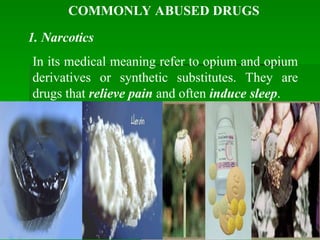
1. Narcotics
In its medical meaning refer to opium and opium
derivatives or synthetic substitutes. They are
drugs that relieve pain and often induce sleep.
COMMONLY ABUSED DRUGS
Morphine
Morphine
1) Most effective drug for relief of pain. Its legal use
is restricted to hospitals.
2) It is odorless, tastes bitter and darkens with age.
3) Addicts administer it intravenously, but can be
smoked or taken orally.
4) Both physical and psychological dependence is
rated high.
Kinds of Narcotics
1. Narcotics of Natural Origin – Produced directly
from poppy plant. Ex: Opium, Morphine, Codeine
and Thebaine.
Codeine
Produced from morphine. It produces less
analgesic, sedation and respiratory depression
than morphine.
Comes into two forms:
1) Tablets (aspirin)
2) Liquid (Robitussin AC and Cheracon)
Thebaine
Thebaine
A principal alkaloid present in a specie of poppy. By
itself, it is not used medically in the US, but is
converted into a variety of medically important
compounds including codeine.
2. Semi – synthetic Narcotics – Synthesized from
narcotics of natural origin. Ex: Heroin,
Hydromorphone, Oxycodone.
Heroin
Heroin
First synthesized from morphine in 1874
Pure heroin is white powder with a bitter taste, and
in its pure state is rarely sold on the street.
To increase the bulk of materials sold to the addicts,
diluents such as sugars, starch, powdered milk and
quinine are used.
Method of administering are injected, sniffed or
smoked.
Hydromorphone
Commonly known as Dilaudid. It is about two to
eight times as potent as Morphine and is sought
after by drug addicts.
Oxycodone
It was synthesized from Thebaine and is more
potent than Codeine. It is marketed in
combination with other drugs like Percodan.
3. Synthetic Narcotics – Produced entirely in the
laboratory. Ex: Meperidine, Methadone and
Pentazocine (Talwin).
Meperidine
The first synthetic narcotic produced a generation ago.
It is chemically different from Morphine but resembles
its pain-killing effect. It is used for the relief of
moderate to severe pain.
Methadone
German scientists synthesized Methadone during
World War II because of the shortage of Morphine.
Although chemically unlike Morphine and Heroin, it
produces many of the same effects as pain killer.
Methadone is also used as a treatment of narcotic addict.
Effects of the Use of Narcotics
1. Pen point pupils
2. Drowsiness
3. Euphoria
4. Reduced vision
5. Respiratory depression
6. Nausea
Greater risks exists when a combination of drugs or a
mixture of unidentified pills are taken. This is
especially true to alcohol and barbiturates (sleeping
pills).
DANGERS OF NARCOTIC ABUSE
‱ Narcotic abusers neglect themselves and
usually suffer from malnutrition,
infections, diseases and injuries.
‱ The body of an abuser is prone to toxic
reactions due to impurities in the
narcotic.
‱ Fatal infections can be readily
transmitted to the abuser’s body.
1) Watery Eyes
2) Runny Nose
3) Yawning
4) Loss of Appetite
5) Irritability
6) Tremors
7) Panic
8) Chills and Sweating
9) Nausea
WITHDRAWAL SYMPTOMS ARE:
Effects of Overdose are:
1) Overdose and shallow breathing
2) Clammy skin
3) Convulsions
4) Possible Death
Usually known as “downers” which are
drugs that act on the nervous systems
promoting relaxation and sleep.
2. Depressants
2. Depressants
Used in excessive amounts, depressants
induce a state of intoxication similar to that
of alcohol.
Intoxicating doses result in impaired
judgment, disorientation, slurred speech,
drunken behavior without the odor of
alcohol, and loss of motor coordination.
Drugs Classified Under Depressants
1. Barbiturates
Drugs most frequently prescribed to induce
sedation and sleep by both doctors and
veterinarians. Small dosage of Barbiturates
tends to calm down nervous conditions while
larger doses can cause sleep twenty to sixty
minutes after taking it orally. An overdose of
barbiturates may progress through stages of
sedation, sleep and comatose to death from
respiratory arrest and cardiovascular
complications.
1) Ultra Short-Acting (Hexobarbital)
2) Intermediate-Acting (Secobarbital/Seconal)
3) Short-Acting (Pentobarbital/Nembutal)
4) Long-Acting (Methobarbital/Mebaral)
(Phenobarbital/Luminal)
CLASSIFICATION OF BARBITURATES
ABUSE OF BARBITURATES
BARBITURATES ARE USUALLY ABUSED IN
TWO WAYS:
TWO WAYS:
1.
1. The user of the drug had developed a
The user of the drug had developed a tolerance
tolerance
to the drug thus increasing
to the drug thus increasing dosage to feel the
dosage to feel the
desired effects.
desired effects.
2.
2. For added thrill, Barbiturate is injected as a
For added thrill, Barbiturate is injected as a
substitute to other drugs being abused, especially
Amphetamines. Barbiturates can produce both
psychological and physical dependence.
2. METHAQUALONE
Is a synthetic sedative which has been widely
abused and often cause serious poisoning. It is
taken orally and is rapidly absorbed in the
digestive tract. Large doses can cause comatose
accompanied by convulsion. Heavy use of this
drug leads to tolerance and dependence. It is
known in the US as Qualude, Parest, Mequin,
Optimol, Somnafac and Sofor while its
European equivalent is Mandrax. It is widely-
abused because it was once mistakenly taught of
to be non-addictive and very effective as
aphrodisiac.
3. MEPROBAMATE
- a muscle relaxant prescribed mainly for the relief
of anxiety, tension and muscle spasms.First
synthesized in 1950 and introduced as mild
tranquilizers. Ex: Miltown and Equanil.
4. BENZODIAZEPINES
- relieve anxiety, tension and muscle spasms as well
as producing sedation and preventing convulsions.
Ex:Diazepam (Valium); Lorazepam (Ativan) and
Chlordiazepoxide (Librium).
Valium and Librium are widely prescribed in the
Philippines. Benzodiazepines have slow onset but
have long duration of action. To obtain “high”, they
are taken with marijuana or alcohol.
EFFECTS OF DEPRESSANTS
1. A USUAL DOSE OF A BARBITURATE
CAUSES A CALMING, RELAXING EFFECT
WHICH PROMOTES SLEEP
2. RELIEF OF ANXIETY AND EXCITEMENT
3. REDUCED MENTAL AND PHYSICAL
ACTIVITY
4. A MARKED DECREASED IN BREATHING
3.
3. STIMULANTS
STIMULANTS –
– are drugs used to increase mental
are drugs used to increase mental
activity, relieve fatigue, increase alertness and offset
drowsiness. They are usually known as “uppers”.
KINDS OF STIMULANTS
KINDS OF STIMULANTS
1.
1. AMPHETAMINES
AMPHETAMINES –
– First used in the 1930’s to treat
First used in the 1930’s to treat
narcolepsy. They are taken in many forms and are
marketed as inhalers, injectables and tablets. Ex:
Benzedrine, Dexidrine and Mepedrine.
Benzedrine – is a broad class of stimulants known as
“pep pills”. During World War II, US troops
extensively used Benzedrine for energy and
confidence. Pilots used it in long-bombing missions.
It is now found in the form of orange and green
colored heart-shaped tablets such as Dexamyl.
2.
2. COCAINE
COCAINE -
- The most potent stimulant of
The most potent stimulant of
natural origin. It is extracted from the
leaves of the shrub “Erythrocylon Coca”
which is grown in the Andean highland of
South America. Illegal cocaine is in the
form of white crystalline powder and is
snorted through the nose
snorted through the nose.
.
3.
3. “SHABU” OR METHAMPHETAMINE
“SHABU” OR METHAMPHETAMINE
HYDROCHLORIDE
HYDROCHLORIDE
- The most abused stimulant drug in the
Philippines
Philippines today. It is commonly known as
today. It is commonly known as
“poor man’s
“poor man’s cocaine”, or by other names
cocaine”, or by other names
such as: “Shabs”,
such as: “Shabs”, “Ubas”, “S”, “Siopao”,
“Ubas”, “S”, “Siopao”,
“Sha” and “Ice”. Shabu is a
“Sha” and “Ice”. Shabu is a white, odorless
white, odorless
crystal or crystalline powder with
crystal or crystalline powder with bitter
bitter
taste. It can be injected as well as inhaled
taste. It can be injected as well as inhaled by
by
the user. Nowadays, Shabu is sold in different
flavors to sought the taste of the user.
GENERAL EFFECTS OF
GENERAL EFFECTS OF
STIMULANTS
STIMULANTS
1.
1. It gives a feeling of being stronger, more decisive
It gives a feeling of being stronger, more decisive
and self-possessed.
and self-possessed.
2.
2. Extended wakefulness and increased mental
Extended wakefulness and increased mental
alertness.
alertness.
3. It may induce irritability, anxiety and fear.
4. Loss of appetite resulting in decreased body
weight.
weight.
5. Pregnant women who abused Shabu can cause
mental retardation to their unborn babies.
6.
6. Loss of sexual desire; lack of interest
Loss of sexual desire; lack of interest
towards work.
towards work.
7.
7. User suffers “Schizophrenia” or split
User suffers “Schizophrenia” or split
personality leading to violent behavior.
8.
8. Chronic user experiences loss of memory.
Chronic user experiences loss of memory.
9. Chronic snorters suffer from irritation of
the nose leading to frequent nose bleeding.
10. Injecting Shabu using dirty needles can
lead to various infections, such as:
Hepatitis-B, Blood Poisoning and AIDS.
4. HALLUCINOGENS
Hallucinogens are drugs that can produce changes in mood and
behavior. They can produce delusions and hallucinations. They
induce a state of excitation of the central nervous system as
shown by changes in mood. Hallucinogens disorient the sense of
direction, distance and time. A user may speak of “hearing
colors ” and “seeing sounds ” . They are known as ”psychedelics”.
KINDS OF HALLUCINOGENS
‱Mescaline - derived from the fleshy part of peyote cactus.
Produces illusions and hallucinations lasting from 5
to 12 hours.
‱Psilocybin - derived from psilocibe mushroom grown by Indians
for centuries, When the mushroom is eaten , it
produces effect similar to mescaline and LSD.
‱LSD (Lysergic acid diethylamide)-produced from lysergic
acid derived from ergot fungus which grow on rye. LSD is now used
as a tool for research to study the mechanism of mental illness. It is
sold in the form of tablet , thin squares of gelatin or impregnated
paper.
‱Phencyclidine (PCP)-sold under different names such as : Angel
Dust, Crystal, Supergrass, Killer Weed, Rocket Fuel, Embalming
Fluid and many others. PCP causes greater risk to the user than any
other drug of abuse , except shabu.
‱Marijuana (Cannabis Sativa )- annual plant that grows wild in
many temperate parts of the world. It has been introduced as a drug
to the Filipinos by foreigners 5 years after World War II .
‱ Ecstasy- term used for group of “designer drugs” closely related
to Amphetamine. It is also known as XTC, ADAM or Eden tablet,
“hug drug” or “yuppie drug”. It is usually marketed in tablet form,
but is also available in liquid or powder form.
KETAMINE
Originally a depressant drug used as a tranquilizer by
veterinarians when they treat or perform surgery on animals.
Lately, Ketamine is mixed with other ingredients and now known
as Ketamine Hydrochloride (Super K). It is getting popular as a
“Party Drug” that produces tripping effects the whole night.
Teenagers who are fond of “techno parties” or “raves” take the
drug because the user feels uncontrollable urge to dance upon
hearing sound of music.
Super K is usually snipped or at times the powder is sprinkled
or mixed with cigarette or marijuana. Effects of the drug when
taken in large doses are as follows: dizziness, impairment of
motor function, breathing problem resulting to death, convulsion
and depression leading to death.
Recently, Ketamine Hydrochloride is mixed with Shabu and
marketed as “KETABU”.
General Effects of
General Effects of
Hallucinogens
Hallucinogens
 Increased heart rate and pulse rate
Increased heart rate and pulse rate
 Elevated or increased blood pressure
Elevated or increased blood pressure
 Increased activity of the body due to the
Increased activity of the body due to the
effect on the brain
effect on the brain
 Enlarged or dilated pupils of the eyes
Enlarged or dilated pupils of the eyes
 Increased body temperature
Increased body temperature
 Paleness of the face and skin of the body
Paleness of the face and skin of the body
Psychological Effects of
Hallucinogens
Hallucinogens
 Strong emotional feeling
Strong emotional feeling
 Recalling previously suppressed ideas and
Recalling previously suppressed ideas and
thoughts
thoughts
 A feeling of great creativity and imagination
A feeling of great creativity and imagination
 Very lucid and astonishingly clear thoughts
Very lucid and astonishingly clear thoughts
 Intensification of sensory impressions
Intensification of sensory impressions
 Changes in sensation. Sounds are “seen”,
Changes in sensation. Sounds are “seen”,
simple things appear very beautiful and
colors seems to be “heard”
 A mood of joy and strong feeling of religious
A mood of joy and strong feeling of religious
awareness
awareness
 A feeling of oneness with the universe
A feeling of oneness with the universe
“
“Bad Trip” Experiences
Bad Trip” Experiences
Felt by the User
Felt by the User
 Hallucinations such as nightmarish visions and
Hallucinations such as nightmarish visions and
terrifying ideas
terrifying ideas
 Tension and anxiety
Tension and anxiety
 Paranoid delusion to the point of committing
Paranoid delusion to the point of committing
suicide
suicide
 Complete loss of emotional control
Complete loss of emotional control
 Very deep and profound depression
Very deep and profound depression
 Social behavior becomes unruly and uncontrollable
Social behavior becomes unruly and uncontrollable
 Feeling that one is immune to harm and perhaps
Feeling that one is immune to harm and perhaps
able to “fly”
able to “fly”
 Occasional “flashback “ (sensory replay of
Occasional “flashback “ (sensory replay of
previous “trips”) occurs.
 Feeling of dizziness or temporary
Feeling of dizziness or temporary
unconsciousness
unconsciousness
Other Substances Abused
1. INHALANTS-are volatile substances derived from
ether or chloroform. It is inhaled through the nose to
experience intoxication.
These substances include the following :
1. Quick-drying glue or plastic cement like rugby
2. Paint remover and lacquer as thinner and solvent
3. Gasoline and gasoline-based products
4. Kerosene
5. Nail polish or polish remover “acetone”
6. Lighter fluid and dry cleaning fluid
EFFECTS OF INHALANTS
1. Unsteadiness and restlessness
2. Drunkenness with depression leading to
unconsciousness
3. Irritability and highly-agitated condition
4. Initial excitement thereby losing emotional control
5. Irritation of throat and nasal passages
2. Alcohol
Refers to beverages whose effects are related to their
substance contents which are extracted from
chemical compound ethyl and hydrocarbon that
trigger the control nervous system and may damage
vital human organs through misuse. In the
Philippines, it is the most abused recreation drug.
Physical dependence exist if taken regularly in large
quantities
Alcoholism – also known alcohol dependence. It is
defined as a disease that includes alcohol craving and
continued drinking despite suffering alcohol-related
problems
problems
Major Symptoms of
Major Symptoms of
Alcoholism
Alcoholism
 Craving – strong compulsion to drink
Craving – strong compulsion to drink
 Impaired control
Impaired control
 Inability to control the drinking urge
Inability to control the drinking urge
 Physical withdrawal symptoms , sweating
Physical withdrawal symptoms , sweating
, shakiness, anxiety, nausea
 Need for increased doses of alcohol to
Need for increased doses of alcohol to
maintain same level of intoxication
Stages of Alcoholism
Early Stage :
Early Stage : fatigue, fitters and nausea. Avoidance of
fatigue, fitters and nausea. Avoidance of
contact with superiors. Changes of behavior style by
the person – more outgoing and increased self
confidence
confidence.
.
Middle Stage :
Middle Stage : increase nervousness, irritability , red or
increase nervousness, irritability , red or
bleary eyes and flushed face. Individual working in
performance cycles where some cycles have great
output and others have very little.
Late Stage :
Late Stage : prolonged absences. Further decline in
prolonged absences. Further decline in
work performance with many different kinds of
excuses being offered. Increased financial problems
excuses being offered. Increased financial problems.
.
There is a strong link between the consumption of
alcohol and various kinds incident. Approximately fifty
percent of all homicides and thirty percent of all
homicides and thirty percent of suicides take place
while the perpetrator is under the influence of alcohol.
Excessive drinking is involved in the large number of
vehicle accidents
vehicle accidents.
.
DRUG TESTING
DRUG TESTING
One solution to the drug problem is to
conduct drug testing prior to employment,
and the present employees who have not
been tested. Drug screening is one
effective way of refusing substance
abusers. Drugs that are introduced into
the body undergo biotrnasformation and
eventually excreted through the urine and
feces. The presence of the drug and the
metabolites can be tested in the urine,
blood and body tissues through various
kinds of test.
kinds of test.
The types of drug test that are commonly used
are the urine analysis and blood testing.
Substances most commonly tested are,
alcohol, amphetamines, barbiturates,
benzodiazepines, marijuana, cocaine,
methadone, methadone, methaqualone,
opiates, phencyclidine, and testosterone-like
anabolic steroids.
anabolic steroids.
The first and most popular is Enzyme
Immunoassay (EIA) and of the three formats
the (Enzyme Multiplied Immunoassay Test)
EMIT test is the most widely used. EIA uses
urine samples and can be used for as much as
10 drugs.
10 drugs.
The second format is the Radio-
Immunoassay (RIA). While it is similar to
RIA it uses radioactivity as an indicator
rather than color change. The third format is
a combination of gas chromatography and
mass spectrometry. (GS-MS) This test is
99.9 % accurate and is generally accepted
in courts, however due to its prohibitive cost
it is not generally used for screening
purposes. It is used however for
confirmatory test when positive results
occur using cheaper and less accurate
methods.
methods.
RETENTION TIME OF
RETENTION TIME OF
DRUGS IN URINE
DRUGS IN URINE
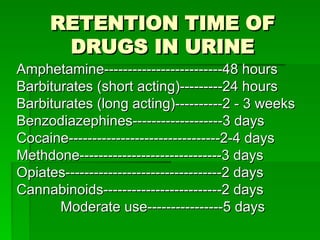
Amphetamine-------------------------48 hours
Barbiturates (short acting)---------24 hours
Barbiturates (long acting)----------2 - 3 weeks
Benzodiazephines-------------------3 days
Cocaine--------------------------------2-4 days
Methdone------------------------------3 days
Opiates---------------------------------2 days
Cannabinoids-------------------------2 days
Moderate use----------------5 days
Heavy use-------------------10 days
Methaqualone---------------------14 or more days
Phencyclidine----------------------8 days
Drug abuse problems can be detected and
reduced by regular drug testing. It will not
only weed out abusers from the applicants at
the time of hiring but also substance abusers
from the current employees. The right of the
individual employee is of less significance
than cleansing the ranks of abusers in the
name of safety and health.
The following are some of the ways in
which an employee can be a substance
abuser to the detriment of an
organization.
organization.
* The employee’s
* The employee’s
performance can be altered by
prescription or prescription card.
* The employee obtains and
uses illegal drugs at his or her work
site.
site.
* The user sells illegal drug to
afford his or her habit.
* The employee drinks alcohol or smokes
marijuana before work, during breaks and
during lunch.
during lunch.
* The employee sniffs glue or industrial or
cleaning fluids to “get high.”
* An assembly-line worker abuses any
type of substance to withstand a monotonous
regimen.
regimen.
* An employee steals products or
sensitive information to support a drug habit.
* A machinist or a machine operator
operates dangerous equipment while
intoxicated.
intoxicated.
* An employee slows production or
makes mistakes due to substance abuse.
* An employee request for additional
breaks to attend to his drug needs.
STEPS IN DRUG TESTING
The following considerations should be
considered when developing a drug
deterrence program.
deterrence program.
1. Drug testing is “one phase” of a
comprehensive program. It is not a “cure
all.”
all.”
2. Contact with reliable, certified drug testing
laboratory that will assure quality controlled
procedures especially in the custody of
samples. The laboratory should be able to
provide expert witness testimony if needed and
called upon.
called upon.
3. The conduct of drug testing should be done in
a fair, consistent, and legally defensible
manner. Caution should be taken to ensure
that collection, handling, and testing
procedures are reliable to prevent mistakes.
The policy should apply to all employees
covered by the policy. All steps taken that lead
up to the drug screening should be well
documented in consistent and accurate
manner.
manner.
4. Require applicants and employees to sign a
waiver that states it is the policy of the
company to test applicants and that one of
the requirements for consideration for
employment is passing a drug test.
Additionally, acceptance of the company’s
drug deterrence program is a condition for
employment. For current employees, the
waiver must state that the employee has read
and understand the company’s policy that the
company’s consideration for employment is
passing a drug test. Additionaly, acceptance
of the company’s drug-free workplace
program is a condition for employment.
For current employees, the waiver
must
must state that the employees has
state that the employees has
read and
read and understand the company’s policy,
understand the company’s policy,
that
that the company reserves the right to
the company reserves the right to
conduct test, and that a positive finding
may subject the employee to disciplinary
action up to and including termination.
5. The testing procedure should include
confirmatory tests such as mass
spectrometry/gas chromatography, after
preliminary positive results, if needed and
called for in legal cases
6. The firm must ensure that it has taken
every reasonable precaution to protect
the confidentiality of the test results. The
firm however has the right to notify others
e.g. supervisors or other officers of the
firm who need to know.
WHY DO PEOPLE ABUSE
WHY DO PEOPLE ABUSE
DRUGS?
DRUGS?
 Peer Pressure
Peer Pressure
 Curiosity
Curiosity
 Pleasurable feeling
Pleasurable feeling
 Want to forget
Want to forget
 Pain killer
Pain killer
 Working at night
Working at night
 For added strength
For added strength
 To lose weight
To lose weight
COMMON SIGNS OF DRUG ABUSE
 Change in attendance at work or school
Change in attendance at work or school
 Change from normal capabilities (work habits,
Change from normal capabilities (work habits,
efficiency etc.)
efficiency etc.)
 Poor physical appearance including inattention to
Poor physical appearance including inattention to
dress and personal hygiene
 Wearing sunglasses constantly at inappropriate
Wearing sunglasses constantly at inappropriate
times.
times.
 Unusual effort made to cover arms in order to hide
Unusual effort made to cover arms in order to hide
needle marks.
needle marks.
 Association with known drug abusers.
Association with known drug abusers.
 Stealing items which can readily be sold for cash
Stealing items which can readily be sold for cash
(to support drug habit)
 Changes in mood-depending on the drug taken.
Changes in mood-depending on the drug taken.
Ex: depressed or elated and euphoric
HOW CAN SECURITY OFFICERS
HELP IN THE PREVENTION AND
CONTROL OF DRUG ABUSE?
 Security officers should find out whether there is
Security officers should find out whether there is
drug abuse in the company.
 A study should be made on the causes of low
A study should be made on the causes of low
productivity of work, frequent tardiness and
absenteeism, change of behavior and violence
in the workplace.
in the workplace.
 Identify potential drug abusers.
Identify potential drug abusers.
 Identify sources of illicit drugs and their contact
Identify sources of illicit drugs and their contact
within the company
within the company
 Render reports of drug abuse.
Render reports of drug abuse.

Substance Abuse- Col. Bringas2008 training.ppt

  • 2.
    SUBSTANCE ABUSE Substance ordrug abuse continues to be a serious threat in the Philippines today. The gravity of the problem is oftentimes reported in the newspapers. Of Metro Manila’s approximately ten million people, about one million or 10% are substance or drug abusers. Shabu which is also known as “poor man’s cocaine” is on the way of becoming just that. A snort now costs an affordable P100.00. The Philippines now ranks second to Mexico among the biggest Marijuana producers in the world and is a transit point for cocaine and heroin shipments. Most of the heinous crimes reported were committed by people high on drugs.
  • 3.
    Is any chemicalsubstance which affects a person in such a way as to bring about physiological, emotional or behavioral change. Drug Is the use of chemical substance, licit or illicit which results in an individual’s physical, mental, emotional or social impairment. Drug Abuse DrugAddiction Addiction is a value-laden catchword popularly used to describe dependence on drug. Originally associated with narcotics, the word “addiction” has become a pejorative term because addiction has been used in so many different ways. It is being replaced by the term “Drug Dependence” in technical circles.
  • 4.
    Drug dependence isa state of physical or psychological need or both which results from continuous or periodic use of a drug. Psychological dependence exists when the effects produced by the drug have become necessary for a person’s well-being. It can be characterized by behavior effects caused by a compulsion to use the drug. Drug Dependence
  • 5.
    Physical dependence existsonly if withdrawal symptoms occur when a person stops the use of a drug. Withdrawal symptoms are physical (such as vomiting and muscle tremors). Tolerance is a physical condition which develops in users of certain drugs. When a person develops tolerance, he requires larger amounts of the drugs to produce the same effects. Tolerance
  • 6.
    1. Narcotics In itsmedical meaning refer to opium and opium derivatives or synthetic substitutes. They are drugs that relieve pain and often induce sleep. COMMONLY ABUSED DRUGS
  • 7.
    Morphine Morphine 1) Most effectivedrug for relief of pain. Its legal use is restricted to hospitals. 2) It is odorless, tastes bitter and darkens with age. 3) Addicts administer it intravenously, but can be smoked or taken orally. 4) Both physical and psychological dependence is rated high. Kinds of Narcotics 1. Narcotics of Natural Origin – Produced directly from poppy plant. Ex: Opium, Morphine, Codeine and Thebaine.
  • 8.
    Codeine Produced from morphine.It produces less analgesic, sedation and respiratory depression than morphine. Comes into two forms: 1) Tablets (aspirin) 2) Liquid (Robitussin AC and Cheracon) Thebaine Thebaine A principal alkaloid present in a specie of poppy. By itself, it is not used medically in the US, but is converted into a variety of medically important compounds including codeine.
  • 9.
    2. Semi –synthetic Narcotics – Synthesized from narcotics of natural origin. Ex: Heroin, Hydromorphone, Oxycodone. Heroin Heroin First synthesized from morphine in 1874 Pure heroin is white powder with a bitter taste, and in its pure state is rarely sold on the street. To increase the bulk of materials sold to the addicts, diluents such as sugars, starch, powdered milk and quinine are used. Method of administering are injected, sniffed or smoked.
  • 10.
    Hydromorphone Commonly known asDilaudid. It is about two to eight times as potent as Morphine and is sought after by drug addicts. Oxycodone It was synthesized from Thebaine and is more potent than Codeine. It is marketed in combination with other drugs like Percodan.
  • 11.
    3. Synthetic Narcotics– Produced entirely in the laboratory. Ex: Meperidine, Methadone and Pentazocine (Talwin). Meperidine The first synthetic narcotic produced a generation ago. It is chemically different from Morphine but resembles its pain-killing effect. It is used for the relief of moderate to severe pain. Methadone German scientists synthesized Methadone during World War II because of the shortage of Morphine. Although chemically unlike Morphine and Heroin, it produces many of the same effects as pain killer. Methadone is also used as a treatment of narcotic addict.
  • 12.
    Effects of theUse of Narcotics Effects of the Use of Narcotics 1. Pen point pupils 2. Drowsiness 3. Euphoria 4. Reduced vision 5. Respiratory depression 6. Nausea Greater risks exists when a combination of drugs or a mixture of unidentified pills are taken. This is especially true to alcohol and barbiturates (sleeping pills).
  • 13.
    DANGERS OF NARCOTICABUSE ‱ Narcotic abusers neglect themselves and usually suffer from malnutrition, infections, diseases and injuries. ‱ The body of an abuser is prone to toxic reactions due to impurities in the narcotic. ‱ Fatal infections can be readily transmitted to the abuser’s body.
  • 14.
    1) Watery Eyes 2)Runny Nose 3) Yawning 4) Loss of Appetite 5) Irritability 6) Tremors 7) Panic 8) Chills and Sweating 9) Nausea WITHDRAWAL SYMPTOMS ARE:
  • 15.
    Effects of Overdoseare: 1) Overdose and shallow breathing 2) Clammy skin 3) Convulsions 4) Possible Death
  • 16.
    Usually known as“downers” which are drugs that act on the nervous systems promoting relaxation and sleep. 2. Depressants 2. Depressants Used in excessive amounts, depressants induce a state of intoxication similar to that of alcohol. Intoxicating doses result in impaired judgment, disorientation, slurred speech, drunken behavior without the odor of alcohol, and loss of motor coordination.
  • 18.
    Drugs Classified UnderDepressants 1. Barbiturates Drugs most frequently prescribed to induce sedation and sleep by both doctors and veterinarians. Small dosage of Barbiturates tends to calm down nervous conditions while larger doses can cause sleep twenty to sixty minutes after taking it orally. An overdose of barbiturates may progress through stages of sedation, sleep and comatose to death from respiratory arrest and cardiovascular complications.
  • 19.
    1) Ultra Short-Acting(Hexobarbital) 2) Intermediate-Acting (Secobarbital/Seconal) 3) Short-Acting (Pentobarbital/Nembutal) 4) Long-Acting (Methobarbital/Mebaral) (Phenobarbital/Luminal) CLASSIFICATION OF BARBITURATES CLASSIFICATION OF BARBITURATES
  • 20.
    ABUSE OF BARBITURATES ABUSEOF BARBITURATES BARBITURATES ARE USUALLY ABUSED IN BARBITURATES ARE USUALLY ABUSED IN TWO WAYS: TWO WAYS: 1. 1. The user of the drug had developed a The user of the drug had developed a tolerance tolerance to the drug thus increasing to the drug thus increasing dosage to feel the dosage to feel the desired effects. desired effects. 2. 2. For added thrill, Barbiturate is injected as a For added thrill, Barbiturate is injected as a substitute to other drugs being abused, especially substitute to other drugs being abused, especially Amphetamines. Barbiturates can produce both Amphetamines. Barbiturates can produce both psychological and physical dependence. psychological and physical dependence.
  • 21.
    2. METHAQUALONE Is asynthetic sedative which has been widely abused and often cause serious poisoning. It is taken orally and is rapidly absorbed in the digestive tract. Large doses can cause comatose accompanied by convulsion. Heavy use of this drug leads to tolerance and dependence. It is known in the US as Qualude, Parest, Mequin, Optimol, Somnafac and Sofor while its European equivalent is Mandrax. It is widely- abused because it was once mistakenly taught of to be non-addictive and very effective as aphrodisiac.
  • 22.
    3. MEPROBAMATE - amuscle relaxant prescribed mainly for the relief of anxiety, tension and muscle spasms.First synthesized in 1950 and introduced as mild tranquilizers. Ex: Miltown and Equanil. 4. BENZODIAZEPINES - relieve anxiety, tension and muscle spasms as well as producing sedation and preventing convulsions. Ex:Diazepam (Valium); Lorazepam (Ativan) and Chlordiazepoxide (Librium). Valium and Librium are widely prescribed in the Philippines. Benzodiazepines have slow onset but have long duration of action. To obtain “high”, they are taken with marijuana or alcohol.
  • 23.
    EFFECTS OF DEPRESSANTS 1.A USUAL DOSE OF A BARBITURATE CAUSES A CALMING, RELAXING EFFECT WHICH PROMOTES SLEEP 2. RELIEF OF ANXIETY AND EXCITEMENT 3. REDUCED MENTAL AND PHYSICAL ACTIVITY 4. A MARKED DECREASED IN BREATHING
  • 24.
    3. 3. STIMULANTS STIMULANTS – –are drugs used to increase mental are drugs used to increase mental activity, relieve fatigue, increase alertness and offset activity, relieve fatigue, increase alertness and offset drowsiness. They are usually known as “uppers”. drowsiness. They are usually known as “uppers”. KINDS OF STIMULANTS KINDS OF STIMULANTS 1. 1. AMPHETAMINES AMPHETAMINES – – First used in the 1930’s to treat First used in the 1930’s to treat narcolepsy. They are taken in many forms and are narcolepsy. They are taken in many forms and are marketed as inhalers, injectables and tablets. Ex: marketed as inhalers, injectables and tablets. Ex: Benzedrine, Dexidrine and Mepedrine. Benzedrine, Dexidrine and Mepedrine. Benzedrine – is a broad class of stimulants known as Benzedrine – is a broad class of stimulants known as “pep pills”. During World War II, US troops “pep pills”. During World War II, US troops extensively used Benzedrine for energy and extensively used Benzedrine for energy and confidence. Pilots used it in long-bombing missions. confidence. Pilots used it in long-bombing missions. It is now found in the form of orange and green It is now found in the form of orange and green colored heart-shaped tablets such as Dexamyl. colored heart-shaped tablets such as Dexamyl.
  • 25.
    2. 2. COCAINE COCAINE - -The most potent stimulant of The most potent stimulant of natural origin. It is extracted from the natural origin. It is extracted from the leaves of the shrub “Erythrocylon Coca” leaves of the shrub “Erythrocylon Coca” which is grown in the Andean highland of which is grown in the Andean highland of South America. Illegal cocaine is in the South America. Illegal cocaine is in the form of white crystalline powder and is form of white crystalline powder and is snorted through the nose snorted through the nose. .
  • 26.
    3. 3. “SHABU” ORMETHAMPHETAMINE “SHABU” OR METHAMPHETAMINE HYDROCHLORIDE HYDROCHLORIDE - The most abused stimulant drug in the - The most abused stimulant drug in the Philippines Philippines today. It is commonly known as today. It is commonly known as “poor man’s “poor man’s cocaine”, or by other names cocaine”, or by other names such as: “Shabs”, such as: “Shabs”, “Ubas”, “S”, “Siopao”, “Ubas”, “S”, “Siopao”, “Sha” and “Ice”. Shabu is a “Sha” and “Ice”. Shabu is a white, odorless white, odorless crystal or crystalline powder with crystal or crystalline powder with bitter bitter taste. It can be injected as well as inhaled taste. It can be injected as well as inhaled by by the user. Nowadays, Shabu is sold in different the user. Nowadays, Shabu is sold in different flavors to sought the taste of the user. flavors to sought the taste of the user.
  • 28.
    GENERAL EFFECTS OF GENERALEFFECTS OF STIMULANTS STIMULANTS 1. 1. It gives a feeling of being stronger, more decisive It gives a feeling of being stronger, more decisive and self-possessed. and self-possessed. 2. 2. Extended wakefulness and increased mental Extended wakefulness and increased mental alertness. alertness. 3. It may induce irritability, anxiety and fear. 3. It may induce irritability, anxiety and fear. 4. Loss of appetite resulting in decreased body 4. Loss of appetite resulting in decreased body weight. weight. 5. Pregnant women who abused Shabu can cause 5. Pregnant women who abused Shabu can cause mental retardation to their unborn babies. mental retardation to their unborn babies.
  • 29.
    6. 6. Loss ofsexual desire; lack of interest Loss of sexual desire; lack of interest towards work. towards work. 7. 7. User suffers “Schizophrenia” or split User suffers “Schizophrenia” or split personality leading to violent behavior. personality leading to violent behavior. 8. 8. Chronic user experiences loss of memory. Chronic user experiences loss of memory. 9. Chronic snorters suffer from irritation of 9. Chronic snorters suffer from irritation of the nose leading to frequent nose bleeding. the nose leading to frequent nose bleeding. 10. Injecting Shabu using dirty needles can 10. Injecting Shabu using dirty needles can lead to various infections, such as: lead to various infections, such as: Hepatitis-B, Blood Poisoning and AIDS. Hepatitis-B, Blood Poisoning and AIDS.
  • 30.
    4. HALLUCINOGENS Hallucinogens aredrugs that can produce changes in mood and behavior. They can produce delusions and hallucinations. They induce a state of excitation of the central nervous system as shown by changes in mood. Hallucinogens disorient the sense of direction, distance and time. A user may speak of “hearing colors ” and “seeing sounds ” . They are known as ”psychedelics”. KINDS OF HALLUCINOGENS ‱Mescaline - derived from the fleshy part of peyote cactus. Produces illusions and hallucinations lasting from 5 to 12 hours. ‱Psilocybin - derived from psilocibe mushroom grown by Indians for centuries, When the mushroom is eaten , it produces effect similar to mescaline and LSD.
  • 31.
    ‱LSD (Lysergic aciddiethylamide)-produced from lysergic acid derived from ergot fungus which grow on rye. LSD is now used as a tool for research to study the mechanism of mental illness. It is sold in the form of tablet , thin squares of gelatin or impregnated paper. ‱Phencyclidine (PCP)-sold under different names such as : Angel Dust, Crystal, Supergrass, Killer Weed, Rocket Fuel, Embalming Fluid and many others. PCP causes greater risk to the user than any other drug of abuse , except shabu. ‱Marijuana (Cannabis Sativa )- annual plant that grows wild in many temperate parts of the world. It has been introduced as a drug to the Filipinos by foreigners 5 years after World War II . ‱ Ecstasy- term used for group of “designer drugs” closely related to Amphetamine. It is also known as XTC, ADAM or Eden tablet, “hug drug” or “yuppie drug”. It is usually marketed in tablet form, but is also available in liquid or powder form.
  • 32.
    KETAMINE Originally a depressantdrug used as a tranquilizer by veterinarians when they treat or perform surgery on animals. Lately, Ketamine is mixed with other ingredients and now known as Ketamine Hydrochloride (Super K). It is getting popular as a “Party Drug” that produces tripping effects the whole night. Teenagers who are fond of “techno parties” or “raves” take the drug because the user feels uncontrollable urge to dance upon hearing sound of music. Super K is usually snipped or at times the powder is sprinkled or mixed with cigarette or marijuana. Effects of the drug when taken in large doses are as follows: dizziness, impairment of motor function, breathing problem resulting to death, convulsion and depression leading to death. Recently, Ketamine Hydrochloride is mixed with Shabu and marketed as “KETABU”.
  • 34.
    General Effects of GeneralEffects of Hallucinogens Hallucinogens  Increased heart rate and pulse rate Increased heart rate and pulse rate  Elevated or increased blood pressure Elevated or increased blood pressure  Increased activity of the body due to the Increased activity of the body due to the effect on the brain effect on the brain  Enlarged or dilated pupils of the eyes Enlarged or dilated pupils of the eyes  Increased body temperature Increased body temperature  Paleness of the face and skin of the body Paleness of the face and skin of the body
  • 35.
    Psychological Effects of PsychologicalEffects of Hallucinogens Hallucinogens  Strong emotional feeling Strong emotional feeling  Recalling previously suppressed ideas and Recalling previously suppressed ideas and thoughts thoughts  A feeling of great creativity and imagination A feeling of great creativity and imagination  Very lucid and astonishingly clear thoughts Very lucid and astonishingly clear thoughts  Intensification of sensory impressions Intensification of sensory impressions  Changes in sensation. Sounds are “seen”, Changes in sensation. Sounds are “seen”, simple things appear very beautiful and simple things appear very beautiful and colors seems to be “heard” colors seems to be “heard”  A mood of joy and strong feeling of religious A mood of joy and strong feeling of religious awareness awareness  A feeling of oneness with the universe A feeling of oneness with the universe
  • 36.
    “ “Bad Trip” Experiences BadTrip” Experiences Felt by the User Felt by the User  Hallucinations such as nightmarish visions and Hallucinations such as nightmarish visions and terrifying ideas terrifying ideas  Tension and anxiety Tension and anxiety  Paranoid delusion to the point of committing Paranoid delusion to the point of committing suicide suicide  Complete loss of emotional control Complete loss of emotional control  Very deep and profound depression Very deep and profound depression  Social behavior becomes unruly and uncontrollable Social behavior becomes unruly and uncontrollable  Feeling that one is immune to harm and perhaps Feeling that one is immune to harm and perhaps able to “fly” able to “fly”  Occasional “flashback “ (sensory replay of Occasional “flashback “ (sensory replay of previous “trips”) occurs. previous “trips”) occurs.  Feeling of dizziness or temporary Feeling of dizziness or temporary unconsciousness unconsciousness
  • 37.
    Other Substances Abused 1.INHALANTS-are volatile substances derived from ether or chloroform. It is inhaled through the nose to experience intoxication. These substances include the following : 1. Quick-drying glue or plastic cement like rugby 2. Paint remover and lacquer as thinner and solvent 3. Gasoline and gasoline-based products 4. Kerosene 5. Nail polish or polish remover “acetone” 6. Lighter fluid and dry cleaning fluid
  • 39.
    EFFECTS OF INHALANTS 1.Unsteadiness and restlessness 2. Drunkenness with depression leading to unconsciousness 3. Irritability and highly-agitated condition 4. Initial excitement thereby losing emotional control 5. Irritation of throat and nasal passages
  • 40.
    2. Alcohol Refers tobeverages whose effects are related to their substance contents which are extracted from chemical compound ethyl and hydrocarbon that trigger the control nervous system and may damage vital human organs through misuse. In the Philippines, it is the most abused recreation drug. Physical dependence exist if taken regularly in large quantities Alcoholism – also known alcohol dependence. It is Alcoholism – also known alcohol dependence. It is defined as a disease that includes alcohol craving and defined as a disease that includes alcohol craving and continued drinking despite suffering alcohol-related continued drinking despite suffering alcohol-related problems problems
  • 41.
    Major Symptoms of MajorSymptoms of Alcoholism Alcoholism  Craving – strong compulsion to drink Craving – strong compulsion to drink  Impaired control Impaired control  Inability to control the drinking urge Inability to control the drinking urge  Physical withdrawal symptoms , sweating Physical withdrawal symptoms , sweating , shakiness, anxiety, nausea , shakiness, anxiety, nausea  Need for increased doses of alcohol to Need for increased doses of alcohol to maintain same level of intoxication maintain same level of intoxication
  • 42.
    Stages of Alcoholism Stagesof Alcoholism Early Stage : Early Stage : fatigue, fitters and nausea. Avoidance of fatigue, fitters and nausea. Avoidance of contact with superiors. Changes of behavior style by contact with superiors. Changes of behavior style by the person – more outgoing and increased self the person – more outgoing and increased self confidence confidence. . Middle Stage : Middle Stage : increase nervousness, irritability , red or increase nervousness, irritability , red or bleary eyes and flushed face. Individual working in bleary eyes and flushed face. Individual working in performance cycles where some cycles have great performance cycles where some cycles have great output and others have very little. output and others have very little. Late Stage : Late Stage : prolonged absences. Further decline in prolonged absences. Further decline in work performance with many different kinds of work performance with many different kinds of excuses being offered. Increased financial problems excuses being offered. Increased financial problems. . There is a strong link between the consumption of There is a strong link between the consumption of alcohol and various kinds incident. Approximately fifty alcohol and various kinds incident. Approximately fifty percent of all homicides and thirty percent of all percent of all homicides and thirty percent of all homicides and thirty percent of suicides take place homicides and thirty percent of suicides take place while the perpetrator is under the influence of alcohol. while the perpetrator is under the influence of alcohol. Excessive drinking is involved in the large number of Excessive drinking is involved in the large number of vehicle accidents vehicle accidents. .
  • 43.
    DRUG TESTING DRUG TESTING Onesolution to the drug problem is to One solution to the drug problem is to conduct drug testing prior to employment, conduct drug testing prior to employment, and the present employees who have not and the present employees who have not been tested. Drug screening is one been tested. Drug screening is one effective way of refusing substance effective way of refusing substance abusers. Drugs that are introduced into abusers. Drugs that are introduced into the body undergo biotrnasformation and the body undergo biotrnasformation and eventually excreted through the urine and eventually excreted through the urine and feces. The presence of the drug and the feces. The presence of the drug and the metabolites can be tested in the urine, metabolites can be tested in the urine, blood and body tissues through various blood and body tissues through various kinds of test. kinds of test.
  • 44.
    The types ofdrug test that are commonly used The types of drug test that are commonly used are the urine analysis and blood testing. are the urine analysis and blood testing. Substances most commonly tested are, Substances most commonly tested are, alcohol, amphetamines, barbiturates, alcohol, amphetamines, barbiturates, benzodiazepines, marijuana, cocaine, benzodiazepines, marijuana, cocaine, methadone, methadone, methaqualone, methadone, methadone, methaqualone, opiates, phencyclidine, and testosterone-like opiates, phencyclidine, and testosterone-like anabolic steroids. anabolic steroids. The first and most popular is Enzyme The first and most popular is Enzyme Immunoassay (EIA) and of the three formats Immunoassay (EIA) and of the three formats the (Enzyme Multiplied Immunoassay Test) the (Enzyme Multiplied Immunoassay Test) EMIT test is the most widely used. EIA uses EMIT test is the most widely used. EIA uses urine samples and can be used for as much as urine samples and can be used for as much as 10 drugs. 10 drugs.
  • 45.
    The second formatis the Radio- The second format is the Radio- Immunoassay (RIA). While it is similar to Immunoassay (RIA). While it is similar to RIA it uses radioactivity as an indicator RIA it uses radioactivity as an indicator rather than color change. The third format is rather than color change. The third format is a combination of gas chromatography and a combination of gas chromatography and mass spectrometry. (GS-MS) This test is mass spectrometry. (GS-MS) This test is 99.9 % accurate and is generally accepted 99.9 % accurate and is generally accepted in courts, however due to its prohibitive cost in courts, however due to its prohibitive cost it is not generally used for screening it is not generally used for screening purposes. It is used however for purposes. It is used however for confirmatory test when positive results confirmatory test when positive results occur using cheaper and less accurate occur using cheaper and less accurate methods. methods.
  • 46.
    RETENTION TIME OF RETENTIONTIME OF DRUGS IN URINE DRUGS IN URINE Amphetamine-------------------------48 hours Amphetamine-------------------------48 hours Barbiturates (short acting)---------24 hours Barbiturates (short acting)---------24 hours Barbiturates (long acting)----------2 - 3 weeks Barbiturates (long acting)----------2 - 3 weeks Benzodiazephines-------------------3 days Benzodiazephines-------------------3 days Cocaine--------------------------------2-4 days Cocaine--------------------------------2-4 days Methdone------------------------------3 days Methdone------------------------------3 days Opiates---------------------------------2 days Opiates---------------------------------2 days Cannabinoids-------------------------2 days Cannabinoids-------------------------2 days Moderate use----------------5 days Moderate use----------------5 days
  • 47.
    Heavy use-------------------10 days Heavyuse-------------------10 days Methaqualone---------------------14 or more days Methaqualone---------------------14 or more days Phencyclidine----------------------8 days Phencyclidine----------------------8 days Drug abuse problems can be detected and Drug abuse problems can be detected and reduced by regular drug testing. It will not reduced by regular drug testing. It will not only weed out abusers from the applicants at only weed out abusers from the applicants at the time of hiring but also substance abusers the time of hiring but also substance abusers from the current employees. The right of the from the current employees. The right of the individual employee is of less significance individual employee is of less significance than cleansing the ranks of abusers in the than cleansing the ranks of abusers in the name of safety and health. name of safety and health.
  • 48.
    The following aresome of the ways in The following are some of the ways in which an employee can be a substance which an employee can be a substance abuser to the detriment of an abuser to the detriment of an organization. organization. * The employee’s * The employee’s performance can be altered by performance can be altered by prescription or prescription card. prescription or prescription card. * The employee obtains and * The employee obtains and uses illegal drugs at his or her work uses illegal drugs at his or her work site. site. * The user sells illegal drug to * The user sells illegal drug to afford his or her habit. afford his or her habit.
  • 49.
    * The employeedrinks alcohol or smokes * The employee drinks alcohol or smokes marijuana before work, during breaks and marijuana before work, during breaks and during lunch. during lunch. * The employee sniffs glue or industrial or * The employee sniffs glue or industrial or cleaning fluids to “get high.” cleaning fluids to “get high.” * An assembly-line worker abuses any * An assembly-line worker abuses any type of substance to withstand a monotonous type of substance to withstand a monotonous regimen. regimen. * An employee steals products or * An employee steals products or sensitive information to support a drug habit. sensitive information to support a drug habit. * A machinist or a machine operator * A machinist or a machine operator operates dangerous equipment while operates dangerous equipment while intoxicated. intoxicated.
  • 50.
    * An employeeslows production or * An employee slows production or makes mistakes due to substance abuse. makes mistakes due to substance abuse. * An employee request for additional * An employee request for additional breaks to attend to his drug needs. breaks to attend to his drug needs. STEPS IN DRUG TESTING STEPS IN DRUG TESTING The following considerations should be The following considerations should be considered when developing a drug considered when developing a drug deterrence program. deterrence program. 1. Drug testing is “one phase” of a 1. Drug testing is “one phase” of a comprehensive program. It is not a “cure comprehensive program. It is not a “cure all.” all.”
  • 51.
    2. Contact withreliable, certified drug testing 2. Contact with reliable, certified drug testing laboratory that will assure quality controlled laboratory that will assure quality controlled procedures especially in the custody of procedures especially in the custody of samples. The laboratory should be able to samples. The laboratory should be able to provide expert witness testimony if needed and provide expert witness testimony if needed and called upon. called upon. 3. The conduct of drug testing should be done in 3. The conduct of drug testing should be done in a fair, consistent, and legally defensible a fair, consistent, and legally defensible manner. Caution should be taken to ensure manner. Caution should be taken to ensure that collection, handling, and testing that collection, handling, and testing procedures are reliable to prevent mistakes. procedures are reliable to prevent mistakes. The policy should apply to all employees The policy should apply to all employees covered by the policy. All steps taken that lead covered by the policy. All steps taken that lead up to the drug screening should be well up to the drug screening should be well documented in consistent and accurate documented in consistent and accurate manner. manner.
  • 52.
    4. Require applicantsand employees to sign a 4. Require applicants and employees to sign a waiver that states it is the policy of the waiver that states it is the policy of the company to test applicants and that one of company to test applicants and that one of the requirements for consideration for the requirements for consideration for employment is passing a drug test. employment is passing a drug test. Additionally, acceptance of the company’s Additionally, acceptance of the company’s drug deterrence program is a condition for drug deterrence program is a condition for employment. For current employees, the employment. For current employees, the waiver must state that the employee has read waiver must state that the employee has read and understand the company’s policy that the and understand the company’s policy that the company’s consideration for employment is company’s consideration for employment is passing a drug test. Additionaly, acceptance passing a drug test. Additionaly, acceptance of the company’s drug-free workplace of the company’s drug-free workplace program is a condition for employment. program is a condition for employment.
  • 53.
    For current employees,the waiver For current employees, the waiver must must state that the employees has state that the employees has read and read and understand the company’s policy, understand the company’s policy, that that the company reserves the right to the company reserves the right to conduct test, and that a positive finding conduct test, and that a positive finding may subject the employee to disciplinary may subject the employee to disciplinary action up to and including termination. action up to and including termination. 5. The testing procedure should include 5. The testing procedure should include confirmatory tests such as mass confirmatory tests such as mass spectrometry/gas chromatography, after spectrometry/gas chromatography, after preliminary positive results, if needed and preliminary positive results, if needed and called for in legal cases called for in legal cases
  • 54.
    6. The firmmust ensure that it has taken 6. The firm must ensure that it has taken every reasonable precaution to protect every reasonable precaution to protect the confidentiality of the test results. The the confidentiality of the test results. The firm however has the right to notify others firm however has the right to notify others e.g. supervisors or other officers of the e.g. supervisors or other officers of the firm who need to know. firm who need to know.
  • 55.
    WHY DO PEOPLEABUSE WHY DO PEOPLE ABUSE DRUGS? DRUGS?  Peer Pressure Peer Pressure  Curiosity Curiosity  Pleasurable feeling Pleasurable feeling  Want to forget Want to forget  Pain killer Pain killer  Working at night Working at night  For added strength For added strength  To lose weight To lose weight
  • 56.
    COMMON SIGNS OFDRUG ABUSE COMMON SIGNS OF DRUG ABUSE  Change in attendance at work or school Change in attendance at work or school  Change from normal capabilities (work habits, Change from normal capabilities (work habits, efficiency etc.) efficiency etc.)  Poor physical appearance including inattention to Poor physical appearance including inattention to dress and personal hygiene dress and personal hygiene  Wearing sunglasses constantly at inappropriate Wearing sunglasses constantly at inappropriate times. times.  Unusual effort made to cover arms in order to hide Unusual effort made to cover arms in order to hide needle marks. needle marks.  Association with known drug abusers. Association with known drug abusers.  Stealing items which can readily be sold for cash Stealing items which can readily be sold for cash (to support drug habit) (to support drug habit)  Changes in mood-depending on the drug taken. Changes in mood-depending on the drug taken. Ex: depressed or elated and euphoric Ex: depressed or elated and euphoric
  • 57.
    HOW CAN SECURITYOFFICERS HOW CAN SECURITY OFFICERS HELP IN THE PREVENTION AND HELP IN THE PREVENTION AND CONTROL OF DRUG ABUSE? CONTROL OF DRUG ABUSE?  Security officers should find out whether there is Security officers should find out whether there is drug abuse in the company. drug abuse in the company.  A study should be made on the causes of low A study should be made on the causes of low productivity of work, frequent tardiness and productivity of work, frequent tardiness and absenteeism, change of behavior and violence absenteeism, change of behavior and violence in the workplace. in the workplace.  Identify potential drug abusers. Identify potential drug abusers.  Identify sources of illicit drugs and their contact Identify sources of illicit drugs and their contact within the company within the company  Render reports of drug abuse. Render reports of drug abuse.