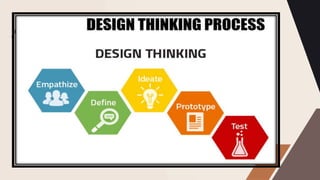
IDEATE
DESIGN THINKING IN SCIENCE
AND MATHEMATICS
MRS. CONNIE R. PANGILINAN
MASTER TEACHER II
Ideation is the mode of design
process in which one concentrates
on idea generation . It represents a
process of โ€œ going wide โ€œ in terms of
concepts and outcomes . It
provides both the fuel and source
of materials for building prototypes
and getting innovative solutions
into the hands of your users.
In IDEATE Phase of DT
A phase of divergent
thoughts , wild ideas and
exploration of solutions
considering brainstorming
of hundred solutions .
โ€œ Itโ€™s not about coming up with
the right idea , its about
generating the broadest range
of possibilities. โ€œ
โ€œ a phase of divergent
thoughts wild ideas and
exploration of solutions
considering brainstorming of
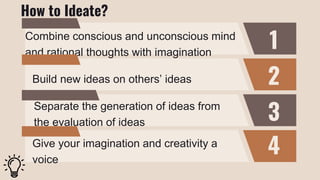
1
2
3
4
Combine conscious and unconscious mind
and rational thoughts with imagination
Build new ideas on othersโ€™ ideas
Separate the generation of ideas from
the evaluation of ideas
Give your imagination and creativity a
voice
How to Ideate?
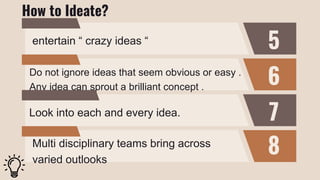
5
6
7
8
entertain โ€œ crazy ideas โ€œ
Do not ignore ideas that seem obvious or easy .
Any idea can sprout a brilliant concept .
Look into each and every idea.
Multi disciplinary teams bring across
varied outlooks
How to Ideate?
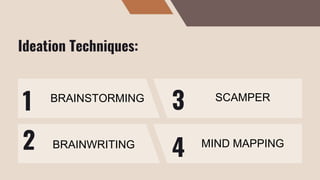
BRAINSTORMING
Ideation Techniques:
BRAINWRITING
SCAMPER
MIND MAPPING
1
2
3
4
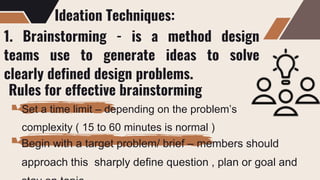
Ideation Techniques:
1. Brainstorming - is a method design
teams use to generate ideas to solve
clearly defined design problems.
Rules for effective brainstorming
Set a time limit โ€“ depending on the problemโ€™s
complexity ( 15 to 60 minutes is normal )
Begin with a target problem/ brief โ€“ members should
approach this sharply define question , plan or goal and
Rules for effective brainstorming
Aim for quantity โ€“ Remember, โ€œquantity breeds
qualityโ€. The sifting-and- sorting process comes
later.
Build on othersโ€™ ideas โ€“ Itโ€™s a process of association
where members expand on othersโ€™ notions and reach
new insights, allowing these ideas to trigger their own.
Say โ€œandโ€โ€”rather than discourage with โ€œbutโ€โ€”to get
ideas closer to the problem.
Rules for effective brainstorming
Refrain from judgement / criticism โ€“ no one
should be negative (including via body
language ) about any idea.
Encourage weird and wacky ideas โ€“ Further to
the ban on killer phrases like โ€œtoo expensiveโ€,
keep the floodgates open so everyone feels
free to blurt out ideas (provided theyโ€™re on
topic).
2. Brainwriting?
Brainwriting is an idea generation method. Instead of asking
participants to yell out lots of ideas during your brainstorming
session, the brainwriting technique involves writing them down
Hereโ€™s how it works:
โ€ข The first person in the group writes their idea down on a sticky note.
โ€ข Then itโ€™s someone elseโ€™s turn.
โ€ข They add their idea to another sticky note, but it canโ€™t be the same as
the idea thatโ€™s already been written.
โ€ข The group repeats the process for 10โ€“15 minutes.
โ€ข The group reviews all the ideas and discusses them.
When to use brainwriting ?
To generate new ideas. Brainwriting is an ideal
technique for teams that want to encourage new ideas.
To create innovative solutions. The entire
brainwriting process encourages original ideas from
every individual.
To encourage everyone to participate. With
brainwriting, everyone gets a chance to have their
voices heard.
3. Scamper
Scamper is a useful
list of words to help us
think differently about
a problem ,idea,
concept or issue.
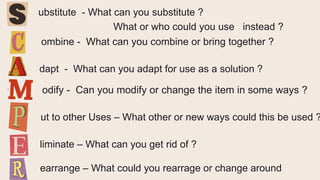
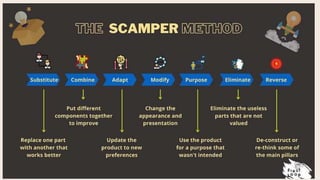
ubstitute - What can you substitute ?
What or who could you use instead ?
ombine - What can you combine or bring together ?
dapt - What can you adapt for use as a solution ?
odify - Can you modify or change the item in some ways ?
ut to other Uses โ€“ What other or new ways could this be used ?
liminate โ€“ What can you get rid of ?
earrange โ€“ What could you rearrage or change around
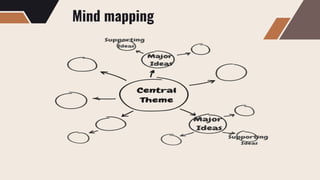
4. Mind mapping
A mind map is diagram ,
an easy way to organize
thoughts. It allows you to
visually structure your
ideas to help with
Mind mapping
WORKSHOP 3: IDEATE
Instructions:
2. Apply any ideation technique on the problem statement.
3. Generate a sketch, mind map or any illustration that will give
you the visualization of the possible solutions.
1.Revisit the problem statements generated in the DEFINE stage.
WORKSHOP 3: IDEATE
1. Problem Statement:
2. Ideation Technique
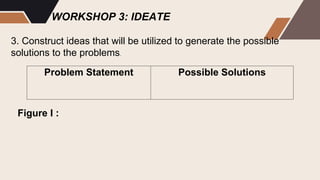
WORKSHOP 3: IDEATE
3. Construct ideas that will be utilized to generate the possible
solutions to the problems.
Problem Statement Possible Solutions
Figure I :
WORKSHOP 3: IDEATE
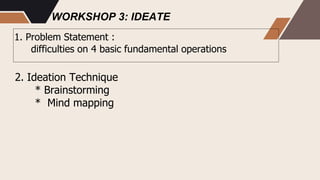
1. Problem Statement :
difficulties on 4 basic fundamental operations
2. Ideation Technique
* Brainstorming
* Mind mapping
WORKSHOP 3: IDEATE
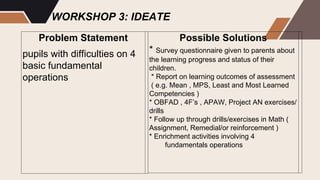
Problem Statement
pupils with difficulties on 4
basic fundamental
operations
Possible Solutions
* Survey questionnaire given to parents about
the learning progress and status of their
children.
* Report on learning outcomes of assessment
( e.g. Mean , MPS, Least and Most Learned
Competencies )
* OBFAD , 4Fโ€™s , APAW, Project AN exercises/
drills
* Follow up through drills/exercises in Math (
Assignment, Remedial/or reinforcement )
* Enrichment activities involving 4
fundamentals operations
WORKSHOP 3: IDEATE
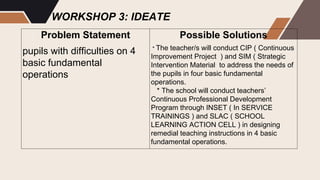
Problem Statement
pupils with difficulties on 4
basic fundamental
operations
Possible Solutions
* The teacher/s will conduct CIP ( Continuous
Improvement Project ) and SIM ( Strategic
Intervention Material to address the needs of
the pupils in four basic fundamental
operations.
* The school will conduct teachersโ€™
Continuous Professional Development
Program through INSET ( In SERVICE
TRAININGS ) and SLAC ( SCHOOL
LEARNING ACTION CELL ) in designing
remedial teaching instructions in 4 basic
fundamental operations.
WORKSHOP 3: IDEATE
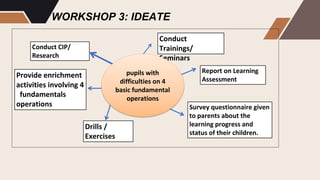
Provide enrichment
activities involving 4
fundamentals
operations
Conduct CIP/
Research
Report on Learning
Assessment
Drills /
Exercises
Conduct
Trainings/
Seminars
Survey questionnaire given
to parents about the
learning progress and
status of their children.
pupils with
difficulties on 4
basic fundamental
operations
I have not failed, Iโ€™ve
just found 10,000
ways that wonโ€™t
workโ€ฆby Thomas Edison
THANK YOU
FOR LISTENING!

IDEATE.pptx

  • 1.
    IDEATE DESIGN THINKING INSCIENCE AND MATHEMATICS MRS. CONNIE R. PANGILINAN MASTER TEACHER II
  • 3.
    Ideation is themode of design process in which one concentrates on idea generation . It represents a process of โ€œ going wide โ€œ in terms of concepts and outcomes . It provides both the fuel and source of materials for building prototypes and getting innovative solutions into the hands of your users.
  • 4.
    In IDEATE Phaseof DT A phase of divergent thoughts , wild ideas and exploration of solutions considering brainstorming of hundred solutions .
  • 5.
    โ€œ Itโ€™s notabout coming up with the right idea , its about generating the broadest range of possibilities. โ€œ โ€œ a phase of divergent thoughts wild ideas and exploration of solutions considering brainstorming of
  • 6.
    1 2 3 4 Combine conscious andunconscious mind and rational thoughts with imagination Build new ideas on othersโ€™ ideas Separate the generation of ideas from the evaluation of ideas Give your imagination and creativity a voice How to Ideate?
  • 7.
    5 6 7 8 entertain โ€œ crazyideas โ€œ Do not ignore ideas that seem obvious or easy . Any idea can sprout a brilliant concept . Look into each and every idea. Multi disciplinary teams bring across varied outlooks How to Ideate?
  • 8.
  • 9.
    Ideation Techniques: 1. Brainstorming- is a method design teams use to generate ideas to solve clearly defined design problems. Rules for effective brainstorming Set a time limit โ€“ depending on the problemโ€™s complexity ( 15 to 60 minutes is normal ) Begin with a target problem/ brief โ€“ members should approach this sharply define question , plan or goal and
  • 10.
    Rules for effectivebrainstorming Aim for quantity โ€“ Remember, โ€œquantity breeds qualityโ€. The sifting-and- sorting process comes later. Build on othersโ€™ ideas โ€“ Itโ€™s a process of association where members expand on othersโ€™ notions and reach new insights, allowing these ideas to trigger their own. Say โ€œandโ€โ€”rather than discourage with โ€œbutโ€โ€”to get ideas closer to the problem.
  • 11.
    Rules for effectivebrainstorming Refrain from judgement / criticism โ€“ no one should be negative (including via body language ) about any idea. Encourage weird and wacky ideas โ€“ Further to the ban on killer phrases like โ€œtoo expensiveโ€, keep the floodgates open so everyone feels free to blurt out ideas (provided theyโ€™re on topic).
  • 12.
    2. Brainwriting? Brainwriting isan idea generation method. Instead of asking participants to yell out lots of ideas during your brainstorming session, the brainwriting technique involves writing them down Hereโ€™s how it works: โ€ข The first person in the group writes their idea down on a sticky note. โ€ข Then itโ€™s someone elseโ€™s turn. โ€ข They add their idea to another sticky note, but it canโ€™t be the same as the idea thatโ€™s already been written. โ€ข The group repeats the process for 10โ€“15 minutes. โ€ข The group reviews all the ideas and discusses them.
  • 13.
    When to usebrainwriting ? To generate new ideas. Brainwriting is an ideal technique for teams that want to encourage new ideas. To create innovative solutions. The entire brainwriting process encourages original ideas from every individual. To encourage everyone to participate. With brainwriting, everyone gets a chance to have their voices heard.
  • 14.
    3. Scamper Scamper isa useful list of words to help us think differently about a problem ,idea, concept or issue.
  • 15.
    ubstitute - Whatcan you substitute ? What or who could you use instead ? ombine - What can you combine or bring together ? dapt - What can you adapt for use as a solution ? odify - Can you modify or change the item in some ways ? ut to other Uses โ€“ What other or new ways could this be used ? liminate โ€“ What can you get rid of ? earrange โ€“ What could you rearrage or change around
  • 17.
    4. Mind mapping Amind map is diagram , an easy way to organize thoughts. It allows you to visually structure your ideas to help with
  • 18.
  • 19.
    WORKSHOP 3: IDEATE Instructions: 2.Apply any ideation technique on the problem statement. 3. Generate a sketch, mind map or any illustration that will give you the visualization of the possible solutions. 1.Revisit the problem statements generated in the DEFINE stage.
  • 20.
    WORKSHOP 3: IDEATE 1.Problem Statement: 2. Ideation Technique
  • 21.
    WORKSHOP 3: IDEATE 3.Construct ideas that will be utilized to generate the possible solutions to the problems. Problem Statement Possible Solutions Figure I :
  • 22.
    WORKSHOP 3: IDEATE 1.Problem Statement : difficulties on 4 basic fundamental operations 2. Ideation Technique * Brainstorming * Mind mapping
  • 23.
    WORKSHOP 3: IDEATE ProblemStatement pupils with difficulties on 4 basic fundamental operations Possible Solutions * Survey questionnaire given to parents about the learning progress and status of their children. * Report on learning outcomes of assessment ( e.g. Mean , MPS, Least and Most Learned Competencies ) * OBFAD , 4Fโ€™s , APAW, Project AN exercises/ drills * Follow up through drills/exercises in Math ( Assignment, Remedial/or reinforcement ) * Enrichment activities involving 4 fundamentals operations
  • 24.
    WORKSHOP 3: IDEATE ProblemStatement pupils with difficulties on 4 basic fundamental operations Possible Solutions * The teacher/s will conduct CIP ( Continuous Improvement Project ) and SIM ( Strategic Intervention Material to address the needs of the pupils in four basic fundamental operations. * The school will conduct teachersโ€™ Continuous Professional Development Program through INSET ( In SERVICE TRAININGS ) and SLAC ( SCHOOL LEARNING ACTION CELL ) in designing remedial teaching instructions in 4 basic fundamental operations.
  • 25.
    WORKSHOP 3: IDEATE Provideenrichment activities involving 4 fundamentals operations Conduct CIP/ Research Report on Learning Assessment Drills / Exercises Conduct Trainings/ Seminars Survey questionnaire given to parents about the learning progress and status of their children. pupils with difficulties on 4 basic fundamental operations
  • 26.
    I have notfailed, Iโ€™ve just found 10,000 ways that wonโ€™t workโ€ฆby Thomas Edison
  • 27.