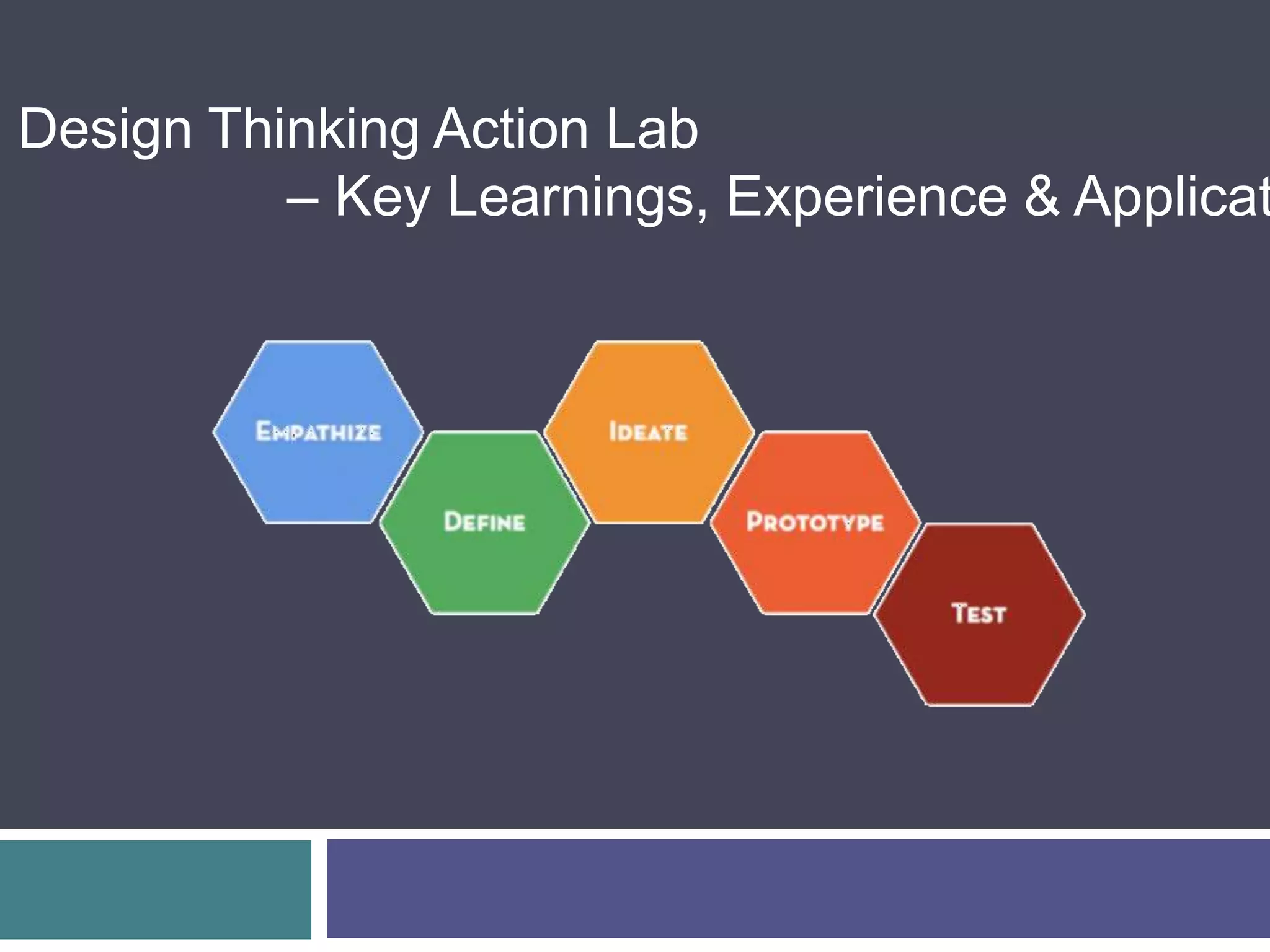
Design Thinking Action Lab
– Key Learnings, Experience & Applicat
3 Key Learnings
 Prototyping and Testing – I haven’t really
tried to prototype anything before. I just used
to do things at one go and assume my work to
be perfect. However, after that assignment, I
have learned how prototyping could be just
one step in the process and that you need a
number of iterations before you actually get
down to solving the problem in totality.
3 Key Learnings
 The importance of Empathy – It’s not easy to
see things from the perspective of another
person. The course gave me format to observe
and collect evidences that may be used to
empathize with another person and
understand their needs from their perspective.
3 Key Learnings
 The framing of the problem statement –
Even though I defined problems, I learned a
new way of doing so when doing the course.
The simple sentence that the course offered
indeed helps to define the problem in such a
way that it stimulates a number of varied
solutions.
Process – As I Experienced It
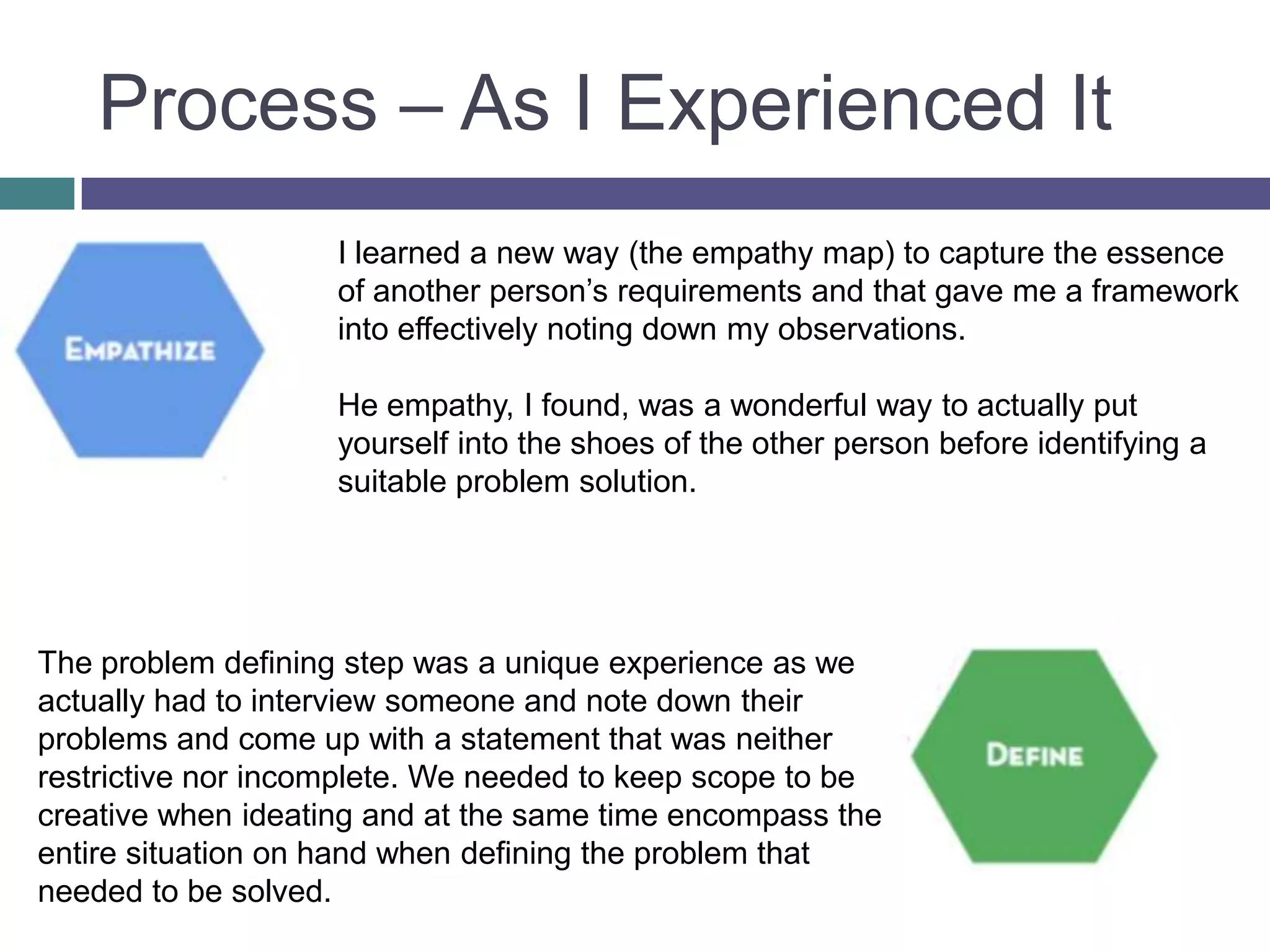
I learned a new way (the empathy map) to capture the essence
of another person’s requirements and that gave me a framework
into effectively noting down my observations.
He empathy, I found, was a wonderful way to actually put
yourself into the shoes of the other person before identifying a
suitable problem solution.
The problem defining step was a unique experience as we
actually had to interview someone and note down their
problems and come up with a statement that was neither
restrictive nor incomplete. We needed to keep scope to be
creative when ideating and at the same time encompass the
entire situation on hand when defining the problem that
needed to be solved.
Process – As I Experienced It
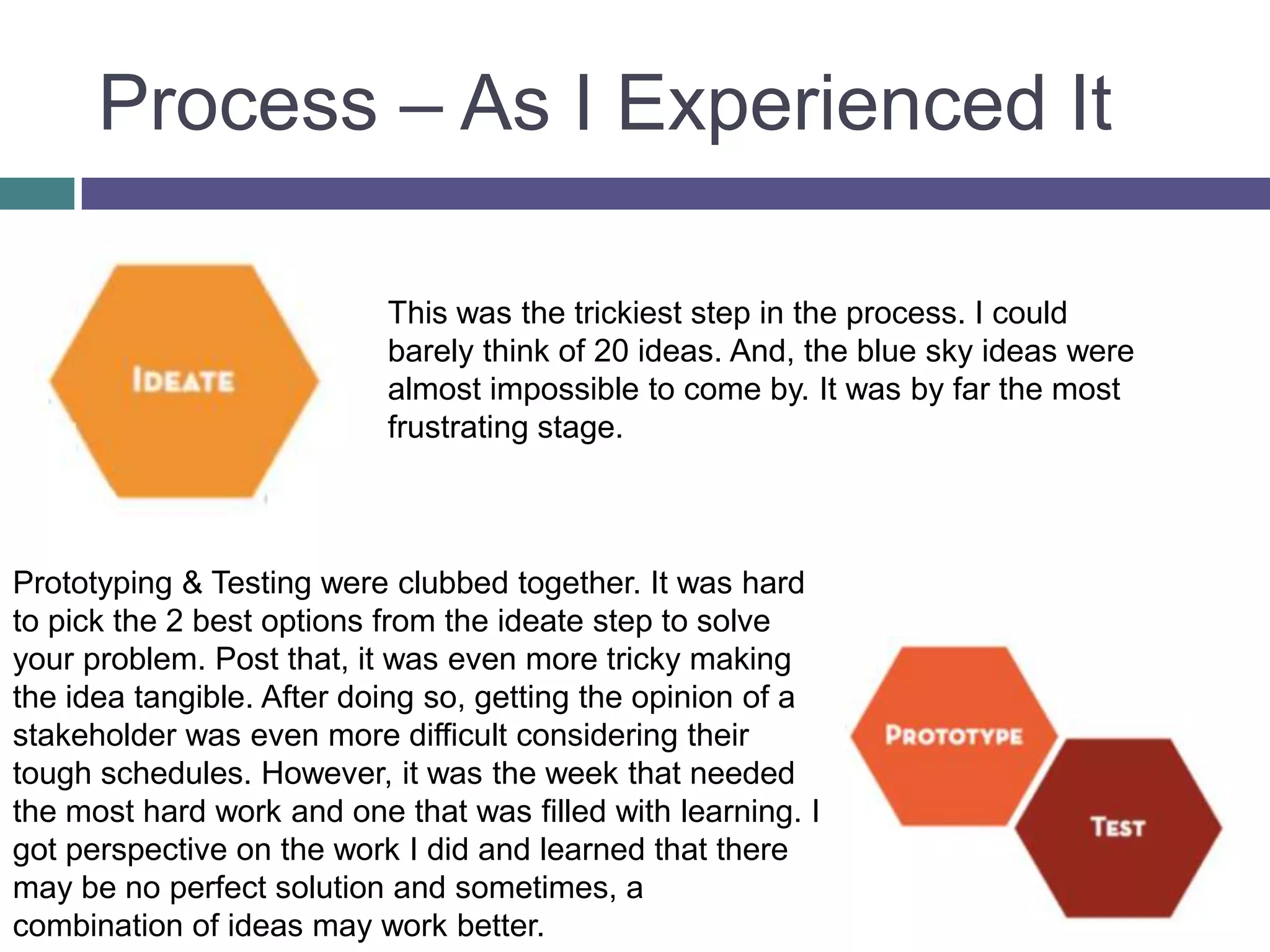
This was the trickiest step in the process. I could
barely think of 20 ideas. And, the blue sky ideas were
almost impossible to come by. It was by far the most
frustrating stage.
Prototyping & Testing were clubbed together. It was hard
to pick the 2 best options from the ideate step to solve
your problem. Post that, it was even more tricky making
the idea tangible. After doing so, getting the opinion of a
stakeholder was even more difficult considering their
tough schedules. However, it was the week that needed
the most hard work and one that was filled with learning. I
got perspective on the work I did and learned that there
may be no perfect solution and sometimes, a
combination of ideas may work better.
Applying the Process to Real-
Life
 Being a trainer, I can apply the process directly to the
trainings I conduct. I could empathize with my target
audience to analyse their training needs. Based on my
findings, I could define my problem statement for each
training based on the observations and inputs from
the audience as well as their supervisors.
 Based on the problem statement, I can ideate to think
about what all to include in my training sessions.
 I could then prototype different programs by mixing
and matching modules and customising it based on
the audience.
 I could then test the solution either on the target
audience or getting an approval from supervisors.

Design Thinking Action Lab - Key Learnings, Experience & Application to Live Scenarios

  • 1.
    Design Thinking ActionLab – Key Learnings, Experience & Applicat
  • 2.
    3 Key Learnings Prototyping and Testing – I haven’t really tried to prototype anything before. I just used to do things at one go and assume my work to be perfect. However, after that assignment, I have learned how prototyping could be just one step in the process and that you need a number of iterations before you actually get down to solving the problem in totality.
  • 3.
    3 Key Learnings The importance of Empathy – It’s not easy to see things from the perspective of another person. The course gave me format to observe and collect evidences that may be used to empathize with another person and understand their needs from their perspective.
  • 4.
    3 Key Learnings The framing of the problem statement – Even though I defined problems, I learned a new way of doing so when doing the course. The simple sentence that the course offered indeed helps to define the problem in such a way that it stimulates a number of varied solutions.
  • 5.
    Process – AsI Experienced It I learned a new way (the empathy map) to capture the essence of another person’s requirements and that gave me a framework into effectively noting down my observations. He empathy, I found, was a wonderful way to actually put yourself into the shoes of the other person before identifying a suitable problem solution. The problem defining step was a unique experience as we actually had to interview someone and note down their problems and come up with a statement that was neither restrictive nor incomplete. We needed to keep scope to be creative when ideating and at the same time encompass the entire situation on hand when defining the problem that needed to be solved.
  • 6.
    Process – AsI Experienced It This was the trickiest step in the process. I could barely think of 20 ideas. And, the blue sky ideas were almost impossible to come by. It was by far the most frustrating stage. Prototyping & Testing were clubbed together. It was hard to pick the 2 best options from the ideate step to solve your problem. Post that, it was even more tricky making the idea tangible. After doing so, getting the opinion of a stakeholder was even more difficult considering their tough schedules. However, it was the week that needed the most hard work and one that was filled with learning. I got perspective on the work I did and learned that there may be no perfect solution and sometimes, a combination of ideas may work better.
  • 7.
    Applying the Processto Real- Life  Being a trainer, I can apply the process directly to the trainings I conduct. I could empathize with my target audience to analyse their training needs. Based on my findings, I could define my problem statement for each training based on the observations and inputs from the audience as well as their supervisors.  Based on the problem statement, I can ideate to think about what all to include in my training sessions.  I could then prototype different programs by mixing and matching modules and customising it based on the audience.  I could then test the solution either on the target audience or getting an approval from supervisors.