Representational State Transfer
(REST)
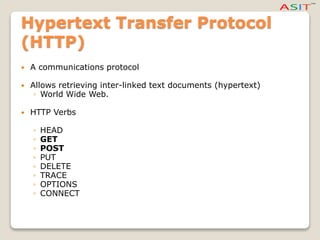
Hypertext Transfer Protocol
(HTTP)
 A communications protocol
 Allows retrieving inter-linked text documents (hypertext)
◦ World Wide Web.
 HTTP Verbs
◦ HEAD
◦ GET
◦ POST
◦ PUT
◦ DELETE
◦ TRACE
◦ OPTIONS
◦ CONNECT
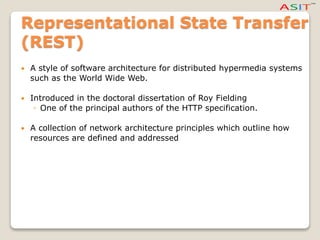
Representational State Transfer
(REST)
 A style of software architecture for distributed hypermedia systems
such as the World Wide Web.
 Introduced in the doctoral dissertation of Roy Fielding
◦ One of the principal authors of the HTTP specification.
 A collection of network architecture principles which outline how
resources are defined and addressed
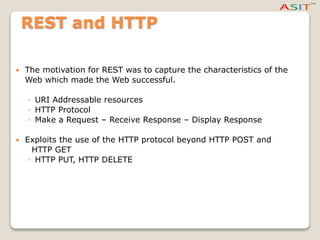
REST and HTTP
 The motivation for REST was to capture the characteristics of the
Web which made the Web successful.
◦ URI Addressable resources
◦ HTTP Protocol
◦ Make a Request – Receive Response – Display Response
 Exploits the use of the HTTP protocol beyond HTTP POST and
HTTP GET
◦ HTTP PUT, HTTP DELETE
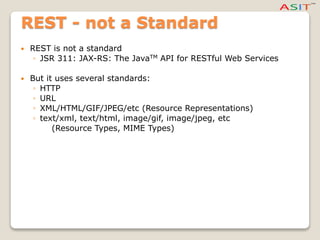
REST - not a Standard
 REST is not a standard
◦ JSR 311: JAX-RS: The JavaTM API for RESTful Web Services
 But it uses several standards:
◦ HTTP
◦ URL
◦ XML/HTML/GIF/JPEG/etc (Resource Representations)
◦ text/xml, text/html, image/gif, image/jpeg, etc
(Resource Types, MIME Types)
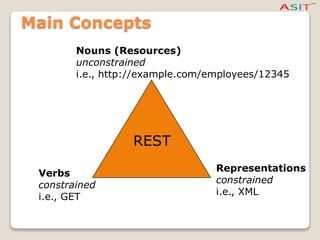
Main Concepts
Nouns (Resources)
unconstrained
i.e., http://example.com/employees/12345
REST
Representations
constrained
i.e., XML
Verbs
constrained
i.e., GET
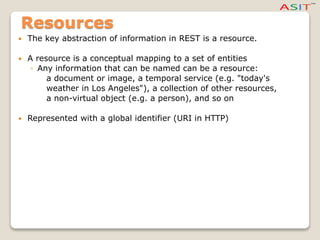
Resources
 The key abstraction of information in REST is a resource.
 A resource is a conceptual mapping to a set of entities
◦ Any information that can be named can be a resource:
a document or image, a temporal service (e.g. "today's
weather in Los Angeles"), a collection of other resources,
a non-virtual object (e.g. a person), and so on
 Represented with a global identifier (URI in HTTP)
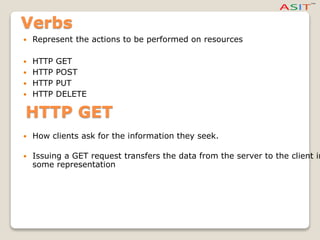
Verbs
 Represent the actions to be performed on resources
 HTTP GET
 HTTP POST
 HTTP PUT
 HTTP DELETE
HTTP GET
 How clients ask for the information they seek.
 Issuing a GET request transfers the data from the server to the client in
some representation
Representations
 How data is represented or returned to the client for presentation.
 Two main formats:
◦ JavaScript Object Notation (JSON)
◦ XML
 It is common to have multiple representations of the same data
Why is it called
"Representational State
Transfer"?
Client
http://www.boeing.com/aircraft/747
Resource
Fuel requirements
Maintenance schedule
...
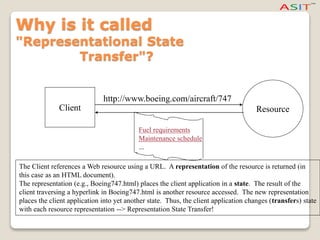
The Client references a Web resource using a URL. A representation of the resource is returned (in
this case as an HTML document).
The representation (e.g., Boeing747.html) places the client application in a state. The result of the
client traversing a hyperlink in Boeing747.html is another resource accessed. The new representation
places the client application into yet another state. Thus, the client application changes (transfers) state
with each resource representation --> Representation State Transfer!
Architecture Style
Request
(XML doc)
Response
(JSON doc)
PO
(XML doc)
Response
(TEXT doc)
URL 1
URL 1
URL 1
Request
(XML doc)
Response
(XML doc)
HTTP POST
HTTP DELETE
HTTP Response
HTTP Response
HTTP Response
HTTP GET
Web/ProxyServer
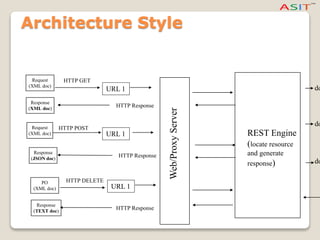
REST Engine
(locate resource
and generate
response)
do
do
do
Real Life Examples
 Google Maps
 Google AJAX Search API
 Yahoo Search API
 Amazon WebServices
REST and the Web
 The Web is an example of a REST system!
 All of those Web services that you have been using all these many
years - book ordering services, search services, online dictionary
services, etc - are REST-based Web services.
 Alas, you have been using REST, building REST services and you
didn't even know it.
we provide online and classroom training
for REST API
For More Details
www.asit.amcsquare.com
Wise Machines India Pvt Ltd
#360, Sri Sai Padma Arcade,
Varthur Main Road,
Ramagondanahalli,
Whitefiled ,Bangalore – 560066.
We also having Branches in Hyderabad & Chennai

Learn REST API at ASIT

  • 1.
  • 2.
    Hypertext Transfer Protocol (HTTP) A communications protocol  Allows retrieving inter-linked text documents (hypertext) ◦ World Wide Web.  HTTP Verbs ◦ HEAD ◦ GET ◦ POST ◦ PUT ◦ DELETE ◦ TRACE ◦ OPTIONS ◦ CONNECT
  • 3.
    Representational State Transfer (REST) A style of software architecture for distributed hypermedia systems such as the World Wide Web.  Introduced in the doctoral dissertation of Roy Fielding ◦ One of the principal authors of the HTTP specification.  A collection of network architecture principles which outline how resources are defined and addressed
  • 4.
    REST and HTTP The motivation for REST was to capture the characteristics of the Web which made the Web successful. ◦ URI Addressable resources ◦ HTTP Protocol ◦ Make a Request – Receive Response – Display Response  Exploits the use of the HTTP protocol beyond HTTP POST and HTTP GET ◦ HTTP PUT, HTTP DELETE
  • 5.
    REST - nota Standard  REST is not a standard ◦ JSR 311: JAX-RS: The JavaTM API for RESTful Web Services  But it uses several standards: ◦ HTTP ◦ URL ◦ XML/HTML/GIF/JPEG/etc (Resource Representations) ◦ text/xml, text/html, image/gif, image/jpeg, etc (Resource Types, MIME Types)
  • 6.
    Main Concepts Nouns (Resources) unconstrained i.e.,http://example.com/employees/12345 REST Representations constrained i.e., XML Verbs constrained i.e., GET
  • 7.
    Resources  The keyabstraction of information in REST is a resource.  A resource is a conceptual mapping to a set of entities ◦ Any information that can be named can be a resource: a document or image, a temporal service (e.g. "today's weather in Los Angeles"), a collection of other resources, a non-virtual object (e.g. a person), and so on  Represented with a global identifier (URI in HTTP)
  • 8.
    Verbs  Represent theactions to be performed on resources  HTTP GET  HTTP POST  HTTP PUT  HTTP DELETE HTTP GET  How clients ask for the information they seek.  Issuing a GET request transfers the data from the server to the client in some representation
  • 9.
    Representations  How datais represented or returned to the client for presentation.  Two main formats: ◦ JavaScript Object Notation (JSON) ◦ XML  It is common to have multiple representations of the same data
  • 10.
    Why is itcalled "Representational State Transfer"? Client http://www.boeing.com/aircraft/747 Resource Fuel requirements Maintenance schedule ... The Client references a Web resource using a URL. A representation of the resource is returned (in this case as an HTML document). The representation (e.g., Boeing747.html) places the client application in a state. The result of the client traversing a hyperlink in Boeing747.html is another resource accessed. The new representation places the client application into yet another state. Thus, the client application changes (transfers) state with each resource representation --> Representation State Transfer!
  • 11.
    Architecture Style Request (XML doc) Response (JSONdoc) PO (XML doc) Response (TEXT doc) URL 1 URL 1 URL 1 Request (XML doc) Response (XML doc) HTTP POST HTTP DELETE HTTP Response HTTP Response HTTP Response HTTP GET Web/ProxyServer REST Engine (locate resource and generate response) do do do
  • 12.
    Real Life Examples Google Maps  Google AJAX Search API  Yahoo Search API  Amazon WebServices
  • 13.
    REST and theWeb  The Web is an example of a REST system!  All of those Web services that you have been using all these many years - book ordering services, search services, online dictionary services, etc - are REST-based Web services.  Alas, you have been using REST, building REST services and you didn't even know it.
  • 14.
    we provide onlineand classroom training for REST API For More Details www.asit.amcsquare.com Wise Machines India Pvt Ltd #360, Sri Sai Padma Arcade, Varthur Main Road, Ramagondanahalli, Whitefiled ,Bangalore – 560066. We also having Branches in Hyderabad & Chennai