Design Patterns
Last Time
• Introduced design patterns
• Abstraction-Occurrence
• General Hierarchy
• Player-Role
This Time
• Singleton pattern
• Observer pattern
• Delegation pattern
• Adapter pattern
• Façade pattern
• Immutable pattern
• Read-Only Interface pattern
• Factory pattern
Singleton
• Context
– Common to want only one instance of a class
– Referred to as a singleton
– E.g. a Company or University class
• Problem
– How to ensure only one instance
• Forces
– Public constructor will not guarantee only one
instance
– Constructor must be accessible to all classes that need
it, though.
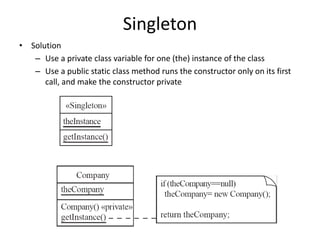
Singleton
• Solution
– Use a private class variable for one (the) instance of the class
– Use a public static class method runs the constructor only on its first
call, and make the constructor private
Observer
• Context
– Two way associations make code for pairs of classes
inseparable
– Need both classes for reuse
• Problem
– How to reduce interconnection between classes
– How to ensure communication with other objects
without knowing what class they belong to
• Forces
– Maximize flexibility
Observer
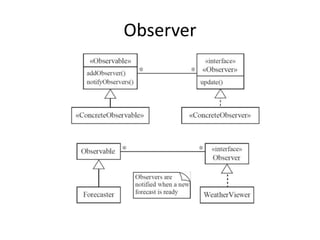
• Solution
– Create abstract class called <<Observable>>
– Includes mechanism to add and remove observers
– Method to send an update message to each
<<Observer>>
– Allow any application class to be <<Observable>>
• <<Observer>> is an interface with an abstract
update method
Observer
Observer
• Examples
– A Forecaster object would perform many calculations
– WeatherViewer is needed to obtain values from this
object
– Java contains an Observer interface and an
Observable class
• Anti-patterns
– Connecting an observer directly to something that is
observable
– Making observers subclasses of what is observable
Delegation
• Context
– Creating a method for a class
– Another class already has that operation
– Inheritance should not be used because the “is-a” rule
does not apply
• Problem
– Effectively make use of a method existing in another class
• Forces
– Development costs should be minimized by reusing
methods from other classes
– Ensure work is completed by an appropriate class
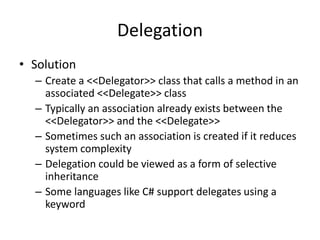
Delegation
• Solution
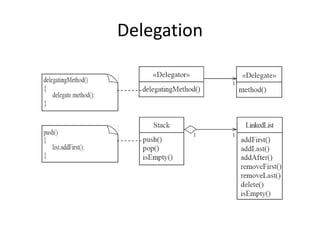
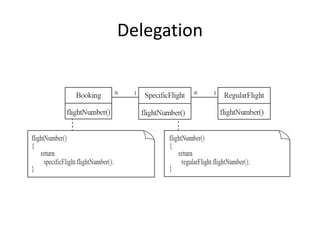
– Create a <<Delegator>> class that calls a method in an
associated <<Delegate>> class
– Typically an association already exists between the
<<Delegator>> and the <<Delegate>>
– Sometimes such an association is created if it reduces
system complexity
– Delegation could be viewed as a form of selective
inheritance
– Some languages like C# support delegates using a
keyword
Delegation
Delegation
Delegation
• Anti-patterns
– Common to inherit method to be reused instead
of delegating it
– Should avoid duplicating code unless necessary
– Should avoid directly accessing code within the
delegate class that is outside of the delegated
method
Adapter
• Context
– Incorporate an existing class into an inheritance
hierarchy
– Methods may have different names and class may be
part of its own inheritance hierarchy
• Problem
– How to use polymorphism when reusing a class with
the same functionality but a different signature
• Forces
– Assume multiple inheritance does not exist
Adapter
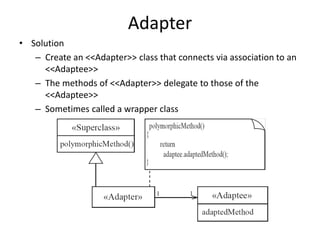
• Solution
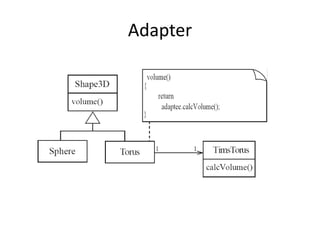
– Create an <<Adapter>> class that connects via association to an
<<Adaptee>>
– The methods of <<Adapter>> delegate to those of the
<<Adaptee>>
– Sometimes called a wrapper class
Adapter
Façade
• Context
– Need to manipulate many different classes in many
packages
• Problem
– Simplify the programmer’s view of these packages
• Forces
– Often hard to understand and use an entire subsystem
– Modifications made to the package would necessitate
a complete review of its subsystems
Façade
• Solution
– Use a <<Façade>> class to simplify use of the package(s)
– Create a simplified set of public methods to interact with the package(s)
– Changes should only need to be made to the <<Façade>> rather than the
package(s)
Immutable
• Context
– Immutable object has a state that never changes after creation – e.g. a Java
String
– Content can be trusted to not change unexpectedly
• Problem
– How to create a class with immutable instances
• Forces
– Immutability must be enforced
– Don’t allow loopholes
• Solution
– Only allow instance variables to be modified within the constructor
– Instance methods should have no side effects
– Instead of using side effects to modify instance variables, instance methods
should create a new instance of the class and return a new object with new
values containing the results of the side effect
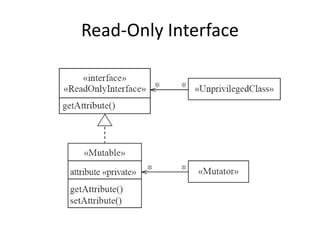
Read-Only Interface
• Context
– Create a privileged class that may modify attributes of objects that are
otherwise immutable
• Problem
– How to create a situation where some classes see another as read-
only
• Forces
– Java allows access control by public, private, and protected keywords,
but public access still allows read and write access
• Solution
– Create a <<Mutable>> class that you may pass instances of to methods
that are allowed to make changes
– Allow associations to unprivileged classes only through a
<<ReadOnlyInterface>>
Read-Only Interface
Read-Only Interface
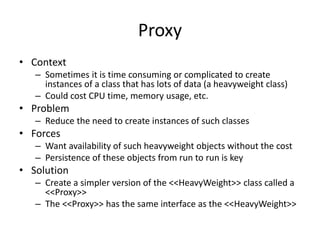
Proxy
• Context
– Sometimes it is time consuming or complicated to create
instances of a class that has lots of data (a heavyweight class)
– Could cost CPU time, memory usage, etc.
• Problem
– Reduce the need to create instances of such classes
• Forces
– Want availability of such heavyweight objects without the cost
– Persistence of these objects from run to run is key
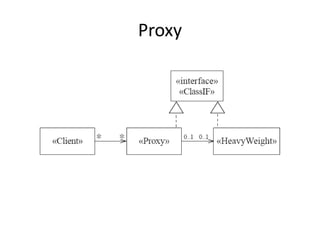
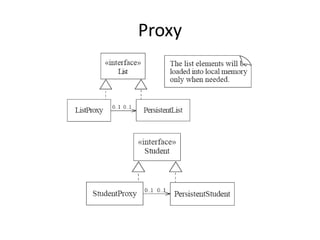
• Solution
– Create a simpler version of the <<HeavyWeight>> class called a
<<Proxy>>
– The <<Proxy>> has the same interface as the <<HeavyWeight>>
Proxy
Proxy
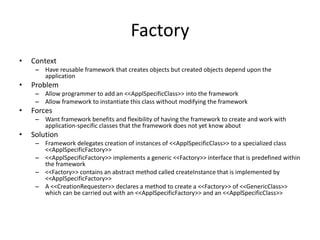
Factory
• Context
– Have reusable framework that creates objects but created objects depend upon the
application
• Problem
– Allow programmer to add an <<ApplSpecificClass>> into the framework
– Allow framework to instantiate this class without modifying the framework
• Forces
– Want framework benefits and flexibility of having the framework to create and work with
application-specific classes that the framework does not yet know about
• Solution
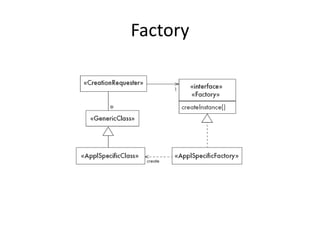
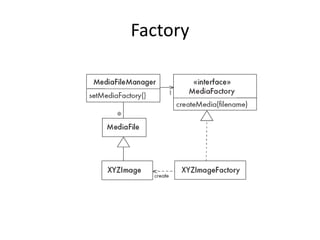
– Framework delegates creation of instances of <<ApplSpecificClass>> to a specialized class
<<ApplSpecificFactory>>
– <<ApplSpecificFactory>> implements a generic <<Factory>> interface that is predefined within
the framework
– <<Factory>> contains an abstract method called createInstance that is implemented by
<<ApplSpecificFactory>>
– A <<CreationRequester>> declares a method to create a <<Factory>> of <<GenericClass>>
which can be carried out with an <<ApplSpecificFactory>> and an <<ApplSpecificClass>>
Factory
Factory

Design patterns

  • 1.
  • 2.
    Last Time • Introduceddesign patterns • Abstraction-Occurrence • General Hierarchy • Player-Role
  • 3.
    This Time • Singletonpattern • Observer pattern • Delegation pattern • Adapter pattern • Façade pattern • Immutable pattern • Read-Only Interface pattern • Factory pattern
  • 4.
    Singleton • Context – Commonto want only one instance of a class – Referred to as a singleton – E.g. a Company or University class • Problem – How to ensure only one instance • Forces – Public constructor will not guarantee only one instance – Constructor must be accessible to all classes that need it, though.
  • 5.
    Singleton • Solution – Usea private class variable for one (the) instance of the class – Use a public static class method runs the constructor only on its first call, and make the constructor private
  • 6.
    Observer • Context – Twoway associations make code for pairs of classes inseparable – Need both classes for reuse • Problem – How to reduce interconnection between classes – How to ensure communication with other objects without knowing what class they belong to • Forces – Maximize flexibility
  • 7.
    Observer • Solution – Createabstract class called <<Observable>> – Includes mechanism to add and remove observers – Method to send an update message to each <<Observer>> – Allow any application class to be <<Observable>> • <<Observer>> is an interface with an abstract update method
  • 8.
  • 9.
    Observer • Examples – AForecaster object would perform many calculations – WeatherViewer is needed to obtain values from this object – Java contains an Observer interface and an Observable class • Anti-patterns – Connecting an observer directly to something that is observable – Making observers subclasses of what is observable
  • 10.
    Delegation • Context – Creatinga method for a class – Another class already has that operation – Inheritance should not be used because the “is-a” rule does not apply • Problem – Effectively make use of a method existing in another class • Forces – Development costs should be minimized by reusing methods from other classes – Ensure work is completed by an appropriate class
  • 11.
    Delegation • Solution – Createa <<Delegator>> class that calls a method in an associated <<Delegate>> class – Typically an association already exists between the <<Delegator>> and the <<Delegate>> – Sometimes such an association is created if it reduces system complexity – Delegation could be viewed as a form of selective inheritance – Some languages like C# support delegates using a keyword
  • 12.
  • 13.
  • 14.
    Delegation • Anti-patterns – Commonto inherit method to be reused instead of delegating it – Should avoid duplicating code unless necessary – Should avoid directly accessing code within the delegate class that is outside of the delegated method
  • 15.
    Adapter • Context – Incorporatean existing class into an inheritance hierarchy – Methods may have different names and class may be part of its own inheritance hierarchy • Problem – How to use polymorphism when reusing a class with the same functionality but a different signature • Forces – Assume multiple inheritance does not exist
  • 16.
    Adapter • Solution – Createan <<Adapter>> class that connects via association to an <<Adaptee>> – The methods of <<Adapter>> delegate to those of the <<Adaptee>> – Sometimes called a wrapper class
  • 17.
  • 18.
    Façade • Context – Needto manipulate many different classes in many packages • Problem – Simplify the programmer’s view of these packages • Forces – Often hard to understand and use an entire subsystem – Modifications made to the package would necessitate a complete review of its subsystems
  • 19.
    Façade • Solution – Usea <<Façade>> class to simplify use of the package(s) – Create a simplified set of public methods to interact with the package(s) – Changes should only need to be made to the <<Façade>> rather than the package(s)
  • 20.
    Immutable • Context – Immutableobject has a state that never changes after creation – e.g. a Java String – Content can be trusted to not change unexpectedly • Problem – How to create a class with immutable instances • Forces – Immutability must be enforced – Don’t allow loopholes • Solution – Only allow instance variables to be modified within the constructor – Instance methods should have no side effects – Instead of using side effects to modify instance variables, instance methods should create a new instance of the class and return a new object with new values containing the results of the side effect
  • 21.
    Read-Only Interface • Context –Create a privileged class that may modify attributes of objects that are otherwise immutable • Problem – How to create a situation where some classes see another as read- only • Forces – Java allows access control by public, private, and protected keywords, but public access still allows read and write access • Solution – Create a <<Mutable>> class that you may pass instances of to methods that are allowed to make changes – Allow associations to unprivileged classes only through a <<ReadOnlyInterface>>
  • 22.
  • 23.
  • 24.
    Proxy • Context – Sometimesit is time consuming or complicated to create instances of a class that has lots of data (a heavyweight class) – Could cost CPU time, memory usage, etc. • Problem – Reduce the need to create instances of such classes • Forces – Want availability of such heavyweight objects without the cost – Persistence of these objects from run to run is key • Solution – Create a simpler version of the <<HeavyWeight>> class called a <<Proxy>> – The <<Proxy>> has the same interface as the <<HeavyWeight>>
  • 25.
  • 26.
  • 27.
    Factory • Context – Havereusable framework that creates objects but created objects depend upon the application • Problem – Allow programmer to add an <<ApplSpecificClass>> into the framework – Allow framework to instantiate this class without modifying the framework • Forces – Want framework benefits and flexibility of having the framework to create and work with application-specific classes that the framework does not yet know about • Solution – Framework delegates creation of instances of <<ApplSpecificClass>> to a specialized class <<ApplSpecificFactory>> – <<ApplSpecificFactory>> implements a generic <<Factory>> interface that is predefined within the framework – <<Factory>> contains an abstract method called createInstance that is implemented by <<ApplSpecificFactory>> – A <<CreationRequester>> declares a method to create a <<Factory>> of <<GenericClass>> which can be carried out with an <<ApplSpecificFactory>> and an <<ApplSpecificClass>>
  • 28.
  • 29.