
Design of Wireless Power
Transfer System via
Magnetic Resonant Coupling
at 13.56MHz
Ajay Kumar Sah
ajayshah2005@yahoo.com
Introduction
 Power
 Wireless Power transmission (WPT)
 Magnetic induction
 Resonant coupling
 Maximum power transfer
IOE – Graduate Conference , 29th November 2013, Central Campus , Pulchowk 2
Types Of WPT Techniques
On the basis of Distance:
Near field Mid field Far field
On the basis of mode of Coupling:
Inductive Capacitive Laser Microwave
IOE – Graduate Conference , 29th November 2013, Central Campus , Pulchowk 3
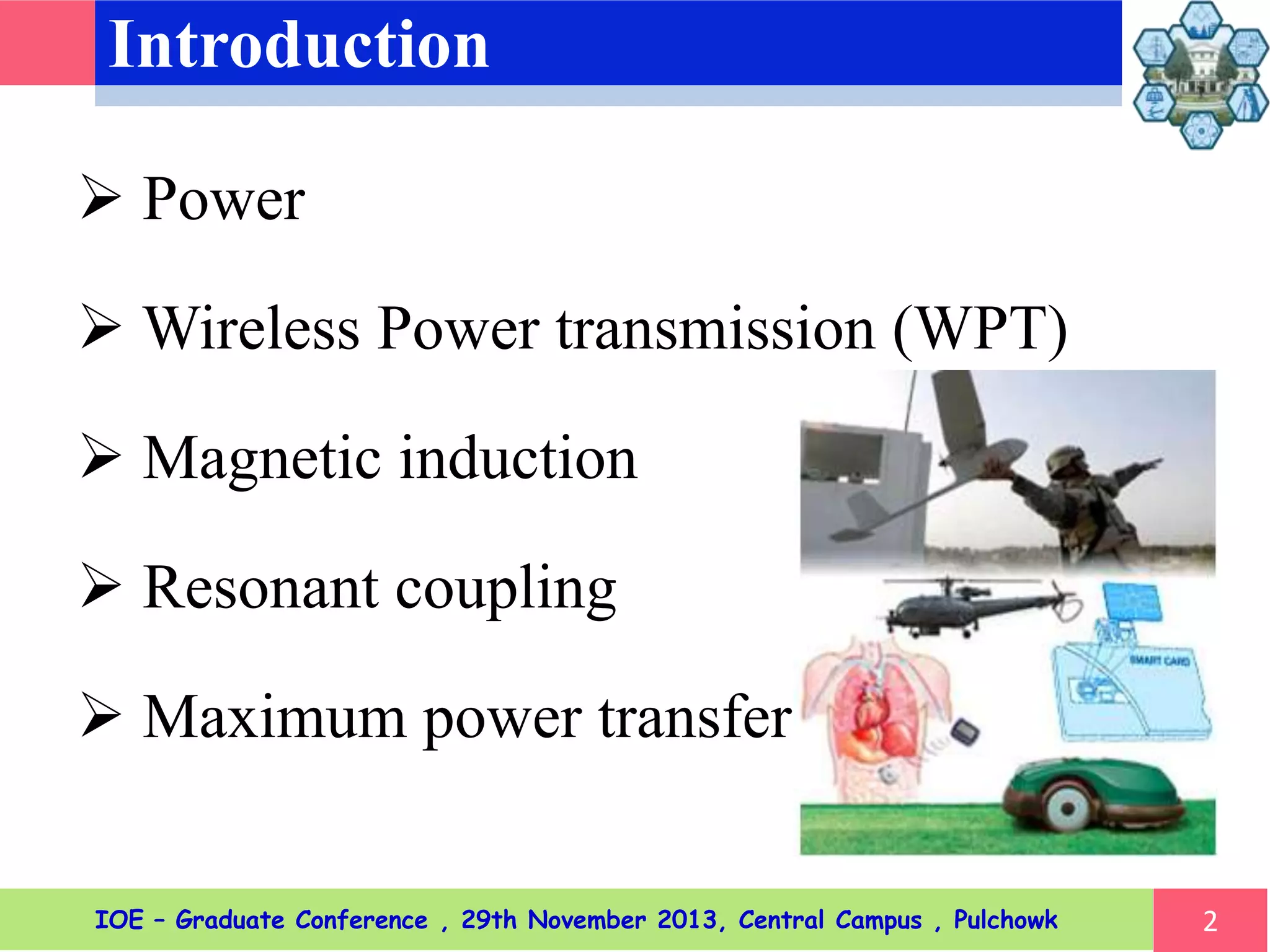
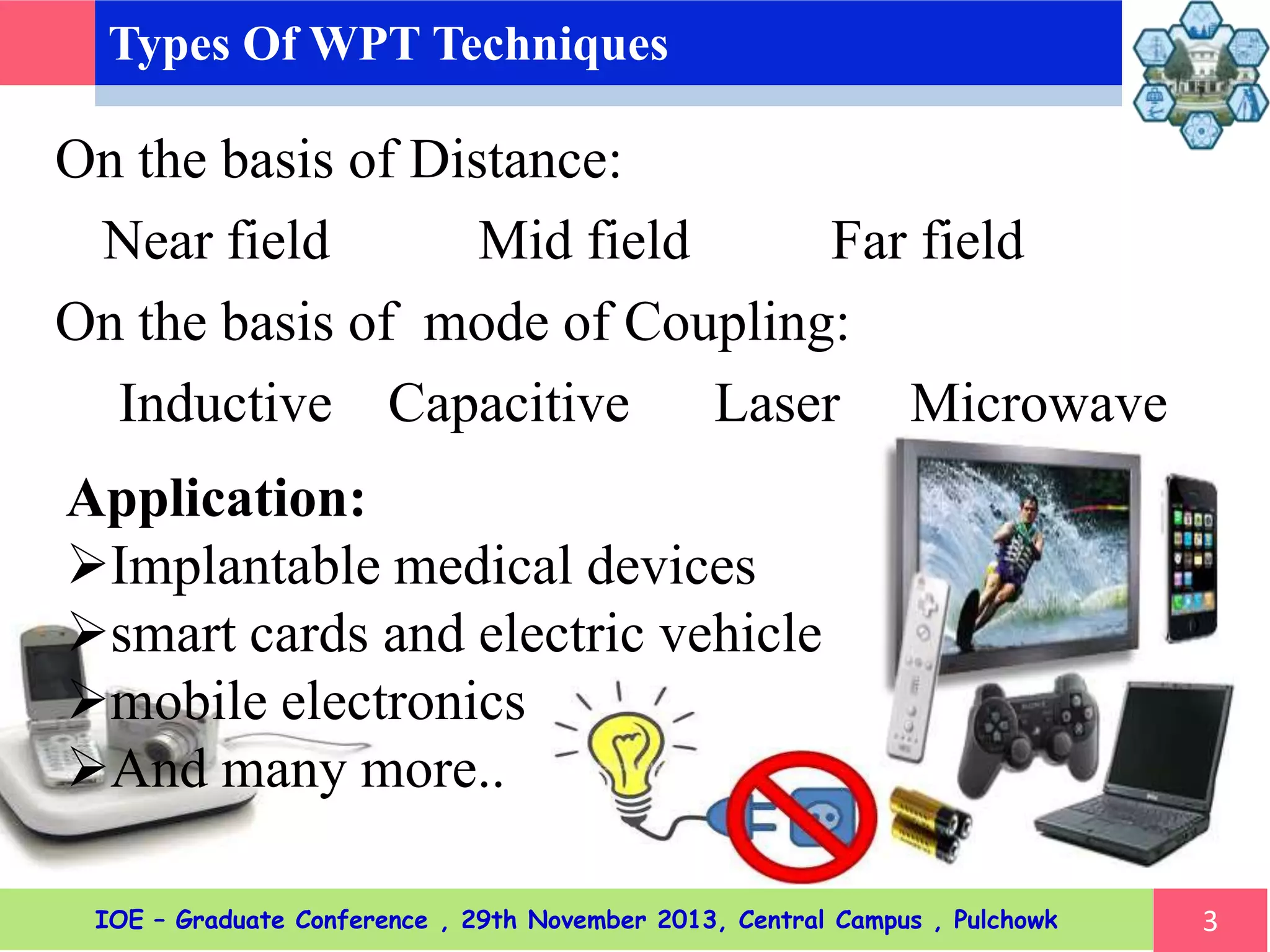
Application:
Implantable medical devices
smart cards and electric vehicle
mobile electronics
And many more..
Objective
To design an improved WPT system
4IOE – Graduate Conference , 29th November 2013, Central Campus , Pulchowk
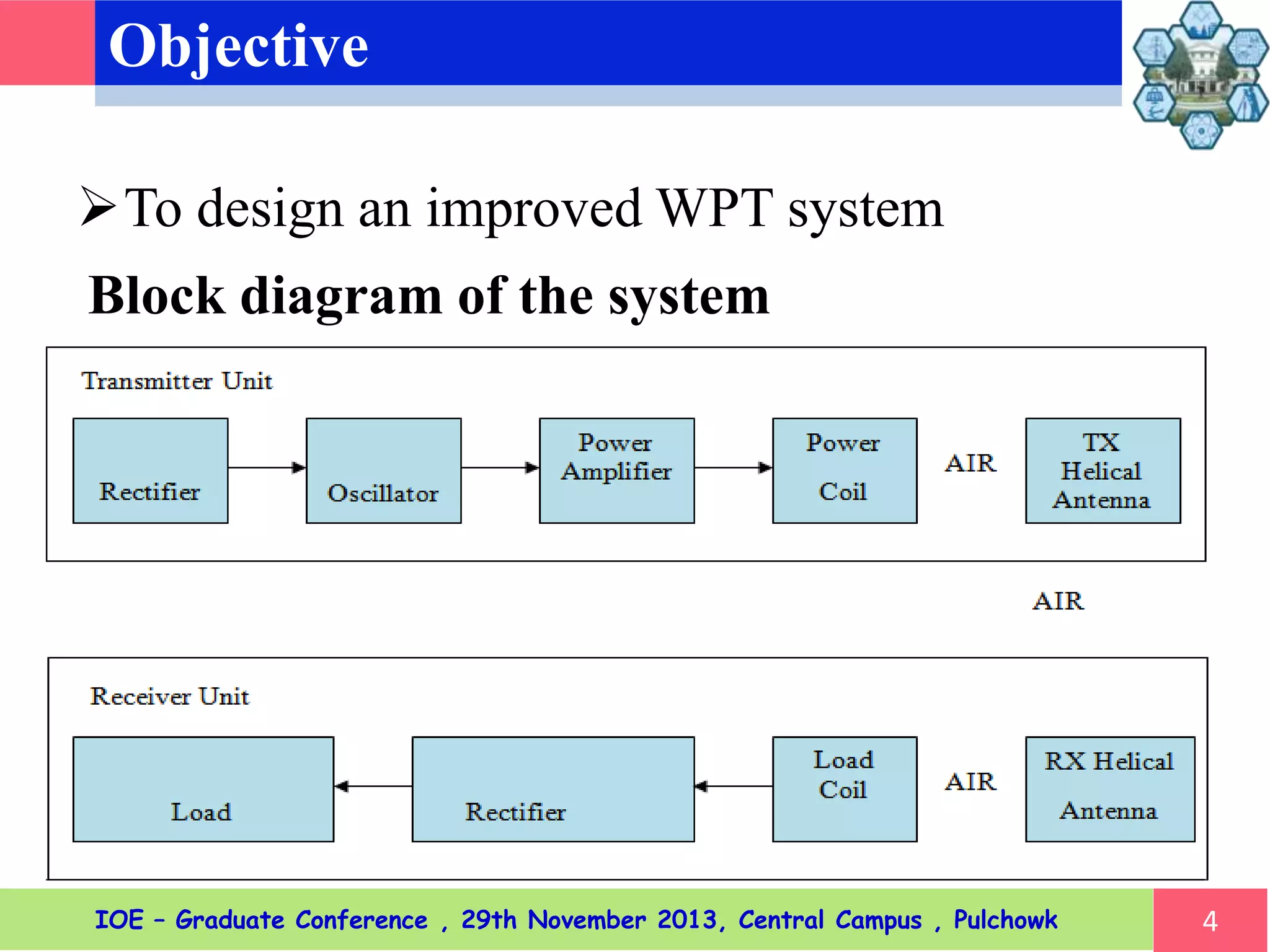
Block diagram of the system
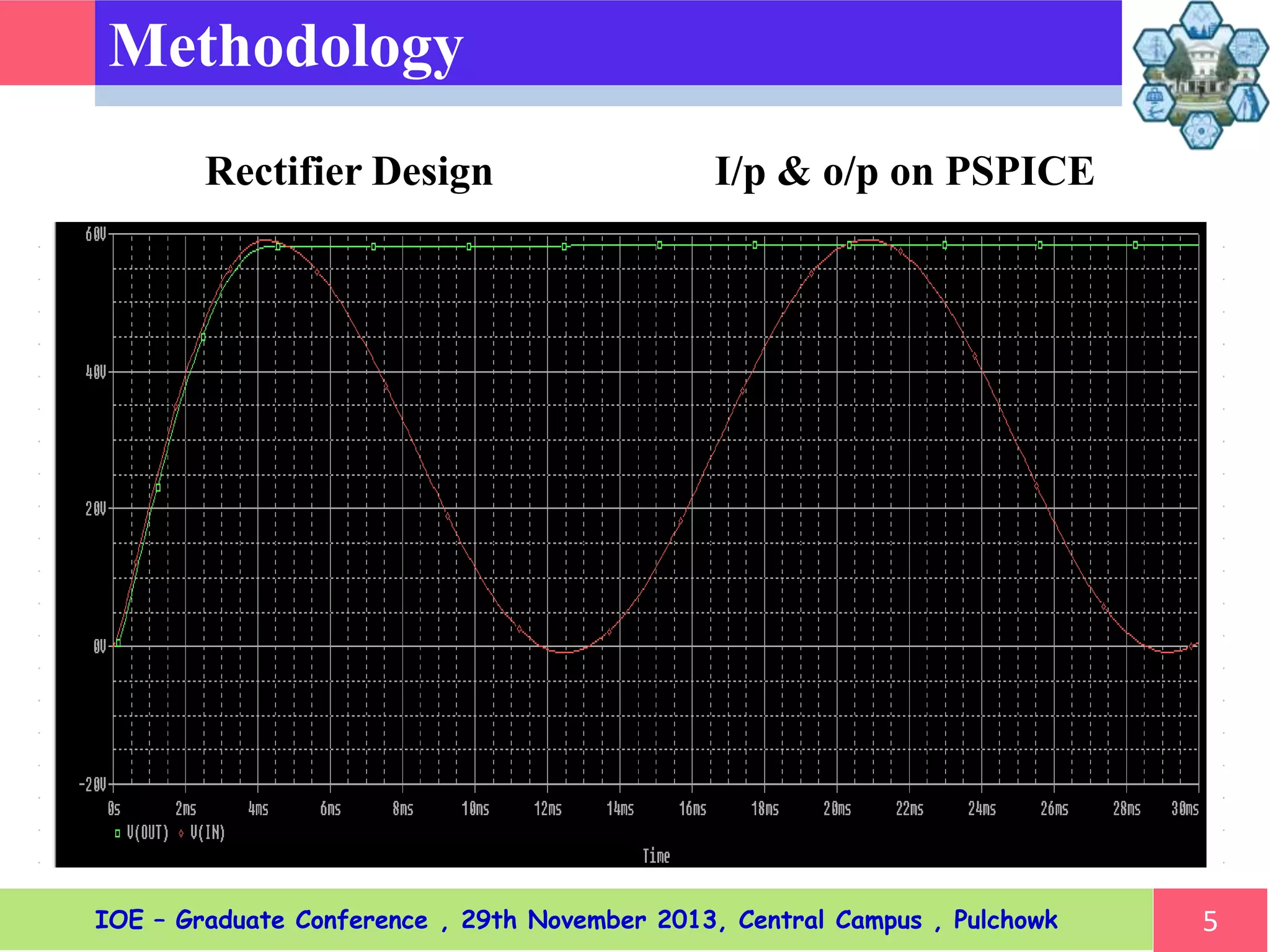
Methodology
Rectifier Design I/p & o/p on PSPICE
5IOE – Graduate Conference , 29th November 2013, Central Campus , Pulchowk
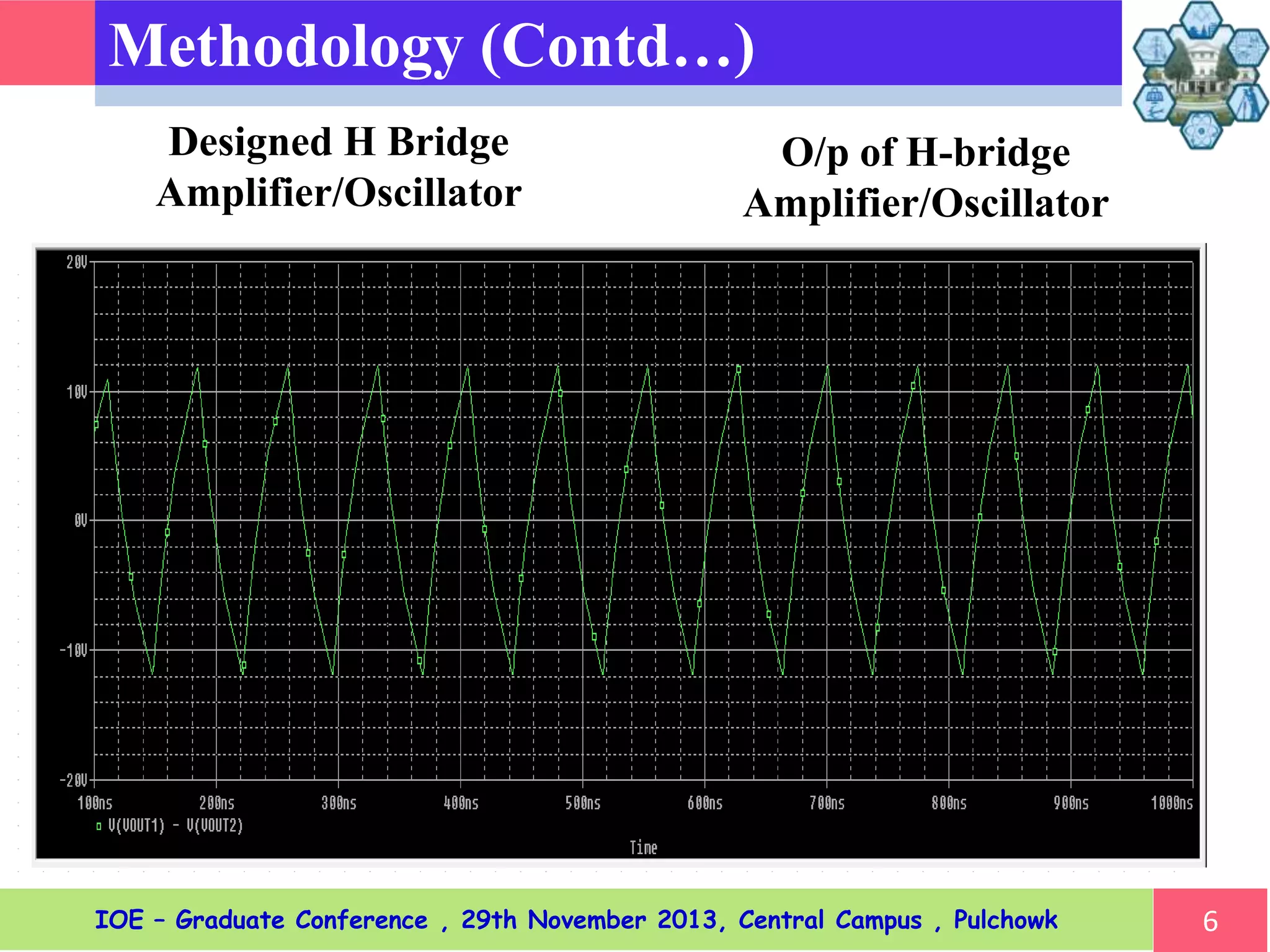
Methodology (Contd…)
Designed H Bridge
Amplifier/Oscillator
O/p of H-bridge
Amplifier/Oscillator
6IOE – Graduate Conference , 29th November 2013, Central Campus , Pulchowk
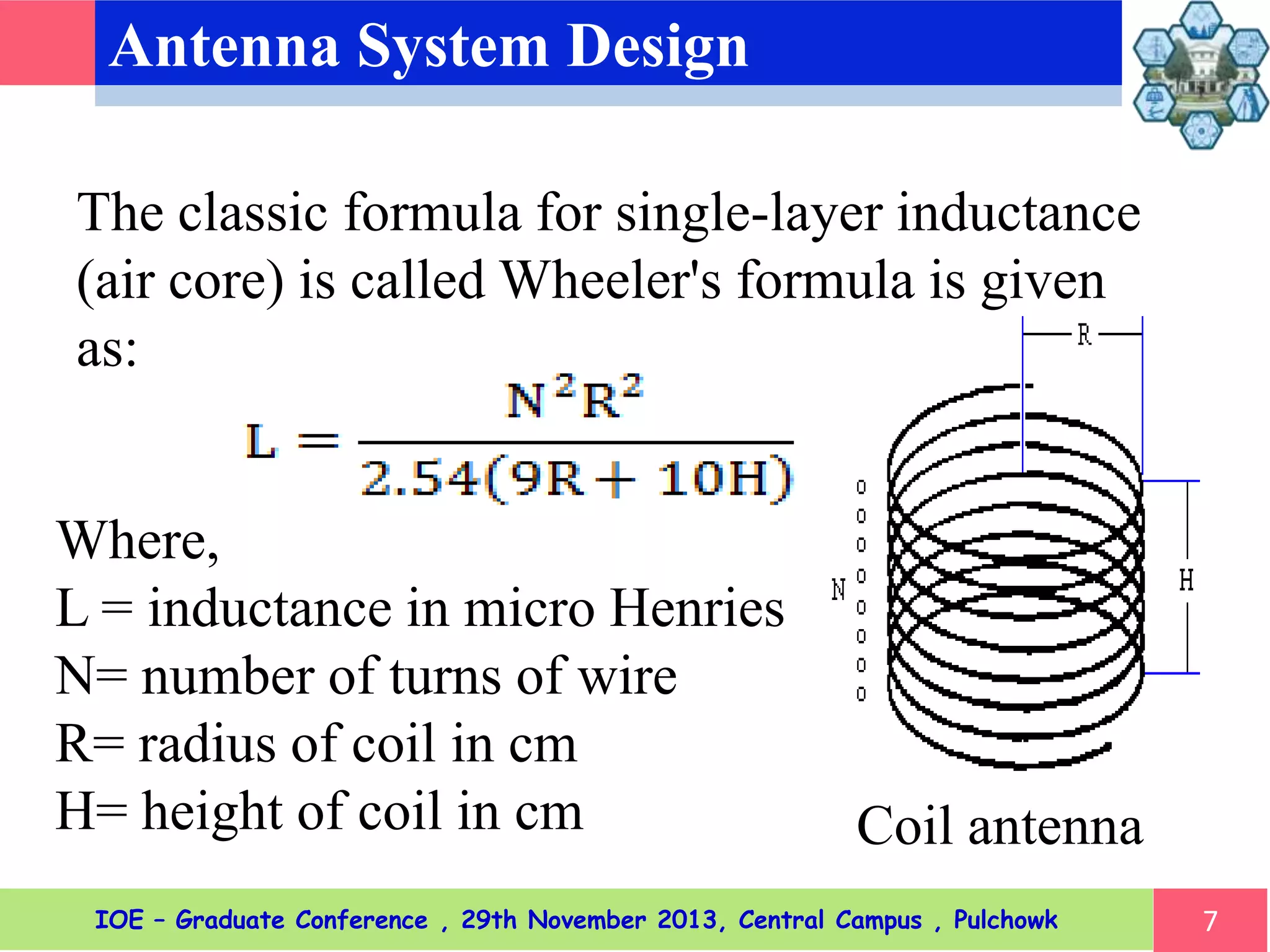
Antenna System Design
7
The classic formula for single-layer inductance
(air core) is called Wheeler's formula is given
as:
Where,
L = inductance in micro Henries
N= number of turns of wire
R= radius of coil in cm
H= height of coil in cm Coil antenna
IOE – Graduate Conference , 29th November 2013, Central Campus , Pulchowk
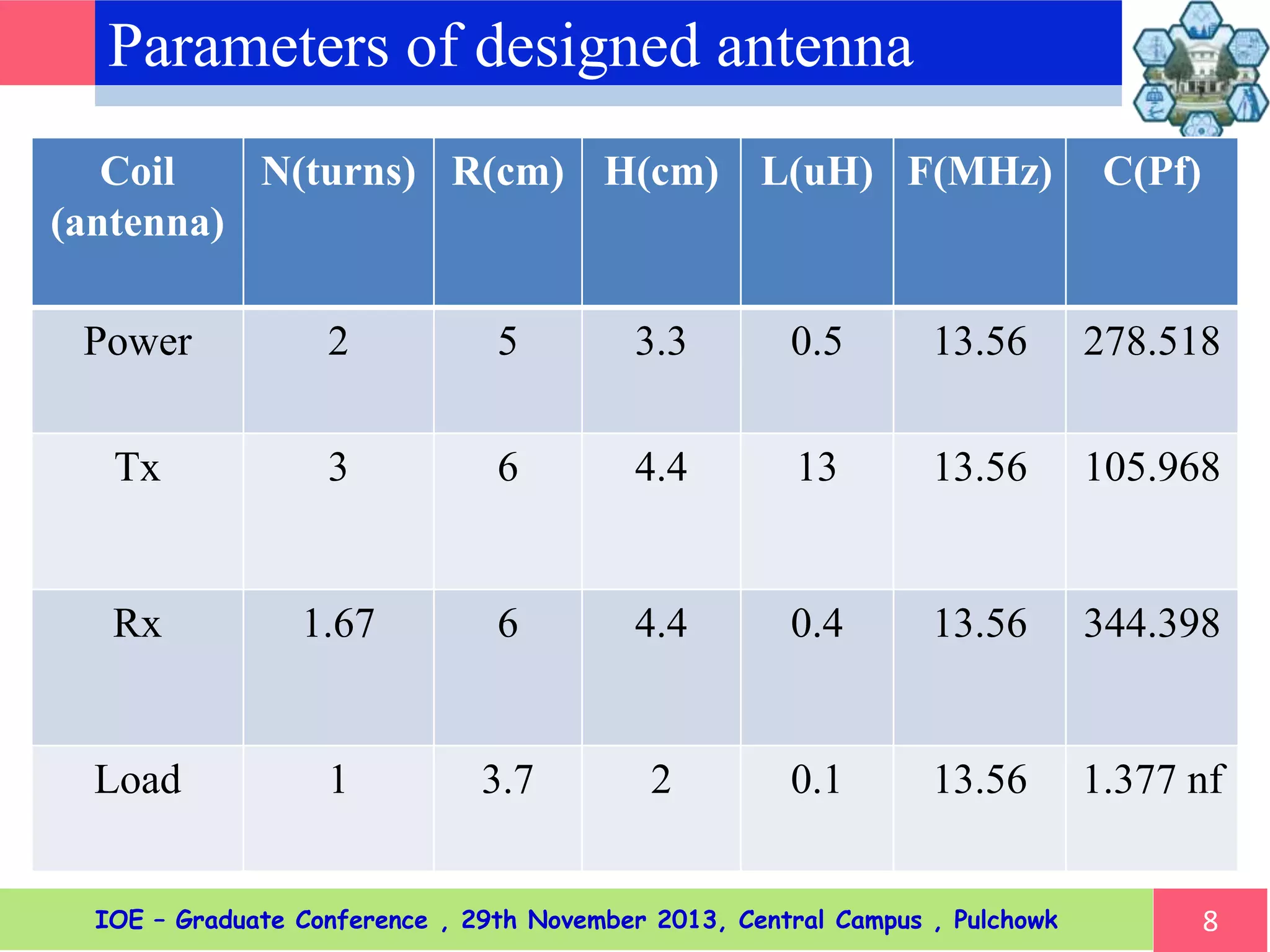
Parameters of designed antenna
Coil
(antenna)
N(turns) R(cm) H(cm) L(uH) F(MHz) C(Pf)
Power 2 5 3.3 0.5 13.56 278.518
Tx 3 6 4.4 13 13.56 105.968
Rx 1.67 6 4.4 0.4 13.56 344.398
Load 1 3.7 2 0.1 13.56 1.377 nf
8IOE – Graduate Conference , 29th November 2013, Central Campus , Pulchowk
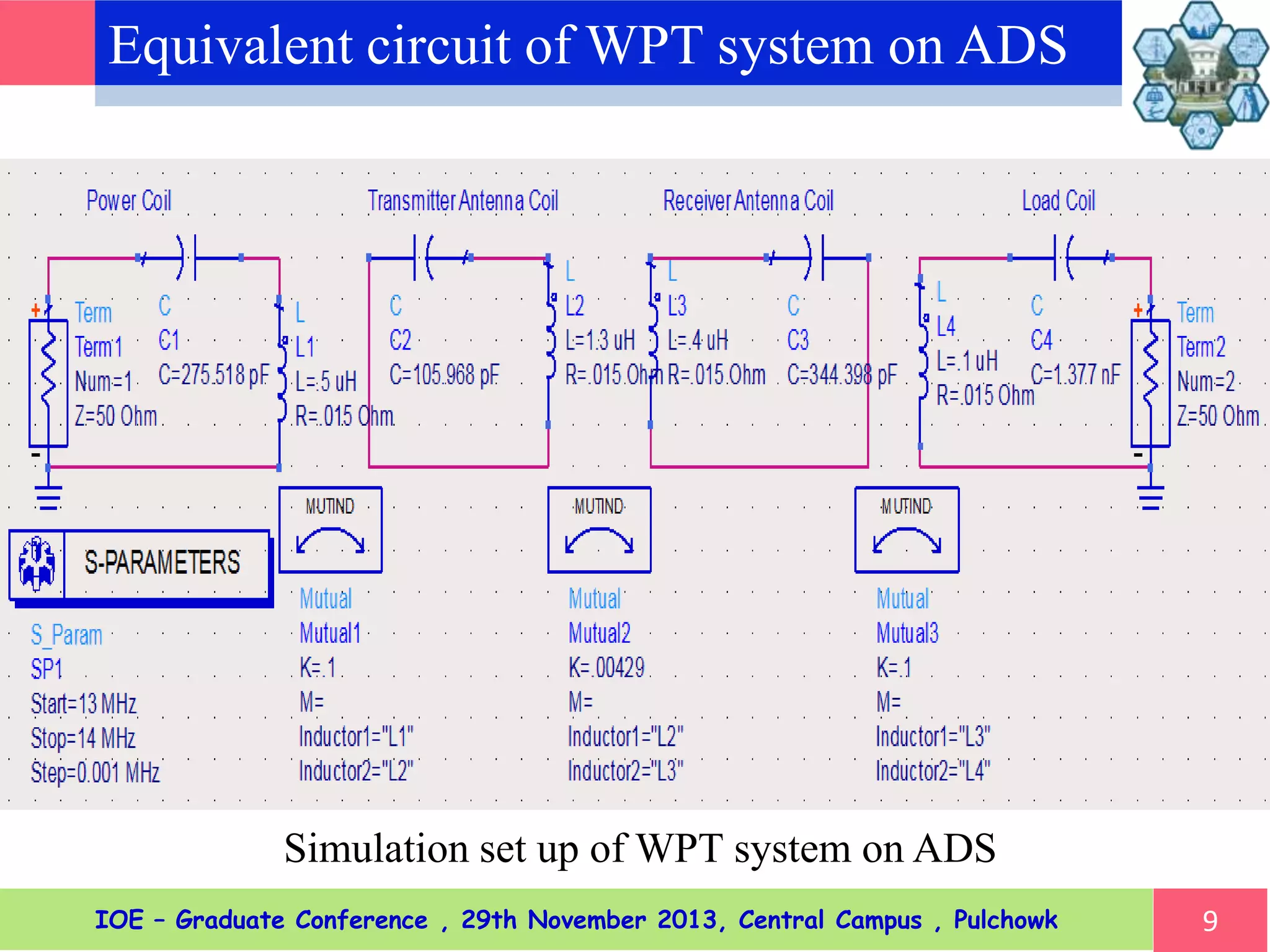
Equivalent circuit of WPT system on ADS
9
Simulation set up of WPT system on ADS
IOE – Graduate Conference , 29th November 2013, Central Campus , Pulchowk
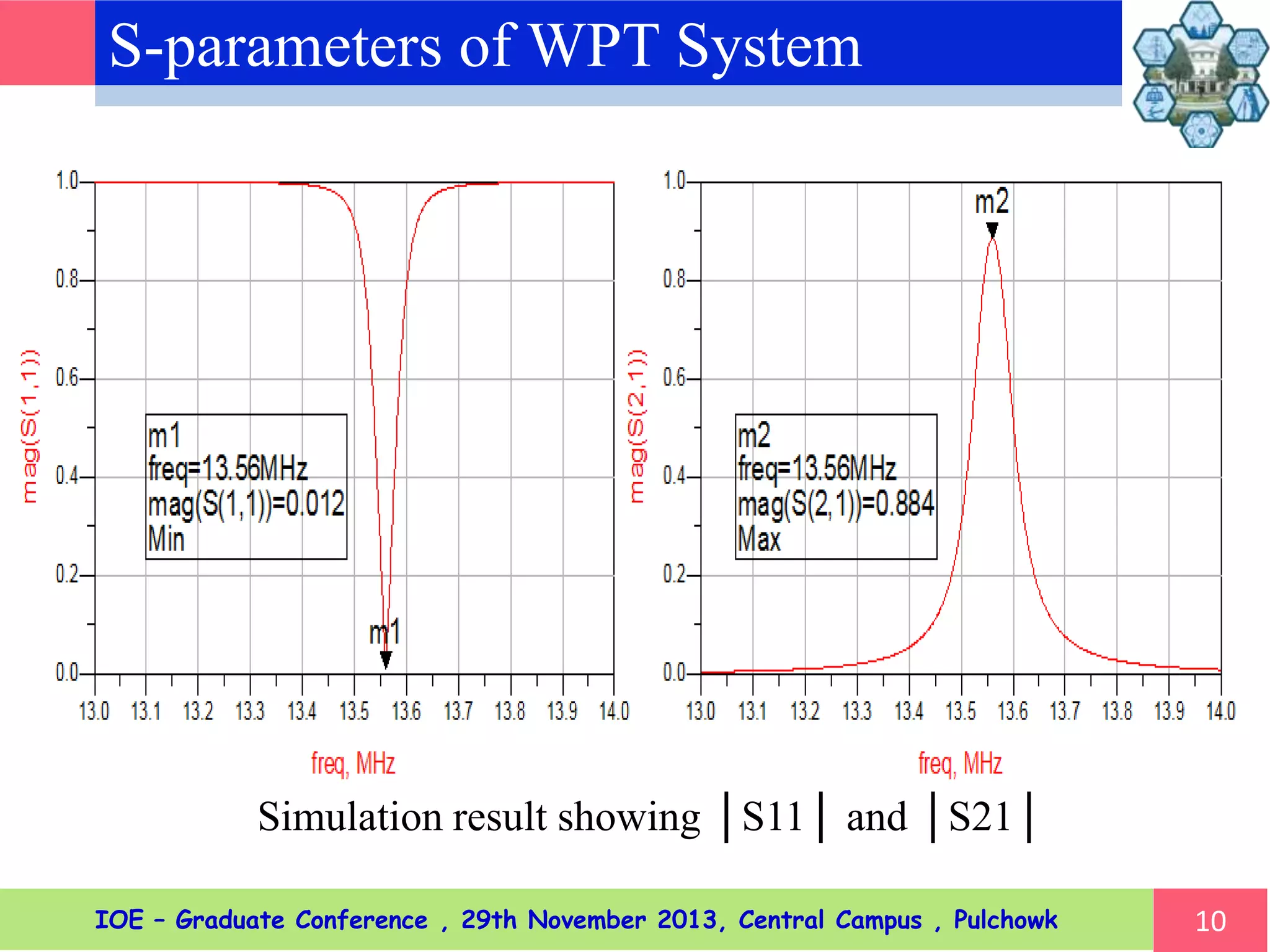
S-parameters of WPT System
10
Simulation result showing │S11│ and │S21│
IOE – Graduate Conference , 29th November 2013, Central Campus , Pulchowk
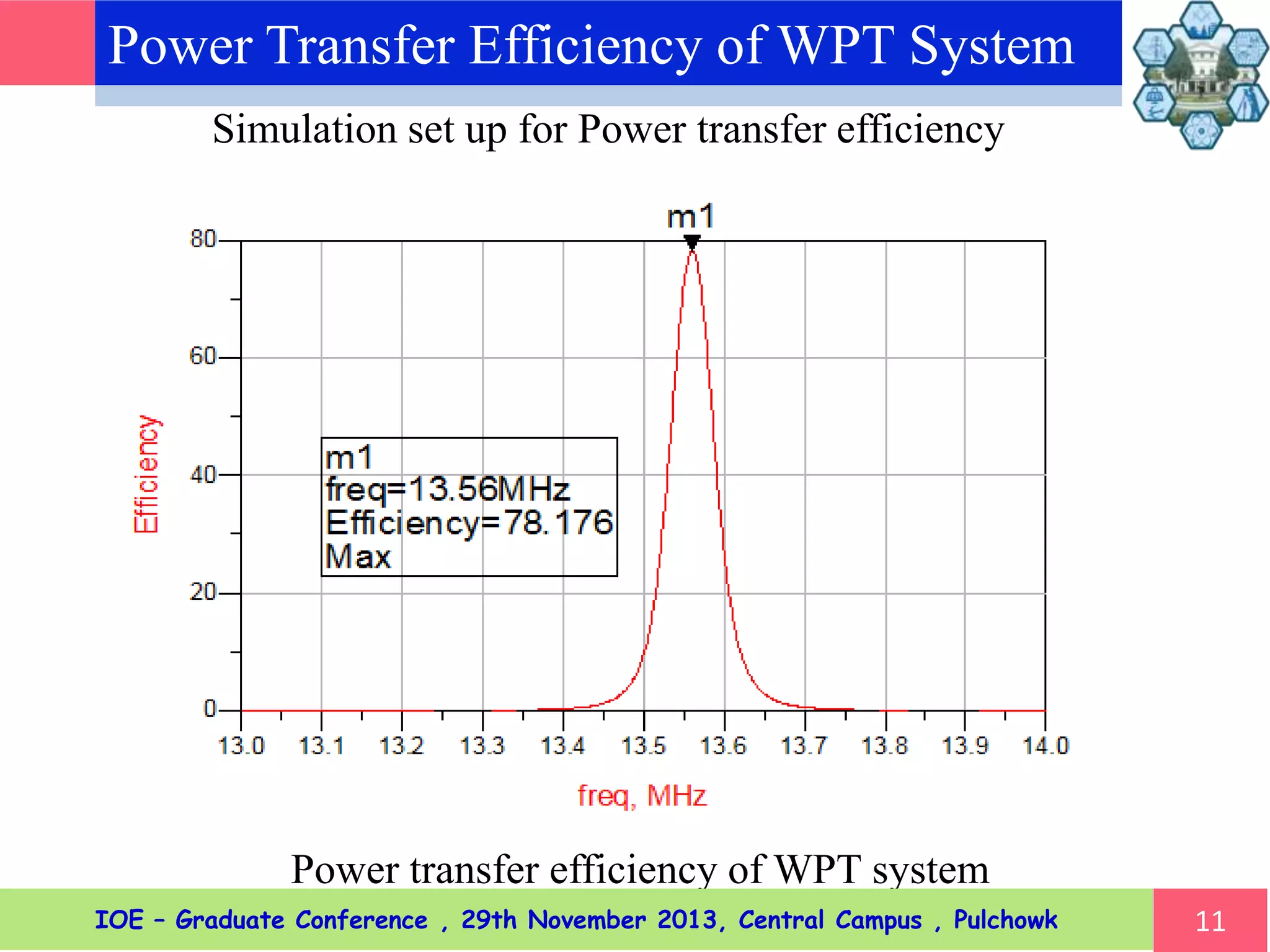
Power Transfer Efficiency of WPT System
11
Simulation set up for Power transfer efficiency
Power transfer efficiency of WPT system
IOE – Graduate Conference , 29th November 2013, Central Campus , Pulchowk
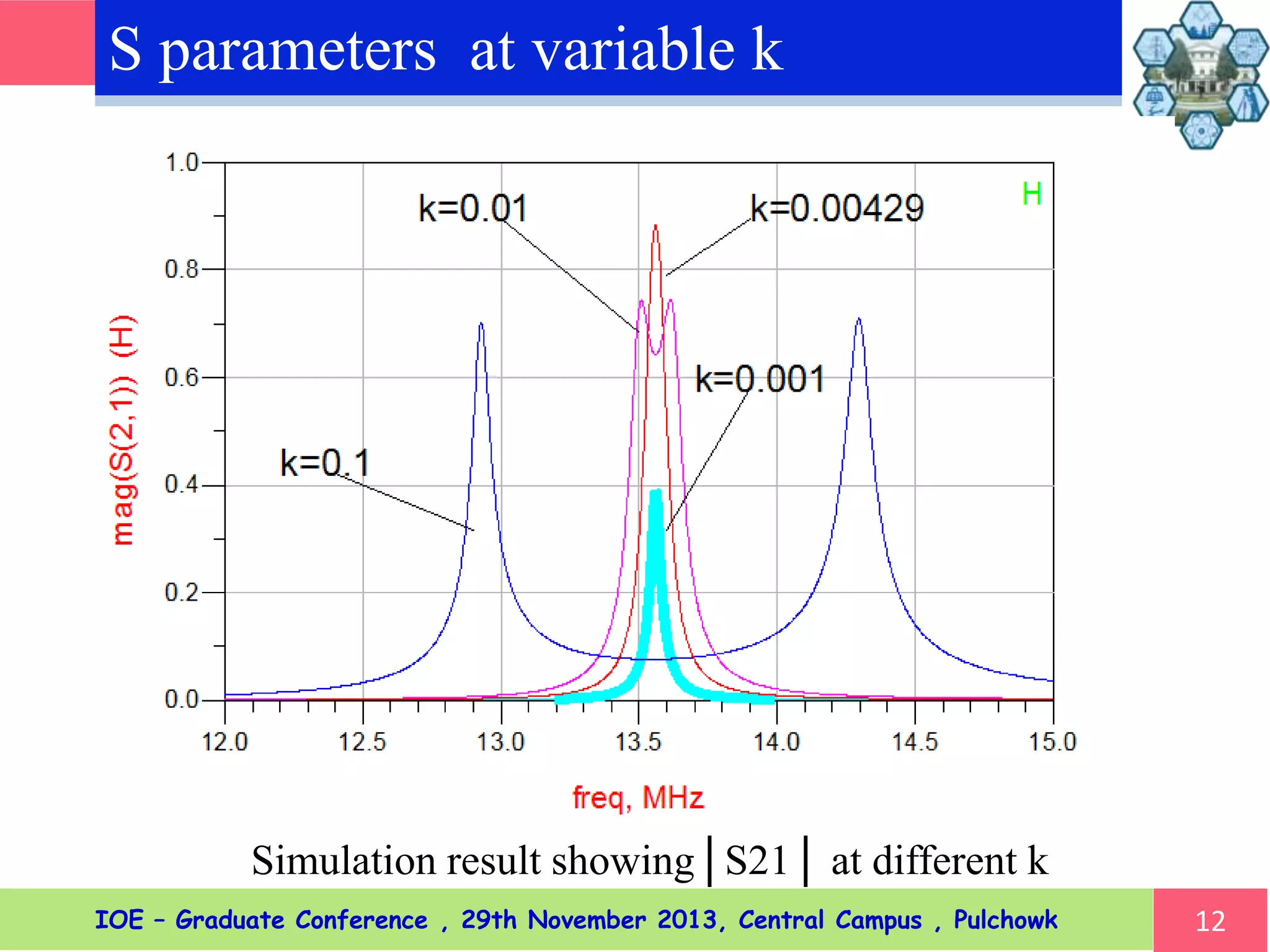
S parameters at variable k
12
Simulation result showing│S21│ at different k
IOE – Graduate Conference , 29th November 2013, Central Campus , Pulchowk
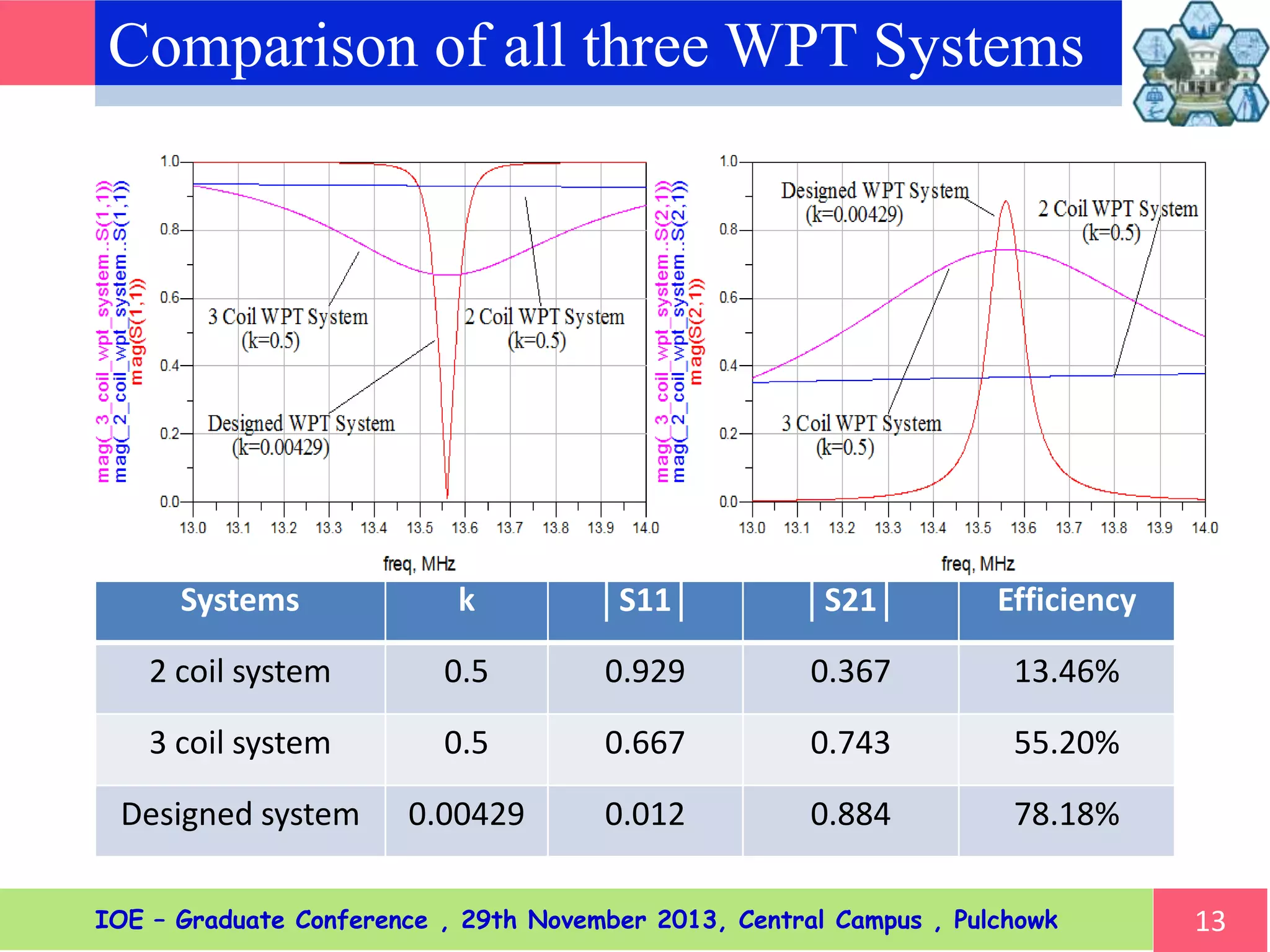
Comparison of all three WPT Systems
13
Simulation result showing │S11│ and │S21
Systems k │S11│ │S21│ Efficiency
2 coil system 0.5 0.929 0.367 13.46%
3 coil system 0.5 0.667 0.743 55.20%
Designed system 0.00429 0.012 0.884 78.18%
Table: Efficiency of Two coil, three coil and designed WPT SystemIOE – Graduate Conference , 29th November 2013, Central Campus , Pulchowk
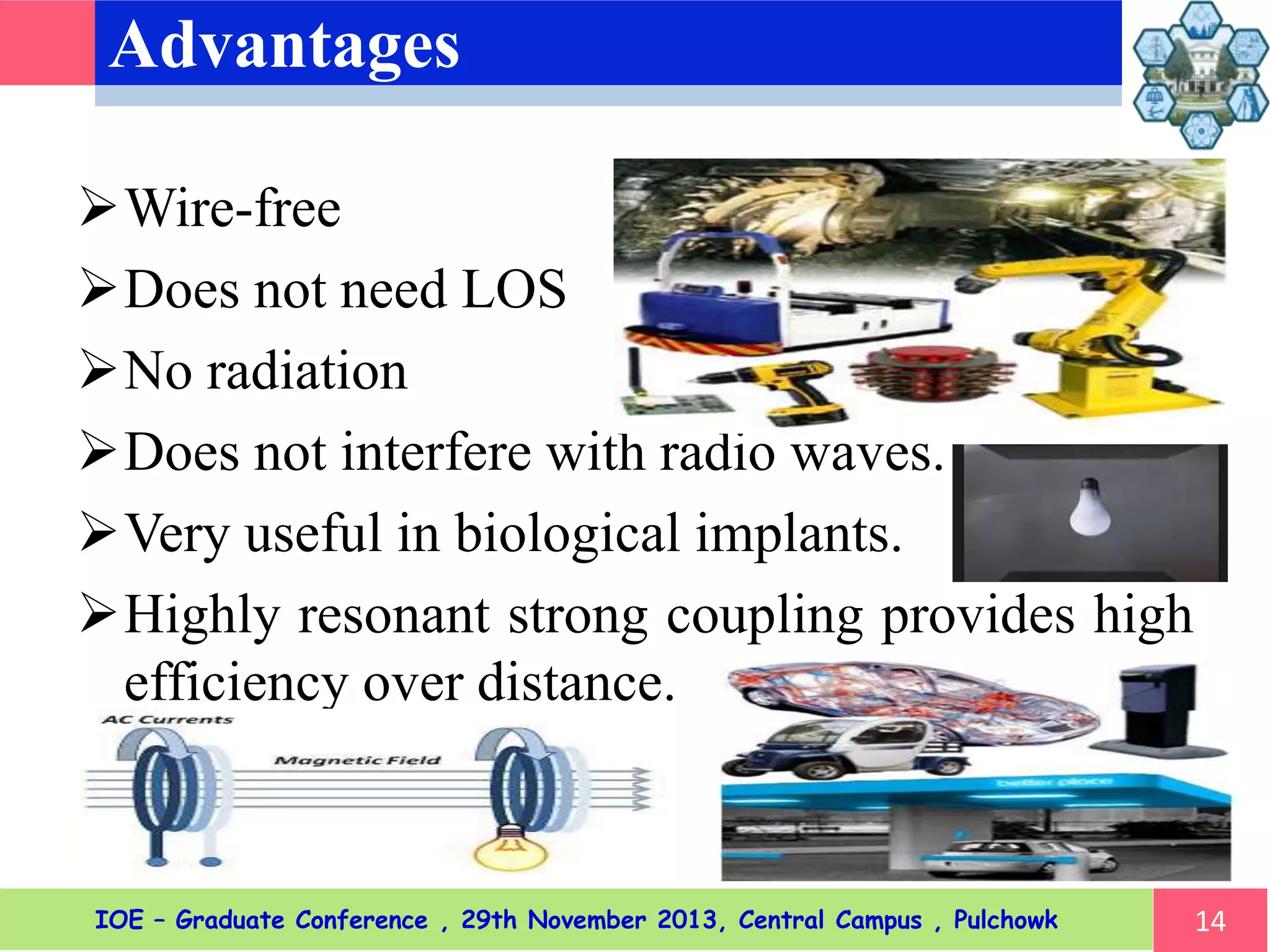
Advantages
Wire-free
Does not need LOS
No radiation
Does not interfere with radio waves.
Very useful in biological implants.
Highly resonant strong coupling provides high
efficiency over distance.
14IOE – Graduate Conference , 29th November 2013, Central Campus , Pulchowk
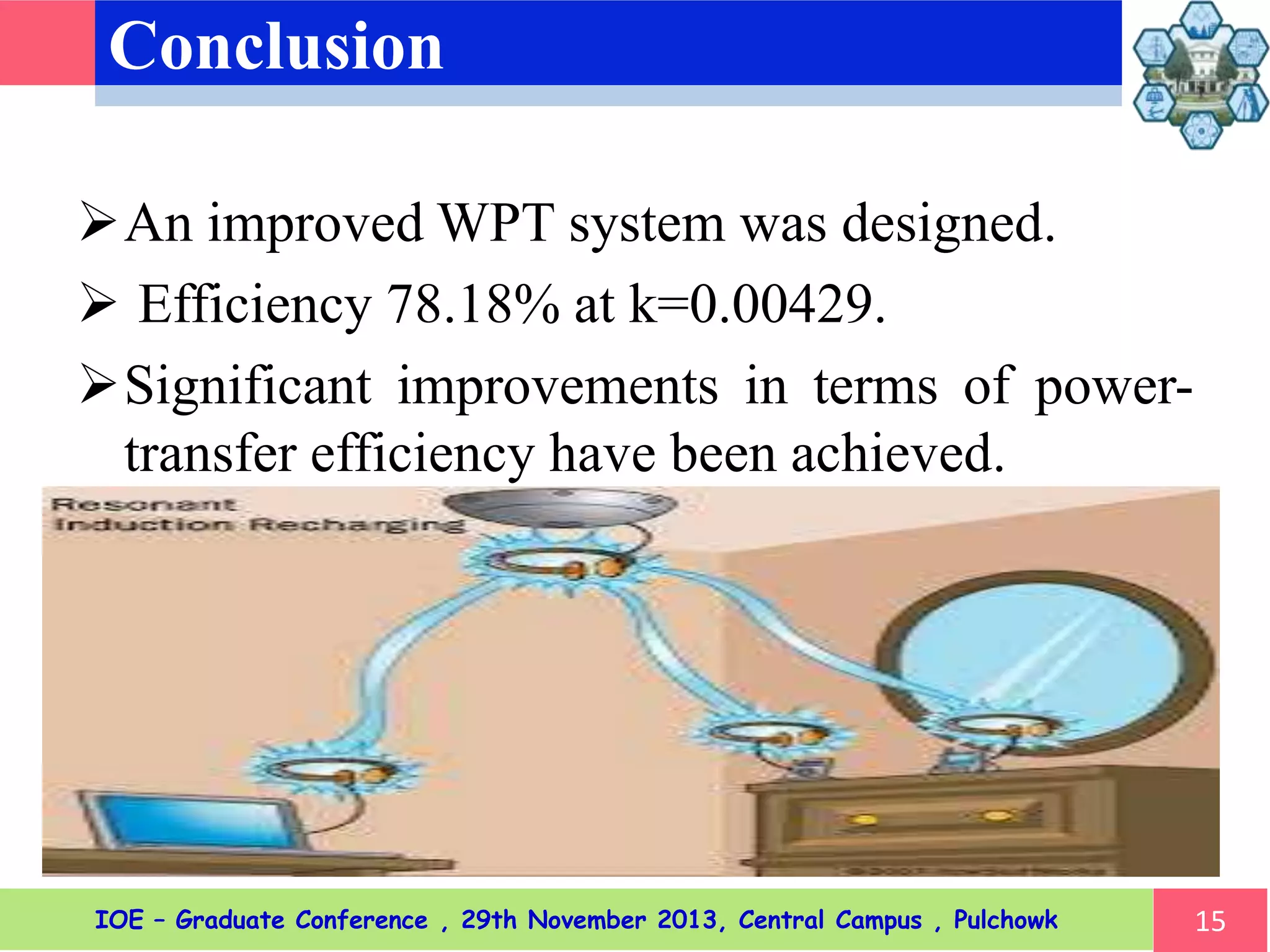
Conclusion
An improved WPT system was designed.
 Efficiency 78.18% at k=0.00429.
Significant improvements in terms of power-
transfer efficiency have been achieved.
15IOE – Graduate Conference , 29th November 2013, Central Campus , Pulchowk
References
1. Sabuj Das Gupta, Md. Shahinur Islam, Kawser Md. Nuronnabi, Mohammad Sakib Hossain, Md. Zahid
Hasan - Design & Implementation of Cost Effective Wireless Power Transmission Model: GOOD BYE
Wires – published at: “International Journal of Scientific and Research Publications(IJSRP), Volume 2,
Issue 12, December 2012 Edition” .
2. William C. Brown, "The history of wireless power transmission," Solar Energy, vol.56, no.1, pp. 3-21,
January 1996
3. Sanghoon Cheon, Yong-Hae Kim, Seung-Youl Kang, Myung Lae Lee, and Taehyoung Zyung “Wireless
Energy Transfer System with Multiple Coils via Coupled Magnetic Resonances” ETRI Journal, Volume 34,
Number 4, August 2012
4. Mandip Jung Sibakoti, Professor Derin Sherman and Joey Hambleton “Wireless Power Transmission Using
Magnetic Resonance” Cornell College PHY312, December 2011.
5. Kurs, A. Karalis, R. Moffatt, J. D. Joannopoulos, P. Fisher, M. Soijacic, “Wireless Power Transfer via
Strongly Coupled Magnetic Resonances”, Massachusetts Institute of Technology, 2007 Science, Vol. 317.
no. 5834, pp. 83— 86, June 2007.
6. Kawamura, Atsuo, and Tae-Woong Kim. "Proposed Equivalent Circuit and Parameter Identification Method
for Electro-Magnetic Resonance Based Wireless Power Transfer.” April 2013.
7. Hoang, Huy, and Franklin Bien. "Maximizing Efficiency of Electromagnetic Resonance Wireless Power
Transmission Systems with Adaptive Circuits."Wireless Power Transfer–Principles and Engineering
Explorations: K. Y. Kim, ed., InTech, 2012. Print.
8. Jordan, Edward C., and K. G. Balmain. “Electromagnetic Waves and Radiating Systems”, Second ed. New
Dehli: Prentice-Hall of India, August 2006. Print.
9. Nilsson, James William., and Susan A. Riedel. “Electric Circuits”. Boston: Prentice Hall, January 2011.
Print.
16IOE – Graduate Conference , 29th November 2013, Central Campus , Pulchowk
Thank You !
17IOE – Graduate Conference , 29th November 2013, Central Campus , Pulchowk

Design of wireless power transfer system via magnetic resonant coupling at 13.56 m hz

  • 1.
    Design of WirelessPower Transfer System via Magnetic Resonant Coupling at 13.56MHz Ajay Kumar Sah ajayshah2005@yahoo.com
  • 2.
    Introduction  Power  WirelessPower transmission (WPT)  Magnetic induction  Resonant coupling  Maximum power transfer IOE – Graduate Conference , 29th November 2013, Central Campus , Pulchowk 2
  • 3.
    Types Of WPTTechniques On the basis of Distance: Near field Mid field Far field On the basis of mode of Coupling: Inductive Capacitive Laser Microwave IOE – Graduate Conference , 29th November 2013, Central Campus , Pulchowk 3 Application: Implantable medical devices smart cards and electric vehicle mobile electronics And many more..
  • 4.
    Objective To design animproved WPT system 4IOE – Graduate Conference , 29th November 2013, Central Campus , Pulchowk Block diagram of the system
  • 5.
    Methodology Rectifier Design I/p& o/p on PSPICE 5IOE – Graduate Conference , 29th November 2013, Central Campus , Pulchowk
  • 6.
    Methodology (Contd…) Designed HBridge Amplifier/Oscillator O/p of H-bridge Amplifier/Oscillator 6IOE – Graduate Conference , 29th November 2013, Central Campus , Pulchowk
  • 7.
    Antenna System Design 7 Theclassic formula for single-layer inductance (air core) is called Wheeler's formula is given as: Where, L = inductance in micro Henries N= number of turns of wire R= radius of coil in cm H= height of coil in cm Coil antenna IOE – Graduate Conference , 29th November 2013, Central Campus , Pulchowk
  • 8.
    Parameters of designedantenna Coil (antenna) N(turns) R(cm) H(cm) L(uH) F(MHz) C(Pf) Power 2 5 3.3 0.5 13.56 278.518 Tx 3 6 4.4 13 13.56 105.968 Rx 1.67 6 4.4 0.4 13.56 344.398 Load 1 3.7 2 0.1 13.56 1.377 nf 8IOE – Graduate Conference , 29th November 2013, Central Campus , Pulchowk
  • 9.
    Equivalent circuit ofWPT system on ADS 9 Simulation set up of WPT system on ADS IOE – Graduate Conference , 29th November 2013, Central Campus , Pulchowk
  • 10.
    S-parameters of WPTSystem 10 Simulation result showing │S11│ and │S21│ IOE – Graduate Conference , 29th November 2013, Central Campus , Pulchowk
  • 11.
    Power Transfer Efficiencyof WPT System 11 Simulation set up for Power transfer efficiency Power transfer efficiency of WPT system IOE – Graduate Conference , 29th November 2013, Central Campus , Pulchowk
  • 12.
    S parameters atvariable k 12 Simulation result showing│S21│ at different k IOE – Graduate Conference , 29th November 2013, Central Campus , Pulchowk
  • 13.
    Comparison of allthree WPT Systems 13 Simulation result showing │S11│ and │S21 Systems k │S11│ │S21│ Efficiency 2 coil system 0.5 0.929 0.367 13.46% 3 coil system 0.5 0.667 0.743 55.20% Designed system 0.00429 0.012 0.884 78.18% Table: Efficiency of Two coil, three coil and designed WPT SystemIOE – Graduate Conference , 29th November 2013, Central Campus , Pulchowk
  • 14.
    Advantages Wire-free Does not needLOS No radiation Does not interfere with radio waves. Very useful in biological implants. Highly resonant strong coupling provides high efficiency over distance. 14IOE – Graduate Conference , 29th November 2013, Central Campus , Pulchowk
  • 15.
    Conclusion An improved WPTsystem was designed.  Efficiency 78.18% at k=0.00429. Significant improvements in terms of power- transfer efficiency have been achieved. 15IOE – Graduate Conference , 29th November 2013, Central Campus , Pulchowk
  • 16.
    References 1. Sabuj DasGupta, Md. Shahinur Islam, Kawser Md. Nuronnabi, Mohammad Sakib Hossain, Md. Zahid Hasan - Design & Implementation of Cost Effective Wireless Power Transmission Model: GOOD BYE Wires – published at: “International Journal of Scientific and Research Publications(IJSRP), Volume 2, Issue 12, December 2012 Edition” . 2. William C. Brown, "The history of wireless power transmission," Solar Energy, vol.56, no.1, pp. 3-21, January 1996 3. Sanghoon Cheon, Yong-Hae Kim, Seung-Youl Kang, Myung Lae Lee, and Taehyoung Zyung “Wireless Energy Transfer System with Multiple Coils via Coupled Magnetic Resonances” ETRI Journal, Volume 34, Number 4, August 2012 4. Mandip Jung Sibakoti, Professor Derin Sherman and Joey Hambleton “Wireless Power Transmission Using Magnetic Resonance” Cornell College PHY312, December 2011. 5. Kurs, A. Karalis, R. Moffatt, J. D. Joannopoulos, P. Fisher, M. Soijacic, “Wireless Power Transfer via Strongly Coupled Magnetic Resonances”, Massachusetts Institute of Technology, 2007 Science, Vol. 317. no. 5834, pp. 83— 86, June 2007. 6. Kawamura, Atsuo, and Tae-Woong Kim. "Proposed Equivalent Circuit and Parameter Identification Method for Electro-Magnetic Resonance Based Wireless Power Transfer.” April 2013. 7. Hoang, Huy, and Franklin Bien. "Maximizing Efficiency of Electromagnetic Resonance Wireless Power Transmission Systems with Adaptive Circuits."Wireless Power Transfer–Principles and Engineering Explorations: K. Y. Kim, ed., InTech, 2012. Print. 8. Jordan, Edward C., and K. G. Balmain. “Electromagnetic Waves and Radiating Systems”, Second ed. New Dehli: Prentice-Hall of India, August 2006. Print. 9. Nilsson, James William., and Susan A. Riedel. “Electric Circuits”. Boston: Prentice Hall, January 2011. Print. 16IOE – Graduate Conference , 29th November 2013, Central Campus , Pulchowk
  • 17.
    Thank You ! 17IOE– Graduate Conference , 29th November 2013, Central Campus , Pulchowk