International Journal of Power Electronics and Drive System (IJPEDS)
Vol. 11, No. 2, June 2020, pp. 711~725
ISSN: 2088-8694, DOI: 10.11591/ijpeds.v11.i2.pp711-725  711
Journal homepage: http://ijpeds.iaescore.com
Design and implementation of an efficient WPT system
Abdulkareem Mokif Obais1
, Ali Faeq Ruzij2
1 Department of Biomedical Engineering, University Babylon, Iraq.
2 Department of Electrical Engineering, University of Babylon, Iraq.
Article Info ABSTRACT
Article history:
Received Oct 10, 2019
Revised Nov 9, 2019
Accepted Jan 22, 2020
Wireless power transfer (WPT) is a technique introduced to transfer power
wirelessly. Generally, WPT systems are characterized by low efficiency and
low output power. Since WPT process depends mainly on mutual coupling
between transmitting and receiving coils in addition to load requirements, it
is focused in this work toward enhancing the mutual coupling and
conditioning the receiving circuit so as to optimally satisfy the load demand.
The mutual coupling between transmitting and receiving nodes is enhanced
via inserting three resonating circuits along with energy transmission path
and conditioning the receiving circuit such that it accomplishes delivering
maximum power to the load node. In this work, an adaptive efficient WPT
system is introduced. This system is carried out on PSpice and validated
experimentally. Both simulative and experimental WPT systems have
accomplished significant enhancement in efficiency. The proposed WPT
system has three resonators and three parallel connected identical receiving
coils located at 6.61m from the power transmitter. The efficiency
enhancement approaches thousands of times the efficiency of a conventional
WPT system having similar power transmitter located at the same distance
from the receiving circuit, which has a single coil identical to those in the
proposed efficient WPT system.
Keywords:
Efficiency enhancement
Inductive link
Mutual coupling
Mutual inductance
Wireless power transfer
This is an open access article under the CC BY-SA license.
Corresponding Author:
Abdulkareem Mokif Obais,
Department of Biomedical Engineering,
University of Babylon,
Hilla, Babylon, Iraq.
Email: karimobais@yahoo.com
1. INTRODUCTION
In the last years, the enhancing technology of power transfer (WPT) develops quickly. The mobiles or other
electronic devices such as laptops or electrical vehicles could be charged by WPT technology. These techniques could
be used in places when wiring is difficult to be accomplished [1-5]. Long-range concept of WPT had been formulated
after microwave amplifier invention for high power purposes. The possibility of power transmission via
electromagnetic waves gained more and more intention for application purposes [6, 7]. The works curried out
by [7, 8] present analytical models for calculating the mutual inductance between planar spiral coils. These models are
very useful in the design and optimization of wireless power transfer systems. The proposed models of mutual
inductances between coils were derived using the solution of Neumann’s integral. An approximate formula for
determining the self-resistance of a circular multi-loop inductor having unequal pitches was introduced by [9]. Both
proximity and skin effects were included in the suggested formula. Proximity effect was determined using
the magnetic fields exerted on a wire due to other wires.
The study conducted by [10] analyzed with a context of non-ferromagnetic metallic plate, the WPT
performances. The model of the WPT impedance in the metal environment was built. The proposed system
in [11] comprised several loop inductors having different sizes. Depending on the changes of the distance
 ISSN: 2088-8694
Int J Pow Elec & Dri Syst, Vol. 11, No. 2, June 2020 : 711 – 725
712
between the transmitting and receiving sides, the power was switched to one loop of the inductors for power
transmission and power reception.
A WPT system of 13.56 MHz was introduced by [12] and investigated both theoretically and
experimentally in addition to simulation. A relative high improvement in efficiency of about 41.7% was
achieved. Three phase angles had been designed and analyzed in [13]. Single power amplifier on the primary
side and two power amplifiers were located at the secondary side. The proposed multi-degrees method of
phase control was capable of achieving simultaneously additional compensation of the reactance, output
regulation, and load transformation.
A consistent optimization technique was conducted by [14] for WPT systems equipped with passive
element’s enhancement beginning from simple reflectors, intermediate relays, and general electromagnetic
focusing and guiding structures, like metamaterials and metasurfaces. The proposed work efficiently solved
the problem of optimization using arbitrary numbers of passive elements.
The work conducted by [15] presented and explained the published techniques and principles
concerning all aspects of inductive link design processes such that no specific preceding information about
inductive link designs are required. The work in [16] introduced accurate formulas for calculating mutual
inductance between spiral coils using Gaussian integration method. The researches introduced by [17-22]
concern enhancing coupling coefficients in different environments of inductive links in addition to
applications of WPT technologies in contactless electrical vehicles and energizing medical sensors.
In this work, poor efficiency of conventional wireless powering process is enhanced by
strengthening the mutual coupling along with power transmission path and conditioning the receiving circuit
such that it accomplishes maximum power reception to load node.
2. Design of the proposed efficient WPT system
The inductive mutual coupling Mab between two 1-turn planar spiral coils is shown in Figure 1a. The
mutual inductance between these two coils is given by [7]
𝑀 ⁄ 1 𝛾 𝛾 (1)
𝛾 (2)
Where, a and b are the outer radii of the first and second coils, respectively. µ0 is the permeability of free
space and z is the distance between the centers of the two coils, which are aligned coaxially.
(a) (b)
Figure 1. Inductive link, (a) coupling between two 1-turn coils, (b) modeling of two coil inductive link.
For multi-turns planar spiral coils, (1) can be modified to
𝑀 ∑ ∑ ⁄ 1 𝛾 𝛾 (3)
𝛾 (4)
Int J Pow Elec & Dri Syst ISSN: 2088-8694 
Design and implementation of an efficient WPT system (Abdulkareem Mokif Obais)
713
Where, N1 and N2 are the numbers of turns of the first and second coils, respectively. If two inductively
coupled coils are forming a resonant inductive link shown in Figure 1b, then the link currents and voltages at
resonance frequency can be given by
𝐼 , 𝑅 ≫ (5)
𝐼 , 𝑅 ≫ (6)
Where, L1 and L2 are self-inductances of the first and second coils, respectively. M12 is the mutual inductance
between the two coils. R1 and R2 are the AC resistances of the first and second coils, respectively. C1 and C2
are the tuning capacitances of the sending (transmitting) and receiving circuits, respectively, whereas ω0=2πf0
is the inductive link operating angular frequency. Rrefl is defined by
𝑅 (7)
The output voltage V2 is determined by
𝑉 𝐼 , 𝑅 ≫ , 𝜔 𝐿 (8)
The link input power Pi, output power P0, and efficiency η can be given by
𝑃
| |
, 𝑅 ≫ (9)
𝑃
| |
, 𝑅 ≫ (10)
𝜂 , 𝑅 ≫ (11)
Where, Q1, Q2, and QL are the quality factors of the first coil, second coil, and load, respectively at resonance
frequency f0. Q1, Q2, and QL are defined by ω0L1/R1, ω0L2/R2, and RL/ω0L2, respectively. k12 is the coefficient
of coupling between the two coils and is defined by
𝑘 (12)
For loosely coupled inductive link (11) can closely be approximated to
𝜂 , 𝑅 ≫ and 𝑄 𝑄 𝑘 ≪ 1 (13)
According to (11), the efficiency of WPT process is directly proportional to the square of the
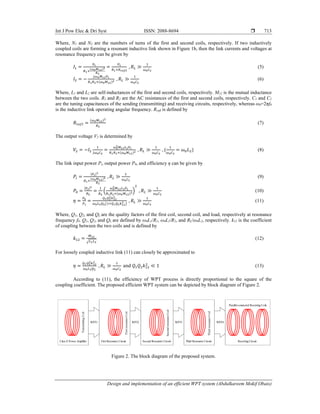
coupling coefficient. The proposed efficient WPT system can be depicted by block diagram of Figure 2.
Figure 2. The block diagram of the proposed system.
Class E Power Amplifier First Resonator Circuit
WPT1
Second Resonator Circuit
WPT2
Third Resonator Circuit
WPT3
Receiving Circuit
WPT4
Transmitting
Coil
Second
resonator
Coil
First
resonator
Coil
Parallel-connected Receiving Coils
Third
resonator
Coil
 ISSN: 2088-8694
Int J Pow Elec & Dri Syst, Vol. 11, No. 2, June 2020 : 711 – 725
714
It is obvious that the proposed system shown in Figure 2 comprises four series WPT systems. In this
work, three resonating coils are inserted on the path joining the transmitting and receiving coils.
The locations of resonating coils are selected such that maximum power is transferred between each two
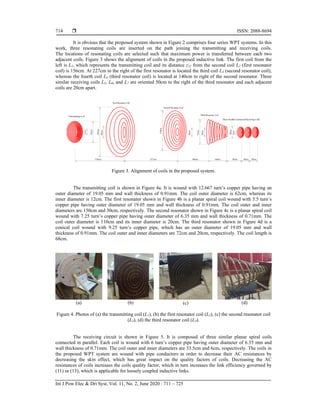
adjacent coils. Figure 3 shows the alignment of coils in the proposed inductive link. The first coil from the
left is L1, which represents the transmitting coil and its distance z12 from the second coil L2 (first resonator
coil) is 156cm. At 227cm to the right of the first resonator is located the third coil L3 (second resonator coil),
whereas the fourth coil L4 (third resonator coil) is located at 140cm to right of the second resonator. Three
similar receiving coils L5, L6, and L7 are oriented 50cm to the right of the third resonator and each adjacent
coils are 20cm apart.
Figure 3. Alignment of coils in the proposed system.
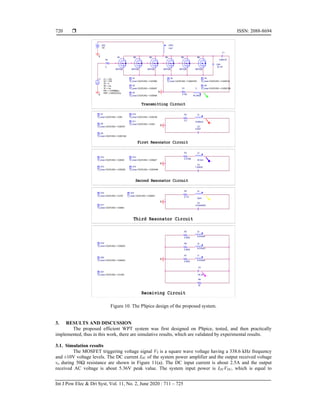
The transmitting coil is shown in Figure 4a. It is wound with 12.667 turn’s copper pipe having an
outer diameter of 19.05 mm and wall thickness of 0.91mm. The coil outer diameter is 62cm, whereas its
inner diameter is 12cm. The first resonator shown in Figure 4b is a planar spiral coil wound with 5.5 turn’s
copper pipe having outer diameter of 19.05 mm and wall thickness of 0.91mm. The coil outer and inner
diameters are 150cm and 30cm, respectively. The second resonator shown in Figure 4c is a planar spiral coil
wound with 7.25 turn’s copper pipe having outer diameter of 6.35 mm and wall thickness of 0.71mm. The
coil outer diameter is 110cm and its inner diameter is 20cm. The third resonator shown in Figure 4d is a
conical coil wound with 9.25 turn’s copper pipe, which has an outer diameter of 19.05 mm and wall
thickness of 0.91mm. The coil outer and inner diameters are 72cm and 20cm, respectively. The coil length is
68cm.
(a) (b) (c) (d)
Figure 4. Photos of (a) the transmitting coil (L1), (b) the first resonator coil (L2), (c) the second resonator coil
(L3), (d) the third resonator coil (L4).
The receiving circuit is shown in Figure 5. It is composed of three similar planar spiral coils
connected in parallel. Each coil is wound with 6 turn’s copper pipe having outer diameter of 6.35 mm and
wall thickness of 0.71mm. The coil outer and inner diameters are 33.5cm and 6cm, respectively. The coils in
the proposed WPT system are wound with pipe conductors in order to decrease their AC resistances by
decreasing the skin effect, which has great impact on the quality factors of coils. Decreasing the AC
resistances of coils increases the coils quality factor, which in turn increases the link efficiency governed by
(11) or (13), which is applicable for loosely coupled inductive links.
227cm
156cm 50cm
68cm
140cm
62cm
20cm
20cm
150cm
110cm
72cm
Transmitting Coil
First Rsonator Coil
Three Parallel Connected Receiving Coils
Third Rsonator Coil
Second Rsonator Coil
12cm
30cm
20cm
20cm
6cm
30cm
Int J Pow Elec & Dri Syst ISSN: 2088-8694 
Design and implementation of an efficient WPT system (Abdulkareem Mokif Obais)
715
The proposed WPT system depicted in Figure 2 can be schematically represented by the circuit
shown Figure 6. In this Figure, R1, R2, R3, R4, R5, R6, and R7 are the AC resistances of the coils L1, L2, L3, L4,
L5, L6, and L7, respectively. C1, C 2, C 3, C 4, and C 5 are tuning capacitors of transmitting, first resonator,
second resonator, third resonator, and receiving circuits, respectively. Each M represents the mutual
inductance between two certain coils. For example M12 represents the mutual inductance between L1 and L2.
M12 is equal to M21 (M12=M21) and this is applicable for each two coils.
Figure 5. A photo of the receiving circuit, which is composed of three planar spiral coils (L5, L6, and L7).
Figure 6. Schematic representation of the proposed system.
The inductances of planar spiral coils can be calculated by [15]
𝐿 𝑙𝑛
.
0.2𝛽 (14)
Where, the average diameter is denoted by davg = 0.5(do+di). di and d0 are the inner and outer diameters of
the coil, respectively, while β is the fill-factor, which is given by
𝛽 (15)
The inductance of the conical coil shown in Figure 7 can be calculated as follows [23]:
𝐿
.
, 𝜇𝐻 (16)
Where, n, di, s, and Y are coil number of turns, inner diameter, distance between two adjacent turns, and coil
angle, respectively. Y and s are defined by
 ISSN: 2088-8694
Int J Pow Elec & Dri Syst, Vol. 11, No. 2, June 2020 : 711 – 725
716
𝑌 𝑡𝑎𝑛
.
(17)
𝑠 (18)
Where, d0 is the coil outer diameter. W and l are coil axial and longitudinal lengths, respectively. All
dimensions are in inches. Substituting for n=9.25, di=20cm=7.874 inches, d0=72cm=28.346 inches,
l=68cm=26.772 inches, and W=72.8cm=28.661 inches into (16) to (18) gives Lcon=22 µH.
Figure 7. The inverse conical coil.
The DC resistances of all coils in the proposed WPT system can be calculated by
𝑅 (19)
Where, lC, σCu, w, and wth, are the coil length, conductivity of copper, outer diameter of coil pipe conductor,
and wall thickness of the pipe. The calculated inductances and DC resistances are listed in Table 1. The
mutual inductances between coils can be calculated using (3). The coefficients of coupling between coils are
calculated according to (12). The calculated mutual inductances and their corresponding coefficients of
coupling are listed in Table 2.
Table 1. Coil’s calculated DC resistance and inductances
Coil Name DC Resistance (Ω) Inductance (µH)
L1 0.0041827 46.334
L2 0.00448 23.864
L3 0.018474 29.3
L4 0.0039 22
L5, L6, L7 0.00458 6.0745
The AC resistance RAC of a coil wound with copper conductors can be calculated by [24]
𝑅 𝑅 (20)
𝛿 (21)
Where, RDC, σCu, w, and δCu are the DC resistance of the coil, conductivity of copper, outer diameter of the
coil conductor, and copper skin depth at f0. Respectively.
Applying (20) using the conductor outer diameters and calculated DC resistance in Table 1, the AC
resistances of all coils are calculated and listed in Table 3.
W
Y
o
d
di
l
Int J Pow Elec & Dri Syst ISSN: 2088-8694 
Design and implementation of an efficient WPT system (Abdulkareem Mokif Obais)
717
Table 2. Mutual inductances and their corresponding coupling
coefficients
Mutual
Inductance
Value (µH)
Coefficient of
Coupling
Value
M12 0.2621 k12 0.007882
M13 0.0161 k13 0.000437
M14 0.003 k14 0.000094
M15 0.000281 k15 0.00001675
M16 0.0002564 k16 0.0000154
M17 0.0002345 k17 0.00001295
M23 0.1592 k23 0.006
M24 0.0179 k24 0.000781
M25 0.0015 k25 0.0001246
M26 0.0013 k26 0.000108
M27 0.0012 k27 0.0001
M34 0.1358 k34 0.00535
M35 0.007 k35 0.000528
M36 0.0057 k36 0.000427
M37 0.0046 k37 0.0003448
M45 0.1931 k45 0.0167
M46 0.0985 k46 0.00852
M47 0.0558 k47 0.004827
M56 0.5018 k56 0.083633
M57 0.1161 k57 0.01935
M67 0.5018 k67 0.083633
Table 3. Coil’s calculated AC resistances
Coil
Name
AC
Resistance
AC Resistance
Value (Ω)
L1 R1 0.185
L2 R2 0.2
L3 R3 0.27246
L4 R4 0.172
L5 R5 0.0676
L6 R6 0.0676
L7 R7 0.0676
Since the transmitting coil (L1) and the three resonating coils (L2, L3, and L4) are operating within
loosely coupled conditions, then the tuning capacitors C2, C3, and C4 shown in Figure 6 can be determined as
9.25nF, 7.5345nF, and 10.034463nF, respectively.The circuit elements C1 and L1 in Figure 6 are parts of the
output circuit of the class-E power amplifier, which represents the power transmitter of the proposed efficient
WPT system. The series combination formed by C1 and L1 Are designed to resonate at a frequency slightly
less than f0 and their equivalent impedance at the resonance frequency f0 is R1+jX, where X is defined by [25]
𝑋 1.152𝑅 𝜔 𝐿 (22)
Where, R represents the resistive load of class-E power amplifier and can be determined by
𝑅 𝑅 𝑅 (23)
The tuning capacitor C5 of the receiving coils shown in Figure 6 can be approximately determined in
a different procedure. Figure 8 models the receiving coils without C5 and RL. Since the receiving circuit is
symmetrical around the branch including L6, then I5=I7 and I6=-2I5. Consequently, the impedance ZRCV of the
parallel-connected receiving coils can be determined by
𝑍 0.5𝑅 𝑗0.5𝜔 𝐿 𝑗𝜔 𝑀 𝑗0.5𝜔 𝑀 // 𝑅 𝑗𝜔 𝐿 𝑗2𝜔 𝑀 (24)
Substituting the calculated circuit parameters in (24) gives
𝑍 0.023 𝑗4.04, 𝛺 (25)
Figure 8. Modeling of the receiving coils without C5 and RL.
 ISSN: 2088-8694
Int J Pow Elec & Dri Syst, Vol. 11, No. 2, June 2020 : 711 – 725
718
According to (25), the required value for C5 to accomplish resonance is 116.3nF. At resonance
frequency f0 and after tuning all capacitors such that all link circuits resonate at the same time, the link currents can be
related to each other by
⎣
⎢
⎢
⎢
⎢
⎢
⎡
𝑉
0
0
0
0
0
0⎦
⎥
⎥
⎥
⎥
⎥
⎤
⎣
⎢
⎢
⎢
⎢
⎢
⎡
𝑅 𝑗𝑋
𝑗𝜔 𝑀
𝑗𝜔 𝑀
𝑗𝜔 𝑀
𝑗𝜔 𝑀
𝑗𝜔 𝑀
𝑗𝜔 𝑀
𝑗𝜔 𝑀
𝑅
𝑗𝜔 𝑀
𝑗𝜔 𝑀
𝑗𝜔 𝑀
𝑗𝜔 𝑀
𝑗𝜔 𝑀
𝑗𝜔 𝑀
𝑗𝜔 𝑀
𝑅
𝑗𝜔 𝑀
𝑗𝜔 𝑀
𝑗𝜔 𝑀
𝑗𝜔 𝑀
𝑗𝜔 𝑀
𝑗𝜔 𝑀
𝑗𝜔 𝑀
𝑅
𝑗𝜔 𝑀
𝑗𝜔 𝑀
𝑗𝜔 𝑀
𝑗𝜔 𝑀
𝑗𝜔 𝑀
𝑗𝜔 𝑀
𝑗𝜔 𝑀
𝑍
𝑍
𝑍
𝑗𝜔 𝑀
𝑗𝜔 𝑀
𝑗𝜔 𝑀
𝑗𝜔 𝑀
𝑍
𝑍
𝑍
𝑗𝜔 𝑀
𝑗𝜔 𝑀
𝑗𝜔 𝑀
𝑗𝜔 𝑀
𝑍
𝑍
𝑍 ⎦
⎥
⎥
⎥
⎥
⎥
⎤
⎣
⎢
⎢
⎢
⎢
⎢
⎡
𝐼
𝐼
𝐼
𝐼
𝐼
𝐼
𝐼 ⎦
⎥
⎥
⎥
⎥
⎥
⎤
(26)
Where, I1, I 2, I 3, I 4, I 5, I 6, and I 7 are the currents flowing through coils L1, L2, L3, L4, L5, L6, and L7, respectively.
Since, L1 and C1 are parts of the class-E driving power amplifier and resonate at a frequency slightly less than the link
resonance frequency f0, the inductive reactance X represents their equivalent reactance at f0. Z55, Z56, Z57, Z65, Z66, Z67,
Z75, Z76, and Z77 are defined by
𝑍 𝑍 𝑍
𝑍 𝑍 𝑍
𝑍 𝑍 𝑍
⎣
⎢
⎢
⎢
⎡𝑅 𝑗𝜔 𝐿 𝑗𝜔 𝑀 𝑗𝜔 𝑀
𝑀 𝑅 𝑗𝜔 𝐿 𝑀
𝑀 𝑀 𝑅 𝑗𝜔 𝐿 ⎦
⎥
⎥
⎥
⎤
(27)
According to the block diagram of the overall proposed WPT system, there are four series WPT
systems namely WPT1, WPT2, WPT3, and WPT4. The first three systems WPT1, WPT2, and WPT3 are
loosely coupled systems due to the relatively large distances between their transmitting and receiving coils,
thus the first WPT system (WPT1) can be analyzed separately from other systems. Figure 9 shows the model
of the resonant inductive link corresponding to WPT1 system. At resonance frequency f0, the reflected
resistance Rrefl from the secondary side (first, second, and third resonators) in the primary side (transmitting
coil) is determined according to Equation (7) as 1.56Ω. V´ in Figure 9 represents the voltage across the
resistive load of class-E power amplifier. According to [25], V´ has an amplitude of Vom and phase of φ=-
32.40
. The maximum possible value of Vom is 1.074VDD=1.074×12V=12.888V, thus the voltage Vi can be
determined by
𝑉 𝑅 𝑅 𝑗𝑋 𝐼 1.7463 𝑗2 𝐼 (28)
Substituting all calculated mutual inductances, coil’s self-inductances, coil’s AC resistances, X, and
C5 into (26) and (27) gives
⎣
⎢
⎢
⎢
⎢
⎢
⎡
𝑉
0
0
0
0
0
0⎦
⎥
⎥
⎥
⎥
⎥
⎤
⎣
⎢
⎢
⎢
⎢
⎢
⎡
0.185 𝑗2
𝑗0.558
𝑗0.034
𝑗0.0064
𝑗0.0006
𝑗0.00055
𝑗0.0005
𝑗0.558
0.2
𝑗0.3388
𝑗0.0381
𝑗0.0032
𝑗0.0028
𝑗0.0026
𝑗0.034
𝑗0.3388
0.27246
𝑗0.289
𝑗0.0149
𝑗0.0121
𝑗0.0098
𝑗0.0064
𝑗0.0381
𝑗0.289
0.172
𝑗0.411
𝑗0.21
𝑗0.1188
𝑗0.0006
𝑗0.0032
𝑗0.0149
𝑗0.411
0.07 𝑗8.9
𝑗2.972
𝑗3.793
𝑗0.00055
𝑗0.0028
𝑗0.0121
𝑗0.21
𝑗2.972
0.07 𝑗8.9
𝑗2.972
𝑗0.0005
𝑗0.0026
𝑗0.0098
𝑗0.1188
𝑗3.793
𝑗2.972
0.07 𝑗8.9⎦
⎥
⎥
⎥
⎥
⎥
⎤
⎣
⎢
⎢
⎢
⎢
⎢
⎡
𝐼
𝐼
𝐼
𝐼
𝐼
𝐼
𝐼 ⎦
⎥
⎥
⎥
⎥
⎥
⎤
(29)
Figure 9. Modeling of the first WPT system (WPT1).
Int J Pow Elec & Dri Syst ISSN: 2088-8694 
Design and implementation of an efficient WPT system (Abdulkareem Mokif Obais)
719
Substituting (28) into (29) and determining the inverse of the resulted matrix produce 𝐼
0.136 𝑗1.61 𝐼 , 𝐼 0.8 𝑗0.341 𝐼 , 𝐼 0.306 𝑗1.184 𝐼 , 𝐼 0.039 𝑗0.13 𝐼 , 𝐼
0.031 𝑗0.101 𝐼 , and 𝐼 0.033 𝑗0.101 𝐼 .
The output voltage V0, input power Pi, output power P0, and overall link efficiency ηoverall are
determined by
𝑉 𝐼 𝐼 𝐼 1.462 𝑗0.404 𝐼 (30)
𝑃 𝐼 𝑅 𝑅 1.7463𝐼 (31)
𝑃
| . . | .
(32)
𝜂 % 100%
.
100% (33)
The above overall link efficiency corresponds to wirelessly energizing a load circuit located at
6.61m from the power source taking into account strengthening the inductive coupling environment and
conditioning the power receiving circuit for maximum power reception. If only one receiving coil is used and
located at the same distance from the power source without using resonators for strengthening the inductive
coupling, then according to (13), the efficiency for single coil receiving circuit without using resonators is
calculated at RL=130Ω as follows:
𝜂 % 100% 0.00421% (34)
The overall link efficiency of the proposed system at a load of 130Ω is calculated as
𝜂
.
100%
.
100% 1.0154% (35)
To show the significance of the efficiency enhancement processed in this work, what is known as
the efficiency gain Geff adopted here reflects this as follows:
𝐺
.
.
241.184 (36)
Many techniques are exploited in the design of the WPT transmitter to target relatively remote
electrical nodes required to be wirelessly energized. The most efficient technique is class-E power amplifier,
which is a switch mode power amplifier characterized by high efficiency and high power. Therefore such
kind of power amplifiers are recommended to be adopted in the design of WPT systems. Figure 10 shows the
PSpice design of the proposed efficient WPT system.
The class-E power amplifier in the proposed system is loaded by an RLC combination composed of
a series RLC circuit represented by C1, L1, and R1 shunted by a capacitor CSH. L1 and R1 represent the
inductance and AC resistance of the transmitting coil, respectively. C1 is a tuning capacitor resonates with L1
at a frequency slightly less than f0, whereas CSH resonates with the series RLC (C1, L1, and R1) circuit at f0.
Using (22) at an operating frequency of 338.6 kHz, C1 is calculated as 4.8631nF. CSH is determined by [25]
𝐶
.
52.1 𝑛𝐹 (37)
 ISSN: 2088-8694
Int J Pow Elec & Dri Syst, Vol. 11, No. 2, June 2020 : 711 – 725
720
Figure 10. The PSpice design of the proposed system.
3. RESULTS AND DISCUSSION
The proposed efficient WPT system was first designed on PSpice, tested, and then practically
implemented, thus in this work, there are simulative results, which are validated by experimental results.
3.1. Simulation results
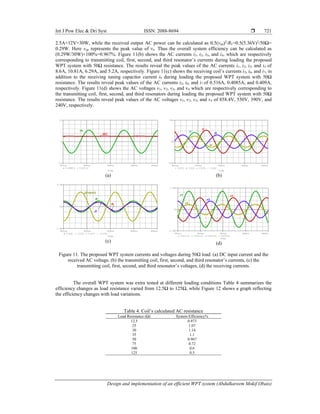
The MOSFET triggering voltage signal VS is a square wave voltage having a 338.6 kHz frequency
and ±10V voltage levels. The DC current IDC of the system power amplifier and the output received voltage
vo during 50Ω resistance are shown in Figure 11(a). The DC input current is about 2.5A and the output
received AC voltage is about 5.36V peak value. The system input power is IDCVDC, which is equal to
L1
46.334uH
C1
4.8631nF
L2
23.864uH
R1
0.185
R2
0.2
CSH
52.1nF
C2
9.25nF
0
0
L3
29.3uH
R3
0.27246
C3
7.5345nF
0
L4
22uH
R4
0.172
C4
10.034463nF
0
L5
6.0745uH
R5
0.0676
C5
116.3nF
L6
6.0745uH
R6
0.0676
L7
6.0745uH
R7
0.0676
R8
50
0
LRFC
1mH
0
VDC
12V
V1
TD = 0
TF = 1ns
PW = 1.4766686us
PER = 2.95333727us
V1 = -10V
TR = 1ns
V2 = +10V
0
Rs
5
K K1
COUPLING = 0.007882
K_Linear
K K2
COUPLING = 0.000437
K_Linear
K K3
COUPLING = 0.000094
K_Linear
K K4
COUPLING = 0.00001675
K_Linear
K K5
COUPLING = 0.0000154
K_Linear
K K6
COUPLING = 0.00001295
K_Linear
K K7
COUPLING = 0.006
K_Linear
K K8
COUPLING = 0.000781
K_Linear
Transmitting Circuit
K K9
COUPLING = 0.0001246
K_Linear
Second Resonator Circuit
First Resonator Circuit
K K10
COUPLING = 0.000108
K_Linear
Receiving Circuit
Third Resonator Circuit
K K11
COUPLING = 0.0001
K_Linear
K K12
COUPLING = 0.00535
K_Linear
K K13
COUPLING = 0.000528
K_Linear
K K14
COUPLING = 0.000427
K_Linear
K K15
COUPLING = 0.0003448
K_Linear
K K16
COUPLING = 0.0167
K_Linear
K K17
COUPLING = 0.00852
K_Linear
K K18
COUPLING = 0.004827
K_Linear
K K19
COUPLING = 0.083633
K_Linear
K K20
COUPLING = 0.083633
K_Linear
K K21
COUPLING = 0.01935
K_Linear
I
I
I
I
I
M1
IRFP250
M2
IRFP250
M3
IRFP250
M4
IRFP250
M5
IRFP250
M6
IRFP250
Int J Pow Elec & Dri Syst ISSN: 2088-8694 
Design and implementation of an efficient WPT system (Abdulkareem Mokif Obais)
721
2.5A×12V=30W, while the received output AC power can be calculated as 0.5(vop)2
/RL=0.5(5.36V)2
/50Ω=
0.29W. Here vop represents the peak value of vo. Thus the overall system efficiency can be calculated as
(0.29W/30W)×100%=0.967%. Figure 11(b) shows the AC currents i1, i2, i3, and i4, which are respectively
corresponding to transmitting coil, first, second, and third resonator’s currents during loading the proposed
WPT system with 50Ω resistance. The results reveal the peak values of the AC currents i1, i2, i3, and i4 of
8.6A, 10.81A, 6.29A, and 5.2A, respectively. Figure 11(c) shows the receiving coil’s currents i5, i6, and i7, in
addition to the receiving tuning capacitor current i8 during loading the proposed WPT system with 50Ω
resistance. The results reveal peak values of the AC currents i5, i6, and i7 of 0.516A, 0.4085A, and 0.409A,
respectively. Figure 11(d) shows the AC voltages v1, v2, v3, and v4 which are respectively corresponding to
the transmitting coil, first, second, and third resonators during loading the proposed WPT system with 50Ω
resistance. The results reveal peak values of the AC voltages v1, v2, v3, and v4 of 858.4V, 550V, 390V, and
240V, respectively.
(a) (b)
(c) (d)
Figure 11. The proposed WPT system currents and voltages during 50Ω load. (a) DC input current and the
received AC voltage, (b) the transmitting coil, first, second, and third resonator’s currents, (c) the
transmitting coil, first, second, and third resonator’s voltages, (d) the receiving currents.
The overall WPT system was extra tested at different loading conditions Table 4 summarizes the
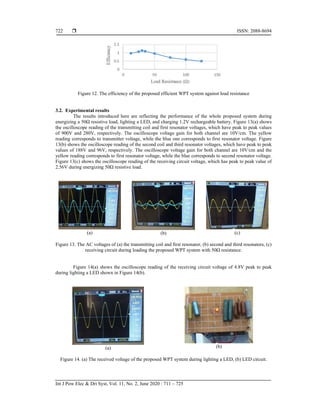
efficiency changes as load resistance varied from 12.5Ω to 125Ω, while Figure 12 shows a graph reflecting
the efficiency changes with load variations.
Table 4. Coil’s calculated AC resistance
Load Resistance (Ω) System Efficiency%
12.5 0.973
25 1.07
30 1.14
35 1.1
50 0.967
75 0.72
100 0.6
125 0.5
Time
952us 954us 956us 958us 960us
I(LRFC) V(L5:1)
-10
0
10
IDC
vo
Time
952us 954us 956us 958us 960us
I(C1) I(L2) I(L3) I(L4)
-20A
0A
20A
i4
i3
i2
i1
Time
952us 954us 956us 958us 960us
I(L6) I(L5) I(L7) -I(C5)
-2.0A
0A
2.0A
i6
i7
i5
-(i5+i6+i7)
Time
952us 954us 956us 958us 960us
V(L1:1) V(C2:2) V(C3:2) V(C4:2)
-1.0KV
0V
1.0KV
v4
v2
v3
v1
 ISSN: 2088-8694
Int J Pow Elec & Dri Syst, Vol. 11, No. 2, June 2020 : 711 – 725
722
Figure 12. The efficiency of the proposed efficient WPT system against load resistance
3.2. Experimental results
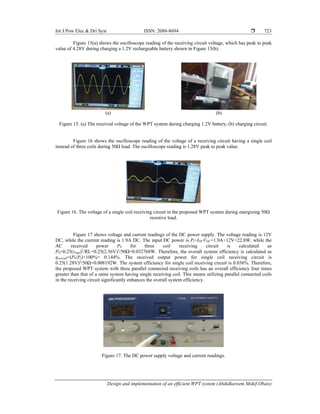
The results introduced here are reflecting the performance of the whole proposed system during
energizing a 50Ω resistive load, lighting a LED, and charging 1.2V rechargeable battery. Figure 13(a) shows
the oscilloscope reading of the transmitting coil and first resonator voltages, which have peak to peak values
of 900V and 280V, respectively. The oscilloscope voltage gain for both channel are 10V/cm. The yellow
reading corresponds to transmitter voltage, while the blue one corresponds to first resonator voltage. Figure
13(b) shows the oscilloscope reading of the second coil and third resonator voltages, which have peak to peak
values of 188V and 96V, respectively. The oscilloscope voltage gain for both channel are 10V/cm and the
yellow reading corresponds to first resonator voltage, while the blue corresponds to second resonator voltage.
Figure 13(c) shows the oscilloscope reading of the receiving circuit voltage, which has peak to peak value of
2.56V during energizing 50Ω resistive load.
(a) (b) (c)
Figure 13. The AC voltages of (a) the transmitting coil and first resonator, (b) second and third resonators, (c)
receiving circuit during loading the proposed WPT system with 50Ω resistance.
Figure 14(a) shows the oscilloscope reading of the receiving circuit voltage of 4.8V peak to peak
during lighting a LED shown in Figure 14(b).
(a) (b)
Figure 14. (a) The received voltage of the proposed WPT system during lighting a LED, (b) LED circuit.
Int J Pow Elec & Dri Syst ISSN: 2088-8694 
Design and implementation of an efficient WPT system (Abdulkareem Mokif Obais)
723
Figure 15(a) shows the oscilloscope reading of the receiving circuit voltage, which has peak to peak
value of 4.28V during charging a 1.2V rechargeable battery shown in Figure 15(b).
(a) (b)
Figure 15. (a) The received voltage of the WPT system during charging 1.2V battery, (b) charging circuit.
Figure 16 shows the oscilloscope reading of the voltage of a receiving circuit having a single coil
instead of three coils during 50Ω load. The oscilloscope reading is 1.28V peak to peak value.
Figure 16. The voltage of a single coil receiving circuit in the proposed WPT system during energizing 50Ω
resistive load.
Figure 17 shows voltage and current readings of the DC power supply. The voltage reading is 12V
DC, while the current reading is 1.9A DC. The input DC power is Pi=IDCVDC=1.9A×12V=22.8W, while the
AC received power P0 for three coil receiving circuit is calculated as
P0=0.25(vopp)2
/RL=0.25(2.56V)2
/50Ω=0.032768W. Therefore, the overall system efficiency is calculated as
ηoverall=(P0/Pi)×100%= 0.144%. The received output power for single coil receiving circuit is
0.25(1.28V)2
/50Ω=0.008192W. The system efficiency for single coil receiving circuit is 0.036%. Therefore,
the proposed WPT system with three parallel connected receiving coils has an overall efficiency four times
greater than that of a same system having single receiving coil. This means utilizing parallel connected coils
in the receiving circuit significantly enhances the overall system efficiency.
Figure 17. The DC power supply voltage and current readings.
 ISSN: 2088-8694
Int J Pow Elec & Dri Syst, Vol. 11, No. 2, June 2020 : 711 – 725
724
The effects of resonators on received AC power are addressed in this work. Table 5 lists the
received AC power and efficiency for all important cases of removing resonators from the circuit of the
practical WPT system taking into account a DC input power of 22.8W, which is taken as reference power
during the calculation of efficiency.
Table 5. Efficiency gain values of different WPT systems
System Type Received AC Power (mW) Efficiency %
Overall WPT System 32.768 0.144
Overall WPT System without First resonator 1 0.02
Overall WPT System without Second resonator 3.53 0.075625
Overall WPT System without Third resonator 1.25 0.003
Overall WPT system without second & third resonators 0.2 74.6×10⁻⁵
Overall WPT System without resonators 0.0026 3×10⁻⁵
4. CONCLUSION
In this work, an adaptive efficient WPT system is introduced. This system is carried out on PSpice
and validated experimentally. Both simulative and experimental WPT system have accomplished significant
enhancement in efficiency. The proposed WPT systems has three resonators and three parallel connected
identical receiving coils located at 6.61m from the power transmitter. The efficiency enhancement
approaches thousands times the efficiency of a conventional WPT system having similar power transmitter
located at the same distance from the receiving circuit, which has a single coil identical to those in the
proposed efficient WPT system. The conclusions of this work are summarized in: Both simulative and
practical systems have demonstrated that efficiency enhancement can be accomplished through inserting
resonators along with energy transmission path. Both simulative and practical systems have demonstrated
that efficiency enhancement can be accomplished through the modification of the receiving circuit using
parallel connected receiving coils. More power can be received when the reactance of the equivalent
receiving coil is much less than the load impedance. Energy transmission can approach distant nodes via
inserting more resonators along the path toward the targeted node. Heavier power transmission requires
lower frequency range, but bigger sending and receiving antennas.
Both systems show similar responses, which they differ in amounts, but exhibit similar behaviors.
The differences in amounts are due to commercial tuning capacitors which have dielectric resistances
responsible for causing significant reduction in the resonant currents in all resonator circuits.
REFERENCES
[1] A. Esser and H.-C. Skudelny, “A new approach to power supplies for robots,” IEEE Transactions on Industry
Applications, vol. 27, no. 5, pp. 872–875, 1991.
[2] L. Cannon, J. F. Hoburg, D. D. Stancil, S. C. Goldstein, “Magnetic resonant coupling as a potential means for
wireless power transfer to multiple small receivers,” IEEE Transactions on Power Electronics, vol. 24, no. 7, pp.
1819-1825, 2009.
[3] J. J. Casanova, Z. N. Low, and J. Lin, “Design and optimization of a Class-E amplifier for a loosely coupled planar
wireless power system,” IEEE Transactions on Circuits and Systems-II: Express Briefs, vol. 56, no. 11, pp. 830–
834, 2009.
[4] J. A. Taylor, Z. N. Low, J. Casanova, and J. Lin, “A wireless power station for laptop computers Jason,” IEEE
Radio and Wireless Symposium (RWS), 10-14 Jan. 2010, New Orleans, LA, USA,
pp. 625-628, 2010.
[5] M. Pinuela, D. C. Yates, S. Lucyszyn, and P. D. Mitcheson, “Maximizing DC to load efficiency for inductive
power transfer,” IEEE Transactions on Power Electronics, vol. 50, no. 6, pp. 1-11, 2010.
[6] A. Massa, G. Oliveri , F. Viani , and P. Rocca, “Array designs for long-distance wireless power transmission: State-
of-the-art and innovative solutions,” Proceedings of the IEEE, vol.101, no. 6,
pp. 1464- 1481 , 2013.
[7] S. Raju, R. Wu, M. Chan, and C. P.Yue, “Modeling of mutual coupling between planar inductors
in wireless power applications,” IEEE Transactions On Power Electronics, vol. 29, no. 1,
pp. 481-490, 2014.
[8] Y. Cheng and Y. Shu, “A new analytical calculation of the mutual inductance of the coaxial spiral rectangular
coils,” IEEE Transactions on Magnetics, vol. 50, no. 4, pp. 1-6, 2014.
[9] J. Kim, -J. Park, “Approximate closed-form formula for calculating ohmic resistance in coils of parallel round wires
with unequal pitches,” IEEE Transactions On Industrial Electronics, vol. 62, no. 6,
pp. 3482-3489, 2015.
Int J Pow Elec & Dri Syst ISSN: 2088-8694 
Design and implementation of an efficient WPT system (Abdulkareem Mokif Obais)
725
[10] L. Tan, J. Li, C. Chen, C. Yan, J. Guo, and X. Huang, “Analysis and performance improvement of
wpt systems in the environment of single non-ferromagnetic metal plates,” Energies, vol 9,
pp. 1-16, 2016.
[11] V. V. Nair and J. R. Choi, “An efficiency enhancement technique for a wireless power transmission system based
on a multiple coil switching technique,” Energies vol. 9, pp. 1-15, 2016.
[12] J. Chen, Z. Ding, Z. Hu, Sh. Wang, Y. Cheng, M. Liu, B. Wei, and S. Wang, “Metamaterial-based high-efficiency
wireless power transfer system at 13.56 Mhz for low power applications,” Progress in Electromagnetics Research,
vol.72, pp.17-30, 2017.
[13] X. Liu, T. Wang, X. Yang, N. Jin, and H. Tang, “Analysis and design of a wireless power transfer system with dual
active bridges,” Energies vol. 10, pp. 1-20, 2017.
[14] H.-D. Lang and C. D. Sarris, “Optimization of wireless power transfer systems enhanced by passive elements and
metasurfaces,” IEEE Transactions on Antennas and Propagation, vol. 6, no. 10,
pp. 5462- 5474, 2017.
[15] M. Schormans, V. Valente, and A. Demosthenous, “Practical inductive link design for biomedical wireless power
transfer: A tutorial,” IEEE Transactions on Biomedical Circuits and Systems, vol. 12, no. 5, pp. 1112 - 1130, 2018.
[16] S. Liu, J. Su, and J, Lai, “Accurate expressions of mutual inductance and their calculation of archimedean spiral
coils,” Energies vol 12, 2017.
[17] A. Kurs, “Power transfer through strongly coupled resonances,” Master Thesis, Massachusetts Institute of
Technology, Massachusetts Ave, Cambridge, USA 2008.
[18] T. Peng, S. Koulouridis, and J. L. Volakis, “Miniaturization of conical helical antenna via optimized coiling,” Aces
Journal, vol. 26, no. 6, pp. 452-458, 2011.
[19] W. Junhua, “Resonant coupling energy transmission technology and its applications to implanted medical devices,”
PhD Thesis, The Hong Kong Polytechnic University, Hong Kong, 2012.
[20] M. C. Pickelsimer, “Wireless power transfer system for electric vehicles with power factor correction,” MSc
Thesis, University of Tennessee, Knoxville, Tennessee, 2012.
[21] A. Bourřa and M. Husák, “Communication and powering scheme for wireless and battery-less measurement,”
Radioengineering, vol. 21, no. 1, pp. 239-245, 2012.
[22] T. Sun, X. Xie, and Z. Wang, "Wireless power transfer for medical microsystems", Springer, New York, USA,
2013.
[23] E. B. Wasatonic, “Comparison of tesla coil driver topologies: Rotary spark gap versus double resonant solid state,”
MSc Thesis, The Pennsylvania State University, Pennsylvania, USA, 2013.
[24] R. Ludwig and P. Bretchko, “RF circuit design: Theory & applications,” Prentice Hall, Upper Saddle River, New
Jersey, USA, 2000.
[25] J. Rogers and C. Plett, “Radio frequency integrated circuit design,” Artech House, Boston, London, U.K, 2003.

Design and implementation of an efficient WPT system

  • 1.
    International Journal ofPower Electronics and Drive System (IJPEDS) Vol. 11, No. 2, June 2020, pp. 711~725 ISSN: 2088-8694, DOI: 10.11591/ijpeds.v11.i2.pp711-725  711 Journal homepage: http://ijpeds.iaescore.com Design and implementation of an efficient WPT system Abdulkareem Mokif Obais1 , Ali Faeq Ruzij2 1 Department of Biomedical Engineering, University Babylon, Iraq. 2 Department of Electrical Engineering, University of Babylon, Iraq. Article Info ABSTRACT Article history: Received Oct 10, 2019 Revised Nov 9, 2019 Accepted Jan 22, 2020 Wireless power transfer (WPT) is a technique introduced to transfer power wirelessly. Generally, WPT systems are characterized by low efficiency and low output power. Since WPT process depends mainly on mutual coupling between transmitting and receiving coils in addition to load requirements, it is focused in this work toward enhancing the mutual coupling and conditioning the receiving circuit so as to optimally satisfy the load demand. The mutual coupling between transmitting and receiving nodes is enhanced via inserting three resonating circuits along with energy transmission path and conditioning the receiving circuit such that it accomplishes delivering maximum power to the load node. In this work, an adaptive efficient WPT system is introduced. This system is carried out on PSpice and validated experimentally. Both simulative and experimental WPT systems have accomplished significant enhancement in efficiency. The proposed WPT system has three resonators and three parallel connected identical receiving coils located at 6.61m from the power transmitter. The efficiency enhancement approaches thousands of times the efficiency of a conventional WPT system having similar power transmitter located at the same distance from the receiving circuit, which has a single coil identical to those in the proposed efficient WPT system. Keywords: Efficiency enhancement Inductive link Mutual coupling Mutual inductance Wireless power transfer This is an open access article under the CC BY-SA license. Corresponding Author: Abdulkareem Mokif Obais, Department of Biomedical Engineering, University of Babylon, Hilla, Babylon, Iraq. Email: karimobais@yahoo.com 1. INTRODUCTION In the last years, the enhancing technology of power transfer (WPT) develops quickly. The mobiles or other electronic devices such as laptops or electrical vehicles could be charged by WPT technology. These techniques could be used in places when wiring is difficult to be accomplished [1-5]. Long-range concept of WPT had been formulated after microwave amplifier invention for high power purposes. The possibility of power transmission via electromagnetic waves gained more and more intention for application purposes [6, 7]. The works curried out by [7, 8] present analytical models for calculating the mutual inductance between planar spiral coils. These models are very useful in the design and optimization of wireless power transfer systems. The proposed models of mutual inductances between coils were derived using the solution of Neumann’s integral. An approximate formula for determining the self-resistance of a circular multi-loop inductor having unequal pitches was introduced by [9]. Both proximity and skin effects were included in the suggested formula. Proximity effect was determined using the magnetic fields exerted on a wire due to other wires. The study conducted by [10] analyzed with a context of non-ferromagnetic metallic plate, the WPT performances. The model of the WPT impedance in the metal environment was built. The proposed system in [11] comprised several loop inductors having different sizes. Depending on the changes of the distance
  • 2.
     ISSN: 2088-8694 IntJ Pow Elec & Dri Syst, Vol. 11, No. 2, June 2020 : 711 – 725 712 between the transmitting and receiving sides, the power was switched to one loop of the inductors for power transmission and power reception. A WPT system of 13.56 MHz was introduced by [12] and investigated both theoretically and experimentally in addition to simulation. A relative high improvement in efficiency of about 41.7% was achieved. Three phase angles had been designed and analyzed in [13]. Single power amplifier on the primary side and two power amplifiers were located at the secondary side. The proposed multi-degrees method of phase control was capable of achieving simultaneously additional compensation of the reactance, output regulation, and load transformation. A consistent optimization technique was conducted by [14] for WPT systems equipped with passive element’s enhancement beginning from simple reflectors, intermediate relays, and general electromagnetic focusing and guiding structures, like metamaterials and metasurfaces. The proposed work efficiently solved the problem of optimization using arbitrary numbers of passive elements. The work conducted by [15] presented and explained the published techniques and principles concerning all aspects of inductive link design processes such that no specific preceding information about inductive link designs are required. The work in [16] introduced accurate formulas for calculating mutual inductance between spiral coils using Gaussian integration method. The researches introduced by [17-22] concern enhancing coupling coefficients in different environments of inductive links in addition to applications of WPT technologies in contactless electrical vehicles and energizing medical sensors. In this work, poor efficiency of conventional wireless powering process is enhanced by strengthening the mutual coupling along with power transmission path and conditioning the receiving circuit such that it accomplishes maximum power reception to load node. 2. Design of the proposed efficient WPT system The inductive mutual coupling Mab between two 1-turn planar spiral coils is shown in Figure 1a. The mutual inductance between these two coils is given by [7] 𝑀 ⁄ 1 𝛾 𝛾 (1) 𝛾 (2) Where, a and b are the outer radii of the first and second coils, respectively. µ0 is the permeability of free space and z is the distance between the centers of the two coils, which are aligned coaxially. (a) (b) Figure 1. Inductive link, (a) coupling between two 1-turn coils, (b) modeling of two coil inductive link. For multi-turns planar spiral coils, (1) can be modified to 𝑀 ∑ ∑ ⁄ 1 𝛾 𝛾 (3) 𝛾 (4)
  • 3.
    Int J PowElec & Dri Syst ISSN: 2088-8694  Design and implementation of an efficient WPT system (Abdulkareem Mokif Obais) 713 Where, N1 and N2 are the numbers of turns of the first and second coils, respectively. If two inductively coupled coils are forming a resonant inductive link shown in Figure 1b, then the link currents and voltages at resonance frequency can be given by 𝐼 , 𝑅 ≫ (5) 𝐼 , 𝑅 ≫ (6) Where, L1 and L2 are self-inductances of the first and second coils, respectively. M12 is the mutual inductance between the two coils. R1 and R2 are the AC resistances of the first and second coils, respectively. C1 and C2 are the tuning capacitances of the sending (transmitting) and receiving circuits, respectively, whereas ω0=2πf0 is the inductive link operating angular frequency. Rrefl is defined by 𝑅 (7) The output voltage V2 is determined by 𝑉 𝐼 , 𝑅 ≫ , 𝜔 𝐿 (8) The link input power Pi, output power P0, and efficiency η can be given by 𝑃 | | , 𝑅 ≫ (9) 𝑃 | | , 𝑅 ≫ (10) 𝜂 , 𝑅 ≫ (11) Where, Q1, Q2, and QL are the quality factors of the first coil, second coil, and load, respectively at resonance frequency f0. Q1, Q2, and QL are defined by ω0L1/R1, ω0L2/R2, and RL/ω0L2, respectively. k12 is the coefficient of coupling between the two coils and is defined by 𝑘 (12) For loosely coupled inductive link (11) can closely be approximated to 𝜂 , 𝑅 ≫ and 𝑄 𝑄 𝑘 ≪ 1 (13) According to (11), the efficiency of WPT process is directly proportional to the square of the coupling coefficient. The proposed efficient WPT system can be depicted by block diagram of Figure 2. Figure 2. The block diagram of the proposed system. Class E Power Amplifier First Resonator Circuit WPT1 Second Resonator Circuit WPT2 Third Resonator Circuit WPT3 Receiving Circuit WPT4 Transmitting Coil Second resonator Coil First resonator Coil Parallel-connected Receiving Coils Third resonator Coil
  • 4.
     ISSN: 2088-8694 IntJ Pow Elec & Dri Syst, Vol. 11, No. 2, June 2020 : 711 – 725 714 It is obvious that the proposed system shown in Figure 2 comprises four series WPT systems. In this work, three resonating coils are inserted on the path joining the transmitting and receiving coils. The locations of resonating coils are selected such that maximum power is transferred between each two adjacent coils. Figure 3 shows the alignment of coils in the proposed inductive link. The first coil from the left is L1, which represents the transmitting coil and its distance z12 from the second coil L2 (first resonator coil) is 156cm. At 227cm to the right of the first resonator is located the third coil L3 (second resonator coil), whereas the fourth coil L4 (third resonator coil) is located at 140cm to right of the second resonator. Three similar receiving coils L5, L6, and L7 are oriented 50cm to the right of the third resonator and each adjacent coils are 20cm apart. Figure 3. Alignment of coils in the proposed system. The transmitting coil is shown in Figure 4a. It is wound with 12.667 turn’s copper pipe having an outer diameter of 19.05 mm and wall thickness of 0.91mm. The coil outer diameter is 62cm, whereas its inner diameter is 12cm. The first resonator shown in Figure 4b is a planar spiral coil wound with 5.5 turn’s copper pipe having outer diameter of 19.05 mm and wall thickness of 0.91mm. The coil outer and inner diameters are 150cm and 30cm, respectively. The second resonator shown in Figure 4c is a planar spiral coil wound with 7.25 turn’s copper pipe having outer diameter of 6.35 mm and wall thickness of 0.71mm. The coil outer diameter is 110cm and its inner diameter is 20cm. The third resonator shown in Figure 4d is a conical coil wound with 9.25 turn’s copper pipe, which has an outer diameter of 19.05 mm and wall thickness of 0.91mm. The coil outer and inner diameters are 72cm and 20cm, respectively. The coil length is 68cm. (a) (b) (c) (d) Figure 4. Photos of (a) the transmitting coil (L1), (b) the first resonator coil (L2), (c) the second resonator coil (L3), (d) the third resonator coil (L4). The receiving circuit is shown in Figure 5. It is composed of three similar planar spiral coils connected in parallel. Each coil is wound with 6 turn’s copper pipe having outer diameter of 6.35 mm and wall thickness of 0.71mm. The coil outer and inner diameters are 33.5cm and 6cm, respectively. The coils in the proposed WPT system are wound with pipe conductors in order to decrease their AC resistances by decreasing the skin effect, which has great impact on the quality factors of coils. Decreasing the AC resistances of coils increases the coils quality factor, which in turn increases the link efficiency governed by (11) or (13), which is applicable for loosely coupled inductive links. 227cm 156cm 50cm 68cm 140cm 62cm 20cm 20cm 150cm 110cm 72cm Transmitting Coil First Rsonator Coil Three Parallel Connected Receiving Coils Third Rsonator Coil Second Rsonator Coil 12cm 30cm 20cm 20cm 6cm 30cm
  • 5.
    Int J PowElec & Dri Syst ISSN: 2088-8694  Design and implementation of an efficient WPT system (Abdulkareem Mokif Obais) 715 The proposed WPT system depicted in Figure 2 can be schematically represented by the circuit shown Figure 6. In this Figure, R1, R2, R3, R4, R5, R6, and R7 are the AC resistances of the coils L1, L2, L3, L4, L5, L6, and L7, respectively. C1, C 2, C 3, C 4, and C 5 are tuning capacitors of transmitting, first resonator, second resonator, third resonator, and receiving circuits, respectively. Each M represents the mutual inductance between two certain coils. For example M12 represents the mutual inductance between L1 and L2. M12 is equal to M21 (M12=M21) and this is applicable for each two coils. Figure 5. A photo of the receiving circuit, which is composed of three planar spiral coils (L5, L6, and L7). Figure 6. Schematic representation of the proposed system. The inductances of planar spiral coils can be calculated by [15] 𝐿 𝑙𝑛 . 0.2𝛽 (14) Where, the average diameter is denoted by davg = 0.5(do+di). di and d0 are the inner and outer diameters of the coil, respectively, while β is the fill-factor, which is given by 𝛽 (15) The inductance of the conical coil shown in Figure 7 can be calculated as follows [23]: 𝐿 . , 𝜇𝐻 (16) Where, n, di, s, and Y are coil number of turns, inner diameter, distance between two adjacent turns, and coil angle, respectively. Y and s are defined by
  • 6.
     ISSN: 2088-8694 IntJ Pow Elec & Dri Syst, Vol. 11, No. 2, June 2020 : 711 – 725 716 𝑌 𝑡𝑎𝑛 . (17) 𝑠 (18) Where, d0 is the coil outer diameter. W and l are coil axial and longitudinal lengths, respectively. All dimensions are in inches. Substituting for n=9.25, di=20cm=7.874 inches, d0=72cm=28.346 inches, l=68cm=26.772 inches, and W=72.8cm=28.661 inches into (16) to (18) gives Lcon=22 µH. Figure 7. The inverse conical coil. The DC resistances of all coils in the proposed WPT system can be calculated by 𝑅 (19) Where, lC, σCu, w, and wth, are the coil length, conductivity of copper, outer diameter of coil pipe conductor, and wall thickness of the pipe. The calculated inductances and DC resistances are listed in Table 1. The mutual inductances between coils can be calculated using (3). The coefficients of coupling between coils are calculated according to (12). The calculated mutual inductances and their corresponding coefficients of coupling are listed in Table 2. Table 1. Coil’s calculated DC resistance and inductances Coil Name DC Resistance (Ω) Inductance (µH) L1 0.0041827 46.334 L2 0.00448 23.864 L3 0.018474 29.3 L4 0.0039 22 L5, L6, L7 0.00458 6.0745 The AC resistance RAC of a coil wound with copper conductors can be calculated by [24] 𝑅 𝑅 (20) 𝛿 (21) Where, RDC, σCu, w, and δCu are the DC resistance of the coil, conductivity of copper, outer diameter of the coil conductor, and copper skin depth at f0. Respectively. Applying (20) using the conductor outer diameters and calculated DC resistance in Table 1, the AC resistances of all coils are calculated and listed in Table 3. W Y o d di l
  • 7.
    Int J PowElec & Dri Syst ISSN: 2088-8694  Design and implementation of an efficient WPT system (Abdulkareem Mokif Obais) 717 Table 2. Mutual inductances and their corresponding coupling coefficients Mutual Inductance Value (µH) Coefficient of Coupling Value M12 0.2621 k12 0.007882 M13 0.0161 k13 0.000437 M14 0.003 k14 0.000094 M15 0.000281 k15 0.00001675 M16 0.0002564 k16 0.0000154 M17 0.0002345 k17 0.00001295 M23 0.1592 k23 0.006 M24 0.0179 k24 0.000781 M25 0.0015 k25 0.0001246 M26 0.0013 k26 0.000108 M27 0.0012 k27 0.0001 M34 0.1358 k34 0.00535 M35 0.007 k35 0.000528 M36 0.0057 k36 0.000427 M37 0.0046 k37 0.0003448 M45 0.1931 k45 0.0167 M46 0.0985 k46 0.00852 M47 0.0558 k47 0.004827 M56 0.5018 k56 0.083633 M57 0.1161 k57 0.01935 M67 0.5018 k67 0.083633 Table 3. Coil’s calculated AC resistances Coil Name AC Resistance AC Resistance Value (Ω) L1 R1 0.185 L2 R2 0.2 L3 R3 0.27246 L4 R4 0.172 L5 R5 0.0676 L6 R6 0.0676 L7 R7 0.0676 Since the transmitting coil (L1) and the three resonating coils (L2, L3, and L4) are operating within loosely coupled conditions, then the tuning capacitors C2, C3, and C4 shown in Figure 6 can be determined as 9.25nF, 7.5345nF, and 10.034463nF, respectively.The circuit elements C1 and L1 in Figure 6 are parts of the output circuit of the class-E power amplifier, which represents the power transmitter of the proposed efficient WPT system. The series combination formed by C1 and L1 Are designed to resonate at a frequency slightly less than f0 and their equivalent impedance at the resonance frequency f0 is R1+jX, where X is defined by [25] 𝑋 1.152𝑅 𝜔 𝐿 (22) Where, R represents the resistive load of class-E power amplifier and can be determined by 𝑅 𝑅 𝑅 (23) The tuning capacitor C5 of the receiving coils shown in Figure 6 can be approximately determined in a different procedure. Figure 8 models the receiving coils without C5 and RL. Since the receiving circuit is symmetrical around the branch including L6, then I5=I7 and I6=-2I5. Consequently, the impedance ZRCV of the parallel-connected receiving coils can be determined by 𝑍 0.5𝑅 𝑗0.5𝜔 𝐿 𝑗𝜔 𝑀 𝑗0.5𝜔 𝑀 // 𝑅 𝑗𝜔 𝐿 𝑗2𝜔 𝑀 (24) Substituting the calculated circuit parameters in (24) gives 𝑍 0.023 𝑗4.04, 𝛺 (25) Figure 8. Modeling of the receiving coils without C5 and RL.
  • 8.
     ISSN: 2088-8694 IntJ Pow Elec & Dri Syst, Vol. 11, No. 2, June 2020 : 711 – 725 718 According to (25), the required value for C5 to accomplish resonance is 116.3nF. At resonance frequency f0 and after tuning all capacitors such that all link circuits resonate at the same time, the link currents can be related to each other by ⎣ ⎢ ⎢ ⎢ ⎢ ⎢ ⎡ 𝑉 0 0 0 0 0 0⎦ ⎥ ⎥ ⎥ ⎥ ⎥ ⎤ ⎣ ⎢ ⎢ ⎢ ⎢ ⎢ ⎡ 𝑅 𝑗𝑋 𝑗𝜔 𝑀 𝑗𝜔 𝑀 𝑗𝜔 𝑀 𝑗𝜔 𝑀 𝑗𝜔 𝑀 𝑗𝜔 𝑀 𝑗𝜔 𝑀 𝑅 𝑗𝜔 𝑀 𝑗𝜔 𝑀 𝑗𝜔 𝑀 𝑗𝜔 𝑀 𝑗𝜔 𝑀 𝑗𝜔 𝑀 𝑗𝜔 𝑀 𝑅 𝑗𝜔 𝑀 𝑗𝜔 𝑀 𝑗𝜔 𝑀 𝑗𝜔 𝑀 𝑗𝜔 𝑀 𝑗𝜔 𝑀 𝑗𝜔 𝑀 𝑅 𝑗𝜔 𝑀 𝑗𝜔 𝑀 𝑗𝜔 𝑀 𝑗𝜔 𝑀 𝑗𝜔 𝑀 𝑗𝜔 𝑀 𝑗𝜔 𝑀 𝑍 𝑍 𝑍 𝑗𝜔 𝑀 𝑗𝜔 𝑀 𝑗𝜔 𝑀 𝑗𝜔 𝑀 𝑍 𝑍 𝑍 𝑗𝜔 𝑀 𝑗𝜔 𝑀 𝑗𝜔 𝑀 𝑗𝜔 𝑀 𝑍 𝑍 𝑍 ⎦ ⎥ ⎥ ⎥ ⎥ ⎥ ⎤ ⎣ ⎢ ⎢ ⎢ ⎢ ⎢ ⎡ 𝐼 𝐼 𝐼 𝐼 𝐼 𝐼 𝐼 ⎦ ⎥ ⎥ ⎥ ⎥ ⎥ ⎤ (26) Where, I1, I 2, I 3, I 4, I 5, I 6, and I 7 are the currents flowing through coils L1, L2, L3, L4, L5, L6, and L7, respectively. Since, L1 and C1 are parts of the class-E driving power amplifier and resonate at a frequency slightly less than the link resonance frequency f0, the inductive reactance X represents their equivalent reactance at f0. Z55, Z56, Z57, Z65, Z66, Z67, Z75, Z76, and Z77 are defined by 𝑍 𝑍 𝑍 𝑍 𝑍 𝑍 𝑍 𝑍 𝑍 ⎣ ⎢ ⎢ ⎢ ⎡𝑅 𝑗𝜔 𝐿 𝑗𝜔 𝑀 𝑗𝜔 𝑀 𝑀 𝑅 𝑗𝜔 𝐿 𝑀 𝑀 𝑀 𝑅 𝑗𝜔 𝐿 ⎦ ⎥ ⎥ ⎥ ⎤ (27) According to the block diagram of the overall proposed WPT system, there are four series WPT systems namely WPT1, WPT2, WPT3, and WPT4. The first three systems WPT1, WPT2, and WPT3 are loosely coupled systems due to the relatively large distances between their transmitting and receiving coils, thus the first WPT system (WPT1) can be analyzed separately from other systems. Figure 9 shows the model of the resonant inductive link corresponding to WPT1 system. At resonance frequency f0, the reflected resistance Rrefl from the secondary side (first, second, and third resonators) in the primary side (transmitting coil) is determined according to Equation (7) as 1.56Ω. V´ in Figure 9 represents the voltage across the resistive load of class-E power amplifier. According to [25], V´ has an amplitude of Vom and phase of φ=- 32.40 . The maximum possible value of Vom is 1.074VDD=1.074×12V=12.888V, thus the voltage Vi can be determined by 𝑉 𝑅 𝑅 𝑗𝑋 𝐼 1.7463 𝑗2 𝐼 (28) Substituting all calculated mutual inductances, coil’s self-inductances, coil’s AC resistances, X, and C5 into (26) and (27) gives ⎣ ⎢ ⎢ ⎢ ⎢ ⎢ ⎡ 𝑉 0 0 0 0 0 0⎦ ⎥ ⎥ ⎥ ⎥ ⎥ ⎤ ⎣ ⎢ ⎢ ⎢ ⎢ ⎢ ⎡ 0.185 𝑗2 𝑗0.558 𝑗0.034 𝑗0.0064 𝑗0.0006 𝑗0.00055 𝑗0.0005 𝑗0.558 0.2 𝑗0.3388 𝑗0.0381 𝑗0.0032 𝑗0.0028 𝑗0.0026 𝑗0.034 𝑗0.3388 0.27246 𝑗0.289 𝑗0.0149 𝑗0.0121 𝑗0.0098 𝑗0.0064 𝑗0.0381 𝑗0.289 0.172 𝑗0.411 𝑗0.21 𝑗0.1188 𝑗0.0006 𝑗0.0032 𝑗0.0149 𝑗0.411 0.07 𝑗8.9 𝑗2.972 𝑗3.793 𝑗0.00055 𝑗0.0028 𝑗0.0121 𝑗0.21 𝑗2.972 0.07 𝑗8.9 𝑗2.972 𝑗0.0005 𝑗0.0026 𝑗0.0098 𝑗0.1188 𝑗3.793 𝑗2.972 0.07 𝑗8.9⎦ ⎥ ⎥ ⎥ ⎥ ⎥ ⎤ ⎣ ⎢ ⎢ ⎢ ⎢ ⎢ ⎡ 𝐼 𝐼 𝐼 𝐼 𝐼 𝐼 𝐼 ⎦ ⎥ ⎥ ⎥ ⎥ ⎥ ⎤ (29) Figure 9. Modeling of the first WPT system (WPT1).
  • 9.
    Int J PowElec & Dri Syst ISSN: 2088-8694  Design and implementation of an efficient WPT system (Abdulkareem Mokif Obais) 719 Substituting (28) into (29) and determining the inverse of the resulted matrix produce 𝐼 0.136 𝑗1.61 𝐼 , 𝐼 0.8 𝑗0.341 𝐼 , 𝐼 0.306 𝑗1.184 𝐼 , 𝐼 0.039 𝑗0.13 𝐼 , 𝐼 0.031 𝑗0.101 𝐼 , and 𝐼 0.033 𝑗0.101 𝐼 . The output voltage V0, input power Pi, output power P0, and overall link efficiency ηoverall are determined by 𝑉 𝐼 𝐼 𝐼 1.462 𝑗0.404 𝐼 (30) 𝑃 𝐼 𝑅 𝑅 1.7463𝐼 (31) 𝑃 | . . | . (32) 𝜂 % 100% . 100% (33) The above overall link efficiency corresponds to wirelessly energizing a load circuit located at 6.61m from the power source taking into account strengthening the inductive coupling environment and conditioning the power receiving circuit for maximum power reception. If only one receiving coil is used and located at the same distance from the power source without using resonators for strengthening the inductive coupling, then according to (13), the efficiency for single coil receiving circuit without using resonators is calculated at RL=130Ω as follows: 𝜂 % 100% 0.00421% (34) The overall link efficiency of the proposed system at a load of 130Ω is calculated as 𝜂 . 100% . 100% 1.0154% (35) To show the significance of the efficiency enhancement processed in this work, what is known as the efficiency gain Geff adopted here reflects this as follows: 𝐺 . . 241.184 (36) Many techniques are exploited in the design of the WPT transmitter to target relatively remote electrical nodes required to be wirelessly energized. The most efficient technique is class-E power amplifier, which is a switch mode power amplifier characterized by high efficiency and high power. Therefore such kind of power amplifiers are recommended to be adopted in the design of WPT systems. Figure 10 shows the PSpice design of the proposed efficient WPT system. The class-E power amplifier in the proposed system is loaded by an RLC combination composed of a series RLC circuit represented by C1, L1, and R1 shunted by a capacitor CSH. L1 and R1 represent the inductance and AC resistance of the transmitting coil, respectively. C1 is a tuning capacitor resonates with L1 at a frequency slightly less than f0, whereas CSH resonates with the series RLC (C1, L1, and R1) circuit at f0. Using (22) at an operating frequency of 338.6 kHz, C1 is calculated as 4.8631nF. CSH is determined by [25] 𝐶 . 52.1 𝑛𝐹 (37)
  • 10.
     ISSN: 2088-8694 IntJ Pow Elec & Dri Syst, Vol. 11, No. 2, June 2020 : 711 – 725 720 Figure 10. The PSpice design of the proposed system. 3. RESULTS AND DISCUSSION The proposed efficient WPT system was first designed on PSpice, tested, and then practically implemented, thus in this work, there are simulative results, which are validated by experimental results. 3.1. Simulation results The MOSFET triggering voltage signal VS is a square wave voltage having a 338.6 kHz frequency and ±10V voltage levels. The DC current IDC of the system power amplifier and the output received voltage vo during 50Ω resistance are shown in Figure 11(a). The DC input current is about 2.5A and the output received AC voltage is about 5.36V peak value. The system input power is IDCVDC, which is equal to L1 46.334uH C1 4.8631nF L2 23.864uH R1 0.185 R2 0.2 CSH 52.1nF C2 9.25nF 0 0 L3 29.3uH R3 0.27246 C3 7.5345nF 0 L4 22uH R4 0.172 C4 10.034463nF 0 L5 6.0745uH R5 0.0676 C5 116.3nF L6 6.0745uH R6 0.0676 L7 6.0745uH R7 0.0676 R8 50 0 LRFC 1mH 0 VDC 12V V1 TD = 0 TF = 1ns PW = 1.4766686us PER = 2.95333727us V1 = -10V TR = 1ns V2 = +10V 0 Rs 5 K K1 COUPLING = 0.007882 K_Linear K K2 COUPLING = 0.000437 K_Linear K K3 COUPLING = 0.000094 K_Linear K K4 COUPLING = 0.00001675 K_Linear K K5 COUPLING = 0.0000154 K_Linear K K6 COUPLING = 0.00001295 K_Linear K K7 COUPLING = 0.006 K_Linear K K8 COUPLING = 0.000781 K_Linear Transmitting Circuit K K9 COUPLING = 0.0001246 K_Linear Second Resonator Circuit First Resonator Circuit K K10 COUPLING = 0.000108 K_Linear Receiving Circuit Third Resonator Circuit K K11 COUPLING = 0.0001 K_Linear K K12 COUPLING = 0.00535 K_Linear K K13 COUPLING = 0.000528 K_Linear K K14 COUPLING = 0.000427 K_Linear K K15 COUPLING = 0.0003448 K_Linear K K16 COUPLING = 0.0167 K_Linear K K17 COUPLING = 0.00852 K_Linear K K18 COUPLING = 0.004827 K_Linear K K19 COUPLING = 0.083633 K_Linear K K20 COUPLING = 0.083633 K_Linear K K21 COUPLING = 0.01935 K_Linear I I I I I M1 IRFP250 M2 IRFP250 M3 IRFP250 M4 IRFP250 M5 IRFP250 M6 IRFP250
  • 11.
    Int J PowElec & Dri Syst ISSN: 2088-8694  Design and implementation of an efficient WPT system (Abdulkareem Mokif Obais) 721 2.5A×12V=30W, while the received output AC power can be calculated as 0.5(vop)2 /RL=0.5(5.36V)2 /50Ω= 0.29W. Here vop represents the peak value of vo. Thus the overall system efficiency can be calculated as (0.29W/30W)×100%=0.967%. Figure 11(b) shows the AC currents i1, i2, i3, and i4, which are respectively corresponding to transmitting coil, first, second, and third resonator’s currents during loading the proposed WPT system with 50Ω resistance. The results reveal the peak values of the AC currents i1, i2, i3, and i4 of 8.6A, 10.81A, 6.29A, and 5.2A, respectively. Figure 11(c) shows the receiving coil’s currents i5, i6, and i7, in addition to the receiving tuning capacitor current i8 during loading the proposed WPT system with 50Ω resistance. The results reveal peak values of the AC currents i5, i6, and i7 of 0.516A, 0.4085A, and 0.409A, respectively. Figure 11(d) shows the AC voltages v1, v2, v3, and v4 which are respectively corresponding to the transmitting coil, first, second, and third resonators during loading the proposed WPT system with 50Ω resistance. The results reveal peak values of the AC voltages v1, v2, v3, and v4 of 858.4V, 550V, 390V, and 240V, respectively. (a) (b) (c) (d) Figure 11. The proposed WPT system currents and voltages during 50Ω load. (a) DC input current and the received AC voltage, (b) the transmitting coil, first, second, and third resonator’s currents, (c) the transmitting coil, first, second, and third resonator’s voltages, (d) the receiving currents. The overall WPT system was extra tested at different loading conditions Table 4 summarizes the efficiency changes as load resistance varied from 12.5Ω to 125Ω, while Figure 12 shows a graph reflecting the efficiency changes with load variations. Table 4. Coil’s calculated AC resistance Load Resistance (Ω) System Efficiency% 12.5 0.973 25 1.07 30 1.14 35 1.1 50 0.967 75 0.72 100 0.6 125 0.5 Time 952us 954us 956us 958us 960us I(LRFC) V(L5:1) -10 0 10 IDC vo Time 952us 954us 956us 958us 960us I(C1) I(L2) I(L3) I(L4) -20A 0A 20A i4 i3 i2 i1 Time 952us 954us 956us 958us 960us I(L6) I(L5) I(L7) -I(C5) -2.0A 0A 2.0A i6 i7 i5 -(i5+i6+i7) Time 952us 954us 956us 958us 960us V(L1:1) V(C2:2) V(C3:2) V(C4:2) -1.0KV 0V 1.0KV v4 v2 v3 v1
  • 12.
     ISSN: 2088-8694 IntJ Pow Elec & Dri Syst, Vol. 11, No. 2, June 2020 : 711 – 725 722 Figure 12. The efficiency of the proposed efficient WPT system against load resistance 3.2. Experimental results The results introduced here are reflecting the performance of the whole proposed system during energizing a 50Ω resistive load, lighting a LED, and charging 1.2V rechargeable battery. Figure 13(a) shows the oscilloscope reading of the transmitting coil and first resonator voltages, which have peak to peak values of 900V and 280V, respectively. The oscilloscope voltage gain for both channel are 10V/cm. The yellow reading corresponds to transmitter voltage, while the blue one corresponds to first resonator voltage. Figure 13(b) shows the oscilloscope reading of the second coil and third resonator voltages, which have peak to peak values of 188V and 96V, respectively. The oscilloscope voltage gain for both channel are 10V/cm and the yellow reading corresponds to first resonator voltage, while the blue corresponds to second resonator voltage. Figure 13(c) shows the oscilloscope reading of the receiving circuit voltage, which has peak to peak value of 2.56V during energizing 50Ω resistive load. (a) (b) (c) Figure 13. The AC voltages of (a) the transmitting coil and first resonator, (b) second and third resonators, (c) receiving circuit during loading the proposed WPT system with 50Ω resistance. Figure 14(a) shows the oscilloscope reading of the receiving circuit voltage of 4.8V peak to peak during lighting a LED shown in Figure 14(b). (a) (b) Figure 14. (a) The received voltage of the proposed WPT system during lighting a LED, (b) LED circuit.
  • 13.
    Int J PowElec & Dri Syst ISSN: 2088-8694  Design and implementation of an efficient WPT system (Abdulkareem Mokif Obais) 723 Figure 15(a) shows the oscilloscope reading of the receiving circuit voltage, which has peak to peak value of 4.28V during charging a 1.2V rechargeable battery shown in Figure 15(b). (a) (b) Figure 15. (a) The received voltage of the WPT system during charging 1.2V battery, (b) charging circuit. Figure 16 shows the oscilloscope reading of the voltage of a receiving circuit having a single coil instead of three coils during 50Ω load. The oscilloscope reading is 1.28V peak to peak value. Figure 16. The voltage of a single coil receiving circuit in the proposed WPT system during energizing 50Ω resistive load. Figure 17 shows voltage and current readings of the DC power supply. The voltage reading is 12V DC, while the current reading is 1.9A DC. The input DC power is Pi=IDCVDC=1.9A×12V=22.8W, while the AC received power P0 for three coil receiving circuit is calculated as P0=0.25(vopp)2 /RL=0.25(2.56V)2 /50Ω=0.032768W. Therefore, the overall system efficiency is calculated as ηoverall=(P0/Pi)×100%= 0.144%. The received output power for single coil receiving circuit is 0.25(1.28V)2 /50Ω=0.008192W. The system efficiency for single coil receiving circuit is 0.036%. Therefore, the proposed WPT system with three parallel connected receiving coils has an overall efficiency four times greater than that of a same system having single receiving coil. This means utilizing parallel connected coils in the receiving circuit significantly enhances the overall system efficiency. Figure 17. The DC power supply voltage and current readings.
  • 14.
     ISSN: 2088-8694 IntJ Pow Elec & Dri Syst, Vol. 11, No. 2, June 2020 : 711 – 725 724 The effects of resonators on received AC power are addressed in this work. Table 5 lists the received AC power and efficiency for all important cases of removing resonators from the circuit of the practical WPT system taking into account a DC input power of 22.8W, which is taken as reference power during the calculation of efficiency. Table 5. Efficiency gain values of different WPT systems System Type Received AC Power (mW) Efficiency % Overall WPT System 32.768 0.144 Overall WPT System without First resonator 1 0.02 Overall WPT System without Second resonator 3.53 0.075625 Overall WPT System without Third resonator 1.25 0.003 Overall WPT system without second & third resonators 0.2 74.6×10⁻⁵ Overall WPT System without resonators 0.0026 3×10⁻⁵ 4. CONCLUSION In this work, an adaptive efficient WPT system is introduced. This system is carried out on PSpice and validated experimentally. Both simulative and experimental WPT system have accomplished significant enhancement in efficiency. The proposed WPT systems has three resonators and three parallel connected identical receiving coils located at 6.61m from the power transmitter. The efficiency enhancement approaches thousands times the efficiency of a conventional WPT system having similar power transmitter located at the same distance from the receiving circuit, which has a single coil identical to those in the proposed efficient WPT system. The conclusions of this work are summarized in: Both simulative and practical systems have demonstrated that efficiency enhancement can be accomplished through inserting resonators along with energy transmission path. Both simulative and practical systems have demonstrated that efficiency enhancement can be accomplished through the modification of the receiving circuit using parallel connected receiving coils. More power can be received when the reactance of the equivalent receiving coil is much less than the load impedance. Energy transmission can approach distant nodes via inserting more resonators along the path toward the targeted node. Heavier power transmission requires lower frequency range, but bigger sending and receiving antennas. Both systems show similar responses, which they differ in amounts, but exhibit similar behaviors. The differences in amounts are due to commercial tuning capacitors which have dielectric resistances responsible for causing significant reduction in the resonant currents in all resonator circuits. REFERENCES [1] A. Esser and H.-C. Skudelny, “A new approach to power supplies for robots,” IEEE Transactions on Industry Applications, vol. 27, no. 5, pp. 872–875, 1991. [2] L. Cannon, J. F. Hoburg, D. D. Stancil, S. C. Goldstein, “Magnetic resonant coupling as a potential means for wireless power transfer to multiple small receivers,” IEEE Transactions on Power Electronics, vol. 24, no. 7, pp. 1819-1825, 2009. [3] J. J. Casanova, Z. N. Low, and J. Lin, “Design and optimization of a Class-E amplifier for a loosely coupled planar wireless power system,” IEEE Transactions on Circuits and Systems-II: Express Briefs, vol. 56, no. 11, pp. 830– 834, 2009. [4] J. A. Taylor, Z. N. Low, J. Casanova, and J. Lin, “A wireless power station for laptop computers Jason,” IEEE Radio and Wireless Symposium (RWS), 10-14 Jan. 2010, New Orleans, LA, USA, pp. 625-628, 2010. [5] M. Pinuela, D. C. Yates, S. Lucyszyn, and P. D. Mitcheson, “Maximizing DC to load efficiency for inductive power transfer,” IEEE Transactions on Power Electronics, vol. 50, no. 6, pp. 1-11, 2010. [6] A. Massa, G. Oliveri , F. Viani , and P. Rocca, “Array designs for long-distance wireless power transmission: State- of-the-art and innovative solutions,” Proceedings of the IEEE, vol.101, no. 6, pp. 1464- 1481 , 2013. [7] S. Raju, R. Wu, M. Chan, and C. P.Yue, “Modeling of mutual coupling between planar inductors in wireless power applications,” IEEE Transactions On Power Electronics, vol. 29, no. 1, pp. 481-490, 2014. [8] Y. Cheng and Y. Shu, “A new analytical calculation of the mutual inductance of the coaxial spiral rectangular coils,” IEEE Transactions on Magnetics, vol. 50, no. 4, pp. 1-6, 2014. [9] J. Kim, -J. Park, “Approximate closed-form formula for calculating ohmic resistance in coils of parallel round wires with unequal pitches,” IEEE Transactions On Industrial Electronics, vol. 62, no. 6, pp. 3482-3489, 2015.
  • 15.
    Int J PowElec & Dri Syst ISSN: 2088-8694  Design and implementation of an efficient WPT system (Abdulkareem Mokif Obais) 725 [10] L. Tan, J. Li, C. Chen, C. Yan, J. Guo, and X. Huang, “Analysis and performance improvement of wpt systems in the environment of single non-ferromagnetic metal plates,” Energies, vol 9, pp. 1-16, 2016. [11] V. V. Nair and J. R. Choi, “An efficiency enhancement technique for a wireless power transmission system based on a multiple coil switching technique,” Energies vol. 9, pp. 1-15, 2016. [12] J. Chen, Z. Ding, Z. Hu, Sh. Wang, Y. Cheng, M. Liu, B. Wei, and S. Wang, “Metamaterial-based high-efficiency wireless power transfer system at 13.56 Mhz for low power applications,” Progress in Electromagnetics Research, vol.72, pp.17-30, 2017. [13] X. Liu, T. Wang, X. Yang, N. Jin, and H. Tang, “Analysis and design of a wireless power transfer system with dual active bridges,” Energies vol. 10, pp. 1-20, 2017. [14] H.-D. Lang and C. D. Sarris, “Optimization of wireless power transfer systems enhanced by passive elements and metasurfaces,” IEEE Transactions on Antennas and Propagation, vol. 6, no. 10, pp. 5462- 5474, 2017. [15] M. Schormans, V. Valente, and A. Demosthenous, “Practical inductive link design for biomedical wireless power transfer: A tutorial,” IEEE Transactions on Biomedical Circuits and Systems, vol. 12, no. 5, pp. 1112 - 1130, 2018. [16] S. Liu, J. Su, and J, Lai, “Accurate expressions of mutual inductance and their calculation of archimedean spiral coils,” Energies vol 12, 2017. [17] A. Kurs, “Power transfer through strongly coupled resonances,” Master Thesis, Massachusetts Institute of Technology, Massachusetts Ave, Cambridge, USA 2008. [18] T. Peng, S. Koulouridis, and J. L. Volakis, “Miniaturization of conical helical antenna via optimized coiling,” Aces Journal, vol. 26, no. 6, pp. 452-458, 2011. [19] W. Junhua, “Resonant coupling energy transmission technology and its applications to implanted medical devices,” PhD Thesis, The Hong Kong Polytechnic University, Hong Kong, 2012. [20] M. C. Pickelsimer, “Wireless power transfer system for electric vehicles with power factor correction,” MSc Thesis, University of Tennessee, Knoxville, Tennessee, 2012. [21] A. Bourřa and M. Husák, “Communication and powering scheme for wireless and battery-less measurement,” Radioengineering, vol. 21, no. 1, pp. 239-245, 2012. [22] T. Sun, X. Xie, and Z. Wang, "Wireless power transfer for medical microsystems", Springer, New York, USA, 2013. [23] E. B. Wasatonic, “Comparison of tesla coil driver topologies: Rotary spark gap versus double resonant solid state,” MSc Thesis, The Pennsylvania State University, Pennsylvania, USA, 2013. [24] R. Ludwig and P. Bretchko, “RF circuit design: Theory & applications,” Prentice Hall, Upper Saddle River, New Jersey, USA, 2000. [25] J. Rogers and C. Plett, “Radio frequency integrated circuit design,” Artech House, Boston, London, U.K, 2003.