Basic Mechanical Engineering
By
Nitin G Shekapure
Unit II
Design Fundamentals (L10)
N
itin
Shekapure
By: Nitin Shekapure
Unit II
Design Fundamentals
Design: Steps in design process, Mechanical Properties (Strength,
Toughness, Hardness, Ductility, Malleability, Brittleness, Elasticity, Plasticity,
Resilience, Creep), and selection of Engineering materials, Applications of
following materials in Engineering – Aluminum, Plastic, Steel, Brass, Cast
Iron, Copper, Rubber.
Mechanism (Descriptive Treatment Only): Definition and comparison of
Mechanism and Machine, Four Bar Mechanism, Slider Crank Mechanism.
N
itin
Shekapure
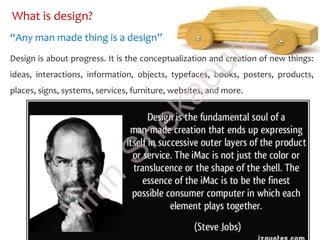
What is design?
Design is about progress. It is the conceptualization and creation of new things:
ideas, interactions, information, objects, typefaces, books, posters, products,
places, signs, systems, services, furniture, websites, and more.
“Any man made thing is a design”
N
itin
Shekapure
Living and Non-Living Things
There are living and non-living things all around us. Go outside and
explore. You can find both living and non-living things. Look inside your
house and other buildings such as a grocery store.
Can you name five things that you think are living?
How do you know they are living?
Can you name five things that you think are non-living?
How do you know they are not living?
N
itin
Shekapure
Both lists show many different things. Some of these things can move while
others cannot. Some of these things need food while others do not. Some can
grow, others do not grow. Some breathe, others do not breathe.
A table, chair, pencil, and clothes cannot grow. These things cannot talk or
walk. Things, which do not grow, move, or respond are called non-living things.
A baby plant grows into a big plant or into a tree. A puppy grows into a dog.
A baby grows into a person. Things that grow, breathe, and respond are called
living things.
All man-made things are non-living things, but not all natural things are living
things. While people, animals, and plants are living natural things, stars,
mountains, clouds, air, and water are non-living natural things.
N
itin
Shekapure
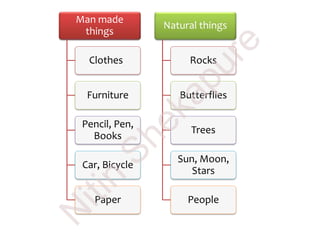
Man made
things
Clothes
Furniture
Pencil, Pen,
Books
Car, Bicycle
Paper
Natural things
Rocks
Butterflies
Trees
Sun, Moon,
Stars
People
N
itin
Shekapure
Design:
Formulation of a plan for satisfaction of human needs.
Machine Design:
Machine design is the process of selection of the materials, shapes, sizes, and
arrangement of mechanical elements so that the resultant machine will
perform the prescribed task.
Engineering Design:
“ The process of applying various techniques and scientific principles for the
purpose of defining a device, a process, or a system in sufficient detail, to
permit it’s realization”
N
itin
Shekapure
Purpose of Design and design improvements.
• To create new products and gadgets for use.
• To improve existing commodities to make them more user
friendly and comfortable.
• To satisfy changes of human needs of enjoyment and beauty.
• To introduce automation
• To improve efficiency
• To face competition in market
N
itin
Shekapure
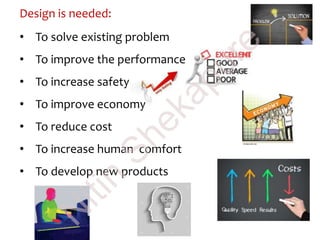
• To solve existing problem
• To improve the performance
• To increase safety
• To improve economy
• To reduce cost
• To increase human comfort
• To develop new products
Design is needed:
N
itin
Shekapure
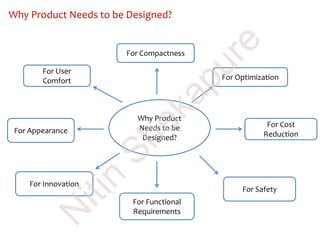
Why Product Needs to be Designed?
Why Product
Needs to be
Designed?
For Compactness
For Functional
Requirements
For Cost
ReductionFor Appearance
For Optimization
For Safety
For Innovation
For User
Comfort
N
itin
Shekapure
N
itin
Shekapure
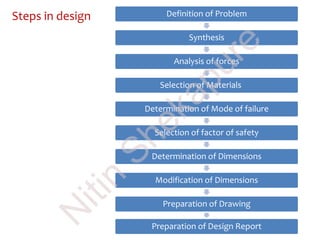
Steps in design Definition of Problem
Synthesis
Analysis of forces
Selection of Materials
Determination of Mode of failure
Selection of factor of safety
Determination of Dimensions
Modification of Dimensions
Preparation of Drawing
Preparation of Design Report
N
itin
Shekapure
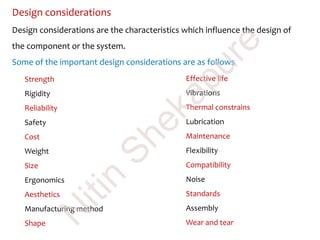
Design considerations
Design considerations are the characteristics which influence the design of
the component or the system.
Some of the important design considerations are as follows
Strength
Rigidity
Reliability
Safety
Cost
Weight
Size
Ergonomics
Aesthetics
Manufacturing method
Shape
Effective life
Vibrations
Thermal constrains
Lubrication
Maintenance
Flexibility
Compatibility
Noise
Standards
Assembly
Wear and tear
N
itin
Shekapure
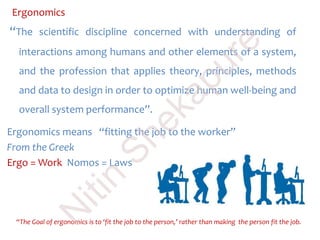
Ergonomics
“The scientific discipline concerned with understanding of
interactions among humans and other elements of a system,
and the profession that applies theory, principles, methods
and data to design in order to optimize human well-being and
overall system performance”.
Ergonomics means “fitting the job to the worker”
From the Greek
Ergo = Work Nomos = Laws
“The Goal of ergonomics is to ‘fit the job to the person,’ rather than making the person fit the job.
N
itin
Shekapure
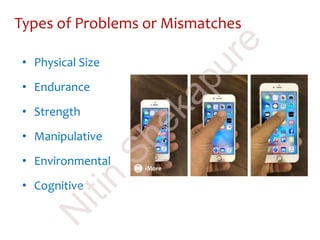
• Physical Size
• Endurance
• Strength
• Manipulative
• Environmental
• Cognitive
Types of Problems or Mismatches
N
itin
Shekapure
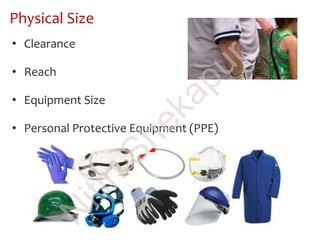
• Clearance
• Reach
• Equipment Size
• Personal Protective Equipment (PPE)
Physical Size
N
itin
Shekapure
Endurance (Capacity for Work)
N
itin
Shekapure
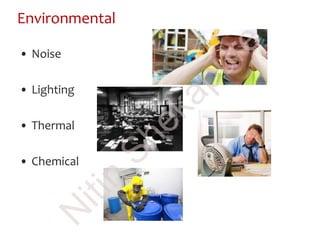
Environmental
• Noise
• Lighting
• Thermal
• Chemical
N
itin
Shekapure
Cognitive
• Machine Pacing
• Shift Work
• Morale
• Psychosocial
N
itin
Shekapure
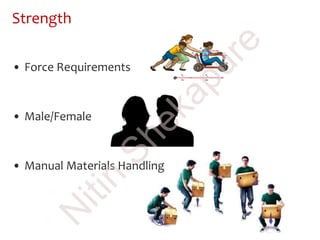
Strength
• Force Requirements
• Male/Female
• Manual Materials Handling
N
itin
Shekapure
• Decreased injury risk
• Increased productivity
• Decreased mistakes/rework
• Increased efficiency
• Decreased lost work days
• Decreased turnover
• Improved morale
Benefits of Ergonomics
N
itin
Shekapure
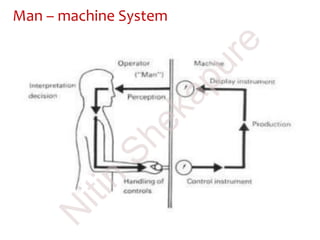
Man – machine System
N
itin
Shekapure
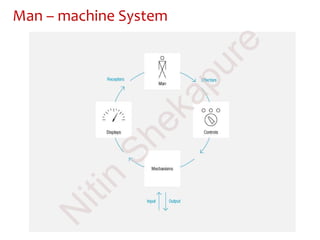
Man – machine System
N
itin
Shekapure
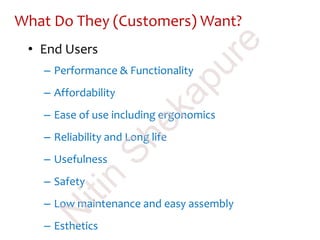
What Do They (Customers) Want?
• End Users
– Performance & Functionality
– Affordability
– Ease of use including ergonomics
– Reliability and Long life
– Usefulness
– Safety
– Low maintenance and easy assembly
– Esthetics
N
itin
Shekapure
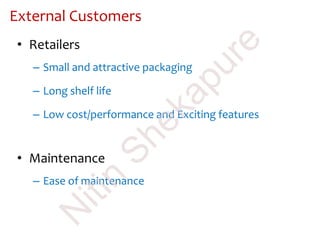
External Customers
• Retailers
– Small and attractive packaging
– Long shelf life
– Low cost/performance and Exciting features
• Maintenance
– Ease of maintenance
N
itin
Shekapure
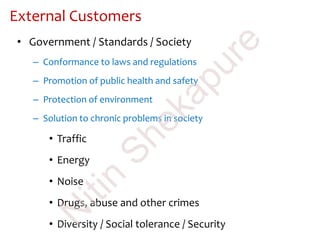
• Government / Standards / Society
– Conformance to laws and regulations
– Promotion of public health and safety
– Protection of environment
– Solution to chronic problems in society
• Traffic
• Energy
• Noise
• Drugs, abuse and other crimes
• Diversity / Social tolerance / Security
External Customers
N
itin
Shekapure
• Management
– Make a big profit
– On time delivery
– Low failure risk
– Documentation
– Process: Conformance to company product
development process
Internal Customers
N
itin
Shekapure
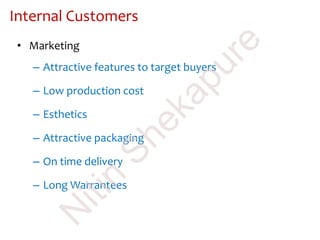
• Marketing
– Attractive features to target buyers
– Low production cost
– Esthetics
– Attractive packaging
– On time delivery
– Long Warrantees
Internal Customers
N
itin
Shekapure
Internal Customers
• Manufacturing
– Manufacturability using standard methods and
schedules.
– Conformance to company documentation formats.
– Use of products from preferred vendors.
N
itin
Shekapure
• Legal
– No patent infringements
– Safety
• All required safety warnings and labels
• Designed protection against reasonable
abuse
– Codes and regulations
Internal Customers
N
itin
Shekapure
MCQ:
1. The process of selection of materials, shapes, sizes and
arrangements of mechanical elements is known as,
a) Product development
b) Machine design
c) Material selection.
d) None of the above
N
itin
Shekapure
MCQ:
2. Machine design does not include
a) Selection of materials.
b) Selection of arrangements of mechanical elements.
c) Selection of shapes and sizes.
d) Selection of machine
N
itin
Shekapure
MCQ:
3. Machine design includes
a) Selection of materials.
b) Manufacturing of components
c) Testing of components
d) All of the above
N
itin
Shekapure
MCQ:
4. The machine design includes
a) Selection of materials.
b) Selection of sizes and shapes
c) Selection of arrangements
d) All of the above
N
itin
Shekapure
MCQ:
5. Product needs to be designed for
a) Functional requirements
b) Appearance
c) User comfort
d) All of the above
N
itin
Shekapure
MCQ:
6. The design of a computer chair is a best example of
a) Computer aided design
b) System design
c) Machine design
d) Ergonomic design
N
itin
Shekapure
MCQ:
7. The product or system is required to be designed so as to ensure that it
performs the prescribed task satisfactorily. It is known as
a) Design for comfort
b) Design for Functional requirements
c) Design for comfort
d) All of the above
N
itin
Shekapure
MCQ:
8. ________is not the step in design process.
a) Synthesis
b) Interference checking
c) Analysis of forces
d) Selection of material
N
itin
Shekapure
MCQ:
9. The first step in any design process is a
a) Selection of material
b) Preparation of drawings
c) Determination of dimensions
d) Definition of problem
N
itin
Shekapure
MCQ:
10. Drawing free body diagram and determination of forces acting on the
machine element is part of the step :________, in design process
a) Determination of Dimensions
b) Preparation of drawings
c) Analysis of Forces
d) Synthesis
N
itin
Shekapure
MCQ:
11. In design procedure, the last step is
a) Selection of material
b) Preparation of drawings
c) Determination of dimensions
d) Preparation of design report
N
itin
Shekapure
MCQ:
12. Ability of the machine element to avoid the failure due to yielding or
fracture under load is known as
a) Rigidity
b) Strength
c) Safety
d) Toughness
N
itin
Shekapure
MCQ:
13. Ability of the machine element to keep the deflections within the
permissible limit under the load is known as
a) Rigidity
b) Strength
c) Safety
d) Toughness
N
itin
Shekapure
MCQ:
14. The objective of ergonomics is
a) To make user adopt himself to the machine
b) To make machine fit for user
c) To make the product economical
d) To make the product stronger
N
itin
Shekapure
MCQ:
15. Stiffness is an important consideration in design of
a) Springs
b) electric switches
c) TV
d) Music system
N
itin
Shekapure
MCQ:
16. Ergonomics deals with the
a) Economy of the product.
b) Appearance of the product.
c) Man-machine-working environment relationship.
d) Safety of the product
N
itin
Shekapure
MCQ:
17. Ergonomics deals with the
a) User comfort
b) Safety of the product
c) Cost of the product
d) Optimization of product
N
itin
Shekapure
MCQ:
18. The design of dash board of a car is an example of
a) Optimum design
b) Ergonomic design
c) Cost effective design
d) Element design
N
itin
Shekapure
MCQ:
19. The design of a computer chair is a best example of
a) Optimum design
b) Ergonomic design
c) Cost effective design
d) Element design
N
itin
Shekapure
MCQ:
20. The important area covered under ergonomics is
a) Energy expenditure in hand and foot-operations
b) Cost of the material
c) Cost of manufacturing process
d) Both (a) and (b)
N
itin
Shekapure
MCQ:
21. The important area covered under ergonomics is
a) Communication between user and machine.
b) Human anatomy and posture while using the machine.
c) Working environment.
d) All of the above
N
itin
Shekapure
MCQ:
22. Every closed loop type man-machine system essentially has
a) Display unit
b) Control unit
c) Electric supply
d) Both (a) and (b)
N
itin
Shekapure
MCQ:
23. In a man-machine system, the display unit is used for
a) Information reception
b) Machine control
c) Corrective action
d) All of the above
N
itin
Shekapure
MCQ:
24. In a man-machine system, the control unit is used for
a) Corrective action
b) Display of information
c) Controlling the operator
d) Both (a) and (b).
N
itin
Shekapure
MCQ:
25. The working environment factor in ergonomic considerations can be
a) Worker salary
b) Other perks
c) Lighting
d) Promotions of worker
N
itin
Shekapure
MCQ:
26. The following is an important guideline in aesthetic design
a) The appearance should contribute to the performance of the product.
b) The appearance should reflect the cost of the product.
c) The product should be comfortable to the user.
d) All of the above
N
itin
Shekapure
MCQ:
26. The following is an important guideline in aesthetic design
a) The appearance should contribute to the performance of the product.
b) The appearance should reflect the cost of the product.
c) The product should be comfortable to the user.
d) All of the above
N
itin
Shekapure
Basic Mechanical Engineering
By
Nitin G Shekapure
Unit II
Design Fundamentals (L13, L14 & L15)
N
itin
Shekapure
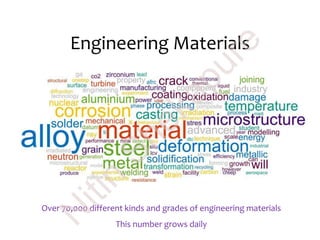
Engineering Materials
Over 70,000 different kinds and grades of engineering materials
This number grows daily
N
itin
Shekapure
What are the kind of questions that a student of materials science would like answers for?
• Why is glass brittle, while copper is ductile? What is meant by a ductile material?
• If we take two rods, one of Al and one of steel, why is it easier to bend the Al rod as
compared to the steel rod?
• How can I change properties like hardness, without changing the composition.
• Why is wire of copper conducting, while piece of brick or wood non-conducting?
• Why is glass transparent, while any typical metal is opaque?
• Why does the electrical conductivity of Cu decrease on heating, while that of Si
increases?
• Why does Iron corrode easily, while Aluminium does not (or does not seem to?!)?
• Usually, good thermal conductors are also good electrical conductors. Why is this so?
Why is diamond a good thermal conductor, but not a good electrical conductor?
• If I pull a spring and then release the load, it ‘comes back’ to its original shape.
However, a if I bend an aluminium rod, does not come back to its original shape. How
can one understand these observations?
N
itin
Shekapure
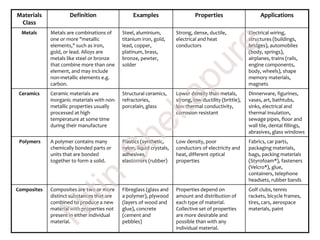
Materials
Class
Definition Examples Properties Applications
Metals Metals are combinations of
one or more "metallic
elements," such as iron,
gold, or lead. Alloys are
metals like steel or bronze
that combine more than one
element, and may include
non-metallic elements e.g.
carbon.
Steel, aluminium,
titanium iron, gold,
lead, copper,
platinum, brass,
bronze, pewter,
solder
Strong, dense, ductile,
electrical and heat
conductors
Electrical wiring,
structures (buildings,
bridges), automobiles
(body, springs),
airplanes, trains (rails,
engine components,
body, wheels), shape
memory materials,
magnets
Ceramics Ceramic materials are
inorganic materials with non-
metallic properties usually
processed at high
temperature at some time
during their manufacture
Structural ceramics,
refractories,
porcelain, glass
Lower density than metals,
strong, low ductility (brittle),
low thermal conductivity,
corrosion resistant
Dinnerware, figurines,
vases, art, bathtubs,
sinks, electrical and
thermal insulation,
sewage pipes, floor and
wall tile, dental fillings,
abrasives, glass windows
Polymers A polymer contains many
chemically bonded parts or
units that are bonded
together to form a solid.
Plastics (synthetic,
nylon, liquid crystals,
adhesives,
elastomers (rubber)
Low density, poor
conductors of electricity and
heat, different optical
properties
Fabrics, car parts,
packaging materials,
bags, packing materials
(Styrofoam*), fasteners
(Velcro*), glue,
containers, telephone
headsets, rubber bands
Composites Composites are two or more
distinct substances that are
combined to produce a new
material with properties not
present in either individual
material.
Fibreglass (glass and
a polymer), plywood
(layers of wood and
glue), concrete
(cement and
pebbles)
Properties depend on
amount and distribution of
each type of material.
Collective set of properties
are more desirable and
possible than with any
individual material.
Golf clubs, tennis
rackets, bicycle frames,
tires, cars, aerospace
materials, paint
N
itin
Shekapure
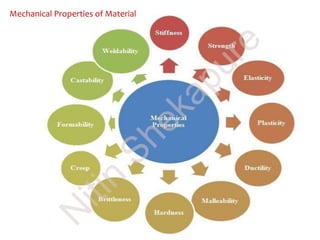
Mechanical Properties of Material
N
itin
Shekapure
Mechanical Properties of Material
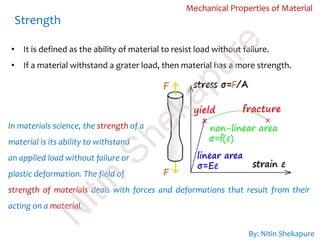
• It is defined as the ability of material to resist load without failure.
• If a material withstand a grater load, then material has a more strength.
Strength
In materials science, the strength of a
material is its ability to withstand
an applied load without failure or
plastic deformation. The field of
strength of materials deals with forces and deformations that result from their
acting on a material.
By: Nitin Shekapure
N
itin
Shekapure
Mechanical Properties of Material
Toughness
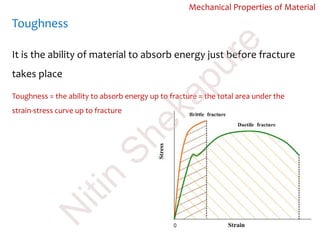
It is the ability of material to absorb energy just before fracture
takes place
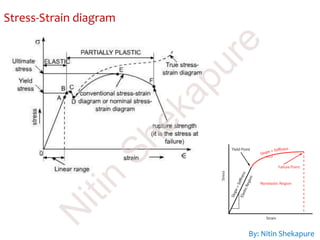
Toughness = the ability to absorb energy up to fracture = the total area under the
strain-stress curve up to fracture
N
itin
Shekapure
Mechanical Properties of Material
Hardness
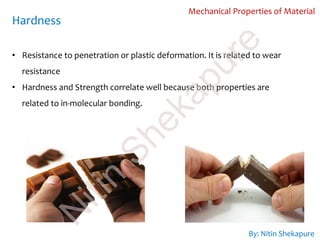
• Resistance to penetration or plastic deformation. It is related to wear
resistance
• Hardness and Strength correlate well because both properties are
related to in-molecular bonding.
By: Nitin Shekapure
N
itin
Shekapure
Ductility
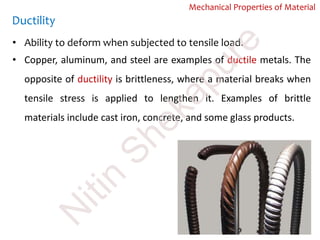
• Ability to deform when subjected to tensile load.
• Copper, aluminum, and steel are examples of ductile metals. The
opposite of ductility is brittleness, where a material breaks when
tensile stress is applied to lengthen it. Examples of brittle
materials include cast iron, concrete, and some glass products.
Mechanical Properties of Material
N
itin
Shekapure
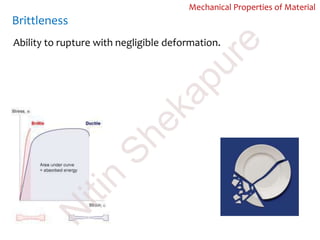
Brittleness
Ability to rupture with negligible deformation.
Mechanical Properties of Material
N
itin
Shekapure
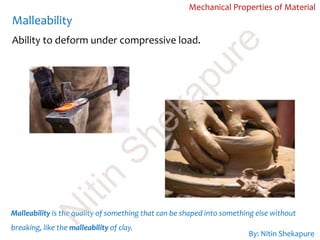
Malleability
Mechanical Properties of Material
Malleability is the quality of something that can be shaped into something else without
breaking, like the malleability of clay.
Ability to deform under compressive load.
By: Nitin Shekapure
N
itin
Shekapure
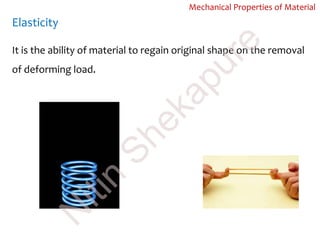
Elasticity
Mechanical Properties of Material
It is the ability of material to regain original shape on the removal
of deforming load.N
itin
Shekapure
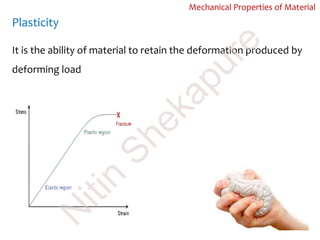
Plasticity
Mechanical Properties of Material
It is the ability of material to retain the deformation produced by
deforming loadN
itin
Shekapure
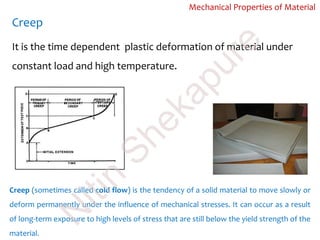
Creep
Mechanical Properties of Material
Creep (sometimes called cold flow) is the tendency of a solid material to move slowly or
deform permanently under the influence of mechanical stresses. It can occur as a result
of long-term exposure to high levels of stress that are still below the yield strength of the
material.
It is the time dependent plastic deformation of material under
constant load and high temperature.
N
itin
Shekapure
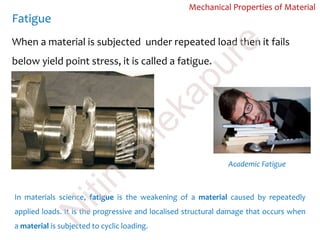
Fatigue
Mechanical Properties of Material
When a material is subjected under repeated load then it fails
below yield point stress, it is called a fatigue.
Academic Fatigue
In materials science, fatigue is the weakening of a material caused by repeatedly
applied loads. It is the progressive and localised structural damage that occurs when
a material is subjected to cyclic loading.
N
itin
Shekapure
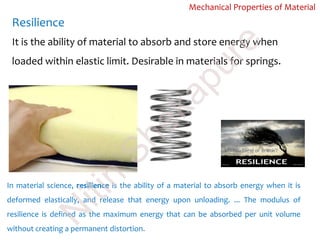
Resilience
Mechanical Properties of Material
It is the ability of material to absorb and store energy when
loaded within elastic limit. Desirable in materials for springs.
In material science, resilience is the ability of a material to absorb energy when it is
deformed elastically, and release that energy upon unloading. ... The modulus of
resilience is defined as the maximum energy that can be absorbed per unit volume
without creating a permanent distortion.
N
itin
Shekapure
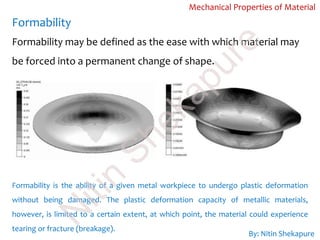
Formability
Mechanical Properties of Material
Formability is the ability of a given metal workpiece to undergo plastic deformation
without being damaged. The plastic deformation capacity of metallic materials,
however, is limited to a certain extent, at which point, the material could experience
tearing or fracture (breakage).
Formability may be defined as the ease with which material may
be forced into a permanent change of shape.
By: Nitin Shekapure
N
itin
Shekapure
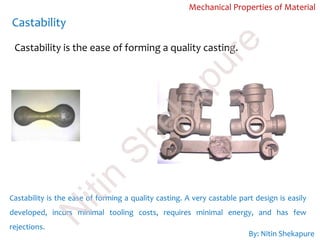
Castability
Mechanical Properties of Material
Castability is the ease of forming a quality casting.
Castability is the ease of forming a quality casting. A very castable part design is easily
developed, incurs minimal tooling costs, requires minimal energy, and has few
rejections.
By: Nitin Shekapure
N
itin
Shekapure
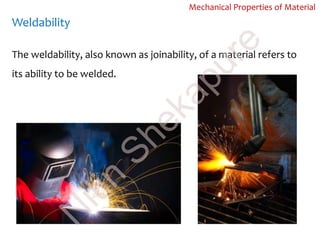
Weldability
Mechanical Properties of Material
The weldability, also known as joinability, of a material refers to
its ability to be welded.N
itin
Shekapure
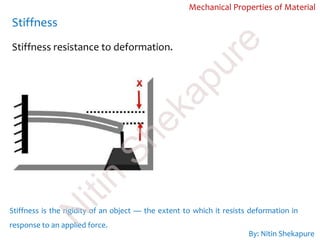
Stiffness
Mechanical Properties of Material
Stiffness is the rigidity of an object — the extent to which it resists deformation in
response to an applied force.
Stiffness resistance to deformation.
By: Nitin Shekapure
N
itin
Shekapure
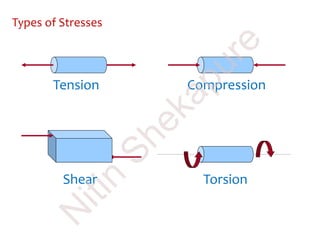
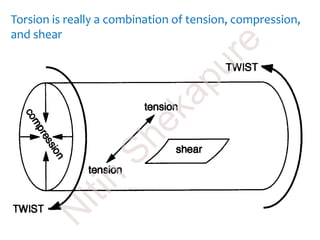
Types of Stresses
Tension Compression
TorsionShear
N
itin
Shekapure
Torsion is really a combination of tension, compression,
and shear
N
itin
Shekapure
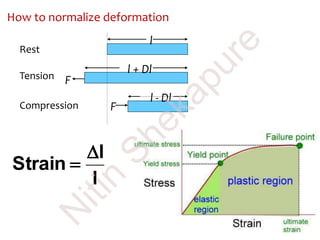
How to normalize deformation
Rest
Tension
Compression
l
l + Dl
l - Dl
F
F
l
l
Strain


N
itin
Shekapure
By: Nitin Shekapure
Stress-Strain diagram
N
itin
Shekapure
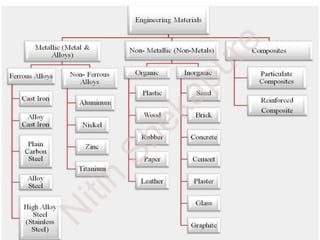
Engineering materials
N
itin
Shekapure
Material Selection Basics
Why
- To make full use of the engineering materials
- To avoid unnecessarily expensive structures
- To avoid failures
When
- A new product is developed
- A product is modified and redesigned
- Failures have occurred
Who
- Design engineers in collaboration with materials engineers
How
- Specify the requirements for the component
- Transfer the requirements to materials properties
- Find the material groups that satisfy the specification
- Find the individual materials that satisfy the specification
- identify the "best" materials that satisfy the specification
N
itin
Shekapure
Material Selection Criteria
Criteria
Availability The material should be already available in the market in the abundant
quantity.
Cost The cost of the material selected for a particular job from several
alternatives should be minimum.
Material
Properties
The properties of the materials selected should meet the functional
requirements and the service conditions.
Manufacturing
Considerations
It has been the most important factor while selecting the material for a
particular job. The materials should be selected for particular part
based on the process by which it is going to be manufactured.
Environmental
Considerations
The effect of environmental conditions [Like temperature, humidity,
etc.] should be given more attention during selection of material.
Machinability
Machinability is the case with which a given metal can be machined.
Machinability of the material depends upon hardness, strength and
chemical Composition of materials.
Formability
It is an indication of suitability of the metal for a machine part that
requires forming. Forming depends upon ductility and tensile Strength.
N
itin
Shekapure
Cast Iron
• It is hard, brittle, nonmalleable (i.e. it cannot be bent, stretched or hammered into
shape) and more fusible (capable of being melted) than steel. Its structure is
crystalline and it fractures under excessive tensile loading with little prior distortion.
• Most cast irons have a chemical composition of 2.5–4.0% carbon, 1–3% silicon, and the
remainder iron.
What is the use of cast iron?
It is used to make pots and pans and all sort of instruments that are used for heating
purposes. This is because the cast iron surface distributes the heat from the stone evenly
all over its surface. It can also be used for baking purposes. It is even used to make
stoves from a single piece of mould.
Why cast iron is very brittle?
The reason why is there is no carbon in it.
N
itin
Shekapure
By: Nitin Shekapure
Properties of Cast Irons
• It has a crystalline structure, and it is weak in tension
• It has excellent machinability
• It has excellent wear resistance, and
• It has ability to damp vibrations
N
itin
Shekapure
By: Nitin Shekapure
Advantages of Cast Irons
• It can be casting properties
• It as very high compressive strength
• It has a good wear resistance.
• It has excellent machinability.
• It has good vibration damping
• It is low cost material
• It can withstand greater load and has a good degree of
resistance against corrosion
N
itin
Shekapure
Applications of Cast Irons
• Machine tool beds, columns
• Guide-ways bearing housings
• Plummer blocks
• I.C. engine cylinder blocks
• Cylinder heads
• Hydraulic cylinders gears
• Gears
• Pulleys
• Flywheels
• Couplings
• Brake drums
• Clutch plates
Cast iron is used as a material for the following machine element
N
itin
Shekapure
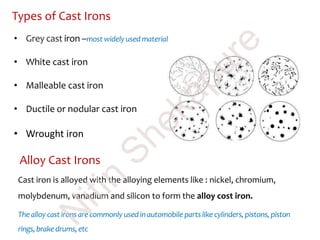
Types of Cast Irons
• Grey cast iron –most widely usedmaterial
• White cast iron
• Malleable cast iron
• Ductile or nodular cast iron
• Wrought iron
Alloy Cast Irons
Cast iron is alloyed with the alloying elements like : nickel, chromium,
molybdenum, vanadium and silicon to form the alloy cost iron.
The alloy cast irons are commonly usedin automobile partslike cylinders,pistons,piston
rings,brakedrums,etc
N
itin
Shekapure
Plain carbon steels
• Carbon steel, or plain-carbon steel, is a metal alloy.
• It is a combination of two elements, iron and carbon.
• Other elements are present in quantities too small to affect
its properties.
• The only other elements allowed in plain-carbon steel are:
manganese (1.65% max), silicon (0.60% max), and copper
(0.60% max).
N
itin
Shekapure
Types of Plain carbon steels
Low carbon steels or mild steels:
The plain carbon steels with less than 0.3 % carbon are called low carbon
steel or mild steel
Medium carbon steels:
The plain carbon steels with carbon content between 0.3 % to 0.6 % are
called medium carbon steels.
High carbon steels
The plain carbon steels with carbon content above 0.6 % are called high
carbon steels
N
itin
Shekapure
Properties of Plain Carbon Steels
• They are ductile and exhibit yielding before failure.
• They have high fatigue strength,
• They have high resilience and toughness.
Advantages of Plain Carbon Steels
• They have high tensile strength.
• They are ductile, and hence exhibit yielding before failure.
• They are stronger against fatigue and impact loading.
• They have high resilience and toughness
N
itin
Shekapure
Limitations of Plain Carbon Steels
• They have poor wear resistance.
• They cannot be cast into complex shapes.
• They are poor in vibration damping.
Applications of Plain Carbon Steels
• Low carbon steels are used as materials for automobile body, spindles,
levers, rocker arms, light duty gears, etc.
• Medium carbon steels are used as materials for nuts and bolts, axles,
transmission shafts crankshafts, spindles, gears, cylinders, connecting
rods, etc.
• High carbon steels are used as materials for coil springs, leaf springs
washers, etc
N
itin
Shekapure
Alloy Steels
• Alloy steel is steel that is alloyed with a variety of elements in total
amounts between 1.0% and 50% by weight to improve its mechanical
properties.
• Alloy steels are broken down into two groups: low-alloy steels and high-
alloy steels.
• Alloy steel is a steel that has had small amounts of one or more alloying
elements (other than carbon) such as such as
• Manganese (Improves the strength of the steel)
• Silicon (Improves elastic limit and resilience of steel)
• Nickel (improves toughness, ductility, and strength)
• Titanium (Improves hardness and toughness)
• copper, chromium and aluminum (Improve, hardness, wear resistance, and
corrosion resistance) added.
N
itin
Shekapure
Advantages of Alloy Steels
Properties of Alloy Steels
• Alloy steels are ductile.
• They have high static strength and fatigue strength.
• They are stronger than plain carbon steels.
• They have high resilience and toughness
• Very high tensile strength.
• Very high fatigue strength.
• Good wear resistance and corrosion resistance.
• High resilience and toughness.
• Good creep resistance
N
itin
Shekapure
Limitations of Alloy Steels
Applications of Alloy Steels
• Alloy steel are costlier than the cast irons and plain carbon steels
• Complicated casting is not possible
• They are poor in vibration dumping
Alloy steels are used as materials for :
• High tensile bolts
• Levers
• welded structures
• Transmission shafts
• crank shafts
• Spindles
• Axles
• Turbine blades
• Heavy forgings
• High strength gears
• Coil springs
• Leaf springs
N
itin
Shekapure
High Alloy Steels (Stainless Steels)
• Iron based alloys i.e. steel containing at least 12 percent
chromium are called stainless steels. As the content of
alloying elements in these steels is more, they are also
known as high alloy steels.
• The most important property of stainless steels is their high
corrosion resistance and have excellent heat resisting
properties
• They are used for high temperature chemical handling
equipment, food processing equipment, spring, etc.
N
itin
Shekapure
Non-ferrous Metals and Alloys
• Non-ferrous alloys are those, which have a metal other than iron as their
main constituent
• The non-ferrous alloys are preferred in certain applications because of the
following properties:
 Corrosion resistance
 Special electrical and magnetic properties
 Castability
 Softness and facility of cold working
• The commonly used non-ferrous alloys are:
 Copper Alloys – Brass, Bronze
 Aluminium
 Babbits
N
itin
Shekapure
Aluminium Alloys
A large number of aluminium alloys are used in mechanical
engineering applications.
The most useful alloying elements for aluminium are : copper, silicon,
manganese, magnesium, and iron.
Properties of Aluminium Alloy
• Low specific weight
• Good corrosion resistance
• High thermal conductivity
• High electrical conductivity
• Good castability
• Low cost material
• Low strength
• Expensive than steel
• Soft in nature
N
itin
Shekapure
Applications of Aluminium Alloys
• I.C. engine cylinder blocks
• Cylinder hade
• Piston
• Gear box casing
• Crank case
• Chain covers
• Pulleys
• Fan blades
• Aircraft parts
• Ship building
• Windows and door frames
• Rivets
N
itin
Shekapure
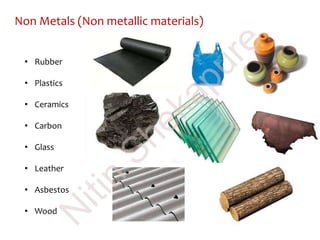
Non Metals (Non metallic materials)
• Rubber
• Plastics
• Ceramics
• Carbon
• Glass
• Leather
• Asbestos
• Wood
N
itin
Shekapure
Rubber
• Rubber is an elastomer (elastic material), capable of:
 Extension of minimum 200%, when subjected to tensile load; and
 Returning rapidly to original dimensions when load is removed.
• Rubber behaves like a spring.
Advantages of Rubber
• High elasticity
• Excellent resilience
• Good electric insulation
• Good tear resistance
• Low cost
N
itin
Shekapure
Plastics
• The plastics are synthetic materials which are moulded into shape under
pressure and with the application of heat.
• The plastics can be cast, rolled, extruded, laminated or machined.
• The name plastic has been derived form the state of plasticity existing
at a certain stage in their manufacturing.
• This makes it possible to give plastic products any desired shape.
N
itin
Shekapure
Advantages of Plastics
• Low density, resulting in light weight construction
• Better resistance to shock and vibrations
• Better resistance to corrosion
• Higher abrasion and wear resistance
• Low coefficient of friction and self lubricating property
• Ability to mould into complex shapes
• Better surface finish and pleasing appearance
• Low thermal conductivity Low cost
• Easy for recycling.
N
itin
Shekapure
Limitations of Plastics
• Low strength and rigidity
• Poor heat resistance
• Poor dimensional stability
• High coefficient of thermal expansion (five to ten times
that of metal)
• High creep
• High deformation under continuous loading
• Embrittlement (make brittle) with age and hence short life.
N
itin
Shekapure
Type of Plastics
1. Thermoplastics or Thermoplasts
2. Thermosetting Plastics or Thermosets
Thermoplastics
The thermoplastics do not under go chemical change or do not become
hard with the application of heat and pressure. They remain soft at
elevated temperatures until they are hardened by cooling. They can be
repeatedly remoulded with the application of heat and pressure.
Commonly used thermoplastics : Celluloid, polyamide, polyethylene, teflon
poly-vinyl-chloride (P.V.C) etc.
N
itin
Shekapure
MCQ:
27. Mechanical properties of material are those properties which describe
a) Mechanical strength of the material.
b) Behavior of the material under use.
c) Fatigue strength of the material.
d) None of the above.
N
itin
Shekapure
MCQ:
28. ________ of materials are those properties which describe the behavior
of the material under use
a) Physical properties
b) Mechanical properties
c) Strength properties
d) Chemical properties
N
itin
Shekapure
MCQ:
29. The ability of material to resist stress without failure, when subjected
to a load is known as
a) stiffness
b) load carrying capacity
c) Strength
d) Toughness
N
itin
Shekapure
MCQ:
30. The static strength of a material is measured by
a) Yield strength
b) Ultimate strength
c) Fatigue strength
d) both (a) and (b)
N
itin
Shekapure
MCQ:
31. The fluctuating load varies in
a) Magnitude only
b) Direction only
c) Magnitude and direction both
d) Magnitude and/or direction
N
itin
Shekapure
MCQ:
32. The graph of load versus time is a straight line parallel to time axis.
Then it must be a case of
a) Impact load
b) Static load
c) Fatigue load
d) Time depend load
N
itin
Shekapure
MCQ:
33. The ability of a material to resist stress without failure, when subjected
to fluctuating load is known as
a) Ultimate strength
b) Static strength
c) Fatigue strength
d) Yield strength
N
itin
Shekapure
MCQ:
34. The property of a material which enables it to regain its original shape
after the external load is removed is called as
a) Ductility
b) Elasticity
c) Malleability
d) Resilience
N
itin
Shekapure
MCQ:
35. The property of a material which enables it to regain the permanent
deformation after external load is removed is called as
a) Deformity
b) Elasticity
c) Malleability
d) Plasticity
N
itin
Shekapure
MCQ:
36. The property which is important in forging and press work is
a) Stiffness
b) Elasticity
c) Brittleness
d) Plasticity
N
itin
Shekapure
MCQ:
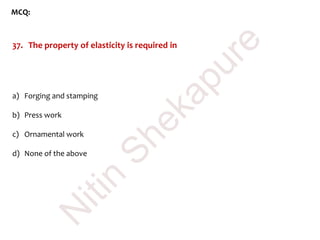
37. The property of elasticity is required in
a) Forging and stamping
b) Press work
c) Ornamental work
d) None of the above
N
itin
Shekapure
MCQ:
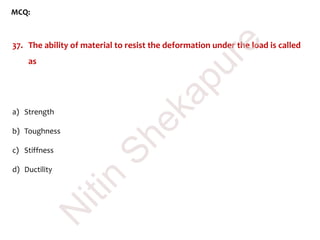
37. The ability of material to resist the deformation under the load is called
as
a) Strength
b) Toughness
c) Stiffness
d) Ductility
N
itin
Shekapure
MCQ:
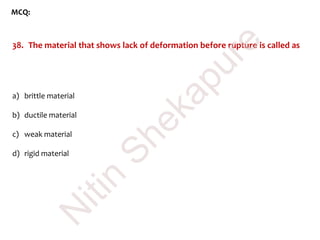
38. The material that shows lack of deformation before rupture is called as
a) brittle material
b) ductile material
c) weak material
d) rigid material
N
itin
Shekapure
MCQ:
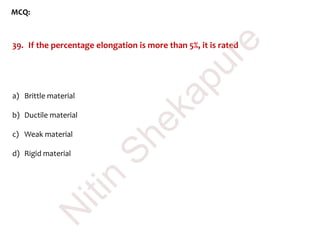
39. If the percentage elongation is more than 5%, it is rated
a) Brittle material
b) Ductile material
c) Weak material
d) Rigid material
N
itin
Shekapure
MCQ:
40. If the percentage elongation is less than 5%, it is rated
a) Brittle material
b) Ductile material
c) Weak material
d) Rigid material
N
itin
Shekapure
MCQ:
41. _______ is an example of ductile material
a) Mild steel
b) Aluminum
c) Copper
d) All of the above
N
itin
Shekapure
MCQ:
42. _______ is an example of brittle material
a) Mild steel
b) Aluminum
c) Cast iron
d) All of the above
N
itin
Shekapure
MCQ:
43. In ductile material, the failure take place due to
a) Fracture
b) Fatigue
c) Yielding
d) Wear
N
itin
Shekapure
MCQ:
44. In brittle material, the failure take place due to
a) Fracture
b) Fatigue
c) Yielding
d) Wear
N
itin
Shekapure
MCQ:
45. Which of the following statements is correct ?
a) Ductile as well as brittle materials show greater plastic deformation prior to
fracture.
b) Ductile materials show negligible plastic deformation while brittle material
show greater plastic deformation before fracture.
c) Ductile materials show greater plastic deformation while brittle material
show negligible plastic deformation before fracture.
d) Ductile as well as brittle materials show negligible plastic deformation
before fracture.
N
itin
Shekapure
MCQ:
46. The property of material which enables it to undergo change in shape;
and size without rupture, under external load is called
a) Ductility
b) Malleability
c) Plasticity
d) Toughness
N
itin
Shekapure
MCQ:
47. The property which is important in wire drawing is
a) Ductility
b) Malleability
c) Plasticity
d) Resilience
N
itin
Shekapure
Basic Mechanical Engineering
By
Nitin G Shekapure
Unit II
Design Fundamentals (L16 & L17)
N
itin
Shekapure
Mechanism and Machine
By: Nitin Shekapure
Machine is a device which receives energy and transforms it into some
useful work. A machine consists of a number of parts or bodies.
Mechanism is a system of parts working together in a machine; a piece of
machinery
A mechanism is something that changes an input motion and force into an
output motion and force.
N
itin
Shekapure
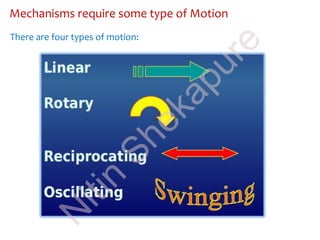
Mechanisms require some type of Motion
There are four types of motion:
N
itin
Shekapure
Structure
It is an assemblage of a number of resistant bodies (known as members)
having no relative motion between them and meant for carrying loads having
straining action. A railway bridge, a roof truss, machine frames etc., are the
examples of a structure.
By: Nitin Shekapure
N
itin
Shekapure
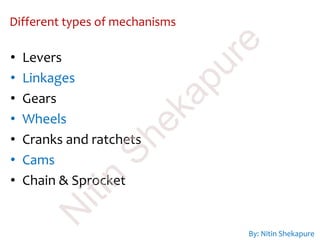
Different types of mechanisms
• Levers
• Linkages
• Gears
• Wheels
• Cranks and ratchets
• Cams
• Chain & Sprocket
By: Nitin Shekapure
N
itin
Shekapure
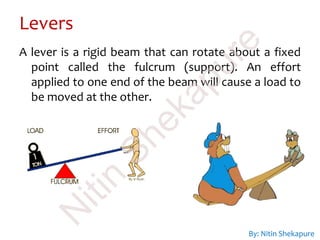
Levers
A lever is a rigid beam that can rotate about a fixed
point called the fulcrum (support). An effort
applied to one end of the beam will cause a load to
be moved at the other.
By: Nitin Shekapure
N
itin
Shekapure
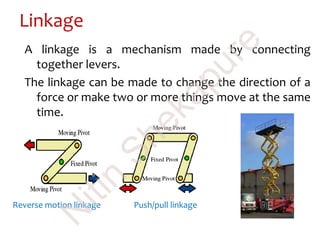
Linkage
A linkage is a mechanism made by connecting
together levers.
The linkage can be made to change the direction of a
force or make two or more things move at the same
time.
Push/pull linkageReverse motion linkage
N
itin
Shekapure
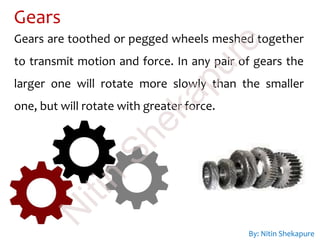
Gears
Gears are toothed or pegged wheels meshed together
to transmit motion and force. In any pair of gears the
larger one will rotate more slowly than the smaller
one, but will rotate with greater force.
By: Nitin Shekapure
N
itin
Shekapure
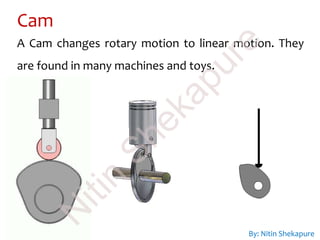
A Cam changes rotary motion to linear motion. They
are found in many machines and toys.
Cam
By: Nitin Shekapure
N
itin
Shekapure
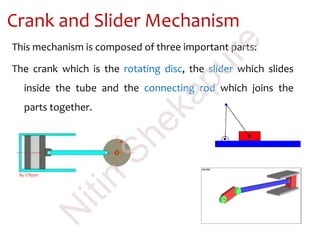
Crank and Slider Mechanism
This mechanism is composed of three important parts:
The crank which is the rotating disc, the slider which slides
inside the tube and the connecting rod which joins the
parts together.
N
itin
Shekapure
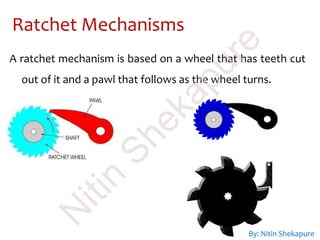
Ratchet Mechanisms
A ratchet mechanism is based on a wheel that has teeth cut
out of it and a pawl that follows as the wheel turns.
By: Nitin Shekapure
N
itin
Shekapure
Mechanisms
• Mechanisms are used to convert between one type of motion
and another.
• Mechanisms are used to make machines.
• Machines are made to do repetitive tasks with consistently
uniform output.
• Machine is a device consisting of mechanisms to perform
intended tasks.
N
itin
Shekapure
Kinematic Link or Element
Each part of a machine, which moves relative to some other part, is known
as a kinematic link (or simply link) or element.
Types of Link
In order to transmit motion, the driver and the follower may be connected
by the following three types of links :
• Rigid link
• Flexible link
• Fluid link
By: Nitin Shekapure
N
itin
Shekapure
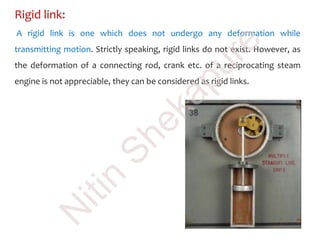
Rigid link:
A rigid link is one which does not undergo any deformation while
transmitting motion. Strictly speaking, rigid links do not exist. However, as
the deformation of a connecting rod, crank etc. of a reciprocating steam
engine is not appreciable, they can be considered as rigid links.
N
itin
Shekapure
Flexible link:
A flexible link is one which is partly deformed in a manner not to affect the
transmission of motion. For example, belts, ropes, chains and wires are
flexible links and transmit tensile forces only.
N
itin
Shekapure
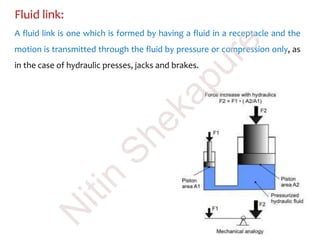
Fluid link:
A fluid link is one which is formed by having a fluid in a receptacle and the
motion is transmitted through the fluid by pressure or compression only, as
in the case of hydraulic presses, jacks and brakes.
N
itin
Shekapure
Mechanisms are made of links/elements
Link: It is a resistant body, which does not deform while
transmitting motion, force or power.
Kinematic pair:
Two elements or links joined together such that the relative
motion between them is predefined.
Link - It must be a resistant body.
It must be connected to the other parts of the machine.
It must have motion relative to other connected parts of
the machine.
By: Nitin Shekapure
N
itin
Shekapure
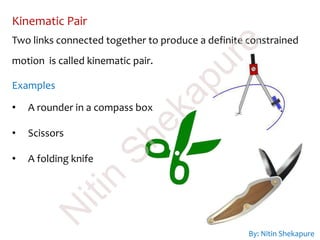
Kinematic Pair
Two links connected together to produce a definite constrained
motion is called kinematic pair.
Examples
• A rounder in a compass box
• Scissors
• A folding knife
By: Nitin Shekapure
N
itin
Shekapure
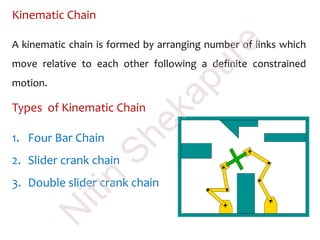
Kinematic Chain
A kinematic chain is formed by arranging number of links which
move relative to each other following a definite constrained
motion.
Types of Kinematic Chain
1. Four Bar Chain
2. Slider crank chain
3. Double slider crank chain
N
itin
Shekapure
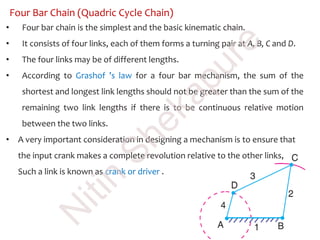
Four Bar Chain (Quadric Cycle Chain)
• Four bar chain is the simplest and the basic kinematic chain.
• It consists of four links, each of them forms a turning pair at A, B, C and D.
• The four links may be of different lengths.
• According to Grashof ’s law for a four bar mechanism, the sum of the
shortest and longest link lengths should not be greater than the sum of the
remaining two link lengths if there is to be continuous relative motion
between the two links.
• A very important consideration in designing a mechanism is to ensure that
the input crank makes a complete revolution relative to the other links,
Such a link is known as crank or driver .
N
itin
Shekapure
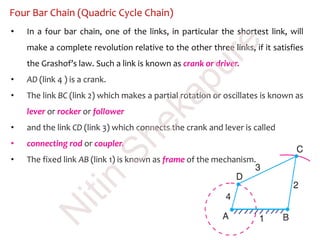
• In a four bar chain, one of the links, in particular the shortest link, will
make a complete revolution relative to the other three links, if it satisfies
the Grashof’s law. Such a link is known as crank or driver.
• AD (link 4 ) is a crank.
• The link BC (link 2) which makes a partial rotation or oscillates is known as
lever or rocker or follower
• and the link CD (link 3) which connects the crank and lever is called
• connecting rod or coupler.
• The fixed link AB (link 1) is known as frame of the mechanism.
Four Bar Chain (Quadric Cycle Chain)
N
itin
Shekapure
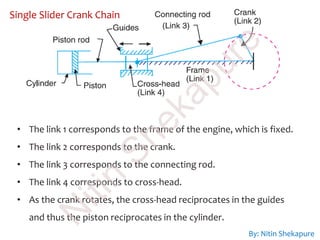
Single Slider Crank Chain
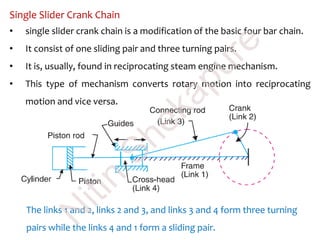
• single slider crank chain is a modification of the basic four bar chain.
• It consist of one sliding pair and three turning pairs.
• It is, usually, found in reciprocating steam engine mechanism.
• This type of mechanism converts rotary motion into reciprocating
motion and vice versa.
The links 1 and 2, links 2 and 3, and links 3 and 4 form three turning
pairs while the links 4 and 1 form a sliding pair.
N
itin
Shekapure
Single Slider Crank Chain
• The link 1 corresponds to the frame of the engine, which is fixed.
• The link 2 corresponds to the crank.
• The link 3 corresponds to the connecting rod.
• The link 4 corresponds to cross-head.
• As the crank rotates, the cross-head reciprocates in the guides
and thus the piston reciprocates in the cylinder.
By: Nitin Shekapure
N
itin
Shekapure
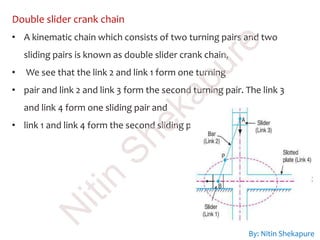
Double slider crank chain
• A kinematic chain which consists of two turning pairs and two
sliding pairs is known as double slider crank chain,
• We see that the link 2 and link 1 form one turning
• pair and link 2 and link 3 form the second turning pair. The link 3
and link 4 form one sliding pair and
• link 1 and link 4 form the second sliding pair.
By: Nitin Shekapure
N
itin
Shekapure

Design Fundamentals

  • 1.
    Basic Mechanical Engineering By NitinG Shekapure Unit II Design Fundamentals (L10) N itin Shekapure
  • 2.
    By: Nitin Shekapure UnitII Design Fundamentals Design: Steps in design process, Mechanical Properties (Strength, Toughness, Hardness, Ductility, Malleability, Brittleness, Elasticity, Plasticity, Resilience, Creep), and selection of Engineering materials, Applications of following materials in Engineering – Aluminum, Plastic, Steel, Brass, Cast Iron, Copper, Rubber. Mechanism (Descriptive Treatment Only): Definition and comparison of Mechanism and Machine, Four Bar Mechanism, Slider Crank Mechanism. N itin Shekapure
  • 3.
    What is design? Designis about progress. It is the conceptualization and creation of new things: ideas, interactions, information, objects, typefaces, books, posters, products, places, signs, systems, services, furniture, websites, and more. “Any man made thing is a design” N itin Shekapure
  • 4.
    Living and Non-LivingThings There are living and non-living things all around us. Go outside and explore. You can find both living and non-living things. Look inside your house and other buildings such as a grocery store. Can you name five things that you think are living? How do you know they are living? Can you name five things that you think are non-living? How do you know they are not living? N itin Shekapure
  • 5.
    Both lists showmany different things. Some of these things can move while others cannot. Some of these things need food while others do not. Some can grow, others do not grow. Some breathe, others do not breathe. A table, chair, pencil, and clothes cannot grow. These things cannot talk or walk. Things, which do not grow, move, or respond are called non-living things. A baby plant grows into a big plant or into a tree. A puppy grows into a dog. A baby grows into a person. Things that grow, breathe, and respond are called living things. All man-made things are non-living things, but not all natural things are living things. While people, animals, and plants are living natural things, stars, mountains, clouds, air, and water are non-living natural things. N itin Shekapure
  • 6.
    Man made things Clothes Furniture Pencil, Pen, Books Car,Bicycle Paper Natural things Rocks Butterflies Trees Sun, Moon, Stars People N itin Shekapure
  • 7.
    Design: Formulation of aplan for satisfaction of human needs. Machine Design: Machine design is the process of selection of the materials, shapes, sizes, and arrangement of mechanical elements so that the resultant machine will perform the prescribed task. Engineering Design: “ The process of applying various techniques and scientific principles for the purpose of defining a device, a process, or a system in sufficient detail, to permit it’s realization” N itin Shekapure
  • 8.
    Purpose of Designand design improvements. • To create new products and gadgets for use. • To improve existing commodities to make them more user friendly and comfortable. • To satisfy changes of human needs of enjoyment and beauty. • To introduce automation • To improve efficiency • To face competition in market N itin Shekapure
  • 9.
    • To solveexisting problem • To improve the performance • To increase safety • To improve economy • To reduce cost • To increase human comfort • To develop new products Design is needed: N itin Shekapure
  • 10.
    Why Product Needsto be Designed? Why Product Needs to be Designed? For Compactness For Functional Requirements For Cost ReductionFor Appearance For Optimization For Safety For Innovation For User Comfort N itin Shekapure
  • 11.
  • 12.
    Steps in designDefinition of Problem Synthesis Analysis of forces Selection of Materials Determination of Mode of failure Selection of factor of safety Determination of Dimensions Modification of Dimensions Preparation of Drawing Preparation of Design Report N itin Shekapure
  • 13.
    Design considerations Design considerationsare the characteristics which influence the design of the component or the system. Some of the important design considerations are as follows Strength Rigidity Reliability Safety Cost Weight Size Ergonomics Aesthetics Manufacturing method Shape Effective life Vibrations Thermal constrains Lubrication Maintenance Flexibility Compatibility Noise Standards Assembly Wear and tear N itin Shekapure
  • 14.
    Ergonomics “The scientific disciplineconcerned with understanding of interactions among humans and other elements of a system, and the profession that applies theory, principles, methods and data to design in order to optimize human well-being and overall system performance”. Ergonomics means “fitting the job to the worker” From the Greek Ergo = Work Nomos = Laws “The Goal of ergonomics is to ‘fit the job to the person,’ rather than making the person fit the job. N itin Shekapure
  • 15.
    • Physical Size •Endurance • Strength • Manipulative • Environmental • Cognitive Types of Problems or Mismatches N itin Shekapure
  • 16.
    • Clearance • Reach •Equipment Size • Personal Protective Equipment (PPE) Physical Size N itin Shekapure
  • 17.
    Endurance (Capacity forWork) N itin Shekapure
  • 18.
    Environmental • Noise • Lighting •Thermal • Chemical N itin Shekapure
  • 19.
    Cognitive • Machine Pacing •Shift Work • Morale • Psychosocial N itin Shekapure
  • 20.
    Strength • Force Requirements •Male/Female • Manual Materials Handling N itin Shekapure
  • 21.
    • Decreased injuryrisk • Increased productivity • Decreased mistakes/rework • Increased efficiency • Decreased lost work days • Decreased turnover • Improved morale Benefits of Ergonomics N itin Shekapure
  • 22.
    Man – machineSystem N itin Shekapure
  • 23.
    Man – machineSystem N itin Shekapure
  • 24.
    What Do They(Customers) Want? • End Users – Performance & Functionality – Affordability – Ease of use including ergonomics – Reliability and Long life – Usefulness – Safety – Low maintenance and easy assembly – Esthetics N itin Shekapure
  • 25.
    External Customers • Retailers –Small and attractive packaging – Long shelf life – Low cost/performance and Exciting features • Maintenance – Ease of maintenance N itin Shekapure
  • 26.
    • Government /Standards / Society – Conformance to laws and regulations – Promotion of public health and safety – Protection of environment – Solution to chronic problems in society • Traffic • Energy • Noise • Drugs, abuse and other crimes • Diversity / Social tolerance / Security External Customers N itin Shekapure
  • 27.
    • Management – Makea big profit – On time delivery – Low failure risk – Documentation – Process: Conformance to company product development process Internal Customers N itin Shekapure
  • 28.
    • Marketing – Attractivefeatures to target buyers – Low production cost – Esthetics – Attractive packaging – On time delivery – Long Warrantees Internal Customers N itin Shekapure
  • 29.
    Internal Customers • Manufacturing –Manufacturability using standard methods and schedules. – Conformance to company documentation formats. – Use of products from preferred vendors. N itin Shekapure
  • 30.
    • Legal – Nopatent infringements – Safety • All required safety warnings and labels • Designed protection against reasonable abuse – Codes and regulations Internal Customers N itin Shekapure
  • 31.
    MCQ: 1. The processof selection of materials, shapes, sizes and arrangements of mechanical elements is known as, a) Product development b) Machine design c) Material selection. d) None of the above N itin Shekapure
  • 32.
    MCQ: 2. Machine designdoes not include a) Selection of materials. b) Selection of arrangements of mechanical elements. c) Selection of shapes and sizes. d) Selection of machine N itin Shekapure
  • 33.
    MCQ: 3. Machine designincludes a) Selection of materials. b) Manufacturing of components c) Testing of components d) All of the above N itin Shekapure
  • 34.
    MCQ: 4. The machinedesign includes a) Selection of materials. b) Selection of sizes and shapes c) Selection of arrangements d) All of the above N itin Shekapure
  • 35.
    MCQ: 5. Product needsto be designed for a) Functional requirements b) Appearance c) User comfort d) All of the above N itin Shekapure
  • 36.
    MCQ: 6. The designof a computer chair is a best example of a) Computer aided design b) System design c) Machine design d) Ergonomic design N itin Shekapure
  • 37.
    MCQ: 7. The productor system is required to be designed so as to ensure that it performs the prescribed task satisfactorily. It is known as a) Design for comfort b) Design for Functional requirements c) Design for comfort d) All of the above N itin Shekapure
  • 38.
    MCQ: 8. ________is notthe step in design process. a) Synthesis b) Interference checking c) Analysis of forces d) Selection of material N itin Shekapure
  • 39.
    MCQ: 9. The firststep in any design process is a a) Selection of material b) Preparation of drawings c) Determination of dimensions d) Definition of problem N itin Shekapure
  • 40.
    MCQ: 10. Drawing freebody diagram and determination of forces acting on the machine element is part of the step :________, in design process a) Determination of Dimensions b) Preparation of drawings c) Analysis of Forces d) Synthesis N itin Shekapure
  • 41.
    MCQ: 11. In designprocedure, the last step is a) Selection of material b) Preparation of drawings c) Determination of dimensions d) Preparation of design report N itin Shekapure
  • 42.
    MCQ: 12. Ability ofthe machine element to avoid the failure due to yielding or fracture under load is known as a) Rigidity b) Strength c) Safety d) Toughness N itin Shekapure
  • 43.
    MCQ: 13. Ability ofthe machine element to keep the deflections within the permissible limit under the load is known as a) Rigidity b) Strength c) Safety d) Toughness N itin Shekapure
  • 44.
    MCQ: 14. The objectiveof ergonomics is a) To make user adopt himself to the machine b) To make machine fit for user c) To make the product economical d) To make the product stronger N itin Shekapure
  • 45.
    MCQ: 15. Stiffness isan important consideration in design of a) Springs b) electric switches c) TV d) Music system N itin Shekapure
  • 46.
    MCQ: 16. Ergonomics dealswith the a) Economy of the product. b) Appearance of the product. c) Man-machine-working environment relationship. d) Safety of the product N itin Shekapure
  • 47.
    MCQ: 17. Ergonomics dealswith the a) User comfort b) Safety of the product c) Cost of the product d) Optimization of product N itin Shekapure
  • 48.
    MCQ: 18. The designof dash board of a car is an example of a) Optimum design b) Ergonomic design c) Cost effective design d) Element design N itin Shekapure
  • 49.
    MCQ: 19. The designof a computer chair is a best example of a) Optimum design b) Ergonomic design c) Cost effective design d) Element design N itin Shekapure
  • 50.
    MCQ: 20. The importantarea covered under ergonomics is a) Energy expenditure in hand and foot-operations b) Cost of the material c) Cost of manufacturing process d) Both (a) and (b) N itin Shekapure
  • 51.
    MCQ: 21. The importantarea covered under ergonomics is a) Communication between user and machine. b) Human anatomy and posture while using the machine. c) Working environment. d) All of the above N itin Shekapure
  • 52.
    MCQ: 22. Every closedloop type man-machine system essentially has a) Display unit b) Control unit c) Electric supply d) Both (a) and (b) N itin Shekapure
  • 53.
    MCQ: 23. In aman-machine system, the display unit is used for a) Information reception b) Machine control c) Corrective action d) All of the above N itin Shekapure
  • 54.
    MCQ: 24. In aman-machine system, the control unit is used for a) Corrective action b) Display of information c) Controlling the operator d) Both (a) and (b). N itin Shekapure
  • 55.
    MCQ: 25. The workingenvironment factor in ergonomic considerations can be a) Worker salary b) Other perks c) Lighting d) Promotions of worker N itin Shekapure
  • 56.
    MCQ: 26. The followingis an important guideline in aesthetic design a) The appearance should contribute to the performance of the product. b) The appearance should reflect the cost of the product. c) The product should be comfortable to the user. d) All of the above N itin Shekapure
  • 57.
    MCQ: 26. The followingis an important guideline in aesthetic design a) The appearance should contribute to the performance of the product. b) The appearance should reflect the cost of the product. c) The product should be comfortable to the user. d) All of the above N itin Shekapure
  • 58.
    Basic Mechanical Engineering By NitinG Shekapure Unit II Design Fundamentals (L13, L14 & L15) N itin Shekapure
  • 59.
    Engineering Materials Over 70,000different kinds and grades of engineering materials This number grows daily N itin Shekapure
  • 60.
    What are thekind of questions that a student of materials science would like answers for? • Why is glass brittle, while copper is ductile? What is meant by a ductile material? • If we take two rods, one of Al and one of steel, why is it easier to bend the Al rod as compared to the steel rod? • How can I change properties like hardness, without changing the composition. • Why is wire of copper conducting, while piece of brick or wood non-conducting? • Why is glass transparent, while any typical metal is opaque? • Why does the electrical conductivity of Cu decrease on heating, while that of Si increases? • Why does Iron corrode easily, while Aluminium does not (or does not seem to?!)? • Usually, good thermal conductors are also good electrical conductors. Why is this so? Why is diamond a good thermal conductor, but not a good electrical conductor? • If I pull a spring and then release the load, it ‘comes back’ to its original shape. However, a if I bend an aluminium rod, does not come back to its original shape. How can one understand these observations? N itin Shekapure
  • 61.
    Materials Class Definition Examples PropertiesApplications Metals Metals are combinations of one or more "metallic elements," such as iron, gold, or lead. Alloys are metals like steel or bronze that combine more than one element, and may include non-metallic elements e.g. carbon. Steel, aluminium, titanium iron, gold, lead, copper, platinum, brass, bronze, pewter, solder Strong, dense, ductile, electrical and heat conductors Electrical wiring, structures (buildings, bridges), automobiles (body, springs), airplanes, trains (rails, engine components, body, wheels), shape memory materials, magnets Ceramics Ceramic materials are inorganic materials with non- metallic properties usually processed at high temperature at some time during their manufacture Structural ceramics, refractories, porcelain, glass Lower density than metals, strong, low ductility (brittle), low thermal conductivity, corrosion resistant Dinnerware, figurines, vases, art, bathtubs, sinks, electrical and thermal insulation, sewage pipes, floor and wall tile, dental fillings, abrasives, glass windows Polymers A polymer contains many chemically bonded parts or units that are bonded together to form a solid. Plastics (synthetic, nylon, liquid crystals, adhesives, elastomers (rubber) Low density, poor conductors of electricity and heat, different optical properties Fabrics, car parts, packaging materials, bags, packing materials (Styrofoam*), fasteners (Velcro*), glue, containers, telephone headsets, rubber bands Composites Composites are two or more distinct substances that are combined to produce a new material with properties not present in either individual material. Fibreglass (glass and a polymer), plywood (layers of wood and glue), concrete (cement and pebbles) Properties depend on amount and distribution of each type of material. Collective set of properties are more desirable and possible than with any individual material. Golf clubs, tennis rackets, bicycle frames, tires, cars, aerospace materials, paint N itin Shekapure
  • 62.
    Mechanical Properties ofMaterial N itin Shekapure
  • 63.
    Mechanical Properties ofMaterial • It is defined as the ability of material to resist load without failure. • If a material withstand a grater load, then material has a more strength. Strength In materials science, the strength of a material is its ability to withstand an applied load without failure or plastic deformation. The field of strength of materials deals with forces and deformations that result from their acting on a material. By: Nitin Shekapure N itin Shekapure
  • 64.
    Mechanical Properties ofMaterial Toughness It is the ability of material to absorb energy just before fracture takes place Toughness = the ability to absorb energy up to fracture = the total area under the strain-stress curve up to fracture N itin Shekapure
  • 65.
    Mechanical Properties ofMaterial Hardness • Resistance to penetration or plastic deformation. It is related to wear resistance • Hardness and Strength correlate well because both properties are related to in-molecular bonding. By: Nitin Shekapure N itin Shekapure
  • 66.
    Ductility • Ability todeform when subjected to tensile load. • Copper, aluminum, and steel are examples of ductile metals. The opposite of ductility is brittleness, where a material breaks when tensile stress is applied to lengthen it. Examples of brittle materials include cast iron, concrete, and some glass products. Mechanical Properties of Material N itin Shekapure
  • 67.
    Brittleness Ability to rupturewith negligible deformation. Mechanical Properties of Material N itin Shekapure
  • 68.
    Malleability Mechanical Properties ofMaterial Malleability is the quality of something that can be shaped into something else without breaking, like the malleability of clay. Ability to deform under compressive load. By: Nitin Shekapure N itin Shekapure
  • 69.
    Elasticity Mechanical Properties ofMaterial It is the ability of material to regain original shape on the removal of deforming load.N itin Shekapure
  • 70.
    Plasticity Mechanical Properties ofMaterial It is the ability of material to retain the deformation produced by deforming loadN itin Shekapure
  • 71.
    Creep Mechanical Properties ofMaterial Creep (sometimes called cold flow) is the tendency of a solid material to move slowly or deform permanently under the influence of mechanical stresses. It can occur as a result of long-term exposure to high levels of stress that are still below the yield strength of the material. It is the time dependent plastic deformation of material under constant load and high temperature. N itin Shekapure
  • 72.
    Fatigue Mechanical Properties ofMaterial When a material is subjected under repeated load then it fails below yield point stress, it is called a fatigue. Academic Fatigue In materials science, fatigue is the weakening of a material caused by repeatedly applied loads. It is the progressive and localised structural damage that occurs when a material is subjected to cyclic loading. N itin Shekapure
  • 73.
    Resilience Mechanical Properties ofMaterial It is the ability of material to absorb and store energy when loaded within elastic limit. Desirable in materials for springs. In material science, resilience is the ability of a material to absorb energy when it is deformed elastically, and release that energy upon unloading. ... The modulus of resilience is defined as the maximum energy that can be absorbed per unit volume without creating a permanent distortion. N itin Shekapure
  • 74.
    Formability Mechanical Properties ofMaterial Formability is the ability of a given metal workpiece to undergo plastic deformation without being damaged. The plastic deformation capacity of metallic materials, however, is limited to a certain extent, at which point, the material could experience tearing or fracture (breakage). Formability may be defined as the ease with which material may be forced into a permanent change of shape. By: Nitin Shekapure N itin Shekapure
  • 75.
    Castability Mechanical Properties ofMaterial Castability is the ease of forming a quality casting. Castability is the ease of forming a quality casting. A very castable part design is easily developed, incurs minimal tooling costs, requires minimal energy, and has few rejections. By: Nitin Shekapure N itin Shekapure
  • 76.
    Weldability Mechanical Properties ofMaterial The weldability, also known as joinability, of a material refers to its ability to be welded.N itin Shekapure
  • 77.
    Stiffness Mechanical Properties ofMaterial Stiffness is the rigidity of an object — the extent to which it resists deformation in response to an applied force. Stiffness resistance to deformation. By: Nitin Shekapure N itin Shekapure
  • 78.
    Types of Stresses TensionCompression TorsionShear N itin Shekapure
  • 79.
    Torsion is reallya combination of tension, compression, and shear N itin Shekapure
  • 80.
    How to normalizedeformation Rest Tension Compression l l + Dl l - Dl F F l l Strain   N itin Shekapure
  • 81.
    By: Nitin Shekapure Stress-Straindiagram N itin Shekapure
  • 82.
  • 83.
    Material Selection Basics Why -To make full use of the engineering materials - To avoid unnecessarily expensive structures - To avoid failures When - A new product is developed - A product is modified and redesigned - Failures have occurred Who - Design engineers in collaboration with materials engineers How - Specify the requirements for the component - Transfer the requirements to materials properties - Find the material groups that satisfy the specification - Find the individual materials that satisfy the specification - identify the "best" materials that satisfy the specification N itin Shekapure
  • 84.
    Material Selection Criteria Criteria AvailabilityThe material should be already available in the market in the abundant quantity. Cost The cost of the material selected for a particular job from several alternatives should be minimum. Material Properties The properties of the materials selected should meet the functional requirements and the service conditions. Manufacturing Considerations It has been the most important factor while selecting the material for a particular job. The materials should be selected for particular part based on the process by which it is going to be manufactured. Environmental Considerations The effect of environmental conditions [Like temperature, humidity, etc.] should be given more attention during selection of material. Machinability Machinability is the case with which a given metal can be machined. Machinability of the material depends upon hardness, strength and chemical Composition of materials. Formability It is an indication of suitability of the metal for a machine part that requires forming. Forming depends upon ductility and tensile Strength. N itin Shekapure
  • 85.
    Cast Iron • Itis hard, brittle, nonmalleable (i.e. it cannot be bent, stretched or hammered into shape) and more fusible (capable of being melted) than steel. Its structure is crystalline and it fractures under excessive tensile loading with little prior distortion. • Most cast irons have a chemical composition of 2.5–4.0% carbon, 1–3% silicon, and the remainder iron. What is the use of cast iron? It is used to make pots and pans and all sort of instruments that are used for heating purposes. This is because the cast iron surface distributes the heat from the stone evenly all over its surface. It can also be used for baking purposes. It is even used to make stoves from a single piece of mould. Why cast iron is very brittle? The reason why is there is no carbon in it. N itin Shekapure
  • 86.
    By: Nitin Shekapure Propertiesof Cast Irons • It has a crystalline structure, and it is weak in tension • It has excellent machinability • It has excellent wear resistance, and • It has ability to damp vibrations N itin Shekapure
  • 87.
    By: Nitin Shekapure Advantagesof Cast Irons • It can be casting properties • It as very high compressive strength • It has a good wear resistance. • It has excellent machinability. • It has good vibration damping • It is low cost material • It can withstand greater load and has a good degree of resistance against corrosion N itin Shekapure
  • 88.
    Applications of CastIrons • Machine tool beds, columns • Guide-ways bearing housings • Plummer blocks • I.C. engine cylinder blocks • Cylinder heads • Hydraulic cylinders gears • Gears • Pulleys • Flywheels • Couplings • Brake drums • Clutch plates Cast iron is used as a material for the following machine element N itin Shekapure
  • 89.
    Types of CastIrons • Grey cast iron –most widely usedmaterial • White cast iron • Malleable cast iron • Ductile or nodular cast iron • Wrought iron Alloy Cast Irons Cast iron is alloyed with the alloying elements like : nickel, chromium, molybdenum, vanadium and silicon to form the alloy cost iron. The alloy cast irons are commonly usedin automobile partslike cylinders,pistons,piston rings,brakedrums,etc N itin Shekapure
  • 90.
    Plain carbon steels •Carbon steel, or plain-carbon steel, is a metal alloy. • It is a combination of two elements, iron and carbon. • Other elements are present in quantities too small to affect its properties. • The only other elements allowed in plain-carbon steel are: manganese (1.65% max), silicon (0.60% max), and copper (0.60% max). N itin Shekapure
  • 91.
    Types of Plaincarbon steels Low carbon steels or mild steels: The plain carbon steels with less than 0.3 % carbon are called low carbon steel or mild steel Medium carbon steels: The plain carbon steels with carbon content between 0.3 % to 0.6 % are called medium carbon steels. High carbon steels The plain carbon steels with carbon content above 0.6 % are called high carbon steels N itin Shekapure
  • 92.
    Properties of PlainCarbon Steels • They are ductile and exhibit yielding before failure. • They have high fatigue strength, • They have high resilience and toughness. Advantages of Plain Carbon Steels • They have high tensile strength. • They are ductile, and hence exhibit yielding before failure. • They are stronger against fatigue and impact loading. • They have high resilience and toughness N itin Shekapure
  • 93.
    Limitations of PlainCarbon Steels • They have poor wear resistance. • They cannot be cast into complex shapes. • They are poor in vibration damping. Applications of Plain Carbon Steels • Low carbon steels are used as materials for automobile body, spindles, levers, rocker arms, light duty gears, etc. • Medium carbon steels are used as materials for nuts and bolts, axles, transmission shafts crankshafts, spindles, gears, cylinders, connecting rods, etc. • High carbon steels are used as materials for coil springs, leaf springs washers, etc N itin Shekapure
  • 94.
    Alloy Steels • Alloysteel is steel that is alloyed with a variety of elements in total amounts between 1.0% and 50% by weight to improve its mechanical properties. • Alloy steels are broken down into two groups: low-alloy steels and high- alloy steels. • Alloy steel is a steel that has had small amounts of one or more alloying elements (other than carbon) such as such as • Manganese (Improves the strength of the steel) • Silicon (Improves elastic limit and resilience of steel) • Nickel (improves toughness, ductility, and strength) • Titanium (Improves hardness and toughness) • copper, chromium and aluminum (Improve, hardness, wear resistance, and corrosion resistance) added. N itin Shekapure
  • 95.
    Advantages of AlloySteels Properties of Alloy Steels • Alloy steels are ductile. • They have high static strength and fatigue strength. • They are stronger than plain carbon steels. • They have high resilience and toughness • Very high tensile strength. • Very high fatigue strength. • Good wear resistance and corrosion resistance. • High resilience and toughness. • Good creep resistance N itin Shekapure
  • 96.
    Limitations of AlloySteels Applications of Alloy Steels • Alloy steel are costlier than the cast irons and plain carbon steels • Complicated casting is not possible • They are poor in vibration dumping Alloy steels are used as materials for : • High tensile bolts • Levers • welded structures • Transmission shafts • crank shafts • Spindles • Axles • Turbine blades • Heavy forgings • High strength gears • Coil springs • Leaf springs N itin Shekapure
  • 97.
    High Alloy Steels(Stainless Steels) • Iron based alloys i.e. steel containing at least 12 percent chromium are called stainless steels. As the content of alloying elements in these steels is more, they are also known as high alloy steels. • The most important property of stainless steels is their high corrosion resistance and have excellent heat resisting properties • They are used for high temperature chemical handling equipment, food processing equipment, spring, etc. N itin Shekapure
  • 98.
    Non-ferrous Metals andAlloys • Non-ferrous alloys are those, which have a metal other than iron as their main constituent • The non-ferrous alloys are preferred in certain applications because of the following properties:  Corrosion resistance  Special electrical and magnetic properties  Castability  Softness and facility of cold working • The commonly used non-ferrous alloys are:  Copper Alloys – Brass, Bronze  Aluminium  Babbits N itin Shekapure
  • 99.
    Aluminium Alloys A largenumber of aluminium alloys are used in mechanical engineering applications. The most useful alloying elements for aluminium are : copper, silicon, manganese, magnesium, and iron. Properties of Aluminium Alloy • Low specific weight • Good corrosion resistance • High thermal conductivity • High electrical conductivity • Good castability • Low cost material • Low strength • Expensive than steel • Soft in nature N itin Shekapure
  • 100.
    Applications of AluminiumAlloys • I.C. engine cylinder blocks • Cylinder hade • Piston • Gear box casing • Crank case • Chain covers • Pulleys • Fan blades • Aircraft parts • Ship building • Windows and door frames • Rivets N itin Shekapure
  • 101.
    Non Metals (Nonmetallic materials) • Rubber • Plastics • Ceramics • Carbon • Glass • Leather • Asbestos • Wood N itin Shekapure
  • 102.
    Rubber • Rubber isan elastomer (elastic material), capable of:  Extension of minimum 200%, when subjected to tensile load; and  Returning rapidly to original dimensions when load is removed. • Rubber behaves like a spring. Advantages of Rubber • High elasticity • Excellent resilience • Good electric insulation • Good tear resistance • Low cost N itin Shekapure
  • 103.
    Plastics • The plasticsare synthetic materials which are moulded into shape under pressure and with the application of heat. • The plastics can be cast, rolled, extruded, laminated or machined. • The name plastic has been derived form the state of plasticity existing at a certain stage in their manufacturing. • This makes it possible to give plastic products any desired shape. N itin Shekapure
  • 104.
    Advantages of Plastics •Low density, resulting in light weight construction • Better resistance to shock and vibrations • Better resistance to corrosion • Higher abrasion and wear resistance • Low coefficient of friction and self lubricating property • Ability to mould into complex shapes • Better surface finish and pleasing appearance • Low thermal conductivity Low cost • Easy for recycling. N itin Shekapure
  • 105.
    Limitations of Plastics •Low strength and rigidity • Poor heat resistance • Poor dimensional stability • High coefficient of thermal expansion (five to ten times that of metal) • High creep • High deformation under continuous loading • Embrittlement (make brittle) with age and hence short life. N itin Shekapure
  • 106.
    Type of Plastics 1.Thermoplastics or Thermoplasts 2. Thermosetting Plastics or Thermosets Thermoplastics The thermoplastics do not under go chemical change or do not become hard with the application of heat and pressure. They remain soft at elevated temperatures until they are hardened by cooling. They can be repeatedly remoulded with the application of heat and pressure. Commonly used thermoplastics : Celluloid, polyamide, polyethylene, teflon poly-vinyl-chloride (P.V.C) etc. N itin Shekapure
  • 107.
    MCQ: 27. Mechanical propertiesof material are those properties which describe a) Mechanical strength of the material. b) Behavior of the material under use. c) Fatigue strength of the material. d) None of the above. N itin Shekapure
  • 108.
    MCQ: 28. ________ ofmaterials are those properties which describe the behavior of the material under use a) Physical properties b) Mechanical properties c) Strength properties d) Chemical properties N itin Shekapure
  • 109.
    MCQ: 29. The abilityof material to resist stress without failure, when subjected to a load is known as a) stiffness b) load carrying capacity c) Strength d) Toughness N itin Shekapure
  • 110.
    MCQ: 30. The staticstrength of a material is measured by a) Yield strength b) Ultimate strength c) Fatigue strength d) both (a) and (b) N itin Shekapure
  • 111.
    MCQ: 31. The fluctuatingload varies in a) Magnitude only b) Direction only c) Magnitude and direction both d) Magnitude and/or direction N itin Shekapure
  • 112.
    MCQ: 32. The graphof load versus time is a straight line parallel to time axis. Then it must be a case of a) Impact load b) Static load c) Fatigue load d) Time depend load N itin Shekapure
  • 113.
    MCQ: 33. The abilityof a material to resist stress without failure, when subjected to fluctuating load is known as a) Ultimate strength b) Static strength c) Fatigue strength d) Yield strength N itin Shekapure
  • 114.
    MCQ: 34. The propertyof a material which enables it to regain its original shape after the external load is removed is called as a) Ductility b) Elasticity c) Malleability d) Resilience N itin Shekapure
  • 115.
    MCQ: 35. The propertyof a material which enables it to regain the permanent deformation after external load is removed is called as a) Deformity b) Elasticity c) Malleability d) Plasticity N itin Shekapure
  • 116.
    MCQ: 36. The propertywhich is important in forging and press work is a) Stiffness b) Elasticity c) Brittleness d) Plasticity N itin Shekapure
  • 117.
    MCQ: 37. The propertyof elasticity is required in a) Forging and stamping b) Press work c) Ornamental work d) None of the above N itin Shekapure
  • 118.
    MCQ: 37. The abilityof material to resist the deformation under the load is called as a) Strength b) Toughness c) Stiffness d) Ductility N itin Shekapure
  • 119.
    MCQ: 38. The materialthat shows lack of deformation before rupture is called as a) brittle material b) ductile material c) weak material d) rigid material N itin Shekapure
  • 120.
    MCQ: 39. If thepercentage elongation is more than 5%, it is rated a) Brittle material b) Ductile material c) Weak material d) Rigid material N itin Shekapure
  • 121.
    MCQ: 40. If thepercentage elongation is less than 5%, it is rated a) Brittle material b) Ductile material c) Weak material d) Rigid material N itin Shekapure
  • 122.
    MCQ: 41. _______ isan example of ductile material a) Mild steel b) Aluminum c) Copper d) All of the above N itin Shekapure
  • 123.
    MCQ: 42. _______ isan example of brittle material a) Mild steel b) Aluminum c) Cast iron d) All of the above N itin Shekapure
  • 124.
    MCQ: 43. In ductilematerial, the failure take place due to a) Fracture b) Fatigue c) Yielding d) Wear N itin Shekapure
  • 125.
    MCQ: 44. In brittlematerial, the failure take place due to a) Fracture b) Fatigue c) Yielding d) Wear N itin Shekapure
  • 126.
    MCQ: 45. Which ofthe following statements is correct ? a) Ductile as well as brittle materials show greater plastic deformation prior to fracture. b) Ductile materials show negligible plastic deformation while brittle material show greater plastic deformation before fracture. c) Ductile materials show greater plastic deformation while brittle material show negligible plastic deformation before fracture. d) Ductile as well as brittle materials show negligible plastic deformation before fracture. N itin Shekapure
  • 127.
    MCQ: 46. The propertyof material which enables it to undergo change in shape; and size without rupture, under external load is called a) Ductility b) Malleability c) Plasticity d) Toughness N itin Shekapure
  • 128.
    MCQ: 47. The propertywhich is important in wire drawing is a) Ductility b) Malleability c) Plasticity d) Resilience N itin Shekapure
  • 129.
    Basic Mechanical Engineering By NitinG Shekapure Unit II Design Fundamentals (L16 & L17) N itin Shekapure
  • 130.
    Mechanism and Machine By:Nitin Shekapure Machine is a device which receives energy and transforms it into some useful work. A machine consists of a number of parts or bodies. Mechanism is a system of parts working together in a machine; a piece of machinery A mechanism is something that changes an input motion and force into an output motion and force. N itin Shekapure
  • 131.
    Mechanisms require sometype of Motion There are four types of motion: N itin Shekapure
  • 132.
    Structure It is anassemblage of a number of resistant bodies (known as members) having no relative motion between them and meant for carrying loads having straining action. A railway bridge, a roof truss, machine frames etc., are the examples of a structure. By: Nitin Shekapure N itin Shekapure
  • 133.
    Different types ofmechanisms • Levers • Linkages • Gears • Wheels • Cranks and ratchets • Cams • Chain & Sprocket By: Nitin Shekapure N itin Shekapure
  • 134.
    Levers A lever isa rigid beam that can rotate about a fixed point called the fulcrum (support). An effort applied to one end of the beam will cause a load to be moved at the other. By: Nitin Shekapure N itin Shekapure
  • 135.
    Linkage A linkage isa mechanism made by connecting together levers. The linkage can be made to change the direction of a force or make two or more things move at the same time. Push/pull linkageReverse motion linkage N itin Shekapure
  • 136.
    Gears Gears are toothedor pegged wheels meshed together to transmit motion and force. In any pair of gears the larger one will rotate more slowly than the smaller one, but will rotate with greater force. By: Nitin Shekapure N itin Shekapure
  • 137.
    A Cam changesrotary motion to linear motion. They are found in many machines and toys. Cam By: Nitin Shekapure N itin Shekapure
  • 138.
    Crank and SliderMechanism This mechanism is composed of three important parts: The crank which is the rotating disc, the slider which slides inside the tube and the connecting rod which joins the parts together. N itin Shekapure
  • 139.
    Ratchet Mechanisms A ratchetmechanism is based on a wheel that has teeth cut out of it and a pawl that follows as the wheel turns. By: Nitin Shekapure N itin Shekapure
  • 140.
    Mechanisms • Mechanisms areused to convert between one type of motion and another. • Mechanisms are used to make machines. • Machines are made to do repetitive tasks with consistently uniform output. • Machine is a device consisting of mechanisms to perform intended tasks. N itin Shekapure
  • 141.
    Kinematic Link orElement Each part of a machine, which moves relative to some other part, is known as a kinematic link (or simply link) or element. Types of Link In order to transmit motion, the driver and the follower may be connected by the following three types of links : • Rigid link • Flexible link • Fluid link By: Nitin Shekapure N itin Shekapure
  • 142.
    Rigid link: A rigidlink is one which does not undergo any deformation while transmitting motion. Strictly speaking, rigid links do not exist. However, as the deformation of a connecting rod, crank etc. of a reciprocating steam engine is not appreciable, they can be considered as rigid links. N itin Shekapure
  • 143.
    Flexible link: A flexiblelink is one which is partly deformed in a manner not to affect the transmission of motion. For example, belts, ropes, chains and wires are flexible links and transmit tensile forces only. N itin Shekapure
  • 144.
    Fluid link: A fluidlink is one which is formed by having a fluid in a receptacle and the motion is transmitted through the fluid by pressure or compression only, as in the case of hydraulic presses, jacks and brakes. N itin Shekapure
  • 145.
    Mechanisms are madeof links/elements Link: It is a resistant body, which does not deform while transmitting motion, force or power. Kinematic pair: Two elements or links joined together such that the relative motion between them is predefined. Link - It must be a resistant body. It must be connected to the other parts of the machine. It must have motion relative to other connected parts of the machine. By: Nitin Shekapure N itin Shekapure
  • 146.
    Kinematic Pair Two linksconnected together to produce a definite constrained motion is called kinematic pair. Examples • A rounder in a compass box • Scissors • A folding knife By: Nitin Shekapure N itin Shekapure
  • 147.
    Kinematic Chain A kinematicchain is formed by arranging number of links which move relative to each other following a definite constrained motion. Types of Kinematic Chain 1. Four Bar Chain 2. Slider crank chain 3. Double slider crank chain N itin Shekapure
  • 148.
    Four Bar Chain(Quadric Cycle Chain) • Four bar chain is the simplest and the basic kinematic chain. • It consists of four links, each of them forms a turning pair at A, B, C and D. • The four links may be of different lengths. • According to Grashof ’s law for a four bar mechanism, the sum of the shortest and longest link lengths should not be greater than the sum of the remaining two link lengths if there is to be continuous relative motion between the two links. • A very important consideration in designing a mechanism is to ensure that the input crank makes a complete revolution relative to the other links, Such a link is known as crank or driver . N itin Shekapure
  • 149.
    • In afour bar chain, one of the links, in particular the shortest link, will make a complete revolution relative to the other three links, if it satisfies the Grashof’s law. Such a link is known as crank or driver. • AD (link 4 ) is a crank. • The link BC (link 2) which makes a partial rotation or oscillates is known as lever or rocker or follower • and the link CD (link 3) which connects the crank and lever is called • connecting rod or coupler. • The fixed link AB (link 1) is known as frame of the mechanism. Four Bar Chain (Quadric Cycle Chain) N itin Shekapure
  • 150.
    Single Slider CrankChain • single slider crank chain is a modification of the basic four bar chain. • It consist of one sliding pair and three turning pairs. • It is, usually, found in reciprocating steam engine mechanism. • This type of mechanism converts rotary motion into reciprocating motion and vice versa. The links 1 and 2, links 2 and 3, and links 3 and 4 form three turning pairs while the links 4 and 1 form a sliding pair. N itin Shekapure
  • 151.
    Single Slider CrankChain • The link 1 corresponds to the frame of the engine, which is fixed. • The link 2 corresponds to the crank. • The link 3 corresponds to the connecting rod. • The link 4 corresponds to cross-head. • As the crank rotates, the cross-head reciprocates in the guides and thus the piston reciprocates in the cylinder. By: Nitin Shekapure N itin Shekapure
  • 152.
    Double slider crankchain • A kinematic chain which consists of two turning pairs and two sliding pairs is known as double slider crank chain, • We see that the link 2 and link 1 form one turning • pair and link 2 and link 3 form the second turning pair. The link 3 and link 4 form one sliding pair and • link 1 and link 4 form the second sliding pair. By: Nitin Shekapure N itin Shekapure