International Research Journal of Engineering and Technology (IRJET) e-ISSN: 2395-0056
Volume: 05 Issue: 01 | Jan-2018 www.irjet.net p-ISSN: 2395-0072
© 2018, IRJET | Impact Factor value: 6.171 | ISO 9001:2008 Certified Journal | Page 1031
Study of Manufacturing of multi-saddle clamp
Sagar Janrao1, Nilesh Adsare2, Krushna Barahate3, Shubham Aher4, Dhiraj Thorat5
1,2,3,4 BE student Mechanical, SND COE & RC, YEOLA, Maharashtra, India
5 Asst. Prof. Mechanical, SND COE & RC, YEOLA, Maharashtra, India
---------------------------------------------------------------------***---------------------------------------------------------------------
Abstract – Today’s engineering world more competition of
product produce in very less time, at the same time the
products are becoming smaller but smarter more powerful
and effective, so we can be designing multi saddle clamp die.
Previously a single cavity die is used for manufacturing saddle
clamp. In that die at time of a bending only one clamp is
manufacture and another die the blanking operation are
carried out at the blank sheet of a saddle clamp is produced
and both end of these sheet having circular hole are formed
with help of punch. But during this single cavity die the
bending operation is performed at one clamp hencemoretime
is required for manufacturing saddle clamp and for another
die the blanking operation only one producing hole but as per
requirement they require both circular and cylindricalholesin
one die hence die is design in such a way that the both holes
are produced in a blanking die. In another die the bending
operation is carried out first or previously a single bending
operation is performed then one saddle clamp is bending but
the requirement is that in bending operation multi-saddle
clamp is produced.
Key words: Clamping, Manufacturing die, Bending,
Blanking, Multi saddle clamp.
1.1 INTRODUCTION
1.1.1. ROLE OF MANUFACTURING ENGINEER
It is the duty of manufacturing engineer to bring the ideas
and design into reality by proper selection of material,
machine and manufacturing process. Present day
manufacturing demandshigh degree of accuracyforthepart
to work satisfactorily when assembled. Tolerance and
surface finish desired demand great care in selection of
manufacturing process, complete quality controlandquality
assurance programs, strict inspection at all stages.
1.1.2. ROLE OF MATERIAL
A large amount of materialsis available today at thedisposal
of engineer. A proper selection has to be made to suit the
requirements. A large variety of steels to suit any
application, plastic to resist attack by acids and capability of
fabrication into a variety of shapes, ceramics to withstand
high temperatures, metalsto stand up to the environmentin
a nuclear reactor, semi-conductors for use in computer
circuits are available. Effective design inengineeringcallsfor
our ability to put them to the best use by selecting the right
material for given job.
We have to understand why different material
behave differently in service and the principle involved. By
careful selection and treatment, it is possible to impart
different properties. It is important for us to understand all
these principles in order to be able to make best use of
materials available to us. To achieve the optimum blend of
properties, an engineer may have to make use ofa variety of
metals, organic material, ceramics.
The selection of material for a particularapplication
involves consideration of factor like service requirement
(strength, wear, corrosion résistance, electrical properties,
aesthetic consideration etc.), manufacturing requirement’s
(ease of machining, finish desired, fabrication technique to
be adopted, casting, moulding, welding etc., method of
forming-hot or cold, method of joining various sub-
assemblies, need of heat treatment to achieve), cost of raw
material. More than obtained one may have two or three
possible solutions in selection of an appropriate material.
The final decision then should be best on preference and
experience of designer and user and considerationslikeease
of repair on occurrence of faults, availability of repair
facilities, skill of personal, use full life, etc.
1.1.3 WHAT IS A DIE?
A die is a specialized tool used in manufacturing
industries to cut, shape and form a wide variety of products
and components. Like moulds and templates, dies are
generally customized and uniquely matched to the product
they are used to create. Products made with dies range from
simple paper clips to complex pieces used in advanced
technology.
Die operations and types: Die operations are often named
after the specific type of die that performsthe operation.For
example, a bending operation is performed by a bendingdie.
Operations are not limited to one specific die as some dies
may incorporate multiple operation types.
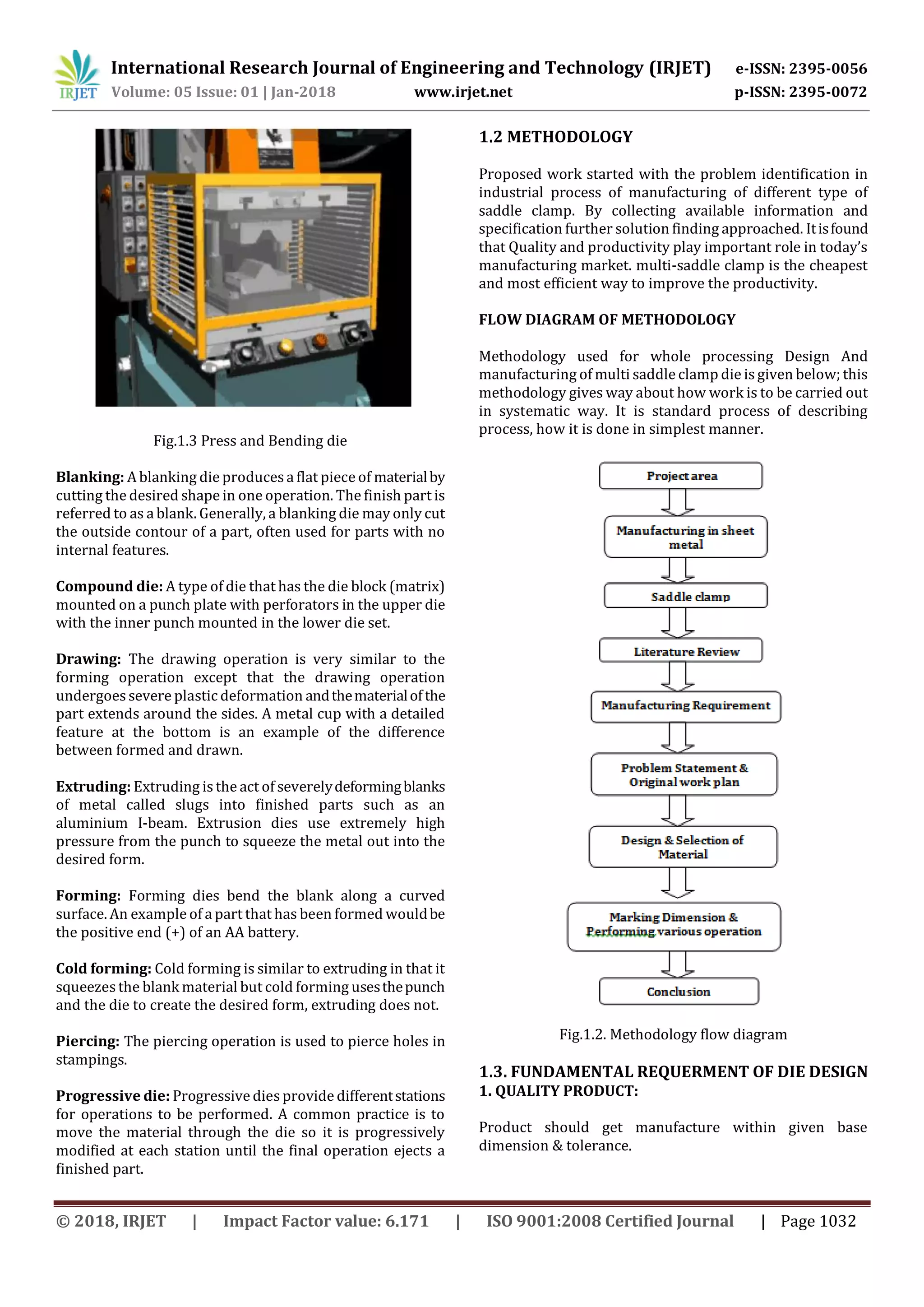
Bending: The bending operation is the act of bendingblanks
at a predetermined angle. An example would be an "L"
bracket which is a straight piece of metal bent at a 90° angle.
The main difference between a forming operation and a
bending operation is the bending operation creates a
straight-line bend as where a form operation may create a
curved bend.
International Research Journal of Engineering and Technology (IRJET) e-ISSN: 2395-0056
Volume: 05 Issue: 01 | Jan-2018 www.irjet.net p-ISSN: 2395-0072
© 2018, IRJET | Impact Factor value: 6.171 | ISO 9001:2008 Certified Journal | Page 1032
Fig.1.3 Press and Bending die
Blanking: A blanking die producesa flat piece of materialby
cutting the desired shape in one operation. The finish part is
referred to as a blank. Generally, a blanking die may only cut
the outside contour of a part, often used for parts with no
internal features.
Compound die: A type of die that has the die block (matrix)
mounted on a punch plate with perforators in the upper die
with the inner punch mounted in the lower die set.
Drawing: The drawing operation is very similar to the
forming operation except that the drawing operation
undergoes severe plastic deformation andthematerialofthe
part extends around the sides. A metal cup with a detailed
feature at the bottom is an example of the difference
between formed and drawn.
Extruding: Extruding is the act of severelydeformingblanks
of metal called slugs into finished parts such as an
aluminium I-beam. Extrusion dies use extremely high
pressure from the punch to squeeze the metal out into the
desired form.
Forming: Forming dies bend the blank along a curved
surface. An example of a part that has been formed wouldbe
the positive end (+) of an AA battery.
Cold forming: Cold forming is similar to extruding in that it
squeezes the blank material but cold forming usesthepunch
and the die to create the desired form, extruding does not.
Piercing: The piercing operation is used to pierce holes in
stampings.
Progressive die: Progressivediesprovide differentstations
for operations to be performed. A common practice is to
move the material through the die so it is progressively
modified at each station until the final operation ejects a
finished part.
1.2 METHODOLOGY
Proposed work started with the problem identification in
industrial process of manufacturing of different type of
saddle clamp. By collecting available information and
specification further solution finding approached. Itisfound
that Quality and productivity play important role in today’s
manufacturing market. multi-saddle clamp is the cheapest
and most efficient way to improve the productivity.
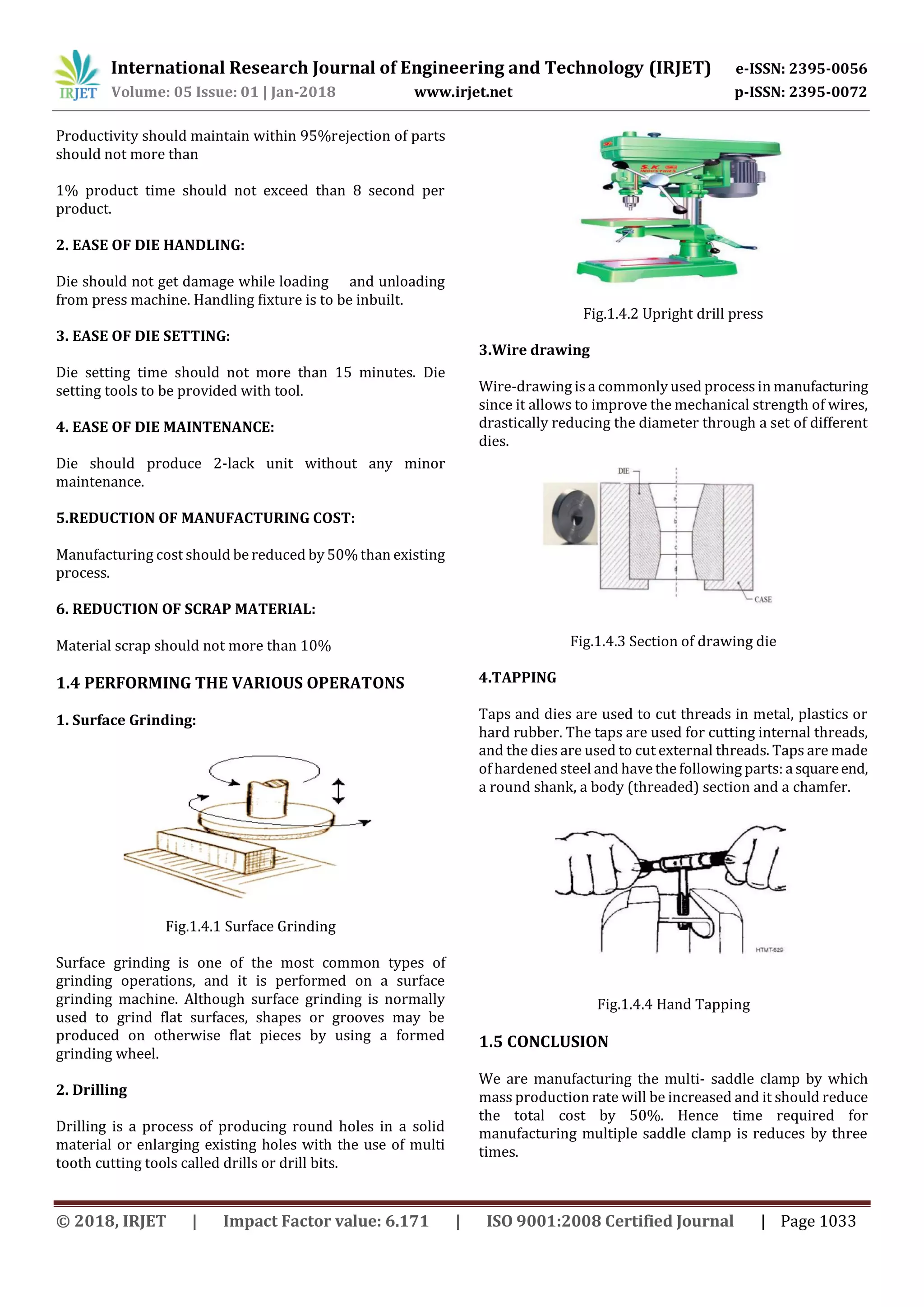
FLOW DIAGRAM OF METHODOLOGY
Methodology used for whole processing Design And
manufacturing of multi saddle clamp die is given below; this
methodology gives way about how work is to be carried out
in systematic way. It is standard process of describing
process, how it is done in simplest manner.
Fig.1.2. Methodology flow diagram
1.3. FUNDAMENTAL REQUERMENT OF DIE DESIGN
1. QUALITY PRODUCT:
Product should get manufacture within given base
dimension & tolerance.
International Research Journal of Engineering and Technology (IRJET) e-ISSN: 2395-0056
Volume: 05 Issue: 01 | Jan-2018 www.irjet.net p-ISSN: 2395-0072
© 2018, IRJET | Impact Factor value: 6.171 | ISO 9001:2008 Certified Journal | Page 1033
Productivity should maintain within 95%rejection of parts
should not more than
1% product time should not exceed than 8 second per
product.
2. EASE OF DIE HANDLING:
Die should not get damage while loading and unloading
from press machine. Handling fixture is to be inbuilt.
3. EASE OF DIE SETTING:
Die setting time should not more than 15 minutes. Die
setting tools to be provided with tool.
4. EASE OF DIE MAINTENANCE:
Die should produce 2-lack unit without any minor
maintenance.
5.REDUCTION OF MANUFACTURING COST:
Manufacturing cost should be reduced by 50%than existing
process.
6. REDUCTION OF SCRAP MATERIAL:
Material scrap should not more than 10%
1.4 PERFORMING THE VARIOUS OPERATONS
1. Surface Grinding:
Fig.1.4.1 Surface Grinding
Surface grinding is one of the most common types of
grinding operations, and it is performed on a surface
grinding machine. Although surface grinding is normally
used to grind flat surfaces, shapes or grooves may be
produced on otherwise flat pieces by using a formed
grinding wheel.
2. Drilling
Drilling is a process of producing round holes in a solid
material or enlarging existing holes with the use of multi
tooth cutting tools called drills or drill bits.
Fig.1.4.2 Upright drill press
3.Wire drawing
Wire-drawing is a commonly used processin manufacturing
since it allows to improve the mechanical strength of wires,
drastically reducing the diameter through a set of different
dies.
Fig.1.4.3 Section of drawing die
4.TAPPING
Taps and dies are used to cut threads in metal, plastics or
hard rubber. The taps are used for cutting internal threads,
and the dies are used to cut external threads. Taps are made
of hardened steel and have the following parts: a squareend,
a round shank, a body (threaded) section and a chamfer.
Fig.1.4.4 Hand Tapping
1.5 CONCLUSION
We are manufacturing the multi- saddle clamp by which
mass production rate will be increased and it should reduce
the total cost by 50%. Hence time required for
manufacturing multiple saddle clamp is reduces by three
times.
International Research Journal of Engineering and Technology (IRJET) e-ISSN: 2395-0056
Volume: 05 Issue: 01 | Jan-2018 www.irjet.net p-ISSN: 2395-0072
© 2018, IRJET | Impact Factor value: 6.171 | ISO 9001:2008 Certified Journal | Page 1034
ACKNOWLEDGEMENT
We work on this project by the support of R&K Engineering
Work pvt ltd. Nashik, our college and Prof. Dhiraj Thorat,
who guided us at any difficulties come across.
REFERENCES
1) Radovan Puzović, et.al., “Prediction of thrust force and
torque in tapping operations using computer Simulation”
University of Belgrade Faculty of Mechanical Engineering,
Vol. 34, No 1, 2006.
2) Günther Schuha, et.al., “Life-Cycle-Oriented Product-
Service-Systems in The Tool and Die Making Industry”
Machine Tools and Production Engineering (WZL) of RWTH
Aachen University, Steinbachstr. 19, 52074 Aachen,
Germany, Procedia CIRP 47(2016) pp.555 – 560.
3) Masao Murakawaa, et.al. “Precision piercing andblanking
of ultrahigh-strength steel sheets” 11th International
Conference on Technology of Plasticity, ICTP 2014, 19-24
October 2014 Nagoya Congress Center, Nagoya, Japan.
4) Ming Deng, et.al., “Development of closed extruding fine
blanking technology” 11th International Conference on
Technology of Plasticity, ICTP 2014, 19-24 October 2014,
Nagoya Congress Center, Nagoya, Japan.
5) Thomas Kuhlmanna, et.al., “Highly Iterative Product
Development Within the Tool and Die Making Industry”,The
24th CIRP Conference on Life Cycle Engineering, Laboratory
for Machine Tools and Production Engineering (WZL) of
RWTH Aachen University, Steinbachstr. 19, 52074 Aachen,
Germany, Procedia CIRP 61 (2017), pp. 576 – 581.
6) G. Schuha, et.al., “Cutting manufacturing failure costs in
the tool and die industry by implementing a knowledge
transfer system to avoid and correct mistake more
effectively”, Product Services Systems and Value Creation.
Proceedings of the 6th CIRP Conference on Industrial.
7) Andrea Ghiotti, et.al., “Shear surface controlinblankingby
adaptronic systems”, 11th International Conference on
Technology of Plasticity, ICTP 2014, 19-24 October 2014,
Nagoya Congress Center, Nagoya, Japan, University ofPadua
- Department of Industrial Engineering,viaVenezia1,35131,
Padova, Italy. Procedia Engineering 81 (2014), pp. 2512 –
2517
8) L. Filice, et.al., “A multi-objective approach for wire-
drawing process”, 8th CIRP Conference on Intelligent
Computation in Manufacturing Engineering, University of
Calabria, Procedia CIRP 12 (2013), pp. 294 – 299.
9) Manjunathan.R, et.al., “Design and Manufacturing of U-
Bending Tool to Overcome Spring Back Effect by Ironin
Impact”, 5th National Conference on Trends in Automotive
Parts Systems and Applications (TAPSA-2017) 30th & 31st
March 2017, Organized by Sri KrishnaCollegeofEngineering
& Technology, Kuniamuthur, Coimbatore-641008,
Tamilnadu, India, Volume 6, Special Issue 7, April 2017.
AUTHORS:
Sagar D. Janrao, SND COE Yeola,
Pune University, Department of
Mechanical Engineering.
Nilesh S. Adsare, SND COE Yeola,
Pune University, Department of
Mechanical Engineering.
Krushna S. Barahate, SND COE
Yeola, Pune University,
Department of Mechanical
Engineering.
Shubham U. Aher, SND COE Yeola,
Pune University, Department of
Mechanical Engineering.
Prof. Dhiraj P. Thorat, SND COE
Yeola, Pune University,
Department of Mechanical
Engineering.

Study of Manufacturing of Multi-Saddle Clamp

  • 1.
    International Research Journalof Engineering and Technology (IRJET) e-ISSN: 2395-0056 Volume: 05 Issue: 01 | Jan-2018 www.irjet.net p-ISSN: 2395-0072 © 2018, IRJET | Impact Factor value: 6.171 | ISO 9001:2008 Certified Journal | Page 1031 Study of Manufacturing of multi-saddle clamp Sagar Janrao1, Nilesh Adsare2, Krushna Barahate3, Shubham Aher4, Dhiraj Thorat5 1,2,3,4 BE student Mechanical, SND COE & RC, YEOLA, Maharashtra, India 5 Asst. Prof. Mechanical, SND COE & RC, YEOLA, Maharashtra, India ---------------------------------------------------------------------***--------------------------------------------------------------------- Abstract – Today’s engineering world more competition of product produce in very less time, at the same time the products are becoming smaller but smarter more powerful and effective, so we can be designing multi saddle clamp die. Previously a single cavity die is used for manufacturing saddle clamp. In that die at time of a bending only one clamp is manufacture and another die the blanking operation are carried out at the blank sheet of a saddle clamp is produced and both end of these sheet having circular hole are formed with help of punch. But during this single cavity die the bending operation is performed at one clamp hencemoretime is required for manufacturing saddle clamp and for another die the blanking operation only one producing hole but as per requirement they require both circular and cylindricalholesin one die hence die is design in such a way that the both holes are produced in a blanking die. In another die the bending operation is carried out first or previously a single bending operation is performed then one saddle clamp is bending but the requirement is that in bending operation multi-saddle clamp is produced. Key words: Clamping, Manufacturing die, Bending, Blanking, Multi saddle clamp. 1.1 INTRODUCTION 1.1.1. ROLE OF MANUFACTURING ENGINEER It is the duty of manufacturing engineer to bring the ideas and design into reality by proper selection of material, machine and manufacturing process. Present day manufacturing demandshigh degree of accuracyforthepart to work satisfactorily when assembled. Tolerance and surface finish desired demand great care in selection of manufacturing process, complete quality controlandquality assurance programs, strict inspection at all stages. 1.1.2. ROLE OF MATERIAL A large amount of materialsis available today at thedisposal of engineer. A proper selection has to be made to suit the requirements. A large variety of steels to suit any application, plastic to resist attack by acids and capability of fabrication into a variety of shapes, ceramics to withstand high temperatures, metalsto stand up to the environmentin a nuclear reactor, semi-conductors for use in computer circuits are available. Effective design inengineeringcallsfor our ability to put them to the best use by selecting the right material for given job. We have to understand why different material behave differently in service and the principle involved. By careful selection and treatment, it is possible to impart different properties. It is important for us to understand all these principles in order to be able to make best use of materials available to us. To achieve the optimum blend of properties, an engineer may have to make use ofa variety of metals, organic material, ceramics. The selection of material for a particularapplication involves consideration of factor like service requirement (strength, wear, corrosion résistance, electrical properties, aesthetic consideration etc.), manufacturing requirement’s (ease of machining, finish desired, fabrication technique to be adopted, casting, moulding, welding etc., method of forming-hot or cold, method of joining various sub- assemblies, need of heat treatment to achieve), cost of raw material. More than obtained one may have two or three possible solutions in selection of an appropriate material. The final decision then should be best on preference and experience of designer and user and considerationslikeease of repair on occurrence of faults, availability of repair facilities, skill of personal, use full life, etc. 1.1.3 WHAT IS A DIE? A die is a specialized tool used in manufacturing industries to cut, shape and form a wide variety of products and components. Like moulds and templates, dies are generally customized and uniquely matched to the product they are used to create. Products made with dies range from simple paper clips to complex pieces used in advanced technology. Die operations and types: Die operations are often named after the specific type of die that performsthe operation.For example, a bending operation is performed by a bendingdie. Operations are not limited to one specific die as some dies may incorporate multiple operation types. Bending: The bending operation is the act of bendingblanks at a predetermined angle. An example would be an "L" bracket which is a straight piece of metal bent at a 90° angle. The main difference between a forming operation and a bending operation is the bending operation creates a straight-line bend as where a form operation may create a curved bend.
  • 2.
    International Research Journalof Engineering and Technology (IRJET) e-ISSN: 2395-0056 Volume: 05 Issue: 01 | Jan-2018 www.irjet.net p-ISSN: 2395-0072 © 2018, IRJET | Impact Factor value: 6.171 | ISO 9001:2008 Certified Journal | Page 1032 Fig.1.3 Press and Bending die Blanking: A blanking die producesa flat piece of materialby cutting the desired shape in one operation. The finish part is referred to as a blank. Generally, a blanking die may only cut the outside contour of a part, often used for parts with no internal features. Compound die: A type of die that has the die block (matrix) mounted on a punch plate with perforators in the upper die with the inner punch mounted in the lower die set. Drawing: The drawing operation is very similar to the forming operation except that the drawing operation undergoes severe plastic deformation andthematerialofthe part extends around the sides. A metal cup with a detailed feature at the bottom is an example of the difference between formed and drawn. Extruding: Extruding is the act of severelydeformingblanks of metal called slugs into finished parts such as an aluminium I-beam. Extrusion dies use extremely high pressure from the punch to squeeze the metal out into the desired form. Forming: Forming dies bend the blank along a curved surface. An example of a part that has been formed wouldbe the positive end (+) of an AA battery. Cold forming: Cold forming is similar to extruding in that it squeezes the blank material but cold forming usesthepunch and the die to create the desired form, extruding does not. Piercing: The piercing operation is used to pierce holes in stampings. Progressive die: Progressivediesprovide differentstations for operations to be performed. A common practice is to move the material through the die so it is progressively modified at each station until the final operation ejects a finished part. 1.2 METHODOLOGY Proposed work started with the problem identification in industrial process of manufacturing of different type of saddle clamp. By collecting available information and specification further solution finding approached. Itisfound that Quality and productivity play important role in today’s manufacturing market. multi-saddle clamp is the cheapest and most efficient way to improve the productivity. FLOW DIAGRAM OF METHODOLOGY Methodology used for whole processing Design And manufacturing of multi saddle clamp die is given below; this methodology gives way about how work is to be carried out in systematic way. It is standard process of describing process, how it is done in simplest manner. Fig.1.2. Methodology flow diagram 1.3. FUNDAMENTAL REQUERMENT OF DIE DESIGN 1. QUALITY PRODUCT: Product should get manufacture within given base dimension & tolerance.
  • 3.
    International Research Journalof Engineering and Technology (IRJET) e-ISSN: 2395-0056 Volume: 05 Issue: 01 | Jan-2018 www.irjet.net p-ISSN: 2395-0072 © 2018, IRJET | Impact Factor value: 6.171 | ISO 9001:2008 Certified Journal | Page 1033 Productivity should maintain within 95%rejection of parts should not more than 1% product time should not exceed than 8 second per product. 2. EASE OF DIE HANDLING: Die should not get damage while loading and unloading from press machine. Handling fixture is to be inbuilt. 3. EASE OF DIE SETTING: Die setting time should not more than 15 minutes. Die setting tools to be provided with tool. 4. EASE OF DIE MAINTENANCE: Die should produce 2-lack unit without any minor maintenance. 5.REDUCTION OF MANUFACTURING COST: Manufacturing cost should be reduced by 50%than existing process. 6. REDUCTION OF SCRAP MATERIAL: Material scrap should not more than 10% 1.4 PERFORMING THE VARIOUS OPERATONS 1. Surface Grinding: Fig.1.4.1 Surface Grinding Surface grinding is one of the most common types of grinding operations, and it is performed on a surface grinding machine. Although surface grinding is normally used to grind flat surfaces, shapes or grooves may be produced on otherwise flat pieces by using a formed grinding wheel. 2. Drilling Drilling is a process of producing round holes in a solid material or enlarging existing holes with the use of multi tooth cutting tools called drills or drill bits. Fig.1.4.2 Upright drill press 3.Wire drawing Wire-drawing is a commonly used processin manufacturing since it allows to improve the mechanical strength of wires, drastically reducing the diameter through a set of different dies. Fig.1.4.3 Section of drawing die 4.TAPPING Taps and dies are used to cut threads in metal, plastics or hard rubber. The taps are used for cutting internal threads, and the dies are used to cut external threads. Taps are made of hardened steel and have the following parts: a squareend, a round shank, a body (threaded) section and a chamfer. Fig.1.4.4 Hand Tapping 1.5 CONCLUSION We are manufacturing the multi- saddle clamp by which mass production rate will be increased and it should reduce the total cost by 50%. Hence time required for manufacturing multiple saddle clamp is reduces by three times.
  • 4.
    International Research Journalof Engineering and Technology (IRJET) e-ISSN: 2395-0056 Volume: 05 Issue: 01 | Jan-2018 www.irjet.net p-ISSN: 2395-0072 © 2018, IRJET | Impact Factor value: 6.171 | ISO 9001:2008 Certified Journal | Page 1034 ACKNOWLEDGEMENT We work on this project by the support of R&K Engineering Work pvt ltd. Nashik, our college and Prof. Dhiraj Thorat, who guided us at any difficulties come across. REFERENCES 1) Radovan Puzović, et.al., “Prediction of thrust force and torque in tapping operations using computer Simulation” University of Belgrade Faculty of Mechanical Engineering, Vol. 34, No 1, 2006. 2) Günther Schuha, et.al., “Life-Cycle-Oriented Product- Service-Systems in The Tool and Die Making Industry” Machine Tools and Production Engineering (WZL) of RWTH Aachen University, Steinbachstr. 19, 52074 Aachen, Germany, Procedia CIRP 47(2016) pp.555 – 560. 3) Masao Murakawaa, et.al. “Precision piercing andblanking of ultrahigh-strength steel sheets” 11th International Conference on Technology of Plasticity, ICTP 2014, 19-24 October 2014 Nagoya Congress Center, Nagoya, Japan. 4) Ming Deng, et.al., “Development of closed extruding fine blanking technology” 11th International Conference on Technology of Plasticity, ICTP 2014, 19-24 October 2014, Nagoya Congress Center, Nagoya, Japan. 5) Thomas Kuhlmanna, et.al., “Highly Iterative Product Development Within the Tool and Die Making Industry”,The 24th CIRP Conference on Life Cycle Engineering, Laboratory for Machine Tools and Production Engineering (WZL) of RWTH Aachen University, Steinbachstr. 19, 52074 Aachen, Germany, Procedia CIRP 61 (2017), pp. 576 – 581. 6) G. Schuha, et.al., “Cutting manufacturing failure costs in the tool and die industry by implementing a knowledge transfer system to avoid and correct mistake more effectively”, Product Services Systems and Value Creation. Proceedings of the 6th CIRP Conference on Industrial. 7) Andrea Ghiotti, et.al., “Shear surface controlinblankingby adaptronic systems”, 11th International Conference on Technology of Plasticity, ICTP 2014, 19-24 October 2014, Nagoya Congress Center, Nagoya, Japan, University ofPadua - Department of Industrial Engineering,viaVenezia1,35131, Padova, Italy. Procedia Engineering 81 (2014), pp. 2512 – 2517 8) L. Filice, et.al., “A multi-objective approach for wire- drawing process”, 8th CIRP Conference on Intelligent Computation in Manufacturing Engineering, University of Calabria, Procedia CIRP 12 (2013), pp. 294 – 299. 9) Manjunathan.R, et.al., “Design and Manufacturing of U- Bending Tool to Overcome Spring Back Effect by Ironin Impact”, 5th National Conference on Trends in Automotive Parts Systems and Applications (TAPSA-2017) 30th & 31st March 2017, Organized by Sri KrishnaCollegeofEngineering & Technology, Kuniamuthur, Coimbatore-641008, Tamilnadu, India, Volume 6, Special Issue 7, April 2017. AUTHORS: Sagar D. Janrao, SND COE Yeola, Pune University, Department of Mechanical Engineering. Nilesh S. Adsare, SND COE Yeola, Pune University, Department of Mechanical Engineering. Krushna S. Barahate, SND COE Yeola, Pune University, Department of Mechanical Engineering. Shubham U. Aher, SND COE Yeola, Pune University, Department of Mechanical Engineering. Prof. Dhiraj P. Thorat, SND COE Yeola, Pune University, Department of Mechanical Engineering.