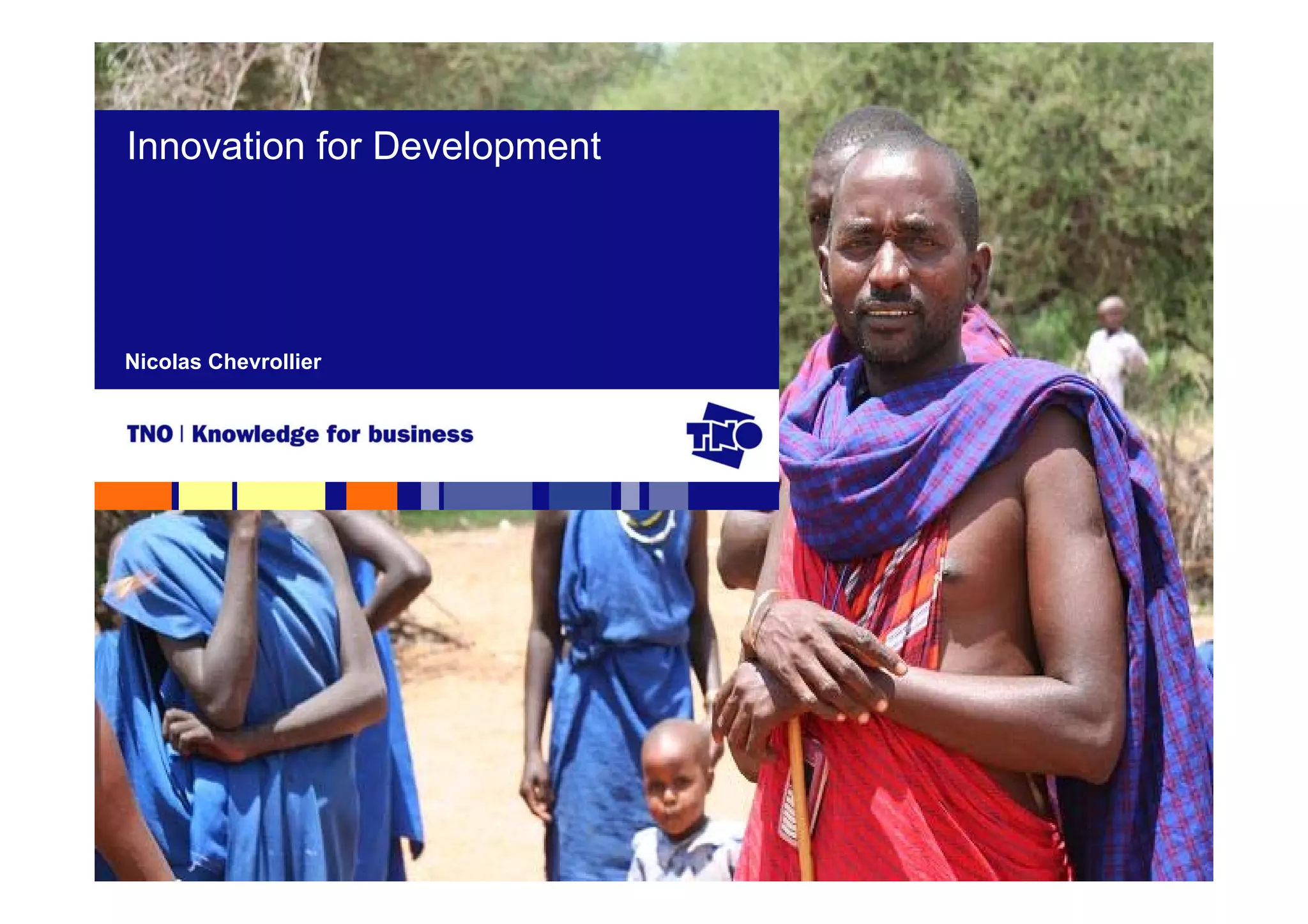
Innovation for Development


Nicolas Chevrollier
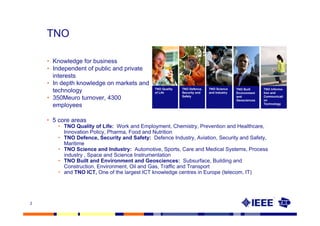
TNO

    • Knowledge for business
    • Independent of public and private
      interests
    • In depth knowledge on markets and
                                              TNO Quality   TNO Defence,   TNO Science
      technology                              of Life       Security and   and Industry
                                                                                          TNO Built
                                                                                          Environment
                                                                                                        TNO Informa-
                                                                                                        tion and
                                                            Safety
    • 350Meuro turnover, 4300                                                             and
                                                                                          Geosciences
                                                                                                        Communicati
                                                                                                        on
      employees                                                                                         Technology


    • 5 core areas
        • TNO Quality of Life: Work and Employment, Chemistry, Prevention and Healthcare,
          Innovation Policy, Pharma, Food and Nutrition
        • TNO Defence, Security and Safety: Defence Industry, Aviation, Security and Safety,
          Maritime
        • TNO Science and Industry: Automotive, Sports, Care and Medical Systems, Process
          industry , Space and Science Instrumentation
        • TNO Built and Environment and Geosciences: Subsurface, Building and
          Construction, Environment, Oil and Gas, Traffic and Transport
        • and TNO ICT, One of the largest ICT knowledge centres in Europe (telecom, IT)


2
Goals of the Webinar


    • Provide an helicopter view of innovation for development via an
      illustrative approach

    • Inspire you to innovate in emerging regions

    • Create an IEEE momentum on the topic


3
Outline

    • Setting the scene
       • What is innovation?
       • Why is it relevant to emerging regions?
       • Guidelines

    • Innovation in products/services
        • Zoom-in: ICT sector

    • Innovation in market based approaches


4
Outline

    • Setting the scene
       • What is innovation?
       • Why is it relevant to emerging regions?
       • Guidelines

    • Innovation in products/services
        • Zoom-in: ICT sector in Africa

    • Innovation in market based approached


5
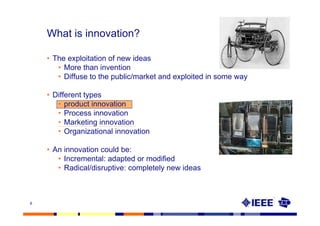
What is innovation?

    • The exploitation of new ideas
       • More than invention
       • Diffuse to the public/market and exploited in some way

    • Different types
       • product innovation
       • Process innovation
       • Marketing innovation
       • Organizational innovation

    • An innovation could be:
       • Incremental: adapted or modified
       • Radical/disruptive: completely new ideas


6
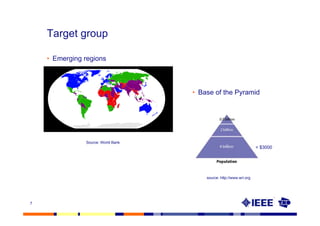
Target group

    • Emerging regions


                                    • Base of the Pyramid


               Source: World Bank
                                                                     < $3000


                                        source: http://www.wri.org


7
Why innovation for development? (1)

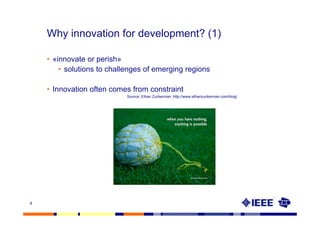
    • «innovate or perish»
        • solutions to challenges of emerging regions

    • Innovation often comes from constraint
                            Source: Ethan Zuckerman ,http://www.ethanzuckerman.com/blog/


8
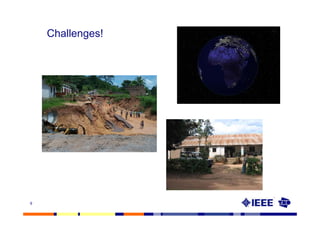
Challenges!


9
Why innovation for development? (2)

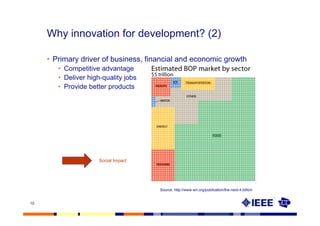
     • Primary driver of business, financial and economic growth
        • Competitive advantage
        • Deliver high-quality jobs
        • Provide better products


                      Social Impact


                                      Source: http://www.wri.org/publication/the-next-4-billion


10
Solving health challenges

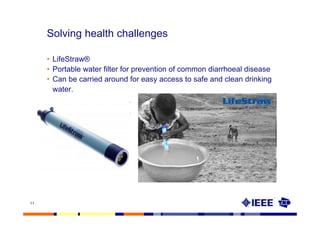
     • LifeStraw®
     • Portable water filter for prevention of common diarrhoeal disease
     • Can be carried around for easy access to safe and clean drinking
       water.


11
Solving Energy challenges
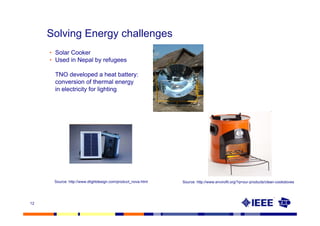
     • Solar Cooker
     • Used in Nepal by refugees

      TNO developed a heat battery:
      conversion of thermal energy
      in electricity for lighting


      Source: http://www.dlightdesign.com/product_nova.html   Source: http://www.envirofit.org/?q=our-products/clean-cookstoves


12
Why innovation for development? (3)

     • Emerging regions are a fertile playing field for
       innovators/inventors

     • Top creativity

      http://makerfaireafrica.com/2009/08/27/video-maker-faire-africa-
                                 ghana-2009/


13
Holistic approach of innovation


14
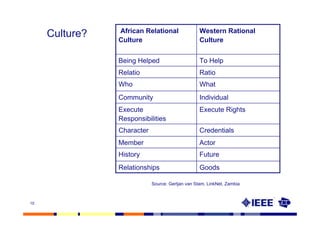
African Relational                Western Rational
     Culture?   Culture                           Culture


                Being Helped                      To Help
                Relatio                           Ratio
                Who                               What
                Community                         Individual
                Execute                           Execute Rights
                Responsibilities
                Character                         Credentials
                Member                            Actor
                History                           Future
                Relationships                     Goods

                            Source: Gertjan van Stam, LinkNet, Zambia


15
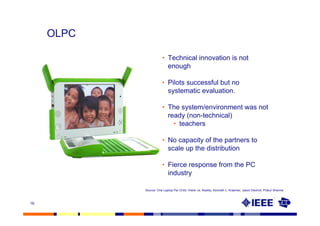
OLPC

                       • Technical innovation is not
                         enough

                       • Pilots successful but no
                         systematic evaluation.

                       • The system/environment was not
                         ready (non-technical)
                           • teachers

                       • No capacity of the partners to
                         scale up the distribution

                       • Fierce response from the PC
                         industry

            Source: One Laptop Per Child: Vision vs. Reality, Kenneth L. Kraemer, Jason Dedrick, Prakul Sharma


16
Co-creation

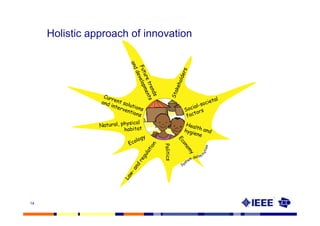
     • Active participation of all stakeholders (holistic approach)

     • Create awareness and ownership

     • Allow to understand the structure of the local community

     • Emulate peers learning


17
Innovation for development: Guidelines


     • Don’t fight culture
     • Embrace market mechanisms
     • Innovate on existing platforms
     • Realize that problems aren’t obvious from afar
     • Understand that what you have is more important than what you
       lack
     • Build infrastructure on infrastructure
                  Source: Ethan Zuckerman, http://www.ethanzuckerman.com/blog/


     • Be holistic
     • Co-create/ Co-design


18
Outline

     • Setting the scene
        • What is innovation?
        • Why is it relevant to emerging regions?
        • Guidelines

     • Innovation in products/services
         • Zoom-in: ICT sector in Africa

     • Innovation in market based approached


19
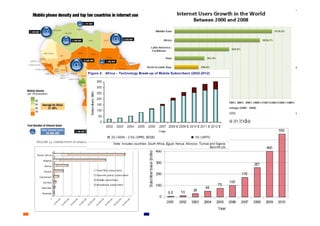
20
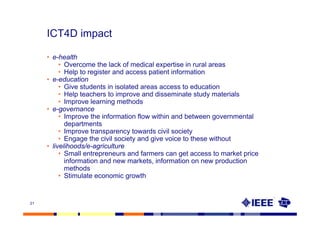
ICT4D impact

     • e-health
          • Overcome the lack of medical expertise in rural areas
          • Help to register and access patient information
     • e-education
          • Give students in isolated areas access to education
          • Help teachers to improve and disseminate study materials
          • Improve learning methods
     • e-governance
          • Improve the information flow within and between governmental
            departments
          • Improve transparency towards civil society
          • Engage the civil society and give voice to these without
     • livelihoods/e-agriculture
          • Small entrepreneurs and farmers can get access to market price
            information and new markets, information on new production
            methods
          • Stimulate economic growth


21
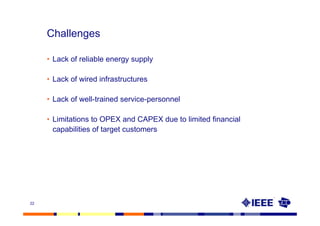
Challenges

     • Lack of reliable energy supply

     • Lack of wired infrastructures

     • Lack of well-trained service-personnel

     • Limitations to OPEX and CAPEX due to limited financial
       capabilities of target customers


22
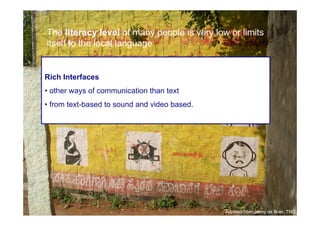
The literacy level of many people is very low or limits
     itself to the local language


     Rich Interfaces
     • other ways of communication than text
     • from text-based to sound and video based.


23

                                                   Adpated from Jenny de Boer, TNO
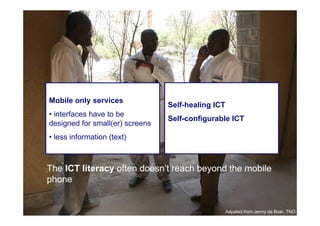
Mobile only services
                                      Self-healing ICT
     • interfaces have to be
                                      Self-configurable ICT
     designed for small(er) screens
     • less information (text)


     The ICT literacy often doesn’t reach beyond the mobile
     phone

24

                                                         Adpated from Jenny de Boer, TNO
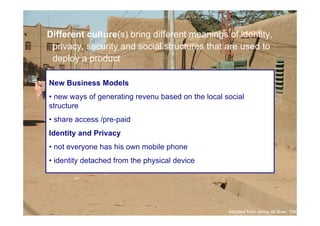
Different culture(s) bring different meanings of identity,
      privacy, security and social structures that are used to
      deploy a product

     New Business Models
     • new ways of generating revenu based on the local social
     structure
     • share access /pre-paid
     Identity and Privacy
     • not everyone has his own mobile phone
     • identity detached from the physical device


25

                                                         Adpated from Jenny de Boer, TNO
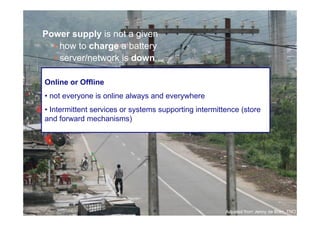
Power supply is not a given
       • how to charge a battery
       • server/network is down

     Online or Offline
     • not everyone is online always and everywhere
     • Intermittent services or systems supporting intermittence (store
     and forward mechanisms)


26

                                                            Adpated from Jenny de Boer, TNO
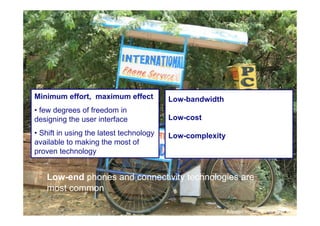
Minimum effort, maximum effect           Low-bandwidth
     • few degrees of freedom in
     designing the user interface             Low-cost

     • Shift in using the latest technology   Low-complexity
     available to making the most of
     proven technology


        Low-end phones and connectivity technologies are
        most common
27

                                                               Adpated from Jenny de Boer, TNO
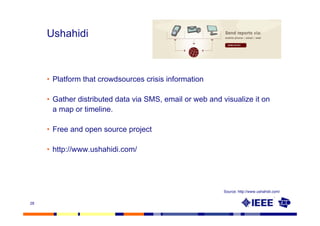
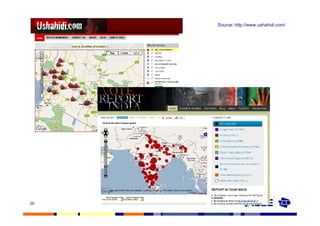
Ushahidi


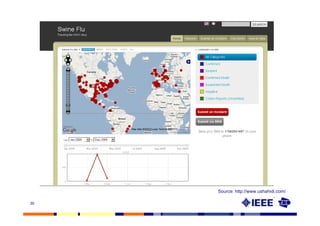
     • Platform that crowdsources crisis information

     • Gather distributed data via SMS, email or web and visualize it on
       a map or timeline.

     • Free and open source project

     • http://www.ushahidi.com/


                                                          Source: http://www.ushahidi.com/


28
Source: http://www.ushahidi.com/


29
Source: http://www.ushahidi.com/

30
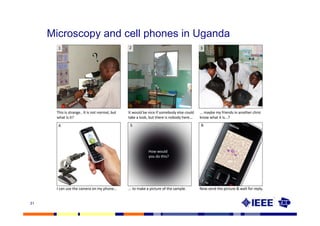
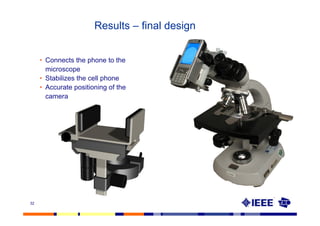
Microscopy and cell phones in Uganda


31
Results – final design


     • Connects the phone to the
       microscope
     • Stabilizes the cell phone
     • Accurate positioning of the
       camera


32
Outline

     • Setting the scene
        • What is innovation?
        • Why is it relevant to emerging regions?
        • Guidelines

     • Innovation in products/services
         • Zoom-in: ICT sector in Africa

     • Innovation in market based approaches


33
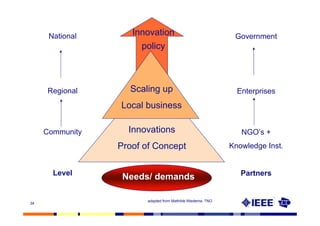
National      Innovation                                Government
                      policy


     Regional      Scaling up                                  Enterprises
                 Local business

     Community     Innovations                                  NGO’s +
                 Proof of Concept                            Knowledge Inst.


       Level                                                    Partners
                  Needs/ demands

                        adapted from Mathilde Miedema, TNO
34
Innovation in market based approaches

     • Profitable/Scalable
        • scale deep
        • scale wide
        • scale up

     • Example of Aravind Eye Care
        • Eliminate needless blindness
        • 2 million surgeries in 32 years
        • 2.7 million patiens screened per year
        • End-to-end, all inclusive business model


35
3As when serving the BoP


     • Affordability

     • Access

     • Availability


                       Source: The Fortune at the Bottom of the Pyramid by C.K. Prahalad


36
Business models

     • The poor as customers
        • A pay-per-use approach
        • No frills service (e.g, telecommunication)
        • Paraskilling
        • Share channels

     • The poor as suppliers or producers
        • Contract production
        • Deep procurement
        • Demand-led training

                         Source: http://www.mim.monitor.com/


37
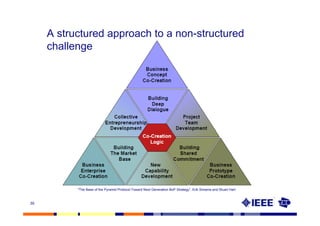
Base of the Pyramid protocol

     • Business incubation process for multinational corporations
       (MNCs)

     • Based on a participatory philosophy to
        • Co-discover and co-create new business opportunities
        • Co-design and launch BoP businesses

      "The Base of the Pyramid Protocol:Toward Next Generation BoP
                   Strategy”, Erik Simanis and Stuart Hart


38
A structured approach to a non-structured
     challenge


           "The Base of the Pyramid Protocol:Toward Next Generation BoP Strategy”, Erik Simanis and Stuart Hart


39
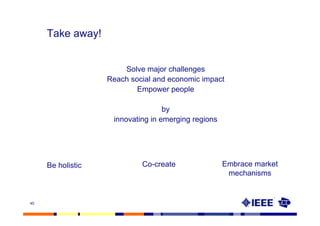
Take away!


                       Solve major challenges
                   Reach social and economic impact
                           Empower people

                                   by
                    innovating in emerging regions


     Be holistic            Co-create                Embrace market
                                                      mechanisms


40
Contact

      Nicolas Chevrollier

     TNO Information and Communication Technology
     Room BA 206
     Brassersplein 2, 2612 CT Delft
     nicolas.chevrollier@tno.nl

      http://nl.linkedin.com/in/nchevrollier
      Twitter: nchevrollier


41

Innovation for Development-IEEE Webinar

  • 1.
  • 2.
    TNO • Knowledge for business • Independent of public and private interests • In depth knowledge on markets and TNO Quality TNO Defence, TNO Science technology of Life Security and and Industry TNO Built Environment TNO Informa- tion and Safety • 350Meuro turnover, 4300 and Geosciences Communicati on employees Technology • 5 core areas • TNO Quality of Life: Work and Employment, Chemistry, Prevention and Healthcare, Innovation Policy, Pharma, Food and Nutrition • TNO Defence, Security and Safety: Defence Industry, Aviation, Security and Safety, Maritime • TNO Science and Industry: Automotive, Sports, Care and Medical Systems, Process industry , Space and Science Instrumentation • TNO Built and Environment and Geosciences: Subsurface, Building and Construction, Environment, Oil and Gas, Traffic and Transport • and TNO ICT, One of the largest ICT knowledge centres in Europe (telecom, IT) 2
  • 3.
    Goals of theWebinar • Provide an helicopter view of innovation for development via an illustrative approach • Inspire you to innovate in emerging regions • Create an IEEE momentum on the topic 3
  • 4.
    Outline • Setting the scene • What is innovation? • Why is it relevant to emerging regions? • Guidelines • Innovation in products/services • Zoom-in: ICT sector • Innovation in market based approaches 4
  • 5.
    Outline • Setting the scene • What is innovation? • Why is it relevant to emerging regions? • Guidelines • Innovation in products/services • Zoom-in: ICT sector in Africa • Innovation in market based approached 5
  • 6.
    What is innovation? • The exploitation of new ideas • More than invention • Diffuse to the public/market and exploited in some way • Different types • product innovation • Process innovation • Marketing innovation • Organizational innovation • An innovation could be: • Incremental: adapted or modified • Radical/disruptive: completely new ideas 6
  • 7.
    Target group • Emerging regions • Base of the Pyramid Source: World Bank < $3000 source: http://www.wri.org 7
  • 8.
    Why innovation fordevelopment? (1) • «innovate or perish» • solutions to challenges of emerging regions • Innovation often comes from constraint Source: Ethan Zuckerman ,http://www.ethanzuckerman.com/blog/ 8
  • 9.
  • 10.
    Why innovation fordevelopment? (2) • Primary driver of business, financial and economic growth • Competitive advantage • Deliver high-quality jobs • Provide better products Social Impact Source: http://www.wri.org/publication/the-next-4-billion 10
  • 11.
    Solving health challenges • LifeStraw® • Portable water filter for prevention of common diarrhoeal disease • Can be carried around for easy access to safe and clean drinking water. 11
  • 12.
    Solving Energy challenges • Solar Cooker • Used in Nepal by refugees TNO developed a heat battery: conversion of thermal energy in electricity for lighting Source: http://www.dlightdesign.com/product_nova.html Source: http://www.envirofit.org/?q=our-products/clean-cookstoves 12
  • 13.
    Why innovation fordevelopment? (3) • Emerging regions are a fertile playing field for innovators/inventors • Top creativity http://makerfaireafrica.com/2009/08/27/video-maker-faire-africa- ghana-2009/ 13
  • 14.
    Holistic approach ofinnovation 14
  • 15.
    African Relational Western Rational Culture? Culture Culture Being Helped To Help Relatio Ratio Who What Community Individual Execute Execute Rights Responsibilities Character Credentials Member Actor History Future Relationships Goods Source: Gertjan van Stam, LinkNet, Zambia 15
  • 16.
    OLPC • Technical innovation is not enough • Pilots successful but no systematic evaluation. • The system/environment was not ready (non-technical) • teachers • No capacity of the partners to scale up the distribution • Fierce response from the PC industry Source: One Laptop Per Child: Vision vs. Reality, Kenneth L. Kraemer, Jason Dedrick, Prakul Sharma 16
  • 17.
    Co-creation • Active participation of all stakeholders (holistic approach) • Create awareness and ownership • Allow to understand the structure of the local community • Emulate peers learning 17
  • 18.
    Innovation for development:Guidelines • Don’t fight culture • Embrace market mechanisms • Innovate on existing platforms • Realize that problems aren’t obvious from afar • Understand that what you have is more important than what you lack • Build infrastructure on infrastructure Source: Ethan Zuckerman, http://www.ethanzuckerman.com/blog/ • Be holistic • Co-create/ Co-design 18
  • 19.
    Outline • Setting the scene • What is innovation? • Why is it relevant to emerging regions? • Guidelines • Innovation in products/services • Zoom-in: ICT sector in Africa • Innovation in market based approached 19
  • 20.
  • 21.
    ICT4D impact • e-health • Overcome the lack of medical expertise in rural areas • Help to register and access patient information • e-education • Give students in isolated areas access to education • Help teachers to improve and disseminate study materials • Improve learning methods • e-governance • Improve the information flow within and between governmental departments • Improve transparency towards civil society • Engage the civil society and give voice to these without • livelihoods/e-agriculture • Small entrepreneurs and farmers can get access to market price information and new markets, information on new production methods • Stimulate economic growth 21
  • 22.
    Challenges • Lack of reliable energy supply • Lack of wired infrastructures • Lack of well-trained service-personnel • Limitations to OPEX and CAPEX due to limited financial capabilities of target customers 22
  • 23.
    The literacy levelof many people is very low or limits itself to the local language Rich Interfaces • other ways of communication than text • from text-based to sound and video based. 23 Adpated from Jenny de Boer, TNO
  • 24.
    Mobile only services Self-healing ICT • interfaces have to be Self-configurable ICT designed for small(er) screens • less information (text) The ICT literacy often doesn’t reach beyond the mobile phone 24 Adpated from Jenny de Boer, TNO
  • 25.
    Different culture(s) bringdifferent meanings of identity, privacy, security and social structures that are used to deploy a product New Business Models • new ways of generating revenu based on the local social structure • share access /pre-paid Identity and Privacy • not everyone has his own mobile phone • identity detached from the physical device 25 Adpated from Jenny de Boer, TNO
  • 26.
    Power supply isnot a given • how to charge a battery • server/network is down Online or Offline • not everyone is online always and everywhere • Intermittent services or systems supporting intermittence (store and forward mechanisms) 26 Adpated from Jenny de Boer, TNO
  • 27.
    Minimum effort, maximumeffect Low-bandwidth • few degrees of freedom in designing the user interface Low-cost • Shift in using the latest technology Low-complexity available to making the most of proven technology Low-end phones and connectivity technologies are most common 27 Adpated from Jenny de Boer, TNO
  • 28.
    Ushahidi • Platform that crowdsources crisis information • Gather distributed data via SMS, email or web and visualize it on a map or timeline. • Free and open source project • http://www.ushahidi.com/ Source: http://www.ushahidi.com/ 28
  • 29.
  • 30.
  • 31.
    Microscopy and cellphones in Uganda 31
  • 32.
    Results – finaldesign • Connects the phone to the microscope • Stabilizes the cell phone • Accurate positioning of the camera 32
  • 33.
    Outline • Setting the scene • What is innovation? • Why is it relevant to emerging regions? • Guidelines • Innovation in products/services • Zoom-in: ICT sector in Africa • Innovation in market based approaches 33
  • 34.
    National Innovation Government policy Regional Scaling up Enterprises Local business Community Innovations NGO’s + Proof of Concept Knowledge Inst. Level Partners Needs/ demands adapted from Mathilde Miedema, TNO 34
  • 35.
    Innovation in marketbased approaches • Profitable/Scalable • scale deep • scale wide • scale up • Example of Aravind Eye Care • Eliminate needless blindness • 2 million surgeries in 32 years • 2.7 million patiens screened per year • End-to-end, all inclusive business model 35
  • 36.
    3As when servingthe BoP • Affordability • Access • Availability Source: The Fortune at the Bottom of the Pyramid by C.K. Prahalad 36
  • 37.
    Business models • The poor as customers • A pay-per-use approach • No frills service (e.g, telecommunication) • Paraskilling • Share channels • The poor as suppliers or producers • Contract production • Deep procurement • Demand-led training Source: http://www.mim.monitor.com/ 37
  • 38.
    Base of thePyramid protocol • Business incubation process for multinational corporations (MNCs) • Based on a participatory philosophy to • Co-discover and co-create new business opportunities • Co-design and launch BoP businesses "The Base of the Pyramid Protocol:Toward Next Generation BoP Strategy”, Erik Simanis and Stuart Hart 38
  • 39.
    A structured approachto a non-structured challenge "The Base of the Pyramid Protocol:Toward Next Generation BoP Strategy”, Erik Simanis and Stuart Hart 39
  • 40.
    Take away! Solve major challenges Reach social and economic impact Empower people by innovating in emerging regions Be holistic Co-create Embrace market mechanisms 40
  • 41.
    Contact Nicolas Chevrollier TNO Information and Communication Technology Room BA 206 Brassersplein 2, 2612 CT Delft nicolas.chevrollier@tno.nl http://nl.linkedin.com/in/nchevrollier Twitter: nchevrollier 41