ICT for policy innovation:
empowering the policy production
            process
                                Sylvie Occelli


   IRES - Istituto di Ricerche Economico Sociali del Piemonte, Via
                       Nizza 18, 10125 Turin, Italy.
                        occelli@ires.piemonte.it


       INPUT Conference –Informatics and Urban and Regional Planning Cagliari, May 10-12
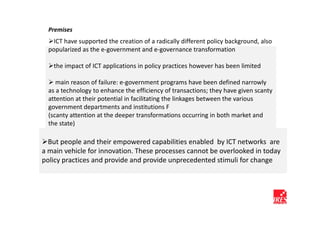
Premises
    ICT have supported the creation of a radically different policy background, also
  popularized as the e-government and e-governance transformation

   the impact of ICT applications in policy practices however has been limited

     main reason of failure: e-government programs have been defined narrowly
  as a technology to enhance the efficiency of transactions; they have given scanty
  attention at their potential in facilitating the linkages between the various
  government departments and institutions F
  (scanty attention at the deeper transformations occurring in both market and
  the state)

  But people and their empowered capabilities enabled by ICT networks are
a main vehicle for innovation. These processes cannot be overlooked in today
policy practices and provide and provide unprecedented stimuli for change
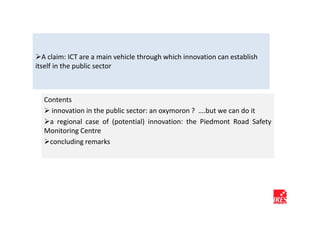
A claim: ICT are a main vehicle through which innovation can establish
itself in the public sector


  Contents
    innovation in the public sector: an oxymoron ? ….but we can do it
   a regional case of (potential) innovation: the Piedmont Road Safety
  Monitoring Centre
   concluding remarks
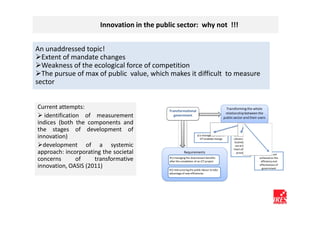
Innovation in the public sector: why not !!!


An unaddressed topic!
  Extent of mandate changes
  Weakness of the ecological force of competition
  The pursue of max of public value, which makes it difficult to measure
sector


Current attempts:                            Transformational
                                                                                             Transforming the whole
                                                                                            relationship between the
   identification of measurement                government
                                                                                           public sector and their users
indices (both the components and
the stages of development of
innovation)                                                          a) a managed process of
                                                                        ICT enabled change
                                                                                                  b) needs of
                                                                                                  citizens and
                                                                                                  businesses
  development of a systemic                                                                        are at the
                                                                                                  heart of the
approach: incorporating the societal                     Requirements                                process
                                                                                                                     c) impacts are
concerns        of   transformative          R1) managing the downstream benefits
                                             after the completion of an ICT project
                                                                                                                    achieved on the
                                                                                                                     efficiency and
innovation, OASIS (2011)                     R2) restructuring the public labour to take
                                                                                                                    effectiveness of
                                                                                                                      government
                                             advantage of new efficiencies
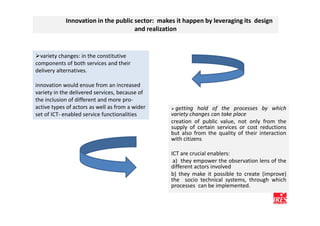
Innovation in the public sector: makes it happen by leveraging its design
                                     and realization


  variety changes: in the constitutive
components of both services and their
delivery alternatives.

innovation would ensue from an increased
variety in the delivered services, because of
the inclusion of different and more pro-
active types of actors as well as from a wider     getting hold of the processes by which
set of ICT- enabled service functionalities      variety changes can take place
                                                 creation of public value, not only from the
                                                 supply of certain services or cost reductions
                                                 but also from the quality of their interaction
                                                 with citizens

                                                 ICT are crucial enablers:
                                                  a) they empower the observation lens of the
                                                 different actors involved
                                                 b) they make it possible to create (improve)
                                                 the socio technical systems, through which
                                                 processes can be implemented.
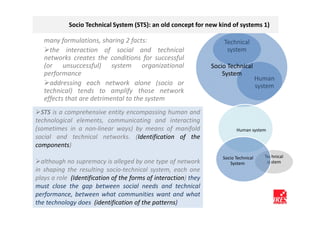
Socio Technical System (STS): an old concept for new kind of systems 1)

   many formulations, sharing 2 facts:                               Technical
     the interaction of social and technical                          system
   networks creates the conditions for successful
   (or unsuccessful) system organizational                       Socio Technical
   performance                                                       System
                                                                                       Human
     addressing each network alone (socio or                                           system
   technical) tends to amplify those network
   effects that are detrimental to the system
  STS is a comprehensive entity encompassing human and
technological elements, communicating and interacting
(sometimes in a non-linear ways) by means of manifold                      Human system
social and technical networks. (Identification of the
components)
                                                                     Socio Technical      Technical
  although no supremacy is alleged by one type of network               System             system
in shaping the resulting socio-technical system, each one
plays a role (Identification of the forms of interaction) they
must close the gap between social needs and technical
performance, between what communities want and what
the technology does (identification of the patterns)
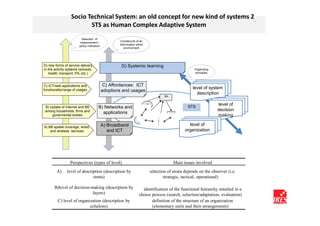
Socio Technical System: an old concept for new kind of systems 2
                         STS as Human Complex Adaptive System
                         Selection of
                        measurement /               Constsructs of an
                        policy indicators           inforrmation wired
                                                       environment


D) new forms of service delivery                     D) Systemic learning
in the activity systems (schools,                                                                            Organizing
   health, transport, PA, etc.)                                                                              principles


C) ICT/web applications and                  C) Affordances: ICT
functionality/range of usages                                                                                level of system
                                            adoptions and usages
                                                                                                               description
                                                                                         RA
                                                                                     S

                                                                         H
                                                                                                          STS
                                                                                                                          level of
B) Uptake of Internet and BB            B) Networks and
among households, firms and                                                                                               decision
                                          applications                                        LA
    govermental bodies                                                                                                    making
                                                                   H
                                                                                 H

A) BB spatial coverage, wired               A) Broadband                                                   level of
    and wireless services                      and ICT                                                   organization


                 Perspectives (types of level)                                                     Main issues involved
        A)     level of description (description by                          selection of strata depends on the observer (i.e.
                              strata)                                                strategic, tactical, operational)

       B)level of decision-making (description by                    identification of the functional hierarchy entailed in a
                            layers)                                choice process (search, selection/adaptation, evaluation)
         C) level of organization (description by                         definition of the structure of an organization
                           echelons)                                      (elementary units and their arrangements)
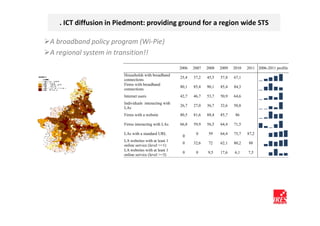
. ICT diffusion in Piedmont: providing ground for a region wide STS

A broadband policy program (Wi-Pie)
A regional system in transition!!
                                                     2006   2007   2008   2009   2010   2011 2006-2011 profile
                      Households with broadband
                                                     25,4   37,2   45,5   57,8   67,1
                      connections
                      Firms with broadband
                                                     80,1   85,4   90,1   85,4   84,3
                      connections
                      Internet users                 42,7   46,7   53,7   50,9   64,6
                      Individuals interacting with
                                                     26,7   27,0   36,7   32,6   50,8
                      LAs
                      Firms with a website           80,5   81,6   88,4   85,7    86

                      Firms interacting with LAs     66,8   59,9   56,5   64,4   71,5

                      LAs with a standard URL                0      59    64,4   75,7   87,2
                                                      0
                      LA websites with at least 1
                                                      0     32,6    72    62,1   80,2    88
                      online service (level >=1)
                      LA websites with at least 1
                                                      0      0     9,5    17,6   6,1    7,5
                      online service (level >=3)
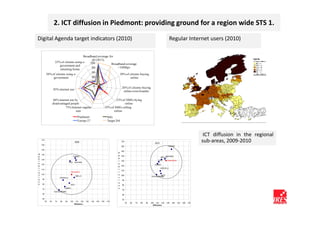
2. ICT diffusion in Piedmont: providing ground for a region wide STS 1.

Digital Agenda target indicators (2010)                                                                                                             Regular Internet users (2010)

                                       Broadband coverage for
                                             all (2013)
                 25% of citizens using e-   100             Broadband coverage
                      government and
                                             80                 >10Mbps
                      returning forms
                                             60
           50% of citizens using e-                               50% of citizens buying
                government                   40                          online
                                             20
                                                                   0                            20% of citizens buying
                    85% internet use
                                                                                                 online cross-boarder

                     60% internet use by                                                   33% of SMEs bying
                    disadvantaged people                                                         online
                              75% Internet regular                                 33% of SMEs selling
                                       user                                              online
                                                Piedmont                            Italy
                                                Europe 27                           Target DA


                                                                                                                                                                              ICT diffusion in the regional
    170
                                              2009                                              170
                                                                                                                                  2010
                                                                                                                                                                             sub-areas, 2009-2010
    160
                                                                                                160                                             TORINO

    150
                                                                                                150
                                                                                            A
A   140                                                                                     p   140                                           NOVARA
p                                           TORINO                                                                                       BIELLA
p                                                                                           p
    130                                                                                                                              VCO
r                                                                                           r   130                                            PIEMONTE
                                      VCO    NOVARA
o                                                                                           o
    120                                                                                                                           CUNEO
p                                                                                           p   120
r                                                                                                                                        VERCELLI
    110                                                                                     r
i                                                                                               110
a                                      PIEMONTE                                             i
z   100                                                                                     a
                                              BIELLA                                            100                                    ASTI
                                                                                                                               ALESSANDRIA
i                          VERCELLI                                                         z
o   90                                                                                      i   90
n
                                                                                            o
e   80                                 ASTI
                                                                                            n   80
    70                          CUNEO                                                       e
                                                                                                70
                     ALESSANDRIA
    60                                                                                          60
    50                                                                                          50
          50   60     70   80   90     100    110    120   130   140   150   160    170
                                                                                                      50   60   70   80   90   100 110 120    130    140   150   160   170
                                             Diffusione
                                                                                                                                 Diffusione
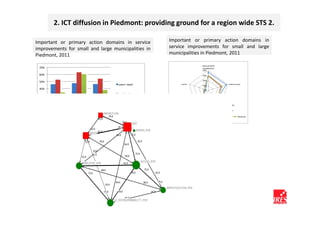
2. ICT diffusion in Piedmont: providing ground for a region wide STS 2.

Important or primary action domains in service                                                                               Important or primary action domains in
improvements for small and large municipalities in                                                                           service improvements for small and large
Piedmont, 2011                                                                                                               municipalities in Piedmont, 2011

                                                                                                                                                            administra ve
 70%                                                                                                                                                        simplifica on
                                                                                                                                                             40%

 60%                                                                                                                                                         30%

                                                                                                                                                             20%
 50%
                                                                         users' need                                                  norms
                                                                                                                                                             10%
                                                                                                                                                                                         online access

 40%
                                                                                                                                                              0%
                                                                         quality of service
 30%

 20%                                                                     promo ng service                                                                                      interoperability
                                                                                                                                         employees'
                                                                         func onality                                                   competences
                                                                                                                                                                                   among
 10%                                                                                                                                                                            governments
                                                        PROMOTION
  0%                                                           70.0                                                                  more than 5000 inhabitants    less than 5000 inhabitants     Piedmont
                                                 62.0
       less than 5000 more than 5000        Piedmont
                                                                              70.0      QoS
         inhabitants   inhabitants
                                                                         81.0
                                        62.0
                                                 81.0                                          NORMS_POP
                                       NEEDS                                            73.0
                                                                       62.0

                                 52.0             59.0                                          62.0
                                                                                64.0

                                          55.0
                                         62.0                                              73.0
                              52.0                                               59.0

                                                                                                  ACCESS_POP
                               EMPLOYEE_POP
                                       81.0                                     81.0

                                                    68.0                                               75.0
                                     73.0                                               78.0                     62.0


                                                                       64.0                            68.0          75.0
                                                         55.0
                                                                                                                            SIMPLIFICATION_POP
                                                        73.0             78.0                                 65.0

                                                                                 65.0
                                                                      LA_INTEROPERABILITY_POP
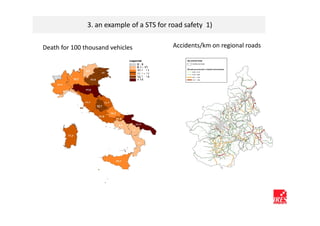
3. an example of a STS for road safety 1)

Death for 100 thousand vehicles            Accidents/km on regional roads
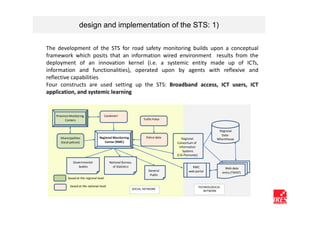
design and implementation of the STS: 1)

The development of the STS for road safety monitoring builds upon a conceptual
framework which posits that an information wired environment results from the
deployment of an innovation kernel (i.e. a systemic entity made up of ICTs,
information and functionalities), operated upon by agents with reflexive and
reflective capabilities
Four constructs are used setting up the STS: Broadband access, ICT users, ICT
application, and systemic learning


   Province Monitoring                   Carabinieri
         Centers                                                     Traffic Police


                                                                                                                  Regional
                                                                                                                   Data-
      Municipalities               Regional Monitoring                 Police data        Regional               Wharehouse
      (local polices)                 Center (RMC)                                    Consortium of
                                                                                        Information
                                                                                          Systems
                                                                                      (CSI-Piemonte)

               Governmental                  National Bureau
                  bodies                       of Statistics                                   RMC                       Web data
                                                                         General             web-portal                entry (TWIST)
                                                                          Public
           based at the regional level

             based at the national level                                                               TECHNOLOGICAL
                                                               SOCIAL NETWORK
                                                                                                          NETWORK
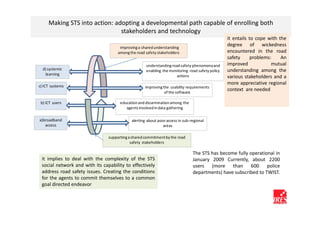
Making STS into action: adopting a developmental path capable of enrolling both
                               stakeholders and technology
                                                                                                 it entails to cope with the
                                      improving a shared understanding
                                                                                                 degree of wickedness
                                     among the road safety stakeholders                          encountered in the road
                                                                                                 safety      problems:    An
                                                    understanding road safety phenomena and      improved             mutual
  d) systemic                                       enabling the monitoring road safety policy   understanding among the
   learning                                                          actions                     various stakeholders and a
                                                                                                 more appreciative regional
c) ICT systems                                      improving the usability requirements
                                                               of the software
                                                                                                 context are needed

 b) ICT users                         education and dissemination among the
                                         agents involved in data gathering

a)broadband                                 alerting about poor access in sub-regional
   access                                                     areas

                                supporting a shared commitment by the road
                                            safety stakeholders

                                                                               The STS has become fully operational in
 it implies to deal with the complexity of the STS                             January 2009 Currently, about 2200
 social network and with its capability to effectively                         users (more than 600 police
 address road safety issues. Creating the conditions                           departments) have subscribed to TWIST.
 for the agents to commit themselves to a common
 goal directed endeavor
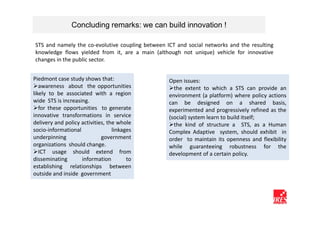
Concluding remarks: we can build innovation !

STS and namely the co-evolutive coupling between ICT and social networks and the resulting
knowledge flows yielded from it, are a main (although not unique) vehicle for innovative
changes in the public sector.


Piedmont case study shows that:                   Open issues:
   awareness about the opportunities                the extent to which a STS can provide an
likely to be associated with a region             environment (a platform) where policy actions
wide STS is increasing.                           can be designed on a shared basis,
   for these opportunities to generate            experimented and progressively refined as the
innovative transformations in service             (social) system learn to build itself;
delivery and policy activities, the whole           the kind of structure a STS, as a Human
socio-informational               linkages        Complex Adaptive system, should exhibit in
underpinning                 government           order to maintain its openness and flexibility
organizations should change.                      while guaranteeing robustness for the
   ICT usage should extend from                   development of a certain policy.
disseminating       information         to
establishing relationships between
outside and inside government

Occelli - input2012

  • 1.
    ICT for policyinnovation: empowering the policy production process Sylvie Occelli IRES - Istituto di Ricerche Economico Sociali del Piemonte, Via Nizza 18, 10125 Turin, Italy. occelli@ires.piemonte.it INPUT Conference –Informatics and Urban and Regional Planning Cagliari, May 10-12
  • 2.
    Premises ICT have supported the creation of a radically different policy background, also popularized as the e-government and e-governance transformation the impact of ICT applications in policy practices however has been limited main reason of failure: e-government programs have been defined narrowly as a technology to enhance the efficiency of transactions; they have given scanty attention at their potential in facilitating the linkages between the various government departments and institutions F (scanty attention at the deeper transformations occurring in both market and the state) But people and their empowered capabilities enabled by ICT networks are a main vehicle for innovation. These processes cannot be overlooked in today policy practices and provide and provide unprecedented stimuli for change
  • 3.
    A claim: ICTare a main vehicle through which innovation can establish itself in the public sector Contents innovation in the public sector: an oxymoron ? ….but we can do it a regional case of (potential) innovation: the Piedmont Road Safety Monitoring Centre concluding remarks
  • 4.
    Innovation in thepublic sector: why not !!! An unaddressed topic! Extent of mandate changes Weakness of the ecological force of competition The pursue of max of public value, which makes it difficult to measure sector Current attempts: Transformational Transforming the whole relationship between the identification of measurement government public sector and their users indices (both the components and the stages of development of innovation) a) a managed process of ICT enabled change b) needs of citizens and businesses development of a systemic are at the heart of the approach: incorporating the societal Requirements process c) impacts are concerns of transformative R1) managing the downstream benefits after the completion of an ICT project achieved on the efficiency and innovation, OASIS (2011) R2) restructuring the public labour to take effectiveness of government advantage of new efficiencies
  • 5.
    Innovation in thepublic sector: makes it happen by leveraging its design and realization variety changes: in the constitutive components of both services and their delivery alternatives. innovation would ensue from an increased variety in the delivered services, because of the inclusion of different and more pro- active types of actors as well as from a wider getting hold of the processes by which set of ICT- enabled service functionalities variety changes can take place creation of public value, not only from the supply of certain services or cost reductions but also from the quality of their interaction with citizens ICT are crucial enablers: a) they empower the observation lens of the different actors involved b) they make it possible to create (improve) the socio technical systems, through which processes can be implemented.
  • 6.
    Socio Technical System(STS): an old concept for new kind of systems 1) many formulations, sharing 2 facts: Technical the interaction of social and technical system networks creates the conditions for successful (or unsuccessful) system organizational Socio Technical performance System Human addressing each network alone (socio or system technical) tends to amplify those network effects that are detrimental to the system STS is a comprehensive entity encompassing human and technological elements, communicating and interacting (sometimes in a non-linear ways) by means of manifold Human system social and technical networks. (Identification of the components) Socio Technical Technical although no supremacy is alleged by one type of network System system in shaping the resulting socio-technical system, each one plays a role (Identification of the forms of interaction) they must close the gap between social needs and technical performance, between what communities want and what the technology does (identification of the patterns)
  • 7.
    Socio Technical System:an old concept for new kind of systems 2 STS as Human Complex Adaptive System Selection of measurement / Constsructs of an policy indicators inforrmation wired environment D) new forms of service delivery D) Systemic learning in the activity systems (schools, Organizing health, transport, PA, etc.) principles C) ICT/web applications and C) Affordances: ICT functionality/range of usages level of system adoptions and usages description RA S H STS level of B) Uptake of Internet and BB B) Networks and among households, firms and decision applications LA govermental bodies making H H A) BB spatial coverage, wired A) Broadband level of and wireless services and ICT organization Perspectives (types of level) Main issues involved A) level of description (description by selection of strata depends on the observer (i.e. strata) strategic, tactical, operational) B)level of decision-making (description by identification of the functional hierarchy entailed in a layers) choice process (search, selection/adaptation, evaluation) C) level of organization (description by definition of the structure of an organization echelons) (elementary units and their arrangements)
  • 8.
    . ICT diffusionin Piedmont: providing ground for a region wide STS A broadband policy program (Wi-Pie) A regional system in transition!! 2006 2007 2008 2009 2010 2011 2006-2011 profile Households with broadband 25,4 37,2 45,5 57,8 67,1 connections Firms with broadband 80,1 85,4 90,1 85,4 84,3 connections Internet users 42,7 46,7 53,7 50,9 64,6 Individuals interacting with 26,7 27,0 36,7 32,6 50,8 LAs Firms with a website 80,5 81,6 88,4 85,7 86 Firms interacting with LAs 66,8 59,9 56,5 64,4 71,5 LAs with a standard URL 0 59 64,4 75,7 87,2 0 LA websites with at least 1 0 32,6 72 62,1 80,2 88 online service (level >=1) LA websites with at least 1 0 0 9,5 17,6 6,1 7,5 online service (level >=3)
  • 9.
    2. ICT diffusionin Piedmont: providing ground for a region wide STS 1. Digital Agenda target indicators (2010) Regular Internet users (2010) Broadband coverage for all (2013) 25% of citizens using e- 100 Broadband coverage government and 80 >10Mbps returning forms 60 50% of citizens using e- 50% of citizens buying government 40 online 20 0 20% of citizens buying 85% internet use online cross-boarder 60% internet use by 33% of SMEs bying disadvantaged people online 75% Internet regular 33% of SMEs selling user online Piedmont Italy Europe 27 Target DA ICT diffusion in the regional 170 2009 170 2010 sub-areas, 2009-2010 160 160 TORINO 150 150 A A 140 p 140 NOVARA p TORINO BIELLA p p 130 VCO r r 130 PIEMONTE VCO NOVARA o o 120 CUNEO p p 120 r VERCELLI 110 r i 110 a PIEMONTE i z 100 a BIELLA 100 ASTI ALESSANDRIA i VERCELLI z o 90 i 90 n o e 80 ASTI n 80 70 CUNEO e 70 ALESSANDRIA 60 60 50 50 50 60 70 80 90 100 110 120 130 140 150 160 170 50 60 70 80 90 100 110 120 130 140 150 160 170 Diffusione Diffusione
  • 10.
    2. ICT diffusionin Piedmont: providing ground for a region wide STS 2. Important or primary action domains in service Important or primary action domains in improvements for small and large municipalities in service improvements for small and large Piedmont, 2011 municipalities in Piedmont, 2011 administra ve 70% simplifica on 40% 60% 30% 20% 50% users' need norms 10% online access 40% 0% quality of service 30% 20% promo ng service interoperability employees' func onality competences among 10% governments PROMOTION 0% 70.0 more than 5000 inhabitants less than 5000 inhabitants Piedmont 62.0 less than 5000 more than 5000 Piedmont 70.0 QoS inhabitants inhabitants 81.0 62.0 81.0 NORMS_POP NEEDS 73.0 62.0 52.0 59.0 62.0 64.0 55.0 62.0 73.0 52.0 59.0 ACCESS_POP EMPLOYEE_POP 81.0 81.0 68.0 75.0 73.0 78.0 62.0 64.0 68.0 75.0 55.0 SIMPLIFICATION_POP 73.0 78.0 65.0 65.0 LA_INTEROPERABILITY_POP
  • 11.
    3. an exampleof a STS for road safety 1) Death for 100 thousand vehicles Accidents/km on regional roads
  • 12.
    design and implementationof the STS: 1) The development of the STS for road safety monitoring builds upon a conceptual framework which posits that an information wired environment results from the deployment of an innovation kernel (i.e. a systemic entity made up of ICTs, information and functionalities), operated upon by agents with reflexive and reflective capabilities Four constructs are used setting up the STS: Broadband access, ICT users, ICT application, and systemic learning Province Monitoring Carabinieri Centers Traffic Police Regional Data- Municipalities Regional Monitoring Police data Regional Wharehouse (local polices) Center (RMC) Consortium of Information Systems (CSI-Piemonte) Governmental National Bureau bodies of Statistics RMC Web data General web-portal entry (TWIST) Public based at the regional level based at the national level TECHNOLOGICAL SOCIAL NETWORK NETWORK
  • 13.
    Making STS intoaction: adopting a developmental path capable of enrolling both stakeholders and technology it entails to cope with the improving a shared understanding degree of wickedness among the road safety stakeholders encountered in the road safety problems: An understanding road safety phenomena and improved mutual d) systemic enabling the monitoring road safety policy understanding among the learning actions various stakeholders and a more appreciative regional c) ICT systems improving the usability requirements of the software context are needed b) ICT users education and dissemination among the agents involved in data gathering a)broadband alerting about poor access in sub-regional access areas supporting a shared commitment by the road safety stakeholders The STS has become fully operational in it implies to deal with the complexity of the STS January 2009 Currently, about 2200 social network and with its capability to effectively users (more than 600 police address road safety issues. Creating the conditions departments) have subscribed to TWIST. for the agents to commit themselves to a common goal directed endeavor
  • 14.
    Concluding remarks: wecan build innovation ! STS and namely the co-evolutive coupling between ICT and social networks and the resulting knowledge flows yielded from it, are a main (although not unique) vehicle for innovative changes in the public sector. Piedmont case study shows that: Open issues: awareness about the opportunities the extent to which a STS can provide an likely to be associated with a region environment (a platform) where policy actions wide STS is increasing. can be designed on a shared basis, for these opportunities to generate experimented and progressively refined as the innovative transformations in service (social) system learn to build itself; delivery and policy activities, the whole the kind of structure a STS, as a Human socio-informational linkages Complex Adaptive system, should exhibit in underpinning government order to maintain its openness and flexibility organizations should change. while guaranteeing robustness for the ICT usage should extend from development of a certain policy. disseminating information to establishing relationships between outside and inside government