October 2012


                                                                         AND THE
               BUILT ENVIRONMENT
                                            by ROB WATSON
                                         CEO, EcoTech International &
                                         Sr. Contributor, GreenBiz.com


                     Defining and accelerating the business of sustainability.
Executive Summary.....................................................................................3
                                         Buildings: Doing More with Less.................................................................5
                                         Transportation: Access Trumps Mobility....................................................10
                                         Information and Communications: Catalyst & Enabler.............................15
                                         Energy: Smarter and Decarbonized..........................................................20
                              Contents   Infrastructure: Falling Apart.......................................................................24
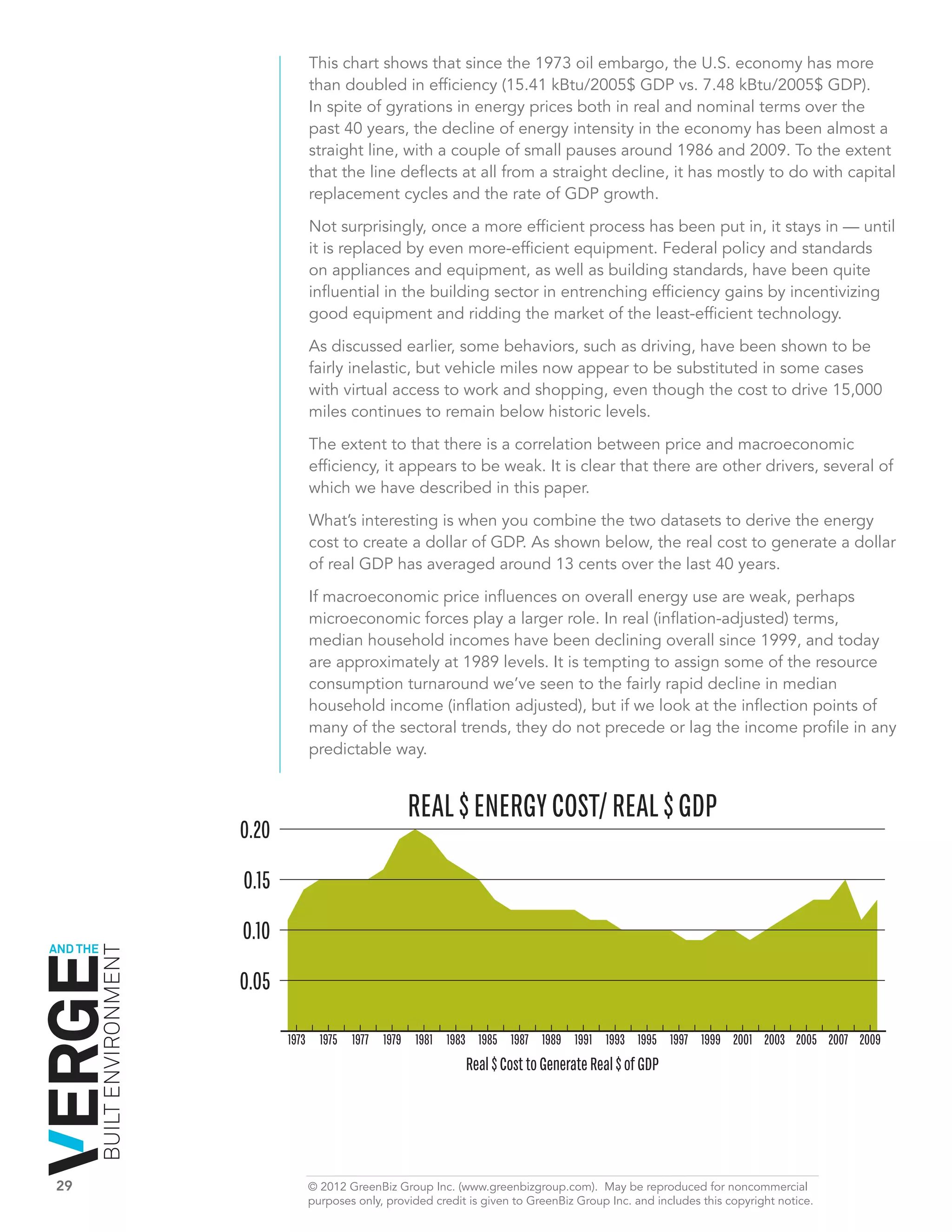
                                         It’s the Economy, Stupid (or Is It?).............................................................29
                                         Coda: Optimizing the Whole....................................................................30
                                         About the Author......................................................................................31
                                         About the Sponsors...................................................................................32
                                         About VERGE............................................................................................33
                                         About GreenBiz Group..............................................................................34


                                                               Researched and Written by Rob Watson
                                                                                  For GreenBiz Group:

                                                                 Joel Makower, Chairman and Executive Editor
                                                            Derek Top, Senior Editor and Program Director, VERGE


                                                                         Eric Faurot, Chief Executive Officer
                                                                        Pete May, Co-founder and President
                                                                         Samuel Smith, Executive Producer
                                                                                Alan Robinson, VP Sales


                                                                      Thanks to Our Sponsors:


AND THE
          BUILT ENVIRONMENT


2	                                       © 2012 GreenBiz Group Inc. (www.greenbizgroup.com). May be reproduced for noncommercial purposes
                                         © 2012 GreenBiz Group Inc. (www.greenbizgroup.com). May be reproduced for noncommercial
	                                        purposes only, credit is given to GreenBiz GreenBiz Group Inc. andthis copyright copyright notice.
                                         only, provided provided credit is given to Group Inc. and includes includes this notice.
In 2011, GreenBiz Group asked: What happens when four massive technologies
                                                  (energy, information, buildings, and transportation) collide? The answer is “an
                                                  unprecedented opportunity for business and sustainability” called VERGE.

                                                  VERGE refers to a vast array of products, services, and business models, and
                                                  includes within its sphere a number of other trends: next-gen cities, intelligent
                                                  buildings, connected mobility systems, big data, smart grids, the “share
                                                  economy,” and more. Each of these things is a product of this technological/
                              Executive Summary   industrial convergence, and each stands to have its own profound impact on
                                                  business, consumers, government, and sustainability.

                                                  Of course, VERGE is place-based — that is, it happens somewhere: a building,
                                                  campus, neighborhood, city, or region. That is the focus of this report: the key
                                                  trends that undergird how this technology convergence will unfold in the context
                                                  of the built environment over the next few years.

                                                  The 20th century emphasized linear thinking and the efficiencies of assembly-
                                                  line production. We got very good at understanding the parts and optimizing
                                                  the components. Unfortunately, this came at the expense of sub-optimization
                                                  of the larger system. By contrast, we believe the 21st century will be one of
                                                  integration and non-linear systems thinking — a convergence of increasingly
                                                  complementary parts in support of an optimized whole. The overall catalyst for
                                                  this systems view is information and communications technologies, or ICT — the
                                                  explosion of information-enabled products and services.

                                                  That is certainly true when it comes to the built environment. Truly competitive
                                                  buildings, developments and cities are rife with connectivity that extends from
                                                  the micro to the macro. Sensors and other metering technologies increasingly
                                                  are becoming embedded in building equipment that can now be connected,
                                                  monitored, controlled, and optimized through cross-platform management
                                                  systems that allow interoperability. ICT is now facilitating and enabling the
                                                  beginning of two-way flow of information and energy — a “conversation”
                                                  between the electric power grid and intelligent buildings, vehicles, and devices
                                                  of all kinds. And, as mobile broadband expands, all these components can be
                                                  controlled at a device, building or portfolio level by a conventional smart phone,
                                                  or even machine-to-machine, without human intervention.

                                                  Although the convergence of buildings with energy, ICT and transportation is
                                                  just emerging, the following indicators show that it is already having a positive
                                                  impact on helping companies and cities achieve their sustainability goals:

                                                      •	    P
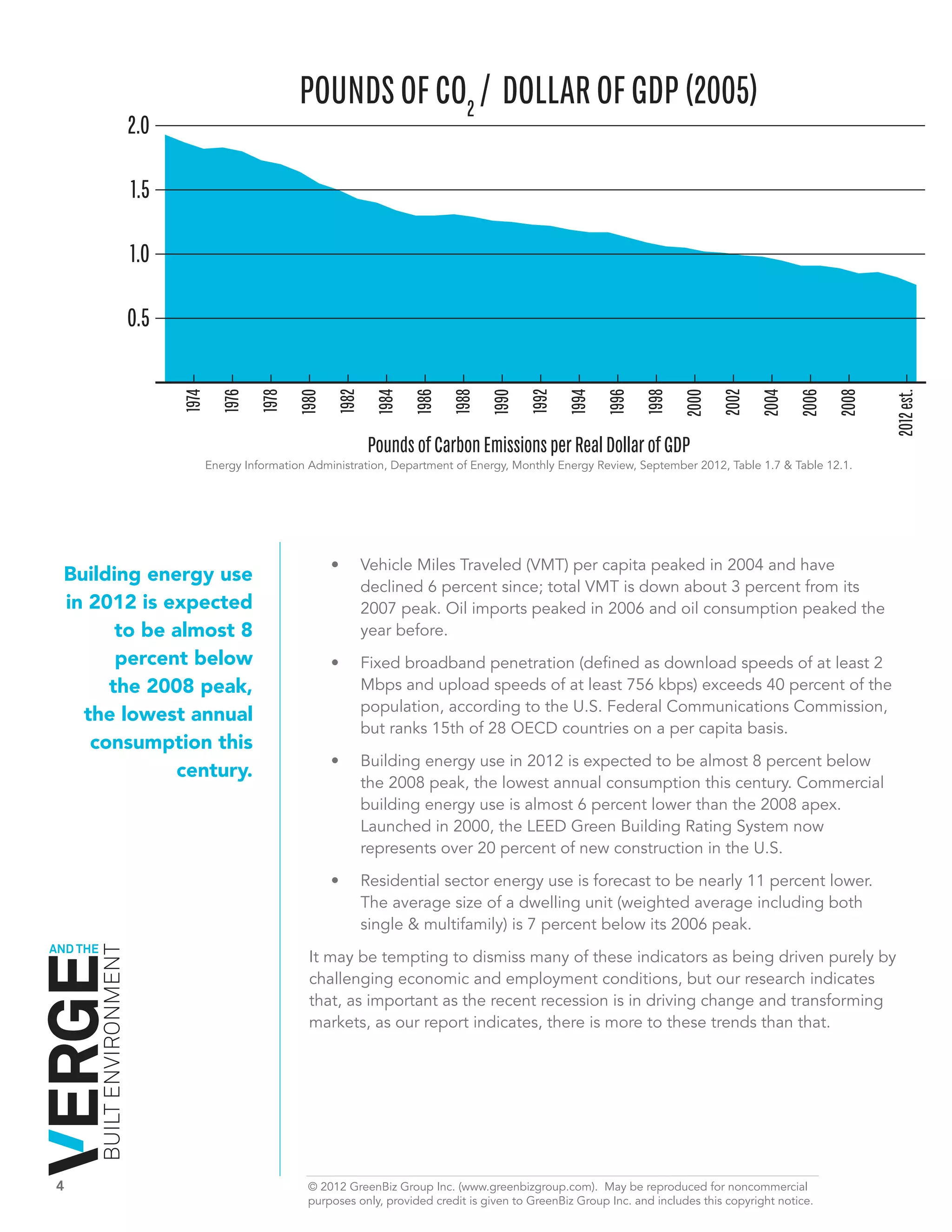
                                                            	 rojected 2012 CO2 emissions in the United States are on track to be
                                                            about 14 percent lower than the 2007 peak. In terms of emissions per
                                                            real dollar1 of GDP, the rate has decreased steadily since the 1973-74
AND THE
          BUILT ENVIRONMENT


                                                            oil embargo — from 1.93 pounds per dollar of GDP to a forecast 0.76
                                                            pounds in 20122 — except for odd year or two when the recession
                                                            sapped economic growth more than the regular improvement of energy
                                                            efficiency. Energy consumption per dollar of GDP shows a very similar
                                                            trend from 15.41 kBtu down to 7.48 kBtu per real dollar of GDP.

                                                  1 “Real” dollars are adjusted for inflation. We used the figures in the Monthly Energy Review (MER) September
                                                  2012 based on chained 2005 dollars. Table 1.7.

                                                  2 2012 GDP figures assume a 1.9% growth rate (Bloomberg, October 15th); CO2 figures are based on YTD fig-
                                                  ures for Buildings (Residential & Commercial), Transportation and Industry derived from the MER report.


3	                                                © 2012 GreenBiz Group Inc. (www.greenbizgroup.com). May be reproduced for noncommercial
	                                                 purposes only, provided credit is given to GreenBiz Group Inc. and includes this copyright notice.
POUNDS OF CO2 / DOLLAR OF GDP (2005)
                                  2.0

                                  1.5

                                  1.0

                                  0.5


2012 est.
                                        1974

                                                 1976

                                                        1978

                                                               1980

                                                                      1982

                                                                              1984

                                                                                     1986

                                                                                            1988

                                                                                                    1990

                                                                                                           1992

                                                                                                                   1994

                                                                                                                          1996

                                                                                                                                 1998

                                                                                                                                         2000

                                                                                                                                                2002

                                                                                                                                                        2004

                                                                                                                                                               2006

                                                                                                                                                                      2008


                                                                                                                                                                             2012 est.
                                                                             Pounds of Carbon Emissions per Real Dollar of GDP
                                               Energy Information Administration, Department of Energy, Monthly Energy Review, September 2012, Table 1.7 & Table 12.1.


                                                                      •	     Vehicle Miles Traveled (VMT) per capita peaked in 2004 and have
        Building energy use
                                                                             declined 6 percent since; total VMT is down about 3 percent from its
        in 2012 is expected                                                  2007 peak. Oil imports peaked in 2006 and oil consumption peaked the
              to be almost 8                                                 year before.
              percent below                                           •	     Fixed broadband penetration (defined as download speeds of at least 2
             the 2008 peak,                                                  Mbps and upload speeds of at least 756 kbps) exceeds 40 percent of the
                                                                             population, according to the U.S. Federal Communications Commission,
          the lowest annual
                                                                             but ranks 15th of 28 OECD countries on a per capita basis.
           consumption this
                                                                      •	     B
                                                                             	 uilding energy use in 2012 is expected to be almost 8 percent below
                    century.
                                                                             the 2008 peak, the lowest annual consumption this century. Commercial
                                                                             building energy use is almost 6 percent lower than the 2008 apex.
                                                                             Launched in 2000, the LEED Green Building Rating System now
                                                                             represents over 20 percent of new construction in the U.S.

                                                                      •	     Residential sector energy use is forecast to be nearly 11 percent lower.
                                                                             The average size of a dwelling unit (weighted average including both
                                                                             single & multifamily) is 7 percent below its 2006 peak.
    AND THE
              BUILT ENVIRONMENT


                                                                  It may be tempting to dismiss many of these indicators as being driven purely by
                                                                  challenging economic and employment conditions, but our research indicates
                                                                  that, as important as the recent recession is in driving change and transforming
                                                                  markets, as our report indicates, there is more to these trends than that.


    4	                                                           © 2012 GreenBiz Group Inc. (www.greenbizgroup.com). May be reproduced for noncommercial
    	                                                            purposes only, provided credit is given to GreenBiz Group Inc. and includes this copyright notice.
The Big Picture Enabled by technology, changing demographics and individual
                                                                preferences, companies are trying to squeeze more out of the space they
                                                                have, rather than squeezing out more space. This trend toward greater asset
                                                                utilization is most evident in the office sector, through we see signs of this in
                                                                retail buildings, schools, and homes, which are increasingly becoming part-
                                                                time workspaces. Most corporate real estate professionals see their portfolio
                                                                contracting, not expanding, in the near term.
                              Buildings: Doing More with Less   Average office space per person is steadily declining and forecast to drop
                                                                more than 30 percent in the next five years. Big-box retailers are downsizing
                                                                their stores, in some cases as much as 40 percent, and adopting urban location
                                                                strategies rather than a strictly suburban/rural approach. (If this trend fully
                                                                evolves, we may need to rethink the “big box” moniker.) In U.S. homes, the size
                                                                of an average new residential unit is down more than 7 percent since 2006.3

                                                                The Drivers In the 2008-2011 Green Building Market and Impact Report, we
                                                                wrote extensively about drivers of building energy efficiency, including the LEED
                                                                Green Building Rating System and its interplay with the ASHRAE national energy
                                                                standard. We believe that these standards will continue to be quite influential in
                                                                the building sector and continue contributing to its lower energy intensity.

                                                                According to Richard Kadzis, CoreNet Global’s Vice President of Strategic
                                                                Communications, the backdrop of continuing economic uncertainty and cost
                                                                containment are two principal drivers of greater asset utilization. However,
                                                                demographic trends are also playing a bigger role, with strong growth in close
                                                                — in urban centers compared with suburban or far suburban areas.

                                                                For starters, commercial building vacancy rates remain stubbornly high after
                                                                the official end to the recession in 2009. While there is some prospect of
                                                                accelerating construction activity over the next few years, the amount of new
                                                                floor space is expected to remain weak. With real estate budgets stretched,
                                                                companies are cutting back on their square footage.

                                                                Technology also is enabling companies to reduce or eliminate permanent space
                                                                per employee. Instead, they have unassigned space that can change daily,
                                                                assigned on a first-come, first-serve basis, or depending upon the need for
                                                                collaborative and team activities. ICT has facilitated both the more-efficient use
                                                                of space through online reservations and also the ability to work remotely.
                                                                But ICT doesn’t do it all: There is a new job position called a “hoteling
                                                                coordinator,” which has been advertised on behalf of Deloitte, Booz Allen
                                                                Hamilton and Ernst & Young, among other firms with large numbers of mobile
                                                                employees. And retailers are beginning to adapt a dual strategy where shoppers
                                                                can come to a physical location to preview and test actual merchandise, which
AND THE
          BUILT ENVIRONMENT


                                                                can be ordered online and delivered to their home with the physical stock being
                                                                located in cheaper warehouse space, perhaps miles away.

                                                                Telework is growing in both government and the private sector, although there
                                                                is not one fixed definition of “telework.” At one end of the spectrum is the
                                                                definition where people work at home at least one day a week, a cohort that
                                                                the Telework Research Network says is growing almost 60 percent per year and
                                                                now encompasses 20-30 million people. More conservative estimates from IDC
                                                                Research — where telecommuters work from home at least 3 days a week — as
                                                                3 Calculations based on US Census Data, Table Q1, Characteristics of New Housing

5	                                                              © 2012 GreenBiz Group Inc. (www.greenbizgroup.com). May be reproduced for noncommercial
	                                                               purposes only, provided credit is given to GreenBiz Group Inc. and includes this copyright notice.
reported in the 2012 State of Green Business report found that telecommuting
                              grew slightly in 2011, from 8.5 million to 8.6 million households.

                              Not surprisingly, telework is quite common in the tech industry, but it also has
                              found adherents in other sectors. In addition to the reduced need for floor
                              space, telework has been credited with reducing absenteeism, improving
                              recruitment, particularly among younger workers who prize flexibility, and
           There is a new     reducing turnover. Many corporate managers continue to be suspicious of
             job position     telework, however. For example, per-employee savings notwithstanding,
                              according to a study by the MIT Sloan School of Management, telecommuters
       called a “hoteling     — rightly or wrongly — are slightly less likely to get promoted. As the 2012
     coordinator,” which      State of Green Business report noted, “Distrust among middle managers is the
    has been advertised       biggest hurdle to growing the ranks of telecommuters.”
             on behalf of     The Impact Overall energy use for buildings should continue to decline, but
    Deloitte, Booz Allen      energy intensity of buildings could rise as space is more intensively utilized.
                              On a macro level, we expect that less floor area will be built for both living and
     Hamilton and Ernst       commerce, which could result in lower overall real estate costs for companies.
        & Young, among        This will allow them to locate in denser, and more expensive, urban cores.
        other firms with      Retailers — including giants such as Walmart, Target, and Best Buy — have been
       large numbers of       shrinking their footprints for a while, gaining more revenue per square foot while
      mobile employees.       reducing overhead. Indeed, some are pursuing a much more urban strategy.
                              Downsizing and urban relocation have affected regional malls, some of which
                              are starting to diversify to include health care and government services, even
                              residential. This trend could have interesting implications for suburban office
                              parks and malls, allowing them to evolve into mixed-use “town centers.”

                              This would not be inconsistent with residential building trends. Living units
                              on average already are 7 percent smaller today and much more likely to be
                              multifamily than five years ago. The amount of occupied commercial floor space
                              per dollar of GDP is at historic lows.

                              Where It’s Headed According to the 2012 Human Capital and Work-Related
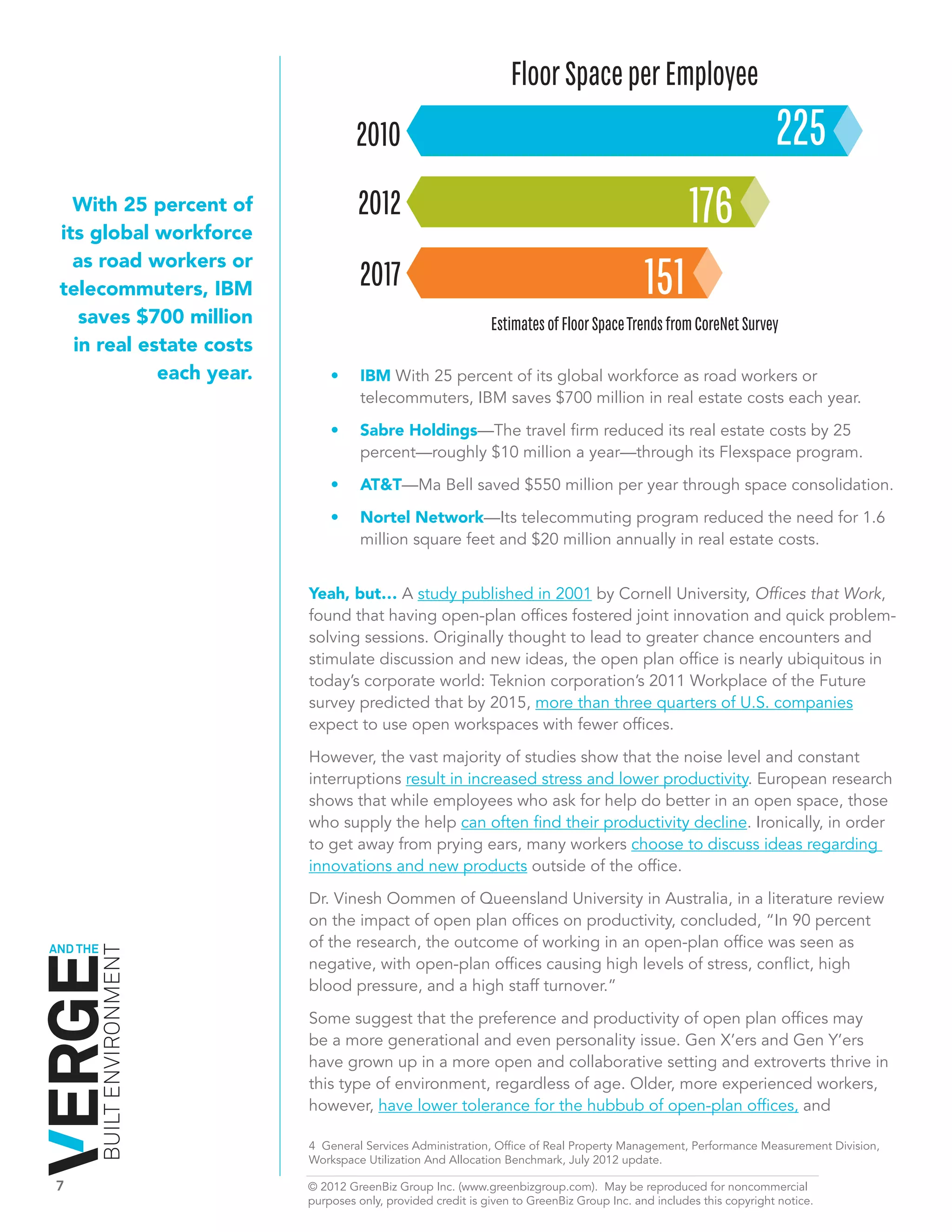
                              Quality of Life survey by CoreNet, the average space allocated office workers
                              across all companies in 2017 is forecast to be 151 square feet, compared to
                              176 square feet today and 225 square feet in 2010. Indeed, 40 percent of the
                              companies surveyed by CoreNet anticipated having average office area of
                              100 square feet or less within five years. For companies that have adopted a
                              comprehensive mobile technology strategy, this figure could be as low as 50
                              square feet per employee, according to Jones Lang LaSalle.

                              An office space benchmarking survey conducted by the General Services
                              Administration showed a 2010 average of 200 square feet of usable space per
AND THE
          BUILT ENVIRONMENT


                              person in the private sector, compared with a 190-square-feet benchmark in
                              government.4 But the GSA office consolidation and upgrade project (currently
                              on hold) was benchmarked at approximately 80 square feet per employee.

                              Key Players A growing number of companies and government departments are
                              stressing “smaller but smarter” workplaces that rely not only on open, flexible
                              space but also heavy reliance on telework strategies. Leaders include:

                                  •	    The federal government is a major adopter of space consolidation and
                                        promoting telework. For example, the U.S. Patent & Trademark Office
                                        expects to save $1.5 million a year thorough offering flexible workspace.

6	                            © 2012 GreenBiz Group Inc. (www.greenbizgroup.com). May be reproduced for noncommercial
	                             purposes only, provided credit is given to GreenBiz Group Inc. and includes this copyright notice.
Floor Space per Employee
                                       2010 675=      225
      With 25 percent of               2012 528=  176
    its global workforce

                                       2017 453=
                                              151
      as road workers or
    telecommuters, IBM
       saves $700 million                                        Estimates of Floor Space Trends from CoreNet Survey
      in real estate costs
                each year.        •	    IBM With 25 percent of its global workforce as road workers or
                                        telecommuters, IBM saves $700 million in real estate costs each year.

                                  •	    Sabre Holdings—The travel firm reduced its real estate costs by 25
                                        	
                                        percent—roughly $10 million a year—through its Flexspace program.

                                  •	    AT&T—Ma Bell saved $550 million per year through space consolidation.
                                        	

                                  •	    Nortel Network—Its telecommuting program reduced the need for 1.6
                                        million square feet and $20 million annually in real estate costs.


                              Yeah, but… A study published in 2001 by Cornell University, Offices that Work,
                              found that having open-plan offices fostered joint innovation and quick problem-
                              solving sessions. Originally thought to lead to greater chance encounters and
                              stimulate discussion and new ideas, the open plan office is nearly ubiquitous in
                              today’s corporate world: Teknion corporation’s 2011 Workplace of the Future
                              survey predicted that by 2015, more than three quarters of U.S. companies
                              expect to use open workspaces with fewer offices.

                              However, the vast majority of studies show that the noise level and constant
                              interruptions result in increased stress and lower productivity. European research
                              shows that while employees who ask for help do better in an open space, those
                              who supply the help can often find their productivity decline. Ironically, in order
                              to get away from prying ears, many workers choose to discuss ideas regarding
                              innovations and new products outside of the office.

                              Dr. Vinesh Oommen of Queensland University in Australia, in a literature review
                              on the impact of open plan offices on productivity, concluded, “In 90 percent
AND THE                       of the research, the outcome of working in an open-plan office was seen as
          BUILT ENVIRONMENT


                              negative, with open-plan offices causing high levels of stress, conflict, high
                              blood pressure, and a high staff turnover.”

                              Some suggest that the preference and productivity of open plan offices may
                              be a more generational and even personality issue. Gen X’ers and Gen Y’ers
                              have grown up in a more open and collaborative setting and extroverts thrive in
                              this type of environment, regardless of age. Older, more experienced workers,
                              however, have lower tolerance for the hubbub of open-plan offices, and

                              4 General Services Administration, Office of Real Property Management, Performance Measurement Division,
                              Workspace Utilization And Allocation Benchmark, July 2012 update.

7	                            © 2012 GreenBiz Group Inc. (www.greenbizgroup.com). May be reproduced for noncommercial
	                             purposes only, provided credit is given to GreenBiz Group Inc. and includes this copyright notice.
introverts need some sort of privacy and seclusion to be productive.

                                           Unfortunately, green office space is not likely to solve many of the issues
                                           surrounding open-plan offices. For a variety of resource conservation reasons,
                                           the majority of green office space is open plan. A 2007 study of LEED
                                           certified office space by the Center for the Built Environment at the University
                                           of California shows that, although they perform better on most indoor
                                           environmental quality metrics, they are acoustically inferior.

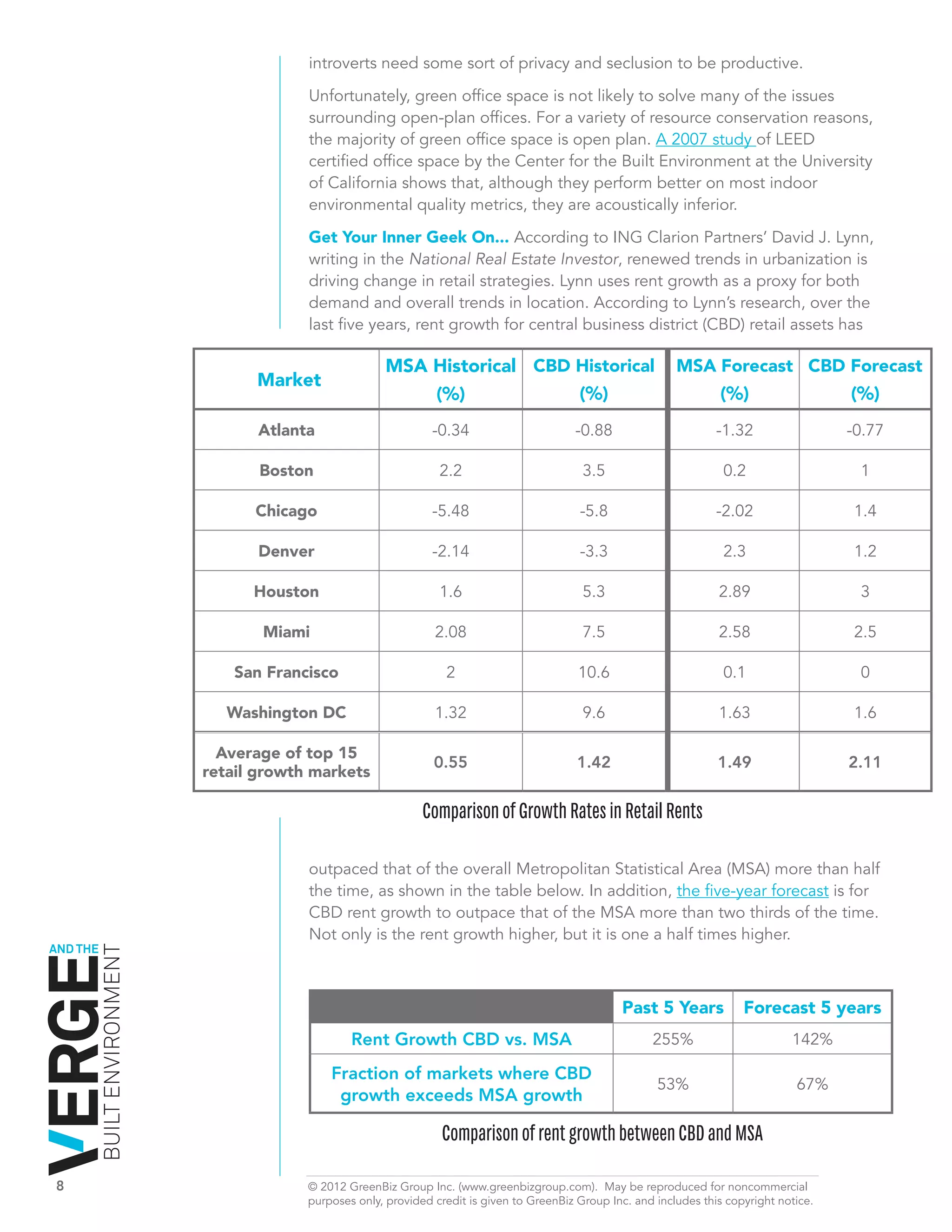
                                           Get Your Inner Geek On... According to ING Clarion Partners’ David J. Lynn,
                                           writing in the National Real Estate Investor, renewed trends in urbanization is
                                           driving change in retail strategies. Lynn uses rent growth as a proxy for both
                                           demand and overall trends in location. According to Lynn’s research, over the
                                           last five years, rent growth for central business district (CBD) retail assets has

                                                          MSA Historical CBD Historical                           MSA Forecast CBD Forecast
                                     Market
                                                              (%)            (%)                                          (%)                   (%)
                                    Atlanta                        -0.34                      -0.88                       -1.32                 -0.77

                                     Boston                         2.2                         3.5                        0.2                   1

                                    Chicago                        -5.48                       -5.8                       -2.02                 1.4

                                    Denver                         -2.14                       -3.3                        2.3                  1.2

                                    Houston                         1.6                         5.3                       2.89                   3

                                     Miami                         2.08                         7.5                       2.58                  2.5

                                 San Francisco                       2                         10.6                        0.1                   0

                                 Washington DC                     1.32                         9.6                       1.63                  1.6

                                Average of top 15
                                                                   0.55                        1.42                       1.49                  2.11
                              retail growth markets

                                                                 Comparison of Growth Rates in Retail Rents

                                           outpaced that of the overall Metropolitan Statistical Area (MSA) more than half
                                           the time, as shown in the table below. In addition, the five-year forecast is for
                                           CBD rent growth to outpace that of the MSA more than two thirds of the time.
                                           Not only is the rent growth higher, but it is one a half times higher.
AND THE
          BUILT ENVIRONMENT


                                                                                                       Past 5 Years            Forecast 5 years
                                                   Rent Growth CBD vs. MSA                                   255%                       142%

                                               Fraction of markets where CBD
                                                                                                              53%                        67%
                                                growth exceeds MSA growth

                                                                    Comparison of rent growth between CBD and MSA

8	                                         © 2012 GreenBiz Group Inc. (www.greenbizgroup.com). May be reproduced for noncommercial
	                                          purposes only, provided credit is given to GreenBiz Group Inc. and includes this copyright notice.
ESREVER MIGRATION
                               As urban environments become more livable, many corporations are reversing
                                           the suburban flight of 30 years ago. Some examples:


                                                      United Airlines
                                                      The airline has signed one of the largest leases in Chicago history in the
                                                      Willis Tower, leasing 830,000 square feet through 2028.


                                                      Sara Lee
                                                      In 2005, the company moved out of its 60-year home in Chicago for
                                                      Downer’s Grove, a suburb. However, the company has announced that in
                                                      2013 it plans to relocate 500–650 employees back to downtown Chicago.


                                                      Amazon.com
                                                      The online retailer’s new headquarters, totaling 1.7 million square feet in 11
                                                      buildings, is located on a Seattle streetcar line, providing direct access to
                                                      the city’s airport.


                                                      Salesforce.com
                                                      announced in 2010 that the company spent more than $270 million to buy
                                                      14 acres in San Francisco’s Mission Bay to build a two million-square-foot
                                                      headquarters. However, in early 2012 the company abandoned its plans
                                                      for building the project, opting to remain in and expand its downtown San
                                                      Francisco presence in 3 newly available buildings that would give them
                                                      nearly the space of Mission Bay several years before that project would
                                                      be ready. According to an article in Forbes, Salesforce CEO Marc Benioff
                                                      noted “We can attract extraordinary talent [to San Francisco]. It’s not Silicon
                                                      Valley, the flatlands.”

                                                      Zappos
                                                      is scheduled to move 1,200 employees to downtown Las Vegas in 2013
                                                      from suburban Henderson.

                                                      Motorola
                                                      is moving all of its 3,000 Mobility division employees outside Chicago to
                                                      downtown, taking over several top floors of the LEED-certified
AND THE                                               Merchandize Mart.
          BUILT ENVIRONMENT


                                     Many fast-growing startups are opting for downtowns, sometimes settling in
                                             sub-prime parts of town. Downtown Internet firms include:
                                  Zynga (San Francisco) • Square (San Francisco) • Tumblr (New York)
                                             Pinterest (Palo Alto) • Twitter (San Francisco)


9	                            © 2012 GreenBiz Group Inc. (www.greenbizgroup.com). May be reproduced for noncommercial
	                             purposes only, provided credit is given to GreenBiz Group Inc. and includes this copyright notice.
The Big Picture With the advent of always-on, high-speed and mobile
                                                                       communication, it is possible to have nearly continuous access to people,
                                                                       work, goods and services from anywhere. Two very large demographic cohorts
                                                                       — retiring Baby Boomers (those between 47 to 67 years old) and coming-of-
                                                                       age “echo boomers” (a.k.a. Generation Y, ages 18 to 34) — are expressing
                                                                       preferences for the compact, diverse opportunities available in denser urban
                                                                       environments, mean that they are choosing access over mobility.
                              Transportation: Access Trumps Mobility   For the younger generation, this choice appears to be reinforced by the fact that
                                                                       in 2011 Gen Y’ers bought 30 percent fewer cars than were sold to this cohort
                                                                       4 years ago, and adults in the 35-44 age range curbed their car-buying by 25
                                                                       percent, while losing a large number of licensed drivers. This indicates that many
                                                                       younger people are eschewing the physical access from remote locations that
                                                                       cars gave earlier generations in favor of the access provided by virtual mobility.
                                                                       Public transit, car-sharing, bicycling, and walking are just a few of the preferred
                                                                       options for sustainable mobility among younger people.

                                                                       Ania Wieskowski outlined in the Harvard Business Review the many physical,
                                                                       mental and cultural problems with suburban living, and notes that almost two-
                                                                       thirds of college-educated job-seekers locate first to where they want to be:
                                                                       the cities, which have quick physical access to a variety of goods and services
                                                                       without having to rely on a car, then they find a good job.

                                                                       The Drivers Before automobiles became a dominant element of American
                                                                       society, if people wanted to see someone or get something, they simply walked
                                                                       to their neighbor’s house, or to the relatively convenient town/city center. With
                                                                       the advent of sprawling suburbs and automobile transportation, access, in terms
                                                                       of time, grew significantly in spatial terms.

                                                                       Earlier this year, Time.com reporter Brad Tuttle wrote about eight key influences
                                                                       on America’s driving habits, which we group here by VERGE category with
                                                                       commentary based on our research:

                                                                       ICT

                                                                       •	 Telecommuting: As noted above, for reasons of greater access and cost
                                                                          savings, more and more companies are embracing at least part-time
                                                                          telecommuting.

                                                                       •	 Online shopping: Online shopping continues to grow by double digits
                                                                          annually, but retailers are finding ways to consolidate their real estate
                                                                          footprint and take advantage of an online component in conjunction with
                                                                          their physical properties. A 2008 Carnegie Mellon study updated last year
                                                                          found that online shopping had a lower environmental footprint than in-store
AND THE                                                                   shopping principally because of the reduced transportation footprint.
          BUILT ENVIRONMENT


                                                                       •	 Information technology: Another side	of the online shopping coin, what we
                                                                          call “informational access,” allows people to interact socially without being
                                                                          physically together.

                                                                       •	 Home entertainment: Numbers vary, but the electronic gaming industry in
                                                                          the United States is 60 percent to 70 percent larger than the film industry in
                                                                          terms of revenue. Add to this a wide array of cable and online entertainment
                                                                          options and it is no longer necessary to leave the home for this type of
                                                                          entertainment.

10	                                                                    © 2012 GreenBiz Group Inc. (www.greenbizgroup.com). May be reproduced for noncommercial
	                                                                      purposes only, provided credit is given to GreenBiz Group Inc. and includes this copyright notice.
Transportation

                               •	 Gas prices: There is no doubt that gas prices influence behavior in the short
                                  run, but as noted below, the overall cost of driving is still considerably below
                                  that of a decade ago, in inflation-adjusted terms. Perhaps the confluence
                                  of rising ownership costs and the other trends mentioned will combine to
                                  moderate, if not reverse, America’s half-century-long increase in annual
 The trends of urban              vehicle miles traveled.
     densification and         •	 Traffic: Although traffic is worse than the 1982 baseline — “wasted time” is
      growing access              about 15 percent greater across the 400+ urban areas studied — congestion
                                  conditions have actually improved slightly since the year 2000, according to
        to broadband
                                  research by Texas A&M University. Of course, your congestion may vary.
      information are
                              Buildings
 affecting two of the
largest demographic            •	 Shift to urban living: As noted above, the trends of urban densification and
                                  growing access to broadband information networks are affecting two of the
   cohorts in the U.S:            largest demographic cohorts in the United States: retiring “empty nest”
  Baby Boomers and                Baby Boomers and the 18-to-34-year-old Gen Y “Echo Boomers.” As part of
    the 18-to-34-year-            wide-ranging livability programs, many urban areas are significantly increasing
                                  the physical and informational infrastructure to support non-motorized
     old Gen Y “Echo
                                  transportation and trips. Research by William Frey of the Brookings Institution
            Boomers.”             indicates that the annual population growth rate in exurban and suburban
                                  areas has declined precipitously from over 2 percent to below 1 percent since
                                  the late 2000s. At the same time, city and high-density suburban populations
                                  have climbed significantly, from negative growth in 2006 to growth rates of
                                  nearly 1 percent today, equaling or surpassing their less-dense counterparts.
                               •	 Employment trends: Of course, employment — or lack thereof — impacts
                                  transportation trends. And although unemployment remains high, the
                                  improving job growth since 2009 has not resulted in a resumption of car
                                  travel. Interestingly, the decrease in energy and carbon emissions from
                                  transportation accelerated in 2012, which could mean that a virtuous cycle
                                  — urban job growth, substituting virtual or non-motorized access for mobility
                                  and continued improvement in auto fuel economy — will keep transportation-
                                  related energy and carbon emissions low amid economic recovery.

                              The Impact There are contradictory trends regarding peoples’ use of
                              transportation services. So, while it is premature to say that America’s love affair
                              with the automobile has ended, certainly the honeymoon is over.

                              On the one hand, vehicle miles traveled — both for personal vehicles as well as
                              heavy trucks, including long–haul transport and local delivery — have declined
AND THE                       over the last few years. Clearly, the trucking industry has been hit by higher fuel
          BUILT ENVIRONMENT


                              prices and the recession since 2007 but large fleets such as UPS and FedEx also
                              have improved the energy efficiency of their fleets.
                              On the other hand, although fuel prices have risen sharply since 2009, the cost
                              in inflation-adjusted dollars for driving 15,000 miles, including both fixed and
                              variable costs, is about the same as it was in 1996 and considerably lower than it
                              was a decade ago.

                              Fuel economy for the personal vehicle fleet (including light trucks) is the highest
                              on record. If FedEx and UPS and the major airlines are any indication, there are

11	                           © 2012 GreenBiz Group Inc. (www.greenbizgroup.com). May be reproduced for noncommercial
	                             purposes only, provided credit is given to GreenBiz Group Inc. and includes this copyright notice.
aggressive efforts underway to upgrade truck and air fleets, which also includes
                              fuel-switching in ground vehicles.

                              Where It’s Headed We believe that workplace policy, demographic,
                              urbanization and pricing trends will continue to put downward pressure on the
                              use of private transportation. Non-motorized transportation, such as walking and
                              bicycling, will continue to grow as cities become more walking and bike friendly.
            We expect to      Although still a relatively small portion of commuting trips, the use of mass
              see greater     transit for non-work-related trips has grown significantly. In addition, walking and
            development       bicycling trips are significantly above the levels of the decade ago, in part due
                              to greater urbanization.
    concentration in the
     more vibrant areas       We believe that urbanization trends of the U.S. population will continue,
                              though not necessarily in the denser central business districts (CBDs) that are
     of larger cities that
                              considerably more expensive to develop. Significant opportunity remains in
      will cluster around     the CBDs of many of the northeastern U.S. cities that suffered population loss
       the fringes of the     over the last three decades. But in the near future we expect to see greater
       existing fixed-rail    development concentration in the more vibrant areas of larger cities that will
                              cluster around the fringes of the existing fixed-rail transportation networks, such
           transportation     as commuter rail, streetcars and subways.
                networks.
                              We also see huge potential for new transit patterns being developed around
                              and between office parks and shopping malls where sufficient density exists.
                              On the vehicle front, one of the key takeaways from a 2012 KPMG survey of
                              global automotive executives is that we are beginning to move into an era of
                              car usership and out of the era of car ownership. This trend is consistent with the
                              overall global movement of the share economy, or what the VERGE speaker, Lisa
                              Gansky, calls “The Mesh,” the title of her 2010 book.
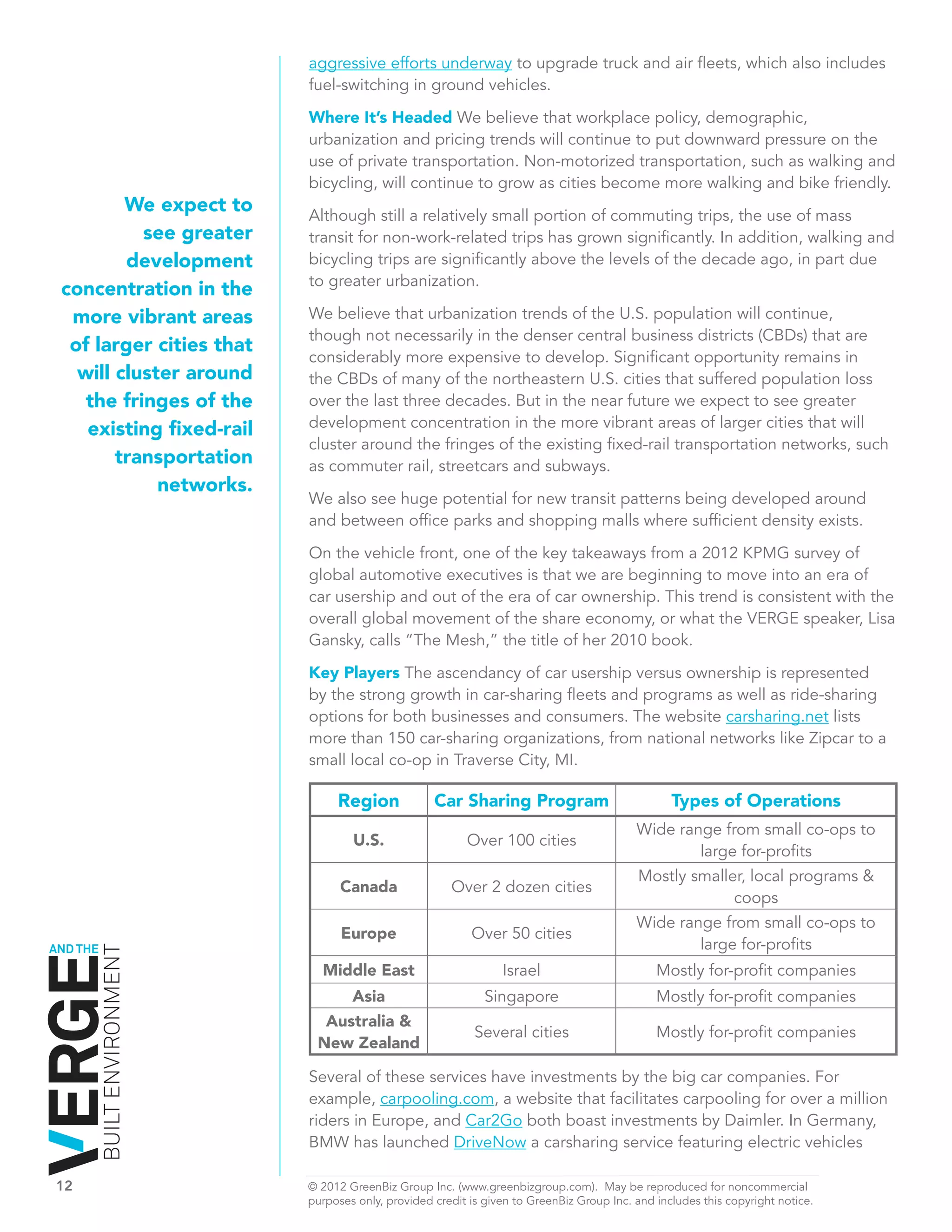
                              Key Players The ascendancy of car usership versus ownership is represented
                              by the strong growth in car-sharing fleets and programs as well as ride-sharing
                              options for both businesses and consumers. The website carsharing.net lists
                              more than 150 car-sharing organizations, from national networks like Zipcar to a
                              small local co-op in Traverse City, MI.

                                   Region             Car Sharing Program                           Types of Operations
                                                                                             Wide range from small co-ops to
                                      U.S.                  Over 100 cities
                                                                                                     large for-profits
                                                                                             Mostly smaller, local programs &
                                    Canada               Over 2 dozen cities
                                                                                                          coops
                                                                                             Wide range from small co-ops to
                                    Europe                   Over 50 cities
AND THE                                                                                              large for-profits
          BUILT ENVIRONMENT


                                Middle East                        Israel                        Mostly for-profit companies
                                      Asia                      Singapore                        Mostly for-profit companies
                                Australia &
                                                              Several cities                     Mostly for-profit companies
                               New Zealand

                              Several of these services have investments by the big car companies. For
                              example, carpooling.com, a website that facilitates carpooling for over a million
                              riders in Europe, and Car2Go both boast investments by Daimler. In Germany,
                              BMW has launched DriveNow a carsharing service featuring electric vehicles

12	                           © 2012 GreenBiz Group Inc. (www.greenbizgroup.com). May be reproduced for noncommercial
	                             purposes only, provided credit is given to GreenBiz Group Inc. and includes this copyright notice.
and recently debuted the service in San Francisco. Ford and Zipcar have jointly
                                        launched a program targeted at universities, and GM has investments with the
                                        peer-to-peer company RelayRides. The large rental companies are also getting
                                        into the act, with Hertz-on-Demand launching into a dozen cities.

                                        City-Go-Round, which is funded by the Rockefeller Foundation, has an excellent
                                        website (www.citygorround.org) principally dedicated to urban and suburban
        It seems almost                 transit mobility that has almost 180 apps for transit (143) walking and biking (21)
       an article of faith              and driving (13).

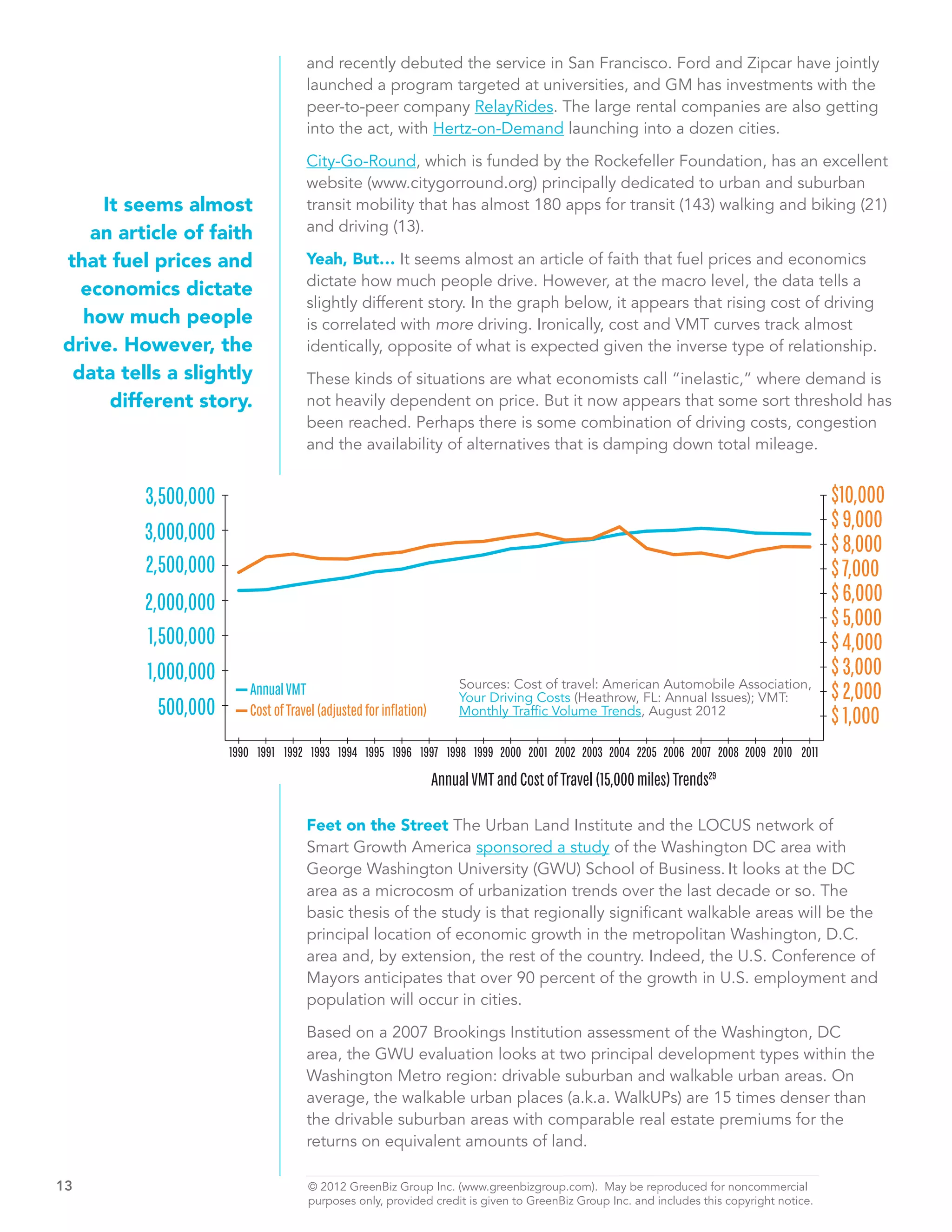
    that fuel prices and                Yeah, But… It seems almost an article of faith that fuel prices and economics
                                        dictate how much people drive. However, at the macro level, the data tells a
      economics dictate
                                        slightly different story. In the graph below, it appears that rising cost of driving
      how much people                   is correlated with more driving. Ironically, cost and VMT curves track almost
    drive. However, the                 identically, opposite of what is expected given the inverse type of relationship.
     data tells a slightly              These kinds of situations are what economists call “inelastic,” where demand is
         different story.               not heavily dependent on price. But it now appears that some sort threshold has
                                        been reached. Perhaps there is some combination of driving costs, congestion
                                        and the availability of alternatives that is damping down total mileage.


             3,500,000                                                                                                                       $10,000
                                                                                                                                             $ 9,000
             3,000,000
                                                                                                                                             $ 8,000
             2,500,000                                                                                                                       $ 7,000
             2,000,000                                                                                                                       $ 6,000
                                                                                                                                             $ 5,000
             1,500,000                                                                                                                       $ 4,000
             1,000,000                                                                                                                       $ 3,000
                            Annual VMT                                     Sources: Cost of travel: American Automobile Association,
                                                                           Your Driving Costs (Heathrow, FL: Annual Issues); VMT:            $ 2,000
               500,000      Cost of Travel (adjusted for inflation)        Monthly Traffic Volume Trends, August 2012
                                                                                                                                             $ 1,000
                         1990 1991 1992 1993 1994 1995 1996 1997 1998 1999 2000 2001 2002 2003 2004 2205 2006 2007 2008 2009 2010 2011

                                                                      Annual VMT and Cost of Travel (15,000 miles) Trends29

                                        Feet on the Street The Urban Land Institute and the LOCUS network of
                                        Smart Growth America sponsored a study of the Washington DC area with
                                        George Washington University (GWU) School of Business. It looks at the DC
                                        area as a microcosm of urbanization trends over the last decade or so. The
                                        basic thesis of the study is that regionally significant walkable areas will be the
                                        principal location of economic growth in the metropolitan Washington, D.C.
                                        area and, by extension, the rest of the country. Indeed, the U.S. Conference of
                                        Mayors anticipates that over 90 percent of the growth in U.S. employment and
                                        population will occur in cities.

                                        Based on a 2007 Brookings Institution assessment of the Washington, DC
                                        area, the GWU evaluation looks at two principal development types within the
                                        Washington Metro region: drivable suburban and walkable urban areas. On
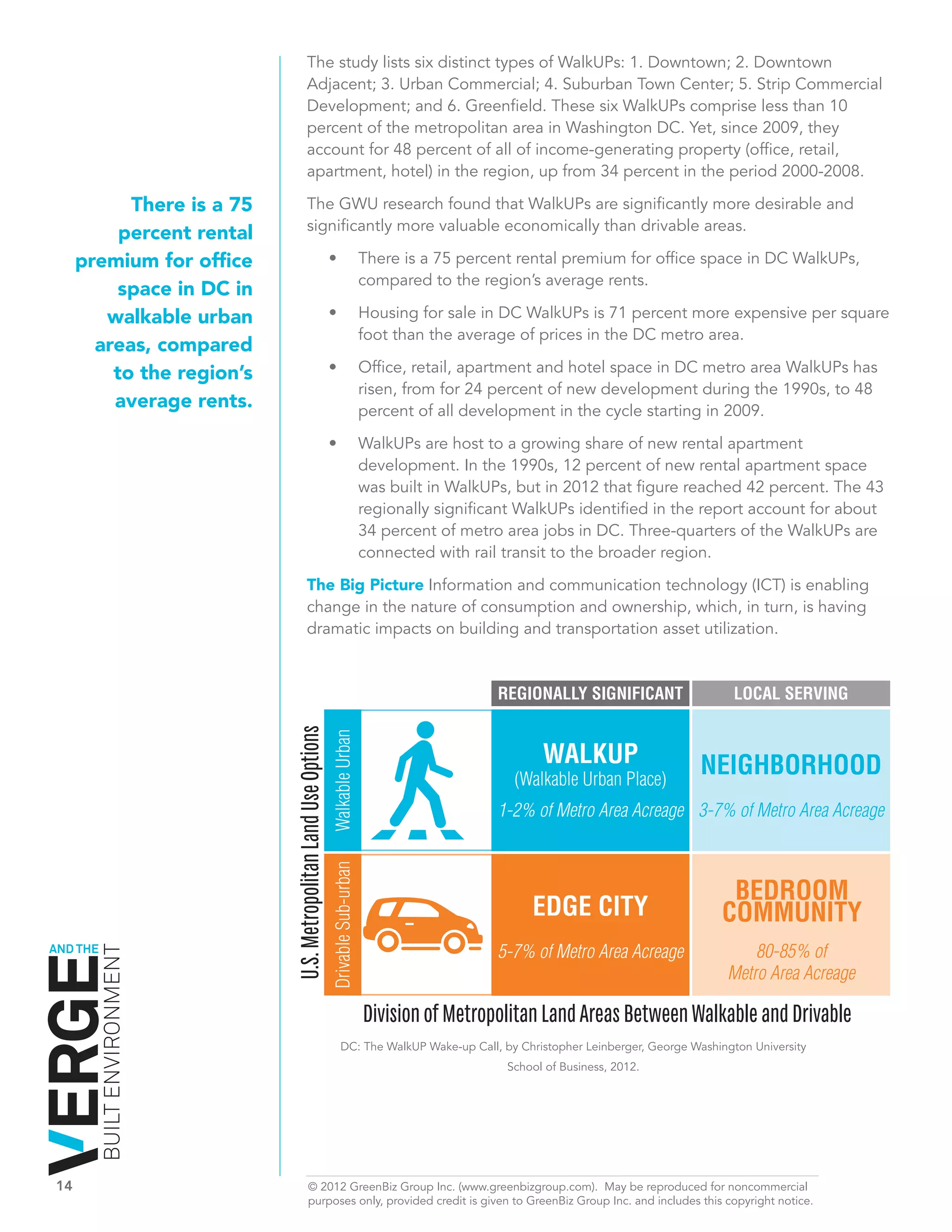
                                        average, the walkable urban places (a.k.a. WalkUPs) are 15 times denser than
                                        the drivable suburban areas with comparable real estate premiums for the
                                        returns on equivalent amounts of land.

13	                                     © 2012 GreenBiz Group Inc. (www.greenbizgroup.com). May be reproduced for noncommercial
	                                       purposes only, provided credit is given to GreenBiz Group Inc. and includes this copyright notice.
The study lists six distinct types of WalkUPs: 1. Downtown; 2. Downtown
                                            Adjacent; 3. Urban Commercial; 4. Suburban Town Center; 5. Strip Commercial
                                            Development; and 6. Greenfield. These six WalkUPs comprise less than 10
                                            percent of the metropolitan area in Washington DC. Yet, since 2009, they
                                            account for 48 percent of all of income-generating property (office, retail,
                                            apartment, hotel) in the region, up from 34 percent in the period 2000-2008.

          There is a 75                     The GWU research found that WalkUPs are significantly more desirable and
                                            significantly more valuable economically than drivable areas.
         percent rental
    premium for office                                             •	                   There is a 75 percent rental premium for office space in DC WalkUPs,
                                                                                        compared to the region’s average rents.
        space in DC in
       walkable urban                                              •	                   H
                                                                                        	 ousing for sale in DC WalkUPs is 71 percent more expensive per square
                                                                                        foot than the average of prices in the DC metro area.
      areas, compared
        to the region’s                                            •	                   O
                                                                                        	 ffice, retail, apartment and hotel space in DC metro area WalkUPs has
                                                                                        risen, from for 24 percent of new development during the 1990s, to 48
        average rents.                                                                  percent of all development in the cycle starting in 2009.

                                                                   •	                   W
                                                                                        	 alkUPs are host to a growing share of new rental apartment
                                                                                        development. In the 1990s, 12 percent of new rental apartment space
                                                                                        was built in WalkUPs, but in 2012 that figure reached 42 percent. The 43
                                                                                        regionally significant WalkUPs identified in the report account for about
                                                                                        34 percent of metro area jobs in DC. Three-quarters of the WalkUPs are
                                                                                        connected with rail transit to the broader region.

                                            The Big Picture Information and communication technology (ICT) is enabling
                                            change in the nature of consumption and ownership, which, in turn, is having
                                            dramatic impacts on building and transportation asset utilization.


                                                                                                           REGIONALLY SIGNIFICANT               LOCAL SERVING
                              U.S. Metropolitan Land Use Options
                                                                   Walkable Urban


                                                                                                                  WALKUP                  NEIGHBORHOOD
                                                                                                             (Walkable Urban Place)
                                                                                                           1-2% of Metro Area Acreage 3-7% of Metro Area Acreage
                                                                   Drivable Sub-urban


                                                                                                                                               BEDROOM
                                                                                                                EDGE CITY                     COMMUNITY
AND THE                                                                                                    5-7% of Metro Area Acreage              80-85% of
          BUILT ENVIRONMENT


                                                                                                                                               Metro Area Acreage

                                                                                        Division of Metropolitan Land Areas Between Walkable and Drivable
                                                                          DC: The WalkUP Wake-up Call, by Christopher Leinberger, George Washington University
                                                                                                            School of Business, 2012.


14	                                          © 2012 GreenBiz Group Inc. (www.greenbizgroup.com). May be reproduced for noncommercial
	                                            purposes only, provided credit is given to GreenBiz Group Inc. and includes this copyright notice.
After some initial (and ongoing) false-starts, ICT is beginning to catalyze the
                                                                                   remaking of the entire facility management industry. On the energy front, the
                                                                                   smart grid could have a potentially similar impact depending on whether the
                                                                                   intelligence is directed toward the building side (huge) or toward the utility side
                                                                                   (less significant) of the meter. Although buildings hold particular promise for the
                                                                                   efficiencies that can be realized from an ICT overlay, there is a mistaken belief
                                                                                   that ICT alone can solve the problem. It can’t.
                              Information and Communications: Catalyst & Enabler   In sum, ICT tools are necessary, and hold considerable promise for the built
                                                                                   environment, but insufficient without cultural or structural changes.

                                                                                   The Drivers One of the cornerstones in the theory of economic efficiency is that
                                                                                   perfect information is uniformly available and that rational decisions are made
                                                                                   solely based on that information and not subject to the context.5 One of the key
                                                                                   explanations of economic inefficiency is the lack of information or information
                                                                                   asymmetry. The spread of fixed and mobile broadband is putting near real-time
                                                                                   information into the hands of more and more people.

                                                                                   ICT is helping reduce the risk to individuals or companies that just because you
                                                                                   don’t “own” resources such as office space or a car, it doesn’t mean you won’t
                                                                                   have them when you need or want them. This means it is not necessary need to
                                                                                   over-consume or “over-own” resources just to guarantee access.

                                                                                   The Impact: Buildings and Urban Development Although dashboards don’t
                                                                                   save energy by themselves, they give insights to building operators that can
                                                                                   lead to eliminating waste. When combined with experienced and skilled
                                                                                   building operators, these insights can lead to more efficient and effective
                                                                                   building operations, though we would argue extent of these energy “savings”
                                                                                   remains somewhat unclear. Most faults detected through dashboards and
                                                                                   analytics should be caught in the course of routine building management. At the
                                                                                   end of the day, it’s the human action that saves the energy, not the information
                                                                                   that revealed the need to act. Clearly, good management makes a difference
                                                                                   and improved tools simply improve management. We have argued elsewhere
                                                                                   that the main goal of building analytics is to prevent ROI, not to create ROI.

                                                                                   The impact of increasing building instrumentation and control, however, is a
                                                                                   different matter. Putting intelligence and control on the building side of the
                                                                                   meter — at the individual building or building cluster level — in our opinion, is
                                                                                   what the “smart grid” is all about. It’s up to buildings themselves, not the grid,
                                                                                   to tune the size of their energy demand to their own needs. This can be helped,
                                                                                   of course, by pricing information from the grid.

                                                                                   The ability to continuously and automatically commission and tune building
                                                                                   services to their exact needs not only reduces maintenance costs significantly,
AND THE
          BUILT ENVIRONMENT


                                                                                   but also should lead to significant improvements in energy efficiency, with
                                                                                   the same caveats about “savings” noted above. In addition, soon we will see
                                                                                   building energy systems integrated and controllable down to the individual
                                                                                   device. Some highly tuned control systems are beginning to emerge, particularly
                                                                                   in lighting and crude space-by-space HVAC control.

                                                                                   Transportation The Telework Research Network estimates that economic

                                                                                   5 If you ever want to drive a conventional economist crazy, simply refer to the willingness to pay experiments
                                                                                   that show people are willing to pay vastly different sums of money for the identical product, simply because of
                                                                                   where they are purchasing the product.


15	                                                                                © 2012 GreenBiz Group Inc. (www.greenbizgroup.com). May be reproduced for noncommercial
	                                                                                  purposes only, provided credit is given to GreenBiz Group Inc. and includes this copyright notice.
savings of up to $10,000 per employee can be realized through a comprehensive
                              approach to telework. These savings range from increased productivity to lower
                              real estate costs and, on the employee front — you guessed it — lower gasoline
                              bills and car operating expenses. According to a survey of global automobile
                              executives done by KPMG, 63 percent think that convergence of TIME (Telecom,
                              IT, Media, Entertainment) and the auto industry is “inevitable.”

         According to a       Energy In an extensive study of the energy efficiency impacts of the smart grid,
       survey of global       Pacific National Northwest Laboratories estimated that reductions in electricity
                              sector energy and CO2 emissions could be reduced directly by approximately 12
            automobile        percent, while the indirect impacts would be approximately 6 percent.
       executives done
                              Where It’s Headed
          by KPMG, 63
                               •	 Transparency: ICT enables more freely available data and greater access
     percent think that
                                  to that information. Understanding operational data and how a building
        convergence of            is managed can help maximize resource efficiency. Information about key
    Telecom, IT, Media,           features, such as neighborhood walkability and amenities, is readily available
     Entertainment and            on the Internet, which helps focus and drive both residential and non-
                                  residential investment. Eventually, people both inside and out will know much
    the auto industry is          more about the building in real time or in terms of reviews. The growing trend
           “inevitable.”          of benchmarking energy consumption and public access to this information
                                  will play an increasing role in real estate markets. It is very easy to see how
                                  savvy owners could promote their buildings based on publicly benchmarked
                                  performance and “crowdsourced” opinions on conditions in certain buildings,
                                  not unlike what happens now with restaurant reviews.
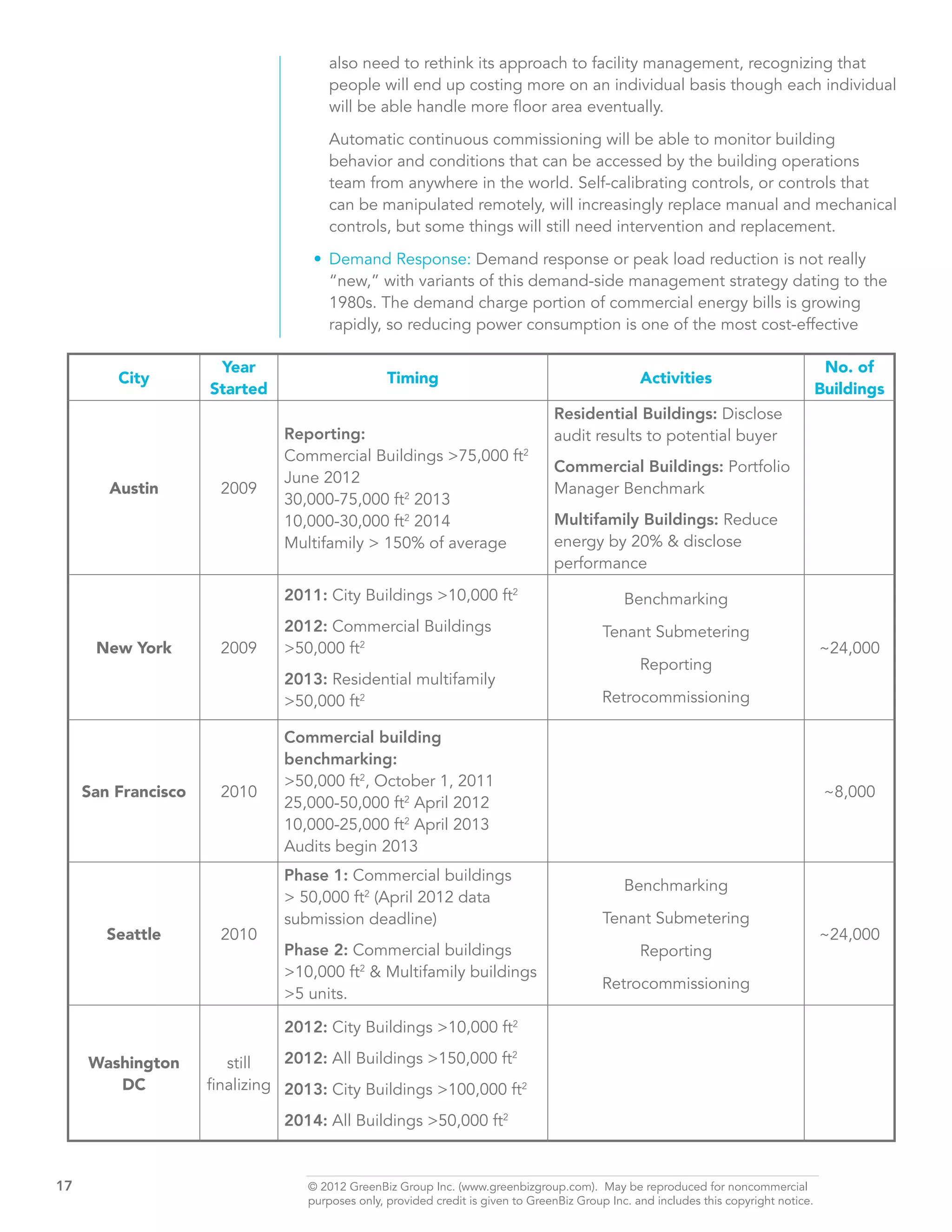
                               •	 Six cities: New York, Philadelphia, Washington DC, San Francisco, Austin,
                                  and Seattle, have requirements for commercial buildings greater than 50,000
                                  square feet to benchmark their energy use and to post it publicly. Some cities,
                                  such as New York, further require that energy audits and retro-commissioning
                                  efforts be undertaken. There are also some requirements for multifamily and,
                                  in the case of Austin, single-family residential buildings at the time of sale, to
                                  be benchmarked to help improve energy efficiency.

                               •	 Real-Time/Just-In-Time Management: Real-time data for building analytics as
                                  a first step in moving buildings toward “autopilot” is a scenario in which the
                                  traditional building operator could end up going the way of the telephone
                                  operator. But simply because there are no longer any phone operators does
                                  not mean that the telecom system runs itself. In the near future, different
                                  skill sets will be needed in building management that combine the ICT with
                                  hands-on field experience. This is not unlike the automotive industry, where
                                  diagnostics is now done principally or increasingly by plugging in to the
AND THE                           dataport, rather than listening to the engine. However, the best mechanics
          BUILT ENVIRONMENT


                                  also know what to listen for, as well as how to read and understand the
                                  computer diagnostic report.

                                  Also in the near future, people involved with facility management would need
                                  to have a significant combination of both ICT experience and mechanical
                                  knowledge. One of our worries is that the rush toward building automation
                                  and integration through ICT is getting ahead of the ability of the operations
                                  and maintenance field to successfully provide enough people with the proper
                                  skill sets to meet upcoming needs. This is part of the potential green job
                                  deficit noted by McGraw-Hill in its green employment study. Management will

16	                           © 2012 GreenBiz Group Inc. (www.greenbizgroup.com). May be reproduced for noncommercial
	                             purposes only, provided credit is given to GreenBiz Group Inc. and includes this copyright notice.
also need to rethink its approach to facility management, recognizing that
                                       people will end up costing more on an individual basis though each individual
                                       will be able handle more floor area eventually.

                                       Automatic continuous commissioning will be able to monitor building
                                       behavior and conditions that can be accessed by the building operations
                                       team from anywhere in the world. Self-calibrating controls, or controls that
                                       can be manipulated remotely, will increasingly replace manual and mechanical
                                       controls, but some things will still need intervention and replacement.

                                    •	 Demand Response: Demand response or peak load reduction is not really
                                       “new,” with variants of this demand-side management strategy dating to the
                                       1980s. The demand charge portion of commercial energy bills is growing
                                       rapidly, so reducing power consumption is one of the most cost-effective

                       Year                                                                                                              No. of
          City                                    Timing                                           Activities
                      Started                                                                                                           Buildings
                                                                                  Residential Buildings: Disclose
                                Reporting:                                        audit results to potential buyer
                                Commercial Buildings >75,000 ft2
                                                                                  Commercial Buildings: Portfolio
                                June 2012
         Austin        2009                                                       Manager Benchmark
                                30,000-75,000 ft2 2013
                                10,000-30,000 ft2 2014                            Multifamily Buildings: Reduce
                                Multifamily > 150% of average                     energy by 20% & disclose
                                                                                  performance
                                2011: City Buildings >10,000 ft2                                Benchmarking
                                2012: Commercial Buildings                                  Tenant Submetering
       New York        2009     >50,000 ft2                                                                                             ~24,000
                                                                                                   Reporting
                                2013: Residential multifamily
                                >50,000 ft2                                                 Retrocommissioning

                                Commercial building
                                benchmarking:
                                >50,000 ft2, October 1, 2011
      San Francisco    2010                                                                                                              ~8,000
                                25,000-50,000 ft2 April 2012
                                10,000-25,000 ft2 April 2013
                                Audits begin 2013
                                Phase 1: Commercial buildings
                                                                                                Benchmarking
                                > 50,000 ft2 (April 2012 data
                                submission deadline)                                        Tenant Submetering
         Seattle       2010                                                                                                             ~24,000
                                Phase 2: Commercial buildings                                      Reporting
                                >10,000 ft2 & Multifamily buildings
                                                                                            Retrocommissioning
                                >5 units.

                                2012: City Buildings >10,000 ft2

      Washington         still   2012: All Buildings >150,000 ft2
         DC           finalizing 2013: City Buildings >100,000 ft2

                                2014: All Buildings >50,000 ft2


17	                                © 2012 GreenBiz Group Inc. (www.greenbizgroup.com). May be reproduced for noncommercial
	                                  purposes only, provided credit is given to GreenBiz Group Inc. and includes this copyright notice.
actions any company can take to trim its energy costs. Typical demand
                                 management measures include, among many others, letting building
                                 temperatures float during peak hours, slight dimming of lighting systems,
                                 reducing voltage at the building transformer level, and slightly slowing the
                                 speed of elevators and escalators slightly.

                                 However, it has only been within the last few years that the process of
        It has only been         demand response has been automated with both standalone and whole
          within the last        building software, such as building management systems. The modern
                                 demand management industry has evolved from a customized, expert-driven
      few years that the         offering to one that is governed by automatic decision rules.
     process of demand
                                 One of the few bright spots in the automated software front, this activity
     response has been           quickly became commoditized. It has made strong inroads into building
        automated with           automation systems and has allowed more effective management of energy
        both standalone          costs and building peak loads, which are the principal driver of capacity
                                 additions to the electric grid.
     and whole building
       software, such as      •	 Collaborative Consumption: ICT also is the principal enabler of the rapidly
                                 growing share economy (or “collaborative consumption” and “peer-to-peer”)
    building automation          movements that are beginning to have a noticeable impact on the more
                systems.         efficient and effective use of transportation and building assets.
                              •	 Gamification: Still in its infancy, but Gainesville Green is an interesting website
                                 site (in beta, as of this publication) that shows what might be possible in the
                                 future for tracking energy consumption. As a study by the American Council
                                 for an Energy Efficient Economy noted, combining smart metering and user
                                 feedback with the ability to compare consumption with peers is the most
                                 powerful combination in reducing energy use.

                              Key Players

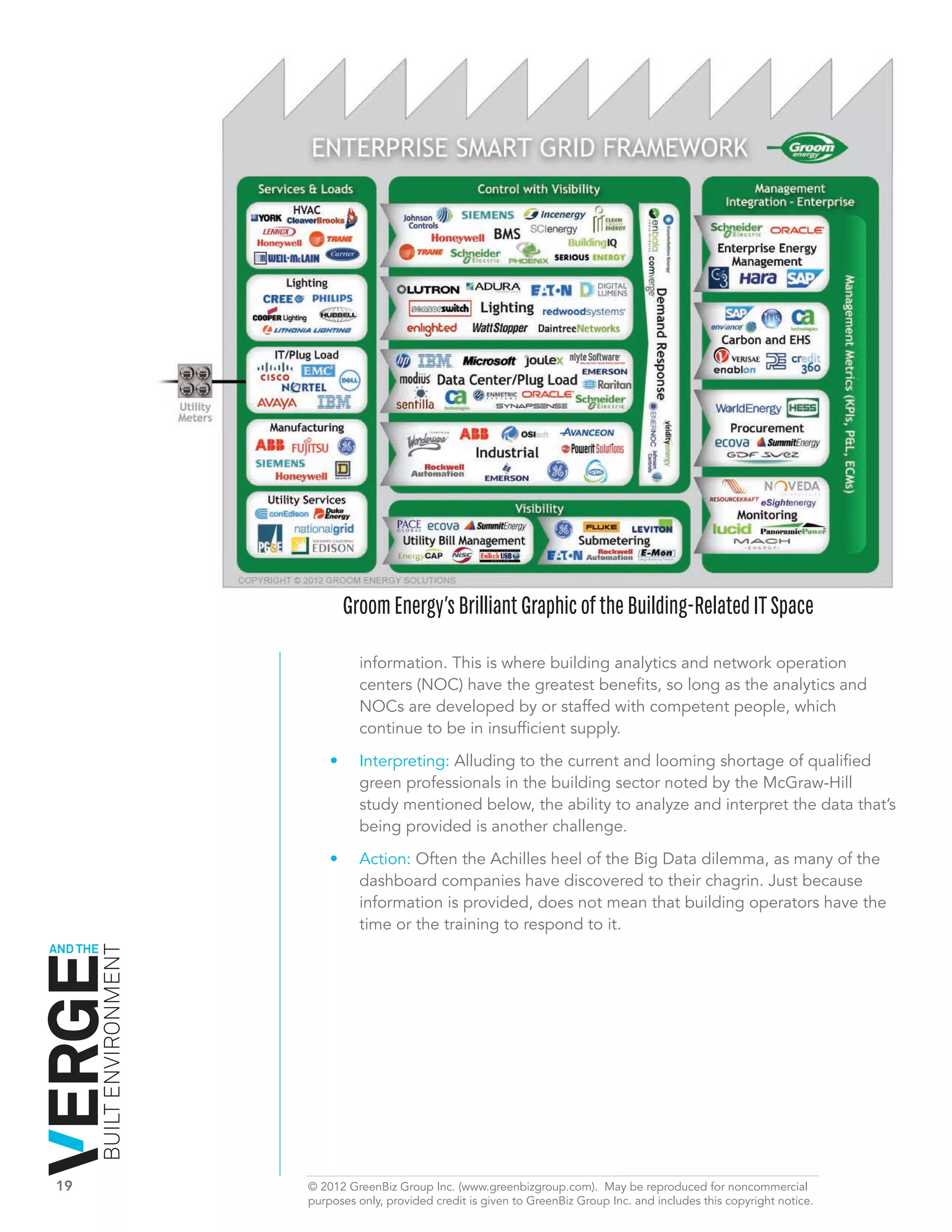
                              •	 Buildings and Energy: Groom Energy has by far and away the best
                                 representation of the key software products that form the intersection
                                 between buildings and the energy system under the rubric of their enterprise
                                 smart grid evaluation services, so we will let the picture speak the thousand
                                 words. (See graphic on next page)

                              Yeah, But…The Dilemma of Big Data Analytics experts at IBM’s Smarter
                              Buildings initiative have noted that a single decent-sized building can have
                              almost 10,000 data points producing meaningful information at 15-minute, or
                              less, intervals, producing nearly a million data points every day. EnerNOC, the
                              demand management and energy efficiency company, manages over 23 GB of
                              data per day across its 13,000 building network. This quantity of information
AND THE                       brings up several challenges:
          BUILT ENVIRONMENT


                                  •	   Verifying: Data is produced by sensors, which have been often sold on
                                       lowest price, that are not terribly accurate or reliable. You know the drill:
                                       garbage in, garbage out, and in a building with thousands of sensors,
                                       that can be a lot of garbage.

                                  •	   Storing: Much less of an issue now, except for that pesky cost thing.

                                  •	   Managing: The next big challenge with this amount of data is that it
                                       needs to be managed and analyzed in a way that can produce useful


18	                           © 2012 GreenBiz Group Inc. (www.greenbizgroup.com). May be reproduced for noncommercial
	                             purposes only, provided credit is given to GreenBiz Group Inc. and includes this copyright notice.
Groom Energy’s Brilliant Graphic of the Building-Related IT Space

                                         information. This is where building analytics and network operation
                                         centers (NOC) have the greatest benefits, so long as the analytics and
                                         NOCs are developed by or staffed with competent people, which
                                         continue to be in insufficient supply.

                                  •	     Interpreting: Alluding to the current and looming shortage of qualified
                                         green professionals in the building sector noted by the McGraw-Hill
                                         study mentioned below, the ability to analyze and interpret the data that’s
                                         being provided is another challenge.

                                  •	     Action: Often the Achilles heel of the Big Data dilemma, as many of the
                                         dashboard companies have discovered to their chagrin. Just because
                                         information is provided, does not mean that building operators have the
                                         time or the training to respond to it.
AND THE
          BUILT ENVIRONMENT


19	                           © 2012 GreenBiz Group Inc. (www.greenbizgroup.com). May be reproduced for noncommercial
	                             purposes only, provided credit is given to GreenBiz Group Inc. and includes this copyright notice.
The Big Picture As technology and data intelligence spark convergence trends
                                                                 in buildings, information and transportation, it makes sense to conclude with
                                                                 the energy impacts needed to deliver lean, efficient new products and services.
                                                                 When combined with a significant shift to electricity generation from natural
                                                                 gas and the growing contributions of wind and solar, the overall impact of
                                                                 convergence is a much lower carbon intensity, or the “decarbonization” of a
                                                                 more intelligent energy system.
                              Energy: Smarter and Decarbonized   As a result, U.S. carbon emissions in 2012 could end up as low as 1993 levels —
                                                                 14 percent below the 2005 peak, and total energy consumption is approaching
                                                                 1992 levels. The carbon intensity of the economy is at its lowest point since
                                                                 comprehensive carbon emissions data has been gathered at an estimated 0.76
                                                                 pounds of CO2 per real dollar of GDP, compared with the nearly two pounds of
                                                                 CO2 per inflation-adjusted dollar in 1973.

                                                                 The Drivers The principal drivers of decarbonization of the U.S. energy sector
                                                                 are twofold. Most influential has been the significant shift in the national fuel
                                                                 mix, which has been underway since 2005. The second element is the growing
                                                                 embedded intelligence in buildings and cars that is fostering a multidirectional
                                                                 “conversation” between and among individuals, buildings and the electricity
                                                                 and roadway grids.

                                                                 The change in the fuel mix has two principal components. First, the dramatic
                                                                 shift toward wind and solar energy, which has grown by approximately 60
                                                                 percent over the last seven years; renewable energy’s share of electricity
                                                                 generation has grown from 8.5 percent to nearly 14 percent overall; and second,
                                                                 the shift away from coal and residual oil toward natural gas.

                                                                 Concerns about domestic energy security, as well as unmanageable climate
                                                                 change, has resulted in a multitude of U.S. state policies promoting renewable
                                                                 energy through the use of regulations that require a minimum percentage
                                                                 of power supply be provided from renewable sources. As scale has grown,
                                                                 renewable-energy costs — both from international and domestic producers —
                                                                 have come down significantly.

                                                                 Energy markets are becoming increasingly global, even for fuels such as coal
                                                                 and natural gas. These global markets, in turn, are having an increasing impact
                                                                 on U.S. domestic energy markets. On the fossil fuel front, coal prices have
                                                                 risen dramatically, about 30 percent in real terms since 2005. This has been
                                                                 driven by increased demand in China, rising mining costs as high-quality coal
                                                                 becomes harder to find and mine, increased coal transportation costs and aging,
                                                                 inefficient coal-fired power plants that are no longer competitive with modern
                                                                 high-efficiency gas–fired equipment. At the same time, natural gas prices
AND THE                                                          have declined by almost 50 percent due to the rapid growth of the shale gas
          BUILT ENVIRONMENT


                                                                 resource.

                                                                 Continuing declines in the cost of renewable energy technology, combined
                                                                 with pending enactment of EPA regulations governing carbon pollution from
                                                                 coal-fired power plants, is likely to prolong, perhaps even accelerate, this fuel-
                                                                 shifting trend. It remains to be seen what impact environmental regulation and
                                                                 deepened extraction experience will have on the shale gas resource and on
                                                                 these price and fuel mix trends.


20	                                                              © 2012 GreenBiz Group Inc. (www.greenbizgroup.com). May be reproduced for noncommercial
	                                                                purposes only, provided credit is given to GreenBiz Group Inc. and includes this copyright notice.
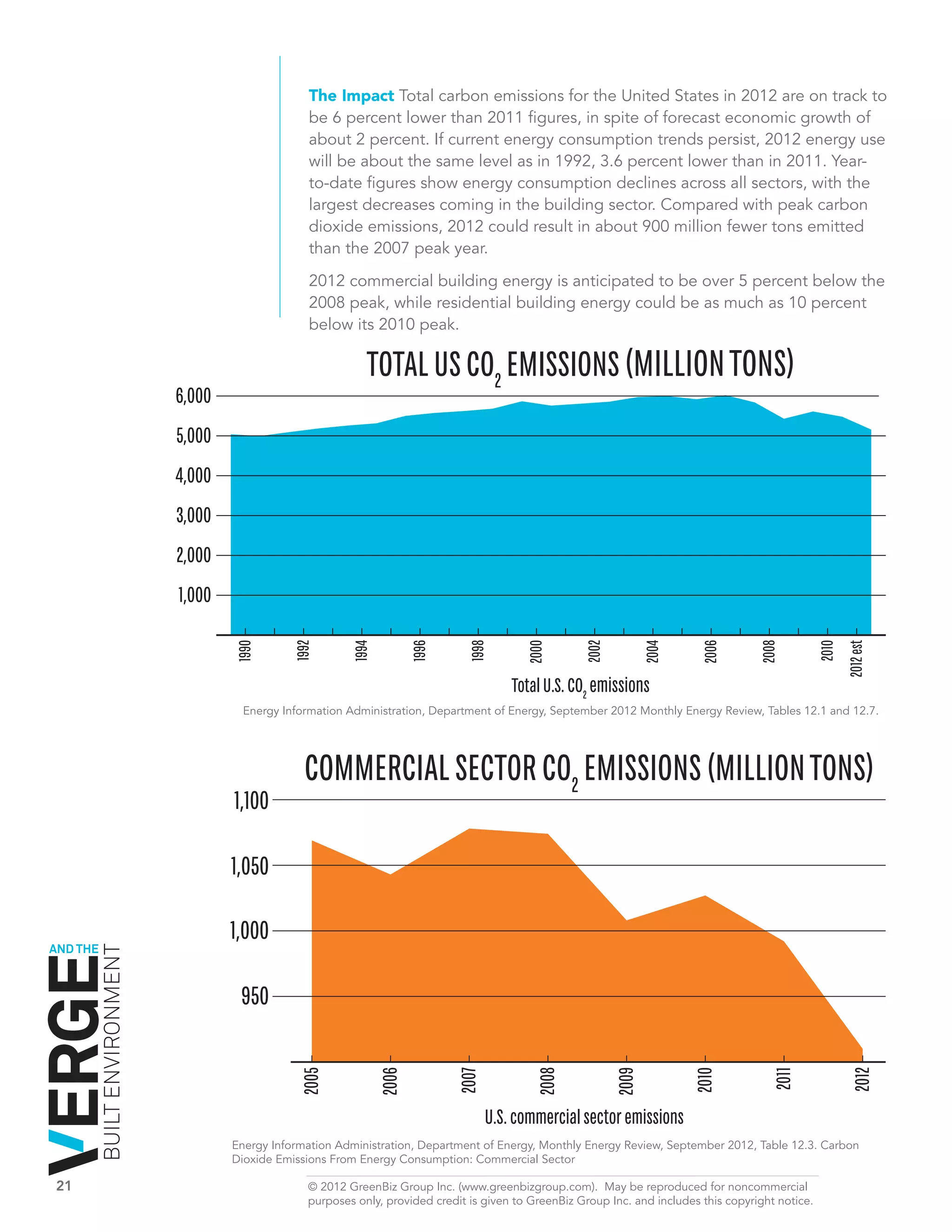
The Impact Total carbon emissions for the United States in 2012 are on track to
                                                    be 6 percent lower than 2011 figures, in spite of forecast economic growth of
                                                    about 2 percent. If current energy consumption trends persist, 2012 energy use
                                                    will be about the same level as in 1992, 3.6 percent lower than in 2011. Year-
                                                    to-date figures show energy consumption declines across all sectors, with the
                                                    largest decreases coming in the building sector. Compared with peak carbon
                                                    dioxide emissions, 2012 could result in about 900 million fewer tons emitted
                                                    than the 2007 peak year.

                                                    2012 commercial building energy is anticipated to be over 5 percent below the
                                                    2008 peak, while residential building energy could be as much as 10 percent
                                                    below its 2010 peak.

                                                               TOTAL US CO2 EMISSIONS (MILLION TONS)
                              6,000
                              5,000
                              4,000
                              3,000
                              2,000
                              1,000
                                      1990


                                                 1992


                                                            1994


                                                                          1996


                                                                                  1998


                                                                                              2000


                                                                                                         2002


                                                                                                                       2004


                                                                                                                                2006


                                                                                                                                           2008


                                                                                                                                                         2010
                                                                                                                                                                2012 est
                                                                                            Total U.S. CO emissions
                                                                                                      2
                                        Energy Information Administration, Department of Energy, September 2012 Monthly Energy Review, Tables 12.1 and 12.7.


                                                   COMMERCIAL SECTOR CO2 EMISSIONS (MILLION TONS)
                                      1,100

                                      1,050

                                      1,000
AND THE
          BUILT ENVIRONMENT


                                       950
                                                  2005


                                                                   2006


                                                                                 2007


                                                                                                2008


                                                                                                                2009


                                                                                                                              2010


                                                                                                                                             2011


                                                                                                                                                                 2012


                                                                                        U.S. commercial sector emissions
                                      Energy Information Administration, Department of Energy, Monthly Energy Review, September 2012, Table 12.3. Carbon
                                      Dioxide Emissions From Energy Consumption: Commercial Sector

21	                                                 © 2012 GreenBiz Group Inc. (www.greenbizgroup.com). May be reproduced for noncommercial
	                                                   purposes only, provided credit is given to GreenBiz Group Inc. and includes this copyright notice.
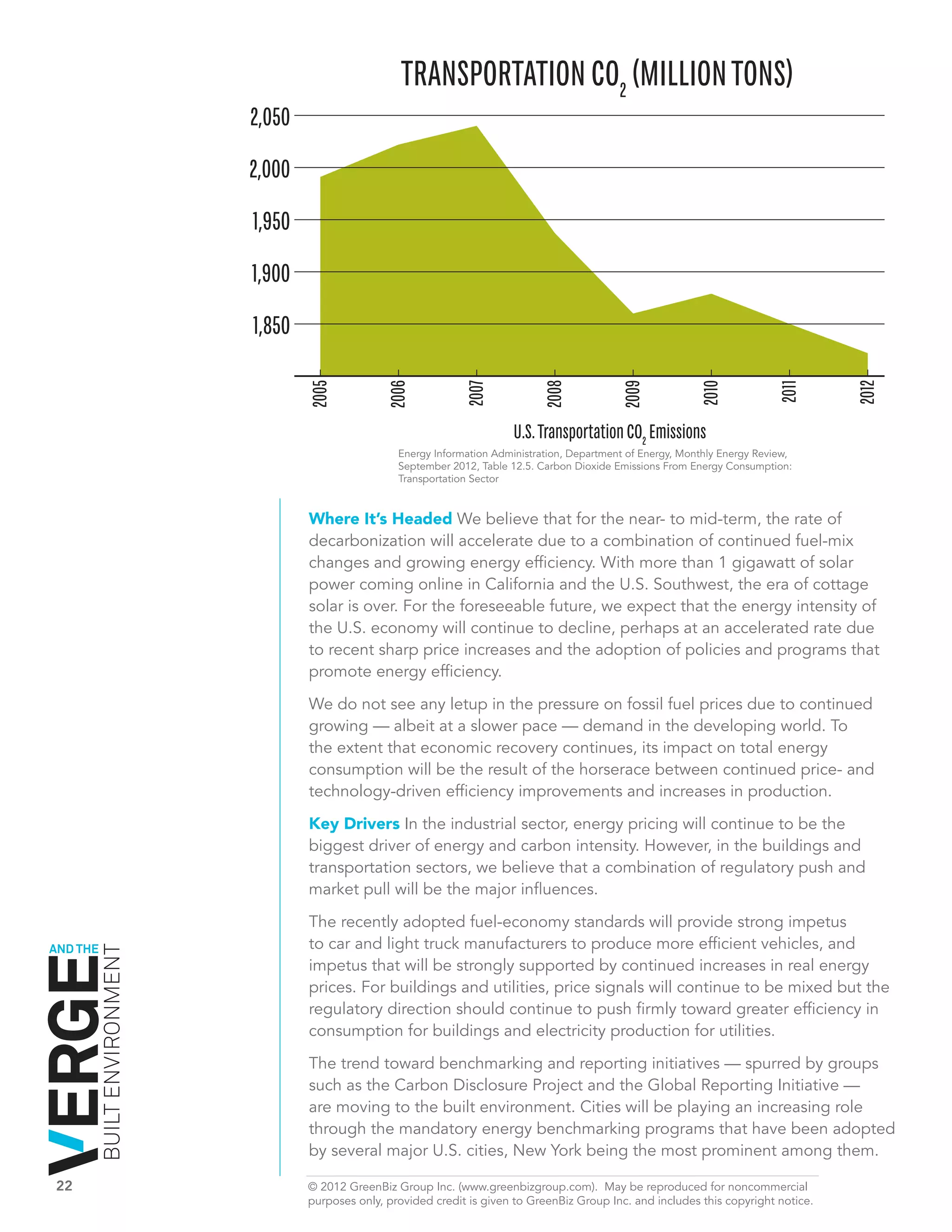
TRANSPORTATION CO2 (MILLION TONS)
                              2,050

                              2,000

                              1,950

                              1,900

                              1,850   2005


                                                    2006


                                                                    2007


                                                                                   2008


                                                                                                   2009


                                                                                                                   2010


                                                                                                                                  2011


                                                                                                                                           2012
                                                                              U.S. Transportation CO2 Emissions
                                                       Energy Information Administration, Department of Energy, Monthly Energy Review,
                                                       September 2012, Table 12.5. Carbon Dioxide Emissions From Energy Consumption:
                                                       Transportation Sector


                                      Where It’s Headed We believe that for the near- to mid-term, the rate of
                                      decarbonization will accelerate due to a combination of continued fuel-mix
                                      changes and growing energy efficiency. With more than 1 gigawatt of solar
                                      power coming online in California and the U.S. Southwest, the era of cottage
                                      solar is over. For the foreseeable future, we expect that the energy intensity of
                                      the U.S. economy will continue to decline, perhaps at an accelerated rate due
                                      to recent sharp price increases and the adoption of policies and programs that
                                      promote energy efficiency.

                                      We do not see any letup in the pressure on fossil fuel prices due to continued
                                      growing — albeit at a slower pace — demand in the developing world. To
                                      the extent that economic recovery continues, its impact on total energy
                                      consumption will be the result of the horserace between continued price- and
                                      technology-driven efficiency improvements and increases in production.

                                      Key Drivers In the industrial sector, energy pricing will continue to be the
                                      biggest driver of energy and carbon intensity. However, in the buildings and
                                      transportation sectors, we believe that a combination of regulatory push and
                                      market pull will be the major influences.

                                      The recently adopted fuel-economy standards will provide strong impetus
AND THE                               to car and light truck manufacturers to produce more efficient vehicles, and
          BUILT ENVIRONMENT


                                      impetus that will be strongly supported by continued increases in real energy
                                      prices. For buildings and utilities, price signals will continue to be mixed but the
                                      regulatory direction should continue to push firmly toward greater efficiency in
                                      consumption for buildings and electricity production for utilities.

                                      The trend toward benchmarking and reporting initiatives — spurred by groups
                                      such as the Carbon Disclosure Project and the Global Reporting Initiative —
                                      are moving to the built environment. Cities will be playing an increasing role
                                      through the mandatory energy benchmarking programs that have been adopted
                                      by several major U.S. cities, New York being the most prominent among them.

22	                                   © 2012 GreenBiz Group Inc. (www.greenbizgroup.com). May be reproduced for noncommercial
	                                     purposes only, provided credit is given to GreenBiz Group Inc. and includes this copyright notice.
It is too soon to appreciate the impact this reporting will have on the actions of
                                     building owners, but as we’ve seen in the past, companies are eager to be seen
                                     at the top of such rankings — or at least not at the bottom.

                                     Yes, and… Above we discussed the impact of energy analytics, demand
                                     response, smart grid in the context of ICT and Buildings, but what about
                                     smart meters? We believe that we will see some impact of smart metering
      Smart meters are               on residential energy use. In spite of pockets of resistance, smart meters are
       approaching the               approaching the magical 20 percent penetration level that usually signals the
                                     beginning of mass adoption. Some forecasts put smart-meter penetration at up
    magical 20 percent               to 75 percent within five years.
      penetration level
                                     Our take is that smart meters are necessary, but not sufficient: Research by
    that usually signals             the American Council for an Energy-Efficient Economy indicates that real-time
       the beginning of              feedback programs have the potential to decrease energy consumption by up
        mass adoption.               to 12 percent, but that smart meters by themselves are not sufficient to result
                                     in these kinds of savings. ACEEE found the most effective combination to be
                                     persistent, regular feedback on energy use and benchmarking with neighbors.

                                     If utilities were to further integrate energy efficiency with their smart-metering
                                     programs, we believe they could have a very strong impact on building energy
                                     consumption in the near to mid term.

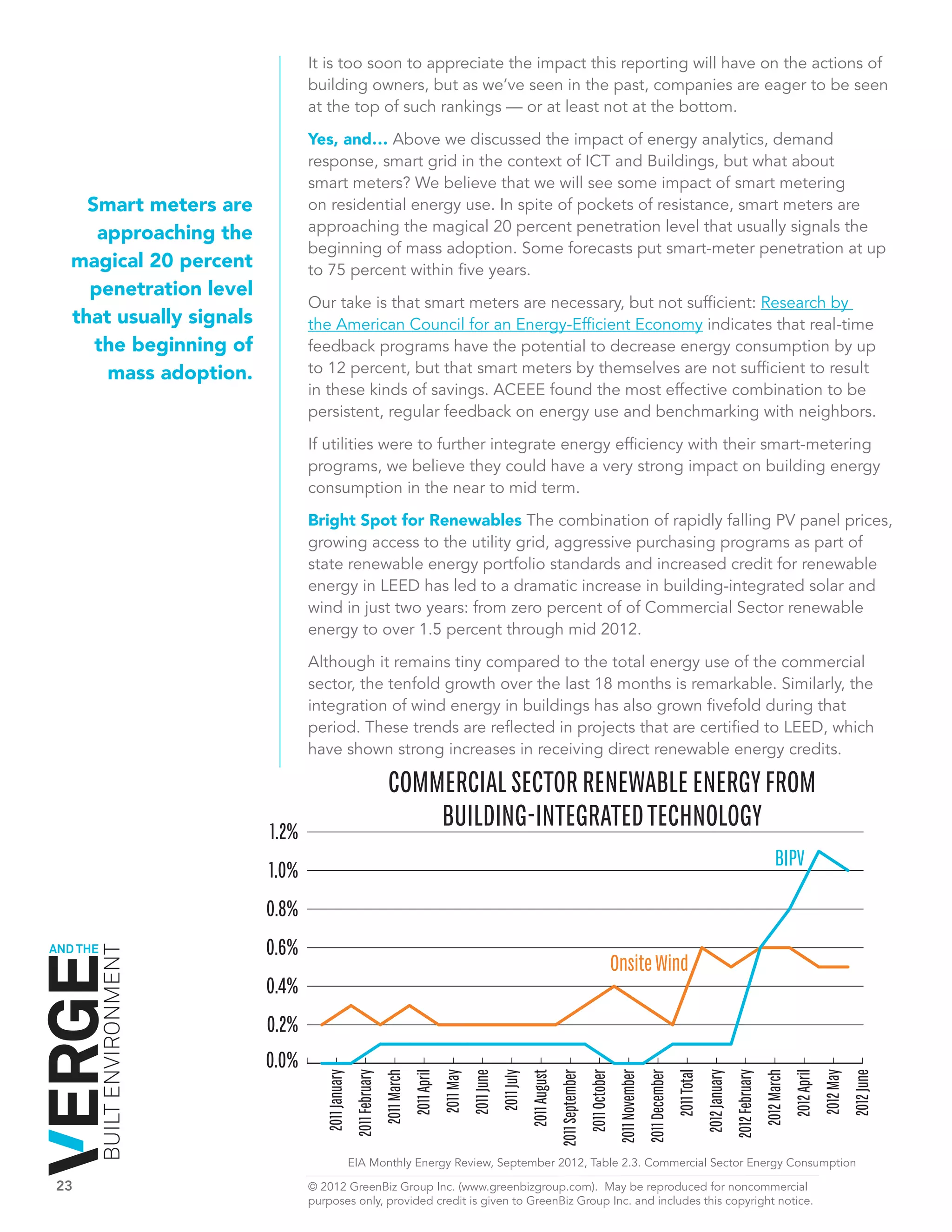
                                     Bright Spot for Renewables The combination of rapidly falling PV panel prices,
                                     growing access to the utility grid, aggressive purchasing programs as part of
                                     state renewable energy portfolio standards and increased credit for renewable
                                     energy in LEED has led to a dramatic increase in building-integrated solar and
                                     wind in just two years: from zero percent of of Commercial Sector renewable
                                     energy to over 1.5 percent through mid 2012.

                                     Although it remains tiny compared to the total energy use of the commercial
                                     sector, the tenfold growth over the last 18 months is remarkable. Similarly, the
                                     integration of wind energy in buildings has also grown fivefold during that
                                     period. These trends are reflected in projects that are certified to LEED, which
                                     have shown strong increases in receiving direct renewable energy credits.

                                                                          COMMERCIAL SECTOR RENEWABLE ENERGY FROM
                              1.2%
                                                                              BUILDING-INTEGRATED TECHNOLOGY
                                                                                                                                                                                                                                                                    BIPV
                              1.0%
                              0.8%
AND THE                       0.6%
          BUILT ENVIRONMENT


                                                                                                                                                                                   Onsite Wind
                              0.4%
                              0.2%
                              0.0%
                                        2011 January
                                                        2011 February
                                                                        2011 March
                                                                                     2011 April
                                                                                                  2011 May
                                                                                                             2011 June
                                                                                                                         2011 July
                                                                                                                                     2011 August
                                                                                                                                                   2011 September
                                                                                                                                                                    2011 October
                                                                                                                                                                                   2011 November
                                                                                                                                                                                                   2011 December
                                                                                                                                                                                                                   2011 Total
                                                                                                                                                                                                                                2012 January
                                                                                                                                                                                                                                               2012 February
                                                                                                                                                                                                                                                               2012 March
                                                                                                                                                                                                                                                                            2012 April
                                                                                                                                                                                                                                                                                         2012 May
                                                                                                                                                                                                                                                                                                    2012 June


                                                       EIA Monthly Energy Review, September 2012, Table 2.3. Commercial Sector Energy Consumption

23	                                  © 2012 GreenBiz Group Inc. (www.greenbizgroup.com). May be reproduced for noncommercial
	                                    purposes only, provided credit is given to GreenBiz Group Inc. and includes this copyright notice.
The Big Picture Concern over infrastructure is a little like concern over the
                                                              weather: Everybody talks about, it but nobody feels they can do much about it.
                                                              Most assessments of infrastructure quality in the United States give it very poor
                                                              grades. Indeed, crumbling conventional infrastructure will both be accelerating
                                                              and hindering the convergence trends described in this report.

                                                              Typically, infrastructure refers water, energy, transportation, and other large-scale
                                                              systems. There is no doubt that these “pipes, wires and lane miles” are critical
                              Infrastructure: Falling Apart   in day-to-day commerce and overall quality of life. But because VERGE is about
                                                              integration across silos, we believe that a broader definition of infrastructure is
                                                              warranted. So we include information and communication technology and green
                                                              building industry expertise as “infrastructure.”

                                                              Based on the most recent infrastructure report from the American Society of
                                                              Civil Engineers, the overall infrastructure grade for the United States was a “D.”
                                                              This report was completed in 2009 and is likely representative of infrastructure
                                                              conditions in 2007–2008. Since 2009, the American Recovery and Reinvestment
                                                              Act of 2009 put about $100 billion dollars into improving energy, water and
                                                              transportation infrastructure, but that is miniscule compared with the $2.2 trillion
                                                              infrastructure repair and upgrade overhang estimated by ASCE.

                                                                                              Grade                              VERGE Impact
                                                               Bridges                            C        Transport (direct); Buildings & Energy (indirect)
                                                               Dams                               D        Energy (direct); Buildings (indirect)
                                                               Drinking Water                     D        Buildings (direct)
                                                               Energy                            D+        Buildings, Transport, IT
                                                               Rail                               C        Transport
                                                               Roads                              D        Transport (direct); Buildings, Energy (indirect)
                                                               Solid Waste                       C+        Buildings (indirect)
                                                               Transit                            D        Buildings, Energy, Transport
                                                               Wastewater                         D        Buildings

                                                                        Selected Infrastructure Category Grades and their Impact on VERGE Sectors
                                                                               American Society of Civil Engineers, America’s Infrastructure Report Cards


                                                              In some ways, the fast-growing ICT infrastructure is substituting for, or at least
                                                              mitigating the need for, conventional infrastructure in transportation and, to a
                                                              less direct extent, energy. With new access to disruptive transportation options,
                                                              and as we tap energy efficiency as the “fifth fuel,” the infrastructure to deliver
AND THE                                                       these services will become increasingly important.
          BUILT ENVIRONMENT


                                                              The Drivers Budget pressures and political tension between the state
                                                              and national level in the United States have conspired to take hostage the
                                                              maintenance of what we think of traditionally as infrastructure.

                                                              As the potential for ICT becomes more fully integrated into building and
                                                              transportation assets — on top of growing entertainment demands — the
                                                              burden on communication infrastructure will grow. Moreover, serious inequalities
                                                              between urban and rural areas and a generally below world-class level of service
                                                              will also put pressure on ICT corporate infrastructure.

24	                                                           © 2012 GreenBiz Group Inc. (www.greenbizgroup.com). May be reproduced for noncommercial
	                                                             purposes only, provided credit is given to GreenBiz Group Inc. and includes this copyright notice.
Communications infrastructure outside of rural areas has been growing steadily
                              and government stimulus has helped bridge some gaps in the market. However,
                              a recent report from the New America Foundation found that U.S. broadband
                              access and speed was more limited than in several Asian and European cities.
                              Studies show U.S. cities ranking near or at the bottom from the perspective of
                              services received per dollar spent.

    Based on conditions       The Impact Based on conditions in 2009, the New America Foundation
       in 2009, the New       estimated that the annual cost of the deficient infrastructure in the United States
                              approaches $200 billion. Not surprisingly, the largest chunk (more than half)
    America Foundation        comes from the nearly five billion hours that Americans waste in traffic. Aviation
           estimated that     delays similarly cost Americans a considerable amount of time, while poor
          the annual cost     energy infrastructure results in excessive transmission and distribution losses and
                              deteriorated power quality.
         of the deficient
    infrastructure in the     It is somewhat ironic that the economic loss attributed to America’s poor water
                              and wastewater treatment infrastructure is among the lowest of the eight key
        U.S. approaches       infrastructure categories investigated. The irony is that although the economic
             $200 billion.    losses are among the lowest of the categories, the cost to upgrade this
                              infrastructure will be among the highest.

                                                        Infrastructure               Annual Efficiency
                                                          Category                    Loss ($ billion)
                                                    Aviation                                    $33
                                                    Bridges                                      $8
                                                    Drinking Water                               $3
                                                    Energy                                      $25
                                                    Roads/Transit                              $115
                                                    Total                                      $184

                                                         Annual Cost of Inadequate Infrastructure
                                                    New America Foundation: Costs of the Infrastructure Deficit


                              There is also a human infrastructure problem. A recent McGraw-Hill study found
                              that in both the design and construction fields, there is a strong belief that
                              there will not be adequate expertise or experience to meet potentially growing
                              needs as soon as 2014. In particular, given the projected rapid growth of green
                              construction as the recession recedes, the Smart Market Report envisions
                              a shortage of design and construction expertise in the green area, which it
                              projects will grow more rapidly than the construction sector as a whole. McGraw-
AND THE                       Hill predicts that as Baby Boomers approach retirement age, a fair amount of
          BUILT ENVIRONMENT


                              experience and institutional knowledge will be lost; moreover, some believe that
                              work in the buildings sector is not as attractive to the incoming generation of
                              workers as it has been in the past.

                              There is no doubt green building will continue to provide opportunity for people
                              in the design, engineering and construction industry. But the question remains
                              whether there is enough opportunity to keep this industry expertise ready and
                              available when needed. Lack of expertise can cause issues with good integrated
                              design and engineering, which means that the savings opportunities from green


25	                           © 2012 GreenBiz Group Inc. (www.greenbizgroup.com). May be reproduced for noncommercial
	                             purposes only, provided credit is given to GreenBiz Group Inc. and includes this copyright notice.
design and retrofit can be reduced. Indeed, we believe that the inadequate
                              intersection between people with expertise across ICT and buildings is why we
                              are likely to see the demise of many energy-benchmarking tool companies in the
                              near term.

                              Where It’s Headed Overall, the infrastructure picture is grim. There is a huge
                              price tag in providing what are generally accepted as public goods, where the
          Deteriorating       tragedy of the commons makes it justifiable to take out more than is being put
     infrastructure will      back in.

 benefit services that        For certain kinds of infrastructure, there will be something of a horserace
                              between the degree to which infrastructure services can be replaced or
  are supported by IT
                              mitigated virtually – most likely in the roads/transit and energy categories – and
    and accelerate the        the degree to which they deteriorate.
   asset consolidation
                              Continuing trends in deteriorating infrastructure will benefit services that
       in buildings and       are supported by IT and accelerate the asset consolidation in buildings and
   transportation that        transportation that are facilitated by this technology. It also could accelerate
      are facilitated by      some of the more demographic and macroeconomic trends in urbanization.

       this technology.       The biggest wildcard has to do with water and sewer infrastructure. Failure to
                              maintain this infrastructure adequately could affect development trends in the
                              built environment, particularly in a world with the potential for more frequent
                              and severe storms.
                              Key Players By its very nature, infrastructure is principally driven by government
                              entities, even though private companies may implement infrastructure projects
                              or policies. Thus, the principal players are those entities at the municipal, state
                              and federal level that regulate infrastructure.

                              In recent years, there has been a growing trend in privatizing certain types of
                              infrastructure, principally in the solid-waste collection and recycling industry.
                              However, there is growing privatization of water and sewer, with mixed results.

                              The 2006 U.S. Conference of Mayors resolution on green infrastructure is
                              intended to promote investment in natural systems to treat and store rainwater
                              and stormwater, as well as reduce urban heat islands. In addition, there is
                              concern by the mayors’ group that investments in transit and transportation
                              infrastructure will not keep pace with the growth needs of cities.

                              The National Governors Association in 2009 put together a vision document
                              for infrastructure in the 21st century that emphasized the need for innovative
                              financing, demand reduction as a means of making investments go further,
                              prioritization of environmentally beneficial alternatives and better coordination
                              with different agencies and levels of governments when delivering infrastructure
AND THE
          BUILT ENVIRONMENT


                              projects.

                              Federal funding of infrastructure tends to play a somewhat perverse role in
                              the problem of its deterioration. Federal funds are almost never available
                              for maintenance programs, which means that states and municipalities are
                              responsible for shouldering the cost of operations and maintenance. In practice,
                              with deferred operations and maintenance, the need for capital improvements
                              accelerates, for which funding is often inadequate or unavailable.


26	                           © 2012 GreenBiz Group Inc. (www.greenbizgroup.com). May be reproduced for noncommercial
	                             purposes only, provided credit is given to GreenBiz Group Inc. and includes this copyright notice.
Yeah, But… It is curious to note that communications infrastructure is not
                              included in this evaluation. The FCC produces an annual report on access
                              to high-speed communications, including broadband Internet. Generally,
                              the access to modern telecommunications infrastructure is weakest in the far
                              suburban and rural areas, principally due to the relatively low density and high
                              cost of providing the service. It is for this reason that the ARRA emphasized
                              these investments.
            McGraw-Hill
        projects that by      Green Jobs and the Built Environment McGraw-Hill projects that by 2015 the
                              green building market size will exceed $120 billion, representing 48 percent of
         2015 the green       the nonresidential market. This means that nearly 900,000 green construction
        building market       jobs could be created in just the next couple of years. A significant minority of
       will exceed $120       professionals surveyed for the report believe that having green job skills will
                              convey significant benefits. About 43 percent believe that more jobs will be
     billion, with nearly
                              available for green skills workers, while 41 percent overall believe that having
    900,000 new green         green skills will result in better career advancement opportunities and almost 30
      construction jobs.      percent believe that greater job security will result.
                              Hiring experienced people, particularly in the construction trade, is forecast to
                              be these most significant personnel challenge in the near future. The survey also
                              found that having a professional certification conveyed significant benefits in
                              knowledge that can be applied on the job, as well as the opportunity for being
                              hired and advancing within the profession.


AND THE
          BUILT ENVIRONMENT


27	                           © 2012 GreenBiz Group Inc. (www.greenbizgroup.com). May be reproduced for noncommercial
	                             purposes only, provided credit is given to GreenBiz Group Inc. and includes this copyright notice.
In identifying some of the trends in this report, one big challenge has been
                                                       ensuring that they could not be dismissed with “It’s just the recession.” While
                                                       recent economic conditions have influenced some of these trends, our research
                                                       identifies fundamental changes that go beyond the recession’s influence.

                                                       Consider energy. There is no doubt that recent economic conditions have
                                                       affected energy supply and demand. However, we believe that there is more
                                                       going on here than simply dollars and cents. At the macroeconomic level, the
It’s the Economy, Stupid (or Is It?)


                                                       relationship between energy prices and behavior is much weaker than most
                                                       people assume, as shown in the figures below.


                                                             ENERGY COSTS PER MMBtu (all sources, Real $)
                                        20

                                        15

                                        10

                                            5

                                                 1973 1975 1977 1979 1981 1983 1985 1987 1989 1991 1993 1995 1997 1999 2001 2003 2005 2007 2009
                                                                                 Cost of energy in Real Dollars per Million BTU
                                                                         Energy Information Administration, Annual Energy Review 2011,
                                                                       Table 3.3 Consumer Price Estimates for Energy by Source, 1970-2010


                                                       The inflation-adjusted cost of energy in real terms has varied fairly dramatically
                                                       over the last 40 years, in some periods doubling, and falling by as much as a
                                                       third during other times. Given these large swings, one could be forgiven if it
                                                       were supposed that overall energy use or the energy intensity of the economy
                                                       were also to vary widely. But, as we see in the chart below, this is not the case
                                                       when it comes to the energy intensity of the economy.


                                                                         KBTU/$ GDP (Inflation Adjusted)
                                       16
                                       14
                                       12
                                       10
                                        8
                                        6
                                        4
                                        2
                                                1973 1975 1977 1979 1981 1983 1985 1987 1989 1991 1993 1995 1997 1999 2001 2003 2005 2007 2009
                                                                            Energy Intensity of the US Economy kBtu/$ Real GDP
                                                                         EIA DOE Monthly Energy Review September 2012, Table 1.7.
                                                                    Primary Energy Consumption per Real Dollar of Gross Domestic Product


     28	                                               © 2012 GreenBiz Group Inc. (www.greenbizgroup.com). May be reproduced for noncommercial
     	                                                 purposes only, provided credit is given to GreenBiz Group Inc. and includes this copyright notice.
This chart shows that since the 1973 oil embargo, the U.S. economy has more
                                        than doubled in efficiency (15.41 kBtu/2005$ GDP vs. 7.48 kBtu/2005$ GDP).
                                        In spite of gyrations in energy prices both in real and nominal terms over the
                                        past 40 years, the decline of energy intensity in the economy has been almost a
                                        straight line, with a couple of small pauses around 1986 and 2009. To the extent
                                        that the line deflects at all from a straight decline, it has mostly to do with capital
                                        replacement cycles and the rate of GDP growth.

                                        Not surprisingly, once a more efficient process has been put in, it stays in — until
                                        it is replaced by even more-efficient equipment. Federal policy and standards
                                        on appliances and equipment, as well as building standards, have been quite
                                        influential in the building sector in entrenching efficiency gains by incentivizing
                                        good equipment and ridding the market of the least-efficient technology.

                                        As discussed earlier, some behaviors, such as driving, have been shown to be
                                        fairly inelastic, but vehicle miles now appear to be substituted in some cases
                                        with virtual access to work and shopping, even though the cost to drive 15,000
                                        miles continues to remain below historic levels.

                                        The extent to that there is a correlation between price and macroeconomic
                                        efficiency, it appears to be weak. It is clear that there are other drivers, several of
                                        which we have described in this paper.

                                        What’s interesting is when you combine the two datasets to derive the energy
                                        cost to create a dollar of GDP. As shown below, the real cost to generate a dollar
                                        of real GDP has averaged around 13 cents over the last 40 years.

                                        If macroeconomic price influences on overall energy use are weak, perhaps
                                        microeconomic forces play a larger role. In real (inflation-adjusted) terms,
                                        median household incomes have been declining overall since 1999, and today
                                        are approximately at 1989 levels. It is tempting to assign some of the resource
                                        consumption turnaround we’ve seen to the fairly rapid decline in median
                                        household income (inflation adjusted), but if we look at the inflection points of
                                        many of the sectoral trends, they do not precede or lag the income profile in any
                                        predictable way.


                                                           REAL $ ENERGY COST/ REAL $ GDP
                              0.20

                              0.15

                              0.10
AND THE
          BUILT ENVIRONMENT


                              0.05

                                     1973 1975 1977 1979 1981 1983 1985 1987 1989 1991 1993 1995 1997 1999 2001 2003 2005 2007 2009
                                                                      Real $ Cost to Generate Real $ of GDP


29	                                     © 2012 GreenBiz Group Inc. (www.greenbizgroup.com). May be reproduced for noncommercial
	                                       purposes only, provided credit is given to GreenBiz Group Inc. and includes this copyright notice.
Winston Churchill famously said, “We shape our buildings, then our buildings
                                                           shape us.” VERGE recognizes that this co–creation between human technology
                                                           and human society is going forward on a much larger and increasingly cross-
                                                           silo way as ICT breaks down barriers between the interaction of buildings,
                                                           transportation and infrastructure. There is also no doubt that this vibrant mash-
                                                           up of historically isolated sectors is reshaping the way we live and interact.

                                                           Although there is still a lot of “noise” resulting from the transition from an
                              Coda: Optimizing the Whole
                                                           extraction economy to a regenerative economy, we believe that a signal is
                                                           beginning to emerge in some of the trends we’ve identified in this report.

                                                           We firmly believe that all significant business and environmental opportunity in
                                                           the 21st century will come from understanding and exploiting the interactions
                                                           between multiple systems and optimizing the whole, rather than simply a
                                                           component or two. We believe that the dynamic interplay between large
                                                           systems can be influenced with approaches to problems that unravel multiple
                                                           issues with a single solution.

                                                           VERGE is about exploring, identifying and implementing the opportunities that
                                                           arise only when we look at the bigger picture. It is this integrated vision that
                                                           represents the clearest hope for a positive future, and truly sustainable business.


AND THE
          BUILT ENVIRONMENT


30	                                                        © 2012 GreenBiz Group Inc. (www.greenbizgroup.com). May be reproduced for noncommercial
	                                                          purposes only, provided credit is given to GreenBiz Group Inc. and includes this copyright notice.
Rob Watson is a Senior Contributor to GreenBiz.com. Described by Thomas
                                                 Friedman as “one of America’s best environmental minds,” Watson also serves
                                                 as the Chairman, CEO & Chief Scientist of the EcoTech International Group,
                                                 which delivers green building operations and design optimization, helping
                                                 companies and organizations to cost effectively minimize their buildings’
                                                 environmental footprint and operating costs.

                                                 Under Rob’s direction as the “Founding Father of LEED” and as its national
                              About the Author   Steering Committee Chairman from 1994 to 2006, the U.S. Green Building
                                                 Council’s LEED rating system became the most widespread and fastest-growing
                                                 standard by which green buildings are measured worldwide. A pioneer of
                                                 the modern green building movement for 25 years, in 2007 Rob founded the
                                                 EcoTech International Group to meet the fast-growing global demand for green
                                                 building technologies and services. Rob is the 2013 recipient of the International
                                                 Award of Excellence in Conservation from the Botanical Research Institute of
                                                 Texas and a semifinalist of the 2011 Zayed Future Energy Prize for Lifetime
                                                 Achievement.


AND THE
          BUILT ENVIRONMENT


31	                                              © 2012 GreenBiz Group Inc. (www.greenbizgroup.com). May be reproduced for noncommercial
	                                                purposes only, provided credit is given to GreenBiz Group Inc. and includes this copyright notice.
Johnson Controls is a global diversified technology leader serving customers
                              About the Sponsors   in more than 150 countries. Our 162,000 employees create quality products,
                                                   services and solutions to optimize energy and operational efficiencies of
                                                   buildings, automotive batteries, advanced batteries for hybrid and electric
                                                   vehicles, and interior systems for automobiles. Our commitment to sustainability
                                                   dates back to 1885. In 2012, Corporate Responsibility Magazine recognized
                                                   Johnson Controls as the #5 company in its annual “100 Best Corporate Citizens”
                                                   list.


                                                   As a global specialist in energy management with operations in more than 100
                                                   countries, Schneider Electric offers integrated solutions across multiple market
                                                   segments. Through our Smart City solutions, we deliver urban efficiency – today.
                                                   With more than 200 projects across the world, we know how to help cities
                                                   optimize their energy, transportation, water, buildings and services - and build
                                                   their future. We make smarter cities a reality.


AND THE
          BUILT ENVIRONMENT


32	                                                © 2012 GreenBiz Group Inc. (www.greenbizgroup.com). May be reproduced for noncommercial
	                                                  purposes only, provided credit is given to GreenBiz Group Inc. and includes this copyright notice.
Since June 2011, VERGE conferences have traveled the globe, with events in
                               Shanghai, London, São Paulo, Washington DC, and San Francisco — all simulcast to
                               a global audience via a highly-interactive virtual environment. VERGE has brought
                               together thought leaders, business executives, city managers, and thousands of
                               practitioners energized by the opportunities created at the intersection of energy,
                               information, building, and transportation technologies.

               About VERGE     At VERGE conferences, presenters offer fresh perspectives on the innovative
                               ideas, convergence opportunities, and enabling technologies shaping our future.
                               You’ll learn about new innovations, real-world challenges, and what the future
                               holds within the four VERGE domains:
                                 •	Energy — Corporate energy management, demand response, policy and
                                   regulation, integrating renewables, innovative financing
                                 •	Buildings and Facilities — Building, automation, smart cities, public-private
                                   partnerships, and organizational change
                                 •	Information and Communications — Cloud computing, big data, open
                                   platforms, M2M and the Internet of Things, analytics & actionable insight
                                 •	Transportation — Connected cars, vehicle-to-grid, V2V, peer-to-peer car
                                   sharing, fleet management & logistics


Select speakers from previous VERGE events


                                                                             Amory Lovins, Rocky Mountain Institute; Robin Chase,
                                                                             Buzzcar; Dennis McGinn, ACORE; Tim O’Reilly, O’Reilly
                                                                             Media; Jennifer Pahlka, Code for America; Daryl
                                                                             Dulaney, Siemens Industry; Carl Bass, Autodesk; Jon
                                                                             Wellinghoff, Federal Energy Regulatory Commission;
                                                                             Melanie Nutter, City of San Francisco; Steve Case,
                                                                             Revolution LLC; Alex Laskey, Opower
              David Bartlett


  33	                          © 2012 GreenBiz Group Inc. (www.greenbizgroup.com). May be reproduced for noncommercial
  	                            purposes only, provided credit is given to GreenBiz Group Inc. and includes this copyright notice.
Defining and accelerating the business of sustainability.

                              About GreenBiz Group   GreenBiz Group is a media, events, and research company whose mission is to
                                                     define and accelerate the business of sustainability. It does this through a wide
                                                     range of products and services, including its acclaimed website GreenBiz.com
                                                     and e-newsletter GreenBuzz; twice-monthly webcasts on topics of importance
                                                     to sustainability executives; conferences and events, such as the State of Green
                                                     Business Forum, the GreenBiz Innovation Forum, and VERGE; research reports,
                                                     such as the annual State of Green Business and the Green Building Market &
                                                     Impact Report; and the GreenBiz Executive Network, a membership-based peer-
                                                     to-peer learning forum for sustainability executives. GreenBiz Group was co-
                                                     founded by veteran sustainability writer and speaker Joel Makower and B-to-B
                                                     publishing executive Pete May. Eric Faurot, who has built and run some of the
                                                     tech world’s leading conferences and expos, rounds out the executive team.


                                                     The GreenBiz Executive Network is a unique and powerful peer-to-peer
                                                     networking forum for senior sustainability professionals at large companies,
                                                     backed by the depth of GreenBiz and an experienced team of researchers and
                                                     facilitators. Visit www.greenbiz.com/gben to learn how to join the leading peer
                                                     network of companies driving the sustainability agenda.


AND THE
          BUILT ENVIRONMENT


34	                                                  © 2012 GreenBiz Group Inc. (www.greenbizgroup.com). May be reproduced for noncommercial
	                                                    purposes only, provided credit is given to GreenBiz Group Inc. and includes this copyright notice.

Verge and the built environment report

  • 1.
    October 2012 AND THE BUILT ENVIRONMENT by ROB WATSON CEO, EcoTech International & Sr. Contributor, GreenBiz.com Defining and accelerating the business of sustainability.
  • 2.
    Executive Summary.....................................................................................3 Buildings: Doing More with Less.................................................................5 Transportation: Access Trumps Mobility....................................................10 Information and Communications: Catalyst & Enabler.............................15 Energy: Smarter and Decarbonized..........................................................20 Contents Infrastructure: Falling Apart.......................................................................24 It’s the Economy, Stupid (or Is It?).............................................................29 Coda: Optimizing the Whole....................................................................30 About the Author......................................................................................31 About the Sponsors...................................................................................32 About VERGE............................................................................................33 About GreenBiz Group..............................................................................34 Researched and Written by Rob Watson For GreenBiz Group: Joel Makower, Chairman and Executive Editor Derek Top, Senior Editor and Program Director, VERGE Eric Faurot, Chief Executive Officer Pete May, Co-founder and President Samuel Smith, Executive Producer Alan Robinson, VP Sales Thanks to Our Sponsors: AND THE BUILT ENVIRONMENT 2 © 2012 GreenBiz Group Inc. (www.greenbizgroup.com). May be reproduced for noncommercial purposes © 2012 GreenBiz Group Inc. (www.greenbizgroup.com). May be reproduced for noncommercial purposes only, credit is given to GreenBiz GreenBiz Group Inc. andthis copyright copyright notice. only, provided provided credit is given to Group Inc. and includes includes this notice.
  • 3.
    In 2011, GreenBizGroup asked: What happens when four massive technologies (energy, information, buildings, and transportation) collide? The answer is “an unprecedented opportunity for business and sustainability” called VERGE. VERGE refers to a vast array of products, services, and business models, and includes within its sphere a number of other trends: next-gen cities, intelligent buildings, connected mobility systems, big data, smart grids, the “share economy,” and more. Each of these things is a product of this technological/ Executive Summary industrial convergence, and each stands to have its own profound impact on business, consumers, government, and sustainability. Of course, VERGE is place-based — that is, it happens somewhere: a building, campus, neighborhood, city, or region. That is the focus of this report: the key trends that undergird how this technology convergence will unfold in the context of the built environment over the next few years. The 20th century emphasized linear thinking and the efficiencies of assembly- line production. We got very good at understanding the parts and optimizing the components. Unfortunately, this came at the expense of sub-optimization of the larger system. By contrast, we believe the 21st century will be one of integration and non-linear systems thinking — a convergence of increasingly complementary parts in support of an optimized whole. The overall catalyst for this systems view is information and communications technologies, or ICT — the explosion of information-enabled products and services. That is certainly true when it comes to the built environment. Truly competitive buildings, developments and cities are rife with connectivity that extends from the micro to the macro. Sensors and other metering technologies increasingly are becoming embedded in building equipment that can now be connected, monitored, controlled, and optimized through cross-platform management systems that allow interoperability. ICT is now facilitating and enabling the beginning of two-way flow of information and energy — a “conversation” between the electric power grid and intelligent buildings, vehicles, and devices of all kinds. And, as mobile broadband expands, all these components can be controlled at a device, building or portfolio level by a conventional smart phone, or even machine-to-machine, without human intervention. Although the convergence of buildings with energy, ICT and transportation is just emerging, the following indicators show that it is already having a positive impact on helping companies and cities achieve their sustainability goals: • P rojected 2012 CO2 emissions in the United States are on track to be about 14 percent lower than the 2007 peak. In terms of emissions per real dollar1 of GDP, the rate has decreased steadily since the 1973-74 AND THE BUILT ENVIRONMENT oil embargo — from 1.93 pounds per dollar of GDP to a forecast 0.76 pounds in 20122 — except for odd year or two when the recession sapped economic growth more than the regular improvement of energy efficiency. Energy consumption per dollar of GDP shows a very similar trend from 15.41 kBtu down to 7.48 kBtu per real dollar of GDP. 1 “Real” dollars are adjusted for inflation. We used the figures in the Monthly Energy Review (MER) September 2012 based on chained 2005 dollars. Table 1.7. 2 2012 GDP figures assume a 1.9% growth rate (Bloomberg, October 15th); CO2 figures are based on YTD fig- ures for Buildings (Residential & Commercial), Transportation and Industry derived from the MER report. 3 © 2012 GreenBiz Group Inc. (www.greenbizgroup.com). May be reproduced for noncommercial purposes only, provided credit is given to GreenBiz Group Inc. and includes this copyright notice.
  • 4.
    POUNDS OF CO2/ DOLLAR OF GDP (2005) 2.0 1.5 1.0 0.5 2012 est. 1974 1976 1978 1980 1982 1984 1986 1988 1990 1992 1994 1996 1998 2000 2002 2004 2006 2008 2012 est. Pounds of Carbon Emissions per Real Dollar of GDP Energy Information Administration, Department of Energy, Monthly Energy Review, September 2012, Table 1.7 & Table 12.1. • Vehicle Miles Traveled (VMT) per capita peaked in 2004 and have Building energy use declined 6 percent since; total VMT is down about 3 percent from its in 2012 is expected 2007 peak. Oil imports peaked in 2006 and oil consumption peaked the to be almost 8 year before. percent below • Fixed broadband penetration (defined as download speeds of at least 2 the 2008 peak, Mbps and upload speeds of at least 756 kbps) exceeds 40 percent of the population, according to the U.S. Federal Communications Commission, the lowest annual but ranks 15th of 28 OECD countries on a per capita basis. consumption this • B uilding energy use in 2012 is expected to be almost 8 percent below century. the 2008 peak, the lowest annual consumption this century. Commercial building energy use is almost 6 percent lower than the 2008 apex. Launched in 2000, the LEED Green Building Rating System now represents over 20 percent of new construction in the U.S. • Residential sector energy use is forecast to be nearly 11 percent lower. The average size of a dwelling unit (weighted average including both single & multifamily) is 7 percent below its 2006 peak. AND THE BUILT ENVIRONMENT It may be tempting to dismiss many of these indicators as being driven purely by challenging economic and employment conditions, but our research indicates that, as important as the recent recession is in driving change and transforming markets, as our report indicates, there is more to these trends than that. 4 © 2012 GreenBiz Group Inc. (www.greenbizgroup.com). May be reproduced for noncommercial purposes only, provided credit is given to GreenBiz Group Inc. and includes this copyright notice.
  • 5.
    The Big PictureEnabled by technology, changing demographics and individual preferences, companies are trying to squeeze more out of the space they have, rather than squeezing out more space. This trend toward greater asset utilization is most evident in the office sector, through we see signs of this in retail buildings, schools, and homes, which are increasingly becoming part- time workspaces. Most corporate real estate professionals see their portfolio contracting, not expanding, in the near term. Buildings: Doing More with Less Average office space per person is steadily declining and forecast to drop more than 30 percent in the next five years. Big-box retailers are downsizing their stores, in some cases as much as 40 percent, and adopting urban location strategies rather than a strictly suburban/rural approach. (If this trend fully evolves, we may need to rethink the “big box” moniker.) In U.S. homes, the size of an average new residential unit is down more than 7 percent since 2006.3 The Drivers In the 2008-2011 Green Building Market and Impact Report, we wrote extensively about drivers of building energy efficiency, including the LEED Green Building Rating System and its interplay with the ASHRAE national energy standard. We believe that these standards will continue to be quite influential in the building sector and continue contributing to its lower energy intensity. According to Richard Kadzis, CoreNet Global’s Vice President of Strategic Communications, the backdrop of continuing economic uncertainty and cost containment are two principal drivers of greater asset utilization. However, demographic trends are also playing a bigger role, with strong growth in close — in urban centers compared with suburban or far suburban areas. For starters, commercial building vacancy rates remain stubbornly high after the official end to the recession in 2009. While there is some prospect of accelerating construction activity over the next few years, the amount of new floor space is expected to remain weak. With real estate budgets stretched, companies are cutting back on their square footage. Technology also is enabling companies to reduce or eliminate permanent space per employee. Instead, they have unassigned space that can change daily, assigned on a first-come, first-serve basis, or depending upon the need for collaborative and team activities. ICT has facilitated both the more-efficient use of space through online reservations and also the ability to work remotely. But ICT doesn’t do it all: There is a new job position called a “hoteling coordinator,” which has been advertised on behalf of Deloitte, Booz Allen Hamilton and Ernst & Young, among other firms with large numbers of mobile employees. And retailers are beginning to adapt a dual strategy where shoppers can come to a physical location to preview and test actual merchandise, which AND THE BUILT ENVIRONMENT can be ordered online and delivered to their home with the physical stock being located in cheaper warehouse space, perhaps miles away. Telework is growing in both government and the private sector, although there is not one fixed definition of “telework.” At one end of the spectrum is the definition where people work at home at least one day a week, a cohort that the Telework Research Network says is growing almost 60 percent per year and now encompasses 20-30 million people. More conservative estimates from IDC Research — where telecommuters work from home at least 3 days a week — as 3 Calculations based on US Census Data, Table Q1, Characteristics of New Housing 5 © 2012 GreenBiz Group Inc. (www.greenbizgroup.com). May be reproduced for noncommercial purposes only, provided credit is given to GreenBiz Group Inc. and includes this copyright notice.
  • 6.
    reported in the2012 State of Green Business report found that telecommuting grew slightly in 2011, from 8.5 million to 8.6 million households. Not surprisingly, telework is quite common in the tech industry, but it also has found adherents in other sectors. In addition to the reduced need for floor space, telework has been credited with reducing absenteeism, improving recruitment, particularly among younger workers who prize flexibility, and There is a new reducing turnover. Many corporate managers continue to be suspicious of job position telework, however. For example, per-employee savings notwithstanding, according to a study by the MIT Sloan School of Management, telecommuters called a “hoteling — rightly or wrongly — are slightly less likely to get promoted. As the 2012 coordinator,” which State of Green Business report noted, “Distrust among middle managers is the has been advertised biggest hurdle to growing the ranks of telecommuters.” on behalf of The Impact Overall energy use for buildings should continue to decline, but Deloitte, Booz Allen energy intensity of buildings could rise as space is more intensively utilized. On a macro level, we expect that less floor area will be built for both living and Hamilton and Ernst commerce, which could result in lower overall real estate costs for companies. & Young, among This will allow them to locate in denser, and more expensive, urban cores. other firms with Retailers — including giants such as Walmart, Target, and Best Buy — have been large numbers of shrinking their footprints for a while, gaining more revenue per square foot while mobile employees. reducing overhead. Indeed, some are pursuing a much more urban strategy. Downsizing and urban relocation have affected regional malls, some of which are starting to diversify to include health care and government services, even residential. This trend could have interesting implications for suburban office parks and malls, allowing them to evolve into mixed-use “town centers.” This would not be inconsistent with residential building trends. Living units on average already are 7 percent smaller today and much more likely to be multifamily than five years ago. The amount of occupied commercial floor space per dollar of GDP is at historic lows. Where It’s Headed According to the 2012 Human Capital and Work-Related Quality of Life survey by CoreNet, the average space allocated office workers across all companies in 2017 is forecast to be 151 square feet, compared to 176 square feet today and 225 square feet in 2010. Indeed, 40 percent of the companies surveyed by CoreNet anticipated having average office area of 100 square feet or less within five years. For companies that have adopted a comprehensive mobile technology strategy, this figure could be as low as 50 square feet per employee, according to Jones Lang LaSalle. An office space benchmarking survey conducted by the General Services Administration showed a 2010 average of 200 square feet of usable space per AND THE BUILT ENVIRONMENT person in the private sector, compared with a 190-square-feet benchmark in government.4 But the GSA office consolidation and upgrade project (currently on hold) was benchmarked at approximately 80 square feet per employee. Key Players A growing number of companies and government departments are stressing “smaller but smarter” workplaces that rely not only on open, flexible space but also heavy reliance on telework strategies. Leaders include: • The federal government is a major adopter of space consolidation and promoting telework. For example, the U.S. Patent & Trademark Office expects to save $1.5 million a year thorough offering flexible workspace. 6 © 2012 GreenBiz Group Inc. (www.greenbizgroup.com). May be reproduced for noncommercial purposes only, provided credit is given to GreenBiz Group Inc. and includes this copyright notice.
  • 7.
    Floor Space perEmployee 2010 675= 225 With 25 percent of 2012 528= 176 its global workforce 2017 453= 151 as road workers or telecommuters, IBM saves $700 million Estimates of Floor Space Trends from CoreNet Survey in real estate costs each year. • IBM With 25 percent of its global workforce as road workers or telecommuters, IBM saves $700 million in real estate costs each year. • Sabre Holdings—The travel firm reduced its real estate costs by 25 percent—roughly $10 million a year—through its Flexspace program. • AT&T—Ma Bell saved $550 million per year through space consolidation. • Nortel Network—Its telecommuting program reduced the need for 1.6 million square feet and $20 million annually in real estate costs. Yeah, but… A study published in 2001 by Cornell University, Offices that Work, found that having open-plan offices fostered joint innovation and quick problem- solving sessions. Originally thought to lead to greater chance encounters and stimulate discussion and new ideas, the open plan office is nearly ubiquitous in today’s corporate world: Teknion corporation’s 2011 Workplace of the Future survey predicted that by 2015, more than three quarters of U.S. companies expect to use open workspaces with fewer offices. However, the vast majority of studies show that the noise level and constant interruptions result in increased stress and lower productivity. European research shows that while employees who ask for help do better in an open space, those who supply the help can often find their productivity decline. Ironically, in order to get away from prying ears, many workers choose to discuss ideas regarding innovations and new products outside of the office. Dr. Vinesh Oommen of Queensland University in Australia, in a literature review on the impact of open plan offices on productivity, concluded, “In 90 percent AND THE of the research, the outcome of working in an open-plan office was seen as BUILT ENVIRONMENT negative, with open-plan offices causing high levels of stress, conflict, high blood pressure, and a high staff turnover.” Some suggest that the preference and productivity of open plan offices may be a more generational and even personality issue. Gen X’ers and Gen Y’ers have grown up in a more open and collaborative setting and extroverts thrive in this type of environment, regardless of age. Older, more experienced workers, however, have lower tolerance for the hubbub of open-plan offices, and 4 General Services Administration, Office of Real Property Management, Performance Measurement Division, Workspace Utilization And Allocation Benchmark, July 2012 update. 7 © 2012 GreenBiz Group Inc. (www.greenbizgroup.com). May be reproduced for noncommercial purposes only, provided credit is given to GreenBiz Group Inc. and includes this copyright notice.
  • 8.
    introverts need somesort of privacy and seclusion to be productive. Unfortunately, green office space is not likely to solve many of the issues surrounding open-plan offices. For a variety of resource conservation reasons, the majority of green office space is open plan. A 2007 study of LEED certified office space by the Center for the Built Environment at the University of California shows that, although they perform better on most indoor environmental quality metrics, they are acoustically inferior. Get Your Inner Geek On... According to ING Clarion Partners’ David J. Lynn, writing in the National Real Estate Investor, renewed trends in urbanization is driving change in retail strategies. Lynn uses rent growth as a proxy for both demand and overall trends in location. According to Lynn’s research, over the last five years, rent growth for central business district (CBD) retail assets has MSA Historical CBD Historical MSA Forecast CBD Forecast  Market (%) (%) (%) (%) Atlanta -0.34 -0.88 -1.32 -0.77 Boston 2.2 3.5 0.2 1 Chicago -5.48 -5.8 -2.02 1.4 Denver -2.14 -3.3 2.3 1.2 Houston 1.6 5.3 2.89 3 Miami 2.08 7.5 2.58 2.5 San Francisco 2 10.6 0.1 0 Washington DC 1.32 9.6 1.63 1.6 Average of top 15 0.55 1.42 1.49 2.11 retail growth markets Comparison of Growth Rates in Retail Rents outpaced that of the overall Metropolitan Statistical Area (MSA) more than half the time, as shown in the table below. In addition, the five-year forecast is for CBD rent growth to outpace that of the MSA more than two thirds of the time. Not only is the rent growth higher, but it is one a half times higher. AND THE BUILT ENVIRONMENT Past 5 Years Forecast 5 years Rent Growth CBD vs. MSA 255% 142% Fraction of markets where CBD 53% 67% growth exceeds MSA growth Comparison of rent growth between CBD and MSA 8 © 2012 GreenBiz Group Inc. (www.greenbizgroup.com). May be reproduced for noncommercial purposes only, provided credit is given to GreenBiz Group Inc. and includes this copyright notice.
  • 9.
    ESREVER MIGRATION As urban environments become more livable, many corporations are reversing the suburban flight of 30 years ago. Some examples: United Airlines The airline has signed one of the largest leases in Chicago history in the Willis Tower, leasing 830,000 square feet through 2028. Sara Lee In 2005, the company moved out of its 60-year home in Chicago for Downer’s Grove, a suburb. However, the company has announced that in 2013 it plans to relocate 500–650 employees back to downtown Chicago. Amazon.com The online retailer’s new headquarters, totaling 1.7 million square feet in 11 buildings, is located on a Seattle streetcar line, providing direct access to the city’s airport. Salesforce.com announced in 2010 that the company spent more than $270 million to buy 14 acres in San Francisco’s Mission Bay to build a two million-square-foot headquarters. However, in early 2012 the company abandoned its plans for building the project, opting to remain in and expand its downtown San Francisco presence in 3 newly available buildings that would give them nearly the space of Mission Bay several years before that project would be ready. According to an article in Forbes, Salesforce CEO Marc Benioff noted “We can attract extraordinary talent [to San Francisco]. It’s not Silicon Valley, the flatlands.” Zappos is scheduled to move 1,200 employees to downtown Las Vegas in 2013 from suburban Henderson. Motorola is moving all of its 3,000 Mobility division employees outside Chicago to downtown, taking over several top floors of the LEED-certified AND THE Merchandize Mart. BUILT ENVIRONMENT Many fast-growing startups are opting for downtowns, sometimes settling in sub-prime parts of town. Downtown Internet firms include: Zynga (San Francisco) • Square (San Francisco) • Tumblr (New York) Pinterest (Palo Alto) • Twitter (San Francisco) 9 © 2012 GreenBiz Group Inc. (www.greenbizgroup.com). May be reproduced for noncommercial purposes only, provided credit is given to GreenBiz Group Inc. and includes this copyright notice.
  • 10.
    The Big PictureWith the advent of always-on, high-speed and mobile communication, it is possible to have nearly continuous access to people, work, goods and services from anywhere. Two very large demographic cohorts — retiring Baby Boomers (those between 47 to 67 years old) and coming-of- age “echo boomers” (a.k.a. Generation Y, ages 18 to 34) — are expressing preferences for the compact, diverse opportunities available in denser urban environments, mean that they are choosing access over mobility. Transportation: Access Trumps Mobility For the younger generation, this choice appears to be reinforced by the fact that in 2011 Gen Y’ers bought 30 percent fewer cars than were sold to this cohort 4 years ago, and adults in the 35-44 age range curbed their car-buying by 25 percent, while losing a large number of licensed drivers. This indicates that many younger people are eschewing the physical access from remote locations that cars gave earlier generations in favor of the access provided by virtual mobility. Public transit, car-sharing, bicycling, and walking are just a few of the preferred options for sustainable mobility among younger people. Ania Wieskowski outlined in the Harvard Business Review the many physical, mental and cultural problems with suburban living, and notes that almost two- thirds of college-educated job-seekers locate first to where they want to be: the cities, which have quick physical access to a variety of goods and services without having to rely on a car, then they find a good job. The Drivers Before automobiles became a dominant element of American society, if people wanted to see someone or get something, they simply walked to their neighbor’s house, or to the relatively convenient town/city center. With the advent of sprawling suburbs and automobile transportation, access, in terms of time, grew significantly in spatial terms. Earlier this year, Time.com reporter Brad Tuttle wrote about eight key influences on America’s driving habits, which we group here by VERGE category with commentary based on our research: ICT • Telecommuting: As noted above, for reasons of greater access and cost savings, more and more companies are embracing at least part-time telecommuting. • Online shopping: Online shopping continues to grow by double digits annually, but retailers are finding ways to consolidate their real estate footprint and take advantage of an online component in conjunction with their physical properties. A 2008 Carnegie Mellon study updated last year found that online shopping had a lower environmental footprint than in-store AND THE shopping principally because of the reduced transportation footprint. BUILT ENVIRONMENT • Information technology: Another side of the online shopping coin, what we call “informational access,” allows people to interact socially without being physically together. • Home entertainment: Numbers vary, but the electronic gaming industry in the United States is 60 percent to 70 percent larger than the film industry in terms of revenue. Add to this a wide array of cable and online entertainment options and it is no longer necessary to leave the home for this type of entertainment. 10 © 2012 GreenBiz Group Inc. (www.greenbizgroup.com). May be reproduced for noncommercial purposes only, provided credit is given to GreenBiz Group Inc. and includes this copyright notice.
  • 11.
    Transportation • Gas prices: There is no doubt that gas prices influence behavior in the short run, but as noted below, the overall cost of driving is still considerably below that of a decade ago, in inflation-adjusted terms. Perhaps the confluence of rising ownership costs and the other trends mentioned will combine to moderate, if not reverse, America’s half-century-long increase in annual The trends of urban vehicle miles traveled. densification and • Traffic: Although traffic is worse than the 1982 baseline — “wasted time” is growing access about 15 percent greater across the 400+ urban areas studied — congestion conditions have actually improved slightly since the year 2000, according to to broadband research by Texas A&M University. Of course, your congestion may vary. information are Buildings affecting two of the largest demographic • Shift to urban living: As noted above, the trends of urban densification and growing access to broadband information networks are affecting two of the cohorts in the U.S: largest demographic cohorts in the United States: retiring “empty nest” Baby Boomers and Baby Boomers and the 18-to-34-year-old Gen Y “Echo Boomers.” As part of the 18-to-34-year- wide-ranging livability programs, many urban areas are significantly increasing the physical and informational infrastructure to support non-motorized old Gen Y “Echo transportation and trips. Research by William Frey of the Brookings Institution Boomers.” indicates that the annual population growth rate in exurban and suburban areas has declined precipitously from over 2 percent to below 1 percent since the late 2000s. At the same time, city and high-density suburban populations have climbed significantly, from negative growth in 2006 to growth rates of nearly 1 percent today, equaling or surpassing their less-dense counterparts. • Employment trends: Of course, employment — or lack thereof — impacts transportation trends. And although unemployment remains high, the improving job growth since 2009 has not resulted in a resumption of car travel. Interestingly, the decrease in energy and carbon emissions from transportation accelerated in 2012, which could mean that a virtuous cycle — urban job growth, substituting virtual or non-motorized access for mobility and continued improvement in auto fuel economy — will keep transportation- related energy and carbon emissions low amid economic recovery. The Impact There are contradictory trends regarding peoples’ use of transportation services. So, while it is premature to say that America’s love affair with the automobile has ended, certainly the honeymoon is over. On the one hand, vehicle miles traveled — both for personal vehicles as well as heavy trucks, including long–haul transport and local delivery — have declined AND THE over the last few years. Clearly, the trucking industry has been hit by higher fuel BUILT ENVIRONMENT prices and the recession since 2007 but large fleets such as UPS and FedEx also have improved the energy efficiency of their fleets. On the other hand, although fuel prices have risen sharply since 2009, the cost in inflation-adjusted dollars for driving 15,000 miles, including both fixed and variable costs, is about the same as it was in 1996 and considerably lower than it was a decade ago. Fuel economy for the personal vehicle fleet (including light trucks) is the highest on record. If FedEx and UPS and the major airlines are any indication, there are 11 © 2012 GreenBiz Group Inc. (www.greenbizgroup.com). May be reproduced for noncommercial purposes only, provided credit is given to GreenBiz Group Inc. and includes this copyright notice.
  • 12.
    aggressive efforts underwayto upgrade truck and air fleets, which also includes fuel-switching in ground vehicles. Where It’s Headed We believe that workplace policy, demographic, urbanization and pricing trends will continue to put downward pressure on the use of private transportation. Non-motorized transportation, such as walking and bicycling, will continue to grow as cities become more walking and bike friendly. We expect to Although still a relatively small portion of commuting trips, the use of mass see greater transit for non-work-related trips has grown significantly. In addition, walking and development bicycling trips are significantly above the levels of the decade ago, in part due to greater urbanization. concentration in the more vibrant areas We believe that urbanization trends of the U.S. population will continue, though not necessarily in the denser central business districts (CBDs) that are of larger cities that considerably more expensive to develop. Significant opportunity remains in will cluster around the CBDs of many of the northeastern U.S. cities that suffered population loss the fringes of the over the last three decades. But in the near future we expect to see greater existing fixed-rail development concentration in the more vibrant areas of larger cities that will cluster around the fringes of the existing fixed-rail transportation networks, such transportation as commuter rail, streetcars and subways. networks. We also see huge potential for new transit patterns being developed around and between office parks and shopping malls where sufficient density exists. On the vehicle front, one of the key takeaways from a 2012 KPMG survey of global automotive executives is that we are beginning to move into an era of car usership and out of the era of car ownership. This trend is consistent with the overall global movement of the share economy, or what the VERGE speaker, Lisa Gansky, calls “The Mesh,” the title of her 2010 book. Key Players The ascendancy of car usership versus ownership is represented by the strong growth in car-sharing fleets and programs as well as ride-sharing options for both businesses and consumers. The website carsharing.net lists more than 150 car-sharing organizations, from national networks like Zipcar to a small local co-op in Traverse City, MI. Region Car Sharing Program Types of Operations Wide range from small co-ops to U.S. Over 100 cities large for-profits Mostly smaller, local programs & Canada Over 2 dozen cities coops Wide range from small co-ops to Europe Over 50 cities AND THE large for-profits BUILT ENVIRONMENT Middle East Israel Mostly for-profit companies Asia Singapore Mostly for-profit companies Australia & Several cities Mostly for-profit companies New Zealand Several of these services have investments by the big car companies. For example, carpooling.com, a website that facilitates carpooling for over a million riders in Europe, and Car2Go both boast investments by Daimler. In Germany, BMW has launched DriveNow a carsharing service featuring electric vehicles 12 © 2012 GreenBiz Group Inc. (www.greenbizgroup.com). May be reproduced for noncommercial purposes only, provided credit is given to GreenBiz Group Inc. and includes this copyright notice.
  • 13.
    and recently debutedthe service in San Francisco. Ford and Zipcar have jointly launched a program targeted at universities, and GM has investments with the peer-to-peer company RelayRides. The large rental companies are also getting into the act, with Hertz-on-Demand launching into a dozen cities. City-Go-Round, which is funded by the Rockefeller Foundation, has an excellent website (www.citygorround.org) principally dedicated to urban and suburban It seems almost transit mobility that has almost 180 apps for transit (143) walking and biking (21) an article of faith and driving (13). that fuel prices and Yeah, But… It seems almost an article of faith that fuel prices and economics dictate how much people drive. However, at the macro level, the data tells a economics dictate slightly different story. In the graph below, it appears that rising cost of driving how much people is correlated with more driving. Ironically, cost and VMT curves track almost drive. However, the identically, opposite of what is expected given the inverse type of relationship. data tells a slightly These kinds of situations are what economists call “inelastic,” where demand is different story. not heavily dependent on price. But it now appears that some sort threshold has been reached. Perhaps there is some combination of driving costs, congestion and the availability of alternatives that is damping down total mileage. 3,500,000 $10,000 $ 9,000 3,000,000 $ 8,000 2,500,000 $ 7,000 2,000,000 $ 6,000 $ 5,000 1,500,000 $ 4,000 1,000,000 $ 3,000 Annual VMT Sources: Cost of travel: American Automobile Association, Your Driving Costs (Heathrow, FL: Annual Issues); VMT: $ 2,000 500,000 Cost of Travel (adjusted for inflation) Monthly Traffic Volume Trends, August 2012 $ 1,000 1990 1991 1992 1993 1994 1995 1996 1997 1998 1999 2000 2001 2002 2003 2004 2205 2006 2007 2008 2009 2010 2011 Annual VMT and Cost of Travel (15,000 miles) Trends29 Feet on the Street The Urban Land Institute and the LOCUS network of Smart Growth America sponsored a study of the Washington DC area with George Washington University (GWU) School of Business. It looks at the DC area as a microcosm of urbanization trends over the last decade or so. The basic thesis of the study is that regionally significant walkable areas will be the principal location of economic growth in the metropolitan Washington, D.C. area and, by extension, the rest of the country. Indeed, the U.S. Conference of Mayors anticipates that over 90 percent of the growth in U.S. employment and population will occur in cities. Based on a 2007 Brookings Institution assessment of the Washington, DC area, the GWU evaluation looks at two principal development types within the Washington Metro region: drivable suburban and walkable urban areas. On average, the walkable urban places (a.k.a. WalkUPs) are 15 times denser than the drivable suburban areas with comparable real estate premiums for the returns on equivalent amounts of land. 13 © 2012 GreenBiz Group Inc. (www.greenbizgroup.com). May be reproduced for noncommercial purposes only, provided credit is given to GreenBiz Group Inc. and includes this copyright notice.
  • 14.
    The study listssix distinct types of WalkUPs: 1. Downtown; 2. Downtown Adjacent; 3. Urban Commercial; 4. Suburban Town Center; 5. Strip Commercial Development; and 6. Greenfield. These six WalkUPs comprise less than 10 percent of the metropolitan area in Washington DC. Yet, since 2009, they account for 48 percent of all of income-generating property (office, retail, apartment, hotel) in the region, up from 34 percent in the period 2000-2008. There is a 75 The GWU research found that WalkUPs are significantly more desirable and significantly more valuable economically than drivable areas. percent rental premium for office • There is a 75 percent rental premium for office space in DC WalkUPs, compared to the region’s average rents. space in DC in walkable urban • H ousing for sale in DC WalkUPs is 71 percent more expensive per square foot than the average of prices in the DC metro area. areas, compared to the region’s • O ffice, retail, apartment and hotel space in DC metro area WalkUPs has risen, from for 24 percent of new development during the 1990s, to 48 average rents. percent of all development in the cycle starting in 2009. • W alkUPs are host to a growing share of new rental apartment development. In the 1990s, 12 percent of new rental apartment space was built in WalkUPs, but in 2012 that figure reached 42 percent. The 43 regionally significant WalkUPs identified in the report account for about 34 percent of metro area jobs in DC. Three-quarters of the WalkUPs are connected with rail transit to the broader region. The Big Picture Information and communication technology (ICT) is enabling change in the nature of consumption and ownership, which, in turn, is having dramatic impacts on building and transportation asset utilization. REGIONALLY SIGNIFICANT LOCAL SERVING U.S. Metropolitan Land Use Options Walkable Urban WALKUP NEIGHBORHOOD (Walkable Urban Place) 1-2% of Metro Area Acreage 3-7% of Metro Area Acreage Drivable Sub-urban BEDROOM EDGE CITY COMMUNITY AND THE 5-7% of Metro Area Acreage 80-85% of BUILT ENVIRONMENT Metro Area Acreage Division of Metropolitan Land Areas Between Walkable and Drivable DC: The WalkUP Wake-up Call, by Christopher Leinberger, George Washington University School of Business, 2012. 14 © 2012 GreenBiz Group Inc. (www.greenbizgroup.com). May be reproduced for noncommercial purposes only, provided credit is given to GreenBiz Group Inc. and includes this copyright notice.
  • 15.
    After some initial(and ongoing) false-starts, ICT is beginning to catalyze the remaking of the entire facility management industry. On the energy front, the smart grid could have a potentially similar impact depending on whether the intelligence is directed toward the building side (huge) or toward the utility side (less significant) of the meter. Although buildings hold particular promise for the efficiencies that can be realized from an ICT overlay, there is a mistaken belief that ICT alone can solve the problem. It can’t. Information and Communications: Catalyst & Enabler In sum, ICT tools are necessary, and hold considerable promise for the built environment, but insufficient without cultural or structural changes. The Drivers One of the cornerstones in the theory of economic efficiency is that perfect information is uniformly available and that rational decisions are made solely based on that information and not subject to the context.5 One of the key explanations of economic inefficiency is the lack of information or information asymmetry. The spread of fixed and mobile broadband is putting near real-time information into the hands of more and more people. ICT is helping reduce the risk to individuals or companies that just because you don’t “own” resources such as office space or a car, it doesn’t mean you won’t have them when you need or want them. This means it is not necessary need to over-consume or “over-own” resources just to guarantee access. The Impact: Buildings and Urban Development Although dashboards don’t save energy by themselves, they give insights to building operators that can lead to eliminating waste. When combined with experienced and skilled building operators, these insights can lead to more efficient and effective building operations, though we would argue extent of these energy “savings” remains somewhat unclear. Most faults detected through dashboards and analytics should be caught in the course of routine building management. At the end of the day, it’s the human action that saves the energy, not the information that revealed the need to act. Clearly, good management makes a difference and improved tools simply improve management. We have argued elsewhere that the main goal of building analytics is to prevent ROI, not to create ROI. The impact of increasing building instrumentation and control, however, is a different matter. Putting intelligence and control on the building side of the meter — at the individual building or building cluster level — in our opinion, is what the “smart grid” is all about. It’s up to buildings themselves, not the grid, to tune the size of their energy demand to their own needs. This can be helped, of course, by pricing information from the grid. The ability to continuously and automatically commission and tune building services to their exact needs not only reduces maintenance costs significantly, AND THE BUILT ENVIRONMENT but also should lead to significant improvements in energy efficiency, with the same caveats about “savings” noted above. In addition, soon we will see building energy systems integrated and controllable down to the individual device. Some highly tuned control systems are beginning to emerge, particularly in lighting and crude space-by-space HVAC control. Transportation The Telework Research Network estimates that economic 5 If you ever want to drive a conventional economist crazy, simply refer to the willingness to pay experiments that show people are willing to pay vastly different sums of money for the identical product, simply because of where they are purchasing the product. 15 © 2012 GreenBiz Group Inc. (www.greenbizgroup.com). May be reproduced for noncommercial purposes only, provided credit is given to GreenBiz Group Inc. and includes this copyright notice.
  • 16.
    savings of upto $10,000 per employee can be realized through a comprehensive approach to telework. These savings range from increased productivity to lower real estate costs and, on the employee front — you guessed it — lower gasoline bills and car operating expenses. According to a survey of global automobile executives done by KPMG, 63 percent think that convergence of TIME (Telecom, IT, Media, Entertainment) and the auto industry is “inevitable.” According to a Energy In an extensive study of the energy efficiency impacts of the smart grid, survey of global Pacific National Northwest Laboratories estimated that reductions in electricity sector energy and CO2 emissions could be reduced directly by approximately 12 automobile percent, while the indirect impacts would be approximately 6 percent. executives done Where It’s Headed by KPMG, 63 • Transparency: ICT enables more freely available data and greater access percent think that to that information. Understanding operational data and how a building convergence of is managed can help maximize resource efficiency. Information about key Telecom, IT, Media, features, such as neighborhood walkability and amenities, is readily available Entertainment and on the Internet, which helps focus and drive both residential and non- residential investment. Eventually, people both inside and out will know much the auto industry is more about the building in real time or in terms of reviews. The growing trend “inevitable.” of benchmarking energy consumption and public access to this information will play an increasing role in real estate markets. It is very easy to see how savvy owners could promote their buildings based on publicly benchmarked performance and “crowdsourced” opinions on conditions in certain buildings, not unlike what happens now with restaurant reviews. • Six cities: New York, Philadelphia, Washington DC, San Francisco, Austin, and Seattle, have requirements for commercial buildings greater than 50,000 square feet to benchmark their energy use and to post it publicly. Some cities, such as New York, further require that energy audits and retro-commissioning efforts be undertaken. There are also some requirements for multifamily and, in the case of Austin, single-family residential buildings at the time of sale, to be benchmarked to help improve energy efficiency. • Real-Time/Just-In-Time Management: Real-time data for building analytics as a first step in moving buildings toward “autopilot” is a scenario in which the traditional building operator could end up going the way of the telephone operator. But simply because there are no longer any phone operators does not mean that the telecom system runs itself. In the near future, different skill sets will be needed in building management that combine the ICT with hands-on field experience. This is not unlike the automotive industry, where diagnostics is now done principally or increasingly by plugging in to the AND THE dataport, rather than listening to the engine. However, the best mechanics BUILT ENVIRONMENT also know what to listen for, as well as how to read and understand the computer diagnostic report. Also in the near future, people involved with facility management would need to have a significant combination of both ICT experience and mechanical knowledge. One of our worries is that the rush toward building automation and integration through ICT is getting ahead of the ability of the operations and maintenance field to successfully provide enough people with the proper skill sets to meet upcoming needs. This is part of the potential green job deficit noted by McGraw-Hill in its green employment study. Management will 16 © 2012 GreenBiz Group Inc. (www.greenbizgroup.com). May be reproduced for noncommercial purposes only, provided credit is given to GreenBiz Group Inc. and includes this copyright notice.
  • 17.
    also need torethink its approach to facility management, recognizing that people will end up costing more on an individual basis though each individual will be able handle more floor area eventually. Automatic continuous commissioning will be able to monitor building behavior and conditions that can be accessed by the building operations team from anywhere in the world. Self-calibrating controls, or controls that can be manipulated remotely, will increasingly replace manual and mechanical controls, but some things will still need intervention and replacement. • Demand Response: Demand response or peak load reduction is not really “new,” with variants of this demand-side management strategy dating to the 1980s. The demand charge portion of commercial energy bills is growing rapidly, so reducing power consumption is one of the most cost-effective Year No. of City Timing Activities Started Buildings Residential Buildings: Disclose Reporting: audit results to potential buyer Commercial Buildings >75,000 ft2 Commercial Buildings: Portfolio June 2012 Austin 2009 Manager Benchmark 30,000-75,000 ft2 2013 10,000-30,000 ft2 2014 Multifamily Buildings: Reduce Multifamily > 150% of average energy by 20% & disclose performance 2011: City Buildings >10,000 ft2 Benchmarking 2012: Commercial Buildings Tenant Submetering New York 2009 >50,000 ft2 ~24,000 Reporting 2013: Residential multifamily >50,000 ft2 Retrocommissioning Commercial building benchmarking: >50,000 ft2, October 1, 2011 San Francisco 2010 ~8,000 25,000-50,000 ft2 April 2012 10,000-25,000 ft2 April 2013 Audits begin 2013 Phase 1: Commercial buildings Benchmarking > 50,000 ft2 (April 2012 data submission deadline) Tenant Submetering Seattle 2010 ~24,000 Phase 2: Commercial buildings Reporting >10,000 ft2 & Multifamily buildings Retrocommissioning >5 units. 2012: City Buildings >10,000 ft2 Washington still 2012: All Buildings >150,000 ft2 DC finalizing 2013: City Buildings >100,000 ft2 2014: All Buildings >50,000 ft2 17 © 2012 GreenBiz Group Inc. (www.greenbizgroup.com). May be reproduced for noncommercial purposes only, provided credit is given to GreenBiz Group Inc. and includes this copyright notice.
  • 18.
    actions any companycan take to trim its energy costs. Typical demand management measures include, among many others, letting building temperatures float during peak hours, slight dimming of lighting systems, reducing voltage at the building transformer level, and slightly slowing the speed of elevators and escalators slightly. However, it has only been within the last few years that the process of It has only been demand response has been automated with both standalone and whole within the last building software, such as building management systems. The modern demand management industry has evolved from a customized, expert-driven few years that the offering to one that is governed by automatic decision rules. process of demand One of the few bright spots in the automated software front, this activity response has been quickly became commoditized. It has made strong inroads into building automated with automation systems and has allowed more effective management of energy both standalone costs and building peak loads, which are the principal driver of capacity additions to the electric grid. and whole building software, such as • Collaborative Consumption: ICT also is the principal enabler of the rapidly growing share economy (or “collaborative consumption” and “peer-to-peer”) building automation movements that are beginning to have a noticeable impact on the more systems. efficient and effective use of transportation and building assets. • Gamification: Still in its infancy, but Gainesville Green is an interesting website site (in beta, as of this publication) that shows what might be possible in the future for tracking energy consumption. As a study by the American Council for an Energy Efficient Economy noted, combining smart metering and user feedback with the ability to compare consumption with peers is the most powerful combination in reducing energy use. Key Players • Buildings and Energy: Groom Energy has by far and away the best representation of the key software products that form the intersection between buildings and the energy system under the rubric of their enterprise smart grid evaluation services, so we will let the picture speak the thousand words. (See graphic on next page) Yeah, But…The Dilemma of Big Data Analytics experts at IBM’s Smarter Buildings initiative have noted that a single decent-sized building can have almost 10,000 data points producing meaningful information at 15-minute, or less, intervals, producing nearly a million data points every day. EnerNOC, the demand management and energy efficiency company, manages over 23 GB of data per day across its 13,000 building network. This quantity of information AND THE brings up several challenges: BUILT ENVIRONMENT • Verifying: Data is produced by sensors, which have been often sold on lowest price, that are not terribly accurate or reliable. You know the drill: garbage in, garbage out, and in a building with thousands of sensors, that can be a lot of garbage. • Storing: Much less of an issue now, except for that pesky cost thing. • Managing: The next big challenge with this amount of data is that it needs to be managed and analyzed in a way that can produce useful 18 © 2012 GreenBiz Group Inc. (www.greenbizgroup.com). May be reproduced for noncommercial purposes only, provided credit is given to GreenBiz Group Inc. and includes this copyright notice.
  • 19.
    Groom Energy’s BrilliantGraphic of the Building-Related IT Space information. This is where building analytics and network operation centers (NOC) have the greatest benefits, so long as the analytics and NOCs are developed by or staffed with competent people, which continue to be in insufficient supply. • Interpreting: Alluding to the current and looming shortage of qualified green professionals in the building sector noted by the McGraw-Hill study mentioned below, the ability to analyze and interpret the data that’s being provided is another challenge. • Action: Often the Achilles heel of the Big Data dilemma, as many of the dashboard companies have discovered to their chagrin. Just because information is provided, does not mean that building operators have the time or the training to respond to it. AND THE BUILT ENVIRONMENT 19 © 2012 GreenBiz Group Inc. (www.greenbizgroup.com). May be reproduced for noncommercial purposes only, provided credit is given to GreenBiz Group Inc. and includes this copyright notice.
  • 20.
    The Big PictureAs technology and data intelligence spark convergence trends in buildings, information and transportation, it makes sense to conclude with the energy impacts needed to deliver lean, efficient new products and services. When combined with a significant shift to electricity generation from natural gas and the growing contributions of wind and solar, the overall impact of convergence is a much lower carbon intensity, or the “decarbonization” of a more intelligent energy system. Energy: Smarter and Decarbonized As a result, U.S. carbon emissions in 2012 could end up as low as 1993 levels — 14 percent below the 2005 peak, and total energy consumption is approaching 1992 levels. The carbon intensity of the economy is at its lowest point since comprehensive carbon emissions data has been gathered at an estimated 0.76 pounds of CO2 per real dollar of GDP, compared with the nearly two pounds of CO2 per inflation-adjusted dollar in 1973. The Drivers The principal drivers of decarbonization of the U.S. energy sector are twofold. Most influential has been the significant shift in the national fuel mix, which has been underway since 2005. The second element is the growing embedded intelligence in buildings and cars that is fostering a multidirectional “conversation” between and among individuals, buildings and the electricity and roadway grids. The change in the fuel mix has two principal components. First, the dramatic shift toward wind and solar energy, which has grown by approximately 60 percent over the last seven years; renewable energy’s share of electricity generation has grown from 8.5 percent to nearly 14 percent overall; and second, the shift away from coal and residual oil toward natural gas. Concerns about domestic energy security, as well as unmanageable climate change, has resulted in a multitude of U.S. state policies promoting renewable energy through the use of regulations that require a minimum percentage of power supply be provided from renewable sources. As scale has grown, renewable-energy costs — both from international and domestic producers — have come down significantly. Energy markets are becoming increasingly global, even for fuels such as coal and natural gas. These global markets, in turn, are having an increasing impact on U.S. domestic energy markets. On the fossil fuel front, coal prices have risen dramatically, about 30 percent in real terms since 2005. This has been driven by increased demand in China, rising mining costs as high-quality coal becomes harder to find and mine, increased coal transportation costs and aging, inefficient coal-fired power plants that are no longer competitive with modern high-efficiency gas–fired equipment. At the same time, natural gas prices AND THE have declined by almost 50 percent due to the rapid growth of the shale gas BUILT ENVIRONMENT resource. Continuing declines in the cost of renewable energy technology, combined with pending enactment of EPA regulations governing carbon pollution from coal-fired power plants, is likely to prolong, perhaps even accelerate, this fuel- shifting trend. It remains to be seen what impact environmental regulation and deepened extraction experience will have on the shale gas resource and on these price and fuel mix trends. 20 © 2012 GreenBiz Group Inc. (www.greenbizgroup.com). May be reproduced for noncommercial purposes only, provided credit is given to GreenBiz Group Inc. and includes this copyright notice.
  • 21.
    The Impact Totalcarbon emissions for the United States in 2012 are on track to be 6 percent lower than 2011 figures, in spite of forecast economic growth of about 2 percent. If current energy consumption trends persist, 2012 energy use will be about the same level as in 1992, 3.6 percent lower than in 2011. Year- to-date figures show energy consumption declines across all sectors, with the largest decreases coming in the building sector. Compared with peak carbon dioxide emissions, 2012 could result in about 900 million fewer tons emitted than the 2007 peak year. 2012 commercial building energy is anticipated to be over 5 percent below the 2008 peak, while residential building energy could be as much as 10 percent below its 2010 peak. TOTAL US CO2 EMISSIONS (MILLION TONS) 6,000 5,000 4,000 3,000 2,000 1,000 1990 1992 1994 1996 1998 2000 2002 2004 2006 2008 2010 2012 est Total U.S. CO emissions 2 Energy Information Administration, Department of Energy, September 2012 Monthly Energy Review, Tables 12.1 and 12.7. COMMERCIAL SECTOR CO2 EMISSIONS (MILLION TONS) 1,100 1,050 1,000 AND THE BUILT ENVIRONMENT 950 2005 2006 2007 2008 2009 2010 2011 2012 U.S. commercial sector emissions Energy Information Administration, Department of Energy, Monthly Energy Review, September 2012, Table 12.3. Carbon Dioxide Emissions From Energy Consumption: Commercial Sector 21 © 2012 GreenBiz Group Inc. (www.greenbizgroup.com). May be reproduced for noncommercial purposes only, provided credit is given to GreenBiz Group Inc. and includes this copyright notice.
  • 22.
    TRANSPORTATION CO2 (MILLIONTONS) 2,050 2,000 1,950 1,900 1,850 2005 2006 2007 2008 2009 2010 2011 2012 U.S. Transportation CO2 Emissions Energy Information Administration, Department of Energy, Monthly Energy Review, September 2012, Table 12.5. Carbon Dioxide Emissions From Energy Consumption: Transportation Sector Where It’s Headed We believe that for the near- to mid-term, the rate of decarbonization will accelerate due to a combination of continued fuel-mix changes and growing energy efficiency. With more than 1 gigawatt of solar power coming online in California and the U.S. Southwest, the era of cottage solar is over. For the foreseeable future, we expect that the energy intensity of the U.S. economy will continue to decline, perhaps at an accelerated rate due to recent sharp price increases and the adoption of policies and programs that promote energy efficiency. We do not see any letup in the pressure on fossil fuel prices due to continued growing — albeit at a slower pace — demand in the developing world. To the extent that economic recovery continues, its impact on total energy consumption will be the result of the horserace between continued price- and technology-driven efficiency improvements and increases in production. Key Drivers In the industrial sector, energy pricing will continue to be the biggest driver of energy and carbon intensity. However, in the buildings and transportation sectors, we believe that a combination of regulatory push and market pull will be the major influences. The recently adopted fuel-economy standards will provide strong impetus AND THE to car and light truck manufacturers to produce more efficient vehicles, and BUILT ENVIRONMENT impetus that will be strongly supported by continued increases in real energy prices. For buildings and utilities, price signals will continue to be mixed but the regulatory direction should continue to push firmly toward greater efficiency in consumption for buildings and electricity production for utilities. The trend toward benchmarking and reporting initiatives — spurred by groups such as the Carbon Disclosure Project and the Global Reporting Initiative — are moving to the built environment. Cities will be playing an increasing role through the mandatory energy benchmarking programs that have been adopted by several major U.S. cities, New York being the most prominent among them. 22 © 2012 GreenBiz Group Inc. (www.greenbizgroup.com). May be reproduced for noncommercial purposes only, provided credit is given to GreenBiz Group Inc. and includes this copyright notice.
  • 23.
    It is toosoon to appreciate the impact this reporting will have on the actions of building owners, but as we’ve seen in the past, companies are eager to be seen at the top of such rankings — or at least not at the bottom. Yes, and… Above we discussed the impact of energy analytics, demand response, smart grid in the context of ICT and Buildings, but what about smart meters? We believe that we will see some impact of smart metering Smart meters are on residential energy use. In spite of pockets of resistance, smart meters are approaching the approaching the magical 20 percent penetration level that usually signals the beginning of mass adoption. Some forecasts put smart-meter penetration at up magical 20 percent to 75 percent within five years. penetration level Our take is that smart meters are necessary, but not sufficient: Research by that usually signals the American Council for an Energy-Efficient Economy indicates that real-time the beginning of feedback programs have the potential to decrease energy consumption by up mass adoption. to 12 percent, but that smart meters by themselves are not sufficient to result in these kinds of savings. ACEEE found the most effective combination to be persistent, regular feedback on energy use and benchmarking with neighbors. If utilities were to further integrate energy efficiency with their smart-metering programs, we believe they could have a very strong impact on building energy consumption in the near to mid term. Bright Spot for Renewables The combination of rapidly falling PV panel prices, growing access to the utility grid, aggressive purchasing programs as part of state renewable energy portfolio standards and increased credit for renewable energy in LEED has led to a dramatic increase in building-integrated solar and wind in just two years: from zero percent of of Commercial Sector renewable energy to over 1.5 percent through mid 2012. Although it remains tiny compared to the total energy use of the commercial sector, the tenfold growth over the last 18 months is remarkable. Similarly, the integration of wind energy in buildings has also grown fivefold during that period. These trends are reflected in projects that are certified to LEED, which have shown strong increases in receiving direct renewable energy credits. COMMERCIAL SECTOR RENEWABLE ENERGY FROM 1.2% BUILDING-INTEGRATED TECHNOLOGY BIPV 1.0% 0.8% AND THE 0.6% BUILT ENVIRONMENT Onsite Wind 0.4% 0.2% 0.0% 2011 January 2011 February 2011 March 2011 April 2011 May 2011 June 2011 July 2011 August 2011 September 2011 October 2011 November 2011 December 2011 Total 2012 January 2012 February 2012 March 2012 April 2012 May 2012 June EIA Monthly Energy Review, September 2012, Table 2.3. Commercial Sector Energy Consumption 23 © 2012 GreenBiz Group Inc. (www.greenbizgroup.com). May be reproduced for noncommercial purposes only, provided credit is given to GreenBiz Group Inc. and includes this copyright notice.
  • 24.
    The Big PictureConcern over infrastructure is a little like concern over the weather: Everybody talks about, it but nobody feels they can do much about it. Most assessments of infrastructure quality in the United States give it very poor grades. Indeed, crumbling conventional infrastructure will both be accelerating and hindering the convergence trends described in this report. Typically, infrastructure refers water, energy, transportation, and other large-scale systems. There is no doubt that these “pipes, wires and lane miles” are critical Infrastructure: Falling Apart in day-to-day commerce and overall quality of life. But because VERGE is about integration across silos, we believe that a broader definition of infrastructure is warranted. So we include information and communication technology and green building industry expertise as “infrastructure.” Based on the most recent infrastructure report from the American Society of Civil Engineers, the overall infrastructure grade for the United States was a “D.” This report was completed in 2009 and is likely representative of infrastructure conditions in 2007–2008. Since 2009, the American Recovery and Reinvestment Act of 2009 put about $100 billion dollars into improving energy, water and transportation infrastructure, but that is miniscule compared with the $2.2 trillion infrastructure repair and upgrade overhang estimated by ASCE. Grade VERGE Impact Bridges C Transport (direct); Buildings & Energy (indirect) Dams D Energy (direct); Buildings (indirect) Drinking Water D Buildings (direct) Energy D+ Buildings, Transport, IT Rail C Transport Roads D Transport (direct); Buildings, Energy (indirect) Solid Waste C+ Buildings (indirect) Transit D Buildings, Energy, Transport Wastewater D Buildings Selected Infrastructure Category Grades and their Impact on VERGE Sectors American Society of Civil Engineers, America’s Infrastructure Report Cards In some ways, the fast-growing ICT infrastructure is substituting for, or at least mitigating the need for, conventional infrastructure in transportation and, to a less direct extent, energy. With new access to disruptive transportation options, and as we tap energy efficiency as the “fifth fuel,” the infrastructure to deliver AND THE these services will become increasingly important. BUILT ENVIRONMENT The Drivers Budget pressures and political tension between the state and national level in the United States have conspired to take hostage the maintenance of what we think of traditionally as infrastructure. As the potential for ICT becomes more fully integrated into building and transportation assets — on top of growing entertainment demands — the burden on communication infrastructure will grow. Moreover, serious inequalities between urban and rural areas and a generally below world-class level of service will also put pressure on ICT corporate infrastructure. 24 © 2012 GreenBiz Group Inc. (www.greenbizgroup.com). May be reproduced for noncommercial purposes only, provided credit is given to GreenBiz Group Inc. and includes this copyright notice.
  • 25.
    Communications infrastructure outsideof rural areas has been growing steadily and government stimulus has helped bridge some gaps in the market. However, a recent report from the New America Foundation found that U.S. broadband access and speed was more limited than in several Asian and European cities. Studies show U.S. cities ranking near or at the bottom from the perspective of services received per dollar spent. Based on conditions The Impact Based on conditions in 2009, the New America Foundation in 2009, the New estimated that the annual cost of the deficient infrastructure in the United States approaches $200 billion. Not surprisingly, the largest chunk (more than half) America Foundation comes from the nearly five billion hours that Americans waste in traffic. Aviation estimated that delays similarly cost Americans a considerable amount of time, while poor the annual cost energy infrastructure results in excessive transmission and distribution losses and deteriorated power quality. of the deficient infrastructure in the It is somewhat ironic that the economic loss attributed to America’s poor water and wastewater treatment infrastructure is among the lowest of the eight key U.S. approaches infrastructure categories investigated. The irony is that although the economic $200 billion. losses are among the lowest of the categories, the cost to upgrade this infrastructure will be among the highest. Infrastructure Annual Efficiency Category Loss ($ billion) Aviation $33 Bridges $8 Drinking Water $3 Energy $25 Roads/Transit $115 Total $184 Annual Cost of Inadequate Infrastructure New America Foundation: Costs of the Infrastructure Deficit There is also a human infrastructure problem. A recent McGraw-Hill study found that in both the design and construction fields, there is a strong belief that there will not be adequate expertise or experience to meet potentially growing needs as soon as 2014. In particular, given the projected rapid growth of green construction as the recession recedes, the Smart Market Report envisions a shortage of design and construction expertise in the green area, which it projects will grow more rapidly than the construction sector as a whole. McGraw- AND THE Hill predicts that as Baby Boomers approach retirement age, a fair amount of BUILT ENVIRONMENT experience and institutional knowledge will be lost; moreover, some believe that work in the buildings sector is not as attractive to the incoming generation of workers as it has been in the past. There is no doubt green building will continue to provide opportunity for people in the design, engineering and construction industry. But the question remains whether there is enough opportunity to keep this industry expertise ready and available when needed. Lack of expertise can cause issues with good integrated design and engineering, which means that the savings opportunities from green 25 © 2012 GreenBiz Group Inc. (www.greenbizgroup.com). May be reproduced for noncommercial purposes only, provided credit is given to GreenBiz Group Inc. and includes this copyright notice.
  • 26.
    design and retrofitcan be reduced. Indeed, we believe that the inadequate intersection between people with expertise across ICT and buildings is why we are likely to see the demise of many energy-benchmarking tool companies in the near term. Where It’s Headed Overall, the infrastructure picture is grim. There is a huge price tag in providing what are generally accepted as public goods, where the Deteriorating tragedy of the commons makes it justifiable to take out more than is being put infrastructure will back in. benefit services that For certain kinds of infrastructure, there will be something of a horserace between the degree to which infrastructure services can be replaced or are supported by IT mitigated virtually – most likely in the roads/transit and energy categories – and and accelerate the the degree to which they deteriorate. asset consolidation Continuing trends in deteriorating infrastructure will benefit services that in buildings and are supported by IT and accelerate the asset consolidation in buildings and transportation that transportation that are facilitated by this technology. It also could accelerate are facilitated by some of the more demographic and macroeconomic trends in urbanization. this technology. The biggest wildcard has to do with water and sewer infrastructure. Failure to maintain this infrastructure adequately could affect development trends in the built environment, particularly in a world with the potential for more frequent and severe storms. Key Players By its very nature, infrastructure is principally driven by government entities, even though private companies may implement infrastructure projects or policies. Thus, the principal players are those entities at the municipal, state and federal level that regulate infrastructure. In recent years, there has been a growing trend in privatizing certain types of infrastructure, principally in the solid-waste collection and recycling industry. However, there is growing privatization of water and sewer, with mixed results. The 2006 U.S. Conference of Mayors resolution on green infrastructure is intended to promote investment in natural systems to treat and store rainwater and stormwater, as well as reduce urban heat islands. In addition, there is concern by the mayors’ group that investments in transit and transportation infrastructure will not keep pace with the growth needs of cities. The National Governors Association in 2009 put together a vision document for infrastructure in the 21st century that emphasized the need for innovative financing, demand reduction as a means of making investments go further, prioritization of environmentally beneficial alternatives and better coordination with different agencies and levels of governments when delivering infrastructure AND THE BUILT ENVIRONMENT projects. Federal funding of infrastructure tends to play a somewhat perverse role in the problem of its deterioration. Federal funds are almost never available for maintenance programs, which means that states and municipalities are responsible for shouldering the cost of operations and maintenance. In practice, with deferred operations and maintenance, the need for capital improvements accelerates, for which funding is often inadequate or unavailable. 26 © 2012 GreenBiz Group Inc. (www.greenbizgroup.com). May be reproduced for noncommercial purposes only, provided credit is given to GreenBiz Group Inc. and includes this copyright notice.
  • 27.
    Yeah, But… Itis curious to note that communications infrastructure is not included in this evaluation. The FCC produces an annual report on access to high-speed communications, including broadband Internet. Generally, the access to modern telecommunications infrastructure is weakest in the far suburban and rural areas, principally due to the relatively low density and high cost of providing the service. It is for this reason that the ARRA emphasized these investments. McGraw-Hill projects that by Green Jobs and the Built Environment McGraw-Hill projects that by 2015 the green building market size will exceed $120 billion, representing 48 percent of 2015 the green the nonresidential market. This means that nearly 900,000 green construction building market jobs could be created in just the next couple of years. A significant minority of will exceed $120 professionals surveyed for the report believe that having green job skills will convey significant benefits. About 43 percent believe that more jobs will be billion, with nearly available for green skills workers, while 41 percent overall believe that having 900,000 new green green skills will result in better career advancement opportunities and almost 30 construction jobs. percent believe that greater job security will result. Hiring experienced people, particularly in the construction trade, is forecast to be these most significant personnel challenge in the near future. The survey also found that having a professional certification conveyed significant benefits in knowledge that can be applied on the job, as well as the opportunity for being hired and advancing within the profession. AND THE BUILT ENVIRONMENT 27 © 2012 GreenBiz Group Inc. (www.greenbizgroup.com). May be reproduced for noncommercial purposes only, provided credit is given to GreenBiz Group Inc. and includes this copyright notice.
  • 28.
    In identifying someof the trends in this report, one big challenge has been ensuring that they could not be dismissed with “It’s just the recession.” While recent economic conditions have influenced some of these trends, our research identifies fundamental changes that go beyond the recession’s influence. Consider energy. There is no doubt that recent economic conditions have affected energy supply and demand. However, we believe that there is more going on here than simply dollars and cents. At the macroeconomic level, the It’s the Economy, Stupid (or Is It?) relationship between energy prices and behavior is much weaker than most people assume, as shown in the figures below. ENERGY COSTS PER MMBtu (all sources, Real $) 20 15 10 5 1973 1975 1977 1979 1981 1983 1985 1987 1989 1991 1993 1995 1997 1999 2001 2003 2005 2007 2009 Cost of energy in Real Dollars per Million BTU Energy Information Administration, Annual Energy Review 2011, Table 3.3 Consumer Price Estimates for Energy by Source, 1970-2010 The inflation-adjusted cost of energy in real terms has varied fairly dramatically over the last 40 years, in some periods doubling, and falling by as much as a third during other times. Given these large swings, one could be forgiven if it were supposed that overall energy use or the energy intensity of the economy were also to vary widely. But, as we see in the chart below, this is not the case when it comes to the energy intensity of the economy. KBTU/$ GDP (Inflation Adjusted) 16 14 12 10 8 6 4 2 1973 1975 1977 1979 1981 1983 1985 1987 1989 1991 1993 1995 1997 1999 2001 2003 2005 2007 2009 Energy Intensity of the US Economy kBtu/$ Real GDP EIA DOE Monthly Energy Review September 2012, Table 1.7. Primary Energy Consumption per Real Dollar of Gross Domestic Product 28 © 2012 GreenBiz Group Inc. (www.greenbizgroup.com). May be reproduced for noncommercial purposes only, provided credit is given to GreenBiz Group Inc. and includes this copyright notice.
  • 29.
    This chart showsthat since the 1973 oil embargo, the U.S. economy has more than doubled in efficiency (15.41 kBtu/2005$ GDP vs. 7.48 kBtu/2005$ GDP). In spite of gyrations in energy prices both in real and nominal terms over the past 40 years, the decline of energy intensity in the economy has been almost a straight line, with a couple of small pauses around 1986 and 2009. To the extent that the line deflects at all from a straight decline, it has mostly to do with capital replacement cycles and the rate of GDP growth. Not surprisingly, once a more efficient process has been put in, it stays in — until it is replaced by even more-efficient equipment. Federal policy and standards on appliances and equipment, as well as building standards, have been quite influential in the building sector in entrenching efficiency gains by incentivizing good equipment and ridding the market of the least-efficient technology. As discussed earlier, some behaviors, such as driving, have been shown to be fairly inelastic, but vehicle miles now appear to be substituted in some cases with virtual access to work and shopping, even though the cost to drive 15,000 miles continues to remain below historic levels. The extent to that there is a correlation between price and macroeconomic efficiency, it appears to be weak. It is clear that there are other drivers, several of which we have described in this paper. What’s interesting is when you combine the two datasets to derive the energy cost to create a dollar of GDP. As shown below, the real cost to generate a dollar of real GDP has averaged around 13 cents over the last 40 years. If macroeconomic price influences on overall energy use are weak, perhaps microeconomic forces play a larger role. In real (inflation-adjusted) terms, median household incomes have been declining overall since 1999, and today are approximately at 1989 levels. It is tempting to assign some of the resource consumption turnaround we’ve seen to the fairly rapid decline in median household income (inflation adjusted), but if we look at the inflection points of many of the sectoral trends, they do not precede or lag the income profile in any predictable way. REAL $ ENERGY COST/ REAL $ GDP 0.20 0.15 0.10 AND THE BUILT ENVIRONMENT 0.05 1973 1975 1977 1979 1981 1983 1985 1987 1989 1991 1993 1995 1997 1999 2001 2003 2005 2007 2009 Real $ Cost to Generate Real $ of GDP 29 © 2012 GreenBiz Group Inc. (www.greenbizgroup.com). May be reproduced for noncommercial purposes only, provided credit is given to GreenBiz Group Inc. and includes this copyright notice.
  • 30.
    Winston Churchill famouslysaid, “We shape our buildings, then our buildings shape us.” VERGE recognizes that this co–creation between human technology and human society is going forward on a much larger and increasingly cross- silo way as ICT breaks down barriers between the interaction of buildings, transportation and infrastructure. There is also no doubt that this vibrant mash- up of historically isolated sectors is reshaping the way we live and interact. Although there is still a lot of “noise” resulting from the transition from an Coda: Optimizing the Whole extraction economy to a regenerative economy, we believe that a signal is beginning to emerge in some of the trends we’ve identified in this report. We firmly believe that all significant business and environmental opportunity in the 21st century will come from understanding and exploiting the interactions between multiple systems and optimizing the whole, rather than simply a component or two. We believe that the dynamic interplay between large systems can be influenced with approaches to problems that unravel multiple issues with a single solution. VERGE is about exploring, identifying and implementing the opportunities that arise only when we look at the bigger picture. It is this integrated vision that represents the clearest hope for a positive future, and truly sustainable business. AND THE BUILT ENVIRONMENT 30 © 2012 GreenBiz Group Inc. (www.greenbizgroup.com). May be reproduced for noncommercial purposes only, provided credit is given to GreenBiz Group Inc. and includes this copyright notice.
  • 31.
    Rob Watson isa Senior Contributor to GreenBiz.com. Described by Thomas Friedman as “one of America’s best environmental minds,” Watson also serves as the Chairman, CEO & Chief Scientist of the EcoTech International Group, which delivers green building operations and design optimization, helping companies and organizations to cost effectively minimize their buildings’ environmental footprint and operating costs. Under Rob’s direction as the “Founding Father of LEED” and as its national About the Author Steering Committee Chairman from 1994 to 2006, the U.S. Green Building Council’s LEED rating system became the most widespread and fastest-growing standard by which green buildings are measured worldwide. A pioneer of the modern green building movement for 25 years, in 2007 Rob founded the EcoTech International Group to meet the fast-growing global demand for green building technologies and services. Rob is the 2013 recipient of the International Award of Excellence in Conservation from the Botanical Research Institute of Texas and a semifinalist of the 2011 Zayed Future Energy Prize for Lifetime Achievement. AND THE BUILT ENVIRONMENT 31 © 2012 GreenBiz Group Inc. (www.greenbizgroup.com). May be reproduced for noncommercial purposes only, provided credit is given to GreenBiz Group Inc. and includes this copyright notice.
  • 32.
    Johnson Controls isa global diversified technology leader serving customers About the Sponsors in more than 150 countries. Our 162,000 employees create quality products, services and solutions to optimize energy and operational efficiencies of buildings, automotive batteries, advanced batteries for hybrid and electric vehicles, and interior systems for automobiles. Our commitment to sustainability dates back to 1885. In 2012, Corporate Responsibility Magazine recognized Johnson Controls as the #5 company in its annual “100 Best Corporate Citizens” list. As a global specialist in energy management with operations in more than 100 countries, Schneider Electric offers integrated solutions across multiple market segments. Through our Smart City solutions, we deliver urban efficiency – today. With more than 200 projects across the world, we know how to help cities optimize their energy, transportation, water, buildings and services - and build their future. We make smarter cities a reality. AND THE BUILT ENVIRONMENT 32 © 2012 GreenBiz Group Inc. (www.greenbizgroup.com). May be reproduced for noncommercial purposes only, provided credit is given to GreenBiz Group Inc. and includes this copyright notice.
  • 33.
    Since June 2011,VERGE conferences have traveled the globe, with events in Shanghai, London, São Paulo, Washington DC, and San Francisco — all simulcast to a global audience via a highly-interactive virtual environment. VERGE has brought together thought leaders, business executives, city managers, and thousands of practitioners energized by the opportunities created at the intersection of energy, information, building, and transportation technologies. About VERGE At VERGE conferences, presenters offer fresh perspectives on the innovative ideas, convergence opportunities, and enabling technologies shaping our future. You’ll learn about new innovations, real-world challenges, and what the future holds within the four VERGE domains: • Energy — Corporate energy management, demand response, policy and regulation, integrating renewables, innovative financing • Buildings and Facilities — Building, automation, smart cities, public-private partnerships, and organizational change • Information and Communications — Cloud computing, big data, open platforms, M2M and the Internet of Things, analytics & actionable insight • Transportation — Connected cars, vehicle-to-grid, V2V, peer-to-peer car sharing, fleet management & logistics Select speakers from previous VERGE events Amory Lovins, Rocky Mountain Institute; Robin Chase, Buzzcar; Dennis McGinn, ACORE; Tim O’Reilly, O’Reilly Media; Jennifer Pahlka, Code for America; Daryl Dulaney, Siemens Industry; Carl Bass, Autodesk; Jon Wellinghoff, Federal Energy Regulatory Commission; Melanie Nutter, City of San Francisco; Steve Case, Revolution LLC; Alex Laskey, Opower David Bartlett 33 © 2012 GreenBiz Group Inc. (www.greenbizgroup.com). May be reproduced for noncommercial purposes only, provided credit is given to GreenBiz Group Inc. and includes this copyright notice.
  • 34.
    Defining and acceleratingthe business of sustainability. About GreenBiz Group GreenBiz Group is a media, events, and research company whose mission is to define and accelerate the business of sustainability. It does this through a wide range of products and services, including its acclaimed website GreenBiz.com and e-newsletter GreenBuzz; twice-monthly webcasts on topics of importance to sustainability executives; conferences and events, such as the State of Green Business Forum, the GreenBiz Innovation Forum, and VERGE; research reports, such as the annual State of Green Business and the Green Building Market & Impact Report; and the GreenBiz Executive Network, a membership-based peer- to-peer learning forum for sustainability executives. GreenBiz Group was co- founded by veteran sustainability writer and speaker Joel Makower and B-to-B publishing executive Pete May. Eric Faurot, who has built and run some of the tech world’s leading conferences and expos, rounds out the executive team. The GreenBiz Executive Network is a unique and powerful peer-to-peer networking forum for senior sustainability professionals at large companies, backed by the depth of GreenBiz and an experienced team of researchers and facilitators. Visit www.greenbiz.com/gben to learn how to join the leading peer network of companies driving the sustainability agenda. AND THE BUILT ENVIRONMENT 34 © 2012 GreenBiz Group Inc. (www.greenbizgroup.com). May be reproduced for noncommercial purposes only, provided credit is given to GreenBiz Group Inc. and includes this copyright notice.