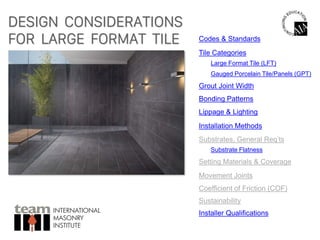

DESIGN CONSIDERATIONS
FOR LARGE FORMAT TILE
INTERNATIONAL
MASONRY
INSTITUTE
Codes & Standards
Tile Categories
Grout Joint Width
Bonding Patterns
Gauged Porcelain Tile/Panels (GPT)
Lippage & Lighting
Substrates, General Req’ts
Substrate Flatness
Setting Materials & Coverage
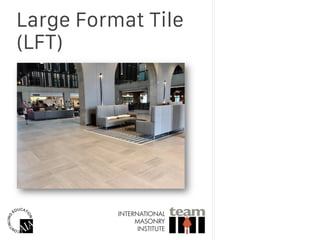
Large Format Tile (LFT)
Movement Joints
Coefficient of Friction (COF)
Sustainability
Installer Qualifications
Installation Methods
Codes &
Standards
INTERNATIONAL
MASONRY
INSTITUTE
Codes & Standards
Large Format Tile
(LFT)
INTERNATIONAL
MASONRY
INSTITUTE
Large Format Tile
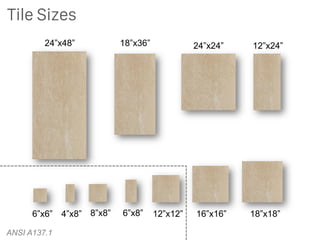
▪ Any side ≥ 15”
12”x12”6”x8”8”x8”4”x8”6”x6”
ANSI A137.1
12”x24”24”x24”18”x36”24”x48”
18”x18”16”x16”
Tile Sizes
3 ft.
Blue Cross Building, Philadelphia
Warpage
Lippage
Bonding pattern Substrate tolerance
Coverage
Grout joint
width
Large Format Tile, Issues
Gauged Porcelain Tile &
Gauged Porcelain Tile Panels
INTERNATIONAL
MASONRY
INSTITUTE
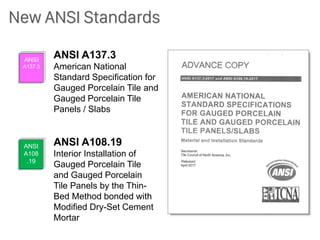
ANSI A137.3
American National
Standard Specification for
Gauged Porcelain Tile and
Gauged Porcelain Tile
Panels / Slabs
ANSI
A137.3
ANSI A108.19
Interior Installation of
Gauged Porcelain Tile
and Gauged Porcelain
Tile Panels by the Thin-
Bed Method bonded with
Modified Dry-Set Cement
Mortar
ANSI
A108
.19
New ANSI Standards
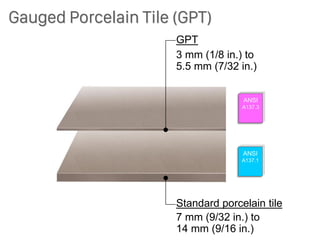
Standard porcelain tile
3 mm (1/8 in.) to
5.5 mm (7/32 in.)
GPT
ANSI
A137.3
ANSI
A137.1
Gauged Porcelain Tile (GPT)
7 mm (9/32 in.) to
14 mm (9/16 in.)
Back side of tile showing mesh reinforcement
Gauged Porcelain Tile (GPT)
Before After
Tile Over Tile
Tile Over Terrazzo
Crate is 124” long x 44” wide; 84” fork length required
Material Handling
Material Handling
Material Handling
Cutting & Drilling
Grout Joint Width
INTERNATIONAL
MASONRY
INSTITUTE
Grout Joint Width
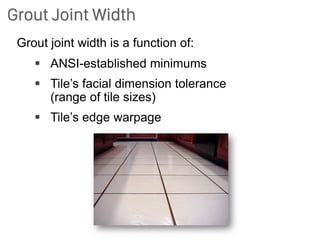
Grout joint width is a function of:
▪ ANSI-established minimums
▪ Tile’s facial dimension tolerance
(range of tile sizes)
▪ Tile’s edge warpage
▪ 12” x 12” porcelain tile, rectified
▪ What is the minimum grout joint width?
12” ?
Grout Joint Width
4.3.8 Grout joint size: To accommodate the range in
facial dimensions of the tile supplied for a specific project,
the actual grout joint size may, of necessity, vary from the
grout joint size specified. The actual grout joint size shall
be at least three times the actual variation of facial
dimensions of the tile supplied. In no circumstance shall
the grout joint be less than 1/16 in.
ANSI A108.02.4.3.8
ANSI Minimum
ANSI A108.02.4.3.8
4.3.8 Grout joint size: To accommodate the range in
facial dimensions of the tile supplied for a specific project,
the actual grout joint size may, of necessity, vary from the
grout joint size specified. The actual grout joint size shall
be at least three times the actual variation of facial
dimensions of the tile supplied. In no circumstance shall
the grout joint be less than 1/16 in.
Facial Dimensions
12” x 12” (nom.) Porcelain tile, rectified
▪ Dimension can vary ± .25% or .03 in.
▪ Allowable variation = 12 in. x .0025 = .03 in = approx. 1/32 in.
▪ 1/32 in. plus or minus = 1/16 in. allowable variation
Facial Dimensions
▪ Min. grout joint width = 3 x 1/16 in. = 3/16 in.
ANSI A108.02.4.3.8.1
“For running bond/brick joint patterns utilizing tiles
(square or rectangular) with any side greater than
15 in., the grout joint shall be, on average, a
minimum of 1/8 in. wide for rectified tiles and, on
average, a minimum of 3/16 in. wide for calibrated
(non-rectified) tiles. The grout joint width shall be
increased over the minimum requirement by the
amount of edge warpage on the longest edge of
the actual tiles being installed.”
LFT in Running Bond
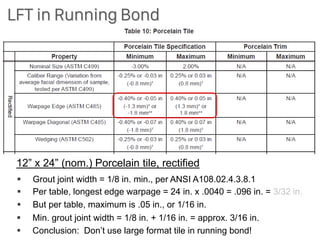
12” x 24” (nom.) Porcelain tile, rectified
▪ Grout joint width = 1/8 in. min., per ANSI A108.02.4.3.8.1
▪ Per table, longest edge warpage = 24 in. x .0040 = .096 in. = 3/32 in.
▪ Min. grout joint width = 1/8 in. + 1/16 in. = approx. 3/16 in.
▪ Conclusion: Don’t use large format tile in running bond!
▪ But per table, maximum is .05 in., or 1/16 in.
LFT in Running Bond
Bonding Patterns
INTERNATIONAL
MASONRY
INSTITUTE
No offset
50% offset
33% offset
Bonding Patterns, Large Format Tile
50% offset (running bond)
Bonding Patterns, Large Format Tile
50% offset (running bond)
Bonding Patterns
50% offset (running bond)
Bonding Patterns
50% offset (running bond)
Bonding Patterns
Bonding Patterns
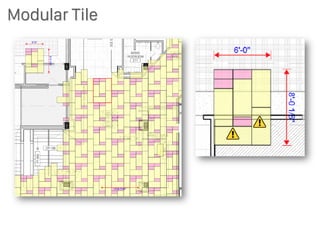
Modular Tile
Modular Tile
Lippage & Lighting
INTERNATIONAL
MASONRY
INSTITUTE
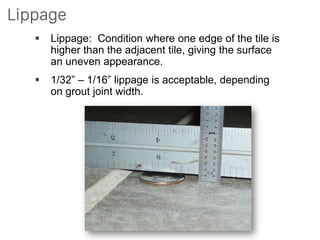
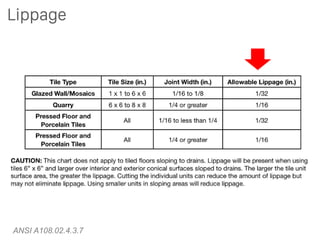
Lippage
▪ Lippage: Condition where one edge of the tile is
higher than the adjacent tile, giving the surface
an uneven appearance.
▪ 1/32” – 1/16” lippage is acceptable, depending
on grout joint width.
ANSI A108.02.4.3.7
Lippage
Mechanical edge leveling system
Lippage
Lippage Control System
Lippage
Mechanical edge leveling system
Lippage
Overhead lighting next to the
wall creates harsh shadows,
emphasizes lippage
Lights moved just one ceiling
panel (24”) from wall
Locate light fixtures at least 24” away from the wall.
Lippage & Lighting
Wall wash lighting accentuates lippage, which may
be in the acceptable range
Lighting
▪ It that’s impossible, insist that permanent lighting
type be placed in the permanent lighting location
prior to installing tile.
▪ Permanent lighting should be in place prior to tile
installation.
Construction Lighting
Installation Methods
INTERNATIONAL
MASONRY
INSTITUTE
▪ Prep time reduced
▪ Thinner installation
▪ Limits deflection
▪ Can compensate for
irregular substrate
▪ Generally 1¼” to 2½” thick
Installation Methods
Mortar Bed (Mud Bed)
Thin-Set
3/32” - 1/4” after embedment
Medium bed mortar may be
3/16” – 3/4” after embedment
Mortar Bed Methods (Mud Work)
Thin Set Methods
“…Mortars are designed
as direct bond
adhesives and are not
intended to be used in
truing or leveling
underlying substrates or
the work of others.”
ANSI A118.4.2.1
ANSI
A118
Mortar for Large and
Heavy Tile (LHT)
“Medium Bed” is not a setting method
Substrate Flatness
INTERNATIONAL
MASONRY
INSTITUTE
Substrate Flatness
▪ Proper coverage
The flatter the substrate, the easier it will be
to achieve:
▪ Minimal lippage
Acceptable flatness Unacceptable flatness
▪ Better bond
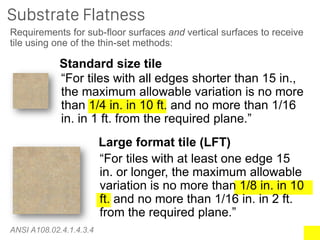
“For tiles with all edges shorter than 15 in.,
the maximum allowable variation is no more
than 1/4 in. in 10 ft. and no more than 1/16
in. in 1 ft. from the required plane.”
“For tiles with at least one edge 15
in. or longer, the maximum allowable
variation is no more than 1/8 in. in 10
ft. and no more than 1/16 in. in 2 ft.
from the required plane.”
Standard size tile
Large format tile (LFT)
ANSI A108.02.4.1.4.3.4
Requirements for sub-floor surfaces and vertical surfaces to receive
tile using one of the thin-set methods:
Substrate Flatness
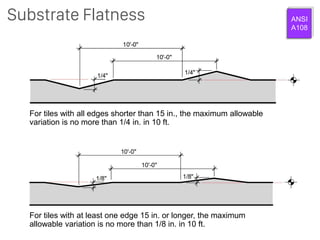
For tiles with all edges shorter than 15 in., the maximum allowable
variation is no more than 1/4 in. in 10 ft.
ANSI
A108
Substrate Flatness
For tiles with at least one edge 15 in. or longer, the maximum
allowable variation is no more than 1/8 in. in 10 ft.
ANSI
A108
Substrate Flatness
Required plane
For tiles with at least one edge 15 in. or longer, the maximum allowable
variation is no more than 1/16 in. in 1 ft. from the required plane.
For tiles with at least one edge 15 in. or longer, the maximum allowable
variation is no more than 1/16 in. in 2 ft. from the required plane.
Required plane
Substrate Flatness
Substrate Flatness
Self-leveling underlayment
(SLU)
Trowel applied patch
(flash patch)
Substrate Flatness
Division 3 (FF method)
vs. Division 9 (10 ft.
straightedge method)
Substrate Flatness
Division 3, Concrete
▪ Concrete floors must comply with a floor flatness (FF)
tolerance based on the ASTM E1155 Standard Test
Method to Determine Floor Flatness and Floor
Levelness Numbers
- FF of 20 is conventional
- FF of 35 is flat
- FF of 60 is superflat
- per ACI 117-06, is suitable for
thin-bed tile installations
- however, FF of 35 will often have areas that
do not meet the required flatness for tile
Substrate Flatness
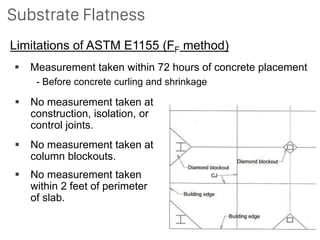
Limitations of ASTM E1155 (FF method)
▪ Measurement taken within 72 hours of concrete placement
- Before concrete curling and shrinkage
▪ No measurement taken at
construction, isolation, or
control joints.
▪ No measurement taken at
column blockouts.
▪ No measurement taken
within 2 feet of perimeter
of slab.
Substrate Flatness
CONCRETE IS FLAT
WHEN CAST IN PLACE
CONCRETE IS FLAT
WHEN CAST IN PLACE
BUT CURLS AND
SHRINKS AS IT SETS
▪ Most curling is caused by shrinkage
as the concrete dries
▪ As the slab top shrinks, the bottom
doesn’t, and the slab curls
▪ Possible remedy: place more
reinforcement at the top of the slab
Substrate Flatness
Straightedge Method
Tile contractor checks individual areas with a 10-ft
straightedge
▪ 1/4 in. in 10 ft. for standard tile
▪ 1/8 in. in 10 ft. for LFT
▪ Often, floors that meet FF of 35 will have
areas that do not meet these criteria.
Substrate Flatness
Unless subfloor prep is required by the spec, or a
bid allowance is included, tile contractor assumes
a suitably flat floor will be provided.
TCNA Handbook
“Project specifications shall include a specific and
separate requirement to bring the subsurface into
compliance if a thin-bed method is specified but
subfloor does not meet the flatness requirements.”
Substrate Flatness
“As tile size increases, the
effect of substrate
irregularities is compounded.
When specifying tile with any
edge longer than 15”,
consider specifying a
recessed substrate and a
mortar bed (thick-set)
installation method to
minimize lippage that results
when a thin-bed method is
specified but subfloor flatness
requirements are not met.”
TCNA Handbook
Substrate Flatness
“…Mortars are designed
as direct bond
adhesives and are not
intended to be used in
truing or leveling
underlying substrates or
the work of others.”
ANSI A118.4.2.1
Substrate Flatness
Installer
Qualifications
INTERNATIONAL
MASONRY
INSTITUTE
Training
TCNA Handbook Language
“Journeyman Tile Layers Apprenticeship
Programs… Contractors that employ union
Journeymen Tile Setters can be found
through the Union Locals that list their
signatory contractors, primarily the
Bricklayer and Allied Craftworkers (BAC)…
“Every aspect of a tile installation relies on
the tile contracting company and its
installers.”
“The following non-profit programs are
well-established and recognized by the
Handbook Committee:
“Tile Contractors’ Association of America
(TCAA) Trowel of Excellence Program…”
“IMI Contractor College…
TCNA Handbook Language
TCNA
TCNA Handbook
New in 2015:
TCNA
TCNA Handbook
09 30 00 Tiling
Hard Rock Casino, Northfield, OH
Project Specification Example
Manufacturer Literature Example
Qualified Labor in Specifications
ACT-certified Installer
Pass hands-on
skills assessment
3.
Pass written exam
based on TCNA &
ANSI Standards
2.
BAC Journeyman
or certified by CTEF
1. ❖ IMI pre-apprenticeship
❖ 3-4 year BAC apprenticeship
❖ or CTI certification
❖ Orientation class
❖ Study materials provided
❖ Open-book test
❖ Minimum passing grade 84%
❖ Tests are widely available
❖ Judged by certified evaluator
❖ Judged on critical points
❖ Testing and criteria are consistent
❖ Certified in one or more skills
❖ Certification good for 3 years
❖ Credential is held by the installer
STEPS TO BECOMING AN ACT-CERTIFIED INSTALLER
Certifications
Certifications
Certifications
Certifications
Certifications
Certifications
Certifications
TCNA
Certifications
www.tilecertifications.com
Expiration Date
01/01/2016
Certifications
Specification Language
ANSI A108.19
Installing Contractor
10.1 Due to the unique material characteristics and
unconventional installation techniques required of gauged
porcelain tiles and gauged porcelain tile panels/slabs, this work
requires installers who are equipped with the proper tools and
have acquired sufficient product knowledge and installation
experience through the completion of an Installer Qualification
Program as listed in 10.2.
10.2 Installer Qualification Programs
10.2.1 Installer certified by Advanced Certification for Tile
Installers (ACT) program for Gauged Porcelain Tiles and
Gauged Porcelain Tile Panels/Slabs.
www.tilecertifications.com
INTERNATIONAL
MASONRY
INSTITUTE
For presentation slides,
scan QR code or visit
http://goo.gl/bn2Dah
This concludes The American Institute of Architects
Continuing Education Systems Course
For presentation slides,
scan QR code or visit
https://goo.gl/DiYK8q
DESIGN CONSIDERATIONS
FOR LARGE FORMAT TILE

Design Considerations for Large Format Tile

  • 1.
    DESIGN CONSIDERATIONS FOR LARGEFORMAT TILE INTERNATIONAL MASONRY INSTITUTE Codes & Standards Tile Categories Grout Joint Width Bonding Patterns Gauged Porcelain Tile/Panels (GPT) Lippage & Lighting Substrates, General Req’ts Substrate Flatness Setting Materials & Coverage Large Format Tile (LFT) Movement Joints Coefficient of Friction (COF) Sustainability Installer Qualifications Installation Methods
  • 2.
  • 3.
  • 4.
  • 5.
    Large Format Tile ▪Any side ≥ 15”
  • 6.
  • 7.
    3 ft. Blue CrossBuilding, Philadelphia
  • 8.
    Warpage Lippage Bonding pattern Substratetolerance Coverage Grout joint width Large Format Tile, Issues
  • 9.
    Gauged Porcelain Tile& Gauged Porcelain Tile Panels INTERNATIONAL MASONRY INSTITUTE
  • 11.
    ANSI A137.3 American National StandardSpecification for Gauged Porcelain Tile and Gauged Porcelain Tile Panels / Slabs ANSI A137.3 ANSI A108.19 Interior Installation of Gauged Porcelain Tile and Gauged Porcelain Tile Panels by the Thin- Bed Method bonded with Modified Dry-Set Cement Mortar ANSI A108 .19 New ANSI Standards
  • 12.
    Standard porcelain tile 3mm (1/8 in.) to 5.5 mm (7/32 in.) GPT ANSI A137.3 ANSI A137.1 Gauged Porcelain Tile (GPT) 7 mm (9/32 in.) to 14 mm (9/16 in.)
  • 13.
    Back side oftile showing mesh reinforcement Gauged Porcelain Tile (GPT)
  • 14.
  • 15.
  • 16.
    Crate is 124”long x 44” wide; 84” fork length required Material Handling
  • 17.
  • 18.
  • 19.
  • 20.
  • 21.
    Grout Joint Width Groutjoint width is a function of: ▪ ANSI-established minimums ▪ Tile’s facial dimension tolerance (range of tile sizes) ▪ Tile’s edge warpage
  • 22.
    ▪ 12” x12” porcelain tile, rectified ▪ What is the minimum grout joint width? 12” ? Grout Joint Width
  • 23.
    4.3.8 Grout jointsize: To accommodate the range in facial dimensions of the tile supplied for a specific project, the actual grout joint size may, of necessity, vary from the grout joint size specified. The actual grout joint size shall be at least three times the actual variation of facial dimensions of the tile supplied. In no circumstance shall the grout joint be less than 1/16 in. ANSI A108.02.4.3.8 ANSI Minimum
  • 24.
    ANSI A108.02.4.3.8 4.3.8 Groutjoint size: To accommodate the range in facial dimensions of the tile supplied for a specific project, the actual grout joint size may, of necessity, vary from the grout joint size specified. The actual grout joint size shall be at least three times the actual variation of facial dimensions of the tile supplied. In no circumstance shall the grout joint be less than 1/16 in. Facial Dimensions
  • 25.
    12” x 12”(nom.) Porcelain tile, rectified ▪ Dimension can vary ± .25% or .03 in. ▪ Allowable variation = 12 in. x .0025 = .03 in = approx. 1/32 in. ▪ 1/32 in. plus or minus = 1/16 in. allowable variation Facial Dimensions ▪ Min. grout joint width = 3 x 1/16 in. = 3/16 in.
  • 26.
    ANSI A108.02.4.3.8.1 “For runningbond/brick joint patterns utilizing tiles (square or rectangular) with any side greater than 15 in., the grout joint shall be, on average, a minimum of 1/8 in. wide for rectified tiles and, on average, a minimum of 3/16 in. wide for calibrated (non-rectified) tiles. The grout joint width shall be increased over the minimum requirement by the amount of edge warpage on the longest edge of the actual tiles being installed.” LFT in Running Bond
  • 27.
    12” x 24”(nom.) Porcelain tile, rectified ▪ Grout joint width = 1/8 in. min., per ANSI A108.02.4.3.8.1 ▪ Per table, longest edge warpage = 24 in. x .0040 = .096 in. = 3/32 in. ▪ Min. grout joint width = 1/8 in. + 1/16 in. = approx. 3/16 in. ▪ Conclusion: Don’t use large format tile in running bond! ▪ But per table, maximum is .05 in., or 1/16 in. LFT in Running Bond
  • 28.
  • 29.
    No offset 50% offset 33%offset Bonding Patterns, Large Format Tile
  • 30.
    50% offset (runningbond) Bonding Patterns, Large Format Tile
  • 31.
    50% offset (runningbond) Bonding Patterns
  • 32.
    50% offset (runningbond) Bonding Patterns
  • 33.
    50% offset (runningbond) Bonding Patterns
  • 34.
  • 36.
  • 37.
  • 38.
  • 39.
    Lippage ▪ Lippage: Conditionwhere one edge of the tile is higher than the adjacent tile, giving the surface an uneven appearance. ▪ 1/32” – 1/16” lippage is acceptable, depending on grout joint width.
  • 40.
  • 41.
  • 42.
  • 43.
  • 44.
    Overhead lighting nextto the wall creates harsh shadows, emphasizes lippage Lights moved just one ceiling panel (24”) from wall Locate light fixtures at least 24” away from the wall. Lippage & Lighting
  • 45.
    Wall wash lightingaccentuates lippage, which may be in the acceptable range Lighting
  • 46.
    ▪ It that’simpossible, insist that permanent lighting type be placed in the permanent lighting location prior to installing tile. ▪ Permanent lighting should be in place prior to tile installation. Construction Lighting
  • 47.
  • 48.
    ▪ Prep timereduced ▪ Thinner installation ▪ Limits deflection ▪ Can compensate for irregular substrate ▪ Generally 1¼” to 2½” thick Installation Methods Mortar Bed (Mud Bed) Thin-Set 3/32” - 1/4” after embedment Medium bed mortar may be 3/16” – 3/4” after embedment
  • 49.
  • 50.
  • 51.
    “…Mortars are designed asdirect bond adhesives and are not intended to be used in truing or leveling underlying substrates or the work of others.” ANSI A118.4.2.1 ANSI A118 Mortar for Large and Heavy Tile (LHT) “Medium Bed” is not a setting method
  • 52.
  • 53.
    Substrate Flatness ▪ Propercoverage The flatter the substrate, the easier it will be to achieve: ▪ Minimal lippage Acceptable flatness Unacceptable flatness ▪ Better bond
  • 54.
    “For tiles withall edges shorter than 15 in., the maximum allowable variation is no more than 1/4 in. in 10 ft. and no more than 1/16 in. in 1 ft. from the required plane.” “For tiles with at least one edge 15 in. or longer, the maximum allowable variation is no more than 1/8 in. in 10 ft. and no more than 1/16 in. in 2 ft. from the required plane.” Standard size tile Large format tile (LFT) ANSI A108.02.4.1.4.3.4 Requirements for sub-floor surfaces and vertical surfaces to receive tile using one of the thin-set methods: Substrate Flatness
  • 55.
    For tiles withall edges shorter than 15 in., the maximum allowable variation is no more than 1/4 in. in 10 ft. ANSI A108 Substrate Flatness For tiles with at least one edge 15 in. or longer, the maximum allowable variation is no more than 1/8 in. in 10 ft.
  • 56.
    ANSI A108 Substrate Flatness Required plane Fortiles with at least one edge 15 in. or longer, the maximum allowable variation is no more than 1/16 in. in 1 ft. from the required plane. For tiles with at least one edge 15 in. or longer, the maximum allowable variation is no more than 1/16 in. in 2 ft. from the required plane. Required plane
  • 57.
  • 58.
  • 59.
    Self-leveling underlayment (SLU) Trowel appliedpatch (flash patch) Substrate Flatness
  • 60.
    Division 3 (FFmethod) vs. Division 9 (10 ft. straightedge method) Substrate Flatness
  • 61.
    Division 3, Concrete ▪Concrete floors must comply with a floor flatness (FF) tolerance based on the ASTM E1155 Standard Test Method to Determine Floor Flatness and Floor Levelness Numbers - FF of 20 is conventional - FF of 35 is flat - FF of 60 is superflat - per ACI 117-06, is suitable for thin-bed tile installations - however, FF of 35 will often have areas that do not meet the required flatness for tile Substrate Flatness
  • 62.
    Limitations of ASTME1155 (FF method) ▪ Measurement taken within 72 hours of concrete placement - Before concrete curling and shrinkage ▪ No measurement taken at construction, isolation, or control joints. ▪ No measurement taken at column blockouts. ▪ No measurement taken within 2 feet of perimeter of slab. Substrate Flatness
  • 63.
    CONCRETE IS FLAT WHENCAST IN PLACE CONCRETE IS FLAT WHEN CAST IN PLACE BUT CURLS AND SHRINKS AS IT SETS ▪ Most curling is caused by shrinkage as the concrete dries ▪ As the slab top shrinks, the bottom doesn’t, and the slab curls ▪ Possible remedy: place more reinforcement at the top of the slab Substrate Flatness
  • 64.
    Straightedge Method Tile contractorchecks individual areas with a 10-ft straightedge ▪ 1/4 in. in 10 ft. for standard tile ▪ 1/8 in. in 10 ft. for LFT ▪ Often, floors that meet FF of 35 will have areas that do not meet these criteria. Substrate Flatness
  • 65.
    Unless subfloor prepis required by the spec, or a bid allowance is included, tile contractor assumes a suitably flat floor will be provided. TCNA Handbook “Project specifications shall include a specific and separate requirement to bring the subsurface into compliance if a thin-bed method is specified but subfloor does not meet the flatness requirements.” Substrate Flatness
  • 66.
    “As tile sizeincreases, the effect of substrate irregularities is compounded. When specifying tile with any edge longer than 15”, consider specifying a recessed substrate and a mortar bed (thick-set) installation method to minimize lippage that results when a thin-bed method is specified but subfloor flatness requirements are not met.” TCNA Handbook Substrate Flatness
  • 67.
    “…Mortars are designed asdirect bond adhesives and are not intended to be used in truing or leveling underlying substrates or the work of others.” ANSI A118.4.2.1 Substrate Flatness
  • 68.
  • 69.
  • 70.
  • 71.
    “Journeyman Tile LayersApprenticeship Programs… Contractors that employ union Journeymen Tile Setters can be found through the Union Locals that list their signatory contractors, primarily the Bricklayer and Allied Craftworkers (BAC)… “Every aspect of a tile installation relies on the tile contracting company and its installers.” “The following non-profit programs are well-established and recognized by the Handbook Committee: “Tile Contractors’ Association of America (TCAA) Trowel of Excellence Program…” “IMI Contractor College… TCNA Handbook Language
  • 72.
  • 73.
  • 74.
    09 30 00Tiling
  • 75.
    Hard Rock Casino,Northfield, OH Project Specification Example
  • 76.
  • 77.
    Qualified Labor inSpecifications
  • 78.
    Qualified Labor inSpecifications
  • 80.
    ACT-certified Installer Pass hands-on skillsassessment 3. Pass written exam based on TCNA & ANSI Standards 2. BAC Journeyman or certified by CTEF 1. ❖ IMI pre-apprenticeship ❖ 3-4 year BAC apprenticeship ❖ or CTI certification ❖ Orientation class ❖ Study materials provided ❖ Open-book test ❖ Minimum passing grade 84% ❖ Tests are widely available ❖ Judged by certified evaluator ❖ Judged on critical points ❖ Testing and criteria are consistent ❖ Certified in one or more skills ❖ Certification good for 3 years ❖ Credential is held by the installer STEPS TO BECOMING AN ACT-CERTIFIED INSTALLER
  • 81.
  • 82.
  • 83.
  • 84.
  • 85.
  • 86.
  • 87.
  • 88.
  • 89.
  • 90.
  • 91.
  • 92.
    ANSI A108.19 Installing Contractor 10.1Due to the unique material characteristics and unconventional installation techniques required of gauged porcelain tiles and gauged porcelain tile panels/slabs, this work requires installers who are equipped with the proper tools and have acquired sufficient product knowledge and installation experience through the completion of an Installer Qualification Program as listed in 10.2. 10.2 Installer Qualification Programs 10.2.1 Installer certified by Advanced Certification for Tile Installers (ACT) program for Gauged Porcelain Tiles and Gauged Porcelain Tile Panels/Slabs. www.tilecertifications.com
  • 93.
    INTERNATIONAL MASONRY INSTITUTE For presentation slides, scanQR code or visit http://goo.gl/bn2Dah This concludes The American Institute of Architects Continuing Education Systems Course For presentation slides, scan QR code or visit https://goo.gl/DiYK8q DESIGN CONSIDERATIONS FOR LARGE FORMAT TILE